Introduction
When a developer sells an apartment off-plan, it does not receive the price in full at the moment of sale. Instead it receives a schedule of instalments, paid by the buyer over the construction period and often beyond, with each instalment typically linked to a construction milestone and paid into a regulated escrow account from which the developer can draw only as the construction progresses. The sale therefore creates an asset, the right to receive those future instalments, that is real and valuable but not yet liquid. The developer has sold the unit, but it has not yet been paid for it.
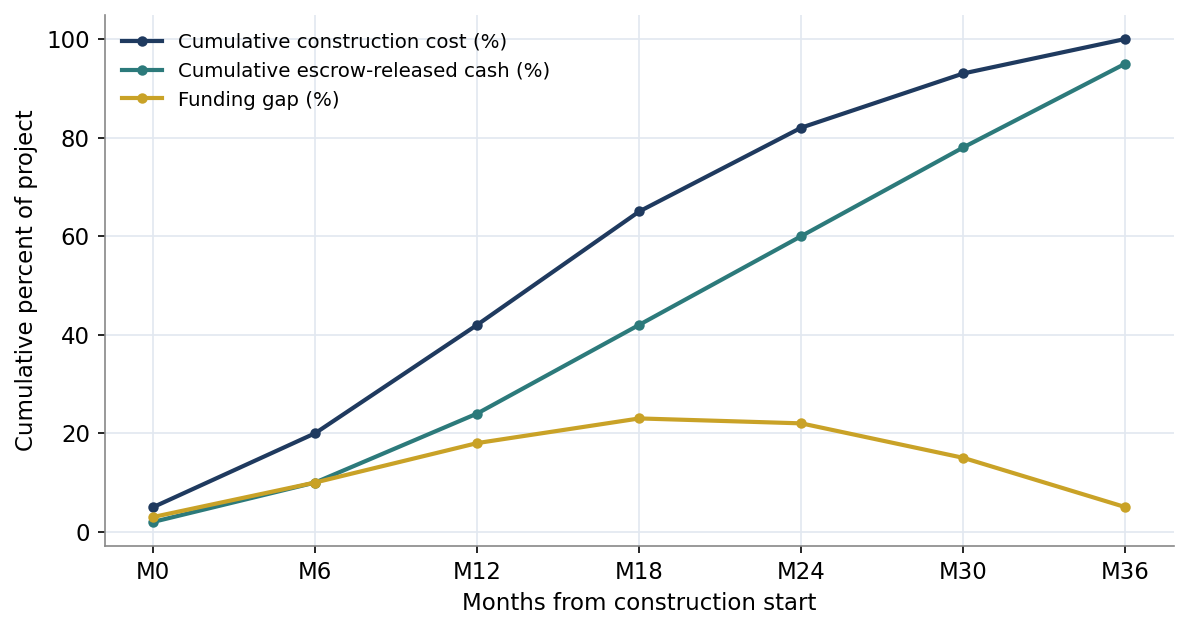
This timing creates a problem. The cost of building the development is incurred on a construction schedule that is largely fixed by the physics of construction, while the cash from buyer instalments arrives on a schedule set by the sales pace and the escrow milestones, and the two schedules do not match. In the early and middle stages of construction, the cumulative cost frequently runs ahead of the cumulative escrow-released cash, opening a funding gap that the developer must bridge from some other source. The developer is, in a sense, rich in receivables but short of cash, holding a valuable asset, the contracted future instalments, that it cannot yet spend.
Receivables financing is the tool that resolves this mismatch. It converts the future buyer instalments into present cash by financing them today, advancing the developer a proportion of the contracted receivables against the security of those receivables and the escrow into which they are paid. The developer obtains the construction capital it needs now, repaid from the buyer instalments as they arrive, and bridges the gap between the cost it must fund and the cash the escrow will eventually release. The receivables, an otherwise illiquid asset, become a source of liquidity.
Anatomy of Receivables Financing Structures
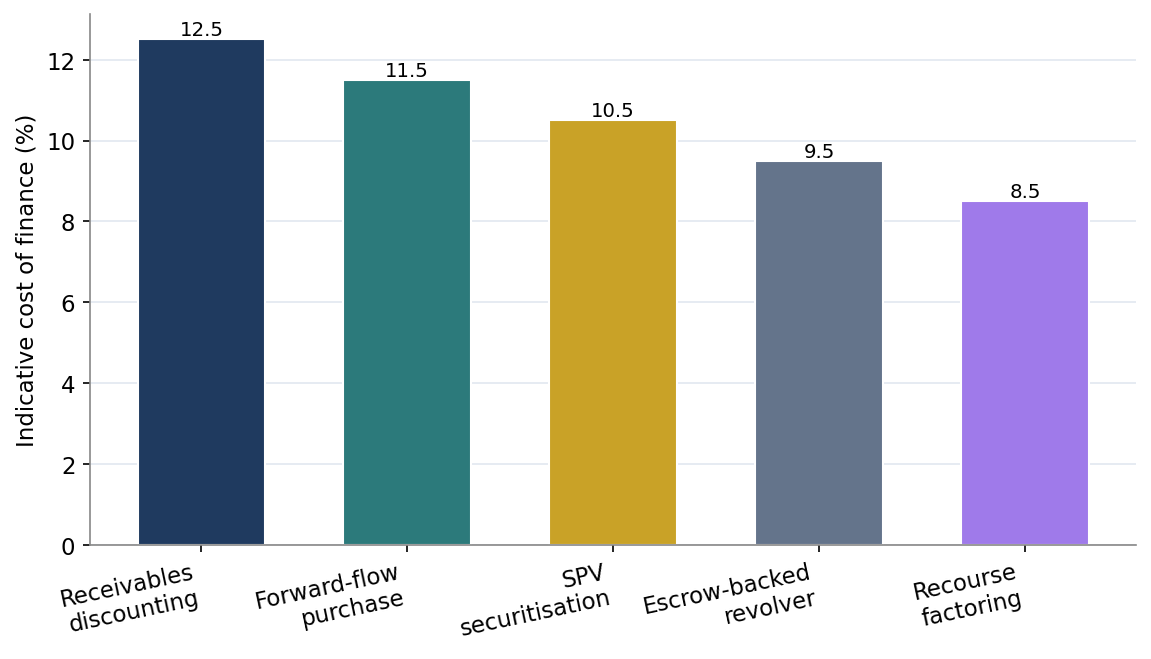
Receivables financing spans a family of structures, from simple bilateral discounting to full securitisation, each suited to a different scale and objective. Table 1 compares the principal structures, and the subsections describe each. Figure 3 sets out their indicative cost.
Figure 3. Indicative Cost by Receivables Financing Structure
Receivables discounting
In its simplest form, receivables discounting advances the developer a proportion of its contracted receivables against the security of those receivables and the escrow, repaid as the instalments arrive. It is a bilateral facility, relatively quick to arrange, and suited to a developer seeking to bridge the funding gap on a single project. It is the most accessible structure and the natural starting point for a developer new to receivables financing.
Forward-flow purchase
A forward-flow arrangement commits a financier to purchase receivables as they are generated, over a defined period and across one or more projects, at pre-agreed advance rates and pricing. It suits a developer with a steady pipeline of sales across multiple projects, because it provides a committed, recurring source of funding that flexes with the sales the developer generates, turning receivables financing from a one-off transaction into an ongoing programme.
Securitisation through a special-purpose vehicle
At the largest scale, a developer can securitise its receivables by selling a pool of them to a special-purpose vehicle that funds the purchase by issuing notes to investors, secured against the receivables pool. Securitisation can achieve the lowest cost of finance, because it accesses capital-market investors and isolates the receivables from the developer credit, but it requires scale, a sizeable and seasoned receivables pool, and the cost and complexity of establishing the structure. It suits large developers with substantial, diversified receivables books.
Escrow-backed revolving facility
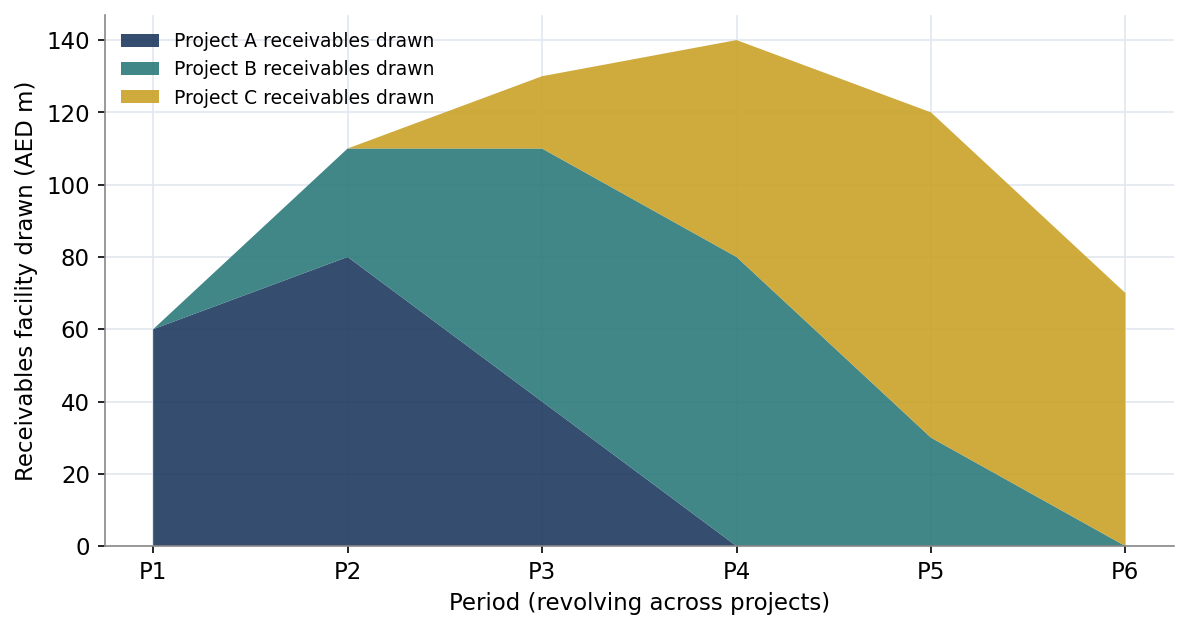
An escrow-backed revolving facility provides a committed line, secured against the escrow account and the receivables flowing into it, that the developer can draw and repay as the funding gap opens and closes. Because it is secured against the escrow itself, it can be among the cheapest structures, and its revolving nature matches the rising and falling shape of the funding gap, making it efficient for a developer that wants flexible, repeatable access to receivables-backed liquidity.
Recourse factoring
Cost of Receivables Finance versus Alternatives
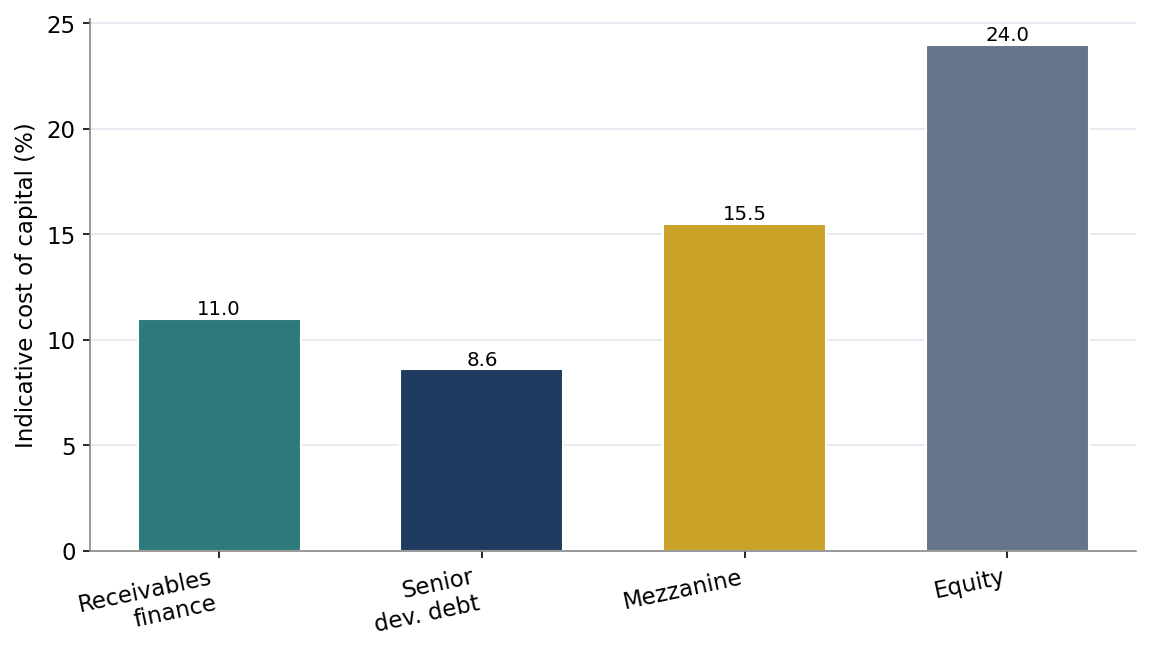
The position of receivables financing in the capital structure is best understood by comparing its cost against the alternatives. Figure 6 sets out the indicative cost of receivables finance alongside senior development debt, mezzanine and equity.
Figure 6. Cost of Receivables Finance versus Other Capital
The comparison shows receivables financing sitting between senior development debt and mezzanine: more expensive than senior debt, because it is secured against receivables rather than against a first mortgage over the whole asset, but cheaper than mezzanine and far cheaper than equity, because it is secured against contracted, diversified cash flows rather than against the subordinated risk of the project. This position makes receivables financing a valuable complement to senior debt: a developer can fund the bulk of its construction with senior debt and use receivables financing to bridge the funding gap, avoiding the more expensive mezzanine or equity that would otherwise fill it.
The cost comparison also reveals why using equity to bridge the funding gap is inefficient. Equity at twenty-four percent is more than twice the cost of receivables finance at around eleven percent, and using it to bridge a temporary timing gap, rather than to fund genuine development risk, wastes the spread between the two. A developer that systematically uses receivables financing to bridge the gap, freeing its equity to fund genuine risk or to be deployed in additional projects, can raise its return on equity meaningfully. The choice of which capital to use for which purpose is, here as in the capital-stack analysis of the first paper in this series, a genuine source of value.
The efficiency argument can be quantified at the level of the developer return on equity. By substituting receivables finance at around eleven percent for equity at around twenty-four percent across the funding gap, a developer reduces the equity it must commit to each project and can therefore undertake more projects with the same equity base. Over a pipeline, this multiplies the developer activity and raises its return on equity. This portfolio effect, the ability to do more with the same equity, is frequently the largest benefit of receivables financing, and it is invisible if the technique is viewed only at the level of a single project.
| Structure | Indicative cost | Risk transfer | Scale required | Best for |
|---|---|---|---|---|
| Receivables discounting | ~12.5% | Partial | Low | Single project |
| Forward-flow purchase | ~11.5% | Substantial | Moderate | Multi-project pipeline |
| SPV securitisation | ~10.5% | Full (true sale) | High | Large seasoned book |
| Escrow-backed revolver | ~9.5% | Limited | Moderate | Flexible gap funding |
| Recourse factoring | ~8.5% | None | Low | Cheapest liquidity |
Risk Considerations
Receivables financing carries risks that both the developer and the financier must manage. The principal risk is buyer default or cancellation: a buyer who stops paying, or who cancels the purchase, ceases to generate the receivable that backs the financing. The escrow regime and the contractual remedies for default mitigate this risk, since a defaulting buyer typically forfeits part of what it has paid and the unit can be resold, but a wave of cancellations in a downturn can impair the receivables pool, which is why the financier advances at less than the full receivable and why the default rate is the central risk variable.
A second risk is construction delay. Because escrow releases and the compulsion of buyer payment are tied to construction milestones, a delay in construction delays both the escrow cash and the maturing of the receivables, extending the funding gap and the period over which the financing must be carried. A developer using receivables financing must therefore manage its construction programme with discipline, because a delay impairs the very cash flows the financing depends on. A third risk concerns the escrow itself: the financing depends on the integrity and the priority of the security over the escrow account, and the developer and financier must ensure that the financing is properly secured against the escrow within the regulatory framework that governs it.
These risks are manageable but real, and they explain the structuring features, the advance rate below the full receivable, the eligibility criteria, the recourse or non-recourse choice, that characterise receivables financing. A well-structured facility allocates each risk to the party best able to bear it: the diversifiable default risk is priced into the advance rate and borne by the financier in a non-recourse structure, the construction risk is borne by the developer who controls it, and the escrow risk is managed through proper security. Understanding and allocating these risks deliberately is what distinguishes a robust receivables facility from one that fails when conditions deteriorate.
The Capital Provider Perspective
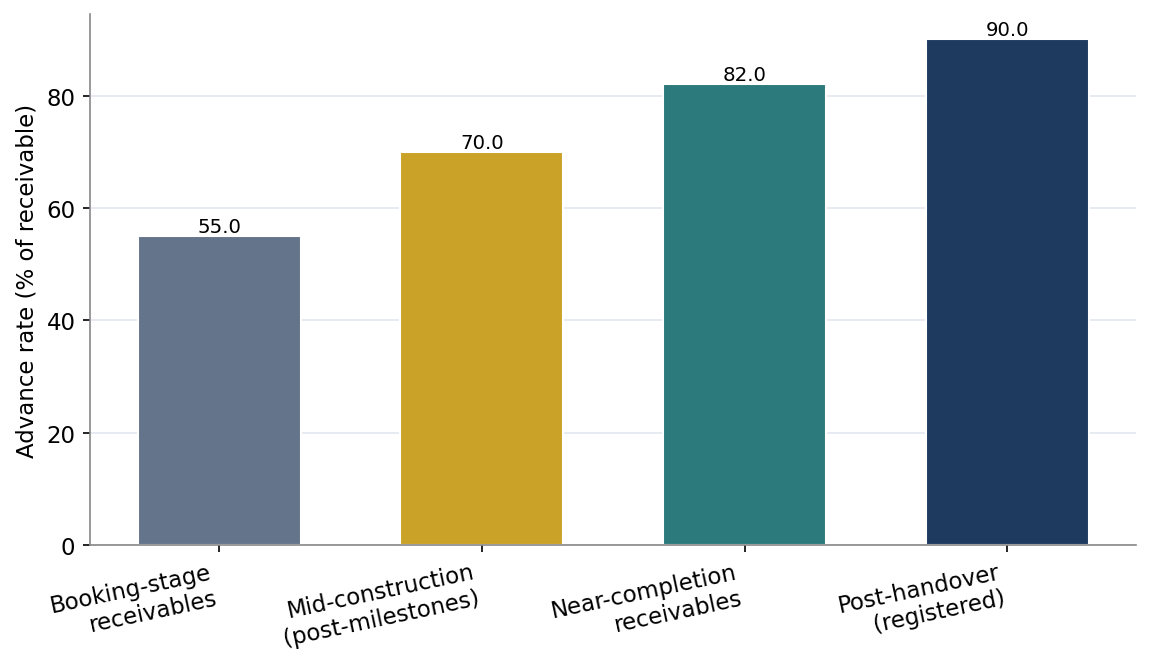
A receivables facility closes only if the financier finds the receivables pool attractive, and understanding the financier underwriting is essential. The financier underwrites the quality and diversification of the receivables pool, the reliability of the escrow mechanism that will repay it, and the developer ability to complete the construction on which the escrow releases and buyer payments depend. It assesses the historic default and cancellation rates of the developer buyers, the seasoning and stage of the receivables, the strength of the sale contracts and the registration, and the construction risk of the project, and it sets the advance rate and the cost to reflect these.
Different financiers value different features. A bank providing an escrow-backed revolver prioritises the security over the escrow and the developer covenant; a specialist receivables financier prioritises the quality and diversification of the receivables pool; a capital-market investor in a securitisation prioritises the seasoning of the pool and the robustness of the true-sale structure. A developer that understands which financier values its receivables most highly can direct the financing to that financier and achieve the best terms. The financier comfort ultimately rests on the predictability of the receivables, which is why the developer that can demonstrate a reliable history of buyer payment and low cancellation obtains the most favourable financing.
Understanding what the financier underwrites also tells the developer how to prepare for a receivables financing. The developer that arrives with clean, well-documented sale contracts, reliable buyer payment data, clear registration and a credible construction plan presents a pool the financier can underwrite quickly and at a favourable advance rate. The developer that arrives with incomplete documentation forces the financier to discount for the uncertainty, widening the cost and lowering the advance. Preparing the receivables for financing materially affects the terms, and it is work the developer should do before approaching the market.
Indicative Case Studies
Three indicative cases show the technique applied at different scales. The figures are synthetic and constructed for analytical clarity, not drawn from any specific transaction.
Case A: single-tower receivables facility
Case A is a single residential tower with strong pre-sales but a back-loaded payment plan that generates little cash during construction, opening a wide funding gap. The developer arranges a receivables discounting facility that advances against the contracted instalments, closing the gap and allowing construction to proceed on schedule without injecting additional equity. Figure 7 shows the sources and uses. The facility is repaid as the escrow releases buyer cash toward completion, and the developer preserves its equity for other projects.
Figure 7. Indicative Sources and Uses, Single-Tower Case (AED 480m)
Receivables facility bridges the gap between cost and senior-debt-plus-equity funding. Not a forecast.
Table 2. Case A Funding Structure, Single Tower
Receivables facility replaces what would otherwise be mezzanine or additional equity. Not transaction-specific.
Case B: multi-project forward-flow programme
Case B is a developer with a pipeline of several projects in construction simultaneously, generating a steady flow of receivables across the portfolio. Rather than arrange a separate facility for each project, it establishes a forward-flow programme under which a financier commits to purchase eligible receivables as they are generated across all projects, at pre-agreed advance rates. The programme provides a committed, recurring source of construction funding that flexes with the developer sales, turning receivables financing into an ongoing funding engine for the whole pipeline.
Table 3. Case B Forward-Flow Programme Economics
Forward-flow turns receivables financing into a recurring portfolio funding engine. Not transaction-specific.
Case C: receivables securitisation
Case C is a large developer with a substantial, seasoned receivables book across many completed and near-complete projects. It securitises a pool of these receivables by selling them to a special-purpose vehicle that issues notes to capital-market investors, achieving the lowest cost of finance of the three cases and removing the receivables from its balance sheet through a true sale. The securitisation accesses a deeper and cheaper pool of capital than a bilateral facility, but it requires the scale, the seasoning and the structuring capability that only a large developer possesses.
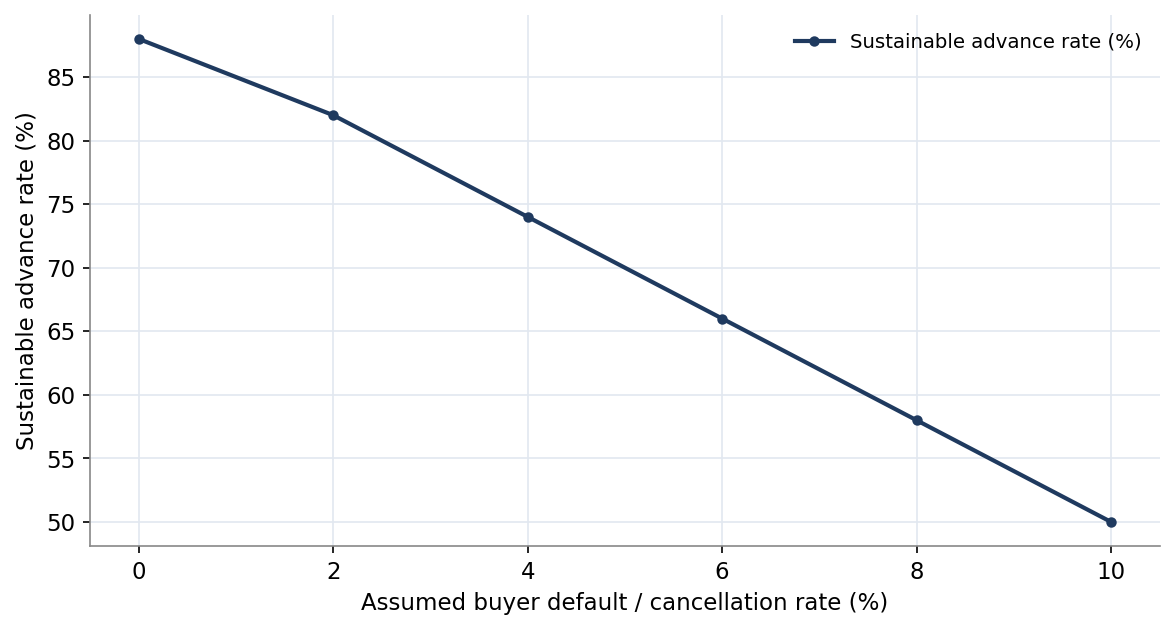
Figure 8. Sustainable Advance Rate Against Assumed Buyer Default Rate
The advance rate a financier can sustain falls as the assumed default rate rises. Not a forecast.
| Source | AED m | Share | Role |
|---|---|---|---|
| Senior development debt | 250.0 | 52% | Bulk construction funding |
| Developer equity | 90.0 | 19% | Genuine development risk |
| Receivables facility | 140.0 | 29% | Bridges the funding gap |
| Total funding | 480.0 | 100% | Matches construction cost |
International Comparison
Receivables financing and securitisation are mature techniques in the developed markets, applied across many industries to convert contracted future cash flows into present capital. In real estate specifically, the securitisation of development receivables and the financing of pre-sale deposits and instalments are well established in markets with strong off-plan or pre-sale models, and the techniques are supported by deep capital markets and well-developed legal frameworks for true sale and security. The lesson for the UAE is that as its legal and capital-market infrastructure for receivables financing matures, the cost of the technique should fall and its use should broaden, much as the securitisation markets in the developed economies deepened over time.
The international experience also highlights the importance of standardisation and data. Securitisation markets develop when the underlying receivables are standardised, well-documented and supported by reliable historic performance data that allows investors to model default rates with confidence. The UAE off-plan market, with its regulated escrow regime and registration system, has many of the ingredients for such standardisation, and as performance data on buyer payment and cancellation accumulates and becomes more transparent, the conditions for a deeper receivables financing and securitisation market improve. Developers that build the data and documentation discipline now will be best placed to access this market as it develops, and to do so at the keenest cost.
A further lesson from the scenario analysis concerns the interaction between receivables financing and the sales strategy. Because the technique depends on creditworthy buyers who pay reliably, it gives the developer a financial incentive to favour quality buyers over marginal ones. A book of reliable buyers supports a higher advance rate and cheaper financing across the whole pool, and the financing benefit of buyer quality can outweigh the marginal price difference on individual sales. Receivables financing thus subtly aligns the developer sales strategy with buyer quality, a healthy discipline that also reduces exposure to cancellations.
| Line | Value | Note |
|---|---|---|
| Committed programme size | AED 600m | Across the pipeline |
| Blended advance rate | 72% | Weighted by receivable stage |
| Blended cost | 11.5% | Forward-flow pricing |
| Projects covered | 4 | Simultaneous construction |
| Revolving | Yes | Repaid and redrawn as sales flow |
Implementation Roadmap
Model the construction funding gap for each project, using the specific sales pace, payment plan, construction programme and escrow milestone schedule, to size the financing required.
Assess the quality and diversification of the receivables pool, including buyer payment history and cancellation rates, since these determine the advance rate and cost.
Choose the structure, discounting, forward-flow, securitisation, escrow-backed revolver or recourse factoring, that matches the scale and objective, weighing cost against risk transfer.
Structure the financing around the escrow regime, securing the financier against the escrow and aligning repayment with the milestone release schedule.
Maintain disciplined receivables administration, with clean documentation, registration and collections, to maximise the eligible pool and the advance rate.
Underwrite the buyer default and cancellation rate conservatively, and size the advance rate with headroom against a stressed scenario.
Where the pipeline supports it, establish a recurring forward-flow or revolving facility to turn receivables financing into a structural funding engine across projects.
Conclusion
Receivables financing converts an off-plan developer most overlooked asset, the contracted future instalments of its buyers, into the construction capital it needs today. This paper has argued that the technique occupies a distinctive and valuable position in the capital structure: cheaper than mezzanine and equity because it is secured against diversified, contracted cash flows, and capable of being structured as a recurring funding engine that finances construction across a developer portfolio. It is the natural tool for bridging the construction funding gap that the off-plan model and the escrow regime create, and it allows a developer to reserve its expensive equity for genuine development risk rather than squandering it on a temporary timing problem.
The analysis has shown that the buyer default rate and the advance rate dominate the economics, that the operational drivers of selling to creditworthy buyers and managing collections matter more than the financing margin, and that the technique is most powerful when deployed not as a one-off bridge but as a recurring engine across a pipeline. The developer that internalises these lessons, modelling its funding gap precisely, maintaining a clean and creditworthy receivables book, structuring around the escrow, and building a recurring facility, can fund its construction more cheaply, accelerate its delivery, and raise its return on equity. In a UAE market built on the off-plan model and governed by a maturing escrow and registration framework, receivables financing is becoming an essential element of the sophisticated developer financing toolkit, and the techniques set out in this paper are intended to help developers use it well.
The roadmap deliberately begins with modelling the gap, because the gap defines the problem the financing must solve. A developer that arranges a facility without first modelling its specific funding gap risks sizing it wrongly, either carrying excess committed capital it does not need or finding the facility too small when the cost curve runs ahead of the escrow releases. The modelling is the foundation of a correctly sized and structured facility, and it should use the developer specific sales, payment and construction assumptions rather than generic ones.
| Scenario | Buyer default rate | Sales pace | Equity IRR |
|---|---|---|---|
| Favourable | Low (2%) | Fast | 26.0% |
| Base | Moderate (5%) | Moderate | 19.0% |
| Mild stress | Elevated (8%) | Slow | 14.0% |
| Severe stress | High (12%) | Very slow | 8.0% |
Limitations and Directions for Further Research
This paper is framework-oriented and relies on indicative data, and its conclusions are directional rather than precise. The advance rates, costs, default rates and funding-gap shapes are calibrated to observable conditions but are not empirical estimates, and they vary materially across developers, projects, payment plans and points in the cycle. The legal analysis of true sale, security over escrow and the enforceability of receivables is described in general terms and requires specialist advice for any specific transaction.
Several extensions would strengthen the analysis. An empirical study of buyer default and cancellation rates across UAE projects and market conditions would replace the indicative default assumptions with data, sharpening the central sensitivity. An analysis of the legal robustness of receivables security and true sale under the applicable escrow and registration framework would clarify the structuring constraints. And a study of how receivables financing performs through a downturn, when cancellations and slow sales impair the pool together, would test the resilience of the technique in the conditions where its risks are greatest. Each is a natural subject for a later paper in this series.