

1. INTRODUCTION
From 6 April 2026, the United Kingdom limits the amount of qualifying agricultural and business property that can receive Inheritance Tax relief at 100 percent. For an individual, the combined allowance is GBP 2.5 million. Qualifying value above the available allowance normally receives relief at 50 percent. An unused allowance from a spouse or civil partner who died first can be transferred to the survivor's estate when the statutory conditions and claim deadline are met, taking the survivor's available amount as high as GBP 5 million [1-4].
The change alters the succession arithmetic of a family-owned company. Before the reform, shares in an eligible unquoted trading company could receive 100 percent Business Relief without a monetary ceiling, provided that the ownership, business and asset conditions were satisfied. The revised regime preserves significant relief and introduces a value threshold. A qualifying GBP 10 million shareholding can therefore contain three distinct layers: value covered by the 100 percent allowance; excess qualifying value relieved at 50 percent; and any value that does not qualify for Business Relief. Each layer has a different effective tax and liquidity consequence [1-5].
The title of this paper uses the word cliff because a threshold changes planning behaviour and because a valuation or eligibility dispute can move substantial value from one relief layer to another. The statutory mechanism itself is closer to a slope. After the allowance is exhausted, each GBP 1 of otherwise qualifying value receives 50 pence of relief. At the standard 40 percent Inheritance Tax rate, the remaining 50 pence can create 20 pence of gross tax before other exemptions, reliefs, liabilities, nil-rate bands and estate facts are considered [2,6,7].
This paper develops a succession and liquidity framework for owners of UK family businesses, including principals who are considering a move to the United Arab Emirates. It addresses five linked questions. First, what value actually qualifies? Second, how much 100 percent allowance remains at the relevant transfer or death? Third, how should ownership, gifts, trusts and shareholder arrangements be reviewed? Fourth, where will cash come from if tax is due? Fifth, what does a UK-to-UAE move change, and what does it leave unchanged?
The analysis uses legislation and official guidance available through 3 August 2026. It does not calculate a reader's tax liability. Every worked case is hypothetical, uses stated assumptions and excludes facts that could materially change an actual result. Qualified UK tax and legal advisers should confirm the Inheritance Tax, Capital Gains Tax, trust, company-law and valuation position. UAE tax, succession, immigration and corporate advice should be obtained where a relocation or UAE structure is contemplated.
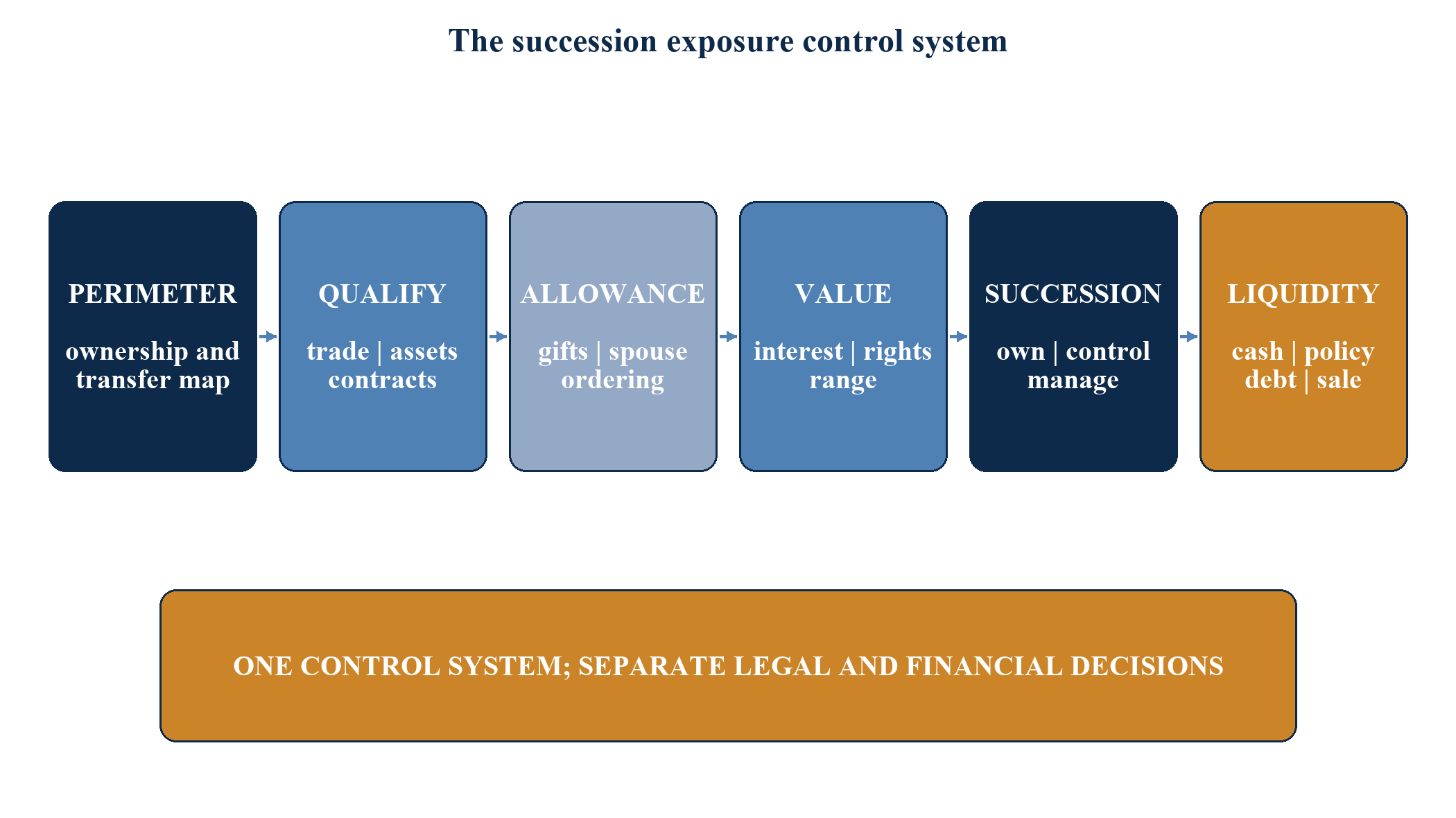
| Control domain | Governing question | Required output |
|---|---|---|
| perimeter | which interests, assets, gifts and trusts are within the review? | consolidated ownership and transfer map |
| qualification | which value is relevant business property and which value is excluded? | asset-by-asset relief memorandum |
| allowance | how much 100 percent allowance is available after earlier chargeable transfers? | allowance ledger and spouse-transfer evidence |
| valuation | what is the supportable open-market value at each relevant date? | independent valuation file and sensitivity range |
| succession | who should own, control and operate the business after a transfer or death? | governance, will, shareholder and management plan |
| liquidity | how can tax, equalisation and operating needs be funded without a forced sale? | staged funding plan and annual stress test |
2. THE 2026 RELIEF ARCHITECTURE
2.1 The combined GBP 2.5 million allowance
HMRC states that, for deaths and chargeable transfers from 6 April 2026, relief at 100 percent on the combined value of qualifying agricultural and business property is limited by a GBP 2.5 million allowance for an individual. Any qualifying value above the available allowance receives relief at 50 percent. The allowance is shared between Agricultural Relief and Business Relief rather than operating as a separate limit for each [1-4].
The allowance is not simply read from the assets held at death. Chargeable transfers of qualifying property made in the preceding seven years can reduce the amount remaining. Transitional rules bring specified gifts made on or after 30 October 2024 into the new allowance mechanism when a death occurs on or after 6 April 2026 within seven years of the gift. Gifts made before 30 October 2024 are treated under separate transitional provisions and do not reduce the post-reform allowance when the published conditions are satisfied [2,3,8].
HMRC's apportionment tool applies the allowance first to qualifying lifetime gifts, from the oldest to the newest, and then apportions the balance proportionally across qualifying assets in the estate. The executor cannot direct the whole remaining allowance to whichever asset would be most convenient. This sequencing matters where different beneficiaries receive different business interests or where a business and agricultural property share one allowance [3].
2.2 Relief at 50 percent above the allowance
When a qualifying unquoted trading-business interest sits above the available 100 percent allowance, 50 percent of the excess value is relieved. The other 50 percent remains in the taxable transfer. Applying the standard 40 percent death rate to that half gives a gross effective rate of 20 percent on the excess qualifying value before the wider estate calculation [1,2,6].
This calculation should be described as a bridge rather than a tax forecast. Debts, exemptions, gifts to a spouse or civil partner, charity provisions, the nil-rate band, the residence nil-rate band, transferred bands, lifetime transfers and other property can alter the estate result. Business Relief is applied to the qualifying business value within that broader computation. A planning model should keep the relief bridge separate from the final estate tax computation.
2.3 Transferred allowance between spouses and civil partners
Unused 100 percent relief allowance from a spouse or civil partner who died first can be transferred to the survivor's estate. HMRC says that the survivor's allowance can reach GBP 5 million. A claim is required by the later of four years after the survivor's death and six months after the personal representative started that role. Where the first death occurred before 6 April 2026, the full GBP 2.5 million allowance can be transferable even if Business Relief was claimed on that earlier estate, subject to the current rules and claim process [2,4,9].
The transfer does not mean that married owners can assume a GBP 5 million allowance in every lifetime plan. The additional amount belongs to the survivor's estate after the first death and a valid claim. Lifetime transfers by an owner, the order of deaths, ownership between spouses, wills and the treatment of business property on the first death require separate analysis. A governance file should record the first estate's grant, Business Relief claims, qualifying property values and the evidence needed for the later claim.
2.4 Property that receives only 50 percent relief
Some property receives 50 percent relief without using the GBP 2.5 million allowance. HMRC lists shares traded on markets that do not meet its definition of listed, including the Alternative Investment Market, as 50 percent relief property from 6 April 2026. Other long-standing 50 percent categories include certain controlling holdings in listed companies and qualifying land, buildings, machinery or plant owned personally and used by a partnership or controlled company [2,4].
The distinction changes the modelling sequence. An AIM portfolio is not placed into the 100 percent allowance and then reduced after the threshold. It starts in the 50 percent relief category where the conditions are met. A family holding both a private trading company and AIM shares should model them separately and confirm eligibility asset by asset.
2.5 Interest-free instalments
From 6 April 2026, tax attributable to property eligible for Agricultural Relief or Business Relief can generally be paid in ten equal annual instalments without interest on the outstanding balance, provided payments are made on time and the property remains within the statutory instalment regime. The first instalment is normally due at the end of the sixth month after death. If the relevant property is sold, the outstanding tax can become due and interest can run after the sale date [1,11,12].
Instalments reduce immediate cash pressure. They do not remove the liability or the need to fund it. A ten-year payment schedule can also interact with dividends, investment, debt covenants, family distributions and a later sale. The succession plan should model the annual cash commitment, the consequences of a sale and the operating resilience of the business under weaker trading conditions.
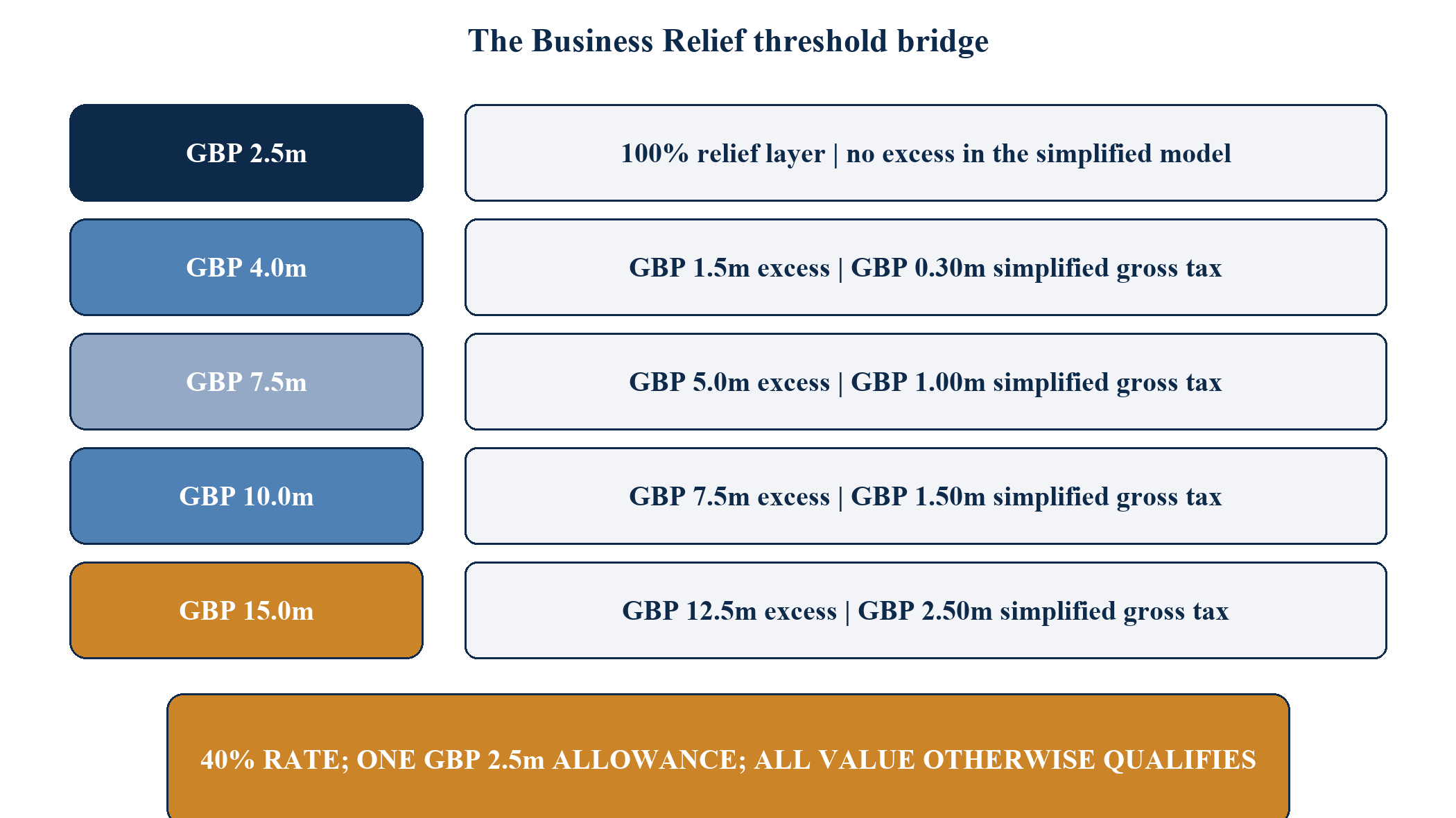
| Qualifying business value | 100% relief layer | 50% relief layer | Gross taxable value before wider estate items | Illustrative gross tax at 40% |
|---|---|---|---|---|
| GBP 2.5m | GBP 2.5m | GBP 0.0m | GBP 0.0m | GBP 0.0m |
| GBP 4.0m | GBP 2.5m | GBP 1.5m | GBP 0.75m | GBP 0.30m |
| GBP 7.5m | GBP 2.5m | GBP 5.0m | GBP 2.50m | GBP 1.00m |
| GBP 10.0m | GBP 2.5m | GBP 7.5m | GBP 3.75m | GBP 1.50m |
| GBP 15.0m | GBP 2.5m | GBP 12.5m | GBP 6.25m | GBP 2.50m |
The table assumes one individual, no transferred relief allowance, all value qualifies for the post-allowance 50 percent rate, a 40 percent death rate and no debts, exemptions, nil-rate bands, residence nil-rate band, lifetime-transfer interactions or other estate property. It illustrates the mechanism and is not a tax computation.
3. WHAT QUALIFIES AS BUSINESS PROPERTY
3.1 Relevant business property
Business Relief applies to defined categories of relevant business property. HMRC identifies a business or interest in a business and shares in an unlisted company among the categories capable of receiving 100 percent relief, subject from 6 April 2026 to the allowance. Other categories receive 50 percent relief. The legal category is the starting point; the nature of the business, ownership period, asset use, contracts and related provisions determine whether relief is available in the amount expected [4,13].
An ownership chart should record the legal owner, beneficial owner, class of shares, voting rights, economic rights, acquisition date, acquisition route, trusts, options, charges, shareholder agreements and any binding sale arrangements. Family discussions often use the word business to cover a group of companies, properties and investments. Business Relief tests the actual property transferred and the actual activities and assets beneath it.
3.2 Trading activity and investment exclusions
Relief is generally unavailable where the business or company consists wholly or mainly of dealing in securities, stocks or shares, land or buildings, or making or holding investments, subject to detailed case law and statutory exceptions. A company that began as a trading business can accumulate investment property, surplus securities or passive assets over time. A group can also contain both trading and investment activities [5,13,14].
The annual qualification review should therefore use evidence rather than a label. It should examine revenue, profit, employee time, asset values, management attention, board papers, contracts, operational risk and the purpose of each activity. A brief statement that the company is family owned or operational does not establish the relief position. Qualified advisers should document the legal conclusion and the facts on which it depends.
3.3 The two-year ownership condition
HMRC's public guidance states that the deceased generally must have owned the business or asset for at least two years before death. Replacement-property rules can aggregate periods in defined circumstances, including certain reorganisations, takeovers and reinvestment into replacement qualifying property. The conditions are detailed and should be tested before relying on an earlier ownership period [2,5,15].
The two-year condition affects acquisitions, family transfers, management buyouts, reorganisations and new holding structures. Moving a business beneath a new entity, exchanging shares or transferring shares among family members can alter the property being tested. A restructure should have a written tax and legal memorandum that addresses continuity, ownership periods and the reason for the transaction before documents are signed.
3.4 Excepted assets
An asset within an otherwise qualifying business can be excluded from relief when it was not used wholly or mainly for the business during the relevant period or was not required for future business use at the transfer date. HMRC's manuals describe the excepted-asset rules as a way to keep private or unnecessary assets outside Business Relief [14].
Surplus cash is a common control issue. Cash can be commercially necessary for working capital, acquisitions, regulatory capital, capital expenditure, debt service or a documented shock reserve. It can also become an idle balance with no evidenced business purpose. The qualification file should connect cash and investments to a board-approved operating requirement, forecast or transaction. Documentation cannot convert a private or unnecessary asset into a business asset, but it can evidence a genuine commercial requirement that existed at the relevant time.
3.5 Property subject to a contract for sale
Shares or business property subject to a binding contract for sale can cease to be relevant business property, except in defined reconstruction or amalgamation cases. HMRC's valuation guidance distinguishes ordinary shareholder arrangements from a binding sale contract and notes that the precise terms matter [5,16].
This rule matters during a founder exit. Heads of terms, exclusivity, conditional contracts, put and call options, cross-option agreements, drag provisions and completion conditions can have different legal effects. A sale process should include a Business Relief contract review before signing a binding instrument, especially where the seller is elderly or in poor health. The transaction timetable and succession timetable are separate risks that need one coordinated legal review.
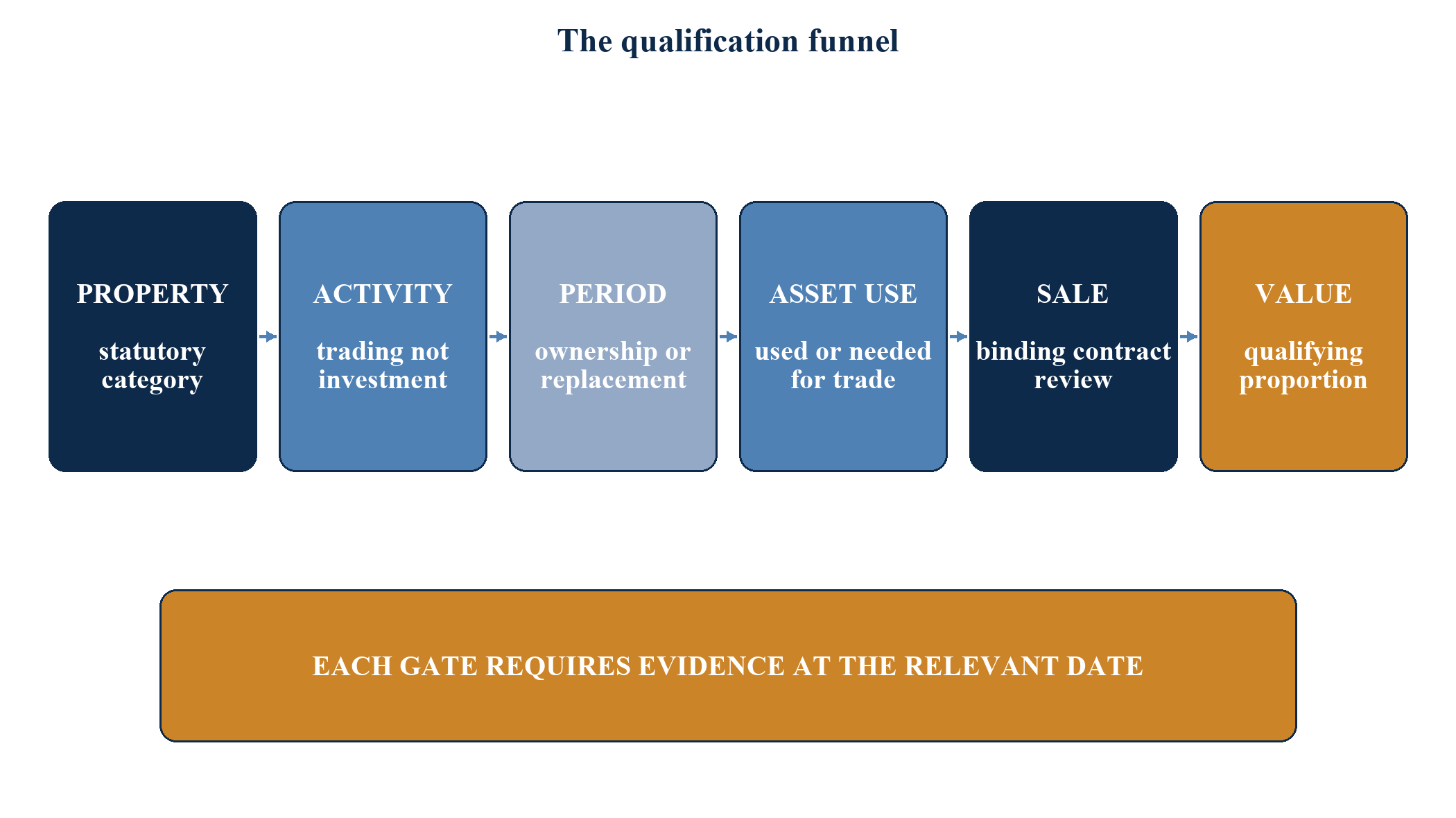
| Gate | Test | Evidence | Failure consequence |
|---|---|---|---|
| property | is the transferred interest a statutory category of relevant business property? | ownership records, articles, registers and trust documents | no Business Relief on the failed property |
| activity | is the business outside the investment and dealing exclusions? | accounts, management information, contracts and operating evidence | business interest can fail relief |
| period | has the ownership condition been satisfied or validly carried through replacement property? | acquisition and reorganisation chronology | relief can be denied |
| asset use | are company assets used or required for the business? | forecasts, board approvals and asset register | excepted value is removed from relief |
| sale | is the property subject to a disqualifying binding contract for sale? | executed transaction documents and legal opinion | relevant business property status can be lost |
| value | what open-market value is attributable to the qualifying and non-qualifying components? | independent valuation and sensitivity analysis | allowance and liquidity model can be misstated |
4. MEASURING THE EXPOSURE
4.1 Start with a consolidated ownership perimeter
The exposure model begins with every business interest, agricultural asset, trust, lifetime gift and personally held asset used by the business. It should include direct and indirect ownership, different share classes, partnerships, shareholder loans, options and jointly owned property. The model then identifies which items could use the combined 100 percent relief allowance and which items begin in the 50 percent category.
The perimeter should be reconciled to statutory registers, trust records, accounts, valuations, wills, shareholder agreements and prior Inheritance Tax filings. Family recollection is useful for discovery and insufficient as the final evidence. Differences between legal ownership, economic benefit and management control should be stated explicitly.
4.2 Value the business and isolate the relief layers
Inheritance Tax generally uses a statutory open-market valuation at the relevant date. Private-company value can be sensitive to maintainable earnings, forecast risk, customer concentration, debt, surplus assets, key-person dependency, minority rights and the size of the holding. A succession model should use an independent range and show how the potential tax changes across that range rather than anchoring to one internal management estimate [5,17].
The valuation should isolate three numbers: gross business value; value that satisfies the Business Relief conditions; and value that is excepted or otherwise ineligible. The available 100 percent allowance is then allocated to the qualifying layer, with 50 percent relief on the qualifying excess. Non-qualifying value enters the wider estate calculation without Business Relief.
4.3 Use a relief bridge before the estate computation
A practical bridge uses the following sequence:
- determine the supportable value of each transferred business interest;
- deduct liabilities that are properly attributable under the relevant rules;
- remove value that does not qualify for Business Relief;
- identify any property that receives only 50 percent relief by category;
- calculate the 100 percent relief allowance remaining after earlier chargeable transfers;
- allocate or apportion that allowance under the statutory sequence;
- apply 50 percent relief to the qualifying excess;
- carry the residual taxable value into the full estate computation.
The model should retain every input and source. It should show the difference between a legal eligibility conclusion, a valuation input and a mathematical output. A change in any one can move the result materially.
4.4 Nil-rate bands, exemptions and other estate facts
The standard Inheritance Tax rate is 40 percent. The nil-rate band is GBP 325,000 through 5 April 2031, and the residence nil-rate band is GBP 175,000 through 5 April 2030, subject to conditions and taper. Transfers to a spouse or civil partner and qualifying charity gifts can be exempt. Unused nil-rate bands can be transferable between spouses and civil partners under separate rules [6,7].
These elements should not be collapsed into the Business Relief allowance. The GBP 2.5 million allowance controls the rate of Agricultural and Business Relief. The nil-rate bands and exemptions apply within the wider estate framework. A combined model can show both while keeping each legal mechanism identifiable.
4.5 Stress the assumptions
The primary sensitivity variables are business value, qualifying percentage, available allowance, ownership structure, order of deaths, lifetime gifts, non-business estate value and liquidity. A five-variable model can reveal whether a plan remains workable if the business value rises, an excepted-asset adjustment increases, the spouse-transfer claim is unavailable, trading weakens or a sale accelerates instalments.
The stress test should include a downside operating case. A tax liability caused by a valuable business can become hardest to fund when the business is temporarily unable to pay dividends or refinance. Valuation and liquidity can move in opposite directions.
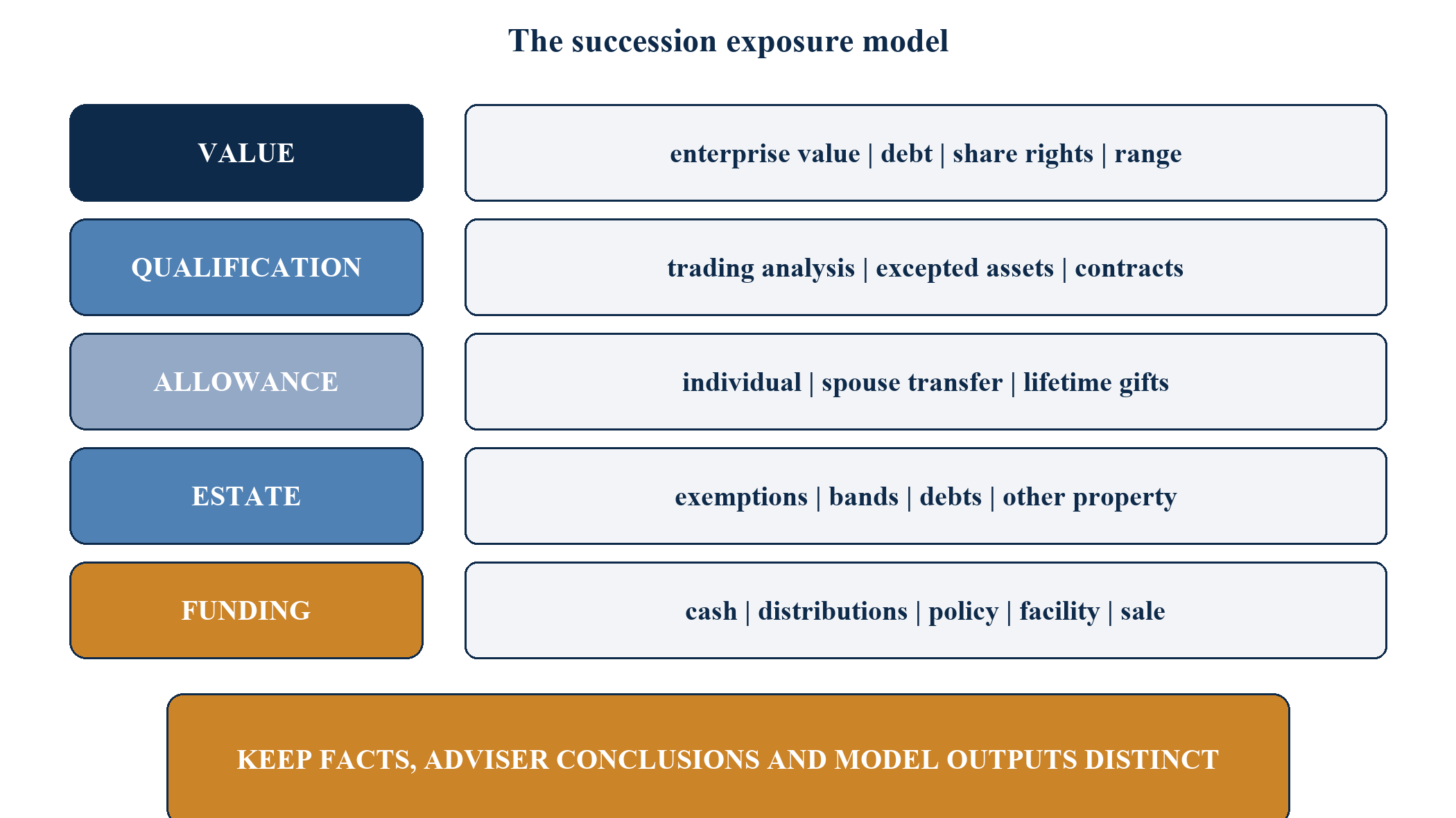
| Input | Base assumption | Downside test | Evidence owner |
|---|---|---|---|
| enterprise and equity value | independent valuation range | lower earnings and higher discount rate | valuer and finance director |
| qualifying proportion | documented trading and asset analysis | larger excepted-asset adjustment | tax adviser and board |
| 100% allowance | verified individual and spouse-transfer ledger | unavailable or partly used allowance | personal representatives and adviser |
| wider estate | reconciled property, investments, debts and gifts | asset growth or debt disallowance | family office or executor |
| operating cash | approved forecast and dividend capacity | two-year trading stress | board and treasury |
| external liquidity | committed facility or policy evidence | delayed or unavailable funding | lender, insurer and adviser |
5. OWNERSHIP AND SUCCESSION DESIGN
5.1 Separate economic ownership, voting control and management
Succession planning becomes more flexible when three questions are separated. Who should receive economic value? Who should control strategic decisions? Who is capable of managing the business? One person need not hold all three roles. Different share classes, a family holding company, independent directors, reserved matters and a documented management succession can align those roles, subject to tax, company-law and governance advice.
The structure should have a commercial purpose and work in practice. Voting restrictions, preference rights, leaver provisions, dividend policies and transfer rules affect value and family outcomes. A tax-motivated document that conflicts with actual decision making can create governance and evidential problems.
5.2 The first-death and second-death plan
For spouses and civil partners, wills and ownership should be modelled across both possible orders of death. A spouse exemption can defer tax on property passing to the survivor. The transferred Business Relief allowance can increase the survivor's allowance where it remains unused and the claim is made. The family should model what the survivor will own, whether the business still qualifies, who will manage it and how the eventual liability will be funded [2,4,9].
The first-death plan should also consider whether the survivor wants or is able to hold a controlling business interest. A tax-efficient transfer that leaves an unprepared spouse with concentrated operational risk can fail the family's broader objectives.
5.3 Fairness among active and non-active children
Equal value and equal ownership can produce different outcomes. Giving equal voting shares to children with different roles can create deadlock. Giving the operating business to one child and liquid assets to another can become unequal when valuations move. A family fairness framework should define whether equality is measured at the transfer date, at death, after tax, after liquidity costs or over a longer period.
The plan can use non-voting shares, growth shares, staged transfers, equalisation insurance, shareholder loans or other structures after professional advice. The governing documents should address dividends, employment pay, related-party transactions, exits, disability, death, divorce, disputes and information rights.
5.4 Management continuity
Business value and tax funding both depend on continuity. The succession file should identify the emergency chief executive, finance authority, bank mandates, customer contacts, regulatory approvals, key suppliers, data access and board quorum. A death or incapacity can create operational disruption before executors obtain probate or advisers complete a tax computation.
The family should run a tabletop exercise. The exercise begins on the first business day after a principal becomes unavailable. It tests who can pay staff, access banking, sign customer documents, communicate with lenders, convene the board and instruct advisers. Gaps become a remediation plan with owners and dates.
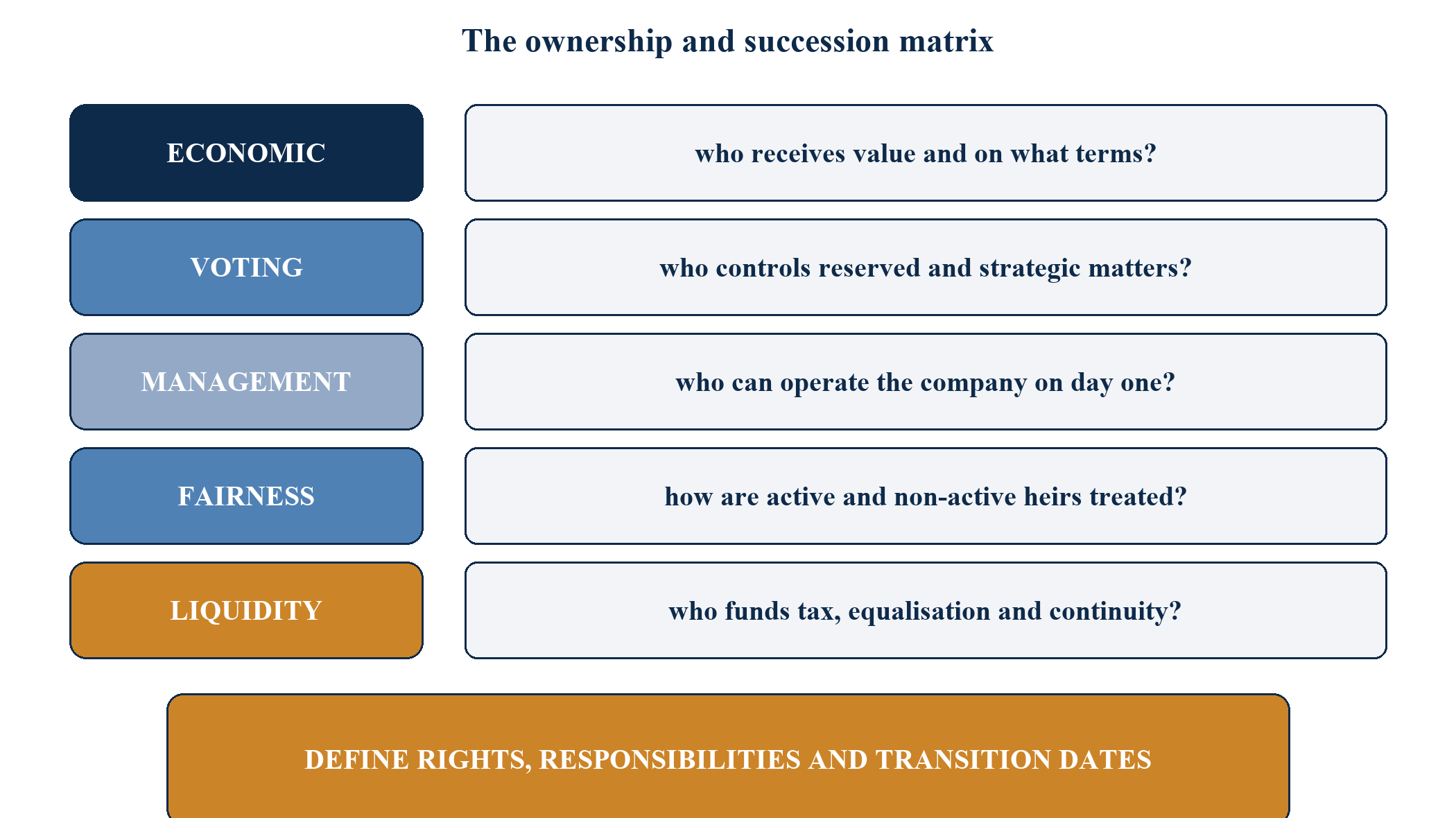
| Dimension | Founder | Successor generation | Independent governance | Funding source |
|---|---|---|---|---|
| economic value | retained, gifted or sold in stages | clear beneficial rights | valuation and conflict oversight | dividends, sale proceeds or policy |
| voting control | reserved matters and transition date | earned or staged authority | chair and board protections | not applicable |
| management | role, handover and emergency deputy | competence and development plan | succession committee | operating budget |
| family fairness | stated equalisation principle | transparent expectations | family council and dispute process | non-business assets or insurance |
| tax liquidity | personal and estate obligation map | inheritance and ownership consequence | annual review | instalments, reserve, borrowing or sale |
6. LIFETIME TRANSFERS AND TRUSTS
6.1 A lifetime gift is a succession decision
A lifetime transfer can move economic ownership, voting power and future growth before death. It also changes the founder's personal balance sheet and can expose the recipient to business, matrimonial and creditor risk. The decision therefore requires a joined legal, tax, valuation, governance and family assessment.
For qualifying transfers made on or after 30 October 2024, a gift within seven years of death can use the GBP 2.5 million allowance available at death. HMRC applies the allowance to earlier lifetime transfers before later transfers and the death estate. A gift that appears fully relieved when made can consequently reduce the allowance available to the estate [2,3,8].
The transfer file should record the date, asset, legal owner, valuation, qualifying analysis, consideration, retained rights, recipient, acceptance, board approvals and continuing commercial purpose. It should also identify every earlier chargeable or potentially exempt transfer within the relevant period.
6.2 Model the sequence, not one transaction
Chronology matters. A family considering several gifts should model the order in which the allowance may be used. A transfer of a minority interest may have a different value from a proportionate fraction of the whole company. A later restructuring, sale agreement, cessation of trade or recipient disposal can affect the evidence and relief position.
The model should show at least three dates: the proposed transfer date, the earliest date at which a seven-year period could complete, and the planned review date. It should also show the founder's expected cash needs and retained control over the same horizon. Survival is only one component; ownership and qualification conditions require separate advice.
6.3 Retained benefit and control
A donor who transfers value while retaining use or benefit can create a different tax outcome from an outright gift. Control rights can also affect valuation and family governance. The documents and actual conduct should align. Dividend access, voting rights, employment remuneration, shareholder loans, premises use and personal guarantees all require explicit treatment.
The practical test is whether the founder can explain what changed economically and legally on the transfer date. If the answer is unclear, the family should pause before relying on the transfer in a succession plan.
6.4 Trusts require a separate workstream
Trusts can serve governance, protection and intergenerational objectives. Their inheritance-tax treatment includes entry, periodic and exit considerations, and the 2026 allowance has specific rules. The family should obtain trust-specific advice before execution, including advice on settlor interests, beneficiary classes, control, residence, reporting and the interaction with Business Relief [25].
A trustee succession plan is also required. The trustee must understand the business, exercise powers independently, manage conflicts, hold adequate information and preserve decision continuity. A trust is a legal relationship with continuing duties; it is not a filing label.
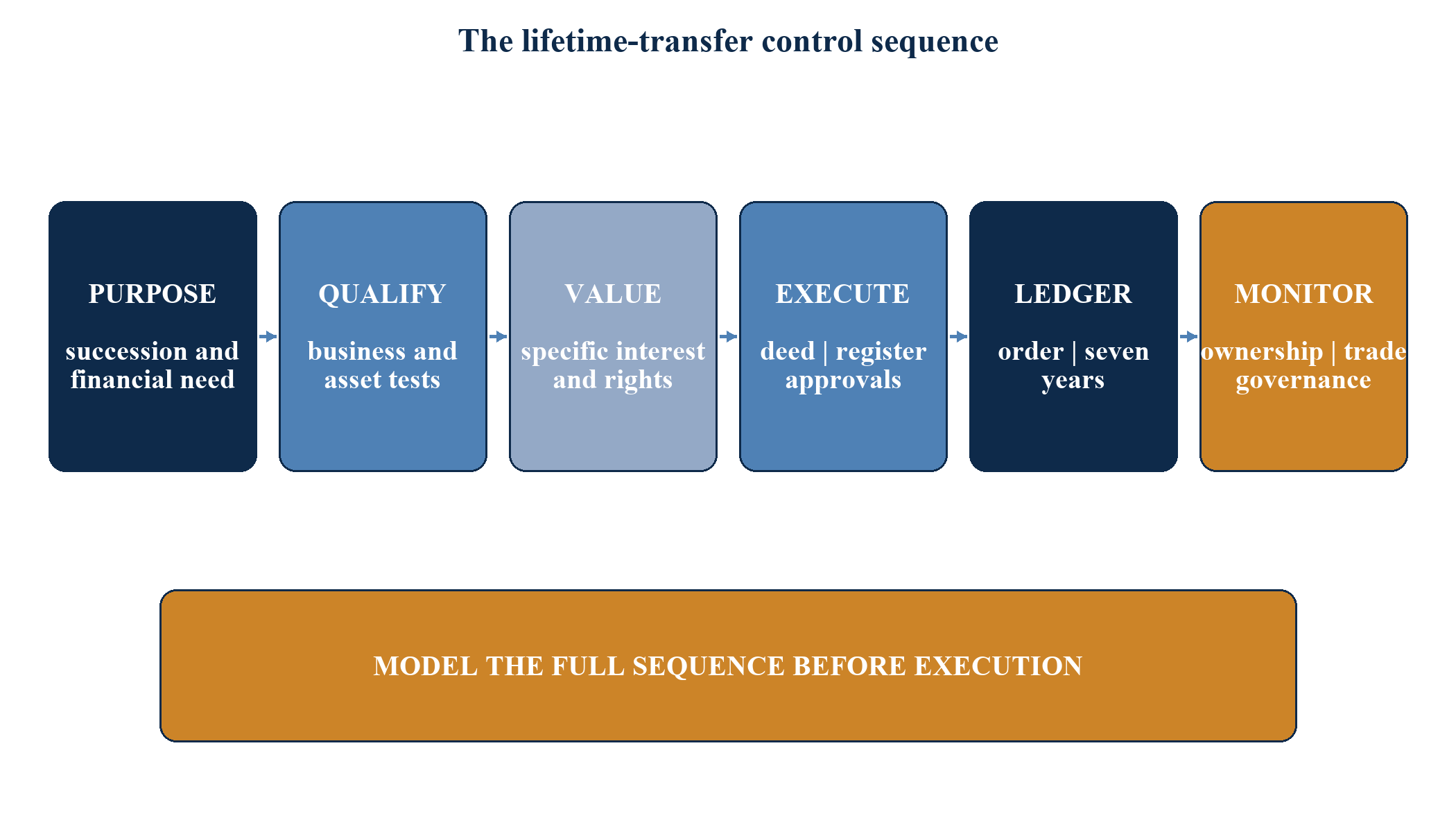
| Stage | Required decision | Evidence | Review trigger |
|---|---|---|---|
| purpose | define succession, governance and financial objective | family mandate and adviser scope | change in family objective |
| qualification | test business, ownership period and asset composition | legal and tax memorandum | restructuring or trade change |
| valuation | value the specific interest and rights transferred | independent valuation | material performance change |
| execution | complete transfer and company approvals | deed, registers, resolutions and filings | document inconsistency |
| seven-year ledger | record transfer order and allowance use | central lifetime-transfer register | new gift or death |
| continuing conditions | monitor recipient ownership and business status | annual confirmation | sale, replacement or cessation |
| governance | operate the agreed control and information rights | minutes, reserved matters and reporting | dispute or leadership change |
7. FUNDING THE LIABILITY
7.1 Value does not create cash
An inheritance-tax exposure can arise from a profitable and valuable private company whose cash is committed to working capital, debt service, capital expenditure or growth. The liability belongs within an estate and succession funding plan, while extraction from the company is governed by company law, tax, lender covenants and directors' duties.
The funding plan should quantify the amount, payment date, sources, approvals, lead times and failure modes. It should distinguish cash legally available to the estate from cash held within the operating group. A consolidated balance sheet can conceal that distinction.
7.2 A funding hierarchy
The first source is usually immediately available personal or estate liquidity after allowing for other obligations. The second can be planned distributions or repayment of shareholder balances, where lawful and affordable. The third can include insurance proceeds structured for the intended recipient and purpose. The fourth can include borrowing. The fifth can be a partial or full asset sale.
Each source carries execution risk. Cash reserves can be consumed. Dividends can become unaffordable. Insurance can be unavailable, costly or incorrectly owned. Lending can depend on valuation, control and covenant capacity. A sale can occur at an adverse time. A robust plan uses multiple sources and documents the order in which they can be activated.
7.3 Insurance as a funding instrument
Life insurance can provide liquidity at death when a suitable policy is available and correctly structured. The sum assured, ownership, beneficiaries, premium source, underwriting assumptions and trust arrangements require regulated advice. Policy proceeds and the tax liability should be modelled in the same legal ownership map.
The annual review should confirm that premiums are current, trustees and beneficiaries remain appropriate, the insurer has accurate contact details, and the sum assured still relates to the updated exposure. Insurance supports liquidity; it does not establish Business Relief eligibility.
7.4 Instalments and the sale consequence
From 6 April 2026, inheritance tax attributable to property qualifying for Agricultural or Business Relief can generally be paid in ten annual instalments without interest, subject to the statutory rules. The instalment option can protect short-term continuity, though the liability remains. If the relevant property is sold, outstanding instalments can become due and interest consequences can arise [11,12].
The estate should model annual instalments against operating cash and debt covenants. The executors should also understand how a refinancing, share buyback, partial sale or group reorganisation could affect the timetable. The plan needs a designated person to monitor payments and transaction triggers after probate.
7.5 Borrowing and security
Borrowing can bridge probate, policy settlement, distributions or a planned transaction. The lender will assess the borrower, repayment source, security, company documents, shareholder restrictions and valuation. Personal representatives may have limited authority or incomplete control during the early period after death.
A standby facility negotiated before a crisis can improve optionality. Its cost should be compared with the opportunity cost of holding permanent cash, insurance premiums and the discount associated with a forced sale. The family should avoid assuming a company can guarantee or fund an owner's personal liability without legal and tax review.
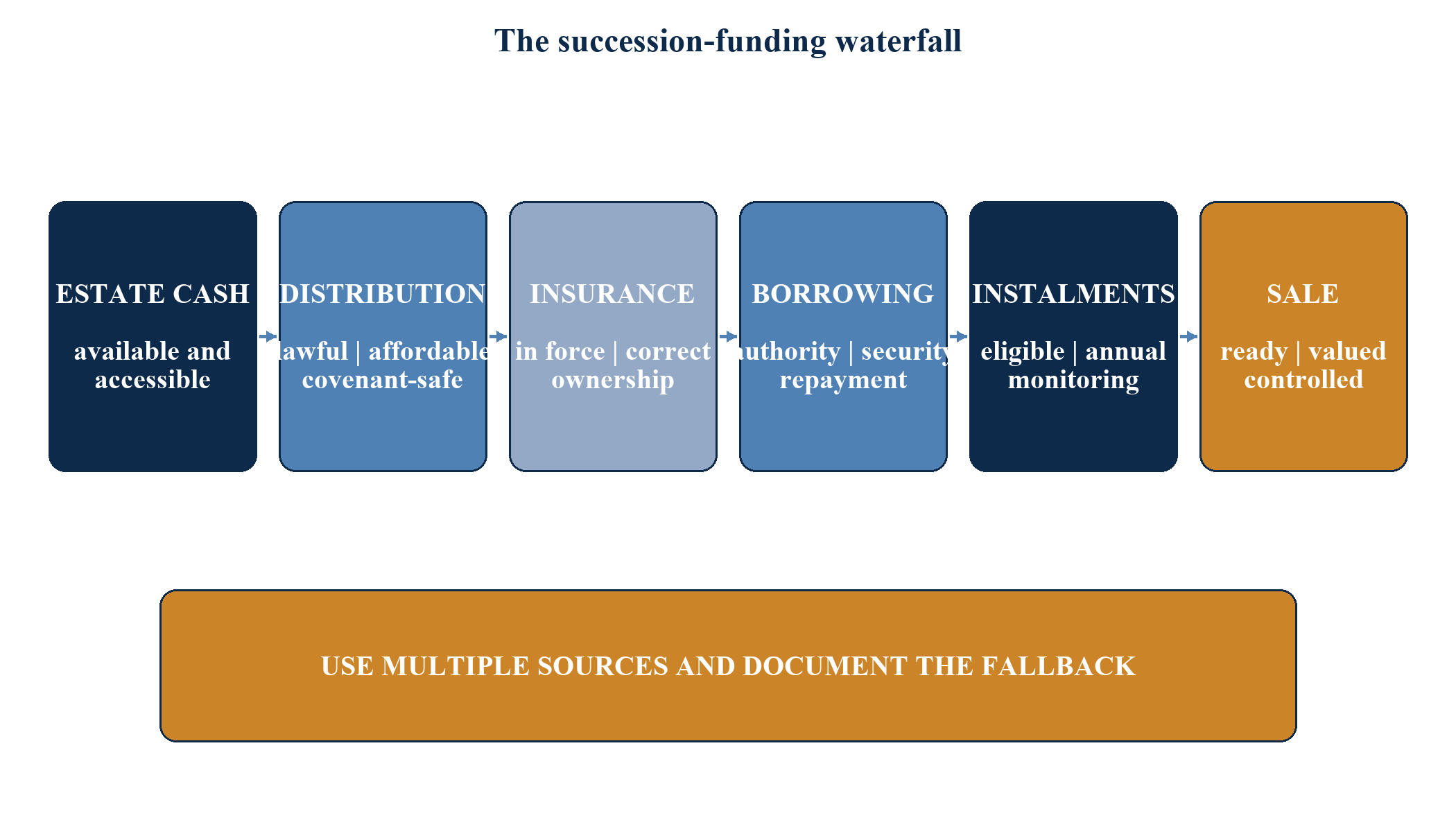
| Priority | Potential source | Availability test | Principal risk |
|---|---|---|---|
| 1 | estate cash and liquid investments | owned by estate and accessible when due | insufficient reserve |
| 2 | lawful distributions or shareholder balances | company cash, approvals, covenants and tax | operating strain |
| 3 | insurance proceeds | policy in force, correct ownership and beneficiary | underwriting or structure mismatch |
| 4 | committed borrowing | borrower authority, security and repayment source | delayed credit approval |
| 5 | instalment plan | statutory eligibility and administration | recurring burden or sale acceleration |
| 6 | partial or full sale | marketability, buyer and transaction readiness | timing and valuation discount |
8. RETAIN, TRANSFER OR SELL
8.1 Retain and prepare
Retention can preserve control, family identity and long-term compounding. It requires a credible management successor, governance that survives the principal, and funded liquidity. The annual review should test whether the company remains a qualifying trading business and whether the family remains capable of owning it.
Preparation includes a current valuation, clean statutory records, documented ownership, board continuity, key-person plans, lender engagement, a data room and a sale-readiness option. Sale readiness provides an alternative; it need not signal an intention to sell.
8.2 Transfer in stages
Staged transfers can move future growth and develop successor responsibility over time. The founder can set objective gates for management competence, governance conduct and information quality. Every stage requires its own valuation and legal record.
The family should model dilution, control, dividend dependence and equalisation across beneficiaries. A schedule based solely on tax dates can transfer responsibility faster than the organisation can absorb it.
8.3 Sell before death
A sale converts an illiquid business interest into cash or other consideration. Cash generally does not qualify for Business Relief merely because it arose from the sale of a qualifying business. A sale can therefore change the inheritance-tax profile, though it may create liquidity and diversify risk. Capital-gains tax, Business Asset Disposal Relief, transaction costs, earn-outs and deferred consideration require separate modelling [4,23].
Business Asset Disposal Relief applies to qualifying disposals under its own conditions and rates. It does not substitute for succession analysis. The decision model should compare the after-tax, after-cost and risk-adjusted outcomes of retaining, transferring and selling.
8.4 Binding contracts for sale
Business Relief can be denied where property is subject to a binding contract for sale at the relevant time, subject to specific statutory exceptions. Heads of terms, options, buy-sell agreements, shareholder provisions and transaction documents should be reviewed before reliance on relief [4,10].
This issue is particularly important in emergency succession arrangements. A document intended to create certainty or fund an exit can unintentionally alter the inheritance-tax analysis. Legal advice should cover the precise rights, timing and enforceability.
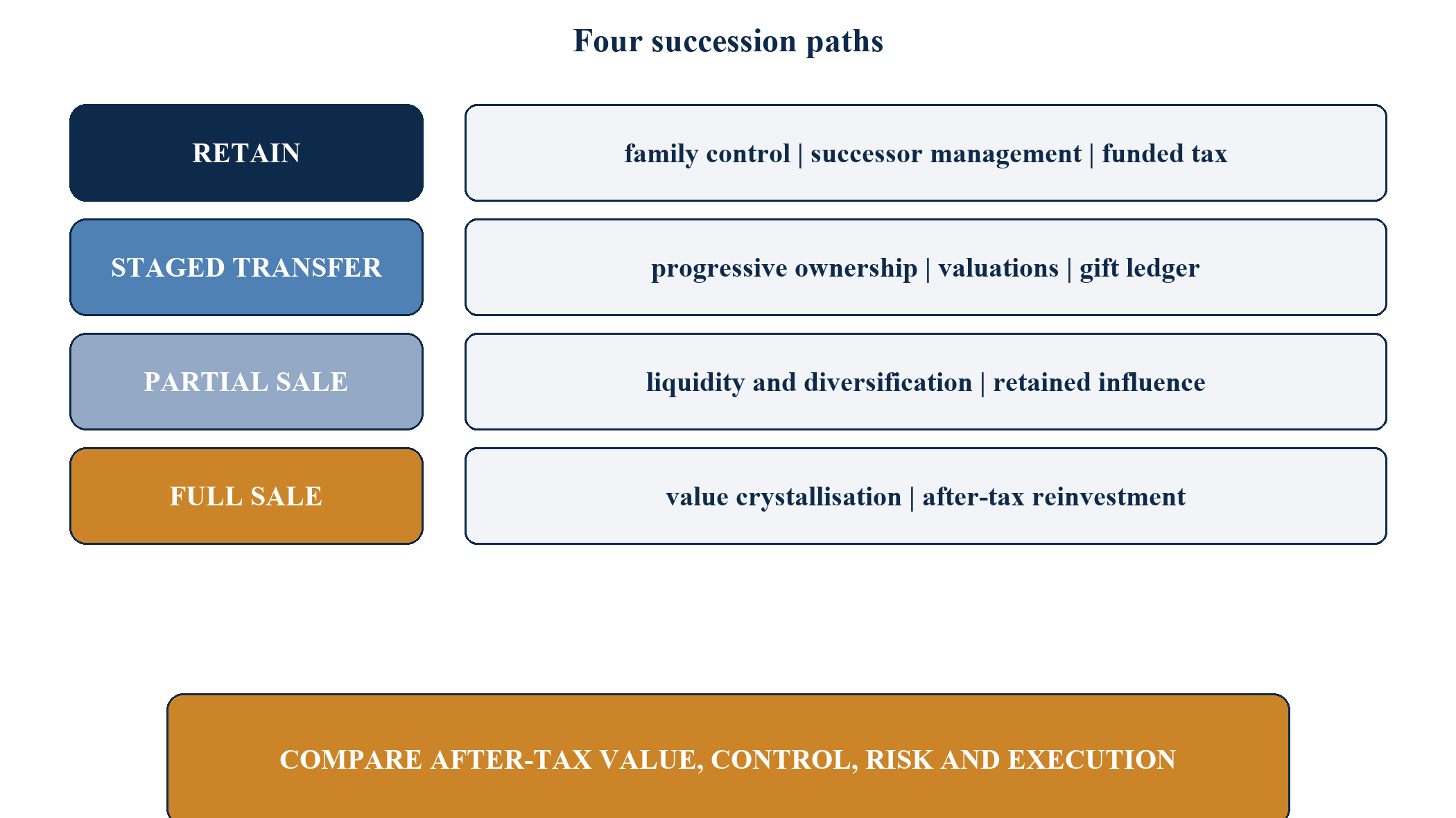
| Path | Strategic objective | Required capability | Liquidity implication | Key review |
|---|---|---|---|---|
| retain | preserve family ownership and compounding | successor management and durable governance | fund tax without disrupting trade | annual qualification and funding test |
| staged transfer | move value and responsibility progressively | recipient readiness and valuation discipline | founder retains sufficient personal liquidity | each transfer and seven-year ledger |
| partial sale | diversify and create liquidity while retaining an interest | transaction readiness and shareholder alignment | proceeds can fund tax and equalisation | relief profile after sale |
| full sale | crystallise value and remove operating concentration | market timing and execution capability | cash becomes available, with a different tax profile | after-tax proceeds and reinvestment |
9. UK-TO-UAE MIGRATION
9.1 Migration and inheritance tax are separate analyses
Moving to the UAE can change a family's personal, commercial and tax position. It does not automatically end UK inheritance-tax exposure. Since 6 April 2025, the UK applies a long-term residence test to determine the scope of inheritance tax for many individuals. An individual who has been UK resident for at least ten of the previous twenty tax years can remain within scope for non-UK assets for a tail period after departure. The tail can range from three to ten tax years according to the statutory history [18].
The residence history should be reconstructed year by year before a move. The family should then model the departure year, continuing UK residence risk and the applicable tail. The conclusion must be updated if travel, work, homes or family circumstances change.
9.2 UK-connected business property remains fact-specific
The location and nature of private-company interests, partnership assets and underlying business property require legal analysis. Moving the shareholder does not move the company, its trade, assets, governance or contracts. A UK company and UK-situated assets can remain relevant after the owner's personal move.
A migration plan should therefore contain two maps: the individual's residence and exposure map, and the business's legal, operational and asset map. Cross-border holding structures, board location, central management and control, permanent establishments, corporate residence and substance require specialist advice.
9.3 UAE residence evidence
UAE domestic tax residence is determined under Cabinet Decision No. 85 of 2022 and related rules. The Federal Tax Authority operates a tax-residency-certificate service with documentary requirements [21,22]. Residence permits, homes, travel records, employment or business evidence and personal connections can be relevant under the applicable test.
A UAE certificate is an evidence document for its stated period and purpose. It does not replace the UK's domestic tests or the Business Relief analysis. The UK-UAE double taxation convention contains residence provisions, while inheritance tax and estate planning require their own review [20].
9.4 The operating substance question
Founder relocation can affect how decisions are made. The board calendar, directors' locations, delegations, banking authority, contract approval and senior-management activity should reflect commercial reality. Personal migration should not create an unmanaged corporate-residence or governance risk.
The family should define which decisions belong to the shareholder, the board, executive management and any family council. Minutes should record genuine deliberation and authority. The operating model should remain practical across time zones and regulatory environments.
9.5 A sequenced move
A defensible sequence begins with residence-history and estate mapping. It then addresses personal and family residence, company governance, succession, valuation, funding and evidence. Implementation should follow professional advice and commercial decisions. Annual review continues after the move because the long-term residence tail, business value, ownership and family circumstances evolve.
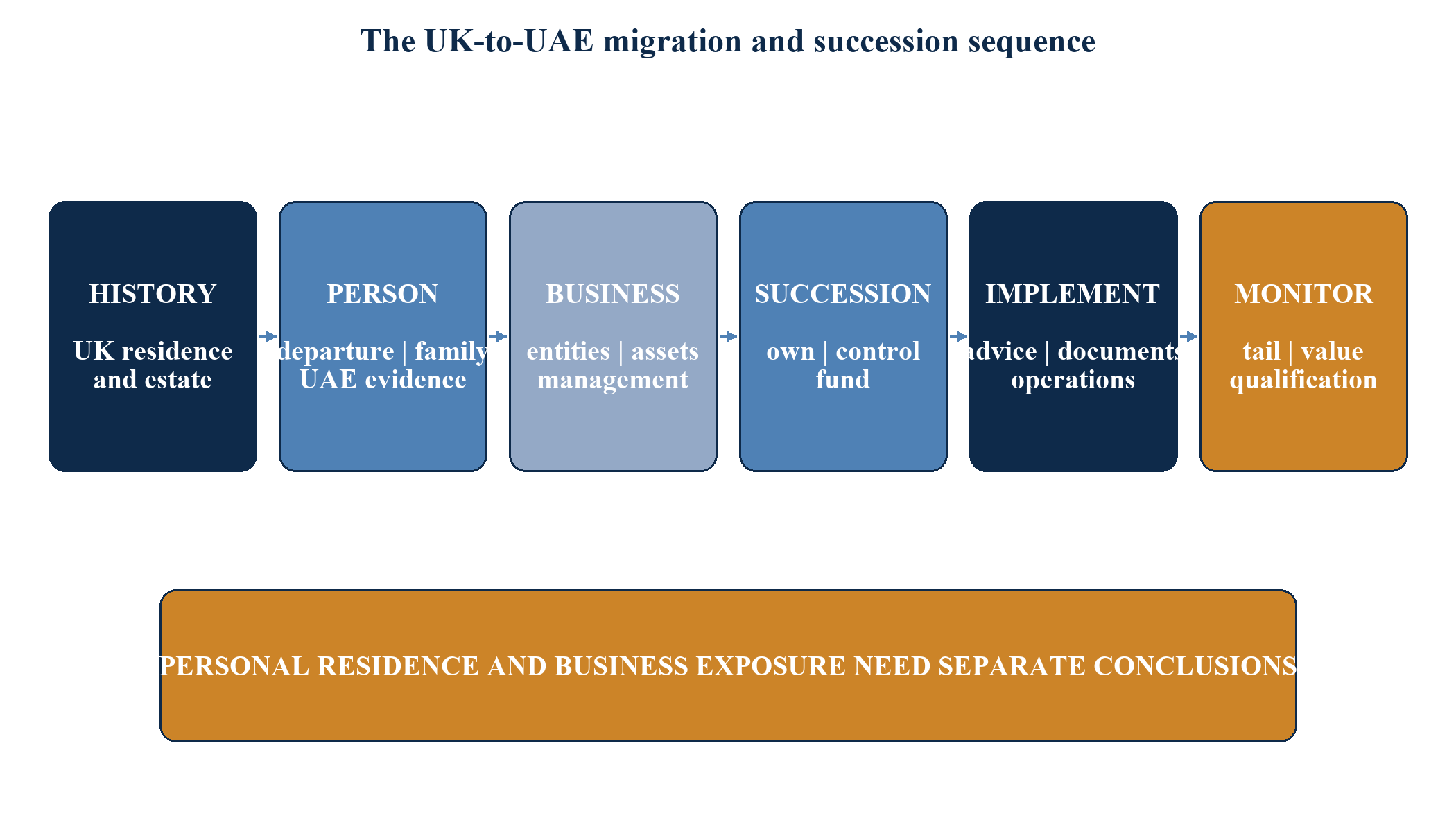
| Phase | Personal workstream | Business workstream | Succession workstream |
|---|---|---|---|
| diagnose | reconstruct UK residence history and estate | map entities, assets and management | identify successors and beneficiaries |
| design | model departure, family and UAE residence | define board and executive authority | compare retain, transfer and sale paths |
| fund | map personal liquidity and liabilities | test dividends, covenants and facilities | build insurance, reserve and instalment plan |
| implement | establish evidence ledger and advice file | operate governance in practice | execute wills, ownership and contingency documents |
| monitor | review travel, homes, work and tail period | review qualification, substance and value | update allowance, gifts and funding annually |
10. WORKED CASES
The following cases are hypothetical planning models. They use simplified assumptions to demonstrate mechanics. They are not valuations, tax computations or advice. Each case assumes a 40 percent inheritance-tax rate and ignores nil-rate bands, exemptions, debts and other estate adjustments unless stated.
10.1 Case A: GBP 4 million qualifying business, one owner
Assume an individual dies after 6 April 2026 owning a GBP 4 million interest that qualifies in full, with the full GBP 2.5 million allowance available and no transferable allowance. The first GBP 2.5 million receives 100 percent relief. The remaining GBP 1.5 million receives 50 percent relief, leaving GBP 750,000 exposed. At 40 percent, the simplified gross liability attributable to the interest is GBP 300,000.
The effective rate on the business value is 7.5 percent in this simplified model. The estate still needs GBP 300,000 of liquidity or a valid instalment plan. A valuation range of GBP 3.5 million to GBP 4.5 million produces a simplified liability range of GBP 200,000 to GBP 400,000.
10.2 Case B: GBP 8 million business and transferred allowance
Assume the owner is the survivor of a married couple, the predeceased spouse left the full Business Relief allowance unused, and the personal representatives make a valid claim. The available 100 percent allowance is assumed to be GBP 5 million. A fully qualifying GBP 8 million interest leaves GBP 3 million above the allowance. After 50 percent relief, GBP 1.5 million remains exposed, producing a simplified liability of GBP 600,000.
The family should verify the first death, ownership history, availability of the allowance and claim deadline. The plan should not record GBP 5 million as available without that evidence.
10.3 Case C: excepted assets within a GBP 10 million company
Assume a GBP 10 million shareholding in a trading company. Advisers determine that 15 percent of value relates to assets excluded from relief, leaving GBP 8.5 million as qualifying value. Assume a GBP 2.5 million 100 percent allowance. The excess qualifying value is GBP 6 million; 50 percent relief leaves GBP 3 million exposed. The GBP 1.5 million excluded portion is also assumed exposed. Total simplified exposure is GBP 4.5 million, producing a gross liability of GBP 1.8 million.
This case demonstrates why the qualifying fraction can matter as much as the headline business value. The 15 percent assumption requires asset-level and commercial evidence.
10.4 Case D: lifetime gift followed by death
Assume an individual gives a qualifying GBP 1 million business interest after 30 October 2024 and dies within seven years. Assume that transfer uses GBP 1 million of the allowance under the applicable ordering rules. If the individual then owns a fully qualifying GBP 4 million interest at death, only GBP 1.5 million of the original GBP 2.5 million allowance remains in this simplified model. The next GBP 2.5 million receives 50 percent relief, leaving GBP 1.25 million exposed and a simplified liability of GBP 500,000.
The actual result depends on valuation dates, qualification, recipient actions, other transfers and the statutory rules. The lifetime-transfer ledger is essential.
10.5 Case E: transaction documents at death
Assume an owner has agreed a sale and dies before completion. The legal question is whether the interest is subject to a binding contract for sale and whether any exception applies. The financial model cannot resolve that question. The executors need an immediate document review before assuming Business Relief in the probate computation.
The succession plan should identify who holds the transaction data room, which law firm can advise, how the buyer is contacted and whether funding is available if relief is unavailable.
10.6 Case F: founder moves to the UAE
Assume a founder moves to the UAE after fifteen UK-resident years within the previous twenty. The family expects continuing UK inheritance-tax exposure for a post-departure tail under the long-term residence rules. The company remains UK incorporated and operates in the UK. The plan models personal residence, the statutory tail, the business interest, Business Relief qualification and funding separately.
The founder obtains UAE residence evidence and reorganises personal travel. Those steps support the UAE and personal-residence files. They do not by themselves remove UK inheritance-tax exposure or determine the treatment of the company interest.
Figure 10. Worked-case sensitivity table
| Case | Simplified business value | 100% allowance | Other adjustment | Simplified gross liability |
|---|---|---|---|---|
| A | GBP 4.0m | GBP 2.5m | none | GBP 0.30m |
| B | GBP 8.0m | GBP 5.0m | full spouse-transfer assumption | GBP 0.60m |
| C | GBP 10.0m | GBP 2.5m | 15% value excluded from relief | GBP 1.80m |
| D | GBP 4.0m at death | GBP 1.5m remaining | earlier GBP 1.0m qualifying gift | GBP 0.50m |
11. GOVERNANCE AND EVIDENCE
11.1 The succession control book
The family should maintain one controlled index of the documents needed after death or incapacity. It can include wills, lasting powers, share certificates, statutory registers, shareholder agreements, trust documents, insurance, shareholder loans, guarantees, facility agreements, board delegations, key contracts, valuations, tax advice and contact details.
Access should be secure and role-based. The file should identify the original document location, custodian, last review date and the person authorised to release it. Passwords and encryption keys require a separate secure protocol.
11.2 An annual relief memorandum
The annual memorandum should state the ownership period, business activities, group structure, investment activities, asset use, surplus cash rationale, property occupation, binding sale arrangements and material changes. It should attach evidence from finance, operations and legal teams.
The memorandum supports an informed review; it is not a guarantee of relief. Qualification is determined under the law and facts at the relevant time.
11.3 The allowance and transfer ledger
The ledger records lifetime transfers, dates, values, recipients, relief claimed, ordering, spouse or civil-partner history and supporting documents. It should distinguish confirmed facts, adviser conclusions and model assumptions. The personal representatives need immediate access.
A major family event, new gift, restructuring or death triggers an update. The ledger should be reconciled with wills, trusts, company records and tax filings.
11.4 Decision rights after incapacity or death
The business needs an authority matrix for payroll, treasury, financing, contracts, litigation, regulatory matters, communications and strategic decisions. The matrix should show the normal owner, emergency delegate, monetary limit, required evidence and escalation route.
The board should test it annually. A plan that depends on one unavailable signatory is incomplete even when the tax analysis is current.
Figure 11. The annual governance cycle
| Quarter | Core activity | Principal output | Board question |
|---|---|---|---|
| Q1 | ownership, gifts and family update | reconciled allowance ledger | has any economic ownership changed? |
| Q2 | qualification and asset-use review | annual relief memorandum | does every material asset serve the trade? |
| Q3 | valuation and funding stress test | exposure range and funding waterfall | can the estate meet the downside case? |
| Q4 | continuity exercise and document review | tested emergency plan | can the company operate on the next business day? |
| event-driven | transaction, move, death, incapacity or restructure | specific legal and tax advice | does the existing plan remain valid? |
12. A 90-DAY IMPLEMENTATION ROADMAP
12.1 Days 1 to 30: establish the facts
The first month creates the ownership chart, family map, residence history, asset schedule, lifetime-transfer ledger and document index. The finance team prepares recent accounts, management information, forecasts, debt documents and an asset-use schedule. Advisers identify evidence gaps and urgent legal defects.
The board also identifies the emergency management team and tests bank mandates. No irreversible transfer should be executed merely to meet the 30-day timetable.
12.2 Days 31 to 60: quantify and compare
The second month commissions or updates the valuation, documents the qualifying analysis, builds the exposure model and compares retain, staged-transfer, partial-sale and full-sale paths. The family defines fairness, control and management objectives.
Funding advisers test cash, distributions, insurance, borrowing and instalments. Each source receives an owner, amount, timing assumption and fallback.
12.3 Days 61 to 90: decide and implement controls
The third month records the preferred succession path, updates wills and governance documents through legal advisers, and approves the annual review calendar. The business completes its emergency continuity exercise and remediates critical gaps.
Any gift, trust, restructuring, insurance policy or transaction proceeds through its own regulated and professional process. The 90-day outcome is a governed decision system, supported by advice and evidence.
Figure 12. The 90-day implementation plan
| Period | Workstream | Deliverable | Decision gate |
|---|---|---|---|
| days 1-10 | family and ownership facts | verified family, entity and ownership map | principal confirms objectives |
| days 11-20 | business and asset evidence | qualification evidence pack | advisers identify uncertainties |
| days 21-30 | continuity and documents | emergency authority map and index | board remediates critical access gaps |
| days 31-45 | valuation and tax model | value range and exposure sensitivities | assumptions approved for planning |
| days 46-60 | options and funding | path comparison and funding waterfall | family selects preferred direction |
| days 61-75 | legal and governance design | draft wills, ownership and governance actions | professional sign-off |
| days 76-90 | implementation control | approved actions, owners and annual calendar | board and family review |
13. LIMITATIONS AND RISK BOUNDARIES
This paper provides a decision framework based on legislation and official guidance available through 3 August 2026. It does not provide tax, legal, valuation, investment, insurance or migration advice. Business Relief depends on detailed facts and law at the relevant time. The treatment of gifts, trusts, partnerships, holding companies, excepted assets, replacement property, binding sale agreements and cross-border structures requires specialist advice.
The worked cases are hypothetical and intentionally simplified. They exclude many estate components and do not predict a tax liability. Values, qualifying percentages, allowance availability, spouse-transfer claims, residence histories and funding costs must be verified for the relevant family.
Government guidance can change, and courts can affect interpretation. A family should obtain current advice before a transfer, transaction, migration or filing. The personal representatives should verify the rules and evidence again at death.
14. CONCLUSION
The GBP 2.5 million Business Relief allowance changes the economics of succession for valuable family-owned businesses from 6 April 2026. The practical challenge extends beyond a tax calculation. Families must establish what qualifies, value the relevant interest, protect management continuity, decide who should own and control the company, and fund a liability without damaging the trade.
The strongest response is a recurring control system. It combines an ownership map, qualification memorandum, valuation range, allowance ledger, residence analysis, succession design, funding waterfall, emergency authority matrix and annual review. The system gives the family choices before a death, dispute, financing pressure or transaction compresses the timetable.
A UK-to-UAE move belongs inside the same framework. Personal residence, the long-term residence tail, business location, corporate governance and Business Relief remain separate questions. Joined planning can align them without relying on a single document or assumption.
APPENDIX A. BUSINESS RELIEF EVIDENCE CHECKLIST
| Evidence item | Owner | Minimum content | Review frequency |
|---|---|---|---|
| ownership schedule | company secretary | legal and beneficial owners, classes and rights | event-driven and annual |
| ownership-period file | legal adviser | acquisition dates and predecessor property | event-driven |
| group chart | finance director | entities, jurisdictions, trades and holdings | quarterly |
| activity analysis | tax adviser and management | trading and non-trading activities | annual and transaction-driven |
| asset-use register | finance and operations | asset, value, use, custodian and rationale | quarterly |
| cash rationale | treasury | operating, covenant and investment purpose | monthly |
| property evidence | operations | occupation and business use | annual |
| sale-contract review | legal adviser | options, buy-sell clauses and transaction status | event-driven |
| valuation | independent valuer | interest, rights, assumptions and range | annual or material event |
| relief memorandum | tax adviser | legal analysis and open issues | annual or material event |
APPENDIX B. ALLOWANCE AND TRANSFER LEDGER
| Field | Required record |
|---|---|
| transfer date | legal completion date and tax date |
| donor and recipient | verified identities and relationship |
| asset | precise interest and rights transferred |
| value | valuation basis, date and adviser |
| qualification | relief analysis and ownership period |
| ordering | position among relevant lifetime transfers |
| allowance use | amount modelled and legal basis |
| spouse transfer | predeceased spouse details, unused amount and claim deadline |
| continuing condition | recipient ownership, replacement or disposal events |
| evidence location | controlled link to executed documents and advice |
APPENDIX C. SUCCESSION FUNDING REGISTER
| Funding source | Committed amount | Availability date | Authority | Failure response |
|---|---|---|---|---|
| estate cash | family-specific | probate and account access | personal representatives | activate standby facility |
| planned distribution | family-specific | board approval and lawful capacity | board | reduce or defer distribution |
| insurance | policy-specific | validated claim timetable | trustee or beneficiary | use borrowing bridge |
| committed facility | lender-specific | facility conditions satisfied | borrower and security provider | alternative lender or asset sale |
| instalments | tax-computation-specific | statutory payment dates | personal representatives | reserve annual payments |
| partial sale | market-dependent | transaction completion | owners and board | broaden process or retain |
APPENDIX D. EMERGENCY AUTHORITY MATRIX
| Decision | Normal authority | Emergency delegate | Evidence | Escalation |
|---|---|---|---|---|
| payroll and supplier payments | finance director | approved deputy | bank mandate and limits | chair |
| customer commitments | chief executive | commercial director | contract authority matrix | board |
| borrowing and security | board | emergency board quorum | articles, facility and resolution | legal adviser and lender |
| regulatory notification | compliance lead | named deputy | notification protocol | chair and counsel |
| family communication | family principal | family council chair | communication plan | independent facilitator |
| media statement | chief executive | nominated spokesperson | approved holding statement | chair and counsel |
APPENDIX E. QUESTIONS FOR ADVISERS
- Which interests and assets qualify for Business Relief on the current facts, and which may be excluded?
- What evidence supports the trading-business analysis and the use of each material asset?
- What is the value range for each specific interest after considering its rights and ownership context?
- How much of the GBP 2.5 million allowance is available after lifetime transfers?
- Is a spouse or civil-partner allowance transferable, and what evidence and deadline apply?
- How would each proposed gift, trust, share-class change or restructuring affect tax, control and valuation?
- Do shareholder arrangements, options or transaction documents create a binding contract for sale concern?
- What amount could be paid by instalments, and what events could accelerate payment?
- Which funding sources are legally available to the estate and commercially affordable to the business?
- How do UK residence history, the long-term residence tail, UAE residence and business location interact?
- Which regulated insurance, investment or lending advisers are required?
- What must be reviewed annually, and which events require immediate advice?
APPENDIX F. BOARD REVIEW AGENDA
- Confirm ownership, family and adviser changes.
- Review business activities, asset use, cash balances and investment exposures.
- Consider pending sales, options, shareholder agreements and reorganisations.
- Approve the valuation scope and review the resulting range.
- Review the allowance, spouse-transfer and lifetime-gift ledger.
- Stress-test tax exposure and operating cash.
- Confirm insurance, borrowing, reserves and instalment capability.
- Test emergency management, bank access and communications.
- Review founder residence and cross-border governance where relevant.
- Approve actions, owners, deadlines and the next review date.
REFERENCES
[1] HM Treasury and HM Revenue & Customs. *Changes to Agricultural Property Relief and Business Property Relief*. Updated 21 July 2026. https://www.gov.uk/government/publications/changes-to-agricultural-property-relief-and-business-property-relief
[2] HM Revenue & Customs. *Inheritance Tax Manual IHTM25510: Allowance for 100% rate of relief*. Updated 2 August 2026. https://www.gov.uk/hmrc-internal-manuals/inheritance-tax-manual/ihtm25510
[3] HM Revenue & Customs. *Work out how to apportion Agricultural and Business Relief for Inheritance Tax*. Updated 21 July 2026. https://www.gov.uk/guidance/work-out-how-to-apportion-agricultural-and-business-relief-for-inheritance-tax
[4] HM Revenue & Customs. *Business Relief for Inheritance Tax: What qualifies for Business Relief*. https://www.gov.uk/business-relief-inheritance-tax/what-qualifies-for-business-relief
[5] HM Revenue & Customs. *Inheritance Tax Manual: Relief for business property*. https://www.gov.uk/guidance/inheritance-tax-manual/section-11-relief-for-business-property
[6] HM Revenue & Customs. *Inheritance Tax*. https://www.gov.uk/inheritance-tax
[7] HM Revenue & Customs. *Inheritance Tax thresholds and interest rates*. https://www.gov.uk/government/publications/rates-and-allowances-inheritance-tax-thresholds-and-interest-rates/inheritance-tax-thresholds-and-interest-rates
[8] HM Revenue & Customs. *Business Relief for Inheritance Tax: Giving away business property or assets*. https://www.gov.uk/business-relief-inheritance-tax/give-away-business-property-or-assets
[9] HM Revenue & Customs. *IHT437: Claim for transferable Agricultural and Business Relief allowance*. April 2026. https://assets.publishing.service.gov.uk/media/69ca6d1795a323ea3496ecd0/IHT437-04-26.pdf
[10] HM Revenue & Customs. *Inheritance Tax Manual IHTM25291: Contracts for sale: Introduction*. https://www.gov.uk/hmrc-internal-manuals/inheritance-tax-manual/ihtm25291
[11] HM Revenue & Customs. *Paying Inheritance Tax: Yearly instalments*. https://www.gov.uk/paying-inheritance-tax/yearly-instalments
[12] HM Revenue & Customs. *Inheritance Tax Manual IHTM25580: Payment by instalments*. https://www.gov.uk/hmrc-internal-manuals/inheritance-tax-manual/ihtm25580
[13] HM Revenue & Customs. *Inheritance Tax Manual IHTM25001: Business Relief overview*. https://www.gov.uk/hmrc-internal-manuals/inheritance-tax-manual/ihtm25001
[14] HM Revenue & Customs. *Inheritance Tax Manual IHTM25351: Excepted assets*. https://www.gov.uk/hmrc-internal-manuals/inheritance-tax-manual/ihtm25351
[15] HM Revenue & Customs. *Shares and Assets Valuation Manual SVM111280*. https://www.gov.uk/hmrc-internal-manuals/shares-and-assets-valuation-manual/svm111280
[16] HM Revenue & Customs. *Shares and Assets Valuation Manual SVM111120*. https://www.gov.uk/hmrc-internal-manuals/shares-and-assets-valuation-manual/svm111120
[17] HM Revenue & Customs. *Inheritance Tax Manual IHTM25082: Valuing the business: Investigating the balance sheet*. https://www.gov.uk/hmrc-internal-manuals/inheritance-tax-manual/ihtm25082
[18] HM Revenue & Customs. *Inheritance Tax if you are a long-term UK resident*. https://www.gov.uk/guidance/inheritance-tax-if-youre-a-long-term-uk-resident
[19] UK Parliament. *Finance Act 2026*. https://www.legislation.gov.uk/ukpga/2026/11/contents
[20] HM Revenue & Customs. *2016 UK-UAE Double Taxation Convention*. https://www.gov.uk/government/publications/united-arab-emirates-tax-treaties/2016-uk-uae-double-taxation-convention
[21] United Arab Emirates Cabinet. *Cabinet Decision No. 85 of 2022 on Determination of Tax Residency*. https://mof.gov.ae/wp-content/uploads/2023/03/Cabinet-Decision-No.-85-of-2022.pdf
[22] UAE Federal Tax Authority. *Issuance of Tax Certificates*. https://tax.gov.ae/en/services/issuance.of.tax.certificates.aspx
[23] HM Revenue & Customs. *Business Asset Disposal Relief*. https://www.gov.uk/business-asset-disposal-relief
[24] HM Revenue & Customs. *Inheritance Tax Manual IHTM25530: AR/BR 100% relief allowance: Transfer of unused allowance*. https://www.gov.uk/hmrc-internal-manuals/inheritance-tax-manual/ihtm25530
[25] HM Revenue & Customs. *Inheritance Tax Manual IHTM25550: Settlement and trust rules*. https://www.gov.uk/hmrc-internal-manuals/inheritance-tax-manual/ihtm25550
ABOUT THE AUTHOR
Chennakeshav Adya is an independent researcher whose work examines capital, ownership, governance and cross-border decision making. His research focuses on practical frameworks for founders, family businesses, investors and boards navigating complex financial and strategic transitions.
