

1. Define the platform before identifying targets
A buy-and-build strategy needs a precise answer to a simple question: what will the combined business do better than a set of independent firms? In engineering services, the answer may involve broader technical capability, denser local delivery, faster mobilisation, access to scarce disciplines, higher bid capacity, stronger project controls, better key-account coverage, improved accreditation or a shared operating backbone. A thesis that begins with the availability of small companies risks turning acquisition supply into strategy.
The platform definition should identify the customer problem, service scope, project type, contract model, geography, technical disciplines and source of repeat work. It should state where local presence matters and where expertise can be shared across offices. It should also identify what the platform will decline. A disciplined boundary protects management capacity and prevents the group from acquiring unrelated revenue merely because the valuation appears attractive.
The UK's policy and investment context can generate demand across infrastructure, clean energy, advanced manufacturing, defence, digital technology and professional services.[1][3][4] These categories span very different risk, accreditation, procurement, security and working-capital characteristics. A civil-infrastructure consultancy, a controls integrator, a nuclear specialist and a building-services designer should not be treated as interchangeable simply because each employs engineers.
The investment thesis should therefore be expressed as a set of falsifiable propositions. It might propose that selected clients buy multiple adjacent services, that response times improve with local density, that specialist teams can be shared, that common bid and project controls protect margin, and that leadership depth reduces owner dependence. Each proposition needs evidence, a measurement method and a condition that would cause the acquirer to stop.
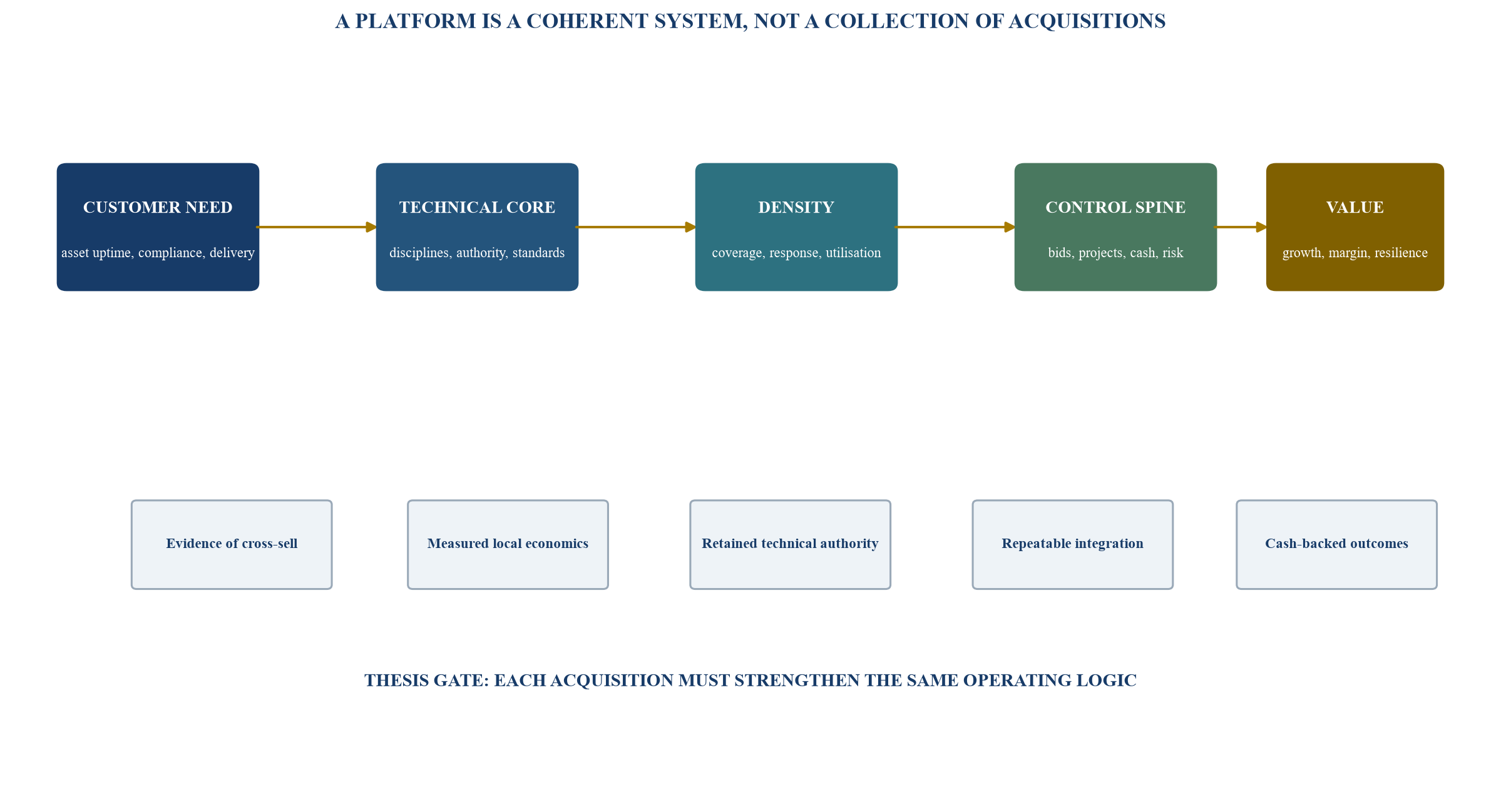
The platform exists only when acquisitions strengthen a coherent customer and operating system.
2. Map fragmentation at the level that matters
Fragmentation is often asserted from the number of registered companies. That measure can be misleading. The relevant market may be concentrated by framework access, accreditation, technical discipline, customer relationship, insurance capacity or region even when many legal entities exist. The ONS engineering footprint provides a useful starting view of enterprises, employment and turnover across grouped activities.[2] A transaction thesis requires a more granular commercial map.
The map should segment firms by service line, end market, geography, customer type, contract size, project duration, route to market and regulated status. It should distinguish independent specialists, regional multidisciplinary firms, national platforms, contractor-owned consultancies, public-sector spin-outs and subsidiaries of international groups. It should also identify firms that appear independent but depend on one founder, customer, framework, licence or professional indemnity arrangement.
Market capacity matters alongside company count. A small specialist may control a scarce approval, team or client relationship. A larger firm may carry revenue that cannot transfer because the framework is entity-specific or the client has change-of-control rights. Addressable acquisition supply should therefore be measured after strategic fit, owner willingness, quality, affordability and transferability are considered.
The map should be dynamic. Infrastructure programmes, regulation, decarbonisation, digital engineering and public procurement can shift demand and capability. The UK industrial strategy identifies engineering-related growth sectors and describes professional and business services, including architecture and engineering, as a national strength.[3][4] The acquisition thesis should translate those policy directions into verified customer budgets and procurement activity before assigning value.
Table 1. Market-fragmentation map for an engineering-services roll-up
| Dimension | Questions | Evidence | Thesis implication |
|---|---|---|---|
| technical discipline | which capabilities are scarce, regulated or complementary? | accreditations, staff profiles, project references | defines adjacency and technical moat |
| geography | where do customers require local mobilisation and supervision? | project locations, travel, response time, office utilisation | defines density cells |
| customer route | direct award, framework, contractor supply chain or tender? | contracts, framework terms, win history | tests revenue transferability |
| project economics | what drives fee, utilisation, variation and cash? | project ledgers, timesheets, backlog and aging | tests margin quality |
| ownership | which firms are genuinely available and succession-ready? | shareholder objectives and governance | defines realistic pipeline |
| regulatory exposure | which licences, security controls or notifications apply? | legal and regulatory diligence | affects timing and integration perimeter |
The entries are analytical categories; management should populate them from verified company and customer evidence.
3. Choose a density cell rather than a national slogan
Regional density can create operational value when projects need local knowledge, site access, short response times, supervision or client intimacy. It can also improve the economics of shared specialists and reduce unproductive travel. Density should be defined around customer and delivery patterns rather than administrative boundaries. A useful cell may be a metropolitan region, infrastructure corridor, cluster of regulated assets or travel-time radius.
The density thesis should quantify how work actually flows. Management should map project locations, staff homes and offices, customer sites, travel time, subcontract use, specialist demand, supervision load and bid opportunities. The objective is to understand which resources can be pooled and which must remain dedicated. A national map with office dots says little about the operating system.
Density can support utilisation when teams share peaks and troughs across nearby projects. It can increase bid capacity when one regional hub assembles technical and commercial inputs. It can strengthen resilience when a customer is no longer dependent on one local individual. It can improve leadership leverage when discipline heads supervise multiple teams within a manageable operating radius.
Density can also destroy value. Office consolidation may weaken customer access or trigger unwanted departures. Central allocation can replace accountable local decisions with delay. Travel may rise when nominally adjacent locations are poorly connected. Acquired firms may compete for the same limited talent and customers. The density case needs a baseline and post-acquisition measures rather than a promise of regional synergy.
4. Model density economics through operational drivers
The financial model should connect density to observable operational variables. Revenue effects may include higher win rates, larger accessible tenders, cross-service penetration, faster response and improved retention. Cost effects may include reduced subcontracting, shared offices, common software, combined recruitment and central support. Working-capital effects may include better contract administration, billing and collection. Integration cost and disruption should be modelled explicitly.
An illustrative model can compare a stand-alone baseline with a density case. The baseline should retain each firm's current revenue, fee rates, utilisation, subcontract spend, office cost, support cost and working capital. The density case should change only drivers supported by a specific action. A proposed utilisation increase requires a resource-pooling mechanism and visible demand. A proposed cross-sell requires account ownership, customer permission, capability proof and a pipeline. A proposed office saving requires lease facts and a delivery plan.
Synergies should have timing, cost, confidence and cash consequences. A payroll reduction is different from avoided future hiring. A higher utilisation assumption may create revenue only when demand exists and staff have available time. Software consolidation can require migration cost, retraining and contract termination fees. The value model should therefore distinguish contracted, actioned, evidenced and realised benefits.
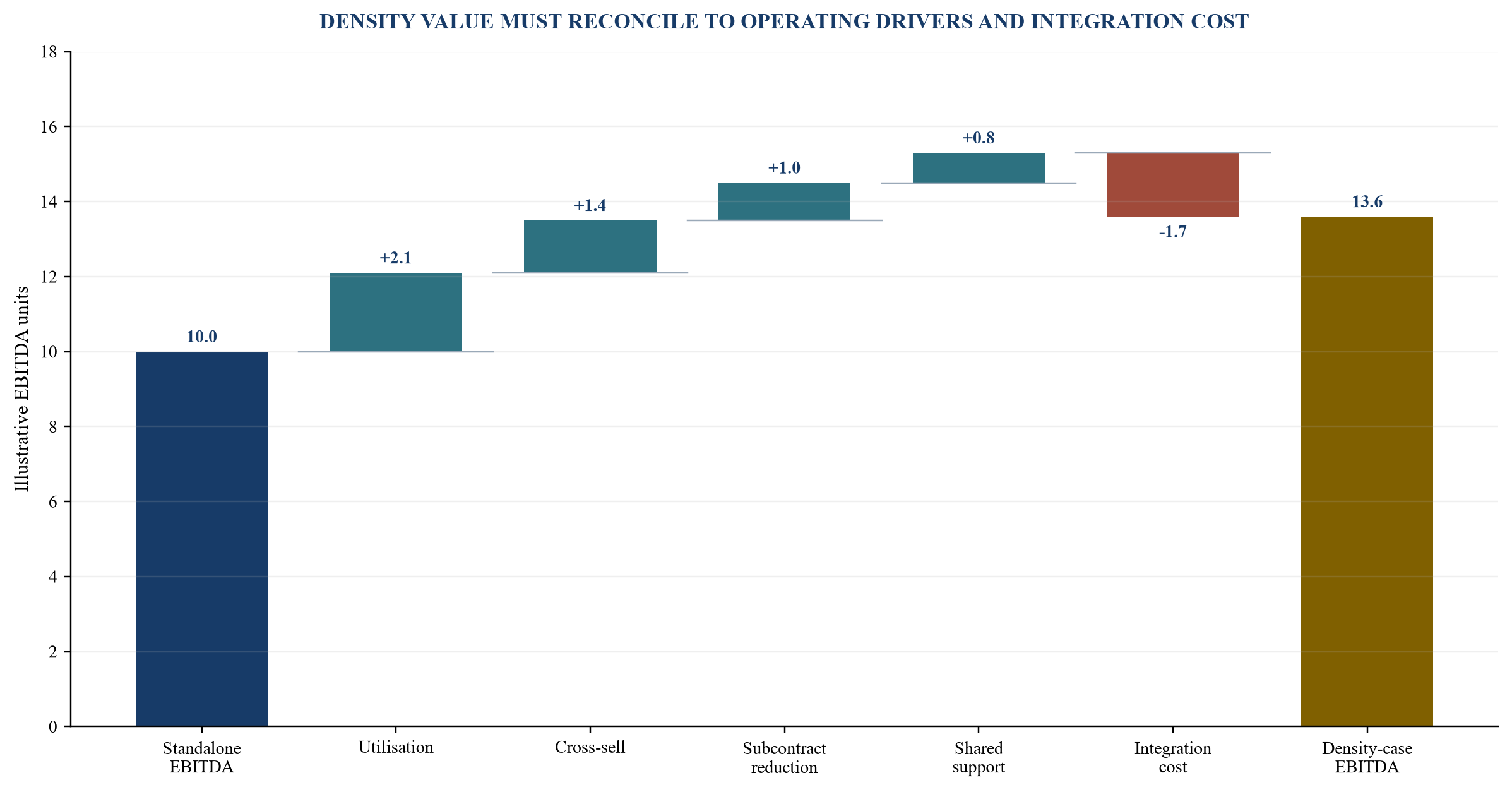
Values are hypothetical management assumptions; the bridge demonstrates driver logic rather than market performance.
Table 2. Density-economics driver sheet
| Driver | Baseline measure | Action mechanism | Verification | Principal risk |
|---|---|---|---|---|
| utilisation | productive hours by discipline and region | pooled scheduling and demand visibility | billed hours and delivery quality | overloading scarce staff |
| cross-sell | services per priority account | joint account plans and capability teams | awarded work and collected margin | customer resistance |
| subcontracting | external spend by skill and project | internal specialist network | displaced spend and staff cost | capacity mismatch |
| response time | mobilisation time and travel | local resource cell | service-level performance | nominal rather than real proximity |
| support cost | finance, HR, IT and premises cost | shared platform services | ledger and headcount evidence | service degradation |
| working capital | application, invoice and collection cycle | common commercial controls | cash conversion and aging | inherited disputes |
Each benefit should be linked to an accountable action and a cash-verification rule.
5. Treat technical talent as an operating asset
Engineering-services value is carried in people, teams, professional judgement, methods, customer trust and the ability to sign or approve work. EngineeringUK reports broad demand for engineering roles and continuing recruitment difficulty across specialist skills.[5][6] The UK Government's infrastructure pipeline also highlights substantial future workforce requirements.[1] An acquisition strategy that assumes talent can be replaced readily may therefore understate both risk and investment need.
The talent thesis should identify technical authorities, discipline leaders, project directors, client anchors, estimators, digital specialists, apprentices and high-potential successors. It should distinguish formal role from practical dependency. The founder may own customer trust; a senior engineer may hold the accreditation; a project administrator may understand the billing evidence; a small group may carry the tacit method for complex work.
Retention requires more than a completion bonus. Technical professionals evaluate workload, leadership, autonomy, standards, career path, professional development, tools, project quality and reputation. A roll-up that centralises decisions without creating a credible professional community can weaken the reasons people joined the acquired firm. The platform should define what remains local, what becomes common and how technical authority is protected.
Succession should be designed before dependency becomes a departure. Each critical role needs a deputy, documented authority, knowledge-transfer plan, customer transition and workload review. Retention arrangements should be coordinated with employment law, tax, transaction structure and fairness. Management should monitor regretted attrition, vacancy time, offer acceptance, professional development and leadership coverage by discipline and region.
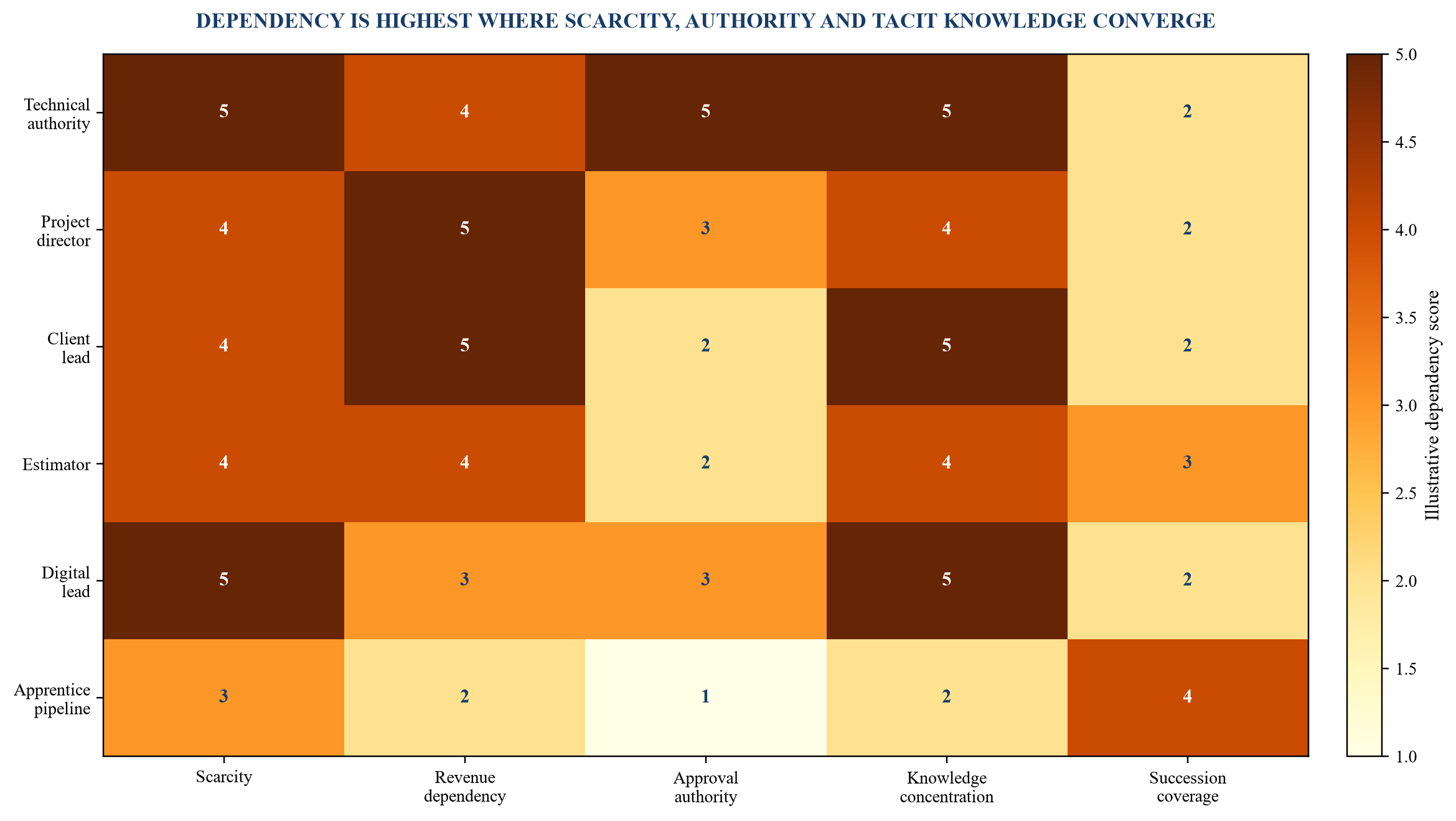
Scores are hypothetical; the heat map illustrates a role-based dependency assessment.
6. Screen targets for platform contribution
The target screen should begin with strategic contribution and disqualifying risk. A target may add regional density, a scarce discipline, a framework, a customer relationship, delivery capacity or leadership. The screen should state which platform gap the acquisition fills and whether the same outcome could be achieved through recruitment, partnership or organic investment.
Financial quality should be assessed at project level. Revenue growth, EBITDA and backlog can conceal fixed-price losses, late changes, unbilled work, disputed receivables, unsustainable founder effort or underinvestment in systems and people. The screen should examine fee mix, contract type, customer concentration, project duration, utilisation, subcontract dependence, bid conversion, margin variance, cash conversion, professional indemnity claims and repeat business.
Transferability is central. Customer and framework contracts may contain assignment, novation, change-of-control, security, data or accreditation conditions. People may be free to leave. Software and methods may be licensed to an individual or another entity. Offices may support local access but carry onerous leases. The screen should downgrade value that cannot be shown to transfer.
Integration capacity belongs in the acquisition score. A high-quality target can be a poor next acquisition when the platform lacks leadership, systems bandwidth or customer-cover capacity. The investment committee should see the current integration load, unresolved prior-deal risks and the people who will execute the next transition.
Table 3. Acquisition scorecard for UK engineering-services targets
| Scorecard domain | Core test | Evidence | Stop condition |
|---|---|---|---|
| platform fit | fills a defined capability, density or customer gap | thesis map and customer interviews | no identifiable platform contribution |
| revenue quality | repeatable, transferable and economically sound work | contracts, cohorts, backlog and project files | material revenue cannot transfer |
| project economics | margins reconcile from bid through cash | project ledgers and cash evidence | unexplained loss or recovery dependence |
| talent | critical roles can be retained and succeeded | role map, interviews and employment terms | irreplaceable dependency without plan |
| liability | technical, contractual, insurance and safety exposure is bounded | claims, policies, files and adviser review | unquantifiable material exposure |
| integration | target can enter the common control spine | systems, data and operating-model assessment | integration exceeds platform capacity |
Weighting should be agreed before targets are scored; a high total cannot override a disqualifying risk.
7. Diligence the project portfolio, not only the accounts
Engineering-services diligence should trace revenue and margin to contracts, projects, people, deliverables and cash. Historical financial statements provide an aggregate view. The acquisition decision depends on whether the underlying projects are repeatable, correctly forecast and collectible.
A project sample should cover the largest contracts, loss makers, high-margin jobs, recent completions, disputed work, aged receivables, major change orders and key customers. For each project, the team should reconcile tender assumptions, executed terms, budget, progress, forecast-at-completion, variations, claims, invoices, certificates, cash, retention and close-out. Differences between operational and finance records require explanation.
Backlog should be classified by contractual status, remaining scope, expected margin, resource need, cash profile, customer dependency and termination rights. Pipeline should remain separate from backlog. Framework appointment without awarded task orders should not be treated like contracted work. A customer forecast should not replace signed authority.
Quality of earnings should examine owner compensation, unpaid overtime, under-resourced support, capitalised software, subcontractor classification, exceptional claims, insurance recoveries, rent, recruitment cost and deferred investment. Working-capital analysis should separate normal timing from structural disputes, weak billing practice and client credit risk.
8. Protect customers and contracts through change of control
Customer continuity begins before signing. The acquirer should identify consent, assignment, novation, key-person, security, confidentiality, data, conflict and change-of-control provisions. It should distinguish legal rights from relationship risk. A contract may continue legally while the customer re-tenders future work because the local identity or founder relationship has changed.
Priority accounts need a transition plan with named relationship owners, communication timing, active projects, service risks and cross-sell boundaries. Communication should explain continuity and customer benefit without making claims that delivery teams cannot support. Sensitive customers may require pre-completion planning within clean-team and confidentiality constraints.
Public-sector and regulated work may involve framework rules, security clearance, supplier assurance and procurement obligations. The platform should preserve entity-specific credentials until transfer is verified. A rapid legal-entity consolidation can create avoidable contract or accreditation risk.
Customer concentration should be assessed across the combined group. Two targets may appear diversified individually while serving the same principal customer, contractor or programme. Density can increase customer relevance and bargaining strength; it can also increase dependence and competition scrutiny in a narrow local market.
9. Address competition and national-security gates early
UK merger control is fact-specific. Current government guidance describes turnover, share-of-supply and hybrid tests. It states that the turnover test can apply where the target has UK turnover of at least £100 million; the share-of-supply test involves a combined share of at least 25 percent with an increment and at least one party with UK turnover above £10 million; and the hybrid test can apply to a party with at least 33 percent share of supply and UK turnover over £350 million when the other party has a UK connection.[7][8] Parties should use current legal advice because market definition, share of supply and jurisdiction can be complex.
A density strategy deserves particular attention because local or regional concentration may matter even when national shares appear modest. The acquisition map should identify overlap by discipline, customer group, procurement framework and region. It should also assess whether serial acquisitions change the competitive picture over time.
The National Security and Investment regime can apply to acquisitions connected with the UK, including mandatory notification in defined sensitive areas. Government guidance identifies areas such as advanced materials, advanced robotics, artificial intelligence, civil nuclear, data infrastructure, defence, energy, military and dual-use, quantum technologies and transport.[9][10] Engineering-services targets may work across these areas even when their public description appears general.
The regulatory workstream should classify activities, control thresholds, sensitive contracts, information, sites and customers at screening. Completion conditions, information access and integration plans should reflect the outcome. The commercial team should avoid treating regulatory review as a late legal formality.
Table 4. Transaction-gate register
| Gate | Screening question | Evidence owner | Timing consequence |
|---|---|---|---|
| CMA jurisdiction | could turnover, share-of-supply or hybrid tests apply? | competition counsel and strategy | notification analysis and deal timetable |
| NSI | does the target perform activities in a sensitive area? | regulatory counsel and technical diligence | mandatory or voluntary notification assessment |
| customer consent | can contracts or frameworks continue after control changes? | legal and account owner | conditions, waivers and communication |
| TUPE and employment | what employee-transfer and consultation duties apply? | employment counsel and HR | information and consultation plan |
| accreditation | do licences, approvals or signatory rights transfer? | technical authority | operating perimeter and entity structure |
| insurance | does historic and future work remain covered? | risk and insurance adviser | run-off cover, warranties and exclusions |
The table is a governance checklist and does not replace transaction-specific legal advice.
10. Design the talent deal before completion
The talent plan should be part of transaction design. It begins with the critical-role map and extends to leadership, rewards, communication, culture, professional development and workload. The acquirer should know which people require direct engagement, which decisions can be communicated before completion, and which arrangements depend on legal or tax advice.
UK employee-transfer rules can apply when a business changes owner. Government guidance explains that employees' jobs, terms and continuity may transfer under TUPE in relevant cases and describes information and consultation obligations.[11]-[14] The application depends on transaction facts. The integration plan should therefore be built with current employment advice rather than assuming immediate harmonisation.
Retention value should be earned through the future operating model. Technical leaders need clarity on authority, standards, client ownership, investment and career path. Project teams need certainty on reporting, systems and current commitments. Junior staff need visible development and mentorship. Central functions need a realistic transition sequence.
Management should measure retention quality, not only headcount. Regretted departures, client-facing continuity, technical-signatory coverage, promotion, recruitment lead time, billable capacity, utilisation and employee sentiment provide a fuller view. A group can retain most employees while losing the few people who carry the platform thesis.
11. Establish an integration factory with controlled waves
A repeatable acquisition programme needs an integration factory: a standard governance and evidence system that can be adapted to each target. The factory should define phases, decision rights, workstreams, minimum controls, templates, data standards, escalation routes and completion criteria. It should preserve delivery continuity while making value and risk visible.
The first wave protects customers, people, cash, systems access, insurance, licences, suppliers and decision authority. The second establishes a common control spine across finance, project reporting, commercial management, HR data, cyber security and performance. Later waves capture selected commercial, capability, procurement, technology and property benefits.
Standardisation should focus on interfaces and minimum controls. Engineering methods may need discipline-specific treatment. Local customer ownership may remain essential. A common chart of accounts, project identifier, cash forecast and risk taxonomy can improve group control without forcing every team into identical delivery practice on Day 1.
The factory should learn. Each acquisition should record assumptions, incidents, customer outcomes, retention, migration effort, synergy delivery and unplanned cost. The next investment case should use the evidence. A strategy that repeats the same optimistic assumptions is scaling transaction activity rather than organisational capability.
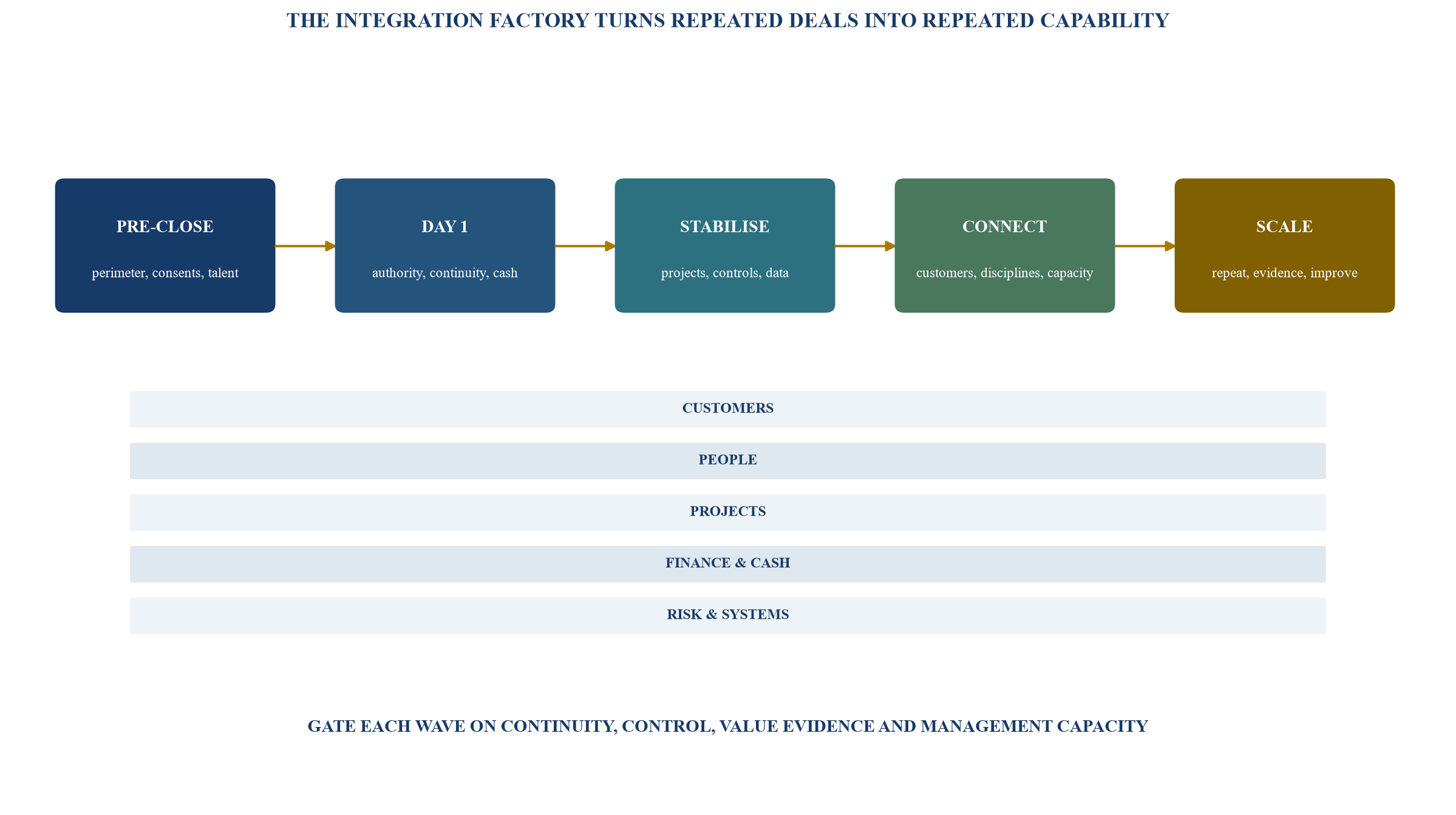
Delivery continuity precedes control-spine adoption and evidence-based value capture.
12. Build one project and financial control spine
The control spine should connect project, commercial and financial facts. At minimum, each project needs a unique identifier, customer, contract, service, region, project manager, technical authority, original fee, approved changes, forecast fee, budget, actual cost, forecast cost, margin, billing, cash, retention and risk status.
Acquired firms often use different definitions of backlog, utilisation, project completion, work in progress, change value and overhead. The integration team should define a data dictionary before consolidating metrics. Group reporting should preserve reconciliation to local source systems until migration is complete.
The monthly project review should explain movement from prior forecast. New awards, scope changes, productivity, subcontract cost, delay, write-offs, revenue treatment, certification and collections should appear in one bridge. Finance should retain authority over accounting policy. Project leaders should own operational evidence and corrective actions.
Cash deserves an early common process. Thirteen-week cash forecasts, payment applications, invoices, aged receivables, disputes and promises to pay should be visible across the group. Acquisitions can increase borrowing need when growth, integration cost and inherited working-capital weakness coincide. The financing plan should reflect the combined downside.
13. Capture cross-sell through account evidence
Cross-sell is frequently included in buy-and-build cases and rarely self-executing. Customers may value integrated capability, prefer specialist independence or restrict supplier lists. The platform should test demand with priority accounts and identify where combined delivery solves a real problem.
An account plan should map customer assets, programmes, decision makers, current services, adjacent needs, procurement routes, performance history and conflicts. The acquired firm's relationship owner should remain visible. Technical specialists should join when their capability is relevant. Commercial pressure that outruns delivery capacity can damage the original relationship.
Cross-sell reporting should progress through evidence states: identified need, qualified opportunity, permitted introduction, proposal, award, delivered work, margin and collected cash. Revenue should be attributed carefully so the platform can distinguish genuine combination value from normal growth.
The strongest platform benefit may be qualification rather than immediate revenue. A broader team can meet framework requirements, demonstrate resilience, offer multi-disciplinary delivery and support larger bids. Those benefits should still be tracked through tender eligibility, win rates and project economics.
14. Use technology to strengthen delivery and knowledge transfer
A shared technology layer can support resource visibility, document control, project forecasting, customer management, quality, cyber security and knowledge reuse. The choice should begin with operating requirements. Acquiring firms and forcing rapid system migration without clean data and stable processes can increase delivery risk.
Digital engineering methods, common data environments, automation and AI can improve design, analysis, document handling and project control. Their value depends on data rights, model governance, professional review, cyber controls and customer requirements. The platform should identify which tools are approved for which information and decisions.
Knowledge transfer should combine structured repositories with communities of practice, peer review, technical forums and mentoring. Tacit judgement cannot be captured fully in a database. The operating model should create time and incentives for experts to teach, review and codify methods.
Technology synergies should be measured through adoption and outcomes. Licence reduction, faster onboarding, lower rework, improved forecast accuracy, retrieval time and audit evidence can support the case. A completed migration is an activity measure rather than proof of operating value.
15. Finance the acquisition pace through downside capacity
A buy-and-build financing plan should reflect purchase consideration, fees, deferred payments, earn-outs, integration cost, working-capital investment, tax, refinancing and downside liquidity. The group may appear asset-light while carrying significant payroll, project liability and cash-conversion exposure.
Debt capacity should be tested against project volatility, customer concentration, utilisation, rate pressure, claims and acquisition timing. Covenant forecasts should include slower synergy, delayed integration, weaker collection and a pause in acquisitions. Earn-outs and deferred consideration can align price with performance but can also complicate integration, decision rights and cash planning.
The capital structure should preserve the ability to protect delivery and talent. Cutting recruitment, training, insurance or project controls to meet a short-term leverage target can weaken the platform. Investment committees should see a funded base case, downside and severe but plausible scenario.
Acquisition pace should be governed by integration capacity and liquidity. A pipeline of attractive targets does not create an obligation to transact. The platform should maintain explicit stop rules based on customer incidents, senior attrition, project-control failure, covenant headroom, unresolved migrations and management bandwidth.
Table 5. Acquisition-pace and funding gate
| Gate | Evidence reviewed | Proceed signal | Pause signal |
|---|---|---|---|
| liquidity | thirteen-week cash and downside funding | funded integration and operating needs | dependence on uncertain collection |
| leverage | covenant and refinancing forecast | resilient headroom under downside | headroom relies on unproven synergy |
| customers | incidents, retention and service levels | stable priority accounts | material unresolved service failure |
| talent | critical-role retention and vacancies | technical coverage maintained | loss of authority or succession gap |
| controls | project, finance and cyber readiness | minimum spine operating | unreconciled data or access weakness |
| management | workstream capacity and prior-deal closure | accountable leaders available | repeated overdue integration actions |
Thresholds should be approved from the platform's own evidence and financing terms.
16. Govern value through an evidence ledger
The value-creation plan should translate the acquisition thesis into initiatives with baselines, owners, milestones, costs, risks, timing and verification. Each initiative should connect to revenue, margin, cash, resilience or strategic option value. The finance function should define how realised value will be measured against the approved baseline.
A synergy ledger should distinguish gross benefit, dis-synergy, cost to achieve, timing, cash and accounting presentation. It should avoid double counting between cross-sell, utilisation and headcount. It should also identify benefits captured in the purchase price or stand-alone plan so the group does not claim normal performance as acquisition value.
Board reporting should show the investment thesis alongside operating evidence. Target count, revenue and adjusted EBITDA are insufficient. The board needs customer continuity, project margin, cash conversion, technical retention, integration gates, regulatory items, realised value and unresolved assumptions.
The ledger should also record thesis failures. A density cell may not produce shared demand. A technical adjacency may not cross-sell. A central service may cost more than expected. Early recognition allows the group to revise the playbook and allocation of capital.
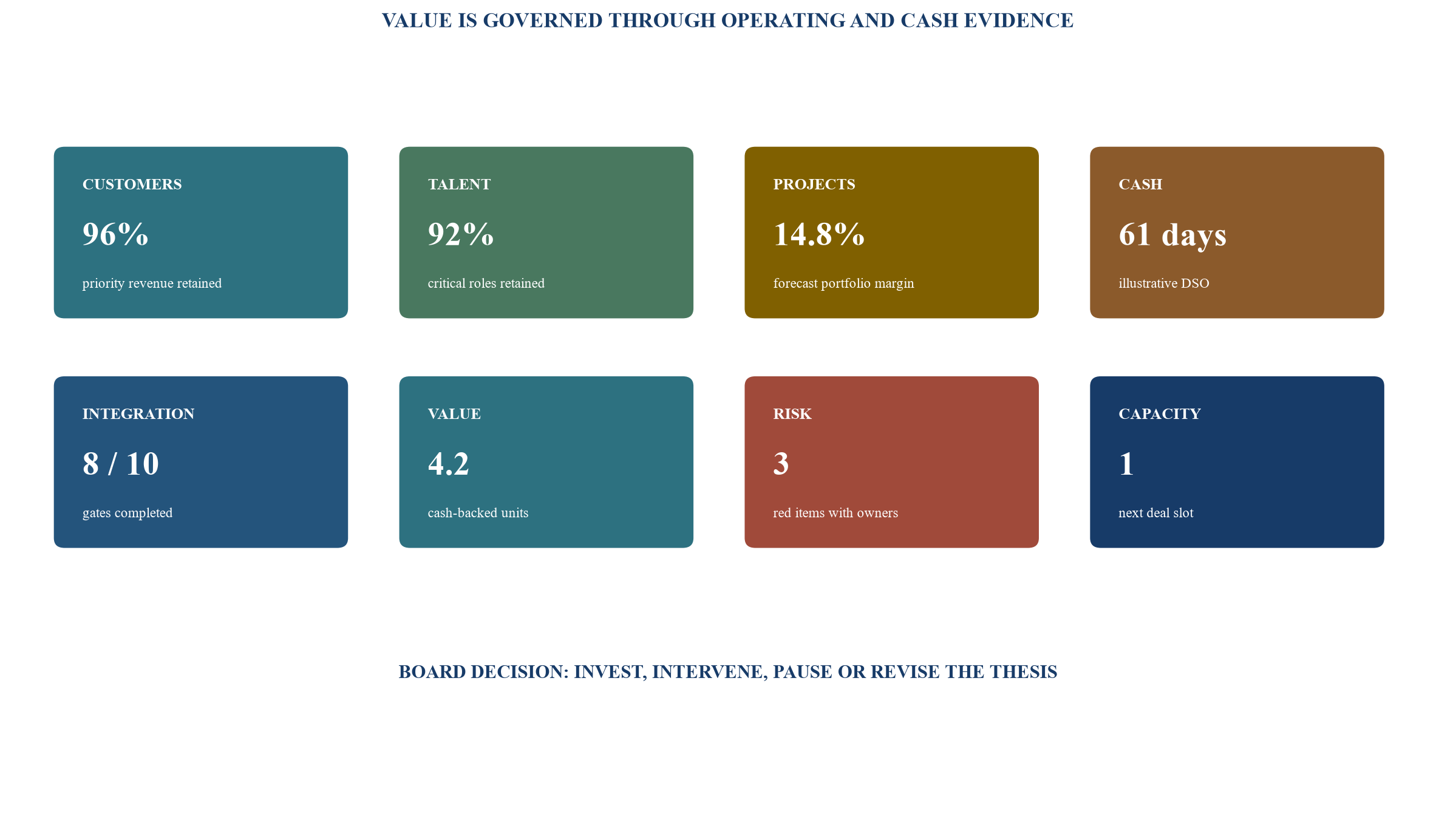
Values are hypothetical and show the relationship between operating health, integration and value evidence.
17. Execute a 180-day platform sequence
The first thirty days should protect continuity and establish facts. Management should confirm authority, customers, critical staff, live projects, cash, access, insurance, regulatory conditions and the combined risk register. It should freeze speculative system or organisation changes until the delivery perimeter is understood.
Days thirty to ninety should establish the common control spine. Project and financial definitions should reconcile. Priority account plans, talent succession, cash control, cyber access and technical governance should operate. The team should complete high-risk contract and project actions and confirm the integration cost forecast.
Days ninety to 180 should connect capability and begin selected value initiatives. Regional resource pools, joint bidding, cross-service account work, supplier opportunities, shared systems and property decisions can move through gated pilots. Each pilot should preserve quality and customer ownership.
At Day 180, the board should reassess the thesis. It should compare the acquisition case with customer, talent, project, cash and value evidence. It should decide which playbook elements are proven, which require revision and whether the platform can absorb another acquisition.
Table 6. First 180 days of an engineering-services platform integration
| Period | Primary objective | Required outputs | Board gate |
|---|---|---|---|
| pre-close | define perimeter and readiness | consents, regulatory plan, critical roles, Day 1 controls | safe to complete |
| Day 1-30 | protect continuity and establish facts | authority, customer cover, cash, project and risk baseline | stable operating perimeter |
| Day 31-60 | install minimum control spine | common definitions, reporting, cyber and commercial controls | reliable group visibility |
| Day 61-90 | resolve priority exposure | project recovery, succession, systems and working-capital actions | controlled downside |
| Day 91-180 | pilot platform value | regional pooling, joint bids, account and capability initiatives | evidence of combination value |
| Day 180 review | test acquisition readiness | thesis variance, realised value, capacity and funding | proceed, pause or revise |
The sequence should be adapted to transaction structure, customer obligations and regulatory conditions.
18. Apply explicit stop rules
A disciplined roll-up has conditions under which it will pause. Acquisition momentum, intermediary pipelines and capital availability can create pressure to continue. Stop rules protect customers, employees, lenders and shareholders from compounding unresolved problems.
Possible stop conditions include loss of a critical technical authority without replacement, a material customer incident, repeated project forecast failures, unresolved cyber weakness, covenant headroom below the approved buffer, integration actions materially overdue, regulatory uncertainty, or a density cell that fails to produce the expected operational evidence.
The stop decision should trigger an operating response. Management may redirect resources to project recovery, succession, systems, collections or customer retention. The target pipeline can remain monitored while execution capacity recovers. A pause can preserve strategic option value.
The board should also define exit tests for targets and business units. If a capability cannot be integrated, lacks strategic relevance or consumes disproportionate capital, the group should review partnership, autonomy, restructuring or divestment options. Portfolio discipline is part of platform building.
19. Structure price and consideration around evidence
Valuation should begin with the sustainable economics of the target as it will operate after completion. Reported EBITDA may require adjustments for owner remuneration, unpaid or excessive working hours, related-party costs, under-market rent, exceptional project recoveries, insurance proceeds, capitalised expenditure, recruitment gaps and deferred investment. Each adjustment should have documentary support and a clear treatment in the combined operating model. An adjustment that raises maintainable earnings while creating an equal future cash cost does not create free value.
Project-based businesses require particular care because earnings quality depends on estimates of progress, cost to complete, change recovery and collectability. The valuation team should reconcile the largest and riskiest projects, identify the range of plausible outcomes and distinguish contractual backlog from pipeline. A target with apparently strong margins may have consumed customer advances or stretched suppliers, leaving the acquirer to fund completion. A target with modest current margins may carry valuable capability and customer access, but the investment case should state the cost and time needed to improve performance.
The price bridge should connect enterprise value to equity value through debt, cash, debt-like items, working capital and transaction-specific adjustments. Debt-like analysis may include overdue payroll taxes, unpaid bonuses, deferred maintenance, litigation, onerous leases, supplier arrears, customer advances and unfunded commitments depending on the facts and the agreed definition. Working-capital targets should reflect seasonality, project mix, billing practices and growth. A simple historical average can transfer an abnormal cash requirement to the buyer.
Consideration structure can allocate uncertainty. Completion accounts can adjust for closing balance-sheet facts. Locked-box structures require diligence on leakage and the reference accounts. Earn-outs can link part of value to future performance, customer retention or project conversion. Deferred consideration can support funding and alignment. Rollover equity can preserve participation in platform value. Each mechanism introduces behaviour, governance, accounting, tax, legal and integration consequences that require transaction-specific advice.
An engineering-services earn-out should avoid incentives that conflict with project quality, safety, cash and integration. Revenue alone can reward low-margin work. EBITDA can be affected by group allocations, investment and accounting judgements. Orders can be signed on weak terms. A balanced design may use a small number of clearly defined measures, consistent accounting rules, information rights, operating covenants and dispute mechanisms. The integration plan should identify decisions reserved to the buyer and the practical autonomy needed to measure performance fairly.
Warranty, indemnity, insurance and escrow arrangements should relate to identified exposure. Technical negligence, historic projects, professional indemnity coverage, intellectual property, data, tax, employment, regulatory matters and customer claims need a coherent risk allocation. Contract language cannot replace diligence or operational remediation. The acquirer should know which historic files, evidence, people and insurance arrangements must remain accessible after completion.
Valuation should also reflect the platform's real ability to capture value. A buyer may be able to pay more for a target that completes a density cell or adds a scarce technical capability. That strategic value is conditional on retention, customer transfer and integration. The investment committee should separate stand-alone value, seller-specific improvements, buyer synergies and option value. It should identify which portion is reflected in price and which remains contingent on execution.
The final decision should be assessed against alternatives. Organic recruitment, team lift-out, joint venture, commercial alliance, minority investment or subcontract network may achieve part of the objective with different risk and control. Acquisition is justified when ownership provides a superior risk-adjusted route to the defined platform outcome and the group has the capacity to execute it.
Conclusion
Buy-and-build in UK engineering services can create a differentiated platform when acquisitions deepen a coherent customer and operating system. Regional density, scarce technical talent and integration capability form the core of the thesis. Each depends on the others. Density without talent cannot deliver. Talent without a professional operating model may leave. Integration without customer and project continuity can destroy the value it seeks to capture.
The strategy should begin with a narrow platform definition and a granular fragmentation map. Target screening should test platform contribution, revenue transferability, project economics, technical dependency, liability and integration capacity. Diligence should follow contracts and projects through margin and cash. Regulatory, customer, accreditation, insurance and employment gates should enter the timetable early.
The operating model should protect local accountability while installing a common control spine. A repeatable integration factory can govern Day 1 continuity, project and financial visibility, talent succession, technology, customers and value initiatives. Regional-density benefits and cross-sell should be measured through specific operating drivers and collected economics. The board should govern acquisition pace through liquidity, leverage, customer health, talent coverage, control readiness and management capacity.
The result is a platform whose value can be tested. It wins work because its capabilities and coverage matter to customers. It retains engineers because it provides authority, development and quality work. It converts projects into credible margin and cash. It learns from each acquisition and earns the right to complete the next one.
References
- UK Government, National Infrastructure and Service Transformation Authority. Infrastructure Pipeline update signals future workforce needs. 9 March 2026. https://www.gov.uk/government/news/infrastructure-pipeline-update-signals-future-workforce-needs
- Office for National Statistics. The engineering footprint, 2025. 30 April 2026. https://www.ons.gov.uk/businessindustryandtrade/business/activitysizeandlocation/adhocs/3394theengineeringfootprint2025
- UK Government. The UK's Modern Industrial Strategy 2025. Updated 17 July 2026. https://www.gov.uk/government/collections/the-uks-modern-industrial-strategy-2025
- UK Government. Industrial Strategy Sector Plans. Updated 8 September 2025. https://www.gov.uk/government/publications/industrial-strategy-sector-plans/sector-plans
- EngineeringUK and Lightcast. Engineering skills needs: now and into the future. 1 May 2023. https://www.engineeringuk.com/research-and-insights/our-research-and-evaluation-reports/engineering-skills-needs-now-and-into-the-future/
- EngineeringUK. Engineering and technology workforce infographic references. https://www.engineeringuk.com/research-and-insights/infographic-references/
- Competition and Markets Authority. Mergers: guidance on jurisdiction and procedure. Updated 19 December 2025. https://www.gov.uk/government/publications/mergers-guidance-on-the-cmas-jurisdiction-and-procedure
- UK Government. Mergers: when they will be investigated. https://www.gov.uk/mergers-when-they-will-be-investigated
- UK Government. National Security and Investment Act guidance on acquisitions. Updated 15 July 2026. https://www.gov.uk/guidance/national-security-and-investment-act-guidance-on-acquisitions
- UK Government. National Security and Investment Act: details of the 17 types of notifiable acquisitions. Updated 6 February 2024. https://www.gov.uk/government/publications/national-security-and-investment-act-guidance-on-notifiable-acquisitions/national-security-and-investment-act-guidance-on-notifiable-acquisitions
- UK Government. Business transfers, takeovers and TUPE: overview. https://www.gov.uk/transfers-takeovers
- UK Government. Business transfers, takeovers and TUPE: transfers of employment contracts. https://www.gov.uk/transfers-takeovers/transfers-of-employment-contracts
- UK Government. Business transfers, takeovers and TUPE: consulting and informing. https://www.gov.uk/transfers-takeovers/consulting-and-informing
- UK Government. Business transfers, takeovers and TUPE: information about employees during transfers. https://www.gov.uk/transfers-takeovers/information-about-employees-during-transfers
- UK Government. Advanced Manufacturing Sector Plan. 5 August 2025. https://assets.publishing.service.gov.uk/media/68920a3366bdd4490c61098f/industrial_strategy_advanced_manufacturing_sector_plan_accessible.pdf
- UK Government. Industrial Strategy to provide over £150 million to reinforce UK as services superpower. 24 June 2025. https://www.gov.uk/government/news/industrial-strategy-to-provide-over-150m-to-reinforce-uk-as-services-superpower
- Project Management Institute. The Standard for Program Management, Fifth Edition. 2024. https://www.pmi.org/standards/program-management-fifth-edition
- International Organization for Standardization. ISO 9001:2015 Quality management systems requirements. https://www.iso.org/standard/62085.html
