
1. The acquisition decision
An AI data-centre site is a proposed conversion system. It converts land, electrical capacity, buildings, cooling, fibre, equipment, people and operating controls into dependable computing service. The land matters because it anchors the physical system. Its investment value depends on whether the complete system can be delivered on commercially acceptable terms.
The buyer therefore faces a transaction decision rather than a conventional property decision. It must decide how much site control to acquire, how long to hold it, which evidence must mature before closing, which costs can be recovered, and when uncertainty should trigger renegotiation or exit. Paying an unconditional land price before power evidence matures can convert a development option into a stranded carrying cost.
This paper develops a grid-first acquisition method. It focuses on transaction perimeter, rights, milestones, valuation, contractual protection, funding and decision governance. Site-specific engineering, planning, legal and environmental conclusions require qualified advisers and current evidence from the relevant authorities and network companies.
2. Preserve the distinction from grid-access valuation
Grid access can have value when a defined bundle of capacity, timing, service conditions, cost and obligations improves project cash flow. A land acquisition asks a different question: what should the buyer sign, pay and assume today while that bundle is still being established?
The acquisition can involve freehold title, leasehold rights, an option, exclusivity, a conditional sale agreement, a development agreement, a project company, easements, connection applications, security deposits, studies, permits, equipment orders and customer arrangements. These assets may sit with different parties and may not transfer together.
A disciplined buyer maps each required right to its legal owner, evidence state, transfer mechanism and closing condition. The resulting structure can acquire the parcel without pretending that the power pathway is complete. This transaction focus prevents a published grid-access valuation framework from being reused as a substitute for land-acquisition diligence.
3. Power demand is changing the site market
The International Energy Agency reported that data-centre electricity demand rose rapidly in 2025 and that AI-focused facilities grew faster. Its Energy and AI work describes material growth in global electricity consumption associated with data centres and identifies grid constraints, generation availability and equipment supply as development limits.[1][2]
The commercial implication is geographic. A site close to fibre, customers and labour can still lack deliverable electrical capacity. A more distant site can gain value where transmission, generation, substation capacity and planning support create a clearer power path. Land screening must therefore combine real-estate and electricity-system evidence from the first stage.
The change also affects seller behaviour. A landowner may market headline megawatts based on a request, preliminary discussion or broader masterplan. A buyer should not price those statements as secured capacity. Every power claim needs a named counterparty, dated document, defined site, legal recipient, stage, remaining action and expiry or milestone profile.
4. Define the required service before selecting land
The buyer should begin with the intended computing service. Training clusters, inference platforms, enterprise colocation, sovereign workloads and edge facilities can require different scale, latency, security, density, expansion and resilience. The electrical requirement follows the service design.
A load brief should state the planned IT load, facility load, power-usage assumptions, phase dates, ramp, redundancy, acceptable interruption, ride-through, backup duration, onsite generation, storage, power quality and future expansion. It should identify which attributes are minimum conditions and which can be traded against cost or timing.
Without this brief, the project can acquire land against an undefined megawatt headline. The same connection may be suitable for a phased colocation facility and unsuitable for a tightly coupled AI cluster. Transaction authority should therefore depend on a controlled service requirement signed by the commercial, engineering and investment teams.
5. Build a power-to-compute architecture
Figure 1 connects the site transaction to the operating service. The framework begins with customer and compute requirements, translates them into electrical and cooling demand, links them to network and onsite supply, and then tests whether the land controls every necessary physical and legal interface.
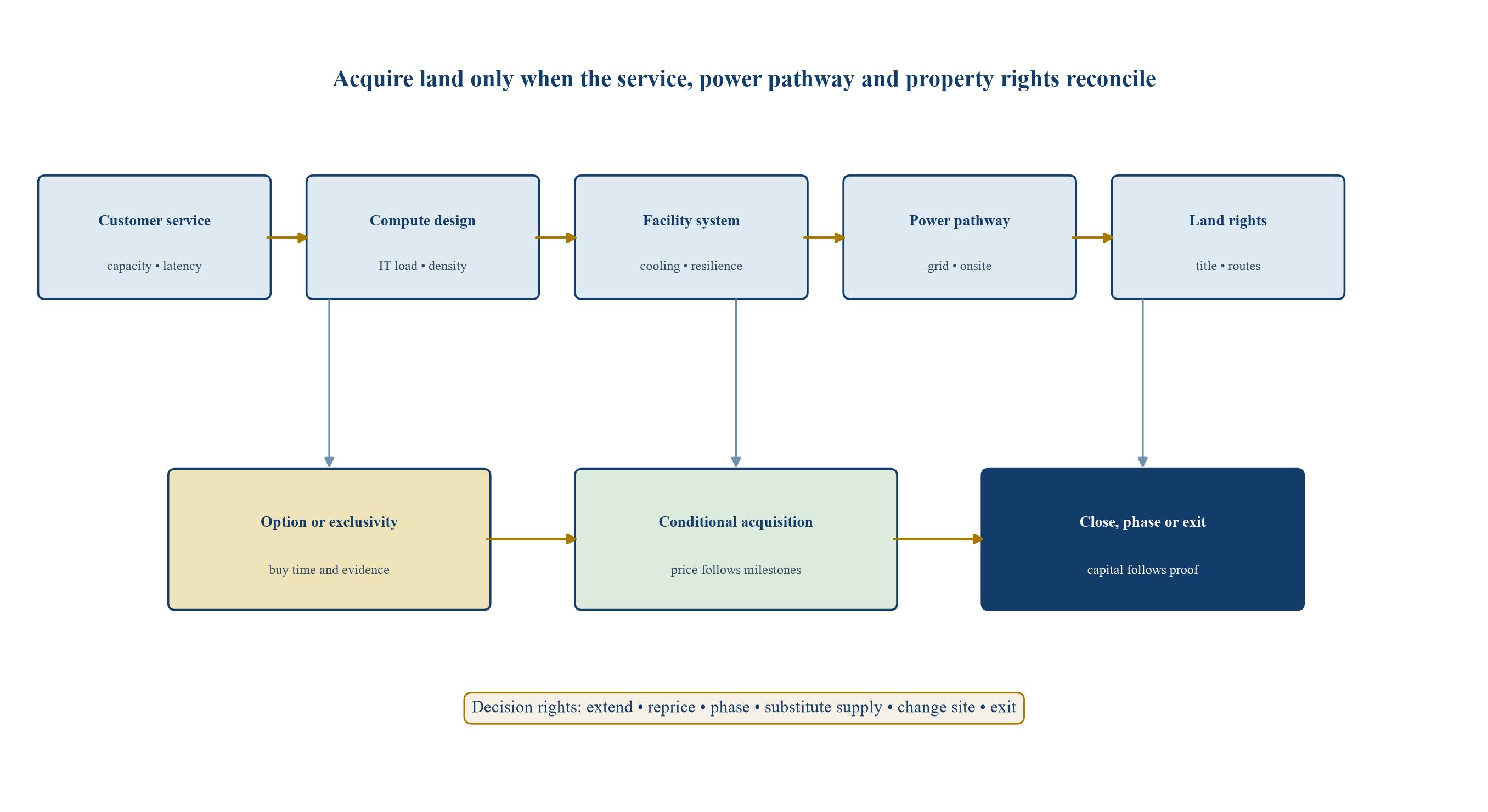
Generic transaction framework; technical requirements and contractual interfaces require project-specific verification.
6. Treat a connection claim as an evidence ladder
Connection evidence develops through stages. A request or feasibility discussion indicates interest. Screening can identify potential constraints. Detailed studies can define impacts and upgrades. An offer can state capacity, cost, milestones and conditions. Executed agreements create contractual rights and obligations. Construction, testing and energisation create operating capability.
These stages should not receive the same valuation reliance. The United States FERC large-load proceeding and NERC materials demonstrate that large computational loads are receiving specific regulatory and reliability attention.[3][4] Great Britain is also reforming demand connections and considering commitment fees and project milestones to address speculative applications.[5][6]
The buyer should record the evidence stage without promotional adjectives. It should state what the document proves, what it leaves unresolved and which party controls the next action. A maturity grade is useful only when the underlying file remains available for independent review.
Table 1. Connection evidence and acquisition treatment
| Evidence state | What may be evidenced | What remains uncertain | Acquisition treatment |
|---|---|---|---|
| Initial request | requested load and proposed site | feasibility, cost, date, route and authority | retain through short exclusivity only |
| Screening response | preliminary network constraints | detailed upgrades, firm date and commercial terms | option price only; no capacity premium |
| Detailed studies | technical scope and indicative works | final offer, security, consents and construction | conditional contract with study conditions |
| Connection offer | stated capacity, date, cost and milestones | acceptance, transfer, performance and delivery | price contingent on legal and technical review |
| Executed agreement | contractual rights and obligations | permits, network works, equipment and testing | risk-adjusted premium with milestone protection |
| Infrastructure under construction | physical progress and committed expenditure | completion, commissioning and reliability | phased closing or deferred consideration |
| Energised and tested capacity | operating connection at stated conditions | continuing compliance, tariff and expansion | evidence supports operating-site valuation |
Illustrative transaction treatment; applicable network rules, agreements and legal advice govern each project.
7. Verify that the right belongs to the transaction
A technically credible connection can still sit outside the transaction perimeter. The application may belong to the seller, a tenant, a master developer, an affiliate or a utility customer that is not being acquired. The land parcel may form only part of the area described in the network documents.
Legal diligence should reconcile the connection recipient, company number, site coordinates, voltage, point of connection, route, land title, easements, security provider and proposed buyer entity. It should test assignment, novation, change of control, termination, milestone default and the consequences of a revised development plan.
The acquisition agreement should state the mechanism that delivers the power right. Share purchase, asset transfer, novation and continued seller cooperation create different risks. Where consent is required, closing should not assume it. A condition, retention, deferred consideration or escrow can align payment with successful transfer.
8. Site control should match the network route
Data-centre land is not limited to the building footprint. The system can require substation land, cable corridors, access roads, drainage, cooling infrastructure, generation, fuel storage, battery systems, water connections, security setbacks and future expansion areas.
The buyer should map the point of connection to the facility intake and identify every intervening right. A missing easement or third-party crossing can delay energisation even where capacity is available. Temporary construction rights can differ from permanent operating rights. A route may cross land subject to environmental, heritage or community constraints.
Title review should therefore use the electrical single-line, route drawing and civil design rather than a parcel plan alone. Each required strip or compound needs an owner, legal instrument, term, access regime, maintenance right, restoration obligation and transfer path.
9. Queue position is not land value
Connection queues can contain projects with different maturity, duplicate applications, alternative sites and uncertain demand. Great Britain reported rapid growth in contracted demand offers, driven significantly by data-centre applications, and proposed a commitment fee and milestones in 2026.[5] The policy response illustrates why a queue entry must be treated as conditional evidence.
The buyer should examine application age, study stage, security paid, land control, planning progress, equipment orders, customer evidence, utility correspondence and milestone compliance. It should also examine the upstream transmission, generation or substation projects on which the connection depends.
A seller's queue position can preserve optionality. It does not establish a deliverable energisation date. The acquisition model should assign value to the probability-weighted and contractually usable power path, net of required capital, delay and continuing obligations.
10. Match the land contract to the evidence state
Early evidence generally supports reversible site control. A short exclusivity agreement can prevent sale while initial utility and planning work is checked. An option can preserve the right to purchase for a defined period and price. A conditional sale can move the parties toward closing while reserving termination if specified conditions fail.
The structure should reflect who controls each condition. The buyer can often control surveys, design and diligence. The seller can control title defects, cooperation and existing applications. The utility, planning authority and other third parties control approvals and network outcomes.
Long-stop dates, extension rights, cost sharing and evidence standards should recognise these control boundaries. An obligation to use reasonable efforts is not equivalent to delivery of capacity. The contract should state which result is required and which party bears the cost if it is not achieved.
11. Price the option, not the promotional future
An early-stage site can have option value because the buyer can spend limited capital to discover whether a financeable project exists. That value depends on exclusivity, term, access, information rights, extension mechanics, assignment, price certainty and the ability to exit.
The option fee should be compared with the cost of losing the site, the probability of clearing the next gates and the capital required to obtain evidence. A large non-refundable deposit can defeat the protective purpose of an option. A low fee with an uncontrolled purchase-price reset can leave the buyer exposed after it creates value through studies and approvals.
The agreement should address who owns new studies, applications, designs and deposits if the option is not exercised. It should prevent the seller from using buyer-funded evidence to re-market the site without agreed compensation or restrictions.
12. Connection timing drives carrying cost
The economic gap between land closing and energisation can contain interest, taxes, security, staff, advisers, design, equipment deposits, site works and opportunity cost. Customer revenue can remain unavailable while these costs accumulate.
The IEA describes a mismatch between data-centre development cycles and the longer time required for some grid infrastructure.[1][2] The acquisition model should therefore contain a dated connection schedule that is separate from the building schedule. It should show dependencies, float, evidence owner and the cash effect of delay.
A single energisation date hides risk. The model should include early, base, delayed and failed pathways. The delayed case can include extension payments, equipment storage, redesign, customer consequences, financing carry and re-permitting. The failed case should show recoverable land value and exit cost without assuming another data-centre buyer.
13. Separate contracted, usable and sellable capacity
Contracted capacity is the amount stated in an agreement or offer. Usable capacity is what the facility can safely draw after internal design, redundancy, losses, cooling and operating constraints. Sellable capacity is the service that can be committed to customers after resilience and ramp are considered.
These measures can differ materially. The buyer should reconcile utility units, voltage and ramp with the facility model and customer product. Capacity that arrives in stages should be linked to building phases, equipment deployment and customer acceptance.
The transaction should avoid paying for nominal capacity that cannot support revenue. Deferred price can be connected to tested, usable capacity rather than the headline connection number. The test method, measurement point, duration and permissible outages should be defined before closing.
14. Make capacity economics reproducible
Capacity economics include connection charges, network upgrades, security, contributions, onsite substations, transformers, cable routes, tariff components, demand charges, energy charges, losses, resilience, curtailment and continuing compliance. The model should identify payer, owner, accounting treatment, payment date and refundability.
The comparison unit should remain consistent. A low land price per acre can be expensive per usable megawatt if upgrades are large or timing is late. A high land price can be efficient where tested capacity, infrastructure and permissions shorten time to revenue.
The buyer should calculate total site basis and risked site basis. Total site basis includes land, transaction costs, power-path capital and directly attributable enabling expenditure. Risked site basis also reflects expected delay, failure and remediation costs. Both should be compared with feasible alternative sites on the same service basis.
15. Use a grid-adjusted residual land value
A residual approach begins with the completed project's supportable value, then deducts building, electrical, cooling, network, professional, financing, contingency and developer-return requirements. The remaining amount is a ceiling for land and site-specific rights.
The method should use scenarios rather than a single completed value. Power timing affects lease-up, customer contracting, equipment deployment and present value. Connection cost affects capital intensity. Reliability and curtailment can affect product and price. Expansion rights can create later phases.
The residual is not a market quotation. It is an internal decision boundary based on stated assumptions. The buyer should compare it with land alternatives, recent evidence where available and the seller's required price, then document why any premium is supported.
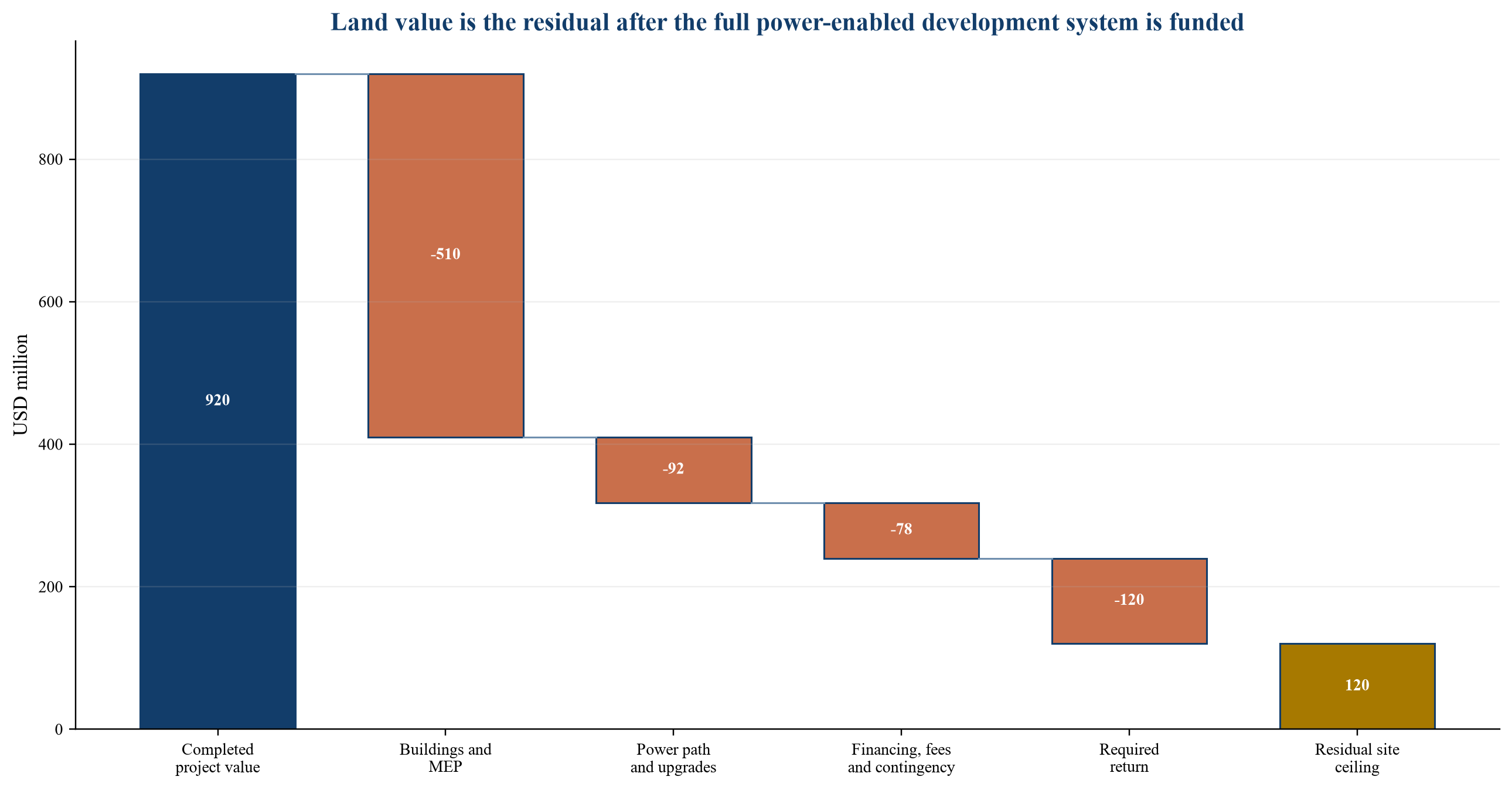
Illustrative USD million values created solely to demonstrate transaction logic; they are not market data or a valuation of any site.
16. Test the no-power land case
The downside value of the parcel should not assume another data-centre buyer. The site may have industrial, logistics, commercial, energy or other development uses, subject to planning, infrastructure and market demand. Those alternatives require separate evidence.
The no-power case should include holding cost, remediation, planning obligations, decommissioning of temporary works, adviser costs, sales period and transaction expenses. A specialised site layout or covenant can reduce alternative-use value. A favourable location or pre-existing industrial permission can improve it.
The difference between purchase price and supportable no-power value is the capital exposed to connection failure. The investment committee should see that amount explicitly before authorising a non-refundable payment.
17. Planning permission and grid rights are separate gates
Planning approval can establish that a proposed development is acceptable under the applicable planning system. It does not create electrical capacity. A connection agreement can establish network rights and obligations. It does not replace planning, building, environmental or operating approvals.
The programme should therefore maintain separate gate registers. Changes made to secure planning approval can alter load, generator configuration, cooling, height, noise, water use, traffic or construction timing. Those changes can require revisions to network studies or customer design.
The land contract should identify which planning outcome is required, what conditions are acceptable, and whether the buyer can waive or appeal. A vague condition for “satisfactory planning” can create disputes. Objective parameters and buyer discretion should be drafted with project-specific legal advice.
18. Water can change the site decision
Cooling architecture affects water and power. The United States EPA provides permitting and water-reuse resources, including material on industrial reuse and data-centre cooling.[7][8] Singapore's Green Data Centre Roadmap also treats power, water and efficiency as linked constraints.[9]
The buyer should identify water source, quality, quantity, pressure, seasonality, treatment, discharge, permits, infrastructure and community context. Reclaimed water, air cooling, hybrid systems and liquid cooling create different site and operating requirements.
Water claims should be evidenced with the same discipline as power claims. A nearby main does not prove allocated capacity or permitted discharge. The acquisition schedule should reserve time for studies and consents, and the model should test the energy and capital consequences of alternative cooling designs.
19. Fibre and latency belong in the acquisition perimeter
Power enables compute, while fibre connects it to users, networks and other facilities. The site should have feasible routes, providers, diversity, rights of way, entry points and physical separation. A marketing statement that fibre is “nearby” does not establish a contracted service.
The buyer should map carrier routes and failure domains. Two providers can use the same duct or crossing. Construction rights can depend on third-party land. Long-haul capacity and local access can have different procurement timelines.
Where latency is commercially important, measurements should use the intended routes and destinations. The acquisition decision should specify the minimum connectivity evidence required before closing and the consequences if a route cannot be secured.
20. Environmental diligence begins before site purchase
Environmental diligence should cover land, water, air, noise, biodiversity, contamination, flood, heat, waste, fuel, generators, batteries and construction impacts under the applicable regime. EPA's permitting resources illustrate the range of public tools and permit authorities that can inform United States site screening.[7]
The buyer should distinguish desktop screening from field evidence and regulator determination. A clean database search does not replace intrusive investigation where contamination risk exists. A conceptual mitigation plan does not establish an approved permit.
The land contract can provide access for surveys, allocate responsibility for existing conditions, define remediation standards and preserve termination rights. Insurance, indemnity and price retention should follow verified exposure and enforceability rather than generic drafting.
21. Reliability obligations can affect design and value
Large computational loads can have electrical characteristics that matter to power-system planning and operation. NERC's Large Loads Action Plan includes work on modelling, registration, interconnection, commissioning and operational performance.[4] FERC has also considered large-load interconnection through a dedicated proceeding.[3]
The buyer should identify applicable ride-through, protection, telemetry, modelling, ramping, curtailment, restoration and coordination requirements. These conditions can affect equipment, controls, testing, operating procedures and customer service.
Reliability obligations should be treated as development scope rather than post-closing compliance detail. The acquisition budget and schedule should include the systems and evidence required by the network operator. A condition that materially changes facility performance should feed back into customer design and valuation.
22. Flexible connection terms require a service decision
A flexible or non-firm connection can enable earlier or lower-cost access where the customer accepts defined interruption, limitation or control. The United Kingdom's 2026 strategic-demand consultation considers incentives and alignment mechanisms for demand connections, including the possible role of flexible arrangements.[10]
The commercial question is whether the proposed computing service can operate under those conditions. Some workloads can move in time or location. Others require continuous local capacity. Backup generation and storage can cover short events, while extended restrictions can exceed practical fuel, environmental or cost limits.
The buyer should model permitted curtailment, notice, duration, frequency, restoration, compensation and measurement. The land should not be priced as if a flexible connection were firm. Any customer commitment should state the same service assumptions used in the power model.
23. Onsite supply is a separate development project
Onsite generation, storage or microgrid infrastructure can supplement or substitute for grid supply. It can also introduce fuel, emissions, equipment, land, noise, safety, operational and financing requirements. The United States DOE identifies generation, storage, grid infrastructure, efficiency and demand flexibility among the tools available to meet data-centre demand.[11]
The acquisition should reserve adequate land and rights for the selected system. Gas supply, fuel logistics, renewable resources, grid export, islanding, environmental approval and interconnection need distinct evidence. A conceptual onsite-power plan should not be treated as available capacity.
The transaction model should separate base-site value from the value and cost of the power project. It should define which entity owns each asset, who operates it, how costs are recovered, and what happens if the power project is delayed or cannot be permitted.
24. Long-lead equipment can reverse the critical path
Transformers, switchgear, generators, turbines, cables and specialised cooling equipment can influence the date at which a powered site becomes usable. Equipment orders can require deposits before land closing, creating exposure across separate contracts.
The buyer should reconcile the utility design, facility design and procurement specification. A change in connection voltage or capacity can alter equipment. Storage, escalation, cancellation and warranty terms should be visible in the integrated model.
Procurement should follow evidence gates. An early reservation can preserve schedule where the specification is sufficiently stable and cancellation exposure is controlled. A full non-refundable order based on an unverified site claim can compound land risk.
25. Seller representations need evidence boundaries
Representations concerning power should be precise. The seller can represent that identified documents are complete copies, that specified communications have been disclosed, that security has been paid, that no stated default notice has been received, and that it has not assigned the relevant rights.
The seller may be unable to guarantee a utility's future performance. The agreement can still allocate risk through conditions, termination, deferred price, retention and cooperation obligations. Disclosure schedules should identify every application, offer, agreement, study, invoice, security instrument, milestone and material communication.
The buyer should avoid relying on broad promotional wording that cannot be tested after closing. Each representation should connect to a document, fact, period and remedy. Legal advisers should assess knowledge qualifiers, materiality, survival, caps and enforceability.
26. Conditions precedent should describe outcomes
A condition precedent should state the evidence required before closing. Examples can include executed transfer or novation of the connection agreement, confirmation of a defined capacity and date, acceptance of a specified upgrade-cost ceiling, secured easements, satisfactory planning parameters and no uncured milestone default.
Conditions should identify who determines satisfaction, whether waiver is permitted, how disputes are resolved and what happens at the long-stop date. A condition that simply requires “grid approval” can be too ambiguous because several approvals, studies and agreements may exist.
The condition package should match the investment thesis. If early closing is essential, the buyer can use price retention and post-closing covenants for defined residual tasks. If power is fundamental, closing can remain conditional on a more mature evidence state.
27. Deferred consideration should track delivered capability
Deferred price can align seller proceeds with connection outcomes. The trigger can relate to transfer, study completion, executed agreement, construction milestone, energisation or tested usable capacity. Each trigger should be objective and within a defined period.
The mechanism needs a calculation basis, evidence source, dispute process and treatment of buyer-caused delay. It should address partial capacity, staged delivery, changed design and network conditions. A binary payment can create a cliff where the project receives most, but not all, of the expected capability.
The buyer should ensure that deferred consideration does not remove funds needed for network works. The capital plan should rank land payments, connection security, construction, equipment and liquidity according to the project's gated priorities.
28. Use price adjustment for unknown upgrade cost
Network studies can revise upgrade scope and customer contribution. A purchase-price adjustment can share or cap this exposure. The agreement can establish a baseline cost, permitted variance, seller contribution, threshold and buyer termination right.
The adjustment should use the correct cost definition. It can include network-company charges, taxes, land and easements, owner works, financing, contingency and escalation. It should state how refunds and security releases are treated.
The buyer should avoid double counting. If the residual land value already deducts the full power-path capital, a separate price adjustment should reflect only changes from the agreed baseline. The investment model and legal formula should be reconciled before signing.
29. Acquisition structure changes risk allocation
An asset purchase can isolate selected land and rights but require assignments, novations and new permits. A share purchase can preserve contracts within the project company but also acquire historical liabilities. A long lease can reduce initial land capital while creating term, rent, security and lender-consent issues.
A joint venture with the landowner can align long-term participation, though governance and funding disputes can impede delivery. A development management arrangement can retain specialist execution capability. A sale and leaseback can release capital after the site becomes operational.
The appropriate structure depends on title, connection ownership, tax, financing, approvals, liability and control. The transaction team should compare structures against the same project cash flows and risk register rather than selecting the legal form in isolation.
30. Funding should follow evidence gates
Early site control is usually exposed to development risk. Equity, sponsor capital or strategic capital can absorb uncertain outcomes more readily than senior project debt. Debt becomes more credible as land rights, connection terms, planning, design, customer cash and completion arrangements mature.
The lender will examine whether the borrower owns or controls the required rights, whether the connection survives enforcement, whether cost and timing are bounded, and whether the project has funded completion liquidity. Security over land alone may provide limited protection if its value depends on a non-transferable connection.
The capital plan should identify each tranche, use, condition, source and fallback. Connection deposits and equipment security can tie up cash before construction. The model should prevent those amounts from being counted as available completion liquidity.
31. Data-room architecture should reveal the dependency chain
The data room should be organised by decision rather than document type alone. A power folder should connect each claim to applications, studies, offers, agreements, security, invoices, network drawings, schedules, correspondence and legal analysis. A land folder should connect title, easements, routes, surveys, planning and environmental evidence.
A controlled index should state document owner, date, version, status, relevance and unresolved question. Superseded studies should remain identifiable. Material oral statements should be converted into confirmed written evidence or labelled as unverified management statements.
Cross-references are essential. The capacity and date in the financial model should trace to the same documents used by engineering, legal and commercial teams. A mismatch register should record inconsistent load, phase, route, entity, cost or timing assumptions.
Table 2. Grid-first land acquisition data room
| Folder | Core evidence | Reconciliation test | Investment decision supported |
|---|---|---|---|
| Service and customer | product, load, ramp, resilience and customer terms | customer service matches facility and connection | required capability and revenue timing |
| Grid connection | applications, studies, offers, agreements, security and milestones | site, entity, capacity, voltage and date reconcile | connection maturity and transferability |
| Land and routes | title, lease, option, easements, coordinates and access | every electrical and fibre route is controlled | transaction perimeter and enforceability |
| Design and procurement | load model, single-line, cooling, equipment and schedule | specification matches network and customer case | cost, timing and usable capacity |
| Planning and environment | permissions, surveys, permits, water, noise and conditions | approved design remains technically and commercially viable | development legality and mitigation cost |
| Commercial model | price, capex, opex, tariff, customer cash and downside cases | all inputs trace to dated evidence | residual value and funding need |
| Transaction documents | conditions, warranties, covenants, retention and deferred price | remedies follow identified risks | signing, closing and post-close protection |
| Governance | approvals, delegated authority, risk owners and dashboard | each gate has evidence and accountable decision rights | controlled capital release |
The required contents depend on jurisdiction, transaction structure and project maturity.
32. Scenario architecture should retain alternatives
The base case should not absorb all uncertainty into one probability. A useful model includes at least four pathways: timely firm connection, delayed firm connection, earlier flexible connection and failed connection with alternative use or disposal.
Each pathway should contain capacity, date, upgrade cost, tariff, customer ramp, construction sequence, financing carry and land exit assumptions. Onsite supply or a different site can be modelled as explicit alternatives rather than hidden contingencies.
The investment committee should see the decision available at each date. The buyer can extend the option, accept a flexible connection, reduce the first phase, add generation, renegotiate price, change site or exit. These management choices create option value only where the contract preserves them.
33. A hypothetical acquisition case
Assume a buyer is considering a site intended for a phased AI data-centre campus. The seller cites a large connection application and seeks a land premium. Detailed studies remain incomplete, and the route requires third-party rights. The buyer can obtain eighteen months of exclusivity and an option, fund studies and negotiate a conditional purchase.
The numerical case below is illustrative. It does not describe a transaction, market price, utility commitment or forecast. Its purpose is to show how connection timing, usable capacity, upgrade cost and land exposure interact.
The model compares four outcomes after initial diligence. Timely capacity supports closing and construction. Delay supports an option extension and phased design. A flexible connection supports a smaller first phase if customer service remains feasible. Failure leads to exit or an alternative-use decision based on separately verified land value.
34. Stage the capital commitment
The buyer can divide capital into site-control, evidence, acquisition and build stages. The first stage pays for exclusivity, surveys and initial advisers. The second stage funds detailed network, planning, environmental and design evidence. The third stage closes the land transaction when defined conditions are met. The fourth stage releases construction capital against delivery milestones.
Each stage should have an approved ceiling and a stop condition. Past expenditure should not justify further commitment. The committee should decide using the current evidence, remaining cost and available alternatives.
Table 3. Hypothetical staged capital plan for a data-centre site
| Stage | Hypothetical capital, USD million | Evidence objective | Contractual protection | Decision |
|---|---|---|---|---|
| Exclusivity and screening | 2 | title, route, load brief and initial network position | exclusivity, access and information rights | proceed to option or exit |
| Option and detailed evidence | 8 | studies, planning path, water, fibre and design basis | fixed option terms, extensions and study ownership | sign conditional purchase or exit |
| Conditional acquisition | 55 | transferable connection package and acceptable conditions | conditions, retention, deferred price and warranties | close, reprice or terminate |
| Enabling works | 70 | route, substation, permits and long-lead procurement | milestone payments and performance security | release main construction or defer |
| First facility phase | 360 | tested usable capacity and customer-ready service | completion tests and funded contingency | operate, expand or remediate |
Illustrative amounts and gates; all values are management assumptions for framework demonstration.
35. Model timing and capacity sensitivities together
Connection delay and reduced usable capacity can interact. Delay postpones revenue and increases carrying cost. Lower capacity can reduce the scale over which fixed land and infrastructure costs are recovered. A combined matrix reveals cases that a one-variable sensitivity can miss.
Figure 3 presents hypothetical project-value effects for different energisation dates and usable-capacity outcomes. The values are invented for method illustration. The red cases indicate that the assumed project no longer supports the same land basis.
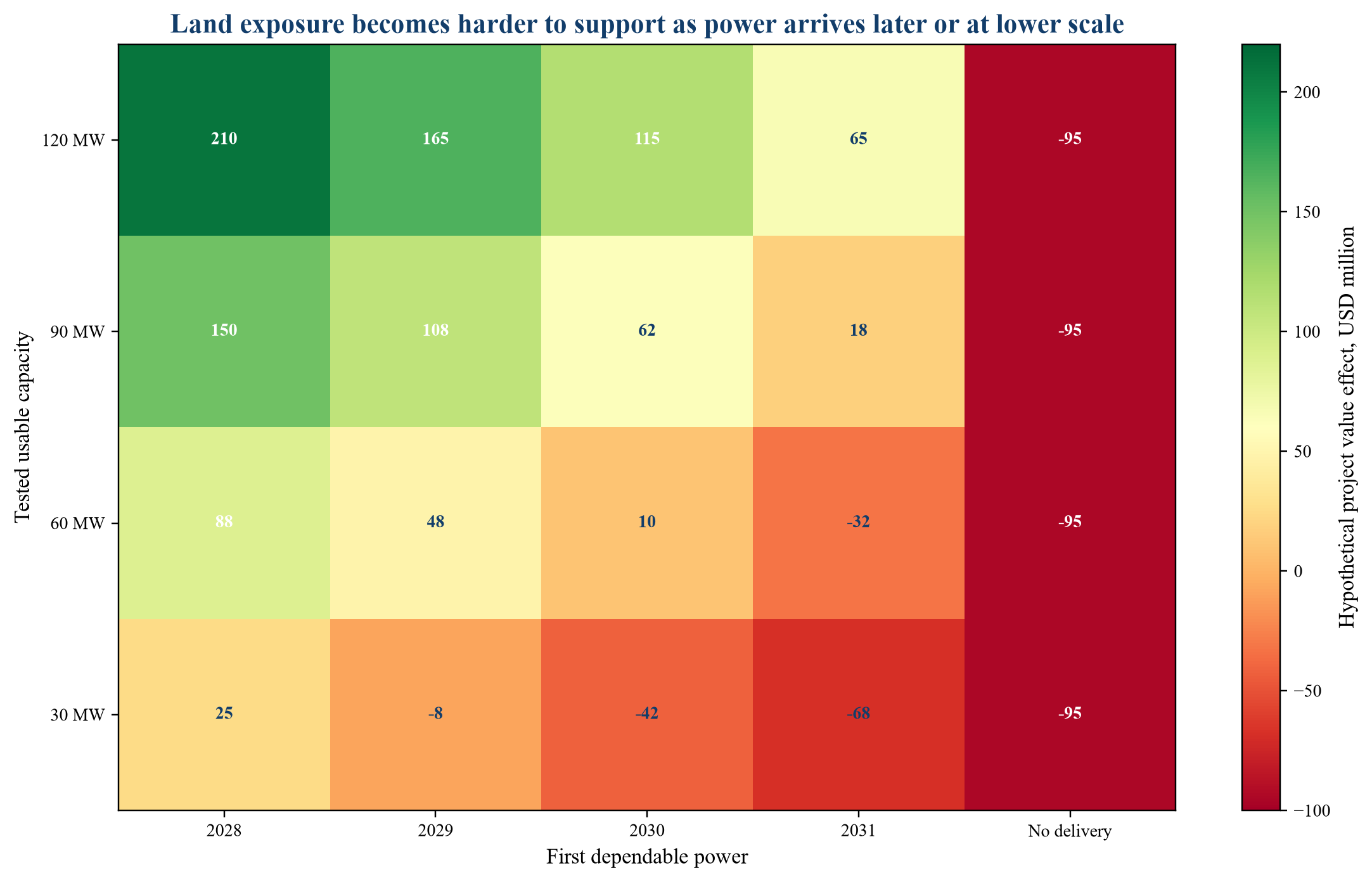
Illustrative USD million value effects; dates, capacity and values are assumptions rather than forecasts or market evidence.
36. Set a walk-away rule before signing
The buyer should define conditions that end the pursuit. Examples include inability to obtain the required land or route rights, connection terms outside approved capacity or timing, upgrade cost above a funded ceiling, unacceptable planning conditions, unresolved contamination, inadequate water or fibre, or loss of the customer case.
The rule should identify evidence, authority and timing. A project team can become attached to a site after months of work. A pre-agreed threshold protects decision quality and preserves capital for alternatives.
Exit execution also needs preparation. The agreement should address notice, study ownership, confidentiality, reinstatement, equipment orders, security refunds and public communication. A clean exit can retain useful evidence without leaving uncontrolled liabilities.
37. Compare sites on one service basis
Alternative sites should be evaluated against the same compute service and customer ramp. One site may offer earlier smaller capacity. Another may offer later larger capacity. A third may support onsite generation or better water and fibre. Direct land-price comparison misses these differences.
The comparison should show total capital, first service date, usable capacity, reliability, tariff, resilience, expansion, permitting, water, fibre, construction, customer access, financing and downside land value. Each rating should link to evidence.
The committee should also consider portfolio design. Two smaller sites can diversify connection and execution risk, though they can increase network, staffing and operating complexity. The preferred configuration should follow the service requirement rather than a general rule.
38. Governance should connect engineering and capital
The acquisition team should include transaction, legal, electrical, mechanical, civil, planning, environmental, commercial, tax, insurance, cyber and financing capability appropriate to the project. Decision rights should be explicit.
Engineering evidence should alter capital authority. A revised network date can change land value, customer contracting and equipment orders. A planning condition can change cooling and power. A legal transfer issue can remove reliance on an otherwise sound connection.
A weekly control group can manage evidence and exceptions. Formal investment-committee gates should approve option entry, option extension, conditional signing, closing, major procurement and construction release. Minutes should record the evidence relied on and the assumptions that remain contingent.
39. Build a board dashboard around exceptions
The dashboard should report the service requirement, contracted and usable capacity, connection stage, target and utility dates, network works, route rights, planning, water, fibre, environmental items, equipment, customer ramp, site-control expiry, capital committed, liquidity and current decision.
Each item needs a source, date, owner, status and threshold. Forecast movement should remain visible. Utility commitment, contractor forecast and management estimate should be distinguishable.
The board should receive the effect of each exception. A three-month delay should show the resulting carry, customer and option-extension consequences. A capacity reduction should show facility phasing and residual-value effects. The dashboard exists to support decisions rather than to display activity.
40. A 120-day acquisition programme
Days one to twenty define the compute service, load, target geographies, transaction authority and screening criteria. The team identifies candidate sites and preserves all seller and utility evidence.
Days twenty-one to forty establish title, route, connection stage, planning context, environmental screening, water and fibre. Sites that fail threshold conditions are removed. Remaining sites enter controlled exclusivity or option negotiations.
Days forty-one to eighty complete targeted technical, legal, commercial and financial work. The model compares capacity, date, total site basis, customer cash and downside outcomes. Transaction documents connect price and closing to verified milestones.
Days eighty-one to one hundred and twenty resolve exceptions, obtain committee authority and sign the appropriate site-control instrument. Unconditional closing occurs only where the approved evidence standard is met. The programme timing remains subject to jurisdiction, project maturity, authority response and transaction complexity.
41. Acquisition checklist
Service. Is the intended computing service defined in capacity, density, latency, resilience and expansion terms?
Power. Does current written evidence establish the entity, site, capacity, voltage, route, date, tariff, cost, firmness, milestones and continuing obligations?
Transfer. Will every required connection, application, deposit, study, easement and permit pass into the transaction through an enforceable mechanism?
Property. Does site control cover buildings, substations, cable and fibre routes, access, cooling, water, generation, storage and expansion?
Planning and environment. Can the required design be permitted, built and operated under current site evidence and stated mitigation?
Economics. Does the risked residual value support the land price after all power-path capital, timing, financing and return requirements?
Structure. Do option, conditions, retention, deferred price, warranties, covenants and termination rights follow the evidence gaps?
Funding. Is every stage funded without treating restricted deposits or future debt as available cash?
Exit. Can the buyer leave, reprice, phase, substitute supply or change site before unresolved conditions create uncontrolled exposure?
42. Limitations
Electricity demand, network rules, connection queues, tariffs, equipment markets, planning policy, environmental requirements, customer designs and AI hardware can change during a development period. Site-level decisions require current evidence from the relevant authority, network company, land registry, contractors, customers and professional advisers.
Official system-level projections do not establish the capacity, date, cost or rights of a particular parcel. FERC and NERC materials apply within their stated United States purposes. United Kingdom materials reflect an evolving reform programme. Singapore policy reflects its national resource and digital-infrastructure context. Each jurisdiction requires separate analysis.
Every capacity, date, cost, price, probability and value in the worked exhibits is a hypothetical assumption created for decision-framework illustration. No utility commitment, land price, transaction, customer contract or realised result is claimed.
43. Conclusion
AI data-centre land becomes investable through a complete and evidenced development system. Title and planning are necessary. Dependable power, routes, water, fibre, customer service and execution capability determine whether the parcel can support operating cash.
The buyer should acquire time and information before acquiring unconditional exposure. Exclusivity, options and conditional contracts can preserve a site while connection and development evidence matures. Price, completion and deferred consideration should follow defined milestones.
Grid-first diligence changes the order of work. The team defines the service, maps the power pathway, reconciles rights to the transaction, models dated scenarios and releases capital by evidence gates. The result is a land decision that remains connected to the operating asset it is intended to create.
Frequently asked questions
Does a connection application justify a land premium?
An application can preserve an opportunity. A premium requires evidence of capacity, timing, cost, transferability, milestones and a credible delivery path. The amount should reflect remaining capital and risk.
Should the buyer purchase or option the site?
The structure should follow evidence maturity and commercial urgency. An option or conditional agreement can preserve the site while power, planning, water, fibre and environmental evidence develops.
What is the most important power diligence question?
Confirm which legal person holds which right for which site, capacity, voltage, connection point, date and service conditions, and whether that right transfers through the proposed transaction.
How should connection delay affect land value?
Model the delay's effect on revenue, carrying cost, security, equipment, customer obligations, financing and option term. Compare the resulting residual value with the agreed price and available alternatives.
Can flexible capacity support an AI data centre?
It depends on workload, interruption terms, resilience, onsite resources and customer commitments. The power and customer models should use the same service assumptions.
When can senior debt enter the capital structure?
Debt becomes more credible as site rights, connection terms, planning, design, customer cash, completion arrangements and funded liquidity become sufficiently reliable for repayment analysis.
About the Author
Authored by Chennakeshav Adya Independent Researcher
Chennakeshav (CK) is a corporate finance and investment banking executive with 25+ years of global experience in deal origination, structuring and execution across M&A, growth capital and corporate strategy. He has led value-creation mandates for founders, corporates and funds — bridging the boardroom view to hands-on execution and close.
His career spans Morgan Stanley, HSBC, Lloyds Banking Group, EWEC, ADQ portfolio companies and Emirates Growth Fund, across TMT, real estate, fintech, deeptech, cleantech, infrastructure and energy. He has partnered with C-suite leaders, private equity and venture funds, sovereign wealth funds and family offices to finance complex fund raises and scale-up ventures, and has led M&A due diligence, post-merger integration and business-transformation initiatives to create value.
At Matchpoint Partners he is Managing Partner, leading the firm's corporate finance, M&A and capital-raising practice. He holds an MBA from London Business School, an engineering degree from VTU and a Master of Laws (LLM, in progress) from UCL London.
An active start-up mentor, CK mentors at Techstars, DIFC FinTech Hive, Startup Grind, Founder Institute and IN5, serves as Entrepreneur Mentor in Residence (EMiR) at London Business School, and judges the Entrepreneurship World Cup.
Matchpoint profile: https://www.matchpoint-partners.com/team/ck-adya.html LinkedIn: https://www.linkedin.com/in/ckadya/
