

1. Define the investment decision
A grid-connection offer is a development pathway rather than an energisation guarantee. The investment decision is how much capital to expose, and on what conditions, before capacity, timing and reinforcement cost become sufficiently reliable.
The working file should identify the governing connection agreement, study, network dependency, responsible party and decision date. Technical and commercial conclusions should remain traceable to current authoritative evidence.
A practical review asks how much capacity is deliverable, when it can energise, what must be built, which costs can change and what mitigation preserves value. The output should be a gated capital decision rather than reliance on one offered date.
2. Treat queue position as a contingent right
A queue position can preserve access to a scarce network opportunity, but its economic value depends on milestones, study outcomes, security, termination rights and the probability that the project reaches energisation.
The assessment should distinguish contracted terms, network estimates and management scenarios. Developers, customers, lenders and advisers should use one reconciled capacity definition, critical path and cost register.
The issue should be translated into dated actions, evidence tests and quantified scenario adjustments. Contracted rights, estimates, contingencies and optional investments should remain visible as separate lines.
3. Separate capacity from certainty
Offered megawatts, connection date and firmness can each change. The model should distinguish requested capacity, reserved capacity, deliverable capacity and dependable operating capacity under the executed agreement.
The decision should be revisited when study results, queue rules, milestones or reinforcement dates change. Every assumption affecting value should have an owner, validation method and expiry date.
The objective is an executable connection strategy that aligns engineering, contracts, customers and finance. Capital should advance only when the evidence supporting the next stage is commensurate with the amount at risk.
4. Distinguish the three asset archetypes
Renewables export variable generation, industrial facilities require process-reliable supply and data centres require dense, continuous load. Their exposure to timing, curtailment, redundancy and alternative supply differs materially.
The working file should identify the governing connection agreement, study, network dependency, responsible party and decision date. Technical and commercial conclusions should remain traceable to current authoritative evidence.
A practical review asks how much capacity is deliverable, when it can energise, what must be built, which costs can change and what mitigation preserves value. The output should be a gated capital decision rather than reliance on one offered date.
5. Map the connection process
The process map should connect application, study, offer, acceptance, design, land, permits, reinforcement, equipment, construction, testing and energisation to contractual milestones and capital decisions.
The assessment should distinguish contracted terms, network estimates and management scenarios. Developers, customers, lenders and advisers should use one reconciled capacity definition, critical path and cost register.
The issue should be translated into dated actions, evidence tests and quantified scenario adjustments. Contracted rights, estimates, contingencies and optional investments should remain visible as separate lines.
Table 1. Connection pathway and capital gate
| Stage | Evidence | Capital exposed | Principal uncertainty | Gate decision |
|---|---|---|---|---|
| Application | Capacity, site and technical data | Fees, land option and advisers | Queue entry and study assumptions | Apply, resize or relocate |
| Study and offer | Study results, scope, date and cost | Deposits, design and security | Reinforcement and restudy | Accept, negotiate or exit |
| Development | Site control, permits and milestones | Land, engineering and long-lead reservations | Queue survival and approvals | Advance or hold |
| Construction | Network and project works | EPC, equipment and financing | Interface completion and energisation | Mobilise or phase |
| Energisation | Tests, metering and operating rights | Working capital and customer ramp | Firmness, curtailment and reliability | Operate, mitigate or expand |
The pathway is generic; executed agreements, network rules and project requirements govern each transaction.
6. Define the requested capacity
Developers should reconcile peak demand or export, ramp, power factor, harmonics, redundancy, growth and auxiliary load. Overstatement can inflate network works while understatement can strand the site.
The decision should be revisited when study results, queue rules, milestones or reinforcement dates change. Every assumption affecting value should have an owner, validation method and expiry date.
The objective is an executable connection strategy that aligns engineering, contracts, customers and finance. Capital should advance only when the evidence supporting the next stage is commensurate with the amount at risk.
7. Define firm and non-firm service
Firm service supports dependable operations within agreed standards. Non-firm or flexible service can accelerate connection, but curtailment rules, notice, compensation and operating consequences must be modelled.
The working file should identify the governing connection agreement, study, network dependency, responsible party and decision date. Technical and commercial conclusions should remain traceable to current authoritative evidence.
A practical review asks how much capacity is deliverable, when it can energise, what must be built, which costs can change and what mitigation preserves value. The output should be a gated capital decision rather than reliance on one offered date.
8. Validate the point of connection
Distance, voltage, fault level, topology, substation capacity and route constraints shape cost and schedule. A superficially close connection point can still depend on remote reinforcement.
The assessment should distinguish contracted terms, network estimates and management scenarios. Developers, customers, lenders and advisers should use one reconciled capacity definition, critical path and cost register.
The issue should be translated into dated actions, evidence tests and quantified scenario adjustments. Contracted rights, estimates, contingencies and optional investments should remain visible as separate lines.
9. Identify enabling reinforcement
Transmission, distribution, substation, protection, stability and control works should be separated into project-specific and wider-system upgrades. Dependencies should be traced to the critical path.
The decision should be revisited when study results, queue rules, milestones or reinforcement dates change. Every assumption affecting value should have an owner, validation method and expiry date.
The objective is an executable connection strategy that aligns engineering, contracts, customers and finance. Capital should advance only when the evidence supporting the next stage is commensurate with the amount at risk.
10. Convert milestones into investment gates
Land, planning, design, financing and construction milestones can determine queue survival. Each milestone needs evidence, responsibility, cure rights and a board decision on continued capital exposure.
The working file should identify the governing connection agreement, study, network dependency, responsible party and decision date. Technical and commercial conclusions should remain traceable to current authoritative evidence.
A practical review asks how much capacity is deliverable, when it can energise, what must be built, which costs can change and what mitigation preserves value. The output should be a gated capital decision rather than reliance on one offered date.
11. Prove project readiness
Readiness regimes increasingly prioritise projects that can demonstrate site control, planning progress, technology definition and delivery capability. Evidence quality can determine queue position and connection date.
The assessment should distinguish contracted terms, network estimates and management scenarios. Developers, customers, lenders and advisers should use one reconciled capacity definition, critical path and cost register.
The issue should be translated into dated actions, evidence tests and quantified scenario adjustments. Contracted rights, estimates, contingencies and optional investments should remain visible as separate lines.
12. Secure durable site control
The connection case should align land rights with route, substation, cable, easement and access requirements. Expiry or conditionality in one parcel can undermine the whole programme.
The decision should be revisited when study results, queue rules, milestones or reinforcement dates change. Every assumption affecting value should have an owner, validation method and expiry date.
The objective is an executable connection strategy that aligns engineering, contracts, customers and finance. Capital should advance only when the evidence supporting the next stage is commensurate with the amount at risk.
13. Align planning and environmental approvals
Grid works and the underlying asset may follow different approval routes. The programme should identify critical surveys, consents, stakeholder interfaces and judicial-review exposure.
The working file should identify the governing connection agreement, study, network dependency, responsible party and decision date. Technical and commercial conclusions should remain traceable to current authoritative evidence.
A practical review asks how much capacity is deliverable, when it can energise, what must be built, which costs can change and what mitigation preserves value. The output should be a gated capital decision rather than reliance on one offered date.
14. Understand the study process
Feasibility, system-impact, facilities and detailed-design studies test increasingly precise configurations. The model should reflect study sequencing, restudy risk, assumptions and responsibility for data.
The assessment should distinguish contracted terms, network estimates and management scenarios. Developers, customers, lenders and advisers should use one reconciled capacity definition, critical path and cost register.
The issue should be translated into dated actions, evidence tests and quantified scenario adjustments. Contracted rights, estimates, contingencies and optional investments should remain visible as separate lines.
15. Price deposits and securities
Application fees, study deposits, milestone securities and reinforcement payments consume liquidity before revenue. Refundability, draw conditions and timing should be reflected in sources and uses.
The decision should be revisited when study results, queue rules, milestones or reinforcement dates change. Every assumption affecting value should have an owner, validation method and expiry date.
The objective is an executable connection strategy that aligns engineering, contracts, customers and finance. Capital should advance only when the evidence supporting the next stage is commensurate with the amount at risk.
16. Understand cost allocation
Network costs can be shallow, deep, shared, socialised or reallocated after other projects withdraw. The project should identify which amounts are capped, estimated, indexed or subject to true-up.
The working file should identify the governing connection agreement, study, network dependency, responsible party and decision date. Technical and commercial conclusions should remain traceable to current authoritative evidence.
A practical review asks how much capacity is deliverable, when it can energise, what must be built, which costs can change and what mitigation preserves value. The output should be a gated capital decision rather than reliance on one offered date.
17. Model upgrade-scope uncertainty
Study outcomes can add substations, lines, dynamic studies, stability equipment or protection changes. Scenario ranges should connect each scope change to capital, schedule and capacity.
The assessment should distinguish contracted terms, network estimates and management scenarios. Developers, customers, lenders and advisers should use one reconciled capacity definition, critical path and cost register.
The issue should be translated into dated actions, evidence tests and quantified scenario adjustments. Contracted rights, estimates, contingencies and optional investments should remain visible as separate lines.
18. Price network-delivery risk
A connection date may depend on works controlled by the network company, transmission owner, contractors and permitting bodies. The contract should clarify relief, liability, reporting and completion evidence.
The decision should be revisited when study results, queue rules, milestones or reinforcement dates change. Every assumption affecting value should have an owner, validation method and expiry date.
The objective is an executable connection strategy that aligns engineering, contracts, customers and finance. Capital should advance only when the evidence supporting the next stage is commensurate with the amount at risk.
19. Map equipment supply chains
Transformers, switchgear, cables, protection systems and high-voltage equipment can have long lead times. Procurement strategy should address reservation, specifications, testing, logistics and storage.
The working file should identify the governing connection agreement, study, network dependency, responsible party and decision date. Technical and commercial conclusions should remain traceable to current authoritative evidence.
A practical review asks how much capacity is deliverable, when it can energise, what must be built, which costs can change and what mitigation preserves value. The output should be a gated capital decision rather than reliance on one offered date.
20. Monitor regulatory reform
Queue rules are changing across major markets. Project decisions should use current methodologies, transition provisions and evidence requirements rather than historical first-come processes.
The assessment should distinguish contracted terms, network estimates and management scenarios. Developers, customers, lenders and advisers should use one reconciled capacity definition, critical path and cost register.
The issue should be translated into dated actions, evidence tests and quantified scenario adjustments. Contracted rights, estimates, contingencies and optional investments should remain visible as separate lines.
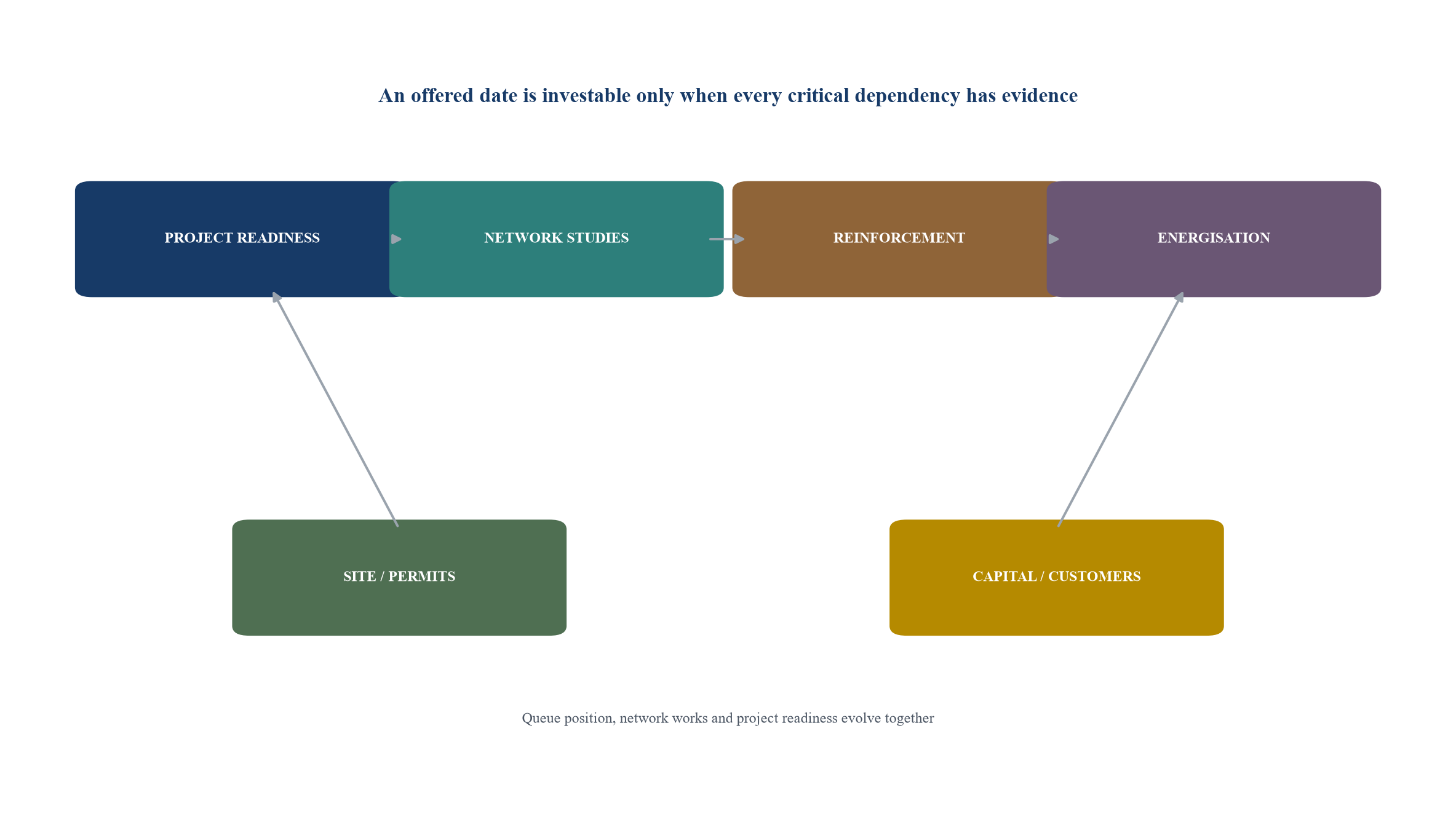
The diagram shows the evidence chain that controls an investable energisation date.
21. Model queue reprioritisation
Readiness and strategic-need tests can move projects forward, backward or out of the firm pipeline. The model should assign outcomes to evidence and policy scenarios without assuming protected priority.
The decision should be revisited when study results, queue rules, milestones or reinforcement dates change. Every assumption affecting value should have an owner, validation method and expiry date.
The objective is an executable connection strategy that aligns engineering, contracts, customers and finance. Capital should advance only when the evidence supporting the next stage is commensurate with the amount at risk.
22. Protect against loss of position
Failure to meet milestones, pay security or maintain an executable project can trigger termination or capacity reduction. Governance should monitor every cure and notice deadline.
The working file should identify the governing connection agreement, study, network dependency, responsible party and decision date. Technical and commercial conclusions should remain traceable to current authoritative evidence.
A practical review asks how much capacity is deliverable, when it can energise, what must be built, which costs can change and what mitigation preserves value. The output should be a gated capital decision rather than reliance on one offered date.
23. Control project modifications
Changes in technology, capacity, site, phasing or ownership can trigger restudy or a new application. Change control should quantify the connection consequence before the wider project approves a variation.
The assessment should distinguish contracted terms, network estimates and management scenarios. Developers, customers, lenders and advisers should use one reconciled capacity definition, critical path and cost register.
The issue should be translated into dated actions, evidence tests and quantified scenario adjustments. Contracted rights, estimates, contingencies and optional investments should remain visible as separate lines.
24. Test capacity reduction
A smaller connection can accelerate delivery, reduce reinforcement or preserve queue status. The economic test should compare lost output or computing capacity with avoided delay and capital.
The decision should be revisited when study results, queue rules, milestones or reinforcement dates change. Every assumption affecting value should have an owner, validation method and expiry date.
The objective is an executable connection strategy that aligns engineering, contracts, customers and finance. Capital should advance only when the evidence supporting the next stage is commensurate with the amount at risk.
25. Design phased energisation
Staged capacity can bring forward commissioning and revenue while wider works continue. The programme should specify phase dates, technical limits, interface works and conversion to final capacity.
The working file should identify the governing connection agreement, study, network dependency, responsible party and decision date. Technical and commercial conclusions should remain traceable to current authoritative evidence.
A practical review asks how much capacity is deliverable, when it can energise, what must be built, which costs can change and what mitigation preserves value. The output should be a gated capital decision rather than reliance on one offered date.
26. Assess temporary and flexible connections
Temporary, interruptible or non-firm arrangements can bridge a delay. Their value depends on curtailment frequency, operating flexibility, fuel alternatives and contract compatibility.
The assessment should distinguish contracted terms, network estimates and management scenarios. Developers, customers, lenders and advisers should use one reconciled capacity definition, critical path and cost register.
The issue should be translated into dated actions, evidence tests and quantified scenario adjustments. Contracted rights, estimates, contingencies and optional investments should remain visible as separate lines.
27. Test behind-the-meter supply
On-site generation can support resilience or early operations, subject to fuel, emissions, permits and economics. The design must coordinate islanding, protection and eventual grid integration.
The decision should be revisited when study results, queue rules, milestones or reinforcement dates change. Every assumption affecting value should have an owner, validation method and expiry date.
The objective is an executable connection strategy that aligns engineering, contracts, customers and finance. Capital should advance only when the evidence supporting the next stage is commensurate with the amount at risk.
28. Test on-site generation economics
Gas, solar, wind, geothermal or other supply should be evaluated on full delivered cost, availability, construction time and carbon exposure. A temporary solution can become a stranded asset.
The working file should identify the governing connection agreement, study, network dependency, responsible party and decision date. Technical and commercial conclusions should remain traceable to current authoritative evidence.
A practical review asks how much capacity is deliverable, when it can energise, what must be built, which costs can change and what mitigation preserves value. The output should be a gated capital decision rather than reliance on one offered date.
29. Integrate storage and hybrid assets
Storage can manage peaks, ramp limits, curtailment and outage resilience. It cannot create energy and should be sized against the actual operating profile and connection constraints.
The assessment should distinguish contracted terms, network estimates and management scenarios. Developers, customers, lenders and advisers should use one reconciled capacity definition, critical path and cost register.
The issue should be translated into dated actions, evidence tests and quantified scenario adjustments. Contracted rights, estimates, contingencies and optional investments should remain visible as separate lines.
30. Use demand response deliberately
Flexible industrial processes and computing workloads can reduce peak capacity or accept curtailment. The operating case should define controllable load, recovery time, service effects and incentives.
The decision should be revisited when study results, queue rules, milestones or reinforcement dates change. Every assumption affecting value should have an owner, validation method and expiry date.
The objective is an executable connection strategy that aligns engineering, contracts, customers and finance. Capital should advance only when the evidence supporting the next stage is commensurate with the amount at risk.
Table 2. Connection-delay risk-allocation matrix
| Risk | Project responsibility | Network responsibility | Shared control | Required evidence |
|---|---|---|---|---|
| Queue readiness | Maintain site, permits, data and milestones | Apply published criteria consistently | Cure and evidence process | Register, declarations and notices |
| Study and restudy | Provide stable technical inputs | Complete studies to required standards | Assumptions and change control | Models, study reports and decisions |
| Reinforcement cost | Fund allocated customer works | Deliver network works and transparent estimates | Scope and true-up | Cost schedule and design baseline |
| Connection date | Progress project dependencies | Manage network critical path | Reporting and mitigation | Integrated programme and milestones |
| Curtailment | Operate within agreed limits | Apply dispatch and access rules | Flexible service design | Metering, notices and operating records |
| Failed connection | Manage exposed project capital | Apply termination and refund terms | Transition and dispute process | Account reconciliation and closing record |
Allocation depends on the connection agreement, market rules, project contracts and cause of delay.
31. Preserve relocation options
Alternative sites can protect value when one connection path deteriorates. Comparable diligence should cover land, network rights, customers, fibre, water, labour, permits and tax.
The working file should identify the governing connection agreement, study, network dependency, responsible party and decision date. Technical and commercial conclusions should remain traceable to current authoritative evidence.
A practical review asks how much capacity is deliverable, when it can energise, what must be built, which costs can change and what mitigation preserves value. The output should be a gated capital decision rather than reliance on one offered date.
32. Manage the development portfolio
A portfolio approach allocates capital across connection options until evidence differentiates them. Governance should prevent sunk-cost bias and avoid financing multiple speculative positions indefinitely.
The assessment should distinguish contracted terms, network estimates and management scenarios. Developers, customers, lenders and advisers should use one reconciled capacity definition, critical path and cost register.
The issue should be translated into dated actions, evidence tests and quantified scenario adjustments. Contracted rights, estimates, contingencies and optional investments should remain visible as separate lines.
33. Quantify development spend at risk
Studies, design, land, permits, advisers and deposits accumulate before final certainty. The model should show committed, cancellable, refundable and irrecoverable spend at every gate.
The decision should be revisited when study results, queue rules, milestones or reinforcement dates change. Every assumption affecting value should have an owner, validation method and expiry date.
The objective is an executable connection strategy that aligns engineering, contracts, customers and finance. Capital should advance only when the evidence supporting the next stage is commensurate with the amount at risk.
34. Quantify land carrying cost
Rent, option fees, rates, security and owner commitments continue during delay. Land rights should remain long enough to cover downside connection dates and extension mechanics.
The working file should identify the governing connection agreement, study, network dependency, responsible party and decision date. Technical and commercial conclusions should remain traceable to current authoritative evidence.
A practical review asks how much capacity is deliverable, when it can energise, what must be built, which costs can change and what mitigation preserves value. The output should be a gated capital decision rather than reliance on one offered date.
35. Quantify construction disruption
Early mobilisation can create idle labour, demobilisation, resequencing and storage costs when energisation slips. EPC terms should align notice-to-proceed with credible network milestones.
The assessment should distinguish contracted terms, network estimates and management scenarios. Developers, customers, lenders and advisers should use one reconciled capacity definition, critical path and cost register.
The issue should be translated into dated actions, evidence tests and quantified scenario adjustments. Contracted rights, estimates, contingencies and optional investments should remain visible as separate lines.
36. Quantify delayed revenue
Delay shifts energy sales, product output, compute capacity and contracted service revenue. The model should reflect ramp-up, customer churn, market price changes and expiry of incentives.
The decision should be revisited when study results, queue rules, milestones or reinforcement dates change. Every assumption affecting value should have an owner, validation method and expiry date.
The objective is an executable connection strategy that aligns engineering, contracts, customers and finance. Capital should advance only when the evidence supporting the next stage is commensurate with the amount at risk.
37. Quantify customer consequences
Customers may have service dates, minimum capacity, liquidated damages or termination rights. Connection uncertainty should flow through the commercial contracting strategy.
The working file should identify the governing connection agreement, study, network dependency, responsible party and decision date. Technical and commercial conclusions should remain traceable to current authoritative evidence.
A practical review asks how much capacity is deliverable, when it can energise, what must be built, which costs can change and what mitigation preserves value. The output should be a gated capital decision rather than reliance on one offered date.
38. Model escalation and inflation
Equipment, labour, civil works and network contributions can escalate over a multi-year delay. Indexation should be applied to the relevant cost base and timing.
The assessment should distinguish contracted terms, network estimates and management scenarios. Developers, customers, lenders and advisers should use one reconciled capacity definition, critical path and cost register.
The issue should be translated into dated actions, evidence tests and quantified scenario adjustments. Contracted rights, estimates, contingencies and optional investments should remain visible as separate lines.
39. Model financing carry
Commitment fees, interest, hedging, letter-of-credit cost and equity opportunity cost accrue before operations. Draw timing should follow actual construction and security requirements.
The decision should be revisited when study results, queue rules, milestones or reinforcement dates change. Every assumption affecting value should have an owner, validation method and expiry date.
The objective is an executable connection strategy that aligns engineering, contracts, customers and finance. Capital should advance only when the evidence supporting the next stage is commensurate with the amount at risk.
40. Control hedge exposure
Interest, currency, power and equipment hedges can become mismatched when the schedule moves. The treasury plan should define extension, close-out and rehedging authority.
The working file should identify the governing connection agreement, study, network dependency, responsible party and decision date. Technical and commercial conclusions should remain traceable to current authoritative evidence.
A practical review asks how much capacity is deliverable, when it can energise, what must be built, which costs can change and what mitigation preserves value. The output should be a gated capital decision rather than reliance on one offered date.
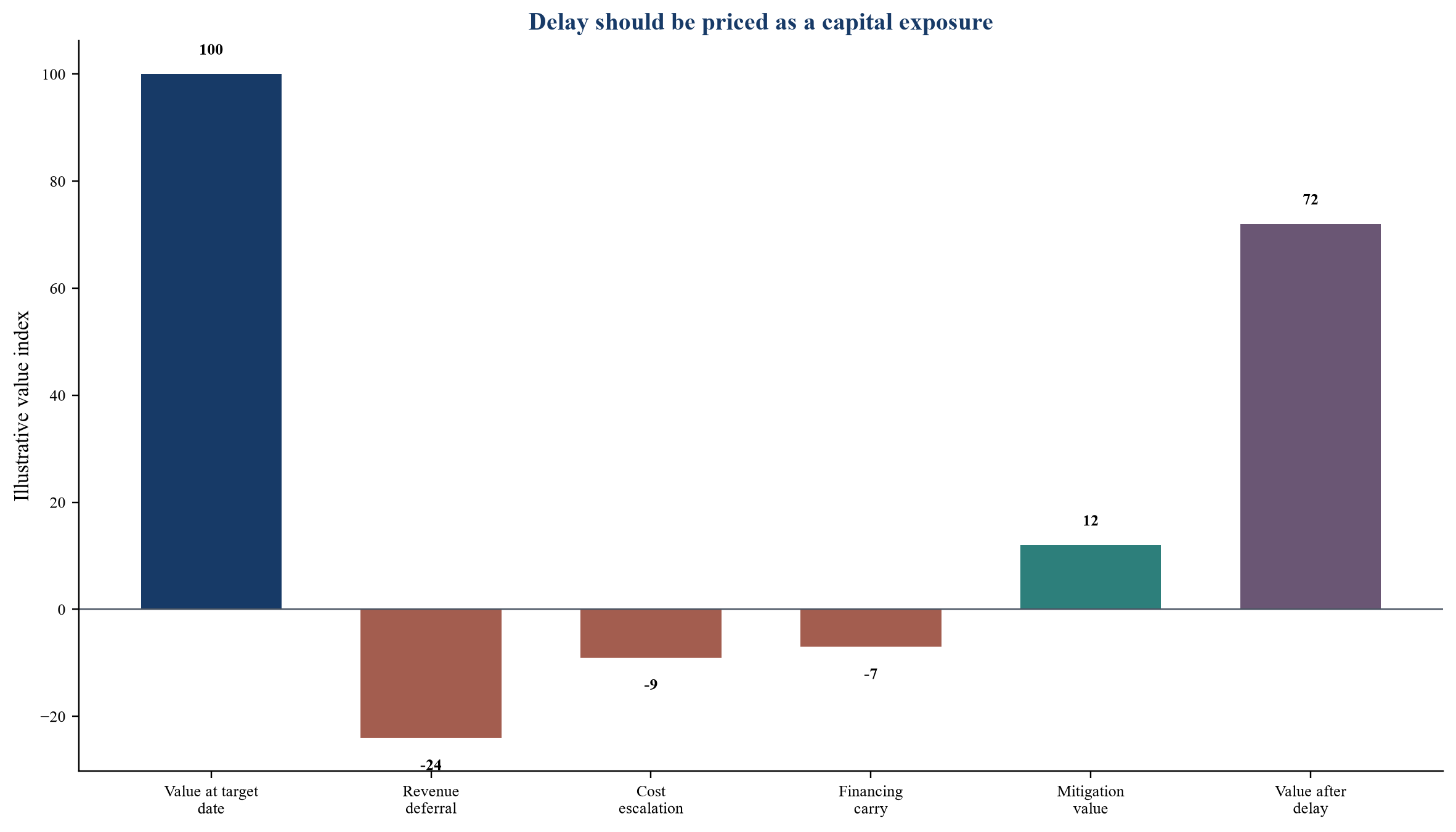
Values are hypothetical management assumptions and demonstrate the valuation bridge only.
41. Adjust the discount rate and probability
Connection uncertainty affects cash-flow timing and outcome probability. The model should avoid double counting by separating scenario probabilities from risk already reflected in the discount rate.
The assessment should distinguish contracted terms, network estimates and management scenarios. Developers, customers, lenders and advisers should use one reconciled capacity definition, critical path and cost register.
The issue should be translated into dated actions, evidence tests and quantified scenario adjustments. Contracted rights, estimates, contingencies and optional investments should remain visible as separate lines.
42. Build the delay-value bridge
The bridge should start with value at the target connection date and show revenue deferral, escalation, financing carry, lost incentives, mitigation cost and option value.
The decision should be revisited when study results, queue rules, milestones or reinforcement dates change. Every assumption affecting value should have an owner, validation method and expiry date.
The objective is an executable connection strategy that aligns engineering, contracts, customers and finance. Capital should advance only when the evidence supporting the next stage is commensurate with the amount at risk.
43. Use a probability-weighted energisation date
A single contractual date can overstate certainty. The project should maintain a distribution informed by studies, dependencies, regulatory status and delivery evidence.
The working file should identify the governing connection agreement, study, network dependency, responsible party and decision date. Technical and commercial conclusions should remain traceable to current authoritative evidence.
A practical review asks how much capacity is deliverable, when it can energise, what must be built, which costs can change and what mitigation preserves value. The output should be a gated capital decision rather than reliance on one offered date.
44. Set the wait, mitigate or exit rule
The board should define thresholds for continued waiting, mitigation capital, capacity reduction, relocation or exit. The rule should update as evidence and sunk cost change.
The assessment should distinguish contracted terms, network estimates and management scenarios. Developers, customers, lenders and advisers should use one reconciled capacity definition, critical path and cost register.
The issue should be translated into dated actions, evidence tests and quantified scenario adjustments. Contracted rights, estimates, contingencies and optional investments should remain visible as separate lines.
45. Apply the framework to renewables
Renewable projects should test export capacity, curtailment, grid-code compliance, support expiry, equipment procurement and power-sale obligations across connection scenarios.
The decision should be revisited when study results, queue rules, milestones or reinforcement dates change. Every assumption affecting value should have an owner, validation method and expiry date.
The objective is an executable connection strategy that aligns engineering, contracts, customers and finance. Capital should advance only when the evidence supporting the next stage is commensurate with the amount at risk.
46. Apply the framework to industrial assets
Industrial facilities should test process continuity, commissioning sequence, captive supply, product contracts, demand flexibility and the cost of under-utilised fixed assets.
The working file should identify the governing connection agreement, study, network dependency, responsible party and decision date. Technical and commercial conclusions should remain traceable to current authoritative evidence.
A practical review asks how much capacity is deliverable, when it can energise, what must be built, which costs can change and what mitigation preserves value. The output should be a gated capital decision rather than reliance on one offered date.
47. Apply the framework to data centres
Data centres should test energisation by phase, redundant feeds, backup duration, workload portability, customer delivery commitments, fibre and cooling dependencies.
The assessment should distinguish contracted terms, network estimates and management scenarios. Developers, customers, lenders and advisers should use one reconciled capacity definition, critical path and cost register.
The issue should be translated into dated actions, evidence tests and quantified scenario adjustments. Contracted rights, estimates, contingencies and optional investments should remain visible as separate lines.
48. Design a scalable campus
A campus can sequence substations, halls and customer capacity around confirmed power. The master plan should avoid overbuilding shared infrastructure ahead of connection certainty.
The decision should be revisited when study results, queue rules, milestones or reinforcement dates change. Every assumption affecting value should have an owner, validation method and expiry date.
The objective is an executable connection strategy that aligns engineering, contracts, customers and finance. Capital should advance only when the evidence supporting the next stage is commensurate with the amount at risk.
49. Evaluate co-location
Co-location with generation can reduce some network dependency but introduces matching, transmission, market, permitting and reliability questions. Physical proximity alone does not ensure dependable supply.
The working file should identify the governing connection agreement, study, network dependency, responsible party and decision date. Technical and commercial conclusions should remain traceable to current authoritative evidence.
A practical review asks how much capacity is deliverable, when it can energise, what must be built, which costs can change and what mitigation preserves value. The output should be a gated capital decision rather than reliance on one offered date.
50. Build the power-to-compute architecture
The architecture should map grid capacity, on-site generation, storage, backup, cooling and workload flexibility to critical and deferrable computing loads.
The assessment should distinguish contracted terms, network estimates and management scenarios. Developers, customers, lenders and advisers should use one reconciled capacity definition, critical path and cost register.
The issue should be translated into dated actions, evidence tests and quantified scenario adjustments. Contracted rights, estimates, contingencies and optional investments should remain visible as separate lines.
Table 3. Hypothetical connection-delay and debt-service sensitivity
| Scenario | Connection delay | Additional capital, USD m | Capacity at first energisation | Minimum DSCR | Decision implication |
|---|---|---|---|---|---|
| Base connection | None | 0 | 100% firm | 1.34x | Proceed through normal gates |
| Phased energisation | 12 months | 28 | 45% then 100% | 1.17x | Align customers and debt draw by phase |
| Non-firm bridge | 18 months | 42 | 70% curtailable | 1.08x | Value depends on flexible operations |
| Full delay | 36 months | 96 | 100% after reinforcement | 0.82x | Requires new liquidity and covenant reset |
| Relocation | 24 months | 135 | 100% firm at alternative site | 1.12x | Compare avoided long-tail queue risk |
All values are hypothetical management assumptions used only to demonstrate the framework.
51. Build sources and uses
Sources should match development, security, reinforcement, mitigation and construction uses by timing and certainty. Contingency should reflect study and schedule risk.
The decision should be revisited when study results, queue rules, milestones or reinforcement dates change. Every assumption affecting value should have an owner, validation method and expiry date.
The objective is an executable connection strategy that aligns engineering, contracts, customers and finance. Capital should advance only when the evidence supporting the next stage is commensurate with the amount at risk.
52. Test debt-service sensitivities
Lenders should test connection delay, cost increase, phased capacity, curtailment, customer delay and weaker utilisation. The model should show minimum DSCR and liquidity runway.
The working file should identify the governing connection agreement, study, network dependency, responsible party and decision date. Technical and commercial conclusions should remain traceable to current authoritative evidence.
A practical review asks how much capacity is deliverable, when it can energise, what must be built, which costs can change and what mitigation preserves value. The output should be a gated capital decision rather than reliance on one offered date.
53. Align covenants and milestones
Financing covenants should reflect evidence-driven connection gates, long-stop dates, cost-overrun support and draw conditions. A covenant should prompt action before liquidity is exhausted.
The assessment should distinguish contracted terms, network estimates and management scenarios. Developers, customers, lenders and advisers should use one reconciled capacity definition, critical path and cost register.
The issue should be translated into dated actions, evidence tests and quantified scenario adjustments. Contracted rights, estimates, contingencies and optional investments should remain visible as separate lines.
54. Review insurance and force majeure
Delay may fall outside traditional delay-in-start-up coverage where no insured physical damage occurs. Contract and insurance analysis should identify retained exposure.
The decision should be revisited when study results, queue rules, milestones or reinforcement dates change. Every assumption affecting value should have an owner, validation method and expiry date.
The objective is an executable connection strategy that aligns engineering, contracts, customers and finance. Capital should advance only when the evidence supporting the next stage is commensurate with the amount at risk.
55. Align customers and offtake
Power-purchase, product-sale, capacity and colocation agreements should use dates and remedies consistent with connection uncertainty. Conditional commitments can preserve demand without creating unfinanceable liability.
The working file should identify the governing connection agreement, study, network dependency, responsible party and decision date. Technical and commercial conclusions should remain traceable to current authoritative evidence.
A practical review asks how much capacity is deliverable, when it can energise, what must be built, which costs can change and what mitigation preserves value. The output should be a gated capital decision rather than reliance on one offered date.
56. Run the model gate
This gate confirms a reconciled probability-weighted schedule, scenario cash flows, mitigation options and board thresholds. Assumptions should have sources and owners.
The assessment should distinguish contracted terms, network estimates and management scenarios. Developers, customers, lenders and advisers should use one reconciled capacity definition, critical path and cost register.
The issue should be translated into dated actions, evidence tests and quantified scenario adjustments. Contracted rights, estimates, contingencies and optional investments should remain visible as separate lines.
57. Run the rights gate
This gate confirms queue status, milestones, site control, permits, cost allocation, security and change rights under current rules.
The decision should be revisited when study results, queue rules, milestones or reinforcement dates change. Every assumption affecting value should have an owner, validation method and expiry date.
The objective is an executable connection strategy that aligns engineering, contracts, customers and finance. Capital should advance only when the evidence supporting the next stage is commensurate with the amount at risk.
58. Run the technical gate
This gate confirms capacity, firmness, reinforcement, equipment, phasing, alternatives and the evidence supporting the network critical path.
The working file should identify the governing connection agreement, study, network dependency, responsible party and decision date. Technical and commercial conclusions should remain traceable to current authoritative evidence.
A practical review asks how much capacity is deliverable, when it can energise, what must be built, which costs can change and what mitigation preserves value. The output should be a gated capital decision rather than reliance on one offered date.
59. Run the commercial and financing gate
This gate confirms customer dates, revenue, sources and uses, liquidity, debt resilience and the conditions for wait, mitigate, relocate or exit.
The assessment should distinguish contracted terms, network estimates and management scenarios. Developers, customers, lenders and advisers should use one reconciled capacity definition, critical path and cost register.
The issue should be translated into dated actions, evidence tests and quantified scenario adjustments. Contracted rights, estimates, contingencies and optional investments should remain visible as separate lines.
60. Adopt the decision record and 90-day plan
The final record should state the selected connection strategy, exposed capital, evidence conditions, mitigation budget, owners, dates and fallback. The first 90 days should close the largest value uncertainties.
The decision should be revisited when study results, queue rules, milestones or reinforcement dates change. Every assumption affecting value should have an owner, validation method and expiry date.
The objective is an executable connection strategy that aligns engineering, contracts, customers and finance. Capital should advance only when the evidence supporting the next stage is commensurate with the amount at risk.
Table 4. Illustrative 90-day connection-risk programme
| Period | Workstream | Core actions | Decision output | Accountable owner |
|---|---|---|---|---|
| Days 1-15 | Rights and queue | Reconcile agreement, queue status, milestones, security and current rules | Confirmed connection perimeter | Counsel and connection lead |
| Days 16-30 | Technical baseline | Validate capacity, point, studies, reinforcement and equipment | Network critical path | Grid engineer |
| Days 31-45 | Project readiness | Verify land, permits, design, EPC, customers and data | Readiness evidence register | Development director |
| Days 46-60 | Scenario economics | Model delay, phasing, non-firm supply, on-site options and relocation | Comparable value cases | Financial adviser |
| Days 61-75 | Financing and contracts | Align sources, covenants, customers, hedges and long-stop dates | Financeable mitigation plan | Sponsors and lenders |
| Days 76-90 | Decision record | Set capital cap, evidence gates, owners, dates and exit thresholds | Approved connection strategy | Authorised project board |
Timing is indicative and should be adapted to the applicable network process and project stage.
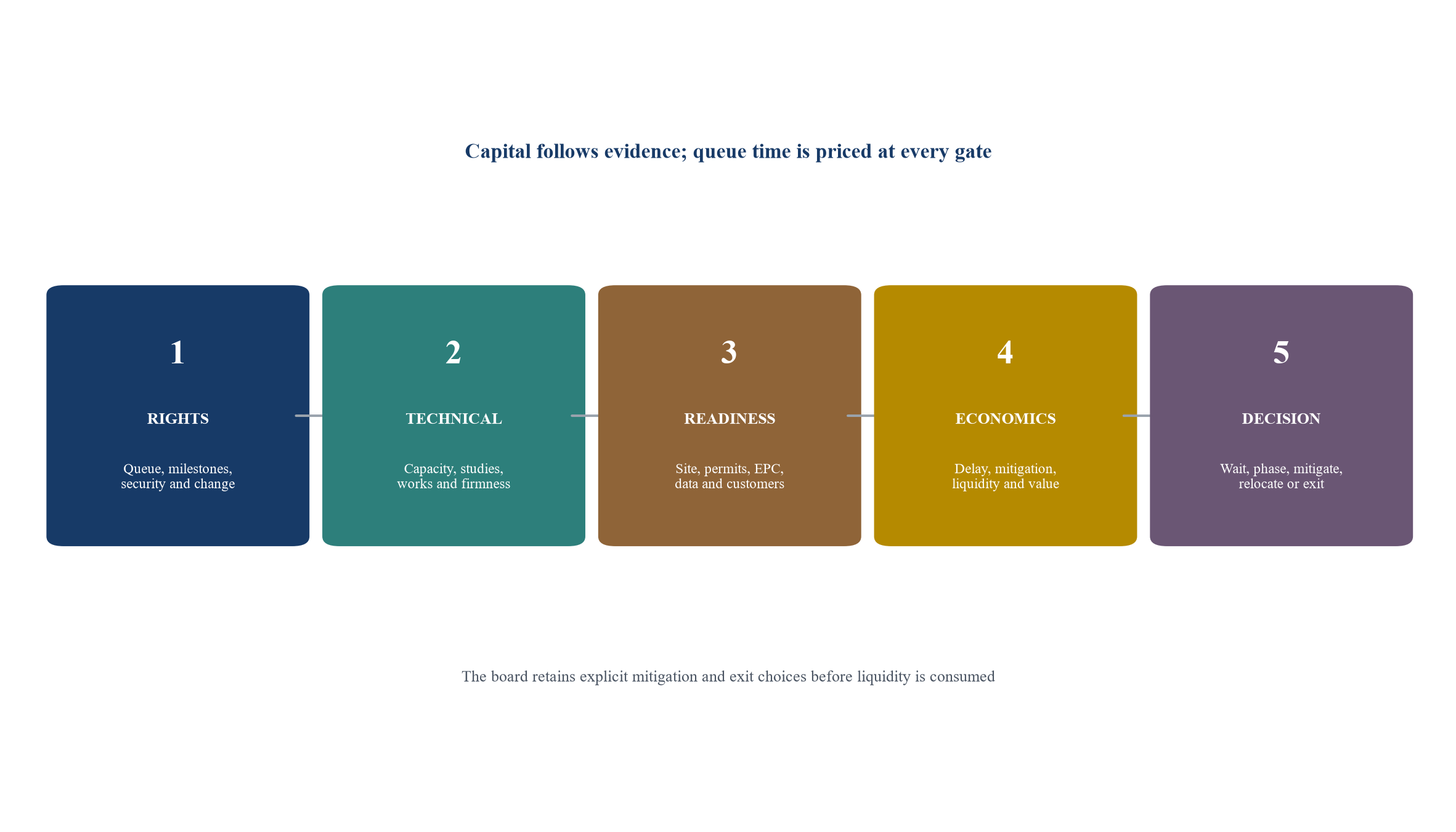
Each gate requires documented evidence before the next capital commitment.
The framework makes grid-connection uncertainty visible before it consumes the project's liquidity and customer credibility. It links queue rights and engineering dependencies to capital exposure, valuation and financing.
Execution should proceed through evidence-based gates. A project that can phase, flex, mitigate or relocate retains option value; a project committed around an unsupported date can convert grid delay into an enterprise-level loss.
References
- International Energy Agency, "Electricity Grids and Secure Energy Transitions," 2023, https://www.iea.org/reports/electricity-grids-and-secure-energy-transitions
- International Energy Agency, "Electricity 2026: Grids," https://www.iea.org/reports/electricity-2026/grids
- International Energy Agency, "Energy and AI," 2025, https://www.iea.org/reports/energy-and-ai
- Federal Energy Regulatory Commission, "Explainer on the Interconnection Final Rule," https://www.ferc.gov/explainer-interconnection-final-rule
- Federal Energy Regulatory Commission, "Improvements to Generator Interconnection Procedures and Agreements," https://www.ferc.gov/news-events/news/fact-sheet-improvements-generator-interconnection-procedures-and-agreements
- US Department of Energy, "i2X Transmission Interconnection Roadmap," 2024, https://www.energy.gov/sites/default/files/2024-04/i2X%20Transmission%20Interconnection%20Roadmap.pdf
- UK Government and Ofgem, "Connections Action Plan," https://www.gov.uk/government/publications/electricity-networks-connections-action-plan/connections-action-plan-speeding-up-connections-to-the-electricity-network-across-great-britain
- Ofgem, "Decision on Connections Reform Package," 15 April 2025, https://www.ofgem.gov.uk/decision/decision-connections-reform-package-tm04
- National Energy System Operator, "Connections Reform Results," https://www.neso.energy/industry-information/connections-reform/connections-reform-results
- National Energy System Operator, "Queue Management," https://www.neso.energy/industry-information/connections/queue-management
About the Author
Chennakeshav (CK) is a corporate finance and investment banking executive with 25+ years of global experience in deal origination, structuring and execution across M&A, growth capital and corporate strategy. He has led value-creation mandates for founders, corporates and funds — bridging the boardroom view to hands-on execution and close.
His career spans Morgan Stanley, HSBC, Lloyds Banking Group, EWEC, ADQ portfolio companies and Emirates Growth Fund, across TMT, real estate, fintech, deeptech, cleantech, infrastructure and energy. He has partnered with C-suite leaders, private equity and venture funds, sovereign wealth funds and family offices to finance complex fund raises and scale-up ventures, and has led M&A due diligence, post-merger integration and business-transformation initiatives to create value.
At Matchpoint Partners he is Managing Partner, leading the firm's corporate finance, M&A and capital-raising practice. He holds an MBA from London Business School, an engineering degree from VTU and a Master of Laws (LLM, in progress) from UCL London.
An active start-up mentor, CK mentors at Techstars, DIFC FinTech Hive, Startup Grind, Founder Institute and IN5, serves as Entrepreneur Mentor in Residence (EMiR) at London Business School, and judges the Entrepreneurship World Cup.
