

1. Frame the approval decision around evidenced cash
The investment committee must decide how much capital, if any, can be committed to a defined set of loan rights after allowing for data defects, legal transfer conditions, servicing dependence and uncertain recovery timing. Gross principal provides a useful reference point. It does not measure collectible value. The approval case should start with cash that can be traced through source records and assigned to valid borrower obligations under an enforceable operating model.
The committee should require five reconciliations. The first ties each tape balance to the seller's servicing ledger and accounting records at a common cut-off. The second traces post-cut-off bank receipts to borrower and facility identifiers. The third separates contractual receipts from fees, recoveries, refunds, reversals and unidentified cash. The fourth tests whether delinquency, restructuring and impairment fields agree with payment history and documented credit events. The fifth connects the legal transfer perimeter with the data and servicing perimeter so that each acquired right can be administered after closing.
CBUAE's current credit-risk framework covers acquisition, management, monitoring, recovery and provisioning. It requires effective data aggregation and controls over data quality, reliability and relevance. [1][2] SAMA's credit-risk and problem-loan rules likewise require governance, management information, workout plans, reliable classification and regulatory reporting. [3][4] These rules apply to regulated institutions in their respective jurisdictions. An investor should use them as evidence of the standards governing the seller or servicer where applicable, then obtain legal confirmation of the exact transaction requirements.
Approval should be conditional. Unresolved exceptions should reduce eligible balance, lower the bid, increase holdbacks, strengthen seller warranties, or prevent closing. The conditions should identify owners, deadlines and evidence. A general promise to clean the tape after closing transfers uncertainty to the purchaser without establishing a remedy.
2. Define the GCC perimeter before comparing portfolios
GCC markets share commercial links and regional banking groups, yet loan transfer, confidentiality, enforcement, licensing, tax, insolvency and data-location rules remain jurisdiction-specific. A pool containing borrowers, guarantors, collateral, bank accounts or servicers in several countries requires a legal and operating map by exposure. The committee should avoid treating a regional label as a common legal regime.
The first perimeter question is the asset being acquired. A transaction can involve the lender's full contractual position, a receivable, a participation, an economic interest, a securitised note, a rescue facility or another structure. Each structure changes control, borrower notice, set-off exposure, servicing authority, accounting and enforcement. IFRS 9 also distinguishes transfers that qualify for derecognition from arrangements where the transferor retains substantially all risks and rewards; retained servicing can create a separate servicing asset or liability. [11] The accounting analysis belongs with qualified advisers and the seller's auditors.
The second question is borrower scope. SME definitions, reporting categories and treatment can differ by regulator and product. The purchaser should record the seller's definition, legal entity, connected group, jurisdiction, industry, facility type, currency, origination channel and regulatory classification. A portfolio containing owner-managed trading companies, contractors, manufacturers and professional firms can respond differently to the same macroeconomic stress.
The third question is servicing. A bank may remain lender of record or servicer while the purchaser receives economic cash. Another structure may transfer administration to a licensed collection entity. SAMA has issued specific rules on assigning collection operations to licensed entities for clients inside Saudi Arabia and distinguishes clients outside the Kingdom. [5] CBUAE outsourcing standards retain responsibility and require data, audit, security and access controls. [14] The operating model should therefore be confirmed country by country before the bid assumes any collection capacity.
3. Establish one loan identity across every system
The reconciliation begins with identity. Every obligation needs a stable loan identifier that connects the sale tape, core servicing system, bank receipt, general ledger, collateral file, legal agreement, payment schedule and enforcement record. Customer name and commercial-registration number help with matching; they should not replace a persistent facility key. Names can be abbreviated, transliterated or changed, while one borrower can have several facilities and accounts.
The EBA's NPL transaction templates use granular loan-by-loan data and relationship mappings among portfolio, counterparty group, counterparty, loan, historical collections, repayment schedules, forbearance, collateral and enforcement. [6][7] The templates apply under a specific European legal mandate. Their data architecture still offers a practical reference for a GCC purchaser because it exposes the relationships that a flat spreadsheet often hides.
The identity map should include a seller loan ID, borrower ID, group ID, facility ID, settlement account, collection account, currency, original contract, current schedule and any replacement or restructuring agreement. It should preserve legacy identifiers when accounts have migrated between systems. When the servicer changes an identifier, the mapping table should record the old value, new value, change date, reason and approving control.
Duplicate identity creates two risks. The pool can count one obligation twice, or the reconciliation can assign one payment to the wrong account. Missing identity creates the opposite problem: valid cash remains in suspense because no confident match exists. Both conditions can inflate reported delinquency and distort recovery curves. The buyer should test uniqueness, referential integrity and coverage before applying any performance statistics.
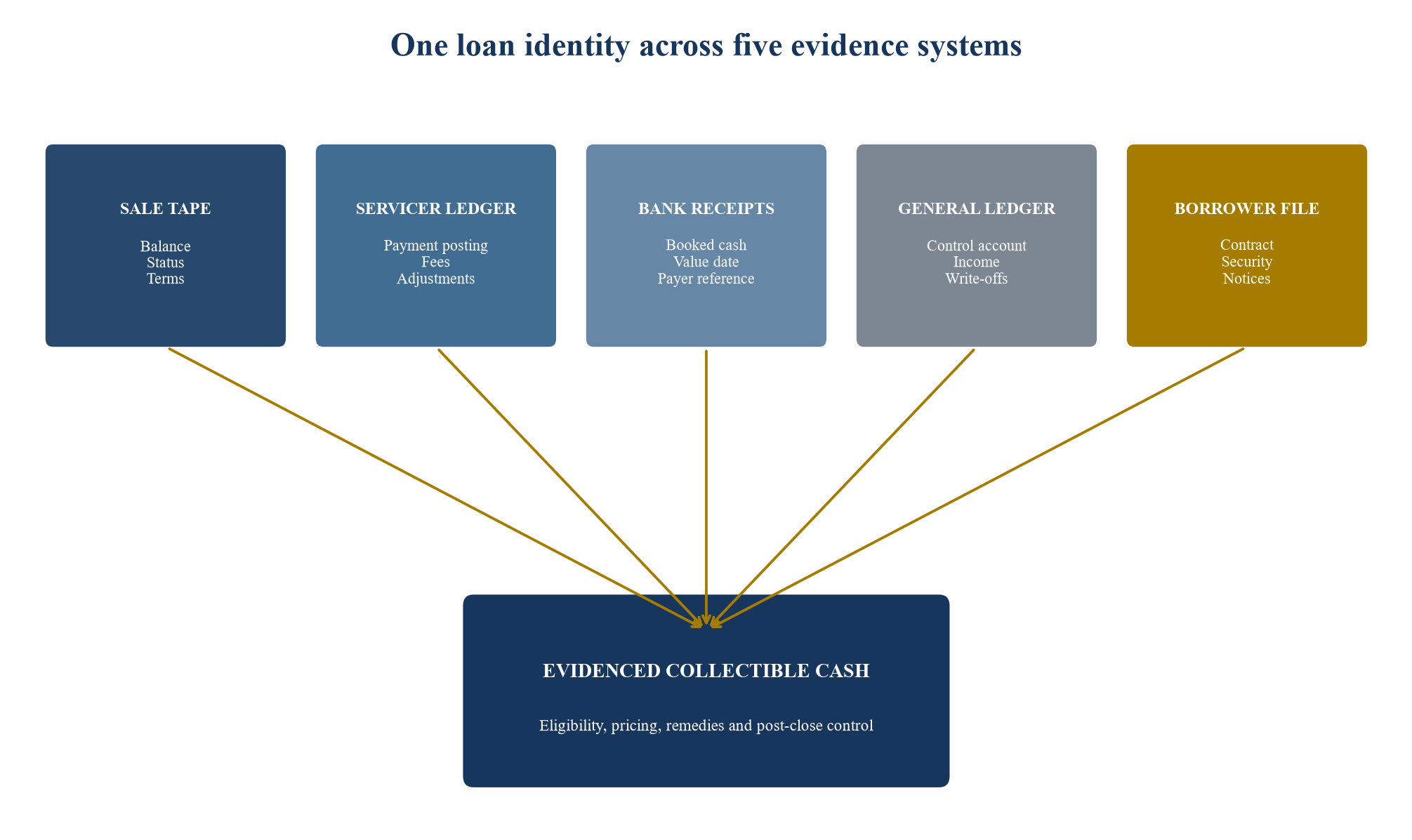
Original framework. Legal ownership, data access and servicing authority require jurisdiction-specific review.
4. Build the minimum data tape and evidence map
A useful sale tape contains fields that support identity, contractual cash flow, payment performance, classification, security and servicing. Field presence alone is insufficient. Each material field needs a system source, owner, as-of date, definition, permitted values and control. A balance copied from a servicing screen and a balance rebuilt from contractual movements can match by chance; the evidence map distinguishes the two.
The buyer should group fields by decision purpose. Identity fields establish the borrower, connected group and obligation. Contract fields define principal, pricing, maturity, currency, repayment schedule and rights after default. Performance fields record scheduled amounts, receipts, days past due, arrears buckets, restructurings and credit events. Security fields identify collateral, guarantees, registration, ranking, valuation and enforcement status. Servicing fields record collector, action history, promises to pay, disputes, legal referrals, fees and cash allocation.
Mandatory, conditional and optional fields should be separated. A collateral valuation date is mandatory for a secured exposure and irrelevant for a genuinely unsecured loan. A guarantor identifier becomes mandatory when recovery assumptions include a guarantee. Blank conditional fields should carry an explicit reason such as unsecured, no restructuring or no enforcement action. Empty cells without explanation prevent the reviewer from distinguishing absence from missing data.
The buyer should also identify authoritative evidence for each field. Contractual terms come from executed agreements and valid amendments. Cash comes from bank statements or bank-generated transaction files. Posting status comes from the servicing ledger. Accounting control comes from the general ledger. Classification comes from the seller's controlled credit records. The tape becomes a mapped view of those records rather than an independent source of truth.
| Data domain | Minimum fields | Primary evidence | Core test |
|---|---|---|---|
| Identity | Loan, facility, borrower and connected-group IDs; legal name; registration number; jurisdiction | Core system and customer due-diligence records | Every acquired obligation maps uniquely across systems |
| Contract | Original principal; current principal; currency; pricing; maturity; schedule; amendments | Executed agreement, schedule and amendments | Tape terms agree with legally effective documents |
| Performance | Due dates; receipts; arrears; days past due; restructurings; reversals | Servicing ledger, payment history and bank statements | Status can be rebuilt from dated cash movements |
| Security | Collateral type; registration; rank; guarantor; valuation; insurance | Registry extracts, security documents and valuation files | Recovery assumption uses a valid and controlled right |
| Servicing | Collector; actions; promises; disputes; fees; legal stage; cash allocation | Servicer system, call records, legal file and control reports | Servicing action and expense agree with mandate and policy |
| Accounting | Gross carrying amount; impairment; write-off; suspense; control account | General ledger and controlled reconciliations | Pool totals tie to seller records at the cut-off |
Field requirements depend on the product, jurisdiction and transaction structure. The table is a diligence framework.
5. Measure completeness before measuring performance
Completeness should be measured at cell, account and value levels. A tape can have 98 percent of cells populated while missing the collateral rank on the loans that drive most projected recovery. A loan-level completion rate treats a USD 20,000 facility and a USD 2 million facility equally. The committee needs all three views.
Cell completeness measures populated required fields divided by required cells. Account completeness measures loans that pass every mandatory-field rule. Value completeness measures principal or expected cash associated with passing accounts. Concentration completeness measures whether the largest exposures and recovery contributors have full evidence. The latter two views usually matter most for price.
Data validity forms a separate test. Dates should fall in logical order. Current principal should not exceed original principal without an explained redraw or capitalisation. Days past due should agree with unpaid scheduled instalments. Write-off dates should not precede default. Collateral value should show currency, valuation date and basis. Recovery cash should not be counted as both borrower payment and collateral proceeds.
The hypothetical pool contains 1,200 accounts. All appear in the first seller tape. Identity and contract rules leave 1,146 accounts. Payment-history and bank-reference requirements leave 1,092. Security and enforcement checks leave 1,035. Final accounting and legal-perimeter tests leave 984 accounts eligible for base-case pricing. The reduction does not prove that excluded loans have no value. It means the buyer lacks enough evidence to assign the same value before the defect is cured.
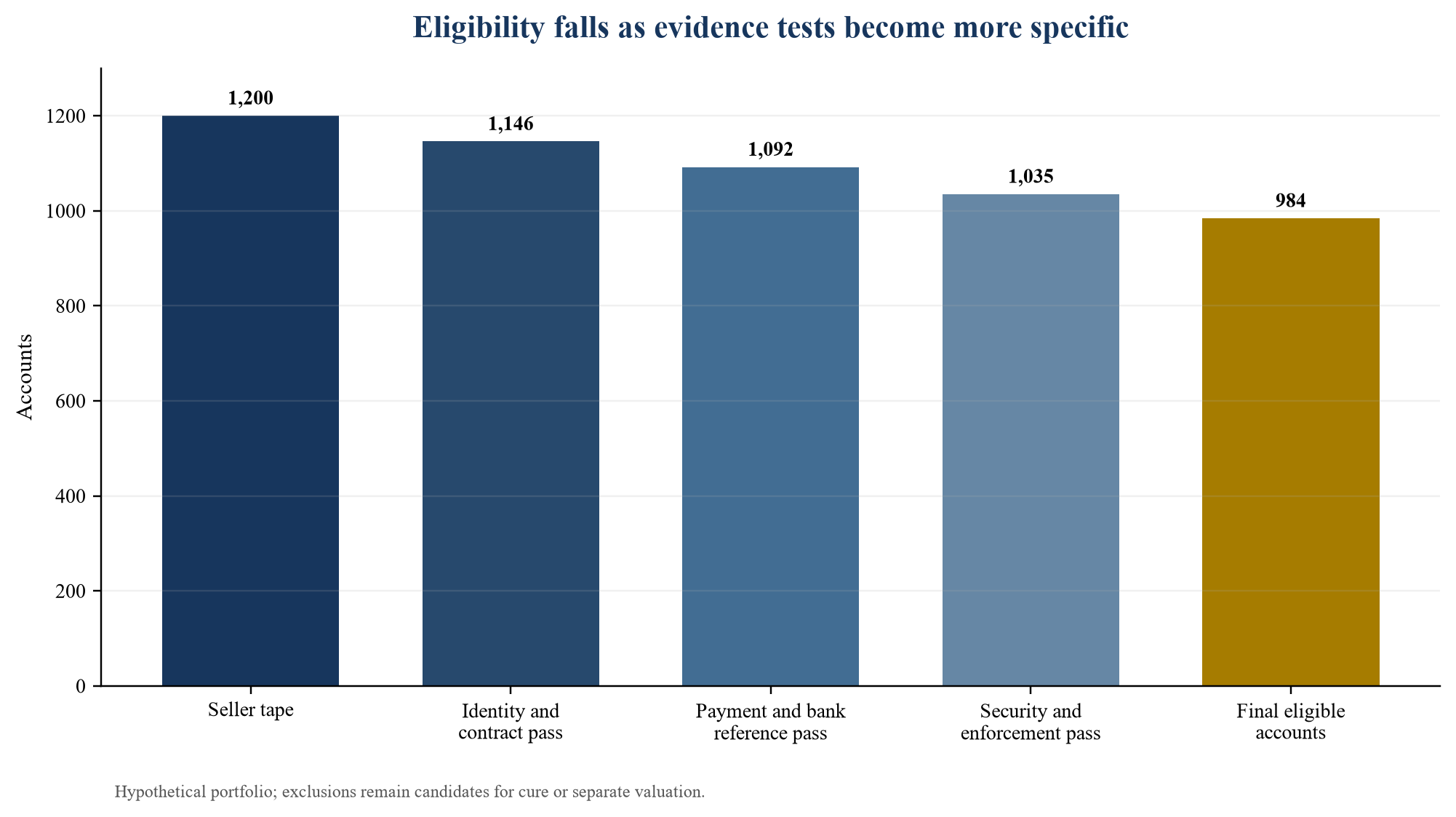
All account counts are hypothetical and do not describe an observed GCC portfolio.
6. Rebuild the opening balance at one cut-off
The opening balance provides the denominator for every collection rate, discount and recovery assumption. It should be rebuilt at one agreed cut-off using contractual movements. A reliable bridge starts with prior principal, adds permitted drawdowns and capitalised amounts, subtracts principal receipts, applies documented write-offs or settlements, and arrives at current principal. Interest, profit, fees and legal costs should remain in separate columns unless the contract and accounting policy support capitalisation.
The tape should distinguish contractual outstanding, accounting carrying amount, overdue amount and total claimed amount. These figures can differ legitimately. Contractual outstanding follows the agreement. Carrying amount reflects accounting adjustments. Overdue amount reflects unpaid scheduled cash. Claimed amount may include legal fees, default charges or accelerated sums. Pricing one field while collections are posted against another creates a false recovery ratio.
The pool-level total should tie to a controlled seller report. Account-level differences should be grouped by cause, value and age. Common causes include late postings, migrated accounts, manual write-offs, interest suspensions, settlement concessions, foreign-exchange translation and payments received after the tape cut-off. The buyer should request journal-level evidence for material manual adjustments.
Cut-off discipline also matters around closing. The seller may receive cash after the economic cut-off and before legal completion. The sale agreement should define who owns that cash, how it is reported, when it is remitted and how adjustments affect the purchase price. The operating protocol should state the time zone, value-date convention and treatment of returned or reversed payments.
An unexplained difference in the opening balance should remain an exception. The model can carry a conservative value for that exposure or exclude it. A balancing plug conceals the issue and weakens every downstream metric.
7. Reconcile bank receipts to borrower accounts
Bank receipts show cash that reached the collection account. The servicer ledger shows cash attributed to borrower obligations. The reconciliation must connect the two without losing amount, date, currency or transaction identity. ISO 20022's BankToCustomerStatement message, camt.053, is designed to report booked entries and balances for cash management and reconciliation; it may include underlying transaction details. [10] Actual availability and field population depend on the servicing bank and local implementation.
The buyer should request bank-generated statements or transaction files for the relevant period, not spreadsheets assembled solely by the servicer. Each receipt should carry a unique bank reference, booking date, value date, currency, payer name, account, amount and available remittance information. The servicer posting should add loan ID, allocation date, principal, interest or profit, fee, expense, suspense and reversal fields.
Matching should proceed from strongest to weakest evidence. Exact unique references and virtual-account identifiers support deterministic matches. Contract-specific payment references can support a second tier. Payer name, amount and date can support a provisional match when separately reviewed. Many-to-one and one-to-many allocations require documented rules because one receipt can cover several facilities and one instalment can arrive through several transfers.
The reconciliation should produce four populations: matched and posted, matched but posted differently, received but unallocated, and posted without a supporting bank receipt. The last population requires particular attention. It can arise from cash held in another account, non-cash adjustments, reversals, migration entries or errors. Each reason affects collectible value and should be tested rather than grouped as timing.
8. Test allocation rules and suspense discipline
Allocation rules determine which contractual component a payment cures. The sequence can apply to taxes, costs, fees, accrued interest or profit, overdue principal, current principal and other charges. The governing contract, local law, product terms and restructuring agreements may change the sequence. The buyer should obtain the approved rule set and test it against account histories.
A payment posted entirely to interest can leave principal unchanged and extend the apparent collection runway. A payment posted first to principal can reduce exposure faster. Neither approach should be assumed. The tape should preserve component-level allocations and any manual overrides. The purchaser's cash model should use the legal and operational rule that will apply after closing.
Suspense accounts require their own ledger. For each unidentified or unresolved receipt, the servicer should record the bank reference, amount, date, currency, possible borrower, investigation status, owner and ageing. Subsequent allocation should preserve the original receipt date and the allocation date. The model should avoid treating aged suspense as fully collectible until evidence identifies the beneficiary and ownership.
Reversals, returns and chargebacks should link to the original receipt. Netting them into a monthly total hides volatility and can make repeated failed payments appear as stable cash. Refunds and seller-owned amounts also need separation. A sale cut-off can create cash that belongs to the seller even though it arrives after closing, or buyer-owned cash that the seller receives before servicing migration.
The committee should review both value and count. A small number of high-value suspense items can change the bid materially. A large count of small unresolved items can signal weak reference capture, manual workload and future servicing cost.
| Exception | Evidence question | Valuation response | Transaction response |
|---|---|---|---|
| Receipt without loan match | Can the payer, reference and obligation be established independently? | Hold the cash outside base collections until resolved | Require a suspense schedule, cure deadline and post-close ownership rule |
| Ledger posting without bank receipt | Is there another account, a non-cash entry or an unsupported posting? | Remove unsupported cash from observed performance | Require source evidence and seller warranty for posting integrity |
| Amount or currency mismatch | Does foreign exchange, netting, fee deduction or split allocation explain the difference? | Model the documented net cash and conversion basis | Define currency and allocation rules in the servicing protocol |
| Late allocation | How long does cash remain unavailable to the pool? | Apply timing drag and liquidity reserve | Set ageing thresholds and escalation service levels |
| Reversal or returned payment | Was prior performance overstated and is the borrower still in arrears? | Restate collections and delinquency history | Require linked transaction IDs and reversal reporting |
| Manual balance adjustment | Who approved it and what contract or accounting event supports it? | Exclude value until the adjustment is evidenced | Add a material-adjustment consent and audit trail |
Remedies require transaction documents and applicable law. The table sets out analytical responses.
9. Recalculate arrears and classification from cash history
Days-past-due and stage fields should be rebuilt from scheduled obligations and allocated cash. Seller classifications can be valid under policy while the purchaser's recovery model needs more granular states. The buyer should preserve the regulatory and accounting labels, then add transparent analytical fields rather than overwrite source classifications.
CBUAE requires regulated institutions to identify and measure credit deterioration within a documented credit-risk framework. [1][2] SAMA's rules cover loan classification, provisioning and the management of problem loans, including workout strategy and reporting. [3][4] Separate SAMA rules for finance companies map credit-risk exposures into stages and regulatory categories. [5] The applicable rule depends on entity and product, so legal and regulatory advisers should confirm the current requirement for the seller and servicer.
The recalculation should identify the contractual due date, amount due, grace period where valid, amount received, allocation and remaining shortfall. Restructured accounts require both original and revised schedules, approval date, concession, borrower circumstances and performance after modification. A payment holiday or rescheduling can reset the operational schedule while economic weakness persists.
The purchaser should analyse roll rates between current, early arrears, serious arrears, restructuring, legal action and closure. Cure definitions should require sustained payment behaviour rather than a single small receipt. Re-default after restructuring should be reported separately because repeated modification can raise servicing cost and reduce confidence in projected cash.
Any derived classification is a model input. It should not be described as a regulatory determination by the purchaser unless the authorised institution has made it under the applicable framework.
10. Separate contractual rights from expected recovery
The sale perimeter should identify the rights transferred with each loan: principal, interest or profit, default amounts, fees, guarantees, security, insurance proceeds, judgments, settlement rights and claims in insolvency. It should also identify excluded amounts and retained obligations. A data tape cannot establish legal transfer on its own.
Document review should test execution, authority, amendments, notices, governing law, jurisdiction, assignment restrictions, set-off, counterclaims, limitation periods, waivers, security perfection, guarantee validity and enforcement status. Local counsel should confirm any consent, borrower notice, regulatory approval, licensing, registration or data-sharing condition. Multi-country pools should carry a country-level condition matrix and account-level exceptions.
Recovery should be modelled by right and remedy. Contractual borrower payments follow operating cash and repayment capacity. Guarantee recovery depends on the guarantor and enforceability. Collateral proceeds depend on valid security, priority, valuation, time and costs. Litigation recoveries depend on evidence, procedure and debtor assets. Settlement cash depends on borrower capacity and documented authority.
The World Bank identifies effective insolvency and collateral-enforcement frameworks as essential to NPL resolution and notes that legal assessment has meaningful fixed costs for investors. [13] IFC's distressed-asset work combines investment with servicing and restructuring capability. [12] These sources support a disciplined view of recovery infrastructure. They do not establish a recovery rate for any GCC pool.
The model should therefore avoid one blended recovery percentage applied to gross principal. It should calculate cash by recovery path, evidence state and time.
11. Underwrite the servicer as an operating counterparty
The servicer converts legal rights and borrower payments into recorded cash. Its mandate, people, systems, incentives and controls influence value throughout the hold period. A purchaser that retains the seller or an external provider should underwrite the servicer with the same care applied to the loan pool.
The review should cover licensing, regulatory permissions, governance, staffing, training, case segmentation, contact strategy, restructuring authority, legal referral, cash handling, complaints, quality assurance, cyber controls, business continuity, subcontractors and audit rights. Performance measures should include cash collected, promises kept, roll rates, cure durability, complaint outcomes, suspense ageing, posting accuracy, legal-cycle duration and cost per resolved account.
Incentives require care. A fee based only on gross cash can encourage expensive actions or short settlements that damage net value. A fee based on balances can reward delay. A balanced schedule can distinguish routine collection, restructuring, legal recovery and exceptional work, with quality and conduct conditions. The contract should define permitted expenses and approval thresholds.
The servicer should deliver loan-level files and control totals on a fixed calendar. The purchaser needs direct or escrowed access to critical data, the right to validate bank accounts, and a tested transfer plan if performance fails. CBUAE outsourcing standards require regulated banks to address service levels, audit, reporting, continuity, confidentiality, termination and regulator access. [14] SAMA's problem-loan and collection rules likewise place responsibility on regulated entities and constrain collection arrangements. [4][5]
12. Control confidential data during diligence and servicing
Loan-pool diligence can expose borrower identities, account details, financial information, guarantor records, payment history and collection communications. Data minimisation, access control and a legal basis for disclosure should be established before the virtual data room opens. The buyer should avoid requesting personal or confidential data that is unnecessary for the pricing stage.
A staged process can begin with aggregated and pseudonymised data, then allow controlled loan-level access for qualified bidders under agreed conditions. Sensitive identifiers can be tokenised while preserving stable relationships across tables. Access logs, encryption, download restrictions, approved locations, retention periods and destruction certificates should be part of the protocol.
UAE law and CBUAE rules treat customer and transaction information as confidential and restrict third-party disclosure except through authorised legal routes. [1][14] Saudi Arabia's Personal Data Protection Law materials emphasise purpose limitation, minimum collection, regulated disclosure and controls over transfers outside the Kingdom. [15] These sources require current legal interpretation for the transaction. The paper does not determine whether a specific disclosure or transfer is permitted.
The sale agreement and servicing contract should allocate controller and processor roles where relevant, breach notification, permitted uses, subcontracting, regulator access, audit, return and destruction. The operating data model should separate fields needed for valuation from fields needed for servicing or enforcement. The purchaser should also confirm where data, backups and bank records will be hosted after closing.
Data-protection controls affect execution timing. A buyer that discovers restrictions after bid submission may be unable to validate the tape, onboard the servicer or transfer records on schedule.
13. Construct the base cash model from reconciled evidence
The cash model should start with observed bank receipts that have been reconciled to loan accounts. It can then project future cash by borrower status, contractual schedule, restructuring behaviour, collateral path and servicing action. The model should keep observed history, management estimates and purchaser assumptions in separate fields.
The hypothetical case assumes 1,200 SME accounts and USD 40.0 million of gross principal. The proposed price is USD 16.0 million. Over thirty-six months, the base scenario assumes USD 26.4 million of gross bank receipts. USD 0.8 million remains outside recognised purchaser cash because allocation evidence is insufficient. Recognised collections are therefore USD 25.6 million. Servicing fees are USD 2.3 million, legal and workout costs are USD 1.2 million, and taxes, transfer costs and contingency are USD 0.6 million. Net purchaser cash is USD 21.5 million.
The resulting nominal cash multiple is 1.34 times the purchase price. This figure does not include the timing of cash, acquisition financing, fund expenses, foreign-exchange changes, tax beyond the stated allowance or any terminal value. It is not an internal rate of return. A transaction model should calculate monthly cash and a range of discount rates after validating local tax and legal treatment.
The model should include a cash provenance flag. Observed, bank-matched cash can receive the highest evidence grade. Cash matched through reviewed secondary rules can receive a lower grade. Management forecasts, collateral estimates and litigation outcomes should remain clearly identified assumptions. The committee can then see whether the bid depends on cash with weak evidence.
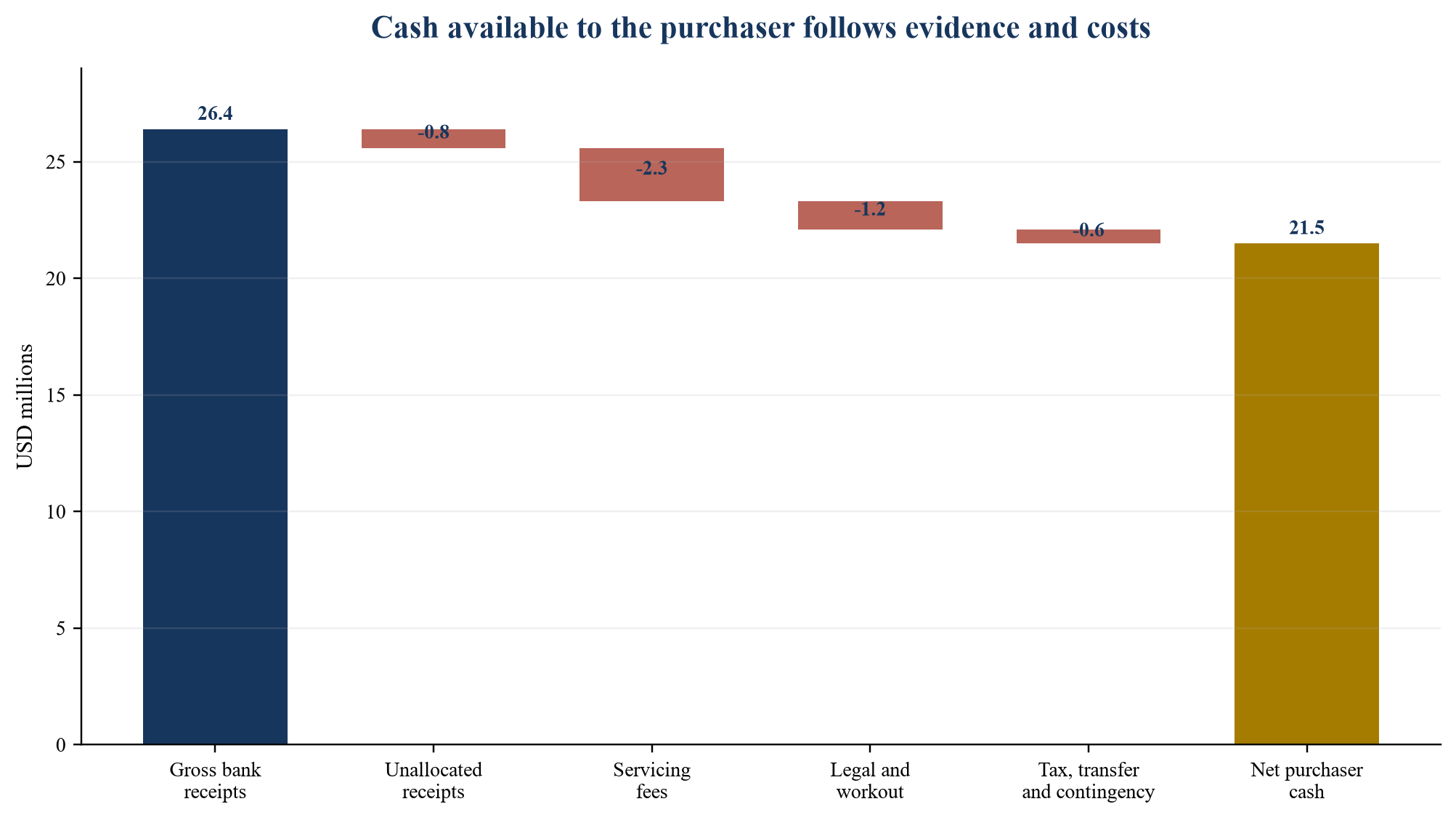
USD millions. Every amount is a scenario assumption and is not a market forecast.
14. Design a controlled cash waterfall
The post-close cash waterfall should reproduce the ownership and allocation rules agreed in the transaction. It should identify collection accounts, permitted signatories, bank mandates, sweep times, reserve accounts, servicer fees, approved expenses, tax amounts, purchaser distributions and seller-retained cash. Each movement should be visible in the reporting pack.
Direct collection into controlled accounts reduces reliance on servicer remittance. Where existing borrower instructions cannot change immediately, the transition plan should define legacy accounts, daily reporting and sweep obligations. Bank account validation should confirm ownership, currency, lien status, access rights and operational capability.
The waterfall should preserve gross receipts before netting. The purchaser needs to see cash received, cash returned, cash held in suspense, cash applied to borrower accounts and cash distributed. A net remittance from the servicer hides the components needed to test performance and fees.
Liquidity reserves can address predictable timing differences. A suspense reserve covers unidentified cash until allocation. An operating reserve covers approved servicing and legal costs. A tax reserve should reflect advice on applicable obligations. A transition reserve can cover migration failures or duplicate operating costs. Reserve releases should follow objective evidence.
The purchaser should test access and continuity before closing. The test can include a sample statement retrieval, payment-file ingestion, allocation run, exception report, sweep and management report. A documented test result gives the committee stronger evidence than a narrative description of the future process.
15. Convert cash evidence into a bid ceiling
A bid should be derived from projected net cash, timing, uncertainty and required return. The model should preserve the gap between seller face value and purchaser value. Face value is a contractual amount; purchase price is an investment decision.
One simple screen divides projected net cash by a required nominal cash multiple. In the hypothetical base case, USD 21.5 million of net cash divided by a 1.25 times hurdle supports a maximum price of USD 17.2 million before additional reserves, tax adjustments, financing and concentration limits. The proposed USD 16.0 million price leaves USD 1.2 million of headroom against that simple screen. The 1.25 times hurdle is an editorial assumption, not an observed investor requirement.
A complete model should use monthly cash and calculate present value under several discount rates. It should also separate systematic and idiosyncratic risks. Broad SME stress can reduce collections across the pool. Servicer failure can delay many accounts simultaneously. A disputed guarantee affects one group. A legal defect may eliminate a recovery path for a subset of loans.
The bid should exclude or haircut accounts that fail essential evidence rules. A separate contingent value mechanism can allow the seller to receive additional consideration when defined evidence or recoveries emerge. This structure can bridge information gaps while preserving buyer protection, subject to legal, tax and accounting advice.
The committee should see the bid as a range. The range narrows as bank reconciliation, legal review, borrower-file sampling and servicing tests improve confidence.
| Item | Hypothetical value | Analytical treatment |
|---|---|---|
| Gross principal at cut-off | 40.0 | Reference balance; not a valuation |
| Proposed purchase price | 16.0 | Cash paid before financing and transaction costs |
| Gross bank receipts over 36 months | 26.4 | Scenario cash received into collection accounts |
| Less unallocated receipts | 0.8 | Held outside recognised purchaser cash pending evidence |
| Less servicing fees | 2.3 | Hypothetical servicing cost |
| Less legal and workout costs | 1.2 | Hypothetical enforcement and restructuring cost |
| Less tax, transfer and contingency | 0.6 | Hypothetical allowance requiring local advice |
| Net purchaser cash | 21.5 | Nominal cash before time value, fund cost and financing |
| Nominal cash multiple | 1.34x | Net cash divided by purchase price |
| Bid ceiling at 1.25x cash hurdle | 17.2 | Simplified screen; not a market benchmark |
USD millions unless stated. All values and hurdles are scenario assumptions.
16. Stress collections, allocation and costs together
Sensitivity analysis should combine risks that can occur together. A collection haircut reduces gross cash. Allocation delays postpone distributions and can increase working-capital needs. Servicer weakness can lower collections and raise fees. Legal defects can extend recovery time while increasing cost. Testing each factor separately can understate the compound effect.
The hypothetical sensitivity uses net purchaser cash under three gross-collection cases and three cost-and-leakage cases. The base row starts from USD 26.4 million of gross receipts. Moderate stress reduces receipts to USD 23.8 million. Severe stress reduces receipts to USD 21.1 million. Cost and leakage rise from USD 4.9 million in the controlled case to USD 6.2 million and USD 7.6 million in weaker-control cases. The cells show net cash divided by the proposed USD 16.0 million purchase price.
The result should inform price, reserves and conditions. A case below the committee's minimum return threshold can require a lower bid, stronger seller support, excluded accounts or a different servicing structure. The committee should also examine monthly liquidity because an acceptable total cash multiple can still produce a poor time-adjusted return.
Scenario probabilities should be avoided when evidence cannot support them. A range can present the decision honestly. The committee can identify which evidence would move an account or portfolio from one case to another, such as resolving suspense, validating security, improving bank-reference capture or agreeing a tested servicing migration.
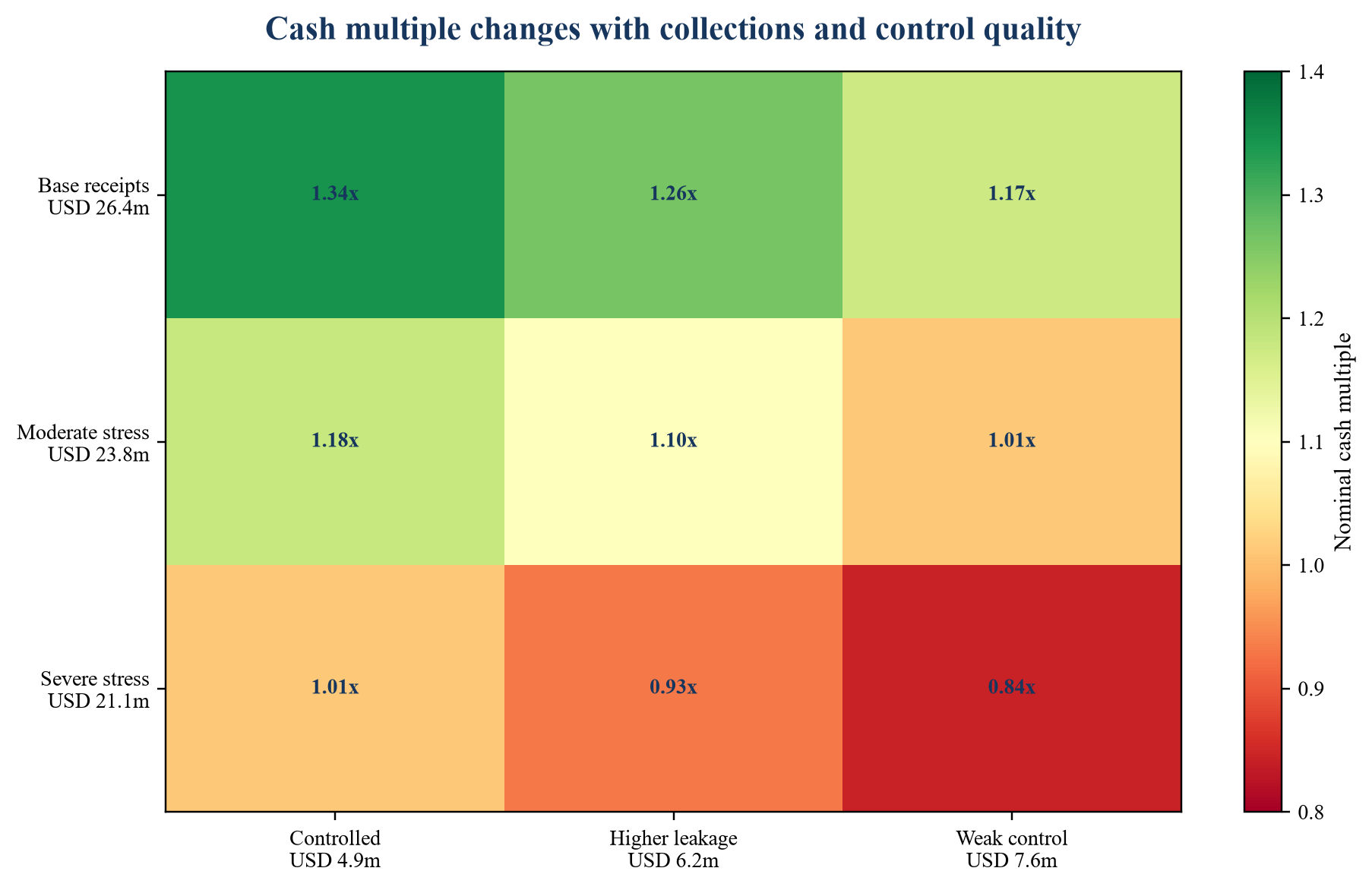
Net cash divided by a USD 16.0 million purchase price. All inputs are scenario assumptions.
17. Use transaction protections that match the exception
Transaction protections should respond to identified loss mechanisms. A broad warranty that the tape is accurate may be difficult to enforce and may not address timing. The purchaser should define material fields, tolerances, knowledge standards, claim procedures and remedies with counsel.
A balance warranty can cover the existence and amount of obligations at cut-off. A cash warranty can cover ownership and completeness of post-cut-off collections. A document warranty can cover execution and custody of contracts and security. A servicing warranty can cover compliance with agreed allocation and collection policies. A data warranty can cover the completeness and consistency of specified fields. Regulatory and privacy warranties should reflect the applicable law and transaction process.
Holdbacks or escrow can secure defined post-close adjustments. A loan-by-loan put-back can address an obligation that does not exist, was paid before cut-off, lacks a required document or falls outside agreed eligibility. A contingent-price mechanism can pay for cured documentation or realised collections. Caps, baskets, survival periods and credit support determine whether the remedy has practical value.
The buyer should also protect operational continuity. The servicing agreement can require daily cash reporting, monthly loan-level files, reconciliation standards, audit rights, business continuity, data return, transition assistance and step-in or termination rights. Bank-account control and cash-sweep arrangements should align with those provisions.
Legal advisers should confirm enforceability and regulatory implications. The economic model should value protections according to realistic recovery, timing and counterparty capacity rather than their stated amount.
18. Control the cut-over from seller to purchaser
Closing creates a period where ownership, cash and servicing can move on different dates. A cut-over plan should list every system, account, file, notice, mandate, report and responsible person. The plan should have a rehearsal, closing checklist and fallback.
The first control is a frozen cut-off tape with a cryptographic hash or equivalent integrity record. Subsequent movements should appear in a bridge showing receipts, reversals, adjustments, closures, restructurings and new legal events. The final price file should be generated from the agreed version rather than a manually edited copy.
The second control is a cash protocol. It should define bank accounts, ownership by value date, remittance timing, foreign-exchange treatment, suspense, fees and evidence. The parties should exchange control totals and loan-level allocations for the gap period.
The third control is servicing continuity. Borrower communication should follow applicable law and minimise disruption. The purchaser needs access to active promises, disputes, complaints, legal deadlines and upcoming payments. User access, authority limits and data backups should be tested before responsibility changes.
The fourth control is evidence custody. Executed agreements, security documents, notices, judgments and correspondence should be inventoried. Physical files need chain-of-custody records where relevant. Digital documents need indexes and access controls.
The committee should receive a closing readiness report that states completed tests, open exceptions, temporary controls and owners. Material exceptions should trigger a price adjustment, holdback or delayed closing.
19. Monitor post-close performance through reconciliation
Post-close reporting should preserve the same evidence chain used for pricing. Monthly reporting needs opening balances, scheduled cash, bank receipts, allocations, suspense, reversals, fees, expenses, principal, interest or profit, closures, restructurings, legal stages and ending balances. Control totals should tie to bank and accounting records.
The investor should monitor reconciliation quality alongside collections. Useful measures include percentage of receipts matched automatically, suspense value and age, posting delay, manual-adjustment value, reversal rate, unmatched ledger entries, file delivery timeliness and exception closure. A rising suspense balance can precede a deterioration in reported performance.
Borrower-level monitoring should include days past due, roll rate, cure durability, restructuring performance, promises kept, collateral changes, guarantor status, legal milestones and collection cost. Connected-group aggregation can reveal concentration that facility-level reports miss.
BCBS 239 emphasises accuracy, completeness, timeliness, adaptability, integrated taxonomies, ownership and reconciliation across systems. [8] The Basel Committee's 2026 implementation update continues to identify data lineage and fragmented systems as practical challenges. [9] A purchaser can apply these principles proportionately even when it is outside their original supervisory scope.
Governance should assign data owners, servicing owners and investment owners. A monthly exception committee can approve corrections, valuation changes and remedial action. Independent testing should sample bank-to-ledger matches and high-risk manual entries. The investment committee should receive the exceptions that can change value, cash control or legal rights.
20. Build the lender and investor evidence checklist
The evidence pack should let an independent reviewer reproduce the approval case. It should contain the sale perimeter, legal structure, country matrix, data dictionary, source-system map, opening-balance reconciliation, bank-receipt reconciliation, exception log, borrower-file sample, classification rebuild, servicing review, cash model, sensitivity analysis and transaction protections.
The data pack should identify as-of dates and versions. Each total should reconcile to a controlled source. Each assumption should name an owner, rationale and evidence. Each exception should show value, count, age, cause, proposed cure, valuation impact and transaction response.
The legal pack should separate confirmed rights from pending advice. It should identify transfer requirements, borrower notices, confidentiality constraints, servicing permissions, security perfection, enforcement status, limitation issues, tax and accounting analysis. The committee should receive a clear list of conditions that remain outstanding.
The operating pack should include servicer organisation, policies, licences where applicable, system architecture, bank accounts, cash allocation, quality control, complaints, continuity, cyber controls, subcontractors and migration plan. A sample end-to-end test should demonstrate that cash can be received, identified, posted and reported.
The investment pack should show the price bridge, monthly net cash, evidence grades, concentration, downside cases, reserves, return measures and exit assumptions. It should state that modelled amounts are hypothetical where the analysis uses an illustrative case.
| Approval area | Required evidence | Decision test | Response to failure |
|---|---|---|---|
| Asset perimeter | Loan list, contracts, amendments, transfer matrix and exclusions | Rights and obligations are defined for every priced account | Exclude, hold back or obtain a binding cure |
| Data integrity | Dictionary, lineage, validation and opening-balance tie-out | Material fields are complete, valid and controlled | Haircut value and require remediation |
| Cash evidence | Bank statements, receipt ledger, allocation and suspense report | Observed performance is reproducible from booked cash | Restate collections and reduce bid |
| Servicing | Mandate, licences, process, controls, service levels and migration test | The operating model can preserve value after closing | Change servicer, add reserve or defer closing |
| Recovery rights | Security, guarantees, enforcement and legal opinions | Modelled recovery uses a valid and practical route | Remove recovery value or add protection |
| Economics | Monthly cash model, costs, sensitivities and reserves | Price remains acceptable under approved downside cases | Reprice, restructure or decline |
| Governance | Owners, reporting, audit, exception process and escalation | Material drift will be detected and acted upon | Add controls and committee conditions |
Approval requires current transaction-specific legal, regulatory, tax, accounting and data-protection advice.
21. Use approval gates from first data room to closing
A staged approval process protects diligence resources and prevents a preliminary price from becoming an implicit commitment. The first gate confirms strategic fit, transaction structure, jurisdictions, seller, pool size and access to essential data. The second gate tests tape completeness, balance tie-out and a sample of bank receipts. A pool that fails identity or cash evidence should not progress to detailed valuation without a cure plan.
The third gate completes legal, regulatory, privacy and servicing perimeter work. It identifies transfer conditions, permitted data access, collection model and security rights. The fourth gate completes borrower-file sampling, servicing diligence, cash model and downside cases. The fifth gate approves price, protections, financing, reserves and closing conditions.
Each gate should record evidence, open exceptions, owner and expiry date. A stale approval should return to committee when the tape, cut-off, pool composition, servicer, law or price changes materially. The final committee paper should show changes from the indicative bid.
The process should preserve competitive flexibility. Standard data requests, scripts and exception taxonomies can accelerate review. The decision standard should remain consistent. Faster diligence should come from reusable controls and direct source access.
Where evidence remains incomplete, the committee can approve a conditional range instead of a final price. Conditions can include completion of the bank reconciliation, delivery of missing contracts, validation of security, regulatory confirmation, servicer testing and agreement of enforceable remedies.
22. Implement the framework in six workstreams
The first workstream establishes scope. It confirms the transaction form, seller, jurisdictions, borrower population, cut-off, accounts, servicer and expected timetable. It creates the country and rights matrix.
The second workstream builds the data foundation. It freezes source files, creates identifiers, documents definitions, validates fields and ties opening balances to controlled records. It produces the data-quality dashboard and exception log.
The third workstream reconciles cash. It obtains bank-generated statements, matches receipts, tests allocations, analyses suspense and rebuilds payment histories. It produces observed collection curves with evidence grades.
The fourth workstream tests law and operations. It reviews contracts, transfer restrictions, confidentiality, security, enforcement, servicing permissions, outsourcing, tax and accounting. It assesses the servicer and runs the end-to-end cash test.
The fifth workstream values the pool. It builds monthly recovery paths, costs, reserves, sensitivities and bid ceilings. It shows value by evidence grade, jurisdiction, borrower group, status and recovery route.
The sixth workstream executes and monitors. It negotiates protections, finalises the cut-over, locks the closing tape, validates cash ownership and begins monthly reconciliation. Governance continues until the portfolio is fully resolved or transferred.
These workstreams should share one exception register. A missing guarantor document can affect data completeness, legal recovery, valuation, transaction protection and post-close monitoring. One record with linked owners prevents the issue from being diluted across separate reports.
23. Conclusion
A GCC SME loan-pool bid should be supported by cash that can be traced, rights that can be administered and a servicing model that can operate after closing. The sale tape organises the analysis. Bank receipts, controlled servicing records, accounting tie-outs and borrower documents establish the evidence.
The practical sequence is clear. Establish one loan identity. Rebuild the opening balance. Trace bank receipts to borrower accounts. Test allocation and suspense. Recalculate arrears from scheduled obligations and cash. Confirm transfer and recovery rights by jurisdiction. Underwrite the servicer. Protect confidential data. Convert reconciled cash into a price range. Link unresolved exceptions to valuation and contractual remedies.
The hypothetical case shows why reconciliation can change bid capacity. USD 26.4 million of gross receipts becomes USD 21.5 million of net purchaser cash after unallocated items and costs. The resulting 1.34 times nominal cash multiple depends on every stated assumption. A live transaction can produce a materially different result.
The investment committee should require the evidence that would change its decision. A resolved suspense item can increase eligible cash. A missing contract can remove an account. A weak servicing test can require a reserve or replacement. A jurisdictional restriction can change the transaction structure. This discipline gives the buyer a price that reflects demonstrated cash and controlled execution.
Sources
- Central Bank of the UAE, Credit Risk Management Regulation and Standards, in force from 30 November 2024, Read the primary source
- Central Bank of the UAE, Article 3 Credit Risk Management Framework, Read the primary source
- Saudi Central Bank, Credit Risk Management Rulebook, Read the primary source
- Saudi Central Bank, Rules on Management of Problem Loans, Read the primary source
- Saudi Central Bank, Rules Governing Credit Risk Exposure Classification and Provisioning, Read the primary source
- European Banking Authority, Implementing Technical Standards on NPL Transaction Data Templates, Read the primary source
- European Banking Authority, Final Report on Draft ITS on NPL Transaction Data Templates, Read the primary source
- Basel Committee on Banking Supervision, Principles for Effective Risk Data Aggregation and Risk Reporting, Read the primary source
- Basel Committee on Banking Supervision, Implementation of the Principles for Effective Risk Data Aggregation and Risk Reporting, 6 January 2026, Read the primary source
- ISO 20022 Registration Authority, Bank-to-Customer Cash Management Message Definitions, updated 19 March 2026, Read the primary source
- IFRS Foundation, IFRS 9 Financial Instruments, Transfer and Derecognition Requirements, Read the primary source
- International Finance Corporation, Distressed Asset Resolution and Recovery Program, Read the primary source
- World Bank, Non-Performing Loans in East Asia and the Pacific Practices and Lessons in Times of COVID-19, Read the primary source
- Central Bank of the UAE, Outsourcing Standards for Banks, Read the primary source
- Saudi Data and Artificial Intelligence Authority, Personal Data Protection Knowledge Center, Read the primary source
