

1. Define the transaction question
The transaction question is whether the buyer is acquiring current network economics, enforceable spectrum rights, reusable capability or an uncertain path to future spending. These elements can coexist in one asset, yet they should not carry the same probability or valuation treatment.
An operator may own licensed spectrum and upgradeable sites. A software target may own orchestration, data and models while depending on customer spectrum. A tower or fibre platform may benefit from densification without owning radio rights. An equipment vendor may hold standards-essential intellectual property and still depend on operator adoption. The deal team should identify the legal and economic perimeter before applying a 6G label.
The investment committee should approve an option register. Each option should identify the underlying asset, exercise condition, required capital, deadline, counterparty dependency, downside if unexercised and evidence owner. This turns a broad future narrative into a set of decisions that can be priced and governed.
Table 1. 6G option layers and evidence
| Option layer | Underlying asset or right | Exercise condition | Minimum evidence |
|---|---|---|---|
| Spectrum access | Licence, lease, sharing right or acquisition pathway | Lawful use in the required band, geography and term | Licence instrument, encumbrances, obligations and renewal history |
| Refarming | Existing low- and mid-band portfolio | Legacy traffic migrates without unacceptable service loss | Traffic, device, coverage and migration plan |
| Infrastructure reuse | Sites, fibre, power, radios and upgradeable compute | Equipment and location support the target architecture | Asset inventory, capacity, interfaces and costed upgrade path |
| AI-native capability | Data, models, orchestration and control | Performance persists across customers and network stacks | Production KPI, rights, lineage and portability evidence |
| Standards alignment | Contributions, patents and implementable know-how | Approved specifications and ecosystem adoption | Standards map, claim chart and product roadmap |
| New-service option | Sensing, deterministic, immersive or machine services | Customer demand, device support and service economics | Trials, budgets, contracts and unit economics |
Each layer should be valued through its own rights, dependencies and exercise conditions.
2. Separate current assets from contingent rights
Current value comes from revenue, cash flow, spectrum that is presently usable, sites and fibre that serve traffic, production automation, enforceable contracts and transferable intellectual property. Contingent value comes from rights or capabilities whose economic use depends on later standards, assignments, devices, investment or customer adoption.
The model should value the current business first. It should then identify the incremental cash flow available if an option is exercised, the investment required, the time window, the probability of each dependency and the value lost through delay. A distant addressable market should not substitute for a current asset assessment.
Some options reduce downside before they create new revenue. Flexible radios can reduce replacement cost. A portable data and orchestration layer can lower migration risk. Spectrum-sharing capability can preserve capacity choices. These benefits should be measured through avoided or deferred expenditure rather than labelled as 6G revenue.
3. Use the standards clock as an option clock
ITU-R Recommendation M.2160-0 established the IMT-2030 framework in 2023. The framework describes six usage scenarios: immersive communication, hyper-reliable and low-latency communication, massive communication, ubiquitous connectivity, artificial intelligence and communication, and integrated sensing and communication. ITU reported in March 2026 that draft technical performance requirements had been agreed, with formal approval expected in December 2026.
3GPP has approved its first 6G work item and positions Release 21 as the first normative 6G release. Current planning places Stage 2 completion in March 2028 and ASN.1 and OpenAPI freezes in March 2029. Final specifications, national spectrum decisions and commercial deployment remain separate events.
The standards clock determines when product claims can be tested and when investments can become irreversible. A target can prepare architecture, data, compute and intellectual property before standards freeze. It should not claim completed 6G conformance while the normative definition remains under development. The valuation model should connect standards milestones to investment release and contingent consideration.
4. Distinguish spectrum from network capability
Spectrum is a regulated input. Its value depends on a lawful right to use specified frequencies in a defined geography for a defined period and purpose. Bandwidth alone does not establish value. Coverage characteristics, interference, power limits, coexistence, equipment availability, renewal, trading, lease rights and rollout obligations influence the cash-flow pathway.
Network capability combines sites, fibre, power, radios, compute, software, data and operations. An operator with attractive spectrum can still face uneconomic densification or weak backhaul. A software asset can improve spectrum efficiency without owning a licence. The buyer should therefore avoid treating spectrum and software as substitutes in the valuation bridge.
The option emerges from combination. A wider channel can support capacity when devices and radios support it. AI-native control can improve utilisation when data, safeguards and production integration exist. The deal model should identify which party controls each dependency and how much further capital is required.
5. Map the spectrum-to-cash-flow architecture
The valuation chain begins with a legal right and ends with customer or cost economics. A licence permits use. Radios and devices create practical access. Sites, fibre and power convert access into coverage and capacity. Software and AI allocate resources. Products and tariffs capture customer value. Obligations, operating costs and capital requirements reduce the cash flow.
Every material spectrum claim should be traced through this chain. A nominally large holding can have limited near-term value when the band lacks device support or requires extensive densification. A smaller block in a mature ecosystem can create greater cash flow because deployment and adoption are immediate.
The buyer should model the chain at market and cluster level. Dense-city capacity, national coverage, industrial private networks and fixed wireless access have different propagation, site and revenue conditions. A single price per MHz-pop can conceal these differences.
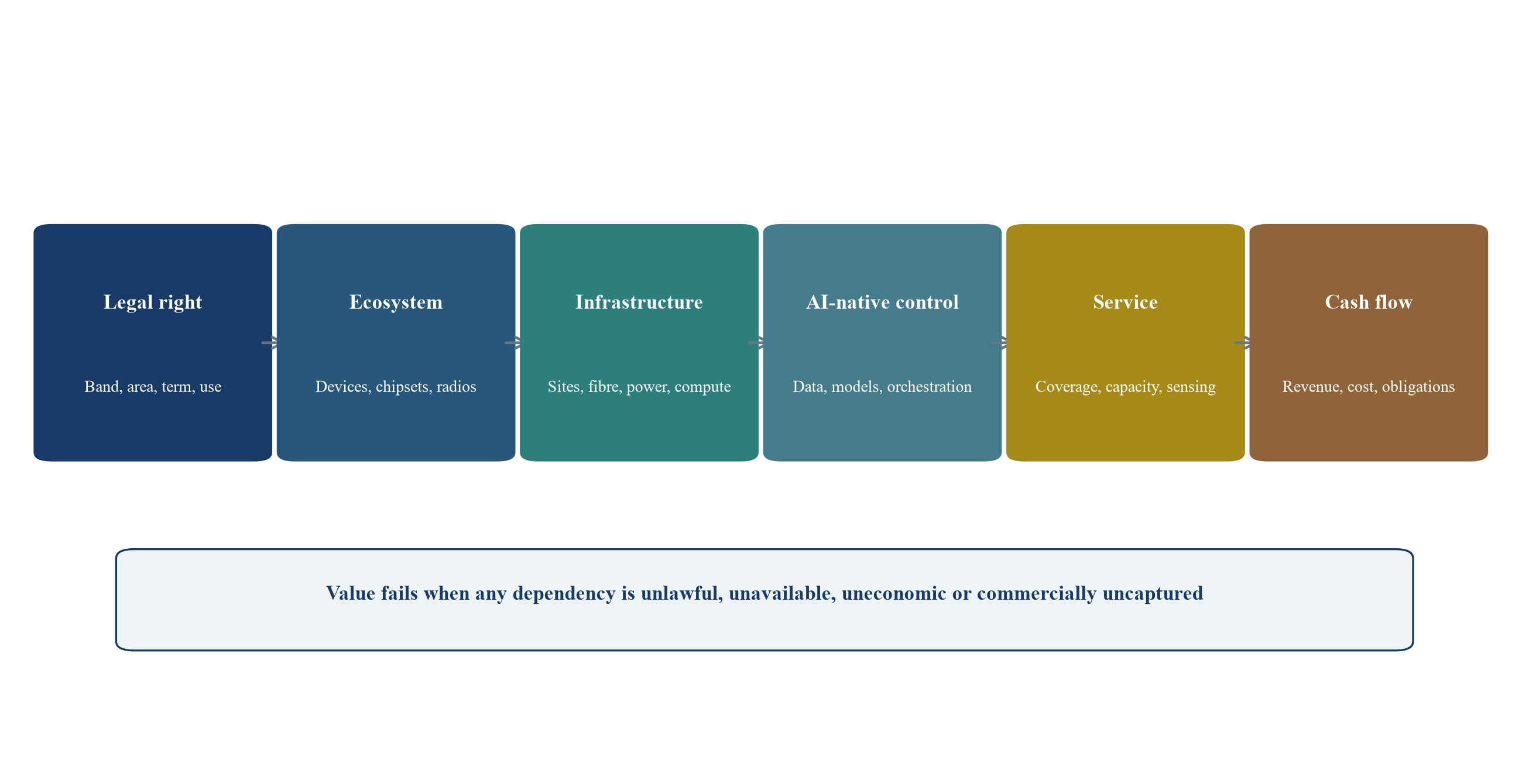
Spectrum becomes transaction value through an enforceable right, deployable ecosystem, network investment and commercial capture.
6. Audit the legal spectrum right
The spectrum file should begin with the primary legal instrument rather than a management schedule. The buyer should confirm the licensee, frequencies, duplex arrangement, bandwidth, geography, permitted services, commencement, expiry, renewal process, transfer restrictions, fees and conditions. It should reconcile the instrument with regulator databases and actual network use.
Encumbrances can include security interests, sharing agreements, wholesale commitments, interference coordination, use-it-or-lose-it provisions and change-of-control consent. Coverage, quality, emergency-service and rollout obligations create costs that belong in the valuation. The buyer should identify breaches, waivers and pending proceedings.
Renewal expectations should be supported by law, precedent and regulator practice. A perpetual treatment for a fixed-term licence overstates terminal value when renewal price and conditions remain uncertain. Scenarios should reflect renewal, repricing, partial loss and non-renewal where material.
7. Establish the band ecosystem
A band becomes economically usable when chipsets, devices, radios, antennas, test equipment and supply chains support it at commercial scale. Ecosystem maturity affects deployment timing, procurement competition, unit cost, roaming and customer adoption.
The buyer should inventory supported devices and network equipment by release, geography and price tier. It should distinguish announced support from certified and shipped products. A premium handset ecosystem can mature before mass-market or industrial devices, changing the revenue profile.
The analysis should compare the target band with substitutable bands. A technically attractive block may carry lower value if another band offers similar capacity with broader support. Ecosystem risk belongs in probability, time-to-exercise and capital cost rather than a generic discount.
8. Test propagation and densification
Frequency affects propagation, building penetration and cell radius. Higher frequencies can support wider channels and capacity while requiring denser infrastructure for comparable coverage. The economic result depends on existing sites, street furniture, indoor systems, fibre, power and permitting.
The buyer should model representative urban, suburban, rural and indoor clusters. It should use measured clutter, traffic, antenna heights and service thresholds. A national average can hide the locations where most capital and value reside.
Densification cost should include site acquisition, civil work, fibre or microwave backhaul, power, active equipment, operations and lease escalation. AI-native optimisation may reduce the number or timing of sites. That benefit requires a reproducible network plan and should be separated from the intrinsic value of the spectrum right.
9. Measure spectrum contiguity and channel utility
Contiguous spectrum can support wider channels and simplify radio design. Fragmented holdings may require aggregation, guard bands, multiple radios or coordination. The value difference should be measured through deployable channel width, device capability and network cost.
The buyer should map blocks by market and identify interference or coexistence constraints. Nominal MHz should be adjusted for unusable segments, asymmetric holdings and power limitations. Paired and unpaired arrangements can serve different traffic and architecture choices.
GSMA's July 2026 analysis identifies several candidate mid-band ranges relevant to future capacity, including 3.8 to 4.2 GHz, 4.4 to 4.99 GHz, the upper 6 GHz range and 7.125 to 8.4 GHz. Candidate status does not create national rights. The valuation should follow the jurisdiction's allocation, licensing and equipment pathway.
10. Assess spectrum need without treating forecasts as rights
GSMA estimates that dense urban locations could need an average of 2.0 to 2.5 GHz of mid-band spectrum during 2035 to 2040, with 2.4 to 3.3 GHz in higher-demand countries. It describes existing IMT assignments commonly around 1 GHz and an additional requirement of roughly 1 to 2 GHz. These figures support long-range planning and remain scenario estimates.
The buyer should rebuild demand using local traffic, offload, spectral efficiency, cell density, service targets and price. Higher traffic does not translate mechanically into spectrum value because operators can densify, refarm, improve radios, manage demand or change service quality.
Forecast ranges should be refreshed as traffic, compute cost and architecture evolve. A transaction model can carry downside, base and high-demand cases. It should avoid giving a distant aggregate need the same certainty as a current licensed holding.
11. Model refarming as a staged option
Existing low- and mid-band portfolios may support later technologies through refarming. The option is constrained by legacy devices, coverage obligations, roaming, enterprise systems and the cost of parallel operation.
The operator should provide traffic and device cohorts by band and technology. The model should estimate when sufficient demand can migrate, which radios need replacement, how coverage will be preserved and whether spectrum can be shared during transition.
Refarming can create value before full migration by improving flexibility and reducing stranded investment. The option should be priced net of customer migration, device support, network change and service risk. A target with strong automation and observability may exercise the option earlier and more safely.
12. Analyse licence obligations and hidden capital
Spectrum licences can require population or geographic coverage, deployment by specified dates, service availability, quality, security, lawful-intercept capability and annual fees. These obligations can convert an apparently valuable right into a capital commitment.
The buyer should build an obligation calendar and cost each milestone. It should identify whether investment would occur without the licence, whether assets can serve other bands and whether failure leads to penalties or revocation. Compliance evidence should be reconciled with regulator submissions.
Hidden capital also arises from power upgrades, backhaul, cloud capacity, testing and operational readiness. The option value is the present value of incremental cash flow after all exercise costs. Gross spectrum value without obligation cost is incomplete.
13. Test coexistence, sharing and interference
Future spectrum access may involve incumbent services, geographic exclusion zones, power limits, indoor conditions or dynamic sharing. Coexistence can expand access and also reduce certainty or usable capacity.
The diligence team should review technical rules, coordination agreements, incumbent databases, interference complaints and mitigation cost. It should test peak and tail performance rather than theoretical bandwidth alone. Rights to share, lease or trade can create flexibility when enforceable and operationally practical.
AI can support interference prediction, channel selection and dynamic resource allocation. Valuation should follow production evidence, regulator acceptance and reliable safeguards. A research demonstration does not establish that a sharing regime will be authorised or commercially scalable.
14. Link WRC-27 and national decisions
World Radiocommunication Conference outcomes coordinate international allocations and identification. National regulators then determine local allocation, licensing, conditions and timing. The steps should be treated separately in the option tree.
ITU-R preparatory studies for WRC-27 examine candidate frequency ranges and technical coexistence. A favourable international result can improve the pathway without creating a licence. National consultation, clearance and auction or assignment may take additional years.
The transaction model should name each decision authority and earliest credible milestone. Consideration tied to spectrum events should specify the event precisely: international identification, national allocation, assignment, licence effectiveness, equipment availability or commercial launch.
15. Price device and chipset timing
Network investment creates limited revenue when customers cannot access the band or feature. Device and chipset timing therefore belongs in the spectrum option model. The buyer should evaluate flagship, mass-market, enterprise, industrial and fixed-wireless device segments separately.
Certification, radio-frequency front ends, antenna design, battery life and regional variants can delay adoption. A standardised band with weak device economics may remain underused. A mature device ecosystem can accelerate traffic migration and improve capital productivity.
The forecast should use shipped and active-device cohorts rather than announcement counts. It should connect adoption to addressable customers, tariffs and network load. Device risk can be addressed through staged deployment, procurement commitments and contingent consideration.
16. Audit data rights
Network telemetry can contain commercially sensitive, security-sensitive or personal information. The target needs rights to access, process, retain and use data for the contracted purpose. Rights to train general models may be narrower than rights to optimise one customer's network.
The data register should identify source, controller, processor, location, retention, permitted purpose, model use, sharing and deletion. It should connect contracts to actual pipelines. A broad statement that the target owns its data should receive no valuation weight without evidence.
Acquisition can change the permitted use or counterparty. Change-of-control provisions, operator policies and national-security controls may affect continuity. The buyer should secure consents or structure access before completion.
17. Inspect model lineage
Model lineage records the code, training data, features, parameters, evaluation sets, approvals and deployed versions. It enables reproducibility and helps determine which improvements belong to the target, customer or technology supplier.
The target should show how it prevents leakage between customers and protects confidential configurations. It should document open-source and third-party model components, licences and obligations. Training and inference infrastructure should be identifiable and costed.
Lineage becomes an acquisition asset when it shortens validation, supports audit and enables continued development. Weak lineage can turn proprietary performance into an unverifiable claim. The buyer should condition value on a clean and usable record.
18. Review MLOps and lifecycle control
Production network models require monitoring, drift detection, retraining, testing, promotion, rollback and retirement. These processes should operate across customers without creating an unmanageable release burden.
The diligence team should inspect approval roles, automated tests, shadow mode, canary deployment and incident handling. It should compare documented process with release records. A slide describing MLOps is weaker than evidence of controlled model changes.
Lifecycle cost belongs in gross-margin analysis. Customer-specific models, manual retraining and frequent intervention can make reported software revenue service-intensive. The forecast should include compute, engineering and assurance resources required to maintain promised performance.
19. Assess cybersecurity and supply chain
Network automation sits near critical infrastructure. A compromise could expose operational data, alter configurations or disrupt service. Security should cover software development, dependencies, identity, secrets, data, update mechanisms and operational access.
The buyer should review secure-development evidence, vulnerability management, penetration testing, incident history, software bills of materials and privileged-access controls. It should test whether deployment architecture limits blast radius and supports rapid revocation.
National requirements and operator policies can restrict hosting, support locations and supplier ownership. These constraints can affect market access and integration cost. The acquisition plan should include security remediation and customer re-approval.
20. Identify concentration risk
Early network-software companies often depend on a small number of operators, vendors or geographies. Concentration can provide deep validation and create bargaining risk.
Revenue analysis should separate paid production, paid trial, project, pass-through and non-recurring income. The buyer should inspect renewal, expansion, termination, acceptance and most-favoured terms. Pipeline probability should reflect procurement history and deployment readiness.
Technical concentration matters as much as revenue concentration. A product proven on one network stack may require material work elsewhere. The valuation should not treat one operator's footprint as a general market share.
21. Normalise commercial metrics
Annual recurring revenue should include only contracted, recurring consideration for a continuing service. Implementation, hardware, cloud pass-through and engineering projects should be identified separately. Benefit-sharing revenue should be assessed against measurement and dispute provisions.
Gross margin should include deployment engineering, customer support, compute, data movement, third-party licences and lifecycle work. Capitalised development can make current profitability appear stronger while deferring cost to the balance sheet.
Retention should distinguish logo, contract and product retention. Expansion can arise from more cells, regions, modules or measured benefits. The buyer should understand which unit drives price and whether it grows with value delivered.
22. Connect network benefits to cash flow
Technical improvement becomes acquisition value only when it affects cash flow. Energy savings may lower operating expense. Capacity improvement may defer radios or spectrum investment. Better experience may protect revenue or reduce complaints. Faster planning may accelerate rollout.
The bridge should identify the operator's benefit, the target's contractual capture and the buyer's ownership period. A customer benefit does not automatically accrue to the software vendor. Strong evidence can support renewal and pricing, but the contract determines realised revenue.
Benefits should be discounted for attribution, persistence, implementation cost and sharing. The team should avoid adding the same benefit to both the customer's savings and the target's forecast revenue.
Table 2. Spectrum-right diligence matrix
| Domain | Required record | Red flag | Valuation response |
|---|---|---|---|
| Legal right | Primary licence, registry confirmation and transfer terms | Management schedule differs from legal instrument | Cure, condition or exclude |
| Term and renewal | Expiry, renewal process, precedent and fee history | Terminal value assumes automatic renewal | Scenario-weight renewal |
| Obligations | Rollout, coverage, quality, fee and security calendar | Underfunded near-term milestone | Deduct required capital |
| Ecosystem | Certified devices, radios, chipset and procurement evidence | Announcement without shipped support | Delay exercise date |
| Deployment | Cluster plan, sites, fibre, power and cost | Spectrum plan excludes densification | Deduct full deployment cost |
| Commercial capture | Product, tariff, customer cohort and cash-flow bridge | Traffic forecast without revenue or saving | Exclude unsupported uplift |
The licence, deployability and commercial route should be reconciled before a premium is attributed.
23. Build the option-readiness scorecard
The scorecard should combine legal control, technical deployability, ecosystem maturity, commercial capture and capital requirements. A band with a strong legal right and weak device support is different from a mature band with uncertain renewal. A software platform with production value and speculative 6G features should be split accordingly.
Every score should identify source, owner, date and threshold. Management aspiration should be shown beside verified current evidence and the acquisition assumption. The scorecard should record whether a dependency sits with the target, buyer, regulator, standards body, vendor or customer.
The same scorecard can govern post-completion funding. Capital should be released when the option moves through defined gates. A green aggregate score should not conceal a failure in legal rights, security, economics or safety.
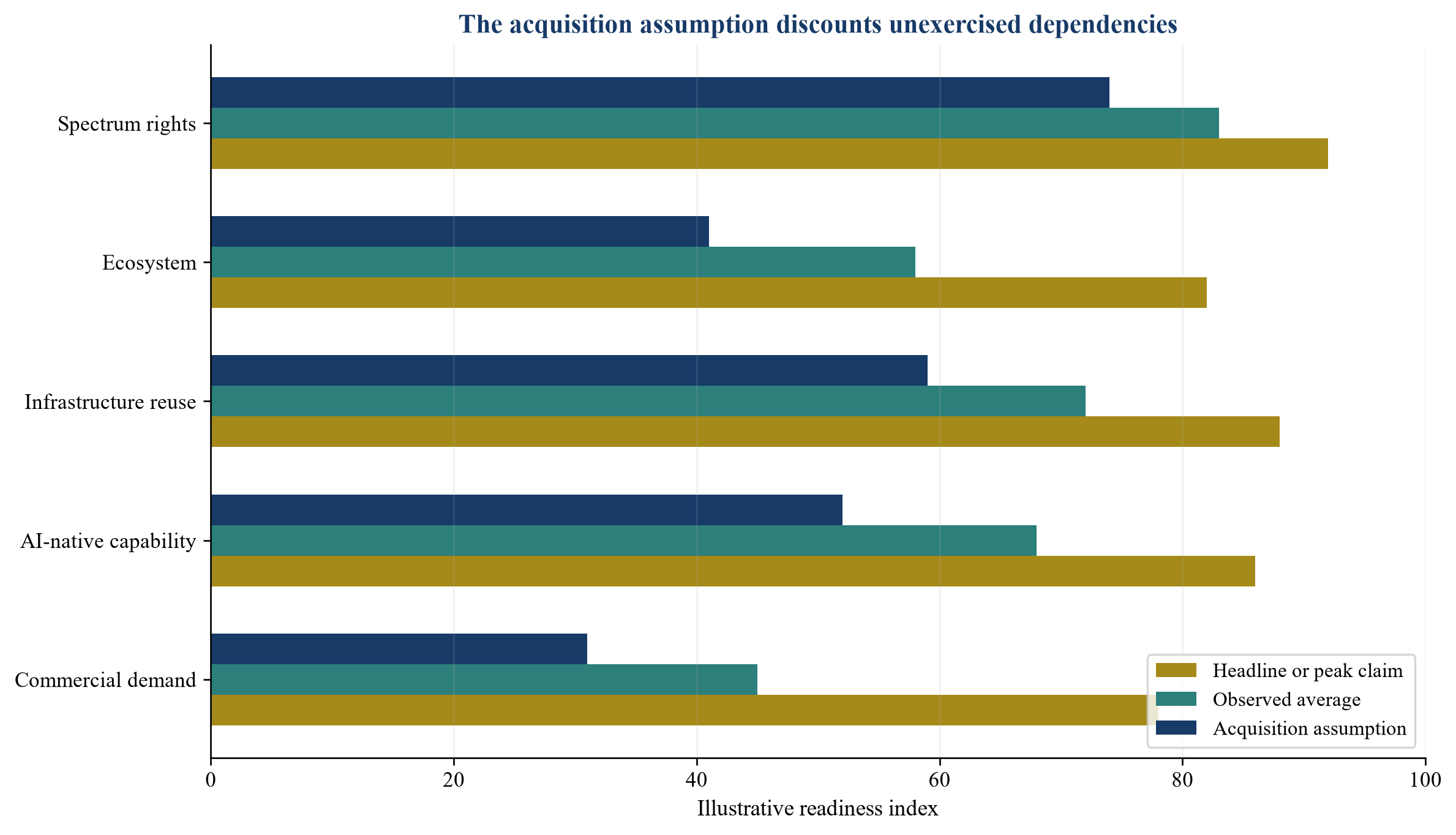
Illustrative management scores; valuation uses verified evidence rather than strategic aspiration.
24. Model the spectrum-versus-densification curve
An operator can add capacity through spectrum, spectral efficiency, densification, offload and demand management. The correct comparison uses the same traffic, geography, service and quality assumptions. Spectrum value is partly the capital and disruption avoided through a better capacity path.
The model should compare a constrained-spectrum plan with an additional-spectrum and AI-native plan. It should include licence payments, radios, sites, fibre, power, compute, integration and operations. A spectrum-rich plan can still require significant densification at higher frequencies.
Deferred capital should be distinguished from permanently avoided capital. AI-native optimisation may postpone a site while traffic remains manageable. The site can return later in the plan. The transaction model should preserve the future obligation and recognise the time value of delay.
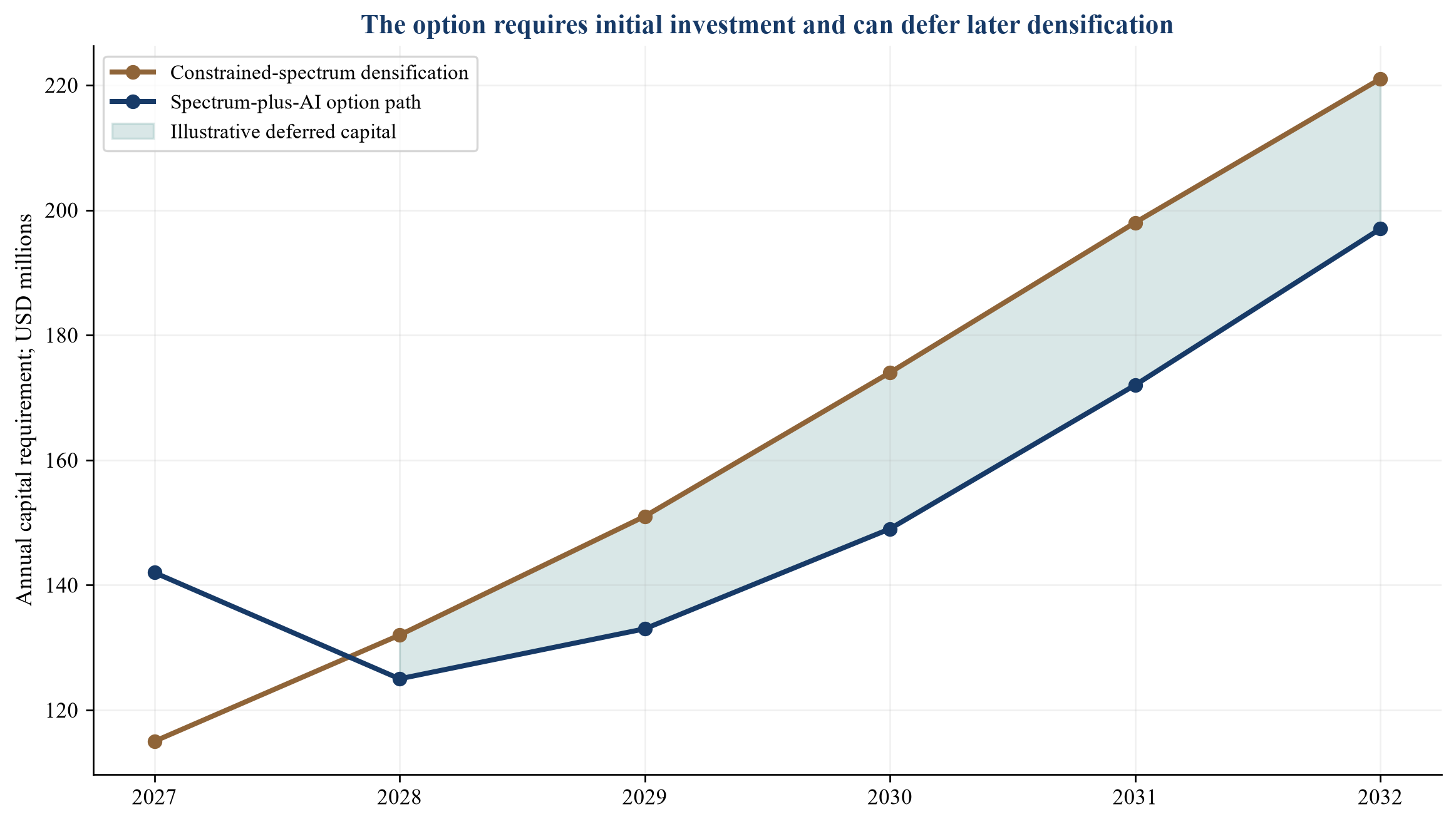
Illustrative management assumptions; additional usable spectrum and AI-native control defer part of site densification after initial investment.
25. Value the present business and usable spectrum
The present business can be valued through a discounted cash-flow method, comparable transactions or revenue and earnings multiples, subject to availability and comparability. The forecast should begin with contracted revenue and build through evidence-based expansion.
The buyer should normalise research grants, pilots, hardware and non-recurring engineering. It should include productisation and compliance spending needed to scale. A high growth rate should connect to operator budgets, procurement cycles and deployment capacity.
Comparable companies may combine spectrum, software, equipment and services. Spectrum auction benchmarks require adjustment for band, geography, term, obligations, market structure, timing and deployability. A generic price per MHz-pop or software multiple can obscure the asset's cash-flow economics.
26. Price current network intelligence
Validated customer value can support a premium when it is independently measured, repeatable and linked to commercial capture. The buyer can compare the present value of customer benefit with subscription fees and switching costs.
The premium should be limited by competitive alternatives and contract terms. Operators may build similar capability, obtain it from network vendors or procure another independent supplier. Open interfaces can expand the market and lower barriers.
Benefit evidence is strongest when customers renew, expand and permit reference use. A buyer should speak directly with technical, operational and procurement stakeholders. Enthusiasm from an innovation team does not replace a production budget.
27. Value spectrum and software flexibility
Flexibility reduces dependence on one band, vendor, customer or architecture. It can preserve the ability to refarm, share, aggregate, upgrade or redeploy. Its value depends on legal rights, reusable software, stable interfaces, automated onboarding and evidence that performance survives transfer.
The team should calculate a portability coefficient: the proportion of code, models, tests and integration assets reused in the next deployment. It should measure deployment time and engineering effort. These measures should be verified from project records.
The premium can be staged. Part may be paid at closing for demonstrated deployments. Further consideration can follow acceptance on a new operator or stack. This aligns price with realised transferability.
28. Apply a real-options discipline
The 6G option represents the right, without the obligation, to invest when standards, spectrum, devices and demand reach defined conditions. It should not be valued as forecast 6G revenue when products, timing and procurement remain uncertain.
An option register can score standards relevance, technical reuse, partner access, intellectual property, required investment and time to commercial evidence. The value should be capped by the incremental capital needed and probability of exercise.
Milestones can include approved standards, accepted interfaces, successful trials, operator budgets and signed contracts. Consideration linked to these events protects the seller's upside and the buyer's capital.
29. Construct the USD 500 million case
The valuation bridge begins with the present business and adds only distinct, supportable value. It can add verified spectrum access, reusable AI-native capability and a capped standards option. It subtracts integration, licence obligations, ecosystem delay and standards risk.
In the hypothetical case, the parties discuss an enterprise value of USD 500 million. The bridge is a decision aid rather than a valuation opinion. USD 360 million comes from the present operating business. The remaining bridge reflects evidence-weighted assets and risks rather than an unconstrained 6G narrative.
The buyer should run downside, base and upside cases. Each adjustment needs an evidence owner and closing treatment. Risks that can be cured before signing should be conditions. Risks whose outcome emerges after closing should be reflected through contingent consideration or holdback.
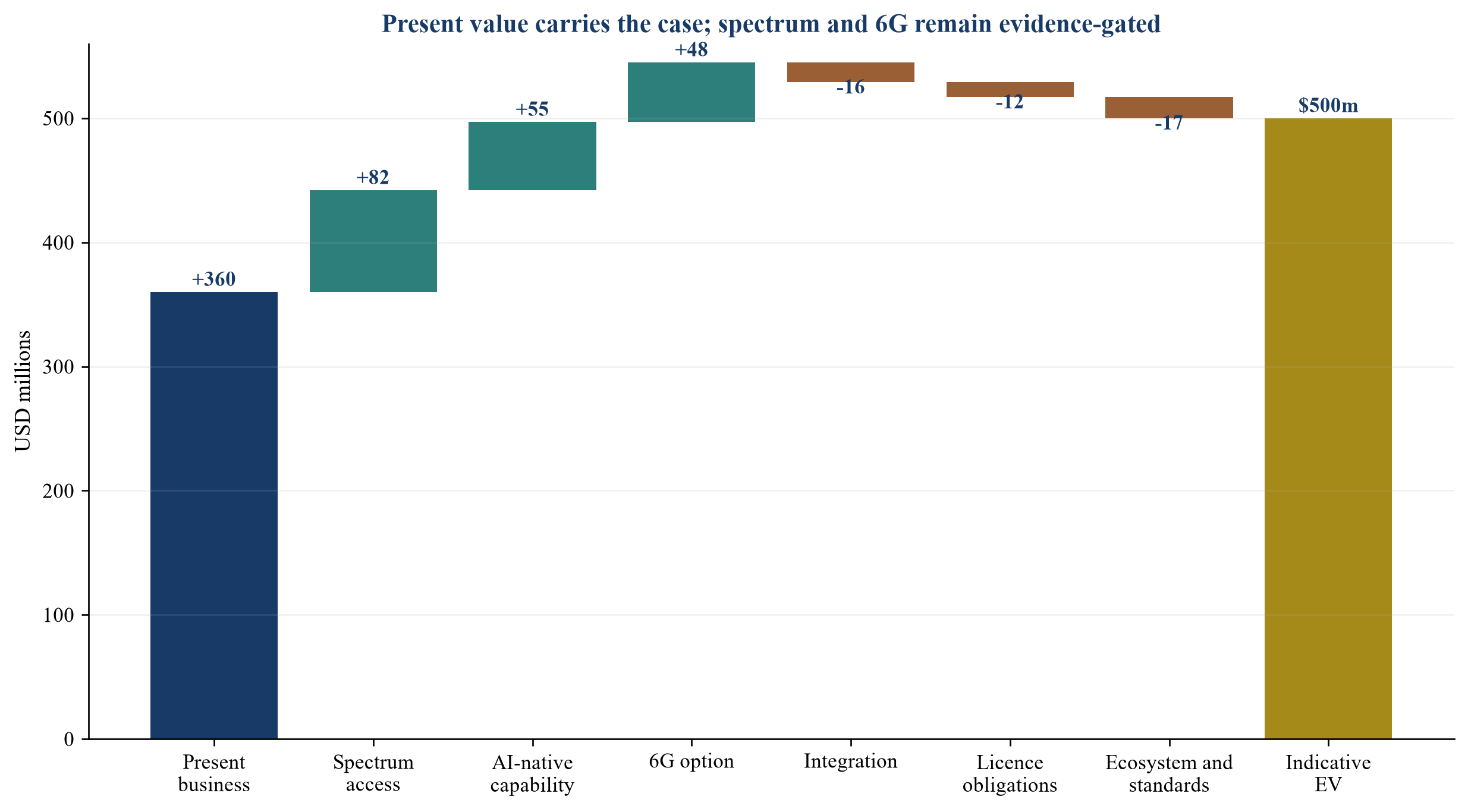
Illustrative management assumptions in USD millions; the future standards option is deliberately capped.
30. Structure consideration
Cash at completion should fund verified present value. Seller rollover can maintain alignment when founders and technical leaders remain important. Earn-outs can pay for revenue, production deployment or validated portability after closing.
Technical earn-outs require objective definitions. The agreement should state the network scope, baseline, KPI, measurement period, control conditions, independent verifier and consequences of buyer decisions. A vague milestone invites conflict.
Milestone payments can address standards and 6G uncertainty. They should reward outcomes within the seller's influence and account for buyer funding. Long schedules need governance, information and dispute provisions.
31. Use representations and indemnities
Representations should cover ownership, licences, data rights, open-source use, security, standards claims, customer contracts, model records and regulatory compliance. They should reflect disclosed facts and actual control.
Specific indemnities or escrow may address identified chain-of-title, cybersecurity or customer-consent issues. Insurance can support parts of the risk and may exclude forward-looking performance.
Technical claims used in valuation should appear in diligence records and transaction schedules. Marketing language should not become an unintended warranty, and material evidence should not remain outside the deal documents.
32. Protect key people and know-how
Network-automation value can depend on engineers who understand operator systems, model behaviour and informal integration pathways. The buyer should map key-person concentration and documentation gaps.
Retention should combine role clarity, incentives, career path and resources. Restrictive covenants require jurisdiction-specific advice. Knowledge transfer should be measured through completed documentation, tests and successor capability.
The operating model should reduce heroic dependence. Product, deployment, data science, standards and customer ownership should have accountable leaders and repeatable processes.
33. Plan integration before signing
Integration decisions affect product credibility. Operators may need to approve a change in ownership, hosting or support. Combining code repositories and security processes too quickly can disrupt releases.
The first plan should preserve service continuity, customer trust, privileged access and roadmap focus. Corporate systems can be integrated in stages. Product architecture should change only through a tested plan.
Synergies should identify owner, cost, timing and dependency. Revenue synergy through the buyer's channels requires technical enablement and procurement access. Cost synergy should not remove the engineering capacity needed for delivery.
34. Build the first 100-day plan
The first 100 days should validate rights, customer commitments, product releases, security controls and KPI baselines. The buyer should freeze a verified inventory of code, models, data, interfaces and deployments.
Customer meetings should confirm continuity and expansion plans. Product teams should reproduce material evidence and establish a common measurement standard. Finance teams should reconcile revenue quality and delivery cost.
The board should approve the present-value roadmap and the option roadmap separately. Capital for future standards work should follow technical and commercial milestones.
35. Create a board dashboard
The board dashboard should cover recurring revenue, renewal, gross margin, deployment time, portability, KPI persistence, incidents, overrides and standards milestones. Each measure needs a stable definition.
The dashboard should show observed, customer-validated and acquisition-case values. It should distinguish maximum results from fleet averages. Exceptions should remain visible.
Management can use the dashboard to decide whether to scale, remediate or stop a use case. A composite score should not hide failure in security, rights or resilience.
Table 3. Hypothetical USD 500 million transaction case
| Item | Base assumption | Diligence condition | Deal response |
|---|---|---|---|
| Enterprise value discussion | USD 500 million | Present business supports most of value | Limit cash at completion |
| Present operating business | USD 360 million | Revenue, margin, rights and cash-flow review | Base-value input |
| Spectrum-access contribution | USD 82 million | Enforceable rights, ecosystem and deployment plan | Premium or staged payment |
| AI-native capability | USD 55 million | Production KPI, portability and lawful data | Earn-out or premium |
| 6G option | USD 48 million capped contribution | Standards, spectrum, device and adoption gates | Deferred option payment |
| Integration and licence obligations | USD 28 million deduction | Costed integration and obligation calendar | Price adjustment or escrow |
| Ecosystem and standards risk | USD 17 million deduction | Defined external milestones and downside case | Holdback or contingent value |
Illustrative management assumptions only; no amount represents observed company data or a valuation opinion.
36. Establish the diligence workplan
The workplan should join commercial, technical, operational, legal, regulatory, cybersecurity and financial diligence. Separate streams should use one claim register so that the same benefit is not accepted in one workstream and challenged in another.
Material claims should identify evidence, owner, verifier and transaction consequence. The team should prioritise value-bearing claims: recurring revenue, customer savings, portability, rights and future-option dependencies.
Testing should include code and architecture review, data-right mapping, model reproduction, deployment sampling, customer calls and contract reconciliation. Findings should flow into valuation, conditions, covenants and integration.
37. Prepare the data room
The data room should include entity records, intellectual-property assignments, source-code inventory, licences, model lineage, architecture, security evidence, customer contracts, deployments, KPI studies, incident history, financial records and standards contributions.
Evidence should be attributable and dated. Screenshots and presentations should link to underlying records. Customer-sensitive network data may require controlled review rather than broad disclosure.
The target should maintain a red-flag register with owners and closure dates. A clean data room shortens transaction time and improves confidence; it does not replace substantive evidence.
38. Apply a go, reprice or stop decision
A go decision requires a defensible present business, usable rights, manageable integration and a credible path to scale. Repricing is appropriate when the asset remains useful and value claims exceed evidence. A stop decision is appropriate when critical rights, security, customer continuity or technical attribution cannot be cured.
The decision should be explicit about future optionality. A buyer can acquire a valuable 5G automation business while assigning little value to 6G. It can also pursue a partnership or option instead of acquiring an immature platform.
Decision records should identify assumptions and unresolved matters. This preserves accountability when technology and standards evolve.
Table 4. Board and diligence scorecard
| Domain | Minimum evidence | Red flag | Decision response |
|---|---|---|---|
| Spectrum right | Primary licence, term, transfer, renewal and encumbrances | Ownership or transfer unresolved | Cure or stop |
| Deployment economics | Cluster plan, ecosystem, sites, fibre, power and full capex | MHz valued without network cost | Rebuild or reprice |
| Obligations | Complete milestone calendar and regulator evidence | Underfunded rollout or compliance gap | Deduct, escrow or stop |
| AI-native capability | Rights, lineage, production KPI and portability | Research claim presented as fleet result | Exclude unsupported uplift |
| Security and resilience | Secure development, access control and incident evidence | Critical-infrastructure exposure | Remediate or stop |
| 6G option | Standards map, reusable capability and adoption milestone | Forecast revenue before product definition | Cap and defer value |
Each domain requires evidence before material value is attributed.
39. Recognise limitations
This framework supports acquisition analysis. It does not determine whether a product is safe, compliant or suitable for a specific network. Qualified technical, regulatory, security, legal, tax, accounting and valuation advice is required.
Standards, interfaces and operator plans continue to evolve. Results published by vendors and operators are specific to their described deployments. They should not be generalised without reproduction.
The hypothetical case demonstrates a method. Actual revenue, costs, benefits, probabilities, terms and values require transaction-specific evidence. No figure in the case is a forecast or recommendation.
40. Conclude with a governed call option
Spectrum and AI-native capability can preserve valuable choices before 6G commercialisation. The value is strongest when the buyer controls enforceable rights, deployable infrastructure, lawful data, portable software and a credible route to customers. Standards and demand can then determine when the option is exercised.
The valuation should remain layered. Present operations and presently usable spectrum support base value. Reusable network intelligence can support an evidence-based premium. Future spectrum assignments, sensing services and 6G architecture belong in a capped option whose capital is released through observable milestones.
The disciplined sequence is to verify the legal right, model the complete deployment chain, test the device and vendor ecosystem, value present cash flow, deduct obligations and integration, and stage future consideration. This approach preserves participation in 6G while keeping the purchase price anchored to assets, capabilities and economics that can be examined today.
References
- International Telecommunication Union. IMT-2030 technical performance requirements for the 6G future. 17 March 2026. https://www.itu.int/hub/2026/03/imt-2030-technical-requirements-for-the-6g-future/
- International Telecommunication Union. IMT-2030 portal and process. https://www.itu.int/en/ITU-R/study-groups/rsg5/rwp5d/imt-2030/pages/default.aspx
- International Telecommunication Union. Recommendation ITU-R M.2160-0: Framework and overall objectives of the future development of IMT for 2030 and beyond. 2023. https://www.itu.int/rec/R-REC-M.2160-0-202311-I
- International Telecommunication Union. Preparatory studies for WRC-27. https://www.itu.int/en/ITU-R/study-groups/rcpm/Pages/wrc-27-studies.aspx
- International Telecommunication Union. Work programme: framework for network architecture for IMT-2030. https://www.itu.int/itu-t/workprog/wp_item.aspx?isn=23853
- GSMA. Vision 2040: Future Spectrum Needs. 22 July 2026. https://www.gsma.com/connectivity-for-good/spectrum/gsma_resources/vision-2040-future-spectrum-needs/
- GSMA. Spectrum activity for the 2030s is gathering pace. https://www.gsma.com/connectivity-for-good/spectrum/spectrum-activity-for-the-2030s-is-gathering-pace/
- GSMA. Mobile Spectrum Needs. Mobile Policy Handbook. https://www.gsma.com/solutions-and-impact/connectivity-for-good/public-policy/mobile-policy-handbook/spectrum-management-and-licensing/mobile-spectrum-needs/
- GSMA. Spectrum Policy Trends 2026. https://www.gsma.com/connectivity-for-good/spectrum/gsma_resources/spectrum-policy-trends-2026/
- GSMA. 6G Community Industry Progress Report. May 2026. https://www.gsma.com/solutions-and-impact/technologies/networks/gsma_resources/gsma-6g-community-industry-progress-report-may-2026/
- GSMA. 6G Terminals Study Report. https://www.gsma.com/solutions-and-impact/technologies/networks/gsma_resources/6g-terminals-study-report/
- O-RAN Alliance. Working Group 2: Non-real-time RIC and A1/R1 interfaces. https://www.o-ran.org/technical-groups/wg2
- O-RAN Alliance. Technical groups. https://www.o-ran.org/technical-groups
- O-RAN Alliance. O-RAN Alliance completed Specification Release 5. 8 June 2026. https://www.o-ran.org/blog/o-ran-alliance-completed-its-specification-release-5-o-ran-r005
- O-RAN Alliance. 60 new or updated O-RAN technical documents released since March 2025. https://www.o-ran.org/blog/60-new-or-updated-o-ran-technical-documents-released-since-march-2025
- O-RAN Alliance. Open and AI-driven RAN priorities. 28 March 2025. https://mediastorage.o-ran.org/press-release/O-RAN.EC.2025-03-28.PR%20MWC25%20summit%20messages.pdf
- 3rd Generation Partnership Project. 3GPP Highlights, Issue 10. https://www.3gpp.org/images/newsletters/3GPP_Highlights_Issue_10_WEB.pdf
- Ericsson. Far EasTone uses AI and machine learning for RAN energy savings. 2023. https://www.ericsson.com/en/cases/2023/ericsson-far-eastone
- Ericsson. Augmenting MIMO energy management with machine learning and AI. https://www.ericsson.com/en/cases/2019/augmenting-mimo-energy-management-with-machine-learning-and-ai
- Ericsson. Elisa Finland and Ericsson energy-efficiency case. 2023. https://www.ericsson.com/en/cases/2023/elisa-finland-and-ericsson
- Ericsson and SoftBank. Japan commercial-network AI-in-RAN trial. 20 August 2026. https://www.ericsson.com/en/press-releases/2/2026/softbank-corp-and-ericsson-conduct-japans-first-trial-of-ericsson-ai-in-ran-on-5g-commercial-network
- Ericsson. The RAN gets smarter: Ericsson puts AI where it matters. June 2026. https://www.ericsson.com/en/news/2026/6/the-ran-gets-smarter-ericsson-puts-ai-where-it-matters
- Ericsson and KDDI. Live AI-powered RAN optimisation rApps. 2026. https://www.ericsson.com/en/cases/2026/kddi-boosts-uplink-with-live-ai-powered-ran-optimization-rapps
- Ericsson and AT&T. Shaping the networks of tomorrow with a programmable network. 2025. https://www.ericsson.com/en/cases/2025/shaping-networks-of-tomorrow
- Ericsson and TAWAL. Energy infrastructure operations in Saudi Arabia. 2023. https://www.ericsson.com/en/press-releases/5/2023/tawal-reaps-benefits-of-ericsson-energy-infrastructure-operations-in-saudi-arabia
- SoftBank. AI-RAN: Unveiling the Future of Telecom with Breakthrough Innovations. 7 February 2025, version 1.1. https://www.softbank.jp/corp/set/data/technology/research/story-event/wp_location/pdf/SoftBank_AI-RAN%20Unveiling%20the%20Future%20of%20Telecom%20with%20Breakthrough%20Innovations_Feb7_2025_Ver.1.1.pdf
- IFRS Foundation. IFRS 3 Business Combinations. https://www.ifrs.org/issued-standards/list-of-standards/ifrs-3-business-combinations/
- IFRS Foundation. IAS 36 Impairment of Assets. https://www.ifrs.org/issued-standards/list-of-standards/ias-36-impairment-of-assets/
- IFRS Foundation. IAS 38 Intangible Assets. https://www.ifrs.org/issued-standards/list-of-standards/ias-38-intangible-assets/
- IFRS Foundation. IFRS 13 Fair Value Measurement. https://www.ifrs.org/issued-standards/list-of-standards/ifrs-13-fair-value-measurement/
About the Author
Chennakeshav (CK) is a corporate finance and investment banking executive with 25+ years of global experience in deal origination, structuring and execution across M&A, growth capital and corporate strategy. He has led value-creation mandates for founders, corporates and funds — bridging the boardroom view to hands-on execution and close.
His career spans Morgan Stanley, HSBC, Lloyds Banking Group, EWEC, ADQ portfolio companies and Emirates Growth Fund, across TMT, real estate, fintech, deeptech, cleantech, infrastructure and energy. He has partnered with C-suite leaders, private equity and venture funds, sovereign wealth funds and family offices to finance complex fund raises and scale-up ventures, and has led M&A due diligence, post-merger integration and business-transformation initiatives to create value.
At Matchpoint Partners he is Managing Partner, leading the firm's corporate finance, M&A and capital-raising practice. He holds an MBA from London Business School, an engineering degree from VTU and a Master of Laws (LLM, in progress) from UCL London.
An active start-up mentor, CK mentors at Techstars, DIFC FinTech Hive, Startup Grind, Founder Institute and IN5, serves as Entrepreneur Mentor in Residence (EMiR) at London Business School, and judges the Entrepreneurship World Cup.
https://www.linkedin.com/in/ckadya/
https://www.matchpoint-partners.com/team/ck-adya.html
This paper is part of a continuing series on the structure of private and alternative markets. The views expressed are the author's own. The paper is for information only, describes market structure in general terms, and does not constitute investment, legal, tax or regulatory advice or a recommendation in respect of any security, vehicle or counterparty.
