

1. Define the capital decision
The board decision is the allocation of scarce cash and management capacity across an existing portfolio of technology commitments. The question is broader than whether a particular application is old. It asks which capabilities the company must protect, which commitments still support the strategy, which projects need more evidence, which should be stopped and which platforms deserve additional capital. Each recommendation should state the cash consequence, operating consequence, benefit case, dependency and person authorised to decide.
This distinction matters in an investor-owned company. Management can describe a programme as strategic while the investment committee sees repeated overruns, delayed milestones and benefits that cannot be traced to accounts or customers. A cost reduction can look attractive until the review identifies contractual termination charges, data migration, cyber remediation or months of parallel operation. A proposed growth platform can claim large revenue potential while lacking a defined product, customer cohort, price, adoption path or contribution-margin bridge. The decision file should expose these conditions before funds move.
The G20/OECD Principles identify strategy, budgets, performance objectives, risk policy and oversight of major capital expenditure among key board functions. The allocation of responsibilities can differ by company and jurisdiction. The practical implication is that a review office should prepare comparable evidence and recommendations while leaving approval with the company's documented authority. A project sponsor, chief information officer or transformation team should not approve its own exception merely because it controls the source data. [2]
The proposed Capital Productivity Office is therefore a decision service rather than a new source of authority. It can be a temporary team sponsored by the chief executive, chief financial officer and investment committee. It maintains one register and one evidence standard across finance, operations, technology, cyber, procurement and commercial teams. Its output is a sequence of documented decisions. If the company already has a capable portfolio office, the same method can be assigned to that office without creating another organisational layer.
2. Reconcile the portfolio before ranking projects
A capital review begins with population completeness. The company should reconcile the general ledger, approved budgets, purchase orders, vendor contracts, project tools, cloud commitments, capital work in progress, prepaid licences, internal labour allocations and business-unit spreadsheets. The register should include initiatives that have no current-year invoice but can create a future payment or operational obligation. It should also identify software and infrastructure already in service whose maintenance, support or replacement competes for the same capacity.
Each register line needs a stable identifier, legal entity, sponsor, product or system, purpose, current status, approved amount, cash paid, remaining commitment, expected completion, operating cost, accounting treatment, vendor, contract dates, dependencies, benefit owner and decision authority. Records should link to source documents rather than restating them in an untraceable presentation. A portfolio total that cannot be reproduced from underlying records is not ready for reallocation.
Duplicates require deliberate treatment. One programme can appear as a capital project, a cloud contract and a transformation initiative. A platform may serve several business units while each unit records a local budget. Conversely, one project name can hide separate deployments with different contracts and benefits. The office should preserve source identifiers, map related records and choose one counting unit for the decision. It should not delete inconvenient records to make the total fit an approved budget.
Reconcile timing as well as total value. An approved amount can represent a multi-year ceiling, while the immediate decision concerns cash in the next quarter or financial year. Separate paid amounts, irrevocable commitments, cancellable commitments, forecast spend and unapproved requests. State currency and the exchange-rate basis used for consolidation. Record whether taxes are included. This produces a cash calendar that can support an actual reallocation instead of an accounting total with no funding date.
The GAO investment-management framework uses selection, control and evaluation as a recurring cycle. It also treats ongoing projects as candidates for reselection. Although the framework was written for U.S. federal organisations, this logic addresses a common private-company problem: approval becomes permanent while evidence changes. A complete register allows the company to compare existing and proposed investments under the same criteria at each funding gate. [4]
| Review field | Minimum evidence | Decision use | Responsible challenge |
|---|---|---|---|
| Commitment | Approved budget, contract, order, invoice and payment record | Distinguish sunk, committed, cancellable and forecast cash | Finance and procurement |
| Business purpose | Strategy reference, user need and operating outcome | Test continuing strategic fit | Sponsor and business owner |
| Service criticality | Process map, recovery requirement and failure consequence | Protect essential continuity and resilience | Operations, cyber and risk |
| Delivery status | Milestones, accepted outputs, defects and dependency record | Measure progress and remaining work | Technology and independent assurance |
| Benefit | Baseline, calculation, owner, timing and source system | Compare expected and realised value | Finance and commercial owner |
| Exit path | Termination terms, migration, archive and parallel-run plan | Quantify cash release and execution risk | Procurement, legal and technology |
| Accounting | Ledger treatment, useful life, impairment indicator and policy | Separate cash allocation from reporting effects | Controller and external adviser where required |
| Authority | Approval limit, reserved matter and conflict record | Route stop, continue or scale decision | Company secretary, legal and board sponsor |
Original framework. The fields should be adapted to the company's systems, authority matrix and reporting obligations.
3. Separate investment cash from accounting labels
The word capex is frequently used as shorthand for technology investment. It does not settle accounting treatment. Hardware, purchased software, implementation services, internal development, research, training, data preparation, subscriptions, maintenance, migration and restructuring can have different treatments under the applicable reporting framework and the company's policies. The portfolio register should therefore record cash, expense and recognised asset positions separately.
IAS 38 describes an intangible asset as an identifiable non-monetary asset without physical substance and includes computer software among its examples. Expenditure is recognised as an asset only when the relevant definition and recognition criteria are met. Research expenditure is expensed as incurred. Development expenditure is recognised only when the entity can demonstrate the required matters, including technical feasibility, intention and ability to complete, probable future economic benefits, adequate resources and reliable measurement. Management's decision to call a programme a growth platform cannot replace that assessment. [7]
Stopping a project can also raise questions under IAS 36 and other applicable requirements. IAS 36 uses recoverable amount and, where individual cash flows cannot be determined, the smallest cash-generating unit that produces independent cash flows. An impairment loss follows the Standard's requirements and evidence. A portfolio recommendation to stop funding is a management decision input. It is not, by itself, an impairment conclusion or a measure of the required charge. [6]
The cash decision should show all consequences without trying to manufacture an accounting benefit. If USD 8.0 million has already been paid, stopping the project does not release that cash. It may prevent USD 5.0 million of future payments, trigger USD 1.0 million of exit work and create a separate impairment or write-off review. The decision case should report the future cash avoided, incremental exit cash, service effect and accounting review as separate lines. Combining them into one savings number can overstate liquidity and obscure reported earnings.
An investor or acquirer also needs consistent treatment across portfolio companies. One company may capitalise qualifying internal development while another relies on software subscriptions. Comparing only reported capex can therefore misstate the amount of technology change. The review should reconcile total investment cash, operating cost, recognised assets and benefit evidence. Qualified accounting advisers should confirm company-specific treatment, disclosure and tax consequences.
4. Protect essential resilience and contractual obligations
The first classification is the minimum spend required to keep critical services within approved risk tolerances. It can include supported infrastructure, cyber controls, data protection, safety, regulatory reporting, disaster recovery, licences, vendor support and remediation of a known control weakness. The amount should come from a defined service and risk assessment. A label such as mandatory should not shield an unlimited budget from challenge.
NIST Cybersecurity Framework 2.0 provides a taxonomy for assessing, prioritising and communicating cybersecurity outcomes and makes governance an explicit function. It does not prescribe how an organisation must implement those outcomes. A company can use the Framework to test whether a proposed saving would leave an identified governance, protection, detection, response or recovery outcome unsupported. The relevant risk owner should record the exposure, tolerance, compensating control and authority for any exception. [8]
Legacy systems can be critical even when they are expensive and technically weak. The GAO's 2025 review considered attributes such as system age, vendor support, obsolete languages, cyber vulnerabilities, operating cost and modernisation planning. Its evidence concerns U.S. federal systems and should not be imported as a GCC cost benchmark. The useful lesson is the attribute-based review. A system's age alone neither proves that it should be retired nor establishes that continuing it is safe. [3]
Contractual obligations require the same precision. Minimum licence quantities, cloud-spend commitments, notice periods, termination payments, data-extraction charges and supplier assistance can delay or reduce cash release. Procurement should distinguish a legally committed amount from a management forecast. Legal counsel should interpret disputed terms. The portfolio office should also identify dependencies on a vendor that supplies several systems because cancelling one order may affect pricing or support elsewhere.
Essential spend still needs an end state. The decision should state whether the company will continue the system, stabilise it while a replacement is proven, isolate it, migrate it or retire it. It should identify the point at which resilience spending can decline and the evidence required to reach that point. Permanent emergency funding can otherwise become another legacy commitment.
5. Diagnose legacy value and risk
Legacy is an economic condition, not an age category. A system becomes a capital-allocation concern when the cost, constraint and risk of continuing it exceed the value of the service and available alternatives after transition effects are considered. The assessment should cover functional fit, reliability, security, support, architecture, data quality, integration, skills, operating cost, change lead time and exit complexity.
Begin with the business service. Identify the customers, employees, suppliers or regulators who rely on it. Measure transaction volumes, downtime, error rates, manual work, release frequency, customer abandonment, control exceptions and recovery performance. A system with stable demand and low total cost can remain sensible. A newer application with poor adoption, duplicated data and weak controls can deserve reduction or retirement.
Then identify the constraint on growth or productivity. A legacy core may delay product launches because every change requires extensive regression testing. Fragmented customer data may prevent cross-selling or accurate service. Manual reconciliations may consume finance capacity and extend close cycles. The review should trace the constraint to observed process evidence. A general statement that technology is holding the company back is too broad to support a capital decision.
Measure full continuation cost. Include support, infrastructure, licences, specialist contractors, incident response, manual workarounds, duplicated controls and change effort. Keep contingent exposures separate from recurring cash. Avoid assigning an expected loss without a supported frequency and impact basis. Where the company lacks evidence, record a range and the action required to narrow it.
Finally, compare realistic alternatives. The options can include continued maintenance, targeted remediation, modular replacement, managed service, platform consolidation, data-layer separation, acquisition of a capability or full replacement. Each option should state transition time, customer effect, data and integration work, supplier dependency, security requirements and the period of parallel operation. The lowest purchase price may not be the lowest whole-life cash requirement.
6. Map the portfolio allocation
The hypothetical company has a USD 72.0 million annual technology-investment cash envelope. The initial map assigns USD 18.0 million to essential resilience, USD 24.0 million to legacy sustainment, USD 12.0 million to data and integration foundations, USD 12.0 million to growth platforms and USD 6.0 million to option bets. These categories are management views for the example. They do not determine accounting treatment.
The review stops or reduces USD 15.0 million of planned commitments. USD 14.0 million comes from legacy-sustainment items and USD 1.0 million from option bets. The reviewed map uses USD 4.0 million for exit and dual-run work, increases foundations by USD 2.0 million and increases growth platforms by USD 9.0 million. Essential resilience remains USD 18.0 million. Total cash stays at USD 72.0 million.
Holding the envelope constant makes the choice visible. The company is not claiming an immediate budget saving. It is accepting transition costs and changing the purpose of the spend. A board seeking absolute cash reduction could retain part of the USD 11.0 million net capacity rather than reallocating all of it. A company with binding growth commitments might add external capital. Those would be different decisions and should have separate cases.
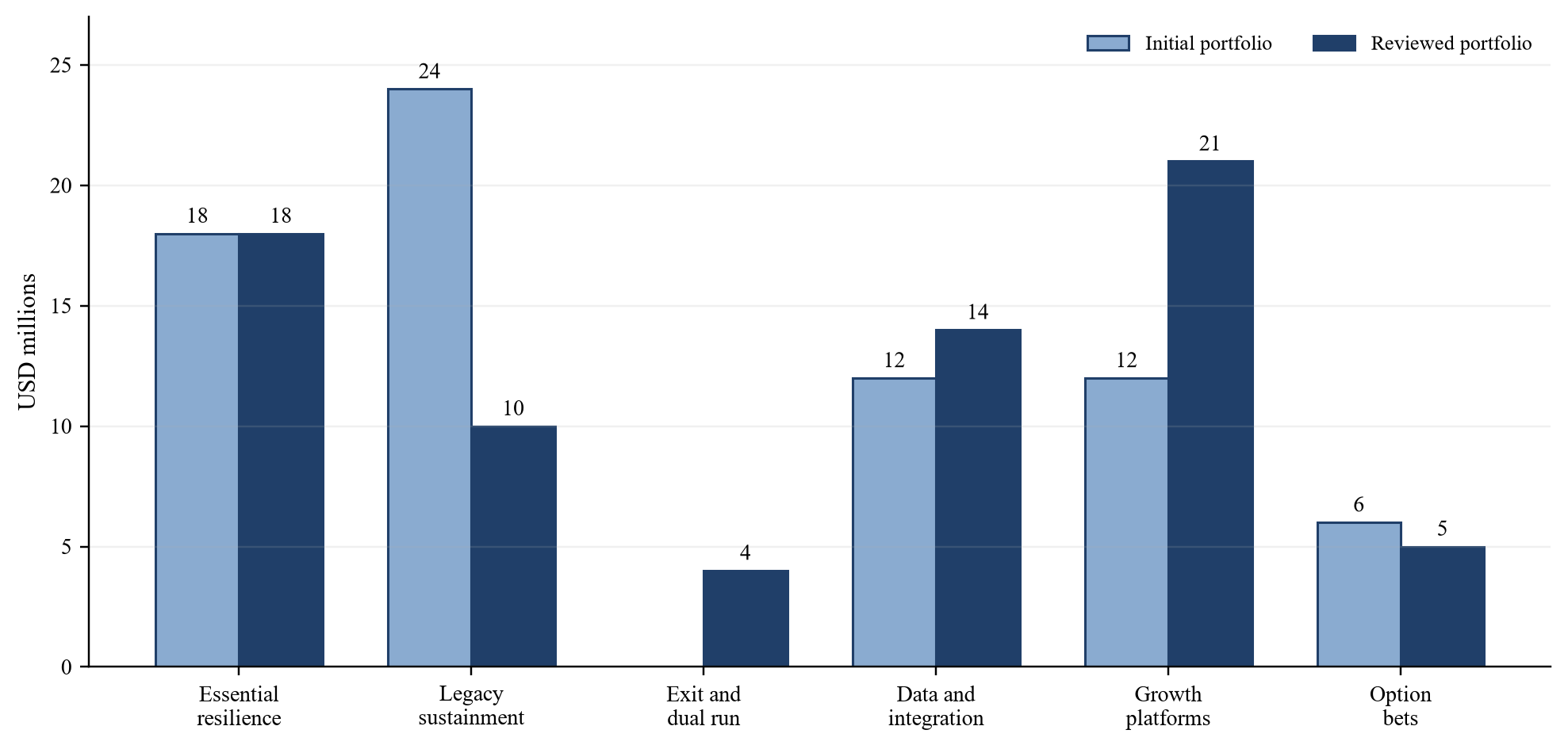
USD millions. Every category and amount is hypothetical; the classification is a management view and not an accounting conclusion.
7. Establish comparable decision criteria
Projects should compete under a common set of criteria before the committee applies judgment. A practical scorecard can cover service criticality, strategic benefit, evidence confidence, cash requirement, time to usable outcome, delivery performance, architecture fit, cyber and control exposure, contract flexibility, dependency and benefit ownership. Scores should link to source records. They should not convert weak evidence into false precision.
Separate benefit magnitude from evidence confidence. A project can have a large potential benefit and weak proof. Another can produce a modest but verified saving. The first may deserve a staged continue decision with a limited evidence budget. The second may deserve scale if it remains valuable after the comparison. Multiplying a sponsor's estimate by an arbitrary probability can conceal both issues. The scorecard should display them independently before any scenario adjustment.
Cash should use the same time basis. Compare remaining cash from the decision date, not total historic budget. Include exit and parallel-run cash where stopping or migrating. Identify cash that can be cancelled within the review horizon. A five-year saving cannot fund a payment due next quarter unless the financing and timing bridge supports it.
Risk should distinguish exposure created by the project, exposure reduced by it and exposure that exists regardless of the decision. A resilience programme may have limited revenue benefit but reduce an unacceptable service or cyber exposure. A growth platform can create new privacy, model, vendor or operational risks. Avoid using one net risk score that hides the direction, owner and acceptance authority.
HM Treasury's Green Book requires comparison with business as usual and consideration of costs, benefits, risk and uncertainty within its public-sector scope. It also distinguishes appraisal before approval from evaluation after implementation. The proposed private-company scorecard adopts those analytical distinctions. It does not apply UK public-sector discount rates or claim compliance with the Green Book. [5]
8. Make stop continue and scale decisions
A stop recommendation means the company will cease or reduce future commitment under a documented exit plan. It should identify what will no longer be delivered, which contracts change, how data and records are preserved, who accepts the service consequence and when cash becomes available. Stopping without completing these steps can turn a budget saving into an operational incident or a disputed supplier claim.
A continue recommendation has a specific purpose. It can protect an essential service, complete a nearly finished deliverable, fund a bounded discovery, test adoption or preserve an option until a decision date. It should state the amount, milestone, evidence and expiry. Continue should not become a holding category for sponsors who cannot support scale and do not accept stop.
A scale recommendation increases capital or expands deployment because the company has evidence of strategic fit, usable delivery and an owned benefit. Scale can still be staged. The committee can release funds against customer adoption, unit economics, reliability, security, integration or cash milestones. Incremental funding narrows loss if the case fails and supplies current evidence for the next decision.
The hypothetical matrix below plots twelve initiatives by strategic benefit and evidence confidence. Bubble size represents remaining cash. The colours show proposed decisions. Scores and decisions are illustrative. A real committee would set thresholds, document exceptions and consider criticality and dependencies that a two-axis chart cannot display.
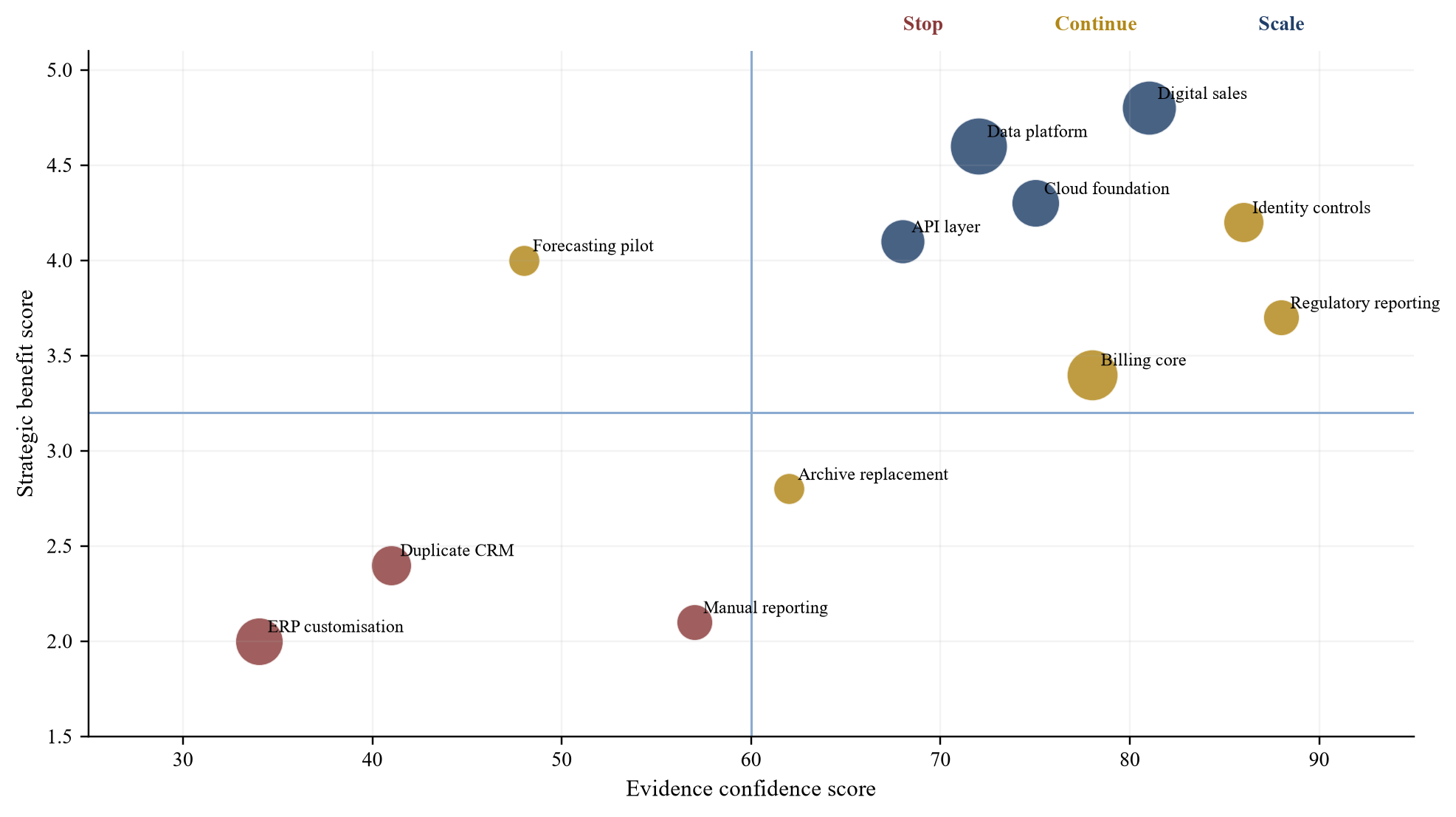
Scores, cash amounts and decisions are hypothetical. Bubble size represents remaining cash; a live decision requires the full evidence record and authorised judgment.
9. Quantify exit migration and dual run
Gross release is the future cash removed from cancelled or reduced commitments before transition. Net reusable capacity deducts every cash requirement created by the decision. Typical items include termination payments, supplier assistance, data extraction, archive, migration, interfaces, testing, security work, customer communication, training, redundancy, retention of scarce staff and parallel operation.
The model assumes USD 15.0 million of gross release and USD 4.0 million of exit and dual-run cash. Net capacity is therefore USD 11.0 million. This is a timing assumption as well as an amount. It assumes the released commitments and transition payments fall within the same portfolio period. If exit cash occurs first and supplier credits arrive later, the company may need temporary liquidity even when the total programme is self-funded.
Parallel operation should have an acceptance condition and an end date. The company may need both systems until data reconciles, controls operate, customers migrate and disaster recovery is proven. The decision file should specify who can authorise cutover and who can extend parallel operation. An extension consumes cash and delays benefit. It should trigger a revised case rather than appearing as an unavoidable technical detail.
Contracts can constrain sequencing. A company may need to give notice months before a renewal, preserve licences until audit or retain a vendor to support extraction. Procurement and legal teams should map these dates before the investment committee relies on the release. The cash bridge should use the earliest evidenced cancellation or reduction date, not the date management wishes the obligation would end.
The office should reconcile the bridge after each decision. Actual termination, transition and new-platform purchase orders should replace estimates. Any unused reserve can return to the portfolio. Any overrun should identify the source, owner, forecast and funding decision. This keeps the original reallocation claim from surviving after its cash basis has changed.
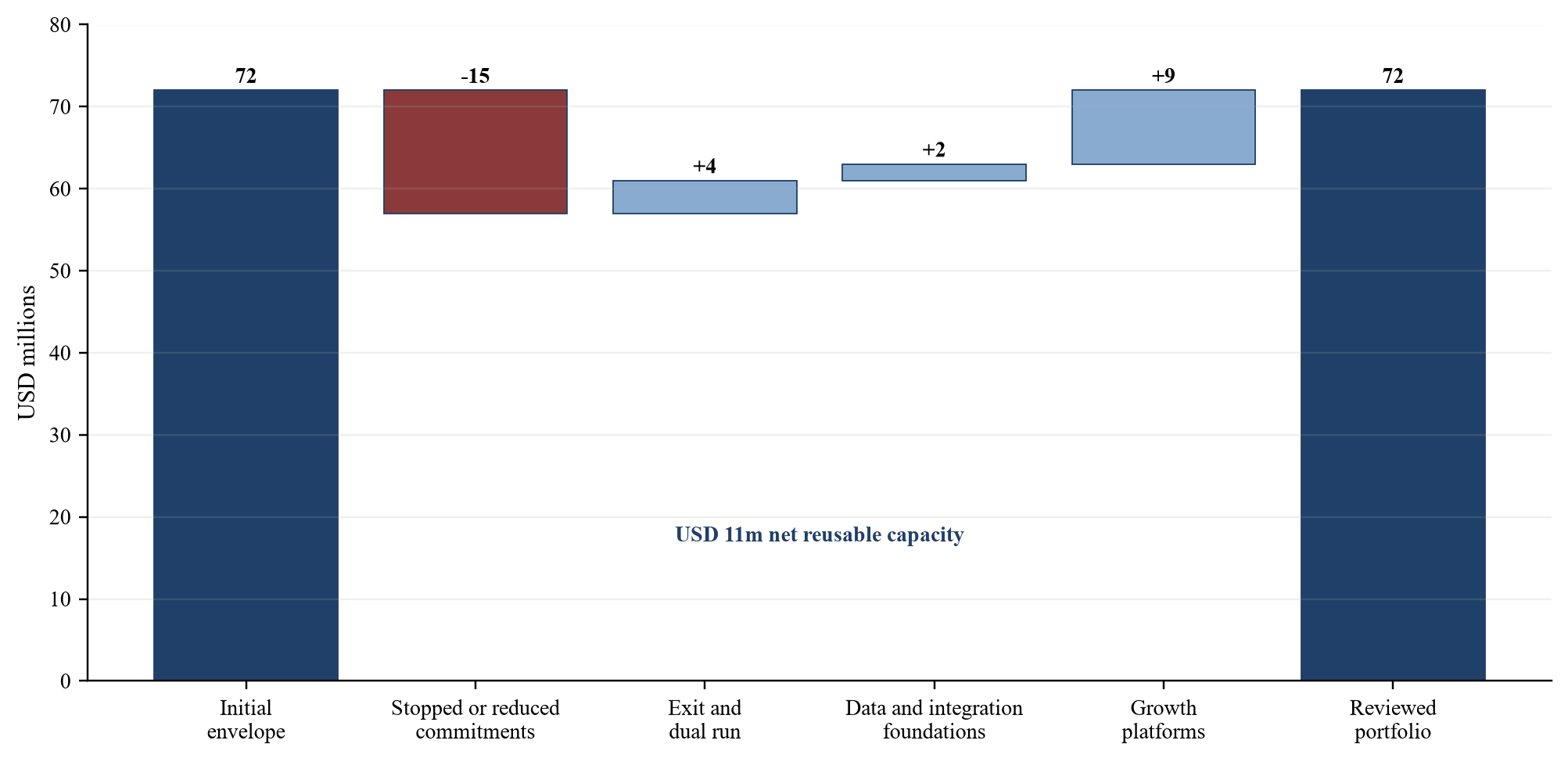
USD millions. The bridge holds the total annual cash envelope at USD 72.0 million and assigns no probability to the result.
10. Build a benefits ledger that can reach cash
A benefit belongs to a named business owner, not to the project office. The ledger should identify the baseline, measure, formula, source system, expected start, ramp, gross amount, implementation cost, recurring cost, possible overlap, evidence confidence and actual result. Finance should challenge the calculation before approval and reconcile realised amounts after implementation.
Revenue benefits require a customer and margin bridge. Additional transactions should link to a product, eligible customer group, price, conversion, churn, fulfilment cost and timing. A platform can enable growth without causing every subsequent sale. The ledger should specify the part attributed to the programme and preserve other commercial drivers. Gross revenue should not be reported as cash benefit.
Cost benefits require a removal action. Faster processing does not create cash if headcount, contractor spend, overtime, error cost or avoided hiring remains unchanged. The owner should state how capacity will be redeployed or removed and when the ledger will recognise the result. Service and control measures should prevent a saving from being recorded while performance deteriorates elsewhere.
Legacy run-cost avoidance should begin after the old cost actually ends. During migration, the company may pay both old and new costs. Vendor credits, licence reductions and contractor releases need evidence. If a support contract covers several systems, allocate only the amount the decision can cancel. Avoid counting a reduction in legacy support both as a cash release in the portfolio bridge and as an annual benefit unless the two calculations clearly cover different periods or uses.
The hypothetical ledger below starts with USD 15.4 million of estimated annual run-rate benefit. It applies four stated realisation factors and produces USD 11.8 million. The factors express planning scenarios. They are not empirically estimated probabilities. The USD 11.8 million is a steady-state planning amount and is separate from the time-phased four-year cash illustration in the next section. A live model should reconcile the two before approval.
| Benefit stream | Gross annual estimate | Realisation factor | Planning amount | Evidence required before recognition |
|---|---|---|---|---|
| Growth-platform contribution | 6.0 | 70% | 4.2 | Customer cohort, price, volume, churn, contribution margin and collected cash |
| Data-foundation productivity | 3.0 | 80% | 2.4 | Process baseline, hours removed, capacity action and finance reconciliation |
| Digital self-service saving | 2.4 | 75% | 1.8 | Channel adoption, contact reduction, service level and unit cost |
| Legacy run cost avoided | 4.0 | 85% | 3.4 | Contract cancellation, licence reduction, vendor credit and payment record |
| Total | 15.4 | Not additive | 11.8 | Finance-approved benefit ownership and overlap review |
USD millions per year. Realisation factors are scenario assumptions rather than probabilities or market benchmarks.
11. Evaluate the reallocation under scenarios
The investment committee should compare the preferred reallocation with continued spending, a narrower migration, a different platform sequence and retaining cash. The model should include costs and benefits over their relevant lives, with scenario ranges for the assumptions that can change the decision. It should show non-monetised service, risk and strategic effects beside the financial metrics.
The separate hypothetical project case treats USD 15.0 million as the central initial investment. Net cash benefits are USD 4.0 million in year one, USD 9.0 million in year two, USD 12.0 million in year three and USD 12.5 million in year four. At an assumed 10 percent discount rate, net present value is USD 13.63 million. Simple payback occurs in 2.17 years. These results follow directly from the inputs and do not estimate a company's return.
The downside assumes USD 18.0 million of initial investment and annual net cash benefits of USD 2.0 million, USD 4.5 million, USD 6.0 million and USD 5.0 million. Net present value is negative USD 4.54 million at the same discount rate, and cumulative nominal benefits remain below investment after four years. The upside assumes USD 14.0 million of investment and benefits of USD 5.0 million, USD 11.0 million, USD 14.0 million and USD 15.0 million. Its net present value is USD 20.40 million and simple payback is 1.82 years.
No likelihood is assigned to any scenario. The committee should identify which evidence would make the downside less likely or reduce its impact. Examples include a fixed-price migration, tested data conversion, proven customer adoption, contractual release of legacy spend and staged platform commitments. If these facts remain absent, the appropriate response may be a smaller continue decision rather than full scale.
| Scenario | Initial investment | Annual net cash benefits years 1 to 4 | Four-year nominal benefit | Net present value | Simple payback |
|---|---|---|---|---|---|
| Downside | 18.0 | 2.0; 4.5; 6.0; 5.0 | 17.50 | -4.54 | Beyond four years |
| Central | 15.0 | 4.0; 9.0; 12.0; 12.5 | 37.50 | 13.63 | 2.17 years |
| Upside | 14.0 | 5.0; 11.0; 14.0; 15.0 | 45.00 | 20.40 | 1.82 years |
USD millions except payback. Net present value uses a hypothetical 10 percent discount rate; no scenario has an assigned probability.
12. Sequence capital through acceptance gates
Capital should follow evidence maturity. An initial gate establishes the problem, business owner, service perimeter, baseline, options and decision authority. A design gate approves architecture, security, data, operating process and commercial approach. A build gate releases implementation cash against a tested plan. A deployment gate requires operational readiness. A scale gate requires usable delivery and benefit evidence. A retirement gate ends the legacy cost after migration and control acceptance.
Each gate should have a dated evidence pack and recorded decision. The record should show approved amount, remaining contingency, conditions, exceptions and next review. A condition such as improve adoption supplies no test. Achieve 60 percent active use among the defined eligible customer group for eight weeks, with the stated service and margin measures, can be tested. The target remains a management decision and should be supported by the business case.
Funding tranches should correspond to work the company can assess. A large non-cancellable order at the first gate defeats the purpose of staged capital. Procurement should negotiate options, milestones, acceptance and termination rights where commercially available. The committee should understand any premium paid for flexibility and compare it with the potential loss avoided.
Dependencies can require portfolio-level sequencing. A growth platform may rely on identity, data quality, interfaces, pricing, customer operations and finance controls. Scaling the visible application before its foundations can create rework and unstable service. The office should maintain an architecture and dependency map so a stop decision does not remove a capability required elsewhere and a scale decision includes the full enabling cost.
The GAO investment-management framework emphasises actual performance data, portfolio review and post-implementation learning. A private-company adaptation should compare approved and actual cost, schedule, functionality, adoption and benefit at each gate. It should also record why the committee continued a project outside normal thresholds. This provides evidence for later decisions instead of allowing exceptions to disappear in meeting minutes. [4]
13. Assign authority and challenge
The board or investment committee should approve the portfolio principles, material reallocations and exceptions within its reserved matters. The chief executive owns enterprise priorities. The chief financial officer owns the cash envelope, financial case and benefits challenge. The chief information or technology officer owns architecture and delivery evidence. Business leaders own operating adoption and benefits. Risk, cyber, legal, procurement, tax and accounting specialists provide conclusions within their authority.
The Capital Productivity Office maintains the register, applies the agreed method, reconciles evidence, prepares options and tracks conditions. It should have access to source systems but should not replace their accountable owners. Its leader needs sufficient independence to challenge both technology and business sponsors. A temporary office can report to a joint executive sponsor and the relevant committee.
Conflicts should be visible. A sponsor seeking more capital should disclose incentives tied to launch, revenue or cost targets. A vendor should not validate its own delivery or benefit. An adviser preparing the business case should state the scope and source of information. Management-provided estimates should remain identified until corroborated. The decision can still rely on an assumption, provided the assumption, sensitivity and authority are recorded.
The office should operate a regular cadence. Weekly work can focus on data quality, exceptions and upcoming gates. Monthly executive review can decide changes within delegated limits. Quarterly committee review can assess portfolio mix, realised benefits, major exceptions and capital returned or reallocated. Urgent resilience decisions can follow a defined escalation without waiting for the ordinary cycle.
| Activity | Prepare | Challenge | Approve | Evidence retained |
|---|---|---|---|---|
| Portfolio population and cash bridge | Capital Productivity Office and finance | Procurement, controller and sponsors | Chief financial officer within authority | Ledger reconciliation, commitments and timing |
| Service criticality and resilience floor | Technology and operations | Cyber, risk and internal audit | Risk owner or committee within authority | Service map, tolerance, controls and exception |
| Stop continue or scale recommendation | Capital Productivity Office and sponsor | Finance, technology, commercial and risk | Executive or investment committee | Scorecard, options, dependencies and conditions |
| Accounting and tax consequence | Controller and qualified specialists | Audit and tax governance | Authorised finance officer | Policy analysis and professional conclusion |
| Benefit recognition | Business owner and finance | Capital Productivity Office and internal audit | Chief financial officer or delegate | Baseline, source data, formula and cash link |
| Legacy retirement | Technology and operations | Cyber, data, legal and customer owner | Authorised service owner | Migration, control, recovery and acceptance results |
Original responsibility map. Actual authority must follow the company's governance documents and applicable law.
14. Use the framework in acquisition diligence
An acquirer should test the target's technology-investment portfolio before accepting management's capital plan. Historical capex can understate required change if the target relies on expensed subscriptions, deferred maintenance or scarce internal staff. It can overstate productive investment if capital work in progress includes delayed programmes or assets with weak adoption. Reconcile the ledger, commitments, operating costs, architecture and benefit evidence.
The diligence team should identify systems essential to revenue, fulfilment, cash collection, reporting and regulatory obligations. It should record support status, cyber findings, data rights, licences, change-of-control clauses, separation dependencies and transition-service requirements. A high-level red-amber-green application list is insufficient when the purchase price, financing or integration case depends on cash release.
The bidder can prepare a preliminary stop, continue and scale map using verified target information. The map should preserve uncertainty where access is limited. Management's synergy estimate should remain separate from the bidder's case. The acquisition model should include exit, migration, parallel operation and delayed benefits. It should avoid counting the same legacy reduction as both a cost synergy and funding source for a growth platform unless the timing bridge supports both uses.
Post-close governance should revisit the map because access and priorities change. The combined company may discover duplicate systems, contractual restrictions, new cyber exposure or data incompatibility. It may also identify a stronger platform than the one selected during diligence. A Day 1 decision should protect continuity. A later gate can approve retirement or scale after the evidence is available.
IAS 36 may become relevant to assets and cash-generating units after the transaction, while IFRS 3 and other standards can govern acquisition accounting. This paper makes no accounting determination. The acquirer should obtain current advice and keep the portfolio decision, purchase-price accounting and impairment assessment as related but distinct workstreams. [6]
15. Connect the portfolio to GCC growth strategy
GCC companies operate amid substantial public investment in digital infrastructure and national transformation. The IMF's 2025 departmental paper reviews digitalisation across the GCC and links corporate digital penetration with productivity and resilience while identifying the importance of skills, adoption and regulation. Its macro and firm-level analysis supplies regional context. It does not prove that a particular platform will produce a stated return. [9]
The UAE Digital Economy Strategy sets a national objective to increase the digital economy's contribution and describes a unified measurement mechanism. A corporate board can use the policy direction to test strategic relevance, ecosystem dependencies and possible demand. It still needs a company-specific customer, operating and cash case. National ambition does not convert an unsupported project into productive capital. [10]
OECD evidence for up to 32 OECD countries shows that digital investment has grown faster than other forms of business investment and highlights software, databases and hardware. It also notes high depreciation and measurement considerations. The research is descriptive and stops short of assigning a return to an individual company. The capital office should therefore measure the portfolio's actual adoption and economic results rather than relying on the category of digital investment. [1]
Skills deserve explicit funding. A platform can be technically available while employees and customers cannot use it effectively. The case should include process redesign, training, data ownership, commercial change and control operation. These items can be expensed rather than capitalised under the applicable accounting policy. Excluding them from the decision because they are not capex can leave an approved asset without the capability required to generate benefits.
The portfolio should also reflect local legal entities, data locations, customer expectations and operating models. A group-wide platform can create scale but may require jurisdiction-specific configuration and authority. Local exceptions should be documented and costed. The office should distinguish a justified difference from local preference that preserves duplication without measurable value.
16. Monitor realised capital productivity
The committee needs a small set of measures that connects capital to outcomes. Useful measures can include committed and cancellable cash, cash released, exit cash, amount reallocated, milestone acceptance, active adoption, service performance, benefit recognised, benefit collected, recurring cost removed and forecast variance. Each metric requires a definition, source, owner and date.
Capital productivity should not collapse into one ratio. A ratio of benefit to spend can omit resilience, customer experience and strategic options. It can also reward sponsors who use aggressive benefit estimates. Present the financial measures with service, risk, adoption and evidence indicators. Explain which benefits are recurring, one-time, gross, net, booked or collected.
The benefits ledger should follow the company's reporting calendar. Finance can freeze data, receive owner submissions, reconcile source systems, challenge exceptions and publish an approved result. If a benefit cannot be traced, keep it pending. If performance deteriorates elsewhere, investigate whether the claimed saving transferred cost or risk. Reversals should remain visible rather than overwriting earlier claims.
Evaluation should feed the next selection cycle. Compare the original case with actual cost, delivery, adoption and benefit. Record which assumptions failed and whether governance responded. Use the results to adjust evidence thresholds, vendor terms, contingencies and stage sizes. Do not punish prudent early stops by treating every cancelled project as failure. A timely stop can be a successful capital decision when the evidence no longer supports further investment.
The office should have a sunset test. Once the register, gates and benefit discipline operate within normal finance and portfolio processes, a temporary office can transfer responsibilities and close. If it remains permanent, its mandate, cost, authority and performance should be reviewed. The objective is better decisions and traceable cash, not the survival of the review function.
17. Commission a bounded advisory mandate
A company or sponsor can commission a bounded capital-productivity review before the annual budget, after an acquisition or when a transformation portfolio loses confidence. The scope can cover population reconciliation, commitment review, decision criteria, sponsor interviews, architecture and dependency mapping, stop-continue-scale recommendations, cash release, benefits challenge and an investment-committee memorandum.
The engagement should define entities, systems, period, materiality, access, deliverables, decision dates and excluded professional opinions. Management remains responsible for records, assumptions and decisions. Technology specialists should verify architecture and delivery. Qualified legal, accounting, tax, cyber and regulatory advisers should provide conclusions within their fields. The adviser should state where evidence is missing or management-provided.
A useful first phase is diagnostic. It produces a reconciled population, identifies material gaps and estimates which decisions can be reached within the available evidence. A second phase can prepare detailed cases for the selected projects. A third phase can support execution and benefits tracking. The client should approve each phase separately, with no promise that the review will release a particular amount or produce a transaction outcome.
The mandate should also protect confidentiality and decision integrity. Data access should follow the company's controls. Conflicts, vendor relationships and incentive arrangements should be disclosed. Draft recommendations should receive factual review without allowing sponsors to remove adverse evidence. Final approval belongs to the authorised company body.
18. Research limits and conclusion
The research reviewed for this paper consists of selected public sources accessed on 10 September 2026. It supports specific propositions on corporate governance, digital investment, GCC digitalisation, technology portfolio management, legacy-system attributes, project appraisal, cybersecurity governance and accounting. It supplies no dataset of GCC corporate technology budgets, project returns, cancellation rates, migration costs or realised benefits. This paper therefore estimates no market return, probability or benchmark.
Several sources arise from public-sector contexts. The GAO material concerns U.S. federal agencies. The Green Book concerns UK public-sector appraisal. Their selection, control, evaluation, option and uncertainty concepts are adapted as an original private-company framework. They do not prescribe governance, accounting or legal treatment for a GCC company. OECD and IMF research provides macro or cross-company context and does not establish causation or return for an unnamed programme.
The numerical illustration is intentionally simple. It uses one annual USD 72.0 million cash envelope, five initial allocation categories, a USD 15.0 million gross release, USD 4.0 million of transition cash and a full USD 11.0 million reallocation. The benefits ledger uses four streams and fixed realisation factors. The four-year case uses a fixed 10 percent discount rate and no terminal value. It omits tax, financing, working capital, foreign exchange, inflation, acquisition accounting, leases, depreciation, vendor claims, capacity constraints and several interactions.
The practical sequence is clear. Reconcile the population. Separate cash from accounting labels. Protect evidenced resilience and obligations. Diagnose legacy systems by service, risk, cost and constraint. Compare projects under common criteria. Quantify exit and dual-run cash. Assign stop, continue and scale decisions through existing authority. Fund against acceptance evidence. Track benefits to source systems and collected cash. Revisit the portfolio when evidence changes.
A Capital Productivity Office can make this sequence repeatable. Its value depends on the quality of the records and decisions it supports. It should expose assumptions, unresolved evidence and downside outcomes so the board can choose. It cannot turn a weak project into a good investment or guarantee that released cash will create growth. Those results require disciplined execution and current company evidence.
Appendix A. Minimum evidence for a portfolio decision
| Decision area | Record to request | Question the committee must answer |
|---|---|---|
| Purpose and baseline | Strategy, process, customer or control baseline | Which observable condition should change |
| Cash and commitment | Budget, ledger, contract, orders, invoices and forecast | Which future cash is cancellable and when |
| Service and risk | Service map, recovery requirement, cyber and control findings | What must remain protected during the decision |
| Delivery | Scope, architecture, milestones, acceptance and defects | What usable outcome exists and what remains |
| Adoption | Eligible users, active use, customer evidence and process change | Who uses the capability and at what sustained level |
| Benefit | Formula, owner, source data, timing and overlap review | Which net cash or measured outcome can be attributed |
| Exit | Notice, termination, migration, archive and parallel operation | What cash and operational work follows a stop |
| Accounting and tax | Policy, asset register, impairment indicators and advice | Which separate reporting consequences require action |
| Authority | Delegation, reserved matter, conflict and meeting record | Who can approve and accept the residual exposure |
| Monitoring | Conditions, next gate, actuals and exception route | What evidence will trigger further funding or stop |
Original checklist. It creates no finding about an unnamed company, project, accounting treatment or professional appointment.
The decision pack should retain source links and dates. A missing record should remain open. The committee should decide whether it stops funding, narrows scope, creates a reserve, requires a condition or represents an accepted exposure. A statement that management is comfortable supplies no reproducible basis. The record should identify the person accepting the exposure and the period before review.
Evidence should be proportionate to the decision. A small reversible discovery can use a short case and strict cash limit. A core-system replacement, major customer platform or acquisition integration requires deeper technical, operational, financial and legal work. Proportionality changes the depth of evidence. It does not remove population completeness, authority or the need to state assumptions.
Appendix B. Reproducing the hypothetical calculations
For the portfolio map, add USD 18.0 million of essential resilience, USD 24.0 million of legacy sustainment, USD 12.0 million of data and integration foundations, USD 12.0 million of growth platforms and USD 6.0 million of option bets. The initial envelope is USD 72.0 million. Stop or reduce USD 14.0 million of legacy sustainment and USD 1.0 million of option bets. Gross release is USD 15.0 million.
Allocate USD 4.0 million to exit and dual-run work. Net reusable capacity is therefore USD 11.0 million. Increase data and integration foundations by USD 2.0 million and growth platforms by USD 9.0 million. The reviewed portfolio is USD 18.0 million of essential resilience, USD 10.0 million of legacy sustainment, USD 4.0 million of exit and dual-run work, USD 14.0 million of foundations, USD 21.0 million of growth platforms and USD 5.0 million of option bets. The total remains USD 72.0 million.
For the benefits ledger, multiply USD 6.0 million by 70 percent, USD 3.0 million by 80 percent, USD 2.4 million by 75 percent and USD 4.0 million by 85 percent. The planning amounts are USD 4.2 million, USD 2.4 million, USD 1.8 million and USD 3.4 million. Gross annual benefit is USD 15.4 million and the scenario-adjusted planning amount is USD 11.8 million. The factors are assumptions and carry no assigned probability.
For the central net present value, begin with negative USD 15.0 million at year zero. Discount USD 4.0 million, USD 9.0 million, USD 12.0 million and USD 12.5 million from years one through four at 10 percent. The result is USD 13.63 million after rounding to two decimal places. Nominal cumulative benefit reaches USD 13.0 million after year two. The remaining USD 2.0 million is recovered by USD 2.0 million divided by the USD 12.0 million year-three benefit, producing simple payback after 2.17 years.
The committee should ask which commitments create the USD 15.0 million release and which documents establish their cancellation dates. Which USD 4.0 million transition items protect continuity? Which customers, processes and accounts support each benefit? What evidence would move a project from continue to scale or stop? Which downside assumption can the company reduce before committing the next tranche? The answers should identify evidence, unresolved assumptions and decision authority.
Sources
- OECD. Business investment in the face of the digital transformation: Initial evidence. 10 March 2026. Accessed 10 September 2026. Read the primary source
- OECD. G20/OECD Principles of Corporate Governance 2023. The responsibilities of the board, Section V.D. Accessed 10 September 2026. Read the primary source
- U.S. Government Accountability Office. Information Technology: Agencies Need to Plan for Modernizing Critical Decades-Old Legacy Systems. GAO-25-107795. 17 July 2025. Accessed 10 September 2026. Read the primary source
- U.S. Government Accountability Office. Information Technology Investment Management: A Framework for Assessing and Improving Process Maturity. GAO-04-394G. 1 March 2004. Accessed 10 September 2026. Read the primary source
- HM Treasury. The Green Book 2026: Appraisal and Evaluation in Central Government. Accessed 10 September 2026. Read the primary source
- IFRS Foundation. IAS 36 Impairment of Assets. Official standard overview. Accessed 10 September 2026. Read the primary source
- IFRS Foundation. IAS 38 Intangible Assets. Official standard overview and paragraphs 54-57. Accessed 10 September 2026. Read the primary source
- National Institute of Standards and Technology. The NIST Cybersecurity Framework 2.0. NIST CSWP 29. 26 February 2024. Accessed 10 September 2026. Read the primary source
- International Monetary Fund. Digital Transformation in the Gulf Cooperation Council Economies. Departmental Paper 2025/003. 2025. Accessed 10 September 2026. Read the primary source
- United Arab Emirates Government. Digital Economy Strategy. Updated 30 December 2024. Accessed 10 September 2026. Read the primary source
