

1. Define the capital-allocation decision
The board is creating two financeable companies, not dividing one historical balance sheet into convenient columns. Each company must be able to fund operations, withstand a credible downside, meet contractual obligations, refinance maturities and pursue its disclosed strategy without routine support from the other. The capital-allocation decision therefore covers debt, cash, committed facilities, guarantees, derivatives, pension obligations, plan assets, security, covenant headroom and any transitional support that survives completion.
The decision should start with the businesses as they will operate after separation. Historical cash generation can be distorted by central procurement, intercompany settlement, pooled treasury, shared working capital and parent-funded investment. Standalone performance must incorporate replacement costs, dis-synergies, one-time separation expenditure, new tax and funding arrangements, and the timing of cash receipts and payments. A leverage ratio calculated from historical segment EBITDA can appear precise while overlooking the cash needed to survive the first quarter.
The board should approve an integrated package. Opening cash without committed liquidity may be consumed during an ordinary working-capital peak. A revolver without clean access conditions may provide little protection. Debt sized to an optimistic earnings case can constrain investment or trigger a refinancing under pressure. A pension allocation based only on an accounting deficit can ignore legal responsibility, funding plans and trustee powers. The package should be tested under the same operating scenarios and closing timetable.
The final approval record should identify the operating perimeter, valuation date, debt instruments, cash sources, liquidity minimum, covenant basis, pension allocation, guarantees, completion steps and residual risks. It should also state which facts remain conditional on lender, trustee, regulator, tax authority or market action. This turns a headline allocation into an executable decision.
2. Establish the standalone operating perimeter
Capital cannot be allocated reliably until the asset and liability perimeter is stable. The perimeter should identify businesses, subsidiaries, contracts, employees, intellectual property, property, tax attributes, cash pools, bank accounts, benefit plans and litigation that will sit with each company. It should distinguish legal ownership from economic use because a company may rely on an asset that remains legally owned by another group entity during transition.
The separation agreement normally provides the master allocation and mechanisms for omitted assets, wrong-pocket receipts, guarantees and shared contracts. Solventum's filed separation agreement illustrates this breadth by addressing transferred assets and liabilities, novation, guarantees, shared contracts, bank accounts and cash. [1] The document is transaction-specific, yet it shows why finance design must remain connected to legal implementation.
Perimeter uncertainty should be recorded as a capital risk. If a major customer contract cannot be novated, the related revenue may continue through RemainCo while operating cost moves to NewCo. If a property lease remains guaranteed by the parent, the apparent separation may leave contingent exposure. If an intercompany loan is settled through a distribution, tax and solvency consequences can differ from those of an arm's-length refinancing.
Management should maintain one perimeter schedule linking each material item to its legal owner, operating user, accounting treatment, cash effect, transfer mechanism and evidence. The schedule should reconcile to the pro forma balance sheets, debt documentation, benefit-plan work and public disclosure. Differences should be resolved before the capital package is marketed to lenders or investors.
3. Reconstruct cash generation by business
Earnings are a starting point for debt capacity; cash conversion determines whether the capital structure survives. Each company needs a monthly cash model covering revenue collection, supplier payment, payroll, taxes, capital expenditure, interest, lease payments, pension contributions and separation expenditure. The model should extend through at least one full operating cycle and every material seasonal peak.
Historical allocations should be replaced with operating evidence. Customer-level collection patterns, supplier terms, inventory cycles and payroll calendars provide a stronger basis than a percentage of annual revenue. Capital expenditure should separate maintenance, compliance, committed growth and discretionary expansion. Standalone costs should include treasury, audit, insurance, listing, technology, controls and public-company capability where relevant.
Cash should be modelled before financing. A company that requires recurring revolver drawings to pay ordinary expenses may have insufficient opening liquidity or excessive debt. A company that appears cash generative on an annual basis can still encounter a severe intra-month deficit. The model should show minimum daily or weekly headroom during sensitive periods, not only period-end balances.
Management should reconcile the standalone cash model to the transaction financial model and public pro forma information. Any difference between accounting earnings and cash should have a named driver and evidence source. The resulting cash profile supports the allocation of opening cash, revolver size, amortisation, interest rate exposure and maturity.
4. Separate debt capacity from debt allocation
Debt capacity estimates the amount and form of debt that a company can support. Debt allocation determines which instruments and obligations it actually receives. The two can differ because existing bonds may remain with the parent, new debt may be raised by NewCo, proceeds may be distributed, and lenders may require particular security or guarantees.
Capacity should be assessed through several lenses: cash interest coverage, fixed-charge coverage, leverage, free cash flow after maintenance investment, minimum liquidity and refinancing capacity. The analysis should use through-cycle assumptions and company-specific volatility. A stable contracted business may support a different maturity and amortisation profile from a cyclical project business with the same EBITDA.
Allocation should reflect instrument mechanics. A long-dated fixed-rate bond provides different protection from a short-dated floating-rate term loan. A revolving facility is a liquidity instrument and should not be counted as permanent balance-sheet cash. Guarantees and cross-defaults can preserve economic linkage after the legal separation. Hedging arrangements may need novation or replacement.
The board should compare at least three packages: a conservative resilience case, a central financing case and a distribution-maximising case. Each package should show proceeds, interest, maturities, covenant headroom, liquidity, rating implications and the effect on strategic investment. The selected package should have a documented rationale tied to the separation thesis.
| Decision | Primary evidence | NewCo test | RemainCo test | Approval question |
|---|---|---|---|---|
| Operating perimeter | Legal entity and transfer schedule | Can it control every cash-critical asset? | Are retained exposures understood? | Is the perimeter executable? |
| Gross debt | Cash conversion and downside model | Can it service and refinance the debt? | Can it absorb stranded cost and volatility? | Does debt capacity survive downside? |
| Opening cash | Monthly liquidity model | Is the minimum cash buffer protected? | Is cash available after transaction uses? | Is cash genuinely accessible? |
| Revolver | Peak funding need and bank terms | Are draw conditions usable during stress? | Is facility size sufficient after separation? | Is committed liquidity real? |
| Pension allocation | Legal, actuarial and covenant analysis | Can the sponsor support the allocated plan? | Does the residual covenant remain sound? | Is member security protected? |
| Guarantees | Instrument and contract inventory | Are inherited guarantees released or priced? | Does contingent exposure remain? | Is economic separation complete? |
Original framework. Each decision should be supported by company-specific evidence and approved assumptions.
5. Design opening liquidity from the downside backwards
Opening liquidity consists of unrestricted cash that can be used immediately and committed facilities that remain available under stress. Restricted cash, trapped cash, customer money, regulated balances and operational deposits should be excluded or separately identified. Cash needed for known completion payments should not be presented as operating headroom.
The minimum buffer should be derived from a downside sequence. Management should model slower collections, inventory build, supplier tightening, restructuring cost, separation delays, tax payments and interest increases. Correlations matter. A revenue shock can arrive with customer-payment delays and reduced supplier credit. A company may also lose access to group cash pooling precisely when its standalone systems are least mature.
Committed facilities should be reviewed for conditions precedent, representations, draw stops, financial covenants, material-adverse-effect language, sanctions restrictions and documentary requirements. A nominal facility that cannot be drawn during the relevant scenario is not reliable liquidity. The company should test the operational ability to deliver a compliant draw notice and receive funds into an active bank account.
Liquidity approval should specify a minimum opening cash amount, a minimum undrawn committed amount and an escalation threshold. The thresholds can differ between NewCo and RemainCo because their cash volatility, customer concentration and market access differ. The board should receive a bridge from the closing statement to the first twelve months of minimum headroom.
6. Match maturity to the separation risk curve
A separation creates a period of heightened execution risk. Systems, controls, people, contracts and reporting may still be stabilising when the first standalone refinancing arrives. Debt maturity should allow the company to demonstrate its operating record before it must access the market again.
Short-dated bridge facilities can be useful when the final financing depends on market conditions or post-separation performance. They also introduce refinancing risk. A bridge should have a credible take-out route, realistic fees, extension mechanics and sufficient liquidity if the market window closes. The board should understand the consequences of a delayed bond issue, rating change or covenant amendment.
Amortisation should reflect cash generation. A business with seasonal working-capital requirements may need back-ended repayment or a sculpted profile. A company funding major standalone investment may require a grace period. Excessive amortisation can force revolver use and convert a long-term financing question into a recurring liquidity problem.
The maturity ladder should show debt, leases, pension contributions, contingent consideration and material contractual commitments. Concentration in one year can create a refinancing cliff even when headline leverage is moderate. A capital structure is more resilient when it provides time to respond to operating variance rather than requiring perfect delivery.
7. Allocate interest-rate and currency risk
Debt allocation changes the distribution of market risk. NewCo and RemainCo may have different revenue currencies, cost currencies and cash-flow sensitivity. Existing hedges may have been entered at group level and may not transfer automatically. The separation can therefore create open exposures even when total group debt is unchanged.
Each company should define its target mix of fixed and floating rates, hedge duration, currency denomination and counterparty limits. The decision should reflect cash-flow variability and expected refinancing. Fixed-rate debt protects near-term interest expense but can create break costs or reduce flexibility. Floating debt can preserve optionality while exposing a newly independent company to rate shocks.
Derivative novation requires counterparty consent and may require collateral or revised documentation. Hedge accounting may need redesignation. Treasury teams should identify termination values, replacement cost, collateral flows and accounting consequences before completion. These cash effects belong in the sources-and-uses statement.
The downside model should show interest expense after a two-percentage-point increase in floating rates and after any planned hedge expires. Foreign-currency debt should be tested against a simultaneous adverse currency movement. The objective is to demonstrate that market risk is controlled within each company's own governance and liquidity resources.
8. Determine covenant capacity
Covenants provide a boundary between operating performance and creditor control. The relevant question is how close the company comes to that boundary under a credible downside and during the separation period. Headroom should be measured in cash and operating terms, not only in ratio points.
Definitions can materially change the result. EBITDA add-backs for separation cost, synergies, restructuring or run-rate savings may be capped, time-limited or subject to evidence. Debt may include leases, guarantees or factoring. Cash netting may be restricted. The board should see covenant calculations based on the actual proposed documents and a conservative interpretation.
NewCo may need greater headroom because its standalone reporting history is short and its operating model is still changing. RemainCo may face stranded costs, dis-synergies or reduced diversification. Both companies should test covenant compliance after pension contributions, interest-rate shocks and working-capital absorption.
A covenant cure is not a substitute for a resilient capital structure. Equity cures, add-backs and waivers can provide flexibility, but they may require shareholder action, lender consent or fees. The board should approve a contingency ladder that begins before a breach is imminent.
9. Treat guarantees as debt-like exposure
Group guarantees, letters of credit, performance bonds, lease guarantees and parent support can survive legal separation. A guarantee may not appear as drawn debt, yet it can constrain borrowing capacity and create a cash call. The allocation should identify the beneficiary, underlying obligation, maximum exposure, expiry, release condition and recourse.
The separation agreement may require one company to indemnify the other until release. An indemnity changes the internal economics but does not release the external creditor. The guaranteeing company remains exposed to enforcement and may need to reserve liquidity or obtain security from the indemnifying company.
Management should prioritise release of guarantees connected to the transferred business. Replacement instruments should be arranged before completion where possible. Pricing should reflect any period in which one company supports the other. Long-dated or open-ended guarantees should be escalated as residual dependencies.
The board should receive a guarantee register alongside the debt schedule. Economic leverage should include a risk-adjusted view of material contingent exposure. This prevents a company from appearing conservatively financed while carrying substantial obligations for the other business.
10. Understand the pension obligation before allocating it
Pension allocation requires legal, actuarial, accounting, tax and covenant analysis. IAS 19 distinguishes defined contribution and defined benefit arrangements and prescribes accounting for post-employment benefits. [2] Accounting measurement is essential, but it does not determine legal responsibility or the cash funding required by trustees and regulators.
The work should identify each plan, sponsoring employer, participating entity, member population, benefit promise, plan assets, funding basis, accounting basis, guarantees, security, recovery plan and jurisdiction. It should also identify employees whose legal employer changes and retirees whose service spans both businesses.
The UK Pensions Regulator's clearance guidance considers whether an event is materially detrimental to a defined benefit scheme and whether appropriate mitigation is provided. [3] Its corporate-transaction guidance directs early trustee engagement, due diligence, assessment of detriment, mitigation and documented decisions. [4] In the United States, PBGC identifies controlled-group breakups and spin-offs involving underfunded liabilities as risk events and maintains reportable-event requirements. [5] [6]
These regimes differ, and the transaction must be analysed under the applicable law. The common board discipline is to understand how the separation changes sponsor covenant, asset access and funding reliability before assigning liabilities or extracting value.
11. Allocate pension obligations through covenant equivalence
An allocation based solely on employee headcount or service history can weaken member security. The relevant comparison is the support available to the plan before and after the transaction. That support includes cash generation, assets, priority, guarantees, access to group resources and the volatility of the sponsoring business.
The board should prepare a pre-transaction covenant baseline and post-transaction covenant assessment for each plan. The analysis should identify value leakage, increased leverage, asset transfer, loss of diversification and changes in insolvency recovery. Where detriment arises, mitigation can include cash contributions, security, guarantees, escrow, contingent funding or a revised recovery plan.
The UK Pensions Regulator's sponsoring-employer distress guidance discusses mitigation tools including cash injection, security and a share of divestiture proceeds. [7] These tools should be evaluated for enforceability, priority, duration and interaction with lenders. Security granted to a pension plan can reduce financing flexibility; a parent guarantee can preserve linkage after the intended separation.
The selected allocation should balance clarity and support. Dividing a plan may create additional administration and investment cost. Retaining one plan with one sponsor may concentrate exposure. A mirrored or transferred arrangement can require consents and operational work. The board should approve the structure only after seeing the legal path, actuarial consequences and funding commitments.
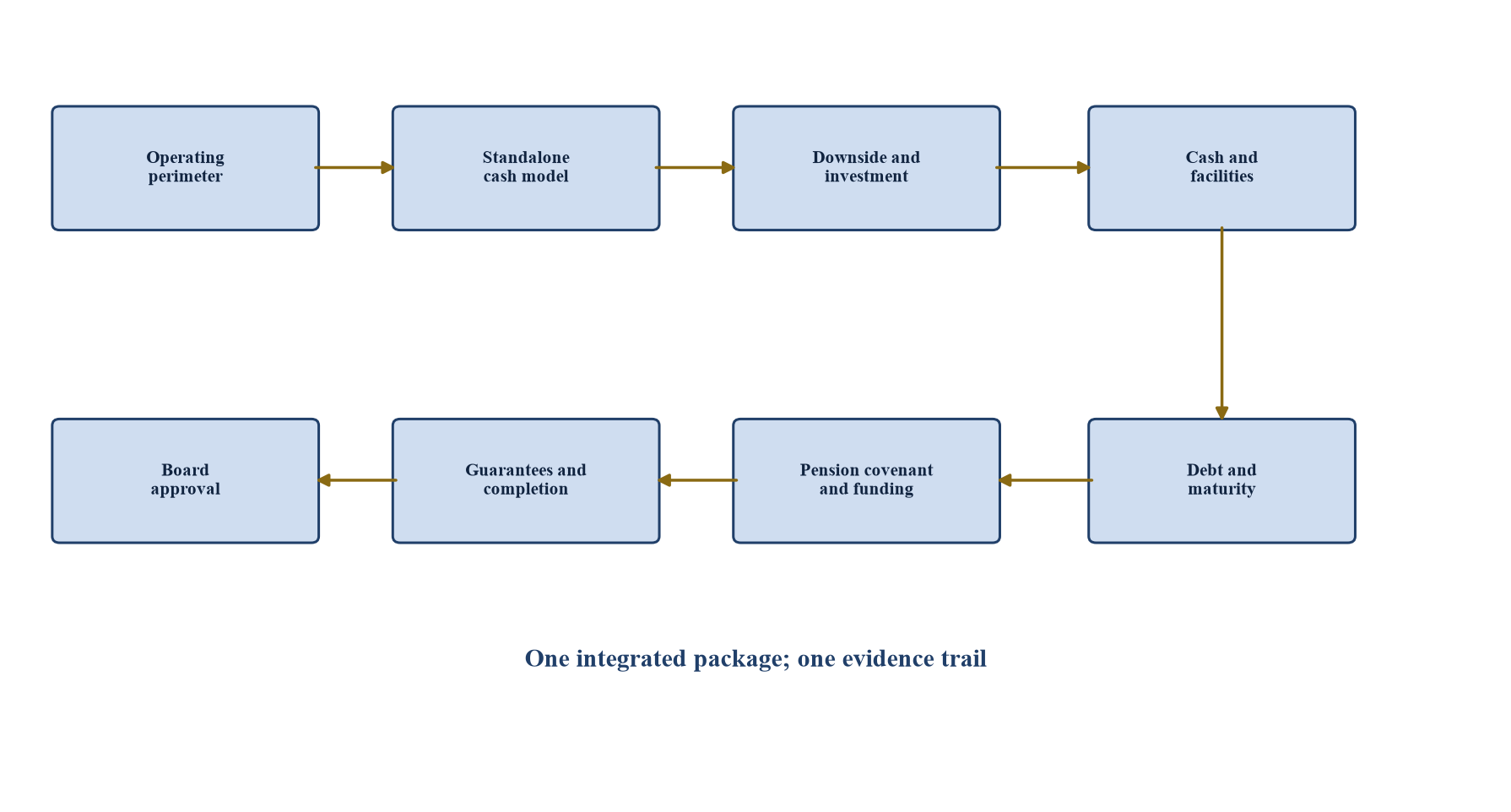
Original framework. The allocation begins with standalone operations and moves through cash, debt, pension and completion evidence.
12. Coordinate pension and lender protections
Pension trustees and lenders can seek protection from the same asset base and cash flows. A security package granted to lenders may reduce the plan's insolvency recovery. A large pension contribution may reduce liquidity or borrowing-base capacity. Negotiations should therefore be coordinated through one capital-allocation model.
The model should show creditor priority before and after separation, including secured debt, pension claims, leases, guarantees and structural subordination. It should identify restricted subsidiaries, asset-transfer limits and permitted security. Management should avoid making inconsistent representations to lenders, trustees and investors.
Mitigation can be conditional. A pension contribution may become payable on a refinancing, asset sale, dividend or deterioration in funding. A contingent security package may activate if specified metrics weaken. These mechanisms can protect members while preserving operating liquidity, but they require clear measurement, reporting and enforcement.
The board should compare the cost and flexibility of each mechanism. A cash contribution provides immediate value to the plan and permanently reduces corporate liquidity. Security protects downside while leaving cash in the business, yet it can affect future financing. A guarantee preserves sponsor support but may frustrate full separation. The selected package should be explicit about these trade-offs.
13. Build pro forma opening balance sheets
The pro forma balance sheets should reflect the legal perimeter, financing transactions, cash distribution, debt issuance, transaction cost, tax, pension allocation and other completion adjustments. Each line should link to a transaction step or operating assumption. Balancing entries should be explained rather than hidden in a generic equity account.
Public filings illustrate the scale of separation financing. Solventum disclosed USD 6.9 billion of senior notes, USD 500 million and USD 1 billion term facilities, approximately USD 7.7 billion of cash payments to 3M and USD 600 million of retained cash. [8] Kenvue disclosed approximately USD 9 billion of new debt and approximately USD 1.17 billion of retained cash in connection with its separation. [9] These are company-specific transactions, not leverage benchmarks.
The opening balance sheets should be reconciled to sources and uses. Cash movements should distinguish debt proceeds, distributions, transaction fees, tax, pension funding, restricted cash and operating cash. Debt should reconcile by instrument and legal borrower. Pension balances should reconcile to the applicable accounting and transaction documents.
Management should also prepare an opening liquidity statement. A balance sheet may show cash that is not available in the relevant legal entity or jurisdiction. The liquidity statement should show unrestricted cash, undrawn committed facilities, immediate uses and the minimum buffer.
| Metric | NewCo | RemainCo | Combined |
|---|---|---|---|
| EBITDA | 235 | 385 | 620 |
| Gross debt | 620 | 1,130 | 1,750 |
| Opening unrestricted cash | 180 | 260 | 440 |
| Net debt | 440 | 870 | 1,310 |
| Gross debt / EBITDA | 2.64x | 2.94x | 2.82x |
| Net debt / EBITDA | 1.87x | 2.26x | 2.11x |
| Committed revolving facility | 300 | 450 | 750 |
| Undrawn revolver at opening | 300 | 450 | 750 |
| Pension and post-employment obligation | 280 | 500 | 780 |
| Related plan assets | 240 | 420 | 660 |
| Accounting deficit | 40 | 80 | 120 |
All amounts are hypothetical USD millions. EBITDA is a scenario input, not a forecast. Net debt excludes pension deficit and other contingent liabilities.
14. Test the hypothetical central allocation
The hypothetical group produces USD 620 million of consolidated EBITDA before separation adjustments. NewCo represents USD 235 million and RemainCo USD 385 million. The proposed central allocation places USD 620 million of gross debt with NewCo and USD 1.13 billion with RemainCo. Opening cash is USD 180 million and USD 260 million respectively, supported by committed revolvers of USD 300 million and USD 450 million.
The allocation produces gross leverage of 2.64 times for NewCo and 2.94 times for RemainCo. Net leverage is lower because the companies retain operating cash. These ratios alone do not prove resilience. The model must consider cash availability, working-capital timing, capital expenditure, pension contributions, interest and separation cost.
The pension and post-employment obligation is hypothetically allocated as USD 280 million to NewCo and USD 500 million to RemainCo, together with related plan assets of USD 240 million and USD 420 million. The resulting accounting deficits are USD 40 million and USD 80 million. The allocation is an analytical assumption. A real allocation would depend on plan rules, member data, legal sponsors, actuarial values and regulatory engagement.
The central case should be treated as a package. Moving debt without adjusting cash and facilities changes minimum liquidity. Moving pension responsibility without adjusting contributions changes free cash flow. The board should evaluate the effect of each change across both companies and the completion sources and uses.
15. Apply a severe operating scenario
The hypothetical severe scenario reduces NewCo EBITDA by 18 per cent to USD 192.7 million and RemainCo EBITDA by 12 per cent to USD 338.8 million. NewCo absorbs USD 75 million of working capital and RemainCo USD 95 million. Floating financing cost increases by two percentage points. The scenario assumes the shocks occur while separation expenditure and pension contributions continue.
NewCo's gross leverage rises to approximately 3.22 times before any revolver draw. RemainCo's gross leverage rises to approximately 3.34 times. If working-capital absorption is funded entirely from opening cash, NewCo cash falls from USD 180 million to USD 105 million and RemainCo cash falls from USD 260 million to USD 165 million before interest, investment and other cash uses. The figures show why gross leverage and opening cash must be tested together.
The scenario should include a monthly profile. A working-capital outflow can precede the related revenue recovery. Additional interest can begin immediately, while cost actions take time. The board should see the lowest point of liquidity and the actions available before it is reached.
This scenario is neither a forecast nor a probability-weighted valuation. It is a decision test. Management should replace it with evidence-based company scenarios and should use additional tests where customer concentration, commodity prices, regulation or project execution creates different risks.
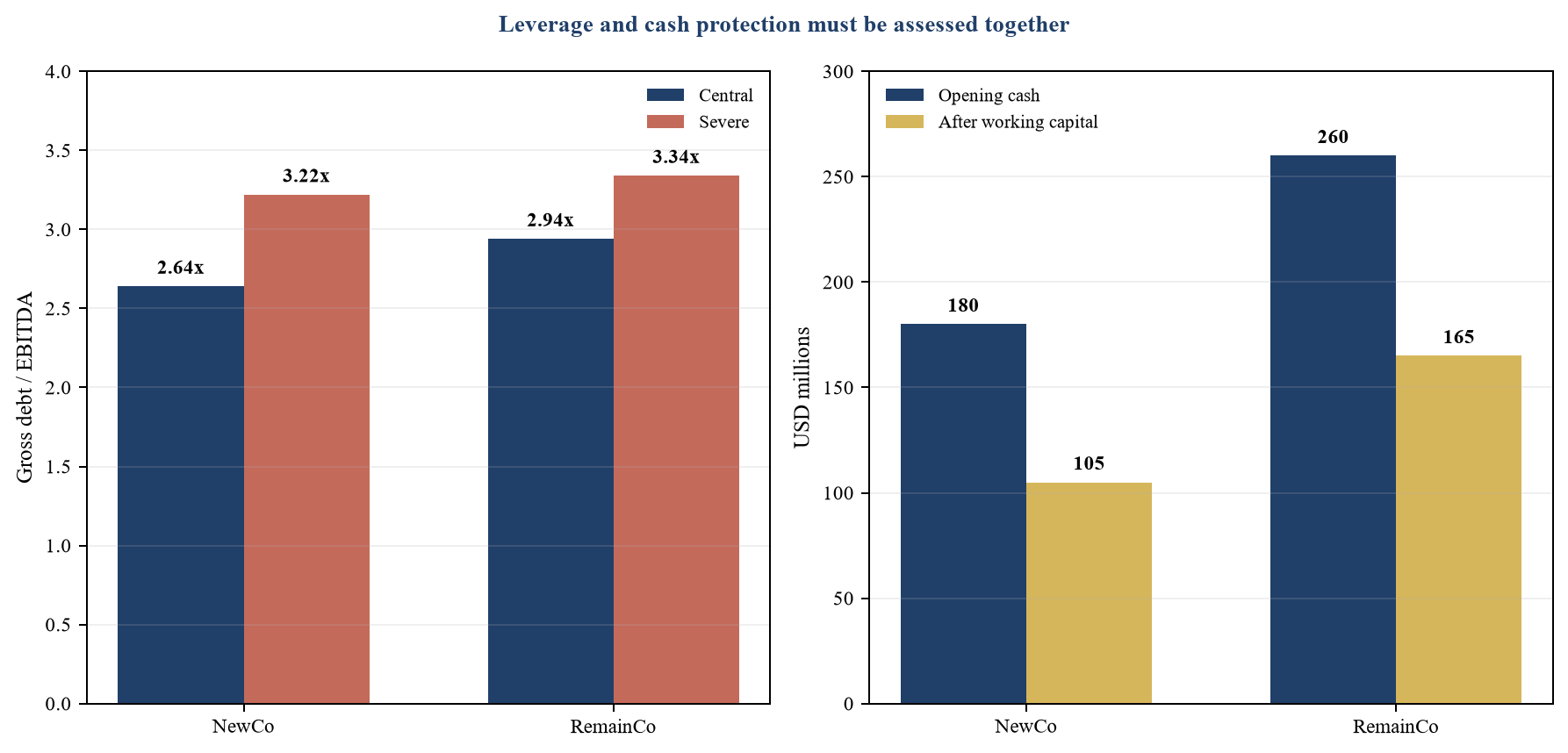
Original analysis. EBITDA declines by 18 per cent for NewCo and 12 per cent for RemainCo; working-capital absorption is USD 75 million and USD 95 million respectively.
| Metric | NewCo central | NewCo severe | RemainCo central | RemainCo severe |
|---|---|---|---|---|
| EBITDA | 235.0 | 192.7 | 385.0 | 338.8 |
| Gross debt | 620.0 | 620.0 | 1,130.0 | 1,130.0 |
| Gross leverage | 2.64x | 3.22x | 2.94x | 3.34x |
| Opening cash | 180.0 | 180.0 | 260.0 | 260.0 |
| Working-capital absorption | 0.0 | 75.0 | 0.0 | 95.0 |
| Cash after working capital | 180.0 | 105.0 | 260.0 | 165.0 |
| Undrawn committed revolver | 300.0 | 300.0 | 450.0 | 450.0 |
All amounts are hypothetical USD millions except ratios. Cash after working capital excludes interest, capital expenditure, pension contributions and other cash uses, which require a complete monthly model.
16. Test strategic capacity after separation
A capital structure can remain solvent and still frustrate the separation thesis. NewCo may require investment in products, systems, sales capacity or acquisitions. RemainCo may need restructuring, portfolio repair or shareholder distributions. Debt and pension funding should leave enough capacity for the strategy disclosed to investors.
Management should identify committed and high-confidence strategic uses for the first three years. The analysis should distinguish maintenance expenditure, mandatory compliance, separation build, growth investment and optional acquisitions. Each category should be modelled with timing and cash evidence.
The board should see how the allocation affects return thresholds and decision rights. A highly leveraged NewCo may reject valuable investments because of covenant or liquidity constraints. An overcapitalised NewCo can reduce the intended distribution and may still lack a coherent capital policy. RemainCo should not rely on future asset sales unless timing and proceeds are sufficiently supported.
The capital policy should state leverage range, liquidity minimum, dividend conditions, acquisition funding principles and pension funding commitments. This provides investors and management with a consistent framework after completion.
17. Translate the allocation into instruments
The financing plan should specify legal borrower, guarantors, principal, currency, rate, maturity, amortisation, security, covenants, use of proceeds and distribution mechanics for every instrument. It should also identify existing debt that remains, is repaid or requires consent.
New debt can be issued before separation and transferred or remain with the issuing entity. The steps must align with corporate authority, solvency, tax and securities law. Proceeds used for a parent distribution should be clearly distinguished from operating liquidity retained by NewCo.
Commitment papers should be reviewed against the board model. Flex rights can alter pricing, maturity, covenant and structure. Market disruption provisions can affect certainty. The company should understand the maximum adverse terms available to arrangers and whether the transaction remains viable under them.
The instrument package should preserve operational flexibility. Baskets for capital expenditure, acquisitions, working capital, pensions and restructuring should reflect the plan. Reporting requirements should be deliverable by the standalone finance function. A covenant package that assumes mature systems on day one can create avoidable compliance risk.
18. Prepare the rating and investor case
Ratings and investor reception can affect price, access and capital-policy flexibility. The presentation should explain the business perimeter, standalone earnings, cash conversion, capital allocation, pension exposure, separation cost, liquidity and governance. Adjustments should reconcile to audited or clearly identified pro forma information.
The case should address both companies. Investors may question why debt is concentrated in one entity, why cash remains in another or how pension obligations were assigned. A coherent explanation connects the allocation to risk, strategy and cash generation rather than to a desired distribution alone.
Management should prepare sensitivities before engagement. Questions may focus on stranded cost, customer concentration, cyclicality, working capital, restricted cash, refinancing and contingent liabilities. Answers should be consistent across lender materials, equity communications and public filings.
Disclosure should separate historical facts, pro forma adjustments and forward-looking assumptions. IFRS 7 requires disclosures that enable users to evaluate the significance of financial instruments and the nature and extent of related risks. [10] It also includes liquidity-risk disclosures such as maturity analysis and descriptions of risk management. [11] The financing story should be supported by the same control discipline.
19. Sequence lender, trustee and regulatory engagement
Stakeholders should be engaged early enough to influence the structure. A late request for consent can transfer negotiating leverage, delay completion or force expensive interim support. The engagement map should identify required approvals, consultation, notice, clearance, information and timing.
Lenders may require consent to transfer assets, release guarantees, incur debt, make distributions or change control. Trustees may require covenant information and mitigation. Regulators may require filings or capital approvals. Tax authorities may affect the feasibility of distribution and reorganisation steps.
The programme should maintain one issues log showing stakeholder, request, supporting evidence, dependency, owner and long-stop date. Commitments made in one negotiation should be reflected in the central model. A trustee security package or lender restriction can change the economics of the whole allocation.
Escalation should occur before a timetable becomes critical. The board should know which items can prevent separation, which can survive under transitional arrangements and which affect value without blocking completion.
20. Control cash and debt at completion
Completion converts models into bank balances and legal obligations. The closing plan should specify bank accounts, payment instructions, debt draw, debt repayment, distribution, fees, tax, pension contributions, restricted cash and minimum operating balances. Every material flow should have an authorised source, recipient and evidence trail.
Cash sweeps and pooling should cease or be redesigned. NewCo needs functioning bank mandates, payment controls, signatories and treasury systems. RemainCo should remove access rights and confirm that no automatic transfer can drain the other company's accounts after separation.
Debt documents, guarantees and derivatives should become effective in the intended sequence. A gap between repayment and funding can create an intraday liquidity problem. A guarantee release that depends on repayment should be confirmed. Draw conditions should be satisfied and documented.
The closing statement should reconcile projected and actual cash. Variances should be assigned under the separation agreement. The companies should confirm opening cash, restricted cash, debt principal, accrued interest, fees and facility availability immediately after completion.
21. Govern the first hundred days
The capital structure should be monitored more frequently during early standalone operation. Management should report cash, revolver availability, covenant headroom, collections, inventory, separation spend, pension contributions and material guarantees. Thresholds should trigger action before a formal breach or liquidity minimum is reached.
The first reporting cycle should reconcile actual cash conversion to the allocation model. Variances may reveal missing standalone cost, delayed collections or one-time payments. The model should be updated without rewriting the original decision record.
NewCo and RemainCo should each have independent treasury authority and board oversight. Any continuing intercompany facility or guarantee should have documented terms, limits, reporting and expiry. Transitional support should not become an informal substitute for adequate capitalisation.
The board should schedule a capital review after the first audited or reviewed standalone period. The review can reassess leverage, liquidity, hedging, pensions and capital policy using actual evidence.
22. Use a capital-allocation risk heat map
The risk register should connect likelihood, financial consequence, liquidity timing and mitigation. High-priority risks can include refinancing delay, cash trapping, covenant underperformance, guarantee release failure, pension detriment, contribution acceleration, working-capital absorption and separation-cost overrun.
Each risk should have a quantitative exposure where possible. A guarantee should show maximum and expected cash call. A refinancing delay should show bridge cost and liquidity effect. A pension event should show contribution or security requirement. Ranges should be labelled as scenarios when the outcome is uncertain.
The heat map should also show evidence confidence. A large exposure supported by executed documents differs from a moderate exposure based on incomplete data. Management should prioritise risks with both material consequence and weak evidence.
The board should approve risk acceptance explicitly. Some residual linkage may be commercially necessary. The approval should identify duration, compensation, control and exit path.
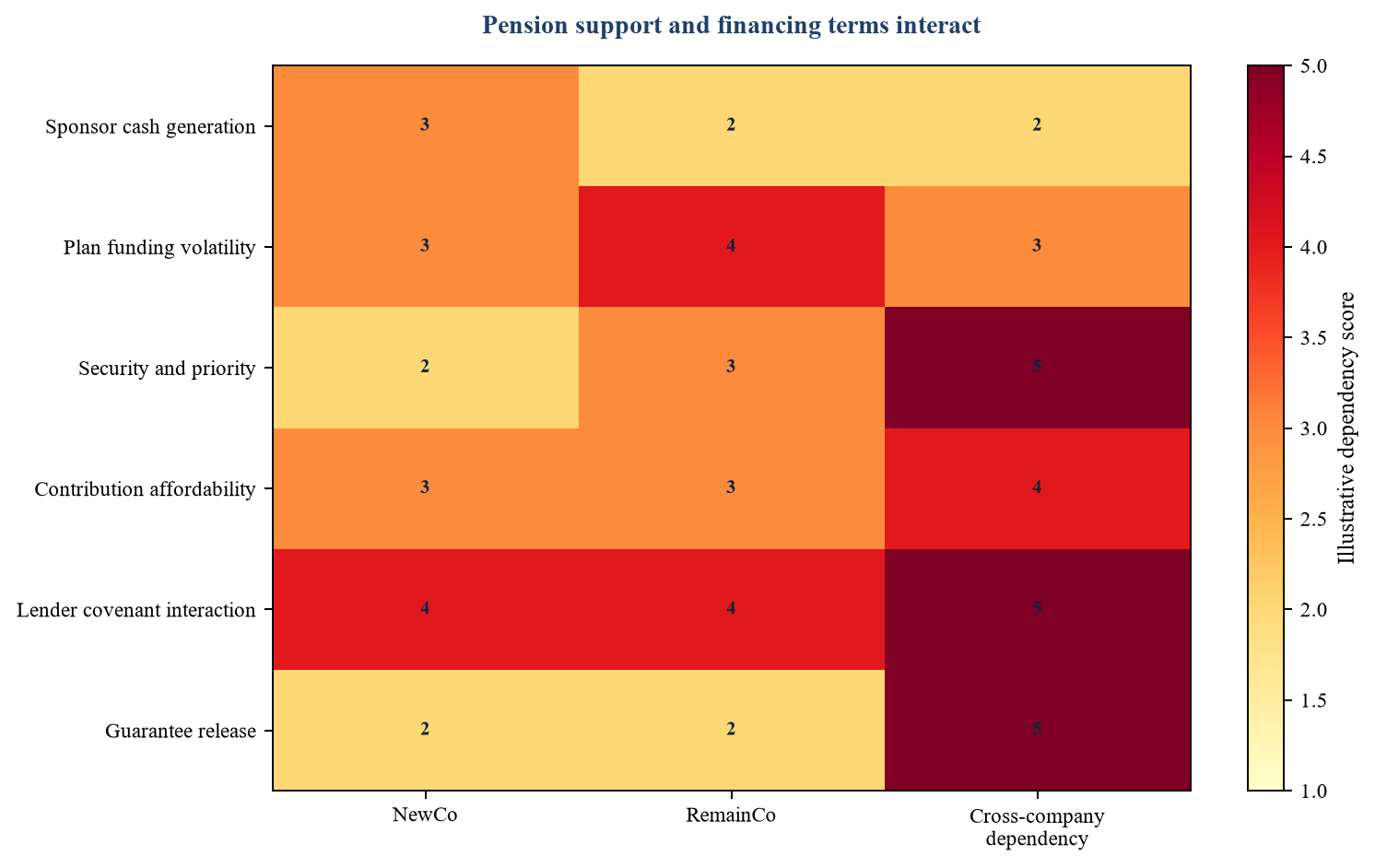
Original framework. Scores are illustrative design values on a five-point scale and do not assess any actual company.
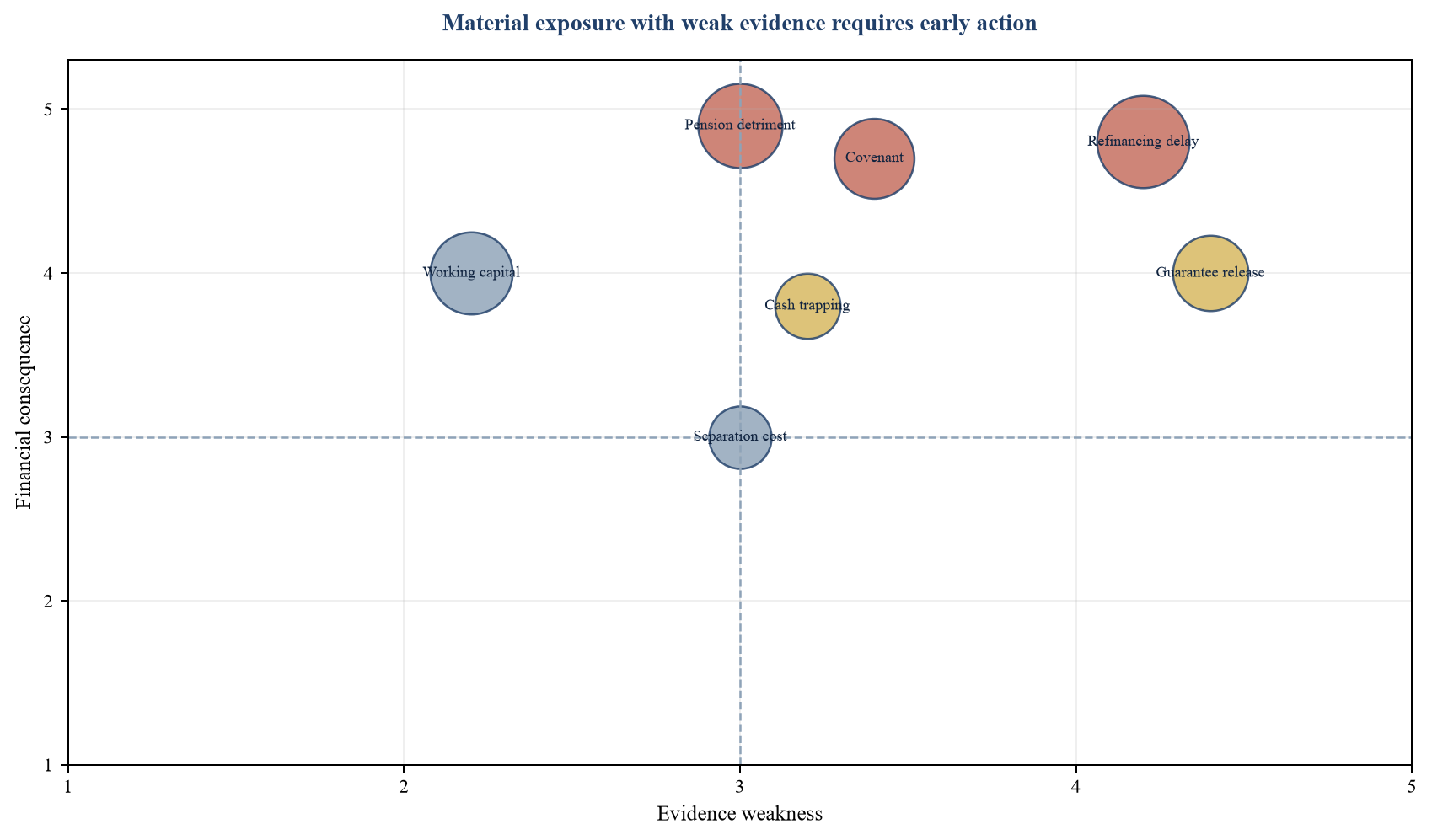
Original framework. Likelihood and consequence scores and hypothetical cash exposures are design examples only.
23. Apply decision gates and a phased roadmap
The programme should move through explicit gates. Gate one confirms the operating and legal perimeter. Gate two approves standalone cash models and downside scenarios. Gate three selects the capital package. Gate four secures commitments and stakeholder agreements. Gate five confirms completion readiness. Gate six validates the opening position and early standalone performance.
Each gate should require evidence rather than status reporting. A debt commitment is evidenced by executed documents and satisfied conditions. Liquidity readiness is evidenced by bank-account tests, draw mechanics and reconciled cash. Pension readiness is evidenced by legal and actuarial analysis, trustee engagement and signed mitigation where required.
The roadmap should integrate finance, legal, tax, treasury, pensions, investor relations and separation management. Separate workstreams can create inconsistent assumptions. A central model and decision log should record every approved change.
The board can delegate detailed execution while retaining approval of the package and material changes. A change that shifts debt, reduces liquidity, accelerates pension funding or extends a guarantee should return through governance.
| Gate | Required output | Minimum evidence | Board decision |
|---|---|---|---|
| 1. Perimeter | Asset and liability map | Legal schedules and operating ownership | Approve allocation baseline |
| 2. Capacity | Standalone cash and downside models | Reconciled historical and pro forma evidence | Approve financing envelope |
| 3. Structure | Debt, cash, facilities and pension package | Terms, covenant model and covenant assessment | Select capital package |
| 4. Commitments | Lender, trustee and regulatory path | Commitments, consents and mitigation documents | Authorise execution |
| 5. Completion | Funds flow and readiness pack | Draw conditions, bank tests and signed documents | Approve closing |
| 6. Validation | Opening balance and first-cycle review | Reconciled cash, debt, covenant and pension reporting | Accept or remediate |
Original framework. Timing is transaction-specific and should be aligned to legal, financing, pensions and market requirements.
24. Conclusion
Capital allocation after separation is an operating, financing and stakeholder decision. Debt capacity, opening liquidity, pension support, guarantees and maturity should be designed from the standalone businesses and tested through the same downside scenarios. Ratios provide useful summaries, but they cannot replace cash timing, instrument terms, covenant definitions, legal responsibility and completion mechanics.
The board should require one integrated model and one evidence trail. The model should reconcile the legal perimeter, pro forma balance sheets, sources and uses, debt documents, pension analysis, cash forecasts and public disclosure. The evidence should show that both companies can operate, invest and refinance independently.
The hypothetical case demonstrates the interaction. NewCo and RemainCo can each appear moderately leveraged under central assumptions while a severe combination of lower EBITDA, working-capital absorption and higher rates materially reduces resilience. Pension and post-employment obligations add a further claim on cash and creditor support. Changing one element requires re-testing the package.
A successful separation leaves two companies with understandable capital policies, usable liquidity, executable obligations and a governance process for early variance. This is the standard against which the allocation should be approved.
Sources
- U.S. Securities and Exchange Commission, Solventum Corporation, Separation and Distribution Agreement, 2024, Read the primary source
- IFRS Foundation, IAS 19 Employee Benefits, issued 2026, Read the primary source
- The Pensions Regulator, Clearance guidance, Read the primary source
- The Pensions Regulator, Corporate transactions flowchart, Read the primary source
- Pension Benefit Guaranty Corporation, Risk Mitigation, Read the primary source
- Pension Benefit Guaranty Corporation, Reportable Events, Read the primary source
- The Pensions Regulator, Protecting schemes from sponsoring-employer distress, Read the primary source
- U.S. Securities and Exchange Commission, Solventum Corporation Form 10, 2024, Read the primary source
- U.S. Securities and Exchange Commission, Kenvue Inc. prospectus, 2023, Read the primary source
- IFRS Foundation, IFRS 7 Financial Instruments: Disclosures, Read the primary source
- IFRS Foundation, IFRS 7 Financial Instruments: Disclosures, issued 2021, Read the primary source
- U.S. Securities and Exchange Commission, GE Vernova S-1/A, 2024, Read the primary source
