

1. Define the revenue decision
The first decision is which party should bear changes in the quantity of service used and which party should bear changes in the quality or availability of the service delivered. These are separate exposures. A hospital operator may control whether facilities are clean, safe and available while having little influence over the number of patients referred by the public health system. A toll-road operator may influence maintenance, incident response and customer experience while regional development, competing roads, fuel prices and public policy determine much of the traffic.
The World Bank describes three broad approaches. Under a user-pays model, the private party earns revenue by charging users. Under a government-pays model, the authority makes payments that can depend on availability or delivered volume. Hybrid arrangements combine government payments and user fees during construction, operations or both. [1] This classification begins the analysis. The final contract still needs a precise allocation of tariff, collection, demand, performance, inflation and political risk.
The authority should state the service objective, affordability constraint, funding sources and risks that the private party can influence. It should also identify the risks the public sector is willing and legally able to retain. The preferred payment mechanism follows from those facts. It should not be selected because a familiar contract form is available or because a particular accounting result appears convenient.
The decision paper should show expected payments and revenues under a central case and stated downside cases. It should identify who pays, when payment begins, what evidence supports an invoice, how deductions operate, how tariffs change, which exposures create contingent public liabilities and what happens if the service remains necessary after the project company suffers financial distress.
The governing principle is managerial control. Risk should sit with the party that can influence its likelihood or consequence, measure it, absorb it and respond at reasonable cost. Some risks need to be shared because neither party controls them fully. The contract should express that sharing through objective thresholds and rules rather than broad statements of partnership.
2. Separate the payment mechanism into components
A payment mechanism is a system of linked components. It includes the revenue base, price or tariff, indexation, performance standard, measurement method, deduction regime, relief events, payment timing, security, dispute process and termination consequences. Treating the mechanism as a single clause conceals interactions that can determine bankability and public value.
The revenue base identifies the payable unit. It can be a passenger journey, cubic metre of treated water, kilowatt-hour, occupied bed day, available lane kilometre, usable school place or another defined output. The unit must correspond to the service specification and a source of evidence that both parties can audit.
The price rule states the amount payable per unit or period. It can contain fixed and variable elements. Indexation determines how the price changes with general inflation, wages, energy, foreign exchange or other cost drivers. A single consumer-price index may leave the operator exposed to a cost mix that behaves differently. Full cost pass-through can weaken the incentive to manage costs.
Performance adjustments translate service failure into reduced payment. Deductions require measurable standards, response periods, severity weights, caps and escalation for repeated failure. A mechanism that deducts too little can leave the authority paying for inadequate service. A mechanism that can remove all cash flow for minor failures may be difficult to finance and can accelerate distress.
Relief events define circumstances in which performance or timing is adjusted. Payment security addresses public-counterparty credit and annual appropriations. Dispute rules preserve service continuity while contested amounts are resolved. Termination provisions determine value when the mechanism cannot continue.
| Component | Decision | Required evidence | Control test |
|---|---|---|---|
| Revenue base | Output, availability, use or combination | Service map and measurable unit | Payment follows the intended public service |
| Price and tariff | Fixed, regulated or formula-based | Cost, affordability and willingness-to-pay evidence | Price can be administered through the term |
| Indexation | General or cost-specific indices | Verified cost composition and index availability | Adjustment reflects material uncontrollable cost |
| Performance | Standards, measurement and deductions | Operating data and monitoring design | Failure changes remuneration predictably |
| Demand sharing | Full transfer, band, guarantee or sharing | Demand study and stress cases | Exposure matches influence and financial capacity |
| Payment security | Budget, fund, guarantee or reserve | Legal authority and fiscal approval | Valid invoice can be paid when due |
| Relief and change | Events, thresholds and compensation | Risk register and governing law | Exceptional events have a defined response |
| Termination | Triggers and compensation | Valuation and lender analysis | Essential service can continue through distress |
Original framework. Each field requires project-specific legal, financial, technical and public-finance review.
3. Map the transaction and cash flow
The transaction map should follow cash and evidence from the public service to the project company. In a user-charge project, users receive the service, usage is measured, the tariff is applied, collections enter controlled accounts and the project company pays operating costs, taxes and debt service. The authority regulates tariffs and service standards and may provide land, grants, guarantees or targeted subsidies. Lenders depend on the collection system, account controls and enforcement rights.
In an availability-payment project, the authority or its contract manager verifies service availability and performance. The project company submits an invoice based on the contractual payment formula. The authority validates the invoice, applies deductions and pays from an approved budget or other funding source. Lenders depend on the authority's legal payment obligation, credit quality, appropriations framework and dispute discipline.
A hybrid project contains both routes. User revenue may fund a defined share of the required payment. The authority can pay a fixed availability amount, a revenue top-up, a capital contribution or a subsidy for eligible users. The contract must reconcile the two sources and prevent double recovery. The authority needs timely visibility over user revenue, collection costs, related-party arrangements and leakage.
Cash flow should be mapped at the same frequency as payment and debt service. Annual averages can conceal monthly or quarterly shortfalls. The model should show invoicing lags, collection delays, reserve requirements, tax, lifecycle expenditure and trapped cash. It should also distinguish accounting revenue from cash available for debt service.
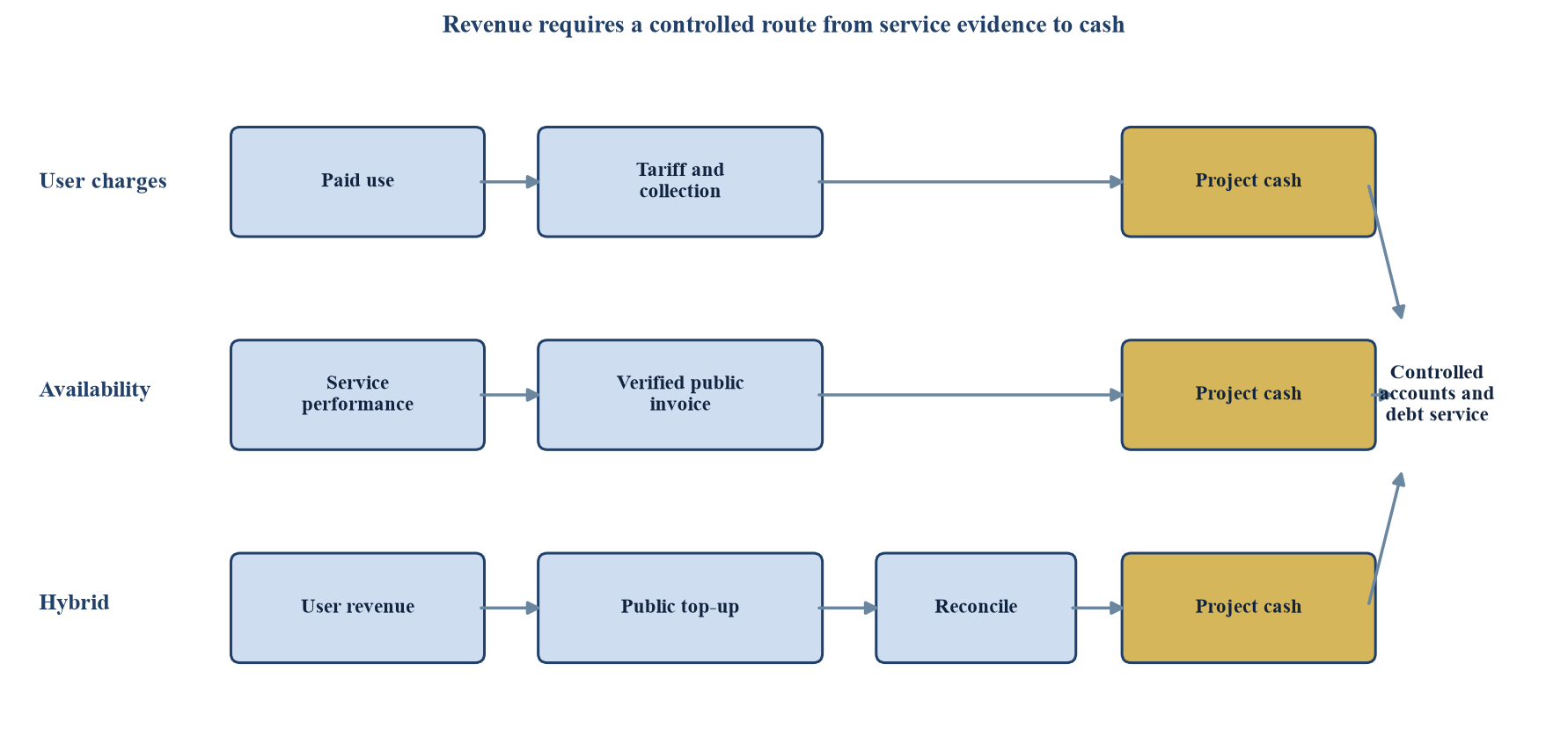
Original framework. The routes are illustrative and require project-specific legal and operational validation.
4. Test whether users can carry revenue risk
A user-charge model requires more than forecast demand. The service must support lawful charging, practical exclusion or enforcement, a workable collection process and a tariff that users can afford and are willing to pay. The authority should examine who benefits, who pays, how alternatives affect behaviour and whether the service has monopoly characteristics.
Demand analysis should separate population or economic need from paid use. A city may need new transport capacity while users remain sensitive to tolls or have untolled alternatives. A water project may have stable physical demand while collections vary by customer type, subsidy policy and enforcement. A port may have regional cargo potential while shipping routes and competing terminals determine realised volume.
The demand case should document the catchment, baseline usage, competing services, price sensitivity, ramp-up, capacity, seasonality and structural change. It should reconcile technical forecasts with observed payment behaviour. Independent review should test the model, data provenance and material judgement.
Tariff authority is central. The contract should identify who sets the initial tariff, who approves increases, which formula applies, how taxes and indexation are handled and what happens when government freezes or reduces charges. A theoretical right to increase tariffs has limited value if implementation requires discretionary political approval each year.
Collection risk should be allocated separately. The project company may control billing technology and enforcement while the authority controls customer records, disconnection policy or public subsidies. The mechanism should define bad debt, exemptions, fraud, disputed use and public-service obligations.
A user-charge structure can be appropriate where the private party can influence use or customer experience, demand is sufficiently understood, tariffs are implementable and the project can absorb downside. Where those conditions are weak, full demand transfer can increase the required return, reduce debt capacity or produce aggressive bids that later require renegotiation.
5. Design availability payments around service
An availability payment converts a public-service obligation into a periodic contractual payment. The project company receives the payment when the asset or service is available at the required quality. The World Bank notes that this approach removes direct demand exposure from project revenue and places demand risk with the authority. [2] The project company continues to bear construction, maintenance and performance risks to the extent defined in the contract.
The payment should begin only when the required service is available. Completion tests must therefore connect physical completion, commissioning, permits, safety and operational readiness. Partial availability can be recognised when the service can lawfully and usefully operate in defined units. The mechanism should avoid paying for capacity that users cannot access because an authority dependency remains incomplete unless that dependency is allocated to the authority.
The base payment commonly covers debt service, operating cost, lifecycle cost, tax and equity return under the agreed risk allocation. Indexation should reflect the parts of cost exposed to inflation while preserving incentives to manage controllable costs. Foreign-currency indexation or convertibility support requires separate fiscal and legal analysis.
Deductions should reflect the public consequence of failure. They can vary by location, time, duration, severity and recurrence. A closed hospital operating theatre can carry more weight than a short failure in a non-clinical room. A blocked lane during peak hours can carry more weight than the same event overnight. Rectification periods should reflect safety and operational reality.
The authority needs an independent or contractually credible monitoring system. Self-reporting may remain part of the process, supported by audit rights, sensors, inspections and user complaints. The contract should address missing or disputed data. Payment should remain administrable over decades despite technology changes.
Availability payments transfer revenue stability to the project company and create a long-term direct public commitment. The authority should test affordability over the full term and include the obligation in budgeting, fiscal-risk reporting and contract management.
6. Build a hybrid for defined reasons
A hybrid mechanism is useful when user revenue can fund part of the service but cannot support the full investment or acceptable tariffs. The public contribution can take the form of an availability payment, capital grant, minimum-revenue support, targeted user subsidy, shadow tariff or payment for specified public benefits. Each component should have a clear policy and financial purpose.
The design should begin with the funding gap under an affordable and implementable tariff. The authority should test whether the gap arises from construction cost, ramp-up, service obligations, below-cost tariffs or risks that the project company cannot manage. Support should address the identified constraint. A broad revenue guarantee can expose the public sector to commercial underperformance that a narrower instrument would leave with the operator.
Hybrid structures require a revenue waterfall. The contract should state how gross user charges, taxes, collection costs, operating expenses and public payments are calculated. It should define whether user revenue reduces the authority payment pound for pound, within bands or after thresholds. It should also specify upside sharing where demand exceeds the agreed case.
Minimum-revenue guarantees need a reference volume or revenue, measurement rules and exclusions for operator failure. A guarantee should not compensate demand loss caused by poor service, insufficient maintenance, unauthorised tariff practices or weak collection. The authority should cap the exposure, define its duration and record it as a contingent liability.
Capital contributions can reduce required financing and user tariffs. Payment during construction reduces private capital at risk, so the authority should retain completion protection through milestones, security, retention or deferred amounts. Viability gap funding should be linked to a project that remains economically justified and publicly affordable.
A hybrid can also support distributional policy. The authority may subsidise eligible users while preserving a cost-reflective tariff for others. Eligibility, verification and reimbursement should be controlled. The payment mechanism should keep social policy visible rather than hiding it inside unexplained project-company compensation.
7. Allocate demand through bands
Demand does not need to sit wholly with one party. Bands can allocate normal variation to the project company and extreme outcomes to the authority, or share upside and downside around a central case. The structure should reflect which drivers each party can influence and the capacity of each balance sheet.
A banded mechanism can establish a lower threshold, a central range and an upper threshold. Within the central range, user revenue moves with demand and the project company bears the effect. Below the lower threshold, the authority can provide a partial top-up subject to service and collection conditions. Above the upper threshold, excess revenue can be shared or used to reduce future payments.
The thresholds should arise from evidence and a financing test. They should not be placed at convenient round numbers without analysis. The demand model should estimate the probability and consequence of different outcomes while preserving uncertainty. Lenders will focus on cash available for debt service under plausible downside cases. The authority will focus on expected and tail fiscal exposure.
The contract should define the demand measure. Traffic, passengers, units sold and revenue can produce different outcomes when tariffs, customer mix or exemptions change. Revenue-based support can compensate price and collection effects as well as volume. Volume-based support may leave tariff intervention outside the mechanism.
Rebasing should be limited and transparent. Frequent rebasing can convert transferred demand risk into public risk after the fact. A long-term contract may still need adjustment for major scope change, competing infrastructure built by government or a legal change that directly alters permitted use. Those events should have defined tests and valuation rules.
| Exposure | Possible private allocation | Possible public allocation | Possible sharing rule |
|---|---|---|---|
| Ordinary demand variation | Revenue changes with paid use | None | Central demand band borne privately |
| Publicly imposed tariff freeze | Limited where contract protects tariff | Compensation or revised public payment | Threshold and verified net effect |
| Poor service | Revenue loss and deductions | None for operator-caused failure | Relief only for authority-caused event |
| Collection performance | Billing and enforcement within operator control | Customer data or statutory enforcement duties | Benchmark loss plus audited sharing |
| General inflation | Efficiency risk around indexed price | Approved index adjustment | Partial indexation by cost category |
| Exceptional cost shock | First-loss layer | Defined relief above threshold | Deductible, cap and open-book evidence |
| Competing public asset | Ordinary network evolution | Specific discriminatory intervention | Materiality threshold and time limit |
| Extreme demand collapse | Agreed base downside | Policy response and essential-service continuity | Temporary floor with upside recapture |
Original framework. The recommended allocation depends on the project, governing law, market evidence and the parties' actual control.
8. Treat tariff policy as a contractual system
Tariff risk includes the legal power to charge, the initial level, indexation, periodic review, affordability measures and political intervention. The project agreement, sector regulation, licence and financing documents must use consistent rules. A concession cannot create a dependable tariff right if another authority can lawfully prevent collection without compensation.
The initial tariff should be tested against willingness to pay, household or business affordability, existing charges, service quality and alternatives. The analysis should identify taxes, connection fees, minimum charges and customer categories. Published tariff schedules should match the financial model.
Indexation can use a general inflation measure or a weighted basket of cost drivers. The basket should be based on the operator's material uncontrollable costs. Fixed weights can become outdated over a long term. Periodic review can address structural change, provided it does not reopen the commercial bargain routinely.
Affordability measures should be explicit. Targeted subsidies, lifeline tariffs, vouchers or public-service payments can support eligible users. Cross-subsidy between customer groups needs a lawful basis and transparent expected volumes. The project company should not carry an undefined obligation to serve below cost.
Political intervention should be defined carefully. A general economic policy that affects all businesses may be treated differently from an authority decision that directly prevents the contracted tariff. Compensation should measure the verified net effect and account for avoided cost, insurance and mitigation. The operator should remain obliged to pursue collection and operational remedies within its control.
Tariff review needs data. The parties should agree audited revenue, customer mix, consumption, collection, cost indices and service performance. A change should flow through a controlled model with approval and publication steps. The resulting tariff or public payment should be traceable to the contractual formula.
9. Link performance deductions to consequences
Performance deductions should create a financial incentive to restore service and compensate the authority for receiving less than the contracted output. They should not function as arbitrary penalties. The service specification, monitoring system and payment formula must therefore use the same definitions.
The design should identify unavailable units and quality failures. An unavailable unit cannot deliver the contracted service. A quality failure means the unit remains usable but falls below a standard. The mechanism can assign severity weights, time multipliers and location multipliers. Repeated failures can escalate because persistence reveals a deeper control weakness.
Rectification periods should reflect the consequence and realistic repair time. Immediate safety failures can produce immediate unavailability. Minor defects can have a reasonable correction period. The contract should prevent repeated resetting of the period through temporary fixes.
Deductions need calibration against project cash flow. Lenders usually test the deductions required to impair debt service and the circumstances that could produce them. An overly soft regime weakens performance transfer. An uncapped or highly volatile regime can make revenue difficult to finance. Persistent serious failure should ultimately support step-in or termination even if periodic deductions are capped.
Monitoring data should be verifiable and proportionate. Automated systems can improve timeliness while creating cybersecurity, calibration and data-governance requirements. Manual inspections need sampling rules and records. User complaints can inform performance assessment but require validation and protection against duplicate or malicious reports.
Disputed deductions should not paralyse payment. The authority can pay undisputed amounts while preserving rights over the balance. The dispute process should include operational experts where the issue is technical and should maintain service continuity.
10. Allocate inflation by cost driver
Inflation risk affects construction, labour, energy, maintenance, insurance and lifecycle replacement differently. A single index can produce a mismatch between project revenue and cost. The authority should identify material cost categories, determine which the project company can manage and select available indices that remain credible over the term.
Construction inflation is commonly addressed through bid validity, price adjustment or private fixed-price contracting. The public-private partnership agreement should align with the construction contract. If the project company receives relief while the contractor remains fixed-price, the structure can create a windfall. If the project company bears unlimited inflation while its price is fixed and financing is delayed by the authority, the bid may include a large premium or fail.
Operating inflation should preserve efficiency incentives. Full reimbursement of actual cost transfers procurement and productivity risk to the authority. Fixed nominal payments transfer general inflation to the project company. Partial indexation can divide the exposure. A weighted formula may index labour and energy while leaving a fixed portion subject to efficiency management.
Indices can be discontinued, revised or become unrepresentative. The contract should establish a replacement process based on economic equivalence and independent evidence. Foreign-exchange effects require separate treatment where debt, equipment or operating inputs use another currency.
Exceptional price shocks may exceed the intended allocation. A relief mechanism can use a deductible, materiality threshold, temporary sharing, cap and open-book evidence. It should exclude costs caused by operator inefficiency or unapproved procurement. Any support should account for hedging, insurance and mitigation.
The financial model should test index mismatch over time. The relevant output is the distribution of cash available for debt service and equity under stated cost and index scenarios, together with the public payment effect.
11. Price public-counterparty and appropriations risk
An availability-payment project replaces direct demand risk with public-counterparty credit and budget risk. The project company needs a valid, enforceable and funded claim. The authority needs a lawful commitment that fits its fiscal framework.
The World Bank identifies a mismatch between annual budget cycles and long-term payment commitments. [3] A project can have a signed contract while future appropriations remain subject to process and law. The transaction should therefore document the authority's power to enter the obligation, the approved budget treatment, priority of payment and remedies for delay.
Payment security can include dedicated budget lines, reserve accounts, statutory funds, guarantees, letters of credit or support from another public entity. Each instrument has a cost, legal limit and trigger. A guarantee from an entity with the same funding constraint may add limited protection. A reserve can cover temporary delay without solving structural non-payment.
Invoice mechanics should be practical. The contract should state the service period, data cut-off, invoice package, review period, permitted dispute, payment date and interest. Broad rights to withhold all payment for a narrow dispute increase financing risk. The authority should retain audit and recovery rights for overpayment.
Lenders will review sovereign or municipal credit, legal enforceability, currency convertibility, payment history and termination compensation. The project team should test these issues before procurement so that bidders price the intended structure rather than competing on different assumptions.
The authority should include direct payments, guarantees, revenue floors, exchange support and termination exposure in fiscal reporting. OECD guidance links infrastructure value to affordability, fiscal discipline and transparency. [4] Long-term commitments need governance even when the project is classified outside a particular accounting boundary.
12. Measure fiscal exposure in cash terms
Fiscal analysis should show direct payments and contingent liabilities over the contract term. Direct commitments include capital contributions, availability payments, shadow tariffs and service subsidies. Contingent commitments include revenue guarantees, debt guarantees, exchange protection, compensation events and termination payments.
The central case should show nominal and real annual payments, their funding source and the share of the responsible budget. Stress cases should combine demand, inflation, construction delay, performance, exchange and termination events where their interaction is plausible. The authority should identify the largest annual payment, expected present value and tail exposure.
Affordability should be tested against the public service objective and other obligations. A stable availability payment can still become unaffordable when public revenue falls or several projects draw support together. Portfolio analysis is therefore necessary where an authority sponsors multiple partnerships.
Contingent exposure needs triggers and controls. A minimum-revenue guarantee should state the reference, measurement period, exclusions, cap and approval route. A foreign-exchange guarantee should identify eligible debt and prohibited changes. Termination compensation should align with cause and preserve incentives.
The IMF Public-Private Partnerships Fiscal Risk Assessment Model provides a structured approach for assessing fiscal costs and risks from partnerships. [5] The project team can use such tools alongside its jurisdiction's budget and accounting rules. Model output should remain linked to the executed contract rather than a generic project category.
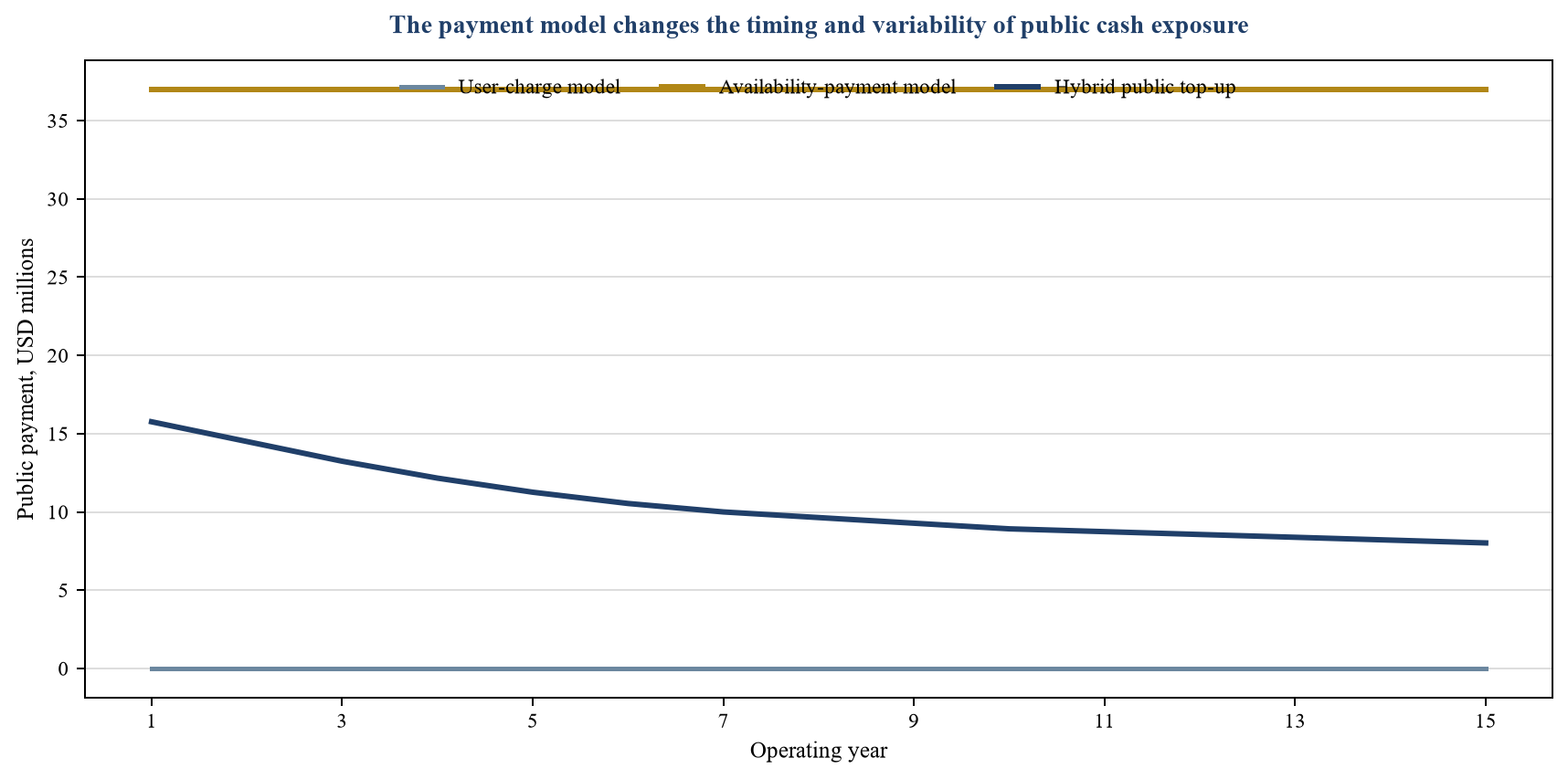
Wholly hypothetical illustration in USD millions. User revenue, availability payments and hybrid support use stated assumptions and do not represent a live project.
13. Build a lender-tested revenue case
Lenders assess whether project cash flow can pay debt under the contractual allocation. They will review the payment formula, demand forecast, tariff rights, collection, deductions, indexation, public credit, reserve structure, termination compensation and direct agreement.
The base case should reproduce the contract. It should calculate gross revenue from observable inputs, apply deductions and relief, record taxes and operating costs, fund reserves and measure cash available for debt service. Every material model input should map to a document, study or stated assumption.
Debt sizing should use downside cases appropriate to the structure. A user-charge project may require lower leverage, a demand ramp-up reserve, cash sweep or distribution lock-up. An availability project may support more stable debt service while remaining exposed to construction completion, severe deductions and authority credit. A hybrid needs tests of both user revenue and public support.
The model should calculate debt-service coverage, loan life coverage, reserve use and minimum cash. It should also identify the deduction or demand level at which distributions stop and debt service becomes impaired. Sensitivity tables should avoid implying statistical precision where inputs are uncertain.
The financing documents should align with project-agreement rights. Cure periods, step-in, insurance proceeds, compensation and termination payments affect recovery. Lenders cannot rely on an authority payment that is conditional on evidence the project company cannot produce.
Market sounding should ask bidders and lenders specific questions. The authority should test leverage, tenor, demand appetite, tariff risk, indexation, deduction calibration, public support and payment security. It should record the assumptions behind responses and avoid changing the transaction privately for one participant.
14. Control political and regulatory intervention
Political risk in the payment mechanism includes tariff freezes, new exemptions, competing public services, changes in collection enforcement, delayed budget approval and changes to sector rules. Some events reflect legitimate public policy. The contract should allocate their economic effect without preventing lawful government action.
The first step is to distinguish general law from project-specific or discriminatory action. A tax applying across the economy may remain a private risk subject to the agreed change-in-law regime. A direction that prevents only the project company from applying its contracted tariff may support compensation. The governing law and procurement framework determine the exact treatment.
Compensation should use verified net effect. The calculation should include lost revenue, avoided cost, mitigation, insurance and later recovery. A formula can reduce dispute where the event is measurable. Broader claims may need expert determination or arbitration.
Competing infrastructure requires a defined boundary. Government should retain the ability to plan networks and meet public need. A narrow protection can address a deliberately discriminatory facility within a stated corridor or period. A broad non-compete can constrain public policy and create large contingent liabilities.
Stakeholder engagement can reduce tariff intervention risk. The authority should explain service benefits, charges, affordability measures and performance rights before implementation. Public consultation does not replace lawful approval, but it can reveal distributional effects and operational constraints.
The financial model should include delayed or reduced tariff adjustment and public-payment delay. The project team should identify which cases trigger reserves, lock-ups, support or termination. Political risk should therefore appear in cash flow, contractual rights and fiscal reporting rather than remain a generic risk-register entry.
15. Apply an integrated risk-allocation test
The authority should evaluate each exposure against five questions. Which party influences the event? Which party can observe and verify it? Which party can mitigate it? Which balance sheet can absorb it? What public-service consequence follows if the allocation fails? The answers can point to private, public or shared allocation.
Influence matters because transferred risk should create useful incentives. The operator can often influence availability, maintenance and collection. It may influence demand through service quality while regional growth or policy remains outside its control. The authority controls statutory tariff decisions and some network changes.
Observability matters because payment depends on evidence. A risk can be economically transferable while difficult to measure. If the parties cannot distinguish operator failure from external demand loss, a guarantee or compensation mechanism can produce disputes.
Mitigation and absorption affect price. A private party can carry a risk that it cannot control if it can insure, hedge or diversify it at reasonable cost. The authority may carry a risk more cheaply through its fiscal capacity, yet doing so can weaken incentives or conceal liabilities. The analysis should compare expected public cost and service outcomes.
Service continuity constrains allocation. A contract can allocate extreme revenue risk to the project company, but the public authority may still need the essential service after insolvency. The structure should anticipate step-in, replacement and transition.
| Test | Evidence | Allocation implication | Failure warning |
|---|---|---|---|
| Influence | Operating and policy responsibility map | Allocate where behaviour can change the outcome | Risk premium without useful incentive |
| Observability | Meter, audit and causal evidence | Use objective measurement and defined baselines | Persistent payment dispute |
| Mitigation | Insurance, hedging and operating options | Allocate to efficient mitigation route | Exposure remains unmanaged |
| Absorption | Capital, reserves and fiscal capacity | Size risk to credible balance sheet | Distress or unbudgeted public support |
| Service continuity | Step-in and replacement plan | Preserve essential service through failure | Allocation collapses during distress |
Original framework. Scores are management aids and do not replace legal analysis, market testing or public approval.
16. Run combined scenarios
Single-variable sensitivities help explain mechanics. Combined scenarios show whether the allocation remains viable when related events occur together. A demand fall can coincide with delayed tariff indexation and higher operating cost. An authority budget shock can coincide with payment delay. Construction delay can postpone service revenue while increasing financing cost.
The scenario set should be small enough to understand and broad enough to cover material failure paths. It can include a central case, manageable downside, severe downside and recovery case. Each case should state its assumptions, contractual response, financing effect, fiscal effect and management action.
The hypothetical illustration uses a project with USD 420 million of initial investment and fifteen operating years shown for simplicity within a twenty-five-year term. Central paid demand reaches its reference level in year seven. The user tariff produces USD 42 million at reference demand. Operating and lifecycle cash cost is USD 16 million, and annual debt service is USD 21 million. These are assumptions.
Under the user-charge model, a 70 per cent demand case produces USD 29.4 million of gross revenue before deductions. After USD 16 million of cost, cash available for debt service is USD 13.4 million and coverage is 0.64 times. Under a USD 37 million availability payment and the same cost, coverage is 1.00 times before deductions. A 12 per cent performance deduction reduces revenue to USD 32.56 million and coverage to approximately 0.79 times.
The illustrative hybrid uses user revenue plus a public top-up subject to a cap and performance adjustment. At low demand it produces more stable revenue than pure user charges while leaving some demand effect with the project company. The authority's support rises as paid use falls.
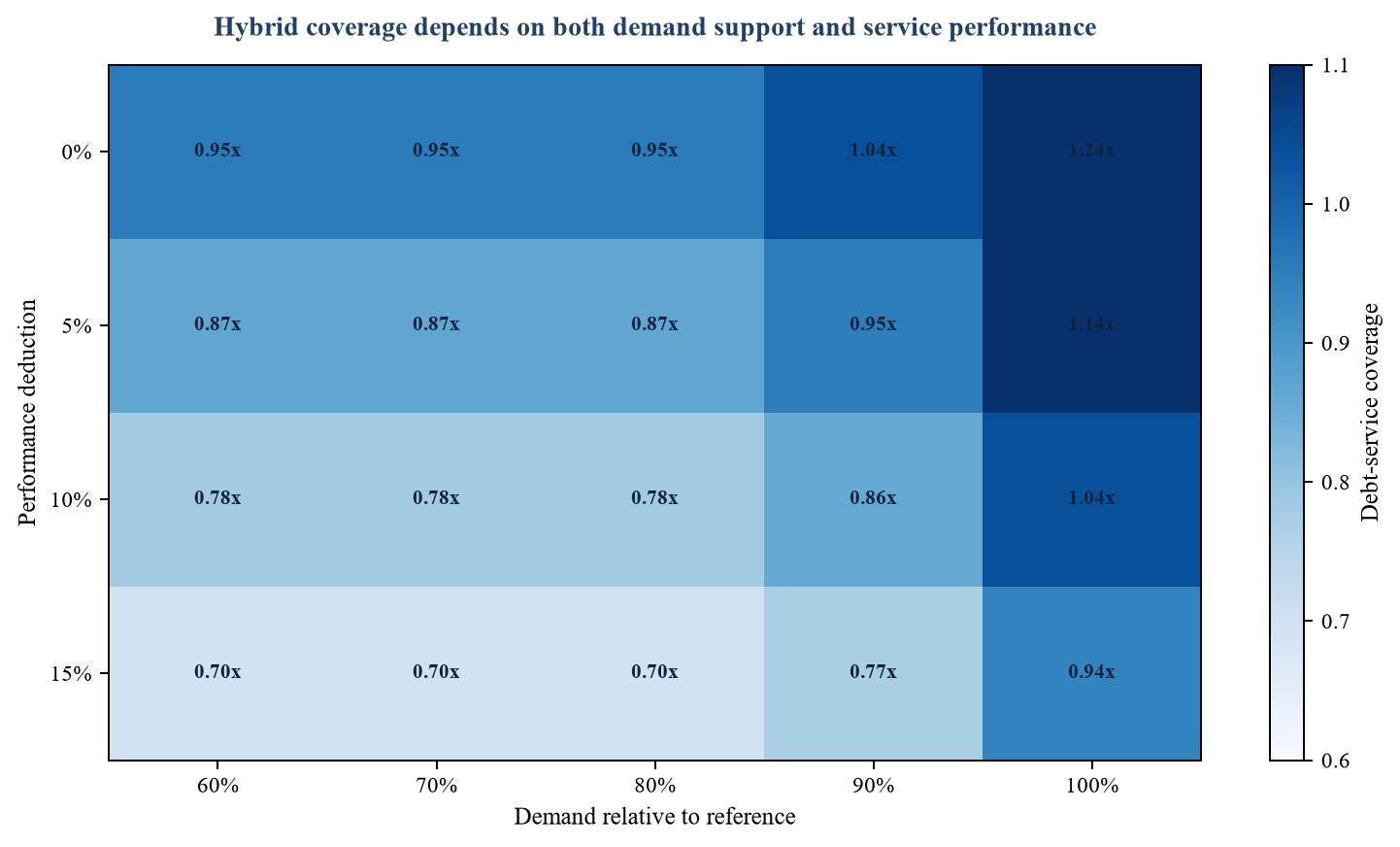
Wholly hypothetical illustration. Coverage uses stated revenue, cost and debt-service assumptions and excludes tax, reserves and project-specific adjustments.
17. Compare the three structures
The user-charge model produces no direct public operating payment in the simplified example. The project company bears demand, tariff implementation and collection exposure subject to contractual relief. Equity upside can be substantial when demand exceeds the case, while downside can impair debt service quickly. Debt capacity therefore depends on the reliability of paid-use evidence and the severity of stress.
The availability model gives the project company a more stable revenue base while placing long-term payment and demand exposure with the authority. Performance deductions preserve operating incentives. The authority must fund the payment even when use is below forecast, unless the contract includes a volume component or other adjustment.
The hybrid divides the exposure. In the illustration, user charges fund the first part of required revenue and a capped public top-up supports the remaining amount. Performance deductions apply to the combined service payment. The project company retains collection and some demand exposure. The authority records the top-up as a direct or contingent commitment according to its terms.
No structure produces value automatically. A user-charge model can transfer risk inefficiently when the operator lacks influence. An availability model can create unaffordable obligations when the authority underestimates long-term payments. A hybrid can become opaque if its guarantees, revenue sharing and tariff rules are poorly specified.
| Measure | User charges | Availability payment | Hybrid model |
|---|---|---|---|
| Reference gross revenue | USD 42.0m | USD 37.0m | Up to USD 36.0m combined |
| Revenue at 70% demand before deductions | USD 29.4m | USD 37.0m | USD 36.0m |
| Primary demand bearer | Project company | Public authority | Shared through top-up cap |
| Performance consequence | Lost users plus contractual remedies | Direct payment deduction | Deduction plus user-revenue effect |
| Direct public operating payment | None in illustration | USD 37.0m | Up to USD 6.6m at 70% demand |
| Main lender focus | Demand, tariff and collection | Authority credit and deductions | Demand, support and payment security |
| Main public control | Tariff and service regulation | Affordability and monitoring | Reconciliation and contingent exposure |
Wholly hypothetical illustration based on the assumptions in this paper. USD amounts are annual and simplified.
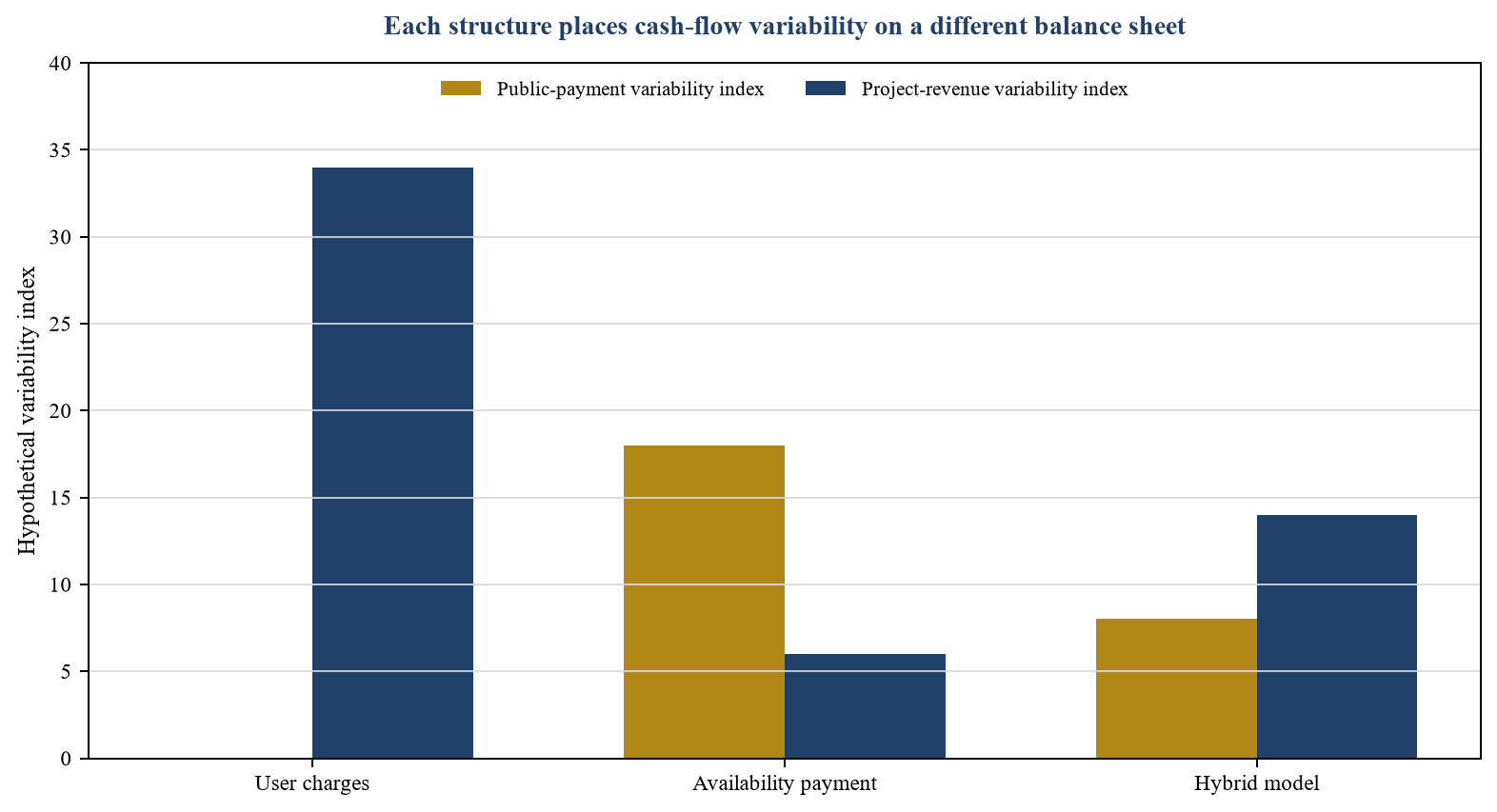
Wholly hypothetical illustration. Indices use the central case as 100 and show the stated scenario range, not a probability distribution.
18. Establish governance and model control
The payment mechanism needs joint ownership across policy, technical, legal, financial, fiscal and contract-management teams. A finance model alone cannot establish service standards. A technical specification alone cannot show fiscal affordability or lender coverage.
The authority should appoint an accountable payment-mechanism owner. The owner should maintain the decision record, risk allocation, formula, model, data requirements, market feedback and approvals. Changes should be version controlled and assessed across the project agreement, financial model, procurement documents and fiscal record.
The model should have controlled inputs, formulas, checks and outputs. Independent model audit should confirm arithmetic and consistency with the documents. The audit does not validate demand or policy assumptions unless its scope says so. Those inputs need separate evidence and approval.
The performance regime should be tested with operational scenarios before procurement. The team should calculate payments for partial availability, repeated failure, missing data, authority-caused delay and disputed performance. Bidders should receive enough information to price the rules consistently.
The fiscal team should approve direct and contingent commitments. The legal team should confirm authority, enforceability and consistency with procurement and regulation. The technical team should confirm that standards and measurement reflect the service. Contract managers should confirm that the mechanism can be operated with available people and systems.
After close, the authority should reconcile invoices, deductions, user revenue, support and fiscal exposure. Periodic review should identify patterns, data weaknesses and emerging affordability risks. Changes should follow the contract and public approval framework.
19. Apply the framework to the hypothetical project
The hypothetical project is a transport corridor with USD 420 million of initial investment and a twenty-five-year operating term. The authority seeks reliable capacity, safe operations and affordable access. The demand study has material uncertainty during ramp-up, and the operator can influence availability, incident response, collection and customer experience.
The user-charge option gives the project company the contracted tariff and responsibility for collection. The authority retains lawful tariff approval and targeted subsidies for eligible users. The financing case shows that low demand can impair debt service, so the structure would require lower leverage, reserves or support.
The availability option pays USD 37 million a year before indexation and deductions in the simplified illustration. The authority carries demand and funds the payment. The operator carries availability and quality. The fiscal review must establish long-term affordability and payment authority.
The hybrid option targets up to USD 36 million of combined annual revenue before deductions. User revenue is applied first. The authority provides a top-up within a stated cap when verified user revenue falls below the target. The top-up excludes revenue loss caused by service failure, unauthorised tariff practices or collection weakness. Upside above the threshold is shared.
The authority compares the structures using public cost, user affordability, lender coverage, equity volatility, performance incentives and tail exposure. It also tests political feasibility, data quality and operational capacity. The result is a reasoned choice among specific contractual systems rather than a label.
The illustration does not establish which model is correct for a live corridor. It shows the evidence, calculations and controls required for the decision. Actual selection would require verified demand, legal authority, procurement strategy, public-finance approval, technical design and market feedback.
20. Implementation roadmap
The first stage should define the service, users, outcomes and funding boundary. The authority should map service units, user groups, tariff powers, subsidies, public payments and existing obligations. It should identify which demand and performance drivers each party can influence.
The second stage should build the evidence base. The team should validate demand, willingness to pay, affordability, cost composition, inflation indices, collection, performance measurement and fiscal capacity. Each material assumption should have an owner, source, date and confidence assessment.
The third stage should develop payment alternatives. Each alternative should contain a formula, risk allocation, scenario model, public-support terms, monitoring design, lender case and termination treatment. The authority should compare expected and stressed outcomes.
The fourth stage should conduct market sounding and approvals. Questions should test demand appetite, leverage, indexation, deductions, public credit, guarantee terms and data requirements. The authority should document responses and obtain policy, legal and fiscal decisions before issuing the request for proposals.
The fifth stage should integrate the mechanism into procurement. The project agreement, financial model, service specification, bid instructions and evaluation should use consistent definitions. Bid evaluation should compare price and risk on the published basis.
The sixth stage should prepare contract management. The authority should establish meters, reporting, invoice review, deduction approval, audit, dispute and fiscal reporting. Staff should rehearse scenarios using the final formula. The implementation record should state decision rights and escalation.
The final approval should identify the chosen model, rejected alternatives, evidence, sensitivities, direct commitments, contingent liabilities and residual risks. That record provides the basis for procurement, financing and later review.
21. Management questions before approval
Decision makers should ask which service outcome creates payment, who measures it and which evidence supports the calculation. They should ask who bears ordinary demand variation, tariff intervention, collection failure, inflation mismatch, service failure and public-payment delay.
The financial questions should cover revenue in the central and downside cases, debt-service impairment, required reserves, equity volatility, public payment and termination exposure. The model should show the formula and assumptions behind each result.
The public-value questions should cover affordability, distributional effects, fiscal capacity, service continuity and transparency. The authority should identify whether support is a direct payment, subsidy, guarantee or contingent liability and how it will be approved and reported.
The implementation questions should cover data, systems, people and disputes. The mechanism should remain operable after advisers leave. A formula that requires evidence the authority cannot collect will weaken performance transfer and invoice control.
The final question is whether the allocation can survive the downside without an improvised renegotiation. That test includes the contract, financing, public budget and essential service. A credible structure states the response before the event occurs.
22. Conclusion
Revenue-risk allocation connects service design, public policy, project finance and fiscal governance. The choice among user charges, availability payments and a hybrid should follow the parties' control over demand and performance, the evidence available, user affordability and the authority's capacity to fund and manage long-term obligations.
The strongest mechanism separates exposures and gives each one a measurable rule. Demand, tariff, collection, inflation, availability, quality, political intervention and payment credit should each map to an owner, evidence source, adjustment, cap, remedy and reporting route. Combined scenarios should show how the system behaves when several exposures move together.
The decision framework in this paper provides a disciplined route from the public-service objective to a financeable and governable contract. Its hypothetical calculations illustrate mechanics only. A live partnership requires project-specific evidence, approvals and documentation.
Sources
- World Bank Group, PPP Reference Guide: Defining Public-Private Partnership and Payment Models, accessed 15 September 2026. Read the primary source
- World Bank Group, Payment Mechanism, PPP Legal Resource Center, accessed 15 September 2026. Read the primary source
- World Bank Group, Budgeting for Government Commitments to PPPs, accessed 15 September 2026. Read the primary source
- Organisation for Economic Co-operation and Development, Infrastructure Governance, accessed 15 September 2026. Read the primary source
- International Monetary Fund and World Bank Group, Public-Private Partnerships Fiscal Risk Assessment Model, accessed 15 September 2026. Read the primary source
- European PPP Expertise Centre, EPEC Guide to Public-Private Partnerships, 2026. Read the primary source
- World Bank Group, Guidance on PPP Contractual Provisions, 2017. Read the primary source
- World Bank Group, Government Support in PPP Projects, accessed 15 September 2026. Read the primary source
- Global Infrastructure Hub, Allocating Risks in Public-Private Partnership Contracts, 2016. Read the primary source
- APMG International, PPP Certification Guide: Availability, Quality and Revenue Risk, accessed 15 September 2026. Read the primary source
