

1. INTRODUCTION
From 6 April 2026, the United Kingdom taxes carried interest through a dedicated Income Tax framework. An individual who performs investment-management services and receives carried interest under the relevant arrangements is treated as carrying on a trade. Non-qualifying profits enter that deemed trade in full. Qualifying profits enter at 72.5 percent. Class 4 National Insurance contributions can also apply [1-3].
This change follows an interim year in which carried-interest gains were generally subject to a 32 percent Capital Gains Tax rate. The post-April 2026 framework creates a different set of questions. The amount due depends on the legal and economic character of the return, the qualification percentage produced by the investment scheme's average holding period, permitted deductions, the tax rate applicable to the individual, National Insurance, residence, applicable workdays and the point at which the carried interest arises [1,4-8].
For a private-equity, venture-capital or other alternative-investment professional considering a move from the United Kingdom to the United Arab Emirates, the flight date is only one date in a much longer chronology. The statutory territorial rules can allocate carried-interest profits by reference to applicable UK and non-UK workdays over a relevant period. A person can become non-UK resident and retain UK exposure connected with UK workdays. A person can obtain UAE domestic residence evidence and still need a separate analysis under the United Kingdom's Statutory Residence Test and the UK-UAE double taxation convention [1,9-14].
This paper develops an integrated mobility and fund-economics framework. It addresses six linked questions. First, does a return meet the statutory definition of carried interest? Second, what proportion is qualifying carried interest? Third, when does the amount arise? Fourth, how is the deemed trade located by applicable workdays? Fifth, how do domestic residence, split-year treatment, temporary non-residence and the treaty interact? Sixth, what evidence should an individual and fund organisation retain?
The analysis uses legislation and official guidance available through 4 August 2026. The worked cases are hypothetical and simplified. They illustrate mechanics rather than calculate any reader's liability. Fund structures, residence histories, partnership allocations, employment arrangements, elections, permitted deductions and treaty positions can change the result materially. Current UK and UAE tax, legal, regulatory and immigration advice is essential before a relocation, carry restructuring, election or distribution.
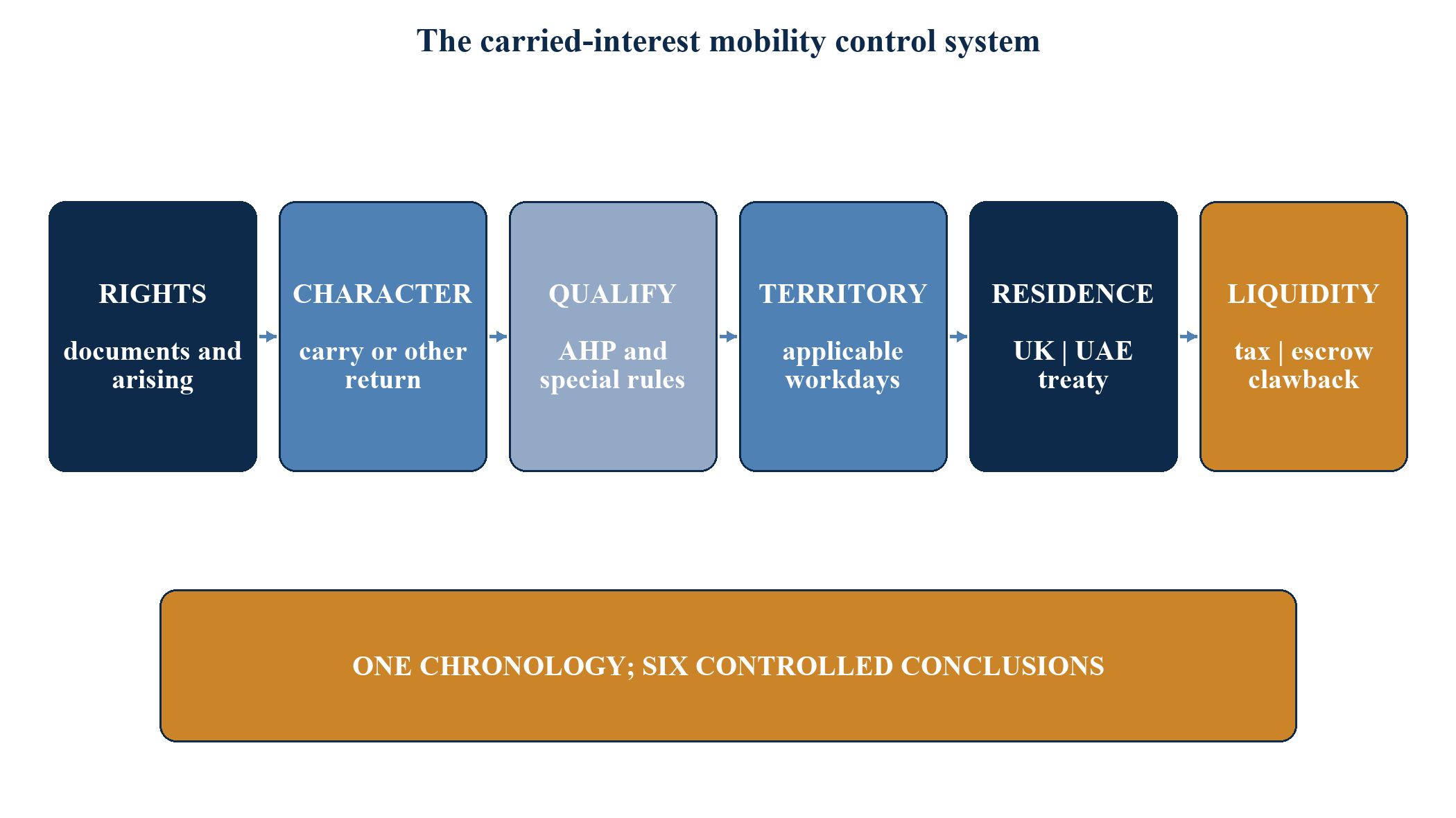
| Control domain | Governing question | Required output |
|---|---|---|
| entitlement | what legal instrument creates the return and when can it arise? | carry entitlement and distribution map |
| character | is the return carried interest under the statutory definition? | legal and tax classification memorandum |
| qualification | what average holding period and special rules apply? | scheme-level qualification model |
| territory | which applicable workdays are UK workdays? | fund-by-fund workday ledger |
| residence | what is the domestic and treaty residence position for each tax year? | residence chronology and evidence file |
| liquidity | when is cash received relative to tax, escrow and clawback obligations? | personal carry cash-flow and reserve plan |
2. THE 2026 CARRIED-INTEREST ARCHITECTURE
2.1 A deemed trade within Income Tax
Finance Act 2026 inserts a dedicated carried-interest regime into the Income Tax (Trading and Other Income) Act 2005. It applies where an individual performs investment-management services, directly or indirectly, in respect of an investment scheme under arrangements and one or more sums of carried interest arise under those arrangements. The individual is treated as carrying on a trade for the tax year in which the carried interest arises [1].
The statutory amount of deemed trading profit combines two components. The non-qualifying profits of the trade are brought in at 100 percent after the attributed share of any permitted deduction. Qualifying profits are brought in at 72.5 percent after their attributed share of permitted deductions. This structure makes the qualifying proportion a core computational input rather than a descriptive label [1,2].
The regime applies to carried interest arising on or after 6 April 2026. The date on which an award was granted, a fund was launched or an investment was acquired does not displace that operative rule. A complete analysis therefore connects legacy fund documentation to the new arising, qualification and territorial rules [1].
2.2 The bridge from Capital Gains Tax
Before 30 October 2024, carried-interest gains within the capital regime could be taxed at 18 or 28 percent. From 30 October 2024 to 5 April 2025, the applicable carried-interest rates remained 18 and 28 percent while the general individual Capital Gains Tax rates changed. From 6 April 2025 to 5 April 2026, a single 32 percent carried-interest Capital Gains Tax rate applied. From 6 April 2026, the official Capital Gains Tax rate table no longer includes a carried-interest rate because the dedicated regime sits within Income Tax and Class 4 National Insurance [6,16,17].
The transition should be modelled by tax year and arising date. It should not be described as a simple rate increase. The computational base, qualification rules, workday allocation and National Insurance treatment change as well. An individual with several carry vehicles can therefore have receipts governed by different regimes across a short period.
2.3 The meaning of carried interest
HMRC describes carried interest as a share of fund profits arising to fund managers when investments perform above a specified level. Its guidance identifies a profit-related return through three linked features: the sum arises only if the fund or relevant investments make profits; the amount varies substantially by reference to those profits; and external-investor returns are determined by reference to the same profits. A fixed fee deferred until a fund becomes profitable does not become carried interest merely because payment is conditional [4,5].
The classification review should examine the limited-partnership agreement, carry vehicle, award letter, waterfall, hurdle, catch-up, vesting, good-leaver and bad-leaver provisions, escrow, clawback and any side agreement. It should also identify co-investment returns, management fees, transaction fees, phantom awards and employment-related securities. Different streams can have different tax classifications even when the organisation calls all of them carry.
2.4 Permitted deductions and net profits
Finance Act 2026 provides for permitted deductions in computing the deemed trade. The statutory definition and allocation of deductions should be applied to the actual arrangements. A model that begins with gross cash received can overstate the taxable profit if a permitted deduction is available. A model that nets a commercial expense without statutory support can understate it [1].
The carry register should therefore include separate fields for gross carried interest, permitted deductions supported by the legislation, qualifying percentage, non-qualifying amount, deemed trading-profit base, Income Tax and National Insurance. The register should reconcile to partnership statements, payment advices, tax computations and bank receipts.
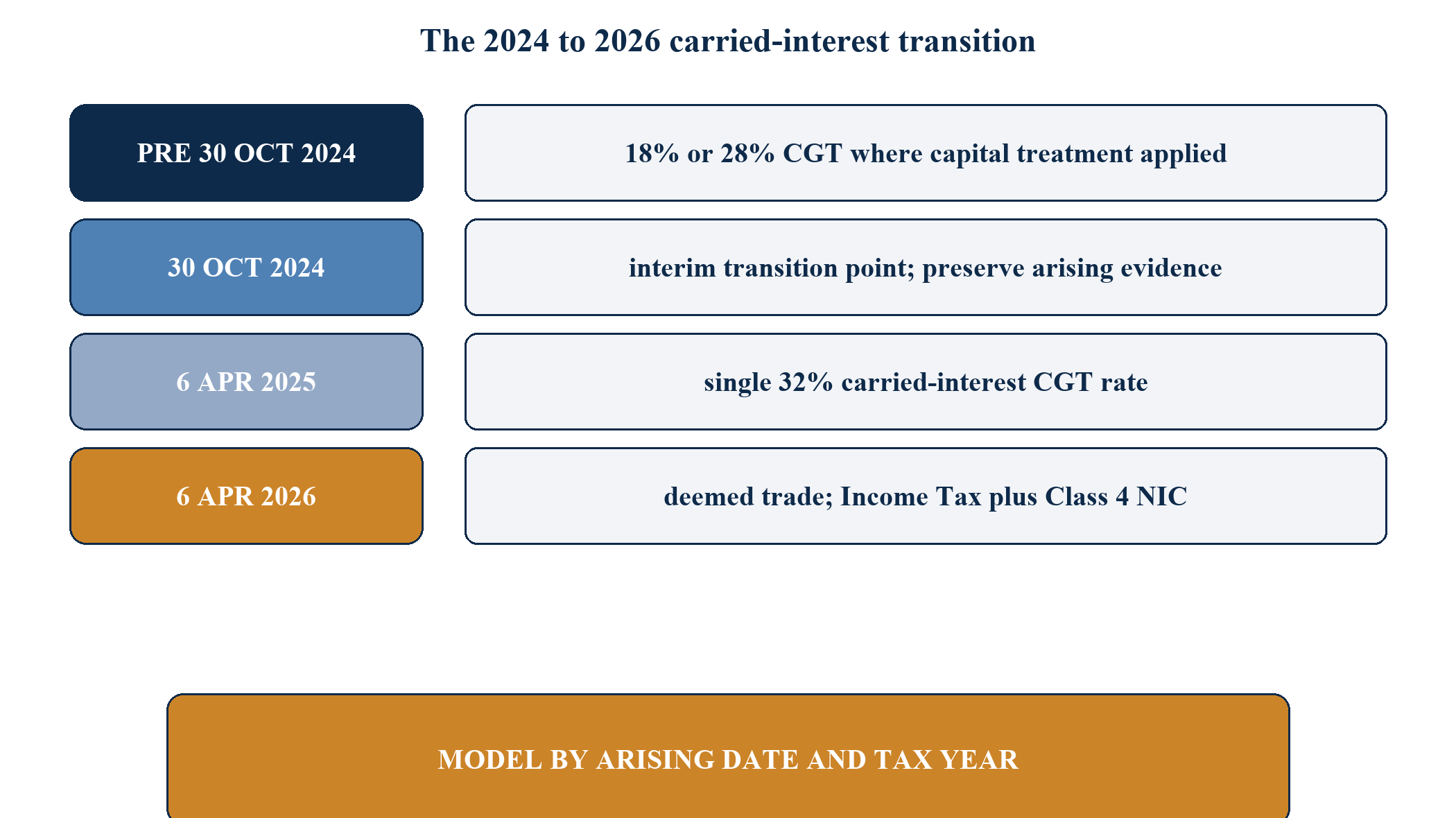
| Period | Core treatment | Headline mechanism | Mobility implication |
|---|---|---|---|
| before 30 October 2024 | Capital Gains Tax where capital treatment applied | 18 or 28 percent carried-interest rates | historic classification and residence remain relevant |
| 30 October 2024 to 5 April 2025 | Capital Gains Tax where capital treatment applied | 18 or 28 percent carried-interest rates | establish exact arising date and tax year |
| 6 April 2025 to 5 April 2026 | Capital Gains Tax where capital treatment applied | single 32 percent carried-interest rate | preserve interim-year computations and elections |
| from 6 April 2026 | deemed trading profits | 100 percent of non-qualifying profits plus 72.5 percent of qualifying profits; Income Tax and Class 4 NIC | workday, qualification and residence records become central |
3. QUALIFYING CARRIED INTEREST
3.1 Average holding period as the general rule
Under the general rule in Schedule 11 to Finance Act 2026, the qualifying proportion depends on the investment scheme's average holding period. An average below 36 months produces a 0 percent qualifying proportion. From 36 months, the proportion increases by 20 percentage points for each additional completed month: 20 percent from 36 to under 37 months; 40 percent from 37 to under 38; 60 percent from 38 to under 39; 80 percent from 39 to under 40; and 100 percent from 40 months [1].
The statutory average is value weighted. For each relevant investment, the value invested is multiplied by the length of time held. Those products are aggregated and divided by the total value invested in the relevant investments. The calculation is made at the time the carried interest arises. Investments already disposed of use their holding period to disposal. Investments still held use the period up to the arising time [1].
This can make the qualifying percentage dynamic. A fund can move through several bands as time passes. New follow-on investments, disposals and the value attributed to investments can also change the weighted result. A carry distribution expected to arise shortly before a 40-month threshold may therefore have a different qualifying proportion from one arising later, subject to the full statutory rules and anti-avoidance provisions.
3.2 Scheme, pool and arrangement perimeter
The denominator and relevant-investment perimeter require legal analysis. Deal-by-deal carry, whole-fund carry, parallel vehicles, continuation funds, feeder structures, co-investments and special-purpose vehicles can produce different mapping questions. Intermediate holding structures are generally disregarded when identifying the underlying relevant investments for the average holding period [1].
A robust model begins with the arrangements under which the individual performs services and receives carry. It then identifies the investment scheme, the investments by reference to which the carry is calculated, the dates and value invested, the disposal dates, and any statutory grouping or special rule. The organisation's performance-reporting perimeter may be useful evidence and should not be assumed to be the statutory perimeter.
3.3 Early distributions and the statutory exception
Schedule 11 includes circumstances in which carried interest can be treated as 100 percent qualifying even when the average holding period at the arising time has not reached 40 months. The exception is conditional. Among other requirements, it addresses early carry arising within specified periods where it is reasonable to suppose that the carry would be 100 percent qualifying at the relevant future time [1].
The exception should not be reduced to a blanket forecast. The fund should document the investment strategy, expected holding profile, realisation model, relevant time, assumptions and later evidence. A change in strategy, accelerated exit, continuation transaction or value concentration may require the earlier conclusion to be revisited.
3.4 Asset-class and strategy-specific rules
The legislation contains detailed provisions for calculating average holding periods and for particular types of investment strategy. Private equity, venture capital, credit, fund-of-funds, secondary and real-asset strategies can have different investment patterns. Drawdowns, refinancing, add-ons, bridge investments and partial realisations require scheme-specific treatment [1].
The practical response is a qualification workbook for every carry arrangement. It should list each underlying relevant investment, acquisition and disposal chronology, invested value, supporting source document, holding-period treatment and statutory adjustment. The tax conclusion should be signed off at every material carry arising rather than copied from the previous year.
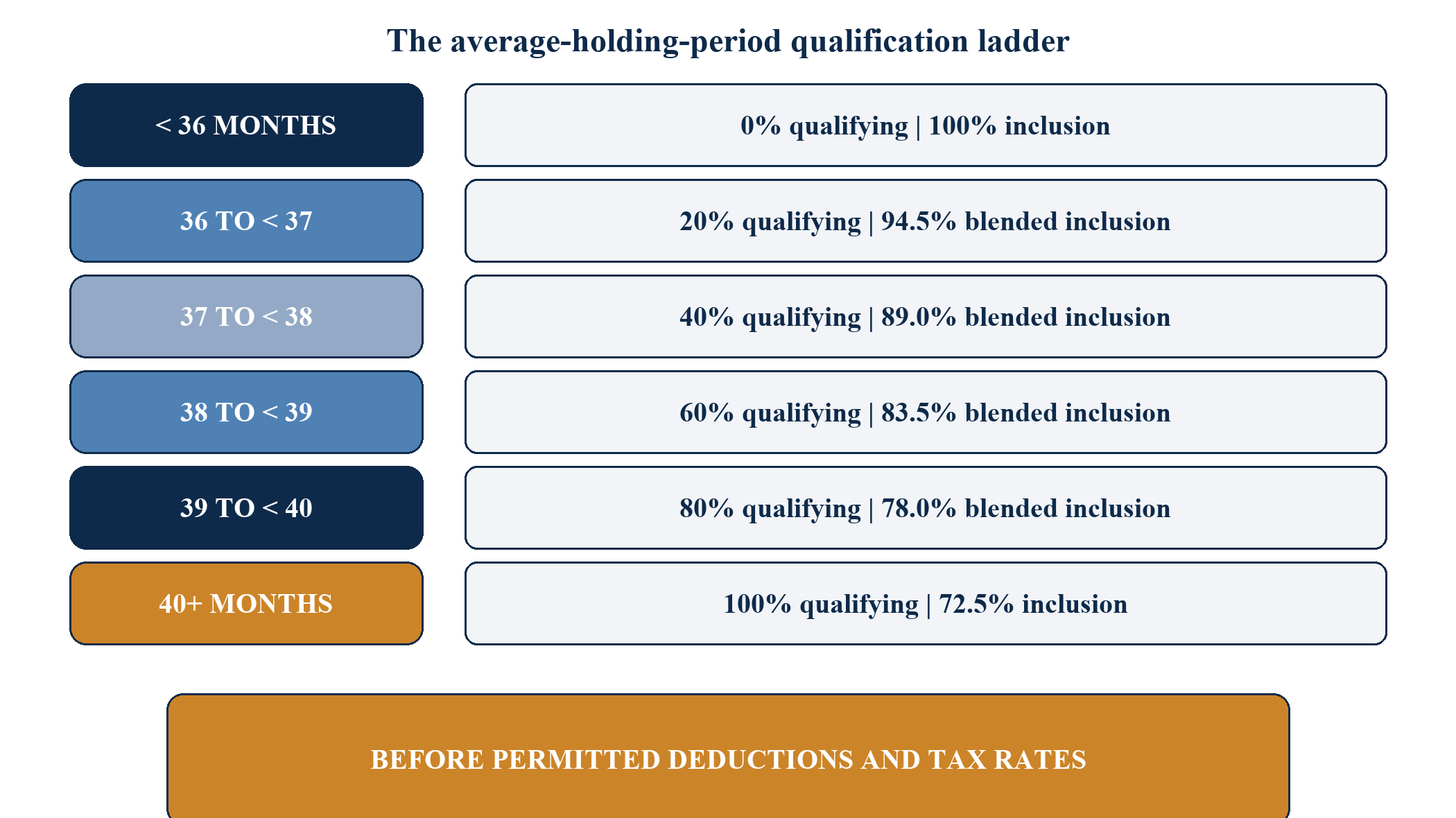
| Average holding period | Qualifying proportion | Amount of qualifying profit entering deemed trade | Amount of non-qualifying profit entering deemed trade |
|---|---|---|---|
| under 36 months | 0% | 0% | 100% |
| 36 to under 37 months | 20% | 14.5% of total profit | 80% of total profit |
| 37 to under 38 months | 40% | 29.0% of total profit | 60% of total profit |
| 38 to under 39 months | 60% | 43.5% of total profit | 40% of total profit |
| 39 to under 40 months | 80% | 58.0% of total profit | 20% of total profit |
| 40 months or more | 100% | 72.5% of total profit | 0% |
The final two columns show the statutory inclusion base before permitted deductions. They do not show the tax rate or liability.
4. THE EFFECTIVE-RATE BRIDGE
4.1 Fully qualifying carried interest
For a UK taxpayer subject to the 45 percent additional rate, 72.5 percent of fully qualifying profit produces a simplified Income Tax charge equal to 32.625 percent of the original qualifying profit. Where the entire deemed trading profit falls above the Class 4 upper profits limit, a 2 percent Class 4 charge on the 72.5 percent base adds 1.45 percent. The simplified combined marginal burden is therefore 34.075 percent before permitted deductions, reliefs and other interactions [1,7,8].
This is a marginal illustration. Class 4 National Insurance uses annual thresholds and bands. The individual may have other trading profits, losses, relief claims or residence limitations. Scottish non-savings Income Tax rates can also produce a different Income Tax result. A fund professional should calculate the actual tax-year position with an adviser.
4.2 Partly qualifying carried interest
Where only part of the carry is qualifying, the 72.5 percent multiplier applies to that part and the balance enters the deemed trade in full. A 60 percent qualifying proportion creates a deemed-profit base equal to 83.5 percent of the original profit before deductions: 60 percent multiplied by 72.5 percent, plus 40 percent non-qualifying. At an illustrative 45 percent Income Tax rate and 2 percent Class 4 rate on the full deemed base above the upper profits limit, the simplified marginal burden is 39.245 percent of the original profit.
The relationship is linear within this simplified model. Each 20 percentage-point increase in qualification reduces the deemed-profit base by 5.5 percentage points. The actual cash outcome can still be non-linear because tax bands, permitted deductions, losses, reliefs, timing and workday allocation interact.
4.3 Non-qualifying carried interest
Non-qualifying profits enter the deemed trade in full. At illustrative marginal rates of 45 percent Income Tax and 2 percent Class 4 National Insurance above the upper profits limit, the simplified combined burden is 47 percent of the original profit before deductions or reliefs [7,8].
This result explains why qualification evidence matters commercially. A short holding period, incorrect investment perimeter or unsupported exception can change the taxable base materially. The investment team's holding-period data becomes a personal-tax control for carry participants.
4.4 Comparison with the 32 percent interim rate
The 2025 to 2026 Capital Gains Tax rate of 32 percent provides a useful historical comparator and should not be used as a proxy for the post-2026 liability. Fully qualifying carry subject to the simplified 34.075 percent marginal illustration is 2.075 percentage points above 32 percent. Partly qualifying and non-qualifying carry can be higher. The timing, source, deductions and tax-base rules also differ [1,6-8].
The comparison should be made after tax on the same legal entitlement and stated assumptions. A professional should not accelerate or defer a distribution solely because a headline rate appears lower. The legal ability to alter timing, the anti-avoidance provisions, elections, fund economics, escrow, clawback and commercial governance all require review.
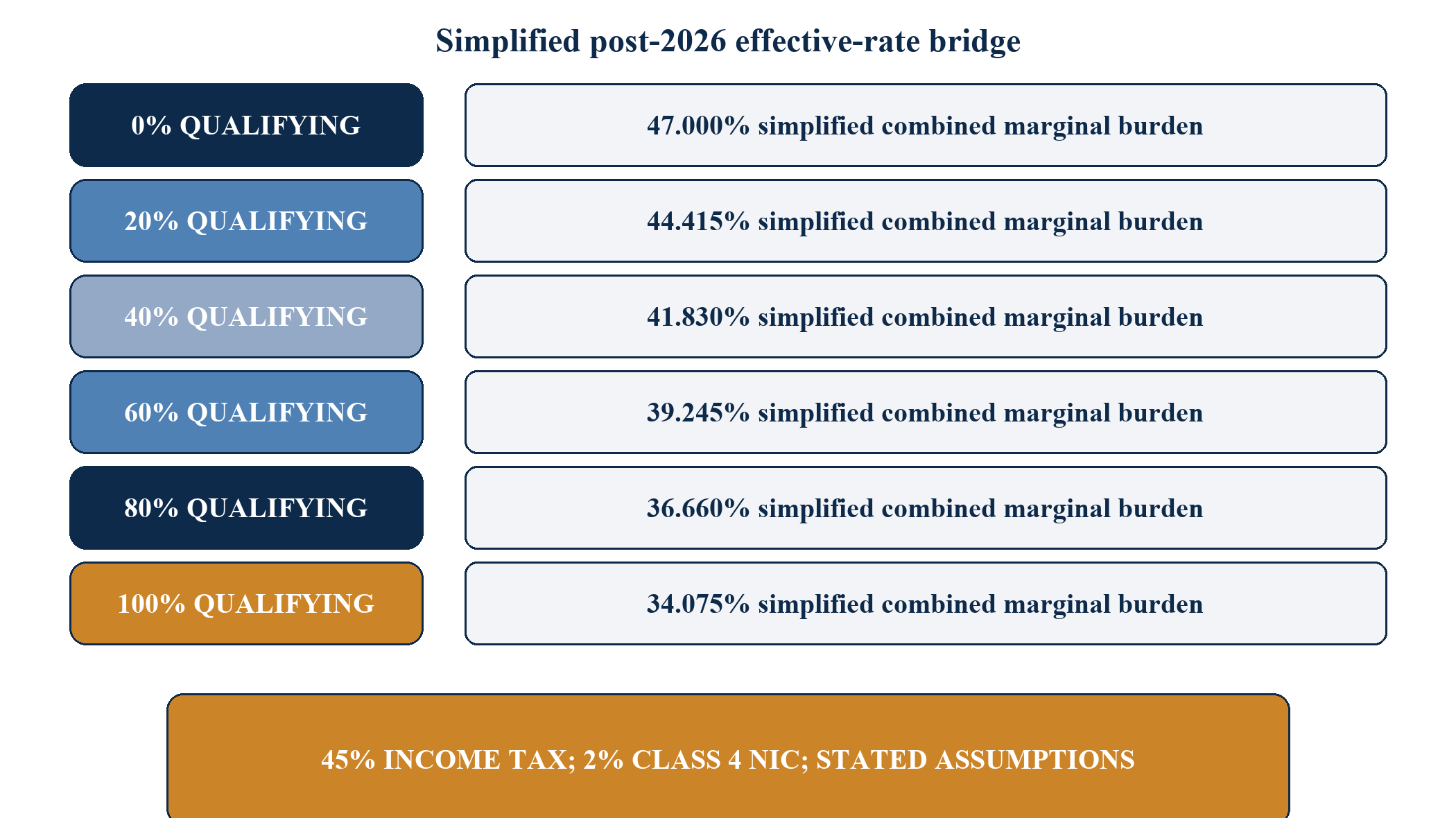
| Qualifying proportion | Deemed trading-profit base as % of carry | Illustrative Income Tax at 45% | Illustrative Class 4 NIC at 2% | Simplified combined burden |
|---|---|---|---|---|
| 0% | 100.0% | 45.000% | 2.000% | 47.000% |
| 20% | 94.5% | 42.525% | 1.890% | 44.415% |
| 40% | 89.0% | 40.050% | 1.780% | 41.830% |
| 60% | 83.5% | 37.575% | 1.670% | 39.245% |
| 80% | 78.0% | 35.100% | 1.560% | 36.660% |
| 100% | 72.5% | 32.625% | 1.450% | 34.075% |
The table assumes England, Wales or Northern Ireland additional-rate Income Tax; all deemed profits above the Class 4 upper profits limit; no permitted deductions, losses or reliefs; and no territorial limitation. It is a mechanics illustration rather than a personal tax computation.
5. TERRITORIAL SCOPE AND APPLICABLE WORKDAYS
5.1 Location of the deemed trade
Finance Act 2026 locates the deemed carry trade by applicable workdays. If all applicable workdays are UK workdays, the trade is treated as carried on wholly in the United Kingdom. If none are UK workdays, it is treated as carried on wholly outside the United Kingdom. A mixed history creates a trade carried on partly in and partly outside the United Kingdom [1].
For a mixed trade, the UK part is calculated by applying the UK-workday proportion separately to non-qualifying and qualifying profits, subject to specified modifications. The 72.5 percent multiplier is then applied to the qualifying profits of the UK part [1]. This is why a move date alone cannot allocate the carry. The service chronology and workday count are integral statutory inputs.
5.2 What is a UK workday?
For this regime, a UK workday includes a day on which the individual spends more than three hours performing investment-management services in the United Kingdom. The services can be performed directly or indirectly in respect of an investment scheme. The statutory definition should be applied to actual activity rather than office location or payroll label [1].
Travel has a specific rule. Investment-management services performed while travelling to or from the United Kingdom by air, sea or through the Channel Tunnel are assumed to be performed overseas, including the part of the journey in or over the United Kingdom. The journey is treated as beginning on boarding and ending on disembarkation [1]. Work performed in an airport lounge before boarding or after disembarkation requires separate factual review.
5.3 The relevant period
Applicable workdays are measured over a relevant period tied to the arrangements and investment-management services. Finance Act 2026 frames the start by reference to the later of the admission of the first external investor to a relevant scheme and the first day on which the individual performs investment-management services under the arrangements. The end is linked to the earlier of the last relevant carry-arising day and the last service day [1].
The resulting lookback can span many years and several employers or residences. A calendar maintained only after the relocation decision can be insufficient. The individual and fund organisation should reconstruct historic workdays from travel records, calendars, building access, expense claims, meeting minutes, deal systems and email metadata, then retain a controlled ledger prospectively.
5.4 Non-resident modifications
The legislation modifies which UK workdays count for certain non-residents. For qualifying profits, specified UK workdays before 30 October 2024 and UK workdays in a defined non-UK tax year are excluded from the UK-workday numerator while remaining applicable workdays. A non-UK tax year for this purpose generally requires non-UK residence and fewer than 60 UK workdays. Separate rules address anticipated qualifying profits [1].
These modifications create a matrix rather than a single day-count test. The analysis should identify each tax year, UK residence status, total UK workdays, applicable UK workdays, pre-30 October 2024 days, non-UK tax years and whether profits were anticipated to be qualifying at the specified point. An adviser should review the ledger before a material distribution.
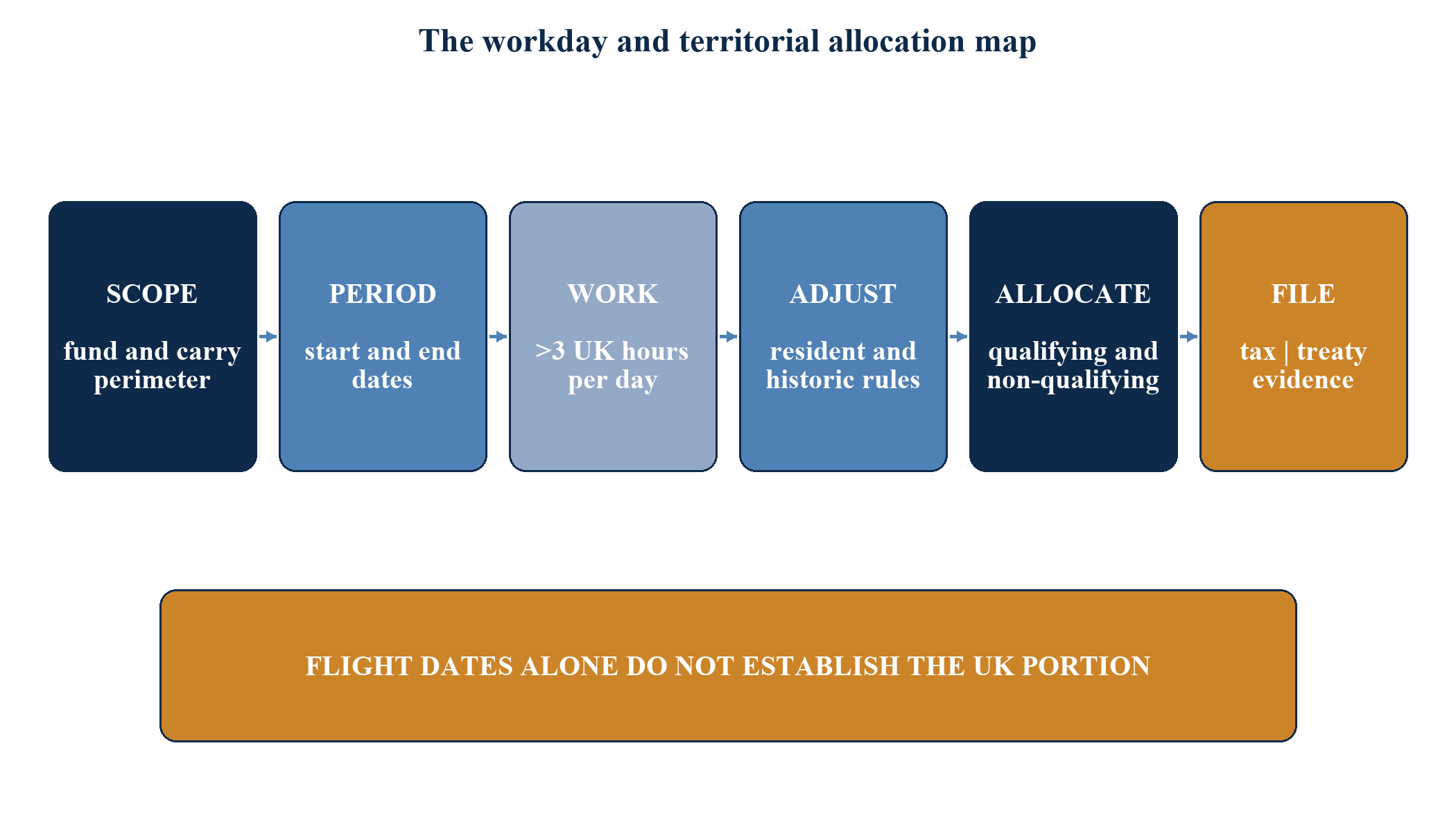
| Step | Question | Evidence | Output |
|---|---|---|---|
| 1 | what arrangements produce the carry? | fund and carry documents | arrangement identifier |
| 2 | when does the relevant period start and end? | investor admission, service and distribution records | period boundaries |
| 3 | which days contain more than three hours of UK investment-management services? | calendar, travel, access and work records | preliminary UK-workday list |
| 4 | which statutory exclusions or modifications apply? | residence chronology and historic dates | adjusted numerator and denominator |
| 5 | what portion of qualifying and non-qualifying profits is UK? | approved workday ledger | territorial profit allocation |
| 6 | what tax and treaty analysis follows? | computation and adviser memorandum | filed position and evidence archive |
6. RESIDENCE, SPLIT YEARS AND THE UK-UAE TREATY
6.1 The United Kingdom Statutory Residence Test
The Statutory Residence Test determines UK residence for a tax year through automatic overseas tests, automatic UK tests and sufficient-ties tests. Day count is only one element. Full-time work, a UK home, family, accommodation, substantive UK work and prior residence can alter the result [9,10].
A departure plan should model at least the departure tax year, the first full overseas year and expected travel in later years. It should include contingency ranges for cancelled trips, family emergencies, board meetings, investment committees and deal closings. The plan should record midnight presence, workdays, UK ties and evidence. A narrow day-count budget can fail when commercial activity changes.
6.2 Split-year treatment
An individual who is UK resident for a tax year may qualify for split-year treatment under one of the statutory cases. Each case has its own conditions and relevant date. HMRC's current guidance requires all potentially applicable cases to be considered in the prescribed priority order [9].
Split-year treatment does not replace the carried-interest workday analysis. The residence year may be divided into a UK part and an overseas part, while the carry regime continues to use its own applicable-workday and relevant-period rules. Both layers should appear in the same chronology.
6.3 UAE domestic tax residence
The UAE Federal Tax Authority describes three principal evidence paths for a natural person seeking a Tax Residency Certificate for non-treaty purposes: at least 183 days of physical presence in a consecutive 12-month period; between 90 and 182 days together with UAE employment, business or a permanent place of residence; or a primary place of residence and centre of financial and personal interests in the UAE. Documentary requirements vary by path [13,14].
For treaty purposes, the FTA requires the applicant to review the relevant treaty definition and submit supporting evidence. A residence visa or Emirates ID is important evidence and is not a complete treaty analysis by itself. Entry and exit reports, UAE housing, employment or business, family location, bank and professional relationships, and the centre of personal and economic life can all matter [12-14].
6.4 The UK-UAE double taxation convention
The convention defines residence separately for each state. If an individual is resident in both under domestic rules, the treaty tie-breaker applies sequentially: permanent home; centre of vital interests; habitual abode; nationality; and competent-authority agreement if required [12].
The treaty classification of carried-interest profits requires fact-specific advice. The United Kingdom's domestic regime treats relevant carry as deemed trading profits. The treaty contains articles for business profits, employment income, capital gains and other income, each with its own conditions. Treaty residence does not erase a domestic UK workday calculation automatically. The interaction should be addressed in a written adviser memorandum for the actual structure.
6.5 Temporary non-residence and return risk
HMRC's Statutory Residence Test guidance explains that a person can be temporarily non-resident if specified prior-residence and return conditions are met, including a period of non-residence lasting five years or less. Certain income and gains received during the period can then be taxed in the year of return [9]. Finance Act 2026 also includes carried-interest provisions connected with temporary non-residence [1].
A mobility plan should therefore include a return scenario from the outset. It should record the anticipated length of non-residence, carry arising during the period, distributions, elections, disposals, UK workdays and any event that may trigger an earlier return. The return analysis belongs beside the departure analysis.
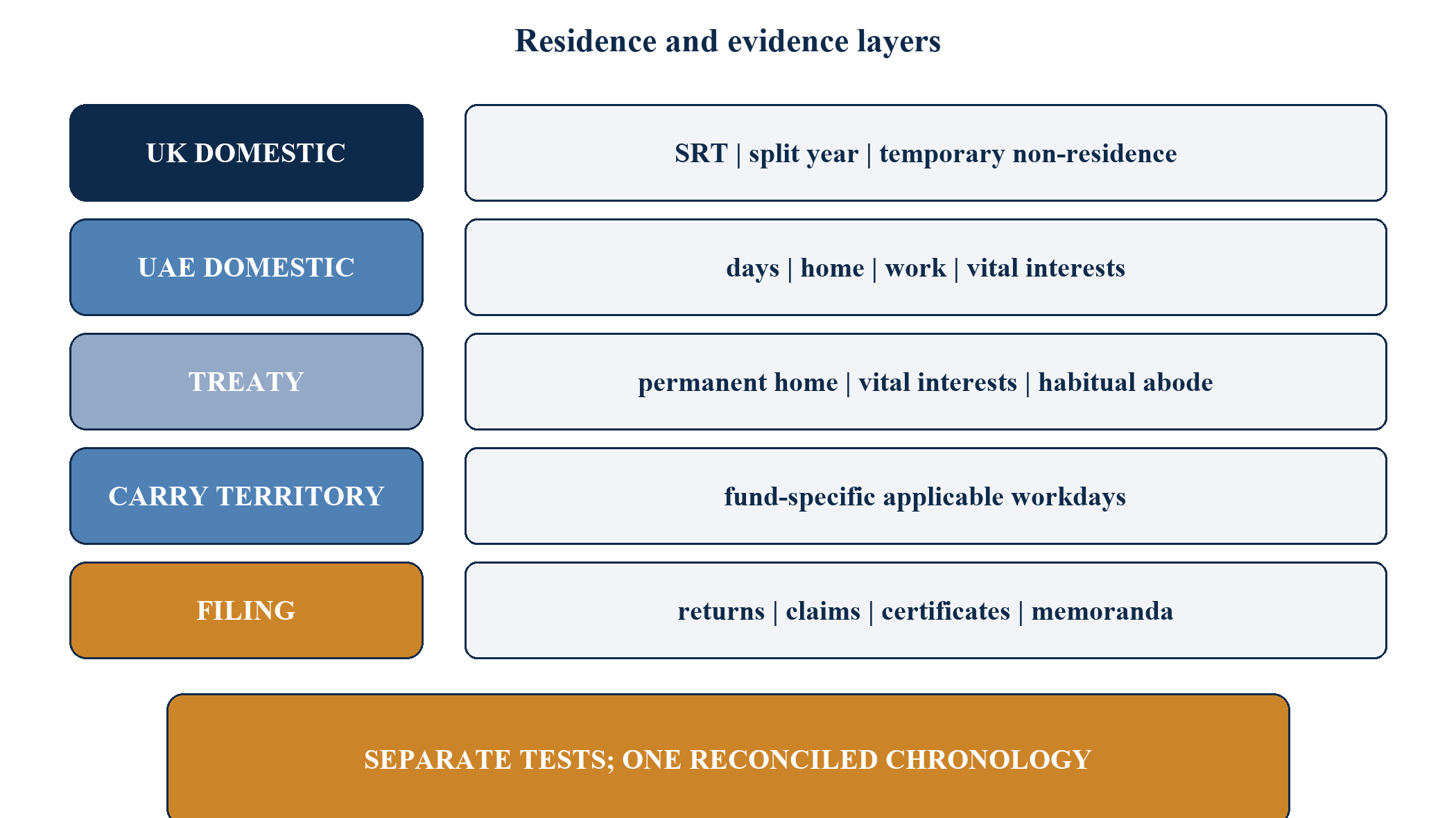
| Layer | Core test | Typical evidence | Control owner |
|---|---|---|---|
| UK domestic residence | Statutory Residence Test | day log, home, family, work and tie evidence | individual and UK adviser |
| split year | conditions for the relevant statutory case | departure, work, home and family chronology | UK adviser |
| UAE domestic residence | UAE residence criteria | entry and exit report, Emirates ID, housing, employment or business | individual and UAE adviser |
| treaty residence | Article 4 tie-breaker where dual resident | permanent home, vital interests, habitual abode and nationality | treaty adviser |
| carry territory | applicable UK and non-UK workdays | fund-specific service ledger | individual, GP finance and tax |
| filing position | tax computation and disclosure | returns, claims, certificates and memoranda | individual and advisers |
7. FUND ECONOMICS, ARISING AND CASH TIMING
7.1 Entitlement, vesting, allocation and arising
Four dates often appear in a carry chronology: the award date; the vesting date; the date on which carry is allocated or becomes due under the waterfall; and the date cash is paid. They may coincide and often do not. The post-2026 regime applies when a sum of carried interest arises. The statutory and case-specific arising conclusion should be documented from the legal arrangements [1].
A vesting schedule can determine whether the participant retains an entitlement on departure. It does not necessarily determine the tax arising date. A bank receipt can occur after an amount has arisen. Escrow can delay cash availability while the tax position follows a different date. The carry register should show each date separately and cite the governing document.
7.2 Whole-fund and deal-by-deal waterfalls
In a whole-fund waterfall, the sponsor generally receives carry after investors have received specified capital and preferred-return amounts across the fund. In a deal-by-deal model, carry may arise after individual successful realisations, often with escrow or clawback protection. These structures change the timing and volatility of distributions, the investments by reference to which carry is calculated and the evidence required for qualification [4,5].
The tax model should reconcile to the contractual waterfall. It should show realised proceeds, investor capital, preferred return, catch-up, sponsor carry, escrow, prior distributions and clawback exposure. A tax distribution should be identified as a separate cash-flow item and classified under the documents.
7.3 Leaver provisions and mobility
Relocation can trigger employment, partnership, regulatory or good-leaver questions. The award may depend on continued employment, partnership status, committee membership, regulatory approval or the performance of services from an approved location. A unilateral move can therefore change the economics before tax is considered.
The individual should obtain written confirmation of the treatment of vested and unvested carry, future participation, service obligations, investment-committee roles, non-compete and non-solicit restrictions, confidentiality, clawback, tax withholding, reporting and governing law. The fund organisation should assess licensing, payroll, permanent-establishment and management-and-control implications through its advisers.
7.4 Escrow, clawback and tax reserves
Carry cash can remain at risk after distribution. A later fund loss can create clawback. Tax paid may not be fully recoverable at the same time or in the same amount. An individual should hold a tax and clawback reserve that reflects the fund documents, distribution profile, currency, adviser estimate and limitation period.
The reserve should be held in accessible assets and reviewed after every distribution, valuation change, exit or tax filing. Personal borrowing against expected carry should be stress tested for delay, partial qualification, higher tax, clawback and foreign-exchange movements.
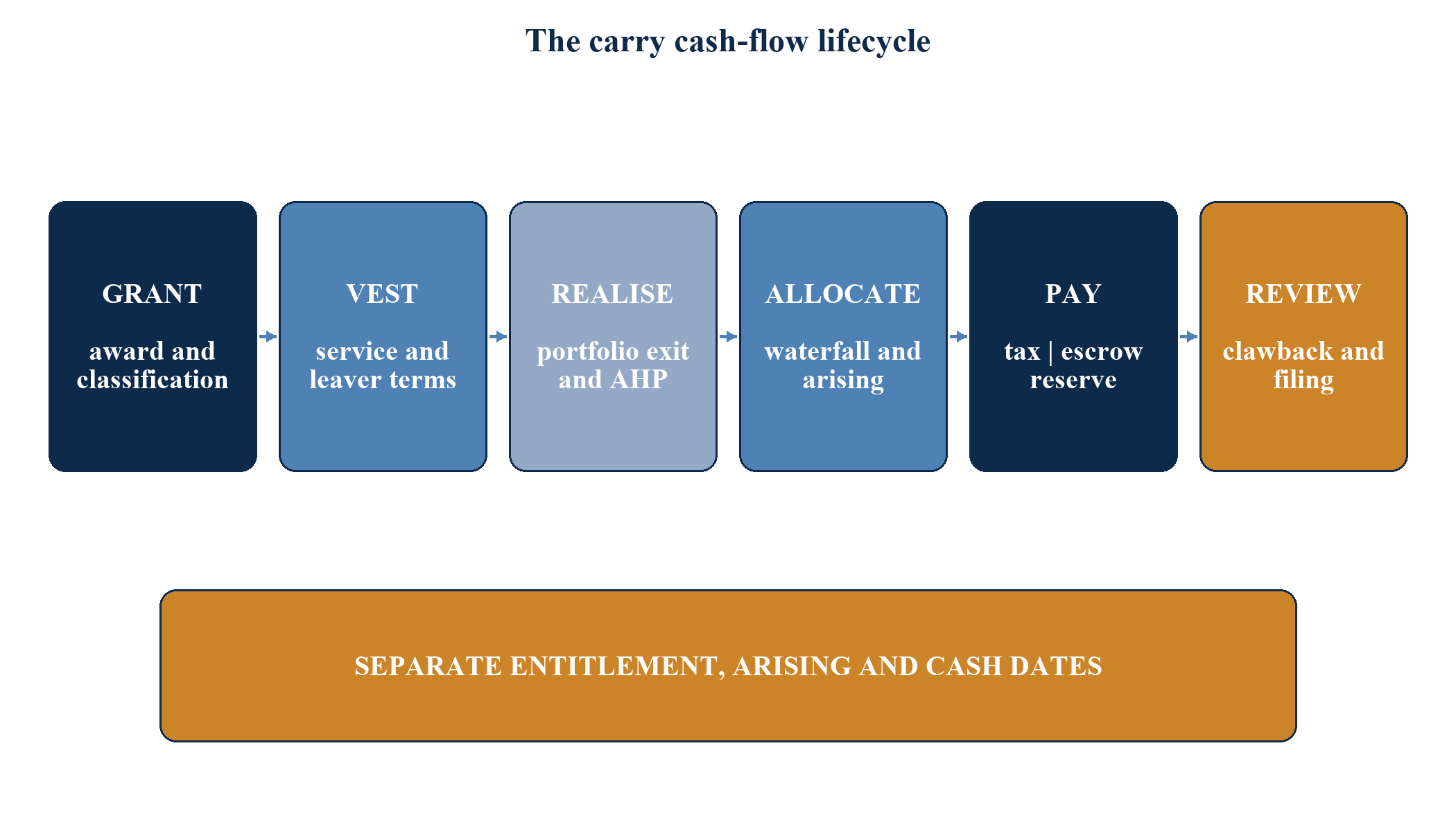
| Stage | Fund event | Individual control | Main risk |
|---|---|---|---|
| grant | participation awarded | archive documents and tax advice | classification misunderstood |
| vesting | service conditions satisfied over time | track leaver and mobility conditions | economic entitlement reduced |
| realisation | portfolio investment generates proceeds | update holding-period model | qualification percentage changes |
| allocation | waterfall allocates carry | determine statutory arising | tax date differs from cash date |
| payment | cash or assets transferred | reserve tax and clawback | liquidity shortfall |
| post-payment | escrow release or clawback review | reconcile filings and remaining exposure | cash returned without matching relief |
8. MOBILITY DECISION PATHS
8.1 Path A: remain UK resident
A professional remaining UK resident should build a fund-by-fund qualification and arising register, forecast the deemed trading-profit base and reserve for Income Tax and Class 4 National Insurance. Residence uncertainty is reduced, while qualification, timing, deductions and liquidity remain material.
The operating model should integrate fund finance, personal tax and investment-team data. Finance should produce gross carry and permitted-deduction information. The investment team should maintain average-holding-period evidence. The individual and adviser should complete the tax computation and reconcile it to cash.
8.2 Path B: relocate before carry arises
A move before a distribution can change domestic residence and the workday pattern. It does not rewrite historic applicable workdays. The analysis should establish the relevant period, identify historic UK workdays, model future UK travel, test the non-resident modifications and determine the likely UK portion of carry [1].
The individual should also confirm that relocation does not cause forfeiture or regulatory difficulty under the carry, partnership and employment arrangements. UAE immigration, housing, banking, insurance, schooling and tax-residence evidence should be implemented as an integrated programme.
8.3 Path C: UAE residence with regular UK work
A UAE-based professional who attends frequent UK investment committees, portfolio-board meetings or transactions can accumulate UK workdays for the carried-interest regime. The more-than-three-hour threshold makes detailed time records important. A day can count even when the person sleeps outside the United Kingdom that night [1].
Travel policy should assign a pre-approved purpose, expected working hours and fund arrangement to every UK visit. The actual record should be completed promptly. A year-end reconstruction based on flight dates alone can miss work performed during short visits.
8.4 Path D: return to the United Kingdom
A return within the temporary non-residence window can change the tax treatment of items arising during the absence. A return also changes future residence, workdays, payroll, partnership and family planning [1,9].
The return model should be refreshed before the decision is irreversible. It should list carry received or arising during the overseas period, fund-by-fund workdays, asset disposals, foreign income and gains claims, elections, tax certificates and adviser positions. The professional should preserve the UAE evidence file even after returning.
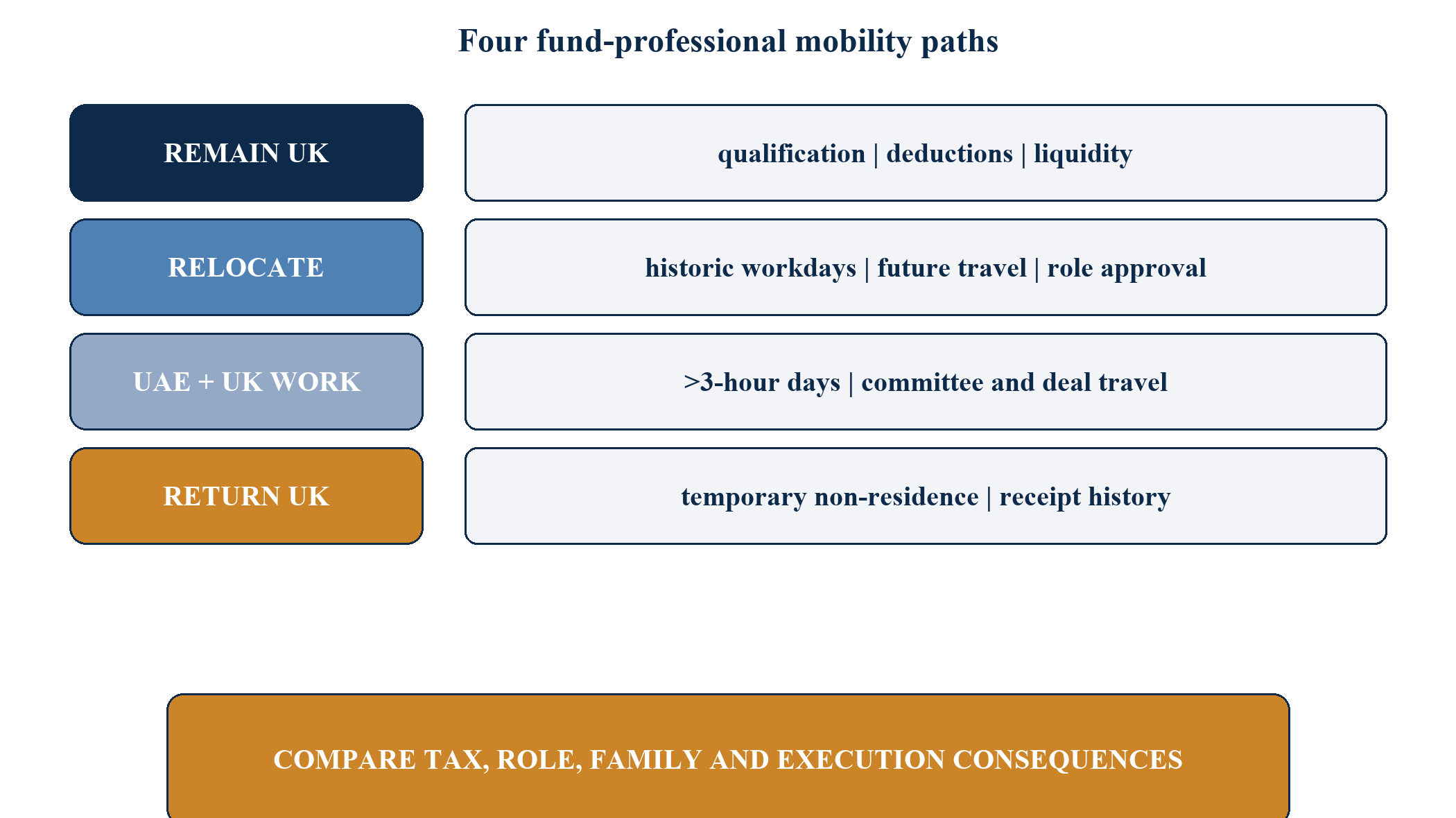
| Path | Residence profile | Carry control priority | Principal execution risk |
|---|---|---|---|
| remain UK resident | continuing UK residence | qualification, deductions and cash reserve | underestimating Income Tax and NIC |
| relocate before carry arises | departure followed by non-UK residence | historic workday reconstruction and future travel budget | assuming departure removes UK exposure |
| UAE base with UK work | UAE residence evidence plus recurring UK activity | more-than-three-hour workday ledger | frequent UK days increase UK allocation |
| return to UK | non-residence followed by UK return | temporary non-residence and receipt history | deferred return analysis creates surprise liability |
9. WORKED CASES
9.1 Case 1: fully qualifying carry for a UK additional-rate taxpayer
Assume GBP 2.0 million of carried interest arises after 6 April 2026. The entire amount is qualifying carried interest. There are no permitted deductions. The individual is UK resident and all applicable workdays are UK workdays. The individual is subject to 45 percent Income Tax, and the full deemed profit falls above the Class 4 upper profits limit.
The deemed trading-profit base is GBP 1.45 million, calculated as GBP 2.0 million multiplied by 72.5 percent. Income Tax is GBP 652,500. Class 4 National Insurance at 2 percent is GBP 29,000. The simplified combined amount is GBP 681,500, equal to 34.075 percent of the original carried interest. The hypothetical case excludes permitted deductions, losses, reliefs, payments on account and wider tax facts [1,7,8].
9.2 Case 2: partial qualification at 38.5 months
Assume GBP 2.0 million of carried interest arises when the statutory average holding period is 38.5 months. Under the general ladder, 60 percent is qualifying and 40 percent is non-qualifying. The qualifying GBP 1.2 million produces GBP 870,000 of deemed profit after the 72.5 percent multiplier. The non-qualifying GBP 800,000 enters in full. The total deemed-profit base is GBP 1.67 million.
At the same simplified 45 percent Income Tax and 2 percent Class 4 marginal rates, the combined amount is GBP 784,900. The case shows a GBP 103,400 difference from Case 1 on the same gross carry. Actual analysis would test the investment perimeter, statutory adjustments, early-distribution exception, deductions and tax-year bands.
9.3 Case 3: UAE resident with historic and continuing UK workdays
Assume GBP 3.0 million of fully qualifying carry arises to a non-UK resident. The approved relevant-period ledger contains 600 applicable workdays after applying the statutory definitions and modifications. Of those, 150 are UK workdays that remain in the numerator. The simplified UK workday proportion is 25 percent.
The UK-attributed qualifying profit is GBP 750,000 before the multiplier. The deemed UK trading-profit base is GBP 543,750, calculated as 72.5 percent of GBP 750,000. The applicable Income Tax and National Insurance calculation requires personal advice. The remaining territorial amount and treaty interaction also require advice. The case illustrates that non-UK residence and UAE residence evidence do not by themselves reduce the UK workday numerator to zero [1,12-14].
9.4 Case 4: UAE resident with fewer than 60 UK workdays
Assume the same fully qualifying carry and 600-day relevant period. The individual is non-UK resident in a tax year and has 40 UK workdays in that year. Finance Act 2026 provides specified modifications for qualifying profits where a non-UK tax year has fewer than 60 UK workdays. The adviser removes only days that meet the statutory exclusion and keeps them in the applicable-workday denominator as required [1].
The case cannot be completed from annual totals alone. Each day must be assigned to the correct tax year, residence status and statutory category. Days before 30 October 2024 also need separate identification. A carry computation should attach the approved ledger rather than quote a single annual day count.
9.5 Case 5: qualifying new resident returning to the UK
Assume a professional has been non-UK resident for at least ten consecutive tax years and becomes UK resident. The person may be a qualifying new resident for the four-year foreign income and gains regime, subject to the statutory conditions and a claim. Finance Act 2026 connects qualifying foreign carry profits to the location of the deemed trade and includes special pre-arrival concepts [1,11].
The adviser should separate non-UK workdays before arrival, non-UK workdays after arrival, UK workdays, qualifying and non-qualifying profits, and the claim consequences. Claiming the foreign income and gains regime can affect other allowances. A general statement that pre-arrival carry is exempt would be unsafe without the complete statutory computation.
9.6 Case 6: three funds with different clocks
Assume a partner participates in a buyout fund, a venture fund and a continuation vehicle. Carry arises from all three in the same tax year. The buyout fund has a 100 percent qualifying proportion; the venture fund has an 80 percent proportion; and the continuation vehicle requires separate perimeter and holding-period analysis. Each arrangement also has a different relevant-period workday ledger.
The personal computation should preserve three scheme-level schedules before aggregation. Using one average qualification percentage or one workday ratio across the portfolio could misstate the result. The controlling unit is the arrangement and scheme analysis required by the legislation.
10. THE GP AND FUND OPERATING MODEL
10.1 A carry data room for each participant
The organisation should maintain a controlled record for each carry arrangement and participant. The file should include executed documents, amendments, capital accounts, vesting, leaver status, investment and holding-period data, waterfall calculations, distribution notices, deductions, withholding, workday records and tax reporting.
Access should be restricted by role. The tax team may need detailed investment and participant data. Investment professionals should not be able to alter approved tax attributes without review. Every material output should identify the source system, preparer, reviewer and version date.
10.2 Average-holding-period governance
The investment data used for performance reporting should be mapped to the statutory average-holding-period calculation. The mapping should identify acquisitions, follow-ons, partial disposals, restructures, intermediate vehicles, continuation transactions and valuation inputs. Changes after a distribution should be controlled and documented.
The investment committee can receive a concise qualification dashboard. It should show each carry pool's current average, qualifying band, next threshold date, major sensitivity and unresolved legal issue. The dashboard should support compliance and should not direct investment exits around personal tax outcomes.
10.3 Mobility and travel governance
The GP should approve cross-border roles, work locations, committee participation and travel through a coordinated legal, tax, regulatory and human-resources process. The process should distinguish the individual's personal residence position from the firm's corporate obligations.
A UAE-based role should have substance consistent with the organisation's approved operating model. Board and committee calendars, decision rights, office access, payroll, regulatory permissions and reporting lines should match actual behaviour. Personal workday limits cannot substitute for corporate governance.
10.4 Distribution governance
Before a carry distribution, fund finance should produce a distribution pack containing the legal basis, arising analysis, gross amount, escrow, permitted deductions, qualification model, workday information available to the firm and participant statement. The participant remains responsible for personal advice and filing.
The distribution calendar should provide enough time for advisers to review material cross-border cases. Emergency distributions, in-kind transfers and allocations close to the tax-year boundary require heightened controls.
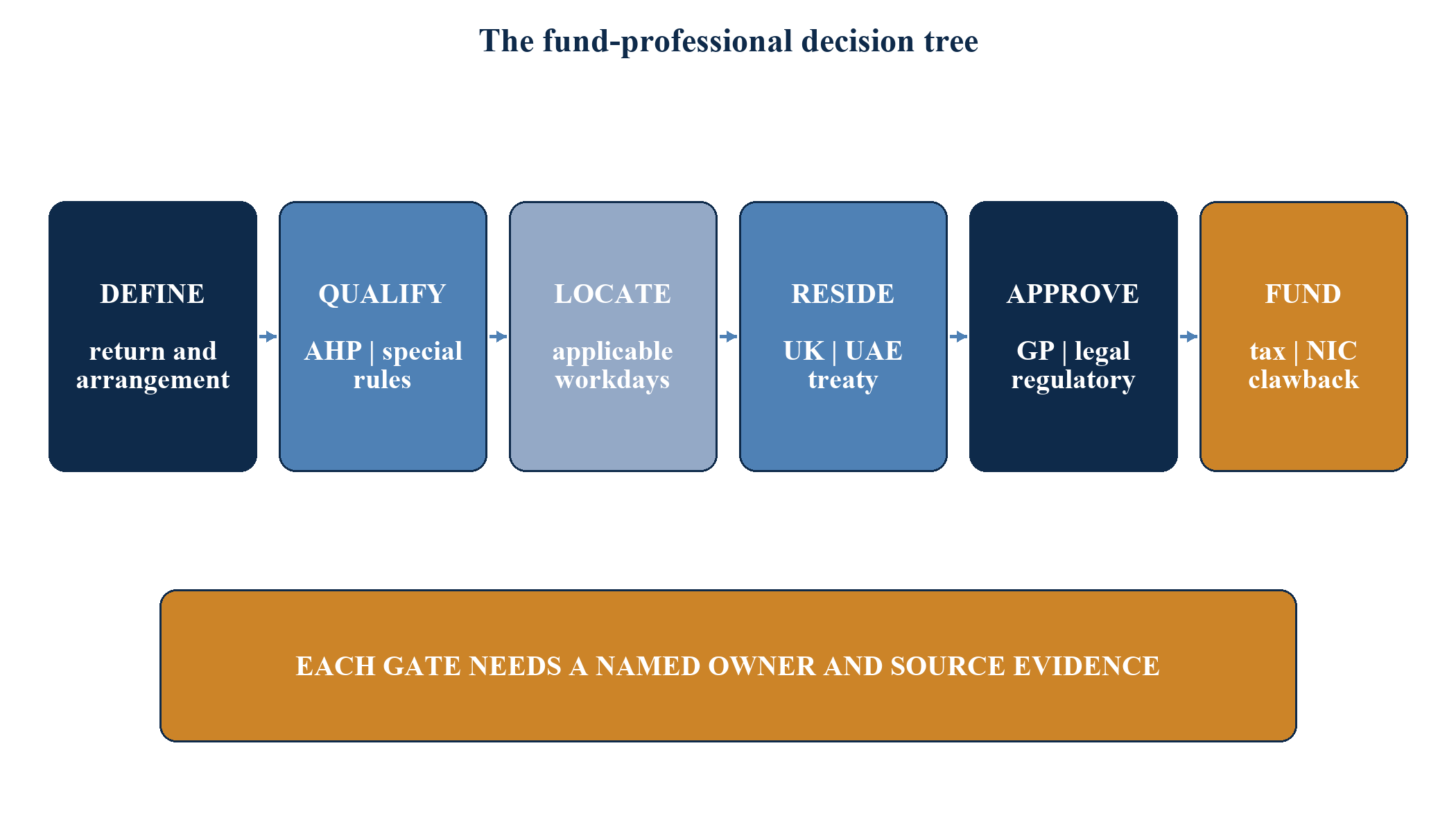
| Decision gate | Yes path | No path | Required sign-off |
|---|---|---|---|
| does the return meet the carried-interest definition? | enter dedicated regime analysis | classify under the applicable alternative rules | tax counsel |
| is the carry fully qualifying? | apply 72.5 percent base to qualifying profit | separate qualifying and non-qualifying components | fund tax |
| are all applicable workdays UK workdays? | UK-located deemed trade | compute mixed or overseas location | personal tax adviser |
| is the individual non-UK resident? | test modifications and treaty | compute UK-resident position and any FIG claim | residence adviser |
| is the move permitted under fund and employment documents? | implement governed relocation | revise role, timing or economics | legal, HR and compliance |
| is tax and clawback liquidity funded? | release approved reserve | defer personal deployment of proceeds | individual and wealth adviser |
11. PERSONAL LIQUIDITY AND WEALTH ARCHITECTURE
11.1 Separate gross carry from deployable capital
Gross carry is not deployable wealth. The individual should deduct adviser-estimated tax, National Insurance, escrow, clawback reserve, currency conversion, debt repayment and near-term family obligations before establishing an investable amount.
A personal treasury schedule should show base, downside and severe-downside cases. The downside case can assume lower qualification, more UK workdays, delayed distributions and weaker foreign exchange. The severe case can add clawback and an earlier UK return.
11.2 Currency and banking
Carry may be denominated in sterling, US dollars, euros or fund-asset currency, while UAE spending is primarily in dirhams. The UAE dirham's US-dollar peg reduces one pair of exposures and does not remove sterling or euro risk. Tax may remain payable in sterling while investment assets and family spending move to other currencies.
The individual should maintain accounts capable of receiving partnership or fund distributions, paying UK tax and preserving source-of-funds evidence. Transfers between personal, family and investment entities should be documented.
11.3 Concentration and co-investment
Fund professionals often hold carry, co-investment, partnership capital and employment income linked to the same platform and portfolio. A relocation can add property, business and banking concentration in a new jurisdiction. The family balance sheet should measure common-factor exposure before adding further private assets.
Liquidity ladders should place near-term tax and clawback reserves in suitable liquid assets. Long-duration private investments should be funded from capital that is not required for those obligations.
11.4 Estate and succession
The United Kingdom moved from domicile-based to long-term residence concepts for Inheritance Tax from 6 April 2025. A former long-term UK resident can remain exposed for a post-departure period depending on residence history. Carry interests, partnership interests, trusts, life insurance and wills should be reviewed alongside the mobility plan [18].
UAE succession and estate-planning documents should be coordinated with UK documents and the governing law of the carry arrangements. Beneficiary designations, powers of attorney and emergency access to fund and adviser records should be tested.
12. A 120-DAY RELOCATION ROADMAP
12.1 Days 1 to 30: build the fact base
Create a complete inventory of carry awards, funds, vehicles, vesting, leaver provisions, expected realisations, escrow, clawback and co-investment. Obtain the latest partnership statements and waterfall models. Identify every jurisdiction connected with the individual, the fund, the carry vehicle and the underlying services.
Reconstruct at least the full potential relevant period of workdays for each arrangement. Build the UK residence chronology for prior tax years and the expected departure year. Record homes, family location, work patterns and substantive ties.
12.2 Days 31 to 60: obtain adviser conclusions
Commission written UK advice on carry classification, qualification, arising, permitted deductions, applicable workdays, residence, split-year treatment, temporary non-residence, foreign income and gains relief and treaty interaction. Commission UAE advice on immigration, domestic residence, Tax Residency Certificate evidence, personal-tax position, employment or partnership structure and estate planning.
Obtain employer, partnership, regulatory and compliance approvals. Confirm the treatment of vested and unvested carry, continuing services, committees, travel, payroll, benefits and reporting.
12.3 Days 61 to 90: implement substance and records
Secure UAE immigration status, housing, banking, insurance and operational arrangements. Align the approved role, office, decision rights and reporting line with actual conduct. Establish a daily residence and workday system that records location, hours, activity, fund and evidence.
Build the carry tax reserve and clawback reserve. Test the ability to pay UK liabilities after currency movements or distribution delays. Put wills, powers of attorney and emergency records in place.
12.4 Days 91 to 120: rehearse and govern
Run a mock tax computation for the next expected distribution. Trace the amount from fund waterfall through qualification, permitted deductions, territory, tax and cash reserve. Reconcile the workday ledger to calendars and travel records.
Approve an annual travel budget with contingency, a committee-attendance protocol and a process for unplanned UK work. Schedule quarterly reviews and a pre-distribution adviser review. Prepare a return-to-UK scenario even when no return is planned.
Figure 10. The 120-day implementation sequence
| Period | Workstream | Deliverable | Gate |
|---|---|---|---|
| days 1-30 | entitlement, funds, residence and workdays | complete carry and mobility fact book | data reconciled |
| days 31-60 | UK and UAE advice; employer approvals | signed advice and approved role | legal and tax route approved |
| days 61-90 | UAE substance, records and liquidity | residence evidence, workday system and reserves | operating model active |
| days 91-120 | computation rehearsal and governance | reviewed model, travel policy and review calendar | relocation control signed off |
13. LIMITATIONS AND RISK BOUNDARIES
This paper is a general research framework. It does not determine whether a particular return is carried interest, the relevant investment scheme, the average holding period, the application of an exception, the amount of a permitted deduction, the time at which a sum arises, the applicable workday period, residence, treaty classification or liability.
The effective-rate examples use simplified marginal rates and exclude personal allowances, other income, losses, reliefs, Scottish rates, payments on account, interest and penalties. National Insurance depends on annual profits, thresholds, status and other facts. The examples do not model employer or fund-level consequences.
Residence and treaty outcomes are fact specific. A UAE residence visa, Emirates ID, home or Tax Residency Certificate is evidence and does not by itself resolve UK domestic residence, treaty residence or the source of carried-interest profits. The United Kingdom and UAE can amend legislation, guidance, administrative practice and treaty interpretation after the date of this paper.
Fund documents can restrict relocation, role, service location, committee participation and continuing carry. Regulatory, employment, partnership, corporate-tax, permanent-establishment and management-and-control issues can arise at organisation level. The individual and the organisation require separate advice.
14. CONCLUSION
The 2026 carried-interest regime links tax to fund economics, time and physical work in a more explicit way. The decisive inputs are the legal character of the return, the scheme's qualification percentage, the arising event, permitted deductions, the applicable-workday history and the individual's residence and treaty position.
For a UK private-capital professional moving to the UAE, the control objective is a defensible chronology. Every carry arrangement should have a legal entitlement map, qualification schedule, workday ledger, residence file, distribution computation and liquidity reserve. The same records should support the GP's reporting and the individual's tax return while respecting confidentiality and role-based access.
A well-governed move begins before departure and continues through every distribution and possible return. It connects the individual's family and residence plans with fund obligations, service patterns and cash-flow risk. The practical outcome is a relocation that can be explained from source documents rather than reconstructed after a tax authority asks the question.
APPENDIX A. CARRY ENTITLEMENT REGISTER
| Field | Purpose | Source evidence | Review frequency |
|---|---|---|---|
| fund and arrangement identifier | define the statutory and contractual perimeter | partnership agreement and award | on amendment |
| carry vehicle and legal owner | identify recipient and attribution issues | register, deed and tax forms | quarterly |
| waterfall and hurdle | establish profit-related mechanics | fund model and agreement | each distribution |
| vesting and leaver terms | identify economic continuity on move | award letter and employment or partnership terms | before role change |
| expected arising event | forecast tax timing | legal memorandum and distribution calendar | monthly near realisation |
| escrow and clawback | quantify unavailable and at-risk cash | distribution notice and fund accounts | each distribution |
| co-investment and other returns | preserve separate classification | subscription and account statements | quarterly |
APPENDIX B. AVERAGE-HOLDING-PERIOD SCHEDULE
| Field | Required content | Control |
|---|---|---|
| relevant investment | asset by reference to which carry is calculated | reconcile to fund perimeter |
| acquisition date | statutory holding-period start after adjustments | cite completion record |
| invested value | value used in weighting | reconcile to capital ledger |
| follow-on investment | amount, date and statutory treatment | review separately |
| disposal date | full or partial realisation | reconcile to proceeds |
| holding months | approved statutory duration | calculation control |
| weighted month-value | invested value multiplied by duration | formula review |
| special rule | any exception or adjustment | legal citation and approval |
| qualifying proportion | band at the arising time | signed tax conclusion |
APPENDIX C. WORKDAY LEDGER
| Field | Required entry | Evidence |
|---|---|---|
| date and tax year | each day in the relevant period | calendar |
| country at midnight | residence record | travel and location history |
| UK presence window | arrival and departure time | carrier and border records |
| investment-management hours in UK | actual hours and activities | calendar, time record and work product |
| fund and arrangement | carry connection | meeting or deal record |
| travel rule | boarding and disembarkation where relevant | ticket and itinerary |
| residence status | UK or non-UK for the tax year | adviser chronology |
| statutory category | counted, excluded or denominator only | approved tax rule |
| reviewer | name and date | workflow log |
APPENDIX D. PRE-DISTRIBUTION CHECKLIST
- Confirm the executed carry documents and all amendments.
- Confirm the amount, asset form, currency, escrow and clawback.
- Obtain a written arising conclusion.
- Recalculate the average holding period at the expected arising time.
- Confirm every statutory exception or special rule.
- Identify and evidence permitted deductions.
- Freeze and review the applicable-workday ledger.
- Confirm UK residence, split-year and treaty assumptions.
- Model Income Tax, Class 4 National Insurance and payment timing.
- Confirm withholding, reporting and partnership-statement treatment.
- Fund the tax and clawback reserves before deploying proceeds.
- Archive the final computation and source evidence.
APPENDIX E. QUESTIONS FOR ADVISERS
UK tax adviser
- Which returns meet the post-2026 statutory definition of carried interest?
- What is the arrangement and investment-scheme perimeter for each award?
- What proportion is qualifying at each expected arising date?
- Which deductions are permitted and how are they allocated?
- When does each sum arise under the documents and statute?
- What is the relevant period and applicable-workday methodology?
- Which non-resident modifications apply to the individual's history?
- Does split-year treatment apply, and from which date?
- How does the UK-UAE treaty apply to the actual carry structure?
- What temporary non-residence or return risk remains?
UAE adviser
- Which domestic residence path applies to the individual?
- What evidence is required for a Tax Residency Certificate?
- How should employment, partnership or advisory activity be structured?
- What UAE business, corporate-tax or licensing obligations arise?
- What succession and estate documents should be coordinated with UK documents?
Fund counsel and GP
- Does relocation affect vesting, leaver status or future participation?
- Which services and committees can be performed from the UAE?
- What approvals, regulatory permissions and reporting are required?
- What data will the GP provide for qualification and workday computations?
- How will tax distributions, escrow and clawback be documented?
APPENDIX F. QUARTERLY GOVERNANCE AGENDA
| Agenda item | Evidence | Decision |
|---|---|---|
| expected carry events | fund forecast and waterfall | update timing range |
| qualification | average-holding-period schedule | approve current band and sensitivity |
| workdays | reconciled ledger | approve numerator, denominator and travel headroom |
| residence | SRT and UAE evidence dashboard | confirm risk status |
| legal and regulatory role | committee and service record | approve location and activity |
| liquidity | tax, clawback and currency reserve | top up or release reserve |
| return scenario | personal and commercial triggers | refresh contingency plan |
| filings and certificates | returns, claims and TRC status | close evidence gaps |
REFERENCES
[1] UK Parliament. Finance Act 2026, section 58 and Schedule 11, Tax treatment of carried interest. https://www.legislation.gov.uk/ukpga/2026/11/contents
[2] HM Revenue & Customs. Revised tax regime for carried interest, 21 July 2025. https://www.gov.uk/government/publications/reform-of-the-tax-treatment-of-carried-interest/revised-tax-regime-for-carried-interest
[3] HM Treasury and HM Revenue & Customs. The Tax Treatment of Carried Interest: Government Response and Policy Update, June 2025. https://www.gov.uk/government/calls-for-evidence/the-tax-treatment-of-carried-interest-call-for-evidence/outcome/the-tax-treatment-of-carried-interest-government-response-and-policy-update-june-2025-accessible
[4] HM Revenue & Customs. Investment Funds Manual IFM36510, Carried interest and profit related returns: Introduction, updated 25 June 2026. https://www.gov.uk/hmrc-internal-manuals/investment-funds/ifm36510
[5] HM Revenue & Customs. Investment Funds Manual IFM36520, Meaning of carried interest, updated 25 June 2026. https://www.gov.uk/hmrc-internal-manuals/investment-funds/ifm36520
[6] HM Revenue & Customs. Capital Gains Tax rates and allowances, updated 13 April 2026. https://www.gov.uk/guidance/capital-gains-tax-rates-and-allowances
[7] HM Revenue & Customs. Income Tax rates and Personal Allowances: current rates and allowances, 2026 to 2027. https://www.gov.uk/income-tax-rates/current-rates-and-allowances
[8] HM Revenue & Customs. National Insurance: how much you pay, 2026 to 2027 Class 4 rates. https://www.gov.uk/national-insurance/how-much-you-pay
[9] HM Revenue & Customs. RDR3 Statutory Residence Test notes, updated 11 June 2026. https://www.gov.uk/government/publications/rdr3-statutory-residence-test-srt/guidance-note-for-statutory-residence-test-srt-rdr3
[10] UK Parliament. Finance Act 2013, Schedule 45, Statutory Residence Test. https://www.legislation.gov.uk/ukpga/2013/29/schedule/45
[11] HM Revenue & Customs. HS266 Foreign income and gains regime, 2026. https://www.gov.uk/government/publications/foreign-income-and-gains-fig-regime-self-assessment-helpsheet-hs266/hs266-foreign-income-and-gains-fig-regime-2026
[12] HM Revenue & Customs. 2016 UK-UAE Double Taxation Convention. https://www.gov.uk/government/publications/united-arab-emirates-tax-treaties/2016-uk-uae-double-taxation-convention
[13] UAE Federal Tax Authority. Issuance of Tax Certificates for Tax Residency, updated 6 April 2026. https://tax.gov.ae/en/services/issuance.of.tax.certificates.aspx
[14] UAE Cabinet. Cabinet Decision No. 85 of 2022 on Determination of Tax Residency. https://mof.gov.ae/wp-content/uploads/2023/03/Cabinet-Decision-No.-85-of-2022.pdf
[15] HM Revenue & Customs. International Manual INTM154020, Double taxation agreements: dual residents, updated 24 July 2026. https://www.gov.uk/hmrc-internal-manuals/international-manual/intm154020
[16] UK Parliament. Finance Act 2025, carried-interest Capital Gains Tax rate provisions. https://www.legislation.gov.uk/ukpga/2025/8/contents
[17] HM Treasury. Autumn Budget 2024 and Overview of tax legislation and rates. https://www.gov.uk/government/publications/autumn-budget-2024/autumn-budget-2024-html
[18] HM Revenue & Customs. Inheritance Tax if you are a long-term UK resident. https://www.gov.uk/guidance/inheritance-tax-if-youre-a-long-term-uk-resident
[19] HM Revenue & Customs. Investment Funds Manual IFM36531, no significant risk condition. https://www.gov.uk/hmrc-internal-manuals/investment-funds/ifm36531
[20] HM Revenue & Customs. Capital Gains Tax: rates of tax for carried interest, 30 October 2024. https://www.gov.uk/government/publications/carried-interest-rates-of-capital-gains-tax/capital-gains-tax-rates-of-tax-carried-interest
ABOUT THE AUTHOR
Chennakeshav Adya is an Independent Researcher and Managing Partner at Matchpoint Partners. His work examines private-capital markets, cross-border mobility, fund economics, transaction design, family-office strategy and evidence-led decision systems.
