

1. Define the investment decision
The decision is whether ownership of a larger CDMO network creates durable cash flow after the buyer pays for capacity, compliance and integration. The answer should determine price, financing, closing conditions, deferred consideration and the post-close capital plan. A general expectation of sector growth cannot replace evidence that the acquired sites can manufacture the products in the forecast at the required quality and margin.
The mandate should identify the legal entities, sites, licences, products, customers, contracts, equipment, personnel and intellectual property included in the transaction. It should also define the intended operating model. A buyer creating a specialised sterile network needs different evidence from an investor combining discovery, development, drug substance and finished-dose services. The perimeter affects both achievable cross-selling and regulatory complexity.
Approval should state the maximum price, minimum liquidity, permitted leverage, required remediation reserve and conditions for releasing contingent consideration. The investment committee should receive one reconciled case linking site operations to revenue, EBITDA, cash conversion and debt service. Every material assumption should identify its source, owner, evidence date and downside response.
2. Use the Capacity, Quality and Concentration Framework
The proposed framework has eight linked tests: market and customer demand; contract quality; product and customer concentration; technically qualified capacity; quality and compliance; technology transfer; capital and working-capital requirements; and integration execution. Each test produces a finding that changes valuation, transaction terms or the first 100-day plan.
The framework begins at product and manufacturing-line level. Site totals can hide bottlenecks in formulation, filling, inspection, packaging, quality control, storage or release. A facility can report spare floor space while lacking qualified equipment, trained operators, validated methods or regulatory approval for the relevant product. Capacity becomes economically useful only when the complete production and release chain is available.
The buyer should maintain a single evidence register that connects customer forecasts, master service agreements, work orders, bills of material, batch records, deviation history, quality agreements, regulatory inspections, maintenance logs, capital requests and the financial model. This register prevents commercial, technical and financial workstreams from applying different definitions of capacity or backlog.
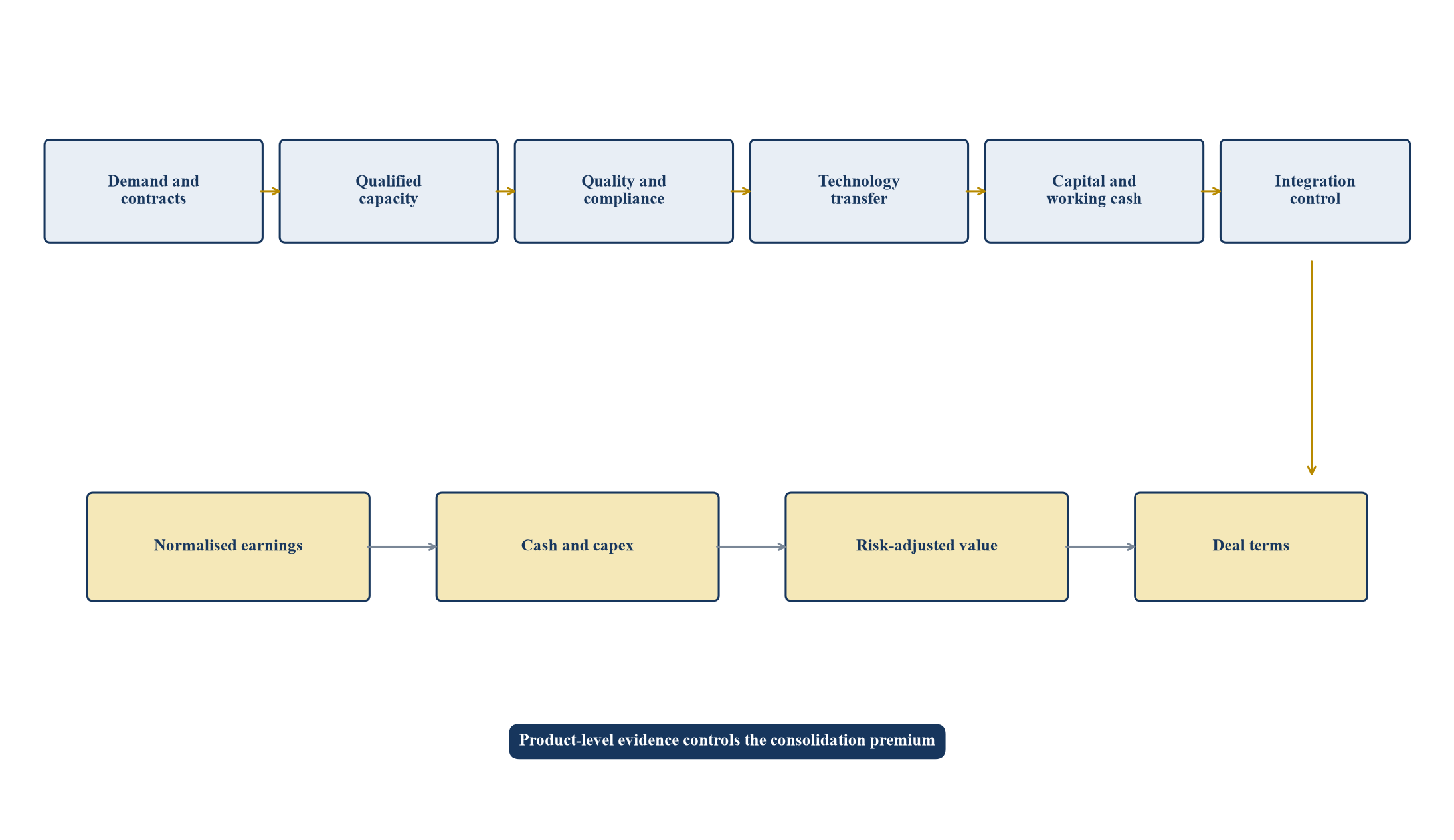
The framework connects site evidence to valuation, deal protection and integration controls.
3. Define the CDMO business model precisely
CDMOs earn revenue from development work, analytical services, clinical supply, commercial manufacturing, packaging and related services. These activities differ in duration, capital intensity, transferability and margin. Development revenue can be project-based and volatile. Commercial manufacturing can be recurring, although volumes remain exposed to product demand, customer decisions and regulatory events.
The diligence team should classify every material revenue stream by product stage, molecule type, service, site, production line, customer, contract form and currency. It should identify whether pricing is based on time, batch, unit, reserved capacity, materials pass-through or a combination. Reported growth can result from price, materials inflation, favourable product mix or one-time transfer activity rather than greater manufacturing output.
The consolidation thesis should state where scale is expected to improve economics. Potential sources include fuller lines, shared procurement, reduced overhead, broader customer access, common development methods and a more credible continuity network. Each source requires a mechanism, baseline, owner, cost and timing. Revenue synergies should identify specific customers and capabilities rather than assume that a broader menu automatically wins work.
4. Reconstruct demand from customers and products
Demand should be rebuilt from product-level evidence. The buyer should compare customer forecasts with purchase orders, reserved capacity, historical call-offs, clinical milestones, launch plans and actual market demand. A forecast supplied for operational planning may carry no minimum purchase commitment. A reservation may be cancellable or subject to product approval.
Commercial-stage products require analysis of end-market volume, competition, pricing, inventory and exclusivity. Clinical products require probability-weighted scenarios because trial outcomes and regulatory timing affect manufacturing demand. The model should distinguish current products, approved transfers, transfers in progress and opportunities that have no signed work order.
The buyer should calculate forecast accuracy by customer and product. Repeated over-ordering can inflate backlog and create inefficient labour and inventory. Repeated under-ordering can strain capacity and quality. The operating case should use a range informed by observed call-offs and contractual rights, with separate treatment for launches, mature products and products facing loss of exclusivity.
5. Test contract quality and switching costs
Contracted revenue is only as durable as the commercial and quality arrangements that support it. The review should cover term, renewal, termination, forecast obligations, minimum volumes, reservation fees, price adjustment, raw-material pass-through, change control, liability, intellectual property, audit rights, service levels, force majeure and assignment. Work orders should reconcile to the master agreement and quality agreement.
Switching costs can be substantial because a customer may need process transfer, analytical comparability, validation batches, regulatory submissions and inventory coverage. These costs can support retention, although they do not eliminate customer options. A customer may insource, qualify a second source, discontinue a product or move future products elsewhere while leaving the existing product in place.
The buyer should avoid valuing switching costs as permanent contractual protection. It should estimate the time, expense and regulatory work required for each material product to move, then assess the customer's incentives. Evidence includes dual-sourcing plans, recent requests for information, price disputes, service failures, product strategy and the customer's own manufacturing investments.
Commercial diligence should test the relationship at several organisational levels. Senior executives may describe a strategic partnership while procurement, technical operations and quality teams report unresolved service issues. Meeting minutes, scorecards, audit reports, change requests and escalation records show how the relationship operates. The review should identify products awarded through competitive tenders, sole-source arrangements and customer portfolio decisions. It should also distinguish revenue attached to a manufacturing site from revenue attached to a relationship manager or scientific team. These distinctions affect the probability that volume remains after ownership and integration change.
| Driver | Evidence required | Risk when weak | Transaction response |
|---|---|---|---|
| Demand | Orders, forecasts, product outlook and call-off history | Backlog exceeds executable demand | Rebase volume and working capital |
| Contract | Master agreement, work order and quality agreement | Revenue can terminate or reprice quickly | Adjust duration and margin assumptions |
| Switching cost | Transfer steps, filings, validation and inventory | Retention premium is overstated | Use product-specific attrition cases |
| Customer relationship | Service record, pipeline and governance | Future awards move elsewhere | Exclude unsupported cross-selling |
| Product lifecycle | Approval, competition and exclusivity | Volume declines before capital pays back | Shorten useful life and test impairment |
Evidence and responses should be assessed by product and contract.
6. Measure customer and product concentration
Customer concentration should be measured at group, site, line, technology and product levels. A customer representing 20 percent of group revenue may account for most output on a specialised line. The financial effect of loss depends on the contribution margin, ability to refill the line, termination provisions and stranded labour or capital.
Product concentration can be more important than customer concentration. Several customers may depend on the same molecule class, regulatory pathway, raw material or end market. A single product can also generate revenue across development, manufacturing and packaging, creating apparent diversification while preserving one underlying demand risk.
The model should show revenue and EBITDA before and after the loss or delay of each major product. It should include the time and cost required to replace volume. Concentration covenants, earn-outs or price adjustments may be appropriate when a few products support most of the acquisition value and renewal evidence remains incomplete.
7. Convert installed assets into qualified capacity
Installed capacity is an engineering description. Qualified capacity is the output that can be manufactured, tested, released and shipped under the required regulatory and quality conditions. The conversion requires equipment availability, validated processes, trained staff, approved materials, analytical capacity, environmental controls, utilities, maintenance windows and quality-release resources.
The buyer should construct a line map with theoretical rate, demonstrated rate, batch size, changeover, cleaning, campaign rules, planned downtime, unplanned downtime, yield and release lead time. It should identify the bottleneck for each product family. A filling line may have spare hours while visual inspection or sterility testing constrains finished output.
Capacity should be measured using a common unit only where products are comparable. Hours, batches, litres and units can all mislead when product complexity differs. The preferred model schedules actual products through the full route, then calculates utilisation for each constrained resource. This supports both valuation and the integration production plan.
8. Normalise utilisation
Reported utilisation often depends on management definitions. Some calculations use scheduled hours, others use theoretical hours, and some exclude maintenance, changeover, validation, engineering batches or quality holds. The buyer should reproduce utilisation from source records and reconcile it to output and revenue.
Low utilisation can create opportunity when demand is credible and the site can add volume without disproportionate cost. It can also signal obsolete equipment, weak sales, unattractive product economics or quality constraints. High utilisation can support pricing, yet it may increase overtime, deferred maintenance, deviation risk and customer-service failures.
The underwriting case should define sustainable utilisation by line. It should preserve time for maintenance, training, validation, deviation investigation and unexpected demand. A consolidation case that fills every available hour can reduce resilience and raise the probability that one disruption affects several customers.
Schedule simulation provides a stronger test than one annual utilisation percentage. The buyer can load committed and probability-weighted batches into a weekly plan, apply changeover and maintenance rules, and observe queues at production, testing and release. This exposes whether the plan depends on perfect sequencing or assumes that incompatible products can share campaigns. The simulation should also test a failed batch, delayed material and urgent customer order. A resilient network retains enough flexibility to recover without breaching other commitments. The financial case should recognise the cost of that resilience rather than treating all unused time as inefficiency.
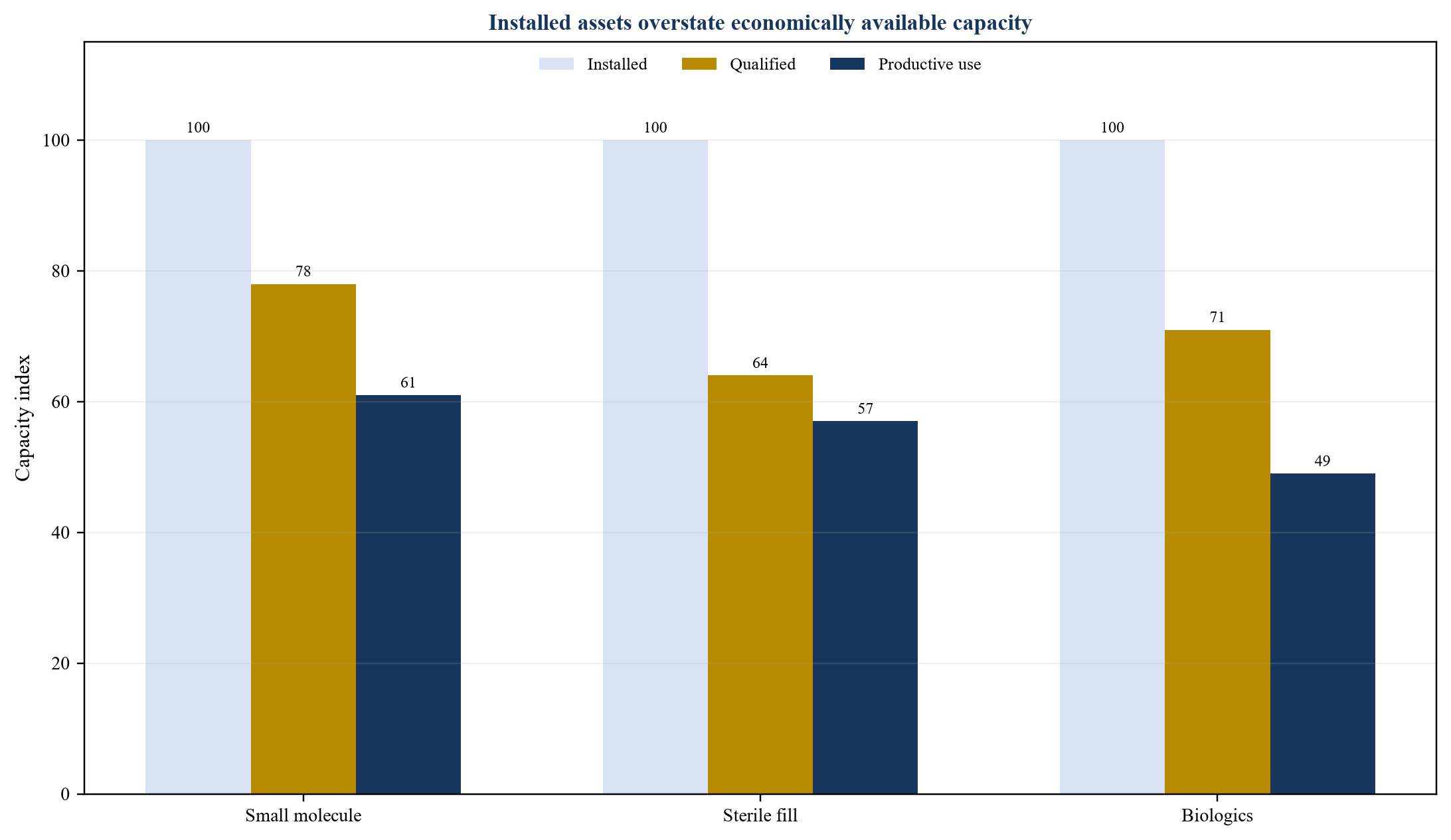
All figures are illustrative management scenarios and do not represent observed company data.
9. Review quality systems as an economic asset
Current good manufacturing practice establishes minimum requirements for consistent production and control. FDA explains that sustainable compliance also depends on mature quality management, continual improvement and insight into manufacturing performance [1][2]. For an investor, quality should be assessed as an operating system that affects supply reliability, cost, customer retention and the ability to win regulated work.
The review should cover management responsibility, quality culture, deviation handling, corrective and preventive action, change control, complaints, supplier quality, training, data integrity, management review and product quality review. Metrics require context. A lower deviation count can reflect better control, weak detection or narrow reporting. Timeliness, recurrence, severity and effectiveness matter more than one aggregate number.
Quality expenditure should be separated into routine cost, remediation and capability investment. Under-resourcing can temporarily support EBITDA while building operational risk. The central case should include staffing, systems, validation and maintenance required to achieve the forecast. Savings that weaken independent quality oversight should be excluded.
The buyer should assess quality maturity through behaviour as well as written procedure. Management review should show that leaders understand recurring deviations, overdue actions, complaints, supplier failures and capacity pressure. Investigation files should identify root causes that explain the evidence and corrective actions that address those causes. Repeat events after closure can show that an action treated the symptom. Employee interviews and training records can reveal whether production targets override escalation. These observations affect the probability of sustained control and the resources required after closing.
10. Build the inspection and compliance record
FDA provides inspection, compliance, recall and import-action information through its public data resources, while the European system provides manufacturing and GMP information through EudraGMDP [3][4]. Public records should be reconciled with the seller's complete inspection history, responses, commitments, regulatory correspondence and internal audit record.
The buyer should analyse observations by system, site, product, recurrence and closure evidence. A closed response does not by itself establish that remediation remains effective. Sampling should trace selected commitments into procedures, training, validation, batch records and current practice. Recent improvements deserve credit only when evidence shows stable operation.
The transaction model should estimate direct remediation cost, lost output, delayed approvals, additional testing, customer attrition and management distraction. Closing conditions may require specific regulatory or quality outcomes. Where timing remains uncertain, a holdback or contingent payment can align value with verified remediation.
11. Test data integrity and digital controls
Manufacturing and laboratory decisions depend on complete, consistent and accurate records. Diligence should map laboratory systems, manufacturing execution, enterprise resource planning, environmental monitoring, equipment interfaces, spreadsheets, archives and audit trails. Access administration, backup, retention, time synchronisation and change control should be tested.
The buyer should select material batches and reconstruct the record from raw observations through release. It should compare electronic records with certificates, investigations, customer reports and regulatory submissions. Unexplained manual transcription, shared accounts, disabled audit trails or uncontrolled spreadsheets can affect both compliance and the reliability of operating metrics.
Digital integration requires caution. Rapid migration can alter metadata, validated states or interfaces. The first integration plan should preserve source systems and retrieval rights until data have been reconciled and the receiving environment is validated. Expected technology savings should include validation, cybersecurity and retention requirements.
12. Assess product and process fit across the network
A network creates value when products can use available capabilities without compromising quality or economics. The buyer should map dosage form, molecule, containment, potency, batch size, equipment train, analytical methods, environmental controls, materials, utilities and regulatory approvals. Similar labels can conceal materially different requirements.
The review should identify products that can move within the existing validated design space and those requiring development or capital. It should also identify products that should remain where they are because transfer cost, customer consent or regulatory delay exceeds the benefit. Network flexibility should be valued from executable alternatives rather than the number of sites.
The combined sales plan should reflect this technical map. Commercial teams should not offer capacity that operations cannot qualify on the promised schedule. A controlled bid process can require technical, quality, regulatory, finance and legal approval before a proposal includes transfer timing or capacity commitments.
13. Underwrite technology transfer
Technology transfer converts a process developed or operated at one site into a reproducible process at another. ICH Q10 and Q12 place knowledge management, change management and lifecycle control within the pharmaceutical quality system [5][6]. For consolidation, transfer is both a growth route and a major execution risk.
The transfer plan should cover process knowledge, analytical methods, materials, equipment equivalence, training, engineering batches, validation, comparability, stability, regulatory submissions, inventory and customer approval. The critical path often includes methods, reference standards, long-lead materials or quality review rather than production equipment.
The valuation should assign probability, cost and timing to each proposed transfer. Benefits should begin after qualification and approval, not when management starts the project. A portfolio of simultaneous transfers should reflect competition for technical, quality and regulatory resources. Failure of one transfer can affect customer trust across the network.
Transfer governance should define acceptance criteria before work starts. The sending and receiving sites should agree the process description, critical parameters, analytical methods, sampling, comparability package and decision rights. Deviations during engineering and validation batches should be evaluated against product knowledge rather than waived to preserve a schedule. The buyer should test whether the forecast includes adequate material for failed or repeated batches and enough inventory to protect supply during regulatory review. A plan that assumes first-time success can understate both cash and customer risk.
14. Test quality agreements and outsourced responsibilities
EMA guidance on outsourced activities requires clear written arrangements and preserves regulated responsibilities across contract parties [7]. WHO GMP also addresses contract manufacturing, testing and the responsibilities of the contract giver and accepter [8]. The buyer should review whether commercial agreements and quality agreements assign consistent responsibilities.
The review should cover material release, testing, deviations, changes, complaints, recalls, subcontracting, records, audits, product disposition and regulatory communication. Gaps can delay decisions when a problem occurs. A subcontractor used without required consent can create both compliance and customer issues.
Consolidation can change legal entities, sites, systems and subcontracting routes. The integration plan should identify agreements requiring consent or amendment before operational changes. Synergy timing should reflect these approvals and the capacity of customers to review them.
15. Evaluate maintenance and asset condition
Reported capacity requires reliable equipment, utilities and facilities. Diligence should examine preventive maintenance, calibration, breakdowns, spare parts, obsolescence, vendor support, utilities, environmental systems and business-continuity arrangements. Deferred maintenance can appear as strong cash flow before acquisition.
The buyer should reconcile the fixed-asset register to the production map and inspect critical assets. Maintenance work orders and downtime should be compared with utilisation and batch records. Repeated temporary repairs, unavailable components or unsupported control systems can require capital sooner than the seller's plan assumes.
Capital classification matters. Maintenance capital preserves current capability. Compliance capital addresses required controls. Growth capital adds approved capacity. The valuation should avoid treating essential maintenance or remediation as optional growth expenditure. Each project should have scope, cost range, downtime, approval route and expected benefit.
16. Model labour and scarce skills
CDMO capacity depends on qualified people as well as equipment. The model should cover operators, engineers, scientists, quality-control analysts, quality assurance, validation, regulatory affairs, supply chain and programme management. Vacancy, overtime, contingent labour, training time and shift coverage affect both cost and output.
The buyer should identify skills tied to particular products, methods or equipment. A site can have nominal headcount while lacking staff authorised to perform a constrained activity. Training records and actual rosters should support the capacity plan. Planned utilisation increases should include recruitment and qualification lead times.
Retention should focus on roles that preserve product knowledge, customer trust and regulated responsibility. Incentives require an operating plan, transfer of knowledge and succession. A broad retention pool without role analysis can raise cost while leaving critical dependencies unresolved.
17. Analyse suppliers and materials
Materials can constrain output even when internal capacity is available. The review should map active ingredients, excipients, single-use systems, primary packaging, reference standards, filters, resins, components and testing services. It should identify approved sources, lead times, minimum orders, shelf life, allocation and change-control requirements.
A second supplier may not provide immediate resilience when qualification, comparability or regulatory approval is required. The buyer should distinguish commercially available alternatives from approved alternatives. Inventory should be assessed for ownership, expiry, customer specificity, obsolescence and release status.
Consolidated procurement can reduce price, yet supplier changes may require customer and regulatory approval. Savings should be scheduled after qualification and should include validation, inventory transition and dual-running costs. Greater network purchasing concentration can also increase exposure to one supplier.
18. Build product-level unit economics
Revenue and margin should be reconstructed by product, batch and service. The model should include materials, direct labour, testing, consumables, utilities, waste, changeover, deviations, yield loss, storage, release and customer-specific overhead. Materials pass-through can raise revenue without contributing equivalent margin.
Standard cost should be compared with actual cost. Persistent variances can indicate outdated routings, yield assumptions, labour standards or purchase prices. A favourable portfolio average may conceal products that consume scarce capacity while earning insufficient contribution.
The buyer should calculate contribution per constrained hour, not only margin percentage. This supports product prioritisation and pricing. Contractual price adjustment, minimum batch charges, cancellation fees and reservation payments should be reflected. Improvement assumptions require a defined operational action and should preserve quality obligations.
19. Normalise EBITDA
Normalisation should remove effects that do not represent sustainable ownership economics while preserving recurring requirements. Adjustments may include unusual remediation, temporary shutdowns, duplicated public-company cost, transaction expenses and start-up losses for qualified capacity. Each adjustment needs documentary support and a cash consequence.
The buyer should challenge add-backs for quality, maintenance, recruitment and validation when those costs recur. It should also test whether a strong product mix or customer launch temporarily raised margin. Historical EBITDA should reconcile to site and product economics before synergies are added.
Synergies should be divided into committed cost actions, operational improvements, capacity benefits and revenue opportunities. The model should show gross benefit, implementation cost, timing, tax and risk. Savings from headcount or systems should be reviewed against regulated responsibilities and validated operating needs.
20. Model working capital and cash conversion
CDMO working capital can be affected by customer-owned materials, milestone billing, deposits, long-lead inventory, work in progress, batch release and disputed receivables. Accounting balances should be reconciled to contractual rights and physical status. Cash conversion can change materially as the product mix shifts.
The buyer should build a monthly cash model covering materials purchases, labour, capital expenditure, taxes, interest, integration and customer receipts. Transfer projects can consume cash before commercial production begins. Remediation can combine expense, capital and lost output.
The purchase agreement should define working-capital principles that reflect the business. A generic completion mechanism can create disputes over customer deposits, deferred revenue, consigned inventory or unreleased batches. The financing plan should include liquidity for downside timing, not only the central annual forecast.
21. Build the hypothetical transaction case
The hypothetical buyer combines three sites. Reported revenue is USD 510 million and reported EBITDA is USD 98 million. Diligence removes USD 9 million of temporary high-margin transfer work and adds USD 6 million of recurring quality, maintenance and technical staffing, producing base EBITDA of USD 83 million before synergies.
The central case adds USD 17 million of validated cost and utilisation benefits after implementation costs. It values the business at 9.0 times central EBITDA, then deducts net debt, remediation, integration and near-term capital requirements. The resulting illustrative equity value is USD 705 million.
The downside case assumes a major customer insources part of its volume, two transfers slip by twelve months, sterile capacity remains constrained and remediation rises. EBITDA falls to USD 65 million and the multiple declines to 8.0 times. After higher cash deductions, illustrative equity value is USD 397 million. These figures are management scenarios, not observed market evidence.
The case should reconcile earnings to free cash flow. Central EBITDA can appear attractive while working capital, maintenance, remediation and validation consume most available cash during the first two years. Debt sizing should use cash after these requirements and after tax rather than a headline EBITDA multiple. The buyer should model covenant headroom through the lowest cash point, including delayed transfers and a temporary production interruption. If the transaction requires immediate access to acquisition facilities for remediation, the financing documents and permitted-use provisions should accommodate that plan.
| Item | Central case | Downside case | Basis |
|---|---|---|---|
| Normalised base EBITDA | 83 | 72 | Product and site reconstruction |
| Net recurring benefits | 17 | (7) | Utilisation, cost actions and attrition |
| Valuation EBITDA | 100 | 65 | Case-specific operating outcome |
| Enterprise-value multiple | 9.0x | 8.0x | Illustrative assumption |
| Enterprise value | 900 | 520 | EBITDA multiplied by case multiple |
| Net debt and debt-like items | (108) | (108) | Illustrative closing amount |
| Remediation, integration and committed capex | (87) | (15) | Central and downside timing differ |
| Additional downside cash reserve | - | - | Included within deductions above |
| Illustrative equity value | 705 | 397 | Sum of stated components |
All figures are illustrative management scenarios in USD millions except multiples.
22. Stress utilisation, remediation and concentration
Sensitivity should focus on variables that affect both earnings and cash. These include productive utilisation, batch success, customer attrition, price, materials recovery, transfer timing, remediation cost, maintenance downtime, capital expenditure and release lead time. The model should preserve relationships among variables.
A quality event can reduce output, delay transfers, increase testing and weaken customer retention at the same time. Independent sensitivities can understate this combined effect. Scenario branches should represent coherent operating states, including the liquidity required to recover.
The committee should see value, leverage, interest cover and minimum cash under each state. It should also see the portion of consideration supported by unqualified capacity or unsigned customer opportunities. This presentation helps align deferred consideration with the evidence still required.
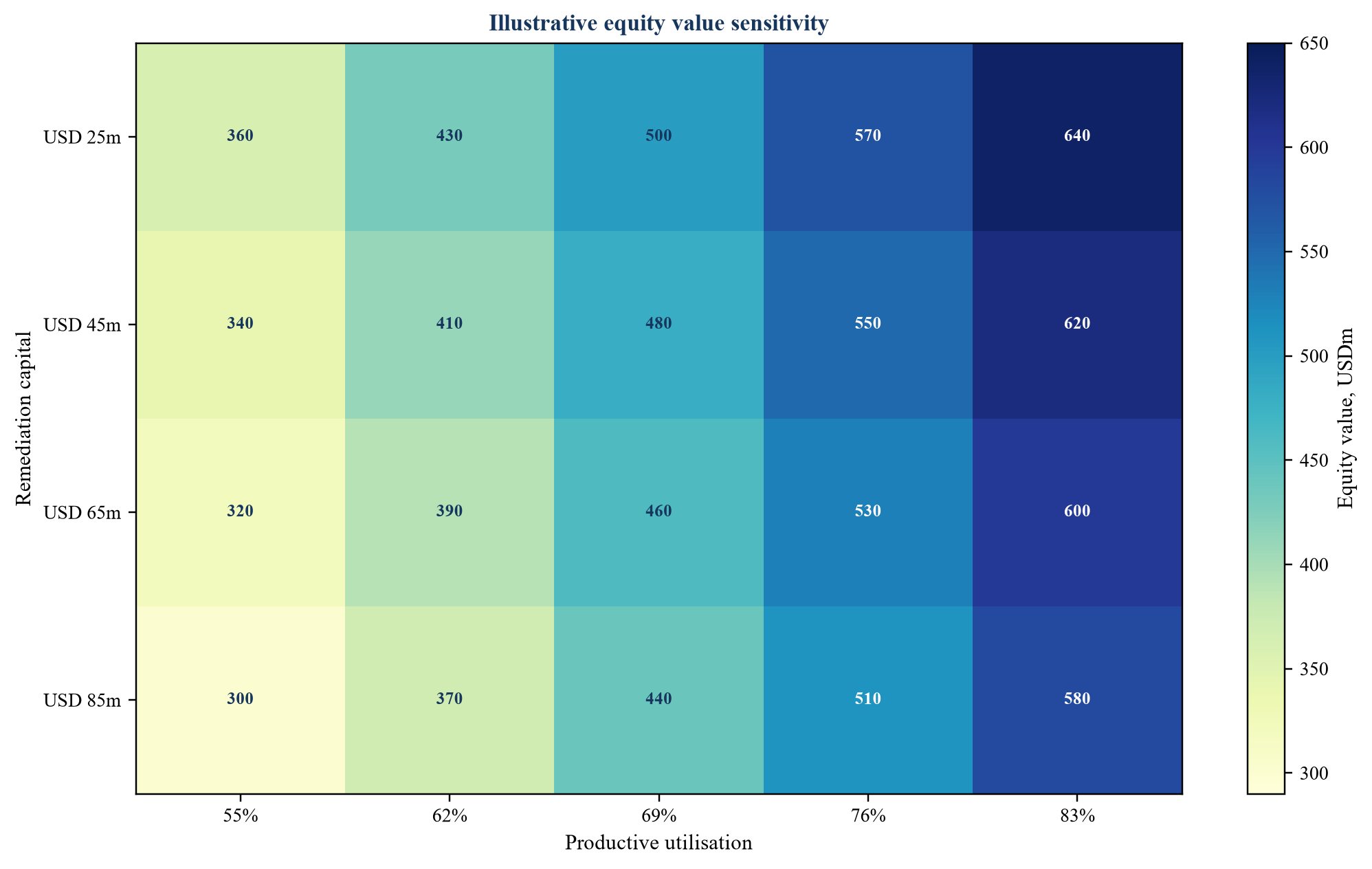
Values are illustrative USD millions and do not represent market data or a fairness opinion.
23. Test the acquisition multiple
Comparable-company and transaction multiples require careful scope adjustment. CDMOs differ by molecule, development stage, service mix, regulatory history, site network, customer concentration, capacity position and capital intensity. A higher multiple may reflect differentiated capabilities or expected growth that the target does not share.
The buyer should reconcile the chosen multiple to the target's normalised growth, margin, cash conversion, quality and concentration. It should then test whether planned synergies are being paid for twice through both a premium multiple and a separate forecast. The acquisition case should state which benefits belong to the seller and which require the buyer's capital and execution.
A discounted cash-flow analysis can expose the timing of transfers, capital and working capital. It should use site and product drivers rather than a smooth top-line growth rate. Terminal assumptions should reflect asset renewal, product lifecycle and customer concentration.
24. Convert findings into transaction protection
Price protection should follow the nature of uncertainty. A known remediation programme can support a price deduction, escrow or specific indemnity. Uncertain future transfer success can support contingent consideration. Customer renewal can support an earn-out when definitions, conduct rights and dispute mechanisms are workable.
Representations should cover licences, inspections, warning letters, data integrity, batch records, deviations, quality agreements, product recalls, customer forecasts, capacity commitments, maintenance, capital projects and subcontractors. Disclosure should identify the product and site affected. General language can make a specific risk difficult to allocate.
Closing conditions may require regulatory clearance, customer consent, delivery of records, completion of critical remediation or confirmation that no material quality event has occurred. The agreement should also address access and cooperation during the gap between signing and closing.
25. Protect competition-sensitive information
Consolidation diligence can involve customer pricing, capacity, pipeline and strategy that are competitively sensitive. The process should use counsel-approved protocols, limited access, aggregation and clean teams where required. Information should be used only for permitted transaction purposes.
The team should define what management can see before closing and how conclusions will be communicated. Integration planning must respect applicable competition law and preserve independent conduct until closing. The transaction timetable should include required filings and any remedy analysis.
The financial model can often use aggregated outputs while a restricted team reviews customer-level detail. This allows the committee to understand concentration and downside without unnecessary circulation of sensitive information.
26. Design integration around regulated continuity
Integration should preserve batch release, data integrity, customer communication and regulatory responsibilities. The first plan should cover governance, quality decision rights, production scheduling, laboratories, systems, suppliers, customer programmes, deviations, complaints and recalls. Changes should follow controlled assessment and approval.
The buyer should avoid forcing immediate standardisation where local validated procedures or product commitments differ. A common policy can be introduced through a documented gap assessment and change-control process. The schedule should include validation, training, customer consent and regulatory submissions.
Integration resources should be additional to the teams running current production. A plan that relies on the same specialists to execute multiple transfers, remediate findings and maintain service can fail even when each project appears feasible in isolation.
The integration management office should maintain one controlled dependency map. A systems change can affect batch documentation, laboratory interfaces, release and customer reporting. A legal-entity change can affect licences, quality agreements, tax registrations and purchasing. A procurement change can affect approved materials and specifications. Each initiative should identify these dependencies, required approvals and rollback plans. Progress should be measured through verified operating outcomes rather than the number of completed workshops or harmonised policies.
| Area | First control | Evidence of completion | Escalation trigger |
|---|---|---|---|
| Quality governance | Confirm independent decision rights | Approved responsibility matrix | Release or investigation authority unclear |
| Production | Freeze unapproved schedule changes | Reconciled product and capacity plan | Customer commitment lacks qualified capacity |
| Data and systems | Preserve validated source systems | Tested retrieval and migration plan | Metadata or audit trail cannot be retained |
| Customers | Confirm communication owners | Approved account and consent plan | Material customer disputes scope or timing |
| Capital | Revalidate remediation and growth projects | Board-approved project register | Cost, downtime or approval path changes |
Owners and evidence should be tailored to the network and regulated obligations.
27. Establish post-close value controls
Post-close reporting should track productive utilisation, batch success, right-first-time performance, deviations, corrective-action ageing, complaints, release lead time, on-time delivery, customer attrition, transfer milestones, maintenance, capital and cash. Definitions should remain stable and reconcile to source systems.
The board should compare the acquisition case with actual results by site and product. Variance should identify volume, price, mix, yield, downtime, quality, labour, materials, working capital and timing. This makes it possible to distinguish market weakness from integration failure or underwritten risk.
Capital allocation should respond to evidence. A site with strong demand and mature quality may merit expansion. A line with repeated failures may require remediation, repurposing or closure. The consolidation thesis should not prevent the owner from making site-specific decisions.
28. Run a controlled diligence programme
The programme should combine commercial, operations, engineering, quality, regulatory, finance, tax, legal, cyber, human-capital and environmental workstreams. A central issue log should connect each finding to revenue, cost, cash, valuation, documents and integration.
Site visits should follow document review and data analysis so that questions are specific. Interviews should be tested against records. The buyer should sample products and batches independently rather than rely entirely on prepared examples.
The timetable should reserve time for seller response, confirmatory testing and model revision. A compressed auction may require an assumption-based bid. Final approval should state which assumptions have been verified and which remain protected through price or terms.
The issue log should use materiality that reflects regulated manufacturing. A finding can be financially small in the current year yet threaten a licence, product supply or customer relationship. Each issue should record the evidence, affected products and sites, immediate containment, long-term action, cost, schedule and transaction consequence. Owners should close issues only after the supporting evidence has been reviewed. This discipline prevents the final report from becoming a list of observations that never reach valuation or documents.
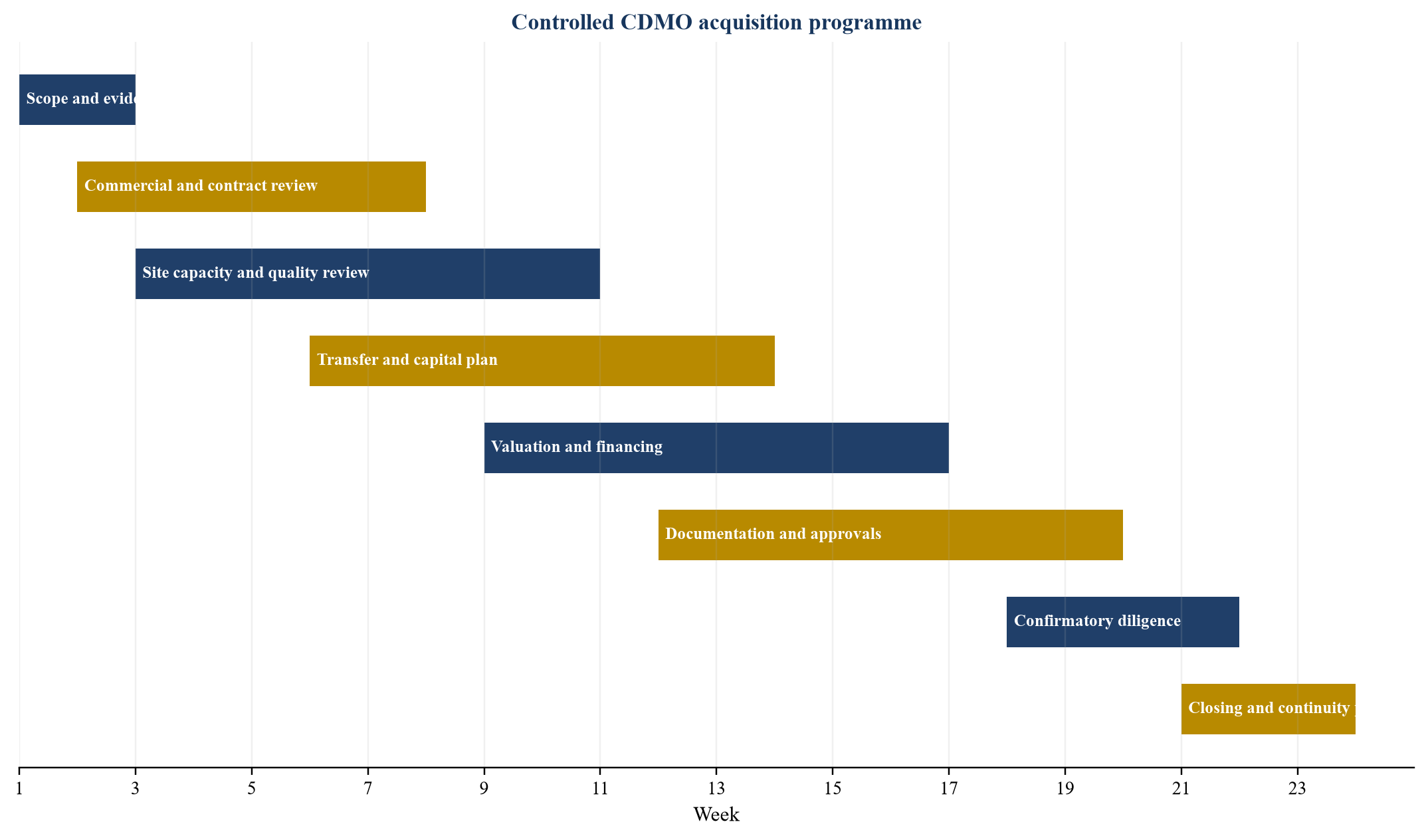
Timing is illustrative and depends on scope, access, regulatory review and transaction structure.
29. Present the investment committee decision
The committee paper should begin with the requested authority, price, financing, equity contribution, liquidity reserve and conditions. It should show the transaction perimeter, customer and product concentration, qualified capacity, regulatory status, remediation, capital and expected integration cost.
The operating case should separate base performance, price, utilisation, transfers, cost actions and attrition. The committee should receive a coherent downside with its cash requirement and covenant effect. It should also see which value depends on customer action, regulatory approval or successful qualification after closing.
The recommendation should assign each unresolved risk to price, contingent consideration, representation, indemnity, covenant, closing condition or post-close action. Approval should expire or return to committee when material facts, scope, financing or price change.
The committee should receive a sources-and-uses schedule that reconciles purchase price, fees, refinancing, remediation, integration, committed capital and minimum liquidity. It should also receive a debt-service case based on actual cash conversion and transfer timing. If the investment thesis depends on a subsequent acquisition, that acquisition should be shown as an option rather than included in base value. The board can then judge the first transaction on its own merits and preserve flexibility for later consolidation.
| Decision gate | Evidence required | Approval test | Response when the test fails |
|---|---|---|---|
| Demand durability | Orders, contracts, call-offs and product outlook | Central volume is supported by executable demand | Rebase revenue or defer consideration |
| Qualified capacity | Product schedules, validation and full-route bottlenecks | Forecast output fits sustainable capacity | Fund qualification or reduce volume |
| Quality control | Inspection, deviation, corrective-action and management evidence | Systems support reliable and compliant supply | Require remediation, reserve or condition |
| Concentration | Customer and product downside with replacement timing | Liquidity survives loss or delay of major exposure | Reduce leverage or price |
| Capital plan | Maintenance, compliance, transfer and growth projects | Required cash is funded with contingency | Increase equity and liquidity reserve |
| Integration | Controlled plan, owners, dependencies and customer consents | Continuity is protected through closing and transition | Phase changes or narrow perimeter |
Thresholds and responses should be tailored to the transaction, product portfolio and regulatory perimeter.
30. Make the decision
A CDMO consolidation can proceed when demand is supported by product-level evidence, contracts and switching costs justify the retention case, qualified capacity can execute the forecast, quality systems support reliable supply, and remediation and integration are fully funded. The valuation should remain financeable under a coherent downside.
The buyer should reduce price, defer consideration or narrow the perimeter when backlog lacks commitment, concentration is high, capacity is unqualified, compliance remediation is uncertain, critical skills are scarce or transfer benefits depend on unsupported timing. These responses connect payment to evidence.
The final approval should also identify the evidence that could reverse the recommendation before closing. A new inspection outcome, material deviation, customer termination, failed validation batch, capital overrun or financing change can alter value and liquidity. Management should maintain a dated bring-down checklist and route each event to the responsible workstream, valuation owner and legal team. The board should receive a revised case when the effect exceeds its approved tolerance. This keeps the transaction decision connected to current operating evidence through signing, closing and the first post-close review.
The strongest consolidation thesis is operationally specific. It identifies which products use which lines, which customers remain, which transfers occur, which capital projects are required, and how quality and cash will be controlled. Specialist regulatory, quality, engineering, legal, tax, accounting, environmental and valuation advisers should assess the relevant evidence and transaction documents.
The recorded decision should remain available for later portfolio review, lender reporting, impairment testing and accountability for the operating assumptions approved at acquisition.
Sources
- United States Food and Drug Administration, CDER Quality Management Maturity. Read the primary source
- United States Food and Drug Administration, Quality Metrics for Drug Manufacturing. Read the primary source
- United States Food and Drug Administration, Pharmaceutical Inspections and Compliance. Read the primary source
- European Medicines Agency, EudraGMDP database and GMP compliance resources. Read the primary source
- International Council for Harmonisation, ICH Q10 Pharmaceutical Quality System. Read the primary source
- International Council for Harmonisation, ICH Q12 Technical and Regulatory Considerations for Pharmaceutical Product Lifecycle Management. Read the primary source
- European Medicines Agency, Good manufacturing practice and good distribution practice questions and answers. Read the primary source
- World Health Organization, Good Manufacturing Practices. Read the primary source
- World Health Organization, Quality assurance of pharmaceuticals, Volume 2, Good manufacturing practices and inspection, 10th edition, 2024. Read the primary source
- International Council for Harmonisation, ICH Q7 Good Manufacturing Practice Guide for Active Pharmaceutical Ingredients. Read the primary source
- International Council for Harmonisation, ICH Q9(R1) Quality Risk Management. Read the primary source
- International Council for Harmonisation, ICH Q13 Continuous Manufacturing of Drug Substances and Drug Products. Read the primary source
- United States Food and Drug Administration, Facts About Current Good Manufacturing Practice. Read the primary source
- United States Food and Drug Administration, Drug Shortages, Root Causes and Potential Solutions. Read the primary source
- United States Food and Drug Administration, Data Integrity and Compliance With Drug CGMP. Read the primary source
- European Commission, EudraLex Volume 4, EU Guidelines for Good Manufacturing Practice. Read the primary source
- World Health Organization, TRS 986 Annex 2, WHO good manufacturing practices for pharmaceutical products, main principles. Read the primary source
- United States Food and Drug Administration, Drug Establishments Current Registration Site. Read the primary source
- United States Food and Drug Administration, Drug Establishment Current Registration Site and inspection data resources. Read the primary source
- Thermo Fisher Scientific, 2025 Annual Report on Form 10-K. Read the primary source
- IFRS Foundation, IFRS 3 Business Combinations and IAS 36 Impairment of Assets. Read the primary source
- United States Department of Justice and Federal Trade Commission, 2023 Merger Guidelines. Read the primary source
