

1. Give the chief executive a precise transformation mandate
The chief executive needs a mechanism that connects strategy to the decisions made each week. A transformation office can provide that mechanism when its mandate is narrow and explicit. It should maintain the strategic outcome map, govern the initiative portfolio, prepare decision evidence, coordinate dependencies, track benefits and preserve the record. It should not absorb the operating authority of line executives or the oversight authority of the board.
The mandate begins with outcomes. A strategy framed as growth, efficiency, digital leadership or customer centricity remains too broad for execution. Management should state the small number of enterprise outcomes that would demonstrate the strategy in operation. Each outcome needs a defined measure, baseline date, target range, time horizon, accountable executive and principal constraints. The target can express an ambition; delivery reporting should continue to distinguish approved assumptions from observed results.
The G20/OECD Principles of Corporate Governance assign boards responsibility for strategic guidance, management oversight, performance objectives, major capital decisions, risk management and internal control within their scope.[1] The UK Corporate Governance Code 2024 likewise describes board responsibilities for risk management and internal control for companies within scope, including a Provision 29 declaration for financial years beginning on or after 1 January 2026.[2] These sources support a clear division between oversight and management. The chief executive leads execution under the applicable delegations. The board retains the responsibilities imposed by law, constitutional documents and its own reserved matters.
The transformation charter should therefore define:
1. the strategic outcomes and planning horizon; 2. the initiatives and decisions within the office's remit; 3. board, chief executive, executive and initiative-owner authorities; 4. approval, funding, evidence, escalation and stop gates; 5. finance, risk, legal, technology, people and assurance roles; 6. the weekly, monthly and quarterly operating rhythm; 7. data access, confidentiality and record-retention rules; and 8. the criteria for closing the office or transferring its routines into normal management.
The chief executive should chair the principal weekly review, because cross-functional trade-offs often require enterprise authority. The meeting should protect that authority for genuine choices. Routine updates, data cleaning and task chasing belong in preparation. A transformation office earns its place when it improves the speed and quality of decisions while keeping accountability with executives who control the work.
2. Translate strategy into an explicit outcome architecture
Strategy execution becomes measurable when management describes the causal path from resources and capabilities to operations, customers, economics and risk. Kaplan and Norton developed strategy maps and the Balanced Scorecard as ways to connect objectives, measures and initiatives across financial, customer, internal-process and learning perspectives.[3][4] Their work also emphasises executive leadership, translation, alignment, employee engagement and a continuing governance process.[4] The transformation office can adapt these ideas without treating a map as proof that every assumed causal link will hold.
A useful outcome architecture has four layers. The first states enterprise results such as sustainable cash generation, customer retention, resilience or a regulated service outcome. The second identifies operating drivers, including price realisation, conversion, service quality, asset availability or time to market. The third identifies enabling capabilities, including data, technology, process, skills and control. The fourth identifies initiatives and milestones. Every initiative should connect upward to a driver and outcome. Every outcome should connect downward to a funded response or be recognised as an unsupported aspiration.
Measures should combine results and drivers. A financial result often arrives after operational performance has already changed. A leading measure can support earlier action, yet it can also create false confidence when the assumed relationship is weak. Management should record the rationale for each link, the evidence available, the expected lag and the conditions that would invalidate the assumption.
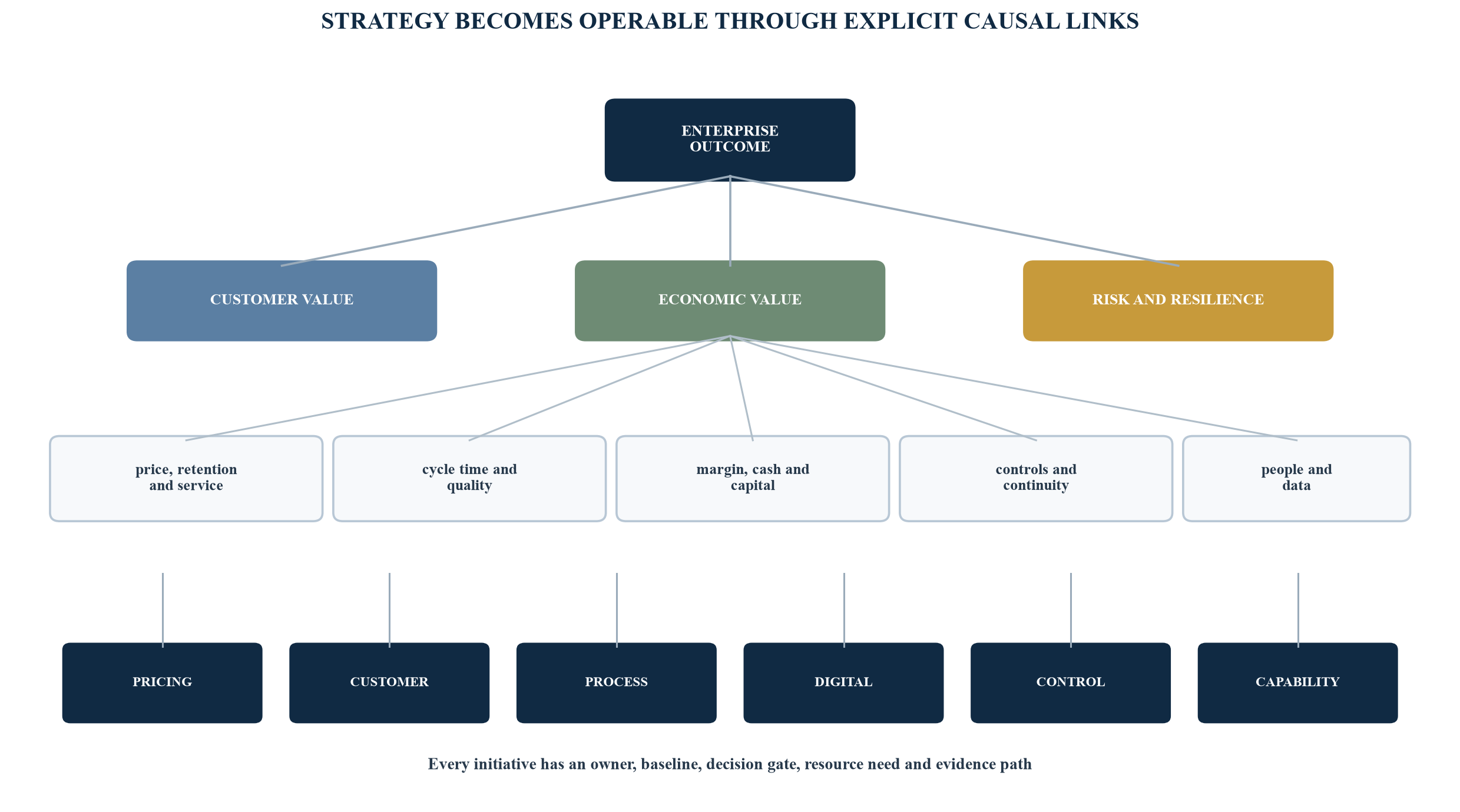
The links are a generic management model. Each organisation should retain only relationships supported by its strategy, operating evidence and approved assumptions.
The map should be version controlled. A strategic assumption can change after new market, customer, regulatory or technical evidence. Management should record the change, the decision-maker and the effect on initiatives and targets. Silent revision removes accountability and makes later benefit attribution unreliable.
3. Freeze a verified baseline and metric dictionary
An initiative cannot demonstrate movement without a reproducible starting point. The office should establish a baseline before approval, or define a time-bound action to complete it before funding becomes irreversible. The baseline should identify the period, perimeter, data source, owner, reconciliation, known limitations and treatment of seasonality, acquisitions, disposals, inflation and foreign exchange.
Metric definitions require equal discipline. Terms such as active customer, on-time delivery, qualified lead, productive hour, run-rate saving and cash benefit can carry different meanings across departments. The metric dictionary should define the numerator, denominator, exclusions, frequency, source system, control owner and restatement policy. Finance should own financial definitions. The relevant function should own operating source data. The office should maintain the cross-reference between them.
The baseline should also include capacity and constraints. Strategy can fail because the organisation lacks a specialist, a decision right, data access, regulatory approval or funding headroom. These facts belong beside financial and operating measures. They identify the constraint that the weekly cadence must resolve.
Table 1. Minimum transformation baseline and metric controls
| Evidence area | Baseline content | Reconciliation source | Accountable role |
|---|---|---|---|
| enterprise economics | revenue, margin, operating cost, cash, capex and capital constraints | controlled accounts, treasury and approved plan | chief financial officer |
| customer | volume, price, retention, service, complaints and concentration | contracts, invoices, CRM and service records | commercial executive |
| operations | capacity, throughput, quality, downtime and cycle time | operating systems and controlled logs | operations executive |
| people | critical roles, skills, vacancies, incentives and change load | HR records and approved organisation | chief people officer |
| technology and data | architecture, delivery capacity, data quality, access and resilience | service records, architecture and control evidence | technology executive |
| risk and control | principal risks, compliance duties, controls and unresolved findings | risk, legal, compliance and assurance records | designated control owners |
The fields are illustrative. Entity-specific reporting, regulatory and operating requirements may require additional evidence.
Where data is incomplete, management can approve a documented estimate for planning. The estimate should show method, source, sensitivity, owner and replacement date. It should remain distinct from observed evidence. A later correction should preserve the original value and the effect on the initiative case.
4. Build one portfolio from the strategic priorities
The transformation office should maintain one portfolio of initiatives within its mandate. Parallel lists maintained by functions, advisers and committees create duplicate benefits, hidden dependencies and competing resource claims. A controlled portfolio gives the chief executive a single view of what has been approved, designed, tested, implemented, paused or stopped.
ISO 21504:2022 provides guidance on project and programme portfolio management and calls for adaptation to the organisation's environment.[5] ISO 21505:2017 addresses governance of projects, programmes and portfolios and is intended for governing bodies, senior management, sponsors, steering committees, portfolio owners and project management offices.[6] These standards support a defined portfolio framework. The company still needs to calibrate that framework to its size, sector, governance and delivery methods.
Every proposed initiative should state its outcome link, baseline, executive owner, delivery lead, economic case, peak funding, capacity demand, dependencies, risk, evidence gates and first irreversible commitment. The portfolio entry should also show whether the work is mandatory. Safety, legal, regulatory, cybersecurity, liquidity and other essential actions may require approval even when a weighted commercial score is low.
Portfolio selection should expose constraints. A technology architect, pricing analyst, plant manager or legal specialist may appear in several business cases. Each initiative can look feasible in isolation while the combined portfolio exceeds available capacity. The office should maintain a resource heat map and sequence work around binding constraints.
The portfolio needs an intake rule. New ideas should enter through a short concept gate, compete for capacity, and receive an explicit decision. A chief executive can authorise an exception where urgency is documented. The exception should still acquire an owner, evidence path and review date. This discipline protects the portfolio from continuous expansion.
5. Put initiatives through economic and evidence gates
Approval should commit resources in stages. A concept gate tests strategic fit and the problem statement. A design gate tests the baseline, mechanism, options, cost, capacity and risks. A funding gate authorises a defined exposure. An implementation gate confirms readiness for an operating change. A benefit gate validates realised results. A close gate transfers durable controls and remaining actions to normal management.
The business case should separate profit, cash, capability and protected value. A sales initiative can improve revenue while increasing working capital. A digital programme can create a capability before measurable benefits arrive. A control remediation can protect an evidenced risk exposure without generating revenue. Combining these outcomes into one headline number removes decision-relevant information.
Table 2. Initiative gate and evidence standard
| Gate | Required evidence | Decision | Record retained |
|---|---|---|---|
| concept | strategic outcome, problem evidence and executive sponsor | reject, investigate or design | concept note and rationale |
| design | baseline, options, economics, capacity, dependencies and risks | redesign or prepare funding | approved assumptions and alternatives |
| funding | peak cash, resources, milestones, controls and stop conditions | fund, sequence, defer or stop | authority, exposure and conditions |
| implementation | testing, operating readiness, training and control evidence | release, pilot or hold | readiness evidence and exceptions |
| benefit | observed source data, attribution and finance validation | recognise, defer, reverse or investigate | benefit ledger and reconciliation |
| close | durable process, owner, controls, open risks and lessons | transfer or continue oversight | closure pack and residual actions |
Approval thresholds and authorities should follow the organisation's delegations, financing arrangements and regulatory obligations.
An evidence gate should answer a specific question. A customer pilot can test willingness to adopt a new proposition. A system test can establish technical readiness. A signed contract can support price and volume assumptions, while collection remains subject to delivery, billing and credit. The office should avoid treating the completion of an activity as evidence of the intended economic outcome.
Cost to achieve should include internal time, external support, systems, capex, working capital, restructuring and transition effects where relevant. The model should show the timing of cash separately from accounting effects. It should also show reversibility. A pilot can often be stopped at limited cost; a signed long-term contract, completed restructuring or major technology cutover can change the exposure materially.
6. Design the transformation control tower
The control tower is the office's integrated view of outcomes, initiatives, benefits, dependencies, capacity, risks and decisions. Its purpose is to direct attention. It should not reproduce every project plan or operational dashboard. Detailed records remain with the teams that own them.
The control tower can be built around seven linked registers: the outcome map, initiative portfolio, milestone plan, resource map, risk and dependency register, benefit ledger and decision log. A common initiative identifier and metric dictionary connect the records. Changes should update every affected view through a controlled process.
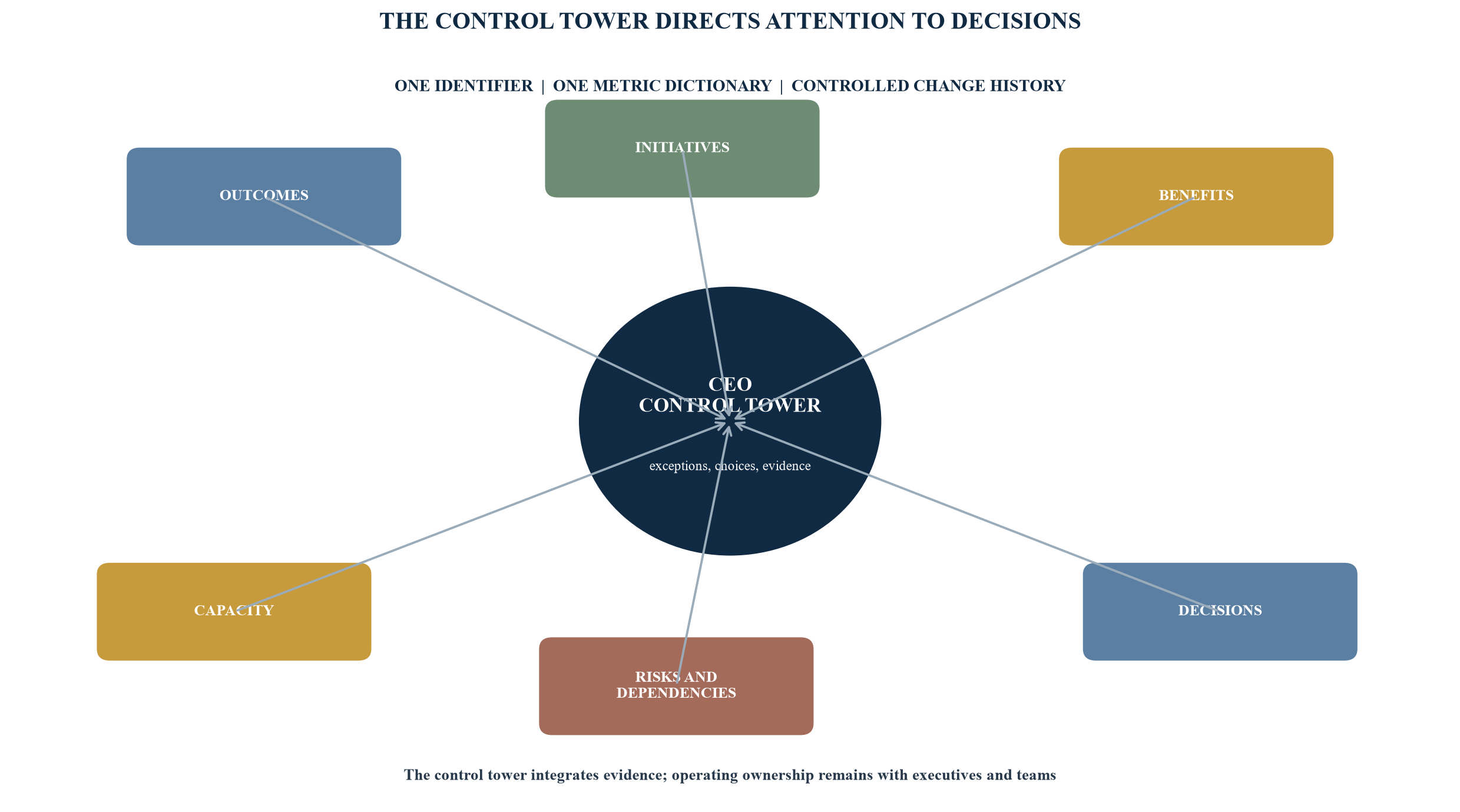
The architecture is illustrative. Technology, access and control design should reflect organisational scale, data sensitivity and existing systems.
The office should reconcile the control tower before the weekly agenda is issued. Finance validates benefit and cash changes. Initiative owners attest to milestones and forecasts. Risk and control functions review material exceptions within their mandate. The office records unresolved data issues separately from delivery failures.
Access should follow need and authority. Transformation data can contain customer, employee, pricing, legal, security and market-sensitive information. The control tower should use approved systems, named access roles, retention rules and change logs. A convenient spreadsheet does not remove the organisation's information-security and privacy obligations.
7. Allocate decision rights before the meeting
The weekly cadence can only move quickly when the organisation knows who may decide. The transformation charter should map decisions across initiative owners, executives, the chief executive, board committees, the board and shareholders. It should also identify consultation and evidence requirements.
A decision-rights map should cover funding, scope, customer commitments, pricing, organisation changes, technology architecture, data use, supplier commitments, capital expenditure, risk acceptance, accounting treatment and public communications. Actual authority comes from law, constitutional documents, board resolutions, shareholder arrangements, financing documents, policies and delegations. The office records these sources; it does not create authority by publishing a matrix.
Table 3. Illustrative decision-rights map for a transformation portfolio
| Decision | Initiative owner | Executive committee | Chief executive | Board or committee |
|---|---|---|---|---|
| routine action within approved case | decides and records | informed through portfolio | informed by exception | receives agreed reporting |
| cross-functional resource conflict | recommends resolution | tests enterprise effect | decides within delegation | decides reserved matters |
| material funding or scope change | prepares evidence | recommends priority | approves within delegation | approves reserved exposure |
| risk acceptance | proposes treatment | obtains control challenge | decides within authority | approves material retained risk where required |
| benefit recognition | provides source evidence | reviews operating effect | uses validated view | receives finance-approved reporting |
| initiative stop | recommends or escalates | tests consequences | stops within authority | addresses reserved or strategic effects |
The allocation is a management example. Each entity should verify the applicable legal and governance sources before use.
The chief executive should expect disagreements to reach the meeting in a decision-ready form. The paper should state the question, evidence, options, consequences, recommendation, authority and latest useful decision date. A disputed issue without alternatives remains a discussion topic. The office should return it for preparation unless delay itself requires an immediate choice.
8. Run a weekly cadence built around exceptions
The weekly cycle begins before the meeting. Initiative owners submit evidence and forecast changes at a fixed cut-off. Finance and relevant control functions validate material changes. The office identifies exceptions, groups related choices and issues a concise agenda. The chief executive review makes decisions, assigns actions and records the result. Owners then communicate and execute the approved action.
The agenda should focus on outcome variance, milestone variance, resource conflicts, unresolved dependencies, material risks, benefit changes and decisions whose timing affects value. Stable initiatives can remain visible in the control tower without consuming discussion time. A rotating deep dive can test one strategic assumption or initiative in detail.
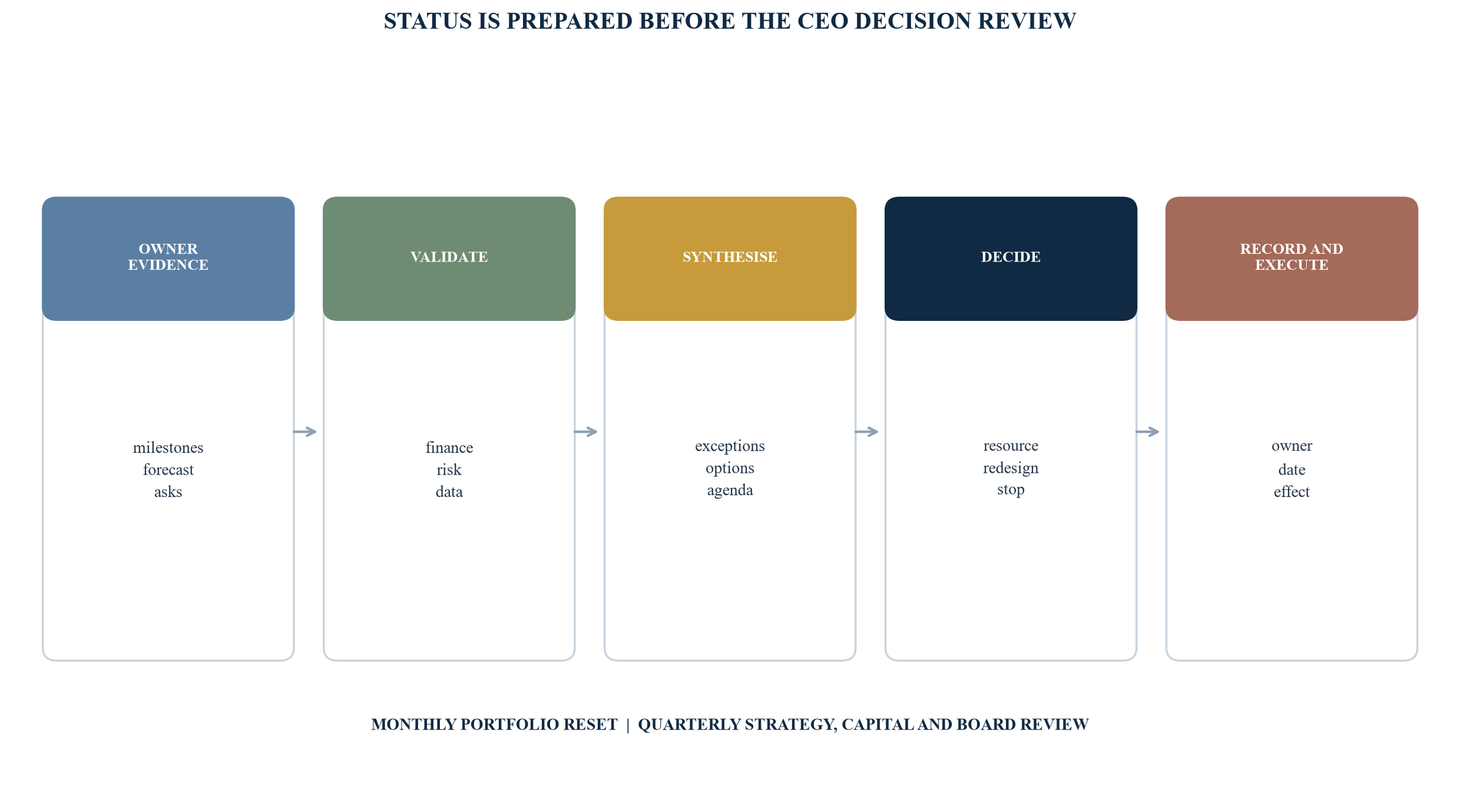
Days and meeting frequency are illustrative. The sequence should reflect the organisation's reporting cycle and decision needs.
Meeting discipline requires a fixed timebox and an explicit decision at the end of each item. Available decisions can include approve, reject, request defined evidence, redesign, sequence, escalate or stop. A request for more analysis should state the exact question, owner and date. Repeated deferral should become an exception because delay consumes time and may change the economics.
The monthly review should reset the portfolio, capacity and forecast. The quarterly review should revisit strategic assumptions, capital allocation, aggregate benefits, principal risks and board matters. Annual planning can then use the same evidence system instead of creating a separate transformation narrative.
9. Preserve every material decision and its rationale
Transformation programmes lose continuity when decisions remain in presentation decks, inboxes or personal notes. A controlled decision log should capture the issue, evidence date, options, decision, authority, rationale, conditions, accountable owner, deadline, financial effect, risk effect and next review. The record should link to the initiative and source documents.
The log supports action and learning. It tells teams what changed and why. It allows the chief executive to identify recurring bottlenecks, unclear delegations and assumptions that repeatedly fail. It also gives the board, finance, auditors and future management a coherent history where they have authority to review it.
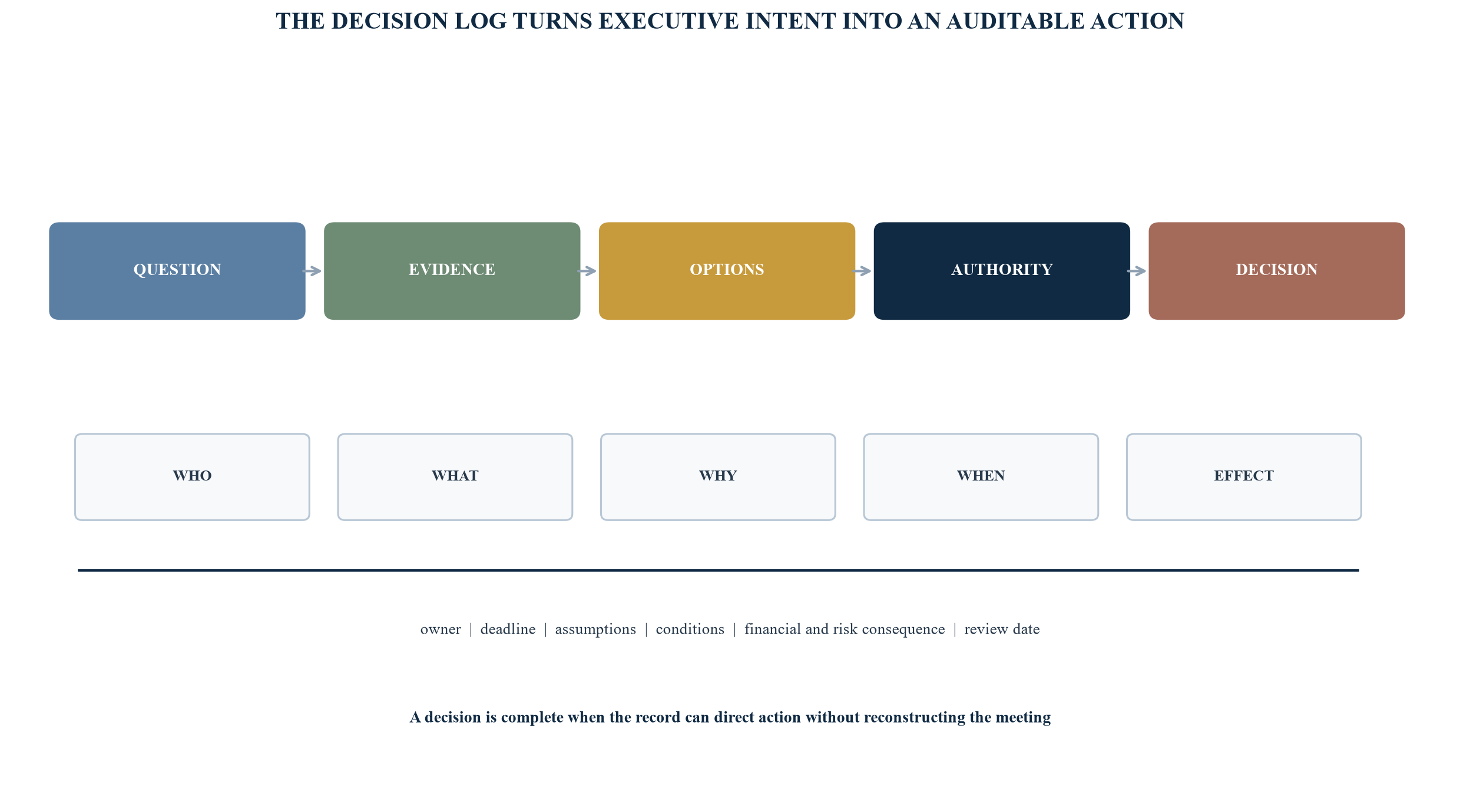
The flow is illustrative. Legal privilege, confidentiality, market disclosure and record-retention requirements need entity-specific treatment.
The office should record superseded decisions and preserve the prior state. A new decision can be correct because facts changed. The history should show those facts and the revised authority. Deleting the old record prevents later understanding of variance and can conceal weak assumptions.
10. Manage dependencies and scarce capacity as enterprise constraints
Many transformation delays occur between initiatives. A pricing change may depend on data cleanup, contract rights, system configuration, training and customer communication. A supply-chain change may depend on product specifications, supplier qualification and working-capital capacity. The control tower should represent these dependencies as owned deliverables with due dates and consequences.
The office should distinguish three types of constraint. A hard constraint includes law, safety, financing, technical architecture or an external approval. A capacity constraint includes scarce people, budget or operational downtime. An assumption constraint includes unresolved customer response, technology performance or benefit causality. The response differs for each type.
Critical resources should be planned across the portfolio. Allocating a person at twenty per cent to five initiatives can appear arithmetically complete while leaving no uninterrupted time for complex work. The office should consider calendar capacity, specialist depth, business-as-usual load and decision lead times. Sequence should be an explicit portfolio choice.
Management routines also affect the information available for delegation. Bloom, Eifert, Mahajan, McKenzie and Roberts conducted a randomised field experiment in Indian textile plants and reported productivity improvement, greater decentralisation and increased use of computers after adoption of defined management practices.[13] The sample, intervention and period differ from a current GCC transformation, so the reported effects should not be transferred into an initiative forecast. The study supports the narrower proposition that operating information and disciplined routines can change how managers coordinate and delegate. Each organisation still needs its own baseline and controlled test.
ISO 21502:2020 provides guidance for project management that can be adapted across organisations and delivery approaches.[7] PMI's 2024 research reports that predictive, hybrid and agile approaches can all perform effectively when used in a fit-for-purpose way.[8] The transformation office should therefore govern outcomes, evidence and interfaces while allowing delivery teams to use methods suited to their work.
11. Recognise benefits through a controlled ledger
The benefit ledger connects delivery to enterprise outcomes. It should preserve the approved case and show forecast, implemented, realised, cash-realised and durable benefits separately. Finance should approve recognition rules before implementation. The initiative owner supplies operating evidence. The office prevents duplication and maintains the change history.
Benefits can be direct, enabled or protected. Direct benefits affect observed revenue, cost, working capital or capital expenditure. Enabled benefits create a capability used by another initiative; they should not be added again to the direct result. Protected value addresses an evidenced risk or loss exposure and should remain separate from realised profit and cash.
Attribution requires a counterfactual. Management should state what would have happened without the initiative and how it will adjust for volume, price, mix, inflation, foreign exchange, seasonality, acquisitions, disposals and interactions. The counterfactual is an assumption. Confidence should reflect evidence quality and should never convert an estimate into an observed result.
Table 4. Benefit-ledger recognition and governance rules
| Status | Required evidence | Reported treatment | Management response |
|---|---|---|---|
| approved case | authorised baseline, assumptions, cost and timing | approved potential only | reserve capacity and set gates |
| implemented | action complete and operating control active | forecast path remains separate | test adoption and adverse effects |
| realised | controlled source data supports movement against baseline | gross and net result with attribution | finance validates and records variance |
| cash realised | bank, treasury or working-capital evidence supports cash effect | reconcile profit and cash timing | confirm liquidity and reversibility |
| durable | repeated periods and embedded controls support continuation | show run rate with remaining limitations | transfer control and preserve evidence |
The rules are illustrative management controls. Accounting recognition follows applicable standards, policies and professional judgement.
IFRS 18 is effective for annual periods beginning on or after 1 January 2027, with earlier application permitted, and includes requirements concerning management-defined performance measures used in public communications and their reconciliation.[9] An internal transformation measure is not automatically within that definition. The standard reinforces the value of stable definitions and reconciliations where a measure enters external communication. Accounting advice should determine scope and presentation.
The ledger should record reversals. A price benefit can disappear through discounting or customer loss. A working-capital release can reverse in a seasonal peak. A cost reduction can return through contractors or overtime. Durable value requires evidence that the operating process and control have changed.
12. Use a benefits dashboard that preserves uncertainty
The chief executive needs a compact view of outcomes and evidence. The dashboard should separate actual results, forecast, confidence and decision need. It should display financial and non-financial outcomes together without collapsing them into a single index that conceals trade-offs.
Figure 5 presents an illustrative dashboard for five initiatives. All values and thresholds are hypothetical. The dashboard shows benefit stage, cash effect, delivery confidence and the next decision. It is a management example, not a forecast.
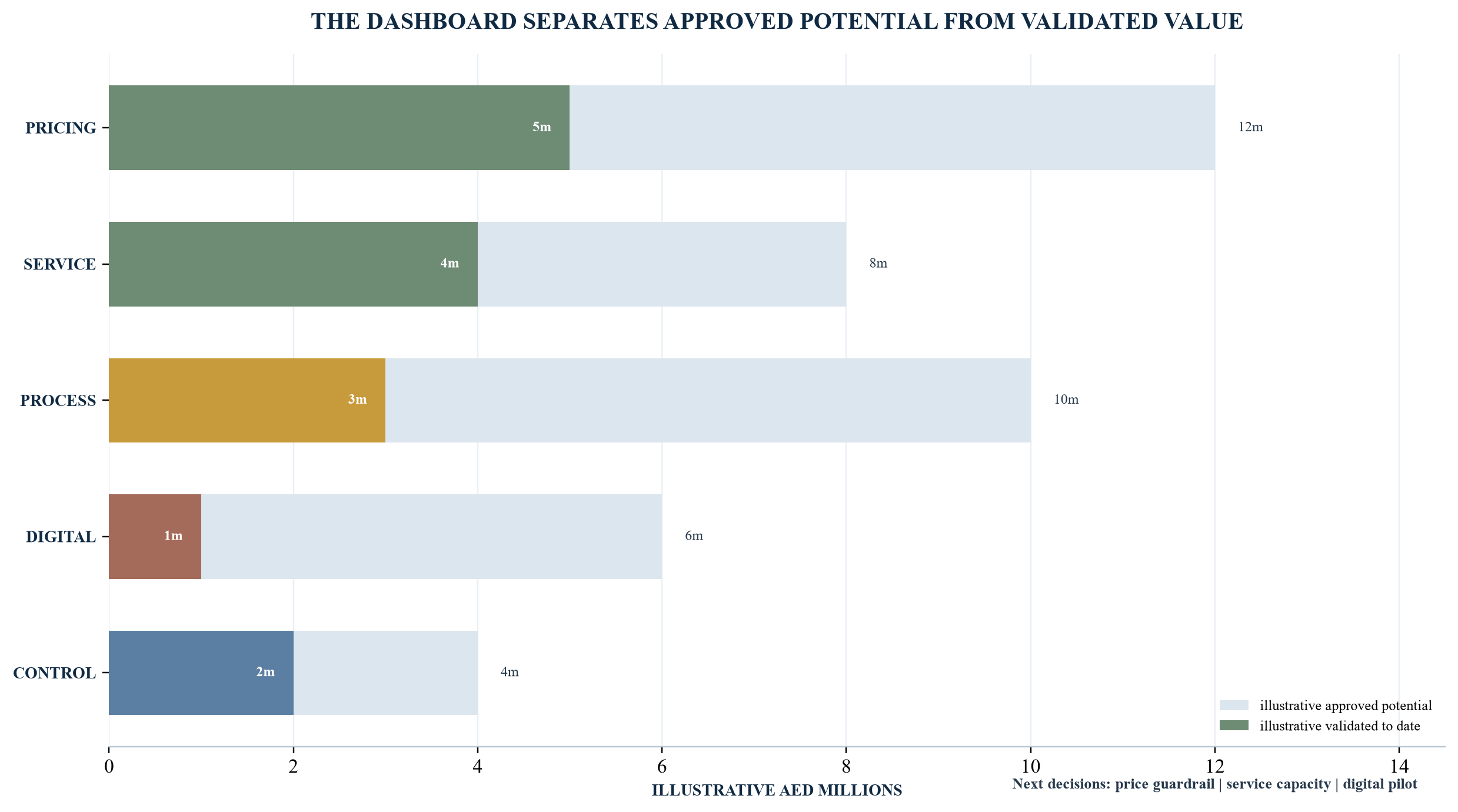
All values, status judgements and thresholds are hypothetical management assumptions. They do not forecast delivery or financial performance.
The dashboard should surface negative effects. Customer complaints, employee attrition, control failures, downtime, data incidents and cash strain can invalidate a headline benefit. A balanced decision view shows these measures beside the economic result and makes the tolerance explicit.
PMI's 2024 research on project success defines success through value and execution and reports research based on 10,000 project professionals and 150 interviews.[10] Its result supports measuring desired outcomes as well as schedule, budget and scope. Those survey findings describe a broad sample; they do not predict any one initiative. The office should use organisation-specific evidence.
13. Separate management control from risk and assurance
The transformation office operates within management. It should coordinate risk and control evidence, but it should not represent its own monitoring as independent assurance. COSO's enterprise-risk framework emphasises integrating risk with strategy and performance.[11] Risk thinking should therefore enter initiative design, portfolio selection and executive decisions rather than appear only in a separate register.
The Institute of Internal Auditors' current Statements of Position describe the Three Lines Model and the respective contributions of management, risk and compliance functions, and independent internal audit.[12] The model supports collaboration and coordination while preserving internal audit's independence and objectivity. An internal audit review can assess governance, risk management and controls within its approved mandate. It should not own the initiative or validate benefits it is expected to assure independently.
The office should maintain an assurance map for material outcomes and risks. The map identifies management controls, second-line monitoring, internal audit work and external assurance where applicable. It helps the chief executive and board identify overlap and gaps. It also prevents the weekly pack from using the word validated when the work performed only established management agreement.
Control requirements should be proportional to the decision. A low-cost reversible experiment may require a narrow evidence set. A customer migration, workforce restructuring, major system cutover or capital commitment requires deeper legal, technical, financial, people and control review. The gate should match the exposure.
14. Apply the model to an illustrative GCC transformation
Consider a hypothetical GCC-headquartered services group with operations in three markets. Management's strategy assumes improved customer retention, faster service delivery, digital self-service, lower process cost and stronger control evidence over thirty months. The group has inconsistent data definitions, several legacy systems and limited programme capacity. These facts describe an illustrative scenario only.
The chief executive approves five enterprise outcomes and creates a twelve-month transformation portfolio. The office maps eight initiatives to those outcomes, then identifies a shared dependency on customer master data and a shortage of process designers. Management sequences the customer-data foundation ahead of two digital releases and limits the first wave to five initiatives.
Table 5. Illustrative transformation portfolio and decision gates
| Initiative | Illustrative approved exposure | Outcome link | Next evidence gate | Principal limitation |
|---|---|---|---|---|
| pricing discipline | AED 3m | margin and customer value | realised price, retention and collections | competitive and customer response |
| service redesign | AED 7m | cycle time and quality | controlled pilot and service evidence | operational disruption and adoption |
| digital self-service | AED 18m | customer effort and process cost | usability, security and controlled release | integration, data and channel shift |
| customer-data foundation | AED 9m | enabling capability | data ownership, quality and migration test | benefit arises through other initiatives |
| control remediation | AED 5m | risk and resilience | control design and operating evidence | protected value is not realised profit |
All amounts, timing, confidence and outcomes are hypothetical management assumptions. The table is not a forecast or investment recommendation.
The first weekly cycles identify three decision types. The pricing initiative needs an approved customer-exception guardrail. The digital programme needs scarce architecture capacity. The control initiative needs clarity on ownership between operations and compliance. Each item reaches the chief executive with evidence, alternatives and authority.
After six hypothetical months, finance validates AED 5 million of gross annualised pricing movement, AED 2 million of associated commercial and system costs, and no durable cash conclusion because collections evidence is incomplete. The dashboard therefore shows AED 3 million of net realised movement and a separate collection gate. The values remain scenario assumptions used to demonstrate recognition discipline.
The scenario could deliver less through customer loss, data error, slower adoption, technology failure, staff turnover, regulation, supply constraints, economic conditions or poor execution. It could deliver more. The portfolio and dashboard cannot establish the result in advance.
15. Launch the office in twelve weeks and embed the discipline
Weeks 1 and 2 establish the charter. The board and chief executive confirm the applicable authorities. Management states the strategic outcomes, names accountable executives and defines the office's information and escalation rights. Finance, legal, risk, technology and people leaders identify mandatory controls.
Weeks 3 and 4 build the strategy-to-initiative map and baseline. The office reconciles the approved strategy with current operating and financial evidence. Metric definitions, source owners, limitations and assumption changes are recorded. Unsupported objectives receive an explicit action or are removed from the first portfolio.
Weeks 5 and 6 create initiative cases and the resource map. Each initiative states the mechanism, options, cost, peak cash, milestones, capacity, dependencies, risk, first irreversible commitment and evidence gates. Finance tests economics and cash timing. Control functions assess the matters within their mandate.
Weeks 7 and 8 select the portfolio. Management exposes resource conflicts and mandatory work. The chief executive and board approve funding through their delegations. The office creates the control tower, benefit ledger, decision log and controlled evidence repository.
Weeks 9 and 10 run two live weekly cycles. Owners submit evidence before the cut-off. The office issues a decision agenda. The chief executive resolves enterprise constraints, records the choices and assigns actions. Measures that do not affect a decision move out of the executive pack.
Weeks 11 and 12 complete the first monthly reset and board review. Management presents outcome movement, initiative health, benefits, cash, capacity, dependencies, material risks and decisions due. The board reviews the matters within its remit and records further evidence required.
The twelve-week sequence establishes the operating system; it does not promise completion of the transformation. Initiative delivery and benefit horizons depend on the work, evidence, capacity and external conditions. The office should continue only while it adds decision value. Stable routines should transfer into normal planning, performance, finance and risk processes. Remaining strategic exceptions can stay under chief executive review.
The office has succeeded when strategy has become a repeatable management discipline. Outcomes have definitions. Initiatives have owners and gates. Capacity follows priority. The weekly meeting decides. Finance validates benefits. Control functions perform their roles. Decisions and evidence remain accessible. This system gives the chief executive, board and management team a shared basis for converting strategic intent into governed action.
References
- [1] OECD, G20/OECD Principles of Corporate Governance 2023, Chapter V: The Responsibilities of the Board. https://www.oecd.org/en/publications/g20-oecd-principles-of-corporate-governance-2023_ed750b30-en/full-report/component-8.html
- [2] Financial Reporting Council, UK Corporate Governance Code 2024. https://www.frc.org.uk/library/standards-codes-policy/corporate-governance/uk-corporate-governance-code/
- [3] Robert S. Kaplan and David P. Norton, Having Trouble with Your Strategy? Then Map It, Harvard Business Review, September-October 2000. https://hbr.org/2000/09/having-trouble-with-your-strategy-then-map-it
- [4] Robert S. Kaplan, Conceptual Foundations of the Balanced Scorecard, Harvard Business School, 2010. https://www.hbs.edu/ris/Publication%20Files/10-074_0bf3c151-f82b-4592-b885-cdde7f5d97a6.pdf
- [5] International Organization for Standardization, ISO 21504:2022, Project, programme and portfolio management: Guidance on portfolio management. https://www.iso.org/standard/82867.html
- [6] International Organization for Standardization, ISO 21505:2017, Project, programme and portfolio management: Guidance on governance. https://www.iso.org/standard/63578.html
- [7] International Organization for Standardization, ISO 21502:2020, Project, programme and portfolio management: Guidance on project management. https://committee.iso.org/sites/tc258/home/projects/published/iso-21502.html
- [8] Project Management Institute, The Future of Project Work: Pulse of the Profession 2024. https://www.pmi.org/learning/thought-leadership/future-of-project-work
- [9] IFRS Foundation, IFRS 18 Presentation and Disclosure in Financial Statements. https://www.ifrs.org/issued-standards/list-of-standards/ifrs-18-presentation-and-disclosure-in-financial-statements/
- [10] Project Management Institute, Maximizing Project Success: What is Project Success?, 2024. https://www.pmi.org/learning/thought-leadership/project-success
- [11] Committee of Sponsoring Organizations of the Treadway Commission, Enterprise Risk Management: Integrating with Strategy and Performance. https://www.coso.org/enterprise-risk-management
- [12] The Institute of Internal Auditors, Statements of Position and the Three Lines Model. https://www.theiia.org/en/resources/statements-of-position/
- [13] Nicholas Bloom, Benn Eifert, Aprajit Mahajan, David McKenzie and John Roberts, Does Management Matter? Evidence from India, NBER 16658, 2011; Quarterly Journal of Economics 128(1), 2013. https://www.nber.org/papers/w16658
- [14] Project Management Institute, Pulse of the Profession 2026. https://www.pmi.org/-/media/pmi/documents/public/pdf/learning/thought-leadership/pulse-of-the-profession_2026_pdf.pdf
- [15] Securities and Commodities Authority of the UAE, Annual Report 2024, corporate governance developments. https://www.sca.gov.ae/assets/download/27cc1e3b/sca-annual-report-english-2024.aspx
- [16] Capital Market Authority of Saudi Arabia, Corporate Governance Regulations. https://cma.org.sa/en/RulesRegulations/Regulations/Documents/CorporateGovernanceRegulations1.pdf
About the Author
Chennakeshav Adya is an independent researcher whose work focuses on corporate finance, value creation, private capital and transaction execution. His research translates financial, commercial and operating evidence into decision frameworks for boards, investors and management teams.
Appendix A: Transformation-office charter checklist
- Confirm the strategic outcomes, planning horizon, executive owners and board oversight.
- Verify decision authorities against law, constitutional documents, delegations, financing arrangements and policy.
- Maintain one outcome map, initiative portfolio, metric dictionary, benefit ledger, decision log and evidence repository.
- Assign each initiative a baseline, owner, business case, capacity view, dependencies, evidence gates and stop conditions.
- Separate profit, cash, capability and protected value; preserve approved assumptions and later changes.
- Schedule weekly exception decisions, monthly portfolio resets and quarterly strategy and board reviews.
Appendix B: Weekly decision-pack checklist
- Outcome movement and changes in the assumptions that connect strategy to initiatives.
- Initiative exceptions, forecast changes, milestones, capacity conflicts and dependencies.
- Benefits by approved, implemented, realised, cash-realised and durable stage.
- Material customer, people, technology, control, liquidity and regulatory effects.
- Decision question, evidence date, alternatives, recommendation, authority and latest useful decision date.
- Recorded owner, deadline, financial effect, risk effect, communication action and next review.
