

1. INTRODUCTION
A principal can establish a home, business routine and economic life in the United Arab Emirates while a child continues school in London. The family may retain its London home, a spouse may remain there during term, and the principal may commute for weekends, school events and holidays. Those arrangements are often driven by continuity and family welfare. They also create facts that must be tested under the United Kingdom's Statutory Residence Test.
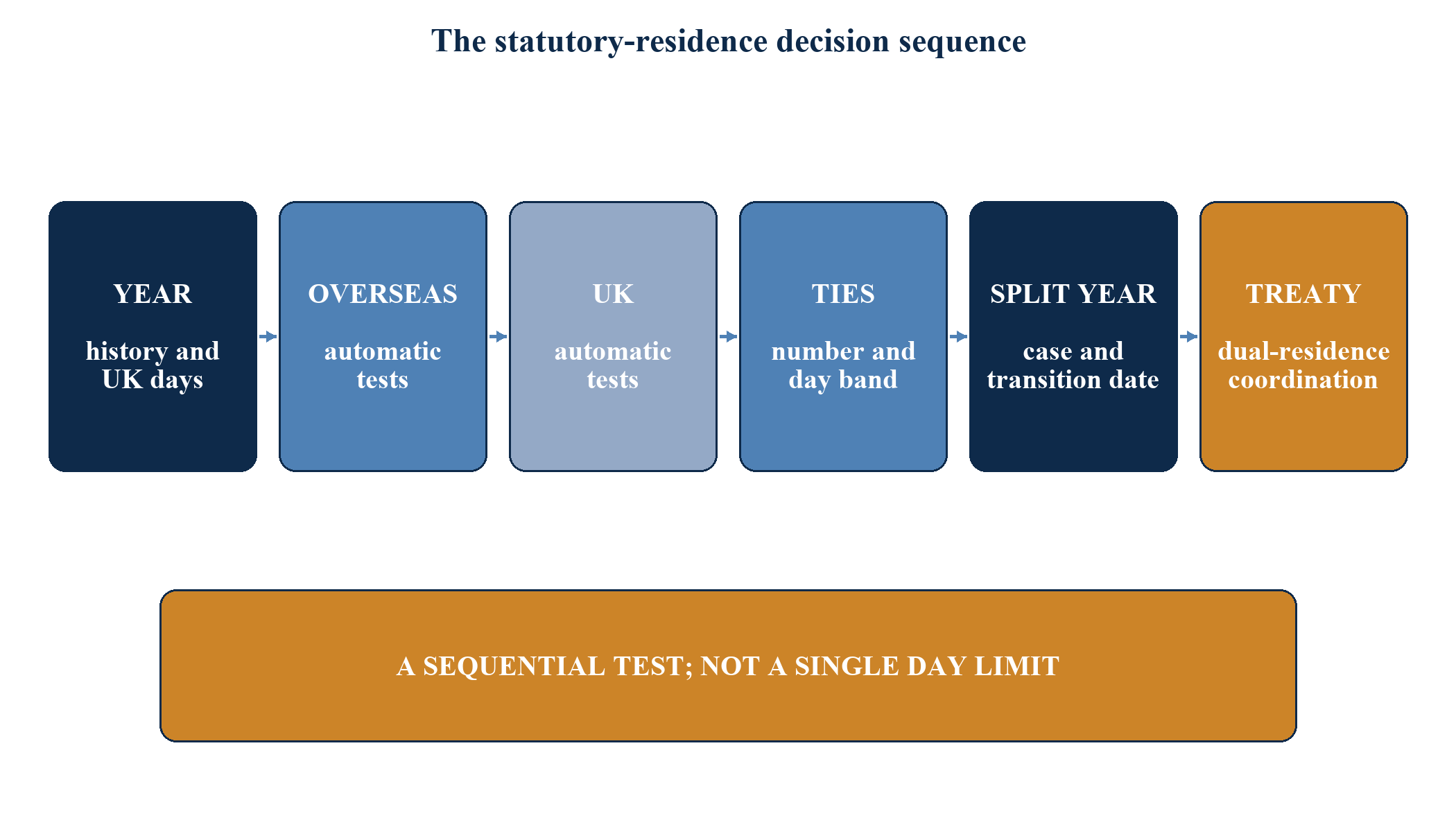
The legal analysis is sequential. Automatic overseas tests are considered before automatic UK tests and the sufficient-ties test. The result depends on the tax year, the person's recent residence history, UK days, work pattern, homes and connections. A child remaining in UK education is one component of that analysis. The child's age, residence, education and contact with the parent determine whether a family tie arises through that child. A UK-resident spouse or partner can create a separate family tie. A retained home, UK work and previous presence can create other ties.
This paper converts those rules into an operating framework. It begins with the statutory decision sequence, then examines the family tie, the full-time-education exception, homes, workdays, historic ties, day counting, split-year treatment, UAE residence and the UK-UAE treaty. It proposes one integrated calendar that reconciles school terms, parent-child contact, travel, UK midnights, workdays and home use.
The central proposition is that family continuity and residence control require the same discipline: accurate dates, clear responsibilities and early decisions. A plan based only on an annual UK-day allowance can fail because a workday, family contact day, accommodation fact or prior-year tie changes the applicable threshold. Monthly forecasting gives the family time to revise travel and work arrangements before a threshold is crossed.
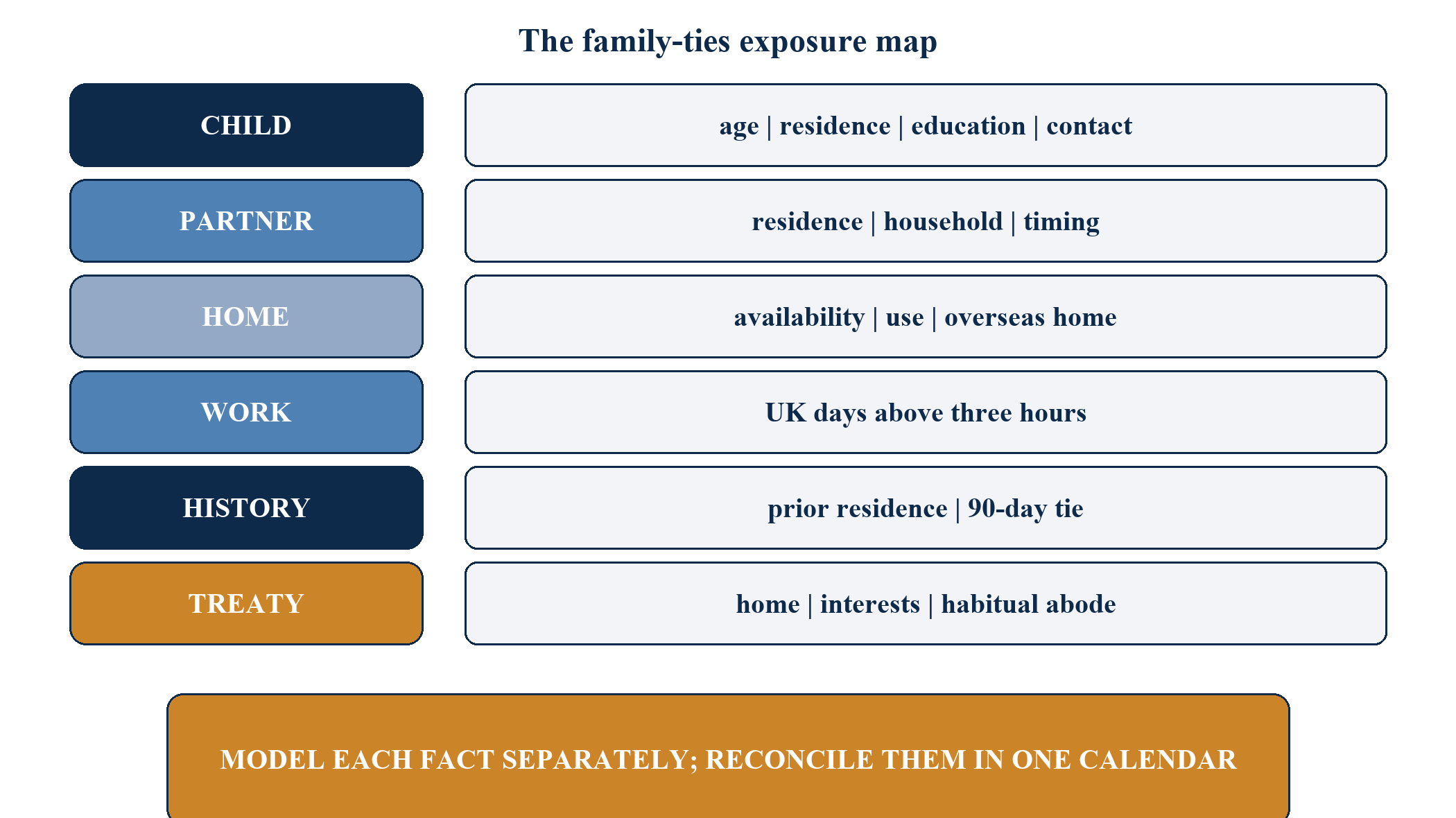
2. WHY CHILDREN CHANGE THE RESIDENCE MODEL
2.1 A child is a fact, not a conclusion
The presence of a child in the United Kingdom does not by itself establish that a parent is UK resident. HMRC's guidance asks whether the child is under 18, UK resident in the relevant year and within the detailed family-tie rules [3]. It also contains specific provisions for a child in full-time UK education and for the amount of in-person contact between parent and child [3,4]. Each condition requires evidence.
The child's position can alter travel. A parent may visit for half-term, sports, medical appointments, parents' evenings, open days or unexpected pastoral issues. A day trip can count as a contact day even when it is not a UK presence day under the ordinary midnight rule. A weekend can also include more than three hours of UK work. The family calendar therefore affects several statutory tests at once.
2.2 The household may contain several residence outcomes
Every family member has a separate residence analysis. A spouse can remain UK resident while the principal becomes non-UK resident. A child can be UK resident because of education while another child studies overseas. An adult child is outside the under-18 family-tie rule, although the adult child's home can still matter if accommodation is available to the principal. Household summaries should preserve these person-specific conclusions.
The family office or personal office should maintain a row for each person. The row should record age, relationship, residence position, school or university location, homes, contact days and relevant changes. Private educational and medical detail should remain outside the general tax calendar unless it is necessary to support a dated event.
2.3 Plans change during the year
A school place can change, a spouse can move, a child can turn 18, or the family can begin using the London home differently. Residence analysis follows facts during the tax year. A year-opening memorandum should therefore be refreshed whenever a material family fact changes. The refresh should state the change date, the affected test, the remaining headroom and the advice obtained.
3. THE STATUTORY-RESIDENCE DECISION ARCHITECTURE
3.1 A sequential annual test
HMRC's current guidance describes the Statutory Residence Test as a sequence of automatic overseas tests, automatic UK tests and the sufficient-ties test [1]. The sequence is applied for each tax year and each person. Recent UK residence matters because some automatic-overseas thresholds and the sufficient-ties day bands differ for recent residents.
The first control is a three-year history. It should show residence conclusions, UK presence days and whether any year exceeded 90 UK days. The current-year record then adds UK midnights, qualifying deeming-rule days, workdays, homes and ties. Split-year treatment is considered only after the whole-year residence position and the statutory split-year cases have been reviewed [16-19].
3.2 The sufficient-ties matrix
For a person who was UK resident in one or more of the previous three tax years, HMRC's matrix requires four ties for 16 to 45 UK days, three for 46 to 90 days, two for 91 to 120 days and one for more than 120 days [2]. A person not resident in any of the previous three tax years has no sufficient-ties residence outcome below 46 UK days; 46 to 90 days requires all four relevant ties, 91 to 120 days requires three, and more than 120 days requires two [2]. The country tie applies only to the recent-resident group.
| UK presence band | Recent UK resident | No UK residence in previous three years |
|---|---|---|
| 16 to 45 days | four ties | not resident under sufficient ties |
| 46 to 90 days | three ties | all four relevant ties |
| 91 to 120 days | two ties | three ties |
| more than 120 days | one tie | two ties |
The matrix is a residence threshold, not a recommended travel budget. A prudent operating limit needs a reserve for delayed travel, family emergencies and incomplete evidence. It should also reflect automatic tests and the deeming rule, which can affect the day total used in parts of the analysis [20].
4. THE FAMILY TIE
4.1 Relevant relationships
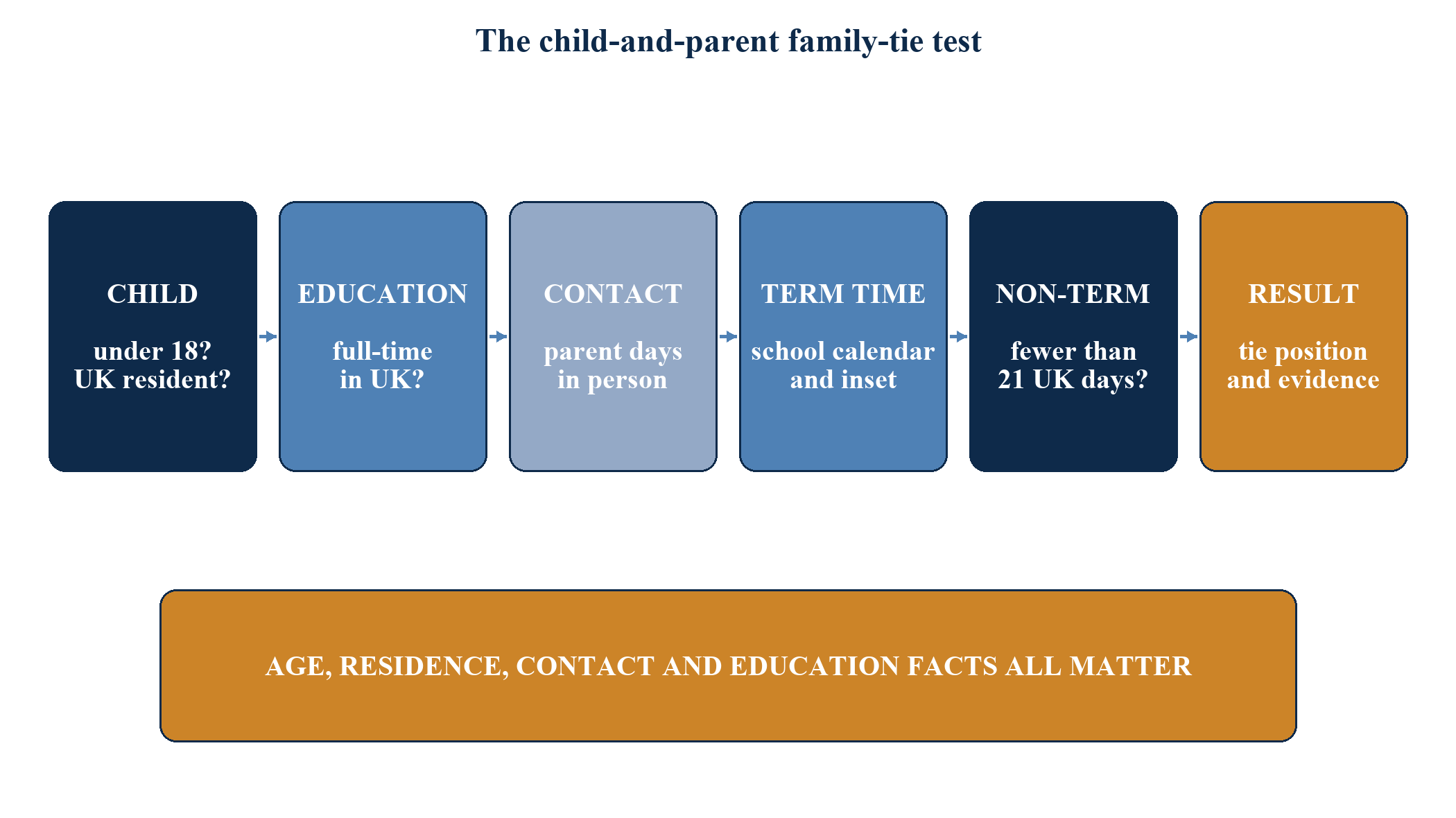
HMRC guidance states that a family tie can arise through a UK-resident spouse, civil partner or person living with the individual as spouse or civil partner, or through a UK-resident child under 18 [3]. The residence of the other person must be established in that person's own right. A family's internal description of where someone lives is not a substitute for that analysis.
A spouse remaining in London can create a family tie independently of the children. The child's education exception therefore cannot remove a tie that already exists through a UK-resident spouse or partner. The residence register should show the source relationship for every asserted family tie.
4.2 Parent-child contact
For a child under 18, HMRC guidance provides that an individual does not have a family tie through the child if the individual spends time with the child in person in the UK on fewer than 61 days during the tax year [3]. Any day or part of a day on which the parent sees the child in person in the UK counts for this purpose [3]. This contact test is different from the ordinary midnight method used for many UK presence counts.
The contact ledger should therefore record same-day visits, airport meetings, school events, meals, medical appointments and brief contact. The source can be the travel calendar, school email, household calendar or contemporaneous note. The record should describe the fact without collecting unnecessary personal detail.
4.3 Age transitions and multiple children
The analysis should record each child's date of birth and the rules applicable during the relevant tax year. Where there are several children, each child's education, residence and contact facts should be reviewed. A family tie can arise through another qualifying child even if one child's education facts fall within an exception.
The family-ties register should state: the person's relationship to the principal; the child's age; the child's residence conclusion; education status; contact days; non-term UK days where relevant; and the documentary source. It should also record the adviser conclusion and review date.
5. FULL-TIME EDUCATION AND THE BOARDING-SCHOOL EXCEPTION
5.1 Cumulative conditions
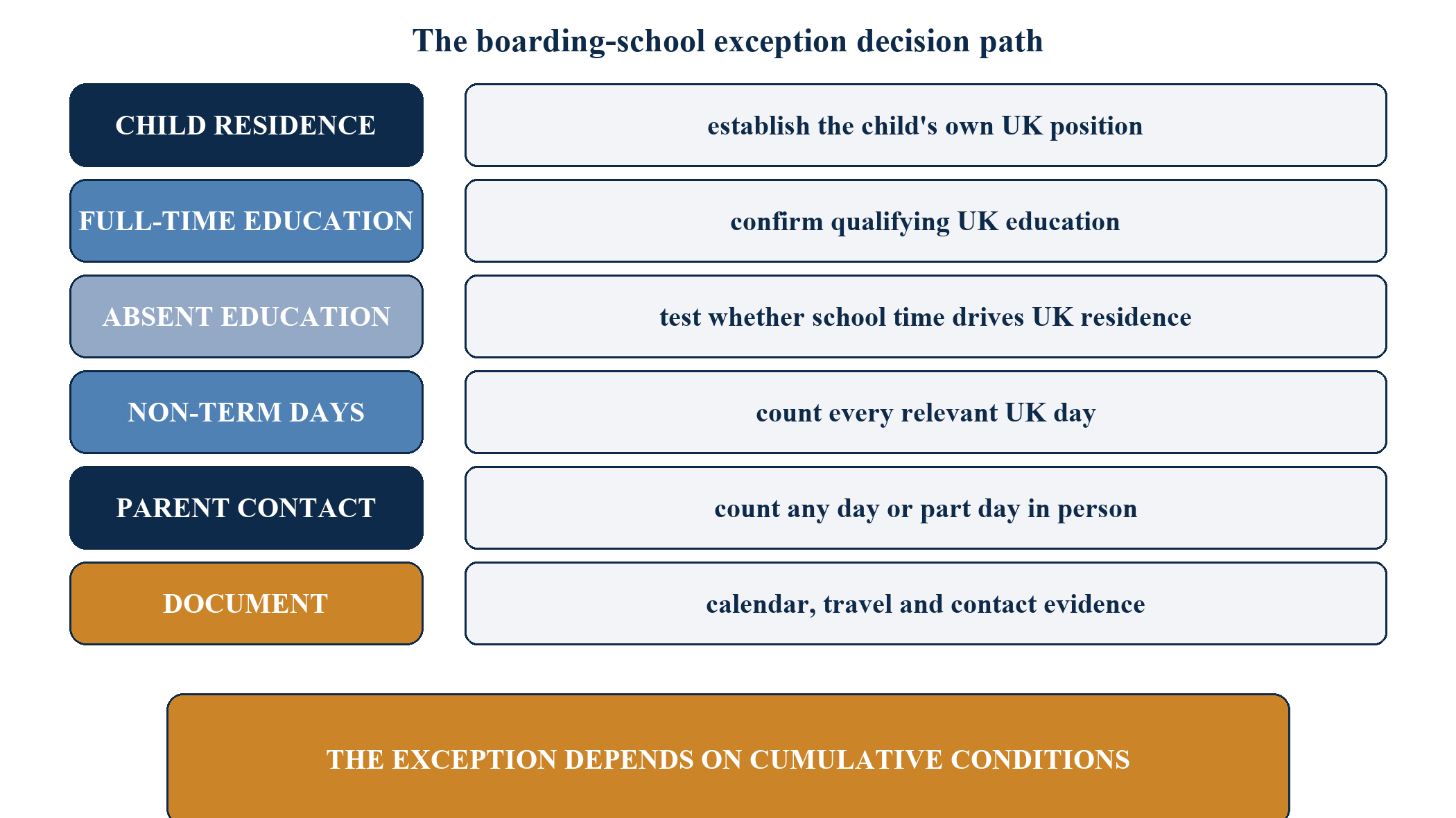
HMRC's full-time-education guidance addresses a UK-resident child under 18 who is in full-time education in the United Kingdom [4]. The guidance tests whether the child would fail to be UK resident if time spent in the UK receiving full-time education were disregarded, and whether the child spends fewer than 21 days in the UK outside term time [4]. The conditions are cumulative and should be evidenced separately.
The exception is commonly associated with boarding school. The legal question remains tied to the specified education and presence facts. School marketing language, residential status or a fee invoice does not answer every condition. The file should contain the official school calendar, attendance arrangement, travel record and the child's own residence analysis.
5.2 Term time requires precise classification
HMRC guidance includes half-term and inset days within term time for this purpose [4]. The school calendar should identify full terms, half-terms, inset days, exeats, weekends and holidays. An internal calendar should preserve the school's source document and the date it was obtained. Changes issued during the year should be versioned.
The fewer-than-21-day test concerns UK days outside term time. The family office should count those days independently from the parent's UK presence and contact days. If a child remains in London for part of the summer, Easter or Christmas holiday, the outcome may differ from a child who leaves the United Kingdom for the great majority of non-term time.
5.3 Education planning and residence planning
Residence control should not drive decisions that conflict with the child's welfare. It should give the family an early view of the consequences of its chosen arrangements. If the child needs to remain in the UK outside term, the model should record that fact and recalculate the parent's ties and travel envelope.
The year-opening review should use confirmed term dates. The monthly review should reconcile actual travel. The end-of-year review should preserve the final calendar and evidence. A material departure from the expected pattern should trigger current tax advice before later travel is booked.
6. SCHOOL CALENDARS AS TAX EVIDENCE
6.1 Three calendars must become one
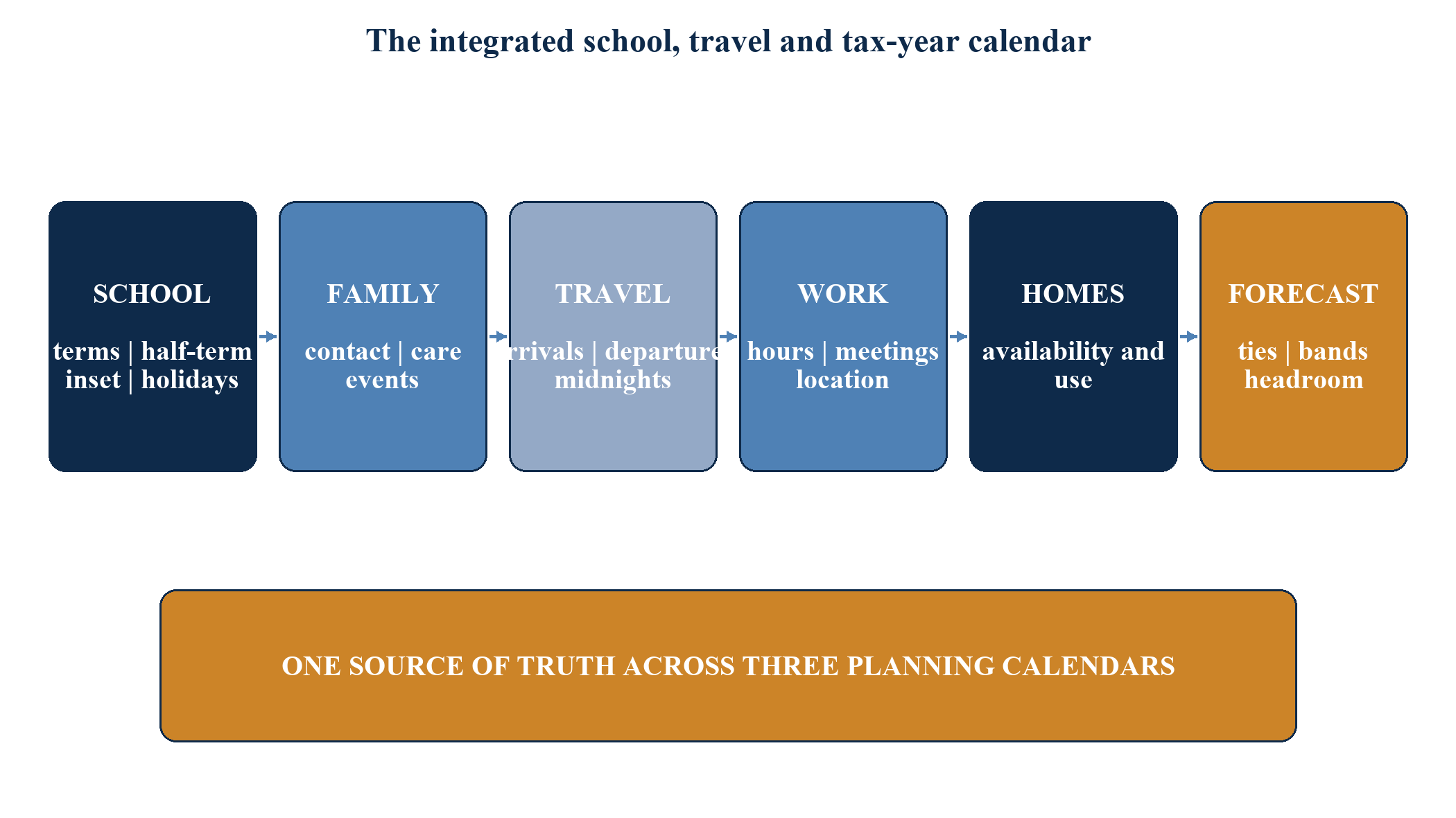
Families often operate separate calendars for school, travel and tax. That separation creates reconciliation risk. The school calendar classifies term and non-term periods. The travel calendar records flights, arrivals, departures and midnights. The tax calendar records UK presence, contact, work and home use. One controlled data set should link the three.
Each date should have fields for school status, child location, principal location at midnight, in-person contact, UK work hours, accommodation used and source evidence. A free-text note can explain unusual events. The system should calculate cumulative totals and retain the underlying data.
| Date field | Purpose | Typical evidence | Owner |
|---|---|---|---|
| school classification | term, half-term, inset or holiday | official school calendar | family administrator |
| child location | non-term and residence analysis | travel and household records | parent or guardian |
| principal midnight | UK presence calculation | passport, airline and calendar | personal office |
| in-person contact | child family-tie test | family calendar or event record | personal office |
| UK work hours | work tie and overseas-work tests | work diary and meeting papers | principal and office |
| accommodation | home and accommodation analysis | property and stay record | property administrator |
6.2 Controls over dates
Travel bookings are prospective evidence. Boarding passes, immigration records, card transactions and driver logs can support actual movement. Calendars can be incomplete or altered, so the control should reconcile several sources when a date is material. The residence file should record uncertainty rather than assigning a convenient answer.
The reviewer should sample boundary dates, same-day trips and time-zone crossings. The review should also check whether a day recorded as personal contained substantial UK work. A monthly sign-off by the principal can confirm that the record reflects actual conduct.
6.3 Forecasting the rest of the year
A rolling 90-day view should include confirmed trips, school events, expected work, family contingencies and a reserve. The forecast should show statutory thresholds and the family's chosen operating limits. The reserve belongs in the governance plan; it does not change the legal rules.
7. THE RETAINED FAMILY HOME
7.1 Ownership and availability answer different questions
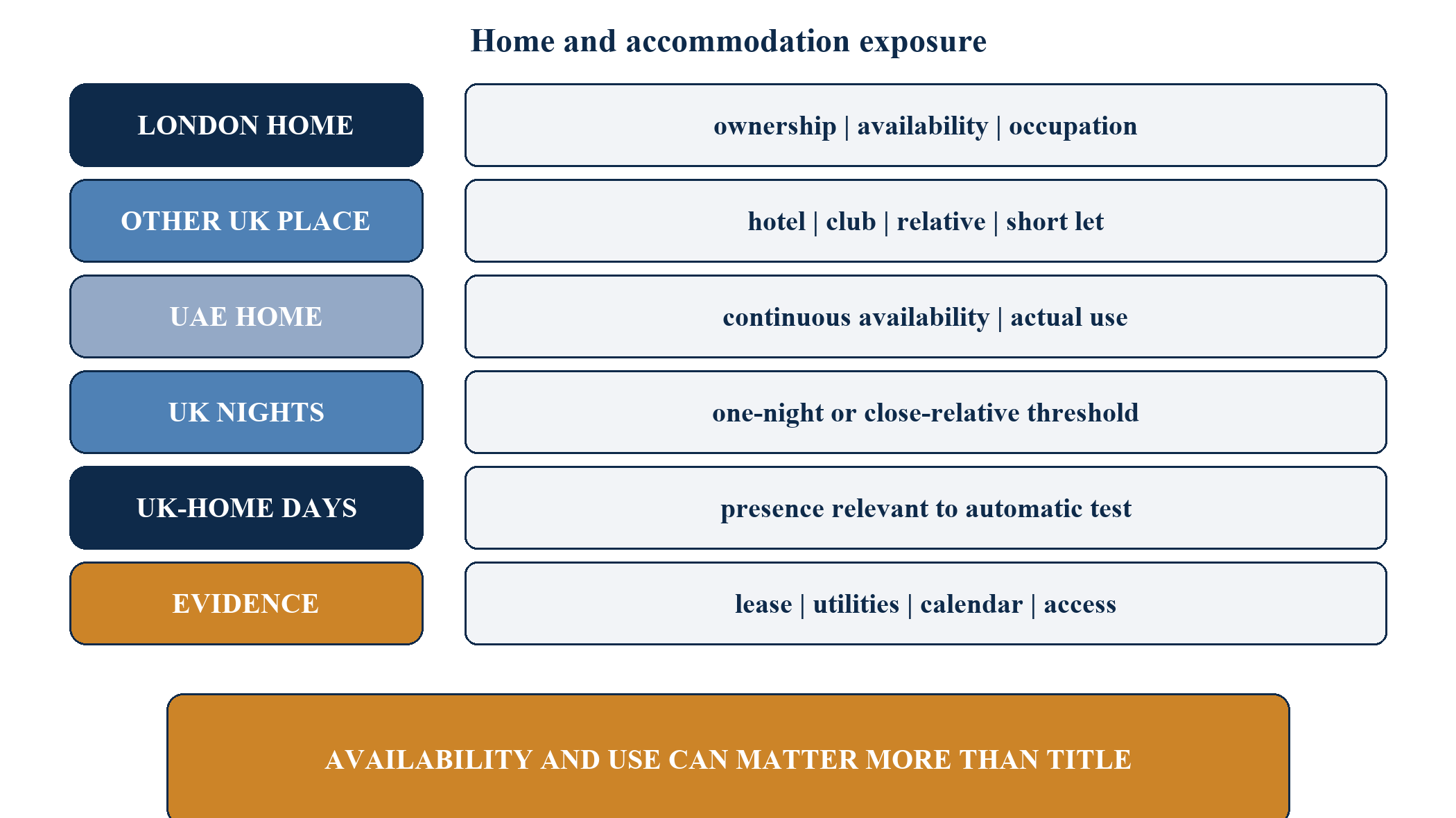
A London family home can be relevant to the automatic UK home test, the accommodation tie and treaty residence. Ownership alone is not decisive. HMRC guidance examines the nature, availability and use of accommodation and homes [6,12-15]. A property that remains available for the principal's use can continue to matter even when the principal regards the UAE as the principal residence.
For the accommodation tie, HMRC describes a place to live that is available for a continuous period of at least 91 days and in which the individual spends at least one night during the year [6]. A different 16-night requirement applies when the accommodation is the home of a close relative [6]. Each place is considered on its facts. A family-owned London home used by the spouse and children should receive specific advice rather than being grouped with occasional hotels.
7.2 Genuine loss of availability
A sale, arm's-length tenancy or other binding arrangement can change availability. The file should preserve the contract, access arrangements, actual occupation and any retained rights. A nominal restriction that does not match actual use is weak evidence. Hotel stays, private clubs, serviced apartments and relatives' homes can create separate accommodation questions.
7.3 Overseas home facts
The UAE home should be documented with tenancy or ownership records, utilities, insurance and actual use. HMRC's automatic UK home test considers presence at a UK home and the individual's relationship with overseas homes during the relevant period [12]. UAE domestic residence also examines permanent home and centre-of-interests facts under the applicable decisions [24,25].
The home register should list every relevant property, owner, occupant, availability period, access rights, nights, supporting documents and adviser conclusion. Changes to a London property should be reviewed before implementation because they can affect residence, succession, property tax and family arrangements.
8. WORKDAYS HIDDEN INSIDE FAMILY VISITS
8.1 The three-hour threshold
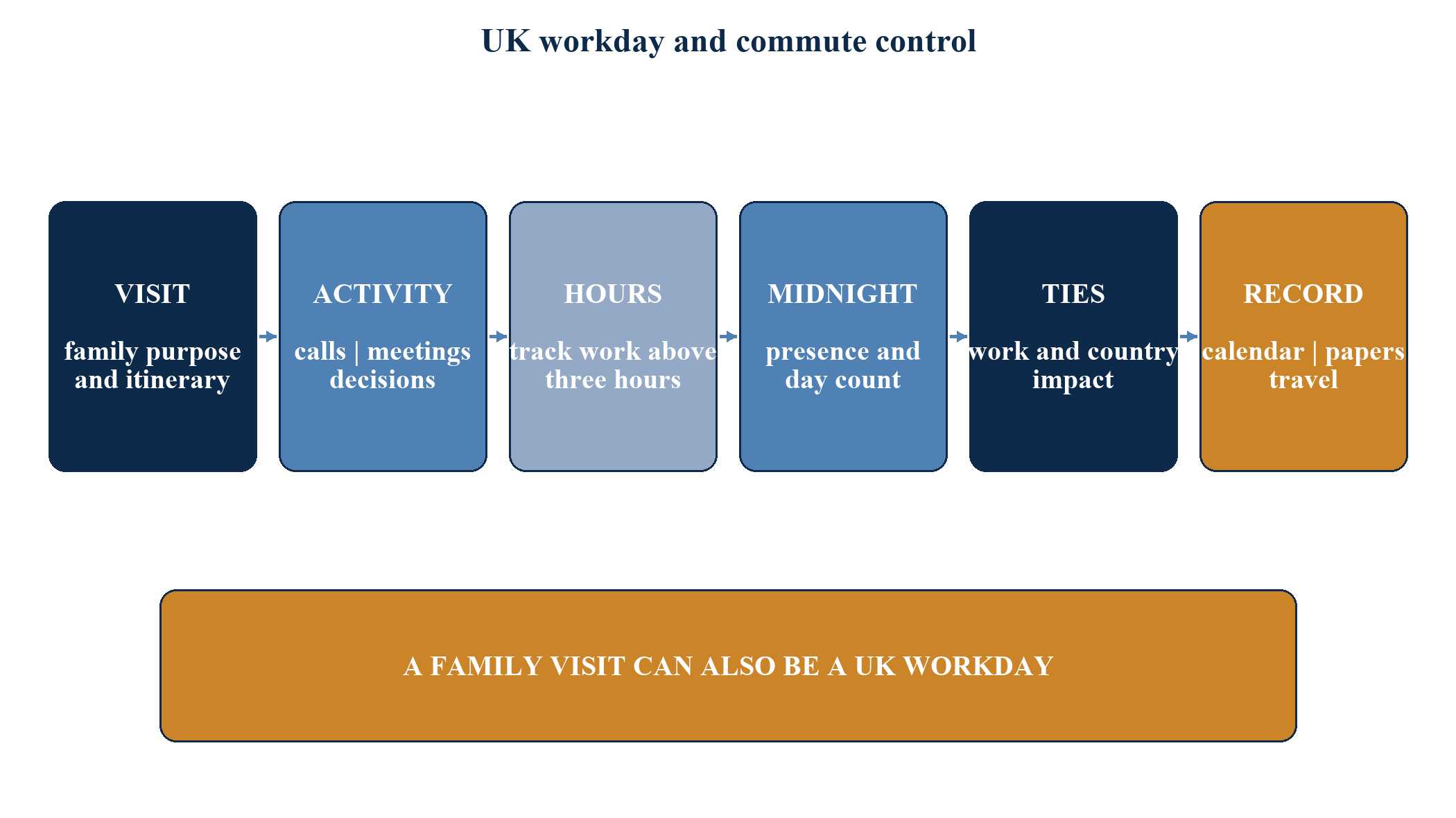
HMRC guidance states that the UK work tie can arise when an individual works for more than three hours a day in the UK on at least 40 days in the tax year [7]. Workdays also matter to the full-time-overseas automatic test, which limits days with more than three hours of UK work [10,11]. A trip described as a family visit can still contain a statutory workday.
Senior principals can work through investment calls, board meetings, negotiations, document review, approvals and management communications. The diary should record start and finish times, breaks, location and activity. It should preserve enough evidence to support the classification without reproducing confidential deal content.
8.2 Same-day and weekend travel
A Friday evening arrival and Sunday departure can include one or more UK midnights, two parent-child contact days and a UK workday. A same-day London trip can create a contact day and workday without an ordinary UK presence day at midnight. The interaction belongs in one ledger.
The principal should receive a clear protocol: tell the office when material work is performed in the UK; do not rely solely on meeting titles; record travel disruption; and obtain review before adding meetings to a family trip near a threshold. Work should be recorded accurately. The objective is faithful classification and early planning.
8.3 Governance and decision location
The workday diary can also support company and investment-governance records. It should remain separate from any conclusion about the residence or permanent establishment of an entity. Personal work location is an input to those analyses, not the whole answer.
9. THE 90-DAY AND COUNTRY TIES
9.1 Residence has a memory
The 90-day tie applies when the individual spent more than 90 days in the UK in either of the two previous tax years [8]. A departure-year plan must therefore begin with historical travel. If reliable records are missing, the file should identify the unresolved period and obtain evidence before setting a current-year threshold.
The tie can persist after the family's immediate pattern has changed. A principal who spent substantial time in London before moving can carry the tie into later years. The three-year residence history also determines which sufficient-ties table applies [2]. A multi-year dashboard is more useful than a single-year counter.
9.2 The country tie
The country tie is relevant to an individual who was UK resident in one or more of the previous three tax years. HMRC guidance asks whether the individual spends more days in the UK than in any other country during the tax year [9]. The comparison is based on the applicable day-count rules, and a tie between the UK and another country can still require attention [9].
Frequent travel across the UAE, UK, Europe and other markets can make the leading country difficult to see. The travel ledger should calculate midnights by country and flag equal totals. A principal who divides time across many countries can accumulate a relatively modest UK count that is still the greatest single-country count.
9.3 Forward planning
The review should forecast every country, not only UK days. It should show the previous two years' 90-day results, recent-resident status, current country totals and future bookings. A change in the country tie can reduce or increase the number of ties applied in the sufficient-ties matrix.
10. DAY COUNTING, COMMUTING AND THE DEEMING RULE
10.1 Midnight and qualifying-day concepts
The ordinary UK presence count generally focuses on whether the person is in the UK at the end of the day, subject to statutory rules and exceptions described in HMRC guidance [1]. Other tests use different concepts. Parent-child contact can count any day or part day [3]. Workdays use a more-than-three-hour threshold [7]. The education exception considers the child's UK days outside term time [4]. These counters must remain distinct.
10.2 The deeming rule
HMRC's deeming-rule guidance addresses certain individuals who have recent UK residence, at least three UK ties and more than 30 qualifying days on which they are present in the UK without being present at the end of the day [20]. Qualifying days above the first 30 can be treated as UK days for specified residence-test purposes [20]. Frequent same-day commuting can therefore matter even when midnight counts appear controlled.
The ledger should identify arrival and departure on the same date, the purpose, contact, work, relevant ties and whether the deeming conditions need advice. A dashboard that records only nights can omit the facts needed for this analysis.
10.3 Exceptional circumstances
HMRC guidance describes limited exceptional-circumstances provisions, including a maximum number of days that can be disregarded in relevant tests and statutory conditions that must be met [21]. The provisions do not create a general travel reserve and do not apply identically to every test. A family medical or school event should be recorded contemporaneously and reviewed against the precise rule.
The file should contain the event, reason for presence, evidence, ability to leave, departure timing and professional conclusion. Operational planning should use verified facts and should not assume future relief.
11. THE AUTOMATIC OVERSEAS TESTS
11.1 Day-based tests
The automatic overseas tests include day-count conditions that depend on recent UK residence [1]. A person with recent UK residence can face a lower UK-day ceiling than a person who has not been UK resident in the previous three tax years. Exact thresholds and statutory conditions should be checked for the relevant year.
These tests can provide a clear outcome when their conditions are satisfied. The operating calendar should show which automatic test is being targeted, the statutory limit, an internal reserve and the evidence needed. A result should be confirmed after the year closes.
11.2 Full-time work overseas
HMRC's third automatic overseas test requires sufficient hours worked overseas, no significant break from overseas work, fewer than 31 UK workdays of more than three hours and fewer than 91 UK days, together with the detailed statutory calculation [10,11]. Family commuting can affect both the UK-day and UK-workday conditions.
The full-time-overseas calculation requires work records beyond a list of business trips. It should cover overseas hours, UK hours, leave, sick leave, gaps and relevant days. A principal with a portfolio of board and investment roles may need careful classification of work and non-work activity.
11.3 Control design
The monthly review should report UK days, UK workdays, overseas work records and significant breaks. When a family trip includes UK work, the forecast should update both automatic-overseas and sufficient-ties analyses. The system should preserve the basis for each calculation so an adviser can reproduce it.
12. THE AUTOMATIC UK HOME TEST
12.1 A separate route to UK residence
The second automatic UK test can apply through home facts even when the sufficient-ties matrix appears manageable. HMRC guidance describes conditions involving a UK home, presence at that home on at least 30 days in the relevant period, and the individual's relationship with overseas homes, including fewer than 30 days of presence at an overseas home in the applicable circumstances [12]. The detailed statutory periods and definitions require fact-specific analysis.
A retained London family home used during school visits can accumulate relevant days. The UAE home must also be evaluated through actual availability and use. The home register should record presence at each home, not only UK midnights.
12.2 What counts as a home
HMRC's manuals explain that a home has the quality of a place used with a sufficient degree of permanence or stability, while the assessment remains fact based [13-15]. A property can be owned without being a home, and accommodation can be relevant without legal ownership. The conclusion should be supported by the pattern of use, availability and the person's relationship with the property.
12.3 Operational questions
For each visit, the calendar should state where the principal stayed and whether that place was a home or accommodation under current advice. The review should calculate UK-home days and overseas-home days separately. A change in the UAE tenancy, a London renovation or temporary occupation elsewhere should trigger review.
13. SPLIT-YEAR DEPARTURE
13.1 Split year is statutory
Split-year treatment applies automatically when one of the statutory cases and all its conditions are met [16]. It is not an election and should not be described as available merely because a person moved during the tax year. The correct case, transition date and period conditions should be recorded.
13.2 Full-time work and accompanying a partner
Case 1 addresses starting full-time work overseas and contains conditions for the overseas period [17]. Case 2 can address a partner accompanying an individual who meets the relevant conditions, including detailed home and presence requirements [18]. A staggered family move can produce different split-year positions for the principal and spouse.
The family record should state who moved, when, to which home, under which employment or work arrangement, and how UK days and workdays were managed. Each family member's case should be evaluated separately.
13.3 Ceasing to have a UK home
Case 3 requires, among other conditions, that the individual ceases to have any home in the UK for the remainder of the tax year and satisfies the relevant overseas-home and day conditions [19]. Retaining the London family home for children and spouse can prevent this case from applying to the principal. Another split-year case may still require review.
Transaction timing should follow a confirmed residence analysis. Income, gains and other events can have different treatment across the UK and overseas parts under the applicable legislation. Current tax advice should be obtained before material distributions, disposals or reorganisations.
14. UAE DOMESTIC AND TREATY RESIDENCE
14.1 UAE domestic rules
UAE Cabinet Decision No. 85 of 2022 and Ministerial Decision No. 27 of 2023 establish tax-residence criteria for natural persons [24,25]. The Ministry of Finance explains tests involving usual or principal residence and centre of financial and personal interests, 183-day presence, and a 90-day route with additional conditions [24]. Ministerial Decision No. 27 provides interpretive rules for days, permanent place of residence, employment, usual residence and centre of interests [25].
All days or parts of days can count for UAE presence under the decision [24,25]. A permanent place of residence need not be owned, but it should be continuously available [24,25]. Evidence can include entry and exit records, tenancy or ownership, utilities, employment or business records and personal connections.
14.2 Dual residence and the UK-UAE convention
Article 4 of the UK-UAE double taxation convention contains a tie-breaker sequence for an individual resident under both countries' domestic rules: permanent home, centre of vital interests, habitual abode, nationality and competent-authority agreement [23]. Each step is fact intensive. A UAE visa or tax-residency certificate does not by itself resolve UK domestic residence or the treaty tie-breaker.
Children, spouse, homes and recurring family life can be relevant to the centre-of-vital-interests analysis. Business, employment, investment and social connections can also matter. The treaty file should identify the facts, the applicable paragraph and the professional conclusion.
14.3 Certificates and filings
The family office should coordinate UAE tax-residency certificate evidence, UK filings and any treaty claim. Treaty residence does not remove every source-country tax or filing obligation. The annual compliance calendar should list advice dates, certificates, returns and evidence owners.
15. THE RESIDENCE EXPOSURE HEATMAP
15.1 Purpose
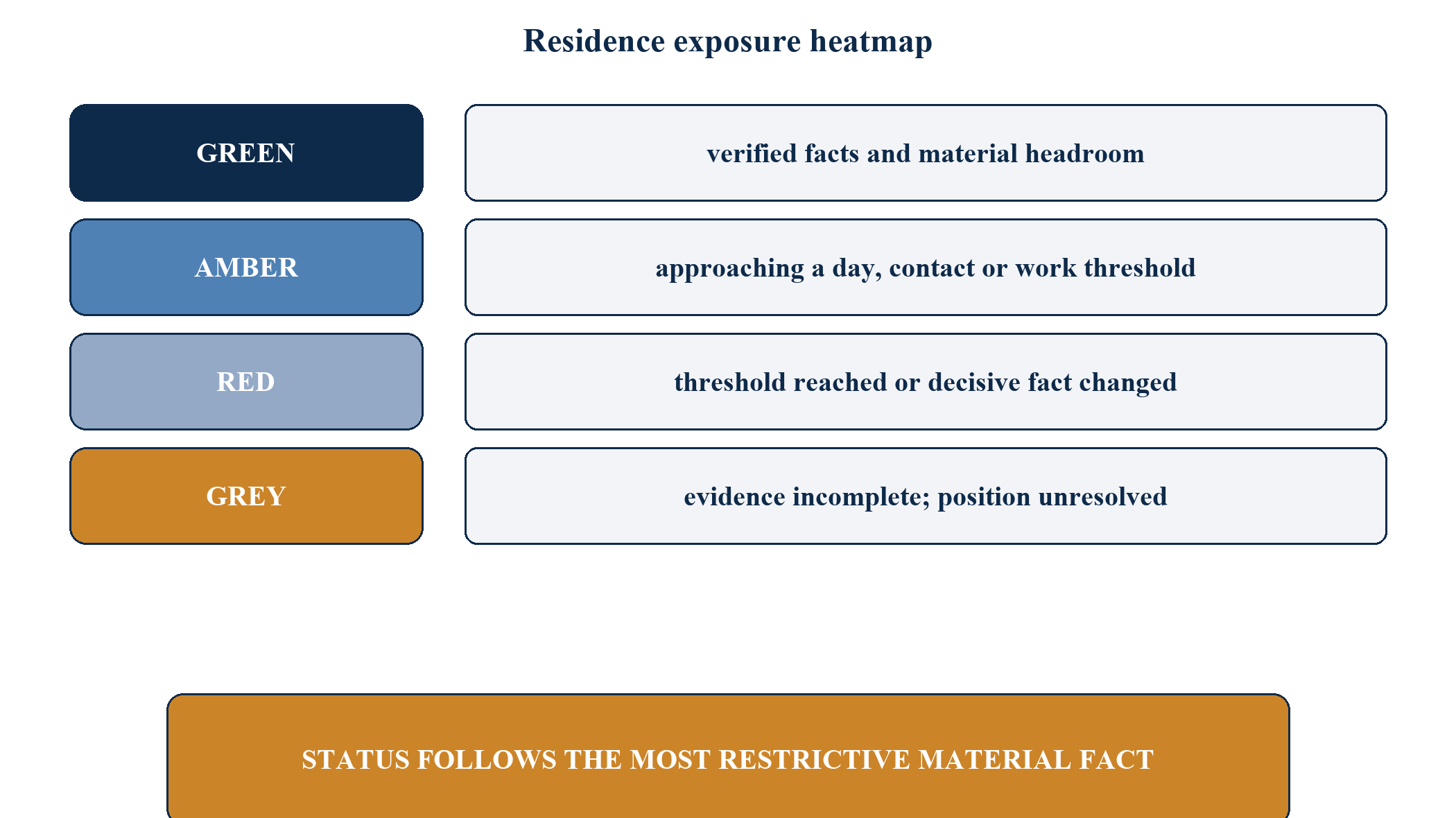
A heatmap makes interacting thresholds visible without replacing the legal analysis. It should include automatic-test status, UK days, same-day qualifying days, child-contact days, non-term child days, UK workdays, family tie, accommodation tie, 90-day tie, country tie, UK-home days, overseas-home days and UAE presence.
Green can identify verified facts with material headroom. Amber can identify an approaching threshold, a planned event or an evidence gap that can be resolved promptly. Red can identify a reached threshold or decisive fact change requiring immediate professional review. Grey should identify an unresolved position. Colours are governance signals, not legal conclusions.
15.2 Headroom and reserves
The dashboard should show statutory headroom and the family's internal operating reserve as separate amounts. A reserve can accommodate disruption; it does not alter the threshold. Each calculation should state the data cut-off and the next 90 days of known commitments.
15.3 Escalation rules
Examples of escalation triggers include a new UK workday, a spouse's residence change, a child remaining in the UK for an unexpected holiday period, use of a new accommodation, cancellation of the UAE home, a same-day UK trip after 30 qualifying days, or a forecast that enters the amber zone. The trigger should lead to a dated review, decision and updated plan.
16. WORKED FAMILY PATTERNS
Every pattern in this section is hypothetical and simplified. The figures are selected to illustrate process. They are not legal thresholds beyond the official rules cited, and they are not conclusions for any actual family.
16.1 Pattern one: boarding school and holidays in the UAE
A principal has a UAE home and business routine. A child under 18 boards at a UK school and spends the great majority of school holidays in the UAE. The file confirms the child's own residence, full-time education, official term dates and fewer than 21 UK days outside term time. The principal records all UK contact days and keeps them below 61.
The education and contact conditions may prevent a family tie through that child if every statutory condition is satisfied [3,4]. The spouse, accommodation, work, 90-day and country ties remain separate. The London home and any UK work during visits still require analysis.
16.2 Pattern two: day school, spouse and London family home
A spouse and child remain in the London family home. The child attends day school and the principal visits on alternate weekends. A family tie can arise through the UK-resident spouse and potentially through the child. The retained home can create accommodation and home-test questions. Calls and investment work during visits can create UK workdays.
The control response is to model all ties, establish the applicable day band, monitor work and home use, and preserve treaty facts. The education exception cannot remove a family tie arising independently through the spouse.
16.3 Pattern three: boarding school with a long UK summer
A boarding-school child stays in London for much of the summer holiday. The child exceeds the non-term condition in HMRC's education guidance. The analysis should not continue to assume that school status removes the family tie. The principal's contact days and all other ties should be recalculated.
16.4 Pattern four: the adult child remains in London
An adult child lives in a London flat. The under-18 child element of the family-tie rule does not apply through that adult child. If the flat or another home is available to the principal, accommodation and home questions can still arise. Financial support, social links and recurring presence can also be relevant to treaty facts.
16.5 Pattern five: same-day travel and hidden work
A recent UK resident makes frequent same-day London visits for school events. The visits create in-person contact days. Some include more than three hours of work. After the first 30 qualifying same-day visits, the deeming rule requires review if the individual has at least three UK ties [20].
The dashboard must show contact, work, ordinary midnight days and qualifying same-day visits as separate counters. The family purpose does not prevent work classification when work actually occurs.
16.6 Pattern six: the London home is let
The family enters a genuine arm's-length tenancy that removes the principal's access to the London home. Availability changes on the contractual and factual date. The principal uses hotels for later visits. The former home, hotels and any other accommodation each need their own analysis. The file preserves the lease, access arrangements and actual stays.
16.7 Pattern seven: split-year departure with the home retained
A principal moves to Dubai midway through the tax year but the spouse and children continue living in the London family home. Case 3 split-year treatment generally requires ceasing to have any UK home for the rest of the year, so the retained-home facts can prevent that case [19]. Full-time overseas work or another statutory case may require review.
16.8 Pattern eight: an early return
The family returns to London after a short period in the UAE. The residence file should test the return year and temporary non-residence rules for relevant transactions under current legislation and HMRC guidance. Distributions, gains and reorganisations during the absence require event-specific advice. The evidence system supports that review.
17. A TWELVE-MONTH OPERATING CALENDAR
17.1 Before the UK tax year
Confirm recent residence history, prior UK days, the official school calendar, family plans, homes, work arrangements and treaty facts. Obtain a year-opening professional memorandum. Set the statutory thresholds, internal reserves and escalation triggers. Load known travel and school events into the integrated calendar.
17.2 Monthly control
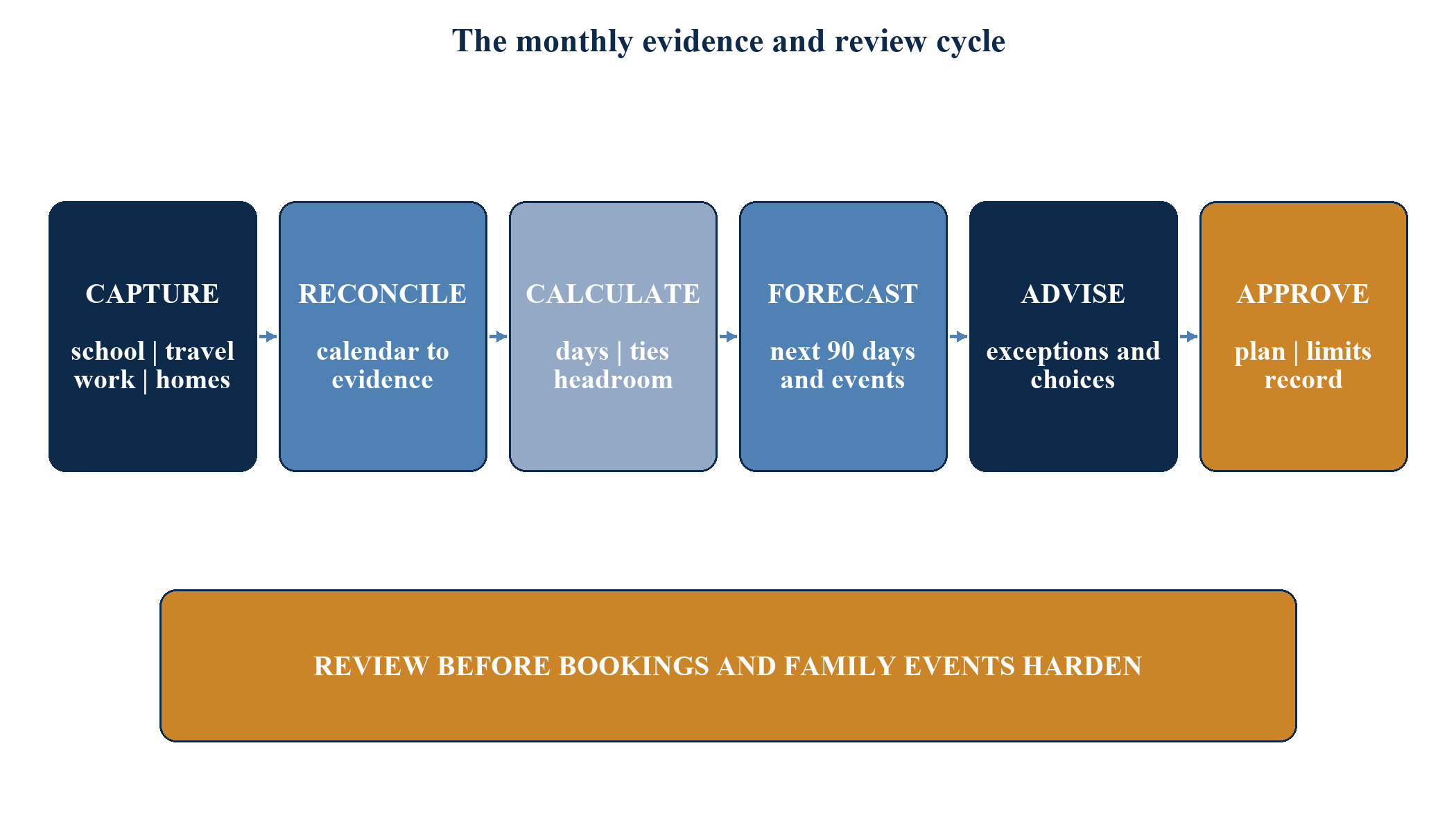
Within five business days after month end, reconcile travel, child contact, work and accommodation. Investigate discrepancies, update totals and forecast the next 90 days. The principal approves the factual calendar. Material legal conclusions remain with qualified advisers.
| Timing | Control | Output |
|---|---|---|
| monthly | reconcile travel, work, contact and homes | signed factual calendar |
| before booking | test proposed UK trip and work | updated headroom |
| term change | update school classification | versioned school calendar |
| quarter end | adviser exception review | decision log and actions |
| year end | close evidence and obtain advice | annual residence file |
17.3 Event-driven review
Review immediately when the spouse moves, a child changes school or holiday location, a home becomes available or unavailable, work plans change, a trip is disrupted or a statutory threshold approaches. The review should state the decision, owner and deadline.
17.4 Year-end close
Reconcile official travel records and final calendars, close each counter, preserve source documents and obtain the residence and compliance conclusions required. The final file should be reproducible by a reviewer who was not involved in the daily administration.
18. EVIDENCE, GOVERNANCE AND PRIVACY
18.1 Minimum evidence set
The file should contain a residence history, official school calendars, child-location and contact ledgers, principal travel, UK work diary, home register, treaty-facts schedule, UAE presence evidence, advice and decision log. The evidence owner should be named for every record.
HMRC guidance recognises the importance of records for work and location facts [22]. Contemporaneous records are stronger than a reconstruction after the year. The process should record uncertainty and retain corrected versions.
18.2 Responsibility matrix
The principal confirms actual travel and work. The family administrator maintains school and household dates. The personal or family office reconciles the calendar and operates the dashboard. Tax advisers interpret the rules. Legal and immigration advisers address their respective matters. One accountable owner coordinates unresolved items.
18.3 Privacy by design
Children's calendars can contain sensitive information. The tax record should use the minimum information needed: date, classification, location, contact and source. Medical, pastoral and safeguarding details should remain in the appropriate restricted system. Access should be role based, exports controlled and retention aligned with professional advice and applicable law.
18.4 Assurance
A quarterly review should sample travel boundary dates, contact days, work above three hours, accommodation, term classifications and evidence links. Exceptions should be resolved or carried as grey items with an owner. The review should also test that external advisers received the correct facts.
19. LIMITATIONS AND CONCLUSION
This paper provides a governance framework based on official guidance available at the publication date. Residence depends on legislation, detailed statutory definitions and the individual's facts. Guidance and treaty interpretation can change. Education, family, tax, legal, immigration and employment considerations require separate professional advice.
The worked family patterns are hypothetical and simplified. They do not model every income source, trust, company, employment, treaty or temporary-non-residence issue. Numerical examples illustrate control design and do not establish a safe travel allowance for an actual person.
A child continuing education in London does not decide a UAE-based parent's UK residence. The outcome emerges from the interaction of the child's age and residence, full-time education, non-term days, parent-child contact, spouse or partner, homes, UK work, historical presence, country pattern and the automatic tests. Dual domestic residence can require treaty analysis.
The practical answer is an evidence-led operating system. It joins the school calendar to travel, contact, work and homes; distinguishes every statutory counter; forecasts the next 90 days; and escalates changes before a threshold is approached. It gives advisers a reliable record and gives the family room to make informed choices.
The system should begin before the tax year, operate monthly and close with a reproducible annual file. Family welfare remains a first-order objective. Residence governance makes the consequences of the family's chosen arrangements visible early enough to manage them responsibly.
APPENDIX A. FAMILY-TIES QUESTIONNAIRE
For each spouse, partner and child, record the relationship, date of birth, citizenship, domestic residence conclusion, homes, school or work location and the date of any change. For each child under 18, record full-time education status, official term dates, UK days outside term and in-person UK contact with the principal.
For the principal, record previous three-year residence, previous two-year UK-day totals, current UK days, same-day UK visits, family ties, accommodation tie, work tie, 90-day tie and country tie. State the source and adviser conclusion for every legal classification.
Questions for each planned visit include: which family members will be seen; on which dates; where the principal will stay; whether any UK work is expected; whether the trip changes a child-contact, workday, home or presence counter; and whether the integrated forecast remains within the approved plan.
APPENDIX B. SCHOOL-CALENDAR LEDGER
The ledger should contain date, school name, academic year, term or holiday label, half-term status, inset status, boarding or day arrangement, child's expected country, child's actual country, source document, source version and reviewer.
The family administrator should load the official calendar before the tax year and update it only from controlled school communications. The tax calendar can reference the classification without retaining unnecessary educational information. Each alteration should show who changed it, when and why.
APPENDIX C. TRAVEL AND CONTACT LEDGER
Minimum fields are date, country at midnight, arrival and departure times, route, purpose, accommodation, child contact, spouse or partner contact, UK work hours, source documents and exception note. Same-day UK visits should be flagged for deeming-rule review.
Contact means in-person time and should be counted by the rule applicable to the family tie. The ledger should distinguish contact days from midnight presence days. Corrections should preserve the original record and supporting evidence.
APPENDIX D. UK WORKDAY DIARY
For each UK date, record work start and finish times, breaks, total hours, location, activity category, meeting or decision reference and evidence. Classify whether work exceeded three hours only after the complete day is recorded.
The diary should cover calls, approvals, investment work, board activity, negotiations and management. It should avoid confidential transaction detail beyond what is needed to support time and activity. Monthly reconciliation should compare the diary with calendars, meeting papers and communications metadata.
APPENDIX E. RESIDENCE HEATMAP
The heatmap should display data cut-off, legal thresholds, internal operating limits, actual totals, booked future events, forecast totals, headroom, evidence status, adviser review date and owner. Separate rows should cover UK days, same-day qualifying visits, child contact, child's non-term UK days, UK workdays, home presence, each tie, UAE presence and treaty evidence.
Green, amber, red and grey statuses should follow documented criteria. A colour change should create an action; it should never substitute for professional analysis.
APPENDIX F. QUESTIONS FOR ADVISERS
- What is the residence conclusion for each family member under current UK and UAE law?
- Which automatic overseas or UK test is relevant to the principal?
- Does a family tie arise through the spouse, partner or any child?
- Are all conditions for the full-time-education treatment satisfied?
- How should parent-child contact and the child's non-term days be evidenced?
- Which properties are homes or accommodation, and during which periods?
- Which activities count as UK work, and how should hours be recorded?
- Does the deeming rule affect frequent same-day travel?
- Which split-year case applies, if any, and from what date?
- Could both countries regard the person as resident, and how does Article 4 apply?
- What filings, certificates and treaty claims are required?
- Which planned transaction or return-to-UK event needs separate advice?
REFERENCES
[1] HM Revenue & Customs. *Guidance note for Statutory Residence Test (RDR3).* Updated 2026. https://www.gov.uk/government/publications/rdr3-statutory-residence-test-srt/guidance-note-for-statutory-residence-test-srt-rdr3
[2] HM Revenue & Customs. *RFIG20520: Number of ties.* https://www.gov.uk/hmrc-internal-manuals/residence-and-fig-regime-manual/rfig20520
[3] HM Revenue & Customs. *RFIG20530: Family tie.* https://www.gov.uk/hmrc-internal-manuals/residence-and-fig-regime-manual/rfig20530
[4] HM Revenue & Customs. *RFIG20540: Child in full-time education.* https://www.gov.uk/hmrc-internal-manuals/residence-and-fig-regime-manual/rfig20540
[5] HM Revenue & Customs. *RFIG20510: UK ties, introduction.* https://www.gov.uk/hmrc-internal-manuals/residence-and-fig-regime-manual/rfig20510
[6] HM Revenue & Customs. *RFIG20550: Accommodation tie.* https://www.gov.uk/hmrc-internal-manuals/residence-and-fig-regime-manual/rfig20550
[7] HM Revenue & Customs. *RFIG20560: Work tie.* https://www.gov.uk/hmrc-internal-manuals/residence-and-fig-regime-manual/rfig20560
[8] HM Revenue & Customs. *RFIG20570: 90-day tie.* https://www.gov.uk/hmrc-internal-manuals/residence-and-fig-regime-manual/rfig20570
[9] HM Revenue & Customs. *RFIG20580: Country tie.* https://www.gov.uk/hmrc-internal-manuals/residence-and-fig-regime-manual/rfig20580
[10] HM Revenue & Customs. *RFIG20140: Third automatic overseas test.* https://www.gov.uk/hmrc-internal-manuals/residence-and-fig-regime-manual/rfig20140
[11] HM Revenue & Customs. *RFIG20150: Full-time work overseas.* https://www.gov.uk/hmrc-internal-manuals/residence-and-fig-regime-manual/rfig20150
[12] HM Revenue & Customs. *RFIG20340: Second automatic UK test, home test timing.* https://www.gov.uk/hmrc-internal-manuals/residence-and-fig-regime-manual/rfig20340
[13] HM Revenue & Customs. *RFIG22130: Home matters.* https://www.gov.uk/hmrc-internal-manuals/residence-and-fig-regime-manual/rfig22130
[14] HM Revenue & Customs. *RFIG22160: Accommodation tie, supplementary guidance.* https://www.gov.uk/hmrc-internal-manuals/residence-and-fig-regime-manual/rfig22160
[15] HM Revenue & Customs. *RFIG22170: Accommodation characteristics.* https://www.gov.uk/hmrc-internal-manuals/residence-and-fig-regime-manual/rfig22170
[16] HM Revenue & Customs. *RFIG21010: Split-year treatment overview.* https://www.gov.uk/hmrc-internal-manuals/residence-and-fig-regime-manual/rfig21010
[17] HM Revenue & Customs. *RFIG21040: Split year, Case 1.* https://www.gov.uk/hmrc-internal-manuals/residence-and-fig-regime-manual/rfig21040
[18] HM Revenue & Customs. *RFIG21090: Split year, Case 2.* https://www.gov.uk/hmrc-internal-manuals/residence-and-fig-regime-manual/rfig21090
[19] HM Revenue & Customs. *RFIG21130: Split year, Case 3.* https://www.gov.uk/hmrc-internal-manuals/residence-and-fig-regime-manual/rfig21130
[20] HM Revenue & Customs. *RFIG20720: Deeming rule.* https://www.gov.uk/hmrc-internal-manuals/residence-and-fig-regime-manual/rfig20720
[21] HM Revenue & Customs. *RFIG22230: Exceptional circumstances.* https://www.gov.uk/hmrc-internal-manuals/residence-and-fig-regime-manual/rfig22230
[22] HM Revenue & Customs. *RFIG21930: Work and location recordkeeping.* https://www.gov.uk/hmrc-internal-manuals/residence-and-fig-regime-manual/rfig21930
[23] HM Revenue & Customs and UAE Ministry of Finance. *Convention between the United Kingdom and the United Arab Emirates for the avoidance of double taxation, Article 4.* 2016. https://www.gov.uk/government/publications/united-arab-emirates-tax-treaties/2016-uk-uae-double-taxation-convention
[24] UAE Ministry of Finance. *Cabinet Decision No. 85 of 2022 on determination of tax residency.* https://mof.gov.ae/en/news/following-cabinet-decision-85-of-2022/
[25] UAE Ministry of Finance. *Ministerial Decision No. 27 of 2023 on implementation of provisions of Cabinet Decision No. 85 of 2022.* https://mof.gov.ae/wp-content/uploads/2023/03/Ministerial-Decision-27-of-2023-of-Tax-Residency.pdf
ABOUT THE AUTHOR
Chennakeshav Adya is an independent researcher whose work examines capital, ownership, governance and cross-border decision making. His research converts complex legal, financial and institutional frameworks into practical tools for principals, family offices, investors and management teams.
Authored by Chennakeshav Adya
Independent Researcher
