

Introduction
Climate analytics sits between physical observation and financial action. Satellites, radar, weather stations, elevation models, claims histories and property records may reveal a hazard. The commercial product earns durable value when a customer can identify the insured asset, estimate loss, document uncertainty, apply an approved decision rule and measure the result. Each hand-off creates potential value leakage.
The insurance context makes this translation demanding. Underwriting decisions must fit policy terms, portfolio limits, rate governance, reinsurance arrangements and regulatory expectations. Claims decisions require event attribution, timing and auditable evidence. Capital decisions require aggregation across locations, perils and return periods. A technically impressive model may remain outside production when its data rights, coverage, explainability, latency, validation or integration do not meet the customer's operating requirements.
Acquirers should therefore value the combined decision system. The relevant unit is the governed workflow that turns a signal into a priced and monitored exposure. The paper maps that system, separates observed facts from hypothetical transaction mechanics and defines the evidence required for price, financing, contingent consideration and post-close accountability.
1. Define the acquisition decision
The decision question concerns the valuation date, buyer strategy, target perimeter, decision workflows and capital structure. Diligence should identify the insurer, business line, peril, geography, workflow, model version, data source, period and accountable owner. Evidence should begin with board papers, transaction scope, management accounts, product architecture and customer contracts. The record should reconcile technical performance, legal rights, customer use, financial reporting and collected cash. Each exception needs a dated owner and a stated consequence for price, financing, integration or closing.
The analytical output is one approved investment question with an evidence cut-off. A value claim should pass through the signal-to-decision sequence: observed source, governed feature, hazard estimate, matched exposure, vulnerability, financial loss, workflow action and verified outcome. A probability or benefit can be used only when its event, evidence, time horizon and dependency are explicit. For transaction purposes, the board should state which insurance decisions the combination must improve and how that improvement will be measured. The model should include base, delayed, degraded, customer-loss and severe-event cases, together with data, compute, validation, regulatory, integration, tax and working-capital costs.
2. Map the signal-to-decision chain
The decision question concerns the sequence from raw observation through feature, hazard, exposure, vulnerability, financial loss and workflow action. Diligence should identify the insurer, business line, peril, geography, workflow, model version, data source, period and accountable owner. Evidence should begin with data lineage, model documentation, APIs, decision rules and customer process maps. The record should reconcile technical performance, legal rights, customer use, financial reporting and collected cash. Each exception needs a dated owner and a stated consequence for price, financing, integration or closing.
The analytical output is a traceable chain from source to customer action. A value claim should pass through the signal-to-decision sequence: observed source, governed feature, hazard estimate, matched exposure, vulnerability, financial loss, workflow action and verified outcome. A probability or benefit can be used only when its event, evidence, time horizon and dependency are explicit. For transaction purposes, the board should assign value only where evidence supports every material transformation. The model should include base, delayed, degraded, customer-loss and severe-event cases, together with data, compute, validation, regulatory, integration, tax and working-capital costs.
3. Inventory observation sources
The decision question concerns satellite, aerial, weather, sensor, cadastral, property, claims and third-party inputs. Diligence should identify the insurer, business line, peril, geography, workflow, model version, data source, period and accountable owner. Evidence should begin with licences, source catalogues, refresh records, coverage maps and supplier contracts. The record should reconcile technical performance, legal rights, customer use, financial reporting and collected cash. Each exception needs a dated owner and a stated consequence for price, financing, integration or closing.
The analytical output is an observation register by peril, geography and use. A value claim should pass through the signal-to-decision sequence: observed source, governed feature, hazard estimate, matched exposure, vulnerability, financial loss, workflow action and verified outcome. A probability or benefit can be used only when its event, evidence, time horizon and dependency are explicit. For transaction purposes, the board should separate proprietary observations from replaceable or restricted inputs. The model should include base, delayed, degraded, customer-loss and severe-event cases, together with data, compute, validation, regulatory, integration, tax and working-capital costs.
4. Test provenance and data rights
The decision question concerns ownership, licensing, derivative rights, redistribution, model-training rights, retention and change of control. Diligence should identify the insurer, business line, peril, geography, workflow, model version, data source, period and accountable owner. Evidence should begin with source agreements, legal opinions, consent clauses, data lineage and deletion obligations. The record should reconcile technical performance, legal rights, customer use, financial reporting and collected cash. Each exception needs a dated owner and a stated consequence for price, financing, integration or closing.
The analytical output is a lawful commercial perimeter for each dataset and derived product. A value claim should pass through the signal-to-decision sequence: observed source, governed feature, hazard estimate, matched exposure, vulnerability, financial loss, workflow action and verified outcome. A probability or benefit can be used only when its event, evidence, time horizon and dependency are explicit. For transaction purposes, the board should make missing rights a price deduction or closing condition. The model should include base, delayed, degraded, customer-loss and severe-event cases, together with data, compute, validation, regulatory, integration, tax and working-capital costs.
5. Measure refresh, latency and continuity
The decision question concerns the time between physical change, observation, processing, delivery and customer decision. Diligence should identify the insurer, business line, peril, geography, workflow, model version, data source, period and accountable owner. Evidence should begin with capture schedules, service levels, outage logs, cloud telemetry and customer incidents. The record should reconcile technical performance, legal rights, customer use, financial reporting and collected cash. Each exception needs a dated owner and a stated consequence for price, financing, integration or closing.
The analytical output is decision-grade latency and continuity by use case. A value claim should pass through the signal-to-decision sequence: observed source, governed feature, hazard estimate, matched exposure, vulnerability, financial loss, workflow action and verified outcome. A probability or benefit can be used only when its event, evidence, time horizon and dependency are explicit. For transaction purposes, the board should avoid paying a real-time premium for products used only in periodic portfolio review. The model should include base, delayed, degraded, customer-loss and severe-event cases, together with data, compute, validation, regulatory, integration, tax and working-capital costs.
6. Define peril and geographic coverage
The decision question concerns the hazards, territories, return periods and edge cases covered by each model. Diligence should identify the insurer, business line, peril, geography, workflow, model version, data source, period and accountable owner. Evidence should begin with hazard catalogues, validation regions, loss histories, scientific literature and exclusions. The record should reconcile technical performance, legal rights, customer use, financial reporting and collected cash. Each exception needs a dated owner and a stated consequence for price, financing, integration or closing.
The analytical output is a coverage matrix tied to customer portfolios. A value claim should pass through the signal-to-decision sequence: observed source, governed feature, hazard estimate, matched exposure, vulnerability, financial loss, workflow action and verified outcome. A probability or benefit can be used only when its event, evidence, time horizon and dependency are explicit. For transaction purposes, the board should exclude unvalidated extrapolation from the base case. The model should include base, delayed, degraded, customer-loss and severe-event cases, together with data, compute, validation, regulatory, integration, tax and working-capital costs.
7. Resolve exposure at decision level
The decision question concerns the linkage between a geospatial signal and the insured location, building, asset, crop or infrastructure unit. Diligence should identify the insurer, business line, peril, geography, workflow, model version, data source, period and accountable owner. Evidence should begin with address matching, geocoding tests, property attributes, portfolio records and exception logs. The record should reconcile technical performance, legal rights, customer use, financial reporting and collected cash. Each exception needs a dated owner and a stated consequence for price, financing, integration or closing.
The analytical output is a verified match rate with known error classes. A value claim should pass through the signal-to-decision sequence: observed source, governed feature, hazard estimate, matched exposure, vulnerability, financial loss, workflow action and verified outcome. A probability or benefit can be used only when its event, evidence, time horizon and dependency are explicit. For transaction purposes, the board should price unmatched and incorrectly matched exposure as operational loss. The model should include base, delayed, degraded, customer-loss and severe-event cases, together with data, compute, validation, regulatory, integration, tax and working-capital costs.
8. Test vulnerability functions
The decision question concerns the conversion of hazard intensity into physical damage and business interruption. Diligence should identify the insurer, business line, peril, geography, workflow, model version, data source, period and accountable owner. Evidence should begin with engineering studies, claims data, calibration records, expert review and uncertainty ranges. The record should reconcile technical performance, legal rights, customer use, financial reporting and collected cash. Each exception needs a dated owner and a stated consequence for price, financing, integration or closing.
The analytical output is vulnerability curves supported by observed evidence. A value claim should pass through the signal-to-decision sequence: observed source, governed feature, hazard estimate, matched exposure, vulnerability, financial loss, workflow action and verified outcome. A probability or benefit can be used only when its event, evidence, time horizon and dependency are explicit. For transaction purposes, the board should separate scientific plausibility from insured-loss performance. The model should include base, delayed, degraded, customer-loss and severe-event cases, together with data, compute, validation, regulatory, integration, tax and working-capital costs.
9. Calibrate financial loss
The decision question concerns policy terms, deductibles, limits, inflation, demand surge, business interruption and reinsurance. Diligence should identify the insurer, business line, peril, geography, workflow, model version, data source, period and accountable owner. Evidence should begin with policy data, claims triangles, event studies, loss adjustment and portfolio simulations. The record should reconcile technical performance, legal rights, customer use, financial reporting and collected cash. Each exception needs a dated owner and a stated consequence for price, financing, integration or closing.
The analytical output is gross, net and retained loss distributions. A value claim should pass through the signal-to-decision sequence: observed source, governed feature, hazard estimate, matched exposure, vulnerability, financial loss, workflow action and verified outcome. A probability or benefit can be used only when its event, evidence, time horizon and dependency are explicit. For transaction purposes, the board should link technical outputs to the economics actually borne by the customer. The model should include base, delayed, degraded, customer-loss and severe-event cases, together with data, compute, validation, regulatory, integration, tax and working-capital costs.
10. Address climate non-stationarity
The decision question concerns whether historical frequency and severity remain representative under changing physical conditions. Diligence should identify the insurer, business line, peril, geography, workflow, model version, data source, period and accountable owner. Evidence should begin with current climate science, scenario sets, model versions, back-tests and governance minutes. The record should reconcile technical performance, legal rights, customer use, financial reporting and collected cash. Each exception needs a dated owner and a stated consequence for price, financing, integration or closing.
The analytical output is explicit treatment of trend, uncertainty and model change. A value claim should pass through the signal-to-decision sequence: observed source, governed feature, hazard estimate, matched exposure, vulnerability, financial loss, workflow action and verified outcome. A probability or benefit can be used only when its event, evidence, time horizon and dependency are explicit. For transaction purposes, the board should avoid embedding one unexamined climate trajectory in price or capital. The model should include base, delayed, degraded, customer-loss and severe-event cases, together with data, compute, validation, regulatory, integration, tax and working-capital costs.
11. Map customer workflows
The decision question concerns where underwriters, actuaries, portfolio managers, claims teams and capital committees use the product. Diligence should identify the insurer, business line, peril, geography, workflow, model version, data source, period and accountable owner. Evidence should begin with screen recordings, process maps, decision logs, user roles and control approvals. The record should reconcile technical performance, legal rights, customer use, financial reporting and collected cash. Each exception needs a dated owner and a stated consequence for price, financing, integration or closing.
The analytical output is a workflow inventory with accountable users. A value claim should pass through the signal-to-decision sequence: observed source, governed feature, hazard estimate, matched exposure, vulnerability, financial loss, workflow action and verified outcome. A probability or benefit can be used only when its event, evidence, time horizon and dependency are explicit. For transaction purposes, the board should distinguish a purchased licence from a product used in consequential decisions. The model should include base, delayed, degraded, customer-loss and severe-event cases, together with data, compute, validation, regulatory, integration, tax and working-capital costs.
12. Test underwriting integration
The decision question concerns risk eligibility, referral, pricing, limits, deductibles, inspection and renewal decisions. Diligence should identify the insurer, business line, peril, geography, workflow, model version, data source, period and accountable owner. Evidence should begin with underwriting rules, production logs, policy cohorts, overrides and quote outcomes. The record should reconcile technical performance, legal rights, customer use, financial reporting and collected cash. Each exception needs a dated owner and a stated consequence for price, financing, integration or closing.
The analytical output is measured adoption and underwriting impact. A value claim should pass through the signal-to-decision sequence: observed source, governed feature, hazard estimate, matched exposure, vulnerability, financial loss, workflow action and verified outcome. A probability or benefit can be used only when its event, evidence, time horizon and dependency are explicit. For transaction purposes, the board should value embedded decision rules above dashboard access. The model should include base, delayed, degraded, customer-loss and severe-event cases, together with data, compute, validation, regulatory, integration, tax and working-capital costs.
13. Test pricing and rate governance
The decision question concerns how model outputs enter technical price, filed rates, approved factors and portfolio steering. Diligence should identify the insurer, business line, peril, geography, workflow, model version, data source, period and accountable owner. Evidence should begin with pricing models, filing support, actuarial review, approval records and change logs. The record should reconcile technical performance, legal rights, customer use, financial reporting and collected cash. Each exception needs a dated owner and a stated consequence for price, financing, integration or closing.
The analytical output is a lawful and controlled route from signal to premium. A value claim should pass through the signal-to-decision sequence: observed source, governed feature, hazard estimate, matched exposure, vulnerability, financial loss, workflow action and verified outcome. A probability or benefit can be used only when its event, evidence, time horizon and dependency are explicit. For transaction purposes, the board should discount benefits that depend on approvals or rate changes not yet obtained. The model should include base, delayed, degraded, customer-loss and severe-event cases, together with data, compute, validation, regulatory, integration, tax and working-capital costs.
14. Measure portfolio accumulation value
The decision question concerns concentration by geography, peril, event footprint, policy term and correlated infrastructure dependency. Diligence should identify the insurer, business line, peril, geography, workflow, model version, data source, period and accountable owner. Evidence should begin with geocoded portfolio data, event sets, aggregation tools, limits and breach records. The record should reconcile technical performance, legal rights, customer use, financial reporting and collected cash. Each exception needs a dated owner and a stated consequence for price, financing, integration or closing.
The analytical output is faster and more accurate accumulation decisions. A value claim should pass through the signal-to-decision sequence: observed source, governed feature, hazard estimate, matched exposure, vulnerability, financial loss, workflow action and verified outcome. A probability or benefit can be used only when its event, evidence, time horizon and dependency are explicit. For transaction purposes, the board should quantify avoided concentration and released capacity only when observed. The model should include base, delayed, degraded, customer-loss and severe-event cases, together with data, compute, validation, regulatory, integration, tax and working-capital costs.
15. Measure reinsurance value
The decision question concerns how the analytics affects placement, attachment, limits, pricing, model views and counterparty discussions. Diligence should identify the insurer, business line, peril, geography, workflow, model version, data source, period and accountable owner. Evidence should begin with treaty submissions, broker models, reinsurer feedback, renewal outcomes and capital models. The record should reconcile technical performance, legal rights, customer use, financial reporting and collected cash. Each exception needs a dated owner and a stated consequence for price, financing, integration or closing.
The analytical output is evidence of improved risk transfer or retained economics. A value claim should pass through the signal-to-decision sequence: observed source, governed feature, hazard estimate, matched exposure, vulnerability, financial loss, workflow action and verified outcome. A probability or benefit can be used only when its event, evidence, time horizon and dependency are explicit. For transaction purposes, the board should avoid double counting underwriting and reinsurance benefits. The model should include base, delayed, degraded, customer-loss and severe-event cases, together with data, compute, validation, regulatory, integration, tax and working-capital costs.
16. Measure claims value
The decision question concerns event detection, triage, damage assessment, fraud, reserve setting and settlement. Diligence should identify the insurer, business line, peril, geography, workflow, model version, data source, period and accountable owner. Evidence should begin with event imagery, claim files, adjuster outcomes, cycle times and leakage studies. The record should reconcile technical performance, legal rights, customer use, financial reporting and collected cash. Each exception needs a dated owner and a stated consequence for price, financing, integration or closing.
The analytical output is verified claims outcomes by event cohort. A value claim should pass through the signal-to-decision sequence: observed source, governed feature, hazard estimate, matched exposure, vulnerability, financial loss, workflow action and verified outcome. A probability or benefit can be used only when its event, evidence, time horizon and dependency are explicit. For transaction purposes, the board should separate faster notification from accurate covered-loss determination. The model should include base, delayed, degraded, customer-loss and severe-event cases, together with data, compute, validation, regulatory, integration, tax and working-capital costs.
17. Test parametric applications
The decision question concerns whether an index is objective, timely, transparent and aligned with actual loss. Diligence should identify the insurer, business line, peril, geography, workflow, model version, data source, period and accountable owner. Evidence should begin with trigger definitions, basis-risk analysis, observation continuity, settlement history and disputes. The record should reconcile technical performance, legal rights, customer use, financial reporting and collected cash. Each exception needs a dated owner and a stated consequence for price, financing, integration or closing.
The analytical output is a governed trigger with measured basis risk. A value claim should pass through the signal-to-decision sequence: observed source, governed feature, hazard estimate, matched exposure, vulnerability, financial loss, workflow action and verified outcome. A probability or benefit can be used only when its event, evidence, time horizon and dependency are explicit. For transaction purposes, the board should cap value where a vendor can change or interrupt the underlying observation. The model should include base, delayed, degraded, customer-loss and severe-event cases, together with data, compute, validation, regulatory, integration, tax and working-capital costs.
18. Map regulatory-capital use
The decision question concerns the role of analytics in standard-formula assumptions, internal models, stress tests and supervisory reporting. Diligence should identify the insurer, business line, peril, geography, workflow, model version, data source, period and accountable owner. Evidence should begin with capital policies, regulator correspondence, model-change governance and validation. The record should reconcile technical performance, legal rights, customer use, financial reporting and collected cash. Each exception needs a dated owner and a stated consequence for price, financing, integration or closing.
The analytical output is approved use with a clear capital consequence. A value claim should pass through the signal-to-decision sequence: observed source, governed feature, hazard estimate, matched exposure, vulnerability, financial loss, workflow action and verified outcome. A probability or benefit can be used only when its event, evidence, time horizon and dependency are explicit. For transaction purposes, the board should treat prospective capital benefits as contingent until approval and operation. The model should include base, delayed, degraded, customer-loss and severe-event cases, together with data, compute, validation, regulatory, integration, tax and working-capital costs.
19. Assess model governance
The decision question concerns ownership, validation, performance thresholds, change approval, documentation, challenge and retirement. Diligence should identify the insurer, business line, peril, geography, workflow, model version, data source, period and accountable owner. Evidence should begin with model inventory, validation reports, audit findings, version history and incident records. The record should reconcile technical performance, legal rights, customer use, financial reporting and collected cash. Each exception needs a dated owner and a stated consequence for price, financing, integration or closing.
The analytical output is a controlled model lifecycle. A value claim should pass through the signal-to-decision sequence: observed source, governed feature, hazard estimate, matched exposure, vulnerability, financial loss, workflow action and verified outcome. A probability or benefit can be used only when its event, evidence, time horizon and dependency are explicit. For transaction purposes, the board should make material validation remediation part of the integration budget. The model should include base, delayed, degraded, customer-loss and severe-event cases, together with data, compute, validation, regulatory, integration, tax and working-capital costs.
20. Build customer cohorts
The decision question concerns adoption, expansion, renewal, contraction and loss by insurer type, workflow, peril and geography. Diligence should identify the insurer, business line, peril, geography, workflow, model version, data source, period and accountable owner. Evidence should begin with contracts, product telemetry, invoices, collections, support records and exit interviews. The record should reconcile technical performance, legal rights, customer use, financial reporting and collected cash. Each exception needs a dated owner and a stated consequence for price, financing, integration or closing.
The analytical output is cohort economics tied to production use. A value claim should pass through the signal-to-decision sequence: observed source, governed feature, hazard estimate, matched exposure, vulnerability, financial loss, workflow action and verified outcome. A probability or benefit can be used only when its event, evidence, time horizon and dependency are explicit. For transaction purposes, the board should use collected renewal evidence rather than logo counts. The model should include base, delayed, degraded, customer-loss and severe-event cases, together with data, compute, validation, regulatory, integration, tax and working-capital costs.
21. Construct the data-moat score
The decision question concerns scarcity, lawful exclusivity, coverage, history, refresh, quality, interoperability and feedback effects. Diligence should identify the insurer, business line, peril, geography, workflow, model version, data source, period and accountable owner. Evidence should begin with source contracts, archive statistics, customer usage, error rates and replacement tests. The record should reconcile technical performance, legal rights, customer use, financial reporting and collected cash. Each exception needs a dated owner and a stated consequence for price, financing, integration or closing.
The analytical output is a transparent score for defensible data advantage. A value claim should pass through the signal-to-decision sequence: observed source, governed feature, hazard estimate, matched exposure, vulnerability, financial loss, workflow action and verified outcome. A probability or benefit can be used only when its event, evidence, time horizon and dependency are explicit. For transaction purposes, the board should deduct value when the moat depends on revocable third-party access. The model should include base, delayed, degraded, customer-loss and severe-event cases, together with data, compute, validation, regulatory, integration, tax and working-capital costs.
22. Value algorithms and models
The decision question concerns performance, transferability, interpretability, maintenance, compute cost and dependence on specific data. Diligence should identify the insurer, business line, peril, geography, workflow, model version, data source, period and accountable owner. Evidence should begin with benchmark tests, code records, model cards, validation, drift and operating costs. The record should reconcile technical performance, legal rights, customer use, financial reporting and collected cash. Each exception needs a dated owner and a stated consequence for price, financing, integration or closing.
The analytical output is risk-adjusted cash attributable to model capability. A value claim should pass through the signal-to-decision sequence: observed source, governed feature, hazard estimate, matched exposure, vulnerability, financial loss, workflow action and verified outcome. A probability or benefit can be used only when its event, evidence, time horizon and dependency are explicit. For transaction purposes, the board should avoid valuing technical complexity without customer conversion. The model should include base, delayed, degraded, customer-loss and severe-event cases, together with data, compute, validation, regulatory, integration, tax and working-capital costs.
23. Measure workflow stickiness
The decision question concerns the operational cost and risk of replacing the product within policy, claims, portfolio and capital processes. Diligence should identify the insurer, business line, peril, geography, workflow, model version, data source, period and accountable owner. Evidence should begin with integration maps, user dependency, switching tests, service levels and renewal negotiations. The record should reconcile technical performance, legal rights, customer use, financial reporting and collected cash. Each exception needs a dated owner and a stated consequence for price, financing, integration or closing.
The analytical output is switching cost supported by observed behaviour. A value claim should pass through the signal-to-decision sequence: observed source, governed feature, hazard estimate, matched exposure, vulnerability, financial loss, workflow action and verified outcome. A probability or benefit can be used only when its event, evidence, time horizon and dependency are explicit. For transaction purposes, the board should distinguish genuine embeddedness from contractual friction. The model should include base, delayed, degraded, customer-loss and severe-event cases, together with data, compute, validation, regulatory, integration, tax and working-capital costs.
24. Test the commercial model
The decision question concerns subscription, usage, portfolio, per-location, event, enterprise and outcome-linked pricing. Diligence should identify the insurer, business line, peril, geography, workflow, model version, data source, period and accountable owner. Evidence should begin with price books, contracts, usage, gross margin, discounting and renewal evidence. The record should reconcile technical performance, legal rights, customer use, financial reporting and collected cash. Each exception needs a dated owner and a stated consequence for price, financing, integration or closing.
The analytical output is unit economics aligned with customer value. A value claim should pass through the signal-to-decision sequence: observed source, governed feature, hazard estimate, matched exposure, vulnerability, financial loss, workflow action and verified outcome. A probability or benefit can be used only when its event, evidence, time horizon and dependency are explicit. For transaction purposes, the board should model expansion revenue separately from temporary event-driven usage. The model should include base, delayed, degraded, customer-loss and severe-event cases, together with data, compute, validation, regulatory, integration, tax and working-capital costs.
25. Measure customer concentration
The decision question concerns revenue, annual contract value, receivables, usage and product learning concentrated in a small number of accounts. Diligence should identify the insurer, business line, peril, geography, workflow, model version, data source, period and accountable owner. Evidence should begin with customer hierarchy, contracts, invoices, cash receipts and telemetry. The record should reconcile technical performance, legal rights, customer use, financial reporting and collected cash. Each exception needs a dated owner and a stated consequence for price, financing, integration or closing.
The analytical output is concentration-adjusted recurring contribution. A value claim should pass through the signal-to-decision sequence: observed source, governed feature, hazard estimate, matched exposure, vulnerability, financial loss, workflow action and verified outcome. A probability or benefit can be used only when its event, evidence, time horizon and dependency are explicit. For transaction purposes, the board should stress correlated loss when customers share the same regulatory or catastrophe-model cycle. The model should include base, delayed, degraded, customer-loss and severe-event cases, together with data, compute, validation, regulatory, integration, tax and working-capital costs.
26. Design integration architecture
The decision question concerns identity, data models, APIs, cloud environments, security, workflow interfaces and release processes. Diligence should identify the insurer, business line, peril, geography, workflow, model version, data source, period and accountable owner. Evidence should begin with architecture diagrams, data contracts, dependency maps, cost estimates and migration tests. The record should reconcile technical performance, legal rights, customer use, financial reporting and collected cash. Each exception needs a dated owner and a stated consequence for price, financing, integration or closing.
The analytical output is an executable integration plan with service continuity. A value claim should pass through the signal-to-decision sequence: observed source, governed feature, hazard estimate, matched exposure, vulnerability, financial loss, workflow action and verified outcome. A probability or benefit can be used only when its event, evidence, time horizon and dependency are explicit. For transaction purposes, the board should fund dual running and rollback before claiming platform synergy. The model should include base, delayed, degraded, customer-loss and severe-event cases, together with data, compute, validation, regulatory, integration, tax and working-capital costs.
27. Test transfer and consent requirements
The decision question concerns assignment, sublicensing, source-data consents, customer approval, privacy and regulated outsourcing. Diligence should identify the insurer, business line, peril, geography, workflow, model version, data source, period and accountable owner. Evidence should begin with change-of-control clauses, licences, customer terms, regulator rules and consent plans. The record should reconcile technical performance, legal rights, customer use, financial reporting and collected cash. Each exception needs a dated owner and a stated consequence for price, financing, integration or closing.
The analytical output is revenue and data rights transferable to the buyer. A value claim should pass through the signal-to-decision sequence: observed source, governed feature, hazard estimate, matched exposure, vulnerability, financial loss, workflow action and verified outcome. A probability or benefit can be used only when its event, evidence, time horizon and dependency are explicit. For transaction purposes, the board should condition closing or consideration on critical permissions. The model should include base, delayed, degraded, customer-loss and severe-event cases, together with data, compute, validation, regulatory, integration, tax and working-capital costs.
28. Remove model and product overlap
The decision question concerns duplicate hazard models, datasets, interfaces, customers and research teams. Diligence should identify the insurer, business line, peril, geography, workflow, model version, data source, period and accountable owner. Evidence should begin with product maps, cost centres, usage, contracts and roadmap decisions. The record should reconcile technical performance, legal rights, customer use, financial reporting and collected cash. Each exception needs a dated owner and a stated consequence for price, financing, integration or closing.
The analytical output is a rationalised portfolio with retained customer coverage. A value claim should pass through the signal-to-decision sequence: observed source, governed feature, hazard estimate, matched exposure, vulnerability, financial loss, workflow action and verified outcome. A probability or benefit can be used only when its event, evidence, time horizon and dependency are explicit. For transaction purposes, the board should avoid counting duplicated revenue and cost savings together. The model should include base, delayed, degraded, customer-loss and severe-event cases, together with data, compute, validation, regulatory, integration, tax and working-capital costs.
29. Reconstruct revenue quality
The decision question concerns recurrence, renewal, usage variability, event sensitivity, services dependence, margin and cash conversion. Diligence should identify the insurer, business line, peril, geography, workflow, model version, data source, period and accountable owner. Evidence should begin with contracts, billing, revenue recognition, cloud costs, support effort and collections. The record should reconcile technical performance, legal rights, customer use, financial reporting and collected cash. Each exception needs a dated owner and a stated consequence for price, financing, integration or closing.
The analytical output is customer-level collected contribution. A value claim should pass through the signal-to-decision sequence: observed source, governed feature, hazard estimate, matched exposure, vulnerability, financial loss, workflow action and verified outcome. A probability or benefit can be used only when its event, evidence, time horizon and dependency are explicit. For transaction purposes, the board should apply different valuation treatment to subscriptions, implementation and event-driven revenue. The model should include base, delayed, degraded, customer-loss and severe-event cases, together with data, compute, validation, regulatory, integration, tax and working-capital costs.
30. Build the hypothetical value bridge
The decision question concerns the movement from standalone value to supported integration, cross-sell and model benefits. Diligence should identify the insurer, business line, peril, geography, workflow, model version, data source, period and accountable owner. Evidence should begin with transaction-specific customer, product, technical, financial and regulatory evidence. The record should reconcile technical performance, legal rights, customer use, financial reporting and collected cash. Each exception needs a dated owner and a stated consequence for price, financing, integration or closing.
The analytical output is USD 230 million of illustrative enterprise value. A value claim should pass through the signal-to-decision sequence: observed source, governed feature, hazard estimate, matched exposure, vulnerability, financial loss, workflow action and verified outcome. A probability or benefit can be used only when its event, evidence, time horizon and dependency are explicit. For transaction purposes, the board should demonstrate mechanics without representing an actual company. The model should include base, delayed, degraded, customer-loss and severe-event cases, together with data, compute, validation, regulatory, integration, tax and working-capital costs.
31. Run downside scenarios
The decision question concerns data loss, failed validation, delayed integration, customer attrition, model error and severe-event performance. Diligence should identify the insurer, business line, peril, geography, workflow, model version, data source, period and accountable owner. Evidence should begin with risk register, sensitivity model, incident history, customer cohorts and liquidity plan. The record should reconcile technical performance, legal rights, customer use, financial reporting and collected cash. Each exception needs a dated owner and a stated consequence for price, financing, integration or closing.
The analytical output is value and cash under severe but plausible cases. A value claim should pass through the signal-to-decision sequence: observed source, governed feature, hazard estimate, matched exposure, vulnerability, financial loss, workflow action and verified outcome. A probability or benefit can be used only when its event, evidence, time horizon and dependency are explicit. For transaction purposes, the board should retain sufficient liquidity and contingent consideration for unresolved risk. The model should include base, delayed, degraded, customer-loss and severe-event cases, together with data, compute, validation, regulatory, integration, tax and working-capital costs.
32. Set transaction protections
The decision question concerns price, holdbacks, earn-outs, escrow, warranties, covenants, consents and milestone conditions. Diligence should identify the insurer, business line, peril, geography, workflow, model version, data source, period and accountable owner. Evidence should begin with value bridge, diligence exceptions, legal terms and integration plan. The record should reconcile technical performance, legal rights, customer use, financial reporting and collected cash. Each exception needs a dated owner and a stated consequence for price, financing, integration or closing.
The analytical output is consideration aligned with realised workflow and customer outcomes. A value claim should pass through the signal-to-decision sequence: observed source, governed feature, hazard estimate, matched exposure, vulnerability, financial loss, workflow action and verified outcome. A probability or benefit can be used only when its event, evidence, time horizon and dependency are explicit. For transaction purposes, the board should tie release of value to lawful data access, validated performance and collected cash. The model should include base, delayed, degraded, customer-loss and severe-event cases, together with data, compute, validation, regulatory, integration, tax and working-capital costs.
33. Sequence the integration
The decision question concerns customer continuity, data migration, model validation, product packaging, sales enablement and governance. Diligence should identify the insurer, business line, peril, geography, workflow, model version, data source, period and accountable owner. Evidence should begin with day-one plan, dependency map, customer communications, validation calendar and accountable owners. The record should reconcile technical performance, legal rights, customer use, financial reporting and collected cash. Each exception needs a dated owner and a stated consequence for price, financing, integration or closing.
The analytical output is a staged operating plan with measurable gates. A value claim should pass through the signal-to-decision sequence: observed source, governed feature, hazard estimate, matched exposure, vulnerability, financial loss, workflow action and verified outcome. A probability or benefit can be used only when its event, evidence, time horizon and dependency are explicit. For transaction purposes, the board should preserve decision continuity while combination benefits are tested. The model should include base, delayed, degraded, customer-loss and severe-event cases, together with data, compute, validation, regulatory, integration, tax and working-capital costs.
34. Govern post-close value
The decision question concerns monthly evidence on data, models, workflows, customers, integration, capital and cash. Diligence should identify the insurer, business line, peril, geography, workflow, model version, data source, period and accountable owner. Evidence should begin with board dashboard, model committee records, customer cohorts and finance reconciliations. The record should reconcile technical performance, legal rights, customer use, financial reporting and collected cash. Each exception needs a dated owner and a stated consequence for price, financing, integration or closing.
The analytical output is one decision record for realised value. A value claim should pass through the signal-to-decision sequence: observed source, governed feature, hazard estimate, matched exposure, vulnerability, financial loss, workflow action and verified outcome. A probability or benefit can be used only when its event, evidence, time horizon and dependency are explicit. For transaction purposes, the board should refresh the valuation and intervention plan when evidence changes. The model should include base, delayed, degraded, customer-loss and severe-event cases, together with data, compute, validation, regulatory, integration, tax and working-capital costs.
Conclusion
Climate-analytics acquisitions create value when physical observations become governed financial decisions that customers use repeatedly. Imagery volume, model sophistication and climate relevance support the thesis, while durable transaction value requires lawful data access, validated performance, workflow integration, customer renewal and collected contribution.
The framework follows the complete chain from observation to verified outcome. It tests each hand-off for technical quality, decision relevance and commercial evidence. It also separates standalone value from combination benefits and charges the case for integration, validation, rights and concentration risk.
For a board or investment committee, the central decision is whether the proposed price and capital structure remain supportable when data access narrows, validation is delayed, a major customer does not renew or an extreme event exposes model weakness. That answer should govern consideration, financing, closing conditions, integration sequence and post-close accountability.
Appendix A. Signal-to-decision evidence register
Record every source, licence, refresh cycle, feature, hazard model, exposure match, vulnerability function, financial-loss model, workflow action, customer, product version, validation result, revenue stream, invoice, collection and accountable owner. Link each value claim to the relevant evidence and date.
Appendix B. Customer outcome record
For each material customer, record the production workflow, users, decisions influenced, policies or assets covered, baseline, intervention, observed outcome, attribution limits, renewal, expansion, support burden, gross margin and collected cash. Preserve unsuccessful and discontinued cohorts.
Appendix C. Transaction approval checklist
The approval file should contain the data-rights map, model inventory, validation, customer cohorts, product and integration architecture, regulatory-use analysis, standalone valuation, combination bridge, downside liquidity, transaction protections, integration plan and post-close dashboard.
Appendix D. Worked-case figures and tables
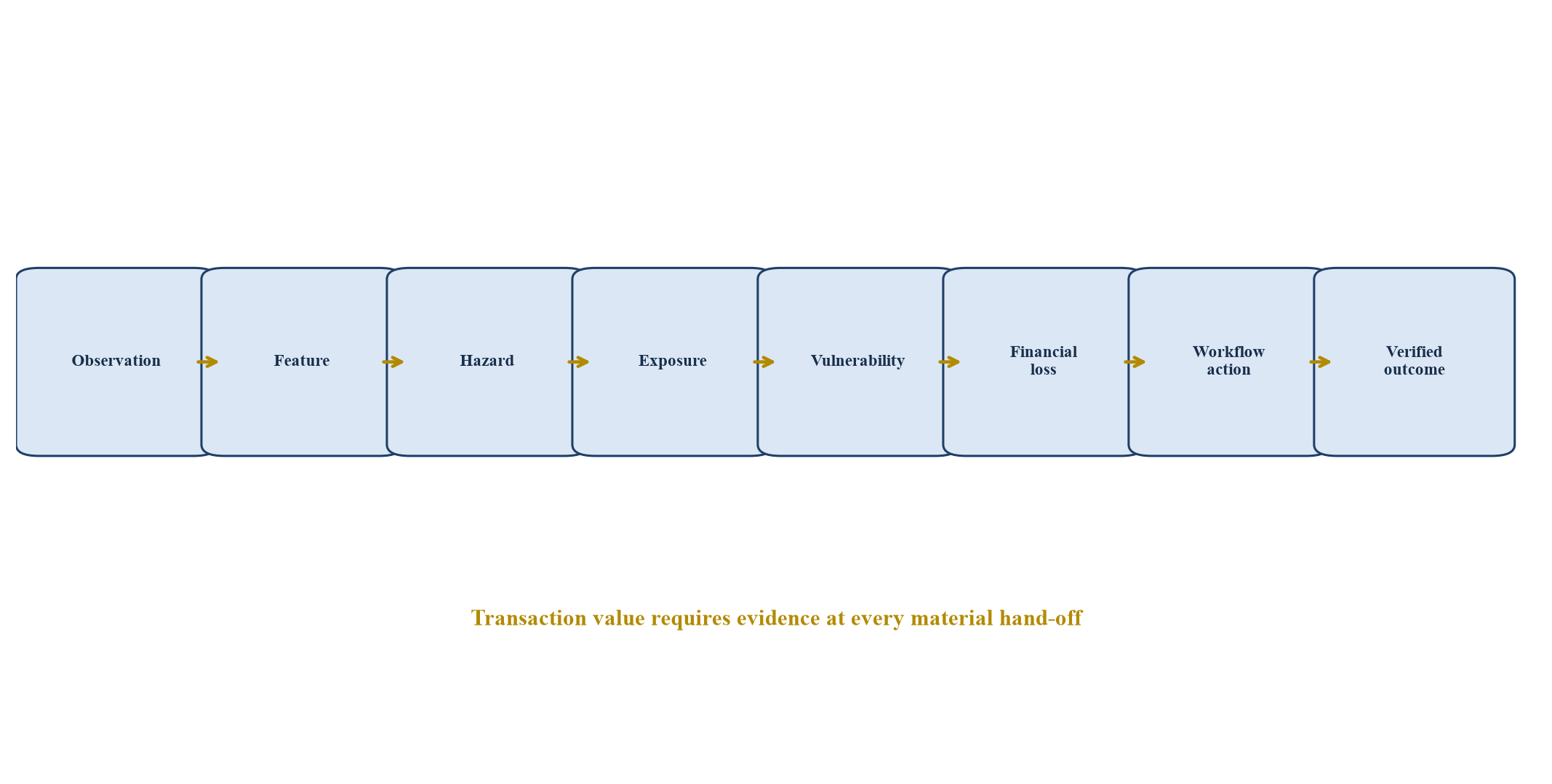
Proposed sequence from physical observation to verified customer outcome.
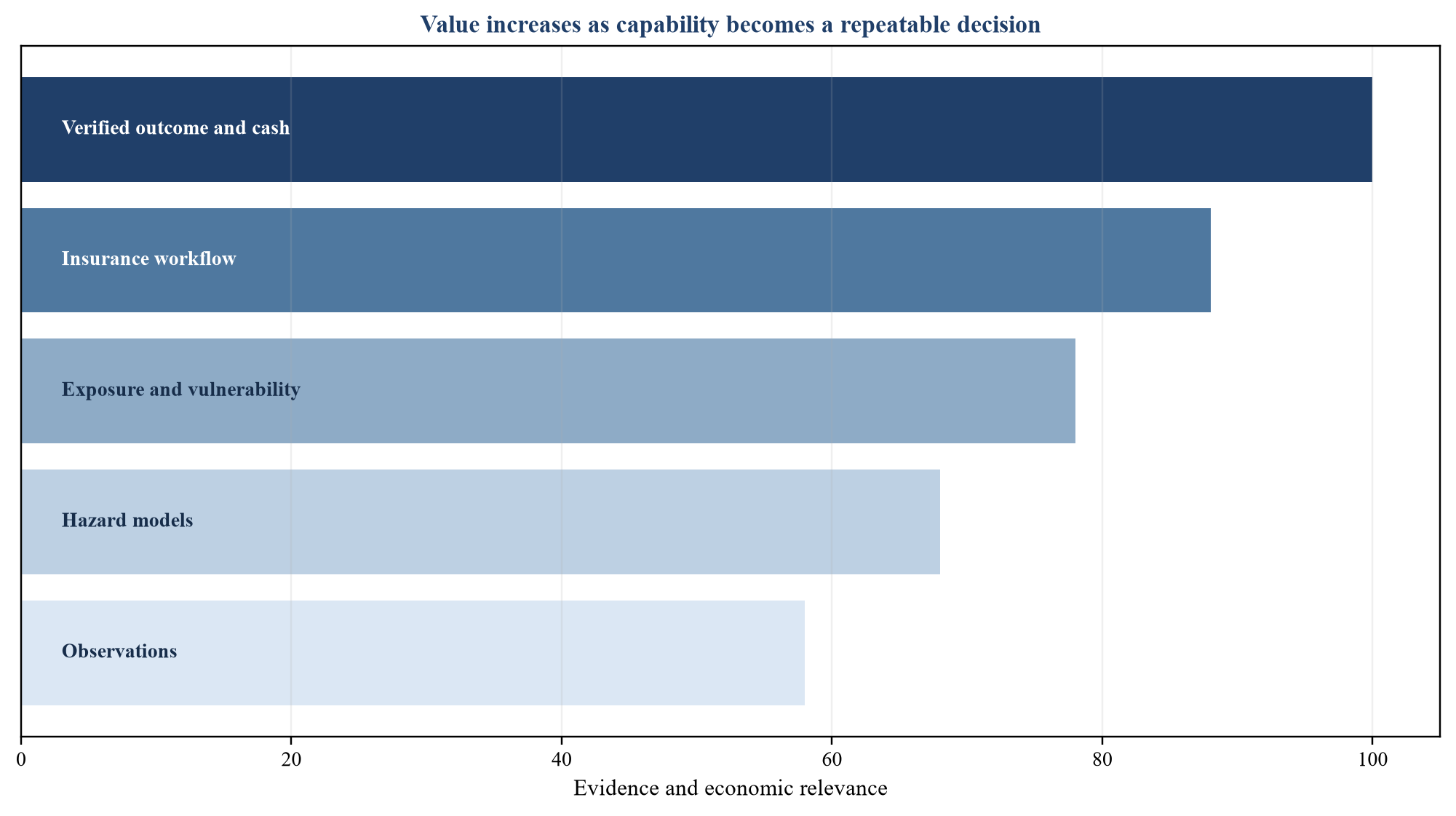
Proposed separation of technical assets, workflow adoption and verified financial outcomes.
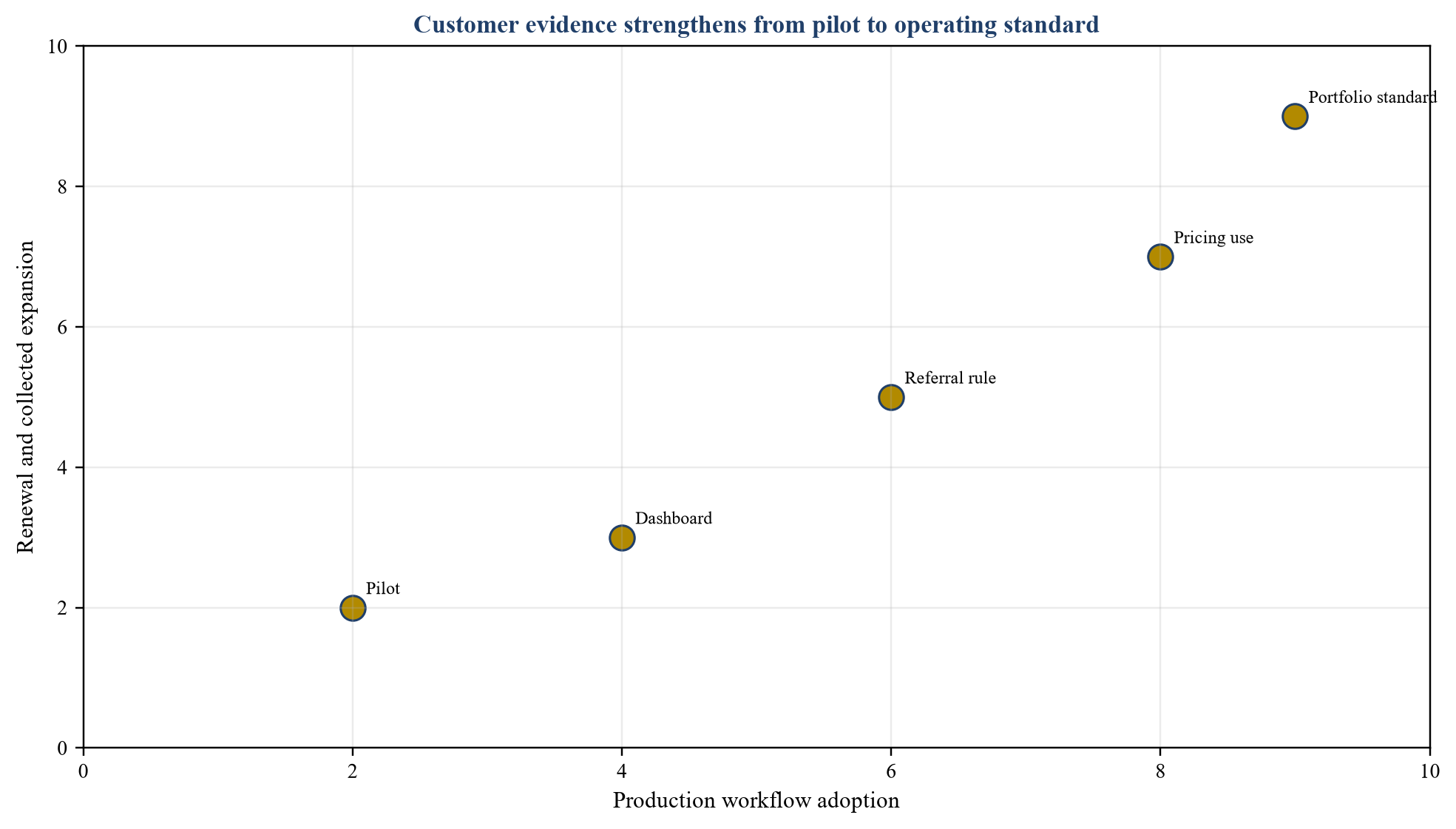
Illustrative relationship between production adoption and collected expansion.
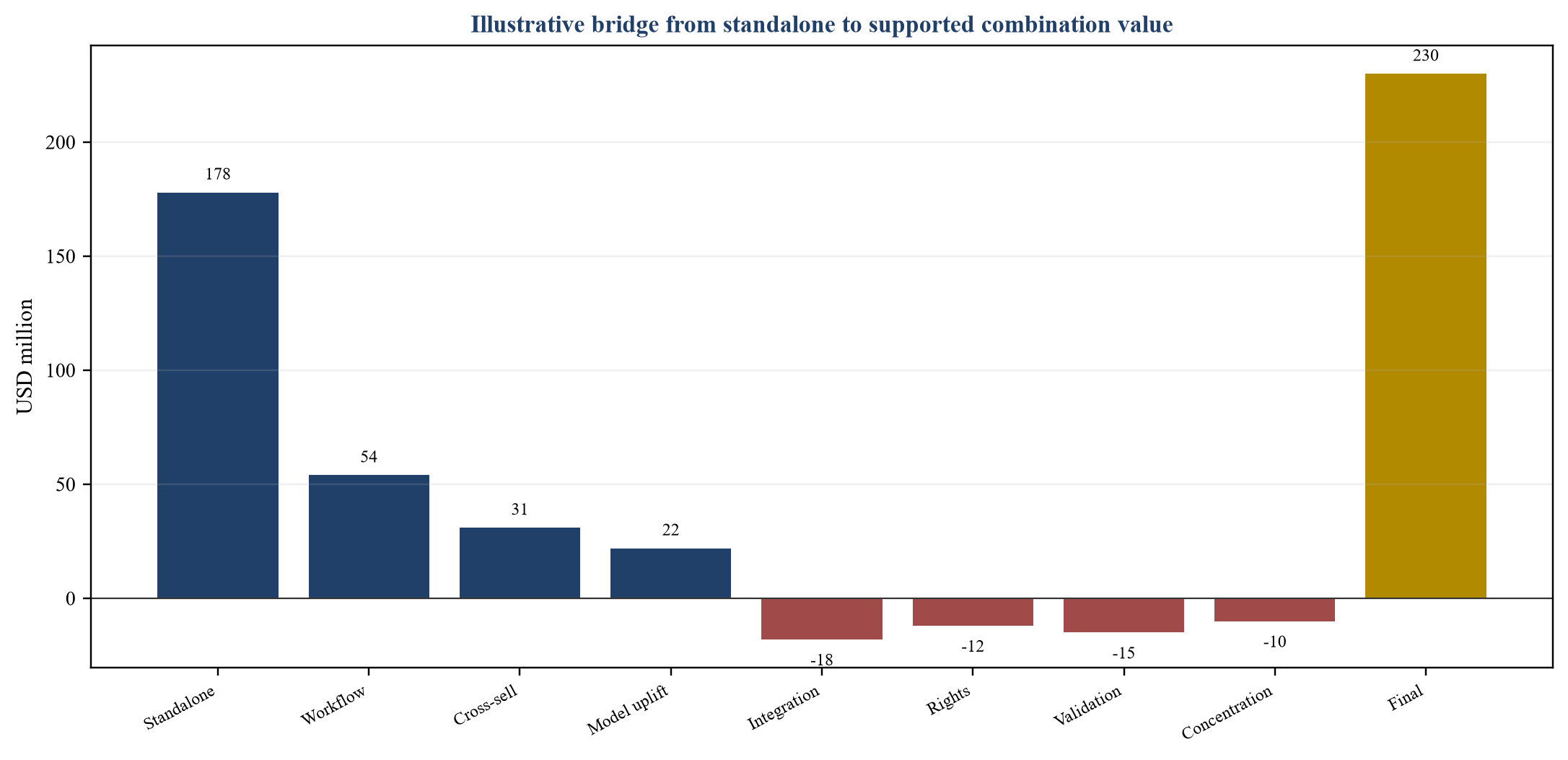
Illustrative USD millions; inputs require transaction-specific evidence.
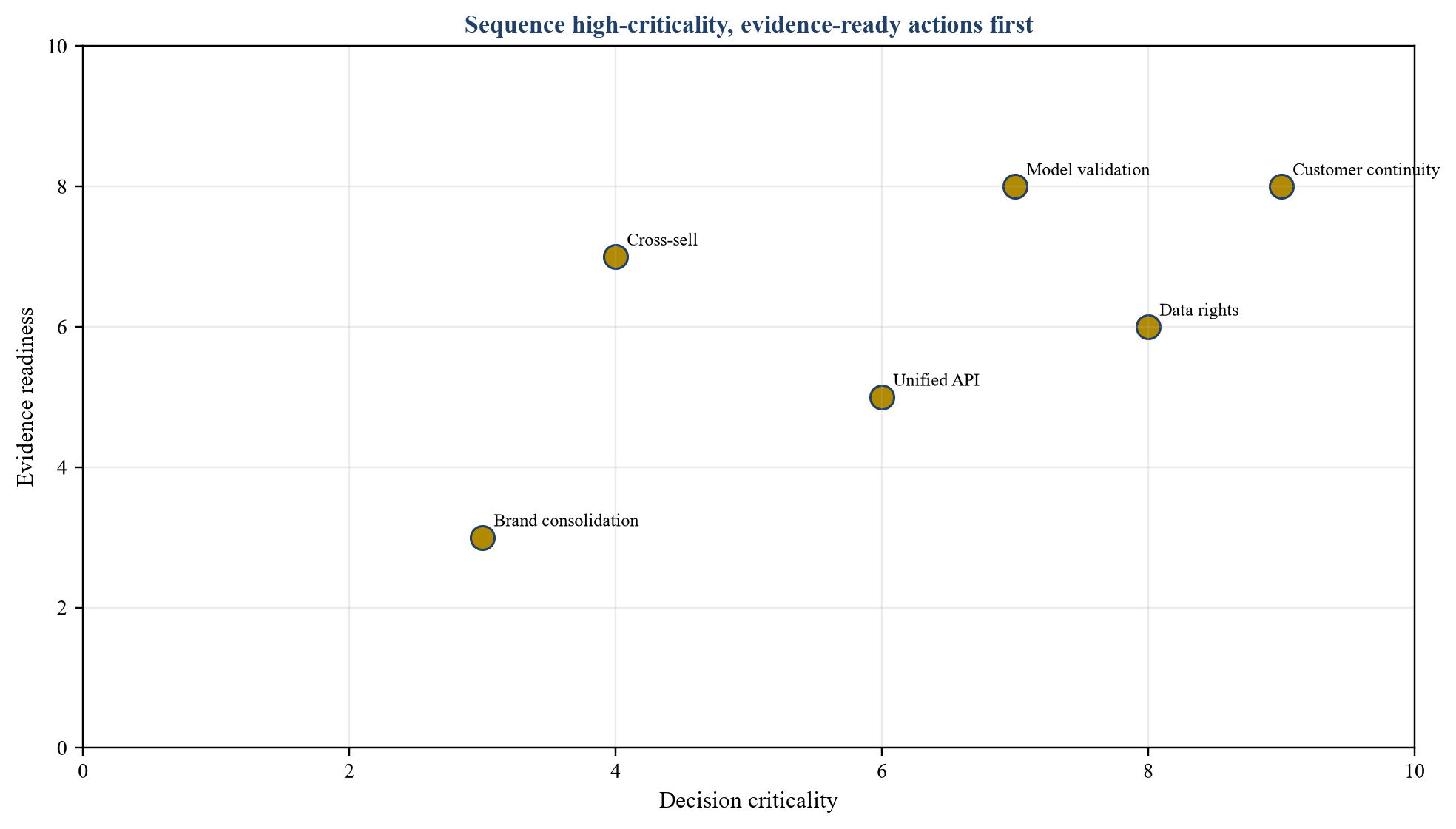
Proposed prioritisation using decision criticality and evidence readiness.
| State | Minimum evidence | Valuation treatment |
|---|---|---|
| Observation | lawful source, coverage and continuity | input capability |
| Feature | repeatable extraction and quality controls | derived data asset |
| Hazard | validated peril intensity and uncertainty | model capability |
| Exposure | verified asset or policy match | addressable portfolio |
| Vulnerability | calibrated damage relationship | loss conversion |
| Workflow action | documented production decision | embedded use |
| Verified outcome | measured result and collected cash | realised customer value |
Proposed evidence sequence for climate-analytics acquisitions.
| Evidence | Disclosed observation | Transaction relevance |
|---|---|---|
| Moody's 2025 | insurance revenue grew 15%; CAPE and Praedicat contributed | workflow and model integration demand |
| MSCI and First Street 2026 | physical-risk data covers more than two billion structures | coordinate-level financial decisions |
| Planet fiscal 2026 | USD 307.7 million revenue and 98% recurring ACV | subscription data economics |
| Verisk 2025 | all top 100 U.S. P&C insurers used offered service lines | embedded insurance distribution |
Named-company disclosures for stated periods; they do not establish an unidentified target's value.
| Dimension | Strong evidence | Weak evidence |
|---|---|---|
| Rights | durable commercial and derivative rights | revocable or unclear access |
| Coverage | decision-relevant peril and geography | broad imagery without use-case fit |
| History | consistent, quality-controlled archive | short or changing series |
| Refresh | reliable cadence and latency | irregular acquisition |
| Feedback | customer outcomes improve product | no production learning loop |
| Replaceability | costly lawful replication | commodity source with many substitutes |
Proposed diligence scoring dimensions.
| Step | Amount | Required evidence |
|---|---|---|
| Standalone value | 178 | recurring contribution and base case |
| Workflow integration | 54 | production adoption and operating plan |
| Supported cross-sell | 31 | identified customers and conversion evidence |
| Validated model improvement | 22 | independent tests and customer benefit |
| Integration execution | minus 18 | architecture, people and dual running |
| Data-rights constraints | minus 12 | licences, consents and lawful perimeter |
| Validation and regulatory gaps | minus 15 | closure plan and approvals |
| Customer concentration | minus 10 | cohort and downside stress |
| Final illustrative enterprise value | 230 | integrated evidence set |
All amounts are illustrative USD millions.
| Level | Evidence | Treatment |
|---|---|---|
| Demonstration | technical output | pipeline only |
| Pilot | time-bounded customer test | no recurring assumption |
| Production use | documented workflow decision | adopted capability |
| Renewal | paid continuation | observed retention |
| Expansion | paid users, portfolios or workflows | cohort growth |
| Verified outcome | measured decision and financial result | supported value claim |
Proposed hierarchy for revenue and synergy claims.
| Risk | Potential protection | Release evidence |
|---|---|---|
| Data rights | closing condition or holdback | consent and transfer confirmation |
| Model performance | performance earn-out | accepted independent validation |
| Customer retention | revenue earn-out | collected retained contribution |
| Regulatory use | milestone consideration | approval and production operation |
| Integration | staged payment | tested migration and continuity |
| Cross-sell | contingent consideration | paid adoption from named cohorts |
Proposed allocation of unresolved acquisition risk.
| Dimension | Core measure | Trigger |
|---|---|---|
| Data | rights-cleared, current and used observations | restriction or degradation |
| Models | cohort performance, drift and cost | validation threshold breach |
| Workflow | active decisions and override rate | adoption decline |
| Customers | retention, expansion and concentration | cohort below case |
| Integration | migrated products and service continuity | milestone delay |
| Capital | cash, integration spend and liquidity | funding shortfall |
| Outcomes | measured customer and financial result | attribution failure |
Proposed monthly decision record.
Sources
- Moody's Corporation, Annual Report for the year ended 31 December 2025. Read the primary source
- Moody's Corporation, Moody's to Acquire CAPE Analytics, 13 January 2025. Read the primary source
- MSCI, MSCI to Acquire First Street to Enhance Physical Climate Risk Capabilities for Financial Decision Making, 24 June 2026. Read the primary source
- Planet Labs PBC, Annual Report for the year ended 31 January 2026. Read the primary source
- Verisk Analytics Inc., Annual Report for the year ended 31 December 2025. Read the primary source
- Planet Labs PBC, Second Quarter Fiscal 2026 Results and Swiss Re drought-insurance case. Read the primary source
- World Meteorological Organization, State of the Global Climate 2025. Read the primary source
- NOAA National Centers for Environmental Information, Insurance and Reinsurance. Read the primary source
- National Association of Insurance Commissioners, Catastrophe Models (Property). Read the primary source
- European Insurance and Occupational Pensions Authority, New risk factors for flood, windstorm and hail risk, 30 January 2025. Read the primary source
- European Commission, Questions and answers on the Solvency II Delegated Regulation, 29 October 2025. Read the primary source
- Arch Capital Group Ltd., Annual Report for the year ended 31 December 2024. Read the primary source
- Chubb Limited, Annual Report for the year ended 31 December 2025. Read the primary source
- Palomar Holdings Inc., Annual Report for the year ended 31 December 2025. Read the primary source
- NASA, Commercial Satellite Data Acquisition Programme. Read the primary source
- Copernicus Data Space Ecosystem, Sentinel Data Collections. Read the primary source
- IFRS Foundation, IFRS 3 Business Combinations. Read the primary source
- IFRS Foundation, IAS 38 Intangible Assets. Read the primary source
- IFRS Foundation, IFRS 13 Fair Value Measurement. Read the primary source
- IFRS Foundation, IAS 36 Impairment of Assets. Read the primary source
- IFRS Foundation, Customer-related intangible assets under IFRS 3 and IAS 38. Read the primary source
- International Valuation Standards Council, Value and Data, 29 February 2024. Read the primary source
- International Valuation Standards Council, Deciphering Technology, 28 June 2023. Read the primary source
- U.S. National Institute of Standards and Technology, Artificial Intelligence Risk Management Framework 1.0. Read the primary source
- U.S. National Institute of Standards and Technology, Cybersecurity Framework 2.0. Read the primary source
- European Union, Regulation (EU) 2024/1689 laying down harmonised rules on artificial intelligence. Read the primary source
- European Union, Regulation (EU) 2023/2854 on harmonised rules on fair access to and use of data. Read the primary source
