

1. Start with the decision behind the question
A climate DDQ is useful when each question supports a defined decision. An investor may be testing governance, exposure, measurement capability, portfolio coverage, disclosure readiness or the credibility of a sustainability claim. A distributor may need product information. A regulator may prescribe entity-level or product-level disclosure. A lender may focus on physical risk, transition cost or covenant evidence. The same words can therefore require different evidence.
The first control is a question register. Each incoming question receives an owner, audience, jurisdiction, product, reporting period, decision use, required definition, source, calculation, review status and approved response. This prevents a response prepared for one limited partner from becoming a universal public statement.
The manager should also distinguish fact, method, estimate, target and commitment. A reported electricity bill is a source fact. Converting it into emissions requires a method and factor. Filling a missing month requires an estimate. A reduction target requires a baseline, perimeter, horizon and governance. A commitment can create legal, operational and reputational consequences. These items should not share one undifferentiated spreadsheet cell.
A compact answer can be institutionally useful when its boundary and limitations are clear. Volume does not cure ambiguity. The objective is a reproducible response that an investment professional, finance lead, compliance reviewer and investor can follow from question to approved evidence.
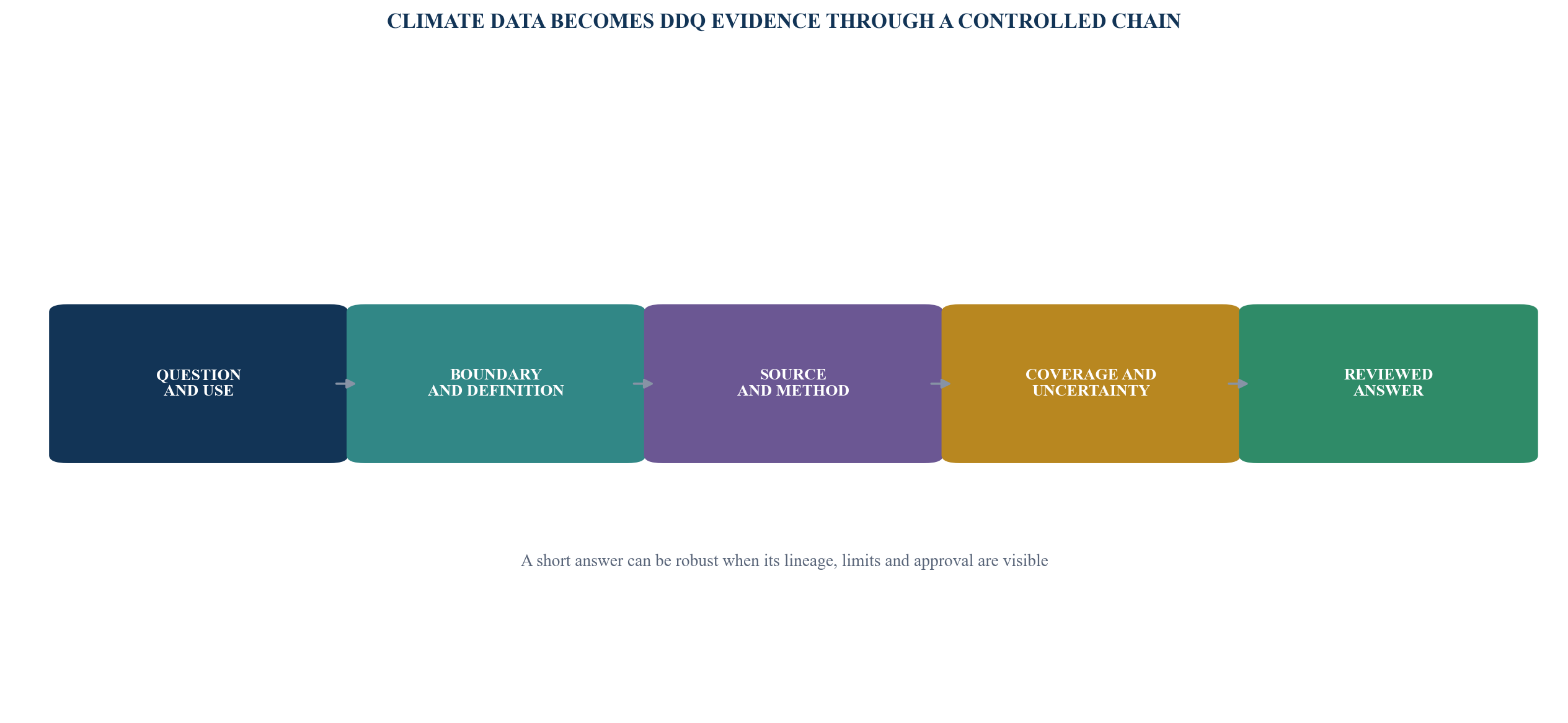
Every response travels from decision use to approved communication through controlled evidence.
2. Separate the reporting perimeters
Climate information can refer to the management company, a legal fund, a portfolio, an investee company, a project or a physical asset. The organisational and financial consolidation boundaries can differ from the investment boundary used for financed emissions. Ownership and control can change during a reporting period. A smaller manager should therefore establish perimeter before collecting numbers.
The firm perimeter covers offices, employees, travel, purchased energy and other manager operations. The fund perimeter covers legal vehicles and the investments attributed to them. The portfolio perimeter can include current holdings, realised holdings, co-investments and excluded assets according to a stated rule. Asset-level reporting can require location, energy, fuel, refrigerant, production or hazard information. Every aggregate should identify which perimeter it represents.
The register records legal entity, fund, asset, ownership percentage, instrument, control status, acquisition and disposal dates, fiscal year, reporting currency, sector and geography. It then maps the consolidation and attribution method used for each metric.
Boundary changes need an event log. Acquisitions, disposals, restructurings and follow-ons can change the population and denominator. A year-on-year movement can otherwise look like operational improvement when it is caused by portfolio composition.
Table 1. Climate metric dictionary
| Field | Required content | Control purpose | Example evidence |
|---|---|---|---|
| metric identifier | stable name and version | prevents duplicate definitions | approved data dictionary |
| perimeter | firm, fund, portfolio, company or asset | establishes inclusion | legal and investment register |
| definition | numerator, denominator and unit | supports comparability | methodology note |
| period | start, end and measurement date | aligns time | reporting calendar |
| source class | reported, calculated, estimated or unavailable | exposes evidence strength | source ledger |
| methodology | consolidation, attribution and factor | enables reproduction | calculation workbook |
| coverage | value and population represented | prevents false completeness | coverage schedule |
| uncertainty | limitation and sensitivity | communicates precision | estimation memo |
| owner and reviewer | responsible roles and approval date | creates accountability | sign-off register |
The live dictionary should identify the applicable standard, jurisdiction and approved calculation version.
3. Build a minimum viable dataset
A smaller GP needs a stable core before adding every requested data point. The core should answer who governs climate matters, which investments are covered, which material risks are assessed, what emissions information exists, how it was produced, what remains missing, and how the manager acts on findings.
At firm level, the core includes governance ownership, policy scope, staff responsibilities, escalation and the manager's own operational data where relevant. At fund level, it includes strategy, investment process, exclusions or additional diligence, product claims, reporting commitments and investor side-letter obligations. At portfolio level, it includes company identifiers, sector, geography, ownership, investment value, revenue or another approved denominator, climate-risk status, emissions availability and engagement actions.
Emissions data should preserve gross Scope 1, Scope 2 and relevant Scope 3 information separately. IFRS S2 uses the Greenhouse Gas Protocol as its general measurement anchor, subject to its requirements and applicable jurisdictional reliefs. The December 2025 IFRS S2 amendments clarify aspects of Category 15 financed emissions and take effect for reporting periods beginning on or after 1 January 2027, with early application permitted. A live framework should record which standard version is being applied.
The minimum dataset should also capture physical and transition risks that can affect cash flow, access to finance or cost of capital. These can include location hazards, energy dependence, carbon cost exposure, regulatory change, customer requirements, asset obsolescence and required capital expenditure. A metric list without decision context can miss the risks that matter to underwriting.
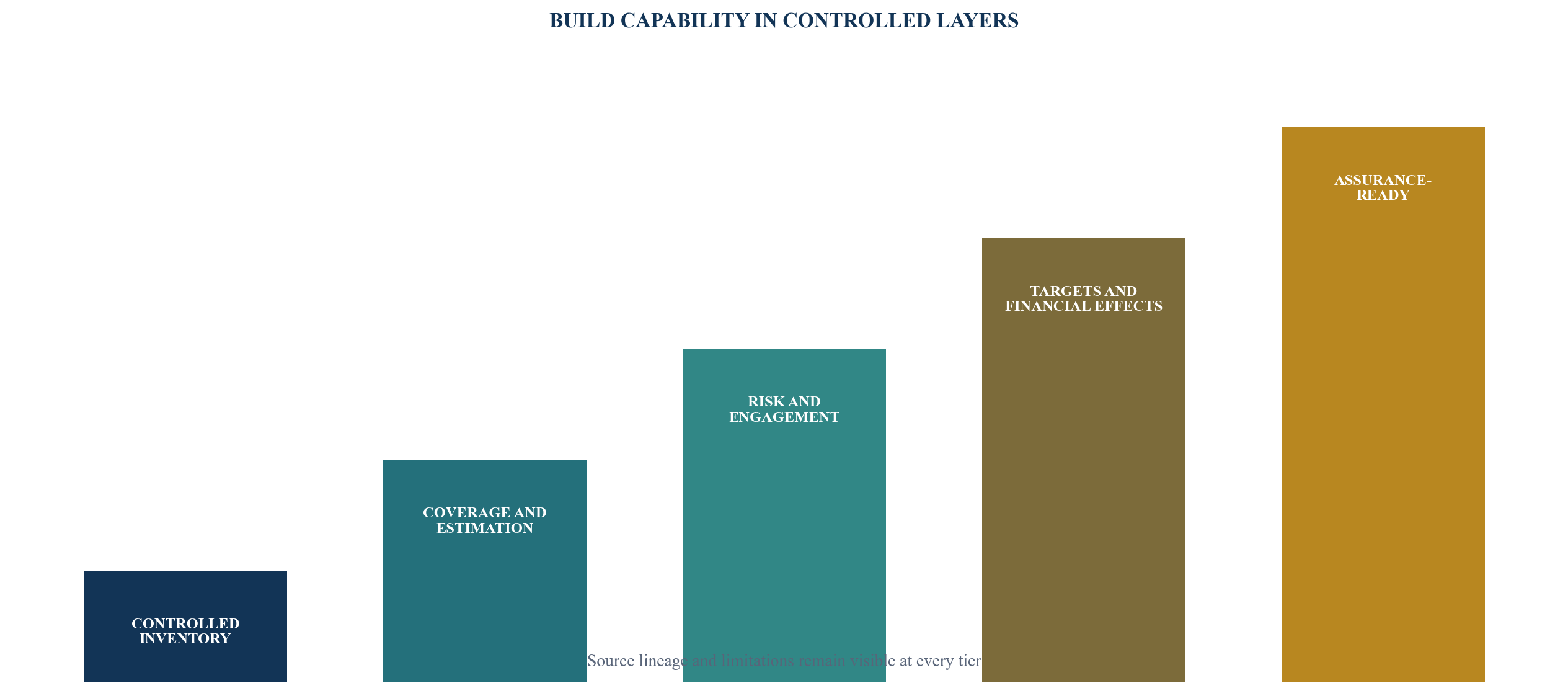
Higher tiers add decision utility and assurance readiness; they do not erase the need for transparent source labels.
4. Use a four-state source taxonomy
Every climate value should be classified as reported, calculated, estimated or unavailable. Reported data comes from a company or asset source and still requires boundary, period and quality checks. Calculated data combines controlled inputs with a documented method. Estimated data uses proxies or models because primary data is incomplete. Unavailable means the manager cannot currently produce a defensible value.
This taxonomy prevents a common failure: displaying estimated emissions beside reported emissions without showing the distinction. Estimates can be decision-useful when the method, source, coverage, uncertainty and update plan are visible. An empty field can also be an honest result when the underlying evidence cannot support a number.
Source hierarchy should be set by metric. Metered utility data can outrank invoices; invoices can outrank spend estimates. Audited company emissions can outrank management submissions; management submissions can outrank sector proxies, depending on boundaries and methodology. External vendor data requires the same examination of scope, method, timestamp and licence.
The source ledger records file, system, owner, received date, period, entity, metric, version and transformation. It stores evidence references rather than embedding every document inside the calculation model. Access controls protect commercially sensitive company information.
Table 2. Source and evidence hierarchy
| Source state | Typical input | Required disclosure | Review test |
|---|---|---|---|
| reported | meter, invoice, company inventory | boundary, period and preparer | reconcile to source and scope |
| calculated | activity data times approved factor | method, factor and version | rerun and reasonableness check |
| estimated | sector, revenue, asset or location proxy | proxy, rationale and uncertainty | compare alternatives and sensitivity |
| unavailable | missing or unusable evidence | gap, cause and owner | remediation date or accepted limitation |
| externally assured | assurance report and covered metric | scope, level and exceptions | confirm period and perimeter |
| vendor-derived | licensed dataset or model output | provider, version and permitted use | challenge coverage and methodology |
Ranking depends on the metric and approved methodology; the table illustrates a control structure.
5. Measure coverage before interpreting the aggregate
A portfolio total can appear precise while representing a small subset. Coverage should accompany the number and should be calculated on more than one denominator where useful. Company count, invested capital, fair value, revenue, floor area, energy use or another strategy-relevant measure can produce different pictures.
Assume a demonstration portfolio of twenty companies with total fair value of USD 400 million. Twelve companies representing USD 310 million provide usable Scope 1 and Scope 2 information. Count coverage is 60 percent and fair-value coverage is 77.5 percent. These are management assumptions for illustration. Neither percentage establishes data quality, comparability or assurance.
Coverage should be shown by source state and by important segments. A portfolio can have strong aggregate coverage while missing its most emissions-intensive sector. The report therefore disaggregates by geography, sector, ownership, strategy and material-risk classification where decision-useful.
The denominator should stay stable within the reporting period and changes should be explained. Acquisitions, disposals and valuation movements can change fair-value coverage even when the underlying submissions do not change. A coverage bridge separates population change from collection progress.
Coverage also needs a materiality view. A company can represent a small share of fair value while carrying a large share of energy use, physical exposure or transition sensitivity. The manager can therefore maintain a priority population alongside the full population. The priority rule is documented before the collection result is known and can combine sector, location, ownership, expected emissions and financial exposure. Progress is then reported for the full portfolio and the priority population.
A late submission should not silently disappear from the denominator. The reporting pack shows whether the company was not requested, did not respond, responded with incomplete information or supplied evidence that failed validation. These states lead to different remediation. They also help the manager explain why portfolio coverage moved between reporting cycles.
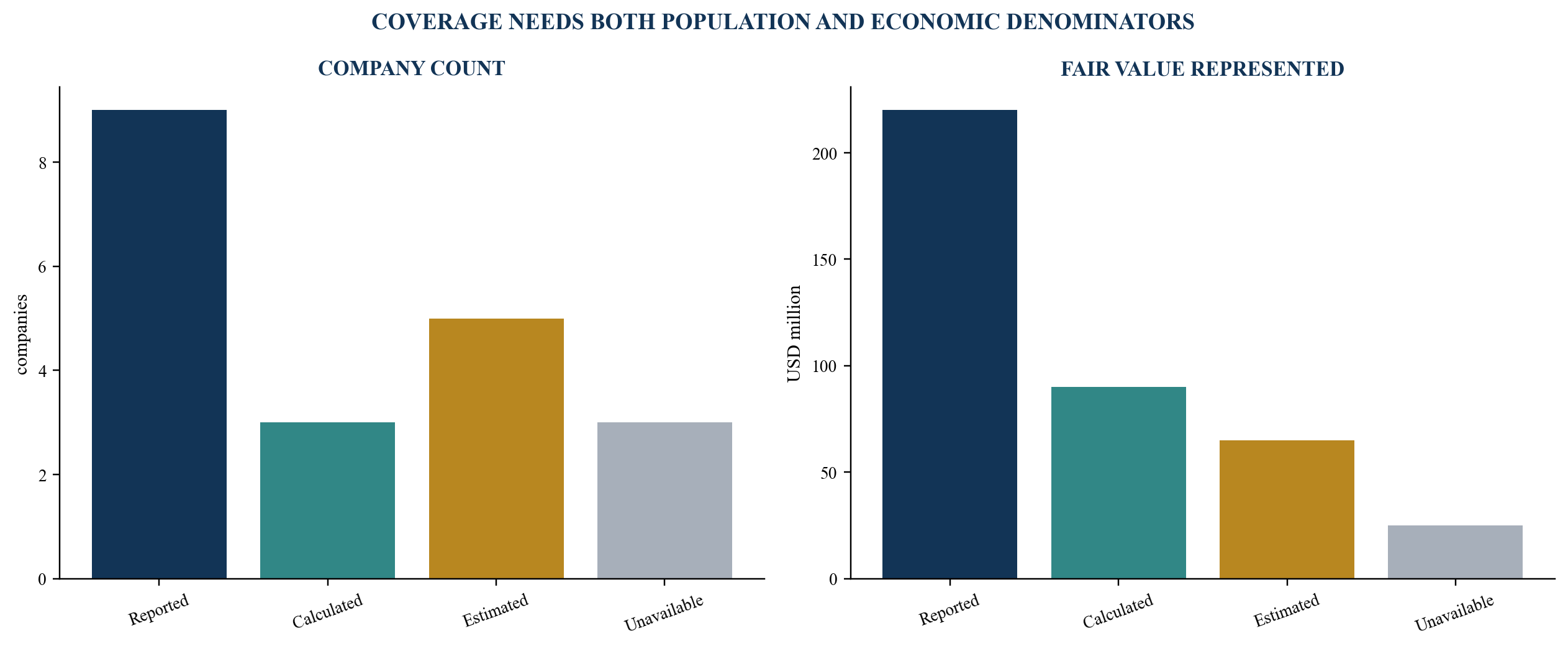
Values are management assumptions used to demonstrate the reporting method; they are not actual portfolio data.
6. Treat methodology as controlled data
Methodology is part of the evidence, not a footnote written after the result. The manager should record consolidation approach, investment attribution formula, emissions factor, global-warming-potential source, currency conversion, valuation date, ownership measure, data hierarchy, estimation logic and exclusions.
The GHG Protocol's investment guidance covers equity, debt, project finance and managed investments within Category 15 boundaries. PCAF's 2025 financed-emissions standard provides financial-sector methods for multiple asset classes. Applicability depends on instrument, use of proceeds, information availability and the reporting framework. A manager should select and document the relevant method rather than blend formulas opportunistically.
Method versions must be locked for a reporting cycle. A change can improve the calculation while breaking comparability. The change log records reason, effective date, affected history and whether prior periods were restated. Parallel calculation can quantify the effect before approval.
Emission factors require jurisdiction, fuel, electricity market, year and unit. A factor taken from a current public source may still be wrong for the asset or period. Conversion controls should catch kilowatt-hour and megawatt-hour errors, currency mismatches, decimal problems and duplicated facilities.
Table 3. Methodology decision matrix
| Decision | Required record | Typical risk | Control |
|---|---|---|---|
| organisational boundary | equity share, financial or operational control | double count or omission | boundary memo and entity map |
| investment attribution | instrument and approved formula | inconsistent financed emissions | asset-class method register |
| reporting date | point in time or period convention | valuation and emissions mismatch | calendar and cut-off rule |
| emission factor | source, geography, year and unit | obsolete or wrong factor | locked factor library |
| estimate | proxy and model version | false precision | uncertainty and sensitivity |
| restatement | threshold and trigger | hidden methodology drift | change-control approval |
Applicable requirements and methods require current specialist review.
7. Request portfolio data once and reuse it
Portfolio companies often receive overlapping climate requests from owners, lenders, customers and regulators. A manager can reduce burden by maintaining one controlled request pack with modular extensions.
The base module asks for entity, reporting period, organisational boundary, energy, fuel, Scope 1, Scope 2, relevant Scope 3, method, factors, assurance, targets, physical locations, material risks and responsible owner. Sector modules add metrics relevant to the business model. Jurisdiction modules add prescribed fields. Investor modules map the same evidence to specific DDQ wording.
The request should define every unit and allow four answers: reported value, management estimate, unavailable, or not applicable with reason. Supporting evidence can be referenced through a secure data room. The manager should avoid asking a small company for a fully developed transition plan when the immediate decision only requires energy records, material exposures and governance ownership.
Collection has a timetable and escalation route. A portfolio company should know who can answer methodology questions and how corrections are handled. Repeated questions are added to the data dictionary rather than recreated in email.
8. Connect climate metrics to underwriting
Climate data creates value when it affects an investment decision, monitoring action or capital plan. The architecture should link metrics to cash flow, operating cost, capital expenditure, asset life, insurance, financing, regulation, customers and exit readiness.
Physical risk begins with location and asset exposure. Flood, heat, water stress, wildfire, storm and sea-level information requires geospatial resolution and scenario assumptions. PRI's technical guide for physical climate risk in private markets emphasises the different location-specific needs of real assets and private equity. A portfolio heat map should distinguish exposure, vulnerability and management response.
Transition risk can include energy price, carbon cost, technology substitution, standards, customer procurement, supply-chain requirements and financing conditions. The investment memo records the causal pathway from driver to financial effect. A broad risk score without this bridge can obscure the decision.
The manager should also capture opportunities such as efficiency, renewable sourcing, resilient design, lower-carbon products and avoided downtime. Opportunity claims need the same evidence discipline as risk claims.
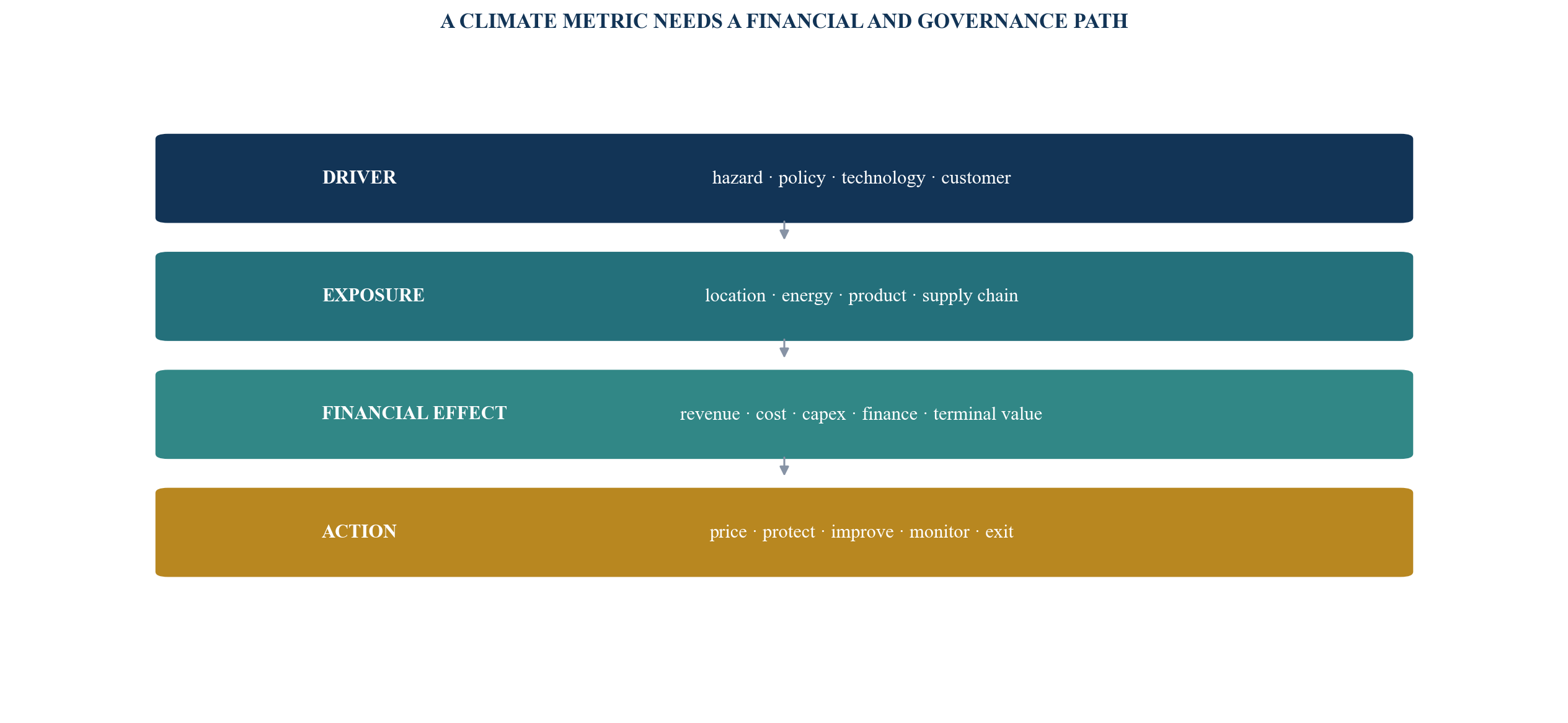
The bridge converts evidence into a decision path rather than a standalone score.
9. Build the DDQ answer library
An answer library should store approved response components, not frozen paragraphs. Each component contains the question theme, current answer, boundary, period, evidence links, calculation reference, limitations, owner, reviewer, approval date and permitted channels.
The library separates governance, policy, diligence, monitoring, engagement, emissions, physical risk, transition risk, targets, incidents and reporting. A response engine can assemble relevant components while preserving investor-specific requirements. Human review remains necessary because wording, fund perimeter and legal context vary.
Every answer should state what the manager does today. Future capability appears as an approved plan with owner and date. Claims such as complete coverage, alignment, net zero, Paris alignment or positive impact require defined criteria and evidence. The FCA anti-greenwashing rule applies to sustainability references made by authorised firms about products and services; current SDR materials require disclosures and claims to be clear and supportable within their scope. Other jurisdictions have distinct rules.
Answer expiry is a core field. Data can change after acquisition, disposal, methodology update, correction, regulation or investor agreement. The library therefore produces an exception queue before each fundraising process.
Table 4. DDQ answer control record
| Component | Content | Evidence | Release control |
|---|---|---|---|
| direct answer | current practice and result | policy, register or calculation | approved wording |
| perimeter | entities, funds and period covered | legal and portfolio map | match recipient request |
| method | definition, formula and source | methodology file | current version only |
| coverage | numerator and denominator | coverage schedule | display beside aggregate |
| limitation | gap, estimate or uncertainty | exception log | retained in response |
| next action | approved remediation | action register | avoid unsupported promise |
| approval | owner, compliance and date | sign-off record | permitted channel and expiry |
The record supports reuse while preserving audience and product boundaries.
10. Design the evidence room around lineage
The evidence room should allow a reviewer to travel from a DDQ response to source records without exposing irrelevant confidential material. Its index mirrors the metric dictionary and answer library.
Governance folders contain policies, committee terms, minutes and roles. Method folders contain boundaries, factors, estimation models and change logs. Portfolio folders contain request returns, evidence references, calculation outputs and exceptions. Reporting folders contain approved disclosures, investor reports and submission records. An issue folder records corrections, late data and remediation.
Permissions should reflect fund, company and personal-data sensitivity. Portfolio companies may provide information under contractual restrictions. Location data can be commercially sensitive. The manager should establish retention, lawful use, access logging and deletion rules with relevant advisers.
The collection notice and portfolio agreement should identify intended uses, onward sharing and contact points. A response collected for internal risk assessment may require additional review before appearing in investor reporting, product disclosure or public marketing. Vendor licences can also restrict reproduction of model outputs or underlying datasets. The evidence index records use rights beside source quality.
Cybersecurity controls should match the sensitivity and concentration of the room. Role-based access, multifactor authentication, download restrictions, encryption, access review and incident procedures are practical controls. The manager should avoid sending company workbooks through uncontrolled email chains when a secure request and exchange process is available.
Evidence status is visible in the index. A file name alone does not show whether evidence covers the correct entity, period and metric. The index therefore records those fields plus reviewer and version.
11. Apply proportionality without disguising gaps
Proportionality is a disciplined scoping decision. IFRS Foundation materials describe mechanisms based on reasonable and supportable information available without undue cost or effort and on skills, capabilities and resources. The European Commission's July 2025 VSME recommendation encourages a voluntary standard to help smaller undertakings respond to sustainability-information requests and treats self-declaration as proportionate for its stated population.
A smaller GP can use those principles to sequence capability. It starts with information already used in financial reporting, operations, strategy and risk management. It then adds data that materially improves investor decisions. The manager documents why a method is proportionate, which information was considered and how the gap will be revisited.
Proportionality does not turn an estimate into a measured value or create a legal exemption. Applicable laws, fund documents and investor agreements still control. A voluntary framework should not be presented as compliance with a mandatory regime unless the applicable tests are met.
The architecture therefore uses maturity tiers. Tier one controls definitions and inventory. Tier two adds collection, estimates and coverage. Tier three connects risk and engagement. Tier four develops targets, scenarios and financial effects. Tier five prepares selected metrics and controls for assurance.
12. Reconcile the global baseline and jurisdiction overlays
The global core can use the ISSB structure of governance, strategy, risk management, metrics and targets. IFRS S2 requires disclosure of material climate-related risks and opportunities within its scope and includes Scope 1, Scope 2 and Scope 3 emissions requirements. Adoption, effective dates and modifications vary by jurisdiction.
The United Kingdom issued UK SRS S1 and UK SRS S2 in February 2026. The FCA's current SDR regime includes an anti-greenwashing rule and product, naming, marketing and disclosure requirements for firms and products within scope. The European SFDR framework continues to govern entity and product disclosures while a November 2025 Commission proposal seeks revision; proposal and current law must remain separate. The EU delegated rules require methodology, sources and best-efforts information for principal adverse impact reporting within their scope.
ADGM's FSRA published ESG disclosure guidance for licensed fund and asset managers, including entity-level threshold discussion. DIFC and other centres require separate current analysis. A global manager should maintain a jurisdiction matrix listing entity, product, investor, distribution location, rule, status, owner and evidence consequence.
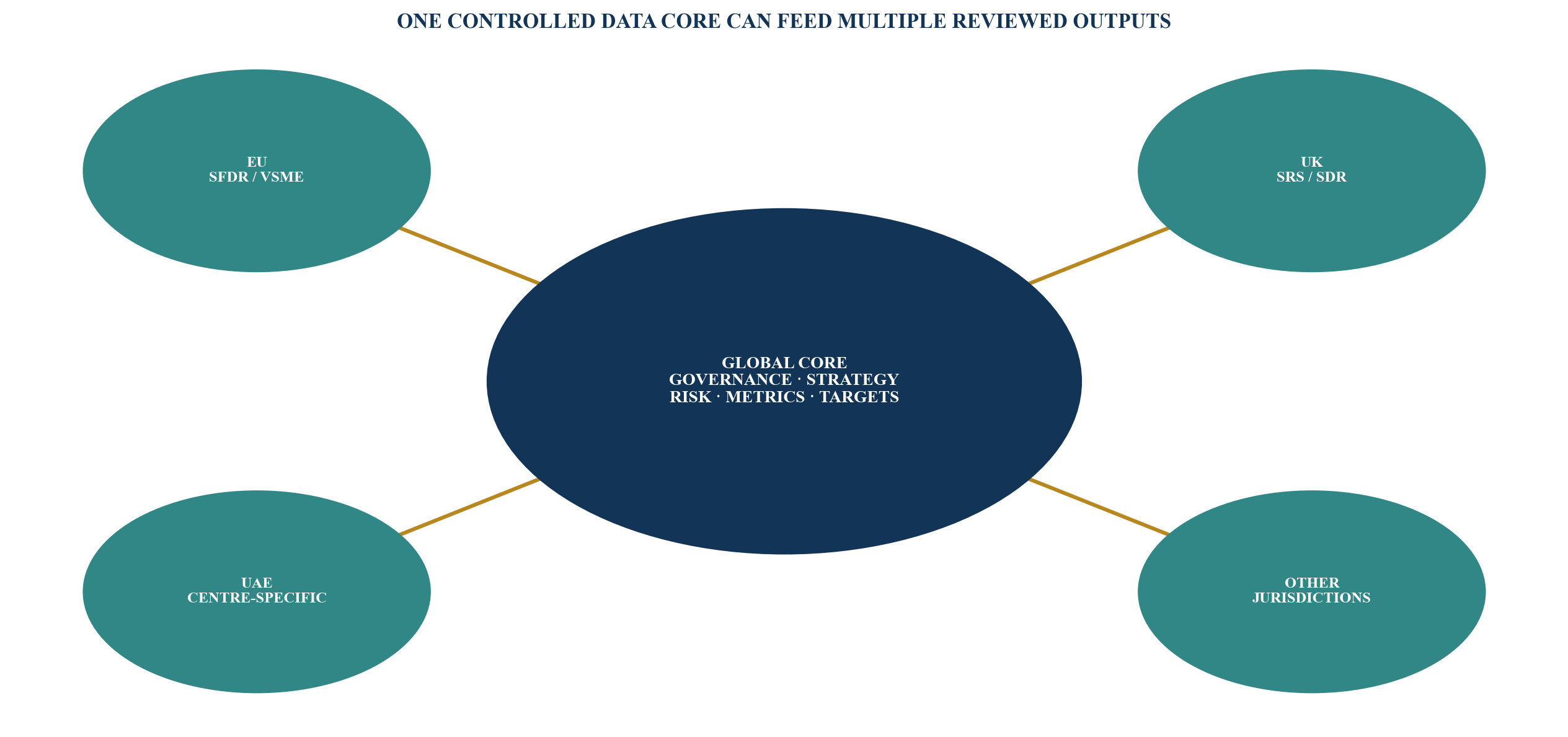
Applicable requirements depend on entity, product, investor, channel and current law.
13. Govern estimates and uncertainty
Estimation should have an approved hierarchy, trigger and expiry. The hierarchy can move from company-specific activity data to asset-specific proxies, peer or sector intensity and broader economic estimates. The chosen proxy should reflect geography, technology, scale and business model where information permits.
Every estimate stores model version, inputs, factor, output, confidence or uncertainty description, sensitivity and replacement plan. A manager should avoid a single confidence score that hides different weaknesses. Boundary uncertainty, activity-data uncertainty, emission-factor uncertainty and attribution uncertainty can be recorded separately.
Sensitivity analysis should focus on decisions. If plausible factor choices do not change risk classification, greater precision may have limited immediate value. If a financing covenant, product claim or investment decision changes, the manager should prioritise better primary data.
Estimated and reported values should remain distinguishable in charts and answers. Restatement thresholds define when corrections or improved data require a revised disclosure.
14. Create a review and assurance pathway
Internal review starts with source reconciliation, formula testing, unit checks, period checks, duplicate detection, exception review and approval. Finance, investment, sustainability, compliance and legal roles should be defined according to the claim.
External assurance is an engagement with a defined subject matter, criteria, period and level. Assurance over selected emissions does not verify every climate statement, target or investment claim. The DDQ should describe precisely what was assured and disclose relevant qualifications.
A smaller GP can prepare for future assurance by preserving calculation versions, evidence indexes, approvals, corrections and control operation. The board chooses which metrics merit external assurance based on legal requirements, investor use, claim risk and cost.
Table 5. Evidence room and review map
| Room | Controlled contents | Reviewer | Output |
|---|---|---|---|
| governance | policy, roles, minutes and escalation | board or delegated committee | governance response |
| perimeter | entity, fund and asset registers | finance and investment | population certificate |
| methodology | definitions, factors and models | technical reviewer | method statement |
| source evidence | company returns and references | data owner | source ledger |
| calculation | versioned workbooks and tests | finance or independent reviewer | approved metrics |
| disclosure | DDQs, reports and claim register | compliance and legal | released communication |
| issues | gaps, corrections and remediation | control owner | exception and restatement log |
Access and retention require fund-specific legal and data-protection review.
15. Run a ninety-day implementation
The first thirty days establish scope. The manager inventories questions, products, jurisdictions, contractual commitments and existing data. It approves the metric dictionary, perimeter rules, owners and issue taxonomy. A pilot fund and a small group of companies are selected based on materiality and data availability.
Days thirty-one to sixty build the evidence flow. The team issues the portfolio request, creates the source ledger, locks factor libraries, implements calculations, records coverage and builds the evidence-room index. Pilot answers are reviewed against actual investor questions.
Days sixty-one to ninety close the loop. The team resolves priority gaps, approves the answer library, completes a reporting pack, documents limitations, tests change control and agrees the recurring calendar. An independent reviewer can rerun selected metrics.
The plan should produce controlled outputs rather than a large software installation. Existing data and document systems may be adequate when identifiers, permissions, versioning and review are sound.
Acceptance criteria should be agreed at the start. By day ninety, the pilot should have a signed perimeter, a versioned dictionary, traceable source records, reproducible calculations, explicit coverage, approved limitations, an answer library and a named recurring owner. A dashboard without these controls is an incomplete implementation.
The pilot also needs a failure test. The reviewer selects one reported value, one calculation, one estimate and one unavailable metric and traces each from answer to evidence. The team then introduces a controlled correction to confirm that downstream answers, tables and approvals are updated. This tests the operating system rather than its appearance.
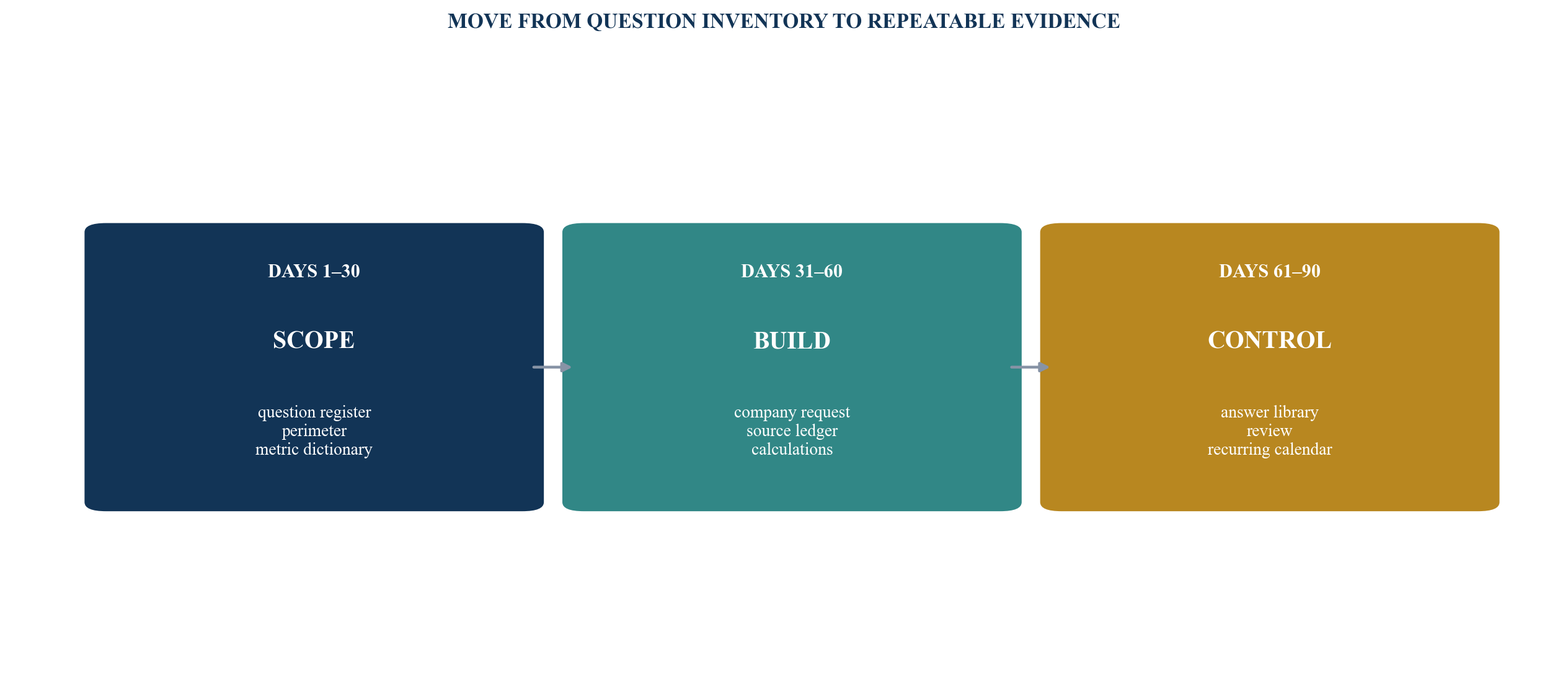
Timing is a management assumption for planning; actual effort depends on portfolio, evidence and requirements.
16. Operate a recurring climate-data office
After implementation, the system needs a cadence. Monthly activity captures acquisitions, disposals, material incidents and data changes. Quarterly review updates portfolio registers, coverage, exceptions and priority actions. Annual work aligns reporting periods, refreshes company requests, locks methodologies, calculates metrics, obtains approvals and releases investor responses.
Event-driven review applies when a methodology changes, a material error appears, a sustainability claim is introduced, a fund enters a new jurisdiction, or an investor commitment changes. The response library is suspended or narrowed when its evidence expires.
Management information should show completion, source quality, coverage, overdue evidence, unresolved exceptions, restatements and DDQ turnaround. It should also show whether climate findings affected underwriting, ownership plans or capital allocation.
Exceptions need severity, owner, due date and release consequence. A minor missing source reference can remain open while a response is held. A material methodology error can require calculation suspension, investor notification or restatement after specialist review. The issue policy defines those outcomes before pressure from a live fundraising process.
Corrections should preserve the original response, revised response, reason, approval and recipient population. A change to one metric can affect several DDQs, reports and claims. The claims register maps that dependency so the manager can identify every communication requiring review.
The board receives a short certification pack: perimeter, methodology version, coverage, principal limitations, material changes, claims, assurance status and open decisions. This makes climate reporting part of investment and operating governance.
Table 6. Recurring climate-data office
| Cadence | Inputs | Controlled output | Decision owner |
|---|---|---|---|
| monthly | transactions, incidents and corrections | event and issue log | investment or control owner |
| quarterly | portfolio, risk and source updates | coverage and exception pack | investment committee |
| annual | company requests, factors and valuations | approved climate dataset | finance and board delegate |
| fundraising | investor questions and product claims | reviewed DDQ response | fundraising and compliance |
| event-driven | rule, method, error or claim change | suspension, update or restatement | designated approver |
| assurance cycle | criteria, evidence and controls | scoped assurance materials | board or audit committee |
Cadence and ownership should be adapted to the manager, funds and reporting obligations.
17. Use a ten-day diagnostic before rebuilding the system
The diagnostic begins by collecting the last investor DDQs, side letters, fund documents, disclosures, portfolio templates, calculations and policies. It maps repeated questions and inconsistent answers. It then selects a small set of material metrics and traces each answer back to source.
The review tests perimeter, definition, period, source state, methodology, factor, coverage, uncertainty, approval and jurisdiction. It also compares public claims with internal evidence. Gaps are ranked by decision and claim risk.
The output is a board-ready map of current capability, priority corrections, minimum dataset, target architecture, ninety-day plan and recurring ownership. A diagnostic should avoid promising full emissions coverage where source data and methodology do not support it.
18. Measure operational and commercial outcomes carefully
Useful operational measures include median DDQ turnaround time, percentage of responses drawn from approved components, portfolio coverage, share of reported versus estimated data, overdue evidence, calculation exceptions, restatements and reviewer findings. Investment measures can track whether material climate risks enter underwriting and ownership plans.
Commercial measures need attribution discipline. A faster DDQ response or stronger evidence room can support fundraising execution, but it does not prove an allocation, mandate or fee outcome. Investor progression, data-room access, diligence completion, signed commitments and funded capital should be recorded separately.
The manager should avoid claiming that climate reporting creates returns or investor demand without evidence. The architecture supports decision quality, consistency and defensibility. Actual commercial outcomes depend on strategy, performance, team, terms, market conditions and investor decisions.
19. Common failure modes
The first failure is collecting data before defining the question and perimeter. The second is mixing reported, calculated and estimated values. The third is showing aggregate emissions without coverage. The fourth is using one methodology across instruments for which it is not appropriate. The fifth is treating a voluntary template as a legal conclusion.
Other failures include stale emission factors, mismatched periods, changing denominators, hidden restatements, unsupported net-zero language, copied investor answers, inaccessible source evidence, excessive portfolio-company requests and assurance claims that extend beyond the engagement.
The remedy is an explicit control chain. Each answer should be reproducible, bounded, reviewed and capable of being narrowed when evidence is weak.
20. Board agenda
The board should approve the purpose, perimeter, metric dictionary, methodology hierarchy, source taxonomy, coverage policy, estimation controls, jurisdiction matrix, answer governance and assurance pathway. It should decide which claims the evidence currently supports.
The immediate agenda has five questions. Which investor decisions require climate information? Which funds and assets fall within each response? Which data can be sourced now? Which gaps create decision or claim risk? Which recurring owner can keep the system current?
A smaller GP can build credible climate evidence in stages. The durable asset is a controlled reporting architecture that turns portfolio information into transparent, reusable and reviewed answers.
References
- IFRS Foundation. Introduction to the ISSB and IFRS Sustainability Disclosure Standards. https://www.ifrs.org/sustainability/knowledge-hub/introduction-to-issb-and-ifrs-sustainability-disclosure-standards/
- IFRS Foundation. IFRS S2 Climate-related Disclosures. https://www.ifrs.org/issued-standards/ifrs-sustainability-standards-navigator/ifrs-s2-climate-related-disclosures/
- IFRS Foundation. Greenhouse Gas Emissions Disclosure Requirements Applying IFRS S2, May 2025. https://www.ifrs.org/content/dam/ifrs/supporting-implementation/ifrs-s2/ghg-ifrs-s2-educational-material.pdf
- IFRS Foundation. Amendments to Greenhouse Gas Emissions Disclosures, December 2025. https://www.ifrs.org/content/dam/ifrs/publications/amendments/english/2025/issb-2025-1-amendments-ifrs-s2.pdf
- IFRS Foundation. Proportionality Mechanisms in IFRS Sustainability Disclosure Standards. https://www.ifrs.org/supporting-implementation/supporting-materials-for-ifrs-sustainability-disclosure-standards/ifrs-s1-and-ifrs-s2/webcast-proportionality-mechanisms-ifrs-sustainability-disclosure-standards/
- Greenhouse Gas Protocol. Technical Guidance for Calculating Scope 3 Emissions, Category 15 Investments. https://ghgprotocol.org/sites/default/files/standards/Scope3_Calculation_Guidance_0.pdf
- Partnership for Carbon Accounting Financials. Global GHG Accounting and Reporting Standard Part A: Financed Emissions, Third Edition, 2025. https://carbonaccountingfinancials.com/files/standard-launch-2025/PCAF-PartA-2025-Full-Document-Clean.pdf
- Institutional Limited Partners Association. Due Diligence Questionnaire 2.0. https://ilpa.org/resources-tools/resource-library/due-diligence-questionnaire/
- Institutional Limited Partners Association. ESG Due Diligence and Investment Decision-Making. https://ilpa.org/industry-guidance/environmental-social-governance/esg-roadmap/due-diligence-and-investment-decision-making/
- Principles for Responsible Investment. Responsible Investment DDQ for Venture Capital Limited Partners. https://public.unpri.org/responsible-investment-ddq-for-venture-capital-limited-partners/10635.article
- Principles for Responsible Investment. Assessing Physical Climate Risk in Private Markets: A Technical Guide. https://public.unpri.org/assessing-physical-climate-risk-in-private-markets-a-technical-guide/13135.article
- European Commission. Recommendation on a Voluntary Sustainability Reporting Standard for SMEs, July 2025. https://finance.ec.europa.eu/publications/commission-presents-voluntary-sustainability-reporting-standard-ease-burden-smes_en
- European Union. Commission Delegated Regulation (EU) 2022/1288. https://eur-lex.europa.eu/eli/reg_del/2022/1288/oj
- European Commission. Proposal to Review the Sustainable Finance Disclosure Regulation, November 2025. https://finance.ec.europa.eu/publications/commission-simplifies-transparency-rules-sustainable-financial-products_en
- United Kingdom Department for Business and Trade. UK Sustainability Reporting Standards S1 and S2, February 2026. https://www.gov.uk/government/publications/uk-sustainability-reporting-standards-uk-srs-s1-and-uk-srs-s2
- Financial Conduct Authority. Sustainability Disclosure Requirements Regime. https://www.fca.org.uk/firms/climate-change-and-sustainable-finance/sustainability-disclosure-requirements-sdr-regime
- Financial Services Regulatory Authority. Environmental, Social and Governance Disclosures Guidance 2024. https://assets.adgm.com/download/assets/Environmental%2BSocial%2Band%2BGovernance%2BDisclosures%2BGuidance%2B2024.pdf/2aaed5de6b9811ef8ab136d4a4edf9e6
About the Author
Chennakeshav Adya, Independent Researcher
