

1. Treat first close as an operating-system outcome
First close is often described as a fundraising milestone. In practice, it is an integrated operating outcome. The manager needs an investable strategy, a viable business, a permitted offer route, consistent legal documents, functioning service providers, approved controls, accepted subscriptions and cleared capital.
Each component can block the closing. A prospective investor may approve the strategy but pause on team capacity. Counsel may complete the limited partnership agreement while tax analysis remains open. The administrator may wait for final terms. The bank may require documents that depend on regulatory or entity approvals. One unresolved side letter can create reporting or governance consequences across the fund.
The first-close factory gives every workstream an owner, decision, dependency, evidence item and deadline. It replaces broad percentage-complete reporting with observable gates. A document is ready when the approved version is reconciled across the complete suite. An investor is in diligence when required materials are accessed and questions are active. A subscription is complete when eligibility, know-your-client, documentation, acceptance and funding conditions have been satisfied.
The system works backward from a closing definition. The board or governing body approves the minimum viable close, authorised investor perimeter, required documents, service-provider readiness, bank and cash controls, and open conditions that can legally remain after closing. It also approves the conditions that cannot be waived.
The 120-day horizon is an implementation frame rather than a promise. Authority review, investor governance, tax, banking, regulated appointments and negotiations determine actual timing. The operating value comes from sequencing controllable work and exposing dependencies early.
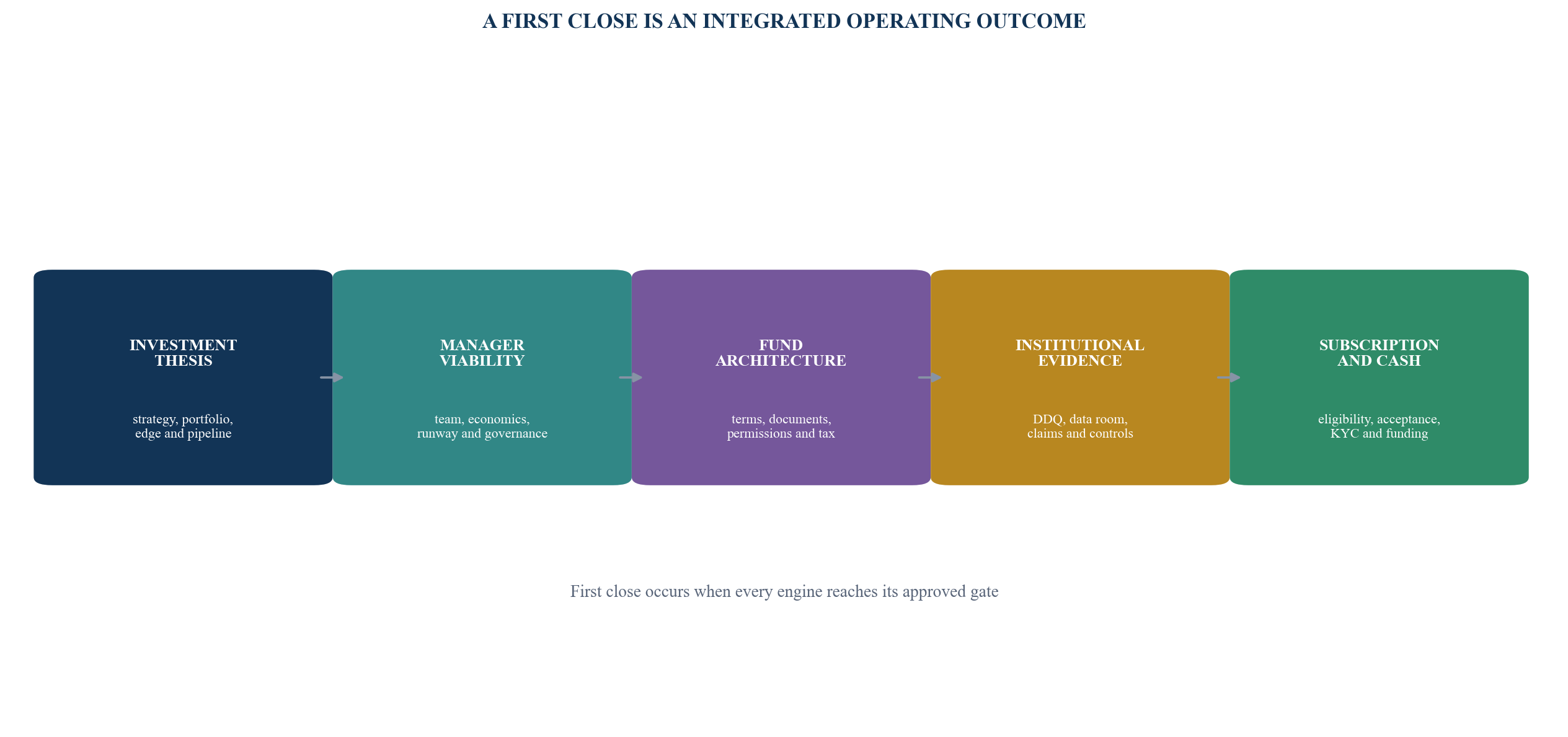
All five engines require evidence-based readiness; the actual sequence depends on the fund and applicable requirements.
2. Define the closing before building the plan
The sponsor should write a one-page closing definition before constructing the schedule. It states the legal entities, fund and manager status, target investor category, offer route, minimum viable commitments, minimum funded capital, approved initial investments, documents, appointments, bank arrangements and decision authority.
Committed capital and funded capital require separate definitions. A valid subscription may create a commitment that will be drawn over time. Initial funding may cover organisational costs, management fees or investments. The closing memo should state which cash must clear, where it is held, who confirms receipt and which conditions precede acceptance.
The close also triggers obligations. The investment period, management-fee clock, reporting cycle, audit period, valuation dates, capital-call mechanics and service-provider charges may begin at or around first close. The economics model should show these effects at the minimum viable close.
The manager should approve a base date and an outer planning range. External communications require the underlying assumptions. An investor committee date, authority response, bank onboarding or tax review can shift the critical path. Forecast dates should therefore carry owners and dependencies.
The readiness certificate distinguishes mandatory conditions, board-waivable commercial conditions and post-close actions. Regulatory, legal and investor-protection requirements remain governed by applicable instruments and advice. A commercial desire to close quickly does not convert a mandatory condition into a waivable item.
The closing definition becomes the system's acceptance test. Every weekly meeting asks whether new evidence improves the probability of meeting those stated conditions.
Table 1. First-close definition register
| Closing dimension | Required evidence | Decision owner | Acceptance test |
|---|---|---|---|
| legal and regulatory | entity status, permission, registration and effective documents | governing body, counsel and compliance | required approvals and instruments are effective |
| commitments | executed and accepted subscriptions | authorised accepting party | minimum valid commitments reached |
| cash | bank evidence and reconciled cleared funds | finance and administrator | minimum initial funding received and controlled |
| operations | appointed providers, accounts, procedures and tested workflows | chief operating owner | critical operating cycle passes readiness test |
| investor protection | eligibility, disclosures, KYC, conflicts and side letters | compliance and governing body | complete investor file and approved exceptions |
| economics | fund construction, manager runway and closing budget | sponsor and finance | minimum close remains viable under approved assumptions |
Required conditions vary by structure, jurisdiction, investor and fund type; current professional advice remains necessary.
3. Make the fund thesis diligence-ready
An emerging manager needs a thesis that can be tested. It identifies the investor problem, target assets, geography, return engine, duration, liquidity, risk, portfolio construction, sourcing advantage, value-creation role, team relevance and conditions under which the strategy should stop deploying.
The thesis should connect opportunity to capacity. Market size is context. The investability file translates addressable activity into qualified opportunities, realistic ticket sizes, ownership requirements, concentration, deployment pace, follow-on capital and exit routes. Named pipeline items need permissioned evidence and clear status.
The portfolio model defines minimum diversification, maximum exposures, reserve policy, loss assumptions and liquidity. A manager targeting a minimum viable fund size should be able to construct a credible portfolio at that size without stretching mandate or concentration.
The differentiated edge requires evidence. Prior roles, transactions, operating capabilities, relationships, datasets and regional access can support the argument. Attribution, confidentiality, permissions and continuity must be clear. A team member's prior-firm experience should not be represented as a new firm's realised fund record.
An investment committee simulation tests whether the thesis survives a real asset decision. The team should underwrite one representative opportunity, one difficult edge case and one decline. The exercise exposes gaps in mandate, data, authority, valuation and portfolio construction.
The thesis memo should remain consistent with the offering document, pitch materials, due-diligence questionnaire, website, case studies and verbal presentation. A controlled claims register links each material statement to its source, owner, date, permitted use and disclosure.
4. Prove that the manager can survive the fund
The manager business and the fund portfolio are distinct economic systems. The fund model contains commitments, deployment, investments, fees, expenses, financing and investor cash flows. The manager model contains fee revenue, payroll, premises, technology, compliance, insurance, advisers, travel, fundraising, regulatory capital and working capital.
The minimum viable fund size must support portfolio quality and operating quality. A smaller close may reduce fee revenue while beginning the investment and reporting clocks. The manager should model cost from formation through first close, subsequent closes and steady-state operations.
Runway analysis should separate cash already available, contracted revenue, contingent revenue, sponsor commitments and future fundraising assumptions. A projected management fee is contingent until the relevant commitments are accepted and the fee is due under the governing documents.
Team planning covers current full-time personnel, controlled or key functions, investment capacity, operations, finance, risk, compliance, investor relations and outsourced roles. The plan should show who performs each function at the minimum close and how capacity expands as the fund grows.
Governance protects the organisation from founder concentration. Reserved matters, conflicts, investment authority, expense approval, valuation, personal dealing, business continuity and key-person events need documented routes.
Worked sensitivities can test USD 50 million, USD 100 million and USD 175 million closing outcomes, different fee rates and delayed subsequent closes. Those values demonstrate the method only. The manager's actual assumptions require board approval and supporting evidence.
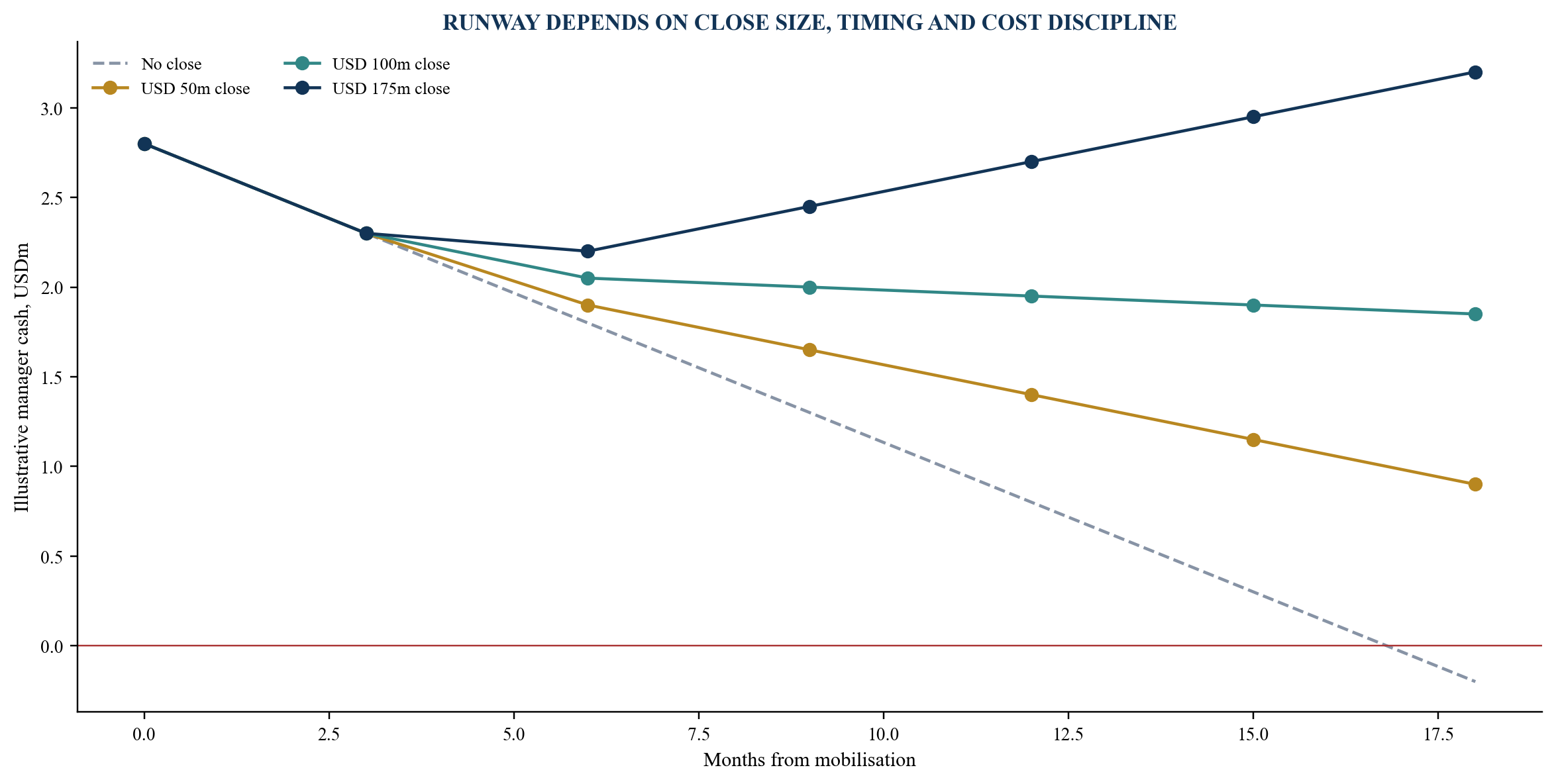
Values are management assumptions for method demonstration and do not represent a named manager or forecast.
5. Fix the legal and regulatory perimeter early
Fund formation begins with the activities, entities, people, investors and places involved. The perimeter analysis maps who manages, advises, arranges, distributes, executes, administers, values, safeguards assets and communicates with investors.
For a DIFC fund, the DFSA's current collective-investment-fund materials describe fund categories, manager routes and governing requirements. Its registration service identifies the fund constitution or relevant partnership document and information memorandum or prospectus among required documents for the applicable route. The definitive position comes from current laws, rule-making instruments, permissions and fund-specific facts.
Cross-border fundraising adds a country-by-country analysis. A fund formed in one centre does not automatically receive permission to market elsewhere. The matrix records the investor class, communication, local entity, intermediary, exemption or registration, filings, legends, data handling and retained evidence.
The manager should establish document ownership between sponsor, fund counsel, regulatory counsel, tax, administrator, auditor and other advisers. Open legal decisions require a decision date and downstream impact.
Entity formation, authorisation, fund registration, service-provider appointments, bank onboarding and investor subscription are interdependent. The critical path should reflect actual prerequisites rather than a generic sequence.
The regulatory file is refreshed before first outreach, data-room access, subscription acceptance and any material change. Legal advice should be current to the intended action and jurisdiction.
Table 2. Regulatory and distribution perimeter
| Question | Evidence | Approval | Trigger for refresh |
|---|---|---|---|
| who performs each activity | entity and people operating map | counsel and compliance | delegation, hiring or provider change |
| where activity occurs | decision, communication and execution locations | relevant legal advisers | new office, travel or remote activity |
| who may receive an offer | investor classification and eligibility facts | compliance and authorised distributor | investor or vehicle changes |
| how contact is made | channel, content, sender and permission | communication approval | new material or intermediary |
| which fund route applies | current law, rule, permission and structure | governing body and counsel | strategy, liquidity or investor changes |
| what record proves compliance | dated advice, version, recipient and action log | compliance owner | every formal gate and rule change |
The matrix is an operating control; it does not replace current legal advice or authority determinations.
6. Build one reconciled term architecture
Fund economics and governance appear across the limited partnership agreement or constitution, offering memorandum, subscription agreement, management agreement, side letters, fee model, pitch materials and diligence responses. Each inconsistency creates negotiation, disclosure or operating risk.
The term architecture starts with an approved commercial term sheet. It covers commitment mechanics, investment period, term and extensions, management fee, offsets, organisational expenses, fund expenses, carried interest, hurdle, catch-up, waterfall, clawback, recycling, borrowing, defaults, transfers, key person, removal, no-fault rights, advisory committee, conflicts, valuation, reporting, co-investment and responsible-investment provisions where relevant.
The manager should model each economic term. A description of the waterfall is insufficient when the spreadsheet produces a different distribution. Worked examples should reconcile with definitions and allocations.
Governance rights need operating owners. An investor advisory committee clause requires appointment, quorum, conflicts, papers, minutes and escalation. A key-person provision requires monitoring and a defined event process. A fee offset requires data capture and reconciliation.
ILPA publishes model limited partnership, subscription, reporting, due-diligence and capital-call resources intended to increase clarity and efficiency. They provide useful institutional reference points. The final documents should reflect the fund's strategy, jurisdiction, investor base and negotiated terms.
The document-control table identifies master definitions, responsible drafter, approved version and reconciliation status. No investor-facing document should contain an economic or governance claim that lacks a governing source.
7. Build the institutional evidence room before broad outreach
The data room is an evidence system, not a file dump. Its index should follow the questions an allocator must answer: organisation, ownership, team, strategy, track record, portfolio construction, risk, operations, compliance, valuation, service providers, legal terms, economics, responsible investment and business continuity.
ILPA's due-diligence questionnaire standardises common areas of inquiry. An emerging manager can use the structure to identify evidence gaps before receiving bespoke questions. A complete answer should point to the relevant source, approval, date and limitation.
Track-record evidence requires special care. The file identifies the entity, portfolio, period, gross and net methodology, currency, cash flows, fees, attribution, verification, realised status and permission to use. Hypothetical, modelled, extracted and predecessor results receive their applicable disclosures and approvals.
The SEC investment-adviser marketing rule applies to advisers within its scope and includes general prohibitions and performance requirements. Its current staff guidance addresses gross and net performance, extracted performance and model-fee presentation. These requirements do not define treatment in other jurisdictions, but they demonstrate the need for controlled methodology and audience-specific review.
Room access should be staged. Initial diligence may require the core fund and manager materials. Sensitive portfolio, personnel, legal and compliance records can follow NDA, qualification and approval. Every upload has a version, owner, effective date and access class.
The question ledger captures each investor request, approved response, supporting source and effect on other documents. A corrected answer should trigger a search for the same claim across the complete estate.
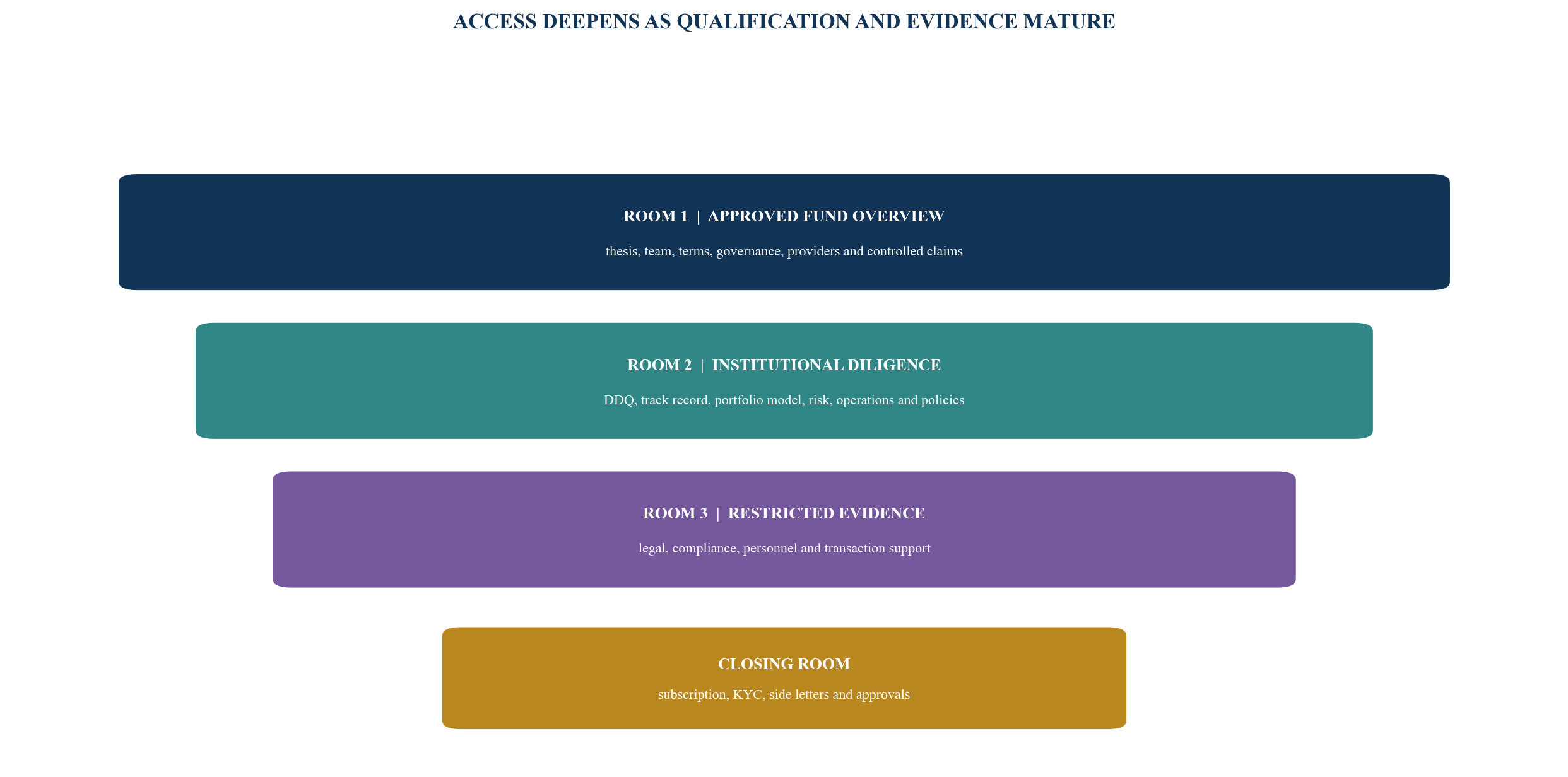
Access depth should follow investor qualification, confidentiality and applicable legal requirements.
8. Convert the investor universe into a qualified portfolio
A large target list can create false confidence. The emerging manager needs a qualified investor portfolio with evidence of mandate fit, decision authority, ticket range, geography, allocation timing, relationship path and permitted next action.
Segmentation begins with investor type and mandate need. Sovereign investors, pensions, insurers, endowments, funds of funds, private banks, family offices and strategic investors can apply different portfolio, governance, liquidity, reporting and tax requirements.
The account thesis states why the fund fits the investor's known mandate. Public information, prior correspondence and authorised relationship intelligence can support the thesis. Wealth or brand prominence alone does not establish appetite.
The funnel uses stages with exit criteria: identified, evidence-qualified, approved for contact, engaged, materials reviewed, active diligence, committee path, terms, subscribed and funded. A meeting advances the relationship only when it produces relevant evidence or an authorised next step.
Coverage should focus scarce senior time. The manager can rank accounts by fit, relationship access, credible ticket, timing, governance path and information burden. The score directs work; it does not predict investment.
The weekly review considers qualified capital ranges, stage age, open questions, decision dates, ownership and loss reasons. Pipeline coverage should be tested under multiple conversion assumptions because first-time managers may experience long and uneven processes.
Table 3. Evidence-based investor funnel
| Stage | Entry evidence | Required action | Exit evidence |
|---|---|---|---|
| identified | named entity and lawful source | research mandate and relationship | written fit thesis or disqualification |
| qualified | strategy, ticket, geography and timing fit | approve contact route and owner | permitted outreach plan |
| engaged | substantive response or meeting | agree information and next decision | materials reviewed or explicit pause |
| diligence | active DDQ, room access or workplan | close evidence questions | allocator recommendation or stop |
| committee path | known governance, sponsor and date | support decision materials | approved, deferred or declined |
| subscribed | executed documents subject to acceptance | complete eligibility and KYC | authorised acceptance |
| funded | valid call or funding obligation | reconcile cash and records | cleared funds in controlled account |
Stage values are controlled definitions; they are not probabilities or forecasts.
9. Govern every fundraising claim
The claims register is the control centre for fundraising content. It includes strategy, market, team, track record, pipeline, performance, portfolio, risk, fees, responsible-investment, case-study and service-provider statements.
Each claim records exact wording, evidence source, owner, effective date, permitted audience, methodology, disclosure, expiry and locations used. A claim can be factually accurate and still become misleading when important context is omitted.
Performance needs consistent periods, methodology and fees. Extracted investments require clear selection and relationship to the wider record. Unrealised valuations need valuation dates and governance. Modelled outcomes need prominent assumptions and should never be blended with realised results.
Pipeline illustrates process and current opportunity only when evidence exists and permission allows disclosure. It is not committed deployment. Case studies should identify attribution, role and predecessor-firm context where applicable.
Marketing approval covers decks, teasers, website copy, thought leadership, social posts, DDQ responses, one-to-one materials and data-room files according to the relevant jurisdiction and audience. The SEC marketing rule is one example of a jurisdiction-specific framework with general prohibitions on materially misleading presentation.
Version control must reach verbal communications. Investor questions that change a material explanation should be logged and assessed for wider correction. The investment team, investor relations, compliance and counsel need one approved vocabulary.
10. Design valuation governance before the first asset
Valuation affects investor reporting, fees, performance, subscriptions, transfers, financing and internal decisions. The process should exist before first close, even if the initial portfolio is empty.
The valuation policy defines methods by asset type, data hierarchy, frequency, responsibilities, independence, committees, thresholds, back-testing, overrides, third-party advisers, documentation and events that trigger an ad hoc valuation.
The FCA's 2025 review of private-market valuation practices highlighted governance, conflicts, functional independence, documentation, ad hoc valuations and investor transparency. It observed that conflicts can arise through fees, marketing, secured borrowing, transfers, redemptions and subscriptions. Those observations provide a useful operating benchmark for private-market managers within the relevant context.
An emerging manager may have a small team. Proportional governance still requires documented challenge. Independent committee members, qualified advisers, segregated model ownership or formal conflict recusal can strengthen the design depending on the fund.
The minutes should record inputs, method, assumption changes, challenges, conflicts, decision and follow-up. A valuation number without its reasoning provides weak evidence to auditors and investors.
The investor materials should describe the process accurately. A third-party valuation adviser may support part of the portfolio or certain dates; the disclosure should state the actual coverage and authority.
Table 4. Valuation readiness before first close
| Control | Evidence before close | Operating owner | Challenge route |
|---|---|---|---|
| methodology | asset-specific methods and data hierarchy | valuation function | committee and external expertise |
| independence | roles, conflicts and recusal design | governing body | compliance and independent members |
| frequency | calendar and event-driven triggers | fund finance | ad hoc valuation authority |
| model control | approved templates, access and change log | model owner | independent review and back-test |
| documentation | valuation paper and decision minutes | committee secretary | auditor and investor diligence |
| disclosure | accurate policy and provider description | investor reporting owner | legal and compliance review |
Policy design should reflect applicable accounting, legal, regulatory and fund-document requirements.
11. Select providers for the operating model
Administrator, bank, auditor, custody or title provider, fund counsel, tax adviser, compliance support, technology and insurance form the operating environment. Provider selection should start from the fund's activities and investor requirements.
The request for proposal defines scope, jurisdictions, asset classes, expected transaction volume, investor population, capital-call process, reporting, valuation, data, interfaces, service levels, control reports, incident handling, business continuity, liability and fees.
The manager should test the proposed operating cycle with real examples. A sample subscription, capital call, investment, expense, valuation, distribution and investor report exposes hand-off gaps between the fund documents and provider systems.
Fees require a complete view. Set-up, minimum annual, investor count, entity count, transaction, valuation, reporting, tax, audit, custody, bank, technology and out-of-scope charges can affect the minimum viable close.
Outsourcing does not remove manager responsibility. The oversight plan establishes owner, performance measure, incident threshold, access, review frequency, escalation, replacement and exit data.
Provider readiness should be evidenced by executed agreements where required, onboarding completion, approved accounts, responsible contacts, data specifications, tested workflows and an open-issues register. A selected provider without completed onboarding does not satisfy the operating gate.
12. Make the documents executable in operations
Fund documents become instructions for administrators, finance, investment teams and investor relations. Every recurring clause should map to a procedure, system field, owner and evidence record.
Commitments map to the investor register. Capital-call notice periods map to a calendar and approval workflow. Management fees map to documented calculations. Transfers and defaults map to eligibility, notices and authority. Side letters map to obligations, most-favoured-nation processes and reporting.
The operating requirements matrix links each clause to implementation. It helps detect terms that a provider cannot administer or a small team cannot monitor reliably.
The manager should run a document-to-model reconciliation. Definitions of invested capital, commitments, fee bases, expenses and distributions must produce the same result in legal documents, financial models and administrator configuration.
Side-letter governance begins before negotiation. The team defines approval authority, prohibited terms, cost, operational feasibility, disclosure, investor advisory committee implications and most-favoured-nation treatment. A concessions log shows aggregate burden across investors.
The final closing set includes controlled versions and signature status. Drafts in an investor data room should carry clear status. Superseded versions should be removed or archived from investor access according to the approved process.
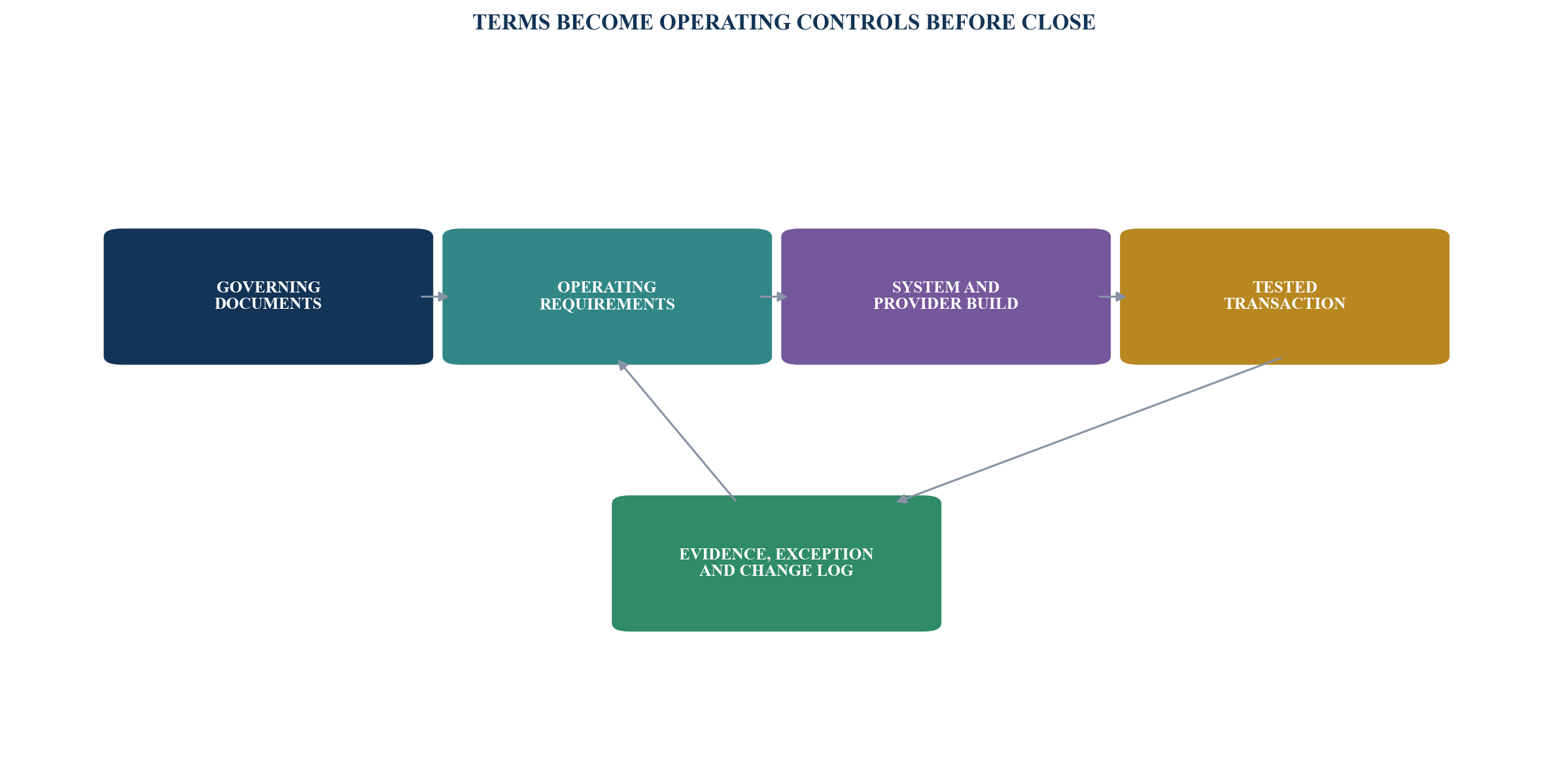
Each recurring fund term should have a system, owner, calculation and retained evidence.
13. Run investor diligence as a controlled delivery process
Investor diligence combines investment judgement, operational due diligence, legal review, tax, responsible-investment requirements, reference calls, background checks and governance approval. The manager needs a coordinated response process.
Each investor receives an agreed workplan with information requirements, meetings, decision bodies, dates and dependencies. The manager records which materials have been reviewed and which questions remain open.
The diligence ledger separates factual questions, judgement questions, document negotiations and conditions. It assigns a response owner, supporting evidence, approval and due date. Similar questions should draw from a reusable answer library while preserving investor-specific context.
Operational diligence frequently tests segregation of duties, valuation, conflicts, cash, cybersecurity, business continuity, service-provider oversight and incident history. The manager should demonstrate the process with actual templates, minutes and test results rather than policy titles alone.
Reference preparation requires consent, relevance and a consistent factual perimeter. References should understand the context and avoid disclosing confidential information.
The manager should measure response time, reopened questions, evidence gaps and decision slippage. Repeated questions can signal unclear documents or weak controls and should trigger systemic remediation.
Investor confidentiality and data-protection requirements govern the room and communications. Access should be removed when the process ends, subject to recordkeeping obligations.
14. Control negotiation and side-letter capacity
Terms negotiations can improve alignment and also fragment the operating model. The manager needs an issue matrix across investors, documents and downstream obligations.
Each request records commercial significance, legal treatment, operational cost, precedent risk, parity implications, disclosure, approval and preferred response. The negotiating team should know which terms are standard, conditional, escalated or prohibited.
Anchor investors may request governance, fee, capacity, co-investment, reporting, key-person, most-favoured-nation or strategic rights. The manager should assess the aggregate effect on other investors and its ability to administer the rights throughout the fund term.
Side letters become structured data. Obligations are mapped to investor, trigger, frequency, responsible owner, provider configuration, evidence and expiry. A PDF stored after closing is insufficient for ongoing compliance.
Economics need transparent comparison. A lower fee, seed share or revenue interest affects the manager model and investor alignment. Worked scenarios should show the cost across fund sizes and durations.
The governing body should approve material deviations and confirm the fund remains viable at the proposed first close. Counsel confirms legal and disclosure consequences. Administrator and operations confirm executability before agreement.
Table 5. Negotiation and side-letter decision matrix
| Request class | Decision test | Evidence required | Operating consequence |
|---|---|---|---|
| economics | alignment, viability and parity | modelled lifetime cost and authority | fee calculation and reporting |
| governance | accountability and conflict treatment | committee design and legal analysis | appointments, notices and minutes |
| information | relevance, confidentiality and capacity | data source, frequency and access | recurring production and control |
| co-investment | allocation fairness and execution | policy, eligibility and process | pipeline, conflicts and records |
| most-favoured nation | comparison scope and exclusions | complete concessions register | election and ongoing monitoring |
| strategic rights | value, duration and dependency | commercial case and downside | business governance and exit terms |
Rights and disclosures require fund-specific legal and operational review.
15. Rehearse the complete closing
A closing rehearsal follows one investor from approved offer through cleared cash. It tests eligibility, communication records, NDA, room access, diligence, subscription documents, tax forms, know-your-client review, sanctions screening, acceptance, side letter, capital notice, bank details, cash receipt, register update and confirmation.
The rehearsal should include an exception. Examples include an incomplete beneficial-owner record, late wire, altered subscription page, bank-account mismatch or side-letter obligation the administrator cannot configure. The team observes escalation and authority.
Cash controls deserve independent attention. Approved bank details, dual authority, callback or verification procedures, payment reconciliation and fraud response reduce closing risk. Investor communications should state the authorised process for any banking change.
The administrator's investor register, finance model, legal closing list and bank records must reconcile. Each investor has one status and identifiable open conditions.
The closing memorandum records satisfied conditions, waivers within authority, unresolved post-close actions, final documents, accepted subscriptions, funded cash and signatories. The governing body receives the evidence needed for its decision.
The process also prepares the first post-close actions: capital call, expense payments, investment execution, reporting timetable, audit, valuation, investor onboarding and later-close equalisation.
16. Use a 120-day evidence-gated sequence
Days one to thirty establish the fund thesis, portfolio model, manager economics, legal and regulatory perimeter, term architecture, provider requirements and target investor segmentation. The team produces a critical-path plan and gap register.
Days thirty-one to sixty develop governing and offering documents, the due-diligence questionnaire, track-record file, operating policies, claims register, room, provider selections and anchor-investor materials. Early investor feedback is converted into controlled decisions.
Days sixty-one to ninety advance active diligence, complete provider onboarding, reconcile documents, negotiate priority terms, configure the operating model and perform transaction tests. Regulatory and legal work progresses according to the applicable route.
Days ninety-one to one hundred and twenty close evidence gaps, complete investor eligibility and know-your-client files, finalise side letters, run the closing rehearsal and deliver the readiness certificate.
The programme uses gates rather than automatic calendar progression. A workstream that lacks required evidence remains open. Parallel work continues where it is safe and authorised.
The weekly governing forum reviews decisions, critical path, investor evidence, cash runway, document reconciliation, provider readiness, legal status and exceptions. It avoids treating activity volume as completion.
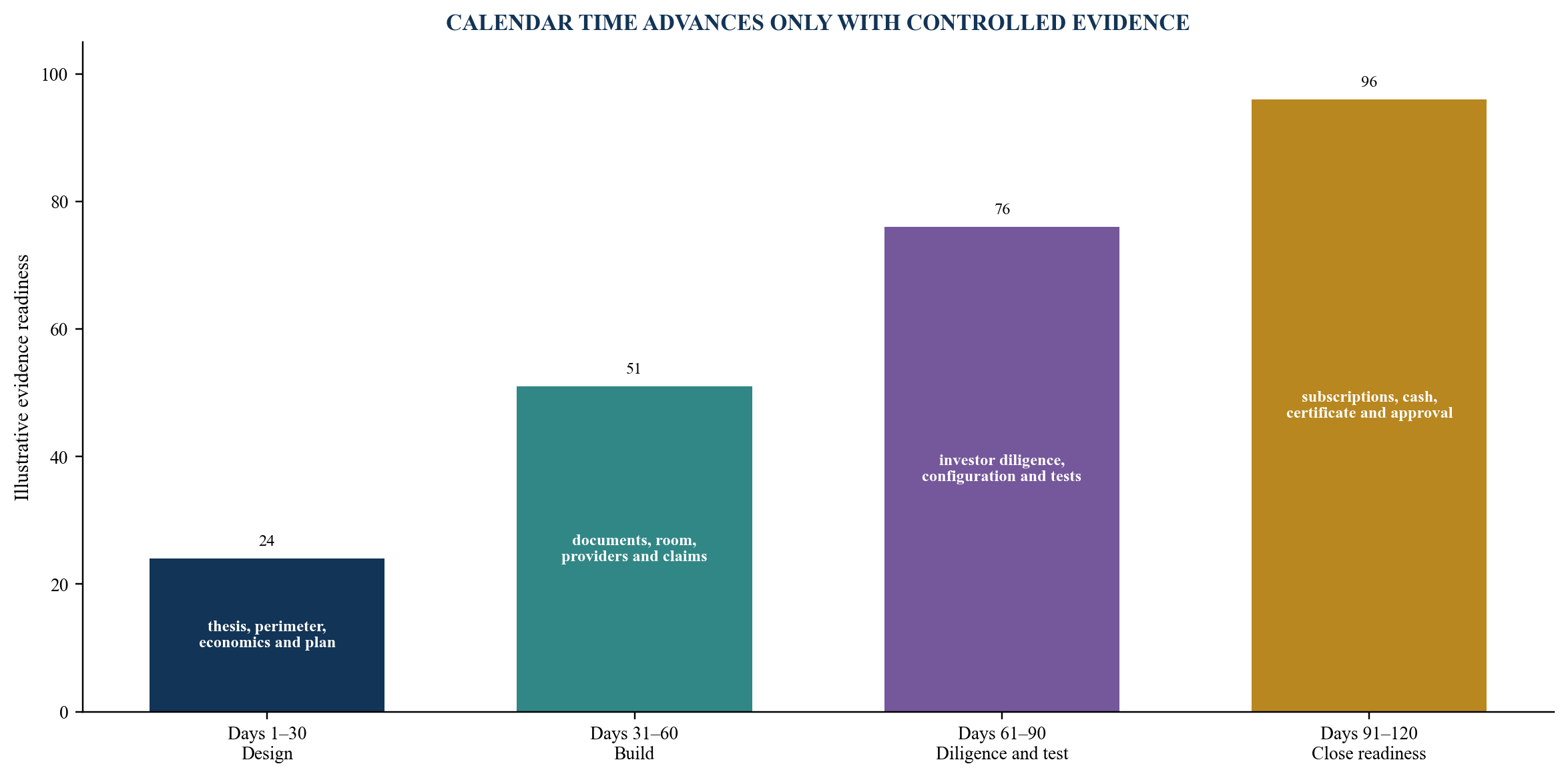
The timing is an implementation framework; authority, investor, banking and adviser processes determine actual duration.
17. Measure evidence, decisions and cash
The dashboard should make status auditable. Core measures include approved thesis items, reconciled documents, controlled claims, provider onboarding, test results, qualified investors, active diligence, committee paths, accepted subscriptions and funded capital.
Pipeline measures need precise definitions. Total names, meetings and data-room invitations can be useful activity indicators. They do not constitute investment demand. Qualified capital should include only investors meeting the approved fit and evidence standard.
Stage-age analysis exposes stalled accounts. The team records the next investor decision, manager deliverable, external dependency and last evidence date. A prospect without an authorised next action can be paused or removed from the active portfolio.
The closing forecast should be a range built from investor-specific evidence, not a fixed percentage applied to aggregate pipeline. Each expected commitment carries the allocator's governance path, amount range, timing, conditions and uncertainty.
Operational metrics include response time, overdue legal decisions, unresolved data-room questions, document conflicts, open provider conditions, test exceptions and side-letter obligations.
Cash remains the definitive measure for funded capital. The administrator, manager and bank should reconcile cleared amounts. Consulting and advisory revenue becomes collected only when the relevant invoice is paid; publication, meetings and proposals are leading indicators rather than collected fees.
18. Run a ten-day mobilisation diagnostic
Days one and two define the fund, manager, strategy, close, investor perimeter and current legal or regulatory route. The team collects existing documents, models, materials and adviser work.
Days three and four assess portfolio construction, track-record evidence, claims, manager economics, runway and minimum viable close. Gaps receive owners and decision dates.
Days five and six map target investors, current relationships, distribution routes, diligence status and decision processes. The team removes unsupported pipeline values from the active forecast.
Days seven and eight test provider requirements, operating design, valuation, conflicts, cash, documents, side-letter capacity and closing mechanics.
Days nine and ten deliver the critical-path map, first-close definition, evidence register, qualified investor portfolio, 120-day plan, governance cadence and initial board paper.
The diagnostic supports a live formation or fundraising decision. Commercial qualification requires a credible strategy and team, senior sponsor, accessible evidence, authorised adviser relationships, budget and decision timetable. General interest in raising a fund is not mandate evidence.
19. Operate a recurring first-close office
The first-close office coordinates sponsor, investment team, operations, finance, compliance, counsel, tax, administrator, bank, auditor, other providers and authorised fundraising participants.
It maintains one integrated plan, decision log, evidence register, document matrix, investor funnel, claims register, question ledger, concessions register and closing checklist. Each record has a named owner and current version.
The weekly decision forum addresses only items requiring authority, escalation or cross-workstream coordination. Working sessions handle drafting and execution. This separation protects senior attention while maintaining accountability.
The office tracks dependencies across legal, regulatory, investor and operating work. A change in target investor, fund size, strategy, liquidity, geography, term or provider triggers a defined review.
The office also prepares post-close operations. Later closes, equalisation, investments, valuations, audits, reporting, advisory committee governance and side-letter compliance should have owners before the first closing.
The operating mandate can be structured around defined deliverables and recurring execution support. Scope should state regulated-activity boundaries, decision rights, adviser roles, dependencies, fees and acceptance criteria.
Table 6. Recurring first-close office cadence
| Cadence | Forum | Decision content | Core evidence |
|---|---|---|---|
| daily | execution huddle | blockers, hand-offs and deadlines | integrated plan and issue log |
| twice weekly | investor and diligence review | account actions and approved responses | funnel, question ledger and room activity |
| weekly | first-close committee | critical path, terms, exceptions and forecast | decision log and readiness dashboard |
| fortnightly | document and operations control | reconciliation and operating tests | document matrix and test evidence |
| monthly | governing-body review | viability, risk, authority and close range | board pack and readiness certificate |
| event-driven | escalation | regulatory, legal, cash, conflict or conduct event | incident record and authorised response |
Governance should be tailored to the manager, fund and adviser responsibilities.
20. Package paid work around a funded decision
The first-close factory can support an emerging manager with a live fund-design, formation, fundraising or close-readiness decision. The paid outcome is a controlled path to an authorised close, with evidence that can be examined by investors, advisers and the governing body.
A mobilisation diagnostic can establish the thesis, minimum viable close, critical path, evidence gaps, investor segmentation and 120-day plan. A formation office can coordinate documents, providers, operating design, diligence and closing. A distribution workstream can support evidence-led investor mapping, approved materials, process management and response governance within the applicable activity perimeter.
Retainer qualification should examine the live decision, senior sponsor, credible investment capability, accessible evidence, legal and regulatory route, budget, authorised roles and closing timetable. A publication download, meeting or expression of interest does not establish willingness to pay.
The engagement model should define deliverables, recurring cadence, exclusions, dependencies, client approvals and measurable acceptance. Counsel, tax advisers, regulated firms, administrators and authorities retain their respective responsibilities.
The emerging manager earns institutional confidence through coherence. Strategy, portfolio, team, economics, terms, governance, valuation, operations, claims and investor communications must describe the same fund. The first-close factory turns that coherence into a controlled sequence of decisions and evidence. Its final output is a valid, viable and funded close under the applicable framework.
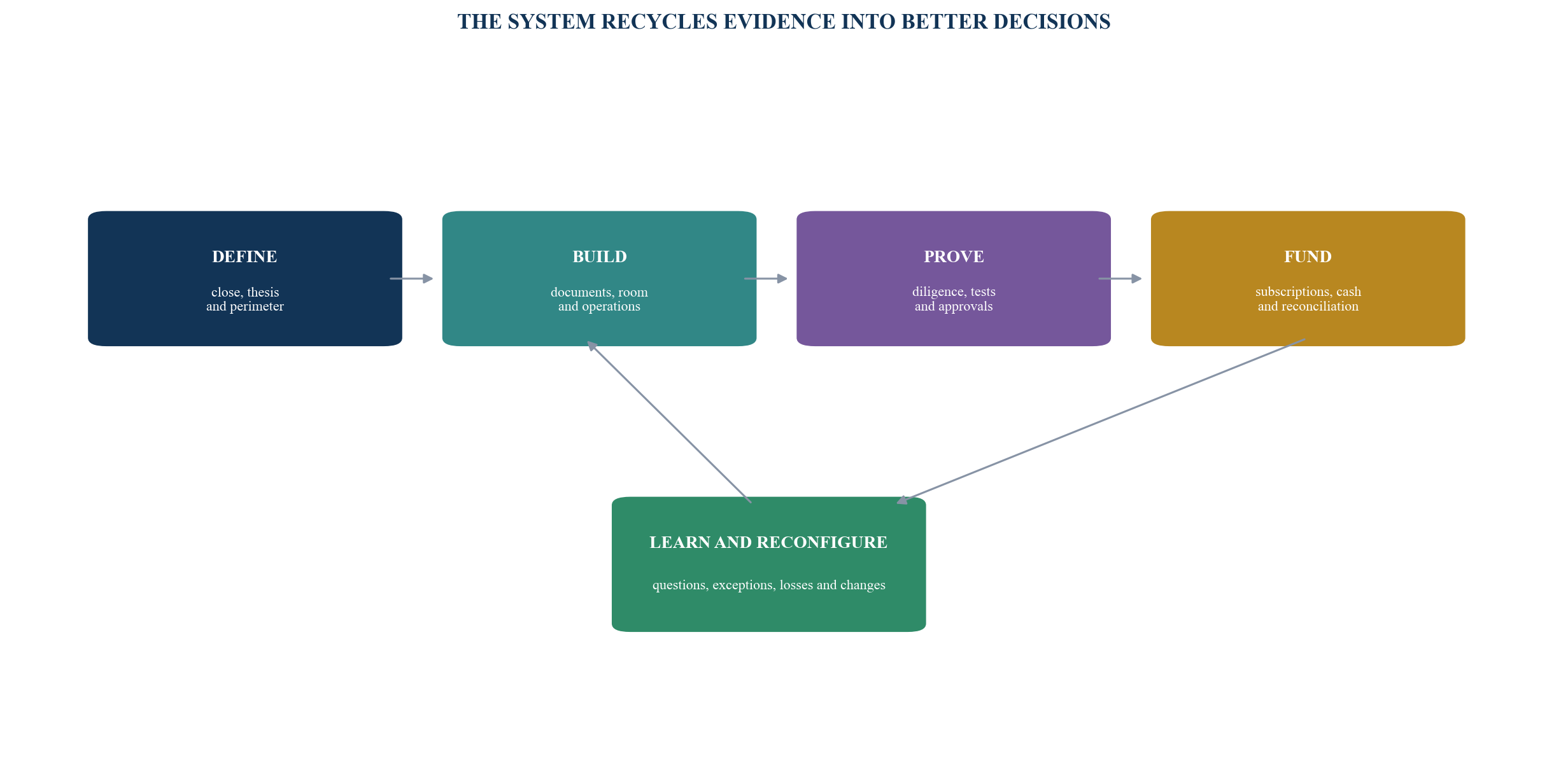
Progress is recognised when evidence satisfies an approved gate; funded capital requires cleared cash.
References
- Dubai Financial Services Authority. Collective Investment Funds. https://www.dfsa.ae/what-we-do/collective-investment-funds
- Dubai Financial Services Authority. Request for New Registration: Collective Investment Funds. https://services.dfsa.ae/collective-investment-funds-qualified-investment-funds/qualified-investment-funds-request-for-new-registration/
- Dubai Financial Services Authority. Fund Constitution Checklist for Public and Exempt Funds. https://www.dfsa.ae/download_file/view/1186/525
- Dubai Financial Services Authority. Legislation. https://www.dfsa.ae/laws-rules/legal-resources/legislation
- Institutional Limited Partners Association. Emerging Manager Toolkit. https://ilpa.org/resources-tools/toolkits-collections/emerging-managers/
- Institutional Limited Partners Association. Templates, Standards and Model Documents. https://ilpa.org/industry-guidance/templates-standards-model-documents/
- Institutional Limited Partners Association. Due Diligence Questionnaire. https://ilpa.org/industry-guidance/templates-standards-model-documents/due-diligence-questionnaire/
- Institutional Limited Partners Association. Model Limited Partnership Agreement. https://ilpa.org/industry-guidance/templates-standards-model-documents/model-limited-partnership-agreement/
- Institutional Limited Partners Association. Model Subscription Agreement. https://ilpa.org/industry-guidance/templates-standards-model-documents/model-subscription-agreement/
- International Organization of Securities Commissions. Principles for the Valuation of Collective Investment Schemes. https://www.iosco.org/library/pubdocs/pdf/IOSCOPD413.pdf
- United Kingdom Financial Conduct Authority. Private Market Valuation Practices. https://www.fca.org.uk/publications/multi-firm-reviews/private-market-valuation-practices
- United States Securities and Exchange Commission. Investment Adviser Marketing. https://www.sec.gov/resources-small-businesses/small-business-compliance-guides/investment-adviser-marketing
- United States Securities and Exchange Commission. Marketing Compliance Frequently Asked Questions. https://www.sec.gov/rules-regulations/staff-guidance/division-investment-management-frequently-asked-questions/marketing-compliance-frequently-asked-questions
- United States Securities and Exchange Commission. Private Funds. https://www.sec.gov/resources-small-businesses/capital-raising-building-blocks/private-funds
- United States Securities and Exchange Commission. Private Fund Adviser Rules Vacatur. https://www.sec.gov/rules-regulations/2024/11/s7-03-22
About the Author
Chennakeshav Adya, Independent Researcher
