

1. Design the next DIFC fund across three regulatory states
A sponsor launching a fund in 2026 faces a live design question. The current Collective Investment Law and DFSA Rulebook govern the fund today. CP173 proposes material changes. Final laws, rules, transition periods and supervisory guidance may differ from the consultation drafts.
The fund-formation process should therefore maintain three separate columns. The first records current binding requirements and the latest relevant instruments. The second records the CP173 proposal, consultation question and draft text. The third records sponsor action: proceed under current law, build a no-regrets capability, preserve an option, or wait for finalisation.
CP173 provides a clear boundary. It states that respondents should submit comments by 7 September 2026. It also states that firms should not act on the proposals until legislative changes are finalised and the DFSA issues a public notice.
The distinction affects fund documents, licence scope, capital, service providers, disclosures, employee vehicles, leverage, master-feeder arrangements and timing. A sponsor should avoid drafting a structure that assumes removal of a current requirement. It should also avoid hard-coding an operating model that becomes expensive to change if the proposals are adopted.
The committee paper should identify the effective source and date behind each conclusion. Current Rulebook text, consultation drafts and sponsor preferences require different labels and approval routes. Counsel and compliance confirm the regulatory interpretation.
The practical objective is controlled adaptability. The sponsor can advance strategy, investor evidence, economics, governance and implementation while preserving formal decisions that depend on final instruments.
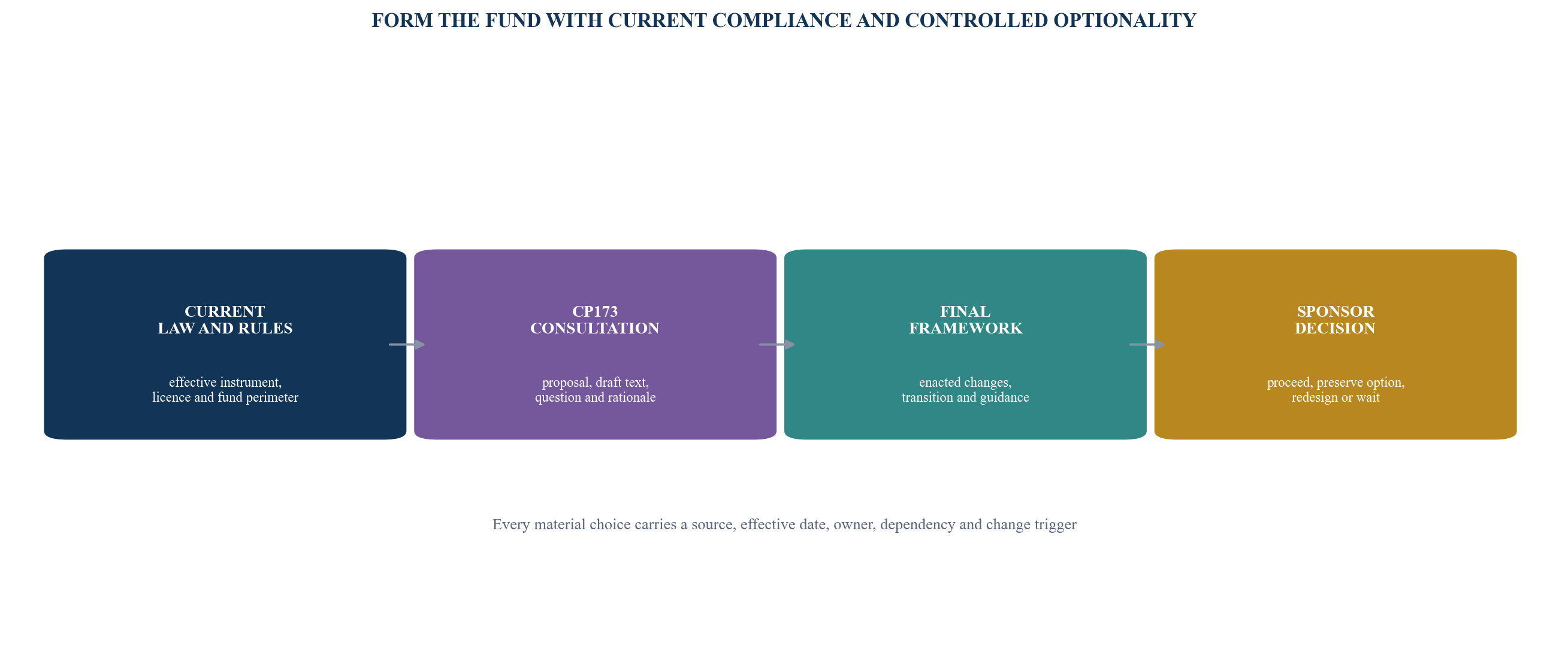
Current legal and regulatory treatment requires confirmation against the latest enacted laws and DFSA instruments.
2. Establish the current legal and rule perimeter
The DFSA legislation page identifies the Collective Investment Law 2010 and Investment Trust Law 2006 among the administered laws. It explains that DFSA Rules are subsidiary legislation and that the definitive Rulebook text at a particular time is contained in the relevant instruments published by the DFSA. Guidance is indicative and does not create a safe harbour.
The current DFSA funds guide describes Public Funds, Exempt Funds and Qualified Investor Funds. Public Funds carry detailed protections for retail participation or public offers. Exempt Funds and Qualified Investor Funds are limited to Professional Clients and private placement under the current guide, with different minimum subscriptions and notification processes. The current instrument and fund-specific facts determine treatment.
The formation file should record fund type, investor category, offer method, minimum subscription, vehicle, manager status, strategy, liquidity, leverage, custody or property holding, valuation, service providers, Shari'a treatment where relevant and marketing geography.
The sponsor must also distinguish managing a Domestic Fund, delegated Managing Assets, arranging, advising, dealing, custody, administration and distribution. Activity descriptions should follow actual functions, contracts and communications. Commercial labels such as sponsor, placement partner or platform do not determine regulatory treatment.
The current registration service identifies a fund constitution or investment partnership and an information memorandum or prospectus among required materials for relevant private funds. The full application and notification package depends on fund type and current DFSA requirements.
A legal-source register should be refreshed at each formal gate: structure approval, application, document sign-off, first marketing, first close and any material change.
Table 1. Current-rule formation perimeter
| Formation dimension | Evidence required | Governing decision | Change trigger |
|---|---|---|---|
| investor and offer | client classification, offer method and minimum subscription | Public, Exempt or Qualified Investor Fund route | target investor or marketing method changes |
| manager and activity | operating map, delegation, orders, advice and distribution | licence, permission and appointment scope | function, entity or geography changes |
| vehicle | legal form, governance, liability and tax analysis | investment company, trust, partnership or permitted structure | investor, asset or platform need changes |
| strategy | asset, liquidity, leverage, concentration and activity | applicable fund and strategy rules | mandate expands or hybridises |
| safekeeping and administration | asset type, title, register, valuation and reporting | required appointments and controls | new asset, market or service provider |
| distribution | investor jurisdiction, communication, intermediary and exemption | permitted route and required filing | new market, investor class or channel |
The table is a decision register rather than a legal conclusion; current treatment requires fund-specific review.
3. Translate CP173 into decision questions
CP173 contains formal proposals and early-stage discussion topics. The consultation covers specialist fund classes, the Managing Assets permission, fund structures, external fund managers, employee investment, first annual accounting periods, technical legal amendments and transition. Tokenisation and long-term investment funds sit in a later-policy discussion section.
The sponsor should map each proposal to its strategy, documents, licence, systems, capital, service providers, distribution and investor message. Relevance matters more than page count.
A private credit or hybrid fund may care about removal of the ninety-percent threshold associated with the current Credit Fund classification, retained restrictions for strategies involving Providing Credit, horizontal risk governance, borrowing disclosure and proposed changes to capital and fees. A global manager using the external fund manager route may face a more fundamental domicile and authorisation decision if that regime is removed.
A master-feeder sponsor may gain more flexibility from proposed changes to master eligibility and direct subscriptions. An employer seeking GP and employee alignment may examine the proposed expansion of employee investment routes. A tokenisation plan remains a strategic option because CP173 seeks early views rather than proposing an immediately adoptable regime.
The response file should distinguish policy impact from drafting comment. A useful consultation response explains the business model, investor population, risk, operational consequence, intended safeguard and specific requested change. Assertions about cost or market impact require supporting evidence.
The board should approve any response and confidentiality request. CP173 notes that the DFSA may publish comments unless the respondent expressly requests otherwise when submitting them.
4. Define the fund thesis before choosing the regulatory wrapper
A fund should begin with a precise investment and investor proposition. The sponsor defines target assets, return source, duration, liquidity, geography, concentration, leverage, value-creation role, downside, deployment pace, team advantage and target investor need.
The regulatory structure supports that thesis. It should not substitute for it. A flexible label cannot repair an unclear mandate, weak sourcing advantage or mismatched liquidity.
The thesis should identify the paid decision for limited partners. Institutional investors may seek a defined exposure, governance, reporting and risk budget. Family offices may value direct access, co-investment, income, capital protection or local execution. Wealth channels may require a product and operational format that fits distributor governance and investor suitability.
The investability file tests whether the proposed opportunity set can absorb the target fund size. It links qualified pipeline, ticket size, ownership, deployment period, follow-on needs, reserves, exits and concentration. Market narratives remain context until converted into controlled opportunities.
DIFC reported substantial growth in its wealth and asset-management ecosystem and highlighted private equity, private credit, real estate, infrastructure, hedge funds and digital assets in its 2025 alternatives report. These ecosystem data support market context. They do not establish demand for a specific fund, achievable commitments or returns.
The sponsor should establish a minimum viable fund size, target size and maximum size. Each size carries a portfolio construction, fee, team and operating case. First-close decisions should remain viable at the minimum size.

The applicable structure and permissions depend on current rules and fund-specific professional advice.
5. Design hybrid strategies around risks and disclosures
CP173 proposes moving away from certain fixed specialist classifications for Exempt Funds and Qualified Investor Funds. The DFSA explains that rigid classifications may not accommodate hybrid or multi-strategy investing and proposes a greater focus on activities, associated risks and safeguards.
This is a proposal. A sponsor forming today follows current requirements. It can still prepare a strategy architecture that describes actual activities rather than relying on a product label.
The strategy map should identify every permitted asset and activity, allocation range, liquidity profile, valuation method, leverage, collateral, counterparty, concentration, conflicts and expertise. It should also identify prohibited activities and conditions requiring investor or governance approval.
For a hybrid private-capital fund, the map can separate direct lending, debt acquisition, structured equity, preferred instruments, asset-backed exposure and warrants. Each component creates different underwriting, valuation, documentation, monitoring, liquidity and enforcement requirements.
Risk governance should be horizontal and activity based. Credit risk, market risk, liquidity, leverage, operational risk, valuation, counterparty, technology, legal, tax, sanctions and sustainability claims can apply across labels. The investment committee should receive a complete fund risk profile rather than separate product checklists.
Disclosure must stay aligned with actual practice. Strategy flexibility should not become an unbounded mandate. The investment objective, limits, allocation process, borrowing, valuation and conflicts should be understandable to the target investor and operationally enforceable.
6. Rebuild private-credit fund architecture carefully
CP173 proposes removing the current condition that ninety percent of Fund Property must be used to Provide Credit for a fund to be constituted as a Credit Fund. It proposes retaining safeguards for strategies involving Providing Credit, including specified prohibitions and credit-risk policies. It also proposes changes to current base capital and fee treatment.
These proposals can widen the design space for a hybrid credit strategy if enacted. The current Credit Fund regime and definitive Rulebook remain the authority before final changes take effect.
The fund architecture should describe origination, underwriting, approval, documentation, disbursement, collateral, covenant monitoring, amendments, impairments, restructurings and recovery. It should distinguish primary lending, loan acquisition, participation, trade instruments and investments that may have debt-like economics without involving Providing Credit under the applicable definitions.
Liquidity must reflect the assets. Closed-ended capital is commonly aligned with illiquid loans and uncertain realisation. Redemption or transfer features require an evidence-led liquidity framework.
Borrowing at fund level can finance timing or enhance exposure. The committee should see purpose, maximum, calculation basis, security, covenant, currency, maturity, counterparty and interaction with portfolio-company leverage. CP173 proposes reasonable and prudent calculation and disclosure of expected maximum borrowing for relevant private funds.
The private-credit operating model also needs independent valuation challenge, conflict controls, watchlist governance, borrower data standards and workout capacity. Capital and fee relief, if eventually enacted, should not be treated as an operating-control reduction.
Table 2. Private-credit strategy control map
| Activity | Core risk | Required capability | Fund-document control |
|---|---|---|---|
| direct origination | underwriting, documentation and concentration | credit committee, diligence and covenant design | borrower, instrument, limit and approval scope |
| loan acquisition | information, transfer, servicing and price | seller diligence, assignment and valuation | eligibility, discount and servicing rules |
| asset-backed finance | collateral quality, perfection and cash control | asset audit, borrowing base and enforcement | eligible collateral and advance methodology |
| structured equity | downside, governance and valuation | rights design, scenario analysis and monitoring | allocation, conversion and conflict treatment |
| fund borrowing | liquidity, leverage and counterparty | treasury, collateral and covenant control | purpose, maximum, calculation and disclosure |
| restructuring | conflicts, impairment and extended duration | workout expertise and independent challenge | authority, valuation and investor reporting |
Current definitions, prohibitions and requirements require confirmation under the applicable DFSA instruments.
7. Decide manager location and authorisation path
The current DFSA guide allows a DFSA-licensed Domestic Fund Manager and, under defined conditions, an External Fund Manager. CP173 proposes removing the external fund manager regime, citing the pipeline of firms seeking full DFSA authorisation and other considerations described in the paper.
A global sponsor using or considering the external route should assess the proposal without assuming its adoption. The decision tree covers current eligibility, proposed transition, DIFC business activity, investment-decision location, staffing, controlled functions, delegation, capital, systems, records, supervision, tax and group governance.
Full DIFC authorisation can create a durable regional operating presence and clearer alignment with local management activity. It also requires senior personnel, systems, control functions, capital, ongoing reporting and supervision. The business case should include the full steady-state cost and implementation timeline.
Delegation does not remove manager accountability. The operating map states which entity originates, advises, decides, executes, administers, values, holds assets, distributes and communicates with investors. Contracts, licence permissions and actual conduct should match.
CP173 also proposes clarifying that dealing as agent and arranging can be integral to delegated investment management and covered by a Managing Assets authorisation where necessary for that delegated activity. The final wording and firm facts will determine application.
The sponsor should preserve a transition file with current licence, waivers, modifications, appointments and any proposed change. CP173 states that firms with affected waivers or modifications should assess impact and engage with supervision where necessary.
8. Build the fund vehicle and master-feeder logic
The DFSA guide identifies investment companies, investment trusts and investment partnerships as current Domestic Fund vehicles. Vehicle selection affects governance, ownership, liability, capital calls, transfers, tax, reporting, service providers and investor familiarity.
The choice should follow the investor and asset model. A closed-ended private-capital strategy may require commitment, drawdown, default, recycling, distribution and extension mechanics. An open-ended strategy needs subscription, redemption, dealing, valuation and liquidity controls.
Master-feeder structures can aggregate investors with different tax, regulatory, currency or channel needs into a common investment pool. CP173 proposes removing selected eligibility criteria for a Public Feeder Fund's Master Fund and broadening the Master Fund definition to permit direct professional or institutional subscriptions alongside feeder subscriptions.
The sponsor should model current and proposed structures separately. It should identify which vehicles hold assets, enter contracts, borrow, receive fees, issue units, maintain registers and report to investors. Cash and data paths should remain traceable.
Additional feeders create set-up cost, audit, administration, banking, tax, compliance and governance. They should be justified by evidenced investor demand. A theoretical channel is insufficient.
The document matrix aligns constitution, partnership agreement, prospectus or information memorandum, subscription agreement, side letter, management agreement, delegation, administration, custody, distribution and financing. Definitions and economics should reconcile across every document.
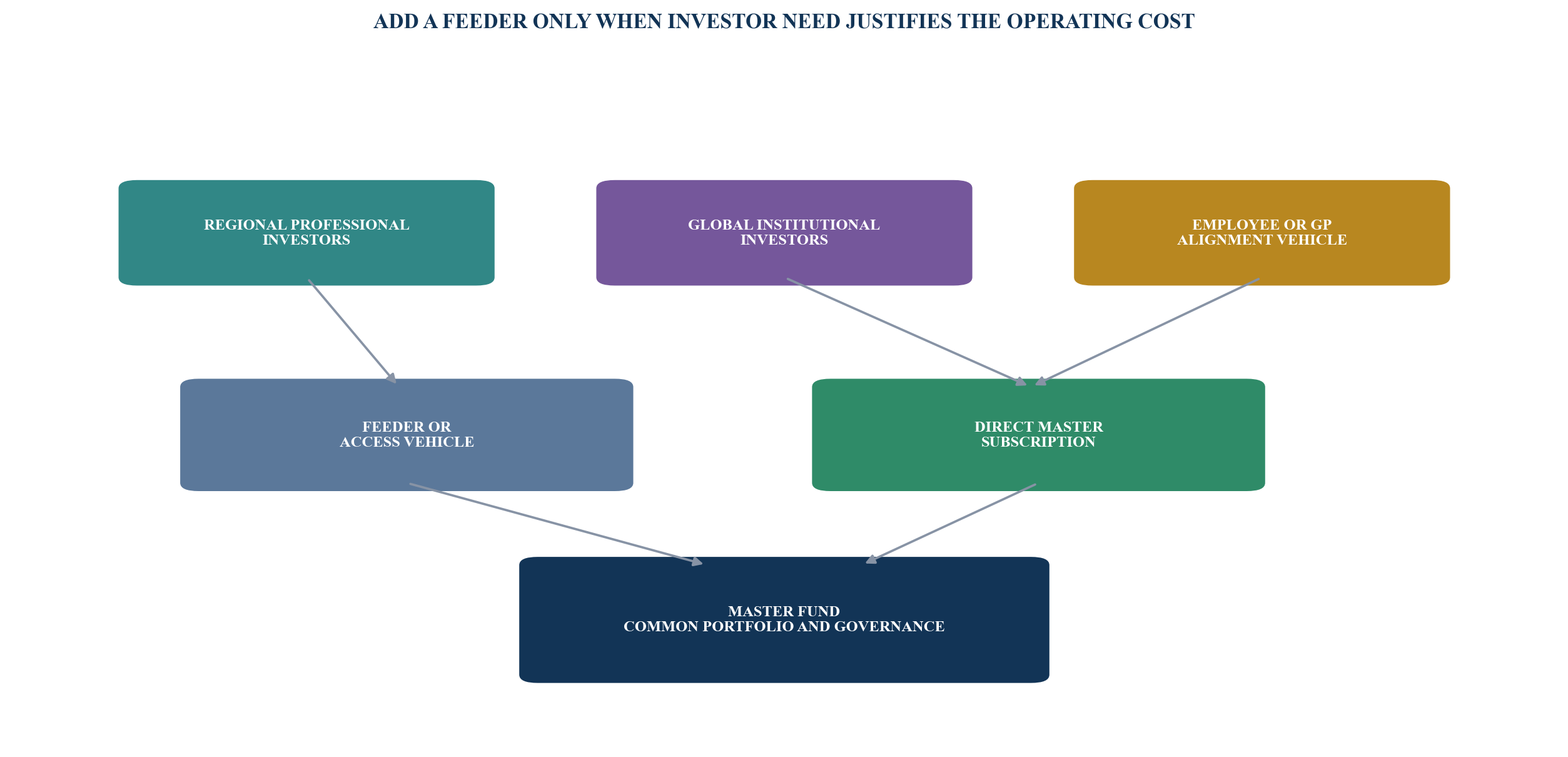
Entities and routes are illustrative; legal, tax and regulatory structure requires investor- and fund-specific advice.
9. Apply horizontal risk governance
CP173 proposes applying existing and new risk-management principles more horizontally across Fund Managers. The proposal reflects a move from product-specific safeguards toward risks arising from actual activities.
A no-regrets operating model begins with a fund risk profile approved before launch. It records investment, credit, market, liquidity, leverage, counterparty, concentration, valuation, operational, cyber, outsourcing, legal, tax, compliance, sanctions and distribution risks.
Each risk has appetite, limit, indicator, owner, data source, committee, escalation and breach response. The portfolio system and investor report use the same definitions. This reduces the gap between offering disclosure and daily control.
The investment committee approves individual transactions within mandate. A risk or valuation committee can challenge aggregate exposure, methodology, concentration and exceptions. Conflicts governance identifies related parties, allocations, cross trades, warehousing, co-investment, fees and personal interests.
Service providers form part of the control environment. The manager should assess administration, custody, trustee, prime broker, valuation, audit, technology, data and distribution providers before appointment and throughout the relationship.
Board reporting should focus on decisions and limit exceptions. A long risk register without current exposure, owner and action has limited governance value.
The operating design should remain proportionate to strategy and scale while meeting applicable requirements. Proportionality needs a documented rationale rather than an assumption that professional investors require fewer controls.
Table 3. Horizontal fund-risk governance map
| Risk domain | Decision measure | Accountable control | Escalation evidence |
|---|---|---|---|
| investment and concentration | mandate, exposure, pipeline and loss scenario | investment committee and portfolio limits | breach, rationale, remediation and approval |
| liquidity and leverage | asset ladder, obligations, borrowing and stress coverage | treasury and risk governance | trigger, cash action and investor effect |
| valuation | methodology, input quality, challenge and override | valuation function or committee | exception, independent review and correction |
| conflicts | affected parties, economic effect and allocation | conflicts register and independent authority | disclosure, consent, recusal or prohibition |
| operations and outsourcing | service level, error, concentration and continuity | manager oversight and provider governance | incident, recovery, investor and authority notice |
| distribution and conduct | investor eligibility, communication and product fit | compliance and authorised distribution owner | hold, correction, filing and retained communication |
Risk ownership, limits and committees should reflect the fund's actual activities and applicable requirements.
10. Define borrowing and prime-broker controls
CP173 proposes requiring Qualified Investor Funds and Exempt Funds to calculate borrowing limitations in a reasonable and prudent manner and disclose expected maximum borrowing with the basis for that level. It also proposes broader application of prime-broker safeguards where assets can be pooled, re-hypothecated or used as collateral.
The fund should distinguish borrowing, embedded leverage, derivatives, subscription facilities, NAV facilities, portfolio-company debt, short positions and securities lending. One headline ratio can miss material exposure.
Borrowing policy states purpose, measure, limit, stress, maturity, liquidity, collateral, currency, counterparty and governance. Temporary bridge financing has a different risk profile from structural return-enhancing leverage.
Prime-broker diligence covers financial standing, regulation, legal entity, custody model, asset use, segregation, close-out, collateral, margin, concentration, reporting and contingency. Rights in insolvency require legal analysis.
Liquidity stress connects investor terms, asset realisation, margin calls, financing maturity and gates or other tools. Expected maximum borrowing disclosure should reconcile with portfolio construction and downside cases.
The committee should receive gross, net and commitment-based measures where relevant, counterparty exposures, encumbered assets, liquidity sources and trigger headroom. Changes in measurement method require documented approval and disclosure review.
Table 3. Borrowing and prime-broker control register
| Control | Evidence | Limit or trigger | Governance response |
|---|---|---|---|
| borrowing purpose | facility, use and repayment source | permitted purpose only | reject or restructure unsupported use |
| leverage measure | gross, net, commitment and look-through data | approved measure and maximum | reduce exposure or seek authorised change |
| liquidity | cash, asset ladder, margin and maturity | minimum stress coverage | reserve, de-risk or restrict new commitments |
| collateral | title, eligibility, haircut and encumbrance | asset and concentration limits | substitute, reduce or escalate |
| prime broker | financial, legal, custody and re-use assessment | approved provider and exposure cap | transfer exposure or activate contingency |
| disclosure | prospectus, side letter and periodic report | actual practice remains within disclosed basis | correct, notify and approve remediation |
Measures and disclosures depend on the fund, instruments and applicable current rules.
11. Build valuation and conflict governance into formation
Private assets do not produce a continuously observable market price. Valuation affects subscriptions, redemptions, performance, fees, transfers, collateral, employee transactions and investor reporting.
IOSCO's valuation principles call for comprehensive documented policies and methodologies for each asset type. The manager should define inputs, hierarchy, calibration, challenge, frequency, overrides, stale data, model change and error correction.
Independence should reflect the strategy and applicable rules. The deal team can provide operating evidence. A valuation function or committee should challenge assumptions and methodology with sufficient authority and expertise. External valuation can add evidence without transferring the manager's full responsibility.
Conflicts should be mapped before documents are final. Examples include allocations between funds, warehoused investments, co-investment, continuation transactions, related-party service providers, portfolio-company fees, broken-deal costs, GP commitments, employee purchases and cross trades.
Each conflict has prevention, disclosure, consent, allocation, independent review or prohibition as appropriate. The control should state whose interests are affected and who has authority to decide.
The fee calculation must use controlled valuation and capital definitions. Management fee basis, carried interest, hurdle, catch-up, recycling, write-offs, clawback, offsets and tax distributions should reconcile with the model and documents.
Valuation and conflicts are also fundraising issues. Investors test whether the governance design can produce comparable, timely and defensible reporting under stress.
12. Design employee and GP alignment with control
CP173 proposes broadening the scope for employee investment in private funds managed by the employer, directly and through dedicated vehicles. The stated policy objective includes recruitment, retention and alignment.
The proposal does not create a current entitlement. Existing law, rules, employment terms, tax, client classification and fund documents govern until changes are finalised.
An alignment vehicle should identify eligible persons, investment source, minimum, vesting, leaver treatment, transfers, defaults, distributions, carry, conflicts, valuation, information rights and administration. Senior executives, investment professionals and wider employees may require different treatment.
The economic exposure should be real and understandable. A nominal commitment financed or protected in a way that removes downside can create a different alignment result from at-risk capital. Financing terms require legal, tax and conflict review.
Employee investors can hold confidential information about portfolio companies and fundraising. Personal-account dealing, market conduct, privacy, data access and communications policies should cover the vehicle.
Governance should address decisions involving employee liquidity, transfers or valuation. Persons with an economic interest should not approve their own preferential treatment without appropriate independent control.
The sponsor can prepare two term sets: one compliant with the current framework and one optional design contingent on final changes. Implementation begins only after counsel and relevant authorities confirm the permitted route.
13. Treat tokenisation as a controlled option
CP173 invites early-stage feedback on tokenisation of fund units and fund assets, including tokenised money market funds. The topic may be subject to later policy proposals. It should not be represented as a final DIFC fund regime.
Tokenisation can refer to different operating changes: a distributed unitholder register, tokenised dealing, on-chain cash, programmable restrictions, tokenised portfolio assets or secondary transfer infrastructure. Each has a different regulatory, legal and operating perimeter.
The United Kingdom Financial Conduct Authority published guidance in April 2026 on tokenised authorised funds and new optional direct-to-fund dealing rules within its jurisdiction. The FCA experience provides a comparator for operational design. It does not determine DIFC treatment.
A tokenisation option paper should define the business problem. Potential objectives include register efficiency, transfer control, settlement, fractional access, collateral use or distribution. Claims of lower cost or wider access require a measured baseline and permitted investor route.
The control architecture covers legal ownership, register authority, identity, wallet, keys, cash settlement, custody, smart contracts, privacy, cybersecurity, outsourcing, resilience, forks, errors, reversals and investor support.
The fund documents should remain technology neutral where possible. A conventional operating route should exist until the tokenised process is legally effective, operationally accepted and supported by service providers and investors.
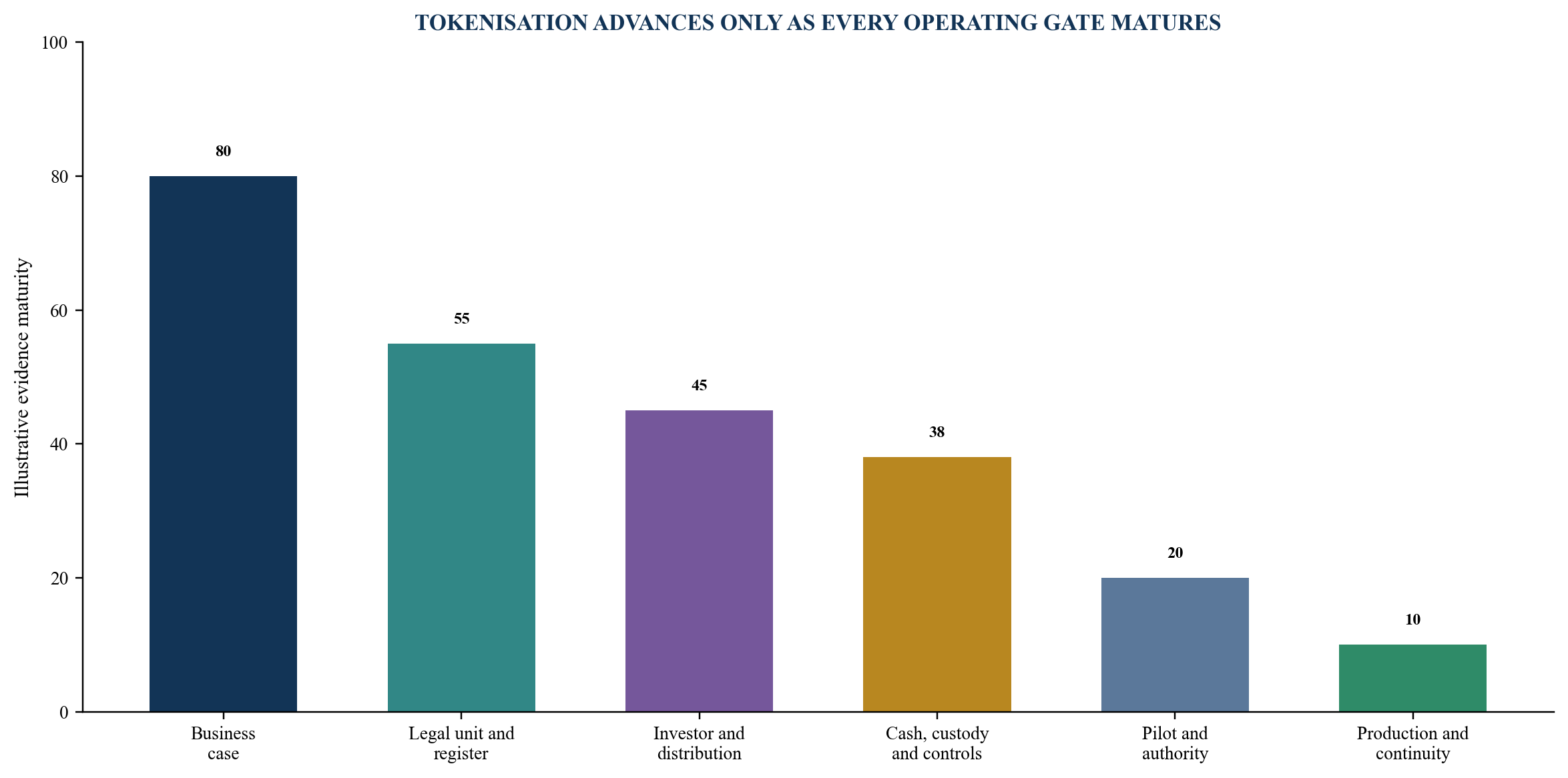
CP173 seeks early feedback; DIFC implementation depends on future policy and final requirements.
14. Build distribution market by market
A DIFC fund does not receive a global marketing passport. Distribution depends on the fund, manager, communication, intermediary, investor and jurisdiction.
The current DFSA framework governs marketing in or from the DIFC. The DFSA also notes that managers with European connections need to consider the Alternative Investment Fund Managers Directive and applicable national private-placement regimes. Other jurisdictions create their own requirements.
The distribution matrix records country, investor class, offer type, local exemption or registration, licensed entity, reverse enquiry treatment, pre-marketing, filings, legends, data protection, financial promotion, suitability and recordkeeping. Current counsel confirms each route.
The target list should be permissioned. An investor's wealth, title or attendance at an event does not establish legal eligibility or commercial interest. Each contact has evidence source, relationship owner, investor classification status, mandate fit, conflict, consent and permitted next action.
Intermediaries require diligence. The manager should understand licence, geography, scope, compensation, conflicts, sub-placement, data handling, communications and records. Introducer language should not conceal regulated distribution activity.
Content governance matters. A thought-leadership article, one-to-one pre-marketing discussion, teaser, data room and binding subscription material have different content and approval controls. Performance and track-record claims require methodology, attribution and disclosure.
The distribution operating model should measure qualified investor progression and document why each prospect advances, pauses or exits.
Table 4. Cross-border distribution control matrix
| Distribution stage | Required evidence | Approval gate | Retained record |
|---|---|---|---|
| market selection | addressable investors, regulatory route and economics | sponsor, compliance and counsel | country memorandum and route decision |
| prospect inclusion | identity, fit, relationship, eligibility and conflict | authorised coverage owner | source, rationale and permitted action |
| first contact | approved entity, channel, language and content | communication approval | recipient, version, time and sender |
| diligence | NDA, access, claims, responses and data restrictions | staged data-room authority | access and Q&A ledger |
| terms | approved economics, side-letter authority and allocation | investment and commercial governance | term comparison and decision |
| subscription | eligibility, KYC, documents, funding and acceptance | authorised acceptance process | complete investor and closing file |
Routes require current advice in each relevant jurisdiction and for each investor interaction.
15. Convert LP segmentation into a fundraising system
Fundraising should begin with investor problems that the fund can solve. Segments may include sovereign and public institutions, pension and insurance capital, funds of funds, private banks, multi-family offices, single-family offices, endowments, corporate investors and manager platforms.
Each segment has allocation size, return and risk objectives, liquidity, governance, due-diligence depth, reporting, tax, currency, co-investment and timeline. A generic pitch creates avoidable cycles.
The sponsor builds an evidence-backed target universe and ranks it by mandate fit, relationship, ticket, geography, process timing and decision authority. Ranking does not claim willingness to invest.
The funnel uses controlled stages: identified, qualified, approved for contact, engaged, diligence, investment-committee path, terms, subscribed and funded. Movement requires evidence. A meeting does not equal a qualified opportunity. A soft indication does not equal committed capital.
Fundraising materials should share one claims register. Strategy, team, pipeline, track record, fees, risks, governance, ESG or sustainability statements and case studies link to approved evidence and document versions.
The weekly committee reviews qualified capital, open evidence, decision dates, blockers, ownership and forecast ranges. It should also review reasons for loss and segment-level conversion.
Commercial planning can identify a likely retainer mandate for fund formation and distribution support. Actual demand and fee collection remain unverified until a signed and paid engagement exists.
16. Model fund and manager economics together
The sponsor needs two economic models. The fund model projects commitments, deployment, fees, expenses, performance allocation and investor cash flows. The manager model projects revenue, team, systems, regulatory capital, service providers, insurance, premises, distribution, fundraising and working capital.
Minimum viable fund size is the commitment level at which the strategy remains diversified, the team can operate, service quality is maintained and the manager has sufficient runway under approved assumptions.
The fee model should distinguish management fee base and rate, step-down, offsets, organisational expenses, fund operating costs, transaction fees, broken-deal allocation, carried interest, hurdle, catch-up, escrow and clawback.
First close can reduce funding uncertainty while starting the investment period and operating-cost clock. The model should show the cost of a smaller close, subsequent-close equalisation and capacity reserved for later investors.
Worked assumptions can illustrate sensitivity. A sponsor might test USD 100 million, USD 200 million and USD 350 million fund sizes with different first-close dates and fee rates. These values are not forecasts or market evidence.
Regulatory proposals that alter capital or fees can affect the manager model. They should enter only as contingent scenarios until final instruments take effect.
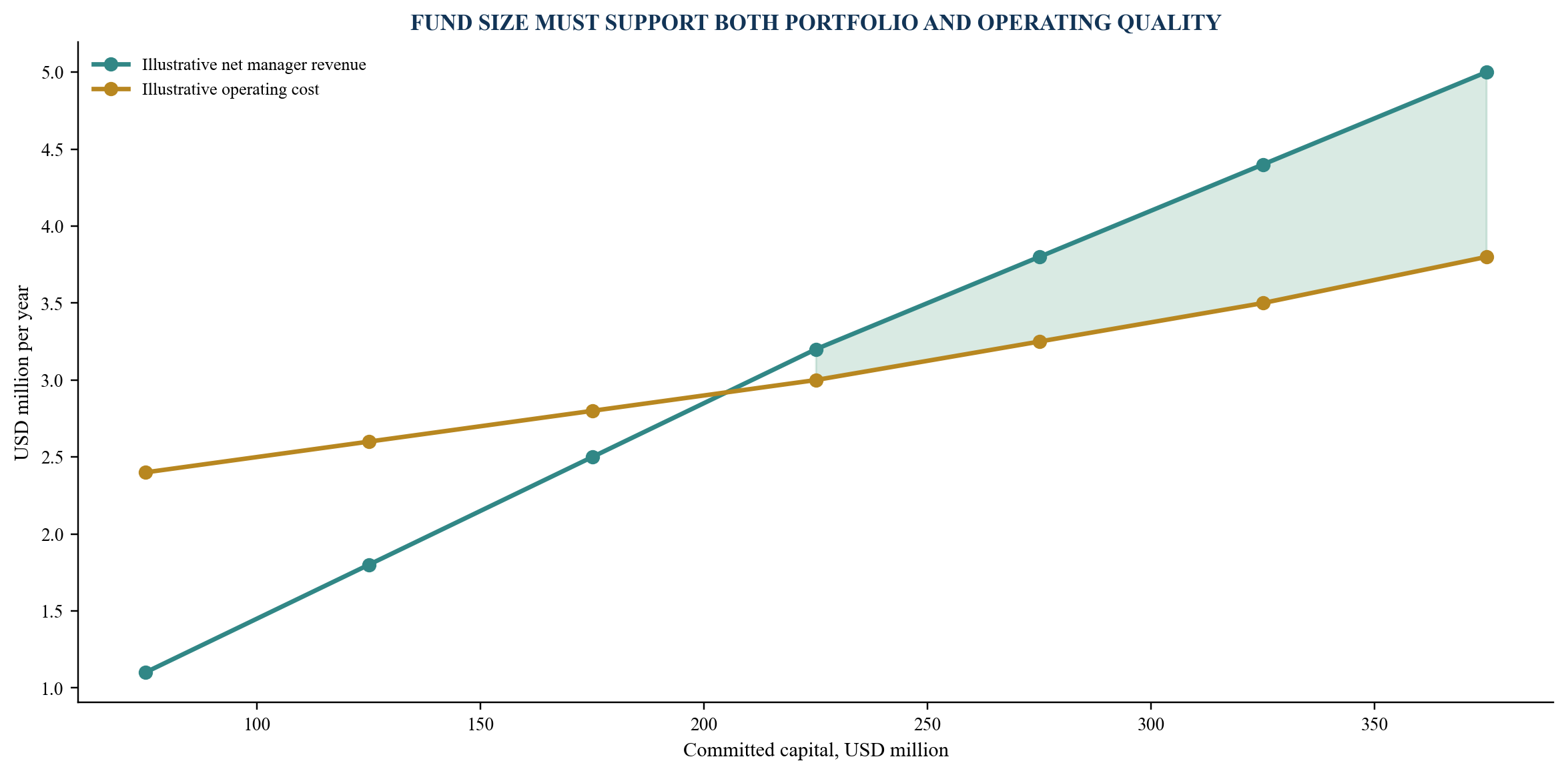
Values are management assumptions for method demonstration and do not represent a named manager or fund.
17. Build a first-close critical path
First close connects regulatory, legal, operational and commercial work. The critical path begins with approved thesis, sponsor and manager structure, current-rule memorandum, service-provider plan, economics and initial investor evidence.
The authorisation and fund-registration route requires early engagement with advisers and the relevant authorities. The DFSA registration service describes enquiry, application, evaluation, fulfilment and approval, with the exact duration depending on the case and required information.
Documents advance in parallel with operating build. The team prepares constitution or partnership agreement, information memorandum or prospectus, subscription materials, management and service-provider agreements, compliance policies, valuation, conflicts, risk, AML, sanctions, data and reporting procedures.
Fundraising advances only through permitted routes. Anchor diligence can expose terms, reporting and structure questions early enough to amend documents before broader circulation.
The closing checklist covers authorisation, registration, legal formation, banking, administrator, custody or title, audit, insurance, investor acceptance, KYC, side letters, minimum capital, funding, equalisation and final approvals.
Long-stop dates and dependencies should be visible. A delayed controlled function, bank account, service-provider onboarding or investor tax review can determine the actual close.
The board should approve a readiness certificate identifying complete items, open conditions, owner, deadline and consequences. No forecast date should be communicated externally without its assumptions.
Table 5. First-close readiness register
| Workstream | Readiness evidence | Critical dependency | Close gate |
|---|---|---|---|
| regulatory | current perimeter, application, responses and approvals | complete and consistent operating model | required authorisation and registration effective |
| legal structure | entities, constitution, agreements and opinions | final economics and governance | documents approved and executed |
| operations | administrator, bank, custody or title, audit and systems | service-provider onboarding | tested operating and reporting process |
| compliance | AML, sanctions, conflicts, valuation, data and records | approved policies and trained owners | responsible functions sign readiness |
| investors | eligibility, diligence, terms, KYC and funding | permitted distribution and resolved side letters | subscriptions accepted under authority |
| economics | minimum size, budget, runway and capital | credible committed and funded close | board confirms viable launch case |
Required steps and sequencing depend on fund type, structure and current authority requirements.
18. Run a ten-day CP173 impact diagnostic
A rapid diagnostic can help an existing manager, new sponsor or global asset manager understand CP173 without treating proposals as rules.
Days one and two establish the current fund, manager, licence, investor, strategy, vehicle, service-provider and distribution perimeter. The team records the definitive instruments and live applications or waivers.
Days three and four map each CP173 proposal and draft amendment to the operating model. The output distinguishes direct impact, indirect opportunity, no impact and insufficient information.
Days five and six test strategy flexibility, credit activities, risk governance, borrowing, prime broker, manager location, master-feeder design, employee investment and tokenisation options.
Days seven and eight build current-state and contingent operating models, implementation cost, transition decisions and a consultation-response evidence pack.
Days nine and ten deliver the three-state regulatory map, no-regrets actions, option register, board paper, response draft if authorised and ninety-day implementation plan.
The paid diagnostic should state its regulatory and evidence boundaries. Counsel confirms legal conclusions and the DFSA retains its authority. Commercial qualification includes a live formation, redesign, licence or distribution decision, senior sponsor, accessible records, current adviser team, budget and decision date.
19. Operate a ninety-day fund-formation office
The first thirty days lock the investment thesis, investor perimeter, current-rule analysis, manager route, fund type, vehicle options, target economics, key service providers and qualified anchor plan. The CP173 map identifies decisions that can proceed and decisions that remain contingent.
Days thirty-one to sixty develop documents, application materials, risk profile, valuation, conflicts, borrowing, liquidity, compliance, operating model, data room, claims register and investor diligence materials. The team engages with relevant authorities and advisers through approved channels.
Days sixty-one to ninety close evidence gaps, negotiate service-provider terms, run operating tests, advance permitted investor diligence, resolve governance issues and prepare a first-close readiness paper.
A recurring office can manage application responses, document reconciliation, provider implementation, fundraising control, due diligence, side letters, closing and post-close reporting. It can also monitor final CP173 instruments and update the transition map.
The office requires one decision log. A change in strategy, investor, vehicle, licence scope or distribution route should trigger legal, regulatory, operational, tax, economic and document review.
Success measures include approved milestones, document reconciliation, response time, qualified investor progression, closed diligence items, operating-test results, committed and funded capital, and first-close readiness. Only funded subscriptions establish collected fund capital.
20. Package advisory work around funded fund decisions
A CP173 diagnostic can support an existing DIFC manager, an international manager evaluating a DIFC presence, or a sponsor preparing a new professional-investor fund. The paid outcome is a decision-grade view of current requirements, proposal impact, structure, governance, operating model and implementation choices.
A fund-formation office can coordinate sponsor, counsel, tax, compliance, administrator, custody or trustee, auditor, placement partners, technology and investors. Deliverables can include the regulatory map, structure options, economics, risk profile, operating model, provider process, data room, first-close plan and board materials.
A distribution mandate can support target segmentation, evidence-backed investor mapping, claims governance, materials, diligence, process management and closing coordination within the permitted activity perimeter. Scope, compensation, conflicts and regulated responsibilities should be documented.
Commercial qualification requires a live fund or manager decision, senior sponsor, credible investment capability, defined investor proposition, budget, adviser access and implementation timetable. A general interest in DIFC or CP173 is not mandate evidence.
The next DIFC fund should be designed for present compliance and future adaptability. The structure begins with a credible thesis, professional-investor need, robust governance and viable operating economics. CP173 then becomes a controlled design input, consultation opportunity and transition programme rather than an assumed rule change.
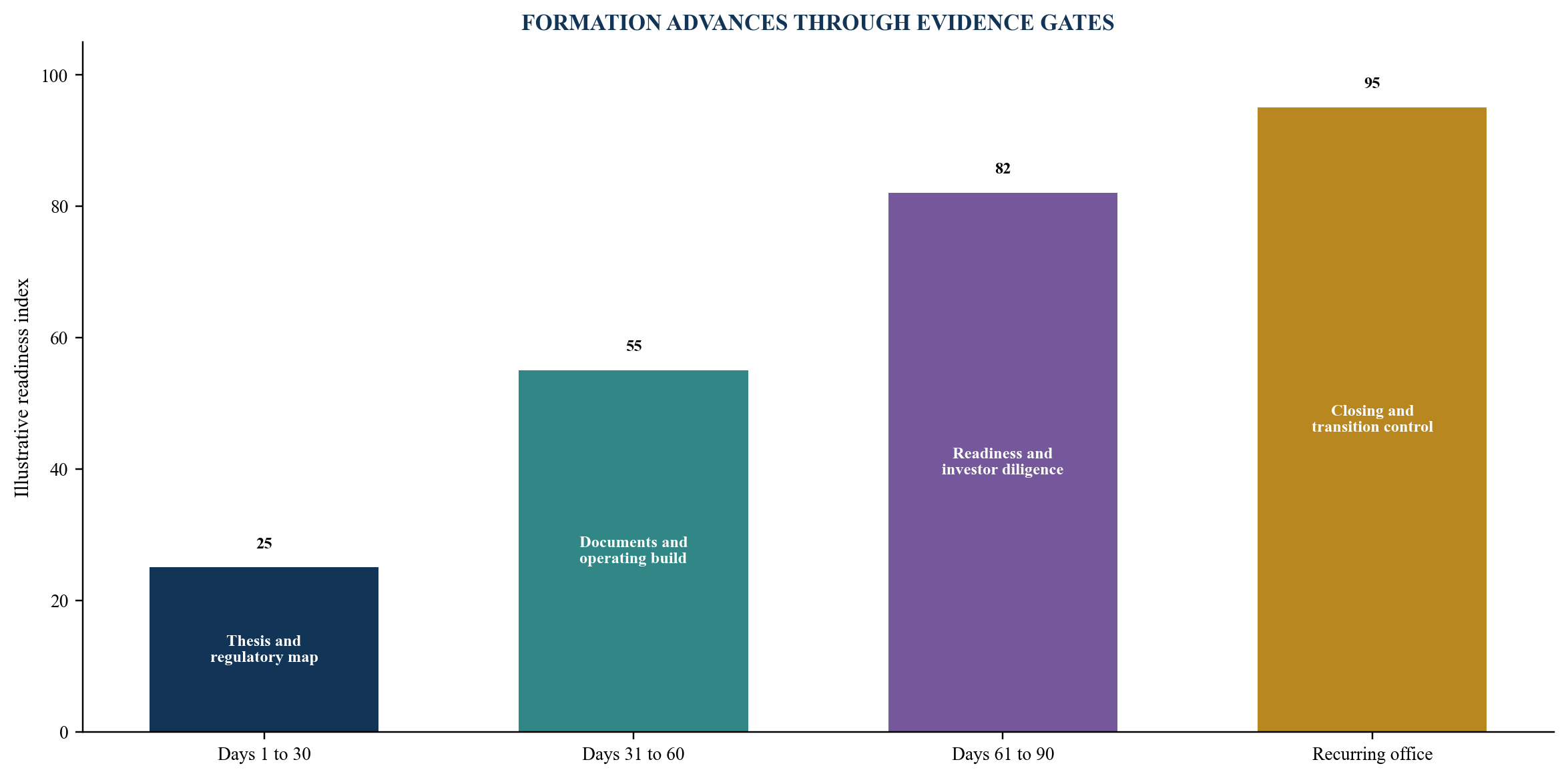
Timing depends on authorisation, registration, advisers, service providers, investor diligence and authority response.
References
- Dubai Financial Services Authority. Consultation Paper No. 173: Proposals to Enhance the DFSA's Collective Investment Fund Framework. https://dfsaen.thomsonreuters.com/sites/default/files/net_file_store/CP_173_Enhance_the_DFSAs_collective_investment_fund_framework.pdf
- Dubai Financial Services Authority. CP173 Draft Amendments to the Collective Investment Rules. https://dfsaen.thomsonreuters.com/sites/default/files/net_file_store/Appendix_4_-_Draft_amendments_to_CIR.pdf
- Dubai Financial Services Authority. CP173 Correlation Table of CIR. https://dfsaen.thomsonreuters.com/sites/default/files/net_file_store/Appendix_11_-_Correlation_Table_of_CIR.pdf
- Dubai Financial Services Authority. The DFSA Proposes Significant Updates to Its Collective Investment Fund Framework. https://www.dfsa.ae/news/dfsa-proposes-significant-updates-its-collective-investment-fund-framework
- Dubai Financial Services Authority. Legislation. https://www.dfsa.ae/laws-rules/legal-resources/legislation
- Dubai Financial Services Authority. Collective Investment Funds. https://www.dfsa.ae/what-we-do/collective-investment-funds
- Dubai Financial Services Authority. Funds in the DIFC. https://www.dfsa.ae/download_file/3125/0
- Dubai Financial Services Authority. Request for New Registration: Collective Investment Funds. https://services.dfsa.ae/collective-investment-funds-qualified-investment-funds/qualified-investment-funds-request-for-new-registration/
- Dubai Financial Services Authority. Fund Constitution Checklist for Public and Exempt Funds. https://www.dfsa.ae/download_file/view/1186/525
- Dubai International Financial Centre. Future of Alternative Investments. https://www.difc.com/whats-on/news/difcs-future-of-alternative-investments-report-underscores-dubai-as-gateway-to-diversifieds
- Dubai International Financial Centre. Annual Report 2025. https://assets.difc.com/v1/media/edge/images/dubaiintern0078-difcexperie96c5-production-3253/media/project/difcexperiences/difc/difcwebsite/documents/media-section/publications/annual-review/annual-report-2025.pdf
- International Organization of Securities Commissions. Principles for the Valuation of Collective Investment Schemes. https://www.iosco.org/library/pubdocs/pdf/IOSCOPD413.pdf
- United Kingdom Financial Conduct Authority. PS26/7: Progressing Fund Tokenisation. https://www.fca.org.uk/publications/policy-statements/ps26-7-progressing-fund-tokenisation
- United States Securities and Exchange Commission. Private Funds. https://www.sec.gov/resources-small-businesses/capital-raising-building-blocks/private-funds
- United States Securities and Exchange Commission. Private Fund Adviser Rules Vacatur. https://www.sec.gov/rules-regulations/2024/11/s7-03-22
About the Author
Chennakeshav Adya, Independent Researcher
