
1. Adaptation becomes a financing question at asset level
Physical climate risk reaches a real asset through a chain. A hazard such as heat, intense rainfall, drought, coastal flooding, wildfire or wind intersects with an exposed location. The asset's design, age, maintenance and safeguards determine vulnerability. The criticality of affected systems determines the operational consequence. A cooling failure in a lightly occupied warehouse differs from a cooling failure in a hospital, data facility or densely occupied residential tower. The same flood depth can create a short clean-up at one site and a prolonged electrical or access failure at another.
The Intergovernmental Panel on Climate Change describes risk as the interaction of climate-related hazards with the exposure and vulnerability of human or ecological systems [1]. Its assessment of cities and infrastructure identifies heat, flooding, water scarcity and cascading infrastructure failures as material urban risks [1]. This framing prevents a common allocation error: treating a map of future hazards as a completed investment case. Hazard data is one input. The board still needs an asset boundary, a time horizon, system dependencies, failure modes, consequence estimates and an intervention plan.
International Financial Reporting Standard S2 requires entities applying the standard to disclose climate-related risks and opportunities that could reasonably be expected to affect cash flows, access to finance or cost of capital [2]. It requires governance, strategy, risk management, metrics and targets, including information about climate resilience informed by climate-related scenario analysis [2]. These disclosure requirements do not dictate a capital programme. They create a disciplined connection between risk, strategic response and financial effects. An owner that cannot explain which assets are exposed, which actions are funded and how resilience is monitored will struggle to make a credible financing proposition.
The United Nations Environment Programme estimates that the adaptation finance gap in developing countries is hundreds of billions of dollars each year [3]. Its 2024 assessment also calls for adaptation that is anticipatory, strategic and transformational [3]. The financing implication is practical. Asset owners cannot wait for a loss event, an insurance withdrawal or a lender condition before defining projects. They need a rolling capital pipeline that is specific enough for procurement and credit review, yet flexible enough to incorporate updated climate, engineering and operating evidence.
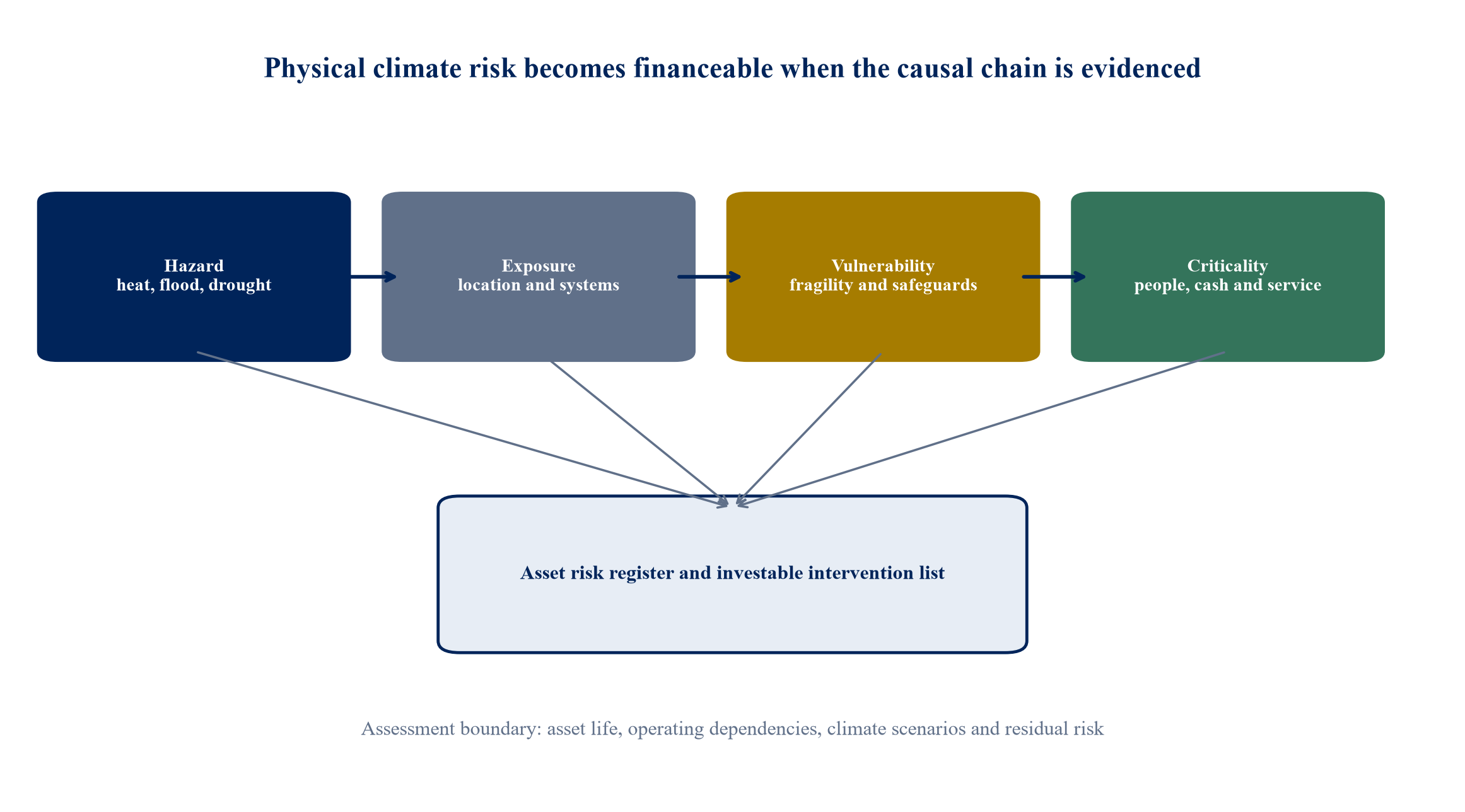
Author-designed framework informed by IPCC risk concepts, IFRS S2 and ISO 14091. It is not a substitute for site-specific engineering, insurance, legal or climate-modelling advice.
2. Define the decision boundary before scoring risk
An effective programme begins by defining what is being protected. The boundary may be a single building, a portfolio, a district utility, a logistics network or a concession. It should include the systems on which the asset depends: grid connection, backup power, potable and process water, wastewater, drainage, transport access, telecommunications, suppliers and emergency services. These dependencies often sit outside the legal property line while remaining essential to rent, production or public service.
The time horizon should reflect the expected holding period, financing tenor, remaining asset life and long-lived components. The European Union Taxonomy requires material physical climate risks to be identified from a prescribed list, assessed against the expected lifetime of an activity, and addressed through adaptation solutions [4]. A five-year loan cannot by itself justify ignoring a twenty-year roof, chiller, seawall or water-system decision. Conversely, a distant hazard projection should not displace urgent maintenance that already reduces vulnerability.
ISO 14091 provides guidance for assessing the risks related to potential impacts of climate change and offers a basis for adaptation planning, implementation, monitoring and evaluation [5]. The standard's value lies in process discipline. The owner should document data sources, scenarios, uncertainties, assumptions, affected systems, responsible people and review dates. Comparable scores across a portfolio require a shared scale and an explicit definition of what low, medium and high mean.
The assessment should distinguish chronic and acute hazards. Chronic heat may raise cooling demand, shorten equipment life and reduce worker productivity. An acute heatwave can exceed plant design capacity and create life-safety constraints. Chronic water stress can increase cost and constrain expansion. A drought or contamination incident can interrupt service. Intense rainfall may exceed drainage assumptions even where annual precipitation remains modest. The intervention list must reflect these different mechanisms.
3. Build an asset evidence room before selecting projects
Physical risk work becomes financeable when the evidence can survive challenge by engineers, lenders, insurers, auditors and investment committees. The minimum evidence room includes geocoded asset records; ownership and lease information; replacement values; historical loss and downtime; engineering surveys; equipment age and maintenance; energy and water data; utility capacity; emergency plans; insurance schedules; claims; lender covenants; and approved capital plans. Data gaps should remain visible rather than being converted into false precision.
Climate datasets require governance. Different providers may use different models, downscaling, return periods and baselines. A flood score from one vendor and a heat score from another may not be comparable. Portfolio screening can identify priorities, while investment decisions require site-level validation. The UNEP Finance Initiative's climate-risk resources warn financial institutions about method, tool and data challenges and encourage scenario-based assessment rather than reliance on one output [6].
Historical claims are valuable and incomplete. An asset without a prior claim may still face rising exposure, while an asset with repeated minor losses may have a clear investment case. Claims data can omit uninsured costs, tenant disruption, management time, reputational effects and public-service consequences. The owner should reconcile loss records with maintenance logs, business-interruption events and lease concessions.
The evidence room should also state the decision rights for each project. Landlord and tenant responsibilities, service-charge rules, concession obligations and public approvals vary by contract and jurisdiction. Financing should follow the entity that controls the work and receives sufficient economic benefit. Where costs and benefits fall on different parties, the programme may require lease amendments, performance contracts, availability payments or a shared-investment mechanism. Legal advice is essential before assuming recovery from tenants or users.
Table 1. Asset-level climate-resilience evidence register
| Evidence domain | Minimum record | Financing relevance | Challenge question |
|---|---|---|---|
| Hazard | Location, scenario, time horizon, source and uncertainty | Establishes risk pathway and review frequency | Does a score describe the asset or only the surrounding area? |
| Exposure | Buildings, equipment, access and external dependencies | Defines secured assets and eligible works | Which critical dependency sits outside owner control? |
| Vulnerability | Design standard, condition, capacity and safeguards | Supports engineering scope and contingency | Has site inspection validated modelled vulnerability? |
| Consequence | Safety, downtime, revenue, cost and contractual service | Connects intervention to cash flow and collateral | Which consequence is measured and which is judgement? |
| Insurance | Coverage, exclusions, limits, deductibles and claims | Tests retained risk and lender requirements | Would the proposed measure change underwriting terms? |
| Intervention | Design, cost, schedule, permits and maintenance | Supports eligibility, procurement and drawdown | Is the project sufficiently mature for committed funding? |
| Outcome | Baseline, metric, owner, frequency and assurance | Enables covenants and impact reporting | Can the claimed benefit be independently reproduced? |
The register is an author-designed diligence aid. Scope and assurance should be adapted to asset class, jurisdiction, financing and risk.
4. Rank interventions by criticality, evidence and readiness
Capital rationing requires more than a risk heat map. A useful priority score combines five dimensions: consequence of failure; evidence quality; intervention effectiveness; delivery readiness; and financial or strategic dependency. A high-consequence project with weak evidence may receive immediate investigation funding rather than immediate construction funding. A modest-risk measure with proven savings and simple installation may proceed quickly. A project needed to preserve insurance or lender compliance may move ahead even when its stand-alone return is low.
The score should remain interpretable. Complex weighted models can conceal judgement. One approach assigns a zero-to-five score for safety and service criticality, cash-flow consequence, insurance or financing dependency, intervention confidence, and delivery readiness. The investment committee then records weights and reasons. The resulting ranking informs sequencing, while explicit vetoes protect life safety and regulatory compliance from being crowded out by projects with easier financial returns.
Projects should be grouped into no-regret, conditional and monitor categories. No-regret measures address current weaknesses, support multiple scenarios and have manageable cost. Conditional measures become necessary at a trigger such as a temperature threshold, insurance change, occupancy increase or utility constraint. Monitor items require updated data or technology maturity. This real-options logic avoids both premature overbuilding and passive delay.
The worked example considers an eight-asset, USD 320 million portfolio with annual net operating income of USD 24 million. Five intervention groups cost USD 12 million over three years. The largest allocation is USD 4.5 million for drainage, flood barriers and protection of below-grade electrical systems. Critical power and controls receive USD 3 million. Passive cooling and HVAC resilience receive USD 2.5 million. Water efficiency and storage receive USD 1.3 million. Landscape and shade receive USD 0.7 million. Every figure is an author assumption.
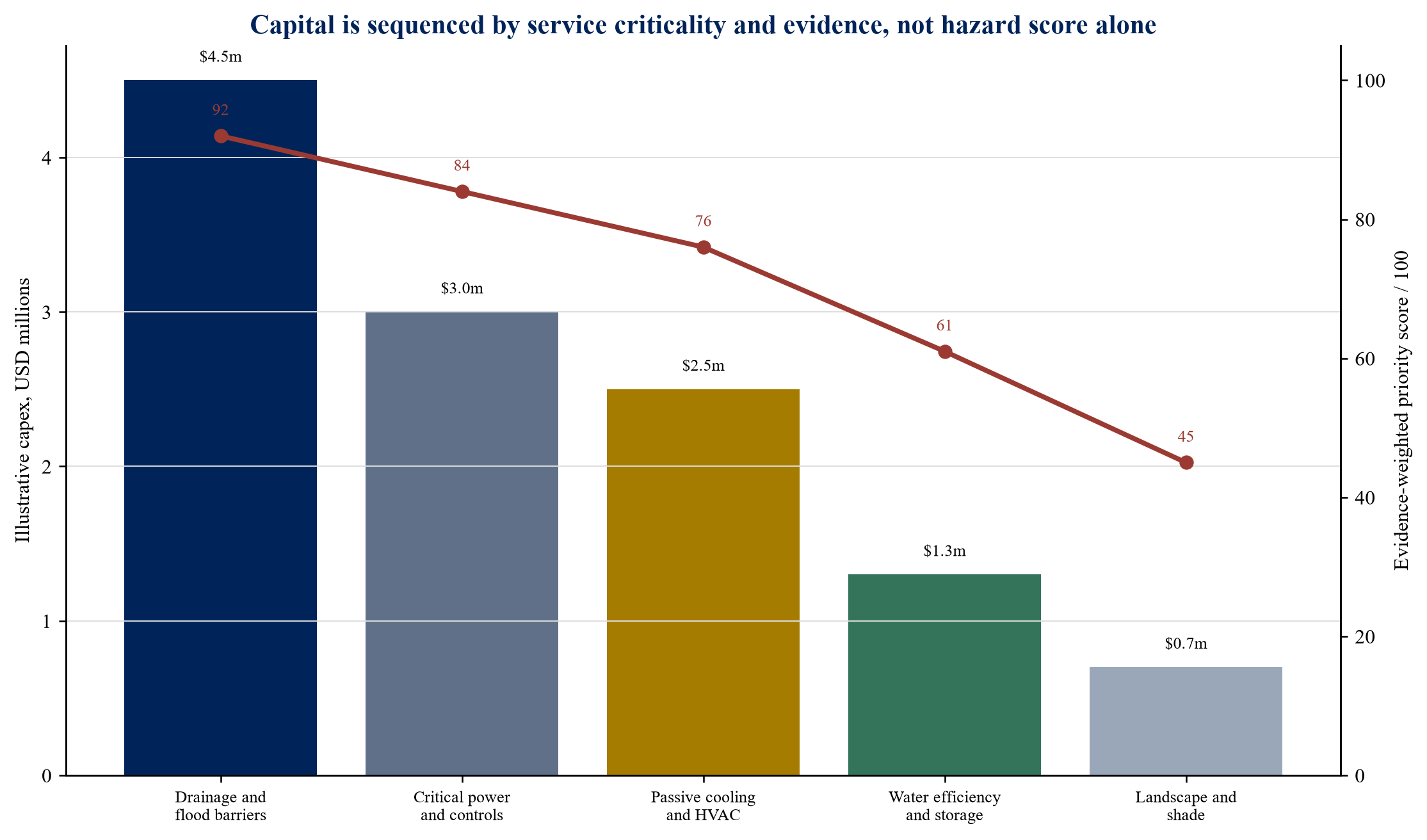
All costs and scores are author assumptions. The score combines criticality, evidence, intervention confidence, delivery readiness and financing dependency; it is not a measured probability of loss.
5. Separate cash-generating, protective and public benefits
The benefit stack determines the financing stack. Measurable operating savings can support repayment when they are stable, attributable and net of maintenance. Examples include reduced electricity consumption, lower water purchase, avoided leakage and reduced equipment failure. Protected revenue may arise where an intervention prevents recurring closure or satisfies a tenant, concession or service requirement. These benefits can be modelled through historical operations and contracts, subject to sensitivity analysis.
Loss avoidance is economically important and harder to lend against. It equals the difference between outcomes with and without an intervention across uncertain events. A model may estimate expected annual loss, yet the resulting value does not arrive as contractual cash each year. It reduces a distribution of possible future losses. Lenders may recognise that protection through collateral value, covenants, advance rates or risk appetite, while debt service still needs dependable cash sources.
Insurance effects require separate treatment. A resilience measure may improve the quality of risk, inform underwriting or support continued coverage. Premium, deductible, limit and exclusion decisions remain with insurers and can reflect portfolio capacity, reinsurance and market conditions beyond the individual asset. A business case should avoid booking a premium reduction unless an insurer has provided reliable evidence. It can show the economic value of preserving coverage or reducing retained loss as scenario cases.
Public and system benefits include community cooling, flood attenuation, water availability, grid resilience and continuity of essential services. The asset owner may capture only part of that value. Public grants, concessional capital, guarantees or district-level cost sharing can be appropriate when the intervention creates benefits beyond the property. The World Bank's Lifelines report estimated that resilient infrastructure in low- and middle-income countries could produce large net benefits and cited an average benefit of four dollars for each dollar invested [7]. That report-level estimate does not establish a return for a specific project; project appraisal needs local evidence.
6. Translate engineering scope into financeable packages
A lender cannot finance a generic ambition to become resilient. It can finance defined assets, contracts and expenditures. Each package should contain an engineering baseline, scope, design standard, cost plan, schedule, procurement route, permissions, commissioning test, maintenance requirement, useful life and outcome metric. Contingency should reflect design maturity and site uncertainty.
Packaging can follow system or asset boundaries. A portfolio-wide water programme may aggregate meters, leak detection, fixtures, reuse and storage across many sites. A flood programme may combine drainage, barriers, pumps, electrical relocation and access protection at one critical facility. Aggregation can reduce transaction cost and diversify delivery risk. It can also obscure whether each asset qualifies under a green-finance framework, so the eligibility schedule should remain granular.
Adaptation should avoid maladaptation. A cooling solution that sharply increases energy demand can create operating and transition risk. A flood barrier can redirect water to neighbours. Groundwater extraction can intensify scarcity. The EU Taxonomy's do-no-significant-harm approach and Climate Bonds Initiative methodologies encourage assessment of wider environmental effects [4, 8]. The owner should test interdependencies, affected stakeholders and operating consequences before final design.
Procurement terms should align payment with evidence. Early draws may fund design and surveys. Construction draws should follow certified progress and cost-to-complete tests. Final release should require commissioning, asset records, training and maintenance plans. Performance retention or warranties can protect against installation defects, while technology-performance risk may require specialist insurance, guarantees or vendor support.
Table 2. Illustrative intervention ranking and financing treatment
| Intervention group | Capex | Priority score | Primary benefit | Proposed financing treatment |
|---|---|---|---|---|
| Drainage, flood barriers and electrical protection | USD 4.5m | 92 | Continuity, asset protection and retained-loss reduction | Green use-of-proceeds tranche plus owner equity |
| Critical power, controls and monitoring | USD 3.0m | 84 | Service continuity and equipment protection | Secured term or equipment facility with commissioning gate |
| Passive cooling and HVAC resilience | USD 2.5m | 76 | Energy savings, thermal safety and continuity | Green loan with energy and capacity verification |
| Water efficiency, leak control and storage | USD 1.3m | 61 | Operating savings and water continuity | Equipment or green facility with metered baseline |
| Landscape, shade and heat-reduction measures | USD 0.7m | 45 | Occupant comfort and site heat reduction | Owner equity or public co-funding where wider benefits exist |
Values, scores and classifications are author assumptions for an eight-asset portfolio. They do not represent an actual project or available terms.
7. Choose the instrument by use of proceeds and repayment source
Owner equity is the first-loss and flexibility layer. It is appropriate for early assessments, uncertain design, maintenance catch-up, works with diffuse benefits and costs excluded by lenders. Equity also demonstrates commitment and absorbs overruns. It should not become the default simply because resilience benefits are difficult to quantify; a better evidence package may unlock debt or risk-sharing capital.
An ordinary secured capex facility can finance mature works where the owner has sufficient cash flow and collateral. The lender underwrites the borrower and assets rather than relying on a green label. Conditions can include approved budgets, cost-to-complete, contractor controls, insurance and minimum liquidity. This route may be simpler for mixed programmes containing eligible and non-eligible expenditure.
Green loans and bonds require proceeds to be applied to eligible green projects. The 2025 Green Loan Principles define four core components around use of proceeds, project evaluation and selection, management of proceeds, and reporting [9]. Loan Market Association guidance identifies climate adaptation and resilience among potential green-project purposes and stresses documented alignment [10]. The 2025 Green Bond Principles similarly emphasise transparency, accuracy and integrity in issuer reporting [11]. An asset owner should build the eligibility schedule, account controls and reporting process before launch.
Sustainability-linked finance links financial or structural characteristics to performance against material key performance indicators and targets. It does not require all proceeds to fund a specific project. The 2025 Sustainability-Linked Loan Principles guidance emphasises material KPIs, ambitious targets, reporting and verification [12]. A resilience KPI can be difficult to design because completed capex is an input, while avoided loss is counterfactual. Better candidates can include the percentage of high-criticality assets with independently verified adaptation plans, completion of defined protections by dates, water intensity against a controlled baseline, or critical-service availability under tested conditions.
Equipment finance, vendor finance and energy-service arrangements can match repayment to assets that generate measurable savings. They need clear ownership, performance, maintenance and end-of-term provisions. Public or blended finance can cover feasibility, first-loss risk, guarantees or wider public benefits. Climate Bonds Initiative's resilience methodology distinguishes adapted investments from activities that enable resilience and seeks evidence of climate-risk assessment and outcomes [8]. The appropriate structure follows the intervention, beneficiary and cash-flow profile.
8. Build a funding stack that respects credit reality
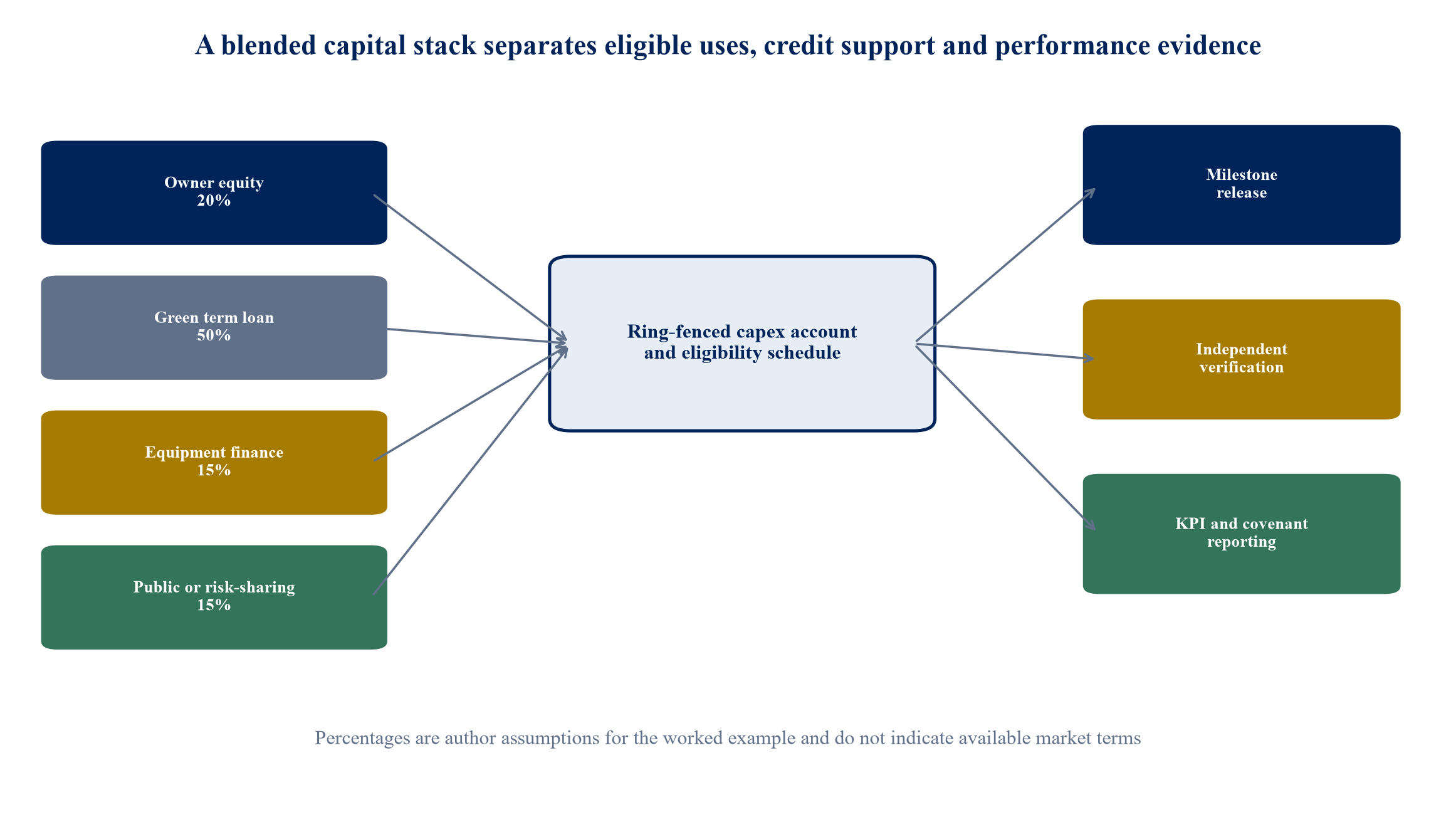
The hypothetical programme uses 20 percent owner equity, 50 percent green term debt, 15 percent equipment finance and 15 percent public or risk-sharing support. These percentages illustrate allocation logic. They do not indicate product availability or market terms. The owner equity funds assessments, early design, excluded costs and contingency. Green debt funds eligible civil, mechanical and water works. Equipment finance funds identifiable systems. Risk-sharing capital supports interventions with substantial public or uncertain private benefit.
Debt capacity should be sized from verified operating cash flow after maintenance, tax, working capital and existing obligations. Energy or water savings can be included when based on measured consumption, credible engineering and conservative performance. Expected loss avoidance belongs in collateral and downside analysis rather than being treated as recurring cash. Insurance savings should enter the base case only when supported by reliable quotes or contractual evidence.
The facility can use a delayed-draw structure. Each project enters an eligibility schedule after design review. Draws require evidence of procurement, permits, equity contribution and cost to complete. A controlled account supports traceability. Completion tests release retention and begin the monitoring period. Undrawn commitments can be cancelled if projects fail to reach readiness by a long-stop date.
Portfolio financing can include concentration limits. A lender may cap exposure to projects relying on one contractor, one technology or one site. A borrowing base can apply advance rates to eligible expenditure and exclude soft costs, related-party charges or unapproved variations. The owner should preserve capacity for urgent works that emerge after the initial assessment.
Percentages are author assumptions. Eligibility, pricing, security, public support and verification requirements depend on transaction documents and applicable programmes.
9. Treat insurance as an independent decision process
Insurance is a financial shock absorber, not a substitute for adaptation. Policy limits, deductibles, exclusions, sub-limits, waiting periods and valuation clauses determine the amount of risk retained by the owner. Market-wide capacity and reinsurance conditions can affect terms even when an individual asset improves. EIOPA's natural-catastrophe protection-gap dashboard combines historical loss, exposure, hazard and insurance-coverage information for European countries and shows why coverage must be assessed alongside risk [13].
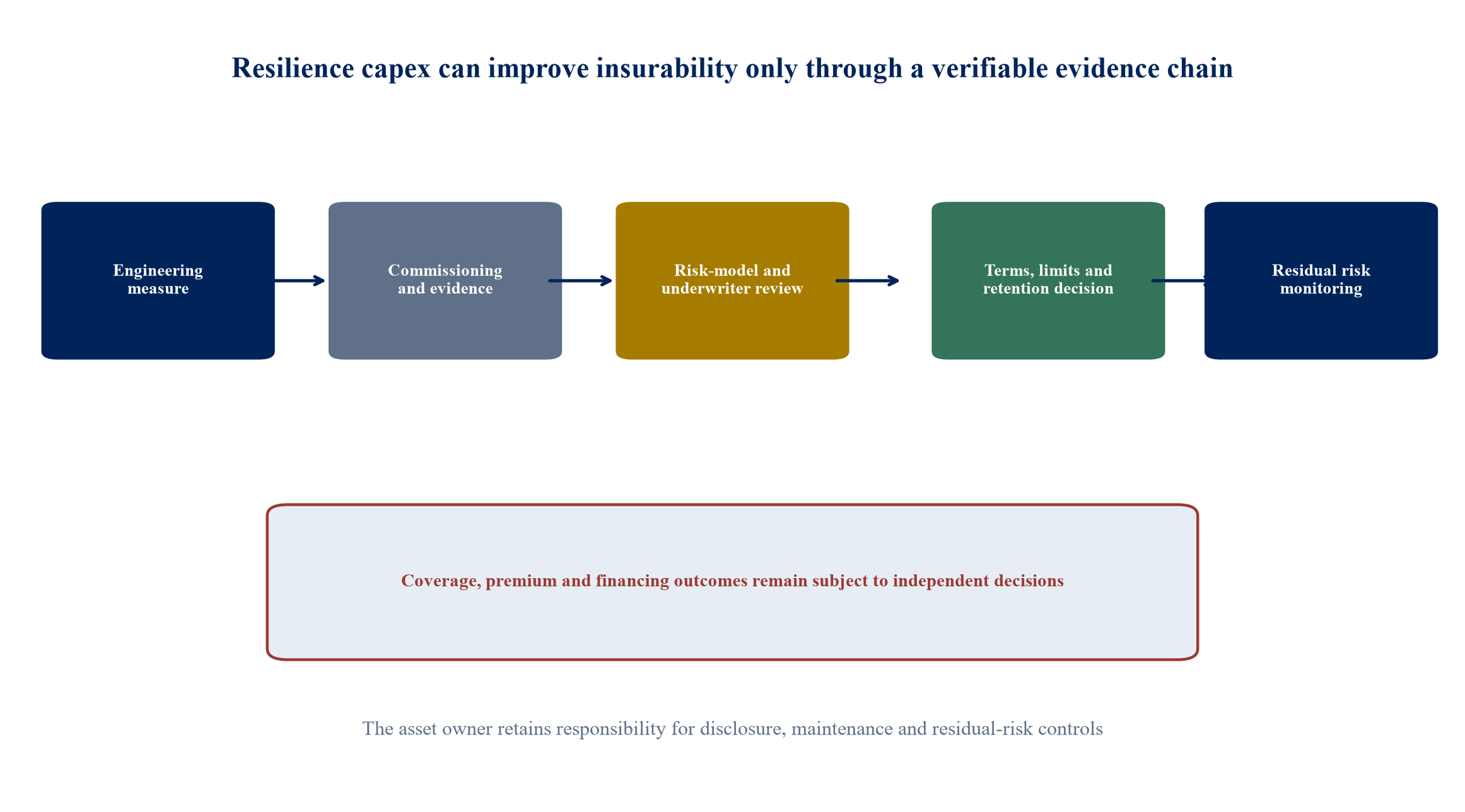
The insurance bridge begins with an engineering measure and a documented risk pathway. Commissioning evidence establishes that the measure exists and performs as designed. Updated exposure information then goes to the broker, modeller and underwriter. They decide how it affects risk quality, probable loss, terms and capacity. The owner records the resulting terms and residual risk. Maintenance and periodic testing preserve the evidence.
The business case can evaluate four insurance outcomes: continued availability, improved limits or sub-limits, lower retention, and lower premium. Only the first three may be more important than price for a critical asset. A board should also examine lender requirements. A project may preserve financing access by allowing the owner to maintain required coverage. That financing benefit should be evidenced through loan terms or lender correspondence.
EIOPA has highlighted the role of insurers in encouraging prevention and adaptation through underwriting and pricing [14]. It has also documented a wide European protection gap for natural catastrophes [13]. These findings support engagement with insurers at design stage. They do not guarantee a commercial reward. The owner should seek written feedback on proposed measures, data and maintenance, while avoiding claims that an intervention is insurer-approved unless approval is explicit.
Author-designed process informed by EIOPA insurance-protection-gap work. No insurance outcome is assumed or guaranteed.
10. Use covenants that preserve the intervention's function
Traditional financial covenants remain relevant because resilience debt is still debt. Minimum liquidity, leverage, debt service, distributions and additional indebtedness should reflect the borrower's cash profile. Project covenants add controls over eligible use, procurement, completion, maintenance and reporting. The covenant set should protect function without transferring ordinary asset management to the lender.
Maintenance is central. A pump without testing, a barrier without deployment training or a sensor without calibration can create false assurance. The asset owner should maintain registers, inspection intervals, spares and responsible personnel. Material changes to the asset, occupancy or surrounding drainage may trigger reassessment. Insurance covenants should require coverage appropriate to availability, with notice of material changes and a defined process when coverage becomes unavailable on reasonable terms.
Information covenants should align with the evidence room. Quarterly reports can show budget, progress, incidents, metrics and exceptions. Annual reports can update physical-risk assessment, insurance and high-criticality actions. Serious failure, loss events, cost overruns or regulatory notices should trigger prompt reporting. Lenders need access to sufficient data while respecting privacy, security and commercially sensitive information.
Remedies should follow the problem. A late report may require cure and enhanced review. Misapplication of proceeds can require repayment or declassification. A cost overrun can require additional equity or scope adjustment. Failure to maintain a critical protection may block distributions or further draws. Acceleration is a final credit remedy rather than an operational management tool.
Table 3. Financing instruments matched to resilience-project characteristics
| Instrument | Suitable project profile | Repayment or support | Principal controls |
|---|---|---|---|
| Owner equity | Early assessment, uncertain design, diffuse benefit or excluded cost | Residual asset cash flow | Board budget, stage gates and portfolio limit |
| Secured capex facility | Mature scope and strong borrower cash flow | General operating cash flow and collateral | Cost-to-complete, security, insurance and financial covenants |
| Green loan or bond | Clearly eligible adaptation or water expenditure | Issuer or borrower credit | Framework, eligible-use schedule, proceeds control and reporting |
| Sustainability-linked loan | Enterprise-wide resilience performance with measurable KPIs | General operating cash flow | Material KPI, ambitious target, reporting and verification |
| Equipment or vendor finance | Identifiable systems with useful life and service contract | Operating savings and borrower credit | Title, performance, maintenance, acceptance and end-of-term rights |
| Public or blended capital | Public-good benefit, affordability gap or early market risk | Grant, guarantee, first loss or concessional return | Additionality, eligibility, procurement, safeguards and impact reporting |
The mapping is indicative. Legal, tax, accounting, credit and green-finance advice should reflect the transaction and jurisdiction.
11. Design metrics around function and evidence
Resilience metrics should describe whether an intervention continues to protect a material function. Inputs such as dollars spent and equipment installed are easy to verify and incomplete. Outputs include protected electrical rooms, drainage capacity, cooling capacity, water storage or assets assessed. Outcomes include reduced outage time, service availability during threshold events, lower water use, controlled indoor temperature or reduced damage. Impact concerns broader welfare or avoided loss and may require longer observation or modelling.
Each metric needs a boundary, baseline, unit, owner, frequency, source and assurance method. A water-intensity metric should define occupied area, operating hours, tenant mix and weather adjustment. A service-availability metric should define the critical load and test condition. A flood-protection metric should identify the design event, protected elevation and dependencies. Changes in asset use require restatement rules.
IFRS S2 expects disclosure about climate-related metrics and targets used to measure and monitor performance [2]. Green-finance principles also expect allocation and, where feasible, impact reporting [9, 11]. These requirements can share a data architecture. The facility report should remain faithful to transaction definitions, while corporate disclosure can explain strategy, uncertainty and material financial effects.
The owner should avoid a single portfolio score that masks high-criticality exceptions. Dashboards should show distribution, overdue actions, unassessed assets and data confidence. Independent assurance can focus on the most consequential metrics and draw conditions. Engineering certification verifies design and commissioning; financial assurance verifies allocation; operational testing verifies function. One reviewer rarely covers all three.
12. Quantify economics without false precision
The hypothetical USD 12 million programme is assessed over ten years. Assume annual measurable energy and water savings of USD 0.75 million after full completion, recurring maintenance of USD 0.15 million, and protected contractual revenue or avoided recurring disruption of USD 0.35 million. These values are author assumptions. At an illustrative eight percent discount rate, the direct cash benefits alone may not justify every intervention. That result is informative because the programme also protects people, collateral, service obligations, insurance access and downside exposure.
Expected-loss modelling should use multiple scenarios. For each hazard, the analyst estimates event frequency or scenario weight, damage, downtime, insurance recovery and retained loss before and after the intervention. Model uncertainty should be disclosed, and correlated events should be considered. A portfolio located in one climate region is not diversified merely because it contains multiple buildings. Utility failure can create common-mode loss.
The investment committee should view three cases. The cash case includes dependable savings and protected contracted cash flow. The credit case adds effects on collateral, insurance and financing access. The strategic case includes safety, regulation, tenant retention, public service and option value. Approval can rely on the combined rationale, while debt sizing remains anchored in the cash case and conservative credit adjustments.
Sensitivity analysis should test cost overrun, delayed completion, lower savings, higher maintenance, failure to secure insurance benefit, accelerated hazard change and early asset sale. The terminal value of a measure should reflect remaining useful life and whether a buyer recognises it. Avoided losses should not be added mechanically to valuation. Market evidence, buyer diligence and appraisal practice determine whether resilience appears in price.
13. Integrate resilience into valuation and transaction diligence
Real-asset valuation depends on expected cash flow, capital needs, risk and market pricing. Climate exposure can affect operating expense, occupancy, downtime, insurance, capital expenditure and exit liquidity. The effect can be asset-specific and non-linear. A lender or buyer may accept current cash flow while requiring immediate capex or a price adjustment once a vulnerability is identified.
Transaction diligence should therefore reconcile the physical-risk assessment with the financial model and technical report. Material interventions belong in the capital plan. Insurance terms should match the model. Lease and concession analysis should establish cost recovery. Environmental and planning diligence should address permits and possible external effects. The acquisition agreement may allocate known remediation, while financing conditions may require completion or escrow.
A seller can improve readiness by maintaining the evidence room and documenting completed measures, tests and outcomes. A buyer should avoid accepting a vendor score without understanding scenario, resolution and assumptions. Site inspection remains essential for critical assets. The investment case should show residual risk after planned works, including dependencies that cannot be controlled.
At exit, a completed and maintained programme may broaden lender or insurer confidence, reduce buyer uncertainty and protect value. These are possible commercial effects rather than assured premiums. The best evidence is a clean record of decisions, commissioned assets, measured performance and current third-party responses.
14. Govern delivery across finance, engineering and operations
The board owns risk appetite and capital allocation. A programme steering committee can combine the chief financial officer, asset management, engineering, operations, risk, insurance and sustainability. Each project needs one accountable executive and one technical owner. Treasury should manage funding and reporting; engineering should own design and commissioning; operations should own maintenance and incident response.
Stage gates create discipline. Gate zero confirms the asset and dependency inventory. Gate one approves detailed assessment. Gate two accepts the intervention concept and options. Gate three approves design, procurement and financing eligibility. Gate four authorises construction draw. Gate five confirms commissioning and operational handover. Gate six reviews performance and residual risk after an operating period.
Independent challenge should focus on high-criticality or novel projects. Climate specialists validate scenarios; engineers validate failure modes and design; quantity surveyors validate cost; insurers explain underwriting; lenders assess credit; lawyers document rights; auditors or assurance providers test reporting. Their roles should be defined to avoid an assumption that one opinion validates the entire programme.
Portfolio governance also needs a change process. Updated models, a new loss event, insurer action, regulation, acquisition or disposal can change priorities. The programme should be refreshed at least annually and after material events. Uncommitted capital can be reallocated through documented approval. Completed projects remain in the risk register because performance and maintenance must continue.
Table 4. Resilience financing KPI, covenant and evidence schedule
| Control | Illustrative definition | Evidence | Review and response |
|---|---|---|---|
| High-criticality assessment coverage | Share of designated assets with current site-validated assessment | Register, report and approval date | Quarterly; new assessment plan for gaps |
| Eligible expenditure allocation | Drawn proceeds matched to approved invoices and projects | Controlled account, invoice and certificate | Each draw; exclude or repay ineligible amount |
| Commissioning completion | Works pass specified engineering and operational tests | Engineer certificate, test record and handover | Milestone; hold retention until cure |
| Critical-service availability | Defined service performs under scheduled test conditions | Test protocol, logs and exception report | Semi-annual; remediation and retest |
| Water or energy performance | Weather- and occupancy-adjusted measure against controlled baseline | Meter data, methodology and assurance | Annual; investigate variance and update plan |
| Insurance status | Required coverage and material changes reported | Policy, broker letter and renewal record | At renewal and on change; lender consultation |
| Maintenance compliance | Critical measures inspected and serviced by due date | Work orders, certificates and spares record | Quarterly; cure before distributions or new draws |
This schedule is an illustrative control framework. Targets and remedies must be calibrated to the asset, facility and verified baseline.
15. Sequence a ninety-day financing-readiness programme
During days one to fifteen, management confirms assets, dependencies, existing assessments, losses, insurance and capital constraints. It names the steering committee, adopts scoring definitions and identifies urgent life-safety or compliance actions. Treasury maps existing debt and covenant capacity. The team creates a controlled data room and logs gaps.
During days sixteen to forty-five, specialists validate the highest-priority sites. Engineering options are compared for effectiveness, interaction, cost, delivery and maintenance. Finance separates savings, protected cash flow, loss avoidance and public benefits. Insurance advisers discuss evidence needs with underwriters. Legal advisers review ownership, leases, concessions, permits and security.
During days forty-six to seventy, the owner approves a sequenced programme, contingency and procurement route. Projects are assigned to equity, green debt, ordinary secured debt, equipment finance or public support. A green-finance framework and eligibility schedule are prepared where relevant. Lenders receive a model with clear assumptions and downside cases.
During days seventy-one to ninety, financing terms and project contracts are aligned. Conditions precedent, draw evidence, cost-overrun support, commissioning, maintenance, reporting and remedies are documented. The owner establishes dashboards and assurance responsibilities before first draw. Projects that remain immature receive investigation budgets and explicit next decisions rather than construction commitments.
16. Common failure modes and corrective actions
The first failure is buying a portfolio hazard score and treating it as an engineering conclusion. The correction is site validation, dependency mapping and documented uncertainty. The second is approving a long list of measures without a capital constraint or sequence. The correction is an evidence-weighted ranking, stage gates and a multi-year budget.
The third is presenting avoided loss as predictable debt-service cash. The correction is to separate the cash, credit and strategic cases. The fourth is promising insurance savings. The correction is an evidence bridge and written underwriter engagement, with no commercial benefit assumed until supported. The fifth is using a green label without proceeds controls or outcome reporting. The correction is an eligibility schedule aligned with applicable principles.
The sixth is financing equipment without funding maintenance, spares, training and testing. The correction is whole-life cost and operating covenants. The seventh is ignoring assets outside the property boundary. The correction is dependency analysis and coordination with utilities, municipalities and neighbours. The eighth is seeking precision from uncertain long-term models. The correction is multiple scenarios, trigger-based decisions and regular review.
The ninth is allowing programme teams to overwrite evidence gaps with management estimates. The correction is an assumptions register that identifies source, owner, sensitivity and validation date. The tenth is designing a metric that rewards spending rather than resilience. The correction is to pair input and output measures with functional tests and residual-risk disclosure.
17. Board and lender decision questions
The board should ask which people, services and cash flows fail under each material scenario; which dependencies sit outside control; which interventions are necessary now; which can wait for a trigger; and which claims are supported by measured evidence. It should understand the cost of delay, the cost of overbuilding and the funding capacity preserved for future information.
The lender should ask whether eligible uses are defined, the borrower can service debt without counting uncertain avoided loss, cost-to-complete is protected, insurance requirements are realistic, and measures will be maintained. It should test whether the financing remains sound if no premium reduction or valuation uplift occurs.
The insurer should receive engineering and operating evidence that is relevant to underwriting. The asset manager should understand how interventions affect tenants, service charges, access and operations. The investment committee should see a clear separation between regulatory or safety necessity, bankable savings, collateral protection and wider public value.
A robust approval records the selected option, rejected alternatives, assumptions, conditions, residual risk and next review. This decision record allows the programme to evolve without losing accountability. It also improves transaction readiness when an asset is refinanced, insured or sold.
18. Conclusion
Climate-resilience capex finance begins with asset truth. Hazard, exposure, vulnerability, criticality and external dependencies must be connected to engineering measures and financial consequences. A portfolio score can direct attention; it cannot replace site evidence or capital design.
The financing architecture follows the benefit architecture. Verifiable operating savings and protected contracted cash flow can support repayment. Avoided loss, insurability, collateral protection and public benefits strengthen the credit and strategic case but require careful treatment. Green use-of-proceeds instruments, ordinary secured debt, equipment finance, sustainability-linked structures, public risk sharing and owner equity each have a role when their controls match the project.
The practical result is a living programme: an asset register, an evidence-weighted priority curve, financeable packages, an independent insurance bridge, stage-gated capital, functional metrics and periodic reassessment. This structure allows boards to invest before exposure becomes a crisis while preserving credit discipline and transparent claims.
References
- Intergovernmental Panel on Climate Change, Climate Change 2022: Impacts, Adaptation and Vulnerability, Chapter 6, Cities, Settlements and Key Infrastructure. https://www.ipcc.ch/report/ar6/wg2/chapter/chapter-6/
- IFRS Foundation, IFRS S2 Climate-related Disclosures. https://www.ifrs.org/issued-standards/ifrs-sustainability-standards-navigator/ifrs-s2-climate-related-disclosures/
- United Nations Environment Programme, Adaptation Gap Report 2024: Come Hell and High Water. https://www.unep.org/resources/adaptation-gap-report-2024
- European Commission, Commission Delegated Regulation (EU) 2021/2139, including climate-change-adaptation criteria. https://eur-lex.europa.eu/legal-content/EN/TXT/?uri=CELEX%3A32021R2139
- International Organization for Standardization, ISO 14091:2021, Adaptation to climate change: Guidelines on vulnerability, impacts and risk assessment. https://www.iso.org/standard/68508.html
- United Nations Environment Programme Finance Initiative, Climate Risk and TCFD Resources, including the Climate Risk Landscape. https://www.unepfi.org/climate-change/tcfd/resources/
- World Bank, Lifelines: The Resilient Infrastructure Opportunity, 2019. https://documents1.worldbank.org/curated/en/111181560974989791/pdf/Lifelines-The-Resilient-Infrastructure-Opportunity.pdf
- Climate Bonds Initiative, Climate Bonds Resilience Taxonomy Methodology, 2024. https://www.climatebonds.net/files/documents/Climate-Bonds_Resilience-Methodology_2024.pdf
- Asia Pacific Loan Market Association, Loan Market Association and Loan Syndications and Trading Association, Green Loan Principles, March 2025. https://www.lma.eu.com/application/files/1917/4298/0817/Green_Loan_Principles_-_26_March_2025.pdf
- Asia Pacific Loan Market Association, Loan Market Association and Loan Syndications and Trading Association, Guidance on Green Loan Principles, March 2025. https://www.lma.eu.com/application/files/1717/4298/0842/Guidance_on_Green_Loan_Principles_-_26_March_2025.pdf
- International Capital Market Association, Green Bond Principles, 2025. https://www.icmagroup.org/sustainable-finance/the-principles-guidelines-and-handbooks/green-bond-principles-gbp/
- Asia Pacific Loan Market Association, Loan Market Association and Loan Syndications and Trading Association, Guidance on Sustainability-Linked Loan Principles, March 2025. https://www.lma.eu.com/application/files/3517/4298/0872/Guidance_on_Sustainability-Linked_Loan_Principles_-_26_March_2025.pdf
- European Insurance and Occupational Pensions Authority, Dashboard on insurance protection gap for natural catastrophes. https://www.eiopa.europa.eu/tools-and-data/dashboard-insurance-protection-gap-natural-catastrophes_en
- European Insurance and Occupational Pensions Authority, Impact underwriting: report on insurers' use of climate-related adaptation measures in non-life underwriting practices. https://www.eiopa.europa.eu/publications/impact-underwriting-report-insurers-use-climate-related-adaptation-measures-non-life-underwriting_en
- United Nations Environment Programme Finance Initiative, Physical Climate Risk Assessment and Management: An Investor Playbook. https://www.unepfi.org/themes/climate-change/physical-climate-risk-assessment-and-management-an-investor-playbook/
- United Nations Environment Programme Finance Initiative, Practical Guidance on Implementing Adaptation and Resilience for Banks. https://www.unepfi.org/industries/banking/adaptation-resilience-guidance/
- United Nations Environment Programme Finance Initiative, Climate Risks in the Real Estate Sector. https://www.unepfi.org/themes/climate-change/climate-risks-in-the-real-estate-sector/
- Climate Bonds Initiative, Updated Water Infrastructure Criteria to Strengthen Climate Resilience, June 2026. https://www.climatebonds.net/news-events/blog/climate-bonds-updates-water-infrastructure-criteria-strengthen-climate-resilience
- Climate Bonds Initiative, Updated Climate Bonds Resilience Taxonomy Methodology, June 2026. https://www.climatebonds.net/data-insights/publications/updated-climate-bonds-resilience-taxonomy-methodology
- United Nations Environment Programme Finance Initiative, Adaptation Finance Taxonomy Playbook, 2026. https://www.unepfi.org/themes/climate-change/adaptation-finance-taxonomy-playbook/
- International Finance Corporation, Climate Adaptation Finance: The Unavoidable Opportunity. https://www.ifc.org/content/dam/ifc/doclink/latest/climate-adaptation-finance-the-unavoidable-opportunity.pdf
- International Organization for Standardization, Climate adaptation standards overview: ISO 14090 family. https://www.iso.org/files/live/sites/isoorg/files/store/en/PUB100449.pdf
- European Commission, EU taxonomy for sustainable activities. https://finance.ec.europa.eu/sustainable-finance/tools-and-standards/eu-taxonomy-sustainable-activities_en
- World Bank, Resilient infrastructure investment can save trillions, press release, 2019. https://www.worldbank.org/en/news/press-release/2019/06/19/42-trillion-can-be-saved-by-investing-in-more-resilient-infrastructure-new-world-bank-report-finds
