

1. The financing decision concerns the payment right, its evidence and its path to cash
Public-sector receivables are often described as high-quality assets because the ultimate debtor is a government, agency, public utility or state-owned enterprise. That description can obscure the actual financing risk. A supplier can have an economically sound customer and still wait months for cash because work has not been certified, a purchase order is missing, a variation remains unapproved, an invoice was rejected by a portal, a performance deduction is being calculated, or the payment requires several administrative approvals. The credit standing of the ultimate obligor matters. The lender also needs to know whether a present payment obligation exists, whether its amount is fixed, whether it can be assigned, whether defences and set-off can reduce it, and whether collections can be controlled.
The relevant asset is not simply an accounting entry called trade receivables. It is a bundle of contractual, statutory and evidential rights. The bundle begins with a valid contract or purchase order and extends through proof of performance, acceptance or certification, an accurate invoice, required tax and compliance documentation, budget and payment approval, an enforceable claim, an effective assignment or security interest, and a collection route that delivers cash to the agreed account. Weakness at any point can postpone payment or reduce recoverable value.
Current public frameworks illustrate why the process matters. The United Kingdom's Procurement Act regime implies 30-day payment terms into public contracts and relevant subcontracts, while official guidance still distinguishes valid and undisputed invoices from claims that have not met the payment conditions [1][2]. Saudi Arabia's procurement regulations require progress invoices to be checked against completed work and bills of quantities, with the consultant reporting after review; the same regulations contemplate deductions and approval requirements [3]. The UAE federal procurement framework permits direct payment to an approved sub-supplier only after stated conditions, completion and acceptance have been verified [4]. In India, the statutory delayed-payment framework for micro and small enterprises, the TReDS mechanism and dispute-resolution channels provide routes to payment or finance, yet those mechanisms still depend on documented transactions, buyer acceptance and platform rules [5][6][7].
The financing decision can be framed through six questions. Has the supplier earned an unconditional payment right? Can the amount be evidenced independently? Can the right be transferred or charged effectively and with priority? What deductions, counterclaims or set-off rights remain? How long will the administrative path to cash take under ordinary and stressed conditions? Can the lender monitor changes and control collections quickly enough to preserve value? A positive sovereign or public-sector credit view answers only part of this sequence.
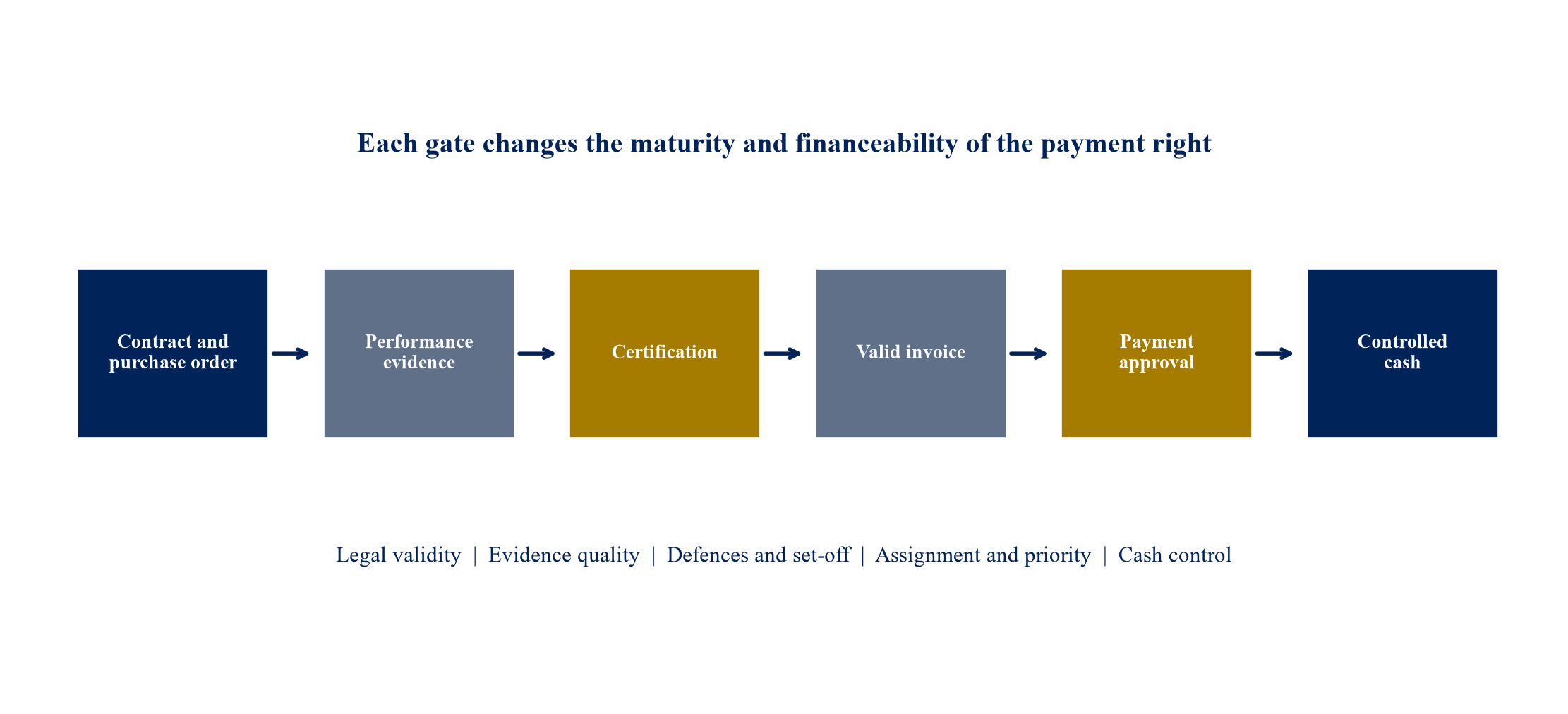
The lifecycle is author-designed. Each gate represents an evidential or legal condition that may change financeability.
A robust facility should therefore finance stages rather than labels. Unbilled work may support a contractor's forecast but ordinarily lacks the same quality as an accepted invoice. A submitted invoice may remain subject to portal rejection or certification. A certified invoice may still face contractual retention, tax withholding, set-off or appropriation risk. A payment instruction may have strong evidence but still require cash-dominion controls. The structure should state which stage is eligible, which stage receives a lower advance, and which stage remains borrower-funded.
2. A receivables lifecycle identifies where value is created and where delay accumulates
The lifecycle starts before the invoice. Contract validity, delegated authority, purchase-order coverage, budget source, scope, pricing mechanism, change-control procedure, acceptance criteria, payment terms and dispute process determine whether performance can become a clean claim. A lender entering after work has been completed should still review these foundations because defects at award or variation stage can emerge as payment defences later.
Performance evidence differs by sector. Construction and engineering contracts may rely on measured works, engineer certificates, completion milestones and approved variations. Technology and managed-service contracts may require service-level reports, user acceptance tests, security clearances and recurring performance confirmations. Healthcare supply may depend on delivery notes, batch records and approved pricing. Utilities work may involve meter data, availability calculations or regulatory approvals. Professional services can require timesheets, deliverables and sign-off. The financing data model should reflect the contract's actual proof of performance rather than impose a generic invoice checklist.
Certification is a critical transition. Before certification, the amount may be an estimate of work performed. After certification, an authorised party has usually confirmed that defined performance occurred and quantified the amount due, subject to contractual adjustments. Certification does not always create an unconditional debt. The contract may preserve rights to correct errors, deduct liquidated damages, retain a percentage, set off other liabilities or reject supporting documents. The lender must read the certificate together with the contract and payment clause.
Invoice validation is another separate transition. Public buyers frequently require a precise purchase-order number, supplier registration, tax invoice format, delivery or service references, bank details and portal submission. The UK Department for Energy Security and Net Zero, for example, states that invoices require the correct purchase-order number to be valid and links payment to authorisation by the relevant officials [8]. Similar procedural dependencies exist in electronic procurement and payment systems elsewhere. A facility should record validation status and rejection reason as structured data rather than treat every issued invoice as equally mature.
Payment approval may involve operational, procurement, finance and treasury steps. The supplier may know that the customer accepts the work yet remain unable to identify the pending approval. A lender should ask for system-generated status evidence where available, historic stage-duration data and escalation rights. Repeated manual assurances carry less weight than a consistent portal trail or direct confirmation from an authorised buyer representative.
Collection completes the lifecycle only when cash reaches an account subject to the agreed control. Payment to the supplier's ordinary account can create diversion risk. Payment to a controlled account may require the buyer to acknowledge new bank details or assignment notice. A government body may refuse to acknowledge an assignment, may retain a right to pay the supplier directly, or may require specific forms. The facility should reflect the collection mechanism that is legally and operationally achievable.
Table 1. Receivable stages and minimum evidence for financing treatment
| Stage | Core evidence | Principal uncertainty | Illustrative financing treatment |
|---|---|---|---|
| Unbilled work | Contract, progress records and cost-to-complete analysis | Performance, measurement and future certification | Normally excluded or financed under a separate contract-asset sublimit |
| Submitted invoice | Valid invoice, purchase order and submission receipt | Rejection, missing documents or unapproved variation | Low or zero advance until validation |
| Validated invoice | Portal acceptance and complete support | Certification, deduction and approval timing | Conditional eligibility with concentration and delay reserves |
| Certified receivable | Authorised certificate or acceptance evidence | Set-off, retention, tax and payment-process delay | Core borrowing-base asset subject to legal and collection tests |
| Approved for payment | Treasury or buyer-system approval | Execution timing and payment diversion | Higher advance where assignment and collection control are effective |
| Disputed or overdue claim | Correspondence, claim record and legal analysis | Quantum, enforceability and resolution time | Excluded from ordinary borrowing base; separate claims-finance analysis |
The table provides an author-designed classification. Transaction documents and local law determine the final treatment.
The lifecycle also reveals responsibility. Commercial teams own contract scope and variations; operations produce performance evidence; project controls measure progress; finance issues invoices and reconciles deductions; tax teams support compliance; treasury monitors cash; legal teams manage assignment and disputes. A receivables facility fails when these functions transmit inconsistent records. The borrowing-base process should force them into one common record for each financed claim.
3. Obligor credit and receivable performance must be separated
A public-sector obligor may have substantial resources and a strong expectation of ultimate payment. The receivable can still perform poorly as working-capital collateral. Lenders should separate ultimate loss risk from timing, dilution, dispute and operational risk. This distinction explains why a portfolio can have low expected credit loss yet require substantial reserves or lower advance rates.
Ultimate obligor analysis starts with legal identity. A ministry, municipality, statutory corporation, public utility and majority state-owned company can have different legal status, funding access and payment obligations. A brand name or policy role does not prove a sovereign guarantee. The lender should identify the contracting entity, its enabling framework, whether obligations are backed by a budget or its own revenues, and whether any guarantee is explicit and enforceable. Where a buyer sits within a corporate group, invoices owed by the operating company should not be treated automatically as obligations of the state or parent.
Appropriation and budget risk concerns whether the buyer has lawful authority and available allocation to make the payment. A signed contract may provide strong evidence, while changes or work performed outside approved scope may face a different budget path. Multi-year projects can encounter annual appropriations, reallocation or delayed release of funds. The lender should seek contract and purchase-order coverage for each invoice and understand how budget confirmation appears in the buyer's system.
Administrative payment risk concerns the time taken after the payment obligation exists. Process steps can create a long tail even without a dispute. Historic payment curves by buyer, department, contract, invoice type and certification status are therefore more informative than a single days-sales-outstanding figure. The curve should show the proportion collected within 30, 60, 90, 120 and more than 180 days, together with reasons for outliers.
Dilution captures reductions between gross invoice and cash received. Sources include credit notes, pricing corrections, quantity differences, service-level deductions, liquidated damages, retention, tax withholding, rebate, penalty, rejected variation and foreign-exchange adjustment. A lender should calculate gross dilution, net dilution and dispute incidence using cash applications and credit-note data. The calculation should avoid classifying ordinary tax withholding as credit deterioration if it creates a separately recoverable tax asset, while still recognising that it reduces cash available for debt service.
Set-off can be broader than invoice-specific deductions. A public buyer may claim amounts under the same contract, another contract, tax law or a wider relationship, depending on governing law and contract terms. The assignment of a receivable does not necessarily eliminate debtor defences or set-off rights. UNCITRAL's receivables framework highlights the importance of debtor defences, contractual limitations, notice and priority in cross-border financing [9][10]. The lender requires jurisdiction-specific advice on which claims can be asserted against an assignee and at what point notice limits future set-off.
Concentration magnifies all these risks. A supplier may have hundreds of invoices that depend on one buyer, one certification team, one budget line or one master contract. Invoice count is therefore an incomplete measure of diversification. Exposure should be aggregated by legal obligor, controlling authority, contract, project, certifier, payment system, geography and dispute source. A single administrative interruption can affect many invoices simultaneously.
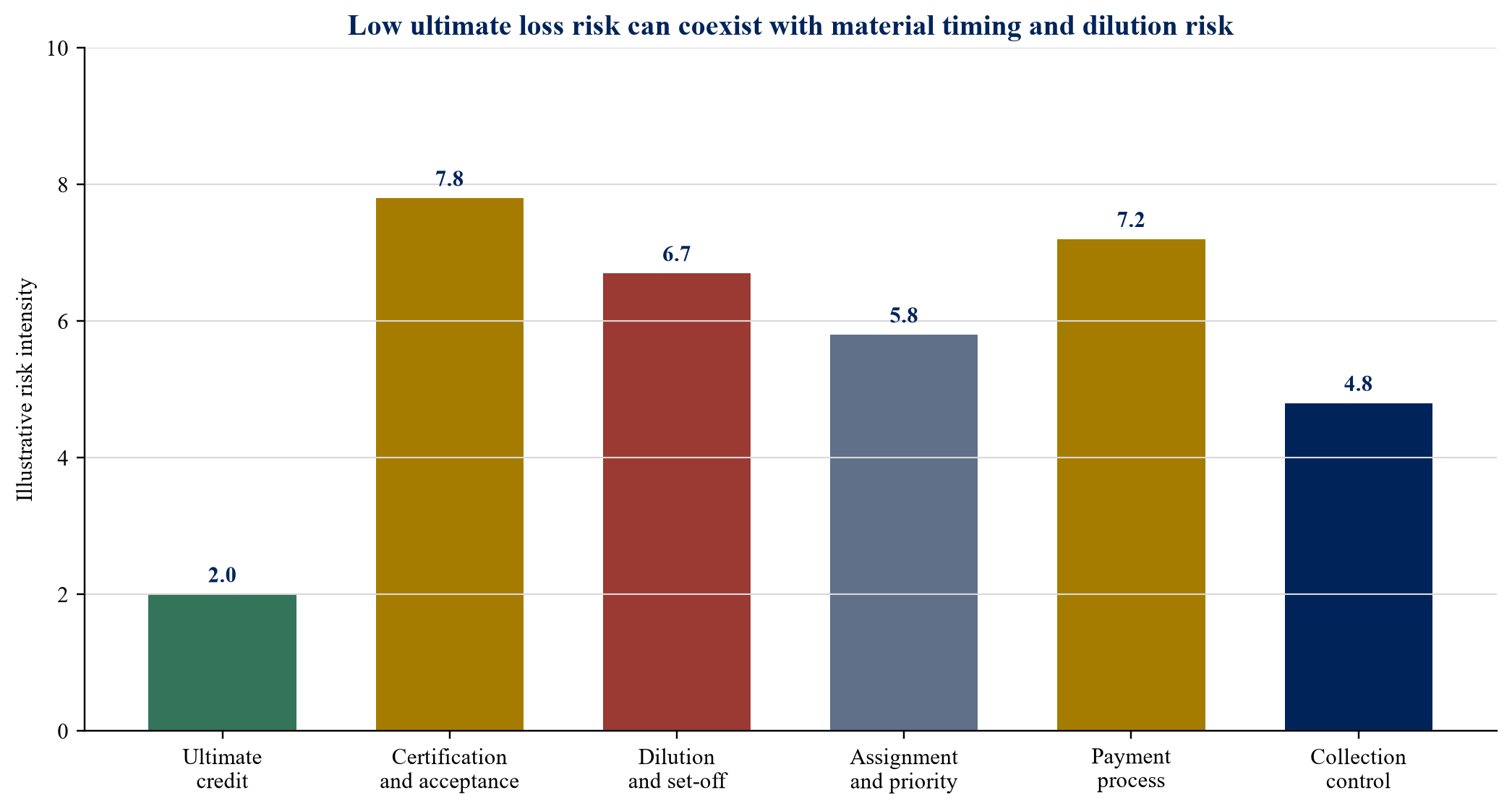
The decomposition distinguishes ultimate credit risk from process, legal and operational drivers. Scores are author assumptions.
4. Jurisdiction changes assignment, certification and enforcement design
Receivables finance is implemented through local law, contract terms and operational practice. A regional or cross-border facility should use a common economic framework while preserving country-specific legal conclusions. The lender should avoid treating a general policy objective, such as prompt payment, as equivalent to an enforceable waiver of defences or an acknowledged assignment.
The UAE's Federal Decree-Law on Factoring and Transfer of Receivables provides a statutory framework for current and future receivables, bulk descriptions, effectiveness between transferor and transferee, and priority-related matters [11]. Its existence can support receivables finance, but a transaction still needs analysis of scope, debtor type, notice, registration, competing rights, governing law, public-law constraints and contract-specific restrictions. Federal procurement rules add performance, acceptance and direct-payment conditions relevant to supplier and sub-supplier cash flows [4]. Receivables owed by emirate-level bodies or commercial state-owned companies may fall under different contractual and legal arrangements.
Saudi Arabia's government procurement law and executive regulations establish formal contracting, performance and payment processes. The regulations describe progress measurement, consultant review and invoice submission, allow certain deductions, and address approval for transfer of contractual amounts [3][12]. These provisions make certification data central to financing. The legal team should distinguish assignment of the contract from assignment or forfeiture of amounts due, identify required approvals and confirm how notice and payment instructions operate through government systems.
Other GCC jurisdictions require their own analysis. The economic questions remain consistent: legal identity of debtor, authority to contract, budget source, performance certification, assignment restrictions, notice, priority, sovereign immunity, dispute forum, enforceability and collection mechanics. A single GCC eligibility opinion is unlikely to answer every question when obligors and laws differ. The facility can use a jurisdiction schedule that activates eligibility only after required conditions are satisfied.
The United Kingdom combines statutory payment policy with assignment and contract rules. The Procurement Act framework strengthens 30-day payment expectations across public supply chains and requires payment-compliance reporting [1][2]. The Business Contract Terms (Assignment of Receivables) Regulations 2018 make certain restrictions on assigning receivables ineffective, subject to exclusions and scope limitations; official explanatory material notes exclusions involving large enterprises, special purpose vehicles and national-security interests [13]. The Crown and public bodies can raise specific issues. Counsel should confirm whether the relevant contract and supplier fall within the regulations, whether an exclusion applies, and what form of legal assignment and notice is required.
India's framework includes the Micro, Small and Medium Enterprises Development Act delayed-payment protections, Micro and Small Enterprise Facilitation Councils, the Samadhaan and online dispute-resolution channels, and TReDS invoice-financing platforms [5][7][14]. RBI guidance states that TReDS can finance receivables due from corporates, government departments and public-sector undertakings, with factoring units created from invoice or bill data and buyer participation in the process [6]. Registration of assignments and central-registry requirements also matter [15]. Eligibility depends on enterprise status, buyer acceptance, platform process, invoice evidence and the applicable legal route.
Table 2. Jurisdiction comparison for facility diligence
| Dimension | GCC facility questions | United Kingdom facility questions | India facility questions |
|---|---|---|---|
| Contract and authority | Which federal, national, emirate, municipal or corporate regime applies? | Is the buyer a contracting authority, public corporation or commercial entity? | Is the buyer a ministry, CPSE, state entity, PSU or commercial company? |
| Payment evidence | What certification, portal and budget approvals create the payment right? | Is the invoice valid and undisputed, and what compliance notice data exists? | Has the buyer accepted the factoring unit or invoice and is MSME status current? |
| Assignment | Is transfer permitted, effective and perfected, and is approval required? | Do the 2018 Regulations apply, and what statutory assignment and notice steps are needed? | Do TReDS, factoring and central-registry rules apply to the selected structure? |
| Deductions and set-off | What contractual, statutory, tax and cross-contract rights remain? | What debtor defences, Crown issues, retention or set-off rights remain? | What withholding, deduction, dispute and statutory delayed-payment rights apply? |
| Enforcement and collection | What dispute forum, immunity, acknowledgement and account control are available? | What acknowledgement, notice, controlled-account and claims routes are effective? | What platform settlement, MSEFC, ODR, court or arbitration routes are available? |
This is a high-level research framework. Local counsel must determine the applicable law and transaction requirements.
Jurisdiction schedules should be living control documents. Changes in procurement law, platform rules, registration practice or public-body policy can alter eligibility. The facility agent should maintain counsel-confirmed conditions, approved forms of notice and acknowledgement, and a list of obligor types that require additional approval.
5. Eligibility converts legal and operating evidence into a borrowing base
An eligible public-sector receivable should satisfy cumulative tests. The receivable must arise from a valid and approved contract or purchase order. The supplier must have performed the relevant obligation. Required measurement, acceptance or certification must be complete. The invoice must be valid under contract, tax and portal requirements. The amount must be due or scheduled to become due without a material unresolved condition. The receivable must be assignable or capable of supporting an effective security interest. The lender's interest must have required priority. Collections must follow the approved route. No material dispute, contra account, sanctions issue, fraud indicator or duplicate financing should exist.
Exclusions should be precise. Common categories include unbilled work; uncertified applications for payment; unapproved variations; claims for extension, disruption or loss and expense; disputed invoices; retention not yet releasable; invoices lacking purchase-order coverage; amounts subject to unresolved tax documentation; invoices rejected by a portal; amounts owed by an ineligible entity; related-party balances; credit notes not processed; receivables sold or pledged elsewhere; and invoices beyond the permitted ageing limit. Exclusion does not mean the supplier has no value. It means the ordinary borrowing base cannot reliably convert that value into current availability.
Advance rates should reflect both payment maturity and evidence strength. An approved-for-payment invoice with effective assignment and controlled collection can justify a higher rate than a merely validated invoice. A certified receivable subject to meaningful retention or cross-contract set-off may require a lower rate and specific reserves. A public-sector exposure without explicit sovereign support should be rated on the actual obligor and legal claim.
Ageing should start from more than one date. Days since performance identifies operational backlog. Days since certificate application reveals certification delay. Days since certification measures invoice preparation or portal delay. Days since valid invoice measures payment performance. Days past contractual due date measures arrears. A single invoice-date ageing report can hide months spent before invoice validation. The lender should retain the full timeline and base triggers on the stage causing the delay.
Concentration caps should aggregate connected risk. Legal-obligor caps address ultimate exposure. Contract and project caps address common performance and dispute risk. Certifier caps address a single engineer or acceptance authority. Payment-system caps address operational concentration. Country caps address legal and transfer restrictions. The lender can permit higher concentrations when evidence, collection control and reserve coverage are strong, while recognising that concentration remains.
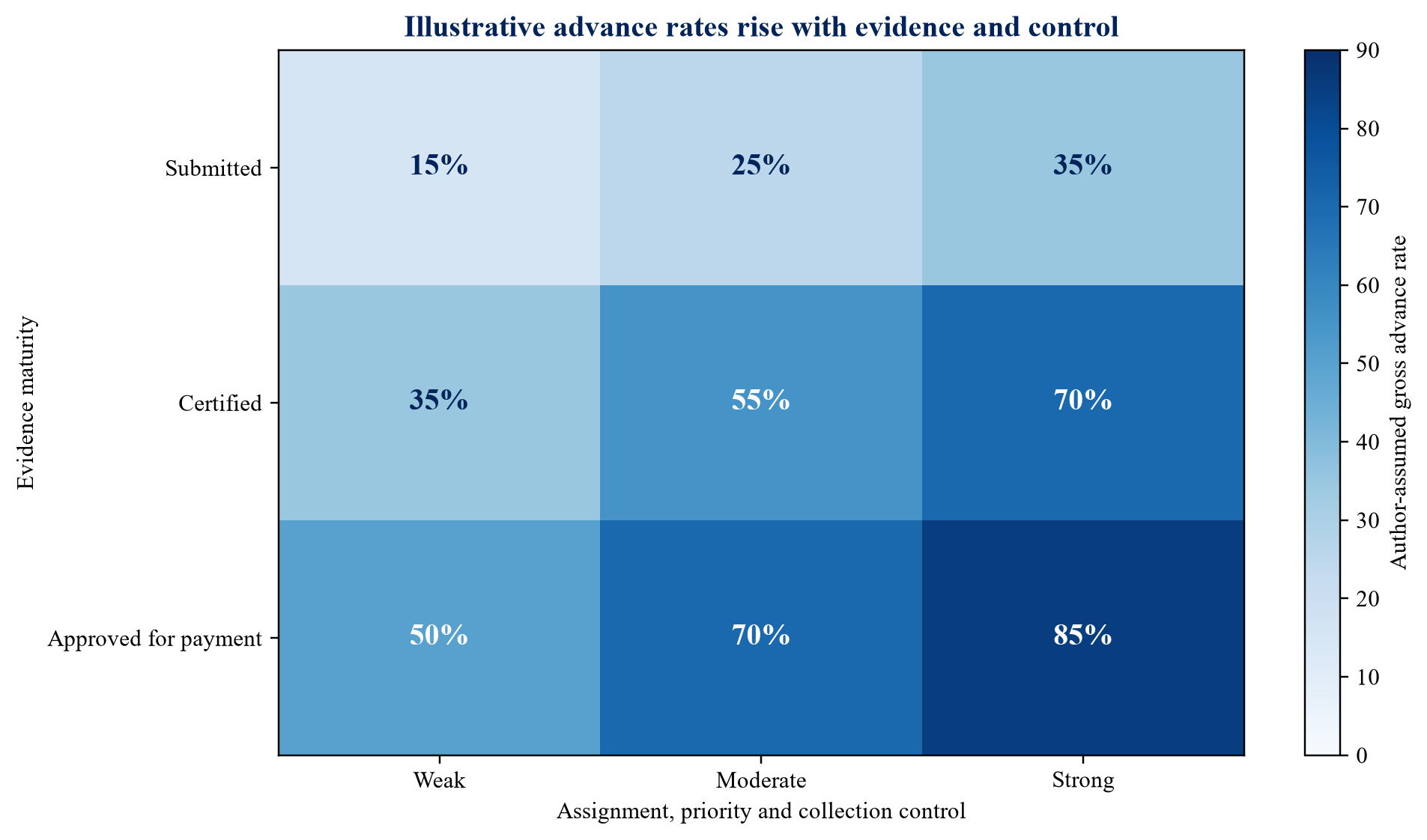
Rates are author assumptions for framework illustration and do not represent market quotations.
Reserves should address risks that eligibility does not eliminate. A dilution reserve can use the higher of recent historic dilution and a forward-looking stress. A set-off reserve should cover known claims and a margin for unresolved cross-contract exposure. A certification reserve can reduce availability when cycle times lengthen. A payment-delay reserve should capture increased funding duration and tail exposure. A retention reserve excludes or discounts amounts whose release depends on future completion. A tax reserve covers deductions or priority amounts. A concentration reserve reduces reliance on a single risk channel.
6. A hypothetical USD 52 million portfolio shows how face value becomes USD 22.1 million of availability
The following model demonstrates the framework using a hypothetical engineering, technology and facilities-services supplier operating across the GCC, United Kingdom and India. The company reports USD 52.0 million of gross public-sector and quasi-public receivables. Every amount, classification, advance rate, reserve, probability and stress result is an author assumption. The model has not been calibrated to a real borrower, lender or public customer.
The gross portfolio consists of USD 23.0 million in the GCC, USD 14.0 million in the United Kingdom and USD 15.0 million in India. By stage, USD 31.0 million is certified, USD 8.0 million is approved for payment, USD 6.0 million is validated but awaiting certification, USD 4.0 million is unbilled work and USD 3.0 million is disputed, retained or otherwise conditional. The stage totals reconcile to the gross portfolio but do not determine eligibility by themselves.
The first eligibility screen excludes USD 4.0 million of unbilled work, USD 3.0 million of disputed or conditional amounts, USD 2.6 million of invoices without complete purchase-order or portal evidence, USD 2.1 million subject to unresolved variation or set-off exposure, USD 1.9 million beyond the ageing limit, USD 1.6 million where assignment or notice conditions are incomplete, USD 1.0 million of retention and USD 2.4 million of other overlapping weaknesses after avoiding double counting. The opening eligible pool is USD 33.4 million.
The model applies an 80 percent gross advance to USD 7.0 million approved-for-payment receivables, a 72 percent advance to USD 22.0 million certified receivables, and a 50 percent advance to USD 4.4 million validated receivables supported by strong historic conversion data. Gross availability is USD 23.64 million. Portfolio reserves total USD 1.54 million, comprising USD 0.55 million for dilution, USD 0.34 million for concentration, USD 0.28 million for payment delay, USD 0.22 million for set-off and USD 0.15 million for operational and tax exceptions. Net availability is therefore USD 22.10 million.
Table 3. Hypothetical opening borrowing-base bridge
| Step | Gross or eligible value | Advance or adjustment | Availability effect |
|---|---|---|---|
| Gross reported receivables | 52.00 | Starting portfolio | 52.00 |
| Eligibility exclusions | (18.60) | Evidence, dispute, ageing, assignment and retention | (18.60) |
| Eligible receivables | 33.40 | Stage-weighted advances | 23.64 |
| Dilution reserve | Author assumption | (0.55) | |
| Concentration reserve | Author assumption | (0.34) | |
| Payment-delay reserve | Author assumption | (0.28) | |
| Set-off reserve | Author assumption | (0.22) | |
| Operational and tax reserve | Author assumption | (0.15) | |
| Net borrowing availability | 22.10 |
All amounts and rates are author assumptions. USD millions; rounding differences may occur.
The moderate stress assumes certification cycles extend, recent dilution rises, one buyer applies a contractual deduction and a portion of validated invoices ages beyond its permitted limit. Eligible value falls by USD 4.2 million. Gross availability falls to USD 20.3 million and reserves rise to USD 2.0 million, producing USD 18.3 million of net availability. If drawings remained at the opening USD 22.1 million, the borrower would face a USD 3.8 million availability deficit.
The severe stress combines a longer certification backlog, a material cross-contract set-off allegation, delayed budget release, higher portal rejection and slower cash application. Eligible value falls to USD 25.0 million. Stage-weighted gross availability declines to USD 16.9 million and reserves rise to USD 2.7 million, leaving USD 14.2 million. The reduction occurs without assuming ultimate default by a public-sector obligor. Process and legal frictions alone create a USD 7.9 million decline from opening availability.
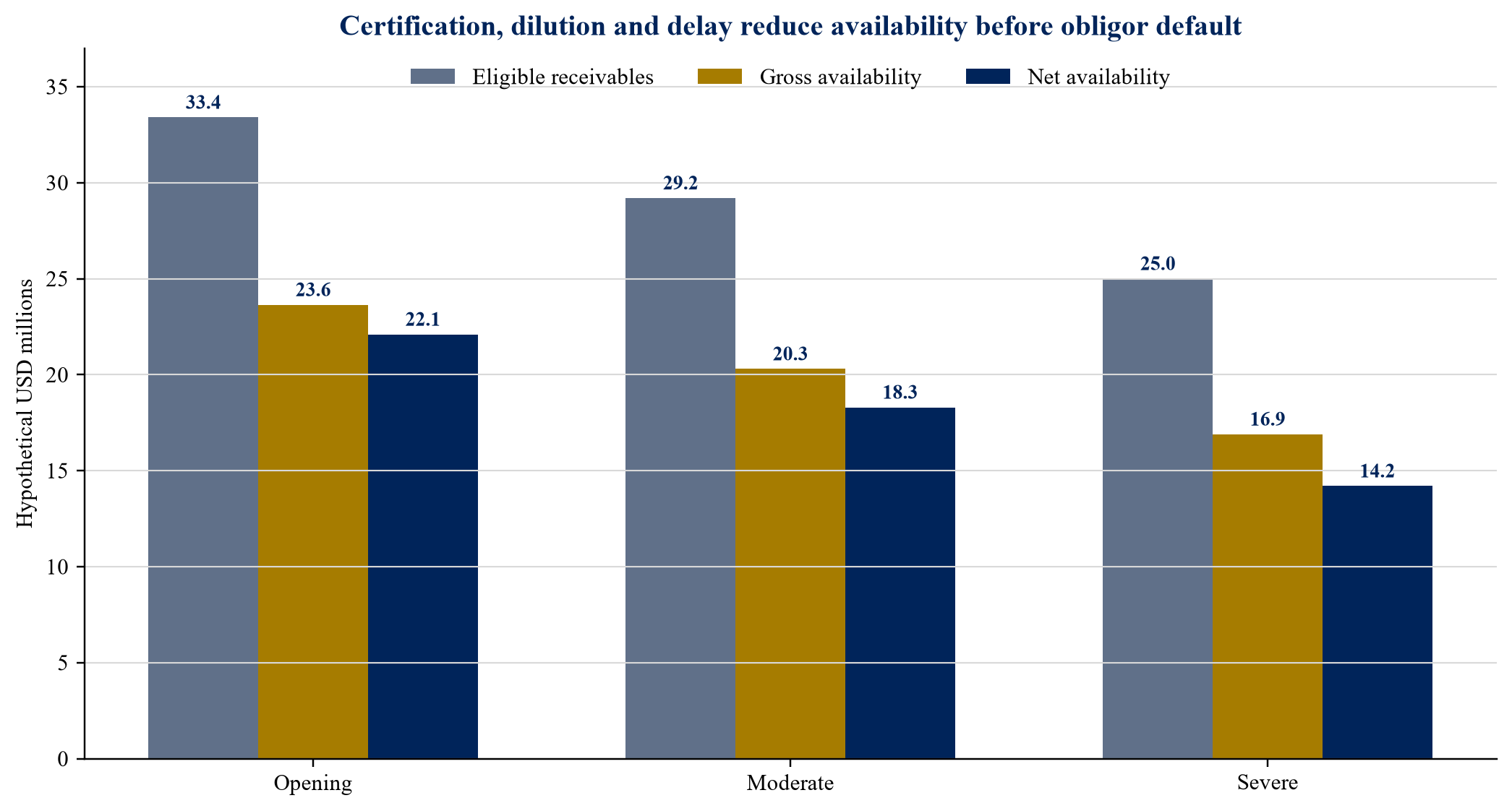
All portfolio values and stress effects are hypothetical author assumptions without empirical calibration.
The model exposes three management questions. First, can the supplier reduce the USD 18.6 million exclusion pool by improving purchase-order discipline, certification evidence, variation approval and assignment conditions? Second, can the facility identify deterioration early enough to avoid an abrupt overadvance? Third, which risks belong with senior debt and which require borrower equity, contractual reform, subordinated capital or a claims-finance solution?
7. Monitoring should measure conversion velocity, evidence quality and cash application
Monthly borrowing-base certificates are insufficient when certification and payment status can change rapidly. The monitoring system should capture each receivable's legal obligor, contract, project, purchase order, performance period, certificate application date, certificate date, invoice date, validation date, due date, approval date, cash date, gross amount, retention, tax, deductions, disputes, credit notes, assigned status and collection account. Each field should have an evidence source and responsible owner.
Conversion velocity is the movement between stages. The lender should track median and tail days from performance to certification, certification to valid invoice, valid invoice to approval, and approval to cash. A stable headline days-sales-outstanding metric can conceal a growing certification backlog. Stage-specific curves show where working capital is becoming trapped.
Evidence quality deserves its own score. System-generated certificate and portal evidence should carry more weight than internal spreadsheets or email estimates. Reconciliation between project controls, invoicing, general ledger, buyer portal and bank cash should be automated where feasible. Exceptions should be visible by value, age and owner. The system should preserve a complete audit trail rather than overwrite prior status.
Dilution should be analysed by cause and cohort. Credit notes linked to pricing or quantity errors indicate preventable process weakness. Retention and tax withholding may be contractually expected but still reduce cash. Service deductions may indicate operating performance. Cross-contract set-off can create correlated loss. The reserve methodology should respond differently to each cause.
Cash application is a control point. Public buyers may combine multiple invoices in one payment, deduct tax, net credit notes or use references that do not match the supplier ledger. Unapplied cash can overstate receivables and availability. The lender should require timely allocation, investigate unmatched payments and reconcile controlled-account receipts to the financed ledger.
Table 4. Early-warning indicators and graduated facility responses
| Indicator | Early-warning interpretation | Initial response | Escalated response |
|---|---|---|---|
| Certification cycle extends | Performance is not converting into an evidenced payment right | Increase reporting and review bottlenecks | Reduce validated-stage advance or impose a certification reserve |
| Portal rejection rate rises | Invoice quality or master-data controls are weakening | Require root-cause correction | Exclude affected buyer, contract or invoice class |
| Dilution exceeds threshold | Cash collected is below financed face value | Recalculate dilution reserve | Reduce advance and require cure or repayment |
| Set-off or dispute emerges | Debtor defences may affect multiple invoices | Reserve known exposure and obtain counsel review | Exclude connected contracts and suspend new advances |
| Payment tail lengthens | Administrative or budget delay is increasing duration | Increase delay reserve and liquidity forecast | Tighten ageing limits and commence amortisation |
| Cash diversion or assignment breach | Collection control has failed | Restore control immediately | Draw stop, mandatory prepayment and enforcement review |
Thresholds must be calibrated to the borrower and facility. The responses illustrate a governance ladder.
8. Documentation and control should allocate each failure mode explicitly
The facility agreement should define eligible receivable, public-sector obligor, approved contract, certified amount, valid invoice, permitted retention, dispute, dilution, set-off, controlled account and eligible jurisdiction. Definitions should align with the data fields used in reporting. Ambiguous definitions create repeated manual judgement and weaken enforcement.
Conditions precedent ordinarily include constitutional and authority documents, contracts and purchase orders, legal opinions, assignment or security documents, registrations, notices, acknowledgements where available, account-control arrangements, insurance where relevant, historic receivables data, cash-application tests, tax documentation and evidence that no conflicting financing exists. The exact package depends on jurisdiction and structure.
Representations should cover validity, performance, accuracy, absence of dispute, absence of undisclosed set-off, ownership, assignment, priority, compliance, no duplicate financing and accurate reporting. Covenants should require preservation of contracts and rights, compliance with invoicing procedures, prompt delivery of notices and disputes, maintenance of controlled collections, restrictions on amendments and waivers, and cooperation with audits or confirmations.
The lender should address communications with public buyers carefully. Direct confirmation can improve evidence, but government entities may follow formal channels and may decline nonstandard acknowledgements. The transaction should not assume that an obligor will sign a waiver of defences, confirm an assignment or redirect payment without evidence. Alternative protections include legal notice, portal-record verification, controlled-account instructions, independent certification and lower advance rates.
Data access should survive stress. If reporting depends on the borrower's personnel and systems, the lender may lose visibility when the borrower is under pressure. Read-only access to relevant portals, periodic data exports, escrowed credentials where lawful, backup records and servicer arrangements can preserve continuity. Cybersecurity and privacy controls should limit access to what the facility requires.
9. Accounting, tax and disclosure affect economics even when legal rights are sound
Receivables financing can be a secured borrowing, a sale of receivables or another transfer structure. IFRS 9 requires analysis of whether contractual rights to cash flows are transferred and whether the transferor retains substantially all risks and rewards or continuing involvement [16]. A legal assignment does not alone establish accounting derecognition. Recourse, guarantees, repurchase obligations, dilution protection, servicing and control can affect the conclusion.
The supplier should determine whether financing costs, reserve accounts, credit insurance and collection arrangements change financial-statement presentation or covenant calculations. The lender should understand how financed receivables, debt and cash appear in management reporting. Misalignment can obscure leverage or create double counting.
Tax withholding can reduce cash received while creating a certificate or credit that is valuable to the supplier but unavailable to the lender. Value-added tax or goods-and-services tax errors can cause invoice rejection or correction. Cross-border assignments can create legal, tax, stamp, registration or withholding questions. Tax advice should be obtained for the actual structure and jurisdictions.
Public-sector contracts can contain confidentiality, data-security, anti-bribery, sanctions, local-content and audit obligations. Financing diligence may require access to sensitive information. The lender, adviser and service providers should use permitted data rooms, redact unnecessary material and obtain consent where required. Financing should not cause the supplier to breach procurement or security rules.
10. Technology can strengthen evidence, while governance determines reliability
Electronic procurement, certification and invoice platforms can produce structured, time-stamped evidence. Application programming interfaces can reconcile purchase orders, certificates, invoices, status changes and payments. Rules engines can test eligibility and reserves. Anomaly detection can identify duplicate invoices, unusual amendments, sudden stage delays or inconsistent buyer references. These tools can reduce manual error and monitoring latency.
Technology does not cure a weak legal right or invalid performance evidence. A portal status must be understood in contractual terms. An algorithm can classify an invoice as accepted while the contract preserves a deduction right. A distributed ledger can record a transfer while local law or buyer policy limits its effect. System design should map digital states to legal consequences and preserve human review for exceptions.
Data lineage is essential. Each financed value should trace to source evidence, transformation rules and approval. Model changes should be versioned. Overrides should identify user, time, reason and authorisation. Access rights should separate preparation, review and approval. Reconciliation should prove that a financed invoice is unique across the supplier's entities and facilities.
Artificial intelligence can assist with document extraction, clause comparison, exception triage and payment-delay forecasting. Any model used for eligibility or availability should be tested for false positives, data drift and explainability. The lender needs an auditable reason for each exclusion or reserve. Sensitive public-contract information requires appropriate security, confidentiality and data-residency controls.
11. A 90-day implementation plan can release cash while improving contract discipline
The first 30 days should establish the truth set. Management identifies legal obligors, contracts, projects, payment systems and collection accounts; reconciles project controls to ledger and bank cash; maps the lifecycle for material invoice classes; and creates an exception inventory. Counsel reviews assignment, notice, set-off, priority and enforcement issues for the proposed jurisdictions. The financing team produces a preliminary eligibility bridge and data-quality score.
Days 31 to 60 should repair high-value leakage. The supplier resolves missing purchase orders, incomplete certificates, portal rejections, unapplied cash, stale credit notes and unapproved variations where commercially possible. It standardises invoice packs and escalation paths. The lender and borrower agree definitions, advance rates, reserves, reporting fields, collection controls and jurisdiction conditions. Historic data is replayed through the rules to test stability.
Days 61 to 90 should implement and test. Security and assignment steps are completed. Controlled accounts and payment instructions are activated where available. Data feeds, reconciliations, borrowing-base reports and exception workflows run in parallel with existing processes. A mock stress tests certification delay, dilution, set-off and cash diversion. Governance forums review results and close remaining defects before first draw.
The programme should produce operational value even if financing closes later. Faster certification, fewer rejected invoices, stronger change control, cleaner cash application and clearer buyer escalation reduce working-capital consumption. The facility then finances a better process rather than masking a broken one.
12. Conclusion
Public-sector receivables can support efficient working-capital finance when the payment right, evidence and collection path are understood in detail. Ultimate obligor strength remains valuable, but it does not replace proof of contract authority, performance, certification, invoice validity, assignment, priority, limited defences and controlled cash. The lender should finance the maturity and reliability of the claim, not the reputation attached to the buyer's name.
A structured lifecycle converts this principle into practice. It identifies where delay accumulates, defines evidence for each stage, separates credit from dilution and process risk, and creates jurisdiction-specific eligibility. A stage-weighted borrowing base, targeted reserves and trigger ladder allow availability to respond before a backlog becomes a liquidity crisis. The same framework helps suppliers improve commercial discipline, contract administration and cash conversion.
The hypothetical model shows the economic consequence. A USD 52 million gross ledger produces USD 22.1 million of opening availability after evidence tests, advance rates and reserves. Severe stress reduces availability by USD 7.9 million without assuming sovereign default. Certification, set-off, dilution and payment routing can therefore determine debt capacity as powerfully as obligor credit. A financeable public-sector receivable is a verified, transferable and controlled path to cash.
References
- UK Cabinet Office. Prompt payment policy. Updated 24 April 2025. https://www.gov.uk/guidance/prompt-payment-policy
- UK Cabinet Office. PPN 018: Taking account of a supplier's approach to payment in the procurement of major contracts. 24 April 2025. https://www.gov.uk/government/publications/ppn-018-how-to-take-account-of-a-suppliers-approach-to-payment-in-the-procurement-of-major-contracts/ppn-018-taking-account-of-a-suppliers-approach-to-payment-in-the-procurement-of-major-contracts-html
- Saudi Ministry of Finance. Executive Regulations of the Government Tenders and Procurement Law, Articles including progress invoices and payment administration. https://www.mof.gov.sa/en/Knowledgecenter/newGovTendandProcLow/Documents/Executive%20Regulations.pdf
- United Arab Emirates. Cabinet Resolution of 2024 on the Executive Regulation of Federal Law of 2023 on Procurement in the Federal Government, Article 44. https://uaelegislation.gov.ae/en/legislations/2709/download
- Ministry of Micro, Small and Medium Enterprises, Government of India. Annual Report 2025-26. 2026. https://msme.gov.in/sites/default/files/MSMEANNUALREPORT2025-26ENGLISH_0.pdf
- Reserve Bank of India. Frequently Asked Questions on Trade Receivables Discounting System. https://www.rbi.org.in/scripts/FAQView.aspx?Id=132
- Ministry of Micro, Small and Medium Enterprises, Government of India. MSME Online Dispute Resolution portal and scheme materials. https://odr.msme.gov.in/
- UK Department for Energy Security and Net Zero. Procurement policy and prompt-payment requirements. 2026. https://www.gov.uk/government/publications/desnz-procurement-policy/desnz-procurement-policy
- United Nations Commission on International Trade Law. United Nations Convention on the Assignment of Receivables in International Trade. 2001. https://uncitral.un.org/en/texts/securityinterests/conventions/receivables
- United Nations Commission on International Trade Law. Legislative Guide on Secured Transactions. 2007. https://uncitral.un.org/sites/default/files/media-documents/uncitral/en/09-82670_ebook-guide_09-04-10english.pdf
- United Arab Emirates. Federal Decree-Law No. 16 of 2021 on Factoring and Transfer of Receivables. https://www.uaelegislation.gov.ae/en/legislations/1515/download
- Saudi Ministry of Finance. Government Tenders and Procurement Law. https://mof.gov.sa/en/Knowledgecenter/newGovTendandProcLow/Documents/Government_Tenders_and_Procurement_Law.pdf
- United Kingdom. Business Contract Terms (Assignment of Receivables) Regulations 2018 and explanatory memorandum. https://www.legislation.gov.uk/uksi/2018/1254/pdfs/uksiem_20181254_en.pdf
- Ministry of Micro, Small and Medium Enterprises, Government of India. Annual Report 2024-25, delayed-payment and Samadhaan provisions. https://www.msme.gov.in/sites/default/files/MSME-ANNUAL-REPORT-2024-25-ENGLISH.pdf
- Reserve Bank of India. Registration of Assignment of Receivables Regulations 2022. 14 January 2022. https://www.rbi.org.in/Scripts/NotificationUser.aspx?Id=12223
- IFRS Foundation. IFRS 9 Financial Instruments, transfer and derecognition requirements. https://www.ifrs.org/content/dam/ifrs/publications/pdf-standards/english/2021/issued/part-a/ifrs-9-financial-instruments.pdf
- World Bank Group. Three ways to increase liquidity in the business sector. 2020. https://blogs.worldbank.org/en/developmenttalk/3-ways-increase-liquidity-business-sector
- World Bank Group. The role of public finance in public-private partnerships. https://ppp.worldbank.org/role-public-finance-ppps
