

1. Define the financed fleet as an operating system
A vessel is simultaneously a physical asset, regulated workplace, mobile collateral item and platform for contracted services. Its financeability depends on how those roles interact. A ship that is technically sound can remain unfinanceable when the charter is cancellable, the owner lacks operating liquidity, insurance proceeds are not assigned or the lender cannot enforce the mortgage. Strong charter cash can become fragile when a survey is overdue or a major engine overhaul is unfunded.
The first credit product should therefore be a fleet perimeter. It should identify each legal owner, vessel, flag, registry, class society, manager, operator, charterer, route, cargo, insurance programme, financing obligation and collection account. It should separate owned, finance-leased, operating-leased and managed vessels. It should also show bareboat, time, voyage, contract-of-affreightment and service-contract exposure.
The perimeter should state what the borrower controls. A vessel owner can control maintenance, crewing and charter selection while remaining dependent on ports, bunker supply, canal access and customer cargo. An integrated logistics group can influence terminals and inland movement but may still rely on third-party vessels. The lender should identify every dependency that can interrupt cash.
Table 1. Fleet-finance evidence perimeter
| Evidence layer | Core information | Credit question | Potential control |
|---|---|---|---|
| ownership and registry | owner, beneficial owner, flag, registry extract and encumbrances | can valid security be created and enforced? | mortgage, share pledge and negative pledge |
| vessel and class | type, age, build yard, class, surveys, certificates and condition | can the vessel remain legally and technically employable? | class covenant, survey calendar and technical inspection |
| employment | charter form, rate, tenor, options, termination and performance | is contracted revenue durable and collectible? | assignment, notice, step-in and concentration limit |
| operations | utilisation, off-hire, fuel, crew, insurance, port cost and claims | does cash cover operating needs and debt through stress? | operating budget, minimum liquidity and cash sweep |
| maintenance | planned maintenance, dry dock, special survey and retrofit | is required expenditure fully funded before it becomes urgent? | funded reserve and draw certificate |
| market value | broker opinions, comparable sales, earnings and scrap economics | what could the lender recover under an orderly or forced sale? | periodic appraisal, advance-rate test and disposal plan |
| corridor demand | cargo flows, port calls, customer contracts and route alternatives | does the fleet serve repeat demand with substitution options? | route diversification and customer limits |
| exit and recycling | sale market, buyer universe, demolition value and recycling compliance | is the exit executable under current rules? | approved broker, sale covenant and recycling plan |
Evidence should be verified vessel by vessel and contract by contract.
2. Separate corridor demand from vessel earnings
Trade growth supports a demand thesis and does not prove a vessel's cash flow. India's Ministry of Commerce reported bilateral India-UAE trade of USD 100.06 billion in financial year 2024-25, up from USD 72.87 billion in 2021-22.[3] DP World reported a 40 per cent rise in Jafza's India-linked trade volume in 2024 and described an India-UAE Trade Bridge connecting businesses through logistics infrastructure.[4] These observations establish commercial depth across the corridor. They do not establish the volume, rate, utilisation or margin of a particular vessel.
The lender should convert corridor demand into vessel-specific evidence. Cargo history should be reconciled by customer, commodity, origin, destination, shipment, weight or container, rate and collected revenue. Contracted volume should be separated from customer forecasts, spot opportunities and management targets. Port-call and automatic-identification-system records can support physical performance, while bills of lading, invoices and bank statements support commercial performance.
Demand should be tested against route substitution. A vessel serving India and the Gulf may redeploy across Indian coastal, Red Sea, East Africa or broader Middle East routes depending on type, flag, draft, class and charter permissions. Redeployment creates option value only when the alternative market has executable demand and does not require uneconomic repositioning or technical modification.
UNCTAD reported that rerouting increased ton-miles by 5.9 per cent in 2024, nearly three times the growth in cargo volume, and described sustained volatility in freight and charter markets.[1] Longer routes can raise demand for effective capacity and also raise bunker, crew, insurance, working-capital and maintenance requirements. The credit model should capture both effects.
3. Build a vessel-level age and obligation curve
Age is a useful summary variable and a weak stand-alone risk measure. UNCTAD reported that the world fleet averaged 12.6 years by gross tonnage and 22.2 years by vessel count in 2024, with the fleet more than three years older than a decade earlier.[2] The wide difference between tonnage-weighted and vessel-count measures shows why a portfolio average can hide smaller, older assets.
The lender should create an obligation curve for every vessel. The curve should show delivery date, class cycle, annual survey, intermediate survey, special survey, dry dock, major machinery hours, coating renewal, ballast-water obligations, energy-efficiency work, insurance renewal and charter expiry. Expected cost should be supported by technical scopes, yard quotations and recent invoices.
Remaining useful life should be assessed by condition and commercial employment. An older, well-maintained specialist vessel under a durable service contract can have stronger cash visibility than a younger generic vessel exposed to a weak spot market. A newer asset can also carry technology or fuel risk when future regulation, bunker availability or charterer preferences change.
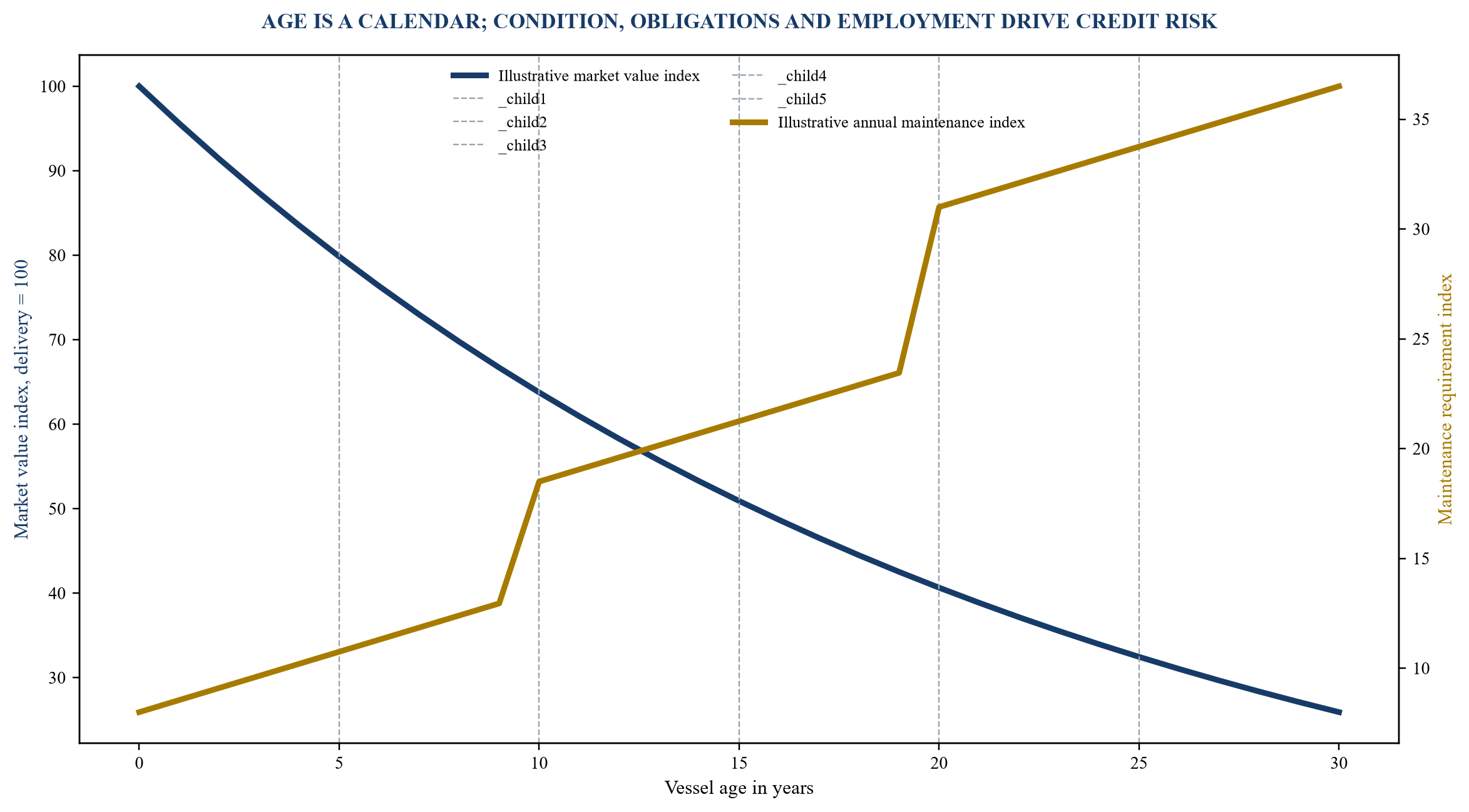
Hypothetical values show how maintenance and market-value risk can rise at different rates.
4. Measure charter quality beyond the headline rate
A charter rate is a price term rather than a complete receivable. Charter quality should be assessed across counterparty capacity, contract form, enforceability, tenor, termination, utilisation, off-hire, deductions, rate adjustment, currency, payment history and claims. The assessment should be based on executed contracts, notices, invoices, statements and collections.
Counterparty quality should identify the legal obligor and payment source. A global brand, trading group, government-linked entity or large logistics company can use a thin special-purpose charterer. Parent guarantees, letters of credit, deposits and termination payments should be verified as legal obligations. Historical collection from the named obligor is more useful than a brand name on a presentation.
Contract duration should be adjusted for options and termination. An apparent five-year charter can contain annual options, convenience termination, performance cancellation, change-of-control rights or vessel-substitution provisions. Revenue concentration should be measured at charterer-group level and across related cargo sources.
Rate mechanics should capture bunker adjustment, port cost, waiting time, indexation, minimum volume, deadfreight, demurrage and foreign exchange. A high gross rate can produce low contribution when fuel and delay risk remain with the owner. The borrowing base should use collected net charter contribution rather than invoiced revenue alone.
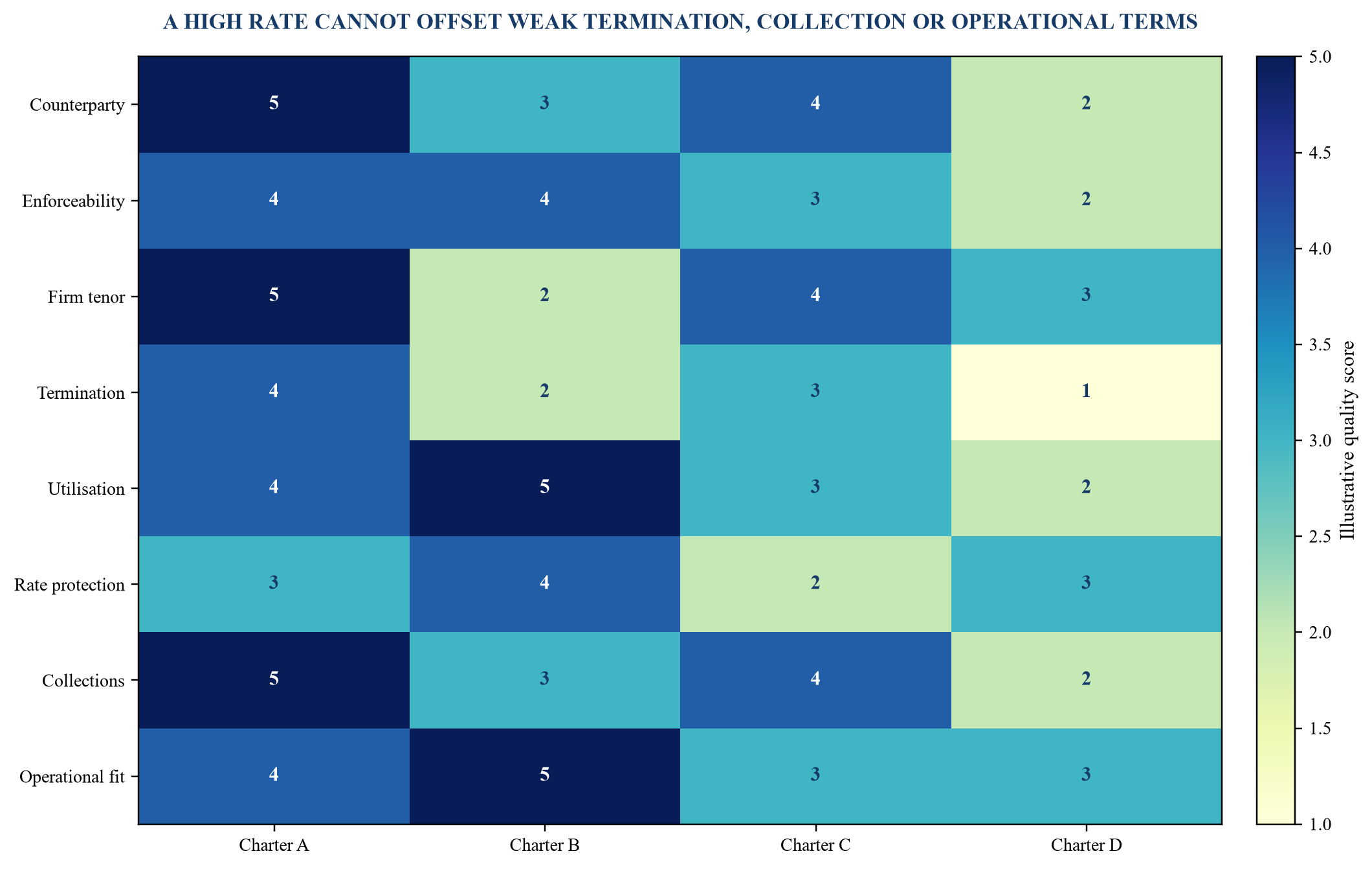
Hypothetical scores demonstrate the need to assess contract and counterparty together.
Table 2. Charter quality scorecard and lending response
| Dimension | Strong evidence | Warning sign | Lending response |
|---|---|---|---|
| counterparty | audited capacity, durable business and payment record | thin obligor or dependence on unverified support | parent support, limit or exclusion |
| contract | executed standard form with clear governing law | side letters, ambiguity or incomplete schedules | legal condition and document cure |
| tenor | firm term beyond debt exposure | short option periods or easy cancellation | shorter amortisation and cash sweep |
| utilisation | minimum hire or volume with narrow relief | broad off-hire or no minimum work | availability haircut and liquidity reserve |
| rate | transparent indexation and cost allocation | fixed revenue with floating fuel and port cost | hedge, pass-through or margin stress |
| collection | timely cash into controlled account | disputes, set-off, dilution or related-party netting | receivable haircut and dilution reserve |
| operational fit | vessel specification matches service requirement | recurring rejection or substitution risk | technical cure and charter eligibility gate |
| termination | defined default and compensation | convenience termination without meaningful payment | concentration cap and accelerated repayment |
Scores should be supported by legal review and observed performance.
5. Map the corridor cash from cargo to controlled account
The cash map should begin with the commercial service and end with unrestricted cash after debt and reserves. For a time charter, hire may be periodic and operating cost allocation relatively clear. For voyage employment, revenue may be earned per voyage while bunker, port, canal and positioning costs move with route and delay. For feeder or integrated logistics services, vessel revenue may be embedded within a broader customer invoice.
Every stage needs documentary evidence. Cargo bookings and contracts support expected demand. Bills of lading, port records and voyage statements support performance. Invoices, credit notes and customer confirmations support receivables. Bank statements support collections. The lender should reconcile these layers rather than accept a management revenue report.
The controlled account should receive assigned charter or eligible logistics cash where legally effective. Cash should fund current crew, insurance, critical operating expenditure, maintenance reserve and tax before scheduled debt service, with defined owner releases after covenants. Restricted cargo proceeds, customs money, customer deposits and third-party collections should remain segregated.
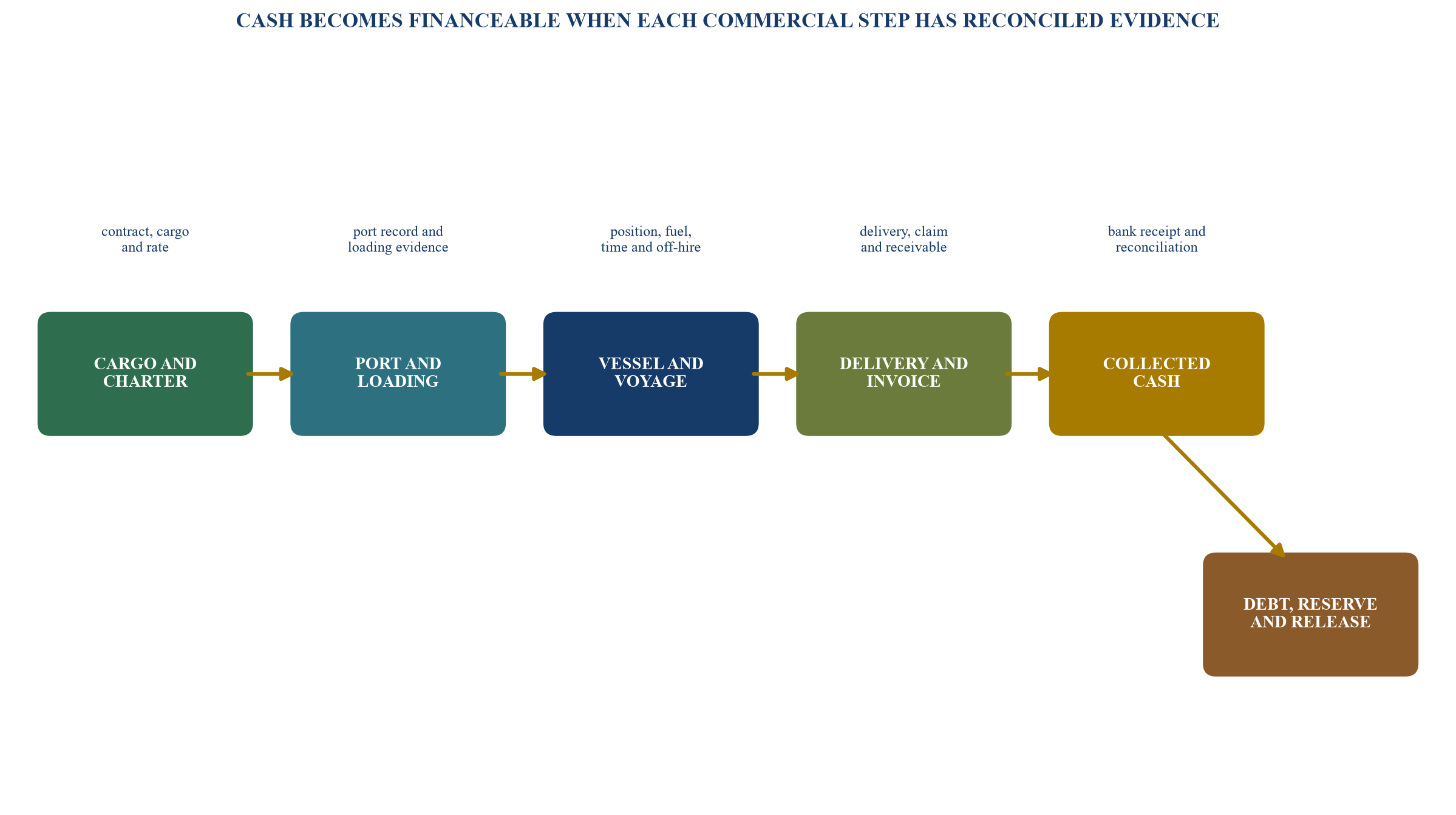
The map links commercial activity to the cash available for debt service.
6. Choose the facility that matches the financed risk
Ownership finance can fund acquisition or refinance of a vessel against mortgage security and operating cash. A finance lease can transfer substantially all ownership economics while retaining legal title with the lessor. An operating lease can provide flexible capacity and residual-value risk to the lessor. Working-capital finance can support bunker, port, crew, voyage and receivable timing. A maintenance or retrofit facility can fund defined capital work with milestone draws.
India's IFSCA framework permits ship leasing through registered finance companies or finance units in the IFSC and covers operating, financial and hybrid leases, as well as sale-and-leaseback and related transactions.[6] The framework can provide a structuring route for eligible activity. Legal, tax, accounting, currency and operational substance still require transaction-specific analysis.
IFRS 16 requires lessees to recognise a right-of-use asset and lease liability for most leases longer than twelve months, subject to specified exemptions.[7] Accounting presentation should be incorporated into leverage, covenant and distribution analysis. Legal ownership, accounting recognition and economic risk can differ.
The facility should match the cash cycle. Long-term mortgage debt should amortise through durable charter cash and expected value retention. Revolving finance should clean down through receivable collection. Dry-dock finance should convert or amortise after the asset returns to service. A short charter should not support a long bullet maturity without alternative employment and sale capacity.
7. Construct the borrowing base from three independent limits
Availability should be the lower of three limits. The receivables limit applies an advance rate to eligible collected or billed charter receivables after dilution, dispute, aging, concentration and set-off reserves. The cash-flow limit uses stressed cash available for debt service after operations and maintenance. The vessel-value limit applies an advance rate to independently supported market value after enforcement, sale-time and condition haircuts.
The three limits prevent a single optimistic input from controlling the facility. A strong appraisal cannot override insufficient cash. A long charter cannot override weak security or technical condition. Receivables cannot support a term loan when they are short, disputed or trapped outside the lender's control.
Eligibility should be tested by charter and invoice. Receivables from related parties, sanctioned counterparties, disputed voyages, unaccepted performance, excessive age or broad set-off should be excluded or deeply reserved. Concentration should aggregate connected charterers and cargo sources.
The vessel limit should use current valuations from qualified brokers or valuers, supported by comparable transactions, earnings context, specification and condition. The lowest relevant value can be used where evidence diverges. Forced-sale and orderly-sale values should be distinguished.
8. Make charter receivables observable
Charter receivables can become attractive collateral when service, invoice and collection are traceable. The lender should know when hire is earned, invoiced, accepted, due, disputed and collected. Voyage completion, statement-of-facts records and charter clauses determine whether an amount is unconditional.
Dilution includes off-hire, performance claims, fuel adjustments, port-cost reconciliation, cargo damage, demurrage dispute, rebates, credit notes and set-off. Historical gross-to-cash conversion should be measured by charterer and contract. A dilution reserve should cover expected and stressed reductions.
Cash control requires legal effectiveness. Assignment notices, acknowledgements, account control and permitted redirection should be examined in the relevant jurisdictions. Some charterers may resist assignment or reserve broad set-off rights. The lender should not assume control because invoices contain bank details.
DP World reported in 2025 that its trade-finance platform and partner financial institutions had financed more than USD 1 billion of trade across emerging markets.[8] The example demonstrates growing integration between logistics evidence and finance. A fleet facility should use the same principle: physical movement, contract performance and collected cash should reconcile.
9. Underwrite operating cash by vessel and voyage
Fleet-level EBITDA can conceal a weak vessel. The model should show revenue, utilisation, off-hire, bunker, crew, insurance, repairs, management fees, port cost, charter hire paid, overhead allocation and working capital by vessel. Shared costs should use a documented allocation basis.
Voyage economics should reconcile distance, speed, fuel consumption, port time, canal cost, cargo and rate. A time-chartered-in vessel should show hire and redelivery exposure. A vessel held for spot employment should show idle and positioning days. Management should explain deviations between planned and actual performance.
UNCTAD described freight-rate volatility and route disruption as continuing features of 2024 and 2025.[1] The model should therefore run low-rate, low-utilisation, high-fuel, delay and off-hire stresses in combination. A corridor demand story cannot substitute for monthly liquidity.
Minimum operating liquidity should be protected because vessels cannot pause critical crew, safety, insurance or maintenance expenditure without impairing the collateral. Debt service should follow the cash required to keep the vessel compliant and employable.
10. Fund maintenance before distributing owner cash
Maintenance is a credit obligation because deferred work can destroy value, class status and charter eligibility. The lender should require a rolling maintenance plan tied to class, flag, manufacturer and operational requirements. Major work should have scope, cost, yard, timing, contingency and funding evidence.
A maintenance reserve should accumulate ahead of dry docking, special surveys, overhaul and mandated retrofit. Contributions can be per day, voyage, operating hour or month. The reserve should be held in a controlled account and released against independent technical certification and invoices.
The reserve should not be treated as excess cash for distributions or ordinary debt prepayment when a known obligation remains. Unused contingency can be released after completion, final cost reconciliation and confirmation of remaining obligations.
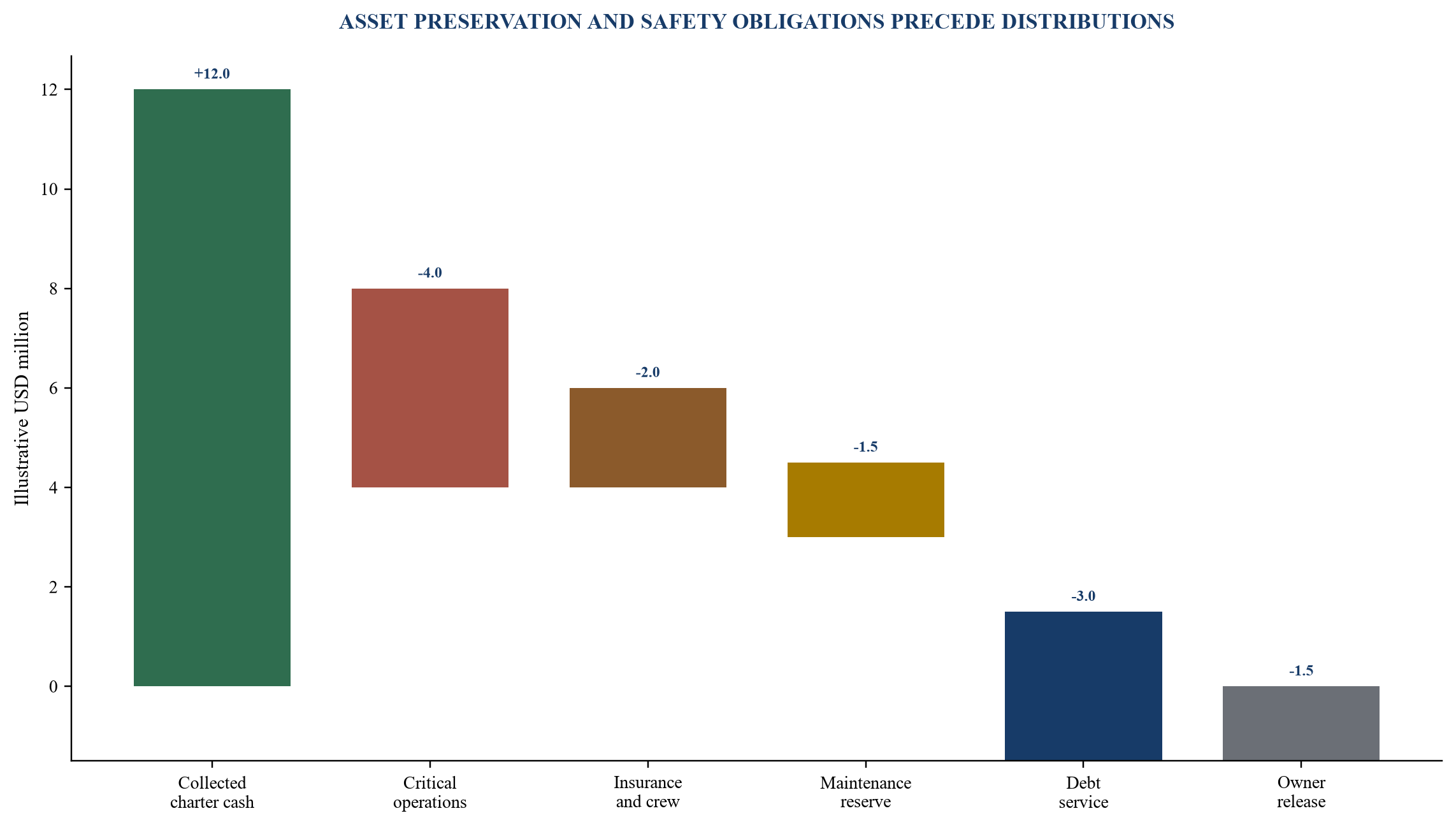
Hypothetical USD amounts show cash priority ahead of permitted owner release.
Table 3. Maintenance reserve control schedule
| Stage | Required evidence | Cash treatment | Failed-gate response |
|---|---|---|---|
| annual plan | class schedule, machinery hours and maintenance budget | monthly reserve contribution begins | restrict distribution and revise budget |
| yard selection | technical scope, quotations, yard slot and downtime plan | fund contingency and mobilisation | defer non-essential release |
| pre-dock | class, flag, insurer and charterer requirements confirmed | lock full expected reserve | sponsor cure for shortfall |
| work progress | surveyor certificate, invoices and variation log | controlled milestone draw | pause draw and investigate variance |
| completion | class status, sea trial, acceptance and final account | convert remaining eligible cost | retain unresolved claims reserve |
| return to service | charter acceptance and observed operation | release surplus subject to covenant | continue reserve until stable service |
The technical manager and lender should agree the evidence and release authority.
11. Treat class, flag and insurance as live controls
Class notation, statutory certificates and survey status should be monitored continuously. A clean registry extract at closing does not protect a lender from later suspension, overdue recommendations or trading restrictions. The covenant package should require prompt notice of class, flag, port-state, casualty and detention events.
Insurance should cover hull and machinery, protection and indemnity, war risk and other exposures appropriate to the vessel and trade. Limits, deductibles, exclusions, sanctions clauses, trading warranties and cancellation notice require review. Mortgagee interest and loss-payee provisions should match the security package.
Claims timing matters. A casualty can create repair cost and lost hire before insurance cash arrives. The model should include deductible, uninsured loss, off-hire and claim delay. Insurance cannot replace maintenance, seaworthiness or operational control.
12. Build legal security around the mobile asset
The security package should connect the vessel, ownership entity, charter cash, insurance and bank accounts. It can include a registered mortgage, shares pledge, charter assignment, earnings assignment, insurance assignment, account security, manager undertaking and negative pledge. Each element requires jurisdiction-specific advice.
The UAE's Federal Decree-Law No. 43 of 2023 concerning Maritime Law permits ship mortgages, including for ships under construction, and allows mortgage transactions through modern technological means.[9] The law also addresses the relationship between a mortgage and insurance proceeds, including the need for contract provision and insurer acceptance or notice.[9] These points should be translated into closing evidence rather than assumed from a generic security list.
India's Directorate General of Shipping lists the Merchant Shipping Act, 2025 and corrigenda as part of the current statutory framework.[10] Flag, registration, mortgage, arrest and enforcement analysis should use the current text and implementation position at the transaction date. Cross-border structures should map each relevant law without presuming uniform treatment.
Table 4. Security package and enforcement evidence
| Security element | Closing evidence | Ongoing evidence | Key failure mode |
|---|---|---|---|
| ship mortgage | executed instrument, registry entry and priority search | updated registry and no further encumbrance | invalid perfection or competing maritime claim |
| share pledge | ownership, constitutional authority and perfected pledge | ownership confirmation and transfer restrictions | change in control outside lender reach |
| earnings assignment | charter review, notice and acknowledgement | invoice and controlled-account reconciliation | set-off, redirection or invalid assignment |
| insurance assignment | policy, broker letter, loss-payee and notice | renewal, premium payment and coverage confirmation | cancellation, exclusion or disputed proceeds |
| account control | bank acknowledgement and waterfall | daily or periodic statements | cash leakage or commingling |
| manager undertaking | technical and commercial manager agreement | reporting and termination notice | manager exit or lien without transition plan |
| documentation custody | title, certificates and executed originals | controlled updates | inability to evidence ownership or authority |
Legal effect, priority and perfection require qualified advice in every relevant jurisdiction.
13. Translate environmental rules into cash and value
Environmental regulation affects fuel cost, retrofit, speed, charter eligibility and residual value. IMO's Energy Efficiency Existing Ship Index and Carbon Intensity Indicator framework requires qualifying ships to measure efficiency and annual operational carbon intensity.[11] A vessel with weak performance can face corrective planning, commercial pressure and additional capital needs.
The IMO Net-Zero Framework was approved in April 2025, while the extraordinary meeting scheduled for adoption in October 2025 was adjourned for one year.[12] The current status should be verified at each credit decision. The financing model should avoid treating proposed measures as enacted obligations and should still test fuel-intensity and emissions-pricing exposure.
Alternative-fuel optionality should be evaluated through technical readiness, bunker availability, safety, charter demand and total cost. UNCTAD reported that alternative-fuel vessels represented more than half of new-order tonnage while over 90 per cent of the active fleet still used conventional fuels.[1] This creates transition uncertainty rather than a single obvious residual-value path.
The lender should model compliance expenditure and commercial response. Potential actions include speed optimisation, operational efficiency, retrofit, alternative fuel, charter pass-through, restricted trade or sale. Each action has cost, timing and revenue effects.
14. Incorporate recycling compliance into terminal value
The Hong Kong International Convention for the Safe and Environmentally Sound Recycling of Ships entered into force on 26 June 2025.[13] It establishes requirements covering ship design, operation and preparation for recycling, recycling facilities, surveys, certification, inspection and reporting. India is among the contracting states listed by IMO.[14]
Terminal value should therefore reflect legal and operational disposal routes. Scrap value is not simply light-displacement tonnage multiplied by a steel price. Inventory of hazardous materials, cleaning, voyage to yard, class or flag requirements, brokerage, currency, claims and facility eligibility can affect net proceeds.
The lender should require a recycling plan for vessels approaching expected retirement. The plan should identify eligible markets, documentation, cost and timing. A non-compliant or reputationally unacceptable route should not be included as a base-case exit.
15. Stress residual value as a distribution, not a point
Residual value is exposed to vessel age, type, size, yard, engine, fuel, class, condition, charter market, regulation, interest rates and buyer liquidity. Comparable sales are often sparse and can reflect special circumstances. Broker valuations should therefore be accompanied by an evidence bridge and sensitivity analysis.
The base case should distinguish continued-use value from forced sale and recycling. Continued-use value depends on expected earnings and future capital needs. Forced-sale value depends on time, location, condition, buyer access and enforcement. Recycling value is a terminal floor only when legally and operationally available.
A useful stress framework applies market, technical, environmental and sale-time haircuts separately. Correlation matters. A weak freight market can reduce earnings, buyer liquidity and appraised value at the same time. A casualty can reduce value and interrupt cash. Regulatory change can require capital expenditure while narrowing the resale market.
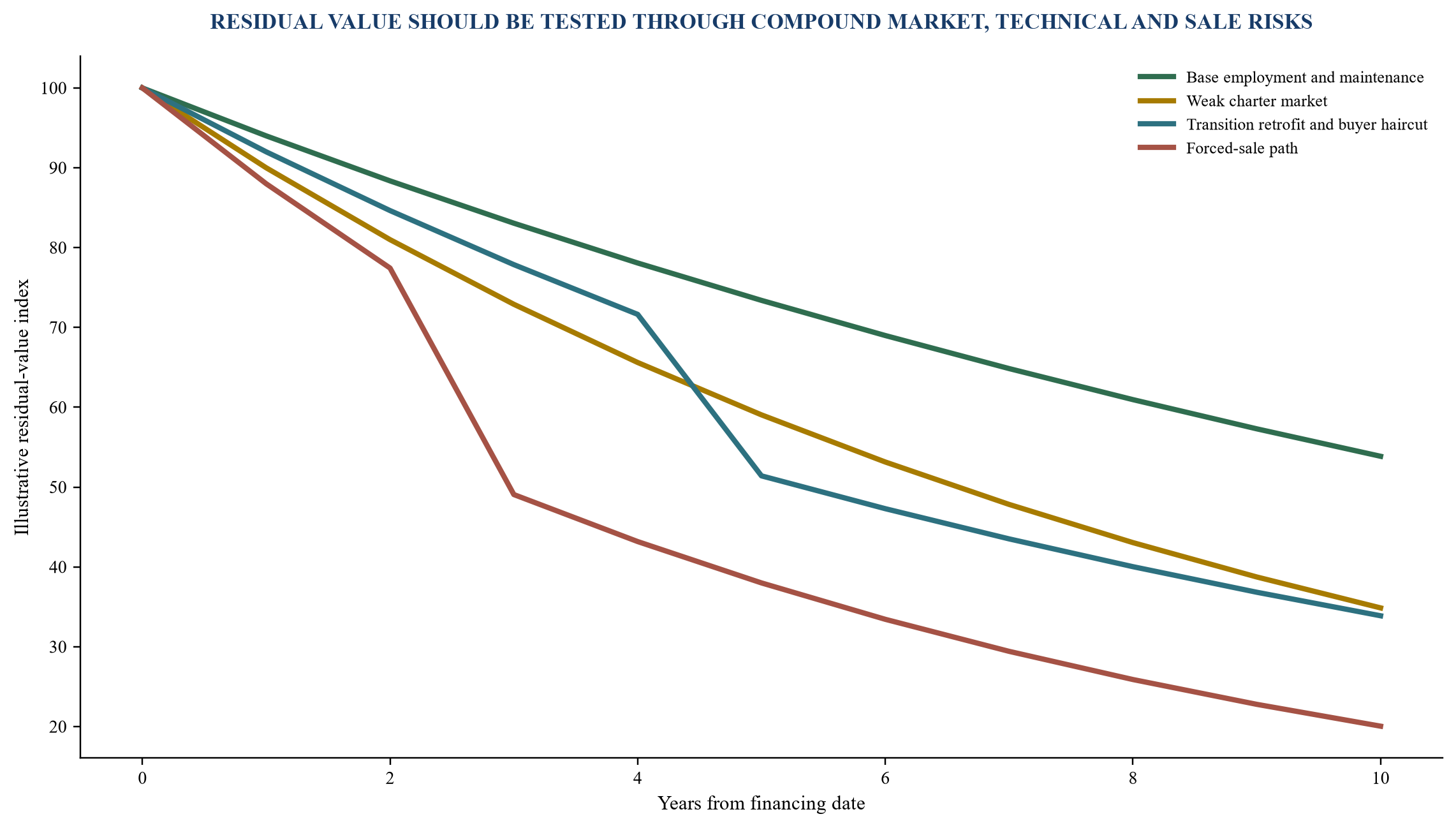
Hypothetical value indices demonstrate how market and transition assumptions can compound.
Table 5. Illustrative residual-value stress matrix
| Scenario | Earnings condition | Technical condition | Sale process | Illustrative value index | Lending implication |
|---|---|---|---|---|---|
| base | contracted and diversified employment | planned maintenance fully funded | orderly sale with broad marketing | 70 | ordinary amortisation and appraisal test |
| low utilisation | charter gap and weaker spot rate | maintenance current | orderly sale | 58 | accelerated sweep and lower advance rate |
| technical shortfall | charter remains but major work is unfunded | overdue overhaul or survey work | sale after disclosed repair estimate | 49 | reserve cure and distribution lock |
| transition discount | weaker demand for conventional specification | retrofit economics uncertain | narrower buyer pool | 44 | shorter tenor and stronger amortisation |
| forced sale | cash default and limited marketing period | buyer assumes uncertainty | accelerated enforcement sale | 35 | recovery case and additional equity |
| recycling | no continued-use buyer | retirement preparation required | compliant recycling route | 22 | terminal floor subject to net disposal cost |
All indices and haircuts are hypothetical management assumptions for method demonstration.
16. Align amortisation with charter and value decay
Debt should amortise while cash is visible and before value becomes dependent on an uncertain exit. The schedule should consider firm charter tenor, expected utilisation, maintenance events, asset age and residual-value stress. A balloon can be used only when sale or refinance capacity is supported under downside conditions.
Cash sweeps can reduce debt during strong markets. They should operate after critical operations and funded maintenance. A sweep based on accounting EBITDA can overstate distributable cash when receivables rise, dry docking approaches or customer money is restricted.
The loan-to-value covenant should use current eligible vessel value and permitted valuation sources. The debt-service covenant should use collected cash after required operating and maintenance costs. Both are needed because asset and cash risks can diverge.
17. Finance acquisition, retrofit and working capital separately
An acquisition facility funds title transfer and closing costs against valuation, diligence and security. A retrofit facility funds specified work with technical milestones and completion support. Working-capital finance funds timing between operating expenditure and collection. Combining these uses in one undifferentiated term loan weakens monitoring.
For newbuild or conversion finance, the lender should evaluate shipyard credit, refund guarantees, construction milestones, specification change, delay, acceptance and post-delivery employment. OECD's Ship Sector Understanding provides disciplines for officially supported export credits for eligible sea-going vessels and conversions among participating jurisdictions.[15] Eligibility and current terms require specific confirmation.
For sale-and-leaseback, sale price, fair value, lease liability, purchase options, residual risk and accounting treatment should be reconciled. The transaction should create durable liquidity rather than a temporary gain followed by unaffordable lease obligations.
18. Govern foreign-exchange and interest-rate mismatch
Vessel purchase price, debt, charter revenue, bunker, crew, insurance, maintenance and resale can occur in different currencies. The model should show each exposure separately. A USD charter does not create a perfect hedge when operating costs are in Indian rupees, UAE dirhams or other currencies and debt terms reset differently.
Natural matching should be used where practical. Derivative hedging can address defined exposures, while margining, break cost, tenor and counterparty risk should be included. A foreign-currency charterer receivable still carries credit and transfer risk.
Interest-rate sensitivity should capture floating debt, lease payments, refinancing and valuation effects. A stressed rate can weaken cash cover and buyer financing capacity simultaneously. The covenant model should use contractual floors and margins rather than a simple benchmark shock.
19. Monitor port and route performance as leading indicators
Port time affects utilisation, bunker, schedule reliability and customer claims. The World Bank's Container Port Performance Index measures vessel time in port and documents the impact of geopolitical and climate disruption on port efficiency.[16] The lender should use corridor-specific port-call data rather than global rankings alone.
DP World's 2025 announcement regarding the Mundra call of the ME11/IMX service described direct weekly connections among Mundra, Jebel Ali, Nhava Sheva and other ports.[5] Service announcements demonstrate available network connectivity. They do not guarantee a borrower's slot, rate, volume or collection.
Leading indicators can include port waiting time, blank sailings, canal transit, berth productivity, schedule reliability, fuel deviation, detention and customer cancellation. Trigger thresholds should link to liquidity, utilisation and charter review.
20. Design covenants around early evidence
Covenants should identify deterioration before payment default. Useful measures include minimum liquidity, eligible charter coverage, debt-service coverage, loan to value, customer concentration, off-hire days, class status, overdue recommendations, insurance renewal, maintenance reserve, survey completion and controlled-account compliance.
Information covenants should require monthly vessel and charter reporting, quarterly valuation or market evidence where appropriate, annual technical inspection and immediate event notice. Data should reconcile to source documents. A dashboard should not replace invoices, statements, class records or bank cash.
Remedies should be proportionate and executable. They can include distribution lock, cash sweep, reserve top-up, lower advance rate, additional charter, technical cure, partial prepayment, vessel sale or replacement. A vague obligation to provide a plan offers little protection.
21. Reverse-stress the fleet before approval
The model should combine low charter rate, utilisation loss, off-hire, bunker increase, port delay, maintenance overrun, rate increase and residual-value decline. Single-variable sensitivity is insufficient when market and asset risks interact.
Reverse stress testing should identify the point at which operating liquidity, maintenance reserve or debt service fails. The output should show which action is available before that point. Sponsor equity should be included only when documented and affordable.
The lender should run vessel-removal cases. The fleet must be tested after loss of the largest vessel, largest charterer and largest route. Cross-collateralisation can provide support and can also transmit problems across otherwise healthy assets.
22. Establish a one-hundred-and-twenty-day financing programme
The first twenty days should define the legal perimeter, vessel list, facility purpose, ownership, debt, charter, accounts and data. Days twenty-one to forty should reconcile vessel, charter, voyage, invoice and collection history. Technical, legal, insurance, tax and accounting diligence should begin.
Days forty-one to sixty should produce inspections, appraisals, charter reviews, security analysis and operating model. Days sixty-one to eighty should design the borrowing base, reserve, amortisation, covenants and downside. Days eighty-one to one hundred should negotiate documents, notices, account control and technical conditions.
Days one hundred and one to one hundred and twenty should complete perfection, insurance endorsement, opening compliance, funds flow and first draw. A shadow borrowing-base certificate should be run before closing.
Table 6. One-hundred-and-twenty-day fleet-finance workplan
| Period | Primary work | Required output | Approval gate |
|---|---|---|---|
| days 1-20 | perimeter, ownership, vessels, charters and purpose | verified transaction map | borrower, assets and uses defined |
| days 21-40 | voyage, invoice, collection and operating reconciliation | vessel-level historical model | source data reconciles to cash |
| days 41-60 | technical, valuation, legal, insurance and tax diligence | integrated diligence report | material risks quantified |
| days 61-80 | borrowing base, reserve, amortisation and downside | credit and recovery model | cash and value support facility |
| days 81-100 | security, charter notices, accounts and covenants | negotiated document set | control package executable |
| days 101-120 | perfection, endorsements, funds flow and first certificate | closing evidence file | controlled first draw ready |
Timing depends on vessel location, registry, charter consents, technical access and transaction complexity.
23. Use an approval gate that can reject the vessel
The approval paper should answer twelve questions. Which legal entity owns the vessel? Which registry governs the mortgage? Which charterer owes cash? What can terminate the charter? Which costs remain with the owner? What keeps class and insurance current? How is maintenance funded? Which account receives earnings? What is the stressed debt capacity? What is the forced-sale value? Which regulation changes value or cost? What action is executable before default?
Funding should pause when ownership is unclear, registry searches are incomplete, charter cash is not assignable, class is suspended, surveys are overdue, insurance is deficient, maintenance is unfunded, valuation evidence is thin, sanctions exposure is unresolved or the model depends on immediate refinancing.
Every management estimate should be dated, owned and sensitised. Every professional conclusion should remain within the scope of qualified technical, legal, insurance, tax, accounting and valuation advisers. A vessel can be declined even when corridor demand is strong.
Approval should also identify the evidence that must remain current after closing. The credit file should name the person responsible for each charter notice, insurance endorsement, class record, valuation update, reserve transfer and borrowing-base certificate. It should state where the original evidence is stored, how frequently it is refreshed and which variance requires escalation. This operating discipline matters because a sound closing package can become stale while the vessel continues to trade. A lender that receives only quarterly summaries may discover off-hire, collection delay or technical deterioration after available liquidity has already narrowed. A controlled evidence calendar makes deterioration visible while the borrower still has practical choices, including a reserve top-up, revised voyage plan, charter replacement, selective asset sale or consensual amortisation. The approval decision should therefore cover the facility's complete monitoring architecture as well as its initial debt quantum.
Conclusion
Fleet finance across the GCC-India corridor becomes investible when the lender connects a mobile asset to durable employment, collected cash, funded maintenance, effective security and a realistic exit. Bilateral trade growth and expanding port connectivity support the commercial setting. They do not replace vessel-level underwriting.
The framework in this paper begins with a fleet perimeter and a vessel age and obligation curve. It then scores charter quality, maps cash from cargo to controlled account, constructs independent receivable, cash-flow and asset-value limits, and protects maintenance ahead of distributions.
Technical, regulatory and environmental obligations are incorporated into operating cash and residual value. Mortgage, charter, insurance and account controls are tested for legal effect. Residual value is treated as a range across continued use, weak markets, transition costs, forced sale and compliant recycling.
The resulting facility can match acquisition, leasing, retrofit, maintenance and working-capital needs to the evidence that repays each exposure. Owners gain capital aligned to vessel and charter cycles. Lenders gain earlier indicators, controlled cash and a clearer recovery path. Corridor growth then becomes a source of opportunity within a disciplined credit structure.
References
- UN Trade and Development. Review of Maritime Transport 2025: Staying the course in turbulent waters. https://unctad.org/publication/review-maritime-transport-2025
- UN Trade and Development. Review of Maritime Transport 2025, Chapter 2: World shipping fleet and services. https://unctad.org/system/files/official-document/rmt2025ch2_en.pdf
- Government of India, Ministry of Commerce and Industry. India-UAE bilateral trade since CEPA, Lok Sabha Unstarred Question No. 305, July 2025. https://www.commerce.gov.in/wp-content/uploads/2025/07/LSUSQ-No.-305.pdf
- DP World. Jafza marks 40 years as a gateway for Indian businesses to the world, May 2025. https://www.dpworld.com/en/news/india/jafza-marks-40-years-as-a-gateway-for-indian-businesses-to-the-world
- DP World. DP World Mundra welcomes first call of new Gemini service, February 2025. https://www.dpworld.com/en/news/india/pioneering-new-gateway-connections-dp-world-mundra-welcomes-first-call-of-new-gemini-service
- International Financial Services Centres Authority. Framework for Ship Leasing and related circulars. https://www.ifsca.gov.in/Pages/Contents/Ship_Leasing
- IFRS Foundation. IFRS 16 Leases. https://www.ifrs.org/issued-standards/list-of-standards/ifrs-16-leases/
- DP World. More than USD 1 billion of trades financed, July 2025. https://www.dpworld.com/en/news/1-billion-trades-financed
- United Arab Emirates Government. Federal Decree by Law No. 43 of 2023 Concerning the Maritime Law. https://www.uaelegislation.gov.ae/en/legislations/2138/download
- Directorate General of Shipping, Government of India. Merchant Shipping Act, including Merchant Shipping Act 2025. https://www.dgshipping.gov.in/Content/MerchantShippingAct.aspx
- International Maritime Organization. EEXI and CII: ship carbon intensity and rating system. https://www.imo.org/en/mediacentre/hottopics/pages/eexi-cii-faq.aspx
- International Maritime Organization. The IMO Net-Zero Framework: frequently asked questions. https://www.imo.org/en/mediacentre/hottopics/pages/faqs-the-imo-net-zero-framework.aspx
- International Maritime Organization. Hong Kong Convention enters into force, June 2025. https://www.imo.org/en/mediacentre/pressbriefings/pages/hong-kong-convention-entry-into-force.aspx
- International Maritime Organization. Status of IMO Conventions, March 2026. https://wwwcdn.imo.org/localresources/en/About/Conventions/StatusOfConventions/Status%202026%2025%20mar.pdf
- OECD. Arrangement on Officially Supported Export Credits and Ship Sector Understanding. https://www.oecd.org/en/topics/arrangement-and-sector-understandings.html
- World Bank. Container Port Performance Index 2025. https://www.worldbank.org/en/topic/transport/publication/cppi
- Poseidon Principles for Financial Institutions. Annual Disclosure Report 2025. https://www.poseidonprinciples.org/finance/
- DP World. 2025 financial results and operating performance, March 2026. https://www.dpworld.com/en/news/releases/uae/dp-world-reports-record-244-bn-revenue-and-64bn-ebitda-for-2025
