

1. Define the receivable before financing it
A healthcare receivable begins with an episode of care and becomes cash only after a chain of clinical, contractual and administrative conditions is satisfied. The lender should underwrite that chain rather than treating the provider's accounts-receivable ledger as a pool of ordinary invoices.
The claim should be traced from patient registration, eligibility confirmation and authorisation through encounter documentation, diagnosis and procedure coding, tariff application, claim submission, acknowledgement, adjudication, resubmission, reconciliation, payment notification and bank receipt. Each stage has a date, owner, system record and possible exception.
The legal debtor should be identified precisely. An insurer, third-party administrator, government programme, employer, patient or other sponsor can bear different portions of one encounter. A third-party administrator may process a claim without assuming ultimate payment risk. A payer group can contain several legal entities. The borrowing base should use the entity contractually responsible for payment.
The provider's right to payment should also be distinguished from expected reimbursement. A submitted claim can be incomplete, late, unauthorised, miscoded, priced above contract, duplicated or outside benefits. A claim acknowledged by an electronic platform is not necessarily admitted by the payer. A payment notification is stronger evidence than mere submission, while actual collection remains the strongest evidence for historical calibration.
The facility purpose should be defined. Receivables finance can fund payroll, medicines, consumables, rent and other operating working capital while verified claims mature. It should not hide persistent operating losses, finance disputed acquisitions, replace regulatory capital or support distributions when the borrowing base is deteriorating.
2. Map the full claim-to-cash cycle
The first diligence product should be a claim-to-cash map for each jurisdiction, payer, service line and system. It should show eligibility, pre-authorisation, encounter, documentation, coding, submission deadline, adjudication, denial response, resubmission, reconciliation, settlement and payment.
Dubai's eClaimLink provides standard data sets and lists for facilities, clinicians, payers, services, medicines and denial codes.[1] The presence of common fields and codes supports reconciliation across provider, payer and financing systems. The lender should still test whether the provider's source records populate the fields accurately and whether updates are implemented on time.
Abu Dhabi's adjudication standard describes automated simple and complex edits, provider access to adjudication guidelines and the payer decision between full settlement, partial settlement and dismissal.[2] The lender's data model should retain the reason, amount and date of each adjudication outcome. A net receivable cannot be reconstructed if the provider overwrites earlier claim versions.
Saudi NPHIES defines transactions for eligibility, authorisation, claims, re-adjudication, amendment, status inquiry, payment notification and confirmation.[4] It also distinguishes benefit, clinical and operational denial categories. This structure supports a state-based borrowing base in which advance rates can rise as a claim moves from submitted to accepted to scheduled for payment.
The map should include manual channels and exceptions. Government claims, overseas insurers, self-pay balances, package reconciliations and legacy contracts can sit outside the main exchange. Their evidence and payment behaviour should be analysed separately rather than assumed to follow the digital channel.
Table 1. Claim-state evidence and financing treatment
| Claim state | Required evidence | Primary uncertainty | Indicative financing treatment | Monitoring field |
|---|---|---|---|---|
| care delivered | encounter, eligibility and clinical record | coverage, authorisation and coding incomplete | exclude | encounter date and responsible payer |
| coded and billable | completed documentation, codes and tariff | submission validity and contract edits | exclude or very low recognition | coding completion date |
| submitted | exchange acknowledgement and claim identifier | payer has not adjudicated | eligible only for proven low-denial pools with reserve | submission date and version |
| pending information | payer request and response deadline | documentation or data gap | exclude until cured | pending reason and aging |
| partially accepted | line-level adjudication and accepted amount | residual dispute and dilution | include accepted amount only | accepted amount and expected payment |
| denied, correctable | denial code, cure evidence and resubmission | cure success and time | exclude until re-accepted | denial root cause and resubmission date |
| denied, final | final rejection or expired appeal | no collectible value | exclude and write off | final disposition |
| payment notified | payer payment notification and reconciliation | timing, set-off or administrative delay | high eligibility subject to concentration | scheduled amount and date |
| collected | bank receipt allocated to claim | allocation and clawback | remove from base and apply cash waterfall | value date and account |
Exact states and rights depend on the relevant payer contract and jurisdiction.
3. Build the claim-level data spine
A borrowing base requires a stable claim identifier that links the clinical event, billing record, payer response, general ledger and bank receipt. The lender should receive the claim history, not only the current balance.
Minimum data include provider entity, facility, patient pseudonymous identifier, payer, third-party administrator, policy or programme, service line, encounter date, authorisation, diagnosis, procedure, billed amount, contract amount, patient share, submission date, claim version, payer acknowledgement, adjudicated amount, denial code, resubmission, payment notification, cash receipt, credit note, write-off and dispute status.
Sensitive clinical and personal data should be minimised for financing. The lender needs enough information to validate claim existence, eligibility and performance without receiving unnecessary patient details. Data access, processing purpose, storage, transfer, retention, deletion and incident obligations should be documented under the applicable health and privacy regime.
The claim tape should reconcile to the accounts-receivable subledger, general ledger and audited or reviewed financial statements. Opening claims plus new billed claims minus collections, credits, write-offs and transfers should equal closing claims. Differences should be explained by claim versioning, patient-share reclassification, payer settlement or accounting cut-off.
Bank receipts should be allocated at claim or settlement-statement level. Unallocated cash can make the ledger appear older than economic reality or conceal that collections relate to claims outside the financed pool. A lender should require a dated allocation process and exception queue.
4. Construct a claims aging cube
Simple aging by invoice date can obscure where risk sits. A claims aging cube adds payer, service line, claim state, denial reason, facility and submission cohort. The lender can then see whether old balances are concentrated in one payer, one coding process or one service.
Several clocks matter. Days from encounter to coding measure provider readiness. Days from coding to submission measure billing operations. Days from submission to first adjudication measure payer processing. Days from denial to resubmission measure cure discipline. Days from acceptance to payment measure settlement. Days from encounter to cash measure the complete working-capital cycle.
The borrowing base should choose a contractual and empirically useful aging start. Encounter date captures the full provider cycle but can penalise legitimate coding and submission periods. Submission date aligns with the payer claim but can reward delayed provider billing. A combined test can require both maximum encounter age and maximum submitted age.
Age buckets should be calibrated from claim-level liquidation. The lender should calculate how much of each historical bucket was eventually collected, diluted or written off and how long collection took. A ninety-day claim can remain strong under a slow government programme, while a ninety-day claim under a thirty-day insurer contract can signal dispute.
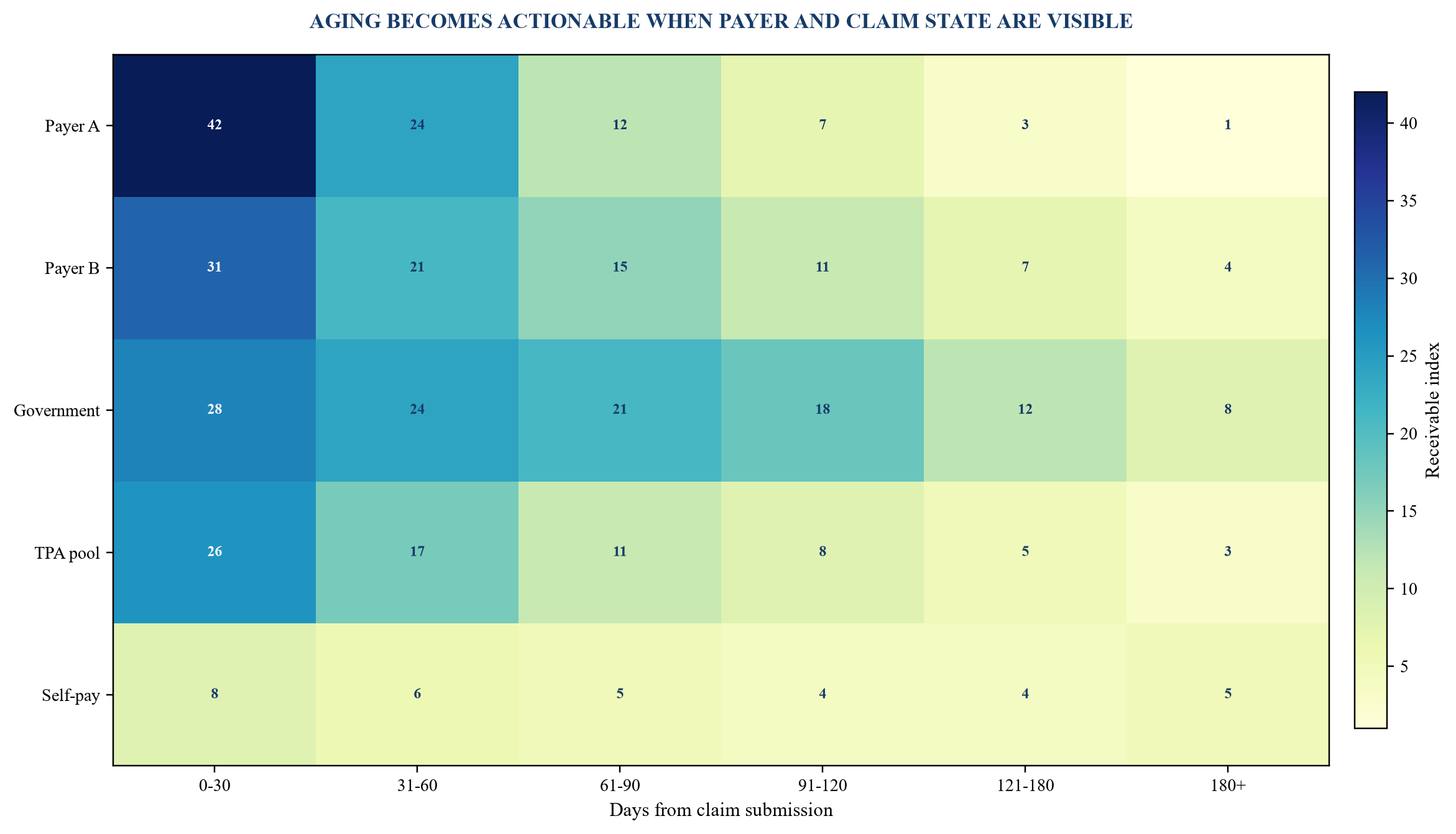
Hypothetical index amounts demonstrate segmentation and are not observed provider data.
5. Convert denials into a recoverability waterfall
A denial rate alone does not measure value. Some denials are administrative and curable. Others reflect missing authorisation, benefit exclusion, clinical necessity, contractual tariff, duplicate submission, coding error, late filing, fraud concern or final non-coverage. Each category has a different cure rate, cost and collection time.
The provider should maintain the original denial code, internal root cause, responsible department, resubmission deadline, action, new claim version, outcome and cash receipt. Denial codes should not be overwritten when a claim is resubmitted. The lender needs the path from first submission to final settlement.
The denial waterfall begins with submitted claims. It deducts patient share, contractual pricing differences, ineligible benefits, missing authorisation, coding and documentation errors, duplicates, late claims, expected settlement deductions and final disputes. Correctable claims can re-enter eligibility only after the required evidence is provided and the payer acknowledges the revised claim.
Saudi NPHIES groups more than 80 denial codes into benefit, clinical and operational categories, including authorisation, eligibility, price, coding, dosage and time.[4] CHI's provider reconciliation form requires service-level rejection details and a defined period for supporting information or objections.[5] These records support line-level dilution analysis.
Abu Dhabi's framework likewise distinguishes adjudication outcomes and provides rules for recovery of payments previously made.[2][6] A reserve should therefore cover both initial dilution and later recoupment or set-off risk.
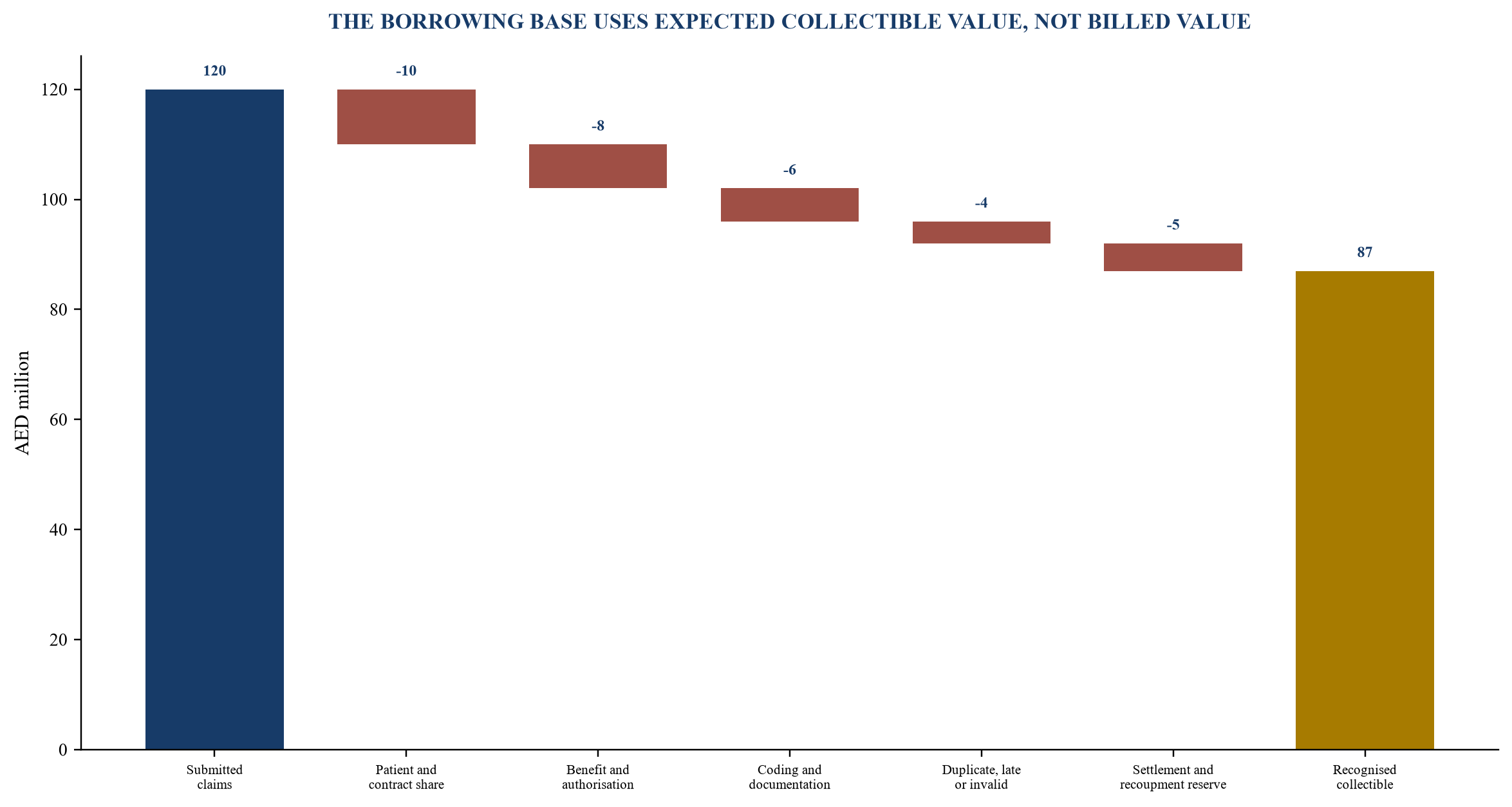
Hypothetical AED million amounts demonstrate recoverability adjustments.
Table 2. Denial root-cause and credit treatment
| Denial category | Typical evidence | Potential cure | Borrowing-base treatment | Management action |
|---|---|---|---|---|
| eligibility | policy response, member and encounter record | correct identity or payer where valid | exclude until payer accepts | front-end eligibility control |
| authorisation | authorisation request, approval and service match | obtain or prove existing approval where permitted | exclude disputed amount | align scheduled care and authorisation |
| benefit | policy terms and clinical service | limited if service is excluded | exclude final non-covered amount | patient disclosure and benefit check |
| coding | clinical record, diagnosis and procedure code | correct code with coder review | exclude until clean resubmission | coding quality programme |
| documentation | signed notes, reports and discharge record | complete permissible missing evidence | exclude pending claim | encounter closure control |
| tariff or contract | payer contract, package and price list | reconcile line or package | include only undisputed contract amount | contract master governance |
| duplicate | claim history and version | cancel duplicate, retain valid original | exclude duplicate | version and resubmission control |
| late filing | encounter and submission timestamps | appeal only if contract permits | exclude unless accepted | submission service-level target |
| clinical necessity | guideline, record and payer rationale | medical appeal where supported | exclude pending adjudication | clinical documentation and review |
| fraud or misuse concern | audit record and investigation | fact dependent | exclude entire affected pool where material | investigation, disclosure and remediation |
Cure rates and timing should be calculated from the provider's own claim history.
6. Measure payer concentration across several dimensions
Payer concentration should be measured by gross billed claims, eligible receivables, monthly collections, old balances, denials, disputes and payment notifications. One payer can represent thirty per cent of current receivables and sixty per cent of balances older than 120 days.
Legal counterparty and administrator should be separated. Several branded plans can settle through one insurer or government entity. One administrator can process claims for multiple insurers. A parent guarantee should not be assumed without documentation.
Concentration also exists within service lines and facilities. A payer can be strong for outpatient claims and slow for high-value inpatient packages. A government programme can pay reliably and on a longer cycle. The lender should apply limits to the stressed collectible amount, not only to invoice face value.
The payer score should include financial capacity, regulatory status, contract term, termination, network status, adjudication behaviour, denial rate, settlement history, dispute, set-off rights and days to cash. Public ratings or financial statements can support capacity where available, but the provider's own collections establish transactional behaviour.
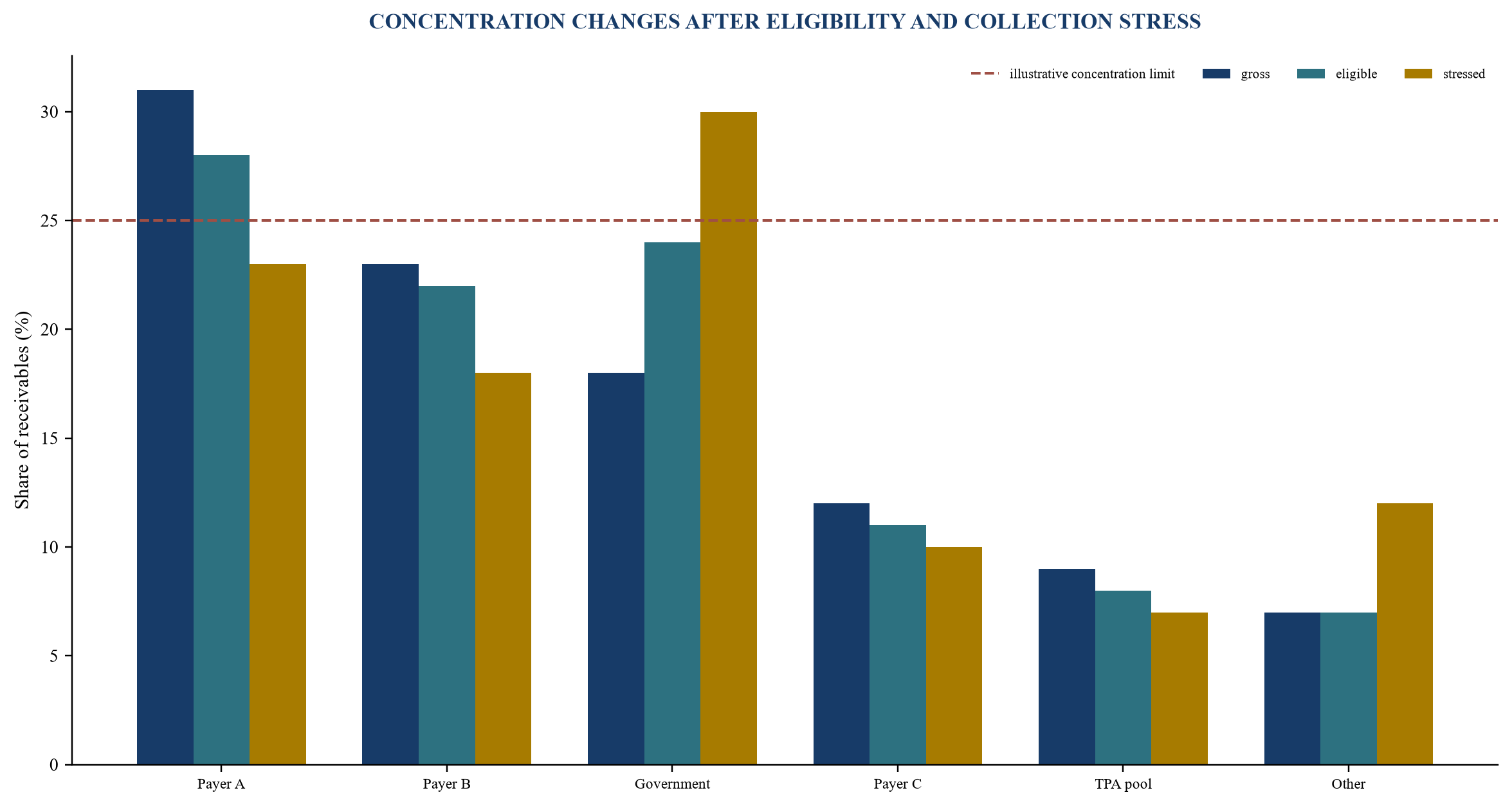
Hypothetical percentages compare gross, eligible and stressed receivables.
7. Reconcile contractual price before applying an advance rate
Healthcare billing can begin with a list price and settle under a negotiated tariff, package, diagnostic-related group, discount, capitation rule or other arrangement. The lender should finance the contractual collectible amount rather than the provider's gross charge master.
The contract master should record payer, plan, facility, service, tariff, package, effective date, authorisation rule, filing deadline, payment period, audit, recoupment, dispute, set-off and termination. Changes should be version controlled. The billing system should apply the contract effective on the encounter date.
Packages need special care. Individual claim lines can be priced at zero within a package while the major code carries the price. Saudi NPHIES guidance refers to package pricing and standard code sets.[4] A line-level borrowing base should preserve the package relationship so that zero-priced components are not treated as missing revenue and the package is not double counted.
Retrospective discounts, volume rebates and settlement agreements create dilution. Historical dilution should be calculated as gross submitted less final cash, separated into contractual adjustment, denial, credit note, write-off and recoupment. A reserve should cover the higher of recent experience, stressed experience and known unresolved settlement exposure.
8. Test historical liquidation by cohort
Static-pool analysis follows a month of submitted claims until it is collected, diluted or written off. It avoids the distortion caused when new claims continually enter the ledger. Each cohort should be analysed by payer, facility and service line.
The lender should calculate cumulative cash at 30, 60, 90, 120, 180 and 270 days from submission. It should also calculate final dilution and unresolved balance. Recent cohorts can be compared at the same age with older cohorts. A deterioration in a sixty-day collection curve can trigger action before year-end aging appears abnormal.
Resubmission can reset system timestamps. The original submission date should remain available, and the borrowing base should prevent artificial rejuvenation. A claim that has been denied and resubmitted three times should not appear as a new thirty-day claim.
Seasonality should be tested around holidays, policy renewals, government budgets, medical peaks and payer settlement cycles. Acquisitions, new facilities and new payer contracts should form separate cohorts until sufficient evidence exists.
Table 3. Illustrative claim-cohort liquidation analysis
| Submission cohort | Cash by day 30 | Cash by day 60 | Cash by day 90 | Cash by day 180 | Final dilution | Credit interpretation |
|---|---|---|---|---|---|---|
| established quarter 1 | 38% | 66% | 82% | 94% | 5% | reference performance |
| established quarter 2 | 36% | 64% | 81% | 93% | 6% | broadly stable |
| growth quarter 3 | 31% | 57% | 74% | 89% | 8% | slower adjudication and higher denial |
| new payer launch | 22% | 44% | 63% | 83% | 11% | separate reserve and concentration cap |
| government programme | 12% | 31% | 54% | 88% | 4% | slower but historically lower dilution |
| high-value inpatient | 19% | 42% | 61% | 80% | 13% | package and authorisation review |
Hypothetical percentages demonstrate same-age comparison.
9. Define eligible receivables precisely
Eligibility should be a claim-level rule applied consistently. The receivable must belong to an approved provider and payer, arise from a completed eligible service, have required eligibility and authorisation evidence, be coded and submitted within deadline, use the applicable contractual price, remain undisputed and fall within age and concentration limits.
Common exclusions include self-pay balances without proven collection, related-party claims, duplicate or late claims, final denials, missing documentation, unapproved services, suspended payer contracts, claims subject to fraud or material audit, credit balances, capitation outside the agreed treatment, restricted government claims and receivables already assigned or pledged.
Partial eligibility should be supported at claim-line level. If a payer accepts AED8,000 of a AED10,000 claim, the borrowing base should include no more than the accepted or empirically collectible portion. A top-down haircut applied to the total pool can conceal specific disputed claims.
Cross-border and multi-jurisdiction pools should be segregated. Assignment, notice, priority, data and enforcement differ. The UAE's Federal Decree-Law No. 16 of 2021 permits transfers of current and future receivables that are described sufficiently and establishes registration-based third-party effectiveness and priority.[7] Transaction counsel should confirm how those provisions apply to the provider, payer contract, notice and proposed security.
10. Build the borrowing base from expected collectible value
The borrowing base starts with eligible receivables at contractual or accepted value. It then applies advance rates and subtracts reserves. An advance rate reflects the time and uncertainty between the current claim state and cash. A submitted claim can receive a lower rate than a payment-notified claim.
Reserves should cover dilution, concentration, recoupment, disputes, slow aging, missing information, taxes, account leakage and other senior claims. A dynamic reserve can rise when denial, aging or concentration deteriorates. Availability should be the lower of the borrowing base and the committed facility limit.
The lender should recalculate at least monthly and more frequently for a revolving facility with rapid collections. The provider should deliver a claim-level certificate and source extracts. Independent testing should select claims from several payers, states, service lines and age buckets and trace them to clinical, contractual and cash records.
Over-advances should be cured through cash retention, new eligible receivables or repayment within a short defined period. A dispute or ineligible claim discovered after funding should be removed immediately. The facility should not wait until the next scheduled certificate when a material payer suspension or regulatory event occurs.
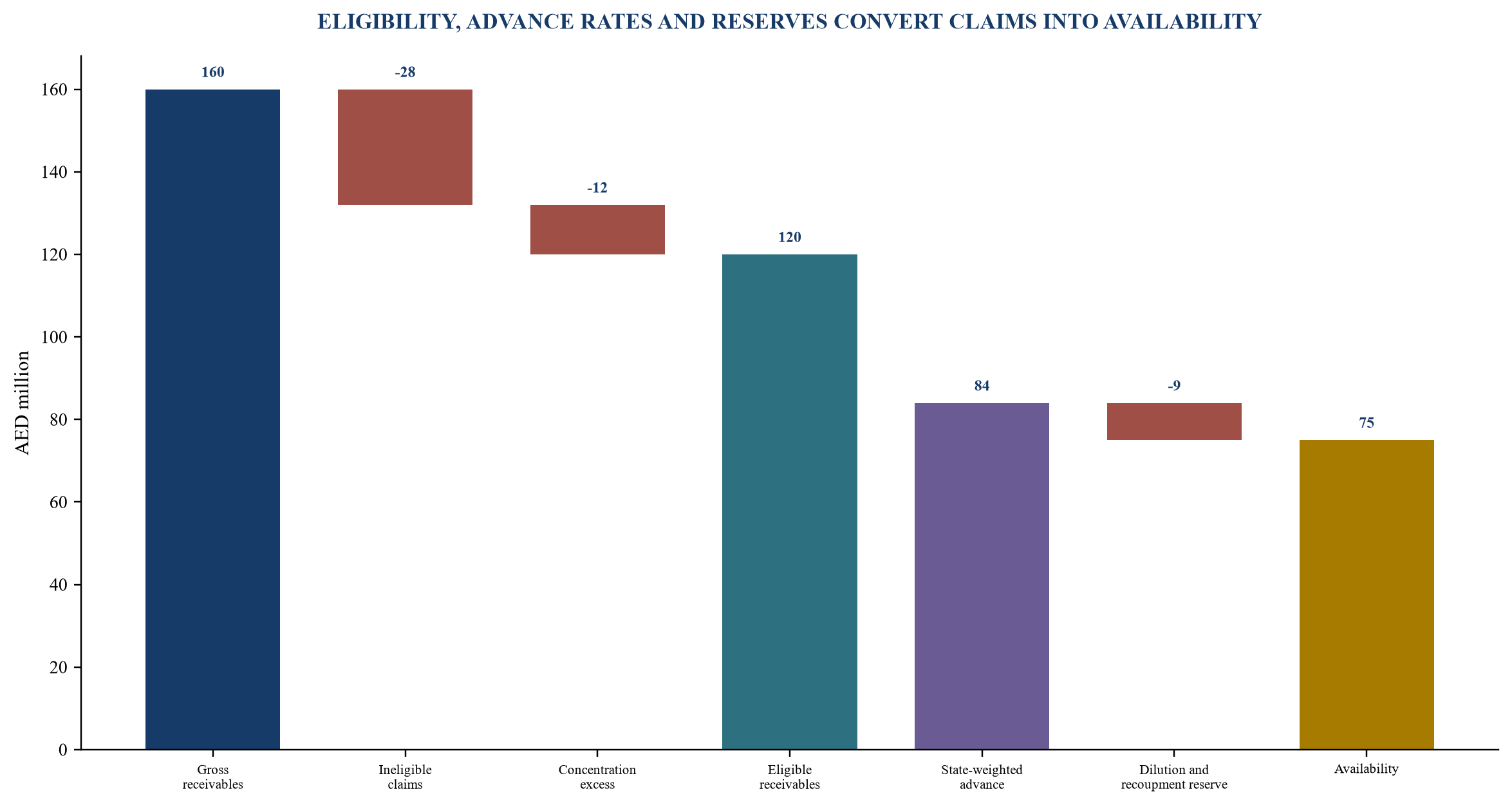
Hypothetical AED million amounts and advance rates demonstrate the method.
Table 4. Illustrative borrowing-base calculation
| Component | AED million | Treatment | Evidence |
|---|---|---|---|
| gross healthcare receivables | 160 | starting ledger balance | reconciled claim tape and ledger |
| patient share and self-pay exclusion | (8) | excluded | patient responsibility and collection history |
| denied, disputed or incomplete | (11) | excluded | line-level adjudication and pending queue |
| age and filing exclusion | (6) | excluded | original encounter and submission dates |
| other ineligible or pledged | (3) | excluded | assignment, related party and legal review |
| payer concentration excess | (12) | excluded above cap | legal-payer aggregation |
| eligible receivables | 120 | state and payer weighted | eligibility certificate |
| weighted advance amount | 84 | average 70% after state weights | historical liquidation and contract |
| dilution and recoupment reserve | (6) | reserve | recent and stressed dilution |
| operational and account reserve | (3) | reserve | cash-control and exception analysis |
| borrowing availability | 75 | subject to facility limit | lender certificate and testing |
Hypothetical amounts require provider-specific calibration.
11. Calibrate advance rates by claim state and payer
A single advance rate is simple and can be blunt. State-weighted advance rates reflect the stronger evidence created by adjudication and payment notification. Payer-specific overlays reflect historical collection and concentration.
Submitted clean claims can receive a conservative rate where the payer, contract, denial history and data quality are strong. Pending-information and denied claims should generally receive no advance until cured. Accepted claim lines can receive a higher rate. Payment-notified claims can approach the rate applied to short-dated confirmed receivables, subject to set-off and recoupment.
The advance rate should also reflect time. A newly accepted claim may be stronger than an old accepted claim whose scheduled payment has been missed. Aging and claim state should therefore interact. The lender can create a matrix by state and days since submission or acceptance.
Historical loss alone is insufficient. Operational disruption, contract renegotiation, payer distress, regulatory audit or cyber incident can change future performance. The advance rate should include a forward-looking overlay and should fall automatically after defined triggers.
12. Create a cash-control architecture that respects healthcare flows
Collections should flow to a designated account subject to lender control or an agreed waterfall, depending on applicable law, contract and payer practice. Payer notices should identify the correct account and preserve patient and regulatory requirements.
The account structure should separate receivable proceeds from patient deposits, restricted government money, escrow, charity funds, VAT or tax liabilities and other amounts unavailable for debt service. A daily reconciliation should allocate receipts to settlement statements and claims.
The waterfall can first retain taxes, patient refunds or other agreed senior amounts, then cure any over-advance, pay interest and required amortisation, replenish reserves and release surplus to the provider while no trigger exists. During a trigger, surplus can remain trapped until the borrowing base and liquidity tests recover.
Payers can use set-off or recoupment against future payments. The lender should understand whether a controlled account captures gross collections before set-off and whether the payer can deduct across facilities, contracts or legal entities. The borrowing base should aggregate the corresponding exposure.
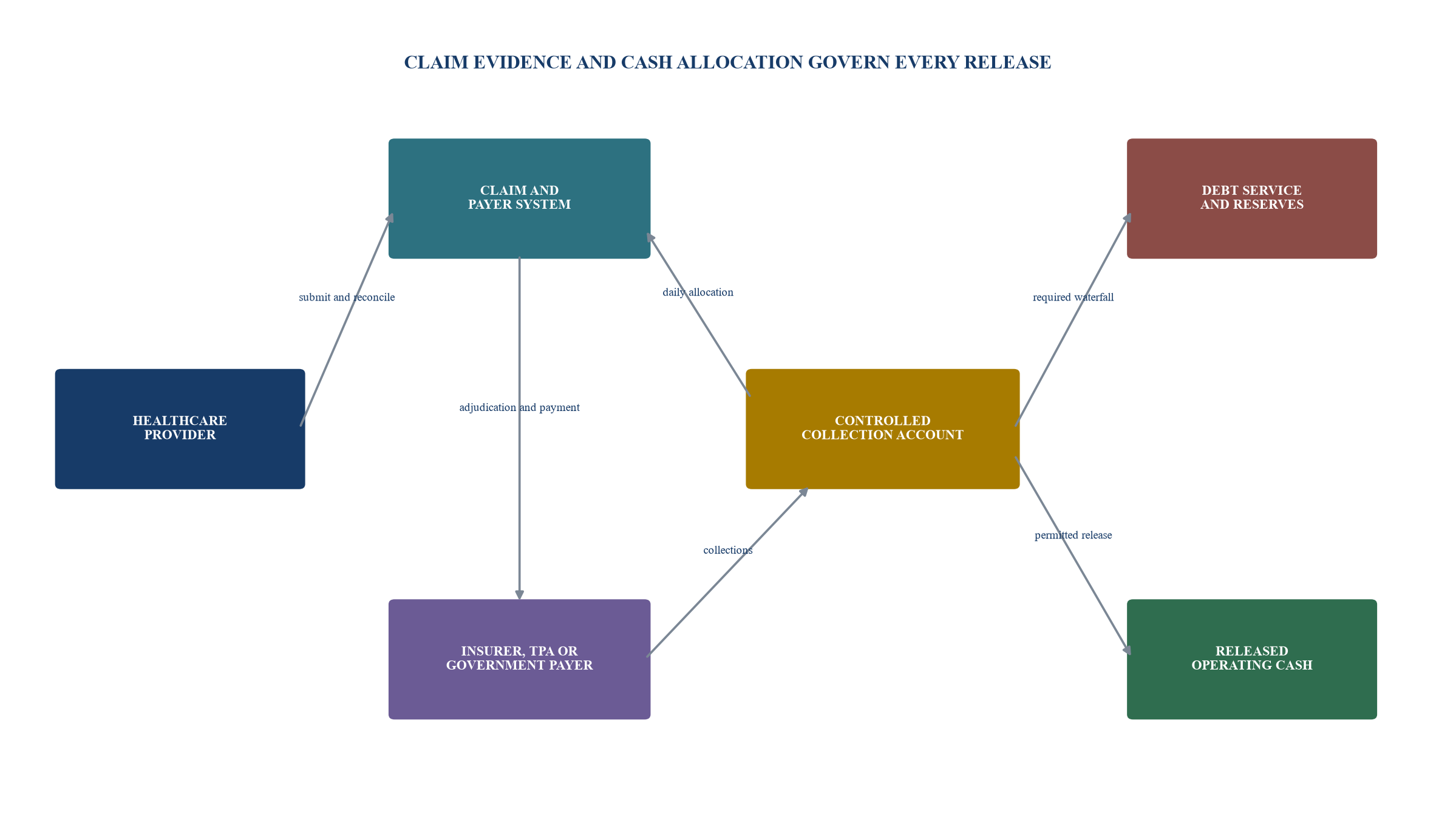
Legal and operational implementation requires jurisdiction-specific advice and payer confirmation.
13. Design covenants around claim deterioration
Minimum liquidity and maximum utilisation should sit alongside claim metrics. Eligible receivables, advance rate, concentration and reserves define availability. Financial covenants should use cash available after recurring capital expenditure, taxes and required clinical operations.
Operational covenants can monitor encounter-to-submission days, clean-claim rate, first-pass acceptance, denial rate, resubmission time, collection days, unallocated cash and aged pending claims. Payer covenants can monitor concentration, termination, suspension, dispute and missed settlement.
Data-quality covenants should cover missing identifiers, changed submission dates, unreconciled ledger differences and claim versions. A material reporting defect should stop new advances until corrected because the lender cannot calculate availability reliably.
Compliance covenants should require current provider licences, payer contracts, coding standards, data protection, fraud controls and prompt disclosure of regulatory correspondence, audits, recoupment notices and material patient complaints.
Table 5. Illustrative covenant and remedy ladder
| Indicator | Early warning | Trigger | Immediate response | Escalated response |
|---|---|---|---|---|
| clean-claim submission | declines below recent range | below agreed floor | root-cause report and enhanced testing | reduce advance rate |
| denial and dilution | trend rises | exceeds reserve assumption | increase reserve and stop affected pool | independent review and repayment |
| aging | slower cohort liquidation | old balance exceeds cap | exclude excess and trap cash | mandatory amortisation |
| payer concentration | approaches limit | exceeds limit | exclude concentration excess | payer-specific reserve or new funding limit |
| submission timeliness | backlog increases | filing deadlines at risk | daily backlog plan | affected claims ineligible |
| data reconciliation | minor exceptions | material tape-to-ledger difference | suspend certificate | independent reconciliation |
| payer contract | adverse negotiation | termination or suspension | stop affected advances | mandatory prepayment from collections |
| licence or regulatory event | inquiry or audit | suspension, material sanction or invalid claim process | freeze draws and notify lender | restructure or enforce as documented |
| controlled account | allocation delay | diversion or unauthorised change | cash trap and cure | event of default where material |
Definitions, thresholds, cure and materiality require transaction-specific drafting.
14. Stress payer delay, denial and operating continuity together
Healthcare receivables risk can compound. A documentation backlog increases denials, slows collections and consumes staff time. A payer dispute can coincide with high medicine purchases and payroll. A cyber incident can interrupt submission and bank allocation. A regulatory audit can create recoupment while new advances stop.
The downside model should combine higher denial, lower cure, longer adjudication, delayed settlement, concentration haircut, recoupment and operating cost. It should show minimum liquidity, borrowing-base availability, over-advance, interest coverage and required management action by week and month.
The provider should identify essential clinical spending that cannot be cut without affecting care or licensing. Management action can reduce elective expansion, defer non-essential capital expenditure, improve coding support, renegotiate suppliers or add equity. It should not assume unsafe clinical reductions.
Reverse stress testing should identify the denial and payment-delay combination that creates an over-advance or minimum-liquidity breach. The early-warning covenant should activate before that point.
The stress should also distinguish a delay from a loss. A reliable government or insurer balance can create severe liquidity pressure while remaining collectible. The facility can respond through lower availability, a dedicated slow-payer sublimit, longer tenor or more equity liquidity. A disputed balance with weak evidence requires an exclusion rather than extra time. This distinction prevents a lender from applying the same remedy to operational timing and fundamental collectability.
Management actions should be linked to claim operations. A temporary coding team can reduce an encounter backlog. Contract escalation can resolve repeated tariff errors. Clinical-documentation training can improve first-pass acceptance. Payer diversification takes longer and should not be credited before executed contracts and collected cohorts exist. Each action needs cost, owner, implementation date, evidence and forecast cash effect.
The lender should run a weekly thirteen-week liquidity forecast during a trigger. Collections should be drawn from claim-level expected dates and stressed by payer. Essential payroll, medicines, consumables, rent, tax and patient obligations should be shown separately. Availability should follow the recalculated pool, and any remaining gap should have a committed funding source or a defined reduction plan that preserves safe care.
15. Address recoupment and audit risk
Payers can review paid claims and seek recovery for duplicate, coding, documentation, benefit, fraud, misuse or other reasons under the relevant contract and rules. Abu Dhabi has published principles and procedures governing recovery of payment for healthcare services.[6] A lender financing collected claims still needs to consider future set-off against the remaining pool.
The provider should maintain audit notices, sampled claims, proposed findings, responses, final determinations, payment plans and set-offs. Exposure should be allocated by payer, facility, service line and period. Known amounts should be reserved in full where collection is probable and timing is near.
Historical recoupment should be included in dilution. Material open audits can justify a specific reserve or exclusion of the affected cohort. Fraud or misuse concerns can require a broader stop because they can affect payer relationships and regulatory standing beyond the sampled claims.
The financing documents should require prompt notice, information access and approval for material settlements where they affect collateral. The lender should avoid directing clinical or payer decisions and should preserve the provider's obligations to patients and regulators.
16. Separate provider operating risk from receivable value
A strong receivable pool can weaken if the provider cannot continue delivering care, coding claims or managing payer relationships. The lender should review licences, accreditation, clinician staffing, pharmacy and consumable supply, information systems, cyber-security, malpractice, quality events and business continuity.
Provider concentration by facility and service line matters. A licence suspension or equipment failure at one site can stop new claims. A key clinician departure can affect high-value services. A tariff or network change can shift patient volume.
The operating model should identify the minimum cash needed to keep care and billing functioning. Collections can lag for months after a disruption, and the borrowing base can decline immediately as new eligible claims fall. Minimum liquidity should reflect this gap.
Insurance policies should be reviewed for business interruption, cyber, professional liability, property and fidelity. Coverage exclusions, waiting periods and claim timing mean insurance is a secondary protection rather than ordinary debt service.
17. Structure security and assignment carefully
The security package can include assignment or charge of eligible receivables, collection accounts, insurance proceeds, relevant contracts and shares or assets where lawful and appropriate. The exact package depends on the jurisdiction, provider licence, payer contract and financier status.
UAE receivables law recognises transfers of current and future receivables and uses registration for effectiveness against third parties and priority.[7] The CBUAE Finance Companies Regulation includes factoring within the regulated framework for finance companies.[8] Transaction counsel should confirm licensing, registration, notice, set-off, priority and enforcement.
Anti-assignment or consent provisions in payer contracts should be abstracted. Even where a transfer can be effective between transferor and transferee, payer defences, payment instructions and third-party priority need analysis. Government receivables may have additional restrictions.
Collateral descriptions should match claim data and legal entities. The lender should search for existing assignments, bank security, negative pledges and liens. Receivables already sold, pledged or subject to cash pooling should be excluded until priority is resolved.
18. Establish a controlled diligence path
The first fifteen days should map legal entities, facilities, licences, payers, administrators, claim systems, service lines, contracts, accounts and the proposed facility use. Management should deliver raw claim history, ledgers and bank receipts with data definitions.
Days sixteen to forty-five should reconcile claim cohorts, denial, aging, dilution, payer concentration, tariffs, recoupment and cash allocation. Samples should trace encounter evidence to cash. Legal and regulatory advisers should review assignment, security, notice, data and provider obligations.
Days forty-six to seventy should build the borrowing base, reserves, downside, facility size, covenant package and cash waterfall. The provider should test a shadow certificate using the proposed definitions. Exceptions should be resolved or explicitly excluded.
Days seventy-one to ninety should finalise security, account control, payer notices where applicable, reporting, independent testing and closing conditions. The first post-closing certificate should be rehearsed before funding.
Table 6. Ninety-day healthcare receivables financing workplan
| Period | Primary work | Required output | Approval gate |
|---|---|---|---|
| days 1-15 | entity, licence, payer, contract, system and account map | claim-to-cash architecture and data request | defined pool and purpose |
| days 16-30 | tape, ledger, settlement and bank reconciliation | reconciled historical data spine | reliable identifiers and balances |
| days 31-45 | aging, denial, cohort, concentration and recoupment | recoverability analysis | evidence-based exclusions and reserves |
| days 46-60 | eligibility, advance rates, downside and liquidity | draft borrowing base and model | financeable base case and combined downside |
| days 61-70 | assignment, security, notice, data and account review | legal and regulatory structure | enforceable and operational route |
| days 71-80 | covenants, remedies, reporting and sampling | term sheet and certificate | definitions aligned across documents |
| days 81-90 | closing evidence and shadow reporting cycle | final conditions and first certificate | controlled funding readiness |
Timing depends on data quality, payer cooperation and legal requirements.
19. Use a credit committee gate that can say no
The credit paper should answer eight questions. Which legal payer owes each eligible claim? Which evidence establishes coverage, authorisation, coding, contract price and submission? How much was collected from comparable cohorts? Which denials are curable? How concentrated is the stressed pool? Which cash is restricted? How are assignment, account control and priority implemented? Which downside can the provider survive without harming care?
The facility should pause when claims cannot reconcile to cash, original submission dates are unavailable, payer identity is unclear, denial reasons are overwritten, provider licences or contracts are uncertain, patient or restricted money is counted as liquidity, assignment conflicts remain, or management cannot deliver a repeatable certificate.
The approval memorandum should list every management estimate, evidence gap, exclusion, reserve and condition. It should state which facts require a bring-down before closing and which milestones govern later availability.
Independent review should have a defined scope. Coding specialists can test sampled claims. Data reviewers can reproduce aging and cohorts. Legal advisers can review contracts and security. Finance reviewers can reconcile ledgers and cash. Management remains responsible for complete information and clinical compliance.
20. Turn the facility into a monthly operating discipline
The borrowing-base process can improve revenue-cycle management. A daily exception queue identifies missing eligibility, authorisation, documentation, coding and submission. A denial waterfall assigns root causes. A payer map directs contract and collection attention. A cash-control account forces timely allocation.
Finance, revenue cycle, clinical operations, coding, compliance and technology should own defined metrics. The monthly certificate should reconcile to the same source records used internally. Restatements should be visible and explained.
The lender should review leading indicators before availability falls. Encounter-to-submission time can signal future aging. First-pass acceptance can signal documentation quality. A rising pending-information queue can precede denial. Missed payment notifications can precede liquidity pressure.
A well-designed facility releases cash as claim evidence strengthens. It provides working-capital support while preserving payer, patient and regulatory obligations. It also gives management a transparent route from care delivered to cash collected.
Conclusion
Healthcare receivables in the GCC can support predictable liquidity when the financing follows the claim's legal and operational state. Gross billed value is an initial record. Collectible value emerges through eligibility, authorisation, documentation, coding, contract pricing, submission, adjudication, reconciliation and settlement.
The framework in this paper converts that process into a controlled borrowing base. It uses claim-level data, original timestamps, denial root causes, static-pool collections, payer concentration, state-weighted advance rates and explicit reserves. It separates restricted cash, captures proceeds in a controlled account and links deterioration to defined remedies.
The result is a financing structure that can support essential healthcare working capital while limiting advances against unresolved claims. Providers gain liquidity and operating visibility. Lenders gain traceable evidence, dynamic collateral value and an actionable early-warning system.
References
- Dubai Health Authority. eClaimLink standard data sets, payer, provider, coding and denial-code resources, updated 2026. https://www.eclaimlink.ae/
- Department of Health Abu Dhabi. Health Insurance Claims Adjudication Standard. https://www.doh.gov.ae/-/media/Feature/Resources/Standards/HAAD_Health_Insurance_Claims_Adjudication_Standard.ashx
- Department of Health Abu Dhabi. Standard for Medical Billing Services in the Emirate of Abu Dhabi. https://www.doh.gov.ae/-/media/018EE04F272C4AD5876B5B9A36FAFCC4.ashx
- Council of Health Insurance, Saudi Arabia. NPHIES insurance services, transaction profiles, business rules and denial codes. https://chi.gov.sa/en/Uniplat/Pages/default3.aspx
- Council of Health Insurance, Saudi Arabia. Appendix 5, Provider Reconciliation. https://www.chi.gov.sa/en/knowledge-center/lawsregulations/Appendix%20%285%29%20provider%E2%80%99s%20reconcilement.pdf
- Department of Health Abu Dhabi. Standard for the Principles and Procedures Governing Recovery of Payment for Healthcare Services. https://www.doh.gov.ae/-/media/Feature/Resources/Standards/standardfortheprinciplesandproceduresgoverningtherecoveryofpaymentforhealthcareservicesunderthehealt.ashx
- United Arab Emirates. Federal Decree-Law No. 16 of 2021 on Factoring and Transfer of Receivables. https://www.uaelegislation.gov.ae/en/legislations/1515
- Central Bank of the UAE. Finance Companies Regulation, C 3/2023. https://rulebook.centralbank.ae/en/entiresection/5075
- Central Bank of the UAE. Legislation and related laws, including factoring and transfer of receivables. https://www.centralbank.ae/en/legislation/
- Council of Health Insurance, Saudi Arabia. Unified provider-insurer contract programme. https://www.chi.gov.sa/aboutchi/CCHIprograms/Pages/prog018.aspx
- Council of Health Insurance, Saudi Arabia. Reconciliation and Settlement Centre. https://www.chi.gov.sa/en/aboutchi/cchiprograms/pages/prog019.aspx
- Council of Health Insurance, Saudi Arabia. Regulation on qualification of health-insurance claims management companies. https://www.chi.gov.sa/en/Rules/Documents/Regulation%20of%20qualification%20of%20claims%20management%20companies.pdf
- National Health Information Center, Saudi Arabia. National Platform for Health and Insurance Information Exchange Services. https://nhic.gov.sa/nphies
- Department of Health Abu Dhabi. Healthcare Insurers Manual and policy resources. https://www.doh.gov.ae/en/resources/policies.aspx/en/term-of-use
- Dubai Health Authority. Standards for Telehealth Services, 2025. https://dha.gov.ae/uploads/012023/Standards%20for%20Telehealth%20Services2023158613.pdf
- Dubai Health Authority. Standards for Code of Ethics and Professional Conduct for Health Professionals, 2026. https://www.dha.gov.ae/uploads/012026/Standards%20for%20Code%20of%20Ethics%20and%20Professional%20Conduct%20for%20Health%20Professionals%20V1%20202613351.pdf
- World Health Organization. Global Health Expenditure Database. https://apps.who.int/nha/database
- World Bank. Private Participation in Infrastructure Database, health-sector project records. https://ppi.worldbank.org/en/ppi
