

1. Put climate resilience inside the feasibility model
A conventional feasibility begins with land, gross floor area, construction cost, programme, financing, sales or rent, operating cost and exit value. Physical climate risk often appears later in an environmental report, design narrative or general contingency. This separation weakens the investment decision because hazard exposure can change several of the original assumptions.
The climate-resilient model begins with the site and intended use. It identifies relevant acute hazards, such as flood, wind, wildfire and extreme rainfall, and chronic pressures, such as heat, water stress, sea-level change and long-term temperature. It then examines the building envelope, structure, mechanical systems, drainage, access, utilities, landscape, critical equipment and operating procedures. The analysis connects each exposure to a financial channel.
Five channels matter. Capital expenditure includes mitigation, redundancy, elevation, protection, storage, equipment sizing and monitoring. Operating expenditure includes energy, water, maintenance, insurance and resilience testing. Revenue includes saleability, rent, occupancy, service charges and interruption. Financing includes lender diligence, covenants, insurance conditions and refinancing. Residual value includes future buyer requirements, remaining life, operating performance and insurability.
The IPCC finds that land use, built form and infrastructure decisions shape urban exposure and adaptive capacity. It identifies heatwaves, drought, changing runoff and floods among the pressures affecting infrastructure and services. The development model therefore treats location, design and operation as connected investment choices.
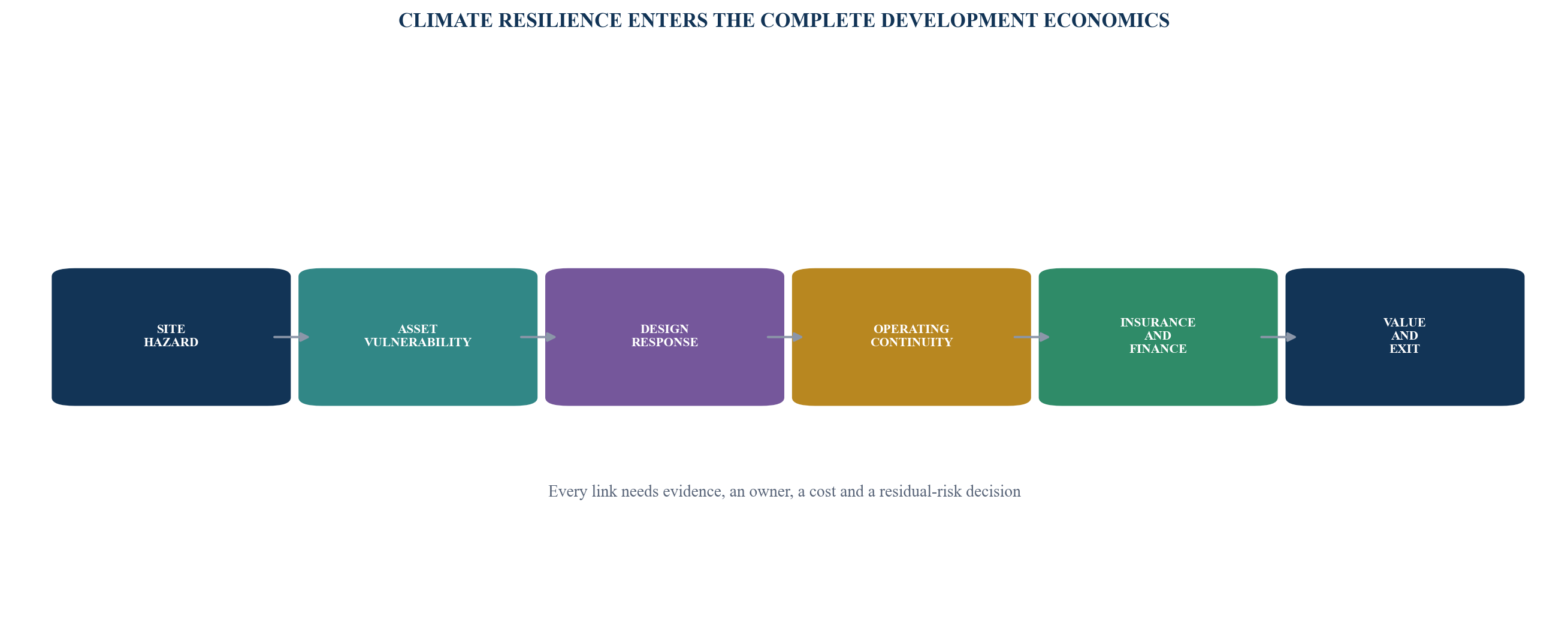
The sequence is a decision framework; project pathways depend on evidence and design.
2. Establish an authoritative site-risk baseline
The baseline should be location-specific, time-specific and suitable for the decision. National strategies describe material pressures and policy direction. Building codes define minimum requirements. Project feasibility needs site data, survey, levels, hydrology, drainage, utility information, climate projections and the planned asset life.
The UAE National Climate Change Plan seeks to minimise climate risks and improve adaptation capacity. MOCCAE's national assessment identifies climate-associated hazards including heat, water stress and heavy rainfall and describes adaptation measures across key sectors. These official sources establish the relevance of adaptation. They do not replace a site study.
For each hazard, the developer records the data source, resolution, baseline period, projection horizon, scenario, confidence, asset life and update date. Historical observations and future projections should remain distinct. A model can use several horizons because construction, stabilisation, loan maturity and exit occur at different times.
The baseline also maps dependencies outside the plot. Access roads, power substations, water supply, sewerage, district cooling, communications, emergency response and neighbouring drainage can determine whether the asset remains usable. A building can resist direct damage and still lose revenue because a shared system fails.
Table 1. Site climate-risk evidence register
| Hazard or dependency | Core evidence | Feasibility variable | Accountable review |
|---|---|---|---|
| extreme heat | observed and projected temperature, humidity and duration | peak load, energy, comfort, public-realm use and labour | climate, MEP and operations |
| water stress | utility capacity, demand, storage, reuse and interruption | capex, water cost, landscape and continuity | utility, civil and operations |
| intense rainfall and flood | levels, hydrology, drainage, return periods and access | elevation, drainage, damage, delay and downtime | hydrology, civil and structural |
| coastal exposure | sea level, surge, erosion, groundwater and asset horizon | site design, foundations, equipment and residual value | coastal, geotechnical and structural |
| wind and storm | design wind, debris, envelope and external equipment | façade, roof, testing, repair and interruption | structural and façade |
| external networks | power, water, cooling, roads, telecoms and emergency routes | redundancy, storage, access and business continuity | utility and operating team |
Required evidence and professional roles depend on location, asset and decision stage.
3. Separate hazard, exposure, vulnerability and consequence
A hazard is a potentially damaging physical event or chronic condition. Exposure identifies the people, building components, equipment, operations and value present in its path. Vulnerability describes susceptibility to damage or loss of function. Consequence describes the financial, safety and operating result.
This distinction prevents a map colour from becoming a financial conclusion. Two neighbouring sites can have similar rainfall exposure and different loss because of elevation, drainage, basements, critical equipment, access and maintenance. Two identical buildings can have different heat consequences because of occupancy, operating hours, envelope performance and cooling redundancy.
The risk register should trace complete chains. An extreme-rainfall chain might connect rainfall intensity to off-site drainage, plot inflow, basement entry, electrical equipment, life safety, repair, access, tenant interruption, insurance and lender notification. A heat chain might connect outdoor conditions to solar gain, cooling capacity, power demand, equipment derating, indoor comfort, public-realm use, service charge and tenant retention.
Each chain receives a current control, proposed measure, residual exposure, test and financial treatment. Legal compliance is one gate. Investment resilience may require a performance objective above the minimum where the asset life, use, financing or operating dependency justifies it.
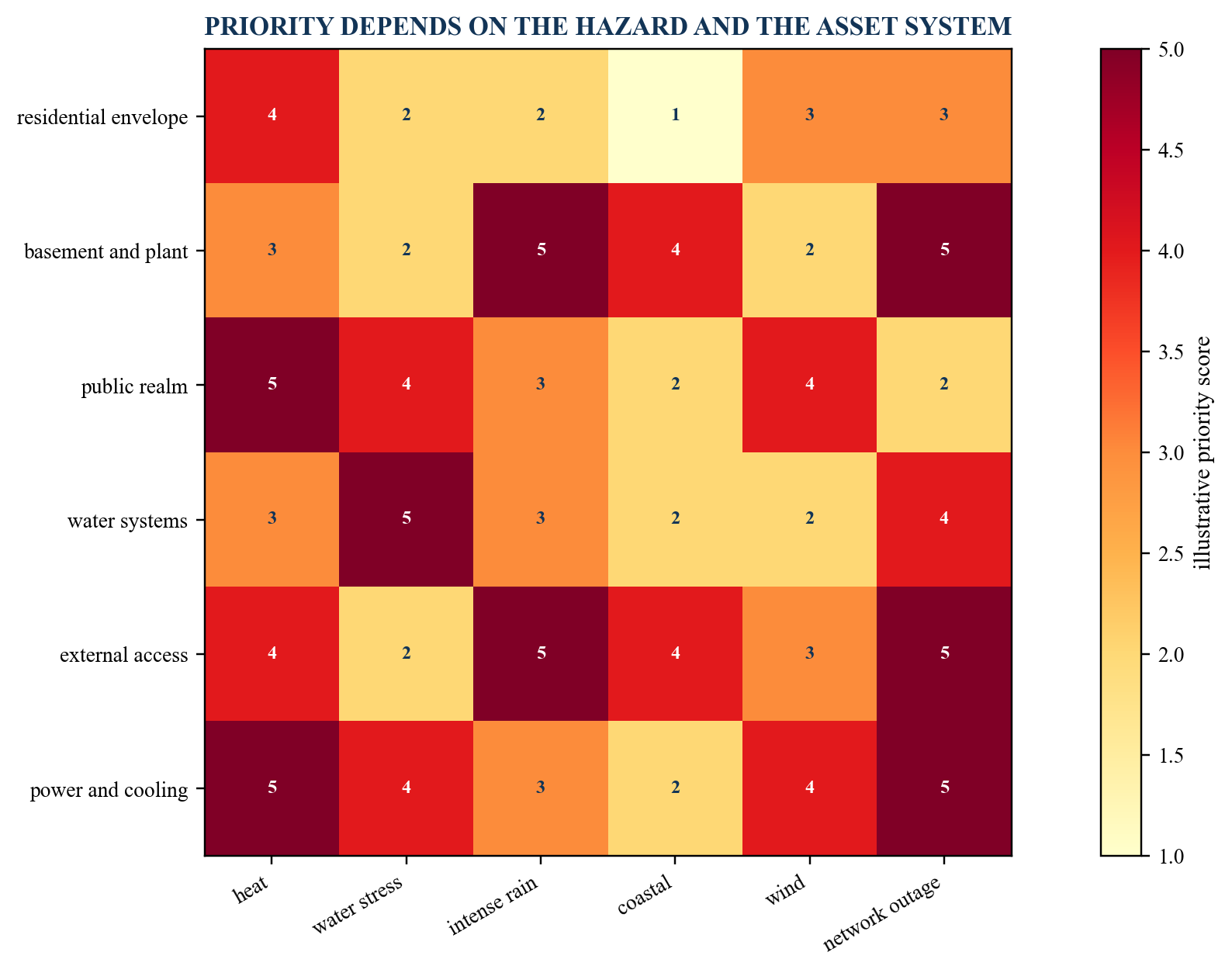
Scores are management assumptions for demonstrating prioritisation; they are not a site assessment.
4. Translate heat into design and cash flow
Heat affects a development before and after completion. During construction it can reduce safe working windows, change sequencing and increase welfare, cooling and logistics requirements. During operation it can increase cooling energy, peak capacity, equipment stress, maintenance and public-realm constraints. It can influence comfort, tenant experience and the usability of outdoor amenities.
The heat model begins with design conditions and future conditions across relevant horizons. It then tests orientation, shading, glazing, insulation, airtightness, thermal mass, ventilation strategy, roof treatment, landscaping, district cooling or plant performance, equipment duty and control systems. Whole-building energy and thermal-comfort modelling should use project-specific inputs.
Dubai Municipality states that the Dubai Building Code sets minimum requirements for health, safety, environmental impact and sustainable development. Its supporting schedules include thermal and air-conditioning calculations. Code compliance provides a required baseline. The investment case can test additional measures against avoided capacity, operating cost, replacement, downtime and market objectives.
The feasibility should avoid double counting. A higher-performance envelope may reduce cooling plant and operating energy, while adding façade cost. Shading may improve comfort and reduce solar gain, while affecting architecture or saleable views. Landscape cooling may increase water demand unless planting, irrigation and reuse are designed together.
5. Build a water balance for normal and disrupted operation
Water enters feasibility through supply capacity, connection, consumption, tariff, landscape, cooling, leakage, treatment, storage, reuse and emergency operation. A gross consumption assumption cannot show which intervention creates value.
The project water balance separates potable use, irrigation, cooling, amenities, cleaning, losses, treated water and recovered sources where applicable. It records daily demand, peak demand, seasonal range and critical minimum. The balance is tested against utility availability, storage, pressure, quality, maintenance and interruption.
The UAE Water Security Strategy 2036 aims to sustain access in normal and emergency conditions. Official DEWA reporting connects water security to production, storage, network resilience and resource efficiency. The developer uses current utility requirements and capacity evidence for the project rather than assuming that a national target establishes plot-level service.
Measures can include efficient fixtures, leak detection, pressure management, drought-tolerant landscape, irrigation controls, condensate recovery, treated-water connections, suitable on-site treatment, storage and emergency procedures. Each measure needs water-quality, health, maintenance, energy, space, capex and operating review. Storage without turnover and maintenance can introduce another risk.
Table 2. Climate inputs to the development feasibility
| Input | Base case | Resilience case | Financial connection |
|---|---|---|---|
| cooling demand | current design model | future-condition and stress tests | plant capex, energy, service charge and replacement |
| potable water | use intensity and tariff | efficiency, reuse, storage and interruption | connection, capex, opex and continuity |
| drainage | code and site baseline | severe-event and dependency tests | earthworks, drainage, equipment and damage |
| insurance | current indication | peril-specific terms and sensitivities | premium, deductible, exclusions and lender conditions |
| construction programme | standard productivity | heat and severe-weather allowances | preliminaries, delay, labour and contingency |
| occupancy and pricing | market assumptions | comfort, continuity and disclosure response | absorption, rent, vacancy and incentive |
| exit yield or value | conventional market case | insurance, operating and resilience scenarios | terminal value and refinancing |
Values and treatment require project-specific modelling and professional advice.
6. Model rainfall, flood and drainage as a system
Flood analysis should follow water from source to consequence. It considers rainfall, upstream catchment, off-site networks, plot grading, inlets, conveyance, attenuation, discharge, groundwater, coastal interaction and blocked-path conditions. The model identifies entry routes, depths, velocities, duration and recovery.
Critical equipment deserves a separate register. Electrical rooms, pumps, controls, generators, fuel systems, communications, lifts, fire systems, cold rooms and data equipment can determine recovery. Their elevation, protection, access, redundancy, spares and test regime should connect to the business-continuity plan.
The financial scenario includes direct repair, professional fees, clean-up, tenant or buyer consequences, temporary operation, lost revenue, insurance deductible, uninsured items, claim timing and financing carry. Prevention cost and residual loss remain separate. A measure that reduces expected damage can still have weak economics if it solves a low-consequence exposure or creates significant lifecycle cost.
The developer should also test construction-phase rainfall and access. Excavation, temporary drainage, stored materials and unfinished envelopes have different vulnerabilities from the completed building. Contract responsibilities, weather allowances, insurance and emergency arrangements need alignment with the programme.
7. Price adaptation measures across the lifecycle
An adaptation option should have a defined performance objective rather than a broad resilience label. The option record includes hazard, component, design change, initial cost, design dependency, embodied impact where relevant, operating cost, maintenance, replacement, test, useful life and residual risk.
The financial analysis uses incremental cash flows. Initial capex can be offset by avoided base design, smaller equipment, reduced repair, lower downtime, improved operating performance or financing benefit. Some benefits are uncertain or difficult to attribute. The model presents them as scenarios rather than guaranteed savings.
Timing matters. Passive site and structural measures can be expensive to retrofit after design or construction. Controls, monitoring and operating procedures can often be phased. The stage-gate should identify irreversible decisions, long-lead items and options that preserve future flexibility.
The developer can rank options through four lenses: life safety and mandatory requirements; protection of critical function; risk-adjusted financial value; and strategic market or financing value. A single payback period is insufficient for measures whose benefit occurs through rare events or terminal value.
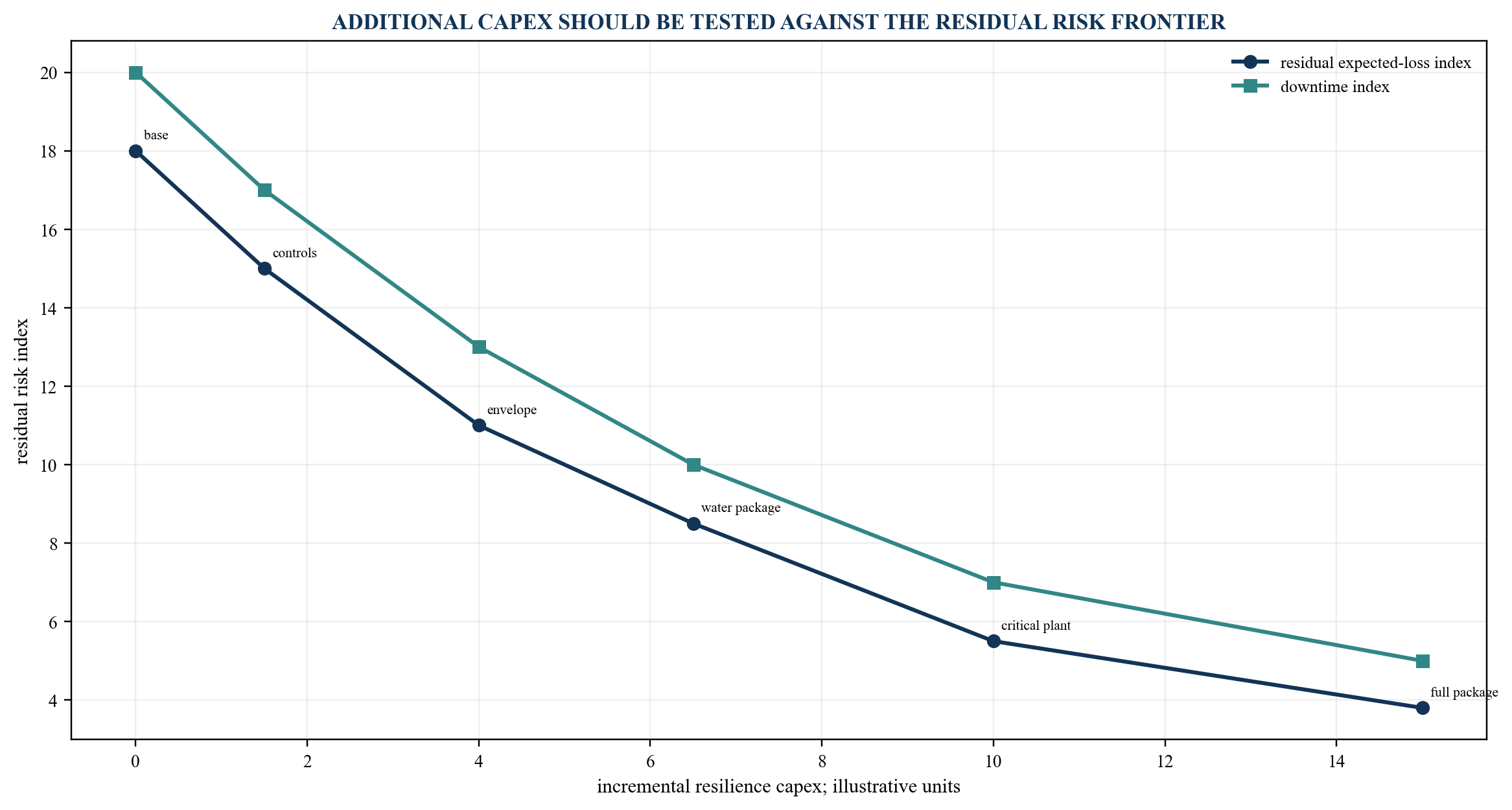
Values are management assumptions; engineering performance, loss and insurance effects require project evidence.
8. Put resilience into sources, uses and contingency
Resilience capex should appear in the cost plan by measure and package. Hiding it inside design development or general contingency prevents management from seeing which risk is funded. The sources-and-uses schedule can show mandatory works, selected enhancements, enabling infrastructure, professional analysis, testing and lifecycle reserves.
Contingency has a separate role. It covers defined uncertainty in cost and scope at the stage. It does not substitute for a known flood barrier, cooling redundancy or water-storage requirement. Once a measure is selected, its estimate moves into the relevant cost package with design maturity and procurement status.
The finance model should show draw timing. Early site work, utility upgrades and design studies can precede revenue-producing construction. Long-lead equipment can create deposits and storage cost. Adaptation measures may also change lender technical diligence or green and resilience financing eligibility; any financing benefit requires current term evidence.
Management should compare three cases: minimum compliant design; selected resilience design; and severe residual-risk case. The comparison shows total development cost, equity need, debt draw, interest, completion timing, operating result, insurance, expected loss and terminal value.
Table 3. Adaptation measures and financial channels
| Measure | Primary risk addressed | Cost treatment | Potential financial channel |
|---|---|---|---|
| solar control and envelope improvement | heat and cooling load | façade and design capex | plant size, energy, comfort and maintenance |
| protected or elevated critical plant | flood and service interruption | structural, MEP and access capex | repair, downtime, insurance and continuity |
| drainage and temporary storage | intense rainfall and plot inflow | civil works and land allocation | damage, access, programme and residual risk |
| efficient fixtures and leak detection | water demand and loss | equipment, controls and maintenance | consumption, incident cost and service charge |
| suitable reuse and storage | water interruption and demand | treatment, tanks, space and testing | continuity, landscape and potable demand |
| backup power or cooling strategy | network outage and heat | equipment, fuel or service contract | safety, tenant continuity and lost revenue |
Measures are illustrative; suitability depends on site, asset, design and current requirements.
9. Treat insurance as a design input and financing condition
Insurance should enter before the design is fixed. The developer needs an early view of relevant perils, available coverage, limits, sublimits, deductibles, exclusions, waiting periods, reinstatement, business interruption, construction cover, completed-asset cover and lender requirements.
EIOPA's catastrophe protection-gap dashboard brings together economic losses, insured losses, risk estimation and coverage across European countries. EIOPA also describes risk-prevention incentives in underwriting and pricing. The Bank of England explains that physical risks can affect property value, insurance availability and affordability, credit risk and loss given default. These official findings demonstrate financial channels. They do not establish the terms available to a specific project.
The insurance workstream therefore seeks project indications and coverage language. It gives the broker and insurer site studies, design measures, maintenance standards, continuity plans and claims information where available. Management records which measures influence underwriting and which remain prudent without a premium benefit.
The base case separates insured and uninsured loss. A policy limit can be inadequate for a portfolio event. A high deductible transfers frequent loss to the owner. Exclusions, sublimits, aggregation, waiting periods and claim delays can create liquidity needs. Lenders may require coverage even when its price weakens feasibility.
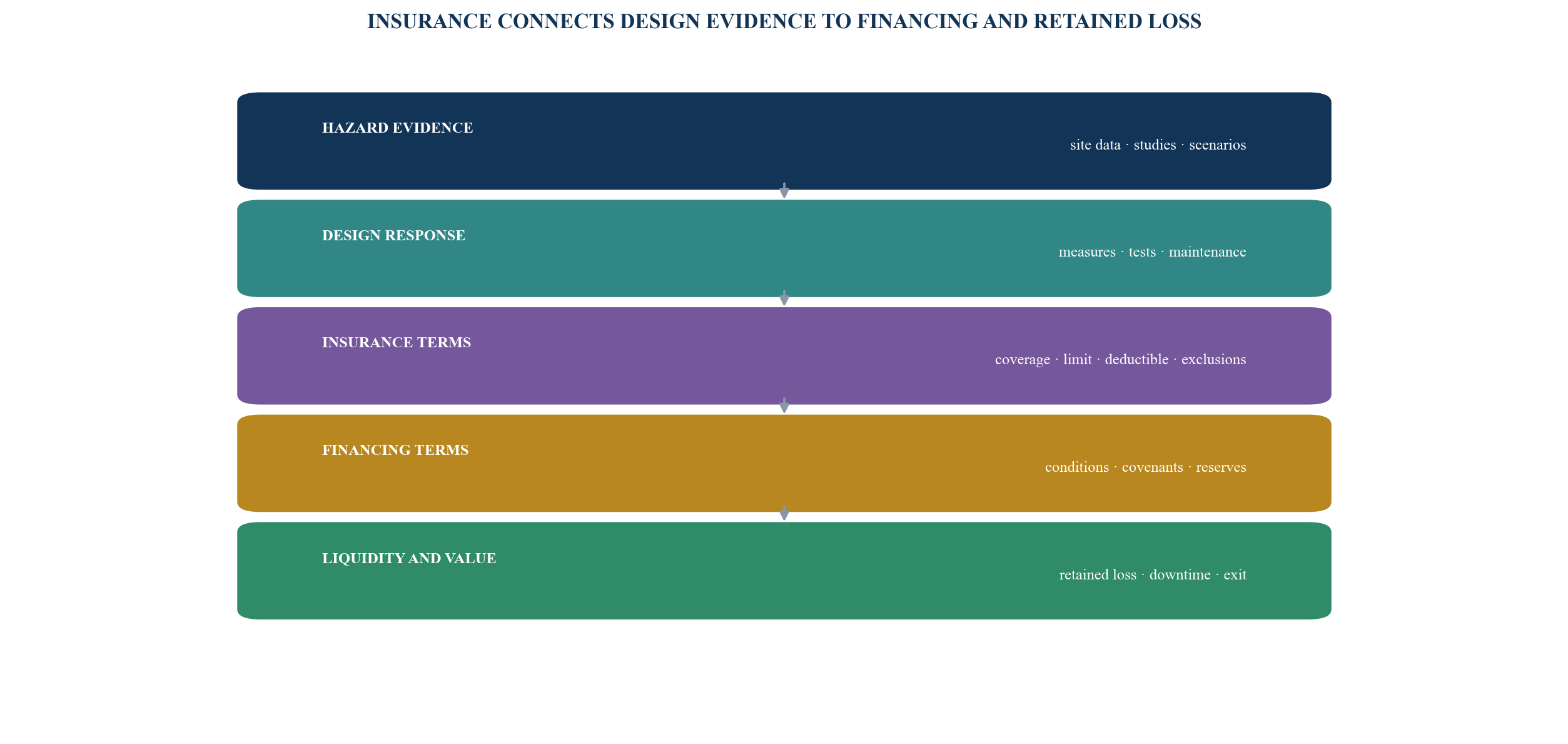
Project documents and decision rights vary by jurisdiction, policy and financing agreement.
10. Build a climate-adjusted operating model
Resilience depends on operation after handover. Pumps, barriers, drainage, filters, sensors, backup systems, storage, controls, envelope components and emergency routes need inspection, testing, maintenance, spares and named responsibility. A design measure without an operating budget can deteriorate before the event it was intended to address.
The operating model defines normal, alert, event and recovery states. It identifies decision thresholds, notifications, occupant communication, contractor support, authority coordination, alternative access, critical loads and recovery priorities. Tests should include loss of external utilities and simultaneous failures where relevant.
The feasibility includes recurring inspection, preventive maintenance, monitoring, calibration, testing, insurance engineering, training and replacement. It also includes the service-charge or operating-cost allocation permitted under the project's legal and commercial structure. An unfunded resilience obligation can become a future owner or community dispute.
Data supports learning. The asset records heat conditions, energy, water, leakage, alarms, drainage performance, equipment failure, incident cost, downtime, complaints, claims and recovery. Management compares actual performance with design assumptions and updates controls and reserves.
11. Stress-test construction productivity and programme
Climate exposure can affect the construction phase differently from the completed asset. Heat influences safe working practices, labour scheduling, equipment, curing, material storage and inspection. Rainfall can affect excavation, temporary works, access, logistics and unfinished interiors. Wind can affect cranes, façades and lifting.
The programme should identify activities with weather sensitivity, thresholds, historical allowances, future conditions, alternative sequencing and recovery options. Contract terms should define responsibilities, notices, evidence, relief, insurance and mitigation. The financial model should not assume that every weather day is compensable or recoverable.
Productivity assumptions need local contractor input and current safety requirements. The developer can test early or night work where permitted, off-site manufacture, temporary cooling, protected logistics, modular sequencing and additional float. Each option has cost, approval, workforce and interface consequences.
The severe case connects delay to preliminaries, financing carry, sales, handover, liquidated damages, contractor liquidity and insurance. A portfolio view can reveal correlated exposure where several projects share the same workforce, logistics route or weather event.
12. Protect revenue, affordability and customer trust
Climate resilience can influence revenue through several mechanisms. Comfort, operating cost, service continuity and amenity usability can affect customer experience. Insurance and financing availability can affect purchaser or investor diligence. Disruption, damage and visible failure can affect absorption, occupancy and reputation.
The developer should avoid assuming a universal resilience premium. Market evidence may be limited, mixed or location-specific. The model instead tests customer segments, competing supply, disclosed features, service-charge implications, evidence and downside protection. Any price or absorption benefit remains a scenario until transaction evidence supports it.
Disclosure should be specific. A development can state the studies performed, design objectives, selected systems, tests, operating arrangements and limitations. Broad claims of being climate-proof or future-proof are unsupported because conditions, dependencies and performance can change.
Affordability matters. Resilience capex can raise price or service charge, while lower energy, water or expected disruption may reduce lifecycle cost. The sales and leasing case should present current estimated costs and assumptions without promising future bills, insurance terms or asset values.
13. Connect physical risk to lending and refinancing
Lenders can encounter physical climate risk through construction delay, cost overrun, collateral damage, revenue interruption, insurance gaps and lower exit value. The Bank of England has described how physical risk can affect mortgaged-property value, insurance and loss given default. Project lenders will apply their own policies, technical reviews and credit decisions.
The financing data room can include the hazard baseline, design risk register, resilience cost plan, permits, technical studies, insurance indications, construction controls, testing, operating plan and residual-risk statement. The developer distinguishes completed evidence from future commitments.
Loan terms may require insurance, reserves, technical sign-off, completion tests or ongoing reporting. These obligations enter the programme and cost plan. A resilience-linked financing claim needs a defined use of proceeds, eligibility criteria, reporting and verification route under the applicable product.
Refinancing analysis uses conditions at the expected date rather than assuming current availability. It tests property value, stabilised income, capex reserve, coverage, remaining exposure and lender appetite. A long-life asset may face standards and market expectations that evolve after the original loan.
14. Model expected loss and severe-event liquidity separately
Expected annual loss is a probability-weighted measure across event severities and consequences. It can support comparison between designs, although it depends on data and modelling uncertainty. Severe-event liquidity asks how much cash is needed in a plausible adverse event before insurance, recovery or refinancing proceeds arrive.
The model should show gross damage, interruption, emergency cost, deductible, excluded items, policy limits, claim timing, contractor or third-party recovery and owner liquidity. It should avoid treating all insurance proceeds as immediate or certain. Coverage interpretation and claim settlement depend on the policy and facts.
The resilience measure can affect event frequency, damage severity, recovery time or all three. A drainage measure may reduce probability of water entry. Elevated electrical equipment may reduce consequence once water enters. A continuity arrangement may shorten revenue interruption without reducing physical damage.
Management compares residual expected loss and severe liquidity with contingency, reserves, insurance and sponsor capacity. The board sees both an economic measure and a funding requirement.
Table 4. Insurance and retained-risk term sheet
| Term | Evidence required | Feasibility treatment | Decision question |
|---|---|---|---|
| covered perils | policy wording and schedule | map to hazard register | which material events are covered? |
| limit and sublimit | policy and aggregation basis | cap recoverable loss | is protection adequate for site and portfolio events? |
| deductible | peril and occurrence terms | owner-funded loss | what liquidity is required before recovery? |
| exclusions and conditions | full wording and endorsements | recognise uninsured exposure | which design or operating obligations affect cover? |
| business interruption | indemnity period, waiting period and basis | model revenue and delay recovery | does the period match realistic restoration? |
| claim timing | historic or advised process assumptions | delay cash receipt | how is repair funded before proceeds? |
| lender requirements | facility and insurance adviser review | include conditions and reserves | can the project maintain compliant cover? |
Terms are illustrative headings; actual coverage requires current broker, insurer and legal confirmation.
15. Use scenarios without false precision
Climate, construction, operating and market inputs contain uncertainty. The model should use a small number of transparent scenarios rather than a single precise adjustment. The base case uses the selected design and current evidence. The stress case changes hazard, outage, cost, insurance and recovery assumptions. The severe case tests correlated failure and constrained recovery.
Time horizons should match decisions. Design conditions can cover the useful life of systems. Residual value may use the expected hold and exit period. Financing tests loan maturity and refinancing. Long-lived structure and site decisions deserve longer horizons than replaceable controls.
Sensitivity analysis shows which inputs drive value: cooling energy, water tariff, adaptation capex, construction delay, premium, deductible, downtime, occupancy, rent, sale price, exit yield and claim timing. Interactions matter. Heat and external power failure can combine. Rainfall and access loss can delay both repair and customer return.
The board receives ranges and break-even points. It sees which resilience package remains viable if no price premium appears, insurance becomes more expensive, a lender requires extra protection or severe-event probability changes.
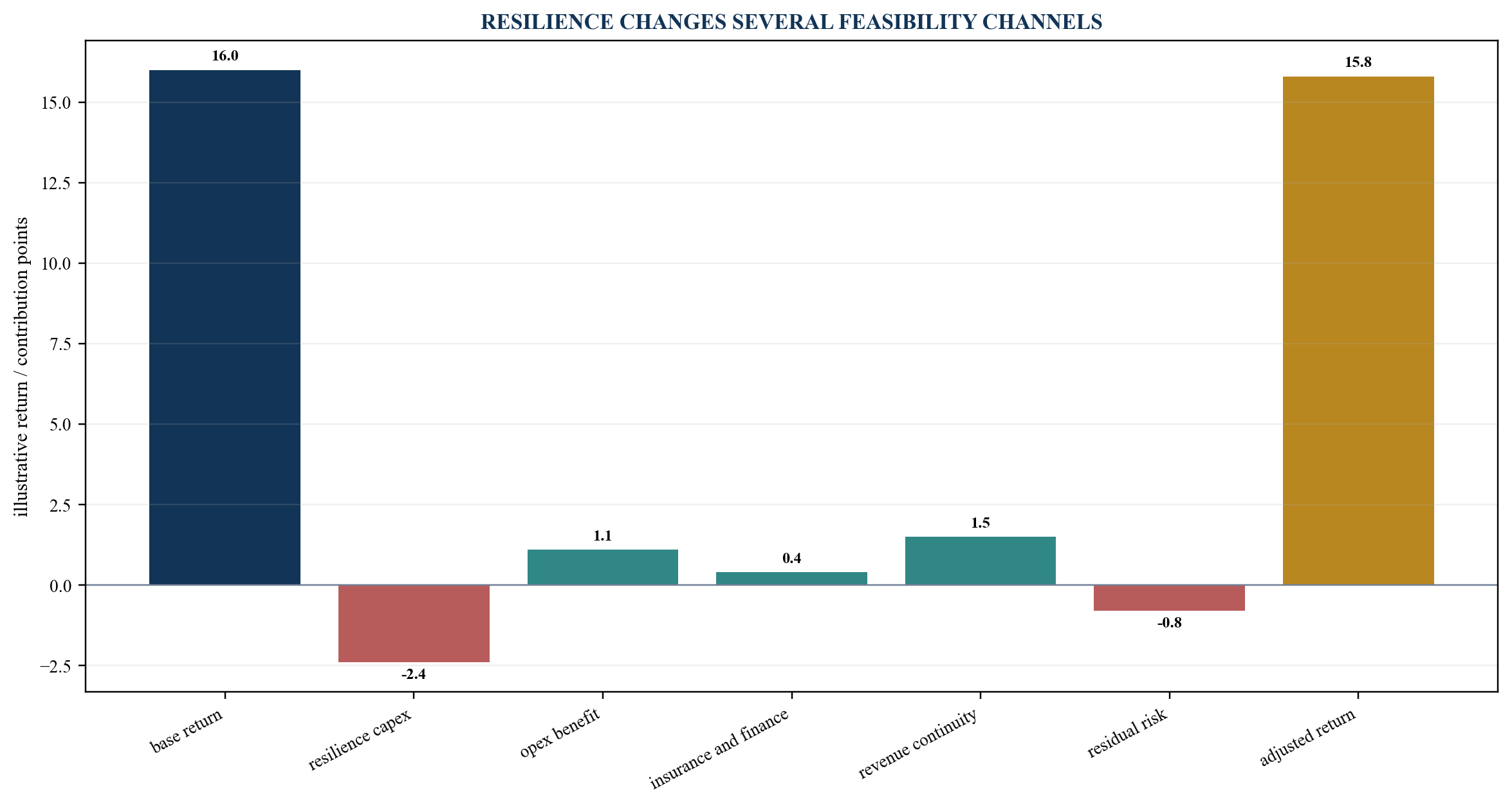
Percentage-point effects are management assumptions used to demonstrate the framework.
16. Create a resilience-adjusted residual value
Terminal value should reflect the asset's expected income, capex, marketability, financing and risk at exit. Climate resilience can enter through operating cost, downtime, insurance, required retrofit, buyer diligence and yield or valuation assumptions. The model should avoid adding the same risk to several inputs without reconciliation.
The exit case begins with the physical-risk register at the sale or refinancing date. It identifies remaining measures, useful life, compliance changes, loss history, insurance, maintenance and operating evidence. It then translates supported effects into net operating income, capex reserve or valuation scenario.
IFC's Building Resilience Index is designed to identify location-specific hazards and vulnerabilities, recommend measures and communicate resilience through a standardised rating. Its framework illustrates how structured disclosure can connect developers, financial institutions and insurers. A project-specific valuation still requires current market evidence and professional analysis.
The residual-value committee should understand whether resilience protects downside, supports access to capital, improves liquidity or produces a market premium. These are different propositions with different evidence.
17. Build a board-level resilience dashboard
The dashboard should connect physical evidence to financial decisions. It shows hazards by site and horizon, unresolved design decisions, funded adaptation capex, insurance gaps, construction exposure, operating readiness, severe-event liquidity and residual-value sensitivity.
Leading measures include studies completed, high-risk items without owners, design gates due, long-lead measures, insurer information gaps and critical-system tests. Outcome measures include energy and water intensity, incident frequency, downtime, damage, claims, recovery time, customer cases and cost variance.
Every red item has an exposure, decision, owner and deadline. A composite resilience score can support communication but should remain traceable to the underlying hazard, system and evidence.
Portfolio views reveal concentration by coastline, catchment, utility, insurer, contractor, equipment supplier or customer use. They also identify reusable design standards and procurement opportunities.
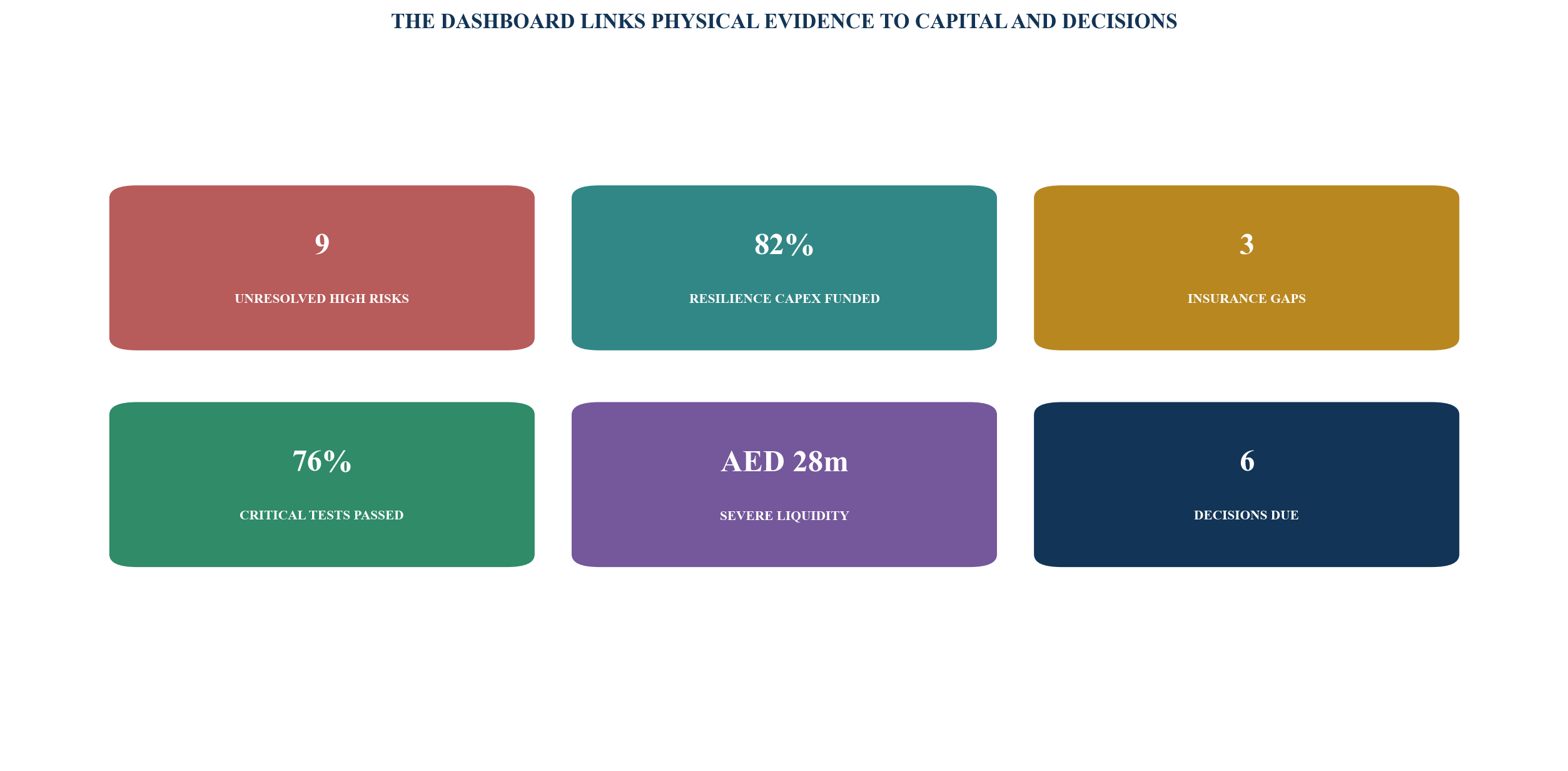
Values are management assumptions and do not represent an assessed project.
18. Run a ten-day climate-resilient feasibility diagnostic
Days one and two confirm the investment decision, site, asset programme, hold period, development model, climate evidence, design stage, cost plan, insurance work and accountable executives. The team creates one evidence register and source hierarchy.
Days three and four map hazards, dependencies, exposed systems and consequences. Site, civil, structural, envelope, MEP, landscape, utility, construction and operating teams test the principal risk chains.
Days five and six translate selected measures into design scope, capex, opex, programme, insurance, financing, revenue and terminal-value assumptions. Missing evidence and irreversible decisions are prioritised.
Days seven and eight build base, stress and severe cases. Expected loss, downtime, liquidity, insurance recovery, refinancing and customer effects remain separately visible.
Days nine and ten present the selected resilience package, deferred options, residual risks, decision gates, procurement needs, operating obligations and ninety-day roadmap. Management receives a signed assumption register rather than a single unexplained resilience score.
The diagnostic samples source documents and calculations. It checks whether hazard maps match the plot, whether design measures appear in drawings and costs, whether insurers received the relevant evidence, whether operating obligations are funded and whether the finance model uses the same assumptions. Contradictions become explicit decision items.
Table 5. Ten-day climate-resilient feasibility diagnostic
| Workstream | Diagnostic output | Acceptance evidence | Executive decision |
|---|---|---|---|
| risk baseline | site hazard and dependency register | sources, horizons, scenarios and limitations | approve decision baseline |
| asset vulnerability | system and consequence map | drawings, studies and operating use | prioritise critical systems |
| design and capex | measure register and cost bridge | performance objectives and cost evidence | select resilience package |
| insurance and finance | coverage, covenant and liquidity map | indications, wording issues and lender inputs | fund retained risk and conditions |
| feasibility | climate-adjusted base and stress cases | reconciled assumptions and sensitivities | approve investment case |
| implementation | ninety-day gated roadmap | owners, dates, tests and residual risks | mobilise delivery office |
Timing depends on project stage, information access and technical complexity.
19. Establish a ninety-day resilience value office
The first thirty days close evidence gaps and freeze decision rules. The team commissions priority studies, reconciles hazards and horizons, defines system performance objectives, obtains insurer and lender inputs and creates the climate-adjusted feasibility baseline.
Days thirty-one to sixty progress the selected design package. Cost planners price measures and avoided scope. The programme identifies interfaces and long-lead items. Procurement documents include performance, testing and information requirements. The insurance workstream tests coverage and retained loss.
Days sixty-one to ninety complete design gates, severe-event tests, operating requirements, customer disclosure, financing evidence and dashboard controls. Residual risks receive explicit acceptance or further action. A recurring forum governs changes in design, cost, climate data, insurance and market assumptions.
Change control is essential. Removing a drainage element, relocating plant, changing glazing, reducing storage or revising landscape can alter several financial channels. Each proposed change should show the affected hazard chain, capex saving, operating effect, insurance consequence and residual risk before approval.
The office maintains a decision trail suitable for the investment committee, lender, insurer, buyer or operator. It does not replace the statutory roles or professional responsibilities of designers, engineers, cost consultants, insurers, legal advisers and authorities.
20. Package advisory work around funded decisions
A site-and-feasibility diagnostic can serve a developer approaching land acquisition, concept approval or an investment committee. The paid outcome is a reconciled risk baseline, costed option set and climate-adjusted feasibility decision.
A resilience design and capital office can support a live project through design gates, cost planning, insurer engagement, lender diligence, procurement and testing. Its acceptance criteria are linked to drawings, estimates, decisions, test evidence and residual-risk approvals.
A portfolio insurance and liquidity review can map hazards, policy terms, deductibles, limits, downtime and severe-event funding across operating assets. The outcome is a prioritised programme for risk reduction, coverage decisions, reserves and recovery readiness.
A recurring retainer can monitor climate data, regulations, insurance renewal, project changes, incidents, tests, operating performance and portfolio concentration. The retainer requires named assets, reporting population, service levels, decision rights and escalation criteria.
Commercial qualification should establish an authorised buyer, current site or portfolio, dated investment or renewal decision, evidence access, budget route and accepted output. General concern about climate risk does not demonstrate willingness to appoint an adviser. A qualified opportunity connects the research topic to a funded decision and measurable deliverable.
The entry engagement can be fixed in scope where the sites, decision, evidence set and outputs are defined. Design support and implementation need separate phases when engineering, insurer or authority dependencies emerge. The adviser records signed scope, accepted deliverables, invoicing and collected fees against the client decision; marketing interest remains a leading indicator.
Table 6. Paid resilience mandate modules
| Module | Buyer decision | Core deliverable | Acceptance criterion |
|---|---|---|---|
| site diagnostic | acquire, redesign or decline | hazard, vulnerability and evidence register | signed decision baseline |
| feasibility reset | approve capital and returns | costed resilience package and scenarios | reconciled investment model |
| insurance and liquidity | coverage and retained risk | term map, severe liquidity and action plan | approved cover and funding decisions |
| design value office | progress gated design | requirements, cost, interfaces and tests | passed design and procurement gates |
| portfolio review | prioritise existing assets | concentration, capex and renewal roadmap | funded asset action plan |
| recurring resilience office | sustain controls and evidence | monitoring, tests, change and governance cadence | service levels and decision record |
Scope, fee, timing and outcomes require client-specific agreement.
References
- UAE Government. National Climate Change Plan of the UAE 2017–2050. https://u.ae/en/about-the-uae/strategies-initiatives-and-awards/strategies-plans-and-visions/environment-and-energy/national-climate-change-plan-of-the-uae
- UAE Government. National Climate Change Plan. https://u.ae/-/media/Documents-2024/National-Climate-Change-Plan.pdf
- UAE Ministry of Climate Change and Environment. UAE Climate Risk Assessment and Adaptation Measures in Key Sectors. https://site.moccae.gov.ae/assets/download/569cd759/UAE%20Climate%20Risk%20Assessment%20and%20Adaptation%20Measures%20in%20Key%20Sectors.pdf.aspx
- Dubai Municipality. Dubai Building Code. https://www.dm.gov.ae/municipality-business/planning-and-construction/dubai-building-code-2/
- Dubai Municipality. Publications Related to Building Regulation. https://www.dm.gov.ae/municipality-business/building-publications/
- Dubai Electricity and Water Authority. Sustainability Report 2025. https://www.dewa.gov.ae/-/media/Files/Sustainability/Sustainability_Report_English_2025.ashx
- Dubai Electricity and Water Authority. Ensuring Water Security and Sustainability. https://dewa.gov.ae/en/about-us/media-publications/latest-news/2024/01/dewa-ensures-water-security-and-sustainability
- Intergovernmental Panel on Climate Change. Climate Change 2022: Impacts, Adaptation and Vulnerability, Chapter 6. https://www.ipcc.ch/report/ar6/wg2/chapter/chapter-6/
- International Finance Corporation. Climate Adaptation Finance: The Unavoidable Opportunity. https://www.ifc.org/content/dam/ifc/doclink/latest/climate-adaptation-finance-the-unavoidable-opportunity.pdf
- International Finance Corporation. Sustainable Buildings: Finance Reference Guide. https://www.ifc.org/content/dam/ifc/doc/2025/sustainable-buildings-finance-reference-guide.pdf
- World Bank Group. Building Resilience Index: User Guide. https://documents.worldbank.org/en/publication/documents-reports/documentdetail/099055006302240701
- European Insurance and Occupational Pensions Authority. Dashboard on Insurance Protection Gap for Natural Catastrophes. https://www.eiopa.europa.eu/tools-and-data/dashboard-insurance-protection-gap-natural-catastrophes_en
- European Insurance and Occupational Pensions Authority. Addressing Protection Gaps. https://www.eiopa.europa.eu/browse/sustainable-finance/addressing-protection-gaps_en
- Bank of England. Climate-Related Financial Disclosure 2025. https://www.bankofengland.co.uk/climate-change/the-bank-of-englands-climate-related-financial-disclosure-2025
- Bank of England. Enhancing Banks' and Insurers' Approaches to Managing Climate-Related Risks. https://www.bankofengland.co.uk/prudential-regulation/publication/2025/april/enhancing-banks-and-insurers-approaches-to-managing-climate-related-risks-consultation-paper
About the Author
Chennakeshav Adya, Independent Researcher
