

1. Treat first-time-buyer policy as an operating channel
A public programme can create an identifiable pool of eligible buyers and a reason for them to engage. The developer's commercial result still depends on converting that pool into reservations, mortgage approvals, contracts, collections and completed registrations. A campaign that counts registrations without tracking funded completions can overstate absorption.
Dubai Land Department and the Dubai Department of Economy and Tourism launched the First-Time Home Buyer Programme in July 2025. DLD describes priority access to new launches, preferential prices, flexible payment plans for off-plan units and mortgage benefits through participating banks. DLD also explains that successfully registered buyers receive a QR code and that selected developers can contact eligible buyers before project launches.
This creates a structured channel with valuable eligibility evidence. The developer still has to decide which units to allocate, what benefit to offer, how to coordinate banks, how to protect price integrity and how to measure incremental conversion. The channel needs a named owner, offer rules, data permissions, service levels and a reconciled record from lead to registration.
The operating model treats each buyer as a sequence of decisions. Policy eligibility, property eligibility, affordability, mortgage suitability, deposit readiness, documentation, reservation, contract, construction-linked payments and completion are separate states. A buyer can pass one state and fail another.
The core metric is funded absorption: eligible units that reach a defined cash and legal milestone within the period. Supporting measures explain why buyers move, pause or exit.
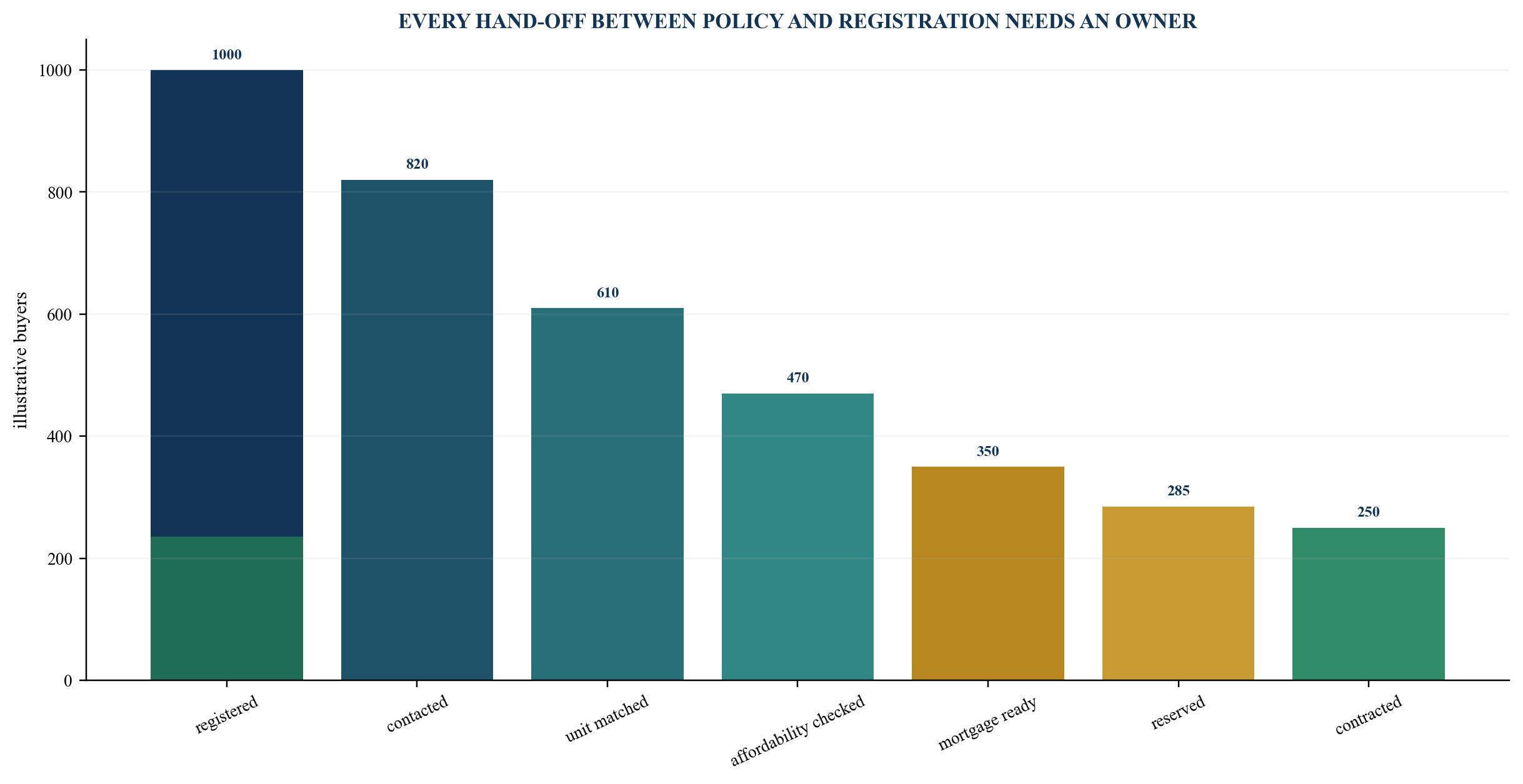
Volumes and conversion rates are illustrative management assumptions.
2. Separate policy, property and lender eligibility
Eligibility has several layers. DLD states that the Dubai programme is open to UAE residents of any nationality who are at least 18, do not currently own a freehold residential property in Dubai and seek a property below AED 5 million. The programme covers off-plan benefits through participating developers and ready-property mortgage benefits through participating banks.
Programme eligibility does not constitute a mortgage approval. A lender applies its current credit policy, verifies income and obligations, assesses the property and follows applicable CBUAE requirements. A developer should avoid representing the programme confirmation or QR code as evidence that finance has been approved.
Property eligibility is also distinct. A particular unit may fall outside programme scope, a developer offer, a bank's acceptable collateral or a buyer's price capacity. Joint purchases require the current programme conditions to be checked for every proposed owner. The developer's rules engine should therefore record the source and date of each decision.
The control record separates verified fact from pending evidence. Identity, residence, ownership status, property value, programme confirmation, income, liabilities, deposit source, lender pre-assessment and valuation should never be collapsed into one green flag.
Eligibility changes require event triggers. A purchase, residency change, new obligation, expired document, altered unit price or changed lender offer can reopen a decision. The buyer should receive a clear explanation of which party made each decision and what remains outstanding.
Table 1. Eligibility and evidence map
| Decision layer | Core question | Primary evidence | Accountable decision-maker |
|---|---|---|---|
| programme | does the buyer meet current public-programme criteria? | programme confirmation and current official rules | programme authority |
| buyer identity | is the applicant verified and authorised? | identity, residence and ownership records | responsible onboarding party |
| property | is the unit within programme and lender scope? | unit schedule, price, title and project records | developer and lender within their roles |
| affordability | can the buyer fund deposit, costs and instalments? | income, liabilities, savings and cash-flow evidence | buyer and financial adviser |
| mortgage | does the application meet lender and regulatory requirements? | lender application, valuation and credit decision | participating lender |
| legal completion | can the transaction contract and register? | contract, approvals, funds and conveyancing record | authorised transaction parties |
Current programme, lender and transaction requirements must be verified for each buyer.
3. Build one authoritative buyer funnel
Developers often hold fragmented buyer records across portals, brokers, sales teams, banks, customer service and project systems. Duplicate leads, inconsistent status labels and missing timestamps make the funnel difficult to manage. A single buyer record should link every application, consent, property interest and transaction state.
The record begins with a unique buyer identifier and programme reference where available. It then captures permission to contact, channel source, preferred location, unit type, price range, household composition, target move date, funding route, deposit position and documentation status. Sensitive information should be minimised and handled under applicable privacy rules.
Each stage needs entry and exit evidence. “Interested” can mean a web enquiry, a completed programme registration or a selected unit. “Mortgage ready” can mean a rough affordability indication, an approval in principle or a binding offer. The status dictionary should remove this ambiguity.
Loss reasons require discipline. Price, deposit, monthly payment, valuation, documentation, credit, property mismatch, timing, service failure and changed intent produce different management actions. “No response” should identify the number, timing and channel of attempted contacts.
The funnel should preserve reversals. A buyer can move from approval to pause, change units, lose an offer, replenish a deposit or return for a later launch. Cohort history supports better allocation and forecasting than a current-status snapshot.
4. Model the complete affordability gap
The relevant affordability gap extends beyond purchase price less maximum mortgage. The buyer needs deposit, registration charges, valuation and processing costs, insurance where applicable, broker or legal costs where applicable, furnishing and moving cash, and resilience for rate or income changes. The developer should not treat a nominal deposit as the complete cash requirement.
CBUAE mortgage regulations specify maximum LTV ratios, including first-house or owner-occupier categories, and require the buyer's down payment to come from the buyer's own resources rather than other borrowing such as personal loans or credit cards. Lenders can apply more conservative limits and additional underwriting.
The model begins with verified income and recurring obligations. It calculates a prudent monthly-payment range, available deposit, transaction costs and cash reserve. It then compares unit price, payment timing and potential mortgage capacity. The result is a range, because interest rates, valuations, income recognition and lender decisions can change.
A developer can address a timing gap with a suitable payment plan, a price gap with a documented discount, or a qualification gap through earlier evidence and lender coordination. Each intervention solves a different problem. Extending payments can increase completion exposure if the buyer's future mortgage capacity remains uncertain.
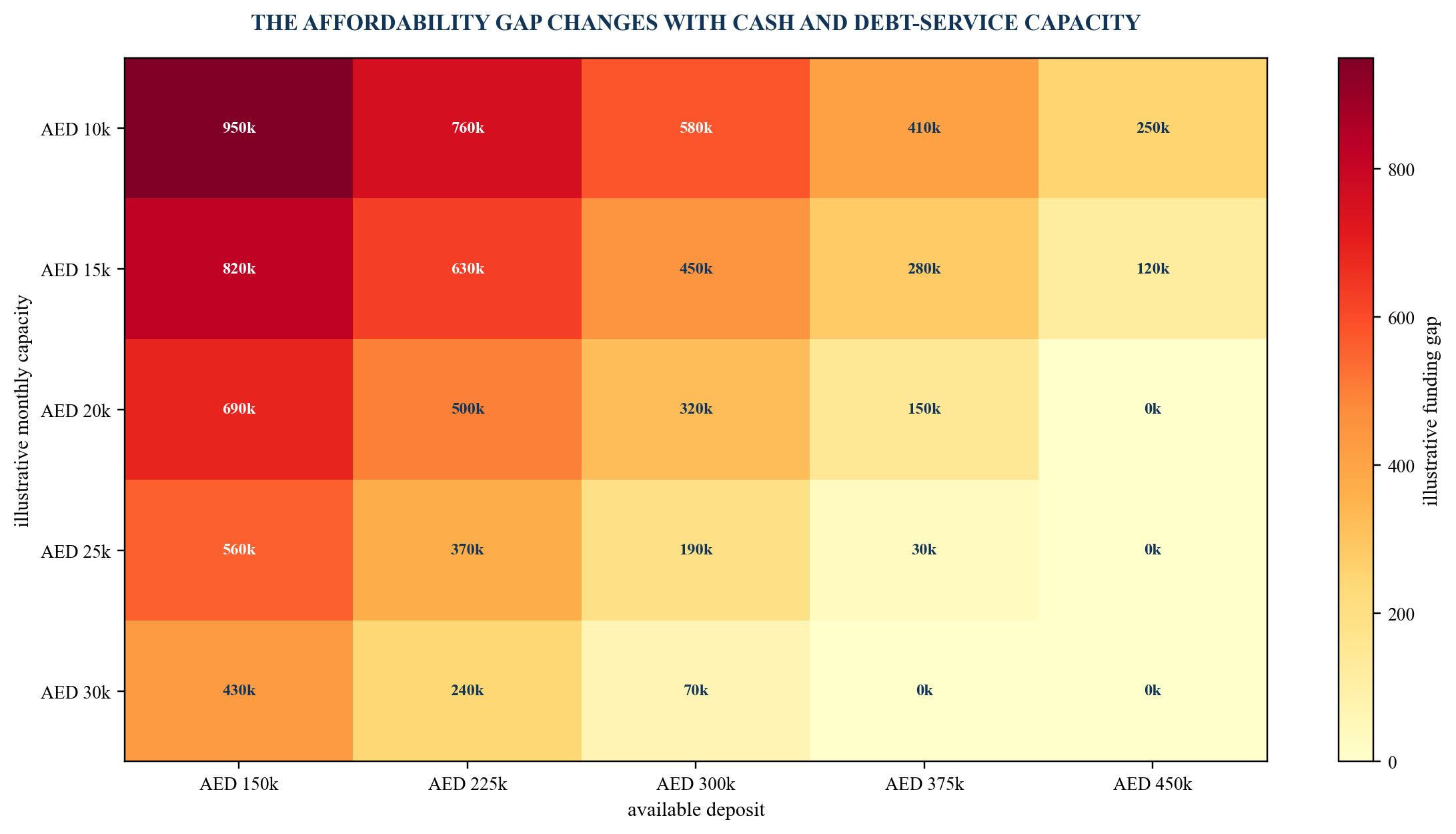
Values are illustrative management assumptions and do not represent credit advice.
Table 2. Buyer affordability bridge
| Component | Evidence | Base treatment | Key sensitivity |
|---|---|---|---|
| available deposit | verified own-source funds | include after preserving required costs and reserve | timing and source verification |
| mortgage capacity | lender assessment and valuation | use current evidenced range | rate, income recognition and collateral value |
| transaction costs | current official and provider charges | add to buyer cash requirement | waivers and offer conditions |
| developer incentive | approved unit-specific offer | reflect documented economic value | margin, price integrity and expiry |
| payment plan | signed schedule and construction timing | model each dated cash obligation | buyer income and completion refinancing |
| resilience reserve | buyer-selected prudent buffer | keep outside committed purchase cash | employment, rate and life events |
Values require buyer-specific evidence and current lender terms.
5. Segment inventory by financeability
The programme channel should not receive a random collection of units. Inventory needs segmentation by price, unit type, completion date, mortgageability, required deposit, payment schedule, service charges, likely valuation, buyer use case and current sales velocity.
A unit below the programme ceiling can still be unaffordable for the target cohort. Large units, high service charges or near-term completion can create a cash requirement that a first-time buyer cannot meet. A lower-priced unit with a clear payment schedule can convert more reliably.
The developer should identify a financeable core, a payment-plan cohort, a lender-led ready-property cohort and a specialist cohort requiring individual structuring. Units with unusual title, valuation, completion or eligibility issues should remain outside standard campaigns until the issues are resolved.
Allocation rules protect fairness and price integrity. The developer records the number of units, release time, eligible population, selection method, hold period, benefit and reallocation path. Sales teams and brokers should see the same rules.
The economic objective is incremental absorption at an acceptable contribution margin and cash profile. A unit already likely to sell at full price may not need the same benefit as slow inventory whose buyer pool expands materially through finance support.
Table 3. Financeability-based inventory segmentation
| Segment | Typical characteristic | Primary intervention | Release condition |
|---|---|---|---|
| financeable core | accessible price, standard unit, lender-ready evidence | priority access and rapid bank routing | verified programme and unit eligibility |
| deposit-constrained | adequate income, insufficient immediate cash | suitable staged payment plan | evidenced own-source funds and schedule capacity |
| monthly-payment constrained | deposit available, debt service tight | smaller unit or lower total price | prudent affordability assessment |
| ready-property | completed unit and current valuation | lender-led approval and completion workflow | acceptable title, valuation and bank decision |
| complex | unusual documentation, timing or property features | specialist review | resolved legal, valuation and credit questions |
| non-incremental | likely full-price sale without support | limited or no incentive | evidence of incremental value before allocation |
Segments and actions are illustrative and require project evidence.
6. Convert benefits into measurable economics
Priority access, preferential pricing, payment plans, fee support, upgrades and mortgage benefits have different economic costs and conversion effects. The developer should calculate the unit-level cost, timing, accounting treatment and expected incremental completion probability.
A headline discount is visible and can affect comparables, buyer expectations and existing customers. A payment plan can preserve headline price but delay cash and increase credit exposure. A fee contribution can target the buyer's immediate cash barrier. An upgrade can have a lower developer cost than its perceived retail value. Each choice needs approval and disclosure.
The incremental test compares the expected contribution from the supported channel with the expected outcome without the support. The analysis includes sales probability, cancellation, collection timing, financing cost, broker cost, incentive cost and resale impact. Unsupported precision should be avoided; ranges and scenarios reveal the decision.
Benefits should have written eligibility, expiry, unit scope and combination rules. Sales teams should not improvise unrecorded side arrangements. A buyer needs a clear statement of which benefit comes from the programme, developer, bank or another party.
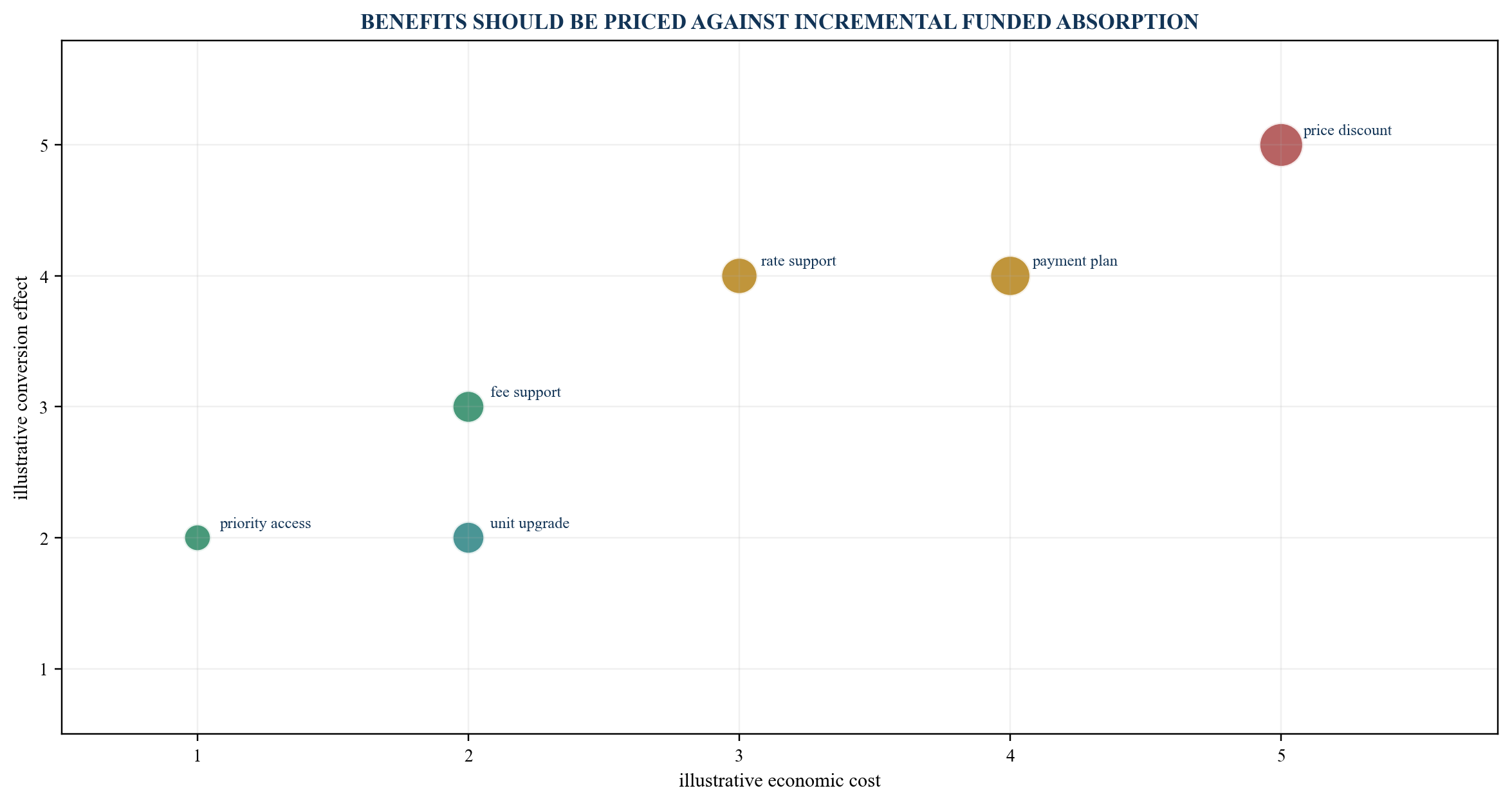
Scores and economics are illustrative management assumptions.
Table 4. Developer incentive economics
| Benefit | Developer cost | Buyer problem addressed | Principal control |
|---|---|---|---|
| priority access | allocation opportunity cost | scarce-unit access | transparent release and hold rules |
| price discount | direct revenue reduction | total price and deposit | approved valuation and price-integrity review |
| fee contribution | cash cost or receivable reduction | transaction-cost liquidity | documented cap and eligible charge |
| staged payment | delayed cash and credit exposure | deposit timing | affordability, collections and completion plan |
| upgrade package | procurement and delivery cost | perceived value and move-in cost | defined specification and availability |
| lender offer | generally borne under bank terms | rate, fee or process friction | bank-issued terms and no developer misrepresentation |
Economics and buyer outcomes require project- and offer-specific analysis.
7. Coordinate developers, brokers and banks as one journey
The buyer should not have to reconstruct the process from several organisations. The programme authority confirms programme eligibility. The developer owns unit availability, offer terms, reservation, contract and project delivery. The bank owns credit assessment, valuation, approval and mortgage documentation. Brokers act within their mandate. Legal and registration parties complete their functions.
A partner operating model defines the hand-off package at each transition. The bank needs accurate project and unit documents. The developer needs timely, permissioned status information rather than confidential underwriting details. The buyer needs a single checklist showing actions, owners and dates.
Service levels should distinguish acknowledgement, document completion, affordability indication, formal application, valuation, credit decision, offer and drawdown. Median response time can conceal aged cases, so the dashboard should show distributions and overdue populations.
Exceptions require a joint route. Valuation shortfall, income evidence, delayed completion, expired approval, unit change and documentation gaps should have named owners and escalation criteria. The operating model should preserve the lender's independent decision authority.
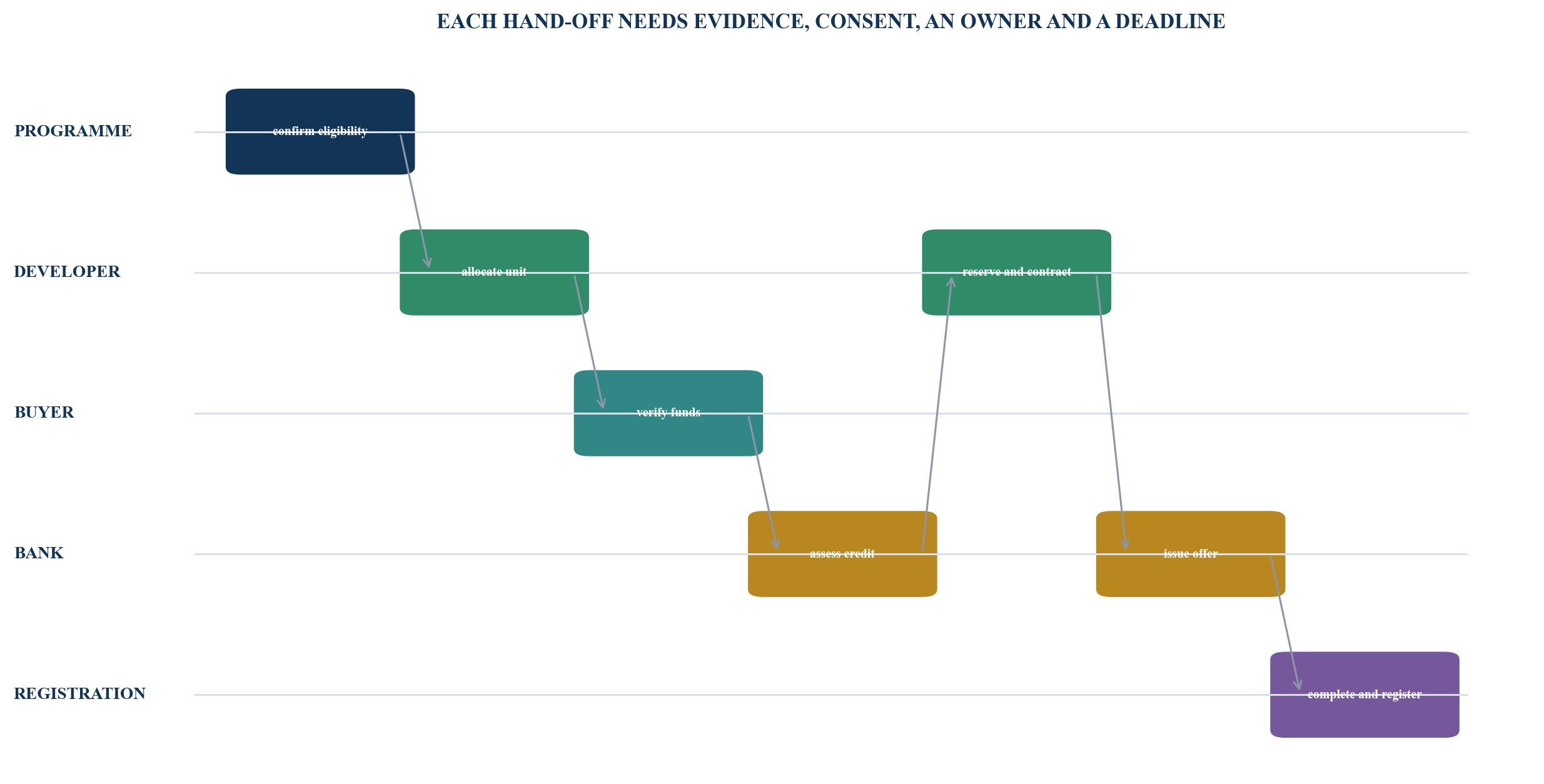
Responsibilities are illustrative and require formal agreement.
Table 5. Partner responsibilities and hand-off evidence
| Party | Core responsibility | Evidence shared through approved route | Escalation trigger |
|---|---|---|---|
| programme authority | programme rules and eligibility confirmation | current criteria and confirmation status | unclear or inconsistent eligibility result |
| developer | unit, offer, reservation, contract and delivery | unit pack, payment schedule and project milestones | unavailable unit, changed term or delivery risk |
| broker or sales adviser | accurate communication and buyer support | consented enquiry and interaction record | unsupported claim or incomplete disclosure |
| participating bank | independent credit, valuation and mortgage decision | permissioned process status and buyer actions | valuation gap, decline, expiry or delayed decision |
| buyer | complete information, funds and decisions | documents, consents, selections and payments | missing evidence or changed circumstances |
| legal and registration parties | contract, conveyancing and registration steps | completion checklist and authorised confirmations | unresolved title, contract or funding condition |
The legal allocation of responsibility depends on current agreements and law.
8. Establish mortgage readiness before reservation pressure
Early mortgage readiness reduces avoidable reservations that later fail. The process should explain that an initial affordability view is provisional and that only the lender can issue its credit decision. The buyer should understand the difference between eligibility, pre-assessment, approval in principle and final offer.
The readiness pack includes identity, residence, employment or business income, bank statements, liabilities, credit information, deposit evidence and the selected property details required by the relevant lender. Self-employed buyers and buyers with variable or overseas income may need longer evidence preparation.
The developer can improve execution by maintaining a current project data pack for participating banks. Title, approvals, construction status, unit details, payment schedule, insurance and handover information should be accurate and version-controlled. Repeated lender questions often reveal a project-document problem rather than a buyer problem.
Reservations should include a clear finance condition, refund rule and deadline where applicable. High-pressure deadlines can produce unsuitable choices and reputational risk. Sales staff should follow approved scripts for credit, rates, savings and future property values.
9. Design payment plans around completion capacity
A payment plan reallocates timing. It can help a buyer build the deposit while construction progresses, yet it can also move a large obligation to completion. The model should show each dated payment, expected income, cash accumulation, mortgage application point, valuation point and final funding source.
The buyer's future mortgage capacity remains uncertain. Rates, income, liabilities, policy, lender appetite and valuation can change. A plan that appears affordable at reservation can become unfinanceable at handover. Developers should monitor evidence and warn buyers to obtain appropriate advice.
The developer's cash model aggregates buyer schedules by project and cohort. It measures collections, overdue amounts, expected cancellations, completion balances and sensitivity to mortgage approval delays. A high volume of back-ended plans can create correlated settlement risk.
Interventions include earlier lender check-ins, smaller units, documented schedule changes, buyer equity top-ups or orderly exit routes where contractually available. Any change requires authorised terms and equal-treatment controls.
10. Protect buyer understanding and sales conduct
First-time buyers may be less familiar with off-plan risk, service charges, mortgage repricing, valuations, completion obligations and the consequences of default. The customer journey should present material information clearly and record acknowledgement without treating a signature as evidence of understanding.
Communications should identify the provider of every benefit and decision. A bank offer should be communicated as the bank's offer. Programme eligibility should not be described as a government guarantee of investment performance, mortgage approval or future value. Illustrations should show assumptions and downside cases.
Sales incentives and staff remuneration can affect behaviour. Quality controls review calls, messages, reservations, exceptions, refunds and complaints. Brokers need approved materials and monitoring. Translations should preserve the substance of the offer and warnings.
Data use requires consent, purpose limitation, controlled access, retention rules and secure transfer. A QR code or programme record should be used only through authorised channels. Sensitive credit information should not flow back to the developer unless the buyer permits it and the disclosure is lawful and necessary.
11. Maintain price and valuation integrity
Preferential pricing needs a reference price, effective date, eligible units and approval. A broad list-price comparison can exaggerate value if ordinary buyers receive similar discounts. The developer should calculate net effective price after all incentives and disclose material conditions.
Lender valuation can differ from contract price. The buyer may need additional equity when the valuation is lower. The funnel should flag valuation risk by unit type, project stage and transaction evidence. Repeated shortfalls require a pricing or documentation review.
England's First Homes guidance uses an independent valuation and a minimum discount against market value, with legal mechanisms intended to preserve the percentage discount on resale. The model differs from Dubai's programme, yet it demonstrates the operational importance of defining value, discount, title treatment and exit conditions.
The developer's price-integrity committee should review programme offers alongside ordinary sales, broker incentives, bulk sales and previous buyers. Decisions record incremental absorption, margin, cash timing, comparables and customer-treatment effects.
12. Learn from global policy architectures
Housing support programmes solve different gaps. Dubai combines verified eligibility with priority access, developer terms and bank participation. England's First Homes applies discounted market-sale requirements through planning obligations and title restrictions. Ireland's First Home Scheme can provide a shared-equity contribution for qualifying homes, while Ireland's Help to Buy can refund qualifying taxes within current limits and conditions.
The Irish First Home Scheme states that eligible buyers generally need participating-lender mortgage approval, maximum available borrowing under the scheme rules and a 10% minimum deposit. The scheme can provide up to 30% of purchase price or build cost, reduced when Help to Buy is also used. Its Q1 2026 update reported more than 10,000 approvals and described EUR 680 million available subject to demand.
Ireland Revenue states that Help to Buy applies to qualifying purchases or self-builds through 31 December 2029, subject to current conditions including property value and mortgage requirements. Revenue describes enhanced relief as the lesser of EUR 30,000, 10% of qualifying value or eligible taxes paid.
These models should not be imported without local analysis. They illustrate a design menu: demand priority, developer discount, deposit support, tax refund, shared equity, mortgage guarantee, planning contribution and resale control. Each changes who bears cost, risk, administration and upside.
13. Forecast absorption with cohorts and scenarios
The forecast should start with eligible buyers by registration cohort, preferred geography, price band, unit type and intended timing. It then applies evidenced conversion rates for contact, unit match, affordability, mortgage readiness, reservation, contract and completion.
Rates should use complete denominators and consistent windows. A reservation cohort needs time to mature before its completion rate is compared with older cohorts. Marketing leads, programme registrants and bank referrals should remain distinct.
Scenarios change key constraints. A higher-rate case reduces mortgage capacity. A valuation-downside case increases required equity. A delayed-completion case can extend approvals and alter buyer circumstances. A strong-demand case tests whether benefits are being given to buyers who would have completed anyway.
Forecast accuracy becomes a governance measure. Management compares predicted and actual transitions, identifies bias and revises assumptions. The cash forecast connects buyer-stage probability to dated project collections.
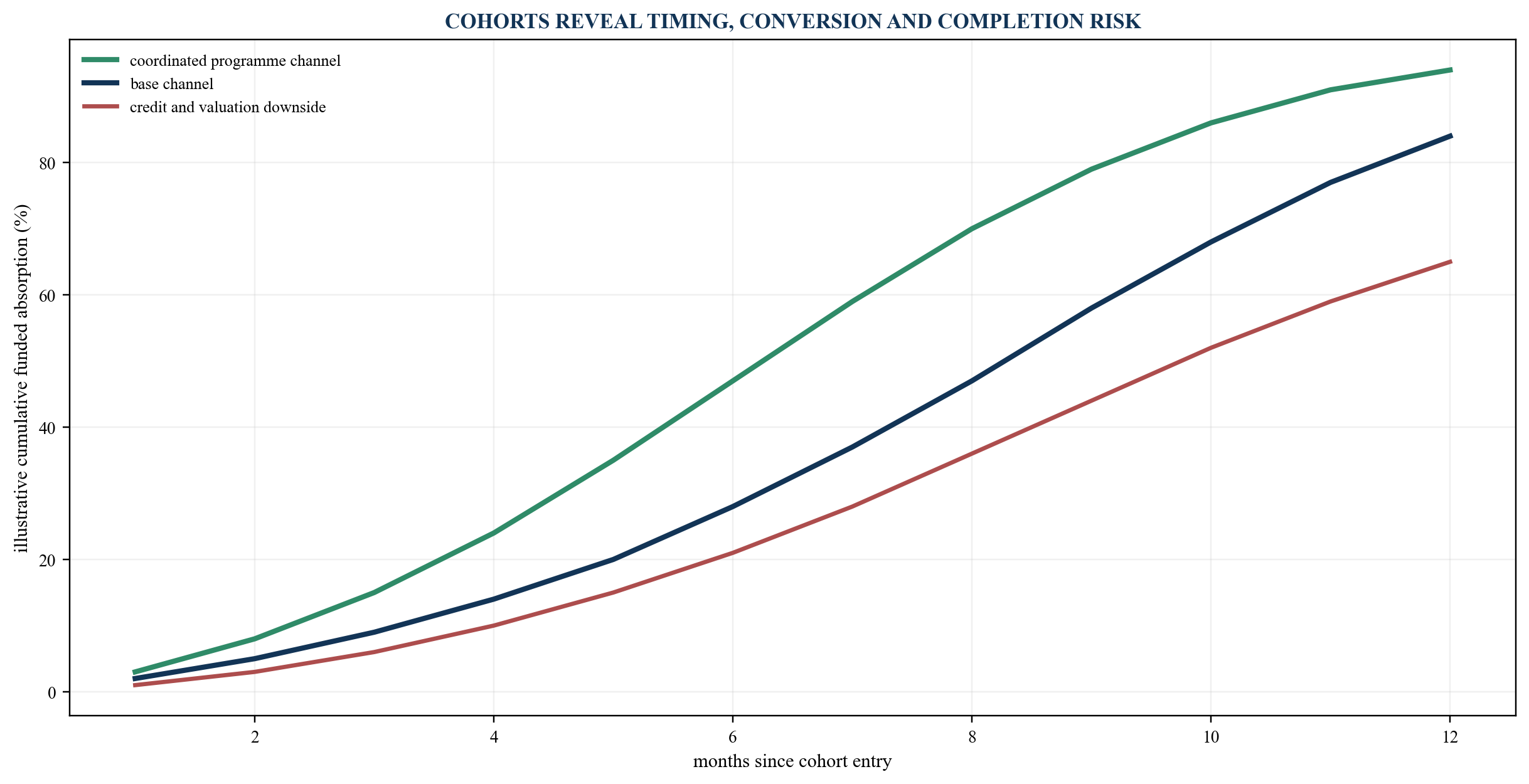
Curves are illustrative management assumptions.
14. Manage reservations, cancellations and reallocation
A reservation consumes scarce inventory and can block another buyer. The developer should define the fee, hold period, required evidence, refund conditions, extension authority and reallocation process. The rules should be stated before payment.
Cases need reason codes and timestamps. A buyer awaiting a bank document differs from one who has not provided deposit evidence. Extensions should follow an approved framework rather than sales discretion alone.
Cancellation analysis distinguishes affordability, valuation, documentation, service, property preference, buyer circumstances and delivery factors. The developer can then change the unit mix, benefit, process or partner service level.
Reallocated units should return through a controlled queue. Priority-access claims require an auditable release record. Existing buyers affected by price or benefit changes need careful treatment under the relevant contracts and policies.
15. Connect buyer finance to project capital
Buyer collections, escrow availability, construction progress, lender drawdowns and project completion are linked. A first-time-buyer campaign changes the timing and risk of project cash flows. The treasury model should reflect reservation deposits, staged payments, potential refunds, cancellations, mortgage-funded completion balances and incentive costs.
A fast reservation campaign can improve reported sales while leaving the project exposed to future completion funding. Management should track funded sales, collected cash, contract status and completion readiness separately.
Project lenders may impose presale, collection, escrow and unit-release conditions. The developer should assess whether programme offers, payment plans or discounts affect covenants, valuations, security or draw conditions. Approvals belong in the offer governance process.
The commercial decision compares alternative absorption routes. Retail first-time-buyer sales, ordinary retail sales, bulk transactions and rental hold strategies have different price, timing, concentration and execution profiles.
16. Build a board-level absorption dashboard
The dashboard starts with the complete funnel and uses counts, value and ageing. It shows eligible registrations, permissioned contacts, unit matches, affordability checks, lender states, reservations, contracts, collections, completion balances, registrations, cancellations and complaints.
Conversion measures use explicit denominators. Mortgage approval rate should identify the application population and maturity window. Cancellation rate should distinguish reservations and contracts. Funded absorption should use the agreed legal and cash milestone.
Commercial measures include net effective price, incentive cost, contribution margin, days to cash, collection variance and incremental conversion. Risk measures include valuation shortfalls, overdue payments, approval expiry, completion concentration and unresolved exceptions.
The dashboard should let management trace a metric to cohorts and individual records. Commentary states what changed, the evidence, impact, action, owner and deadline.
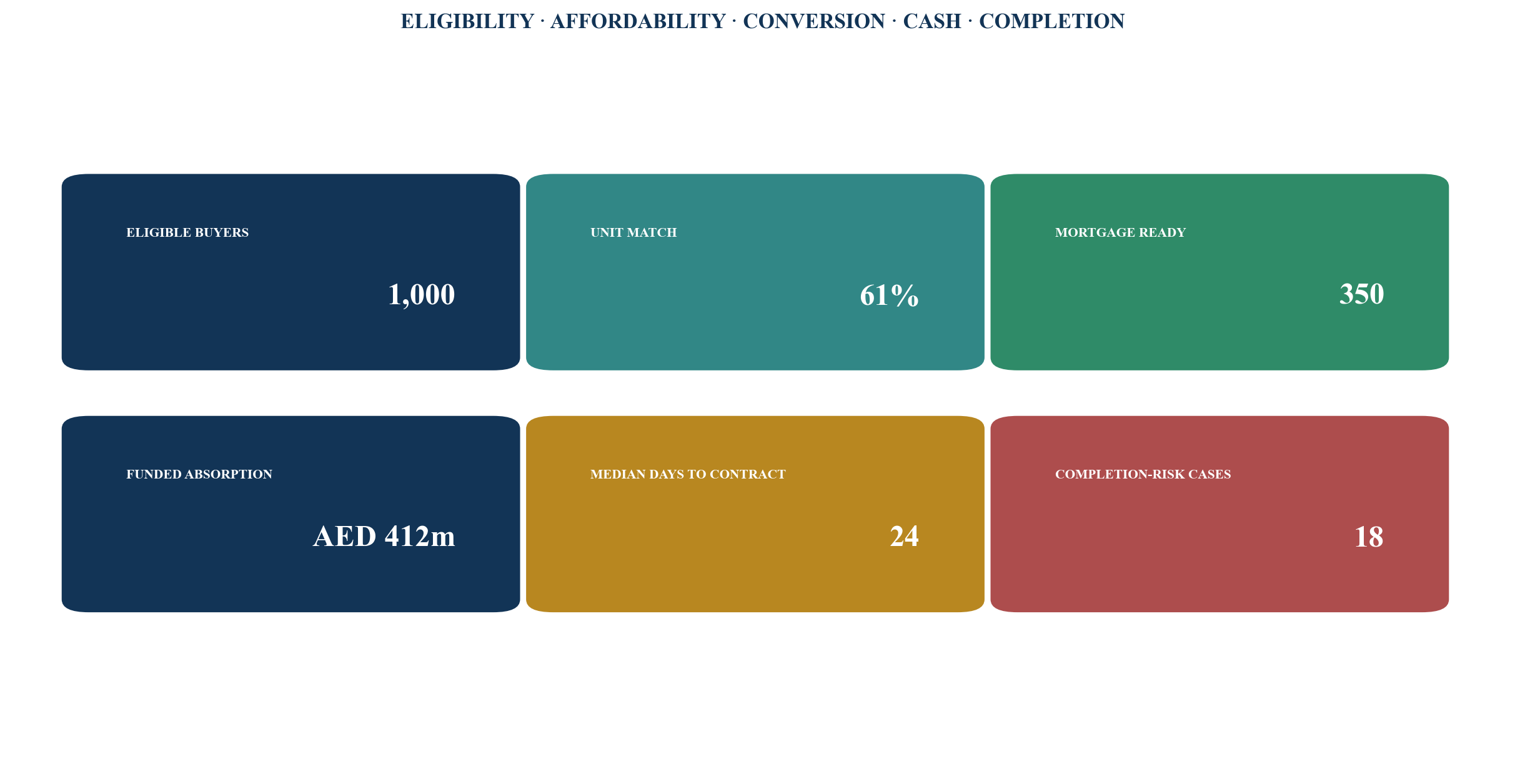
Measures and values are illustrative management assumptions.
17. Establish governance and decision rights
An executive sponsor owns the funded-absorption outcome. A cross-functional committee connects sales, finance, treasury, project delivery, legal, compliance, data, customer service and partner management.
The committee approves eligible inventory, benefits, budgets, scripts, data flows, partner service levels, exceptions and dashboard definitions. Banks retain independent credit authority. Legal and regulatory interpretations remain with qualified advisers and responsible authorities.
Segregation protects price and customer treatment. Sales staff should not approve their own exceptions. Mortgage status should not be altered by the developer. Incentive and refund approvals need recorded authority.
The risk register covers outdated programme terms, mis-selling, privacy, discriminatory outcomes, valuation shortfall, mortgage expiry, payment default, project delay, price integrity, partner performance and reporting error. Each risk has evidence, exposure, mitigation, owner and review trigger.
18. Run a ten-day absorption diagnostic
Days one and two confirm current programme rules, participating partners, inventory, offer terms, sales data, payment plans, project cash requirements and lender documentation. The team creates one evidence register.
Days three and four reconstruct the buyer funnel, remove duplicates, define stages and measure cohort conversion, ageing and loss reasons. Data permissions and sensitive-field handling are reviewed.
Days five and six build affordability ranges, map unit financeability and test valuation, deposit, monthly-payment and completion scenarios. The analysis identifies where policy eligibility fails to become a fundable purchase.
Days seven and eight price incentives, calculate incremental absorption, map partner hand-offs and identify service-level failures. The team prepares base, downside and strong-demand cases.
Days nine and ten present the unit allocation, benefit menu, funnel controls, cash forecast, partner actions, governance and ninety-day plan. Management receives named decisions rather than a generic marketing recommendation.
19. Implement a thirty-day buyer-finance office
Days one to five establish governance, owners, data dictionary, programme evidence, inventory perimeter, approved offers and one case log. Urgent buyer and partner exceptions receive priority.
Days six to ten clean and segment the buyer population, configure consented communications, complete the unit financeability map and assemble current bank-ready project packs.
Days eleven to fifteen launch controlled cohorts, route cases to approved partners, monitor response times and reconcile eligibility, affordability and unit states. Sales scripts and disclosures are sampled.
Days sixteen to twenty rebuild the forecast, price benefits, review valuation results and adjust unit allocation. Treasury receives an updated collections and completion-risk view.
Days twenty-one to twenty-five address aged cases, cancellations, payment-plan risks and partner bottlenecks. Root-cause reviews distinguish buyer, unit, project and process issues.
Days twenty-six to thirty approve the next cohort, refresh governance, transfer recurring controls and publish the board dashboard. Unresolved high-risk cases remain named in the action register.
Table 6. Thirty-day buyer-finance-office deliverables
| Workstream | Core deliverable | Acceptance evidence | Accountable owner |
|---|---|---|---|
| policy and eligibility | current rules and decision map | source register and approved definitions | programme lead |
| inventory | financeability and allocation schedule | reconciled unit, price and offer file | commercial director |
| affordability | buyer gap and scenario model | evidence fields, ranges and limitations | finance director |
| partners | bank and broker operating model | agreed hand-offs, status rules and escalation | partnerships lead |
| conversion | controlled funnel and cohort forecast | complete denominators and transition history | sales operations lead |
| governance | dashboard, conduct and exception controls | signed decisions and residual-risk record | executive sponsor |
Timing depends on project scale, data quality and partner response.
20. Package the work around paid outcomes
A first-time-buyer absorption diagnostic can quantify eligible demand, funnel leakage, financeable inventory, incentive cost, partner delays and completion exposure. The paid outcome is a decision on units, benefits, partners and cash.
An absorption implementation office can build the buyer register, unit map, affordability model, bank hand-offs, approved communications, cohort forecast, dashboard and weekly governance. The engagement runs through defined conversion and cash milestones.
A buyer-finance partner review can evaluate service levels, application outcomes, valuation patterns, project-pack quality and exception resolution across banks and brokers. The result is an evidenced route to improve completion probability.
A project portfolio review can compare funded absorption, incentive efficiency, cash timing, cancellation, valuation and completion risk across developments. The evidence can guide launch sequencing, unit mix, capital planning and future underwriting.
The engagement can also define a retainer-based control office for active launches. The office reconciles programme updates, unit releases, lender cases, buyer exceptions, valuation results, collections and completion exposure on a recurring cadence. Its scope should be tied to named projects, agreed decision forums and measurable service levels. This converts a one-time diagnostic into an accountable execution mandate where the developer requires sustained capacity.
Commercial qualification should take place before mobilisation. The adviser should confirm the economic buyer, funding authority, urgency, affected inventory, decision deadline, accessible evidence and the cost of delay. A large pool of eligible consumers does not establish that a developer will appoint an adviser. Paid demand is evidenced through an authorised engagement, signed scope, agreed retainer and collected fees.
Acceptance criteria should focus on usable management outputs. Examples include a reconciled buyer funnel, an approved unit perimeter, priced offer options, current bank hand-offs, a dated cash forecast, a controlled exception register and decisions recorded by the responsible committee. Outcome reporting should separate adviser deliverables from buyer, lender, regulator, market and project factors outside the adviser's authority.
Every mandate should define the scope, decision authority, deliverables, evidence, data responsibilities, acceptance criteria and commercial terms before work begins. The operating record remains usable after the campaign and supports recurring developer-capital decisions.
References
- Dubai Land Department. First Time Home Buyer Overview. https://dubailand.gov.ae/en/eservices/first-time-home-buyer-overview/
- Dubai Land Department. Dubai Launches Landmark Initiative Further Enabling First-Time Homeownership. 2 July 2025. https://dubailand.gov.ae/en/news-media/dubai-launches-landmark-initiative-further-enabling-first-time-homeownership/
- Central Bank of the UAE. Regulations Regarding Mortgage Loans. https://rulebook.centralbank.ae/en/rulebook/regulations-regarding-mortgage-loans
- UK Government. First Homes Guidance. https://www.gov.uk/guidance/first-homes
- UK Government. First Homes Scheme: First-Time Buyer's Guide. https://www.gov.uk/first-homes-scheme
- UK Government. First Homes Scheme: How to Apply. https://www.gov.uk/first-homes-scheme/how-to-apply
- UK Government. First Homes Stakeholder Guidance Documents. https://www.gov.uk/government/publications/first-homes-stakeholder-guidance-documents
- First Home Scheme Ireland. Eligibility. https://www.firsthomescheme.ie/about-the-scheme/eligibility/
- First Home Scheme Ireland. Quarterly Update, March 2026. https://www.firsthomescheme.ie/media/lq3iqlcz/fhs-q1-2026-update.pdf
- First Home Scheme Ireland. Frequently Asked Questions. https://www.firsthomescheme.ie/faqs
- Revenue Ireland. Who Can Claim Help to Buy. Updated 1 January 2026. https://www.revenue.ie/en/property/help-to-buy-incentive/who-can-claim-htb.aspx
- Revenue Ireland. How Much Can You Claim under Help to Buy. Updated 1 January 2026. https://www.revenue.ie/en/property/help-to-buy-incentive/how-much-can-you-claim.aspx
- Revenue Ireland. What Is a Qualifying Property. https://www.revenue.ie/en/property/help-to-buy-incentive/what-type-of-property-qualifies.aspx
- Revenue Ireland. Help to Buy Incentive Annual Statistics. https://www.revenue.ie/en/corporate/information-about-revenue/statistics/tax-expenditures/htb/yearly.aspx
About the Author
Chennakeshav Adya, Independent Researcher
