

1. Start with the construction transaction, not the invoice file
Construction payment begins before an invoice is issued. A contract, purchase order or authorised instruction defines scope, price, measurement, milestones, retention, tax, supporting evidence and approval. Site work then creates progress records. A consultant, engineer, quantity surveyor or employer may assess the application and issue a certificate. Only then can the payable amount be translated into an invoice, credit note, accounting entry and cash obligation.
E-invoicing makes structured transmission mandatory for transactions within scope. It therefore exposes weaknesses that were previously hidden in attachments and manual interpretation. An invoice with a free-text line such as “progress works” cannot reliably connect to a bill item, certified quantity, variation, project, tax code and payment term.
The UAE Ministry of Finance distinguishes structured eInvoice data from PDFs, scans, word-processing files, images and emails. Its published four-corner flow uses a supplier, supplier service provider, buyer service provider and buyer, while tax data is also reported through the official model. Message-level status communicates technical processing states.
Commercial acceptance remains a separate process. Successful technical validation does not mean that the work is certified, the price is agreed or payment is due. The developer needs two connected state machines: one for regulated electronic exchange and one for contract-to-cash entitlement.
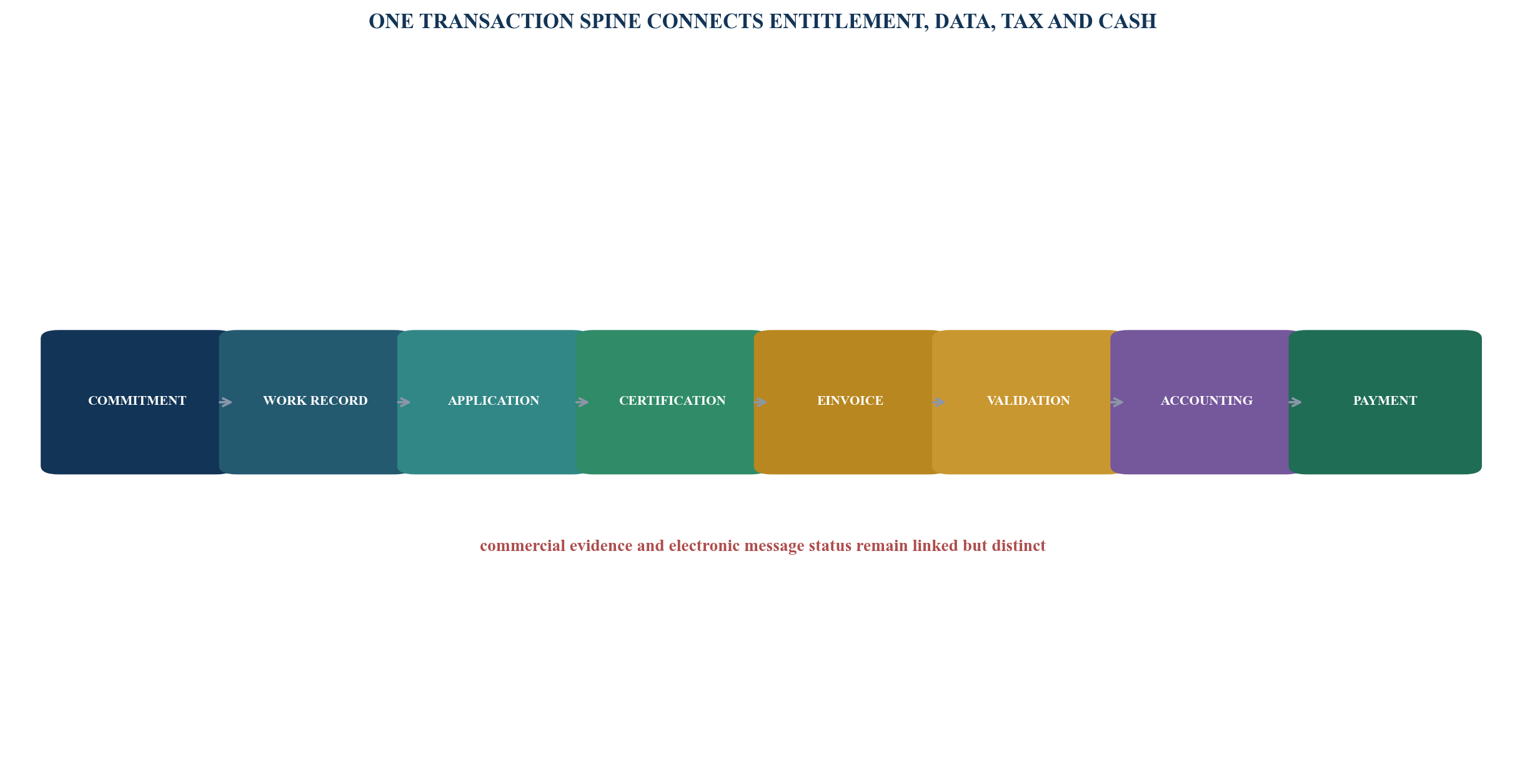
Sequence and responsibilities are illustrative and require contract-specific design.
2. Confirm scope, entities and the current implementation calendar
The programme perimeter should start with every legal entity that carries on business, contracts, procures, invoices, receives invoices or pays within the developer group. Project companies, holding companies, joint ventures, management companies and special-purpose vehicles can have different roles and revenue profiles.
The UAE Ministry of Finance announced that the electronic invoicing framework applies to in-scope business-to-business and business-to-government transactions, subject to stated exclusions. Its official portal is the source for current decisions, guidance, mandatory fields, accredited service providers and updates.
The Ministry's May 2026 amendment extended the service-provider appointment deadline for persons with annual revenue exceeding AED 50 million to 30 October 2026 while confirming that mandatory implementation for that group remains 1 January 2027. The June 2026 guideline should be read with current legislation and later official updates. Smaller entities and government entities have separate phased dates under the published framework.
The developer should not assume that the largest entity's timetable automatically resolves every project company. The scope register records legal entity, tax registration, revenue test, transaction types, exclusions, service-provider decision, systems, owners and applicable dates.
Voluntary implementation can affect entities before their mandatory date. Group design should consider common platforms, intercompany transactions, shared services and supplier expectations without representing one entity's status as another's legal position.
Table 1. Entity and transaction scope register
| Field | Decision question | Evidence | Owner |
|---|---|---|---|
| legal entity | which entity contracts, supplies, receives or pays? | licence, incorporation and contract records | legal and finance |
| tax identity | which registration and branch details apply? | current tax records | tax lead |
| transaction type | B2B, B2G, intercompany or potentially excluded? | contract and customer or supplier classification | tax and commercial |
| revenue band | which implementation threshold and period apply? | approved financial records | finance controller |
| system route | which ERP, project and invoicing systems create the record? | application inventory and interfaces | technology lead |
| service provider | which accredited provider and agreement apply? | official provider status and signed contract | programme sponsor |
| effective date | when must the entity appoint and implement? | current decision and official update | legal and tax |
Current legal scope and deadlines must be verified against official UAE sources.
3. Build one authoritative contract-data model
The eInvoice should be the output of controlled contract and transaction data. Master data begins with supplier and buyer legal names, tax identifiers, addresses, project entity, contract, purchase order, currency, payment terms, bank details, tax treatment and authorised contacts.
Construction detail adds project, plot or asset, work package, bill item, milestone, quantity, unit, rate, variation, retention rule, advance recovery, materials on site, certification authority and supporting-document requirements. Each field needs an authoritative system and owner.
The contract-data model distinguishes agreed terms from transactional values. A standard retention percentage can have project-specific caps, staged release, exemptions or bonds. A purchase order value can change through approved variations. Tax treatment can differ by supply, location and counterparty.
Identifiers need permanence. Supplier codes, contract numbers, project codes, purchase orders, certificates and invoices should be unique and traceable across systems. A supplier merger, tax-group change or novation should create controlled effective dates rather than overwriting transaction history.
Data quality gates should prevent avoidable downstream failures. Missing tax identity, invalid buyer reference, expired bank evidence, closed purchase order, exhausted commitment or inconsistent currency should be resolved before the invoice reaches the exchange service.
4. Separate application, certificate, invoice and payment
A contractor's payment application is a claim for assessment. A certificate records the amount assessed under the relevant process. An invoice presents the supplier's amount and tax data. A payment settles an approved obligation. The four values can differ for legitimate reasons.
The application can include disputed quantities, unapproved variations or missing evidence. The certificate may deduct previous payments, retention, advance recovery, contra charges or rejected work. The invoice can contain a data or tax error. Payment can be reduced by a valid credit note, withholding or set-off where permitted.
One status label such as “approved” cannot describe all four records. The transaction spine stores the submitted, certified, invoiced and paid amounts separately and reconciles the bridge. Every difference has a cause code, evidence and owner.
The developer should define whether the supplier invoices the application, certificate or another agreed amount. Timing rules matter because the electronic invoice obligation, contract payment due date and certification process may follow different events. Current legal and tax advice should determine the applicable sequence.
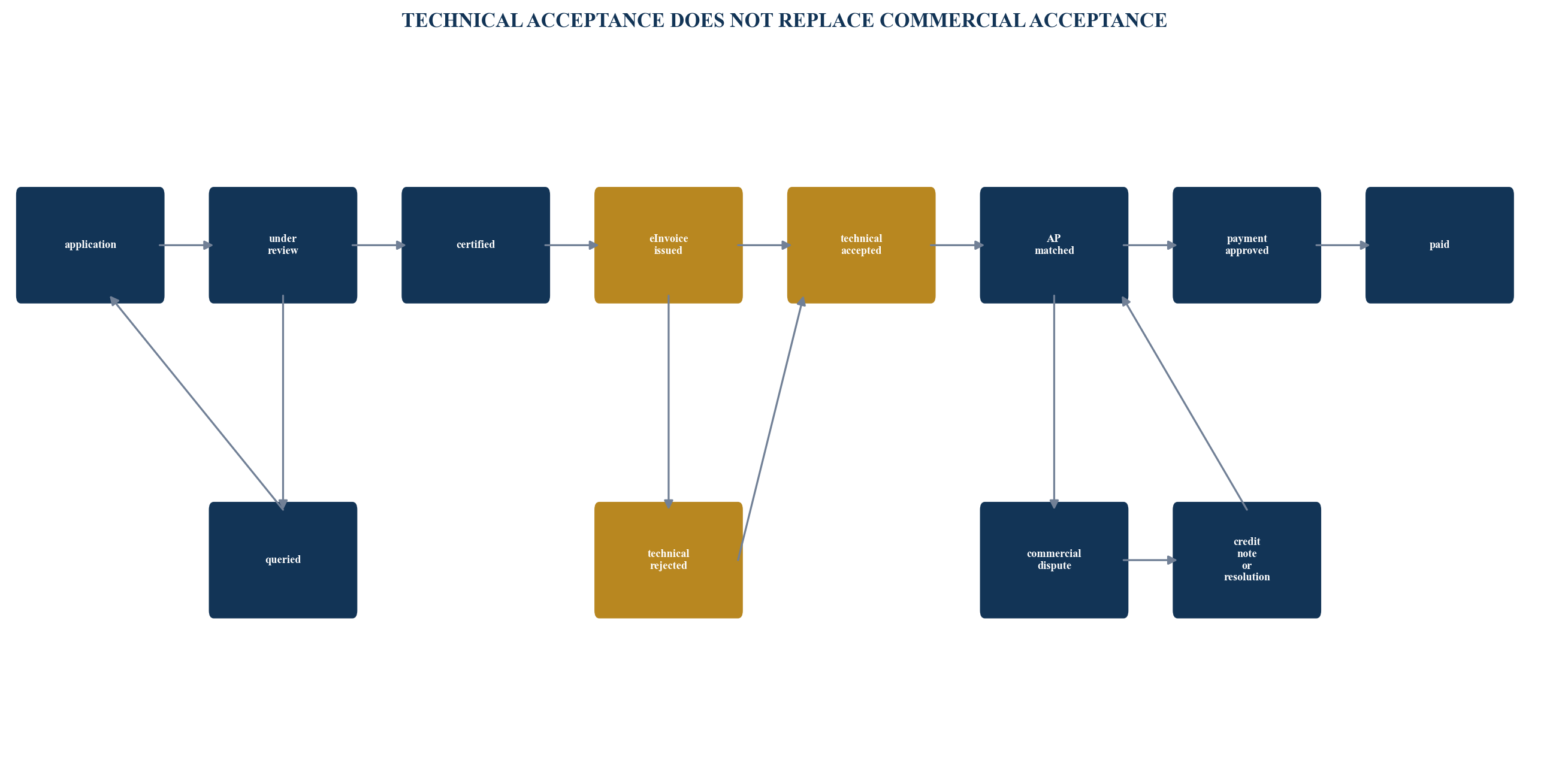
States are illustrative and require legal, tax and contract validation.
5. Map mandatory invoice fields to project evidence
The UAE Ministry publishes mandatory field requirements and structured specifications. The developer should build a field-level mapping from each required invoice element to its source, transformation, validation rule, owner and exception route.
Identity fields should originate from verified entity masters. Contract references should come from procurement or project controls. Supply dates, quantities and descriptions should connect to progress evidence and certification. Tax codes and amounts should follow approved tax logic. Payment references should reconcile to treasury and bank records.
Free text should not carry information required for matching. A human-readable description remains useful, yet machine processing needs structured contract, purchase-order, project, certificate and line identifiers where the relevant standards and systems permit them.
The mapping must handle credit notes and cancellations. The Ministry states that electronic credit notes are required for relevant reductions, refunds, cancellations or specified errors within scope. The record should link each note to the original transaction and commercial resolution.
Table 2. Construction invoice field-to-evidence map
| Data family | Authoritative source | Construction evidence | Validation control |
|---|---|---|---|
| supplier and buyer identity | legal and tax master | contract parties and branch | current identifier and effective date |
| invoice and note reference | invoicing system | unique sequence and linked original | uniqueness and traceability |
| contract and order | procurement system | signed contract, order and variation | valid commitment and remaining value |
| supply and certification | project-controls system | progress record and certificate | accepted period, quantity and authority |
| line description and amount | bill or schedule of rates | measured work and agreed rate | quantity-rate calculation and rounding |
| retention and deductions | contract ledger | certificate bridge and retention rule | permitted treatment and separate ledger |
| tax | governed tax rules | supply classification and tax point | code, rate, amount and jurisdiction |
| payment | accounts payable and treasury | due date, beneficiary and settlement | approved payee and matched obligation |
Exact mandatory fields and formats follow current official specifications.
6. Control variations before they become invoice exceptions
Variations are a major source of construction invoice disagreement. Site teams can request work before scope, price and authority are final. Contractors then invoice provisional or disputed amounts, while procurement and finance systems show no valid commitment.
The variation register records instruction, scope, originator, authority, estimated value, submitted quotation, assessment, approved value, time effect, tax treatment, purchase-order change and invoice status. Emergency work has a controlled retrospective path rather than an informal bypass.
Invoices should identify the approved variation or agreed provisional treatment. Unapproved work remains visible in the commercial forecast while being excluded from amounts that require prior authorisation. This prevents the accounts-payable team from deciding a project entitlement it does not own.
The dashboard shows variation age, value, approval bottleneck and invoiced exposure. Repeated work before approval can signal weak design control, poor authority thresholds or unrealistic procurement lead times.
7. Reconcile retention, advance recovery and other deductions
Construction certificates can include retention, advance-payment recovery, materials offsets, liquidated amounts, contra charges and previous payments. The commercial bridge should calculate each element independently and preserve the governing basis.
Retention needs a project, contract, supplier, currency, original amount, release stage, application, certification, invoice, payment and balance. Upstream retention held against a contractor and downstream retention held from subcontractors require separate ledgers even when management compares them.
The tax invoice and accounting treatment of retention depend on applicable rules and transaction facts. The system should not assume that a cash withholding and a reduction in taxable consideration are the same event. Credit notes should follow current requirements and the underlying commercial event.
The United Kingdom's current payment-practices guidance requires in-scope businesses using qualifying construction contracts to report specified retention practices and metrics. This illustrates why a digital retention ledger should support both transaction execution and management or regulatory reporting.
Table 3. Certificate-to-payment reconciliation
| Bridge item | Commercial basis | System record | Release or resolution evidence |
|---|---|---|---|
| gross work assessed | measured and accepted work | certificate and bill lines | authorised certificate |
| approved variations | authorised change | variation register and order change | signed approval and value |
| retention | contract security | retention subledger | milestone, application and certificate |
| advance recovery | agreed repayment mechanism | advance ledger | cumulative recovery calculation |
| previous payments | prior certified settlement | AP and bank history | reconciled transaction references |
| contra or other deduction | contractually supportable event | dispute or deduction register | notice, evidence and approval |
| tax and credit note | current tax treatment | tax engine and eInvoice record | validated structured document |
| net payment | approved obligation | AP and treasury | authorised payment and bank confirmation |
Treatments depend on contract, law, tax and accounting requirements.
8. Detect mismatches before submission
Pre-submission validation should compare entity, contract, order, certificate, invoice and tax data. It catches missing references, invalid tax identifiers, duplicate invoices, quantity differences, price differences, exhausted commitments, closed periods and unsupported deductions.
Rules should be consequence-based. A formatting error can cause technical rejection. A wrong bank account can cause loss. A small rounding difference can be within an approved tolerance. A duplicated certificate reference can indicate a serious control failure.
The rule library records logic, threshold, data source, owner, severity, effective date and test evidence. It also records exclusions. A supplier should receive a clear error message and corrective action rather than a generic rejection.
Machine validation should not decide disputed commercial matters. A quantity mismatch can be routed to the quantity surveyor. A tax-code issue belongs to tax. A contract-identity problem belongs to legal or procurement. Routing reduces repeated submission and arbitrary overrides.
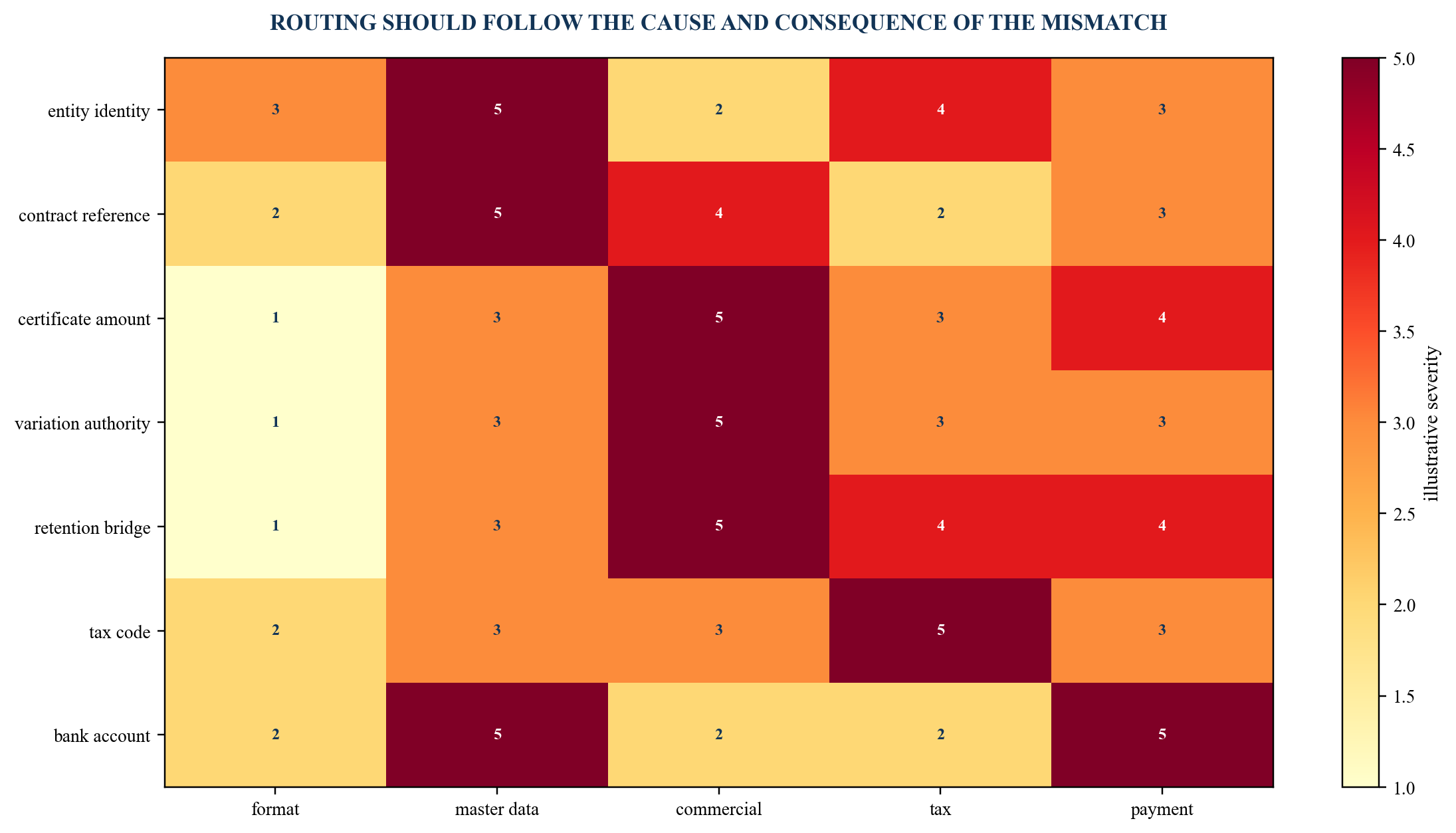
Severity scores are illustrative management assumptions.
9. Design the accredited-service-provider decision
The UAE framework requires in-scope issuers and recipients to use accredited service providers under the applicable decisions. The developer should evaluate current official accreditation, technical capability, commercial terms, coverage, service levels, security, resilience, data location, support and exit.
The provider does not replace the developer's source-data and commercial controls. It can validate, transform, exchange and report structured messages within its service. The developer remains responsible for its systems, master data, tax position, approvals and transaction truth within the applicable allocation of duties.
The selection process uses representative construction cases: progress invoice, mobilisation advance, retention, milestone, variation, materials on site, credit note, intercompany service, multi-currency contract, joint venture and disputed certificate. Demonstrations should include error handling, duplicate prevention, status messages and reconciliation.
Exit design matters. The agreement should address data access, format, migration, pending messages, archive, credentials, subcontractors, incidents and continuity. A single provider outage should not make the project unable to understand its obligations.
10. Integrate project, procurement, ERP, tax and treasury systems
Construction data rarely lives in one platform. Project controls hold progress and measurement. Procurement holds contracts and orders. Document management holds evidence. ERP holds suppliers, invoices and accounting. A tax engine may assign treatment. Treasury releases cash. The service provider exchanges structured documents.
The architecture should define the system of record for each field and event. Interfaces need identifiers, timestamps, validation, acknowledgement, retry, monitoring and reconciliation. Manual uploads can remain as controlled exceptions during transition, with the same data-quality and approval rules.
The integration journal records every message and state change without exposing sensitive data to unauthorised users. A successful transmission, recipient validation, tax reporting status, commercial match, accounting post and payment approval should be individually visible.
Cybersecurity controls cover identities, keys, certificates, privileged access, environment separation, change control, logging, vulnerability management, incident response and service-provider risk. Bank-detail changes require independent verification outside ordinary invoice processing.
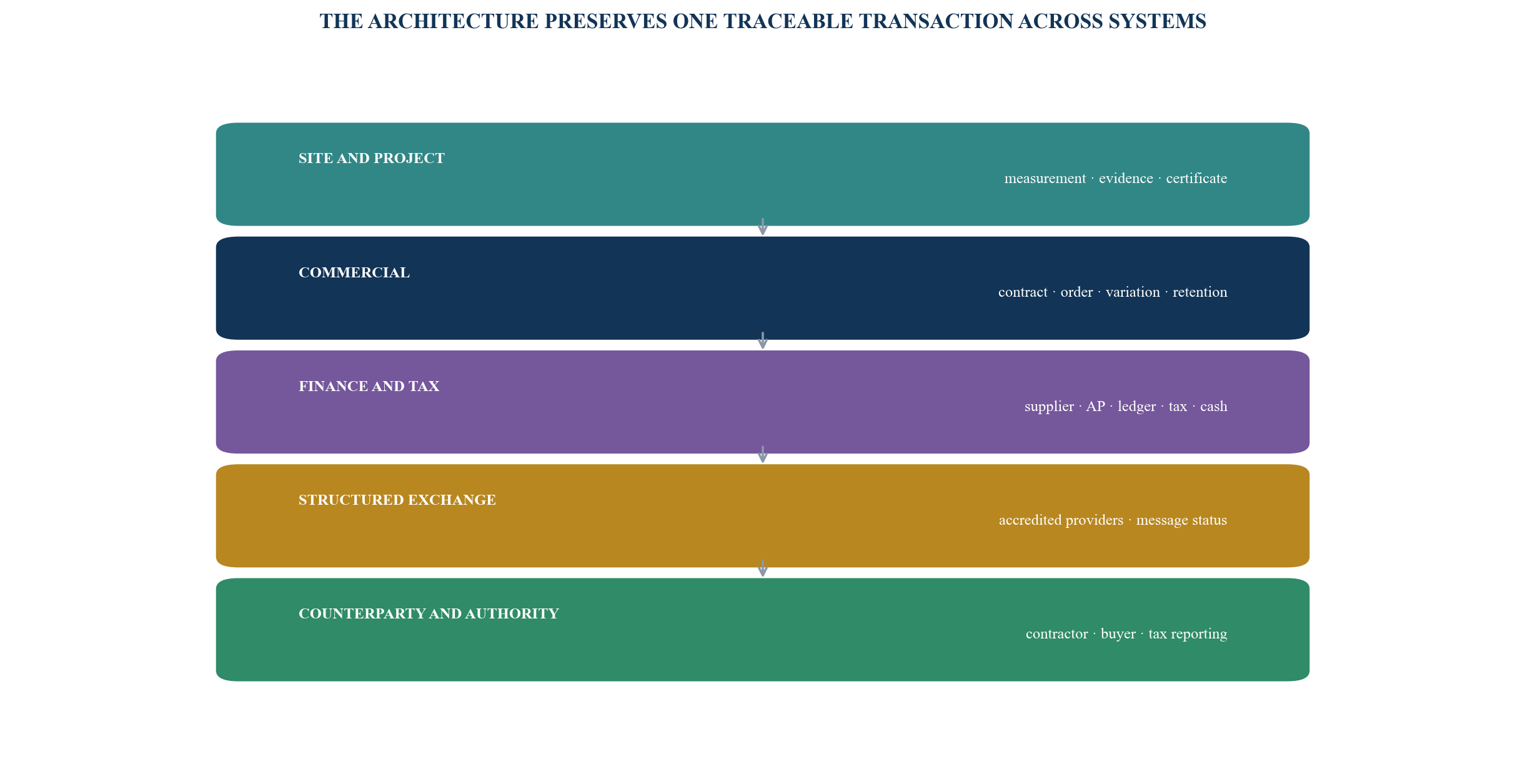
Architecture is illustrative and requires entity- and system-specific design.
11. Onboard contractors as part of project mobilisation
Supplier onboarding should begin before the first invoice. The package confirms legal identity, tax status, bank details, contract reference, order route, project contacts, required fields, supporting evidence, transmission channel, testing and support.
The developer should segment contractors by volume, system maturity, contract criticality and implementation date. Large main contractors may integrate directly. Smaller suppliers may need provider portals or controlled tools. The standard of transaction evidence should remain consistent.
Testing uses positive and negative cases. A contractor proves it can issue a correct progress invoice, receive status, correct rejection, issue a linked credit note and reconcile the result. Production access follows signed acceptance.
Training should be role-based. Commercial teams learn contract and certificate rules. Supplier finance learns structured fields and statuses. Site teams learn evidence and timing. IT learns integration and incidents. Tax retains current interpretation authority.
12. Govern credit notes, cancellations and dispute resolution
Electronic credit notes are not general-purpose devices for hiding disagreement. The record should identify the original invoice, reason, commercial event, authorised amount, tax treatment and effect on retention, contract balance and payment.
A technical rejection can require correction and resubmission without changing the commercial amount. A certified value change can require a new certificate and linked adjustment. A cancellation, refund, discount or error can require an electronic credit note under current rules. The workflow should distinguish these cases.
Disputes need a case file with issue, amount, contract basis, evidence, notices, owners, deadlines, meetings, resolution and resulting documents. Undisputed amounts should be handled according to applicable contract and law rather than trapped by an unrelated line where separation is required.
The system preserves superseded records and their links. An amended document should not erase what was submitted, validated, booked or paid.
13. Use e-invoicing to improve working-capital visibility
Structured events can make the construction cash cycle more observable. Management can measure time from work cut-off to application, application to certification, certification to valid invoice, validation to AP match, match to approval and approval to cash.
The delay bridge identifies whether cash is trapped by site evidence, commercial assessment, supplier data, technical rejection, tax review, budget, dispute or treasury. Each delay belongs to a different owner.
Forecasting should use certified and uncertified populations separately. Uncertified applications represent potential exposure. Valid invoices represent recognised processing obligations subject to commercial state. Approved payments have a stronger timing signal. Disputed and retained amounts need their own curves.
Supplier working capital matters to project delivery. Chronic late certification or avoidable rejection can stress contractors and subcontractors. Faster structured exchange creates value when the upstream approval process is also controlled.
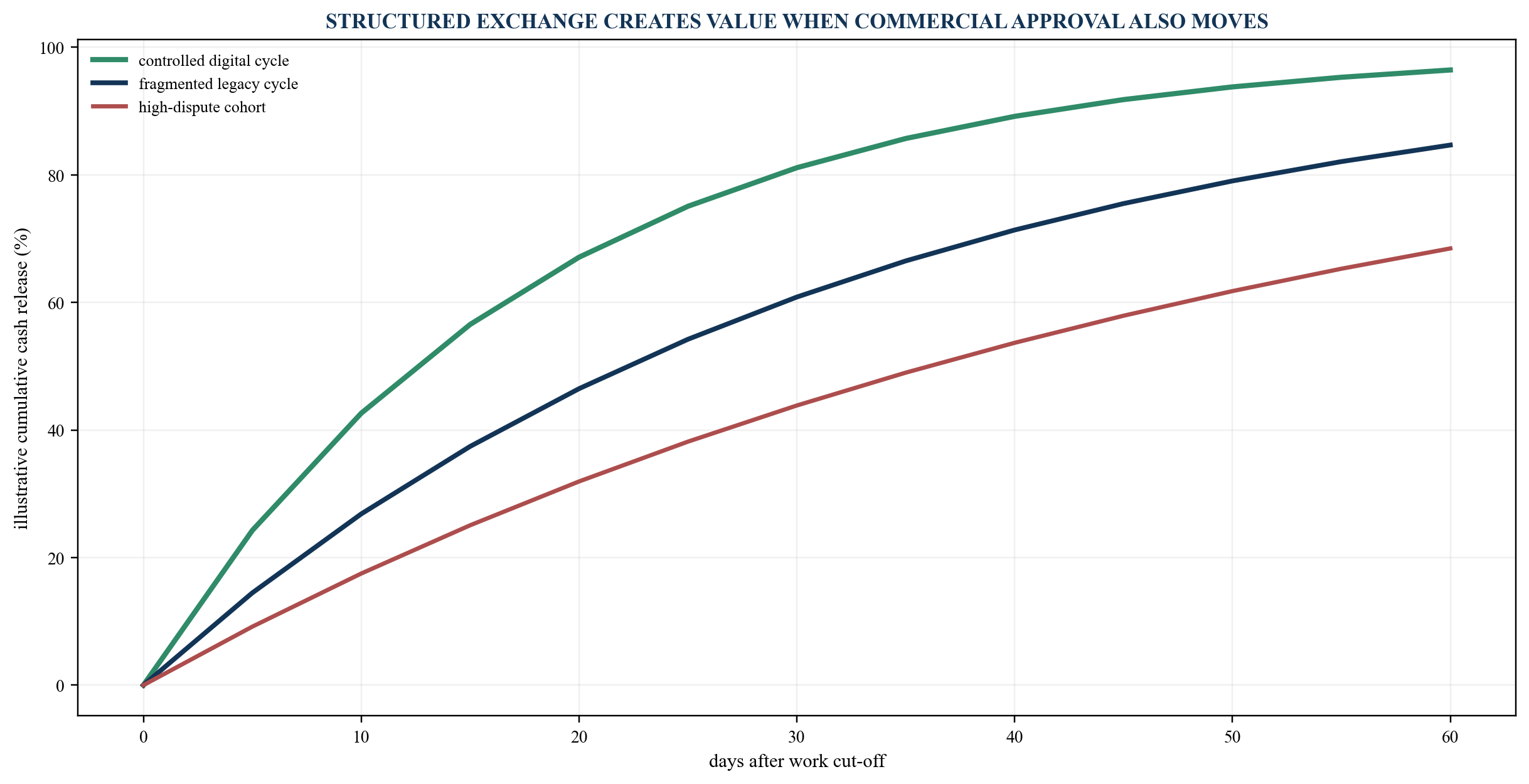
Cycle times and values are illustrative management assumptions.
Table 4. Working-capital delay bridge
| Interval | Start evidence | End evidence | Primary owner |
|---|---|---|---|
| work to application | approved progress cut-off | complete application | contractor and project controls |
| application to certificate | received evidence pack | authorised certificate | certifier or commercial team |
| certificate to eInvoice | certificate release | structured issue timestamp | supplier finance |
| issue to validation | outgoing message | successful technical status | supplier and service providers |
| validation to AP match | received structured document | contract and certificate match | buyer finance and commercial |
| match to approval | complete matched record | authorised payment | budget owner and AP |
| approval to cash | payment instruction | bank settlement | treasury |
Targets are illustrative and require contractual and operational validation.
14. Design exception management around named causes
An exception queue needs a unique case, related transaction, severity, financial value, root-cause category, evidence, owner, deadline and resolution. Technical, master-data, commercial, tax, security and payment issues should remain distinct.
Prioritisation combines statutory deadline, payment due date, project criticality, value, supplier vulnerability, duplicate risk and cash impact. High-value does not always mean high-urgency; a small invoice can block a critical subcontractor.
Overrides require authority and evidence. Repeated overrides signal a broken rule or process. The control owner reviews false positives, aged cases and recurrence.
Supplier communication should state the rejected field or commercial issue, expected correction and contact. A generic portal status can cause repeated resubmission and damage the relationship.
15. Reconcile every reporting period and project close
Daily reconciliation compares issued, transmitted, received, validated, rejected, reported, posted and paid documents. It identifies missing messages, duplicates, sequence gaps, tax differences and interface failures.
Monthly close connects eInvoice data to procurement, certificate, AP, tax and general-ledger populations. Accrued work without invoices, invoices without certificates, certificates without orders, credit notes without original references and payments without matched obligations receive named treatment.
Project close adds final-account, retention and defects-period controls. Open commitments, variations, certificates, invoices, credit notes, retentions, claims and payments should reconcile before systems and entities are retired.
Evidence retention follows applicable law and policy. Structured data, human-readable representations, attachments, message statuses, approvals and system logs should remain accessible and protected for their required periods.
16. Build a board-level readiness and cash dashboard
The dashboard shows in-scope entities, applicable dates, service-provider status, integrations, tested suppliers, invoice volumes, technical success, commercial match, disputes, ageing, retention and cash timing.
Readiness measures need objective acceptance. “System built” should require tested interfaces, security, recovery, business cases, supplier cases, monitoring and signed ownership. “Supplier onboarded” should require a successful end-to-end test.
Operational measures use denominators and cohorts. First-pass validation rate equals successful first submissions over all first submissions. Commercial match rate identifies the complete eligible population. Cycle-time measures show medians and tails.
The board view connects compliance and economics. It shows deadline risk, potential transaction failure, AP backlog, supplier exposure, forecast cash, disputed value and management decisions.
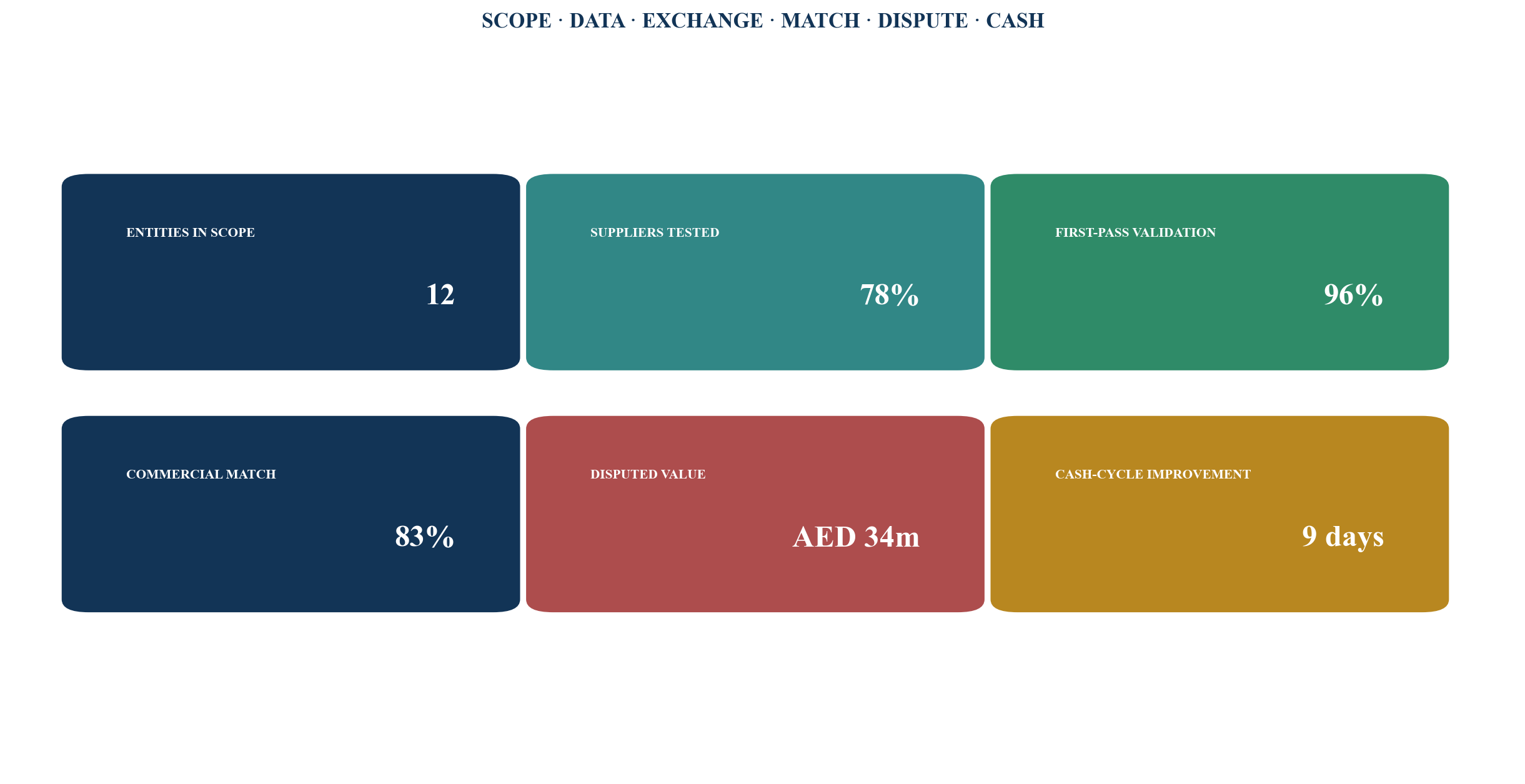
Measures and values are illustrative management assumptions.
17. Establish governance and decision rights
The chief financial officer or designated executive sponsor owns readiness and transaction continuity. A steering committee connects tax, finance, commercial, procurement, project controls, legal, technology, security, treasury and supplier management.
The committee approves scope, architecture, provider selection, field mappings, commercial state model, exception rules, security, testing, deployment waves and residual risks. Tax and legal positions remain with qualified responsible functions and advisers.
Segregation protects transaction truth. Site teams evidence work. Commercial teams assess entitlement. Supplier finance issues documents. AP matches and processes. Treasury pays. Technology cannot approve commercial amounts through a system override.
The risk register covers missed deadlines, incomplete scope, provider dependency, bad master data, invoice rejection, duplicate payment, fraud, privacy, cyber incident, supplier exclusion, dispute ageing, tax error and cash disruption. Each risk has evidence, exposure, control, owner and review date.
18. Run a ten-day construction e-invoicing diagnostic
Days one and two confirm current official requirements, group entities, contracts, projects, transaction volumes, systems, providers, suppliers, implementation dates and accountable executives. The team creates one evidence register.
Days three and four trace representative transactions from commitment through work evidence, certification, invoice, tax, accounting and payment. Breaks, manual interpretation and duplicate records are documented.
Days five and six build the mandatory-field mapping, state model, retention ledger and exception taxonomy. High-value suppliers and critical projects receive focused analysis.
Days seven and eight test architecture, provider options, security, reconciliation, business continuity and working-capital impact. The team prepares implementation waves and severe failure scenarios.
Days nine and ten present the scope decision, target operating model, data remediation, supplier plan, test strategy, cash case, governance and ninety-day roadmap. Management receives named decisions, costs and deadlines.
The diagnostic should test evidence rather than confidence. A project team may report that invoicing is automated while staff still re-key certificate values, attach unstructured schedules, search email for approved variations and reconcile retention outside the finance system. The reviewer should select transactions across different entities, projects, currencies, contract forms, suppliers, tax treatments and commercial states. Each sample is traced to source evidence and forward to settlement. The test records who changed each field, which system owns it, which validation operated, how an exception was approved and whether the final cash entry reconciled.
Five findings deserve separate treatment. A regulatory finding concerns scope, timing, mandatory data or transmission. A commercial finding concerns entitlement, measurement, certification, variation or deduction. A master-data finding concerns entity, supplier, contract, order, project, tax or bank records. A technology finding concerns mapping, interface, status, access, resilience or monitoring. A finance finding concerns matching, close, retention, tax, liquidity or forecasting. Combining these findings into one readiness percentage conceals the intervention required. The diagnostic should show severity, affected value, transaction volume, project dependency, owner, remediation cost and evidence needed for closure.
The cash case also needs discipline. Faster structured exchange does not automatically create earlier payment. The diagnostic measures days spent before certification, between certification and invoice issue, in technical rejection, in commercial query, awaiting approval and after the contractual due date. It then identifies delay that better data or controls can address. Disputed entitlement, missing site evidence, unauthorised variation and funding constraints remain separate causes. This produces a defensible range of operational opportunity without presenting all aged payables as recoverable cash.
19. Implement a thirty-day transaction-readiness office
Days one to five establish governance, current requirements, entity scope, provider workstream, transaction spine, data owners and critical-project perimeter.
Days six to ten cleanse legal, tax, supplier, contract, order and bank masters. The team freezes field definitions and builds validation rules.
Days eleven to fifteen configure interfaces, structured mappings, message monitoring, certificate bridges, credit-note links and retention reconciliation. Representative supplier cases enter testing.
Days sixteen to twenty execute end-to-end tests across standard and exception scenarios. Security, recovery, duplicate prevention, status messages and close reconciliation are evidenced.
Days twenty-one to twenty-five onboard priority suppliers, train roles, resolve test failures and rehearse period close and provider outage. Working-capital measures enter the dashboard.
Days twenty-six to thirty approve deployment waves, residual risks, support, change control and cutover. A recurring control office retains ownership of exceptions, supplier readiness, official updates and performance.
Table 5. Thirty-day construction e-invoicing deliverables
| Workstream | Core deliverable | Acceptance evidence | Accountable owner |
|---|---|---|---|
| scope and compliance | entity, transaction and date register | current official sources and signed perimeter | tax and legal lead |
| commercial data | contract-to-certificate model | reconciled representative project cases | commercial director |
| technology | provider and integration architecture | end-to-end positive and negative tests | technology director |
| suppliers | segmented onboarding and support | successful representative transmissions | procurement director |
| finance and cash | match, close and cash-cycle controls | reconciled ledger and dashboard | financial controller |
| governance | decisions, risk and cutover plan | signed residual risks and named owners | executive sponsor |
Timing depends on entity scale, systems, transaction volume and provider readiness.
20. Package the work around paid outcomes
An e-invoicing readiness diagnostic can establish the entity perimeter, transaction volumes, system breaks, supplier exposure, deadline risk and working-capital case. The paid outcome is a board decision on scope, provider, architecture, waves, investment and ownership.
A construction transaction office can build the contract-data model, certificate bridge, retention ledger, mandatory-field mapping, test cases, supplier onboarding, exception rules, reconciliation and dashboard. The engagement runs through signed readiness gates.
A project cash and payment-control mandate can use structured transaction data to reduce preventable delay, reconcile disputes, improve forecasts and protect critical suppliers. It should measure cycle stages and separate adviser deliverables from contractor, certifier, authority and bank decisions.
A recurring retainer can monitor official updates, new entities, suppliers, integrations, failure patterns, period close, security incidents and cash performance across a developer portfolio. The retainer needs named projects, service levels, decision forums and acceptance criteria.
The strongest mandate begins with an executive decision already on the calendar. Examples include selecting an accredited provider, approving integration funding, mobilising a major project, refinancing a development, changing an enterprise platform, onboarding a strategic contractor, resolving material payment delays or demonstrating readiness to a board or lender. The adviser can then define the evidence required for that decision and price a bounded diagnostic. A generic request for awareness material has a weaker path to a paid engagement unless an authorised buyer, deadline and decision are identified.
Qualification should cover six facts. First, the accountable buyer has authority over the affected entities, projects or systems. Second, a dated external or internal event creates urgency. Third, the client can provide contracts, transaction samples, system maps, supplier data and responsible staff. Fourth, the intervention has a funded commercial route. Fifth, acceptance can be evidenced through signed decisions, tested transactions or reconciled measures. Sixth, implementation ownership is clear after the advisory work. Missing facts become explicit preconditions rather than assumptions embedded in a proposal.
A diagnostic can be structured as a fixed-scope entry engagement because the deliverables and evidence set are defined. Provider selection, operating-model design and implementation management usually require separate phases as dependencies become known. A recurring control office can move to a retainer after the target state, service levels, reporting population and escalation process are agreed. Fees, staffing and timing depend on portfolio size, system complexity, supplier count, transaction volume, jurisdictional coverage and the client's delivery capacity.
Commercial measurement follows the mandate through four stages. Qualified pipeline records the buyer, decision, budget, timing and evidence access. Contracted work records the signed scope, fee mechanism and acceptance terms. Delivery records evidence produced, decisions made, tests passed and client dependencies. Collection records invoiced and received fees against accepted work. This sequence keeps marketing interest separate from signed advisory demand and allows management to invest in topics that repeatedly lead to funded decisions.
The research page, diagnostic and implementation offer should connect without overstating a result. The paper explains the operating problem and decision framework. The diagnostic tests the client's actual transactions. The mandate implements agreed changes with named owners. The retainer monitors performance and change. Each stage has its own decision, evidence and commercial gate, allowing a developer to enter at the level supported by its current need.
Commercial qualification precedes mobilisation. Evidence of a broad compliance deadline does not establish willingness to appoint an adviser. Paid demand is evidenced by an authorised buyer, funded scope, signed engagement, agreed retainer and collected fees. The mandate record should connect deliverables to decisions and measurable operating outcomes.
Table 6. Paid mandate modules and decision outcomes
| Module | Management decision | Core deliverable | Acceptance criterion |
|---|---|---|---|
| readiness diagnostic | perimeter and investment | evidence register and risk-ranked roadmap | approved entities, dates, costs and owners |
| provider selection | provider and commercial route | scored diligence and contract issues | documented decision and residual risks |
| transaction design | target operating model | state, data, control and reconciliation design | signed cross-functional model |
| implementation office | wave and cutover | tested integrations and supplier cohorts | passed end-to-end gates |
| working-capital office | payment and cash action | delay bridge, disputes and cash forecast | agreed actions with evidenced cycle measures |
| recurring control | sustained compliance and performance | monitoring, close and governance cadence | service levels and decision record |
Scope, fees and outcomes require client-specific agreement.
References
- UAE Ministry of Finance. eInvoicing Portal. https://mof.gov.ae/en/about-us/initiatives/einvoicing/
- UAE Ministry of Finance. UAE Electronic Invoicing Guidelines, Version 1.1, 1 June 2026. https://mof.gov.ae/wp-content/uploads/2026/06/UAE-Electronic-Invoicing-Guidelines_V-1.1-01June2026.pdf
- UAE Ministry of Finance. Ministry Issues UAE Electronic Invoicing Guidelines. 23 February 2026. https://mof.gov.ae/en/news/ministry-of-finance-issues-uae-electronic-invoicing-guidelines-to-support-national-rollout/
- UAE Ministry of Finance. Targeted Amendments to eInvoicing System Decisions. 10 May 2026. https://mof.gov.ae/en/news/ministry-of-finance-announces-targeted-amendments-to-einvoicing-system-decisions/
- UAE Ministry of Finance. UAE Marks Milestone with Introduction of eInvoicing 4-Corner Model. 21 April 2026. https://mof.gov.ae/en/news/uae-marks-milestone-with-introduction-of-einvoicing-4-corner-model-for-businesses/
- UAE Ministry of Finance. Decisions on Scope and Timelines for Electronic Invoicing. 29 September 2025. https://mof.gov.ae/en/news/ministry-of-finance-announces-the-issuance-of-two-ministerial-decisions-on-the-scope-of-obligations-and-the-timelines-for-implementing-the-electronic-invoicing-system-2/
- UAE Federal Tax Authority. Legislation. https://tax.gov.ae/en/legislation.aspx
- Zakat, Tax and Customs Authority. E-Invoicing. https://zatca.gov.sa/en/E-Invoicing/Pages/default.aspx
- Zakat, Tax and Customs Authority. Roll-out Phases. https://zatca.gov.sa/en/E-Invoicing/Introduction/Pages/Roll-out-phases.aspx
- Zakat, Tax and Customs Authority. Wave 25 for Integration Phase. 24 July 2026. https://zatca.gov.sa/en/MediaCenter/News/Pages/Wave25-E-invoicing.aspx
- Zakat, Tax and Customs Authority. E-Invoicing Educational Library. https://zatca.gov.sa/en/E-Invoicing/Introduction/Guidelines/Pages/default.aspx
- UK Government. Duty to Report: Payment Practices and Performance. https://www.gov.uk/government/publications/business-payment-practices-and-performance-reporting-requirements/duty-to-report-guidance-to-reporting-on-payment-practices-and-performance
- UK Government. Business Payment Practices and Performance: Reporting Requirements. https://www.gov.uk/government/publications/business-payment-practices-and-performance-reporting-requirements
- European Commission. VAT in the Digital Age Implementation Strategy. https://taxation-customs.ec.europa.eu/document/download/d5c72f2a-df00-473d-8f8a-5400b999e1aa_en?filename=Implementationstrategy.pdf
About the Author
Chennakeshav Adya, Independent Researcher
