

1. Treat completion as the start of the capital tail
Practical or certified completion changes the project's cash profile. Buyer collections, final loan drawdowns, refinancing, asset sales, operating income and partial retention releases can become available. The remaining risk becomes concentrated in a smaller pool of unresolved obligations.
The capital tail includes visible defects, latent issues emerging during the defects period, incomplete commissioning, missing approvals, operating manuals, warranties, as-built records, authority closeout, buyer inspections, common-area issues, contractor claims and final accounts. Each item can delay cash release or generate new expenditure.
The tail is often managed through disconnected records. The developer tracks buyer cases. The consultant maintains a snagging list. The contractor tracks instructions and access. Finance records retentions and guarantees. Legal teams handle disputed liability. Lenders monitor escrow and completion conditions. A single closeout record should connect these views.
Dubai Land Department explains that Article 14 of the Escrow Account Law requires 5% of the total amount paid into the escrow account to remain for one year after completion as a guarantee for prompt and effective remedy of defects. This statutory project-level layer can coexist with construction-contract retentions and other security.
The financing question concerns timing, coverage and control. The framework measures the cash trapped, the obligations remaining, the parties responsible, the likelihood and severity of defects, the ability to recover from contractors and insurers, and the conditions for release.
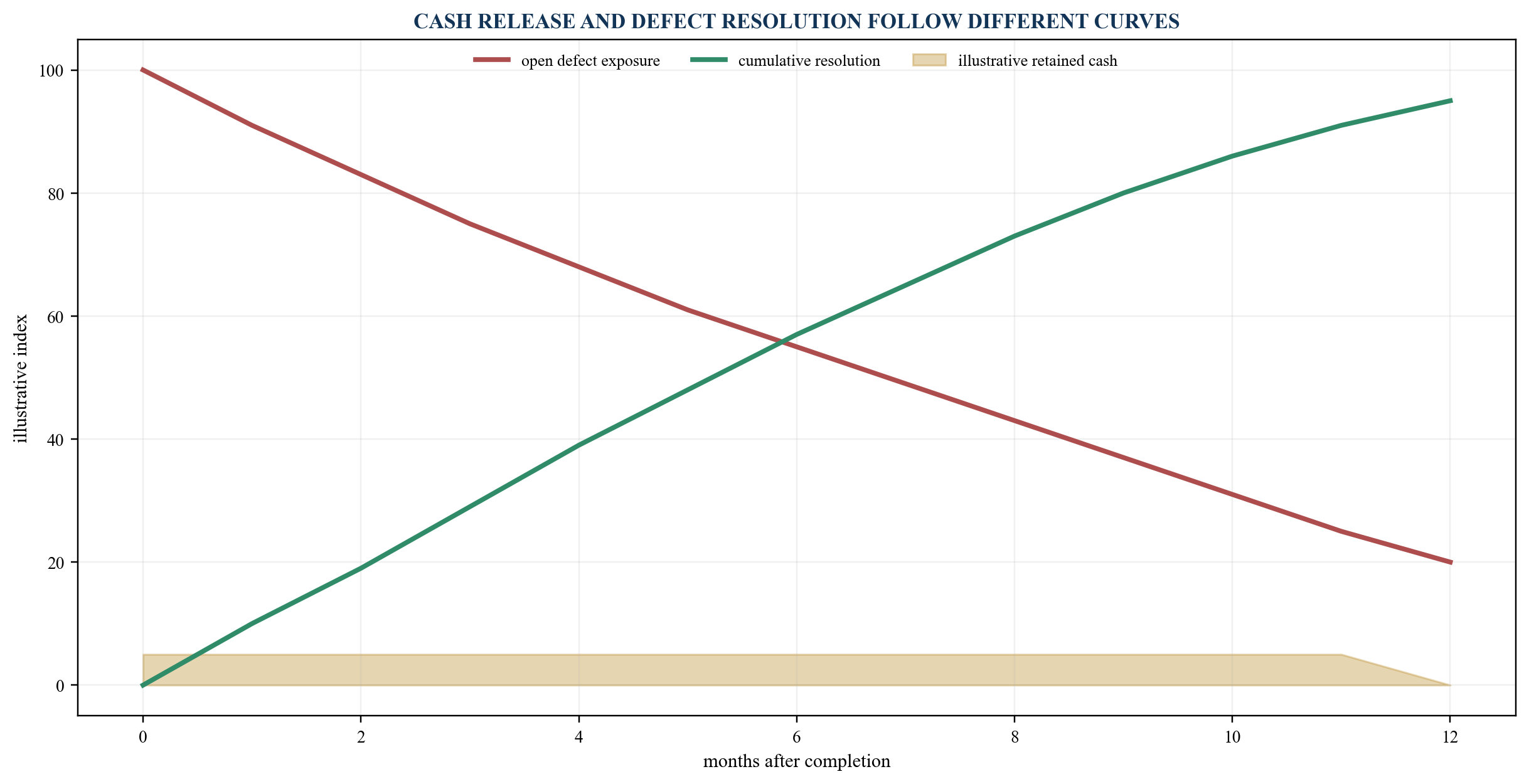
Values are illustrative management assumptions.
2. Separate every layer of protection
Project stakeholders use several forms of protection. Regulatory project escrow protects defined project and buyer interests under the applicable regime. Employer retention secures contractor performance under the main construction contract. The main contractor can hold subcontract retentions. Performance bonds, retention bonds, parent guarantees and warranties create separate recourse.
Insurance can respond to specified damage or defects subject to scope, exclusions, deductibles, notification and policy terms. Latent-defect insurance can cover qualifying structural or other insured defects for a longer period. Professional indemnity, contractor all-risks and product policies address different events and time periods.
The sponsor may also carry an unfunded reserve through available cash, a committed facility or balance-sheet capacity. Buyer contracts can create repair duties and remedies that differ from construction-contract rights. The developer can therefore owe a buyer before recovering from the responsible contractor.
Each layer needs a legal owner, beneficiary, amount, currency, expiry, conditions, draw process, exclusions and claims status. Adding nominal amounts can overstate protection because several instruments can cover the same event or require the same default.
The protection map also identifies gaps. A retention can be insufficient for systemic water ingress. A bond can expire before a defect emerges. An insurer can dispute notification or scope. A contractor can be insolvent. A developer reserve fills the time and recovery gap.
Table 1. Protection-layer map
| Layer | Primary purpose | Control record | Main financing limitation |
|---|---|---|---|
| project escrow tail | project and buyer protection | trustee, regulator and project records | release follows statutory and administrative conditions |
| main-contract retention | contractor performance | payment certificates and contract ledger | amount can remain trapped through defects period |
| subcontract retention | trade performance | subcontract ledgers | upstream and downstream release dates can diverge |
| bond or guarantee | alternative recourse | instrument, issuer and expiry diary | draw conditions and credit quality matter |
| insurance | specified insured loss | policy, notice and claim file | exclusions, deductibles and timing create gaps |
| sponsor reserve | residual and timing exposure | approved reserve and cash forecast | consumes unrestricted liquidity |
Rights depend on the applicable documents and law.
3. Build one authoritative defect register
The defect register begins with a unique issue identifier, location, asset or system, description, discovery date, discoverer, evidence, severity, safety impact, operability impact, buyer impact and contractual notification status.
Classification distinguishes workmanship, material, design, commissioning, damage, maintenance, misuse, variation and incomplete work. Liability remains a separate field because technical cause and contractual responsibility require evidence and sometimes expert or legal determination.
The record connects the buyer unit or common area to the relevant main-contract package, subcontractor, consultant, supplier, warranty and insurance policy. It identifies the party instructed, access arrangements, proposed repair, cost estimate, deadline, completed work, independent verification and closeout acceptance.
Duplicate reports should converge on one root issue while preserving each affected unit and claimant. A systemic waterproofing failure can generate hundreds of tickets. Counting tickets alone can distort exposure and repair planning.
The register should retain history. Changes to severity, cause, liability, cost, status and promised dates require timestamps and accountable users. Supporting photographs, inspection reports, communications and approvals remain linked.
4. Triage defects by consequence and propagation
Severity should reflect safety, legal compliance, building integrity, habitability, system availability, asset damage, number of affected units, likelihood of propagation, repair access and reputational impact. A low-cost defect can deserve urgent action if it creates a safety or water-damage pathway.
Propagation matters. A façade, roof, drainage, fire-stopping or mechanical-control issue can affect many areas. A cosmetic defect can remain isolated. Triage should consider the cost of delayed intervention and the chance that one defect signals a wider population.
The Singapore Building and Construction Authority's quality materials address workmanship issues affecting liveability and functionality and use defects-liability-period experience to refine quality assessment. This supports a consequence-led approach rather than an undifferentiated snag count.
Priority-one issues receive immediate containment, senior oversight and reserved funding. Priority-two issues enter a time-bound technical and liability assessment. Routine issues follow trade work packs and access schedules. Every priority has escalation and verification rules.
The financial model should update when severity or population changes. A sample defect that becomes systemic moves from a ticket allowance to an engineering reserve and recovery strategy.
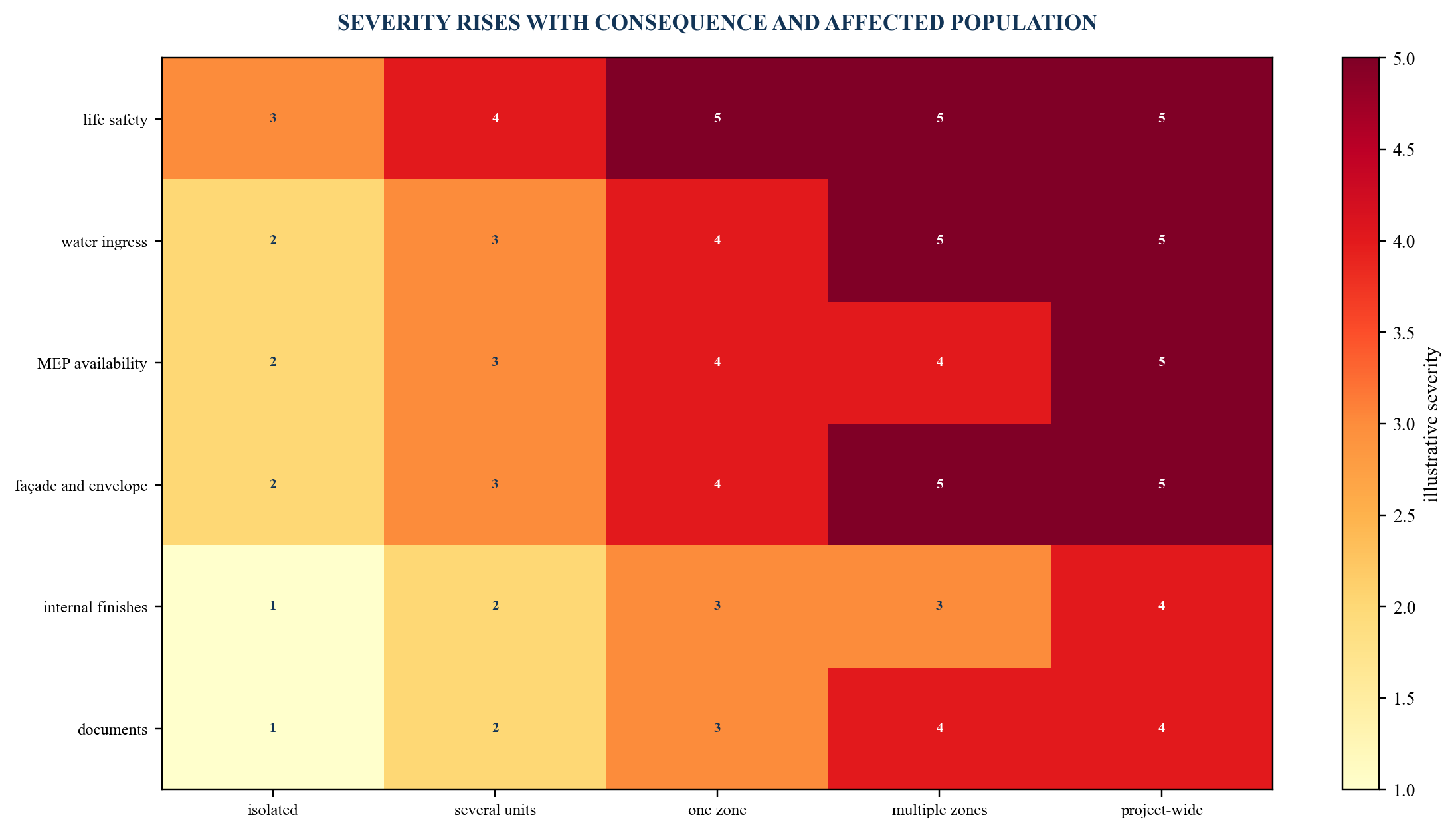
Scores and thresholds are illustrative management assumptions.
5. Model the cash curve by obligation
The closeout cash model begins with ring-fenced project cash, unrestricted sponsor cash, certified receivables, expected buyer collections, retention receivables, contractor retentions held, bonds, guarantees, insurance recoveries and committed financing.
Uses include direct remediation, consultants, access, temporary accommodation where applicable, testing, authority fees, legal and expert costs, insurance deductibles, buyer resolution, final-account settlements, debt service and operating handover.
Timing is as important as amount. The developer can fund repair before contractor liability is accepted. An insurance recovery can arrive after the work. A retention can remain unavailable until an approval. A bond claim can be disputed.
The model separates committed, probable and contingent sources. It haircuts sources for documentation, counterparty credit, expiry, dispute and timing. Each use has a base, severe and systemic scenario.
The minimum liquidity reserve covers the period between paying for urgent works and receiving recoveries. Management should see the lowest projected cash point, required facility size and decisions that move the trough.
Table 2. Post-completion cash model
| Cash item | Availability test | Timing field | Risk adjustment |
|---|---|---|---|
| escrow tail | trustee and regulator release conditions | earliest permissible release | exclude until conditions are evidenced |
| retention receivable | certificate, defects status and application | contractual due date | adjust for dispute and payer credit |
| retentions held | valid contractual right and balance | release or permitted use date | preserve trust or ring-fencing requirements |
| bond proceeds | live instrument and valid call route | notice and payment period | adjust for conditionality and challenge |
| insurance recovery | covered event and compliant notification | investigation and settlement estimate | apply deductible, exclusion and timing risk |
| sponsor or facility cash | approved and drawable commitment | draw notice and maturity | include covenant and liquidity headroom |
Values and probability assessments require project-specific evidence.
6. Estimate the reserve from exposure, recovery and timing
The gross reserve estimates the expected cost of open defects, incomplete work and closeout obligations. Unit rates, quantities, expert estimates, recent repair costs and procurement quotes support the calculation. Contingency reflects uncertainty in scope, access, inflation and propagation.
Recoveries are assessed separately. Contractor retention, guarantees, warranties, insurance and other claims receive evidence-based probability and timing. Presenting a net reserve without the gross obligation can conceal reliance on uncertain collection.
The reserve should avoid double counting. One root defect affecting many units needs a systemic repair estimate plus unit-specific access and reinstatement costs. Individual tickets already included in the systemic scope should be linked and excluded from additive totals.
Long-tail risks need scenarios. Water ingress, façades, structural movement, life-safety systems and common mechanical assets can produce costs far above routine snagging. Expert evidence defines plausible severe cases.
Reserve governance records methodology, evidence date, owner, assumptions, range, recoveries, accounting treatment and approval. Releases follow verified closure and remaining exposure rather than calendar passage alone.
7. Test contractor and subcontractor solvency
Defect recourse has value when the responsible party can and will perform. The closeout review assesses contractor and key trade solvency, current workload, site presence, key staff, disputes, payment stress, insurance, bond issuers and access to materials and specialist labour.
Indicators include late mobilisation, unresolved payroll or supplier claims, management turnover, requests for early retention release, expiring guarantees, incomplete documentation, abandoned communications and a rising volume of disputes across projects.
The response should remain evidence-led. A risk indicator triggers engagement, additional security, direct procurement planning or reserve adjustment. It should avoid unsupported conclusions about insolvency or misconduct.
Subcontractor failure can affect the main contractor's ability to repair. The developer may need step-in rights, assignment of warranties, access to design and commissioning records, supplier contacts and replacement pricing.
The financing plan should assume different recovery pathways. The base case uses responsible-party remediation. The downside case uses developer-funded work followed by recovery. The severe case assumes limited recovery and a replacement contractor.
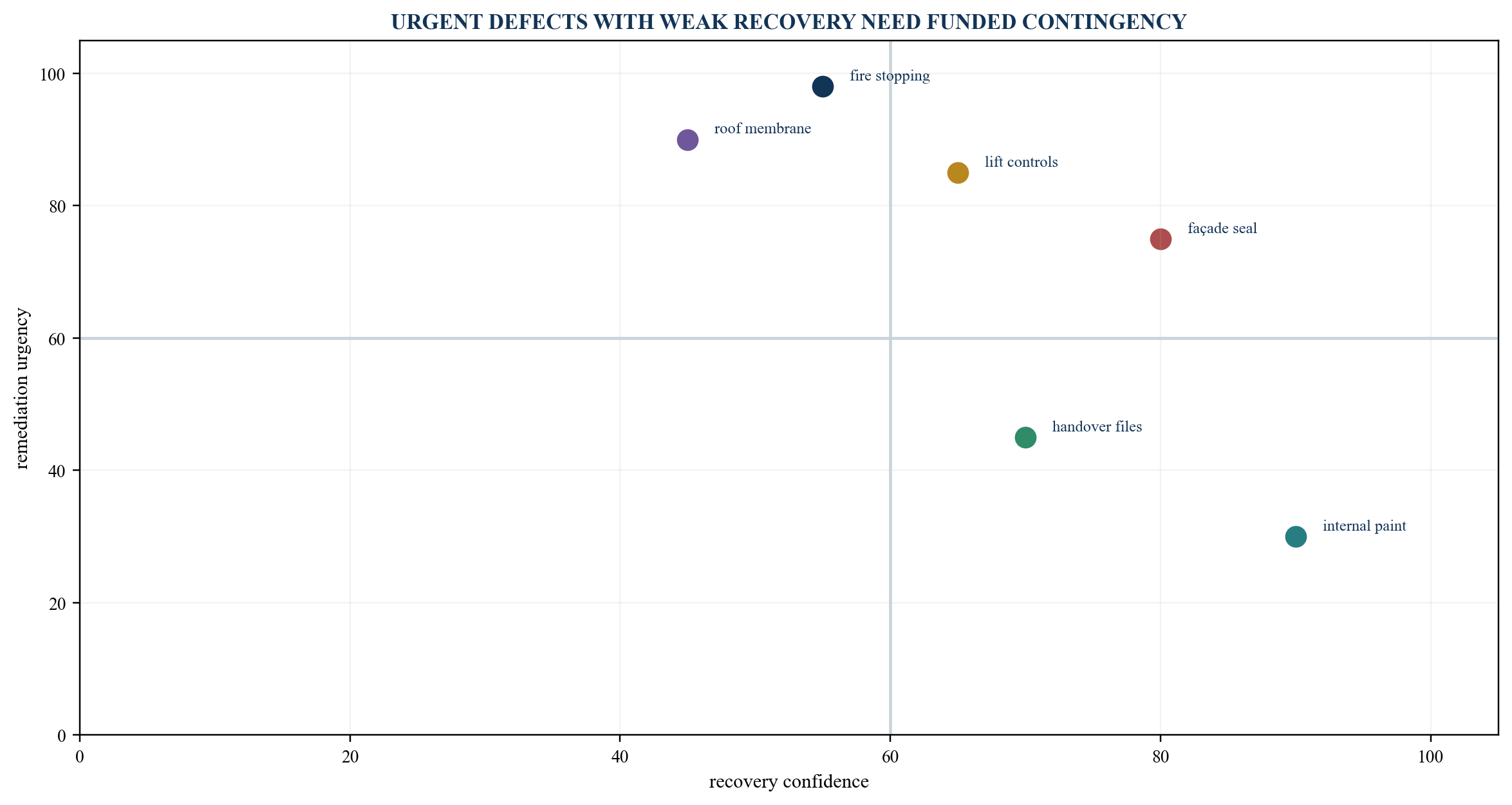
Positions are illustrative management assumptions.
8. Design the reserve waterfall
The waterfall directs funds according to project obligations and adopted priorities. Life-safety containment and legally required work typically rank ahead of cosmetic closeout. The exact order follows applicable law, contracts, finance documents and approvals.
The first layer funds immediate containment, investigation and access. The second funds approved repairs and independent verification. The third addresses buyer or occupier consequences within the applicable framework. The fourth funds final documentation, authority closeout and administrative completion.
Recoveries replenish the reserve where permitted. Contractor payments, bond proceeds and insurance recoveries should map to the costs they cover. The model should preserve restrictions on escrow and trust money.
Release gates use evidence: completed work, verified test, closed buyer case, reconciled cost, preserved warranty, no open linked defect and approval by the authorised parties. Calendar expiry can trigger review while unresolved notified defects remain tracked.
The waterfall should include a disputed reserve. Management can release undisputed surplus while preserving reasonable coverage for named disputes and unresolved systemic investigations, subject to legal and financial approval.
Table 3. Reserve waterfall and release evidence
| Waterfall layer | Funded purpose | Release evidence | Residual risk owner |
|---|---|---|---|
| containment | safety, protection and loss prevention | site record and technical confirmation | project executive |
| investigation | inspection, testing and expert diagnosis | accepted scope and cause report | technical director |
| remediation | approved repair and reinstatement | completion and independent verification | delivery director |
| buyer resolution | valid unit-level consequences | settlement or closed service record | customer director |
| completion | manuals, approvals and final records | accepted closeout pack | project director |
| disputed reserve | named unresolved claims | adjudication, agreement or approved reassessment | legal and finance |
Priority and use depend on applicable documents and law.
9. Finance the tail with the right instrument
Cash retention provides direct liquidity and simple visibility. It also traps capital, creates insolvency exposure in some structures and can exceed or fall short of actual risk. Ring-fenced or trust arrangements can protect beneficiaries while limiting use.
A retention bond or bank guarantee can replace cash while preserving conditional recourse. Its value depends on issuer credit, wording, expiry, extension, governing law and draw mechanics. Pricing should be compared with the working-capital benefit.
A committed defects facility can fund urgent repair before recoveries arrive. Borrowing base inputs can include certified receivables, cash collateral, guarantees, insurance claims and sponsor support. Covenants can track open exposure, reserve coverage, severe defects and release conditions.
Insurance can transfer specified low-frequency, high-severity exposures. It requires alignment between insured scope, defects discovered, notification, repair decisions and subrogation. Insurance is one source in the funding plan.
A structured solution can combine a smaller cash reserve, live guarantees, an undrawn facility and insurance. The sizing model tests cost, availability, counterparty concentration, administrative burden and downside performance.
Instrument selection should follow the defect profile. High-frequency routine defects can be funded through an operating reserve because claims administration would add friction. Low-frequency severe events can be more suitable for insurance or committed liquidity. Contractor-specific performance exposure can align with retention or a guarantee. A disputed final account needs a separate reserve rather than an assumed insurance recovery.
The facility base should use evidence that a lender can monitor. Eligible assets can include unrestricted project cash, certified receivables, verified retention receivables, cash-collateralised guarantees and approved insurance proceeds. Haircuts reflect dispute, expiry, concentration, payer credit and collection timing. Open defect exposure, reserve coverage and severe cases inform covenants and draw stops.
Pricing comparisons should include more than interest or guarantee commission. Cash retention has an opportunity cost. Bonds use credit capacity and can require collateral. Insurance has premium, deductible and claims cost. A facility adds commitment fees, reporting and covenant headroom. The decision model converts each option into annualised cash cost, peak liquidity benefit and severe-case availability.
Table 4. Defects-tail financing option scorecard
| Instrument | Best matched exposure | Liquidity benefit | Principal diligence |
|---|---|---|---|
| cash reserve | frequent and measurable remediation | immediately available | ring-fencing, sufficiency and release control |
| retention bond | contractor performance security | releases contractor cash | issuer credit, wording, expiry and draw route |
| committed facility | timing gap before recovery | funds urgent repair and working capital | borrowing base, covenants and maturity |
| insurance | defined low-frequency severe loss | transfers specified exposure | coverage, exclusions, deductible and notice |
| sponsor support | residual or uncertain exposure | fills gaps across sources | capacity, authority and competing obligations |
| hybrid structure | mixed routine and severe tail | balances availability and cost | interaction, double counting and governance |
Suitability and economics are illustrative and require project-specific terms.
10. Protect retention money through insolvency
Retention can fail as protection when the holder becomes insolvent or uses the cash for other purposes. Several jurisdictions have adopted trust or ring-fencing requirements for defined retention arrangements.
NSW Government guidance states that head contractors for projects meeting the applicable threshold must hold subcontractor retention money in a trust account with an authorised deposit-taking institution. It also describes ledger, reporting and withdrawal controls.
New Zealand's Ministry of Business, Innovation and Employment provides guidance for strengthened retention-money requirements, including responsibilities, reporting, insolvency and consequences of non-compliance. Its examples connect payment release to completion and expiry of the defects period.
The project review should determine who legally owns retained money, whether it is held on trust or ring-fenced, which account holds it, authorised withdrawals, reporting, interest, insolvency treatment and beneficiary rights.
Reconciliation compares contractual retention ledgers to bank or trustee balances and payment certificates. Deficits, unauthorised withdrawals and stale beneficiary records require immediate escalation.
11. Align upstream and downstream release
A main contractor can have retention withheld by the employer while holding retentions from many subcontractors. Release dates can diverge by contract, package completion, defects period and performance. A blanket link to overall project completion can create unfair or legally restricted delay.
The UK reporting framework requires qualifying businesses to describe retention practices, standard rates, terms, release mechanisms and the relationship between amounts withheld from suppliers and amounts withheld against the business. This transparency supports cash-flow analysis.
The closeout model maps retention receivable and payable by counterparty and due date. It distinguishes amounts legitimately held for that party's obligations from sums affected by unrelated work. Pay-when-paid or cross-contract conditions require current legal review.
Release sequencing should preserve the project's funded position while meeting valid payment obligations. A facility can bridge a temporary mismatch between downstream release and upstream receipt.
The dashboard shows overdue applications, uncertified amounts, disputed defects, missing evidence and payment dates. This helps prevent administrative delay from becoming a solvency problem.
Release discipline also requires a package-level view. The project may reach overall completion while one specialist trade remains inside its own defects period. The register should retain each package's completion certificate, notification period, open work, valid security and final-payment status. This prevents the project milestone from erasing a subcontract-specific obligation.
The funding plan should model late upstream receipt without using it as a reason to withhold a valid downstream payment. Where applicable law restricts conditional payment terms, the gap belongs in the project's financing plan. A transparent bridge can protect supply-chain relationships and future tender capacity.
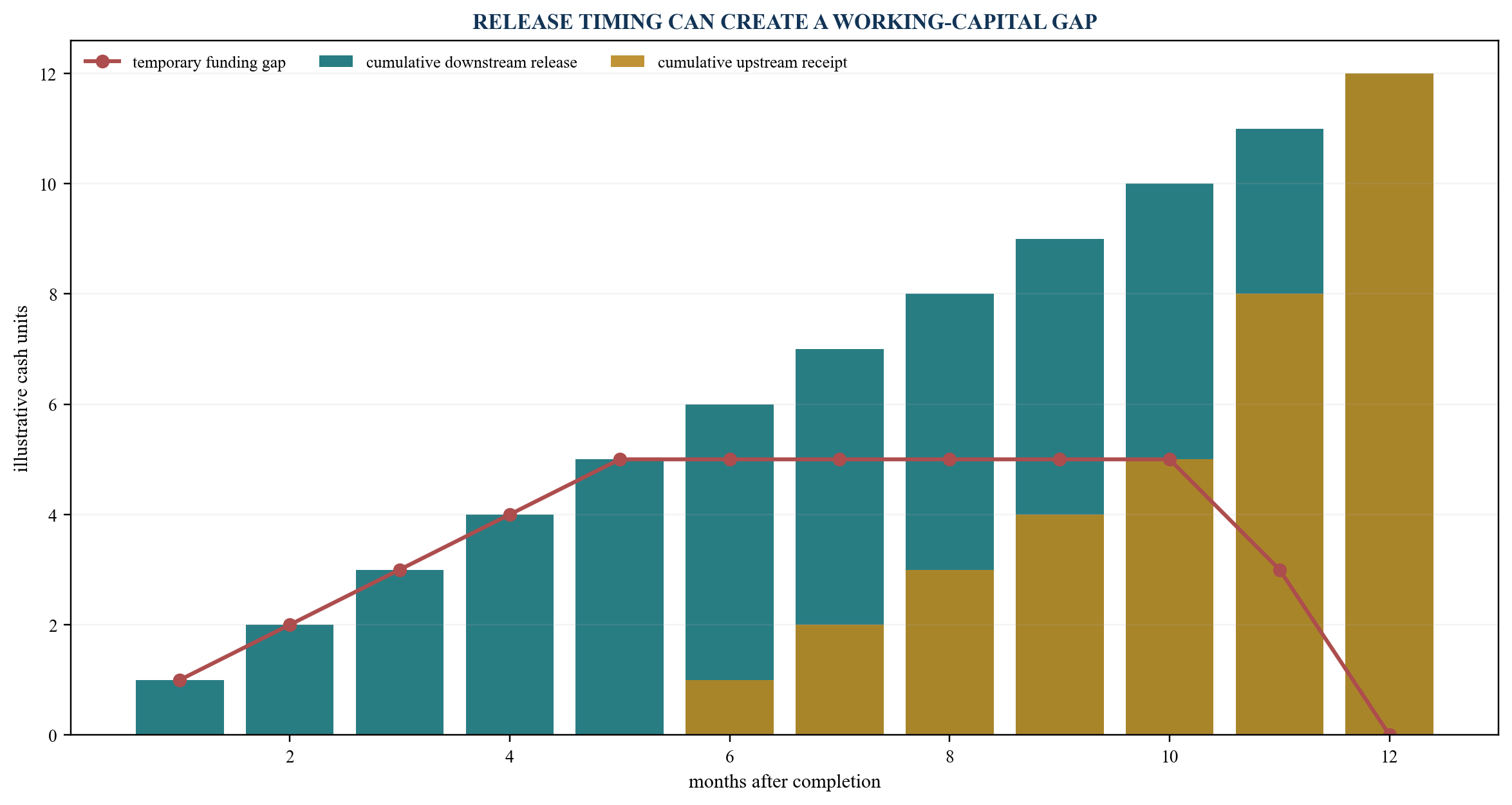
Values are illustrative management assumptions.
12. Integrate buyer and occupier resolution
Buyer experience influences escalation, reputation and cash collection. The service process should provide one intake route, acknowledgement, access coordination, appointment, repair, verification, communication and closure record.
The technical register and buyer case should link without exposing internal or third-party information improperly. The buyer sees relevant status and next action. The project team sees root cause, responsible trade, cost, recovery and systemic population.
Access can be a binding constraint. Occupied units require appointments, protection, temporary shutdowns, reinstatement and sometimes repeat visits. The financing model includes access and customer-service costs alongside physical repair.
Promises should reflect confirmed capacity. A repair date depends on diagnosis, materials, specialist labour, access and approvals. Missed commitments erode trust and can multiply communications.
Closure requires confirmation that the repair addressed the reported issue and any linked root cause. Reopened defects feed quality and reserve analytics.
Table 5. Buyer-resolution funnel
| Stage | Core evidence | Failure signal | Management measure |
|---|---|---|---|
| intake | complete location, description and media | duplicate or missing information | valid cases received |
| triage | severity, root issue and responsibility | high-risk item treated as routine | time to priority decision |
| access | confirmed appointment and constraints | repeated failed visit | access success rate |
| repair | work pack, materials and responsible trade | temporary patch without root solution | first-time repair rate |
| verify | test, inspection and buyer confirmation | case closed without evidence | verified closure rate |
| learn | cause, cost and recovery linked | recurring defect unrecognised | recurrence and recovery rate |
Service levels are illustrative and require formal adoption.
13. Control instructions, repair procurement and evidence
Every repair instruction should identify the defect, contractual basis, scope, location, access, method, safety controls, programme, price treatment, evidence and verification. Emergency work receives a rapid approval path with retrospective documentation.
The responsible contractor should have a reasonable opportunity to inspect and remedy where required. The record preserves notice, response and failure. Step-in or third-party procurement follows the applicable contract and advice.
Repair procurement should avoid inflated emergency pricing and repeated mobilisation. Bundling similar defects by system, location and access window can improve efficiency. High-risk work still needs appropriate competence and independent inspection.
Variations and betterment should be separated from defect remedy. An owner-requested upgrade can exceed the responsible party's obligation. Cost allocation should record the remedial baseline and incremental enhancement.
Evidence includes before-and-after photographs, test results, material certificates, commissioning, consultant acceptance, warranties, cost, payment and recovery. The file supports release, claim and future asset management.
14. Manage insurance and guarantee claims as projects
Claims require early identification of potentially responsive policies and instruments. The team reviews insured parties, period, scope, exclusions, deductibles, notification, consent to incur cost, mitigation, evidence and subrogation.
Notification should preserve rights while facts develop. Technical teams need clear instructions on evidence and insurer engagement. Repair urgency can require action before coverage is determined; approvals and reservations should be documented.
Guarantee management includes original instrument, issuer confirmation, amount, expiry, extension deadlines, reduction mechanics, demand conditions and governing law. A diary with accountable owners prevents accidental lapse.
The recovery forecast records submitted, acknowledged, reserved, disputed, approved and paid amounts. Expected recovery remains separate from available cash until collection.
Settlements should reflect the full economics: repair cost, professional fees, delay, access, deductibles, taxes and future rights. Qualified advisers determine claim strategy and release wording.
15. Validate completion before releasing protection
Completion certification, escrow release, retention release and guarantee reduction can use different definitions and evidence. The closeout matrix lists each gate and its controlling documents.
Technical completion evidence includes inspections, tests, commissioning, authority approvals, outstanding-work lists and verified defects. Commercial evidence includes final accounts, claims, payment certificates and reserve adequacy. Legal evidence includes valid releases, assignments, warranties and unresolved disputes.
The UK Building Safety Fund works-contract guidance requires a minimum defects rectification period and stated retention levels for relevant funded works. It also requires evidence that contractual provisions have been executed. This illustrates the need to connect terms with operating proof.
Release decisions should document remaining obligations, available protection, severe scenarios, contractor credit, insurance, buyer cases and management approval. Partial release can match verified risk reduction.
An independent technical or cost review can support material releases. The reviewer needs access to the complete population and prior findings.
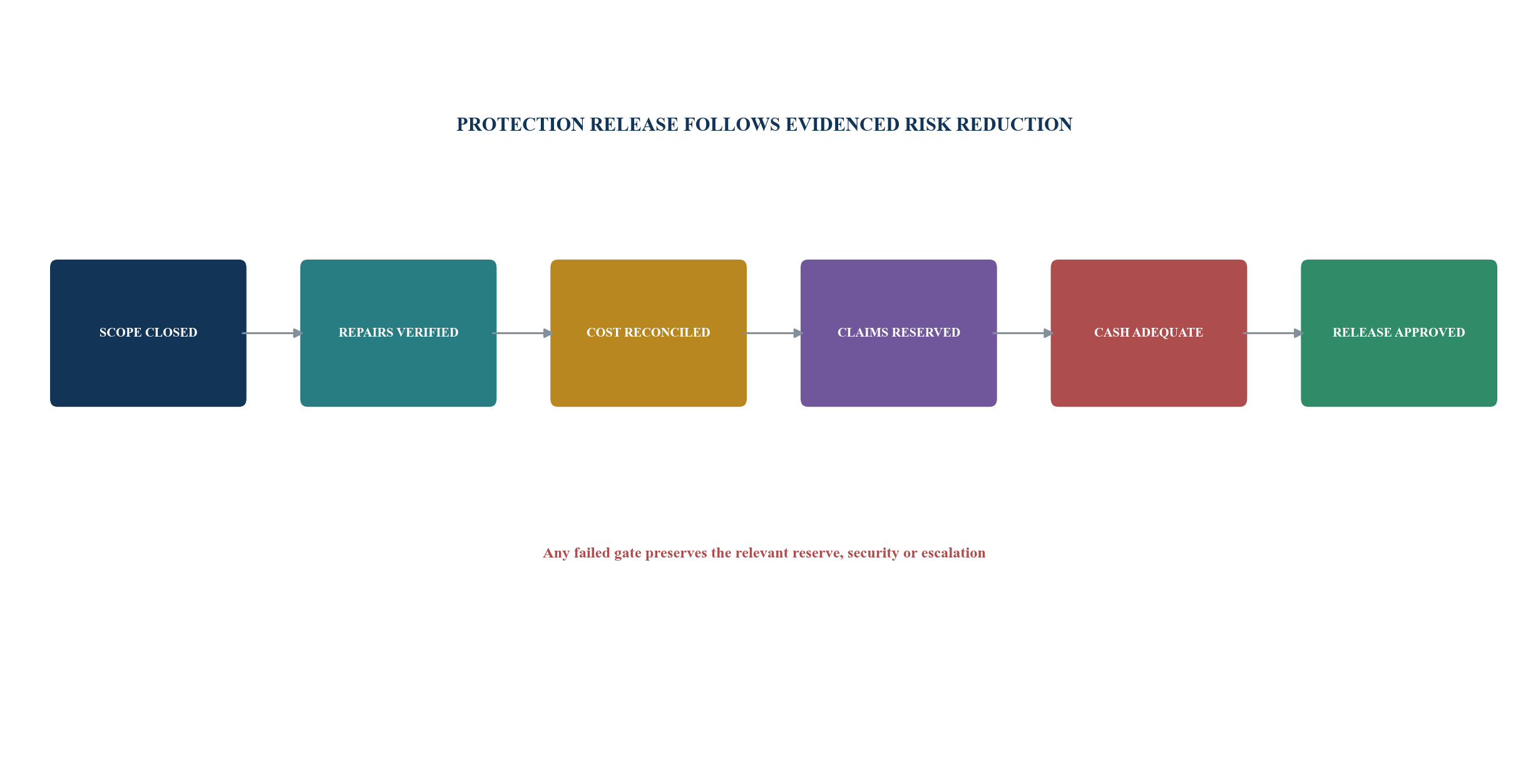
Gates are illustrative and require contract- and jurisdiction-specific design.
16. Build a board-level closeout dashboard
The dashboard connects defects, cash, security and recovery. It shows open defects by severity and system, systemic investigations, buyer cases, repair throughput, reopens, contractor response, reserve, available cash, recoveries, retentions, guarantees and insurance.
Metrics use complete populations and ageing. The board sees the oldest critical defect, units affected, time to containment, time to permanent repair, verified closure rate, expected final cost and downside funding requirement.
Protection coverage should distinguish nominal, available and risk-adjusted amounts. Expired or disputed security should not appear as fully available. The dashboard shows expiry dates and action owners.
Cash metrics include unrestricted liquidity, restricted cash, forecast trough, facility headroom, overdue receivables and valid retention payables. The bridge from gross reserve to expected recoveries remains visible.
Narrative commentary states what changed, why it matters, management action, owner and due date. The evidence link permits audit from summary to individual case.
The dashboard should distinguish defects reported, defects accepted as responsibility and defects fully costed. Using one count for all three can distort both operational performance and the reserve. It should also show the portion of gross exposure supported by cash, recoverable retention, live guarantees, acknowledged insurance and unfunded sponsor capacity.
Forecast accuracy is a core control. Management compares prior-month expected closures and cash uses with actual outcomes, explains variance and recalibrates repair productivity, access success, recovery timing and cost. Repeated optimism in closure or recovery forecasts should increase the liquidity buffer.
Portfolio reporting can compare projects after normalising for completed units, contract value and months since completion. This reveals persistent trade, design, procurement and closeout weaknesses while recognising different project scales.
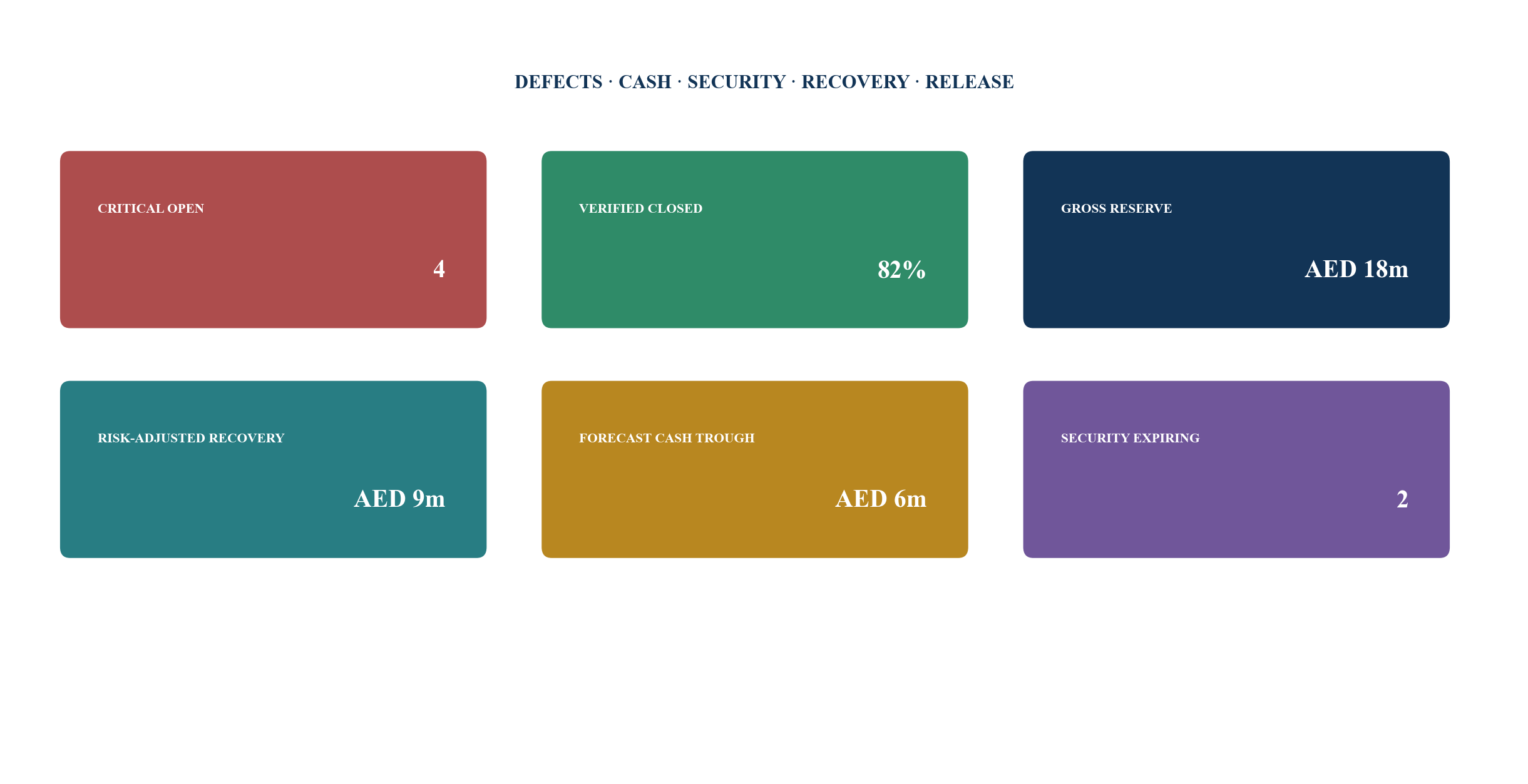
Measures and values are illustrative management assumptions.
17. Establish governance and decision rights
The executive sponsor owns the closeout outcome. A defects and capital committee can unite development, construction, technical, finance, legal, customer, insurance and asset-management teams.
The committee approves severity, systemic investigations, material reserves, third-party repair, claims, settlements, security extensions, partial releases and closure. Delegations define urgent expenditure and routine case authority.
Segregation protects cash and evidence. The person verifying repair should be independent from the party claiming completion where risk warrants. Payment approval connects to verified work and valid contractual entitlement.
The risk register records defects, solvency, liquidity, insurance, buyer, safety, regulatory, schedule and reputation. Each risk has current evidence, exposure, mitigation, owner and trigger.
Records remain accessible after the project team demobilises. Handover to the operating asset owner includes the defect register, warranties, claims, unresolved work, reserve and responsible contacts.
18. Run a ten-day defects-capital diagnostic
Days one and two collect project escrow records, construction and sale contracts, payment certificates, retention ledgers, guarantees, insurance, defect registers, buyer cases, completion evidence, final accounts and cash forecasts.
Days three and four reconcile protection layers and cash. The team confirms legal ownership, balances, expiry, draw conditions, release gates, expected receipts, obligations and funding headroom.
Days five and six test the complete defect population, root causes, systemic exposure, repair capacity, contractor and subcontractor response, access and buyer service. High-risk cases receive immediate escalation.
Days seven and eight rebuild the gross reserve, recovery forecast, severe scenarios and cash curve. The team quantifies the trough and instrument options.
Days nine and ten present the authoritative defect register, protection map, reserve waterfall, release decisions, financing requirement, governance and ninety-day plan. Management receives a clear mandate scope and acceptance criteria.
19. Implement a thirty-day closeout office
Days one to five establish governance, data ownership, case taxonomy, financial controls and a single issue log. Urgent defects, expiring security and cash gaps receive priority.
Days six to ten reconcile registers, retentions, escrow, guarantees, insurance, contractor balances and buyer cases. The team creates the integrated cash and exposure model.
Days eleven to fifteen launch trade work packs, access schedules, claim notifications, security extensions, evidence standards and a weekly dashboard. Procurement addresses gaps in contractor capacity.
Days sixteen to twenty verify completed repairs, close documentation, update recoveries and refine the reserve. Root-cause reviews identify wider populations and recurrence.
Days twenty-one to twenty-five agree release recommendations, facility sizing, disputed reserves, handover and operating responsibilities. Independent review covers material risk.
Days twenty-six to thirty approve the next release, draw or refinancing decision and transfer the recurring control calendar. The office retains named actions for unresolved claims and defects.
Table 6. Thirty-day closeout-office deliverables
| Workstream | Core deliverable | Acceptance evidence | Accountable owner |
|---|---|---|---|
| defects | authoritative register and systemic map | reconciled population and priority review | technical director |
| capital | cash curve and reserve waterfall | approved base and severe scenarios | finance director |
| security | escrow, retention, bond and insurance map | balances, conditions and expiry verified | commercial director |
| delivery | repair work packs and access plan | capacity, cost and verification assigned | delivery director |
| buyers | resolution funnel and communications | linked cases and service measures | customer director |
| release | funding and protection decision | signed gates and residual-risk record | executive sponsor |
Timing depends on project scale, evidence and stakeholder response.
20. Package the work around paid outcomes
A project-closeout diagnostic can quantify open defects, cash trapped, protection available, severe exposure and the funding gap. The outcome is a board decision on reserve, release and remediation.
A retention refinancing workstream can reconcile upstream and downstream cash, validate receivables, size a bridge, negotiate security and build lender reporting. It can support developers and contractors facing a temporary closeout mismatch.
A defects-liability office can manage the authoritative register, trade response, buyer resolution, cost, recovery, insurance and weekly governance. The engagement runs until agreed closure and handover criteria are met.
A distressed closeout mandate can address contractor failure, replacement procurement, bond and insurance recovery, reserve rebuilding and stakeholder communications. Specialist legal and technical advisers remain integral.
A recurring portfolio review can compare projects by defect severity, closure speed, reserve accuracy, contractor performance and release discipline. The resulting evidence can improve procurement, financing and future development underwriting.
Each mandate should define scope, evidence, authority, adviser roles, deliverables, acceptance and commercial terms. The five-percent tail becomes financeable when obligations, cash, security, recovery and decision rights share one controlled record.
The final handover should preserve a live control calendar beyond the engagement. It records defects-period expiries, guarantee extensions, insurance deadlines, reserve reviews, buyer commitments, authority submissions, final-account milestones and lender reporting. Named owners and escalation dates keep the residual tail visible after the original delivery team has demobilised and protect the operating asset from undocumented project risk.
References
- Dubai Land Department. Frequently Asked Questions: Escrow Accounts and the 5% Retained Amount. https://dubailand.gov.ae/en/frequently-asked-questions
- Dubai Land Department. Request to Activate an Escrow Account. Updated July 2026. https://dubailand.gov.ae/en/eservices/request-to-activate-an-escrow-account/
- Dubai Land Department. Dubai Real Estate Legislation. https://dubailand.gov.ae/media/zrrd4qw4/en-legislation.pdf
- UK Government. Annex B: Works Contract Requirements, Building Safety Fund. https://www.gov.uk/government/publications/building-safety-fund-guidance-for-new-applications-2022/annex-b-works-contract-requirements
- UK Government. Duty to Report: Guidance on Payment Practices and Performance. https://www.gov.uk/government/publications/business-payment-practices-and-performance-reporting-requirements/duty-to-report-guidance-to-reporting-on-payment-practices-and-performance
- UK Government, Department for Business, Energy and Industrial Strategy. Retentions in the Construction Industry. https://www.gov.uk/government/uploads/system/uploads/attachment_data/file/654399/Retention_Payments_Pye_Tait_report.pdf
- HM Revenue and Customs. Construction Industry Scheme Guide: Retention Payments. https://www.gov.uk/government/publications/construction-industry-scheme-cis-340/construction-industry-scheme-a-guide-for-contractors-and-subcontractors-cis-340
- NSW Government. Retention Money Held by Head Contractors. https://www.nsw.gov.au/housing-and-construction/compliance-and-regulation/security-of-payment/retention-money
- NSW Government. Building and Construction Industry Security of Payment Regulation 2020. https://legislation.nsw.gov.au/view/html/inforce/current/sl-2020-0504
- New Zealand Ministry of Business, Innovation and Employment. Retention Money Resources. Updated 30 January 2026. https://www.building.govt.nz/projects-and-consents/why-contracts-are-valuable/construction-contracts-act-2002/retention-money-resources
- New Zealand Ministry of Business, Innovation and Employment. Retention Money Guidance for the Construction Contracts Act 2002. https://www.building.govt.nz/assets/Uploads/projects-and-consents/retention-money-guidance-for-construction-contracts-act-2002.pdf
- Singapore Building and Construction Authority. What to Know as a Condo Owner: Defects Liability Period. https://www1.bca.gov.sg/home-and-building-owners/condo-strata/condo-living-be-condo-savvy/what-to-know-as-a-condo-owner/
- Singapore Building and Construction Authority. CONQUAS Private Residential Manual. 13 November 2025. https://www1.bca.gov.sg/docs/default-source/docs-corp-buildsg/quality/conquas-%28private-residential%29-manual.pdf
- Singapore Building and Construction Authority. Security of Payment Act. https://www1.bca.gov.sg/growth-and-transformation/procurement/procurement-and-legal-frameworks/security-of-payment-act/
About the Author
Chennakeshav Adya, Independent Researcher
