

1. Treat climate as a balance-sheet transmission problem
Climate risk enters a family balance sheet through assets, liabilities, income, costs, liquidity and control. A flood can damage a property, interrupt a portfolio company, reduce collateral value and create an uninsured cash requirement. Heat can raise cooling costs, weaken labour productivity, constrain equipment and change tenant demand. A policy, technology or customer shift can alter revenue, capital expenditure, financing and terminal value before physical damage occurs.
The first task is to identify what the family owns, controls, finances, guarantees or depends upon. Personal residences, commercial property, land, operating companies, funds, direct investments, private credit, public securities, insurance policies, debt and contingent support can sit in different companies, trusts, foundations, partnerships and personal estates. A consolidated family view should preserve those legal distinctions.
Physical and transition risks can occur together. The Intergovernmental Panel on Climate Change assesses hazards, exposure and vulnerability as central elements of climate risk. Physical risks can be acute, including flood, storm and wildfire, or chronic, including heat, water stress and sea-level change. Transition risks can arise through policy, law, technology, markets and stakeholder expectations as economies change.
The financial analysis should state the transmission channel. Revenue can fall through interruption or changing demand. Costs can rise through energy, water, insurance, maintenance and compliance. Assets can require adaptation or suffer impairment. Liabilities can increase through borrowing, remediation, litigation or support. Liquidity can tighten when several entities need cash together. The family office should connect each material climate driver to these conventional financial categories.
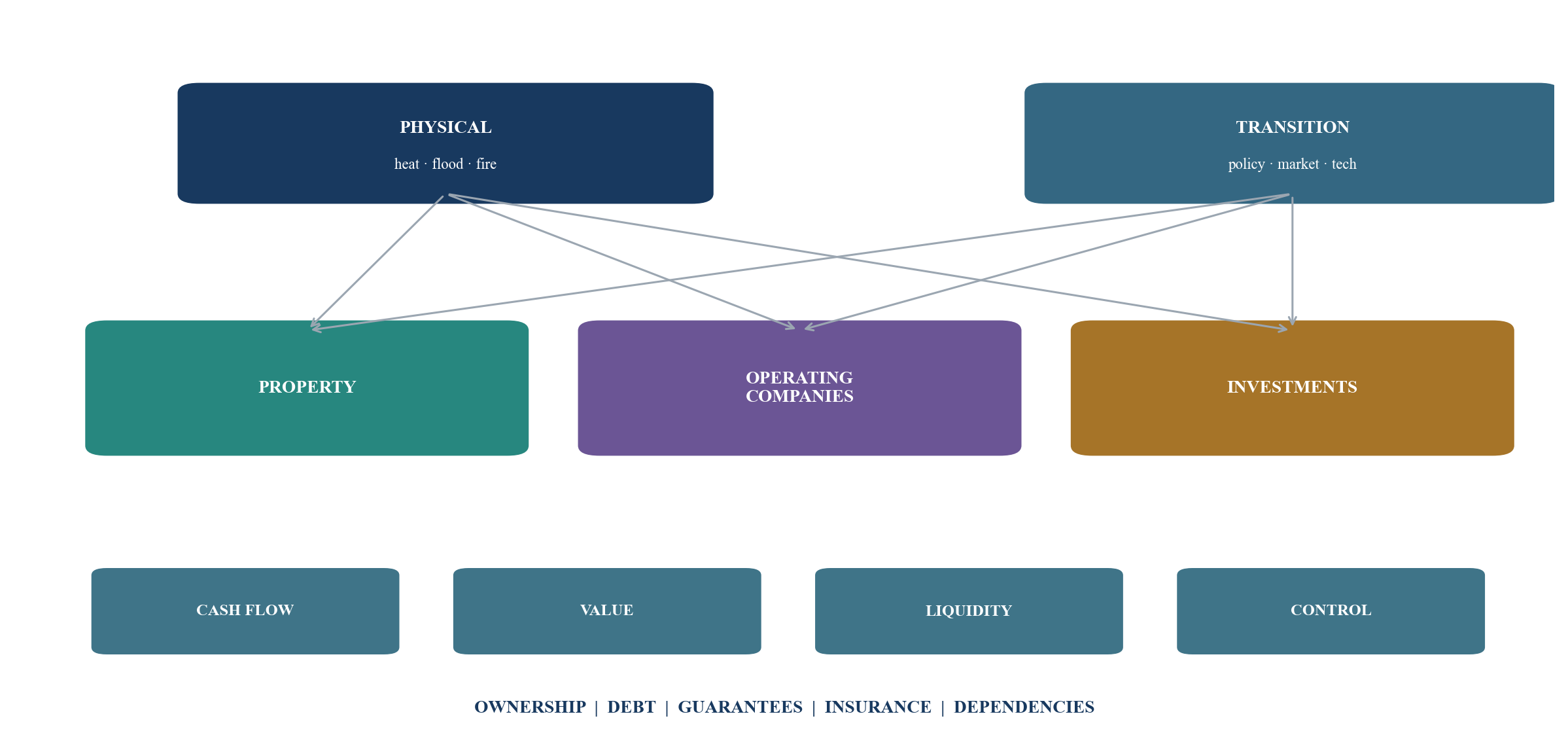
Legal ownership and financial links determine where an exposure becomes a cash, value or control consequence.
2. Define the decision purpose, perimeter and time horizons
The assessment should answer a board decision. It may support acquisition, disposal, refinancing, insurance renewal, capital allocation, adaptation, succession, disclosure or a portfolio review. A general climate score without a decision purpose can consume data while leaving capital unchanged.
The perimeter should begin with legal entities and beneficial interests. It should include assets directly owned by the family, controlled operating companies, material minority holdings, funds, credit, guarantees, pledged assets and contractual support. Look-through depth can be proportionate to materiality, information rights and decision authority. Missing information should remain visible.
Time horizons should align with the relevant asset and decision. A property can have a multi-decade economic life. A private-equity hold can be shorter, while its exit value depends on the buyer's view of longer-term risks. Working-capital decisions can respond to the next season. Insurance renews on a different cycle from debt. Succession and trust structures can extend the family's exposure well beyond a business plan.
IFRS S2 asks reporting entities to consider climate-related physical and transition risks that could reasonably affect cash flows, access to finance or cost of capital over short, medium and long terms. A family office may be outside the standard's scope. Its governance, strategy, risk-management and metrics architecture still provides a useful organising reference where adopted voluntarily and applied with qualified advice.
The perimeter should also capture family objectives. A property can have emotional, heritage or strategic value beyond its financial return. An operating company can support employees, identity and community. A concentrated holding can express long-term conviction. The decision record should identify these objectives so that adaptation, insurance, diversification or exit is assessed against an explicit mandate.
3. Build a reconciled asset, location and dependency register
Climate analysis requires asset-level and location-level evidence. A group address can conceal factories, warehouses, offices, data centres, farms, stores and supplier sites. A fund label can conceal regional, sector and company concentrations. The register should connect legal owner, asset, location, use, value, cash flow, debt, insurance, dependencies and decision authority.
Location data should be precise enough for the hazard analysis and authorised for use. Property coordinates, elevation, building characteristics, construction, age, occupancy and critical equipment can affect vulnerability. Operating companies require owned, leased and supplier sites; logistics, power, water, telecommunications and workforce dependencies; customers and revenue; and recovery routes. Investment records require issuer, vehicle, sector, geography, instrument, duration and information rights.
The evidence should have a source and date. Title records, leases, engineering surveys, insurer schedules, catastrophe models, accounts, loan documents, business-continuity plans, supplier records, manager reports and public disclosures serve different purposes. A portfolio estimate should not be presented as asset-level evidence.
The register should identify interconnections. A family holding company may guarantee operating debt secured on property. A business can rent a building from another family entity. A family office fund can own credit issued by a related company. An insurer and bank can be exposed to the same region. These links can amplify a climate event and create double counting in a consolidated exposure view.
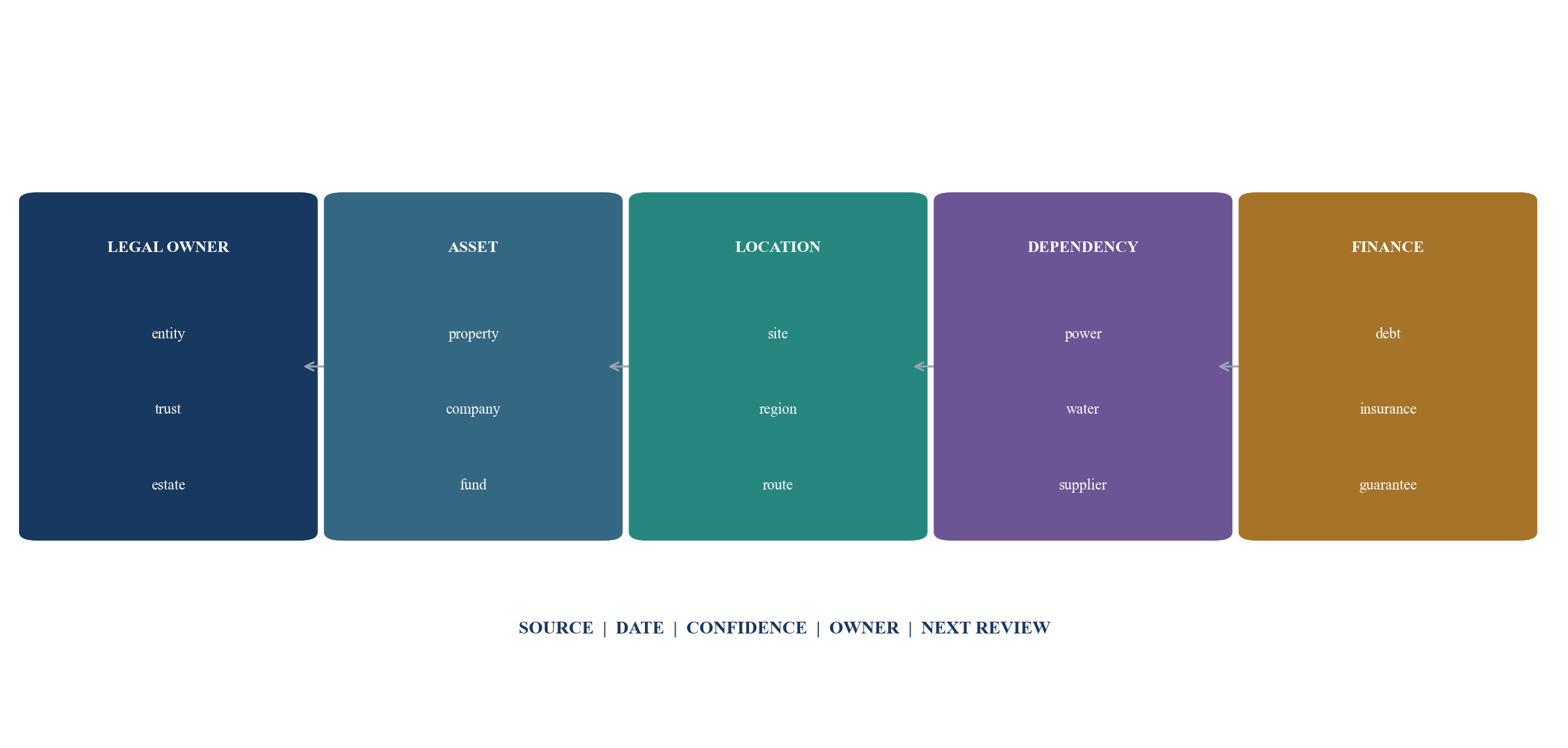
The register joins legal ownership, location, operations, finance and evidence without erasing entity boundaries.
Table 1. Climate-risk taxonomy for a family balance sheet
| Domain | Risk driver | Possible financial transmission | Primary evidence |
|---|---|---|---|
| acute physical | flood, storm, wildfire, extreme heat or precipitation event | damage, interruption, inventory loss, health and safety cost, emergency liquidity | hazard data, site survey, claims, insurer and continuity plan |
| chronic physical | rising heat, water stress, sea-level change or persistent climate shift | operating cost, productivity, maintenance, adaptation capex, useful life and location demand | climate projections, engineering, resource and operating data |
| policy and legal | carbon, building, energy, product, reporting or liability requirements | capex, compliance, tax, restricted activity, contractual and legal exposure | applicable law, permits, contracts and counsel review |
| technology | substitution in energy, transport, materials, processes or products | stranded equipment, new capex, margin, competition and obsolescence | technology roadmap, asset age, cost curve and customer evidence |
| market | changing demand, procurement, finance, insurance or investor preference | revenue, price, volume, access to capital, insurance cost and exit value | customer, lender, insurer, market and transaction evidence |
| reputation and relationship | stakeholder response to claims, performance or incidents | customer loss, hiring, financing, brand and governance consequences | claims record, communications, customer and employee evidence |
| compound and systemic | interacting hazards, supply failure, market stress and funding pressure | correlated losses, liquidity demand, covenant pressure and limited exit routes | scenario narrative, concentration map and group cash-flow model |
Risk drivers should be connected to conventional financial consequences and decision authority.
4. Separate hazard, exposure, vulnerability and response capacity
A hazard map does not establish loss. The asset must be exposed, vulnerable and unable to absorb or respond to the event. Hazard describes the potential climate event or trend. Exposure describes the people, property, operations and value in harm's way. Vulnerability describes susceptibility to damage or disruption. Response capacity describes prevention, adaptation, continuity, finance and recovery.
This separation improves decision quality. Two buildings in the same flood zone can have different elevation, design, critical equipment, access, tenants, insurance and recovery time. Two companies in the same sector can have different facilities, power contracts, suppliers, products and margins. Two funds can report the same regional allocation while holding different assets and governance rights.
The IPCC provides the scientific foundation for considering hazard, exposure, vulnerability and adaptation. Its Sixth Assessment Report integrates physical science, impacts, vulnerability, adaptation and mitigation. The family office should use qualified scientific, engineering and insurance specialists to translate global and regional evidence into asset-specific decisions.
Data uncertainty should remain explicit. Climate models, hazard datasets, catastrophe models, asset records and financial models have different spatial resolution, time horizons and limitations. A point estimate can imply precision the evidence does not support. The decision pack should show ranges, assumptions, excluded risks, data dates and sensitivity to material changes.
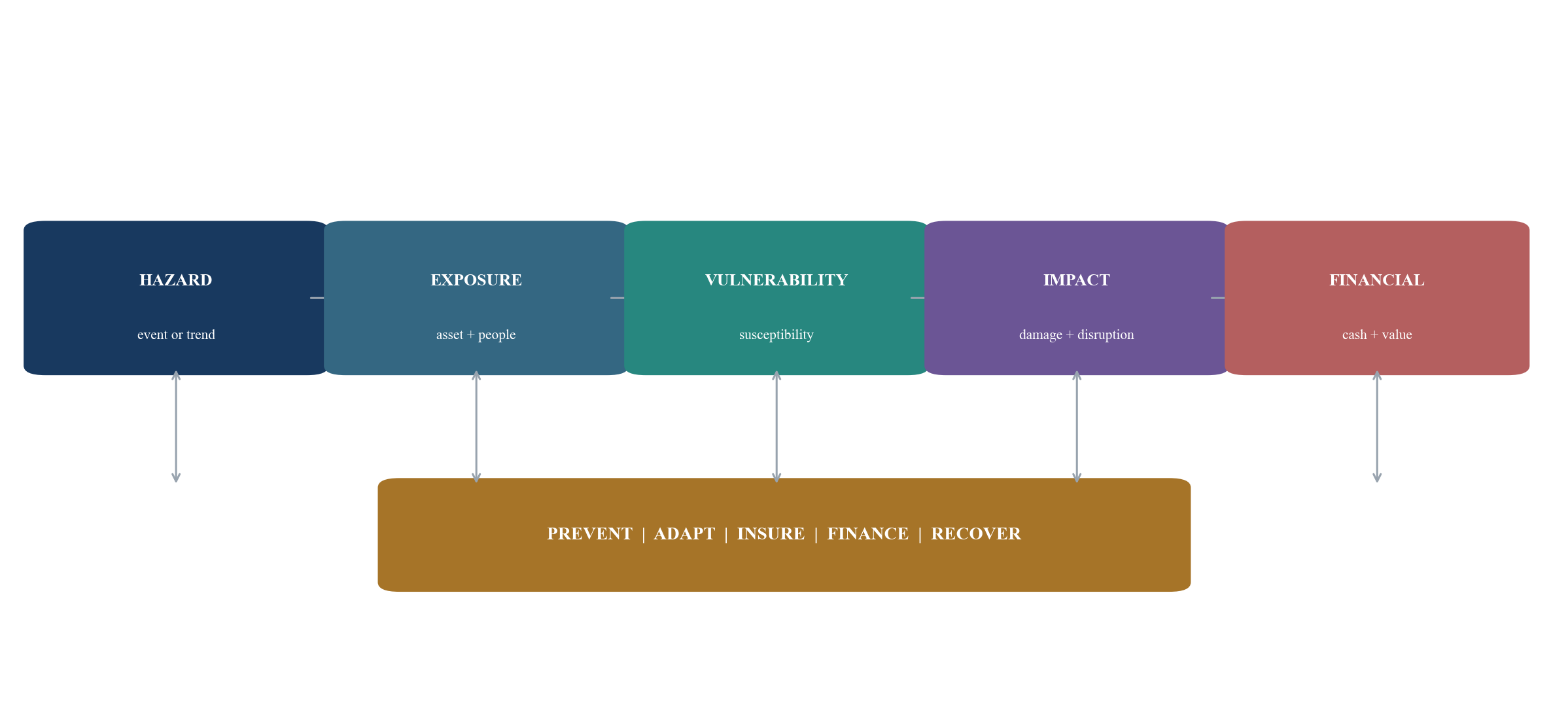
Loss depends on exposure, vulnerability, response capacity and financial structure.
Table 2. Minimum climate exposure register
| Field | Governing question | Minimum evidence |
|---|---|---|
| legal owner | which entity bears the asset, liability, duty and cash impact? | title, register, agreement, trust, guarantee and group structure |
| location | where are the asset and critical dependencies? | verified coordinates, site list, supplier and logistics map |
| use and cash flow | how does the asset create value and who depends on it? | lease, operating data, customer, margin and cash-flow record |
| physical exposure | which acute and chronic hazards are decision material? | qualified hazard data, time horizon, resolution and limitation |
| vulnerability | which building, equipment, workforce or process can fail? | engineering, maintenance, asset condition and continuity assessment |
| transition exposure | which policy, market, technology and contract changes matter? | regulatory, customer, product, energy, financing and insurance evidence |
| finance | what debt, covenant, collateral, guarantee and liquidity link exists? | facility, security, covenant, maturity and treasury record |
| insurance | which peril, limit, exclusion, deductible and interruption period applies? | policy, schedule, broker analysis, claims and renewal terms |
| value | what reference value and financial model are used? | accounts, valuation, forecast, appraisal and transaction evidence |
| authority | who can approve mitigation, capex, transfer, financing or exit? | board, investment committee, delegation and owner mandate |
Each field should have current evidence, a named owner and an update rule.
5. Assess property through location, function and cash flow
Property analysis should begin with the building's function. A home, hotel, warehouse, office, school, clinic, farm, factory and data centre depend on different systems and recovery times. Site access, occupants, critical equipment, utilities, supply, evacuation and business interruption influence the consequence of a hazard.
The physical assessment can cover flood, heat, wildfire, wind, storm surge, sea-level change, drought, water stress and other location-relevant hazards. It should distinguish current conditions from future projections and state the selected horizons. Engineering review should examine structure, drainage, elevation, roof, envelope, cooling, fire protection, backup power, water, equipment placement and maintenance.
Insurance is one layer of response. The policy should be reconciled to asset ownership, replacement cost, perils, sublimits, exclusions, deductible, waiting period, business interruption, contingent business interruption and claims process. The European Insurance and Occupational Pensions Authority's protection-gap dashboard brings together economic losses, insured losses, risk estimates and coverage across European countries. Its work illustrates why insured status, affordability and future availability require separate analysis.
Financing can transmit the risk. Lenders can require insurance, valuations, covenants, reserves and repairs. Reduced insurance availability or higher premiums can affect debt service and refinancing. A damaged or obsolete building can require shareholder funding. Guarantees can move the cash need to another family entity.
The property decision should compare prevention, adaptation, insurance, operational change, refinancing, leasing, sale and acceptance. Adaptation options require cost, timing, life, disruption, maintenance, residual risk, approvals and value analysis. A sale decision should consider disclosure, buyer diligence, financing conditions and the family's use or heritage objective.
Table 3. Property climate-risk decision matrix
| Decision route | Core question | Acceptance evidence |
|---|---|---|
| maintain | is current exposure within approved tolerance with functioning controls? | hazard, engineering, maintenance, insurance and liquidity evidence |
| prevent | can design, maintenance or operating action reduce likelihood? | technical option, cost, implementation and measured residual risk |
| adapt | can the asset remain functional across relevant horizons? | adaptation design, capex, approvals, useful life and scenario test |
| insure | can material residual loss be transferred on workable terms? | policy wording, limit, exclusion, deductible, credit and renewal outlook |
| finance | can reserve or borrowing fund recovery and adaptation without group stress? | facility, collateral, covenant, repayment and downside liquidity |
| change use | does another use reduce exposure or improve economics? | planning, design, demand, capex, operating and valuation analysis |
| sell | is value and liquidity better preserved through transfer? | buyer evidence, disclosure, tax, debt, timing and replacement plan |
| accept | is retained risk deliberate, funded and within authority? | board rationale, threshold, reserve, monitoring and trigger for review |
The appropriate response depends on asset-specific evidence, objectives and lawful authority.
6. Trace operating-company exposure through the value chain
An operating company can experience climate risk at owned sites, leased sites, suppliers, logistics, customers, employees and infrastructure. The assessment should begin with products, services, revenue and critical processes. It should identify which facilities, equipment, people, data, power, water, transport and suppliers support each material cash-flow stream.
Physical risk can interrupt operations without damaging the company's own property. A supplier can lose production, a port can close, a road can fail, a workforce can face heat or health constraints, or a customer region can be disrupted. The company should map single points of failure, inventory, alternate suppliers, geographic substitution, recovery time and contractual allocation.
Transition risk can change demand, input cost, standards and competitiveness. Energy and carbon policy can affect direct cost and supplier prices. Building, product and procurement requirements can create capex or reporting. Technology can reduce the competitiveness of existing equipment or products. Customers and financiers can request data, targets or transition plans. These changes should be connected to the actual business plan.
The financial model can translate the pathways into revenue, margin, working capital, capex, asset life, financing and terminal value. It should distinguish committed action, plausible management response and unsupported assumption. A transition plan should identify owners, funding, milestones, dependencies and consequences of delay.
Business continuity and adaptation should work together. Continuity manages disruption and recovery. Adaptation changes the asset or system to reduce vulnerability. The company should test authority, communications, safety, supplier substitution, data, payment, customer service, lender reporting and cash needs through realistic exercises.
Table 4. Operating-company climate control framework
| Domain | Control question | Decision evidence |
|---|---|---|
| sites and equipment | which location or asset can stop critical output? | site map, condition, hazard, maintenance, redundancy and recovery time |
| workforce | how do heat, travel, health and community conditions affect delivery? | role, location, safety, absence, productivity and alternate-work plan |
| suppliers | which inputs have geographic, capacity or transition concentration? | tier mapping, inventory, alternatives, contract and supplier evidence |
| infrastructure | which power, water, transport, telecoms and data services are critical? | capacity, outage, backup, contract and restoration evidence |
| customers | which revenue is exposed to physical events or changing requirements? | revenue by customer and region, contract, pipeline and demand evidence |
| products and technology | which offering or equipment can lose competitiveness? | product economics, regulation, technology roadmap and replacement cycle |
| finance | can cash, covenants and insurance absorb disruption and capex? | rolling forecast, stress, debt, policy, reserve and shareholder support |
| governance | who owns each risk, action, threshold and escalation? | board mandate, executive owner, milestones, dashboard and assurance |
Controls should connect business dependencies to financial thresholds and decision owners.
7. Look through investment labels to economic exposure
An investment portfolio can reproduce the family's property and business exposure. A real-estate fund, infrastructure vehicle, private credit fund, public equity mandate and direct co-investment can all hold companies operating in the same regions and sectors as the family enterprise. A consolidated view should identify correlated physical, transition, financing and liquidity exposure.
Public investments can offer regular market prices and reporting, while issuer disclosure, methodology and asset-level detail vary. Private funds can provide manager reports, limited-partner information and engagement routes, while valuation and liquidity are periodic. Direct holdings can provide governance rights and deeper diligence, while concentration and operating demands can be higher.
The family office should record mandate, instrument, geography, sector, duration, liquidity, valuation, manager, information rights and climate process. It should distinguish financed emissions or portfolio metrics from financial risk. Emissions data can inform transition exposure; it does not independently establish cash-flow, valuation or loss.
Manager diligence can cover governance, risk identification, scenario use, data quality, valuation, engagement, adaptation, transition planning, insurance, financing and incidents. The office should ask how the manager changes underwriting, ownership and exit decisions. A policy statement without transaction evidence provides limited proof of implementation.
Credit requires attention to borrower resilience, collateral, covenant, insurance, maturity and refinancing. Equity requires revenue, cost, capex, competitive position and terminal value. Fund interests also require portfolio concentration, valuation practice, liquidity, subscription facilities, NAV facilities and the manager's authority. The same climate driver can transmit differently through each instrument.
8. Connect climate risk to valuation and capital allocation
The valuation process should reflect information available at the measurement date under the relevant accounting and valuation framework. Climate analysis can affect cash-flow forecasts, growth, margins, capex, asset life, impairment, terminal value, discount rate, comparable selection and scenario weighting. Qualified valuation and accounting professionals should determine the treatment for the actual asset.
A board should see the bridge from climate driver to financial input. A heat-risk score has limited decision meaning until it connects to cooling capex, operating cost, tenant demand, interruption or useful life. A policy scenario should connect to product demand, energy cost, compliance, equipment replacement or financing. Every adjustment needs an evidence source and date.
Capital allocation can then compare actions across the family balance sheet. It can prioritise life and safety, legal obligations, critical continuity, high-consequence concentrations, cost-effective adaptation and strategic opportunity. Projects should state capex, operating cost, timing, dependencies, risk reduction, financial benefit, residual risk and owner.
The Basel Committee's principles for banks show how climate-related financial drivers can be incorporated into governance, strategy, risk management, data, capital and liquidity through conventional risk categories. A family office is different from a bank. The transmission discipline remains useful when applied proportionately.
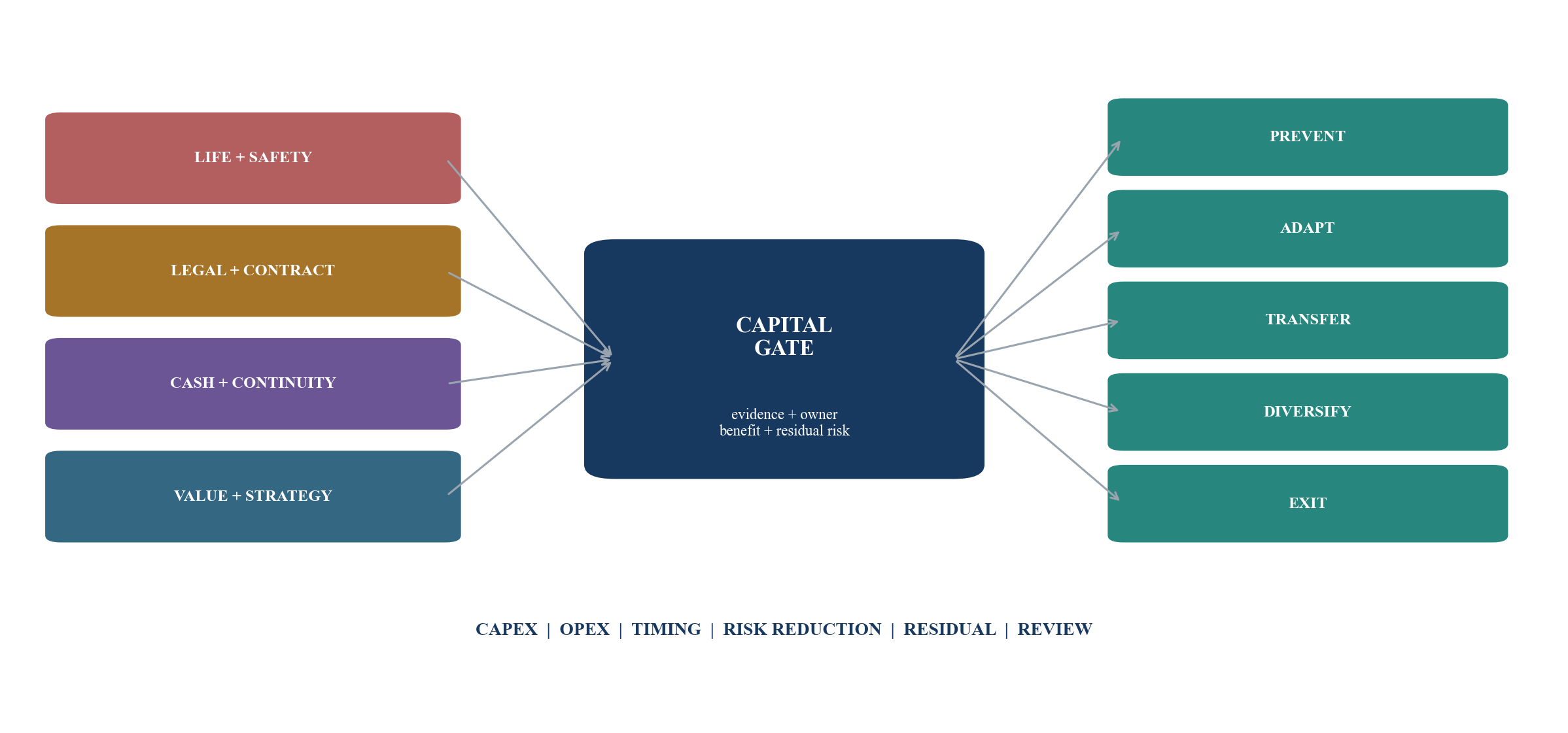
Capital follows verified consequence, response effectiveness and authority rather than a standalone climate score.
9. Test insurance, financing and liquidity together
Insurance analysis should identify what the policy transfers and what remains. Coverage limits, sublimits, exclusions, deductible, waiting period, valuation basis, reinstatement, business interruption, contingent interruption, insurer credit and claims procedures matter. The schedule should reconcile to the legal owner and asset register.
Availability can change at renewal. A family should assess current coverage, price, terms, broker alternatives, risk-improvement conditions and credible future availability. EIOPA's work on natural-catastrophe protection gaps demonstrates the importance of economic loss, insured loss, risk prevention and granular exposure. Other jurisdictions have different insurance markets and public arrangements.
Financing should identify lender requirements, insurance covenants, collateral, valuation, reserves, interest, maturity and information obligations. Adaptation capex can compete with distributions and growth. A property or company can face higher cost of capital or reduced capacity when lenders reassess risk. The office should engage lenders with current evidence and a funded plan.
Liquidity stress can occur when several exposures move together. A physical event can require repairs, deductibles, operating support and family expenditure while markets are volatile. A disorderly transition can require capex across portfolio companies while impairing older assets. The family liquidity reserve should model simultaneous needs and preserve legal-owner constraints.
10. Use scenarios as decision tools with visible limitations
Scenarios explore plausible pathways. They are not forecasts. The board should define the decision, selected hazards and transition drivers, time horizons, geographic and sector scope, assumptions, management response and financial measures. It should use a small set of distinct narratives that expose vulnerabilities.
The Network for Greening the Financial System provides long-term physical- and transition-risk pathways. In February 2026, NGFS warned that the paper underlying Phase V physical-risk estimates had been retracted, highlighted limitations and tail risks, and planned an updated methodology. This warning should accompany the estimates.
A family office can use orderly-transition, fragmented-transition and higher-physical-risk narratives, plus a short-term compound event around actual exposures. Inputs should fit the assets, jurisdictions and decisions. Specialist expertise may be required.
The scenario output should show thresholds and actions. A property may require adaptation before the next refinancing. A company may need a supplier alternative before a heat season. An investment mandate may require a concentration limit or manager engagement. The board should understand which decisions are robust across scenarios and which depend on a disputed assumption.
11. Govern regulatory divergence and reporting claims
Climate disclosure requirements differ by jurisdiction, entity, listing, size, industry and reporting period. IFRS S2 provides a global baseline. The United Kingdom issued UK SRS S1 and S2 in February 2026 and retains climate-disclosure guidance for specified entities. Applicability requires current professional advice.
United States federal policy remains different. In May 2026, the United States Securities and Exchange Commission proposed rescission of its 2024 climate-related disclosure rules. That proposal and any subsequent action should be checked at the time of reporting. Other federal, state, contractual and investor requirements can still be relevant.
The family office should maintain a reporting map by entity and jurisdiction. It should identify applicable law, voluntary frameworks, lender and investor requirements, financial-statement boundaries, assurance, data owners and approval. A group report should not imply that every entity follows the same requirement.
Claims should be supported and scoped. A target should identify the entity, baseline, metric, period, boundary, method and dependencies. Progress should reconcile to approved data and methodology. Marketing, financing and transaction documents require legal review.
12. Make ownership, board and management roles explicit
The family owner body can set purpose, risk appetite and capital-allocation principles within its valid authority. Entity boards remain responsible for their companies under applicable law and documents. Investment committees govern portfolio decisions. Management executes approved actions. Trustees and foundation councils have their own duties.
The climate mandate should name the governing body, executive sponsor, risk owner, finance owner, property owner, investment owner and data owner. It should define thresholds for incident, capex, insurance change, covenant pressure, valuation effect, regulatory development and disclosure error. The escalation route should state timing and alternate authority.
Conflicts should be recorded. A family director can sit on several affected boards. One family entity can own property leased to another. A fund or lender can be exposed to a related operating company. A transaction can shift risk among branches or beneficiaries. Independent review and recusal may be appropriate depending on the matter.
Board information should be decision ready. It should show exposure, financial transmission, evidence quality, current control, scenario range, proposed action, cost, residual risk, owner and deadline. Technical annexes can preserve detail. The main pack should allow the board to decide and monitor.
13. Operate a climate-risk dashboard with financial thresholds
The dashboard should distinguish exposure, evidence, action and outcome. Exposure can cover property value, revenue, cash flow, debt, guarantees and investment concentration. Evidence can cover location precision, hazard quality, engineering, insurance, supplier mapping and manager reporting. Action can cover adaptation, continuity, financing, engagement and exit. Outcome can cover risk reduction, downtime, insurance terms, energy and water performance, cost and value.
Indicators need definitions. A red property status should identify the hazard, vulnerability, financial consequence, missing control and decision date. An amber supplier status should identify the critical input, concentration, alternate route and test. A green status should still have evidence and a review date.
The dashboard should avoid collapsing unlike risks into one score. A low-probability safety risk and a high-probability operating-cost increase require different decisions. The board can use separate thresholds for safety, legal, liquidity, covenant, earnings, value and concentration.
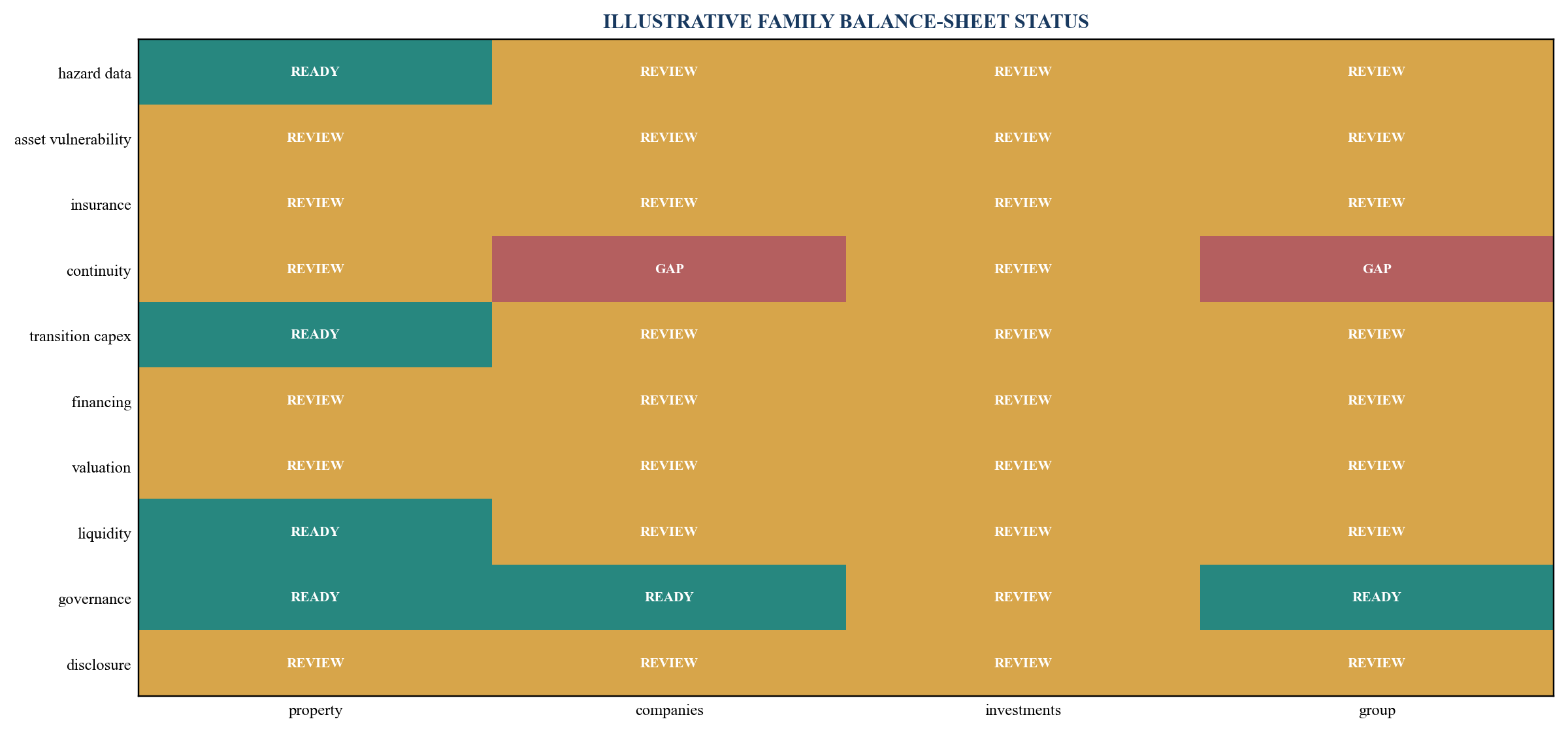
Illustrative status must be supported by an evidence gap, action owner and review date.
14. Demonstrate the method with a hypothetical global family
Consider a hypothetical family with USD 1.50 billion of gross assets before liabilities. The family owns USD 350 million of residences and investment property, USD 500 million of operating-company equity, USD 550 million of investment assets and USD 100 million of cash and short-duration instruments. Group and asset-level debt totals USD 420 million. Every amount, exposure and result is a management assumption for illustration.
Property includes coastal residences, urban commercial assets and a logistics facility across three jurisdictions. Operating companies include food distribution, industrial services and hospitality. Investments include public markets, private equity, private credit and infrastructure funds. Several portfolios hold companies in the same regions as the family businesses.
The initial register reveals three priority issues. A logistics facility has flood exposure and critical electrical equipment at ground level. A food-distribution business depends on one water-intensive supplier region and lacks a tested alternate. Two private funds and the public portfolio create a larger energy-transition concentration than the investment-policy report shows.
The family authorises engineering, supplier and investment workstreams. Engineering evaluates drainage, equipment elevation, access and insurance. The company qualifies alternate suppliers and tests inventory and customer communication. The investment committee requests look-through data, reviews mandates and engages managers. Treasury adds a compound cash-demand scenario to the liquidity reserve.
Table 5. Hypothetical global family balance-sheet climate review
| Layer | Illustrative gross value | Priority exposure | Approved evidence and action |
|---|---|---|---|
| residences and investment property | USD 350m | flood, heat, insurance and refinancing across selected sites | asset coordinates, engineering, policy review, adaptation options and cash reserve |
| operating-company equity | USD 500m | site interruption, supplier water concentration, energy and customer requirements | dependency map, continuity exercise, supplier qualification and transition capex plan |
| public and private investments | USD 550m | hidden geographic and sector overlap, valuation and liquidity | look-through register, manager diligence, mandate review and concentration decision |
| cash and short-duration assets | USD 100m | simultaneous deductibles, repair, company support and capital calls | legal-owner liquidity map, stress range and protected reserve |
| debt and guarantees | USD 420m | insurance covenant, collateral value, refinancing and cross-entity support | facility review, lender engagement, covenant forecast and guarantee map |
| group governance | not applicable | fragmented ownership, reporting and decision rights | entity map, board mandates, thresholds, dashboard and annual calendar |
All amounts, assessments and actions are illustrative management assumptions.
The family does not assign a single climate value adjustment to the portfolio. It updates financial inputs where evidence supports a change, funds high-priority resilience actions, records residual risks and establishes monitoring. The worked example demonstrates the governance method; it does not represent an expected loss or allocation recommendation.
15. Implement the framework through a 100-day sequence
During days 1 to 20, the family defines purpose, perimeter, entities, decisions and time horizons. The office reconciles property, operating companies, investments, debt, guarantees, insurance, obligations and authority. It identifies missing ownership, location and dependency evidence.
During days 21 to 40, specialists assess priority hazards, vulnerability, regulation, technology, markets and insurance. Operating companies map critical processes, sites, suppliers, customers, infrastructure and recovery. Investment teams request look-through and manager evidence. Finance connects exposures to cash flow, value, debt and liquidity.
During days 41 to 60, the office constructs distinct scenarios, documents limitations and estimates decision ranges. It identifies robust actions, thresholds and dependencies. Legal, tax, accounting, insurance, engineering and investment advisers review relevant elements.
During days 61 to 80, boards and committees compare prevention, adaptation, transfer, financing, diversification, engagement and exit. Approved actions receive owners, funding, milestones, measures and residual-risk statements. Treasury updates reserve and financing plans.
During days 81 to 100, management implements priority controls, tests continuity and reporting, updates valuations and documents, and installs the dashboard and calendar. Independent reviewers challenge data, models, approvals and claims. The actual programme can take longer; the sequence defines evidence and authority gates.
16. Install recurring and event-driven governance
Monthly operations can capture incidents, insurance changes, facility outages, supplier issues, data gaps and project milestones. Quarterly governance can review property exposure, company dependencies, investment concentration, financing, liquidity and emerging regulation. Semi-annual work can refresh scenarios, insurance strategy, lender engagement, manager diligence and continuity exercises. Annual governance can approve risk appetite, capital allocation, reporting, assurance and the full register.
Event-driven review should occur after a material physical event, insurance withdrawal, major policy change, financing proposal, acquisition, disposal, new guarantee, asset revaluation, critical supplier change, climate claim or data correction. The event record should identify affected entities and assumptions.
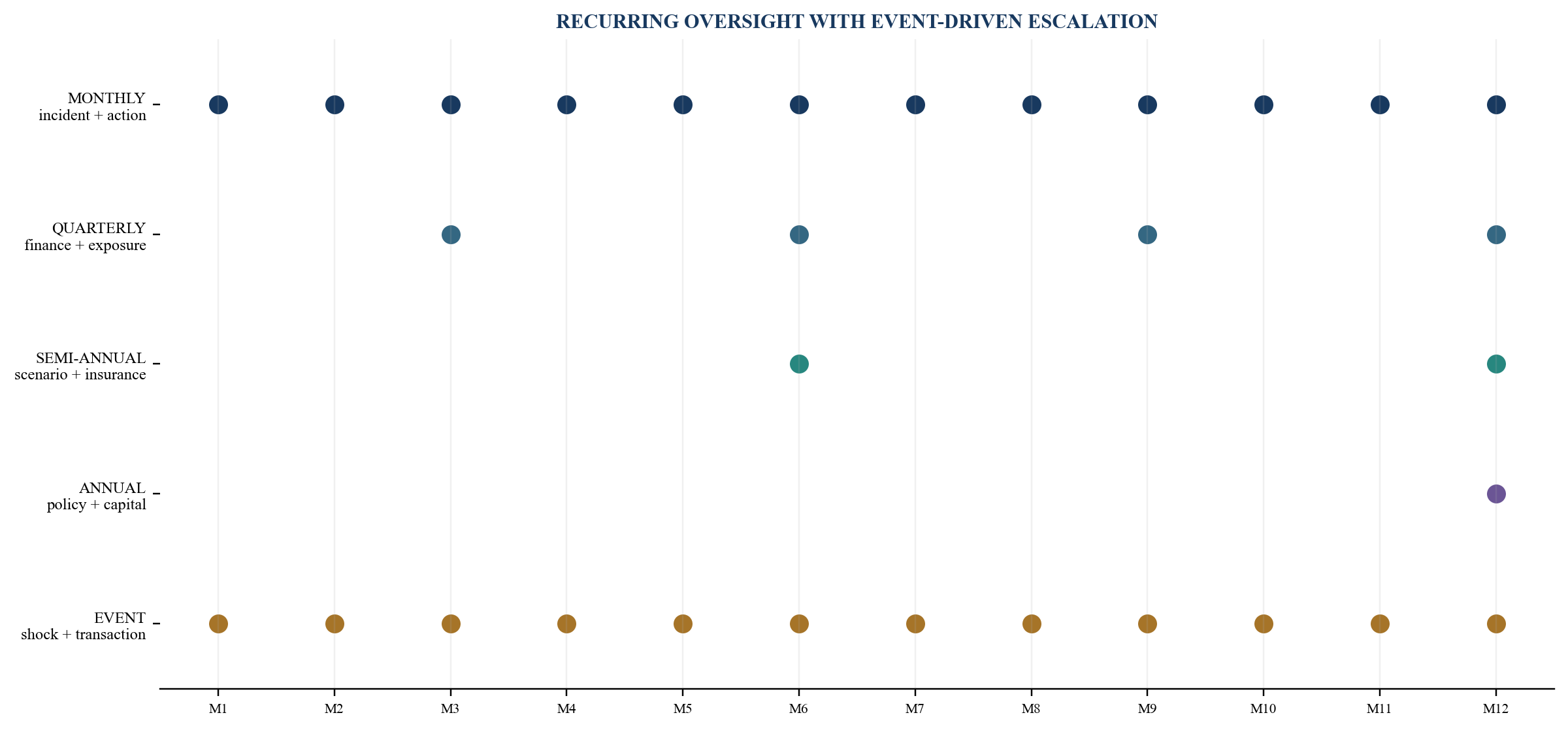
Immediate event review supplements the recurring cycle when exposure, finance or evidence changes.
17. Give the board a closed-loop implementation scorecard
The board scorecard should trace each material climate driver to an asset, financial consequence, authority and action, then test whether completed actions improved resilience under the approved measure.
Table 6. Board-ready climate-risk implementation scorecard
| Domain | Governing question | Acceptance evidence |
|---|---|---|
| perimeter | are material assets, liabilities, guarantees and dependencies included by legal owner? | reconciled entity, asset, finance and obligation registers |
| physical risk | are hazard, exposure, vulnerability and response capacity distinguished? | qualified data, engineering, limitations and financial transmission |
| transition risk | are policy, technology, market and contract drivers linked to the business? | jurisdiction map, product and customer evidence, capex and financial model |
| property | can priority sites remain safe, functional, financed and insurable? | asset assessments, adaptation, policy, lender and recovery evidence |
| companies | can critical products and services continue through material scenarios? | dependency map, alternatives, tests, funding and board action |
| investments | can the office see concentration, manager process, valuation and liquidity? | look-through register, diligence, mandate, engagement and decision record |
| valuation and finance | are climate assumptions connected to cash flow, value, debt and liquidity? | approved models, adviser review, ranges and reconciliation |
| governance | are entity duties, owner mandates, thresholds and conflicts explicit? | board and committee terms, delegations, recusals and calendar |
| implementation | are actions funded, owned, measured and completed? | plan, budget, milestones, evidence, residual risk and assurance |
| learning | do incidents, transactions and outcomes improve the framework? | post-event review, claims, backtest, data correction and policy update |
Acceptance requires current evidence and a named owner for every material exception.
The scorecard should record accepted risk as deliberately as mitigated risk. A board can retain exposure because adaptation is unavailable, cost is disproportionate, strategic value is high or the risk sits within tolerance. The record should identify the evidence, funding, monitoring and trigger for reconsideration.
Climate risk becomes financially governable when the family can connect science and policy to the actual legal owner, property, operating dependency, investment, financing and decision. A consolidated view reveals concentrations and support obligations. Entity-level evidence preserves accountability. The result is a repeatable capital process for resilience, value and liquidity across generations.
References
- Intergovernmental Panel on Climate Change, AR6 Synthesis Report: Climate Change 2023, https://www.ipcc.ch/report/sixth-assessment-report-cycle/
- Intergovernmental Panel on Climate Change, Climate Change 2021: The Physical Science Basis, including regional risk and extreme-event chapters, https://www.ipcc.ch/report/ar6/wg1/downloads/
- IFRS Foundation, IFRS S2 Climate-related Disclosures, effective for annual reporting periods beginning on or after 1 January 2024, https://www.ifrs.org/issued-standards/ifrs-sustainability-standards-navigator/ifrs-s2-climate-related-disclosures/
- IFRS Foundation, Supporting Implementation Materials for IFRS S2, https://www.ifrs.org/supporting-implementation/supporting-materials-for-ifrs-sustainability-disclosure-standards/ifrs-s2/
- Basel Committee on Banking Supervision, Principles for the Effective Management and Supervision of Climate-related Financial Risks, 15 June 2022, https://www.bis.org/bcbs/publ/d532.htm
- Basel Committee on Banking Supervision, Consolidated Guidelines: Climate-related Financial Risks, published 26 February 2026, https://www.bis.org/basel_consolidated_guidelines/chapter/RMA/60.htm
- Network for Greening the Financial System, Climate Scenarios for Central Banks and Supervisors: Phase V, user notice updated 17 February 2026, https://www.ngfs.net/en/publications-and-statistics/publications/ngfs-climate-scenarios-central-banks-and-supervisors-phase-v
- Network for Greening the Financial System, Purpose, Use Cases and Guidance on Where Institutional Adaptations Are Required, 23 January 2024, https://www.ngfs.net/en/press-release/ngfs-publishes-technical-document-providing-guidance-purpose-and-use-ngfs-scenarios
- European Insurance and Occupational Pensions Authority, Dashboard on Insurance Protection Gap for Natural Catastrophes, updated 5 December 2025, https://www.eiopa.europa.eu/tools-and-data/dashboard-insurance-protection-gap-natural-catastrophes_en
- Government of the United Kingdom, UK Sustainability Reporting Standards: UK SRS S1 and UK SRS S2, 25 February 2026, https://www.gov.uk/government/publications/uk-sustainability-reporting-standards-uk-srs-s1-and-uk-srs-s2
- Government of the United Kingdom, Climate-related Financial Disclosures for Companies and Limited Liability Partnerships, https://www.gov.uk/government/publications/climate-related-financial-disclosures-for-companies-and-limited-liability-partnerships-llps
- United States Securities and Exchange Commission, Proposed Rescission of Climate-Related Disclosure Rules, 29 May 2026, https://www.sec.gov/rules-regulations/2026/05/s7-2026-19
About the Author
Chennakeshav Adya is an independent researcher and Managing Partner of Matchpoint Partners. His work examines strategy, capital formation, valuation, transactions and operating execution across private and public markets.
