

1. Define the borrower and the repayment source
A credit committee evaluating refrigerated logistics should begin with the legal entity that earns the invoices and incurs the liabilities. A warehouse operator may hold valuable food belonging to customers while owning only its equipment and service receivables. A distributor may own the food and employ another company to transport it. A group may combine both activities through separate subsidiaries. The underwriting file should show these arrangements before anyone totals the goods inside the premises as security for a loan.
This paper examines a proposed revolving facility for a Saudi food-logistics operator. Its core question is how a temperature-related incident affects the lender's ability to recover advances. The principal example assumes that customers retain ownership of their food. The operator earns storage, handling and transport fees and may face claims if it fails to perform its obligations. The food's full value is therefore a possible source of liability without being an asset available for the operator to pledge. That asymmetry should be visible in the initial screening memorandum.
A lender's proposed mandate should identify the permitted borrower types, facility purpose, commitment range and maximum exposure to a single operating site or customer. The worked example uses a USD 20 million commitment. It sits within an illustrative USD 10 million to USD 40 million screening range, chosen for analysis and carrying no claim about actual market tickets or borrower demand. The decision still requires a specific financing structure, acceptable permissions and independently examined borrower evidence before an offer can be considered.
Map the repayment source to the service performed. A storage invoice may become payable on a different timetable from a transport invoice. A customer could accept a delivery while disputing the charge for temperature monitoring, or pay routine invoices while reserving a separate damage claim. The model should retain those distinctions. A single total for revenue, claims and collections cannot explain which cash flows support current availability and which might become contested following an incident.
The proposed approval question is whether the borrower can fund its operations and meet the facility's requirements through a defined adverse event. It should include the period before insurance adjustment, customer settlement or sponsor assistance. No actual borrower accounts, customer contracts, insurance schedules or operating records were supplied for this analysis. The paper consequently sets out an original diligence framework and hypothetical calculations. It does not rank an existing company or certify that a proposed facility would be lawful, appropriately priced or commercially available.
2. Establish the applicable operating requirements
The Saudi Food and Drug Authority's circular FS-CIR-004-V1/250515, dated 06/12/1446H, specifies maximum transport temperatures of 4°C for chilled food and −18°C for frozen food. It separately addresses unrefrigerated and unfrozen products, including a 25°C provision and a scientific risk-assessment qualification. The circular also addresses licensed transport and supplying facilities, food-transport identification, loading away from direct sunlight and prohibition on using the vehicle for storage. These are published requirements to examine against the relevant operation. [1]
The older English General Requirements for Food Transport contains broader product-specific temperature ranges and states that the Arabic original prevails. Its operational guidance includes continuous recording and maintaining suitable equipment. A lender should ask the operator to reconcile its procedures with applicable current circulars, product requirements and licences. The presence of an older manual in a data room is insufficient evidence that the company's current operating thresholds are appropriate. This paper makes no general finding that every provision of the earlier guide has been repealed. [2]
The source comparison matters for underwriting because an alarm system is configured against a chosen threshold. A dashboard could display compliance with an outdated internal setting while the customer contract or applicable product requirement demands something different. Ask the quality manager to show the approved specification, its source and effective date, the alarm setting and the escalation procedure for the same sample shipment. Any exception should have a documented technical basis and the necessary approval. The lender should record unresolved differences as conditions requiring specialist review.
SFDA's guidance for food and water manufacture addresses record retention through distribution and electronic temperature measurement in refrigerated or frozen vehicles. Its manufacturing context should remain explicit. It provides a useful starting point for testing how a manufacturer's records connect with those of its logistics provider; it does not determine whether a particular damaged consignment can be sold or released. [3]
Separate product safety decisions from commercial claims administration. A competent quality or regulatory specialist should determine the response to a specific excursion using the applicable requirements and product evidence. Finance should then quantify the associated inventory exclusion, customer deduction, replacement obligation and cash payment. A lender should not delay a required safety response to preserve collateral value. It should instead examine, before lending, who is authorised to act and which funds are available when segregation, testing or disposal becomes necessary.
3. Trace custody and responsibility across each handover
Prepare a shipment-level custody map linking the seller or manufacturer, loading team, carrier, receiving warehouse and final customer. The useful unit is a defined consignment with a product identity, quantity, condition record and handover time. Each transfer should connect to a contract and an operational record. This gives the investigator a way to compare the condition accepted by one party with the condition delivered by another. It also permits finance to identify which receivable or potential liability should change after an incident.
The contractual review should distinguish legal title, physical possession and the agreed risk of loss. Counsel should identify the governing law and any mandatory rules that affect the parties' allocation. Ask specifically about preparation and packaging, loading and unloading, subcontracting, declared values, liability limitations and the evidence needed to establish a claim. The paper assigns no universal Saudi compensation cap or claim deadline. Those conclusions require the current applicable rules and the actual transaction documents, including any international carriage element.
| Handover or event | Evidence to inspect | Credit consequence to test |
|---|---|---|
| Acceptance from the customer | Product identity, condition, packaging and signed record | Whether pre-existing damage is being assumed |
| Loading and departure | Responsible party, loading time and temperature trace | Whether the operator accepts loading exposure |
| Subcontracted journey | Executed subcontract and matching obligations | Whether recovery differs from customer liability |
| Receipt into cold storage | Receipt record, lot location and quarantine status | Whether service invoices remain collectible |
| Release or disposal | Quality decision, authority and disposal record | Timing of claims and loss-related expenditure |
| Settlement or insurance payment | Signed settlement, coverage response and bank receipt | Actual cash recovery and remaining exposure |
Diligence questions only. Each allocation requires the actual contracts and applicable legal assessment.
The map should include transitions that are easy to omit from a transport diagram. Examples include a trailer waiting for a receiving slot, a consignment moved temporarily into another cold room and a delivery refused before unloading. The reviewer should identify which party controls the goods during each interval and whether the insurance period continues. These are proposed incident tests; the analysis does not assert that every operator uses the same arrangements or experiences the same failure rate.
Subcontracting needs a separate comparison of obligations. If the operator promises a customer compensation exceeding what it can recover from a carrier, the difference remains an exposure to examine. A subcontractor's limited balance sheet or disputed liability can also delay recovery even where the contractual wording appears aligned. Obtain the executed agreements, evidence of permitted activity, applicable insurance and the operational records necessary to pursue the claim. Model any recovery according to its evidence and timing, with an unresolved claim excluded from available cash.
4. Make temperature evidence usable for credit decisions
The lender should commission a sample test that follows an invoice back to its shipment records. The sample should include completed journeys, rejected deliveries and at least one incident or complaint if such records exist. The purpose is to see whether the borrower can reconstruct what happened using contemporaneous evidence. A lender should record when there is no incident history available and assess the control demonstration on that basis. An empty claims register alone does not establish that losses were absent or that reporting was complete.
For each sample, connect the product specification to the sensor identifier, calibration record, logger position and timestamp convention. Ask whether readings can be altered, who can export the original record and how missing intervals appear. The same clock should support the door-opening log, vehicle movement and handover record. This proposed test concerns evidential continuity. It does not turn a lender into a food-safety certifier or replace a qualified assessment of the product's condition.
An excursion record should explain both the event and the response. The file might include the initial alarm, acknowledgement, communication with the customer, transfer to alternative storage, technical assessment and final disposition. Finance needs a corresponding record of withheld invoices, credit notes, immediate costs, claims notified and funds received. Establish a common incident identifier so that separate teams can reconcile the records without relying on recollection. The identifier should support aggregation where several shipments share one cause.
Common-cause exposure deserves a deliberate test. Several customer accounts may depend on one refrigeration circuit, one backup-power arrangement or the same handling team. A conventional customer concentration report could appear diversified while a single operational event affects many invoices. The proposed review groups exposure by physical dependency as well as debtor. It should quantify the amount of service receivables potentially disputed and the separate value of goods for which liability might arise. These amounts should remain distinct throughout the analysis.
Data access after a default should be addressed before disbursement. Ask who owns the records, whether the borrower can export them and which service agreements continue if invoices to the monitoring provider are unpaid. A recovery plan should include lawful access for the relevant administrator, specialist or appointed service provider. The lender should also budget for maintaining the systems needed to investigate and collect its security. A valuation prepared without those operating dependencies may omit costs that reduce realised recoveries.
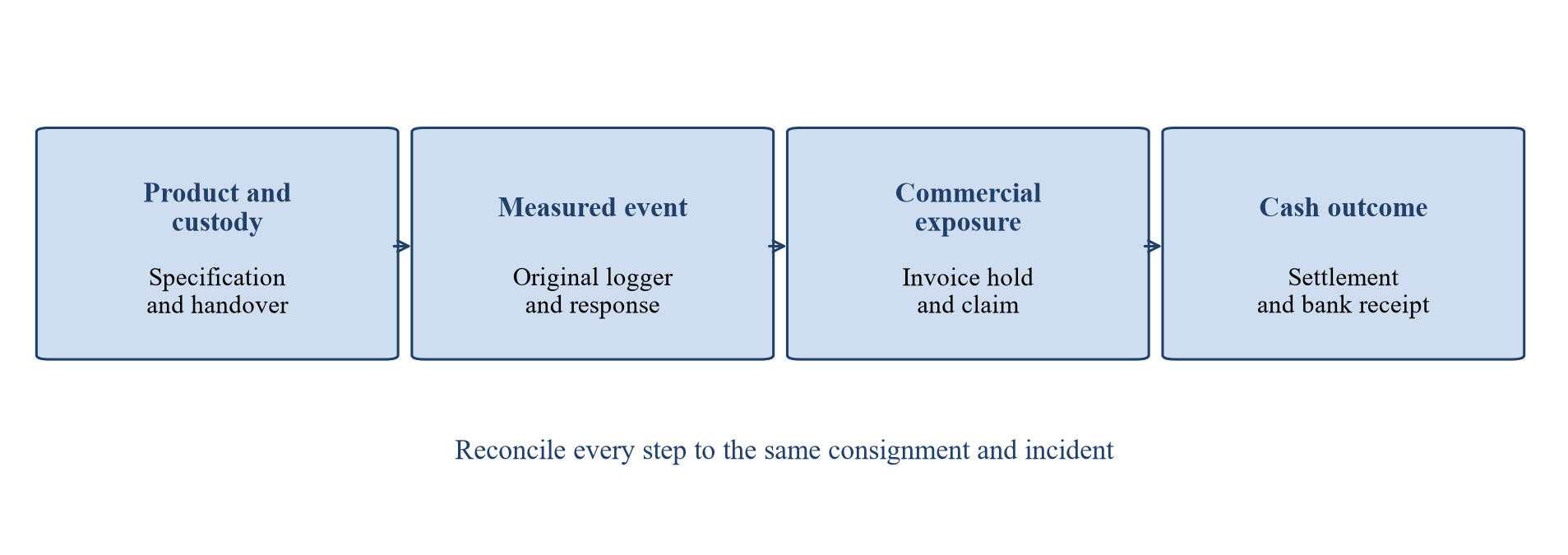
Each connection should be demonstrated for a sample consignment. The diagram is an original diligence framework.
5. Read the insurance response before assigning recovery value
An issuer-hosted copy of Institute Frozen/Chilled Food Clauses (A), CL.423 dated 1 March 2017, illustrates why the precise wording matters. Its temperature-variation cover is tied to listed causes. One machinery-breakdown branch requires stoppage lasting at least 24 consecutive hours; other listed causes have different triggers. It also contains exclusions, transit-duration provisions, an insurable-interest requirement and a provision excluding benefit to the carrier or other bailee. It is an English-law wording example, with no evidence that a particular Saudi borrower has purchased it. [4]
An underwriting review should therefore obtain the complete policy, schedule, endorsements and evidence of premium payment. The insurance specialist should identify the insured entity, property or liability interest, product classes, declared sites, conveyances and territorial scope. The lender needs a written explanation of how the actual policy would respond to the defined stress event. A generic certificate or product name cannot answer all of these questions. Any conclusion remains subject to the policy terms, facts and insurer's assessment.
Separate the customer's cargo insurance from the operator's liability cover and the operator's own property cover. A customer receiving an indemnity may leave rights of recovery to be pursued against another responsible party. An operator's property policy may address damaged equipment without covering the customer's goods or the operator's entire service interruption. These are review questions about potentially different contracts. No specific recovery or subrogation outcome is assumed here. The relevant specialists should identify overlap, exclusions and allocation before a cash recovery is modelled.
Test the proposed incident against the actual coverage conditions. Ask what happens if a refrigeration unit works but is set incorrectly, if a door remains open, if a logger fails or if cargo is rejected because the evidence is incomplete. Examine how notice, survey access, mitigation and disposal decisions affect the claim. The borrower should demonstrate that the people responding to the event can find the notification instructions and contact the appropriate parties. The analysis should retain a coverage-denied case alongside any assumed payment case.
Insurance proceeds also require a cash-control review. The proposed payee, any assignment, lender endorsement, settlement deductions and rights of other parties should be established from documents. Include the difference between notification, acknowledgement, acceptance and receipt. A claim that has merely been lodged should carry no automatic borrowing availability. Where a separate advance against an accepted insurance receivable is proposed, it needs its own eligibility, legal and concentration review. The numerical model below gives pending claims no borrowing-base credit.
6. Translate claims into an auditable borrowing base
A borrowing base is the amount a facility permits the borrower to utilise against defined eligible assets after agreed adjustments. It is subject to the commitment limit and the facility's other conditions. The committee should be able to reproduce the calculation from asset records. Every deduction should state its reason and where it enters the formula. Terms such as reserve, exclusion and haircut should be defined in the agreement and model so that the same loss is not deducted twice without an explicit rationale.
SAMA's Minimum Capital Requirements for Credit Risk addresses legal certainty and monitoring for recognised receivables collateral. Relevant provisions cover enforceable documentation, clear rights to proceeds, collection arrangements and monitoring through records such as ageing, trade documents, borrowing-base certificates and dilution analysis. Its domestic-bank and regulatory-capital scope matters. This paper uses those provisions to ground diligence questions and does not treat them as a universal advance-rate rule for private credit funds. [5]
The OCC's Asset-Based Lending handbook supplies a separate United States supervisory comparison. Its discussion addresses receivable dilution, inventory ownership, liquidation costs and borrowing-base reserves. It highlights the short liquidation window and preservation needs associated with perishable inventory. These principles inform the proposed tests here; the paper imports no United States statutory security mechanism or market advance rate into Saudi underwriting. [6]
For a logistics operator, begin with service receivables that the borrower actually owns. Exclude or separately review unbilled amounts, disputed invoices, related-party balances and sums exceeding agreed concentration limits. Define how customer claims against the operator affect otherwise valid invoices. Counsel should distinguish an enforceable deduction from an unsupported commercial withholding. Both can affect cash timing, although their legal and ultimate loss characteristics differ. Finance should keep the contractual amount, expected collection and actual receipt in separate fields.
The base certificate should have a reconciliation to the general ledger and a record of changes since the prior certificate. A new incident can require an immediate update even when the normal reporting frequency is monthly. The facility should specify who can impose an adjustment, which evidence supports it and how an exception is resolved. The lender's discretion should be reviewed by counsel and reflected in the operating process. A spreadsheet formula alone creates no contractual right to demand repayment.
7. Work through a hypothetical operator facility
Consider a fictional operator with USD 26 million of gross service receivables. Assume four disjoint exclusions: USD 2 million aged beyond the agreed eligibility limit, USD 1.2 million already disputed, USD 0.8 million due from affiliates and USD 2 million above the agreed concentration allowance. The excluded balances total USD 6 million, leaving USD 20 million eligible. The assumption that the categories do not overlap is important. An actual certificate should tag invoices so that overlapping reasons do not create accidental repeated exclusions.
Apply a hypothetical 80% advance rate to the eligible balance and subtract a USD 1 million base reserve. The borrowing base is USD 15 million. The facility commitment is USD 20 million, with USD 12 million drawn in cash and USD 1 million of letter-of-credit usage. Total utilisation is USD 13 million, leaving USD 2 million of availability. The unused commitment is USD 7 million, but the assumed collateral formula limits further utilisation to USD 2 million before other conditions. These are invented contract parameters for the example.
| Calculation | Before incident | After incident |
|---|---|---|
| Gross service receivables | 26.00 | 26.00 |
| Existing exclusions | 6.00 | 6.00 |
| Additional invoices with payment withheld by customers | 0.00 | 2.50 |
| Eligible service receivables | 20.00 | 17.50 |
| Eligible receivables multiplied by 80% | 16.00 | 14.00 |
| Existing reserve | 1.00 | 1.00 |
| Additional distinct claims reserve | 0.00 | 1.50 |
| Borrowing base | 15.00 | 11.50 |
| Utilisation before any cure | 13.00 | 13.00 |
| Availability or required repayment | 2.00 available | 1.50 repayment |
USD millions. Exclusions are disjoint. Customer-owned food is outside this operator's collateral calculation.
Now assume that customers temporarily withhold payment of an additional USD 2.5 million of invoices that were previously eligible. Removing these invoices reduces the base by USD 2 million at the assumed advance rate. A separate USD 1.5 million incident reserve addresses a defined residual claims exposure that is outside those held invoices and outside the immediate costs modelled below. The resulting base is USD 11.5 million. With unchanged utilisation of USD 13 million, the assumed agreement requires a USD 1.5 million cure payment.
The reserve is an availability adjustment. It is not itself an additional cash bill. The cure payment, by contrast, is an actual debt repayment under the assumed facility terms. After that repayment, the cash loan balance becomes USD 10.5 million, with the USD 1 million letter of credit still outstanding. Total utilisation then matches the USD 11.5 million base. A reviewer should carry all three entries through the model to avoid confusing a reserve, an accounting provision and a cash settlement.
The facts supporting the extra reserve would need to be examined carefully in an actual credit file. If it covered the same invoice shortfall already removed from eligibility, the committee should identify the duplication and revise the calculation or explain the additional exposure. If the claim later became payable, its cash effect would enter the liquidity forecast at that point. The model deliberately holds it as a distinct contingent exposure, demonstrating the funding consequence of contractual availability controls without treating every control as a realised loss.
8. Finance the period before any recovery arrives
The hypothetical borrower opens the incident month with USD 1.2 million in unrestricted cash. Its normal forecast produces USD 0.15 million of net cash each month after ordinary operating costs, existing financing costs, maintenance and tax. That forecast assumes the ordinary collection schedule. The incident causes USD 0.7 million of immediate customer settlement expenditure, USD 0.4 million of rescue and alternative-storage costs and USD 0.25 million of repair expenditure. These are separate assumed cash items totalling USD 1.35 million.
The USD 2.5 million held invoices were due for collection in month one, so the forecast must remove those receipts. It must also deduct the USD 1.5 million facility cure. Month-one cash before new funding is therefore USD 1.2 million plus USD 0.15 million, less USD 1.35 million, USD 2.5 million and USD 1.5 million. The result is negative USD 4 million. Maintaining a hypothetical minimum cash balance of USD 0.5 million requires USD 4.5 million of new funding before emergency financing costs.
Removing a held invoice from the base and delaying its cash collection capture different effects. The first changes how much the facility permits the company to borrow. The second changes the cash available to pay obligations. Both belong in a coherent liquidity case. The model assumes a temporary hold rather than a permanent write-off. If the customer ultimately pays less, the difference must remain a loss in the forecast and cannot return as a later collection merely to balance the spreadsheet.
For the first recovery scenario, assume the entire USD 2.5 million hold is released in month three after the required evidence is accepted. Assume separately that USD 1 million of insurance proceeds is received at the end of that month. That hypothetical indemnity comprises the USD 0.7 million customer settlement and USD 0.4 million rescue expenditure, less a USD 0.1 million retention; the repair cost is excluded. No actual cover is verified. After three months, the borrower would be USD 0.2 million short of repaying all USD 4.5 million of emergency principal, even before interest and minimum cash. The reserve is not automatically released or redrawn.
Emergency funding has a cost. At an assumed 12% annual simple rate, retaining USD 4.5 million for 90 days costs approximately USD 0.13315 million on a 365-day basis. Paying all principal and interest while retaining USD 0.5 million minimum cash would require approximately USD 0.83315 million of additional funds. Full repayment is therefore infeasible on the assumed receipts alone. The rate is a modelling choice, with no statement about Saudi lending prices or an offer of finance.
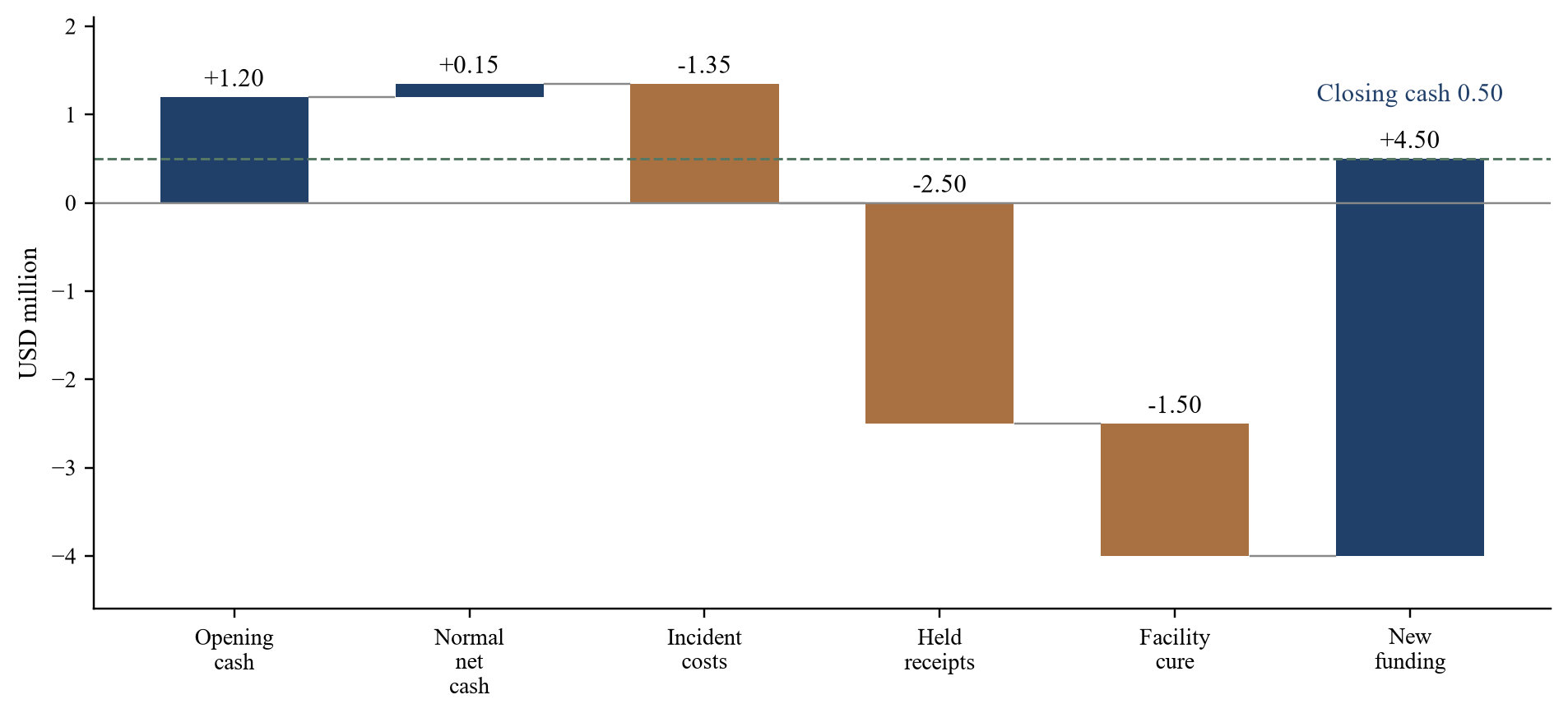
USD millions. The payment hold also reduces borrowing eligibility; reserve deductions are not counted again as cash expenditure. Emergency financing costs are excluded here and assessed separately.
9. Test delay, denial and correlated claims
The sensitivity should begin with variables that change the actual funding requirement. Here those variables are the additional customer payment hold and the distinct incident reserve. Keep the other assumptions constant. If held receipts increase to USD 4 million and the extra reserve remains USD 1.5 million, the borrowing base falls to USD 10.3 million and the cure becomes USD 2.7 million. The minimum cash funding gap rises to USD 7.2 million before emergency financing costs. This is a hypothetical stress, with no estimated probability.
The resulting relationship has a threshold. Until utilisation exceeds the adjusted base, a larger reserve may reduce unused availability without triggering a repayment. Once the threshold is crossed, each additional reserve dollar creates a dollar of cure under the assumed terms. Increasing the customer hold can then affect both collections and the cure. A lender should inspect this transition rather than extrapolating a simple percentage change in revenue into a funding requirement. The shape follows the stated formula and is not an empirical estimate of borrower behaviour.
Insurance timing is a separate dimension. If the assumed USD 1 million payment arrives in month six while held invoices are still released in month three, normal cash generation continues at the same hypothetical monthly rate. After emergency principal repayment, the calculation leaves USD 0.25 million before bridge interest. Interest of approximately USD 0.26630 million over 180 days produces a further shortfall. Retaining minimum cash and repaying principal and interest would require approximately USD 0.51630 million of additional funds. Extra operating months improve this simplified end-date comparison while leaving the earlier funding need intact.
The denial case should assign zero insurance receipt. With the held invoices collected in month three, month-three resources remain USD 1.2 million short of repaying all emergency principal before its interest and the minimum-cash requirement. If the held invoices also become unrecoverable, another USD 2.5 million remains missing. The lender should specify the sponsor funding, revised exposure limit or other response that would be required. An expected insurance receipt should never be inserted as an unexplained balancing item.
Test simultaneous incidents by cause and location. Two customers affected by one cold-room event may not provide independent diversification. A late subcontractor payment could coincide with a customer hold, and the same disputed facts may affect both insurance and contractual recovery. The proposed model should link those dependencies explicitly. It should also show what happens if the residual claim reserve becomes a cash settlement. That payment is absent from the simplified base case and would increase funding needs unless offset by separately evidenced resources.
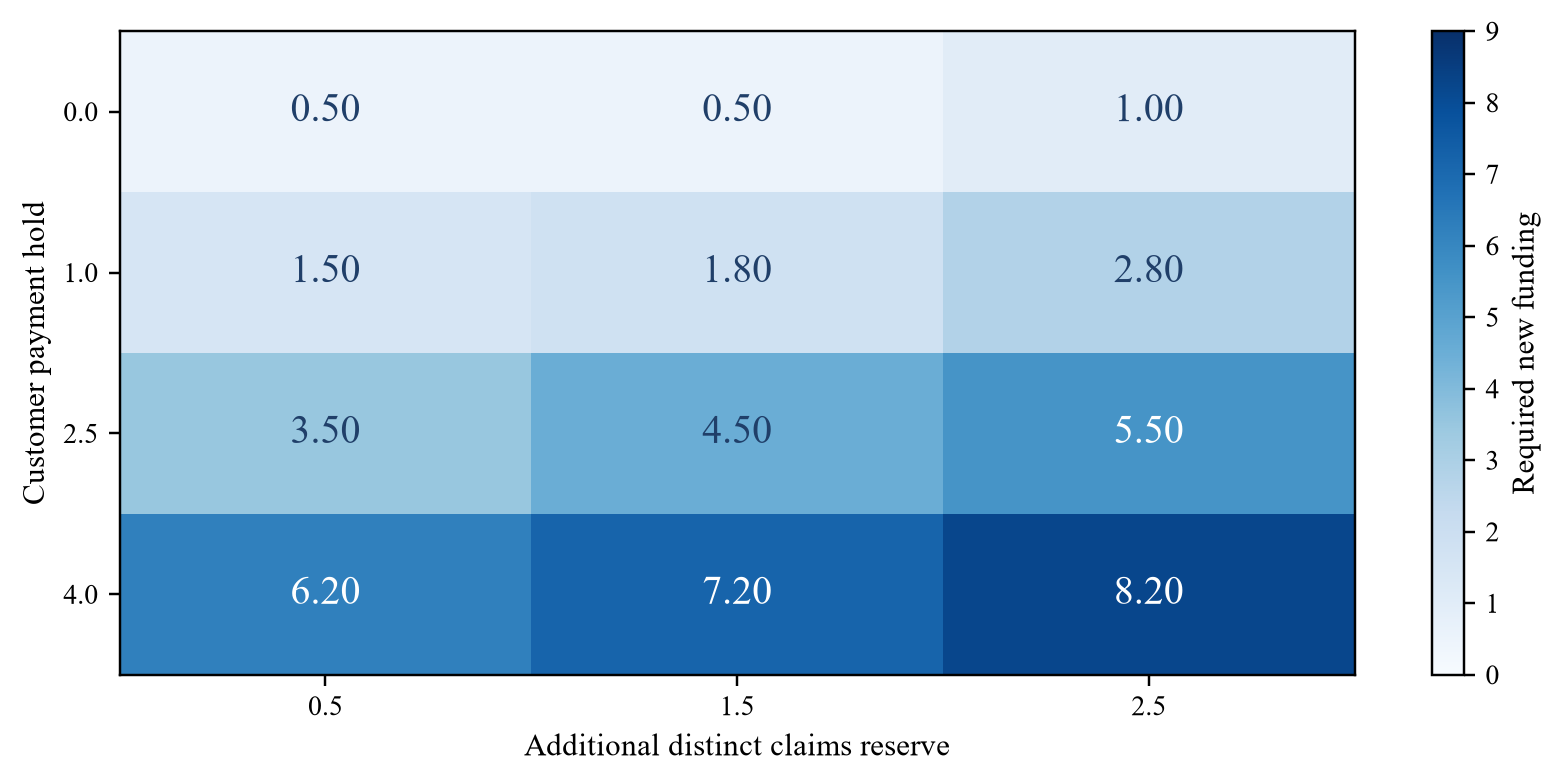
USD millions needed to maintain USD 0.5 million minimum cash before emergency financing costs. All other worked-case inputs remain constant. No loss probabilities are assigned.
10. Examine owned inventory as a separate credit case
A distributor that owns refrigerated goods presents a different collateral question. Its stock may be legally available for security subject to the applicable arrangements, yet still have little usable recovery value if it cannot be safely released and sold within its remaining life. The lender should obtain evidence of ownership, any competing rights, product condition and lawful sale channels. A count of pallets should reconcile to lot records and valuation evidence. Physical access alone establishes neither clear title nor a practicable realisation route.
Consider a separate hypothetical stock pool with USD 4 million of recorded value. Assume USD 1.2 million is quarantined and excluded entirely. Of the remaining USD 2.8 million, assume a gross realisation of 55%, yielding USD 1.54 million. Deduct USD 0.18 million for preservation and USD 0.07 million for sale costs. Net realisable value is USD 1.29 million. A further hypothetical 60% advance against that net amount gives USD 0.774 million. Every percentage and cost is assumed, with no appraisal or observed recovery evidence.
The order of operations should be visible. The quality exclusion determines which goods can enter the valuation. The sale discount converts recorded value into a hypothetical gross receipt. Preservation and selling costs reduce that receipt. The lending margin then determines the permitted advance. If an appraiser's net liquidation value already includes particular costs, those costs should not be deducted a second time. The reviewer should obtain the appraisal definitions before combining them with the lender's certificate.
Preservation needs should be tested against the time available for a lawful sale. Ask who continues refrigeration, pays utilities, supplies replacement parts and authorises movement if the borrower cannot operate normally. Confirm access arrangements with the warehouse and any relevant landlord or service provider. A proposed recovery case should identify the person capable of implementing it and the funding available for doing so. The model makes no assumption that a lender can take unilateral physical control or sell regulated products without the necessary legal and operational authority.
This inventory calculation is excluded from the operator facility in the earlier sections. Adding it to the operator's borrowing base would contradict the assumption that its customers own the food. An actual group facility could involve more than one asset-owning company, but guarantees, security, cash movements and insolvency effects would require a separate legal-entity analysis. The committee should receive that analysis before treating assets and liabilities across entities as interchangeable support for the same obligation.
11. Turn diligence findings into funded approval conditions
The proposed credit memorandum should explain the decision available on the evidence reviewed. It can recommend proceeding subject to identified conditions, reducing the requested exposure, commissioning further investigation or declining. Each condition should identify the responsible party, the document or test needed and the effect of failure. A requirement that merely says to obtain satisfactory insurance is too vague to govern a cold-chain loss scenario. It should identify the relevant interest, event, limit, exclusions, payee and evidence of cover requiring specialist confirmation.
Saudi operating permissions should be reviewed as dated facts. An Official Gazette publication of a Transport General Authority decision dated 07/10/1447H describes six-month exceptions concerning specified vehicle-age and own-account carriage arrangements. A separate April 2026 publication addresses transition timing, including a 27 August 2026 date for a registration change and conditions connected with professional-driver qualification. These publications demonstrate why the permit review needs current, operator-specific evidence. They do not establish that an individual fleet qualifies for an exception or that no later change exists. [7], [9]
The lender's own authority and the proposed adviser's scope should also be confirmed. Article 4 of the Finance Companies Control Law addresses licensing for financing activities within its scope, while Article 10 addresses licensed activities and supporting activities. Cross-border or fund structures require their own applicable-law assessment. The paper offers no blanket conclusion that an offshore fund can lend directly or that an adviser may perform regulated work merely because the engagement is described as consulting. [8]
| Review area | Evidence needed before reliance | Decision if unresolved |
|---|---|---|
| Asset ownership | Entity-level records and specialist legal review | Exclude unsupported collateral |
| Operating permissions | Current licences, vehicle records and relevant approvals | Hold the affected exposure for review |
| Customer liability | Executed terms, claims history and sample records | Quantify residual exposure or reduce the facility |
| Insurance response | Complete wording and specialist event assessment | Keep disputed recovery at zero |
| Borrowing certificate | Ledger reconciliation and tested eligibility rules | Withhold unsupported availability |
| Emergency liquidity | Documented accessible funds and conditions | Reduce utilisation or require funded support |
| Recovery operations | Lawful access, preservation plan and cost evidence | Revise the recovery case |
This is a proposed underwriting process. It creates no licence, insurance cover or enforceable security right.
A proposed advisory engagement can begin with a paid, written assessment of a defined borrower or screening mandate. Its deliverables could include the evidence register, reconstructed borrowing certificate, incident cash model and questions for counsel, insurance and food-safety specialists. The scope should identify which party decides on credit, which party performs regulated activities and how conflicts are handled. Fees should be agreed separately from investment principal. No client funds, credit commitment or discretionary investment authority is implied by this research framework.
12. Monitor the exposure through the operating cycle
After closing, the monitoring design should connect reported availability to operational changes. A proposed certificate should reconcile new invoices, collections, credit notes, exclusions and reserve movements. Its supporting incident register should show open matters, customer responses, evidence gaps and actual recovery receipts. The reporting frequency should reflect the facility's terms and the speed at which an event can affect eligible assets. The committee should require a workable escalation route for a material incident between scheduled certificates.
The monitoring team should test a small number of complete records periodically. Reconstruct the selected receivable, its supporting service, any dispute and the eventual receipt. Compare original information with later amendments and document why a reserve was released. Sample testing should include exceptions selected for their risk characteristics, with the selection method and coverage recorded. The paper prescribes no statistical confidence level or universal sample size. A specialist should design the test in proportion to the pool and the consequences of an undetected problem.
Renewal should consider changes in the operating network. A new subcontractor, product category, storage site or major customer can alter the relationship between liability and recovery. Ask whether the approved insurance, permissions, monitoring process and financing model cover the changed activity. The borrower should demonstrate the new arrangement before increased exposure is accepted. A growth forecast that assumes more refrigerated throughput should include the working capital, equipment reliability and incident-response resources needed to support it.
The lender should also retain a documented route for reducing exposure. This might involve lower drawings, additional eligible security, verified sponsor funds or an agreed repayment timetable, subject to the actual documents and law. Each response should be modelled for its effect on operations. A cure that consumes cash required for refrigeration could damage the very repayment source the facility depends upon. That potential interaction should be examined in advance, with an appropriately funded and lawful response available for committee consideration.
The worked case leads to a specific conclusion: pending insurance is an uncertain later receipt, and the proposed facility needs an independently funded response to earlier customer holds, operating expenditure and repayment obligations. Approval should follow evidence that the borrower can manage that interval under the agreed stress. The final recommendation should name the residual exposure being accepted and the conditions supporting it. Where those conditions remain unverified, the decision should stay conditional and the model should continue to show the missing funds.
Appendix A. Reproduce the hypothetical model
All monetary figures in this appendix are USD millions. The reporting currency is chosen for comparability and does not represent a proposed Saudi facility currency. Exchange-rate movements, withholding, transaction taxes, legal costs and financing fees are excluded unless expressly included in an assumed cash amount. A transaction-specific model should restore relevant items using verified terms. The example uses exact decimal arithmetic before rounding figures shown in prose and charts.
The initial eligible receivable pool is 26 minus 2 minus 1.2 minus 0.8 minus 2, giving 20. The initial borrowing base is 20 multiplied by 0.80, less 1, giving 15. Utilisation is 12 of funded debt plus 1 of letters of credit, giving 13. Availability is the lower of the 20 commitment and the 15 base, less utilisation, giving 2. No other outstanding exposure, blocked amount or conditional draw restriction is assumed. Such items should be added where the actual facility requires them.
Let H be the additional customer payment hold and R the additional distinct reserve. The stressed base is 15 minus 0.80H minus R. The cure is the greater of zero and 13 minus that base. In the principal case H is 2.5 and R is 1.5, giving a base of 11.5 and a cure of 1.5. The hypothetical agreement requires the cure to be paid immediately. Different cure periods, letter-of-credit treatment or contractual remedies would change the timing and require a different case.
Month-one normal cash before the incident is 1.2 plus 0.15. Incident payments are 0.7 plus 0.4 plus 0.25, totalling 1.35. Because the held invoices were due in that month, H is also deducted from the cash forecast. Month-one cash before new money is therefore negative H minus the cure. To retain minimum cash of 0.5, new funding is 0.5 plus H plus the cure. At H of 2.5, the requirement is 4.5. The formula assumes the same incident cash costs throughout the displayed sensitivity.
The recovery cases assume the held invoices are collected in full in month three, with no permanent invoice loss. Insurance of 1 is separately assumed in month three or month six, comprising settlement and rescue costs of 1.1 less a 0.1 retention. Before emergency financing costs, cash after attempted full emergency principal repayment is 1.2 plus the relevant number of months multiplied by 0.15, less 1.35, less 1.5, plus 1. A negative result means full repayment cannot occur without additional money. The withheld and subsequently collected 2.5 cancel over that completed interval. They remain essential to the intervening funding need.
Emergency interest is calculated on 4.5 at a hypothetical 12% simple annual rate. For 90 days, 4.5 multiplied by 0.12 multiplied by 90 divided by 365 gives approximately 0.13315. For 180 days the corresponding amount is approximately 0.26630. The model assumes interest is settled at repayment, with no compounding, fees or intermediate principal reduction. Those simplifying assumptions explain the calculation; they are not proposed market terms. Both recovery cases require additional funds to repay fully while preserving minimum cash. Monthly aggregation can miss intramonth cash troughs; actual underwriting needs payment-date detail.
The model holds the post-incident borrowing base constant and assumes no subsequent redraw. It does not assume that the letter of credit is cancelled or that the extra reserve is released. It assigns no probability to insurance payment, no economic value to an unsigned sponsor promise and no collateral value to customer-owned goods. Any favourable change should enter a revised case only with its own evidence and contractual basis. The residual claims reserve must be linked to a separate cash scenario if the contingent exposure crystallises.
Appendix B. Assemble the lender investigation file
Request an entity chart identifying the borrower, asset owners, contracting parties and any guarantors. The financial file should include reconciled accounts, customer-level receivables, credit notes, collections and an explanation of related-party balances. The operational file should connect each proposed collateral category to the service that generated it. Sample records should allow an independent reviewer to follow the same transaction across contracts, logs, invoices and bank statements. Missing records should be listed individually with their effect on the analysis.
For cold-chain operations, request the applicable product specifications, procedures, temperature records, calibration evidence, maintenance records and incident reports. Identify the storage sites and vehicles used, including subcontracted capacity. Ask how the operator handles rejected deliveries, segregation, testing, disposal and alternative storage. The review should establish who makes a product-safety decision and how the commercial team records its consequences. It should also identify any material dependency whose failure would affect several customers simultaneously.
The contracts file should include customer and subcontractor agreements, material amendments and relevant claims correspondence. Counsel should provide the applicable-law analysis of liability, notice, limitation, set-off, security and enforcement. The insurance file should contain complete policies and endorsements, premium evidence and the insurer or specialist's response to defined events. Describe the evidence received and any conditions attached. A broker's marketing summary, a pending notification and an accepted settlement should remain distinguishable in the credit memorandum.
Reconcile the funding plan to the stress model. Obtain evidence of accessible cash, proposed sponsor support and any emergency facility, including conditions that could stop a draw during the same incident. Identify how the borrower would pay operational costs, meet a cure and preserve goods while claims remain unresolved. The review should test the timing of those obligations at a frequency appropriate to the case. A monthly model is the teaching convention here; actual payment dates can require a daily liquidity schedule.
The final committee paper should state the requested decision, evidence reviewed, remaining questions, model assumptions and proposed conditions. It should separate the estimated loss from the peak funding need and identify who can authorise any exception. A useful recommendation explains which new evidence would change the conclusion. Where adequate operating, legal, insurance or funding evidence is absent, the committee should receive that limitation directly and decide whether further work, lower exposure or a decline is appropriate.
Sources
- Saudi Food and Drug Authority. Circular FS-CIR-004-V1/250515, Requirements for Transporting Food Products, dated 06/12/1446H, pp. 1-2. Arabic original. Read the primary source
- Saudi Food and Drug Authority. General Requirements for Food Transport, English translation, pp. 4-7. Arabic original prevails. Read the primary source
- Saudi Food and Drug Authority. Guidance on Technical Requirements for Food and Water Manufacture, pp. 22-23. Read the primary source
- Institute Frozen/Chilled Food Clauses (A), CL.423, 1 March 2017. Codan/RSA-hosted wording, clauses 1, 4, 8, 11, 15 and 19. Read the primary source
- Saudi Central Bank. Minimum Capital Requirements for Credit Risk, 27 December 2022, scope and paragraphs 16.133-16.141. Read the primary source
- Office of the Comptroller of the Currency. Comptroller's Handbook, Asset-Based Lending, Version 1.1, January 2017, printed pp. 17-21. United States supervisory guidance. Read the primary source
- Umm Al-Qura Official Gazette. Transport General Authority Board Decision 1/8 TR/2026/4, dated 07/10/1447H, published 3 April 2026. Read the primary source
- Saudi Central Bank. Finance Companies Control Law, Articles 4 and 10, consolidated rulebook page reviewed 10 September 2026. Read the primary source
- Umm Al-Qura Official Gazette. Transport General Authority Board Decision 3/8/2026/4, dated 12/10/1447H, published 10 April 2026. Read the primary source
