

1. The diligence output is a governed ownership case
Commercial due diligence should answer a practical question: what should the buyer believe, pay, protect and do? Market size, customer interviews and competitor profiles contribute evidence. The decision product is a governed ownership case that connects the acquisition thesis to observable facts and post-completion action.
The ownership case has five linked outputs. First, it states which elements of the transaction thesis are supported, weakened or unresolved. Second, it translates evidence into a base case and downside cases. Third, it identifies implications for value, structure, contractual protection and closing conditions. Fourth, it defines the initial operating priorities. Fifth, it records the questions that remain open and the evidence required to close them.
This chain creates continuity. A customer-renewal concern stays connected to the account data, interview evidence, commercial model, legal review, purchase agreement, retention plan and owner. The board can see where evidence ends and management judgement begins. The ownership team receives an operating backlog with provenance.
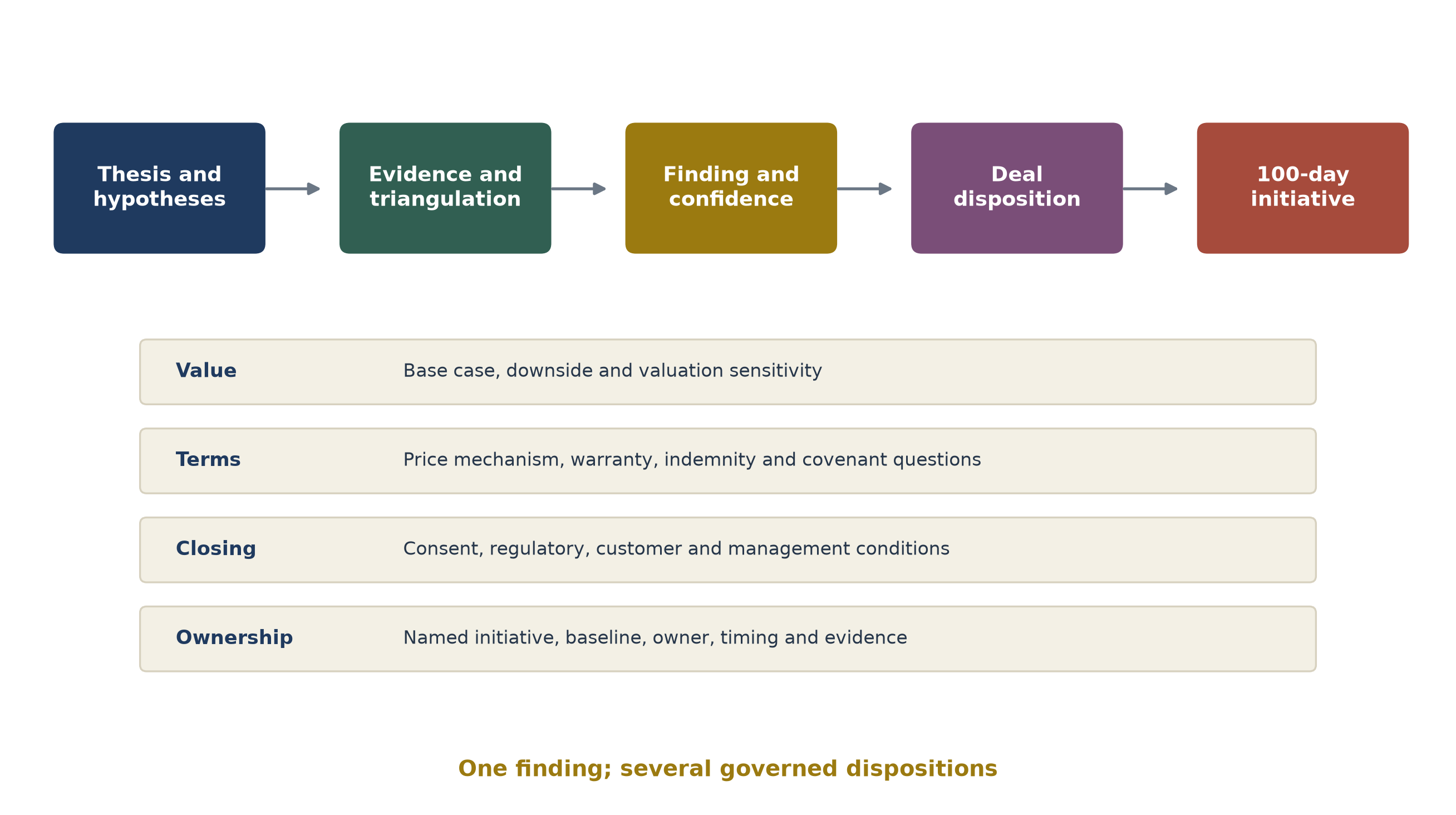
Matchpoint management framework. A finding can affect several decisions at the same time.
The process needs an explicit materiality rule. A finding is material when it could change the buyer's decision, value range, transaction protection, completion path, funding case or initial ownership priorities. Materiality can arise from scale, volatility, concentration, irreversibility, regulatory consequence or weak evidence. A small revenue line can remain material when it contains a required licence, key customer relationship or scarce capability.
Table 1. Evidence grades for commercial diligence
| Grade | Evidence condition | Permitted use | Required treatment |
|---|---|---|---|
| A | Primary records reconcile across systems and periods | Base case and initiative baseline | Retain source, method and owner |
| B | Credible evidence with a limited gap or timing difference | Base case with stated sensitivity | Close the gap or monitor after completion |
| C | Partial, sampled or management-estimated evidence | Scenario range only | Add a validation action and downside case |
| D | Conflicting, stale or unsupported assertion | No base-case reliance | Escalate, protect or exclude |
| N | Evidence unavailable | Open question only | Define required evidence, deadline and decision consequence |
Matchpoint management framework. Confidence reflects source quality, reconciliation and relevance to the decision.
2. Start with hypotheses that can change the decision
The transaction thesis should be decomposed before research begins. A broad claim such as attractive market growth offers limited direction. A testable version states the relevant customer segment, geography, product boundary, growth mechanism, time period and evidence that would disprove the claim. The team can then choose data and interviews for decision value.
Hypotheses should cover market quality, customer behaviour, pricing, competition, route to market, unit economics, capacity, management and regulatory feasibility. Each hypothesis needs an owner and a possible disposition. If the target's growth depends on winning government-related customers, the diligence needs evidence on procurement routes, approval cycles, local-content requirements, payment timing and sales capacity. The 100-day implication may involve bid governance, account coverage and working-capital control.
A disconfirming mindset improves the work. The team actively seeks evidence that challenges the investment case. Customer interviews should include lost, reduced and dormant accounts where access permits. Revenue analysis should reconcile invoices, credit notes, cancellations and collections. Market analysis should test several boundaries. A market can look large when adjacent products, imported supply or unrelated geographies are included.
The hypothesis register also controls scope. Every workstream should map to a board decision or ownership action. Information that has no decision path may remain useful background, yet it should not displace work on revenue quality, customer dependency, pricing, competition or execution capacity.
Table 2. Hypothesis register and decision path
| Hypothesis | Evidence to test | Decision affected | Early ownership implication |
|---|---|---|---|
| Core segment grows through repeat demand | Cohorts, orders, renewals, official statistics | Revenue case and value | Account retention and coverage |
| Price can rise without material volume loss | Contract terms, discount history, win-loss evidence | Margin case and earn-out | Pricing authority and exception control |
| Competitive position rests on service quality | Customer interviews, response times, complaint data | Strategic fit | Service-level recovery plan |
| New capacity can support forecast growth | Utilisation, hiring, supplier and site constraints | Capital need and timing | Capacity release milestones |
| Cross-sell can reach acquired customers | Product overlap, permissions, sales incentives | Synergy case | Pilot accounts and consent checks |
Example structure. The buyer should tailor thresholds and owners to the transaction.
3. Triangulate the market before sizing it
Market analysis should reconcile several views of demand. Official national statistics can anchor the size and direction of sectors. The UAE Federal Competitiveness and Statistics Centre publishes national accounts, industry, trade and price series. Saudi Arabia's General Authority for Statistics publishes structural business statistics covering establishments, employment, expenses, revenues and capital formation.[10][11] These sources provide a disciplined starting point. They may use classifications, publication lags and aggregation levels that differ from the target's commercial market.
The second view comes from the target's activity: transactions, customers, products, branches, tenders, digital leads and lost opportunities. The third comes from the market structure: competitor capacity, customer alternatives, routes to market, regulation and substitution. The fourth comes from external stakeholders, including customers, suppliers, distributors, former employees and industry bodies. The fifth comes from observable investment and operating capacity such as licences, facilities, headcount, imports, installations or procurement awards.
Triangulation means documenting why the views agree or differ. A top-down market estimate may show sector growth while the target's segment contracts. The difference can arise from geography, product mix, customer type, price changes, substitution or execution. The diligence should explain the bridge.
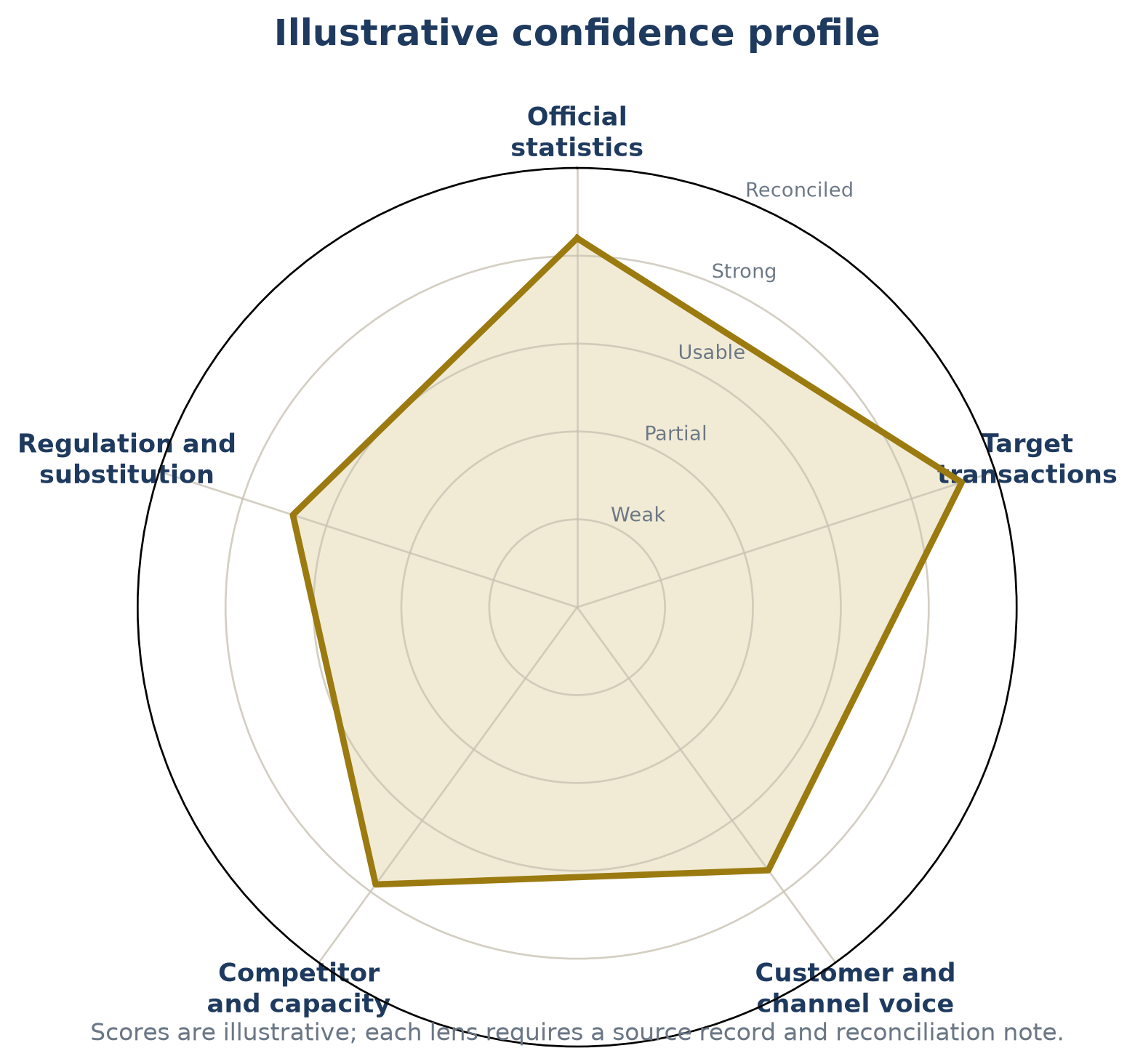
Matchpoint management framework. Agreement increases confidence; disagreement becomes a question for resolution.
Table 3. Market triangulation worksheet
| Lens | Core question | Reconciliation test | Common limitation |
|---|---|---|---|
| Official data | Which published series matches the target's activity? | Bridge sector code, geography, price and period | Aggregation and publication lag |
| Target data | What activity occurred at invoice, order and collection level? | Reconcile operational systems to financial records | System changes and missing history |
| Customer voice | Why do customers buy, renew, reduce or leave? | Compare interviews with recorded behaviour | Selection and courtesy bias |
| Competition | Which alternatives constrain price, quality and access? | Test wins, losses, capacity and substitution | Private competitor data |
| Regulation | Which rules affect entry, control, pricing or service? | Map licences and approvals to the model | Jurisdiction and interpretation |
Questions are designed to reveal classification, timing and scope differences.
Market definition should support the decision. The UK Competition and Markets Authority explains that competitive evidence can capture market dynamics more fully than a static definition, particularly in differentiated markets.[1] Its guidance focuses on meaningful alternatives available to customers and recognises a continuum of competitive constraints. The European Commission's market-definition notice likewise frames product and geographic boundaries around substitution and competitive constraints.[2] A buyer can use these principles to test the commercial case while qualified competition counsel handles legal conclusions.
4. Customer cohorts reveal revenue quality
Aggregate growth can hide customer-level fragility. A buyer should reconstruct revenue by customer, product, channel, geography, contract type, acquisition cohort and account owner. The analysis should reconcile gross billings, discounts, credits, cancellations, recognised revenue and cash collection. Each measure answers a different question.
Cohorts show whether new customers mature into repeat business. Retention should be calculated on customers, revenue and contribution margin because each view can move differently. Gross revenue retention measures the starting cohort after losses and contraction. Net revenue retention also includes expansion. Contracted revenue deserves separate analysis from expected orders, framework agreements and management pipeline.
Concentration needs several lenses. The top ten share can understate dependency when related entities belong to one group, procurement decisions are centralised, or several accounts depend on one channel. The buyer should identify the decision-maker, contract entity, economic beneficiary, end user and collection source where data permits. Customer concentration can also interact with people concentration when one salesperson or founder controls the relationship.
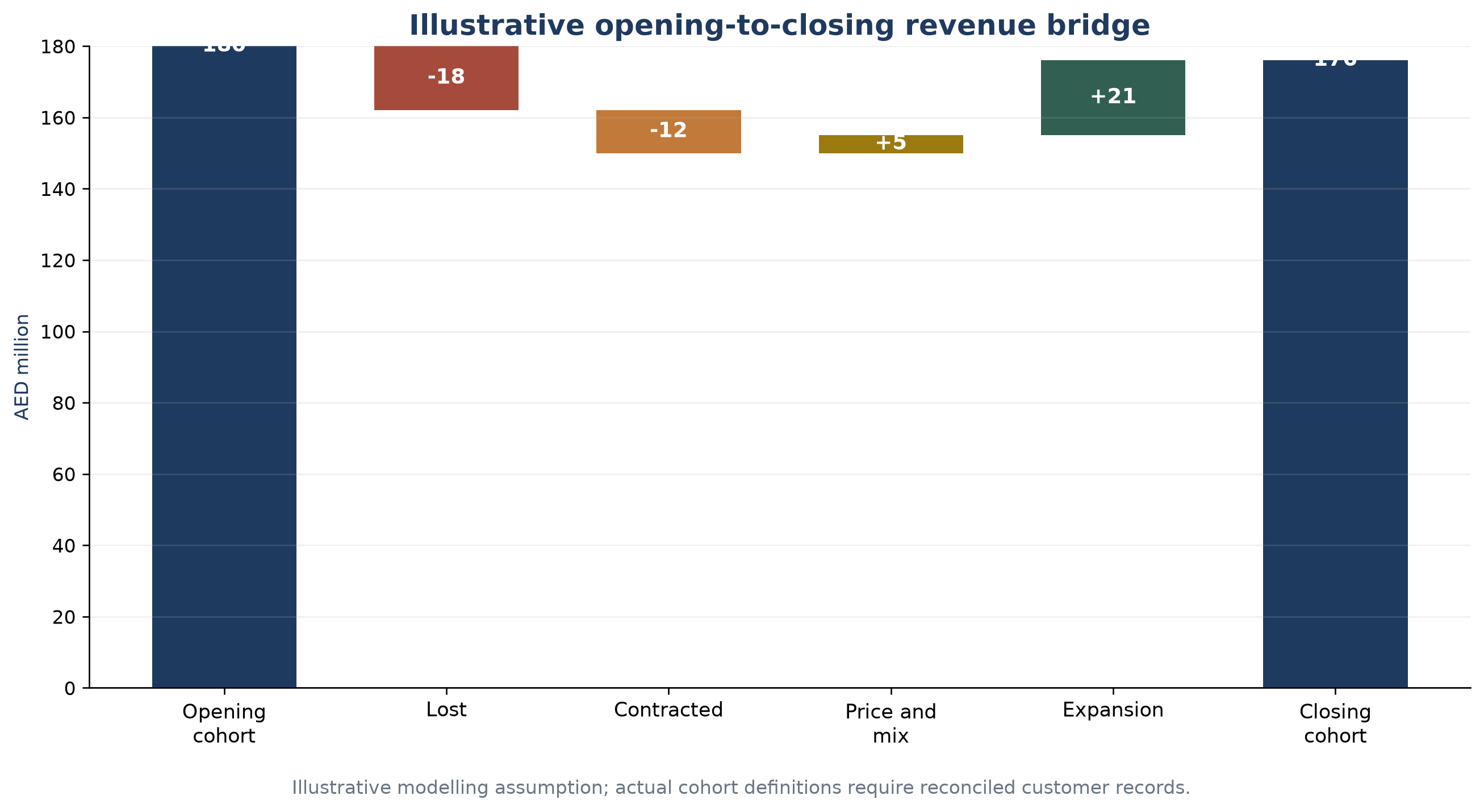
Hypothetical values in AED millions. They demonstrate the method and do not represent a company or forecast.
Table 4. Customer and cohort analysis
| Question | Metric | Evidence | Ownership action when weak |
|---|---|---|---|
| Do customers stay? | Gross and net revenue retention | Cohort revenue, credits and cancellations | Named retention plans for exposed accounts |
| Does growth create value? | Cohort contribution margin and payback | Revenue, service cost and acquisition cost | Channel and offer redesign |
| Is revenue concentrated? | Group-adjusted top customer shares | Legal entities, beneficiaries and channels | Executive coverage and contract renewal plan |
| Is demand recurring? | Repeat orders and contracted backlog | Orders, contracts, delivery and collections | Pipeline reclassification and sales controls |
| Can the buyer cross-sell? | Eligible overlap and conversion evidence | Permissions, product fit and pilot results | Controlled pilot with stop criteria |
Illustrative analysis design. Metrics need documented definitions and reconciled source fields.
Customer interviews require a structured sampling plan. The sample should cover high-value, growing, declining, new, lost and strategically important accounts. The team should record who selected each participant, the interviewer's relationship, the questions asked and the evidence that supports each conclusion. Interview statements can explain behaviour. Transaction data confirms whether the behaviour occurred.
5. Pricing diligence should find the realised price
List prices and standard rate cards provide a starting point. Commercial value depends on realised net price after discounts, rebates, credits, free service, payment terms, channel margin, scope changes and collection cost. The analysis should move from quoted price to invoiced price, recognised revenue, contribution margin and cash.
Pricing architecture includes authority. The diligence should identify who can approve discounts, how exceptions are recorded, whether contract renewals trigger review, which customers receive legacy terms and how sales incentives treat margin. A target can have pricing power in selected segments and leakage elsewhere.
Win-loss evidence provides a practical demand test. The team should compare proposal, competitor, price, decision criteria, sales cycle and outcome. Lost deals can reveal substitutability and procurement behaviour. Won deals can show whether the target's claimed differentiator appears in customer decisions. A low-quality CRM requires sampling from proposals, emails and order records, subject to confidentiality and data-access controls.
Table 5. Pricing waterfall and diligence response
| Layer | Commercial question | Evidence | Potential first-100-day action |
|---|---|---|---|
| List or reference price | Is the anchor current and used? | Rate cards and proposals | Refresh price architecture |
| Contracted discount | Which customers receive structural discounts? | Contracts and approvals | Segment guardrails and renewal rules |
| Discretionary leakage | Who approves exceptions and free scope? | CRM, emails and credit notes | Delegated authority and exception log |
| Service cost | Which offers consume unpriced effort? | Time, delivery and rework data | Offer redesign and scope control |
| Collection cost | Do terms create working-capital drag? | DSO, disputes and write-offs | Credit and collection cadence |
The waterfall should reconcile to invoices, credits and collections by customer segment.
Price-volume scenarios should state assumptions. An assumed price increase has no decision value without eligible revenue, contract timing, customer response, sales capacity and implementation cost. The model should distinguish immediate contractual rights from management ambition.
6. Competitive position is behaviour under pressure
A competitor list does not establish competitive position. The diligence needs evidence on customer alternatives, capacity, route to market, service levels, product substitution, procurement rules and likely responses. Competitors can constrain different parts of the offer. One may lead on price, another on regulatory access, another on relationships, and another on technology or delivery capacity.
The CMA's guidance highlights prices, market shares, entry, capacity, margins, customer behaviour, product differentiation, switching, regulation and barriers as relevant evidence in merger assessment.[1] The United States merger guidelines also examine substitution, concentration, entry and competitive effects.[12] These sources support a broad evidence set. The buyer's commercial conclusion remains transaction-specific.
Competitive advantage should be decomposed into assets and routines. A licence can be durable if transferable and maintained. A relationship can be fragile when it sits with one individual. A data advantage needs rights, quality, coverage and a repeatable use case. Service quality requires operational metrics and customer confirmation. Brand strength needs evidence in preference, win rate, price or retention.
Management should own the actions that preserve the advantage. A deal that acquires scarce engineers requires retention, knowledge transfer and capacity planning. A deal that acquires customer access requires account continuity, consent and value propositions. The 100-day plan begins with the value mechanism.
7. Regulatory and public-data work belongs near the front
Commercial diligence should identify regulatory dependencies early because they affect market boundaries, access, timetable, customer behaviour and ownership action. The legal analysis belongs with qualified counsel. The commercial team supplies reconciled evidence on activities, sales, customers, geographies, market alternatives and the transaction thesis.
In the UAE, Federal Decree-Law No. 36 of 2023 provides the competition framework. Cabinet Decision No. 3 of 2025 states notification thresholds where total annual sales of the concerned establishments in the relevant market within the UAE exceed AED 300 million in the last fiscal year, or where their combined market share exceeds 40 percent of transactions in the relevant market.[3][4] The calculation and legal application require fact-specific advice. The thresholds show why sales classification and market evidence should start before the signing timetable is fixed.
Saudi Arabia's General Authority for Competition publishes Economic Concentration Review Guidelines. The guidelines explain notification and review concepts and state that the authority can approve, block or condition transactions based on competitive effects.[5] A GCC acquisition may involve several jurisdictions, sector regulators, foreign ownership rules, licences and customer consents. The workplan should map each dependency to evidence, adviser, submission date, deal term and operational condition.
Table 6. Regulatory and commercial dependency map
| Dependency | Commercial evidence | Transaction implication | Ownership implication |
|---|---|---|---|
| Economic concentration | Sales, market shares, alternatives and control | Filing, timing, condition or remedy analysis | Information controls and permitted planning |
| Sector licence | Activities, sites, people and technical capacity | Consent, transfer or new approval | Licence owner and compliance readiness |
| Customer consent | Contract, change-of-control and procurement rules | Closing condition or retention protection | Executive engagement and service continuity |
| Data and confidentiality | Data categories, rights and access | Clean team and disclosure controls | Day-One access and segregation |
| Local content or workforce | Spend, staffing and qualification evidence | Eligibility and bid assumptions | Hiring, supplier and reporting initiatives |
This table supports coordination. It does not provide a legal conclusion.
Public data should enter with a source record. The record contains the publisher, series, period, unit, geography, classification, release date, download date and transformation. This discipline makes later updates possible and prevents a market estimate from becoming an unsupported number in the investment model.
8. Convert each finding into a disposition
The issue register should avoid passive observations. Each material finding needs a statement of fact, confidence grade, magnitude, decision consequence, evidence gap, owner and disposition. The possible dispositions are value, terms, closing, ownership action, monitor or stop. Several can apply.
A concentration finding may reduce the base case, support a specific customer warranty, make renewal a closing condition and create an executive retention initiative. A pricing-leakage finding may change EBITDA normalisation, management incentives and the pricing governance installed after completion. A capacity constraint may support capital expenditure, a staged growth case and a Day-One procurement action.
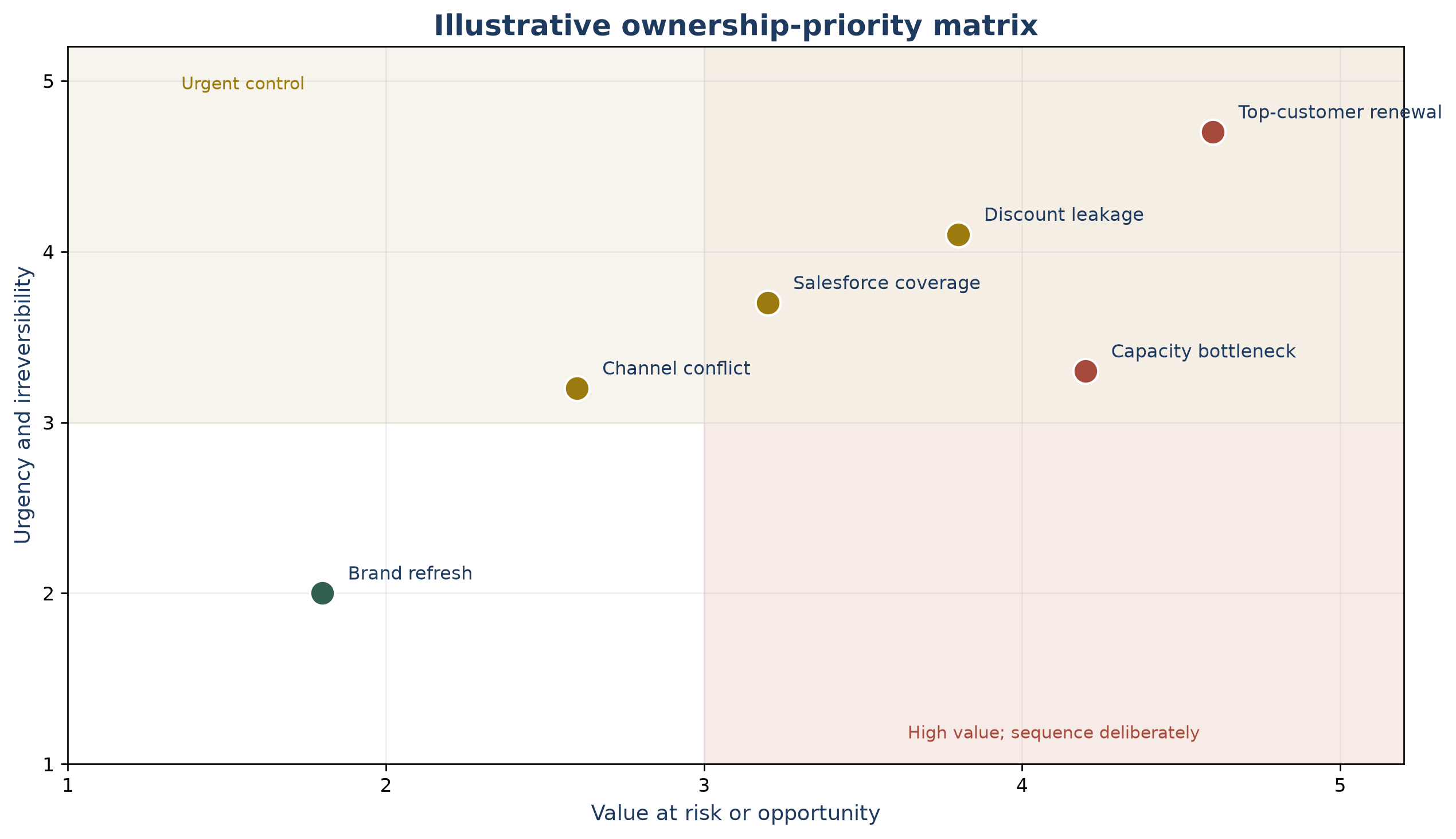
Illustrative priorities. Position depends on transaction evidence, reversibility and owner capacity.
Table 7. Finding-to-action register
| Finding | Confidence | Deal disposition | 100-day initiative | Evidence of closure |
|---|---|---|---|---|
| Top account renews within 60 days of completion | B | Downside sensitivity and customer condition | Executive account plan | Signed renewal or approved contingency |
| Historic discount approvals are inconsistent | A | Earnings normalisation review | Pricing authority and exception log | Approved rules and weekly leakage report |
| Pipeline contains early-stage opportunities as committed | C | Remove from base case | CRM stage definitions and audit | Reclassified pipeline with conversion evidence |
| Capacity constrains two growth segments | B | Capital and timing sensitivity | Capacity-release programme | Throughput and service-level milestones |
| Cross-sell requires customer consent | B | Exclude immediate synergy | Permissioned pilot | Eligible accounts, consent and measured conversion |
Example fields for a common diligence and ownership issue log.
The register should connect to the virtual data room and board materials through stable identifiers. Reader-facing materials should omit those internal identifiers. The transaction team should retain them because the buyer may revisit a conclusion months after completion.
9. Build the 100-day plan during diligence
The 100-day plan is a sequence of decisions and operating changes. It should start with value preservation, legal and regulatory constraints, customer continuity, people, cash, service and control. Growth initiatives follow when the organisation can support them.
Each initiative needs a charter. The charter states the value mechanism, baseline, target, owner, team, dependencies, decision rights, resources, milestones, measures, evidence and stop criteria. A target such as improve pricing is too broad. A charter can specify the eligible customer segment, renewal dates, current realised price, authorised corridor, exception owner, customer risk indicators and weekly evidence.
Day-One actions should be separated from actions that require ownership access. Competition and confidentiality rules can limit pre-completion coordination. The buyer should maintain a permitted-planning protocol with counsel. Clean-team findings should transfer through controlled mechanisms. The operating team should know which actions begin at signing, completion, Day One, Day 30, Day 60 and Day 100.
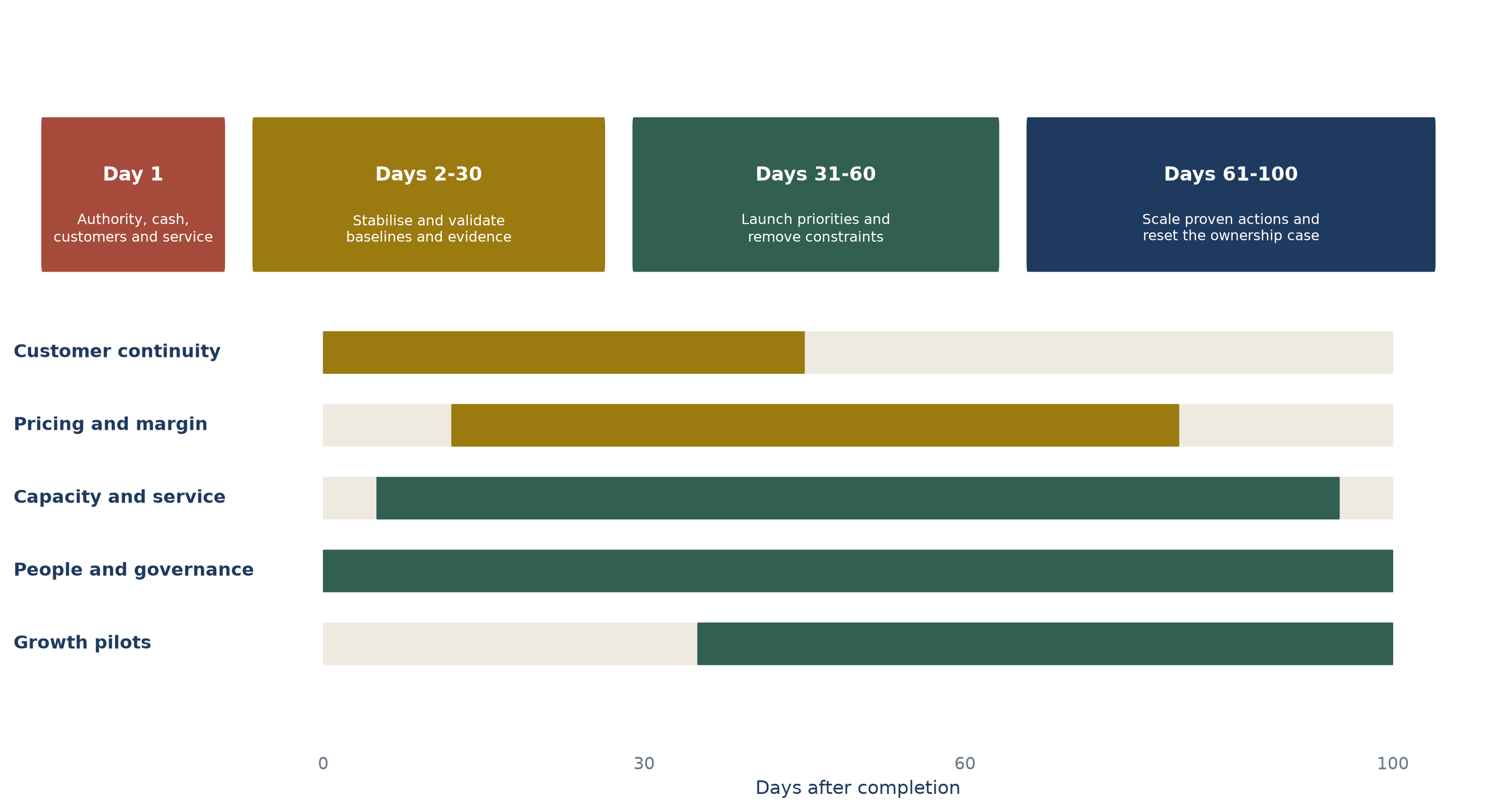
Matchpoint management framework. Timing is illustrative and depends on closing conditions, access and business needs.
The plan needs a review cadence. A weekly initiative meeting should focus on evidence, blockers and decisions. A monthly ownership review should update the value bridge, downside case, cash, customer exposure, people risk and regulatory commitments. The board should receive changes to the ownership case, not a volume of activity slides.
10. Illustrative scenario: a GCC business-services acquisition
The following scenario demonstrates the method. It is hypothetical. The target, customers, contracts, employees, financial results and valuation do not represent an identified company. All numerical values are illustrative modelling assumptions. They should not be used as market benchmarks or transaction advice.
Assume a buyer is considering a GCC business-services company with AED 240 million of reported revenue and AED 36 million of reported EBITDA in the latest twelve months. The seller's plan assumes revenue reaches AED 300 million in two years through price increases, two new sectors and cross-selling to the buyer's customers. The model assumes an enterprise value of AED 300 million before adjustments. Financing, tax, purchase-price allocation, working capital, debt, leakage, transaction costs and legal protections are excluded from the example.
The diligence reconstructs customer cohorts. The top customer group represents an illustrative 18 percent of revenue and renews within sixty days after the assumed completion date. Gross revenue retention for the opening cohort is modelled at 83 percent, while management's aggregate plan assumes limited churn. Discount analysis identifies an illustrative AED 6 million difference between list-price opportunity and realised net price, with only AED 2 million considered addressable within the first year after contract timing and customer risk are considered. Two forecast sectors depend on capacity that is not yet contracted.
These findings produce three cases. The illustrative base case removes unsupported pipeline, includes only contract-timed pricing, and stages capacity-led growth. The illustrative downside case assumes the largest customer reduces spend, pricing action is delayed and new capacity starts later. The illustrative upside case includes measured cross-sell only after a permissioned pilot. Probability weights are intentionally omitted because the scenario contains no observed transaction evidence.
The deal dispositions follow. The board requests a renewal strategy and updated value sensitivity. Transaction counsel reviews whether customer status should affect conditions, warranties or other protection. The operating team prepares an executive account plan that can begin within permitted boundaries. Pricing leakage becomes an initiative with a baseline, approval rules and eligible contracts. Capacity becomes a staged commitment tied to signed demand and service measures. Cross-sell remains outside the immediate base case and enters a controlled pilot.
The example shows the value of continuity. The same evidence changes the model, transaction work and operating plan. A slide about concentration becomes an owned sequence with a decision and closure evidence.
11. Board materials should preserve evidence and judgement
The final board pack should be concise and traceable. It can include the thesis scorecard, evidence-grade summary, market bridge, customer-cohort analysis, pricing waterfall, competitive position, regulatory dependencies, base and downside cases, finding-to-action register and the first 100-day initiative portfolio.
Each quantitative page should state the source, period, unit, definition and reconciliation status. Management estimates should be labelled as estimates. Illustrative scenarios should be labelled as illustrative. Forecasts should distinguish contracted, observable and assumed components. The decision record should show the approved case and the conditions under which it needs to return to the board.
IFRS 3 establishes the accounting framework for business combinations, including recognition and measurement of acquired assets and liabilities, goodwill and disclosures.[6] IFRS 8 addresses operating-segment information, and IAS 36 addresses impairment of assets.[7][8] These accounting requirements sit outside commercial diligence, yet the commercial evidence can inform identification of cash-generating drivers, segments, customer relationships, forecasts and impairment indicators. Qualified accounting advisers should determine the required treatment.
The ownership case should continue after completion. Day 30 validates access and baselines. Day 60 tests whether initiatives are producing evidence. Day 100 resets the value bridge, closes or re-scopes actions and confirms the next operating horizon. The board can then compare the original thesis with observed ownership results.
12. Scope, assumptions and limitations
This paper presents a management framework. It does not provide legal, tax, accounting, regulatory, valuation or investment advice. Competition rules, filing thresholds, sector requirements, customer contracts and data restrictions require current, transaction-specific advice in each jurisdiction.
Commercial evidence contains limitations. Official statistics can be aggregated or delayed. Private-company data can contain system changes, missing fields and management adjustments. Interviews can contain selection, recall and courtesy bias. Competitor information can be incomplete. Customer behaviour can change after a transaction announcement. Forecasts depend on execution capacity and external conditions.
The illustrative scenario uses invented values and simplified relationships. It excludes financing, tax, purchase-price mechanics, working capital, accounting adjustments, legal protection, integration cost and macroeconomic shocks. It does not estimate a fair value or expected return. Its purpose is to demonstrate how a finding moves through evidence, value, transaction and ownership decisions.
Responsible-business-conduct diligence also extends beyond the commercial scope in this paper. OECD guidance covers impacts related to workers, human rights, environment, bribery, consumers and corporate governance through an ongoing, risk-based process.[9] A buyer should integrate these workstreams with legal, financial, tax, technology, cyber, operational and other relevant diligence.
The quality test is practical. The buyer should be able to identify what it believes, the evidence behind that belief, the downside if the belief is wrong, the protection it requires and the owner who will act. That record turns diligence into an ownership system.
References
- Competition and Markets Authority, Merger Assessment Guidelines, CMA129, updated page 3 June 2026. https://www.gov.uk/government/publications/merger-assessment-guidelines/merger-assessment-guidelines-html-version
- European Commission, Commission Notice on the definition of the relevant market for the purposes of Union competition law, 2024. https://competition-policy.ec.europa.eu/antitrust-and-cartels/legislation/market-definition-notice_en
- United Arab Emirates Ministry of Economy, Federal Decree-Law No. 36 of 2023 Regulating Competition. https://www.moec.gov.ae/en/regulation-of-competition-legislations
- United Arab Emirates Cabinet, Cabinet Decision No. 3 of 2025 on thresholds related to Federal Decree-Law No. 36 of 2023. https://www.moec.gov.ae/documents/20121/0/Cabinet%2BDecision%2BNo.%2B%283%29%2Bof%2B2025%2BOn%2Bthe%2BThresholds%2BRelated%2Bto%2Bthe%2BImplementation%2Bof%2BFederal%2BDecree-Law%2BNo.%2B%2836%29%2Bof%2B2023%2BRegulati.pdf/0f228724-8dd5-9b9c-0ed8-0b94d5ae0873?t=1742552419931
- General Authority for Competition, Kingdom of Saudi Arabia, Economic Concentration Review Guidelines. https://gacbep.gac.gov.sa/cms/b9376edc-79a1-4573-a36d-4f3effaba838.pdf
- IFRS Foundation, IFRS 3 Business Combinations. https://www.ifrs.org/issued-standards/list-of-standards/ifrs-3-business-combinations/
- IFRS Foundation, IFRS 8 Operating Segments. https://www.ifrs.org/issued-standards/list-of-standards/ifrs-8-operating-segments/
- IFRS Foundation, IAS 36 Impairment of Assets. https://www.ifrs.org/issued-standards/list-of-standards/ias-36-impairment-of-assets/
- OECD, Due Diligence Guidance for Responsible Business Conduct, 2018. https://www.oecd.org/en/publications/2018/02/oecd-due-diligence-guidance-for-responsible-business-conduct_c669bd57.html
- Federal Competitiveness and Statistics Centre, UAE official statistics and economy data. https://fcsc.gov.ae/
- General Authority for Statistics, Kingdom of Saudi Arabia, Structural Business Statistics Survey. https://stats.gov.sa/en/w/sbs-1
- U.S. Department of Justice and Federal Trade Commission, Merger Guidelines, 2023. https://www.justice.gov/atr/2023-merger-guidelines
About the Author
Chennakeshav Adya is an independent researcher focused on corporate finance, private markets, transaction execution and operating value creation across the Gulf Cooperation Council and international markets.
Appendix A: Commercial diligence minimum question set
- Which transaction thesis is being tested, and which evidence would disprove it?
- Which customer, product, channel and geographic definitions reconcile to reported revenue?
- Which official and primary data series match the target's actual commercial market?
- How do customer, revenue and contribution-margin retention differ by cohort?
- Which accounts depend on one decision-maker, channel, contract, founder or salesperson?
- How does quoted price bridge to invoiced price, contribution margin and cash?
- Which competitors constrain price, quality, access, capacity and customer choice?
- Which licences, approvals, notification rules and customer consents affect timing or ownership?
- Which findings change value, terms, closing, operating action or the decision to stop?
- Which first-100-day initiatives have baselines, owners, dependencies and closure evidence?
Appendix B: 100-day initiative charter
- Initiative name and value mechanism
- Finding and supporting evidence
- Baseline, definition, source and confidence grade
- Day-One protection or continuity action
- Day 30, Day 60 and Day 100 milestones
- Accountable executive and delivery team
- Required legal, regulatory, accounting or specialist advice
- Dependencies, resources and decision rights
- Leading indicators, outcome measures and cash impact
- Risks, scenario limitations and stop criteria
- Evidence required to close, continue or re-scope the initiative
