

1. Start with the complete economics, not the headline fee
A private-share transaction can appear to carry a two percent fee while its complete economics are materially wider. The buyer may pay an all-in price above the seller’s net proceeds. An affiliated entity may retain part of that difference. A referral source may receive a share. Legal, platform, custody, escrow, foreign-exchange and transfer charges may be added. The intermediary may also hold an economic interest in the security or issuer.
The transaction economics record should begin when a mandate or opportunity is accepted. It identifies every party that can pay or receive value, the relevant agreement, capacity, calculation basis, timing, contingency, refund rule, tax treatment and approval. It also records non-cash value such as warrants, equity, data access, future allocation rights, services or reciprocal introductions.
The first control is completeness. A “broker fee” field cannot capture a principal spread, related-party payment or equity upside. Each component should have its own line and source. The total is then presented from the buyer, seller and intermediary perspectives.
The second control is timing. A fee described before the transaction can change with quantity, price, buyer, route or service scope. Every material change should refresh the disclosure and approval before commitment where required.
The third control is reconciliation. The final record connects contracted economics to invoices, settlement statements, bank movements, ledger entries and taxes. A fee schedule without post-close evidence remains an estimate.
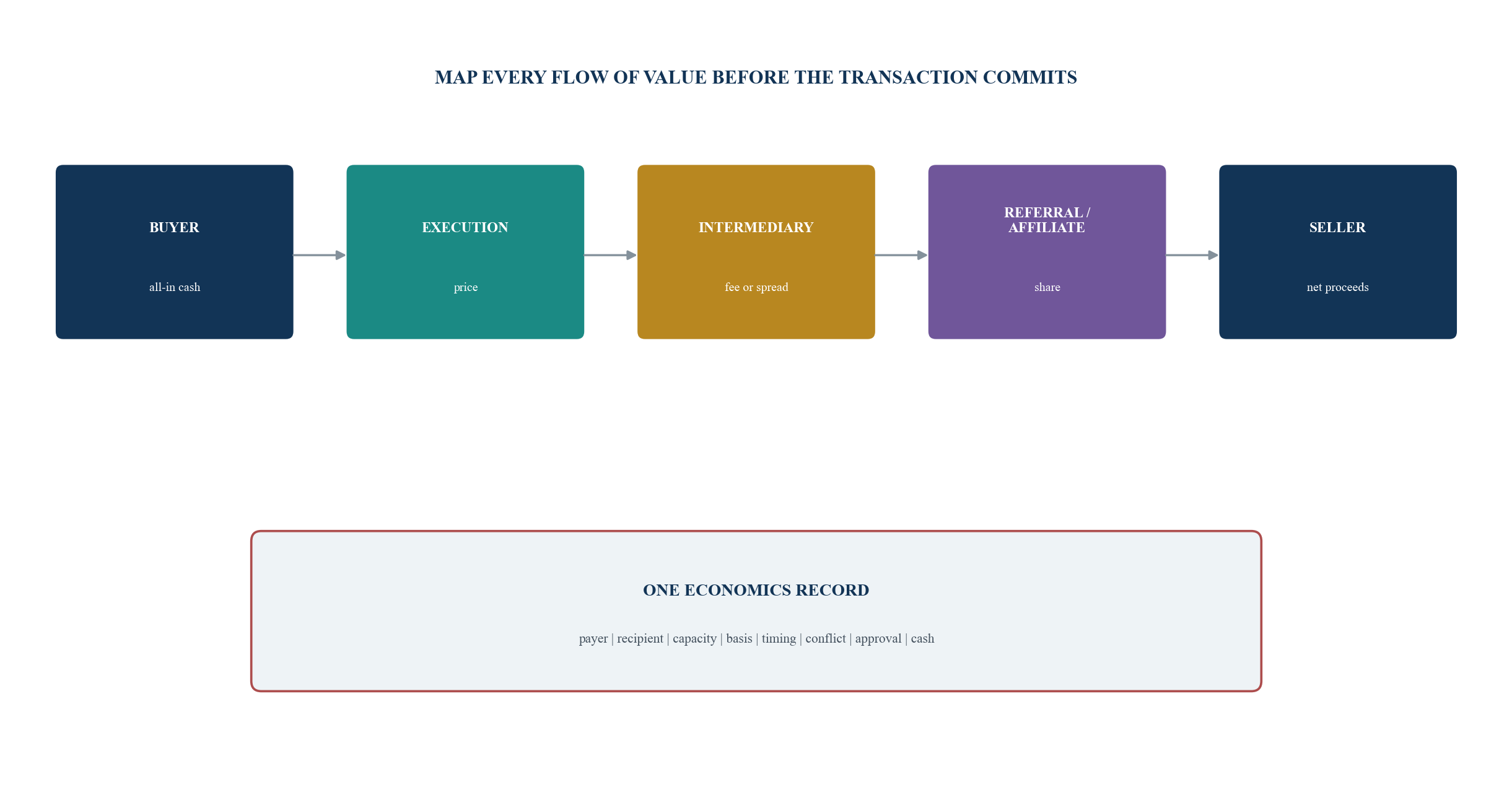
The diagram is an author framework; actual roles and permitted payments require current advice.
2. Define role and capacity before describing compensation
The same economic amount can mean different things in different capacities. An agent may charge a commission for arranging or executing a transaction. A principal may earn the difference between its acquisition cost or prevailing market price and customer price. An adviser may charge for analysis. A consultant may charge for project work outside a regulated transaction role. A platform may charge access, administration or execution fees.
Commercial labels do not determine the regulatory outcome. The file should describe what each person actually does: introduces, solicits, recommends, negotiates, values, arranges, executes, holds funds, holds securities, advises or supplies technology. Transaction-based compensation can be relevant to broker-dealer or other perimeter analysis.
The role memo should identify the contracting party and the entity that performs each task. Groups often use several affiliates. The customer should see which entity owes which obligation and which entity receives each payment.
Dual capacity requires careful treatment. A firm acting as principal has its own economic interest in the price. A firm acting as agent earns a stated charge. If capacity changes during the process, the disclosure, approval and transaction documents should change as well.
The SEC’s broker-dealer and Regulation Best Interest materials provide current US frameworks for analysing role, recommendations, costs and conflicts within their respective scopes. FINRA Rule 2121 addresses fair prices and commissions for member transactions, including unlisted securities. Its outcome depends on relevant circumstances and capacity.
Table 1. Role, capacity and compensation matrix
| Activity | Possible capacity | Economic component | Evidence required |
|---|---|---|---|
| introduction | limited introducer or regulated intermediary | fixed referral fee or transaction share | scope, payer, trigger and authority |
| solicitation | broker or placement role | issuer, seller or buyer-paid fee | audience, communication and permission |
| recommendation | broker or adviser | commission, spread or advisory fee | customer, rationale, costs and conflicts |
| negotiation | agent or principal | commission or principal economics | authority, communications and price record |
| execution | broker, dealer or platform | commission, mark-up or venue charge | order, capacity, price and confirmation |
| custody or escrow | authorised service provider | custody, administration or escrow fee | contract, account and asset controls |
| consulting | scoped project provider | fixed or time-based professional fee | deliverables separated from regulated tasks |
Current counsel and compliance should classify the actual conduct in each relevant jurisdiction.
3. Create a taxonomy that prevents economic components from disappearing
The economics register should use controlled categories. Commission is a charge associated with agency activity. Mark-up or mark-down describes principal economics relative to an appropriate reference price under the relevant framework. Spread can describe the difference between buyer and seller prices, although that label alone does not explain who retained it or why. Mandate, placement, structuring and success fees should identify the services and trigger.
Cost reimbursement should reflect actual third-party or agreed expenses and state whether any margin is added. Platform, administration, custody, escrow, transfer-agent, legal, diligence, tax and foreign-exchange charges require named providers and allocation rules.
Indirect benefits need a place in the same register. Equity, warrants, carried interest, future allocation priority, rebates, soft benefits and reciprocal business can influence conduct. A zero cash fee does not establish economic neutrality.
Taxes and levies should remain separate from intermediary remuneration. The settlement statement can show gross price, transaction taxes, provider charges, compensation and net cash without blending unlike items.
The taxonomy should preserve the original contractual label and add an analytical classification. This prevents a euphemistic label from concealing the economics while retaining traceability to the agreement.
4. Identify every payer, recipient and beneficial economic owner
The payer may be the issuer, seller, buyer, fund, SPV or another intermediary. The contractual recipient may pass value to employees, representatives, referral sources, affiliates or service providers. The register should show both the legal recipient and the final economic allocation known to the firm.
Related-party relationships matter. If an affiliate provides valuation, financing, custody or technology, the customer should understand the relationship and associated benefit where applicable. Ownership interests in the issuer, buyer, seller or platform can create additional conflicts.
The recipient file should include legal identity, beneficial ownership, account, tax documentation, invoice authority and any required licensing or permission. Payment to an undisclosed third party or personal account should stop the process for escalation.
Revenue sharing should reconcile to a rule. The file records the percentage, base, exclusions, cap, timing, clawback and treatment of cancelled or partially settled transactions. Changes need authorisation and updated disclosure where applicable.
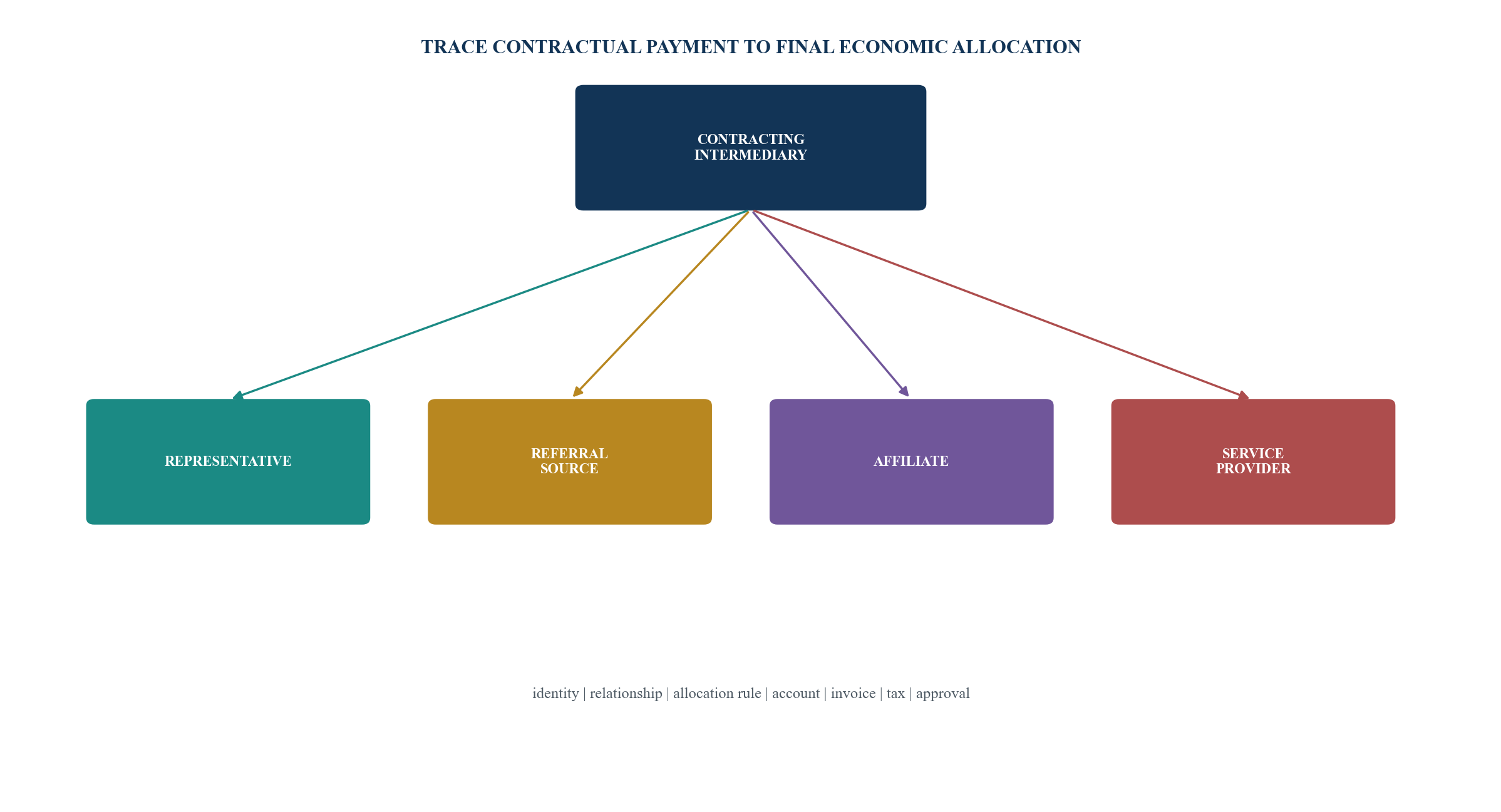
Illustrative relationships show why legal recipient and economic beneficiary should both be recorded.
5. Build a price record before calculating a mark-up or spread
Private shares can lack a continuously observable market. The price record should therefore identify every relevant data point with its date, security class, quantity, rights, information set, transaction status and source. A last primary round, employee tender, secondary indication and completed institutional block may not be comparable.
FINRA Rule 2121 states that fairness depends on relevant circumstances. Its supplementary material describes prevailing-market-price analysis and notes that disclosure alone does not justify an unfair or excessive charge. Those provisions apply within FINRA’s scope and should not be converted into a universal private-share percentage.
The reference-price memo should explain the selected evidence and limitations. It should distinguish a binding trade, bona fide bid, offer, indication, model value and stale observation. It should also show adjustments for class rights, dilution, company performance, information quality, restrictions, block size and timing.
Where the intermediary transacts as principal, its own contemporaneous acquisition or sale evidence may be important under applicable rules. The file should preserve exact timestamps and connected trades. Warehousing risk, capital use and holding period can be described separately; they should not erase the underlying reference-price analysis.
The customer-facing economics should show the execution price and compensation in the form required by the applicable regime. Internal calculations should be reproducible from source data.
The reviewer should also test whether the selected reference changes across the transaction timeline. An early indication can support negotiation context. A contemporaneous executable observation may carry greater weight at commitment. A completed trade provides ex-post evidence only after its terms and settlement are known. The file should preserve each state and avoid replacing an earlier record silently.
Price evidence can be asymmetric. The intermediary may know its own cost, a seller’s reservation price, another buyer’s bid or an issuer-led tender price while the customer sees only one figure. The access matrix should identify who knows each observation, the confidentiality restriction and the information that can lawfully be disclosed. The conflict reviewer then assesses whether the information advantage affects pricing or recommendation.
Class economics deserve a separate bridge. Preferred liquidation rights, conversion ratios, dividends, anti-dilution, participation, voting, information and transfer rights can make equal nominal share prices economically different. The memo should identify the fully diluted quantity, class rights and relevant scenario assumptions before comparing prices.
A valuation range should not be presented as a live market. The output should state the method, valuation date, inputs, sensitivities and absence of executable liquidity where applicable. This distinction is especially important where compensation increases with the stated value.
Table 2. Private-share price-evidence register
| Evidence | Date and status | Comparability test | Use in economics record |
|---|---|---|---|
| primary financing | close date and completed | class, preferences, size and new-money rights | capital-structure reference |
| issuer tender | offer and completion dates | eligible holders, quantity and conditions | organised liquidity reference |
| completed secondary | trade and settlement dates | class, size, buyer and restrictions | observed transaction reference |
| bona fide bid | timestamp and validity | funding, conditions and quantity | current demand evidence |
| seller indication | timestamp and authority | availability and expected net proceeds | negotiation input |
| model valuation | valuation date and assumptions | method, scenarios and calibration | analytical reference only |
| intermediary cost | acquisition and settlement evidence | capacity and connected transaction | principal-economics analysis |
Comparability conclusions require current valuation, legal and regulatory judgement.
6. Reconcile buyer cost, seller proceeds and intermediary economics
The gross-to-net waterfall begins with the buyer’s total cash commitment. It deducts or separately shows the share purchase price, buyer-paid commission, platform and settlement costs, taxes and any financing charge. On the seller side, it starts with gross consideration and deducts seller-paid fees, taxes, lien repayment and provider costs to arrive at net proceeds.
The two perspectives should reconcile. If the buyer pays USD 42 per share and the seller receives USD 39, the USD 3 difference needs a complete explanation. It may include principal economics, fees, costs or different contractual quantities. The file identifies each recipient.
Percentage presentation needs a named denominator. A fee can be expressed against gross consideration, net proceeds, committed amount, funded amount or enterprise value. The same dollar fee produces different percentages. The disclosure should state both amount and basis where known.
Contingent fees should show scenarios. A success fee may step up at price thresholds, include a minimum, apply to deferred consideration or survive termination. The model shows each trigger and final invoice logic.
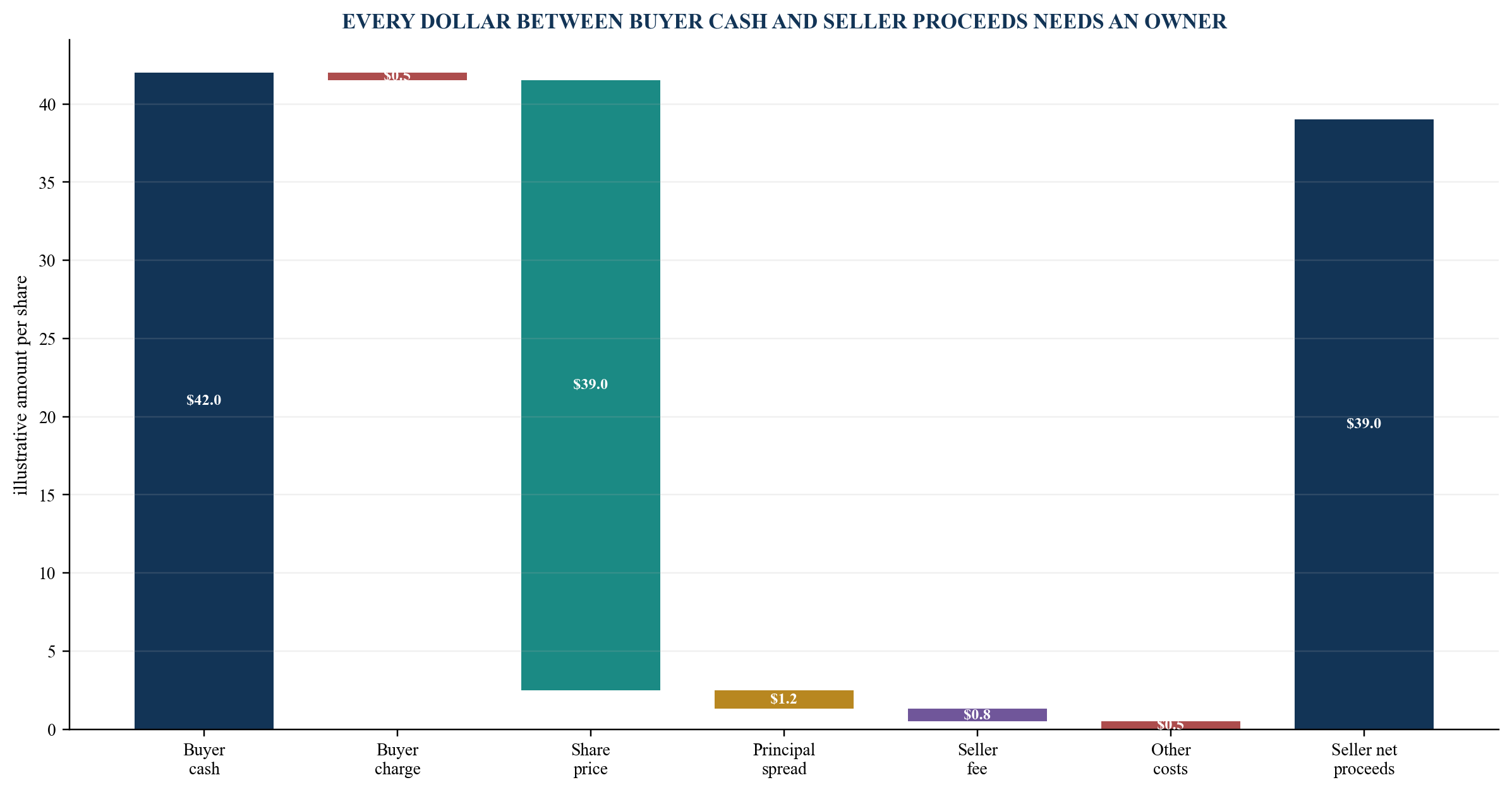
All amounts are illustrative management assumptions and do not describe an actual transaction.
7. Design disclosure around decisions and timing
Disclosure should arrive early enough to inform the relevant decision. A fee revealed after the customer commits cannot support the earlier choice. The file should identify the required audience, form, timing and delivery evidence for each disclosure.
The first disclosure states role, capacity, services and compensation types. A transaction-specific disclosure then shows known amounts, formulas, ranges, payer, recipient, timing and conflicts. The confirmation records executed economics. Periodic or post-close reporting can address later adjustments.
Plain language matters. “Up to two percent plus third-party costs” should identify the base, conditions and likely costs. “No buyer fee” should not be used where the buyer price contains undisclosed principal economics.
FINRA’s fixed-income confirmation rules have a specific scope, yet their presentation discipline offers a useful design reference: where mark-up disclosure applies, amount and percentage are shown on the confirmation itself. A private-share standard can similarly present both absolute and percentage economics without claiming that the fixed-income rule governs the transaction.
The disclosure should distinguish known, estimated and contingent amounts. It should state the methodology and refresh when a material input changes.
The design can use a layered format. Page one shows the all-in amount, roles, capacity, payer, recipient and material conflicts. Page two explains calculations, estimates, taxes and third-party charges. Supporting schedules preserve contractual detail and evidence. The hierarchy gives the decision maker a complete summary while retaining auditability.
Scenario disclosure is useful when economics depend on price, quantity, time or outcome. The schedule can show the fee at three stated prices, the effect of a minimum fee, the treatment of partial settlement and the consequence of deferred consideration. Each scenario should be labelled as an assumption until the transaction fixes the input.
Acceptance evidence should identify the document version, recipient, delivery time and response. A data-room upload alone does not prove that a customer received the economics at the relevant decision point. The process owner should preserve the delivery and acceptance trail required for the engagement.
Accessibility and readability also matter. Dense formulas, undefined abbreviations and overlapping fee labels can obscure the total. The statement should use consistent terms, currencies, bases and decimal precision. A reader should be able to reproduce the total from the visible components.
8. Build a conflict register connected to compensation
Compensation creates incentives. The conflict register should ask whether the firm benefits from a particular issuer, buyer, seller, price, quantity, timing, structure, financing source or service provider. It should include employee and affiliate incentives.
The SEC defines conflicts in Regulation Best Interest materials within that framework and requires relevant firms to identify and address them. FCA conflict rules require relevant firms to maintain records and, where arrangements are insufficient, make specific disclosures in a durable medium before business. The exact obligations depend on scope.
Disclosure is one control among several. Governance can include independent price review, compensation caps, neutral allocation, restricted incentives, supervision, approval committees, surveillance, employee attestations and recusal. Some conflicts may require elimination or a different transaction structure under applicable rules.
The register should record the inherent conflict, affected parties, potential harm, existing controls, residual risk, disclosure and approver. Generic language about “potential conflicts” provides limited decision value.
Conflict analysis should address combinations. An issuer-paid success fee combined with an equity interest and a price-linked employee bonus can create stronger incentives than any component viewed alone. The register should aggregate connected interests across the firm, affiliates and relevant people.
The control owner should test actual operation. A policy requiring independent price review needs a named reviewer, evidence considered, conclusion and time stamp. A recusal needs proof that the conflicted person did not approve the relevant decision. Surveillance should identify the population, exception logic and investigation outcome.
Residual risk should be stated from the customer’s perspective. The description explains how the incentive could affect price, allocation, timing, product choice or willingness to stop. This creates a concrete basis for approval and disclosure.
Conflicts can change after mandate signing. The firm may acquire inventory, receive a new referral agreement, add financing or obtain an equity instrument. Event-driven attestations and deal-team updates should reopen the register before the next affected recommendation or commitment.
Table 3. Compensation-conflict control register
| Incentive | Potential effect | Evidence | Control response |
|---|---|---|---|
| percentage success fee | preference for closing over stopping | mandate and compensation model | independent approval and stop authority |
| price-linked fee | incentive toward a selected price outcome | formula and valuation record | separate price review and scenario disclosure |
| principal inventory | benefit from customer execution price | acquisition cost and capacity | capacity disclosure and fair-price review |
| issuer-paid fee | incentive to favour issuer claims | engagement and communications | diligence, balanced presentation and supervision |
| referral share | preference for one source or counterparty | allocation agreement | recipient disclosure and conflict assessment |
| affiliate provider | group benefit from additional service | ownership and fee schedule | alternatives assessment and related-party approval |
| equity or warrant | upside linked to issuer performance | instrument terms and valuation | ownership disclosure and ongoing restrictions |
Required treatment depends on the applicable role, customer, product and jurisdiction.
9. Control referral, introducer and representative payments
Referral payments should have a written purpose, scope, trigger, calculation and approval. The file identifies the introducer’s activities and confirms that the payment does not assign unauthorised regulated functions.
The firm should know who ultimately receives the payment. Layered consultants, personal accounts or unexplained onward shares can create bribery, AML, tax, sanctions and conduct risk. Recipient diligence and account verification should precede payment.
The customer-facing treatment depends on applicable rules and materiality. The transaction record should at minimum allow the firm to determine whether the referral arrangement affects the recommendation, price, allocation or choice of provider.
Employee and representative compensation deserves the same analysis. Threshold bonuses, deal credits, accelerators and product-specific incentives can change behaviour. The conflict policy should connect individual remuneration to supervision and customer outcomes.
10. Govern fee changes with the same discipline as price changes
A fee can change because quantity changes, another party joins, work expands, a closing is delayed or a structure changes. The change register records the reason, old amount, new amount, affected payer, recipient, service and conflict.
The authorised approver should evaluate the commercial rationale and applicable fairness, disclosure and conflict requirements. Side agreements and oral concessions belong in the same record.
Customer acceptance should be evidenced where required. The updated disclosure should precede the affected commitment. A later invoice cannot serve as the first notice of a material fee.
Fee waivers and rebates also require control. They can benefit selected customers, alter allocations or conceal a prior overcharge. The register records the authority, rationale, beneficiaries and accounting treatment.
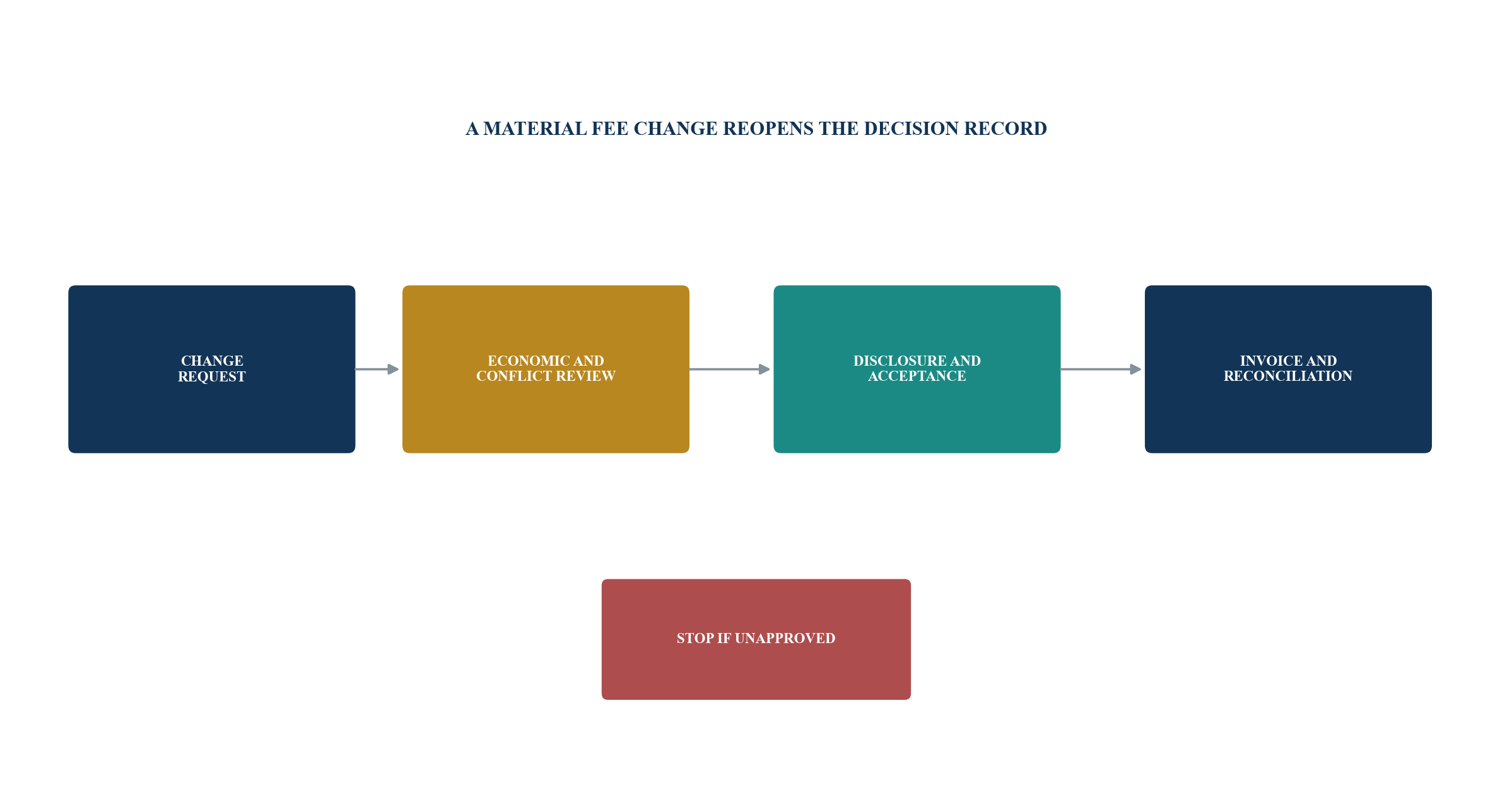
The workflow is an author framework and should be adapted to current legal and compliance requirements.
11. Produce one transaction-specific economics statement
The statement should identify the security, quantity, capacity, execution price, buyer cash, seller proceeds, every fee and cost, payer, recipient, percentage basis, taxes, contingent amounts and net settlement. It also lists material conflicts and links to the governing agreements.
The front page should answer the core questions without cross-referencing a large data room: who pays, who receives, how much, for what, when and under which capacity. Supporting schedules can explain calculations.
The statement needs version control. The signed or accepted version should match the executed terms. The post-close version replaces estimates with actual amounts and describes variances.
Digital presentation should preserve prominence. A hyperlink to buried fee language may not provide decision-useful disclosure. The record should show what the customer received and when.
The transaction statement should carry a unique identifier tied to the order, block or agreement. This prevents a generic fee sheet from being attached to several transactions with different prices, capacities or recipients. Amendments should retain the prior version and show the change.
Capacity deserves a prominent field. “Agent” indicates that the stated commission relates to an agency service. “Principal” identifies the firm’s economic interest in the transaction price. Where several firms act in different capacities, the statement should map each one.
The statement should include a gross cash reconciliation for both sides. Buyer cash equals purchase consideration plus buyer-paid charges and relevant costs. Seller net proceeds equal purchase consideration less seller-paid charges, liens, taxes and relevant costs. The intermediary economics schedule then reconciles the difference and any separate payments.
The approver should compare the statement with the mandate and final transaction document before execution. Mismatches in fee base, currency, minimum, tax or trigger should stop release until corrected or validly amended.
12. Reconcile invoices, settlement and revenue recognition
The closing checklist matches the economics statement to the purchase agreement, mandate, invoices, escrow statement, bank movements and company ledger. Each variance receives an owner and resolution.
Fees can be earned, invoiced, received and recognised at different times. Finance should apply the relevant accounting policy and preserve evidence. Collected consulting fees should mean cleared funds supported by the contract, invoice and bank record.
Contingent consideration and holdbacks require later follow-up. The register should prevent an expected fee from being reported as cash. Taxes, refunds and clawbacks should remain visible.
Foreign-exchange conversions need the currency, rate, source, date and any spread. Where a provider retains FX economics, that benefit belongs in the complete compensation map.
Revenue reconciliation should separate service delivery from collection. A signed mandate establishes contractual terms. An earned-fee assessment applies the contract to completed work or transaction events. An invoice requests payment. A cleared receipt establishes collection. Accounting recognition follows the applicable policy and evidence.
Partial settlement needs allocation logic. If half a block closes, the file should show whether the fee applies pro rata, meets a minimum or waits for later tranches. Expenses can have different treatment. The invoice should match the executed quantity and contract.
Disputed amounts remain open exceptions. The dashboard records the basis of dispute, owner, correspondence, provision or credit treatment and resolution. It should avoid combining a disputed invoice with collected cash.
Bank evidence should match the payer, recipient, amount, currency, value date and reference. A receipt from an unexpected entity requires explanation and relevant compliance review before it is allocated to the engagement.
Table 4. Post-close compensation reconciliation
| Component | Contracted | Invoiced | Settled | Variance treatment |
|---|---|---|---|---|
| buyer commission | USD 50,000 | USD 50,000 | USD 50,000 | matched |
| seller success fee | USD 80,000 | USD 80,000 | USD 76,000 | withholding evidence required |
| referral allocation | USD 20,000 | USD 20,000 | USD 20,000 | recipient and account matched |
| legal reimbursement | USD 12,500 cap | USD 11,800 | USD 11,800 | third-party invoice attached |
| escrow charge | USD 4,000 estimate | USD 4,200 | USD 4,200 | variance approved |
| contingent fee | USD 30,000 potential | zero | zero | remains unearned and unpaid |
Amounts are illustrative management assumptions.
13. Test fairness and reasonableness with evidence
Fairness analysis should consider the applicable legal or regulatory standard, capacity, market evidence, transaction size, complexity, risk, work performed and customer outcome. A percentage cap alone provides incomplete analysis.
FINRA’s mark-up policy describes five percent as a guide within its historical framework, expressly states that it is not a rule and notes that even a lower amount may be unfair. This nuance matters. A private-share policy should avoid treating five percent as an automatic safe harbour.
The reviewer should compare the amount with contemporaneous price evidence and documented services. Expenses used to support a charge should be reasonable and traceable. Scarcity or illiquidity may affect the work and economics, while disclosure alone does not cure an unfair amount.
Pattern analysis can identify outliers across customers, representatives, issuers and transaction types. The dataset should control for relevant differences and route exceptions for review.
The fairness paper should document the reviewer’s independence and competence. It should list the governing standard, capacity, customer type, transaction facts, market evidence, services, expenses, conflicts, comparisons, conclusion and limitations. A numerical output without this reasoning provides weak assurance.
Small transactions can carry high percentage economics because fixed work is spread across a lower value. Large transactions can carry substantial dollar economics at a low percentage. The review should consider both amount and percentage, along with complexity, risk and service value.
Illiquidity can increase sourcing and execution work. It can also increase the information advantage held by an intermediary. The review should address both effects using evidence. Scarcity should not become a generic explanation for any spread.
Exceptions should be analysed over time. Repeated high economics around one representative, affiliate, customer segment or issuer can indicate a pattern that individual approvals miss. Management reporting should show the distribution, rationale and remediation status.
14. Use a scorecard without turning judgement into a formula
The readiness score can cover role clarity, compensation completeness, price evidence, payer and recipient verification, conflict controls, disclosure timing, customer acceptance, settlement logic and reconciliation.
Critical failures override the average. Undisclosed principal capacity, unverified recipient, missing fee authority or unexplained price difference should stop approval regardless of the score.
Evidence has an age. Price observations, ownership records, sanctions screening and buyer terms can become stale. The scorecard records dates and refresh triggers.
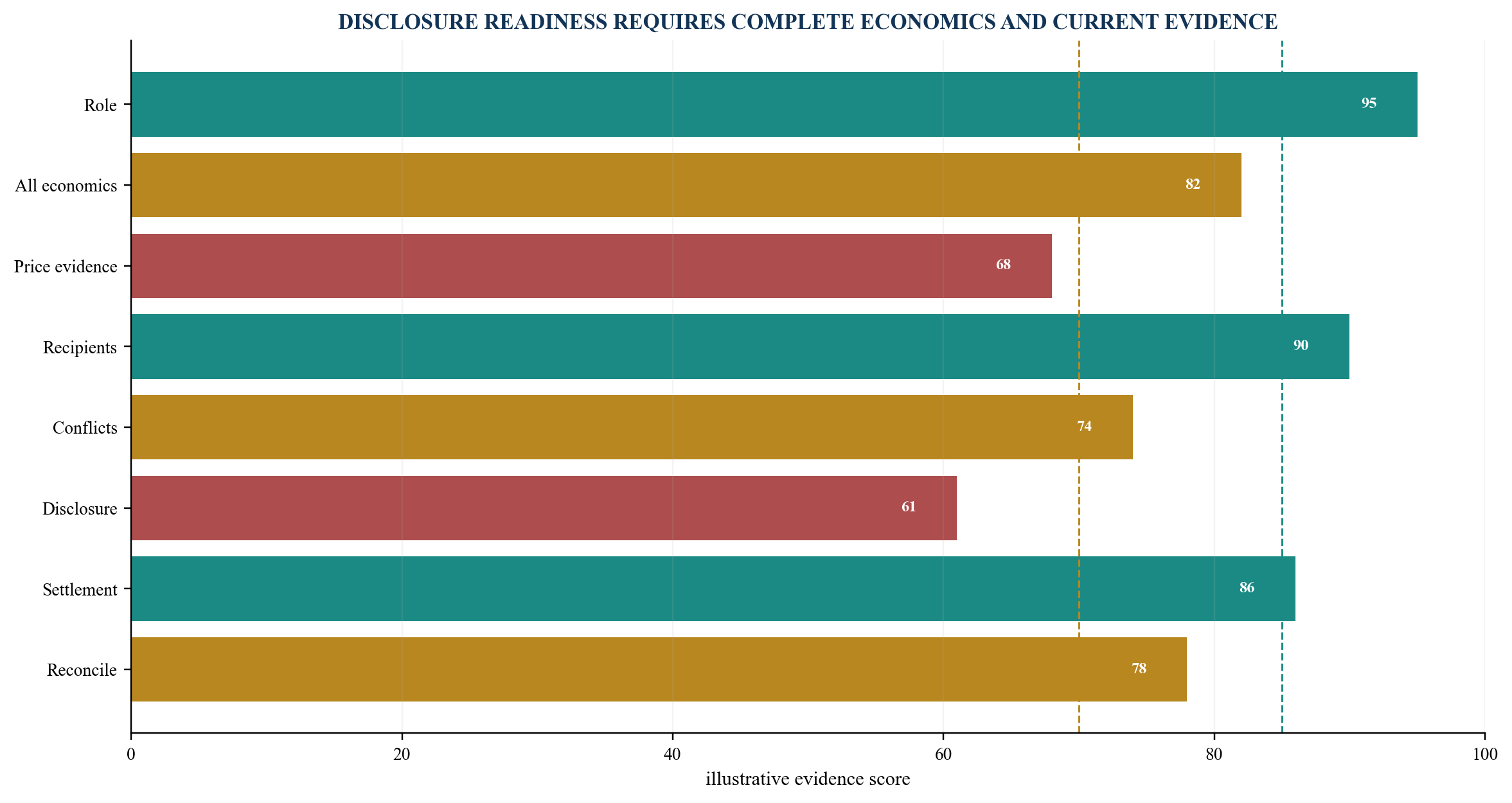
Scores and thresholds are management assumptions; critical controls remain binary.
Table 5. Compensation-readiness scorecard
| Module | Weight | Illustrative score | Open issue | Gate |
|---|---|---|---|---|
| role and capacity | 14% | 95 | none material | legal perimeter confirmed |
| economics completeness | 15% | 82 | affiliate service pending | every value flow recorded |
| price evidence | 15% | 68 | stale secondary indication | current reference memo required |
| recipients | 10% | 90 | none material | identity and accounts verified |
| conflicts | 14% | 74 | principal interest review | controls and disclosure approved |
| customer disclosure | 14% | 61 | fee change not accepted | current statement delivered |
| settlement | 9% | 86 | callback scheduled | payment route verified |
| reconciliation | 9% | 78 | tax variance open | finance treatment approved |
Illustrative weights and scores do not replace legal, compliance or supervisory decisions.
15. Run a ten-day compensation diagnostic
Days one and two establish the parties, role, capacity, security, transaction route, customer and full agreement population. The team freezes the current price and quantity assumptions.
Days three and four create the compensation taxonomy, payer-recipient map, referral and affiliate register, price-evidence file and gross-to-net waterfall.
Days five and six complete the regulatory-perimeter, fair-price and conflict analysis with current counsel and compliance. The team identifies critical gaps.
Days seven and eight prepare the transaction-specific economics statement, fee scenarios, approvals, confirmation fields and settlement instructions.
Days nine and ten deliver the readiness score, remediation plan, decision paper and proposed implementation office. Items without evidence remain open.
16. Operate a thirty-day economics office
Days one to five inventory every contract, fee, spread, reimbursement, indirect benefit and recipient. The office creates one controlled economics register.
Days six to ten reconcile role, capacity, services, price evidence and calculation bases. Counsel and compliance classify applicable obligations.
Days eleven to fifteen map conflicts, remuneration incentives, referrals and affiliates. Decision owners approve controls and required disclosures.
Days sixteen to twenty build customer statements, confirmations, change controls, invoice logic and settlement waterfalls. Representative transactions pass testing.
Days twenty-one to twenty-five reconcile open transactions to agreements, invoices and expected cash. Exceptions are corrected or escalated.
Days twenty-six to thirty establish management reporting, pattern surveillance, post-close review and evidence retention. The governing owner accepts the operating standard.
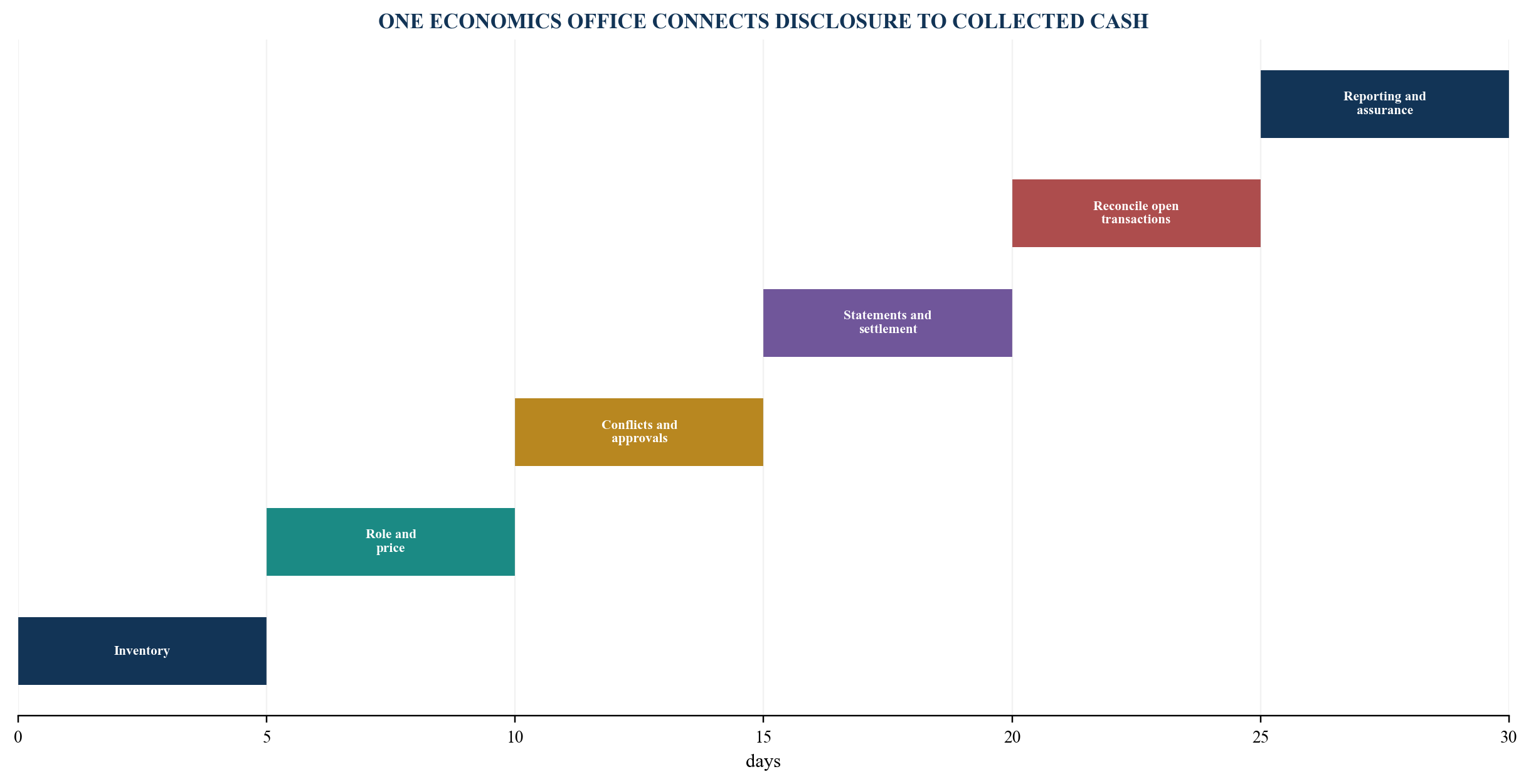
Timing is an author framework and should be adapted to the firm, transaction and applicable requirements.
Table 6. Thirty-day implementation gates
| Days | Workstream | Controlled deliverable | Gate |
|---|---|---|---|
| 1 to 3 | population | agreements, parties, securities and transactions | scope reconciled |
| 4 to 5 | taxonomy | complete economic components and recipients | no unexplained value flow |
| 6 to 8 | role | capacity and service map | perimeter owner confirms route |
| 9 to 10 | price | evidence and reference-price memo | reviewer approves methodology |
| 11 to 13 | conflicts | incentive and related-party register | treatments approved |
| 14 to 15 | governance | authorities, limits and exceptions | decision owners accept controls |
| 16 to 18 | disclosure | transaction-specific statement | timing and content pass review |
| 19 to 20 | confirmation | executed economics and change control | test transaction reconciles |
| 21 to 25 | remediation | open invoices, cash and variances | material exceptions resolved |
| 26 to 30 | assurance | surveillance, reporting and retention | operating owner signs acceptance |
Deliverables require adaptation to current systems, permissions and transaction volumes.
17. Measure commercial outcomes with bank-supported evidence
Quality measures include complete economics, current price evidence, verified recipients, approved conflicts, timely disclosure, accepted fee changes, confirmation accuracy and post-close variance.
Cycle measures include days to agree compensation, approve a recipient, complete price review, issue disclosure, invoice, collect and reconcile. Delay should be assigned to a cause and owner.
Commercial measures include paid diagnostics, signed retainers, completed transactions, invoiced fees, collected fees and repeat mandates. Collected fees require cleared bank evidence. Pipeline and forecasts remain management estimates until the relevant evidence exists.
The service can be packaged as a transaction-economics diagnostic, fee and conflict register, price-evidence review, disclosure redesign, confirmation control, revenue reconciliation and thirty-day economics office. Reserved tasks remain with appropriately authorised legal, regulatory, brokerage, accounting, tax and compliance providers.
Transparent economics can support trust and reduce closing disputes. Signed and paid mandates should validate the proposition.
Commercial reporting should connect the service module to evidence of value. A paid diagnostic can lead to a fixed-term remediation retainer, transaction-office mandate or success fee where permitted and agreed. The reporting should identify which stage produced an executed contract, invoice and cleared receipt.
Customer retention and repeat work can supplement collected-fee measures. The record should still distinguish an inquiry, proposal, signed mandate, active delivery, invoice and collection. This prevents activity from being reported as revenue.
The firm should monitor contribution after direct delivery cost, specialist providers and allocated transaction expenses. Collected gross fees alone do not show the economic quality of the engagement. Margin calculations remain internal management information unless the firm chooses to disclose them.
18. Conclusion
Private-share compensation becomes intelligible when every flow of value has a payer, recipient, capacity, calculation basis, timing, conflict, approval and settlement record. The complete picture extends beyond a headline commission.
The framework connects role to economics, price evidence to mark-up analysis, incentives to conflict controls, disclosure to customer decisions and contracted fees to collected cash. It keeps estimates, invoices and settlement as separate states.
The final standard is practical: explain the economics before commitment, confirm them at execution and reconcile them after close.
References
- Financial Industry Regulatory Authority. Rule 2121: Fair Prices and Commissions. https://www.finra.org/rules-guidance/rulebooks/finra-rules/2121
- Financial Industry Regulatory Authority. 2026 Annual Regulatory Oversight Report: Private Placements. https://www.finra.org/rules-guidance/guidance/reports/2026-finra-annual-regulatory-oversight-report/private-placements
- Financial Industry Regulatory Authority. Fixed Income Confirmation Disclosure: Frequently Asked Questions. https://www.finra.org/rules-guidance/key-topics/fixed-income/confirmation-disclosure-faq
- Financial Industry Regulatory Authority. Regulatory Notice 17-08: Mark-Up and Mark-Down Disclosure on Confirmations. https://www.finra.org/rules-guidance/notices/17-08
- US Securities and Exchange Commission. Regulation Best Interest, Form CRS and Related Interpretations. Updated 12 July 2024. https://www.sec.gov/about/divisions-offices/division-trading-markets/regulation-best-interest-form-crs-related-interpretations
- US Securities and Exchange Commission. Frequently Asked Questions on Regulation Best Interest. Updated 26 June 2024. https://www.sec.gov/rules-regulations/staff-guidance/trading-markets-frequently-asked-questions/faq-regulation-best
- US Securities and Exchange Commission. Regulation Best Interest: The Broker-Dealer Standard of Conduct. https://www.sec.gov/files/rules/final/2019/34-86031.pdf
- Financial Conduct Authority. SYSC 10: Conflicts of Interest. https://handbook.fca.org.uk/handbook/sysc10
- Financial Conduct Authority. COBS 6 Annex 7: Identified Costs That Should Form Part of Costs Disclosed to Clients. Updated 6 April 2026. https://handbook.fca.org.uk/handbook/COBS/6/Annex7.html
- Financial Conduct Authority. DISC 6: Costs and Charges Information. Updated 6 April 2026. https://handbook.fca.org.uk/handbook/disc6
- Financial Conduct Authority. Private Market Valuation Practices. 5 March 2025. https://www.fca.org.uk/publications/multi-firm-reviews/private-market-valuation-practices
- Financial Conduct Authority. PISCES: Platforms for Trading Private Company Shares. https://www.fca.org.uk/markets/pisces-private-intermittent-securities-capital-exchange-system
About the Author
Chennakeshav Adya, Independent Researcher
