

1. Treat the conversation as a sequence of regulated facts
A pre-IPO conversation rarely begins with a completed order. It can begin with a sector view, a company name, an ownership question or a request for market colour. The regulatory character can change as the communication becomes more specific, persuasive or connected to a transaction.
The control record should preserve that sequence. It should identify the sender, recipient, location, entity represented, security, issuer, channel, time, content, requested response, compensation and next step. A later message should not overwrite the earlier context because initiation and progression can matter.
The first decision concerns communication. Does the message invite, induce, solicit, recommend or otherwise seek a transaction or investment service? The second decision concerns conduct. Does the person introduce, arrange, advise, negotiate, execute, handle funds or securities, or receive transaction-related compensation? The third decision concerns territory. Which jurisdictions connect to the sender, recipient, firm, issuer, security, meeting, website, platform, payment or performance?
The operating standard should require a decision before the next material step. A disclaimer added after a targeted solicitation does not change the underlying conduct. A sophisticated recipient label does not itself establish an exemption. A record of the real facts supports counsel and compliance in making the applicable determination.
The sequence should also distinguish information supplied by the issuer, information verified by the intermediary and statements created for the communication. This provenance matters when a conversation moves from a general description to claims about price, transfer rights, liquidity or investor interest. The reviewer can then identify which claims require evidence, permission or qualification before release.
Meeting notes need the same discipline as written messages. A prepared deck may be approved while the spoken discussion introduces new terms, comparisons or recommendations. The file should record material oral content, questions answered and follow-up promised. Where recording is lawful and appropriate, the governing policy should address consent, retention and access. Where recording is unavailable, a contemporaneous note and participant confirmation can support the evidence chain.
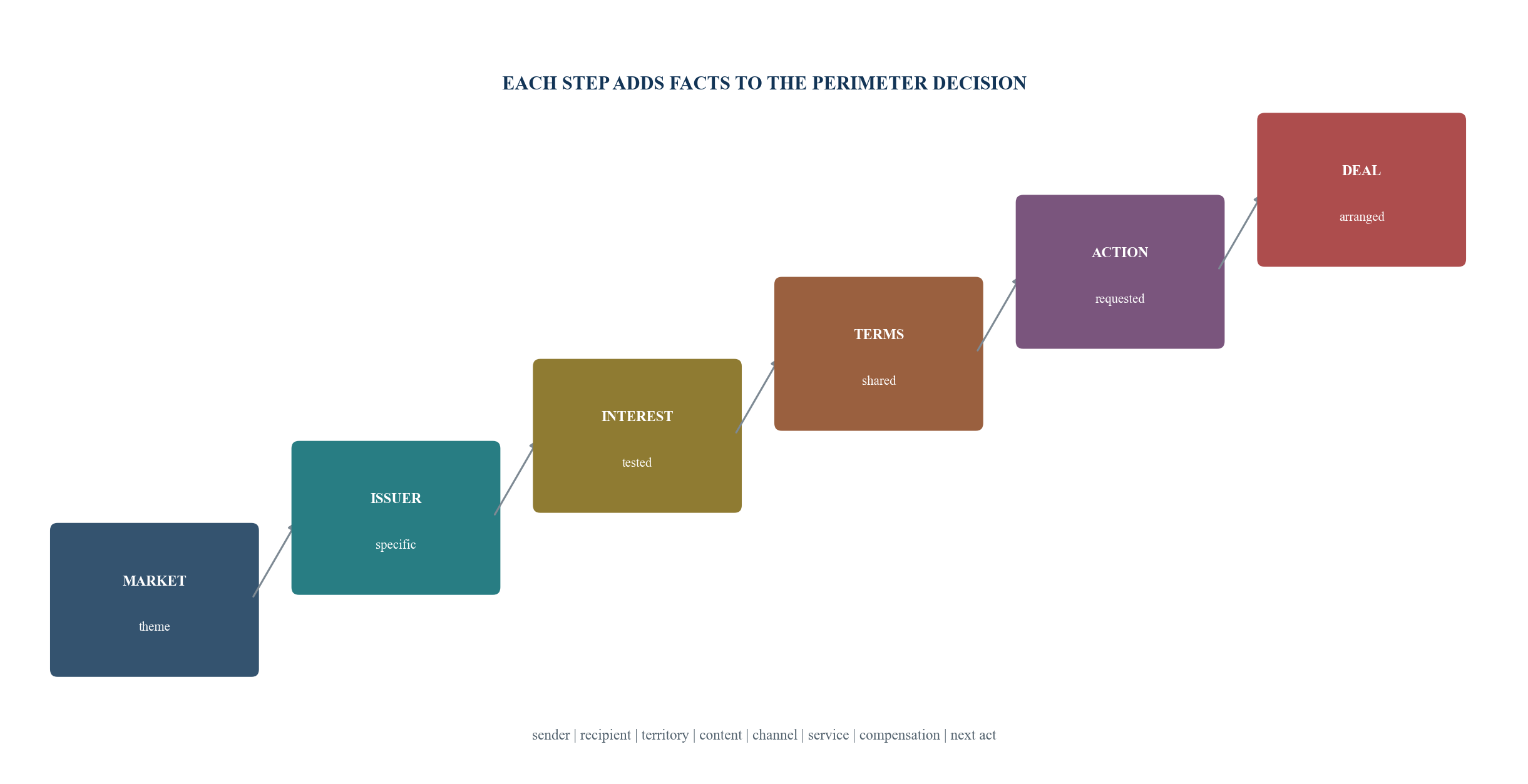
The ladder is an author framework; the legal character of each step depends on the complete facts and current law.
Table 1. Conversation-stage control record
| Stage | Observable content | Requested response | Control question |
|---|---|---|---|
| market context | sector, valuation range or market event | none or general discussion | is the content genuinely general? |
| issuer reference | named company or security | acknowledge relevance | why was this recipient selected? |
| interest test | availability, price or appetite | indicate possible interest | is this an invitation, inducement or solicitation? |
| terms | quantity, price, rights or timing | evaluate stated terms | which offering and promotion rules apply? |
| recommendation | view on merits or suitability | act on the view | is advice or a recommendation being given? |
| arrangement | introductions, negotiation or documents | enter the process | is a regulated transaction service performed? |
| execution | instruction, confirmation or settlement | commit or transfer | are permissions, custody and settlement controls complete? |
The examples are analytical prompts; they are not legal classifications.
2. Separate financial promotion from regulated service
A communication restriction and a licensing perimeter can apply through related facts, yet they answer different questions. The communication analysis asks whether an invitation, inducement, solicitation, offer, advertisement or promotion falls within a restriction. The service analysis asks whether the person is carrying on a regulated activity such as arranging, advising, dealing or broking.
The FCA's perimeter guidance explains that a communication must be an invitation or inducement to engage in investment activity for the UK financial-promotion restriction to apply. It also explains that preliminary material can become an inducement when it forms a significant step intended to persuade or incite the recipient. The same guidance discusses introductions, emails, calls, websites and the distinction between image advertising and transaction-directed content.
The SEC's broker-dealer registration guide directs attention to actual activities. It identifies solicitation, negotiation, execution, transaction-related compensation and handling funds or securities as important questions. It also states that placement agents are not exempt merely because the securities offering itself is exempt from registration.
The review should therefore produce two written conclusions. The communication conclusion identifies the lawful route for the exact message. The activity conclusion identifies the entity and permission required for the proposed conduct. Both conclusions should be approved before the message or service proceeds.
This separation also clarifies ownership. Communications, legal and compliance teams can determine the approved wording and audience. The regulated business owner can determine which entity and people may perform the service. Finance can verify that compensation follows the approved role. Operations can control access, documents and transaction steps. Each owner sees the same facts while deciding a distinct question.
The route should address changes during the engagement. A firm may begin with a fixed-fee market study and later receive a request to introduce buyers or negotiate terms. The original consulting mandate does not resolve the later activity. The change record should identify the new conduct, compensation and provider before work expands.
3. Build the territory map before relying on labels
Territory cannot be reduced to the sender's office. The recipient may be travelling, resident, incorporated or managed in another jurisdiction. A family office can have an investment committee in one country, an adviser in a second, a holding entity in a third and beneficial owners elsewhere. A message sent to one person may be intended for circulation.
The map should begin with facts that can be evidenced. It records physical location when known, ordinary business location, employing entity, recipient entity, decision-making centre, communication destination, website targeting, event venue, governing law, payment route and the location of the regulated provider.
The map should then record the plausible legal connections for review. It should avoid declaring that a single connection determines the outcome. Territorial tests differ, and cross-border rules can address conduct into, within or from a jurisdiction.
A travelling recipient creates a timing issue. The team should not assume that a stored address resolves the location of a live call or meeting. The pre-call record can ask the participant to confirm the entity represented and current location when that information matters to the approved route.
The route should also account for representatives and advisers. A message may be addressed to an external investment adviser acting for a family office, while the beneficial decision maker sits elsewhere. The reviewer should establish who is being invited or induced, who is expected to act and who will receive the material. The record should avoid treating a professional intermediary as a shield from the location and status of the intended recipient.
Language and currency can indicate targeting. Local-language copy, local telephone numbers, jurisdiction-specific tax claims and location-focused events can connect a campaign to a market. These are factual inputs for counsel rather than automatic conclusions. The campaign inventory should retain them so that the territorial analysis reflects the actual presentation.
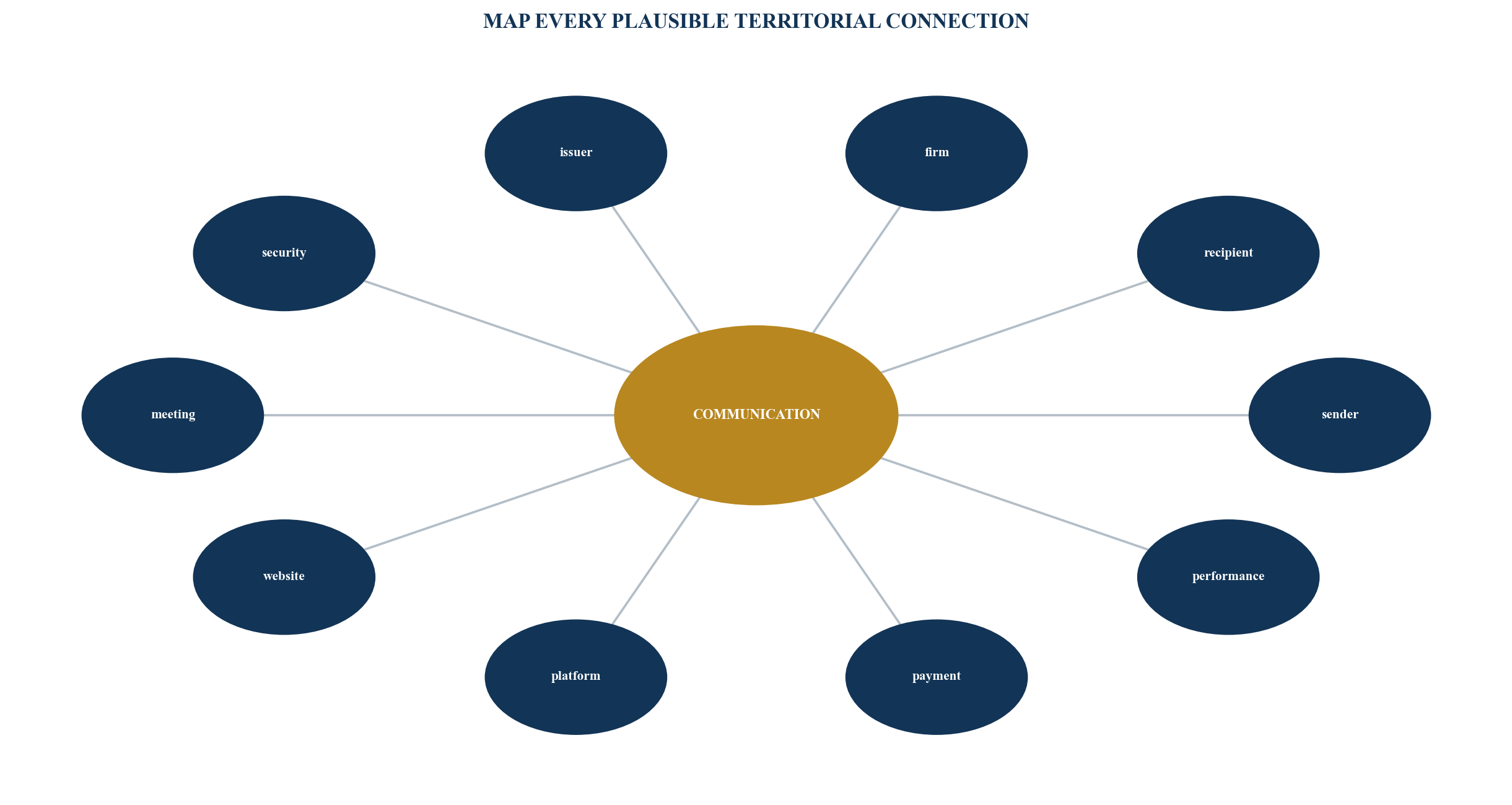
Connections identify issues for review; they do not determine jurisdiction or legal outcome by themselves.
Table 2. Territorial fact file
| Connection | Evidence | Possible change trigger | Owner |
|---|---|---|---|
| sender | employing entity, permission and physical location | travel or entity change | business owner |
| recipient | entity, role, address and current location | forwarding or committee change | relationship owner |
| issuer and security | incorporation, register and security terms | restructuring or new instrument | transaction lead |
| communication | channel, language, audience and targeting | content or distribution change | communications owner |
| meeting or event | venue, invitation list and agenda | new attendee or live deal content | event owner |
| platform or website | access controls, analytics and landing path | campaign or open access | digital owner |
| payment and performance | payer, recipient, service location and account | fee or service change | finance and legal |
Counsel should determine the legal relevance of each connection under current rules.
4. Classify the content by function, not file name
A document called a newsletter can contain a targeted invitation. A message called an introduction can contain issuer-specific terms and a requested indication. A data-room invitation can advance the recipient from curiosity to transaction participation. The review should classify content by what it communicates and what response it seeks.
The content inventory should include emails, direct messages, call scripts, decks, teasers, data-room notices, term sheets, price updates, event invitations, social posts, website pages, forms and automated follow-ups. Each item should retain its exact version and distribution list.
Four analytical fields are especially useful. Specificity records whether the content identifies a security, issuer, seller, price or quantity. Persuasion records claims, comparisons, urgency, scarcity and calls to action. Personalisation records why the recipient was selected and how the message reflects known circumstances. Transaction proximity records whether the communication can lead directly to an indication, document, negotiation, commitment or transfer.
The team should also identify statements that require support. Claims about issuer quality, valuation, liquidity, allocation, transferability, timing, investor demand or likely exit should link to dated evidence and approved wording. Unsupported urgency and scarcity can create conduct and credibility risk.
Content classification should extend to omission. A technically accurate price can mislead when the communication omits the security class, transfer restriction, fee, seller condition or absence of a liquid market. The review should ask what a reasonable recipient needs to understand the message in context under the applicable standard. Required context should remain adjacent to the claim and readable in the delivery channel.
Version control should use a content fingerprint or immutable identifier. Screenshots alone may miss linked pages, attachments or dynamic fields. The approved package should retain the rendered version, source file, links, variables and any automated personalisation. Delivery evidence can then be compared with the exact approved object.
5. Record who initiated contact and preserve the full chain
Recipient initiation can be legally relevant in some regimes. The evidence must show the request itself, its scope, timing and authenticity. A form checkbox created after outreach is weak evidence of an unsolicited enquiry.
The enquiry record should preserve the original inbound message, timestamp, channel, identity verification, subject requested and any prior communication. It should state whether the firm or an affiliate previously advertised, targeted, introduced, prompted, retargeted or discussed the product or service with the recipient.
The scope matters. A request for general information about private markets does not necessarily support sending a specific security. A request about one company does not automatically support future offers in the same sector. ESMA's published MiFID II question and answer explains that the exclusive-initiative analysis applies to the specific service or activity requested and does not become a continuing permission for future marketing.
The record should avoid the phrase reverse solicitation as a self-proving conclusion. It should present the facts for review. Counsel and compliance can then determine whether an exclusive-initiative, unsolicited-contact or other route is available under the relevant law.
Prior marketing should be searched across the group. A recipient may have seen a social campaign, event invitation, newsletter, adviser introduction or affiliate message before making the inbound request. The relationship owner's inbox alone may not reveal that history. Campaign, CRM, website, event and partner records should be searched within the relevant retention period.
The response should remain proportionate to the request. If the recipient asks for a cap-table explanation, sending available blocks, pricing and a subscription process may exceed the requested scope. A controlled response can answer the question and ask whether the recipient wishes to request further specified information through the approved route.
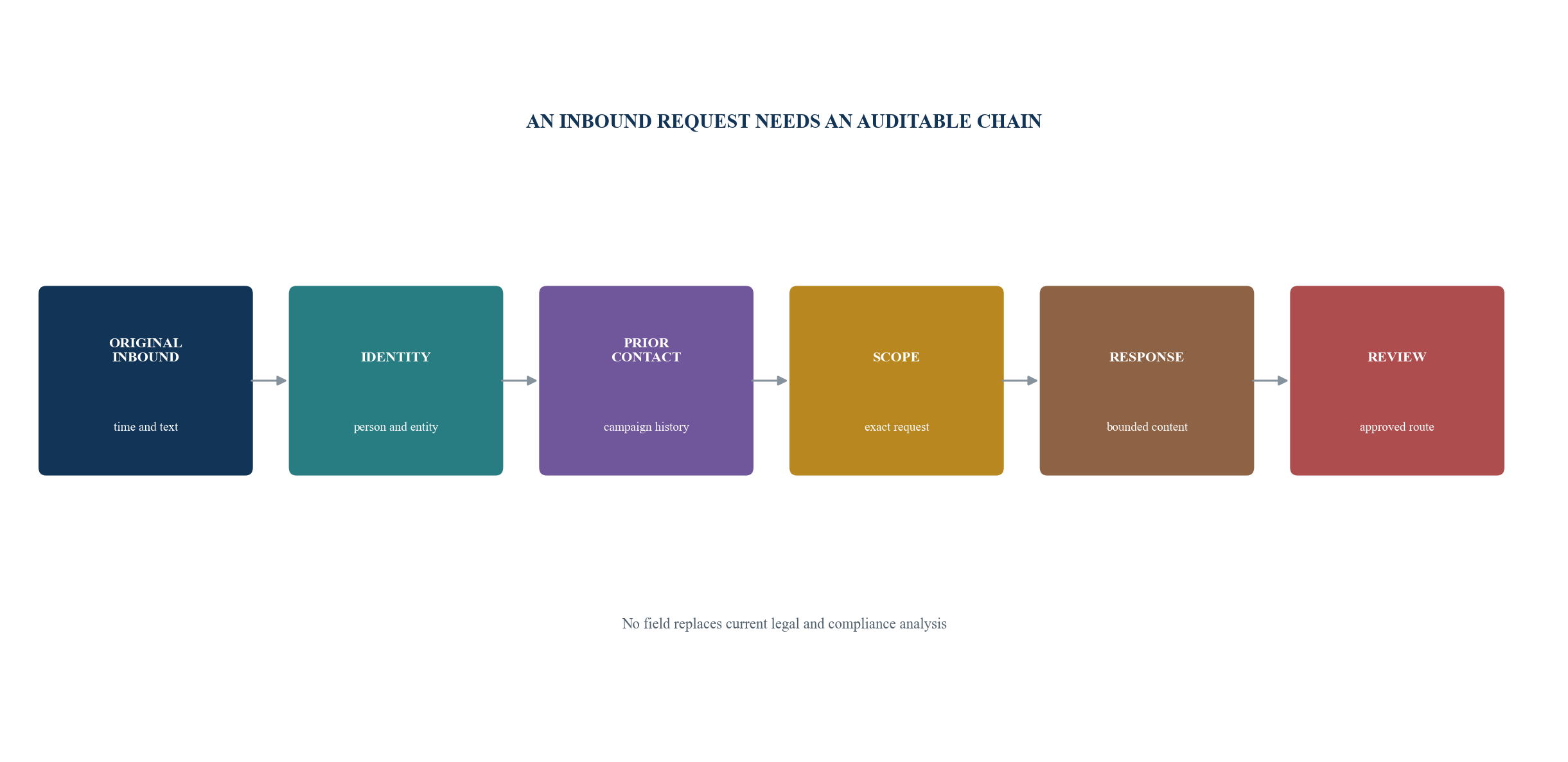
Evidence quality supports review; it does not create an exemption where the applicable conditions are absent.
Table 3. Initiation-evidence standard
| Evidence | Stronger record | Weaker record | Required follow-up |
|---|---|---|---|
| original request | retained inbound text with timestamp | reconstructed note | obtain and preserve source |
| identity | verified person, entity and authority | email address only | complete identity checks |
| prior contact | channel history searched | employee recollection | search systems and affiliates |
| scope | named service or security requested | broad market interest | bound the response |
| location | confirmed for relevant interaction | CRM address assumed | confirm when material |
| response | matches approved scope | unrelated products added | obtain fresh review |
| duration | current request and response | indefinite reliance | set expiry and refresh trigger |
The strength ratings are an author framework for internal triage.
6. Distinguish an introduction from persuasion and arrangement
An introduction can range from providing contact details to actively presenting a transaction and participating in negotiation. The facts after the introduction matter. The introducer may select recipients, describe merits, relay terms, answer objections, organise calls, transmit indications, negotiate price or receive a transaction-linked fee.
The activity map should assign every action to a legal entity and natural person. It should state what that actor may do, must not do and must escalate. A referral agreement should not authorise conduct outside the permitted role.
The FCA perimeter guidance notes that introductions can take many forms and can be inducements where the introducer actively seeks to persuade or incite. The SEC guide identifies finders, referrals, private-placement activity, solicitation, negotiation and transaction-related compensation as facts relevant to broker analysis.
The control should be behavioural. Scripts, training, system permissions, supervision and compensation should align with the approved role. A written restriction has little operational value when the introducer receives deal materials and is rewarded for advancing the investor to close.
Supervision should sample real conversations. Keyword scans can identify price, allocation, return, guarantee, urgency and instruction language, though human review remains necessary. The sample should connect messages to call notes, meetings, data-room access and compensation. A fragmented review can miss a sequence that collectively advances the transaction.
Introducer monitoring should include rejected activity. The firm should record when an introducer attempted to answer merits questions, relay negotiations or distribute materials outside the approved population. Corrective action, training and contract enforcement should follow a defined escalation standard.
7. Map the recipient category with evidence and expiry
Recipient categories can affect available routes, disclosures and protections. The names and thresholds differ among jurisdictions. The record should use the precise category under the relevant rule and preserve evidence supporting it.
A self-certification can be one part of the file where permitted. Entity documents, regulatory status, financial statements, investment portfolio evidence, professional role or third-party confirmation may also be relevant. The exact evidence depends on the applicable regime and route.
Categories can expire or change. Financial measures become stale. A person's role can change. A regulated entity can lose or vary a permission. The system should record an as-of date, evidence source, reviewer and refresh trigger.
Category evidence and commercial profiling should remain distinct. A recipient can meet a legal category and still fall outside the product's intended audience or internal risk appetite. Conversely, a commercially attractive family office cannot be assigned a regulatory category without the required evidence. The decision record should show both assessments separately.
The recipient entity also matters for committees. An employee may correspond from a personal address or serve several vehicles. The team should confirm which entity is evaluating the opportunity, who has authority to act and which vehicle would transact. A classification for one entity should not automatically transfer to another.
The communication approval should identify the recipient category it relies upon. Forwarding can break the route. Materials should state the approved audience and include a control for onward distribution, while recognising that wording alone does not control actual circulation.
8. Govern websites, social media and digital funnels as connected journeys
A public webpage has a potentially wide audience. The FCA's internet guidance states that the test for a website is the same as for other media and focuses on whether content invites or induces investment activity. SEC staff material on foreign broker-dealers notes that a securities firm's website is typically a solicitation for the relevant Rule 15a-6 analysis.
The digital review should trace the entire journey. An educational article can link to an issuer page. The issuer page can link to an availability form. The form can trigger a message with terms. Retargeting can send the user back to the offer. Evaluating one page in isolation can miss the intended chain.
Access controls should match the approved route. Options include public educational content, jurisdiction gating, recipient classification, identity verification, permissioned rooms, document-level restrictions and human approval before issuer-specific materials are released. Technical gating needs regular testing.
Analytics should support governance. The team can record source campaign, user-declared jurisdiction, blocked access, forwarded link, unusual download and conversion to a human conversation. Privacy and data-protection requirements apply to the design and use of this information.
Testing should include failure modes. A user can disable cookies, use a virtual private network, open a forwarded link, misstate location or move between devices. The control architecture should identify which assertions require independent evidence and which risks require a human gate. It should also define the response when signals conflict.
Automated content generation and personalisation require bounded inputs and output review. A system that inserts issuer, price, recipient or jurisdiction fields can create a new communication even when the base template was approved. The stored delivery version should include every populated field and the approval that covered those variables.
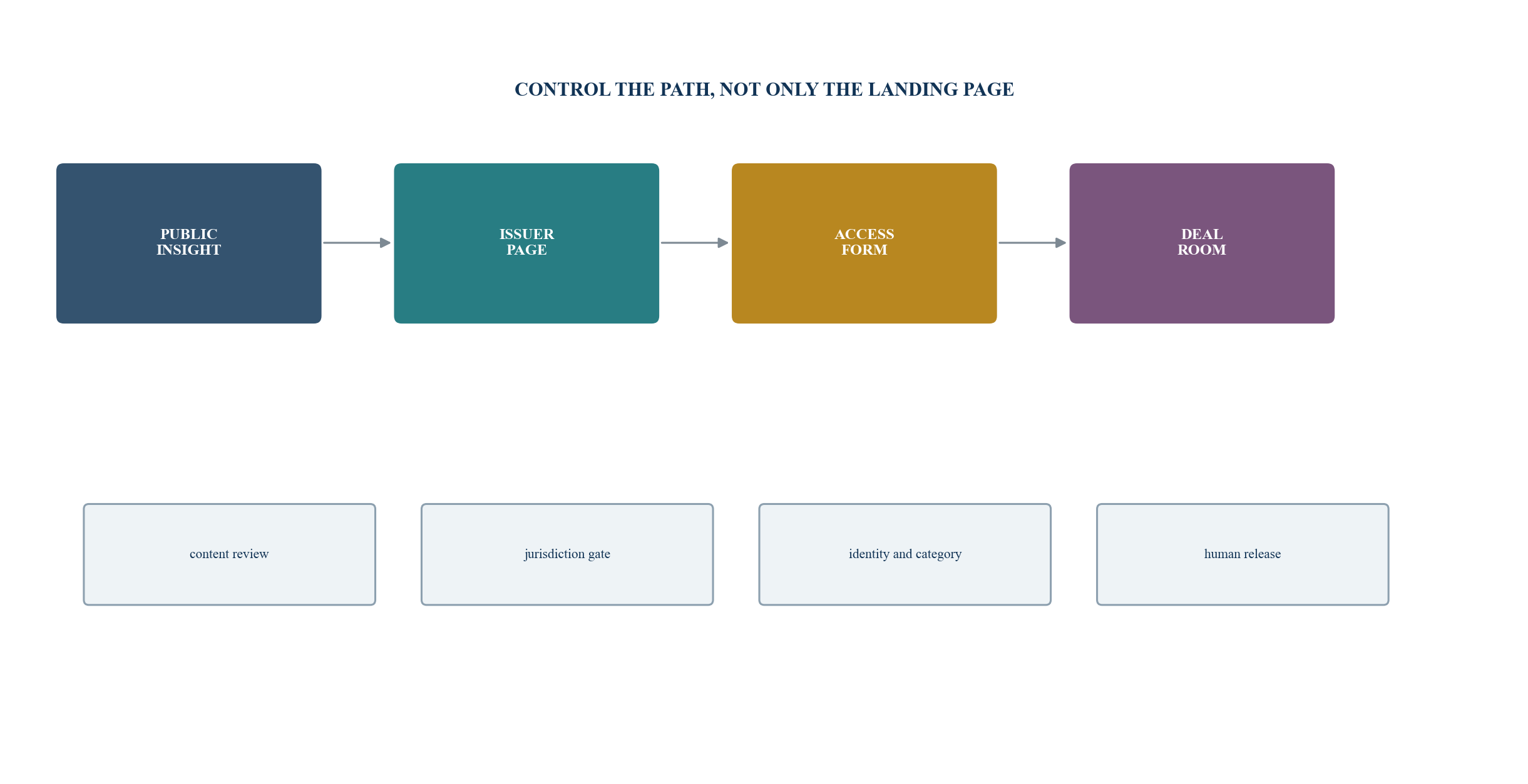
Controls should be designed for the complete journey and tested against actual user paths.
Table 4. Digital-channel controls
| Journey point | Risk event | Preventive control | Evidence |
|---|---|---|---|
| public insight | issuer-specific call to action appears | editorial and perimeter review | approved version and links |
| campaign | unapproved territory targeted | audience and geography approval | campaign configuration |
| issuer page | terms visible to open audience | access rule and content classification | page state and test result |
| form | self-declaration accepted without review | identity and category workflow | input, checks and reviewer |
| data room | link forwarded | named access and anomaly alert | user and download log |
| follow-up | automation sends new opportunity | human approval and scope rule | message and authorisation |
| analytics | data reused beyond stated purpose | privacy control and retention | processing record |
Control design should be adapted to current permissions, privacy requirements and technical architecture.
9. Create a jurisdiction route sheet for each campaign or deal
The route sheet converts legal analysis into executable instructions. It identifies the sender entity, authorised partner where relevant, approved recipient population, permissible content, required legends, approval owner, delivery channel, evidence and prohibited actions.
The US route should address the offer exemption and intermediary perimeter separately. SEC guidance states that a Regulation D or other exempt offering does not itself exempt a placement agent from broker-dealer registration. Rule 506(b) generally does not permit general solicitation. Rule 506(c) has its own conditions, including accredited-investor verification.
The UK route should address section 21 of the Financial Services and Markets Act framework, the invitation-or-inducement analysis, authorised approval where relevant, and any precisely applicable Financial Promotion Order exemption. The FCA's rules for promotions involving overseas persons and its perimeter guidance should be checked in their current form.
The DIFC route should address the DFSA financial-services and financial-promotions prohibitions. DFSA public guidance describes financial promotion broadly across written, verbal and digital communications, including calls and meetings. The ADGM route should use the current Financial Services and Markets Regulations and FSRA rulebooks, permissions and guidance.
The EU, Australia and other relevant routes require their own current analysis. ESMA's MiFID II materials constrain reliance on client exclusive initiative. ASIC states that carrying on a financial-services business in Australia generally requires an Australian financial services licence unless relief or an exemption applies, and it maintains current guidance for foreign providers.
Each route sheet should cite the effective source and advice on which it relies. It should identify open questions rather than converting ambiguity into permission. The owner should refresh the route after a rule change, regulator communication, new product, new recipient type, enforcement development or change in the firm's permission.
The sheet should also specify the evidence required after delivery. Some routes can depend on recipient status, required wording, verification, authorised approval or limits on onward circulation. The file should show that the condition was satisfied for the actual communication, not merely described in policy.
10. Link communication permission to the entity that performs the work
A group can contain advisory, consulting, holding and regulated entities. A communication sent under one brand can create ambiguity about the legal sender and service provider. The route sheet should identify the contracting entity, communicator, regulated entity, supervising principal, fee recipient and data controller.
Entity names should appear consistently across email domains, signatures, decks, terms, data rooms, mandates, invoices and settlement records. A group disclaimer should not obscure which entity is responsible for the communication or service.
Delegation needs evidence. If an authorised firm approves a promotion, introduces a communication or supervises activity, the file should retain the agreement, scope, version approval, audience, conditions and monitoring. The operating team should know when a change requires renewed approval.
Compensation should follow the approved structure. Transaction-linked payments to an entity or person outside the permitted arrangement can alter the perimeter analysis and create conflicts. Finance should block payment where the legal recipient, authority, calculation or service evidence is incomplete.
Intercompany arrangements need the same precision as external mandates. The group should record which entity supplies staff, intellectual property, introductions, regulated services and administrative support. Transfer pricing, invoicing and cost sharing do not replace the regulatory analysis. The service description used for payment should match the activity actually performed.
Brand governance should include representatives' social profiles and event biographies. A person can appear to speak for a regulated or licensed entity when the underlying appointment does not cover the communication. Approved titles, entity disclosures and contact routes should be maintained centrally and tested in market-facing channels.
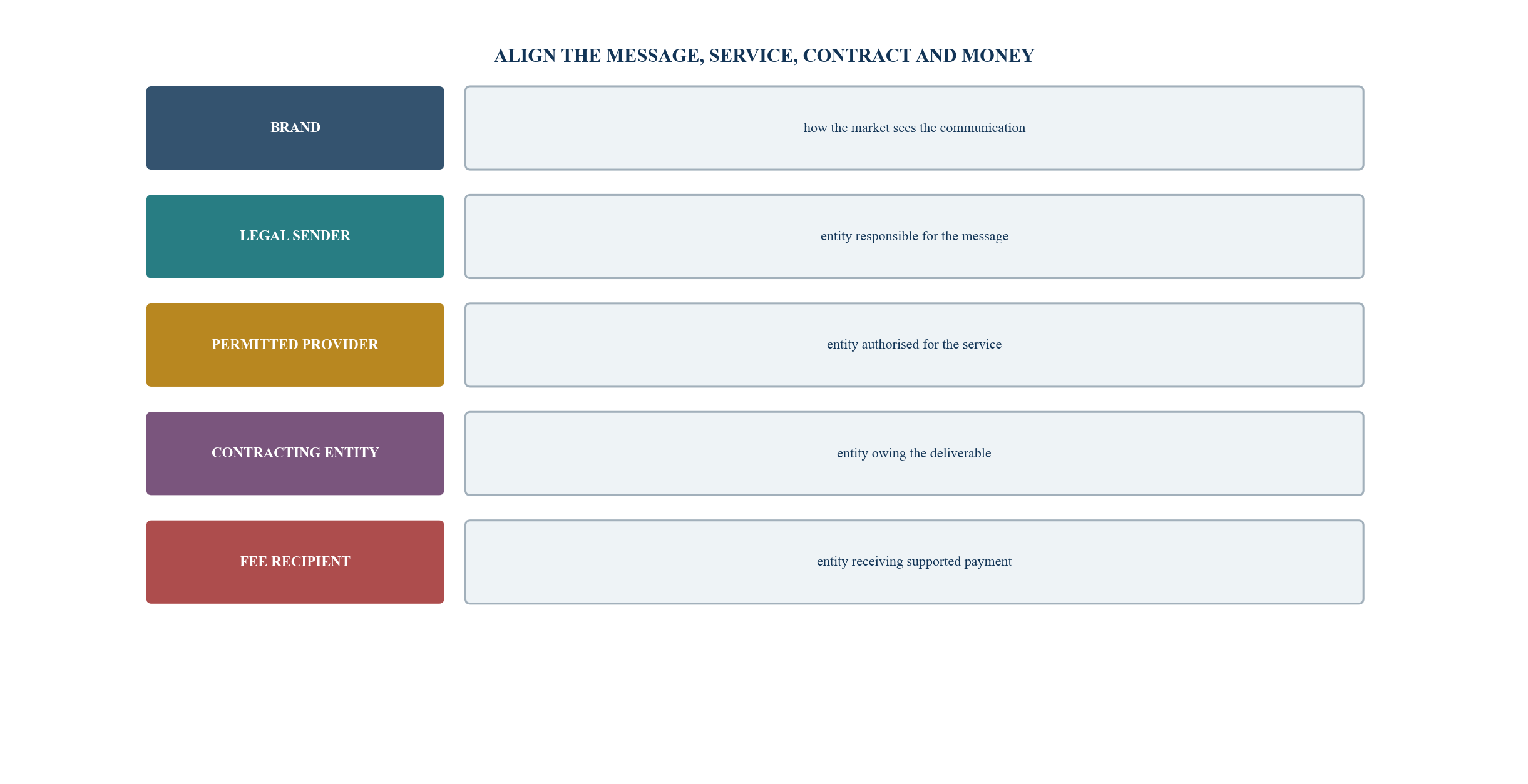
The architecture is illustrative; actual responsibilities require current legal and regulatory confirmation.
Table 5. Entity and permission record
| Field | Required evidence | Gate |
|---|---|---|
| legal sender | entity name and communication authority | sender approved |
| natural person | employment or representative status | individual within scope |
| approved content | final version and conditions | exact version released |
| recipient route | jurisdiction and category evidence | audience approved |
| service provider | permission, exemption or partner route | activity within scope |
| contract | executed mandate and responsibility map | service matched to provider |
| compensation | payer, recipient, basis and authority | payment matched to lawful role |
| supervision | reviewer, monitoring and escalation | owner accepts responsibility |
The gate requires documentary evidence and current professional review.
11. Use a communication decision record before every material release
The record should be short enough to operate and detailed enough to audit. It should capture the exact version, sender, recipients, territories, content classification, proposed activity, route, evidence, required wording, restrictions, approvers and expiry.
Approval should apply to a bounded population and period. A material change in security, price, terms, audience, channel, sender, service or compensation should reopen the decision. The system should prevent employees from treating one approval as a reusable licence for unrelated deals.
The reviewer should be able to return one of four outcomes: approved as submitted; approved with stated conditions; legal or compliance review required; or stop. Conditions should be machine-readable where possible so that workflow rules can enforce them.
The record should link to delivery evidence. The final email, post, page, call script or data-room package must match the approved version. Distribution logs should show who received it and when.
Exceptions need a reasoned trail. An approval with conditions should identify who must verify each condition, the evidence expected and whether the system blocks delivery until completion. A free-text note stating that compliance was consulted provides limited assurance when the decision, scope and conditions cannot be reconstructed.
The review service level should reflect risk and commercial timing. Pre-approved educational modules can move through a lighter check within their defined boundaries. Issuer-specific terms, new jurisdictions, new representatives or new compensation should receive enhanced review. The distinction should be embedded in the workflow rather than left to individual urgency.
12. Define stop triggers that override commercial urgency
Some facts require the team to pause before further communication. Examples include an unknown recipient location, unverified recipient category, unapproved sender, transaction-linked compensation outside the approved structure, a request to conceal the real issuer or intermediary, unsupported valuation claims, an onward-distribution warning, and a change from general content to specific terms.
A request from a senior person should not bypass the gate. The escalation should record the issue, commercial deadline, decision owner and required evidence. The transaction can proceed only through an approved route.
The stop list should include funds and securities. A person who begins to receive, control or transmit client money, settlement instructions or securities creates materially different risk. The matter should move to authorised providers and controlled settlement arrangements.
The team should also stop when the jurisdiction analysis is stale. Rules, exemptions, guidance and permissions change. A route sheet should have an effective date and refresh owner.
Escalation should preserve the proposed next act. The reviewer needs the exact message, call, document or system action that is waiting. Broad requests to approve the deal invite an overbroad response. A narrow decision enables the business to proceed through controlled steps and reopen the analysis when facts change.
Management reporting should count stop events, reasons, resolution time and repeat actors. A high stop rate can indicate poor training, unclear routes or incentives that reward progression before approval. A low stop rate can also require investigation when the business runs a high volume of complex cross-border activity.
13. Test the system with realistic conversation scenarios
Testing should use actual channels and plausible sequences. One scenario can begin with a public thought-leadership post, continue through a direct message, move to a call and end with a data-room request. Another can begin with an inbound enquiry from a professional investor whose team sits in several countries.
The test should ask whether each transition creates a new classification or approval requirement. It should also test forwarding, traveller location, a changed issuer, a new fee arrangement, a recipient who fails classification, and an automated follow-up that exceeds the approved scope.
Results should distinguish control design from operating performance. A policy can state the right rule while staff use unapproved templates. A system can contain a gate while administrators can override it without evidence. Both issues require remediation.
The test population should include successful and blocked communications. A log containing only approved messages cannot show whether the system detects high-risk cases.
Independent replay can strengthen the test. A reviewer who did not approve the original communication reconstructs the outcome from retained evidence. Any fact that cannot be recovered becomes an evidence gap. Differences between the original and replayed decision identify ambiguous policy, missing data or inconsistent judgement.
Testing should produce owners and deadlines. Critical issues can require immediate suspension of a route. Significant issues can require template, system or supervision changes. Lower-risk observations can inform training and periodic improvement. Closure requires evidence that the control changed and a repeat test passed.
14. Score readiness while preserving legal judgement
A readiness score can organise remediation across territory, identity, initiation, content, role, permission, approval, delivery and evidence. Critical failures remain binary. An unapproved regulated activity or unlawful promotion cannot be averaged away by strong recordkeeping elsewhere.
Weights should reflect the business model. A public platform may place greater weight on digital access and targeting. A relationship-led placement business may place greater weight on initiation, recipient category, representative conduct and compensation.
Evidence has an age. The score should record the source date and next refresh. Current permission, recipient classification and jurisdiction route deserve explicit expiry rules.
Management should see the underlying exceptions. A single aggregate score can conceal the precise message, territory or actor that requires action.
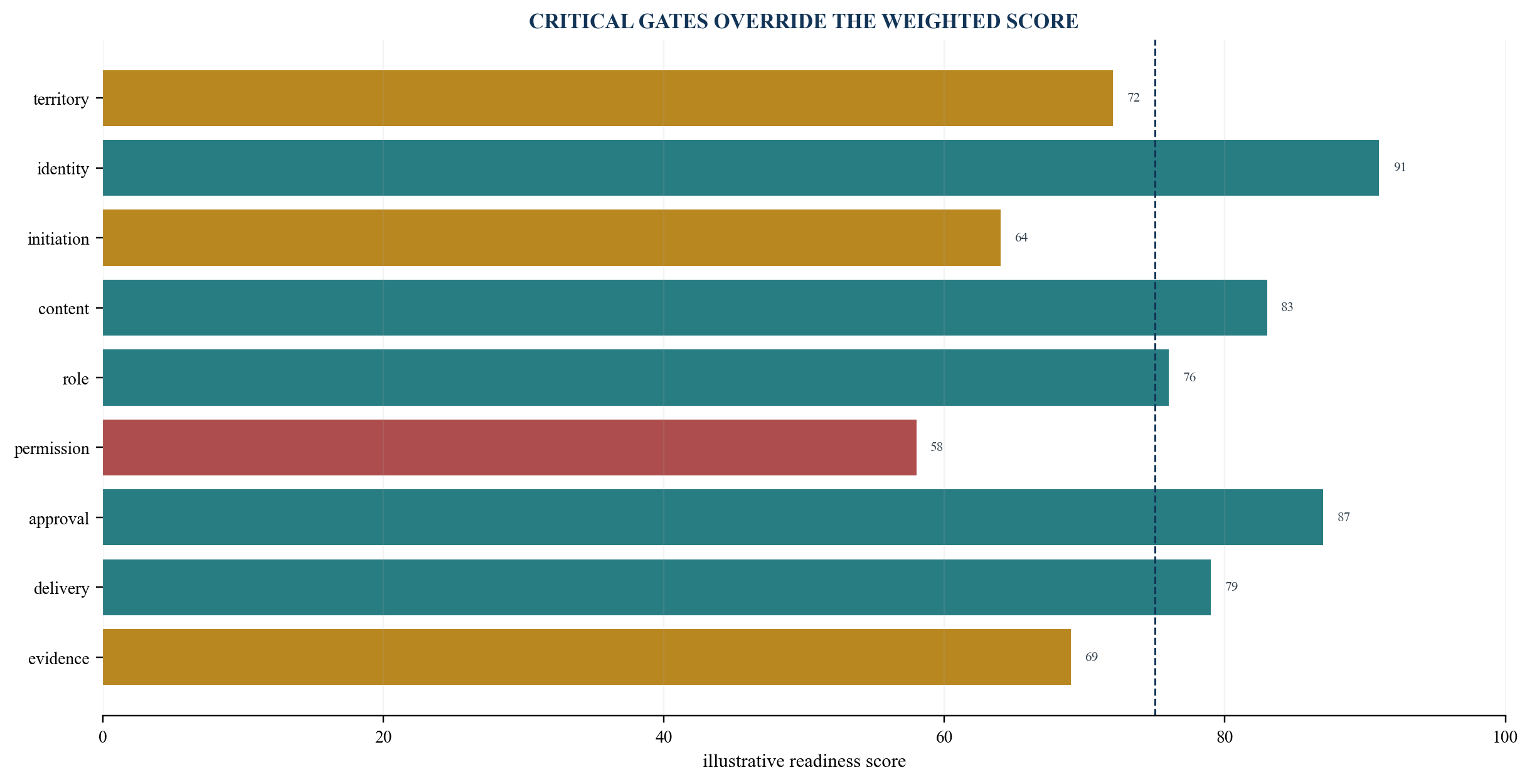
Weights and scores are management assumptions; critical legal and permission gates remain binary.
Table 6. Readiness scorecard and critical gates
| Module | Weight | Illustrative score | Open issue | Critical gate |
|---|---|---|---|---|
| territory | 12% | 72 | travelling recipient | relevant locations confirmed |
| identity and category | 11% | 91 | none material | evidence current |
| initiation | 12% | 64 | prior campaign unresolved | full chain preserved |
| content | 12% | 83 | one claim requires source | version approved |
| role and conduct | 13% | 76 | negotiation boundary unclear | each actor within scope |
| permission route | 15% | 58 | partner approval pending | lawful route confirmed |
| communication approval | 10% | 87 | none material | conditions embedded |
| delivery control | 7% | 79 | forwarding alert untested | audience bounded |
| evidence and refresh | 8% | 69 | route sheet near expiry | record current |
Illustrative scores do not replace a legal, regulatory or compliance decision.
15. Run a ten-day solicitation diagnostic
Days one and two inventory entities, permissions, jurisdictions, campaigns, websites, templates, representatives, compensation and active opportunities. The team identifies every channel that can progress a recipient toward a transaction.
Days three and four sample live conversation chains from first contact through the current stage. The review reconstructs sender, recipient, territory, initiation, content, service and next action.
Days five and six compare those facts with current jurisdiction route sheets and legal advice. The team identifies missing permissions, unsupported exemptions, stale categories and uncontrolled digital journeys.
Days seven and eight design the conversation ladder, decision record, stop triggers, escalation and evidence model. Representative scenarios pass user testing.
Days nine and ten deliver the risk map, remediation priorities, operating instructions and implementation plan. Issues lacking sufficient evidence remain open.
16. Operate a thirty-day cross-border communications office
Days one to five establish the governed population of entities, people, jurisdictions, channels and transaction types. The office freezes unapproved issuer-specific templates while the review proceeds.
Days six to ten create the content taxonomy, territory fact file, initiation record and recipient classification standard. Current counsel and compliance determine the applicable legal routes.
Days eleven to fifteen build jurisdiction route sheets, entity-role mappings, partner approvals and compensation controls. Business owners accept the permitted and prohibited actions.
Days sixteen to twenty implement communication approvals, access gates, version control, delivery logging and change triggers. The office tests websites, social funnels, email and messaging paths.
Days twenty-one to twenty-five remediate active opportunities and historic gaps according to severity. Required notices, approvals or route changes are handled by qualified advisers and authorised providers.
Days twenty-six to thirty establish supervision, training, monitoring, exception reporting and periodic refresh. The governing owner accepts the operating standard and unresolved risk.
17. Measure commercial outcomes with collected-fee evidence
Quality measures include complete territory records, current recipient evidence, documented initiation, approved versions, lawful service routes, compliant compensation, delivery evidence and timely escalation. Cycle measures include hours to classify a communication, days to obtain route approval and time to clear an exception.
Commercial measures include paid diagnostics, signed retainers, active implementation offices, completed transactions, invoices, collections and repeat mandates. Forecasts and pipeline remain management estimates until supported by the relevant evidence. Collected fees require cleared bank evidence and accounting reconciliation.
The service can be packaged as a cross-border solicitation diagnostic, communication inventory, jurisdiction route-sheet build, digital-funnel review, representative-control programme, transaction-specific approval office or thirty-day implementation. Reserved legal, regulatory, brokerage, investment, tax, accounting and compliance work should remain with appropriately qualified and authorised providers.
The operating proposition should be validated through signed and paid mandates. Management can track which pain point produced a paid diagnostic, which diagnostic produced a retainer, and which retainer produced a controlled transaction or recurring programme.
Contribution should be measured after specialist, technology, compliance and delivery costs. Gross contracted fees, invoiced fees and collected cash should remain separate states.
18. Conclusion
A cross-border pre-IPO conversation becomes governable when its progression is visible. The record connects the original contact to the precise content, recipient, location, sender, role, permission, compensation and next act.
The framework separates communication restrictions from regulated services, replaces broad recipient labels with evidence, treats digital journeys as connected systems and turns legal advice into bounded operational routes. Critical changes reopen the decision before the conversation advances.
The practical standard is concise: record the facts, classify the next act, confirm the route and preserve the evidence before proceeding.
References
- US Securities and Exchange Commission. Guide to Broker-Dealer Registration. https://www.sec.gov/about/divisions-offices/division-trading-markets/division-trading-markets-compliance-guides/guide-broker-dealer-registration
- US Securities and Exchange Commission. Broker-Dealers: Foreign Broker-Dealers and Rule 15a-6 Materials. https://www.sec.gov/about/divisions-offices/division-trading-markets/broker-dealers
- US Securities and Exchange Commission. Frequently Asked Questions Regarding Rule 15a-6 and Foreign Broker-Dealers. https://www.sec.gov/rules-regulations/staff-guidance/trading-markets-frequently-asked-questions/divisionsmarketregfaq-2
- US Securities and Exchange Commission. General Solicitation. https://www.sec.gov/resources-small-businesses/capital-raising-building-blocks/general-solicitation
- US Securities and Exchange Commission. Private Placements: Rule 506(b). https://www.sec.gov/resources-small-businesses/exempt-offerings/private-placements-rule-506b
- Financial Conduct Authority. PERG 8: Financial Promotion and Related Activities. https://handbook.fca.org.uk/handbook/perg8
- Financial Conduct Authority. PERG 8.22: The Internet. https://handbook.fca.org.uk/handbook/perg8/perg8s23
- Financial Conduct Authority. COBS 4.9: Financial Promotions with an Overseas Element. https://handbook.fca.org.uk/handbook/COBS/4/9.html
- Dubai Financial Services Authority. A Guide to the DIFC Financial Promotions Prohibition. https://www.dfsa.ae/your-resources/publications-reports/DFSA-Leaflets/dfsas-innovation-programme-2
- Dubai Financial Services Authority. Unauthorised Business in the DIFC. https://www.dfsa.ae/alerts/unauthorised-business-difc
- Abu Dhabi Global Market Financial Services Regulatory Authority. Getting Started Guide. https://assets.adgm.com/download/assets/Getting%2BStarted%2BGuide%2Bwith%2BFSRA.pdf/a8c5b07a589a11efa1111ed8b674bcd6
- European Securities and Markets Authority. MiFID II Q&A: Third-Country Firms Marketing Directly and Exclusive Initiative. https://www.esma.europa.eu/publications-data/questions-answers/1865
- European Securities and Markets Authority. Statement on Reverse Solicitation. https://www.esma.europa.eu/sites/default/files/library/esma35-43-2509_statement_on_reverse_solicitation.pdf
- Australian Securities and Investments Commission. Foreign Financial Services Providers: Licensing Relief. https://www.asic.gov.au/for-finance-professionals/afs-licensees/applying-for-and-managing-an-afs-licence/licensing-certain-service-providers/foreign-financial-services-providers-licensing-relief/
- Australian Securities and Investments Commission. RG 121: Doing Financial Services Business in Australia. https://asic.gov.au/regulatory-resources/find-a-document/regulatory-guides/rg-121-doing-financial-services-business-in-australia/
About the Author
Chennakeshav Adya, Independent Researcher
