

1. The lending decision begins with recoverable value
Accelerator-backed lending has moved from an unusual equipment-finance question to a recurring capital-allocation problem. AI cloud operators, data-centre developers and enterprises can commit large sums to processors, servers, networking and cooling before the related capacity produces stable cash flow. The credit decision is therefore specific: how much can a lender advance against an installed or deliverable compute pool while preserving repayment capacity through utilisation volatility, customer concentration, hardware refresh and enforcement delay?
The purchase invoice does not answer that question. Recoverable value depends on verified title, serial-level identity, physical location, configuration, condition, software and support rights, export-control status, customer commitments, redeployment cost and a credible market for the equipment. This paper develops a borrowing-base framework that translates those variables into eligibility, haircuts, advance rates and reserves. It treats operating cash flow as the principal repayment source and collateral proceeds as a controlled secondary source.
2. Define the collateral perimeter precisely
The phrase compute hardware can cover bare accelerator cards, complete servers, racks, networking, storage, power-distribution units, cooling equipment, spares and construction in progress. These assets differ materially in portability, marketability and dependence on the surrounding facility. A card that can be removed, tested and redeployed may have a broader buyer set than a proprietary liquid-cooled rack whose value relies on matched networking, firmware and site infrastructure.
The collateral schedule should identify each asset by manufacturer, model, serial number, owner, invoice, delivery date, commissioning date, data-centre address, rack position, configuration, warranty, support status and encumbrance. It should distinguish owned equipment from leased, financed, consigned, customer-owned or vendor-retained items. The lender should also identify licences and contractual rights that affect use or resale. A precise perimeter prevents an availability calculation from including assets the borrower does not own or cannot transfer.
Table 1. Proposed accelerator-collateral eligibility matrix
| Test | Eligible evidence | Exclusion trigger | Control response |
|---|---|---|---|
| Title | Paid invoice, acceptance and serial register | Retention of title, lease or competing claim | Exclude until counsel confirms ownership |
| Identity | Serial, configuration and location reconcile | Missing, duplicated or altered identifier | Zero value pending physical verification |
| Condition | Telemetry, diagnostics and maintenance current | Failed tests, damage or unsupported state | Apply condition haircut or exclude |
| Transferability | Hardware and required rights can move | Consent, licence or export restriction blocks transfer | Jurisdiction-specific reserve or exclusion |
| Marketability | Recent independent evidence supports an exit | No tested buyer set or obsolete configuration | Use zero or deeply stressed recovery value |
Eligibility depends on transaction documents, governing law and current technical evidence.
3. Separate accounting life from economic life
Financial statements provide useful evidence about management's asset-life assumptions, although book depreciation is not liquidation value. CoreWeave reported a six-year estimated useful life for technology equipment after changing its estimate from five years in 2023 [5]. Nebius reported four years for server and network equipment at the end of 2025 and stated that it planned to extend the estimate to five years from 2026 after reviewing usage patterns and utilisation commitments [6]. These disclosures demonstrate that useful-life estimates can change as operating evidence develops.
A lender should build an independent economic-life view. The relevant period ends when net cash generation or recovery value falls below the amount required to support the facility, which can occur before or after accounting depreciation ends. The analysis should consider performance per watt, memory, interconnect, software compatibility, warranty, repairability and the economics of removing and reinstalling equipment. Book value remains a reconciliation point rather than a lending value.
4. Treat refresh risk as a curve
Technology refresh does not create one cliff date. New platforms arrive through announcement, qualification, production ramp, customer adoption and software optimisation. Older hardware can continue to serve inference, fine-tuning, scientific workloads or smaller models after leading-edge training shifts to newer accelerators. Its value can still decline rapidly if performance per unit of power, memory capacity or interconnect becomes inadequate for the available workload.
The credit model should therefore use an age-and-configuration curve rather than a uniform straight-line haircut. Each cohort should have a base recovery path, downside path and severe path. The curves should be reviewed when a successor architecture ships, major customers change specifications, export rules change, warranty ends or observed utilisation weakens. The exercise is a scenario analysis. It should not be presented as a prediction of secondary-market prices.
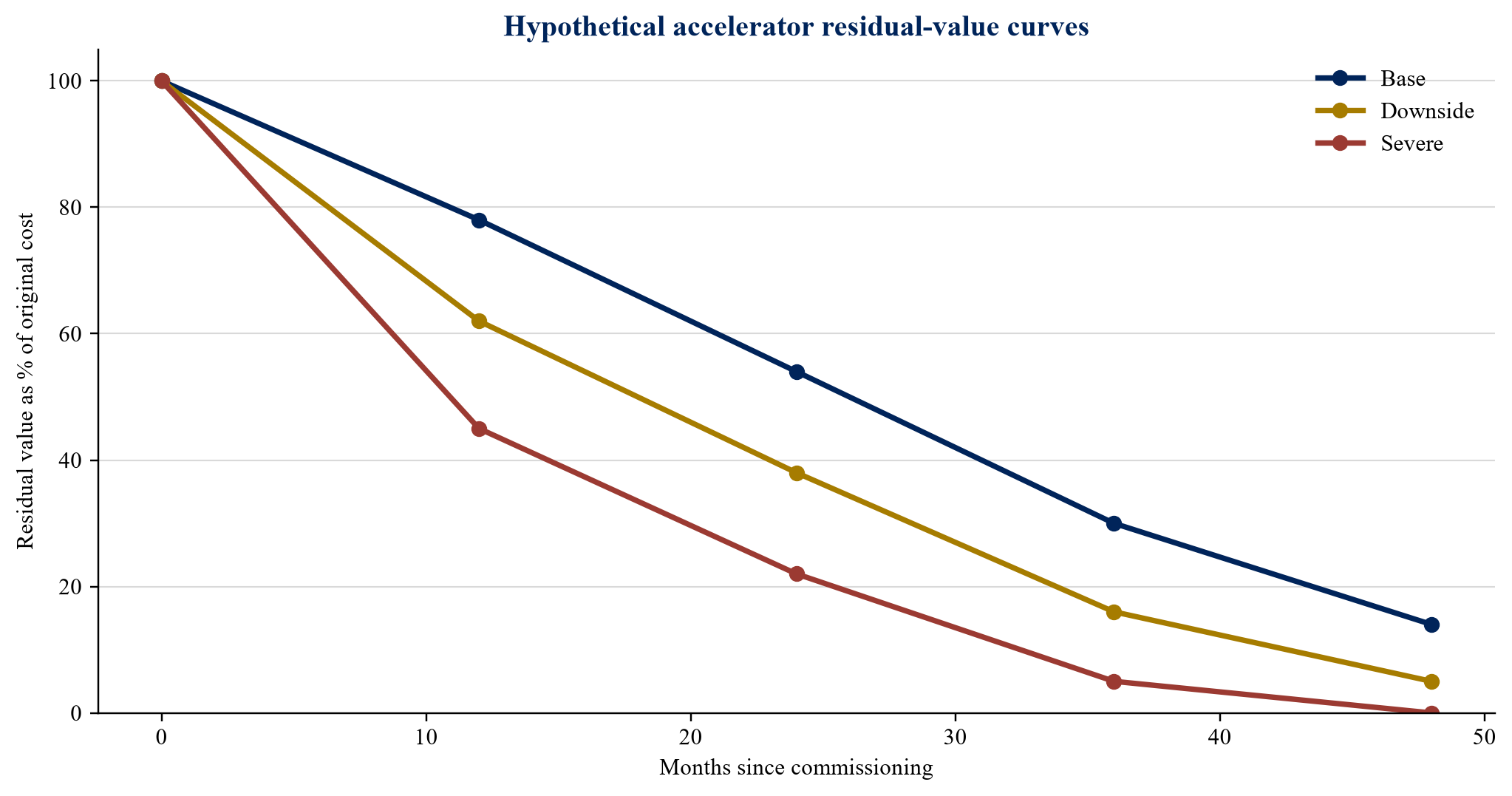
Percentages are author assumptions used only to demonstrate the framework.
5. Use the lower of three value measures
A conservative collateral value can be defined as the lowest of three measures: depreciated eligible cost, independently supported orderly-liquidation value and a stressed cash-flow-supported value. Cost is observable but may overstate recovery after shortages ease or new products arrive. Appraised value can be more current but may rely on thin market evidence. Cash-flow-supported value captures earning power while introducing customer, utilisation and operating assumptions.
Using the minimum reduces dependence on one favourable method. The lender should document the valuation date, evidence hierarchy, excluded costs and currency. Freight, import duty, configuration, software and installation can be economically necessary yet poorly recoverable in a sale. Their treatment should be explicit. If no reliable appraisal or market evidence exists, the advance should rely on a more conservative cost basis or remain unavailable until evidence improves.
6. Verify title before measuring value
Title risk can arise from unpaid vendors, retention-of-title clauses, leasing, purchase-money security interests, financing statements, warehouse claims, taxes, customs, repair liens or intercompany transfers. Hardware may also be acquired through a special-purpose entity and operated by another group company. The lender needs a chain of ownership from purchase order and invoice through payment, delivery, acceptance and current possession.
Legal counsel should search relevant registries and review the perfection steps required in every relevant jurisdiction. UCC Article 9 provides the US framework for secured transactions in personal property and filing financing statements [10]. UK company charges generally require registration at Companies House within the applicable period [11]. Other jurisdictions use different attachment, perfection and priority rules. The paper offers a control architecture and does not determine the legal outcome for any asset.
7. Make location a controlled data field
Portable assets can move, and movement can alter perfection, insurance, export-control, tax, warranty and recovery assumptions. A borrower may place equipment in its own facility, a colocation site, a customer's premises or another country. The lender should know which entity controls physical access, which contract permits removal and whether the facility operator has liens or set-off rights.
The collateral register should reconcile logical inventory to a physical site and rack map. Approved locations should be listed in the facility agreement. Movement should require notice or consent above a materiality threshold, followed by updated insurance, registry filings and export review. Automated location evidence can support monitoring, although it should not replace periodic physical verification. A serial number that exists in an enterprise system without reliable possession evidence should not support borrowing availability.
8. Link utilisation to economic support
Utilisation measures how much of installed compute capacity is doing productive work, but definitions vary. Scheduled availability, billable hours, accelerator occupancy, system model flop utilisation and customer-reserved capacity answer different questions. CoreWeave discusses system model flop utilisation in its platform benchmarking [5]. A lender should select a metric that connects operating performance to revenue and margin, then reconcile it to billing and contract data.
The borrowing base should not rise mechanically with a single utilisation percentage. High utilisation under one cancellable customer can be fragile. Low current utilisation may be acceptable during a contracted ramp if liquidity covers the interval. The model should use a trailing average, a minimum observation period and clear treatment of maintenance, outages, reserved capacity and internal workloads. Exceptions should be reviewed by credit rather than hidden through denominator choices.
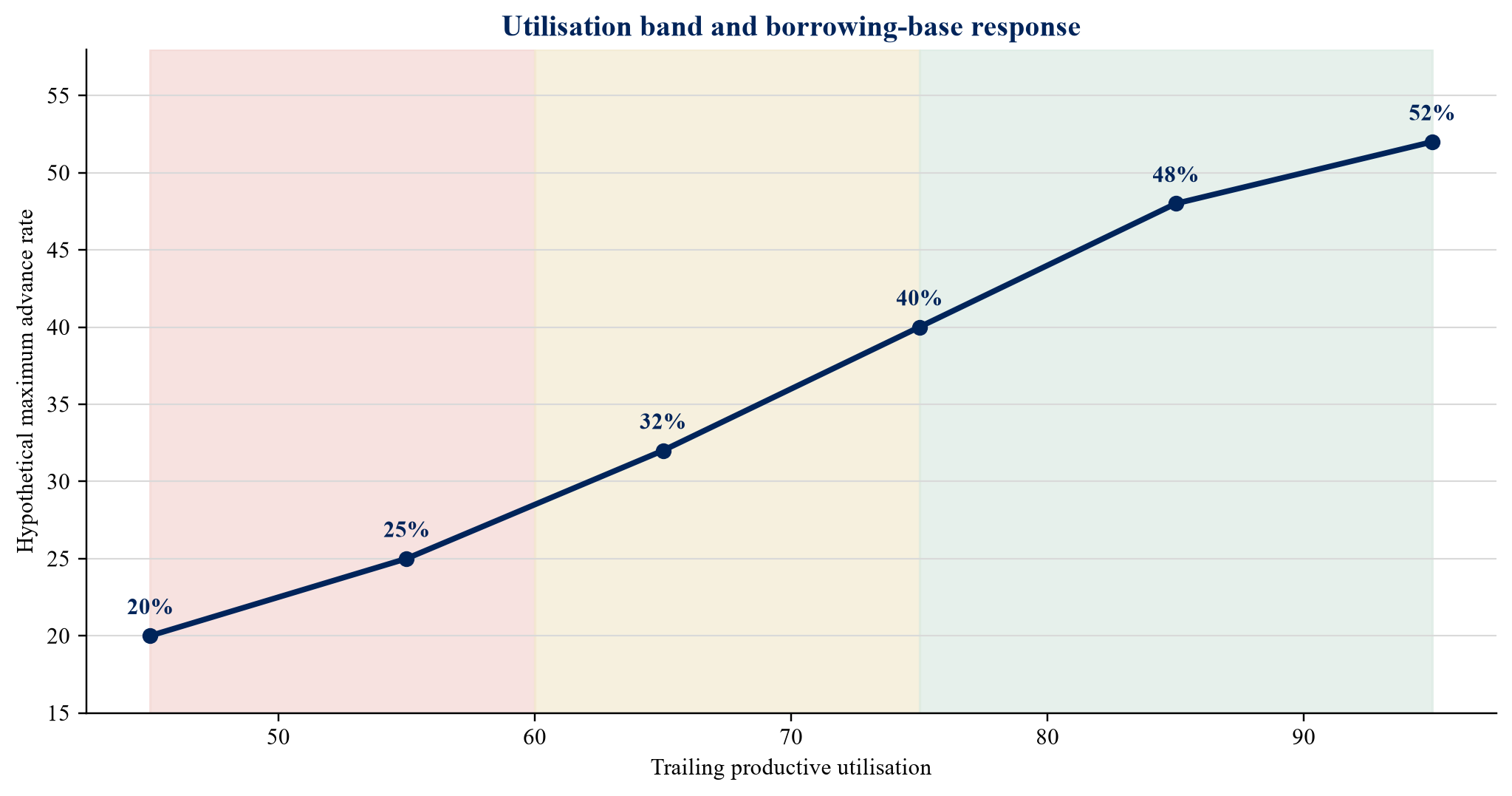
The utilisation path and advance-rate bands are author assumptions, not market observations.
9. Underwrite the revenue contract separately
A take-or-pay customer commitment can support asset-level financing when capacity, commencement, price, term, credit quality and remedies align with the debt. CoreWeave states that it finances infrastructure through asset-level debt supported by take-or-pay customer contracts and that its committed contracts had a weighted-average duration of approximately five years at 31 December 2025 [5]. That public example shows the relevance of contracts without establishing terms for another borrower.
The lender should test conditions precedent, service levels, acceptance, ramp, termination, suspension, credits, price resets, renewal and change-of-control provisions. It should confirm whether the financed equipment is dedicated to the contract and whether it can be redeployed if the customer exits. A backlog number should be reconciled to signed orders and enforceable payment obligations. A customer forecast, letter of intent or unallocated pipeline should receive different credit treatment.
10. Concentration changes both cash flow and collateral value
Customer concentration can amplify recovery risk. CoreWeave disclosed that one customer represented 67% of 2025 revenue and 68% of year-end receivables [5]. That disclosure is company-specific, yet it illustrates why a compute lender should measure exposure by customer, contract, workload and facility. A single anchor contract can improve visibility while creating a sharp refinancing and redeployment challenge if it ends.
The borrowing base can use concentration caps, contract-quality tiers or reserves. Capacity attributable to a customer above the cap can receive a lower advance rate, particularly when the equipment configuration is highly customised. The lender should also examine correlated customers, such as entities controlled by one corporate group or dependent on the same AI application. Concentration tests should reflect the real source of payment rather than legal names alone.
Table 2. Proposed concentration and utilisation controls
| Risk signal | Measurement | Availability response | Required evidence |
|---|---|---|---|
| Anchor customer | Share of contracted revenue and receivables | Cap or reserve above approved share | Contract, credit review and payment history |
| Uncontracted capacity | Share of eligible compute without firm revenue | Lower advance or zero until ramp | Pipeline conversion and liquidity plan |
| Weak utilisation | Trailing productive use below covenant band | Step-down in advance rate | Telemetry reconciled to invoices |
| Facility concentration | Eligible value at one site or power zone | Site cap and outage reserve | Access, power and insurance evidence |
| Workload concentration | Revenue dependent on one model or use case | Stress margin and redeployment period | Workload portability and customer alternatives |
Thresholds must be set for each transaction after diligence.
11. Make telemetry auditable
Operational telemetry can improve collateral monitoring by showing serial presence, temperature, error rate, uptime, workload, power use and maintenance state. The lender should define which data fields are authoritative, who controls them, how frequently they are delivered and how they reconcile to the asset register. Raw dashboards without data lineage can create an appearance of precision without reliable control.
A useful reporting pack includes a signed borrowing-base certificate, serial inventory, location changes, utilisation by cohort, downtime, failures, repairs, customer allocation, invoice reconciliation and exceptions. Data should be retained for audit. Access credentials and interfaces require cyber controls and contingency procedures. Independent field audits remain important. OCC guidance highlights verification of collateral, inventory controls, obsolete-asset identification, appraisal frequency and lien perfection in asset-based lending [1].
12. Treat power and cooling as value dependencies
An accelerator may be movable, although its productive value depends on power, cooling, networking and site access. The IEA reported that global data-centre electricity demand increased by 17% in 2025 and that AI-focused data-centre consumption increased faster [8]. It also identified grid and equipment bottlenecks. A pool of advanced hardware awaiting energisation can therefore have high invoice value and limited near-term earning capacity.
The lender should connect each hardware cohort to commissioned critical load, cooling design, network capacity and customer acceptance. Equipment delivered before the supporting facility is ready may require a delivery reserve or delayed eligibility. The structure should identify who bears storage, deterioration, warranty-start and reconfiguration risks. Hardware and facility completion schedules should sit in one integrated model.
13. Test configuration portability
Recovery value depends on what can be sold. A complete, supported configuration with matched networking and documented firmware may command a wider buyer set than incomplete units. Conversely, highly integrated rack-scale systems can incur substantial removal, packaging, transport, site-modification and recommissioning costs. The financier should not assume that component list price equals net recovery.
The technical adviser should map the bill of materials, dependencies, spare parts, supported software, interconnect and minimum saleable lot. The appraisal should state whether value assumes an in-place sale, orderly removal or forced separation. Recovery costs should include data erasure, testing, labour, freight, duties, broker fees, insurance and downtime. The borrowing base should use net proceeds after those costs.
14. Build a residual-value scenario set
The illustrative portfolio in this paper has an original equipment cost of USD 30 million across three age cohorts. The model assumes 40% of cost is less than twelve months old, 35% is between thirteen and twenty-four months old, and 25% is between twenty-five and thirty-six months old. These values and all scenario percentages are author assumptions without empirical calibration.
Base residual factors are assumed at 78%, 54% and 30% of original cost for the three cohorts. Downside factors are 62%, 38% and 16%. Severe factors are 45%, 22% and 5%. The resulting gross scenario values are USD 17.2 million, USD 12.2 million and USD 8.1 million. These outputs demonstrate sensitivity. They are not appraisals, price forecasts or evidence of financing availability.
Table 3. Hypothetical residual-value scenarios for a USD 30 million compute pool
| Age cohort | Original cost | Base residual | Downside residual | Severe residual |
|---|---|---|---|---|
| 0 to 12 months | USD 12.0m | 78% | 62% | 45% |
| 13 to 24 months | USD 10.5m | 54% | 38% | 22% |
| 25 to 36 months | USD 7.5m | 30% | 16% | 5% |
| Total value | USD 30.0m | USD 17.2m | USD 12.2m | USD 8.1m |
All portfolio amounts, ages and residual factors are author assumptions.
15. Translate value into advance rates
An advance rate should reflect the volatility and controllability of the eligible value. Newer equipment with verified title, strong condition, approved location, transferable support and contracted utilisation can support a higher rate than older, uncontracted or hard-to-move equipment. The rate should also account for appraisal frequency and the time needed to stop further draws when value deteriorates.
The hypothetical model applies advance rates of 55%, 40% and 20% to the three age cohorts under the base residual scenario. Before reserves, this produces availability of about USD 7.8 million. A lender could instead apply one rate to a stressed valuation, provided the result is at least as conservative and the mechanics are transparent. Rate grids should be approved through credit policy and changed through documented triggers.
16. Deduct reserves after cohort availability
Reserves protect against costs or risks that are real but not fully reflected in appraised value. OCC guidance describes reserves as deductions from collateral value that consider costs required to realise collateral [1]. For accelerator pools, possible reserves include removal, storage, transport, data sanitisation, taxes, unpaid vendors, concentration, uncontracted capacity, facility access, export review, maintenance and appraisal staleness.
The hypothetical waterfall starts with USD 7.8 million of cohort availability and deducts USD 0.7 million for customer concentration, USD 0.5 million for removal and remarketing, USD 0.4 million for location and export-control exposure, and USD 0.3 million for reporting or appraisal staleness. Net availability is therefore USD 5.9 million. Each reserve amount is an author assumption used to illustrate mechanics.
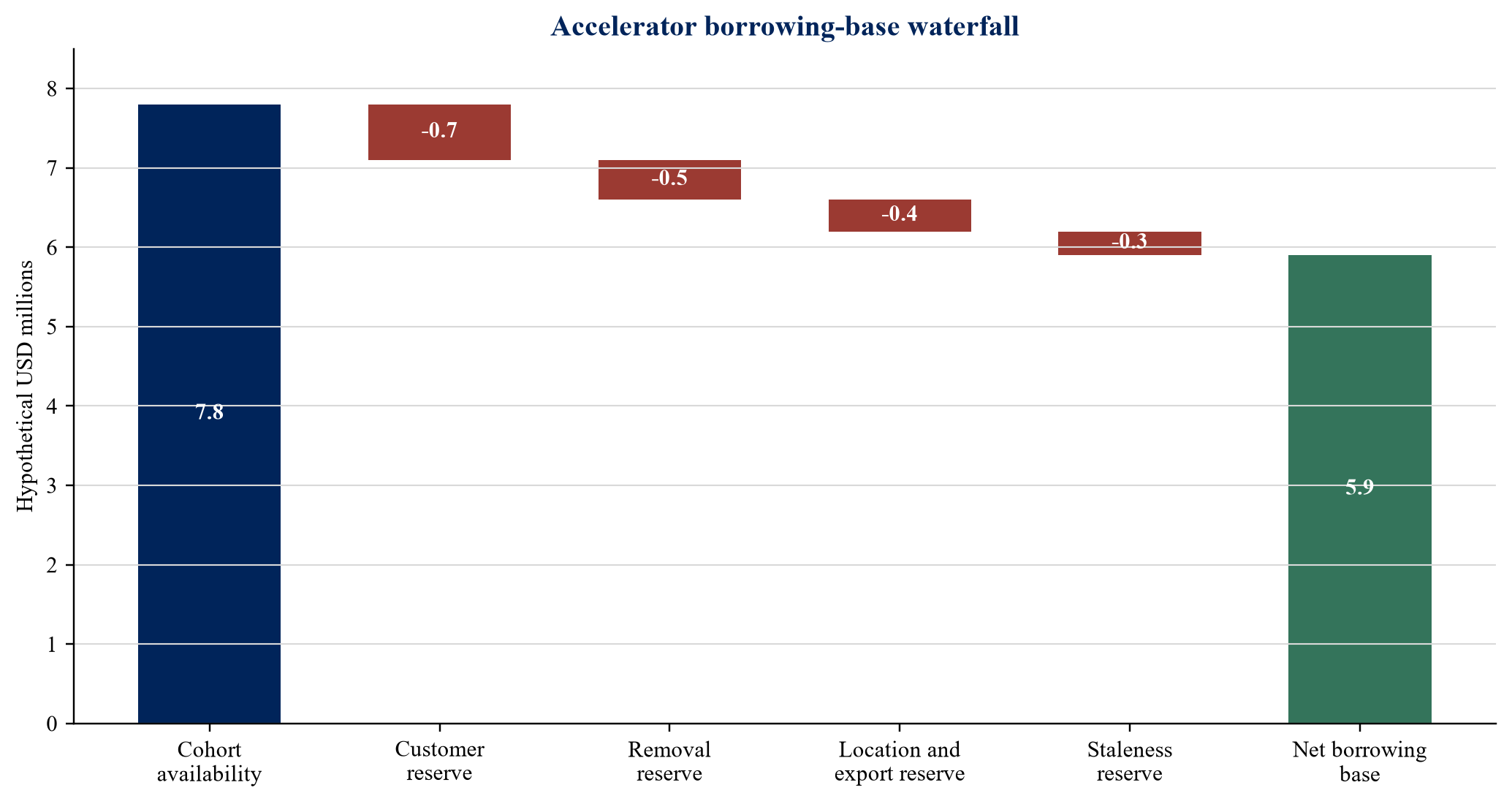
Amounts are author assumptions and do not represent market terms.
17. Cap debt with cash-flow support
Collateral availability should be subject to a second cap based on cash flow. The operating case should show contracted revenue, utilisation, price, power cost, colocation, network, maintenance, staff, software, taxes and sustaining capital. Debt service should remain supportable under customer delay, lower utilisation and margin compression. The lower of collateral availability and cash-flow debt capacity becomes the effective limit.
This dual test matters because a lender does not want to rely on liquidation as the ordinary source of repayment. A high-quality pool can still sit inside an operating model that burns cash. Conversely, strong contracted cash flow may justify a broader corporate or project facility while hardware recovery remains only one component of security. The credit memorandum should identify the primary and secondary repayment sources separately.
18. Finance delivery and installation through gates
Equipment finance can begin before commissioning, but delivery risk requires different controls. A purchase-order tranche might fund a manufacturer deposit against an assignment, refund undertaking or sponsor contribution. A delivery tranche could follow serial verification, title transfer and insurance. An installation tranche could follow site readiness, acceptance testing and customer allocation. Full borrowing-base eligibility should follow productive commissioning.
Each gate should define evidence and maximum exposure. Vendor payments can flow through controlled accounts. The lender should understand cancellation rights, price adjustments, delivery slots, warranty start and what happens if the facility is delayed. A financing structure that advances fully against undelivered hardware exposes the lender to vendor, specification and project-completion risk that an installed-asset appraisal cannot capture.
19. Align debt tenor with the refresh period
The scheduled amortisation should reduce principal faster than the stressed support value declines. A long bullet maturity can leave the lender exposed to an old cohort and a refinancing requirement at the same time. A very short maturity can force a viable operator into repeated capital-market transactions. The appropriate profile depends on contract tenor, utilisation, asset age, refresh plan and residual-value evidence.
The lender can use cohort-specific amortisation, cash sweeps, mandatory prepayment on disposal and a maximum weighted-average age. New hardware may enter the pool if it passes eligibility and does not weaken concentration or location limits. Old hardware should leave the base before its net recovery falls below the allocated debt. The refresh budget must be funded; otherwise scheduled debt service can compete with the capital expenditure required to sustain revenue.
20. Model the refresh funding loop
A sustainable operator uses cash generated by the current fleet to service debt, maintain liquidity and fund the next generation of equipment. If all cash is distributed or consumed by debt service, the business can face a cliff when customers demand newer configurations. The lender should examine the source of deposits for the next platform and the timing of customer commitments relative to procurement.
A reserve account, capex covenant or retained-cash sweep can support the loop. Vendor financing and sale proceeds from retired equipment can help, provided their availability is evidenced. The model should avoid counting the same asset value twice through both residual sale proceeds and continued operating cash flow after the disposal date. Refresh economics should be shown by cohort and period.
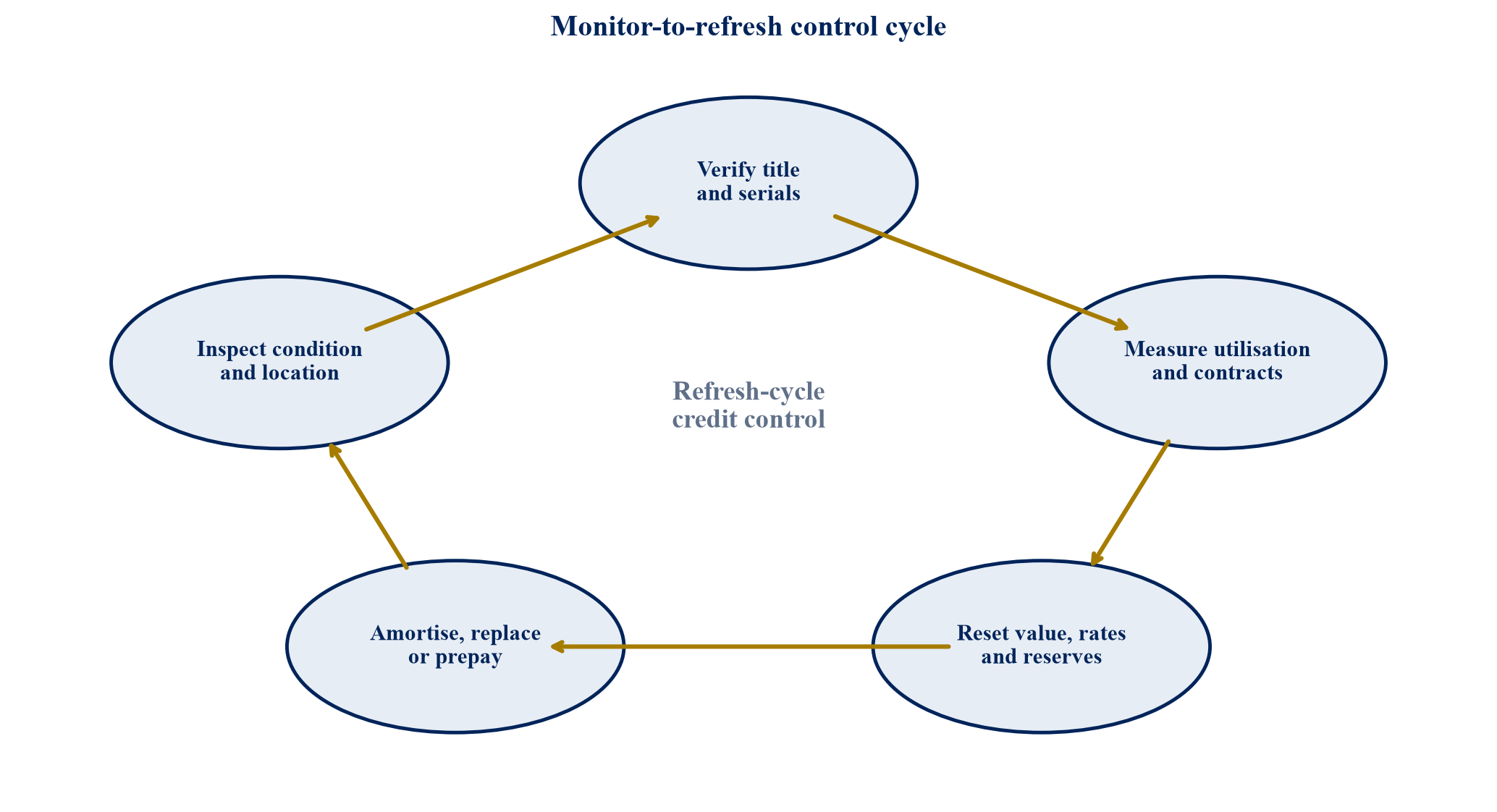
The cycle is a governance framework; transaction frequency depends on the asset pool.
21. Manage disposals without losing collateral control
An operating business needs flexibility to replace failed units and sell older hardware. The security package can permit ordinary-course disposals within limits if proceeds are applied to debt, reinvested in eligible replacement assets or held in a controlled account. Serial-level updates should occur promptly, and replacement collateral should pass the same title, condition and location tests.
Bulk transfers, related-party sales, below-market transactions and movement outside approved jurisdictions should require consent. The lender should receive advance notice of platform retirement or major customer migration. Disposal covenants should preserve business agility while preventing the borrower from selling the most liquid assets and leaving the lender with an adverse-selection pool.
22. Treat export control as a collateral condition
Advanced computing items can be subject to export, re-export and in-country transfer restrictions. US Bureau of Industry and Security guidance identifies advanced computing integrated circuits and servers within specific export-control classifications and describes circumstances in which transfers to data-centre providers or restricted end uses can require authorisation [3]. Rules can change, and the facts of a transaction determine their application.
The lender should obtain specialist advice on classification, destination, end user, end use, support services and enforcement. An asset may be physically recoverable but legally difficult to move or sell to the expected buyer set. The borrowing base should exclude prohibited transactions and apply a reserve where a lawful sale would take longer or reach fewer buyers. Sanctions and export compliance should be monitored throughout the loan, including after asset movement or customer change.
23. Separate hardware rights from software rights
Accelerators operate within software ecosystems. Drivers, orchestration, management tools, firmware, virtualisation and support agreements can affect performance and transferability. A hardware sale may not transfer every licence or service. The lender should identify which rights are embedded, transferable, replaceable or specific to the borrower. It should also understand whether technical support is needed to maintain resale value.
The appraisal should state the assumed software condition. Recovery planning may require a buyer to provide its own licences and support. If the asset's value depends heavily on a non-transferable contract, the hardware-only recovery value should be adjusted. Source code or proprietary customer data should not be treated as collateral merely because it resides on the equipment. Data ownership and privacy obligations require a separate analysis.
24. Make data sanitisation part of recovery planning
An enforcement or resale process must protect customer and company data. The lender should require documented data classification, encryption, access control and sanitisation procedures. The process must address local storage, firmware, logs and removable media. Certificates of destruction or erasure may be required before hardware leaves a facility.
Sanitisation has a cost and can affect timing. The recovery budget should include specialist labour, verification and secure logistics. Contractual obligations to customers and regulators can restrict access or movement. The security agent should have a plan that coordinates technical, legal, privacy and facility teams. A fast foreclosure right without a practicable data-handling process can overstate recoverability.
25. Underwrite the facility operator and access agreement
Equipment located in a third-party data centre can be operationally dependent on the landlord or colocation provider. The lender should review access, removal, lien waiver, cure, notice, power, cooling, insurance and termination provisions. It should identify unpaid charges that could delay access and confirm who owns cabling, racks and supporting infrastructure.
A tripartite or access agreement may provide notice before termination, a cure period and rights to enter and remove collateral. Those rights must be enforceable and operationally realistic. The lender should know whether removal would interrupt other customers or violate safety rules. Site concentration and single-point-of-failure risks belong in both the operating case and collateral haircut.
26. Require independent appraisals with a testable scope
The appraisal instruction should define the assets, premise of value, sale period, location, condition, costs and assumed buyer universe. It should distinguish orderly liquidation, forced liquidation and in-place enterprise use. The appraiser should disclose data limitations and comparable evidence. A headline percentage without a serial-level or configuration-level basis is insufficient for a material borrowing base.
Appraisal frequency should respond to volatility. Quarterly desktop updates with periodic physical inspections may be appropriate for a fast-changing pool, while a stable contracted fleet could support another schedule. Trigger events should include major platform launches, sharp utilisation changes, customer termination, relocation, damage, insurance lapse, regulatory change and market-dislocation evidence. The lender should retain the right to commission additional work when reporting quality weakens.
27. Build a reporting and audit calendar
Monthly reporting can cover the borrowing-base certificate, asset register, utilisation, customer allocation, aged receivables, revenue reconciliation, downtime, failures, repairs, location and covenant compliance. Quarterly reporting can add management accounts, appraisal updates, insurance and technical-adviser review. Annual work can include physical verification, legal registry searches, policy renewal and full model refresh.
Reporting should be proportionate to facility size and risk. Automation can lower the burden if data definitions and access controls are reliable. The facility agreement should specify delivery deadlines, cure periods and consequences. A stale report can trigger a temporary reserve or suspension of new draws. The consequence should encourage timely evidence without destabilising the operating business for a minor administrative delay.
Table 4. Proposed monitoring calendar for accelerator-backed lending
| Frequency | Borrower evidence | Independent control | Potential response |
|---|---|---|---|
| Monthly | Serial register, utilisation, customer allocation and certificate | Data and invoice reconciliation | Update eligibility and reserves |
| Quarterly | Management accounts, covenant model and condition trends | Desktop valuation and technical review | Reset advance bands if required |
| Semi-annual | Site access, insurance and contract changes | Sample physical inspection | Cure exceptions or exclude assets |
| Annual | Full pool, security and policy refresh | Appraisal, registry and field audit | Re-underwrite facility and limits |
| Trigger event | Incident, relocation, termination or platform change | Targeted legal, technical or valuation review | Freeze, reserve, prepay or restructure |
Frequency should reflect portfolio volatility, control maturity and transaction size.
28. Use early-warning indicators before covenant failure
Useful indicators include declining productive utilisation, growing gap between reserved and billed capacity, customer credits, concentration growth, rising hardware error rates, extended repair time, delayed facility completion, appraisal dispersion, unsupported asset movement and repeated reporting exceptions. Power constraints and network outages can also reduce earnings without changing the number of installed accelerators.
Each indicator should have an owner, threshold and action. A warning can prompt more frequent reporting, a reserve, reduced new availability, a technical review or a customer-remediation plan. A hard trigger can stop draws or require prepayment. The framework should leave space for judgment because a planned maintenance event and a structural demand decline can produce similar short-term telemetry.
29. Design covenants around controllable risks
Financial covenants can include minimum liquidity, fixed-charge coverage, leverage and debt-service reserves. Collateral covenants can include minimum eligible value, maximum weighted-average age, location caps, concentration caps, appraisal delivery and disposal controls. Operating covenants can address maintenance, insurance, data security, export compliance and customer-contract changes.
Covenants should use definitions that can be measured consistently. A utilisation covenant requires an agreed numerator, denominator and treatment of reserved capacity and downtime. A customer-concentration covenant requires aggregation rules. The loan agreement should state the cure mechanism, reserve response and testing date. Ambiguous metrics invite disputes precisely when the lender needs rapid action.
30. Plan enforcement before signing
Recovery planning should identify who can take possession, how access is obtained, how workloads are stopped, how data is protected, how equipment is tested and which buyers can lawfully acquire it. It should estimate time, costs and value under in-place sale, controlled removal and component sale. The plan should also identify which customer or facility consents remain necessary.
The security agent should maintain current contacts for the borrower, facility, technical adviser, appraiser, insurer, remarketing specialist and counsel. A periodic tabletop exercise can expose gaps. Enforcement is a severe scenario and may never occur, but an untested recovery route weakens the rationale for advancing against equipment value. The operating business should remain the first repayment source.
31. Apply the hypothetical borrowing base
The model begins with USD 30 million of original equipment cost. Base residual-value factors reduce that amount to USD 17.2 million. Cohort advance rates then produce USD 7.8 million of preliminary availability. Four reserves totalling USD 1.9 million reduce the borrowing base to USD 5.9 million. If cash-flow debt capacity is only USD 5.2 million, the effective facility limit is USD 5.2 million.
In the downside residual case, the same cohort rates would produce lower preliminary availability and may require further reserves if utilisation or concentration also deteriorates. The severe case should be used to test loss and liquidity rather than to justify normal-course availability. Every number in this example is an author assumption. No result should be applied to a transaction without current appraisal, legal, technical and commercial diligence.
Table 5. Hypothetical borrowing-base calculation
| Step | Calculation | Amount | Credit interpretation |
|---|---|---|---|
| Original eligible cost | Three verified age cohorts | USD 30.0m | Reconciliation base only |
| Base residual value | Cohort-specific residual factors | USD 17.2m | Scenario value before lending margin |
| Preliminary availability | Cohort advance rates | USD 7.8m | Asset-supported ceiling before reserves |
| Total reserves | Concentration, removal, location and staleness | USD 1.9m | Deductions for identified recovery risks |
| Net borrowing base | Availability less reserves | USD 5.9m | Collateral-based limit |
| Effective facility limit | Lower of borrowing base and cash-flow capacity | USD 5.2m | Maximum under the illustrative dual test |
All amounts and rates are author assumptions used solely to show the calculation sequence.
32. Stress correlated deterioration
A robust downside does not change one input at a time. A new architecture can reduce resale value while customers delay commitments, utilisation falls and power costs rise. Export restrictions can narrow the buyer set at the same time that relocation is required. A facility outage can damage revenue and extend the time required to test equipment. These correlations matter because they affect both repayment sources.
The stress model should combine residual-value decline, utilisation reduction, customer loss, margin compression, longer recovery time and higher enforcement cost. It should show covenant headroom, liquidity runway, required equity and lender loss. Scenario probabilities are optional and should be clearly supported if used. A transparent severe case is more useful than a precise expected-loss number built on unsupported correlations.
33. Distinguish equipment finance from project finance
Equipment finance focuses on identifiable assets and their cash generation or recovery. Project finance relies on a wider package of construction, offtake, operating, land, power and contractual rights. AI infrastructure often sits between these categories. Hardware can be separately financed while its value depends on a data-centre project and customer contracts.
The capital structure should allocate risks deliberately. A hardware special-purpose vehicle can own equipment and lease capacity to an operator. A project facility can finance the integrated campus. A corporate revolver can provide working capital around contracted revenue. Intercreditor arrangements must address shared accounts, assets, customer cash and enforcement. Structural complexity should serve a clear risk allocation rather than obscure leverage.
34. Match the structure to the borrower stage
An established cloud operator with audited telemetry, diversified customers and repeat procurement can support a revolving borrowing base. A growth company with a single anchor contract may require an asset-level term loan, sponsor equity, liquidity reserve and tighter cash control. A pre-revenue development company may need preferred equity or vendor-backed financing until delivery, power and customer conditions are met.
The lender should scale controls to evidence maturity. Early transactions may use more independent verification, lower advance rates and narrower eligibility. Strong performance can support incremental commitments. The credit should not assume that rapid sector growth cures borrower-specific execution risk. Public disclosures from large operators provide context, but each borrower requires its own diligence.
35. Establish a credit committee decision sequence
The committee should first confirm the borrower, facility purpose and primary repayment source. It should then approve the collateral perimeter, legal ownership, value methodology, eligibility rules, advance rates, reserves, cash-flow cap, tenor, amortisation, covenants, reporting and recovery plan. Material exceptions should be visible in one schedule with owners and cure dates.
The final decision can be expressed as an initial commitment, current availability and conditions for future draws. This separation avoids treating a headline facility size as funded debt. It also allows the borrower to add eligible equipment as the operating pool grows. The approval should state which assumptions require independent confirmation before closing and which remain continuing conditions.
36. Use a ninety-day execution plan
During the first thirty days, the parties can establish the asset register, title chain, location map, contract schedule, telemetry definitions, appraisal scope and integrated financial model. Counsel can map security and export-control issues. The technical adviser can test configuration, condition, portability and site dependencies. The lender can identify missing evidence before documentation advances.
During days thirty-one to sixty, the team can complete physical sampling, appraisal, customer-contract diligence, insurance, account control, covenant calibration and downside modelling. Draft documents should be tested against the actual data flow. During days sixty-one to ninety, the parties can close perfection steps, finalise reporting interfaces, rehearse the first certificate and confirm funding gates. The timetable is illustrative and should change with complexity.
37. Recognise the framework's limits
Secondary-market evidence for advanced accelerators can be fragmented, private and fast-moving. Public accounting useful lives are not sale values. Hardware performance depends on configuration, software, facility and workload. Export, sanctions, tax, insolvency and security rules vary by jurisdiction and can change. Customer contracts may contain confidential terms that public filings cannot reveal.
For these reasons, the framework supports decision discipline rather than a universal advance rate. It requires current legal opinions, serial-level technical diligence, independent valuation, customer analysis and a borrower-specific cash-flow model. The hypothetical calculations are deliberately transparent author assumptions. They have no empirical calibration and should not be interpreted as market terms, forecasts or investment recommendations.
38. Conclude with a controlled financing proposition
Accelerator hardware can support debt when the lender can prove ownership, locate and inspect the assets, understand the configuration, monitor productive use, control movement and disposal, and estimate net recovery through a realistic buyer set. Contracted cash flow and operational capability remain central. A purchase invoice alone provides an incomplete basis for credit.
The proposed structure combines serial-level eligibility, the lower of cost, appraisal and cash-flow value, age-specific advance rates, concentration and recovery reserves, a cash-flow cap, amortisation through the refresh cycle, and trigger-based monitoring. It gives borrowers a route to finance productive compute while giving lenders early evidence of deterioration. Its value lies in making each assumption testable before capital is released.
References
- Office of the Comptroller of the Currency. Asset-Based Lending, Comptroller's Handbook, Version 1.1. January 2017. https://www.occ.treas.gov/publications-and-resources/publications/comptrollers-handbook/files/asset-based-lending/pub-ch-asset-based-lending.pdf
- Office of the Comptroller of the Currency. Asset-Based Lending publication page. Accessed 6 September 2026. https://www.occ.treas.gov/publications-and-resources/publications/comptrollers-handbook/files/asset-based-lending/index-asset-based-lending.html
- US Department of Commerce, Bureau of Industry and Security. Controls that May Apply to Advanced Computing Integrated Circuits and Other Commodities Used to Train AI Models. 13 May 2025. https://www.bis.gov/media/documents/ai-counter-diversion-industry-guidance-may-13-2025.pdf
- US Department of Commerce, Bureau of Industry and Security. Commerce Strengthens Restrictions on Advanced Computing Semiconductors to Enhance Foundry Due Diligence and Prevent Diversion. 15 January 2025. https://www.bis.gov/press-release/commerce-strengthens-restrictions-advanced-computing-semiconductors-enhance-foundry-due-diligence-prevent
- CoreWeave, Inc. Annual Report on Form 10-K for the year ended 31 December 2025. Filed with the US Securities and Exchange Commission in 2026. https://www.sec.gov/Archives/edgar/data/1769628/000176962826000104/crwv-20251231.htm
- Nebius Group N.V. Annual Report on Form 20-F for the year ended 31 December 2025. Filed with the US Securities and Exchange Commission in 2026. https://www.sec.gov/Archives/edgar/data/1513845/000110465926052948/nbis-20251231x20f.htm
- NVIDIA Corporation. Annual Report on Form 10-K for the fiscal year ended 25 January 2026. Filed with the US Securities and Exchange Commission in 2026. https://www.sec.gov/Archives/edgar/data/1045810/000104581026000021/nvda-20260125.htm
- International Energy Agency. Key Questions on Energy and AI, Executive Summary. 16 April 2026. https://www.iea.org/reports/key-questions-on-energy-and-ai/executive-summary
- International Energy Agency. Energy and AI. 10 April 2025. https://www.iea.org/reports/energy-and-ai
- Uniform Law Commission. Uniform Commercial Code, Article 9 Secured Transactions. Accessed 6 September 2026. https://www.uniformlaws.org/acts/ucc
- Companies House. Register a charge for a limited company. Updated 1 February 2026. https://www.gov.uk/guidance/register-a-charge-mortgage-for-a-limited-company
- Companies House. How to complete paper form MR01. Updated 5 March 2026. https://www.gov.uk/government/publications/register-particulars-of-a-charge-mr01/how-to-complete-paper-form-mr01
- International Energy Agency. Energy and AI data product. June 2025. https://www.iea.org/data-and-statistics/data-product/energy-and-ai
- CoreWeave, Inc. Annual Report to Shareholders for 2025. Filed with the US Securities and Exchange Commission in 2026. https://www.sec.gov/Archives/edgar/data/1769628/000176962826000193/formars.pdf
- US Electronic Code of Federal Regulations. 31 CFR Part 850, Provisions Pertaining to US Investments in Certain National Security Technologies and Products in Countries of Concern. Accessed 6 September 2026. https://www.ecfr.gov/current/title-31/subtitle-B/chapter-VIII/part-850/
- International Energy Agency. Energy supply for AI. 2025. https://www.iea.org/reports/energy-and-ai/energy-supply-for-ai
