

Introduction
Distress separates price from continuity. A buyer may be attracted to spectrum, satellites or customers, yet each component can depend on rights and systems outside the proposed perimeter. A licence can require regulatory consent, milestones and operating capability. A satellite fleet can require command software, gateways, engineers, launch and replenishment. A subscriber base can require service, billing, terminals, support and contractual assignment.
The transaction team should therefore model the target as a dependency network before selecting an acquisition structure. The decision is not simply which assets have value. The decision is which combination can produce lawful, continuous and financeable service after closing, and what cash must be committed to reach that state.
This paper compares selected-asset, licence-led, customer-led and going-concern perimeters. Every perimeter is tested against the same operating plan, consent map, replacement schedule, customer curve and downside liquidity requirement.
1. Define the decision and valuation date
The analysis begins with the buyer decision, legal process, bid deadline, information cut-off and assumed closing date. Distress compresses time and can encourage a buyer to treat visible assets as independent sources of value. The dependency map should instead identify the legal owner, operating controller, required counterparty, transfer mechanism and cash needed for every material component. This shows whether the proposed perimeter can deliver lawful and continuous service after closing.
The evidence set comprises process letters, court orders, creditor timetable, management accounts and regulator status. Records should be dated, owned and reconciled to the relevant entity, asset, contract and model assumption. Missing support remains a visible bid risk. The financial model converts the verified record into a bid that uses one evidence date and one closing state. The board should approve the decision perimeter before modelling value, with every adjustment linked to one dependency and one accountable owner.
2. Map the legal and economic perimeter
Decision usefulness requires a trace from entities, licences, satellites, gateways, terminals, software, intellectual property, employees, contracts, cash and liabilities to service, cash and closing mechanics. The trace should distinguish assets that transfer automatically, rights requiring consent, contracts requiring cure or assignment, and capabilities that must be recreated. It should also identify the period during which the seller, restructuring estate or transition provider remains essential to operations.
Diligence should obtain corporate records, asset registers, licence schedules, contract maps and intercompany arrangements. The team should test completeness, transferability, operating condition and cash conversion. Valuation then measures what transfers and what remains behind. Decision makers should reconcile legal title with operational dependency; the assumption register should prevent the same distress risk from appearing in asset value, replacement capital, a general discount and the terminal multiple.
3. Compare four acquisition structures
The control question concerns selected assets, licence-led acquisition, customer-led acquisition and going-concern purchase. It should be answered through a dated transaction and operating record rather than a narrative assertion. Fleet averages, aggregate backlog and book values can hide failed cohorts, non-assignable contracts, unfunded options, stranded infrastructure and regulatory rights that cannot be used by the proposed buyer.
Required support includes draft term sheets, restructuring options, consent requirements and tax analysis. Exceptions, defaults, failed tests and late changes deserve separate review. The model uses the evidence to calculate comparable cash needs and continuity outcomes. The investment committee should select the perimeter that maximises executable value after all dependencies, retaining deductions for incomplete transfers and including the full cash required to reach standalone, stable service.
4. Build the regulatory consent map
The analysis begins with assignments, transfers of control, market access, earth stations, landing rights, export control and national-security review. Distress compresses time and can encourage a buyer to treat visible assets as independent sources of value. The dependency map should instead identify the legal owner, operating controller, required counterparty, transfer mechanism and cash needed for every material component. This shows whether the proposed perimeter can deliver lawful and continuous service after closing.
The evidence set comprises authorisations, statutes, application status, regulator correspondence and conditions. Records should be dated, owned and reconciled to the relevant entity, asset, contract and model assumption. Missing support remains a visible bid risk. The financial model converts the verified record into closing probability, timing and operating restrictions. The board should make each material consent a dated bid condition, with every adjustment linked to one dependency and one accountable owner.
5. Test spectrum and orbital rights
Decision usefulness requires a trace from frequency assignments, orbital parameters, national licences, coordination status, milestones and priority to service, cash and closing mechanics. The trace should distinguish assets that transfer automatically, rights requiring consent, contracts requiring cure or assignment, and capabilities that must be recreated. It should also identify the period during which the seller, restructuring estate or transition provider remains essential to operations.
Diligence should obtain FCC and national authorisations, ITU records, coordination agreements and compliance reports. The team should test completeness, transferability, operating condition and cash conversion. Valuation then measures usable rights that survive the proposed transfer. Decision makers should exclude rights whose transfer, milestone or operating basis cannot be demonstrated; the assumption register should prevent the same distress risk from appearing in asset value, replacement capital, a general discount and the terminal multiple.
6. Distinguish licences from service capability
The control question concerns the gap between holding regulatory rights and operating a compliant network. It should be answered through a dated transaction and operating record rather than a narrative assertion. Fleet averages, aggregate backlog and book values can hide failed cohorts, non-assignable contracts, unfunded options, stranded infrastructure and regulatory rights that cannot be used by the proposed buyer.
Required support includes fleet availability, gateways, control systems, cybersecurity, personnel and vendor support. Exceptions, defaults, failed tests and late changes deserve separate review. The model uses the evidence to calculate capital and time required to convert rights into delivered service. The investment committee should avoid bidding for legal rights without the capability needed to preserve them, retaining deductions for incomplete transfers and including the full cash required to reach standalone, stable service.
7. Reconstruct the fleet by cohort
The analysis begins with satellite age, payload, capacity, reliability, remaining life, propulsion and common design. Distress compresses time and can encourage a buyer to treat visible assets as independent sources of value. The dependency map should instead identify the legal owner, operating controller, required counterparty, transfer mechanism and cash needed for every material component. This shows whether the proposed perimeter can deliver lawful and continuous service after closing.
The evidence set comprises manufacturing lots, launch records, telemetry, anomalies, insurance and disposal plans. Records should be dated, owned and reconciled to the relevant entity, asset, contract and model assumption. Missing support remains a visible bid risk. The financial model converts the verified record into usable capacity and remaining service by cohort. The board should price the fleet from delivered capacity rather than historical cost, with every adjustment linked to one dependency and one accountable owner.
8. Test in-orbit asset condition
Decision usefulness requires a trace from availability, degraded payloads, manoeuvrability, power, thermal performance and command access to service, cash and closing mechanics. The trace should distinguish assets that transfer automatically, rights requiring consent, contracts requiring cure or assignment, and capabilities that must be recreated. It should also identify the period during which the seller, restructuring estate or transition provider remains essential to operations.
Diligence should obtain telemetry, anomaly logs, command records, station-keeping history and engineering assessments. The team should test completeness, transferability, operating condition and cash conversion. Valuation then measures condition-adjusted service and residual life. Decision makers should retain deductions for uninspected or inaccessible spacecraft; the assumption register should prevent the same distress risk from appearing in asset value, replacement capital, a general discount and the terminal multiple.
9. Model replacement capital
The control question concerns manufacture, launch, insurance, commissioning, spares and ground changes required to sustain contracted service. It should be answered through a dated transaction and operating record rather than a narrative assertion. Fleet averages, aggregate backlog and book values can hide failed cohorts, non-assignable contracts, unfunded options, stranded infrastructure and regulatory rights that cannot be used by the proposed buyer.
Required support includes supplier contracts, production cadence, launch slots, deposits and acceptance history. Exceptions, defaults, failed tests and late changes deserve separate review. The model uses the evidence to calculate sustaining cash flow and funding need. The investment committee should deduct replacement capital before applying terminal value, retaining deductions for incomplete transfers and including the full cash required to reach standalone, stable service.
10. Test launch access
The analysis begins with availability of launch providers, slots, integration, export permission and alternative routes. Distress compresses time and can encourage a buyer to treat visible assets as independent sources of value. The dependency map should instead identify the legal owner, operating controller, required counterparty, transfer mechanism and cash needed for every material component. This shows whether the proposed perimeter can deliver lawful and continuous service after closing.
The evidence set comprises executed contracts, manifests, deposits, lead times and contingency plans. Records should be dated, owned and reconciled to the relevant entity, asset, contract and model assumption. Missing support remains a visible bid risk. The financial model converts the verified record into replacement timing and bridge liquidity. The board should stress launch delay together with fleet degradation, with every adjustment linked to one dependency and one accountable owner.
11. Reconstruct commercial customer cohorts
Decision usefulness requires a trace from subscriber type, geography, price, terminal, usage, tenure, churn and support cost to service, cash and closing mechanics. The trace should distinguish assets that transfer automatically, rights requiring consent, contracts requiring cure or assignment, and capabilities that must be recreated. It should also identify the period during which the seller, restructuring estate or transition provider remains essential to operations.
Diligence should obtain billing, activations, collections, service records and cancellations. The team should test completeness, transferability, operating condition and cash conversion. Valuation then measures cohort contribution under continuing and deteriorating service. Decision makers should value customers through retained contribution after transition; the assumption register should prevent the same distress risk from appearing in asset value, replacement capital, a general discount and the terminal multiple.
12. Reconstruct government contracts
The control question concerns funding, task orders, acceptance, termination, security, assignment and change rights. It should be answered through a dated transaction and operating record rather than a narrative assertion. Fleet averages, aggregate backlog and book values can hide failed cohorts, non-assignable contracts, unfunded options, stranded infrastructure and regulatory rights that cannot be used by the proposed buyer.
Required support includes executed awards, funded backlog, invoices, collections and consent correspondence. Exceptions, defaults, failed tests and late changes deserve separate review. The model uses the evidence to calculate durable government cash after transfer. The investment committee should treat non-assignable or unfunded amounts separately, retaining deductions for incomplete transfers and including the full cash required to reach standalone, stable service.
13. Model distress-driven attrition
The analysis begins with churn caused by outages, uncertainty, delayed terminals, channel weakness and competitor offers. Distress compresses time and can encourage a buyer to treat visible assets as independent sources of value. The dependency map should instead identify the legal owner, operating controller, required counterparty, transfer mechanism and cash needed for every material component. This shows whether the proposed perimeter can deliver lawful and continuous service after closing.
The evidence set comprises weekly cancellations, renewal outcomes, support contacts, credits and migration data. Records should be dated, owned and reconciled to the relevant entity, asset, contract and model assumption. Missing support remains a visible bid risk. The financial model converts the verified record into customer cash that survives the transaction process. The board should use a time-dependent attrition curve rather than a static haircut, with every adjustment linked to one dependency and one accountable owner.
14. Test contract assignment and cure
Decision usefulness requires a trace from anti-assignment clauses, change-of-control rights, defaults, arrears, cure obligations and executory-contract treatment to service, cash and closing mechanics. The trace should distinguish assets that transfer automatically, rights requiring consent, contracts requiring cure or assignment, and capabilities that must be recreated. It should also identify the period during which the seller, restructuring estate or transition provider remains essential to operations.
Diligence should obtain contract terms, counterparty notices, default registers, cure statements and legal analysis. The team should test completeness, transferability, operating condition and cash conversion. Valuation then measures contracts that can transfer at a stated cash cost. Decision makers should make high-value assignments and cures bid conditions; the assumption register should prevent the same distress risk from appearing in asset value, replacement capital, a general discount and the terminal multiple.
15. Value gateways and ground systems
The control question concerns sites, antennas, network operations, telemetry, command, data processing and leases. It should be answered through a dated transaction and operating record rather than a narrative assertion. Fleet averages, aggregate backlog and book values can hide failed cohorts, non-assignable contracts, unfunded options, stranded infrastructure and regulatory rights that cannot be used by the proposed buyer.
Required support includes asset registers, title, permits, capacity, maintenance and landlord consents. Exceptions, defaults, failed tests and late changes deserve separate review. The model uses the evidence to calculate ground capability required for the selected fleet and customers. The investment committee should separate essential sites from duplicative or stranded infrastructure, retaining deductions for incomplete transfers and including the full cash required to reach standalone, stable service.
16. Value terminals and installed base
The analysis begins with customer premises equipment, inventory, firmware, certification, ownership and replacement. Distress compresses time and can encourage a buyer to treat visible assets as independent sources of value. The dependency map should instead identify the legal owner, operating controller, required counterparty, transfer mechanism and cash needed for every material component. This shows whether the proposed perimeter can deliver lawful and continuous service after closing.
The evidence set comprises serial-number registers, installation records, inventory counts and support history. Records should be dated, owned and reconciled to the relevant entity, asset, contract and model assumption. Missing support remains a visible bid risk. The financial model converts the verified record into service-enabling assets and refurbishment cash. The board should reconcile terminal rights with each retained customer cohort, with every adjustment linked to one dependency and one accountable owner.
17. Secure software and data rights
Decision usefulness requires a trace from flight software, network orchestration, billing, customer data, models, source code and third-party licences to service, cash and closing mechanics. The trace should distinguish assets that transfer automatically, rights requiring consent, contracts requiring cure or assignment, and capabilities that must be recreated. It should also identify the period during which the seller, restructuring estate or transition provider remains essential to operations.
Diligence should obtain IP schedules, repositories, escrow, licence terms, access controls and privacy records. The team should test completeness, transferability, operating condition and cash conversion. Valuation then measures operating capability and migration cost. Decision makers should require transferable rights and tested access before closing; the assumption register should prevent the same distress risk from appearing in asset value, replacement capital, a general discount and the terminal multiple.
18. Retain critical workforce
The control question concerns flight dynamics, spacecraft operations, network, spectrum, cyber, sales, billing and field support roles. It should be answered through a dated transaction and operating record rather than a narrative assertion. Fleet averages, aggregate backlog and book values can hide failed cohorts, non-assignable contracts, unfunded options, stranded infrastructure and regulatory rights that cannot be used by the proposed buyer.
Required support includes employee roster, skills, access privileges, retention terms and succession plans. Exceptions, defaults, failed tests and late changes deserve separate review. The model uses the evidence to calculate continuity cost and execution capacity. The investment committee should fund retention around critical systems and decision dates, retaining deductions for incomplete transfers and including the full cash required to reach standalone, stable service.
19. Map supplier dependencies
The analysis begins with manufacturers, launch providers, cloud, ground vendors, terminal makers and maintenance contractors. Distress compresses time and can encourage a buyer to treat visible assets as independent sources of value. The dependency map should instead identify the legal owner, operating controller, required counterparty, transfer mechanism and cash needed for every material component. This shows whether the proposed perimeter can deliver lawful and continuous service after closing.
The evidence set comprises contracts, arrears, liens, warranties, capacity and change-of-control terms. Records should be dated, owned and reconciled to the relevant entity, asset, contract and model assumption. Missing support remains a visible bid risk. The financial model converts the verified record into cure cost, continuity and bargaining exposure. The board should price suppliers through executable continuation terms, with every adjustment linked to one dependency and one accountable owner.
20. Test cybersecurity and command continuity
Decision usefulness requires a trace from identity, keys, command authority, monitoring, incident response and recovery to service, cash and closing mechanics. The trace should distinguish assets that transfer automatically, rights requiring consent, contracts requiring cure or assignment, and capabilities that must be recreated. It should also identify the period during which the seller, restructuring estate or transition provider remains essential to operations.
Diligence should obtain access logs, architecture, security tests, incidents and key-rotation plans. The team should test completeness, transferability, operating condition and cash conversion. Valuation then measures closing readiness and residual control risk. Decision makers should make clean command transfer and credential rotation day-one requirements; the assumption register should prevent the same distress risk from appearing in asset value, replacement capital, a general discount and the terminal multiple.
21. Analyse debt, liens and asset encumbrance
The control question concerns security interests, mortgages, pledges, retention of title, lease claims and set-off. It should be answered through a dated transaction and operating record rather than a narrative assertion. Fleet averages, aggregate backlog and book values can hide failed cohorts, non-assignable contracts, unfunded options, stranded infrastructure and regulatory rights that cannot be used by the proposed buyer.
Required support includes credit agreements, registers, financing statements, court filings and payoff letters. Exceptions, defaults, failed tests and late changes deserve separate review. The model uses the evidence to calculate clear title and release cost by asset. The investment committee should condition transfer on enforceable releases, retaining deductions for incomplete transfers and including the full cash required to reach standalone, stable service.
22. Analyse restructuring-law mechanics
The analysis begins with court approval, sale standard, creditor objections, executory contracts, cure and successor-liability protection. Distress compresses time and can encourage a buyer to treat visible assets as independent sources of value. The dependency map should instead identify the legal owner, operating controller, required counterparty, transfer mechanism and cash needed for every material component. This shows whether the proposed perimeter can deliver lawful and continuous service after closing.
The evidence set comprises motions, orders, bid procedures, applicable statutes and local advice. Records should be dated, owned and reconciled to the relevant entity, asset, contract and model assumption. Missing support remains a visible bid risk. The financial model converts the verified record into closing certainty, timing and residual liability. The board should align bid protections with the governing process, with every adjustment linked to one dependency and one accountable owner.
23. Model transition services
Decision usefulness requires a trace from systems, people, facilities, data and supplier support required between closing and standalone operation to service, cash and closing mechanics. The trace should distinguish assets that transfer automatically, rights requiring consent, contracts requiring cure or assignment, and capabilities that must be recreated. It should also identify the period during which the seller, restructuring estate or transition provider remains essential to operations.
Diligence should obtain separation plan, service catalogue, costs, service levels and exit milestones. The team should test completeness, transferability, operating condition and cash conversion. Valuation then measures temporary cash and execution dependency. Decision makers should cap duration and create tested exit criteria; the assumption register should prevent the same distress risk from appearing in asset value, replacement capital, a general discount and the terminal multiple.
24. Build day-one service continuity
The control question concerns the sequence of control transfer, customer communication, network operation, billing, security and regulator notification. It should be answered through a dated transaction and operating record rather than a narrative assertion. Fleet averages, aggregate backlog and book values can hide failed cohorts, non-assignable contracts, unfunded options, stranded infrastructure and regulatory rights that cannot be used by the proposed buyer.
Required support includes runbooks, rehearsals, contact trees, system access and contingency plans. Exceptions, defaults, failed tests and late changes deserve separate review. The model uses the evidence to calculate service stability through closing. The investment committee should require a signed day-one control matrix, retaining deductions for incomplete transfers and including the full cash required to reach standalone, stable service.
25. Build the selected-asset case
The analysis begins with a narrow purchase of satellites, ground assets or technology without the operating company. Distress compresses time and can encourage a buyer to treat visible assets as independent sources of value. The dependency map should instead identify the legal owner, operating controller, required counterparty, transfer mechanism and cash needed for every material component. This shows whether the proposed perimeter can deliver lawful and continuous service after closing.
The evidence set comprises asset title, interfaces, migration, consents and standalone cost. Records should be dated, owned and reconciled to the relevant entity, asset, contract and model assumption. Missing support remains a visible bid risk. The financial model converts the verified record into value after recreating excluded dependencies. The board should use only where the buyer already owns or can rapidly build the missing system, with every adjustment linked to one dependency and one accountable owner.
26. Build the licence-led case
Decision usefulness requires a trace from acquisition of spectrum and orbital rights with the minimum associated capability to service, cash and closing mechanics. The trace should distinguish assets that transfer automatically, rights requiring consent, contracts requiring cure or assignment, and capabilities that must be recreated. It should also identify the period during which the seller, restructuring estate or transition provider remains essential to operations.
Diligence should obtain transfer consent, milestones, coordination, operating plan and funding. The team should test completeness, transferability, operating condition and cash conversion. Valuation then measures rights value after preservation and deployment cost. Decision makers should recognise value only after consent and credible use; the assumption register should prevent the same distress risk from appearing in asset value, replacement capital, a general discount and the terminal multiple.
27. Build the customer-led case
The control question concerns contracts, subscribers, terminals, channels and service migration. It should be answered through a dated transaction and operating record rather than a narrative assertion. Fleet averages, aggregate backlog and book values can hide failed cohorts, non-assignable contracts, unfunded options, stranded infrastructure and regulatory rights that cannot be used by the proposed buyer.
Required support includes assignment rights, cohort economics, churn, capacity and transition plan. Exceptions, defaults, failed tests and late changes deserve separate review. The model uses the evidence to calculate retained customer contribution after migration. The investment committee should price customer value after service and consent leakage, retaining deductions for incomplete transfers and including the full cash required to reach standalone, stable service.
28. Build the going-concern case
The analysis begins with shares or substantially all operating assets with licences, fleet, systems, people and contracts. Distress compresses time and can encourage a buyer to treat visible assets as independent sources of value. The dependency map should instead identify the legal owner, operating controller, required counterparty, transfer mechanism and cash needed for every material component. This shows whether the proposed perimeter can deliver lawful and continuous service after closing.
The evidence set comprises liability map, cash burn, governance, financing and continuity plan. Records should be dated, owned and reconciled to the relevant entity, asset, contract and model assumption. Missing support remains a visible bid risk. The financial model converts the verified record into continuity benefit net of assumed obligations. The board should compare avoided separation cost with inherited risk, with every adjustment linked to one dependency and one accountable owner.
29. Construct sustainable free cash flow
Decision usefulness requires a trace from retained customers and contracts after operations, cures, transition, replacement, tax and working capital to service, cash and closing mechanics. The trace should distinguish assets that transfer automatically, rights requiring consent, contracts requiring cure or assignment, and capabilities that must be recreated. It should also identify the period during which the seller, restructuring estate or transition provider remains essential to operations.
Diligence should obtain reconciled forecasts, cohort data, fleet schedules and bid assumptions. The team should test completeness, transferability, operating condition and cash conversion. Valuation then measures cash available after restoring a stable service state. Decision makers should use the same perimeter in operating cash and terminal value; the assumption register should prevent the same distress risk from appearing in asset value, replacement capital, a general discount and the terminal multiple.
30. Build the hypothetical headline sum
The control question concerns claimed spectrum, satellites, ground, software and customer values totalling USD 4.80 billion. It should be answered through a dated transaction and operating record rather than a narrative assertion. Fleet averages, aggregate backlog and book values can hide failed cohorts, non-assignable contracts, unfunded options, stranded infrastructure and regulatory rights that cannot be used by the proposed buyer.
Required support includes illustrative inputs separated from public evidence. Exceptions, defaults, failed tests and late changes deserve separate review. The model uses the evidence to calculate a starting point before dependency and distress adjustments. The investment committee should use the case to demonstrate mechanics rather than represent a company, retaining deductions for incomplete transfers and including the full cash required to reach standalone, stable service.
31. Apply fleet and replacement deductions
The analysis begins with degraded capacity, shortened life, common-mode risk and unfunded replenishment. Distress compresses time and can encourage a buyer to treat visible assets as independent sources of value. The dependency map should instead identify the legal owner, operating controller, required counterparty, transfer mechanism and cash needed for every material component. This shows whether the proposed perimeter can deliver lawful and continuous service after closing.
The evidence set comprises cohort evidence, engineering review, production and launch plans. Records should be dated, owned and reconciled to the relevant entity, asset, contract and model assumption. Missing support remains a visible bid risk. The financial model converts the verified record into a USD 1.05 billion deduction in the worked case. The board should release deductions only after verified condition and funded replacement, with every adjustment linked to one dependency and one accountable owner.
32. Apply customer and separation deductions
Decision usefulness requires a trace from attrition, non-assignment, cure, transition, regulatory delay and working capital to service, cash and closing mechanics. The trace should distinguish assets that transfer automatically, rights requiring consent, contracts requiring cure or assignment, and capabilities that must be recreated. It should also identify the period during which the seller, restructuring estate or transition provider remains essential to operations.
Diligence should obtain cohort data, contract terms, consent map and executable budgets. The team should test completeness, transferability, operating condition and cash conversion. Valuation then measures USD 1.00 billion of combined deductions. Decision makers should keep each deduction linked to one risk and one owner; the assumption register should prevent the same distress risk from appearing in asset value, replacement capital, a general discount and the terminal multiple.
33. Admit continuity value
The control question concerns verified benefit from keeping licences, fleet, systems, workforce and customers operating together. It should be answered through a dated transaction and operating record rather than a narrative assertion. Fleet averages, aggregate backlog and book values can hide failed cohorts, non-assignable contracts, unfunded options, stranded infrastructure and regulatory rights that cannot be used by the proposed buyer.
Required support includes tested day-one plan, assignments, staff retention and supplier continuation. Exceptions, defaults, failed tests and late changes deserve separate review. The model uses the evidence to calculate USD 0.20 billion in the worked case. The investment committee should cap the premium by demonstrable avoided cost and retained cash, retaining deductions for incomplete transfers and including the full cash required to reach standalone, stable service.
34. Structure financing and bid protections
The analysis begins with purchase price, rescue liquidity, replacement capital, holdbacks, escrows, earn-outs and break protections. Distress compresses time and can encourage a buyer to treat visible assets as independent sources of value. The dependency map should instead identify the legal owner, operating controller, required counterparty, transfer mechanism and cash needed for every material component. This shows whether the proposed perimeter can deliver lawful and continuous service after closing.
The evidence set comprises sources and uses, lender terms, milestones, consents and downside cases. Records should be dated, owned and reconciled to the relevant entity, asset, contract and model assumption. Missing support remains a visible bid risk. The financial model converts the verified record into funded closing and post-close plan. The board should match contingent value to unresolved transfer and retention evidence, with every adjustment linked to one dependency and one accountable owner.
35. Establish post-close governance
Decision usefulness requires a trace from authority over fleet, licences, customers, security, capital and integration to service, cash and closing mechanics. The trace should distinguish assets that transfer automatically, rights requiring consent, contracts requiring cure or assignment, and capabilities that must be recreated. It should also identify the period during which the seller, restructuring estate or transition provider remains essential to operations.
Diligence should obtain board mandates, dashboards, triggers, assurance and decision logs. The team should test completeness, transferability, operating condition and cash conversion. Valuation then measures accountable recovery before liquidity or service limits are breached. Decision makers should refresh value as consents, attrition and fleet evidence resolve; the assumption register should prevent the same distress risk from appearing in asset value, replacement capital, a general discount and the terminal multiple.
36. Define the bid decision
The control question concerns the perimeter, price, funding, conditions, protections and recovery actions supported by evidence. It should be answered through a dated transaction and operating record rather than a narrative assertion. Fleet averages, aggregate backlog and book values can hide failed cohorts, non-assignable contracts, unfunded options, stranded infrastructure and regulatory rights that cannot be used by the proposed buyer.
Required support includes the final dependency map, bid bridge, downside liquidity, consent schedule and day-one plan. Exceptions, defaults, failed tests and late changes deserve separate review. The model uses the evidence to calculate an auditable decision range. The investment committee should bid, reprice, stage or withdraw through a dated record, retaining deductions for incomplete transfers and including the full cash required to reach standalone, stable service.
Conclusion
Constellation distress M&A is a perimeter decision before it is a price decision. Spectrum, satellites and customers can retain value, but each depends on consents, systems, people, suppliers and capital. A narrow purchase can create stranded assets. A going-concern purchase can preserve continuity while importing liabilities and cash burn.
The framework compares four perimeters on a common basis. It values rights only when they can transfer and be used, satellites through delivered capacity and remaining life, customers through retained contribution, and continuity through demonstrable avoided cost and cash preservation. It deducts cure, transition, replacement and working capital before reaching bid value.
For a board or creditor group, the decisive test is whether the selected perimeter can close lawfully, maintain service and reach a stable funded state. The answer determines bid price, structure, conditions, financing and post-close governance.
Appendix A. Bid-perimeter register
The minimum register contains component, legal owner, operating controller, proposed transferee, transfer mechanism, consent, cure, lien release, dependency, day-one owner, replacement need, cash requirement and evidence confidence. Every item should be assigned to one perimeter and one model line.
Appendix B. Customer-continuity register
For each customer cohort, record contract, assignment right, funding, service level, terminal, capacity, billing, arrears, renewal date, churn, transition method, communication plan and retained contribution. Distress attrition should be measured weekly where data permits.
Appendix C. Investment checklist
The approval file should contain bid procedures, entities, licences, spectrum, fleet cohorts, replacement capital, customers, contracts, gateways, terminals, software, workforce, suppliers, cybersecurity, liens, cures, transition services, day-one plan, financing and downside liquidity. Evidence should be dated and owned.
Appendix D. Worked-case figures and tables
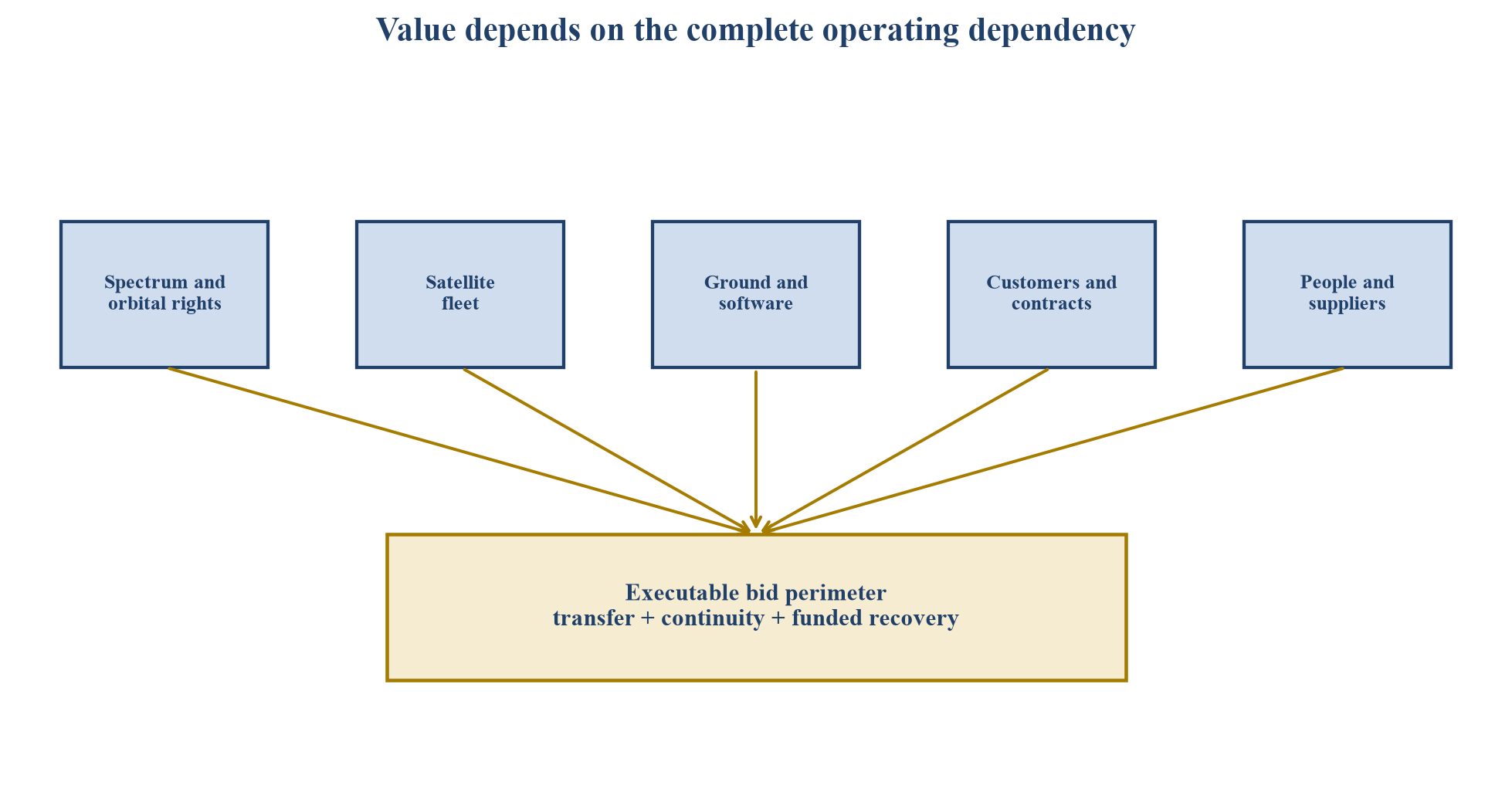
Proposed dependency architecture connecting rights, fleet, ground, customers and operating capability.
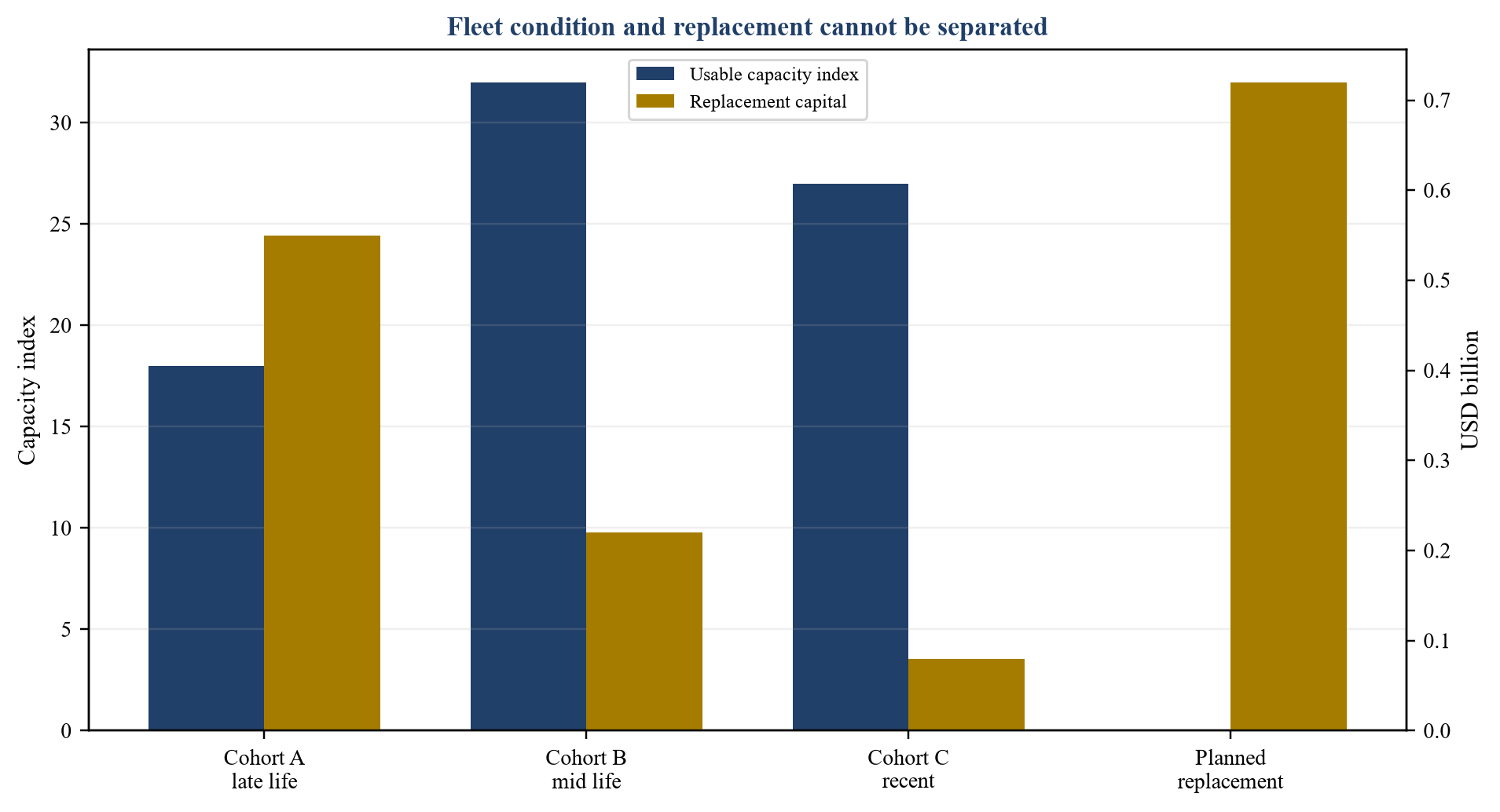
Illustrative usable capacity and replacement capital by satellite cohort.
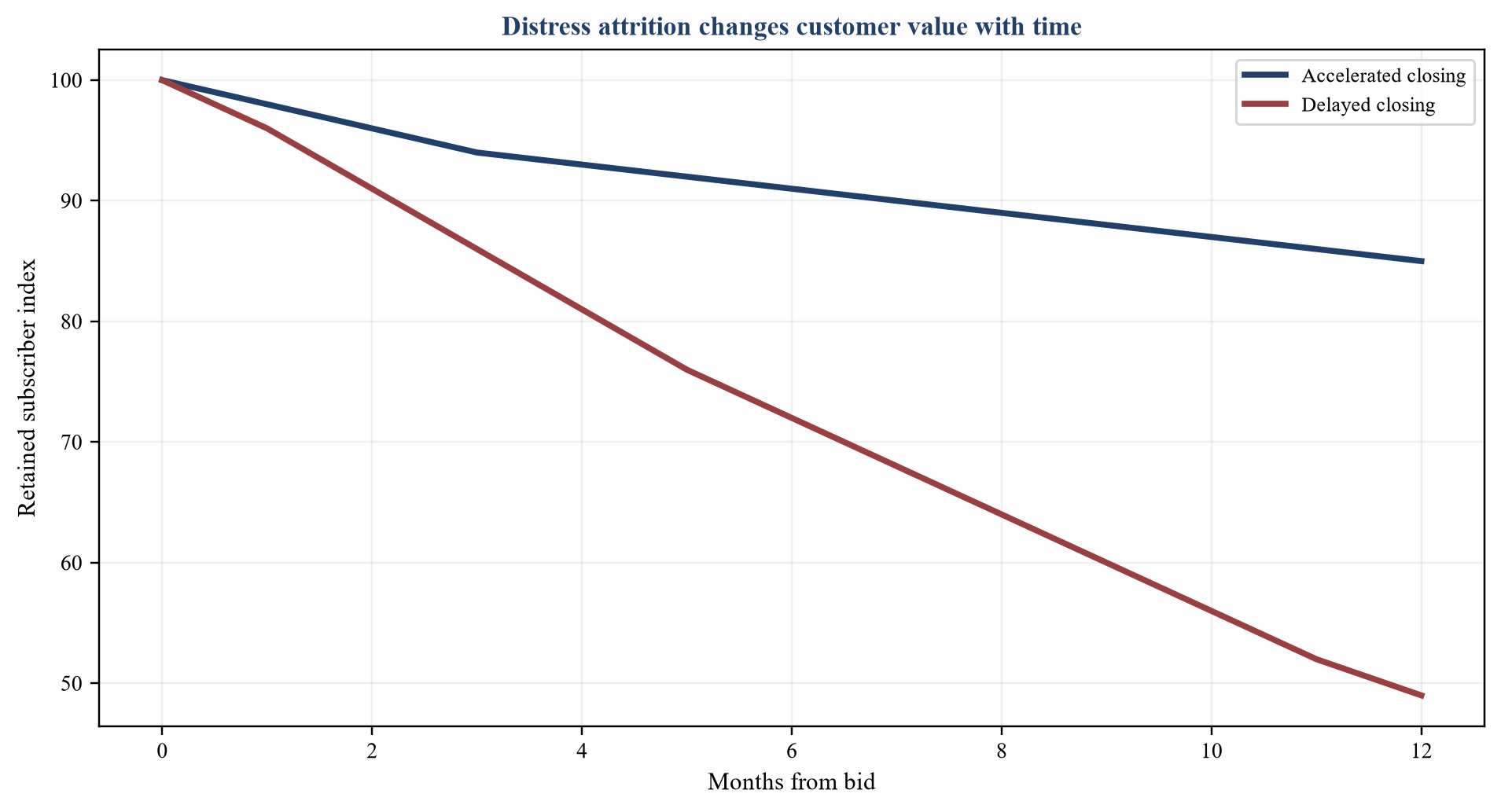
Illustrative retained subscribers under delayed and accelerated closing.
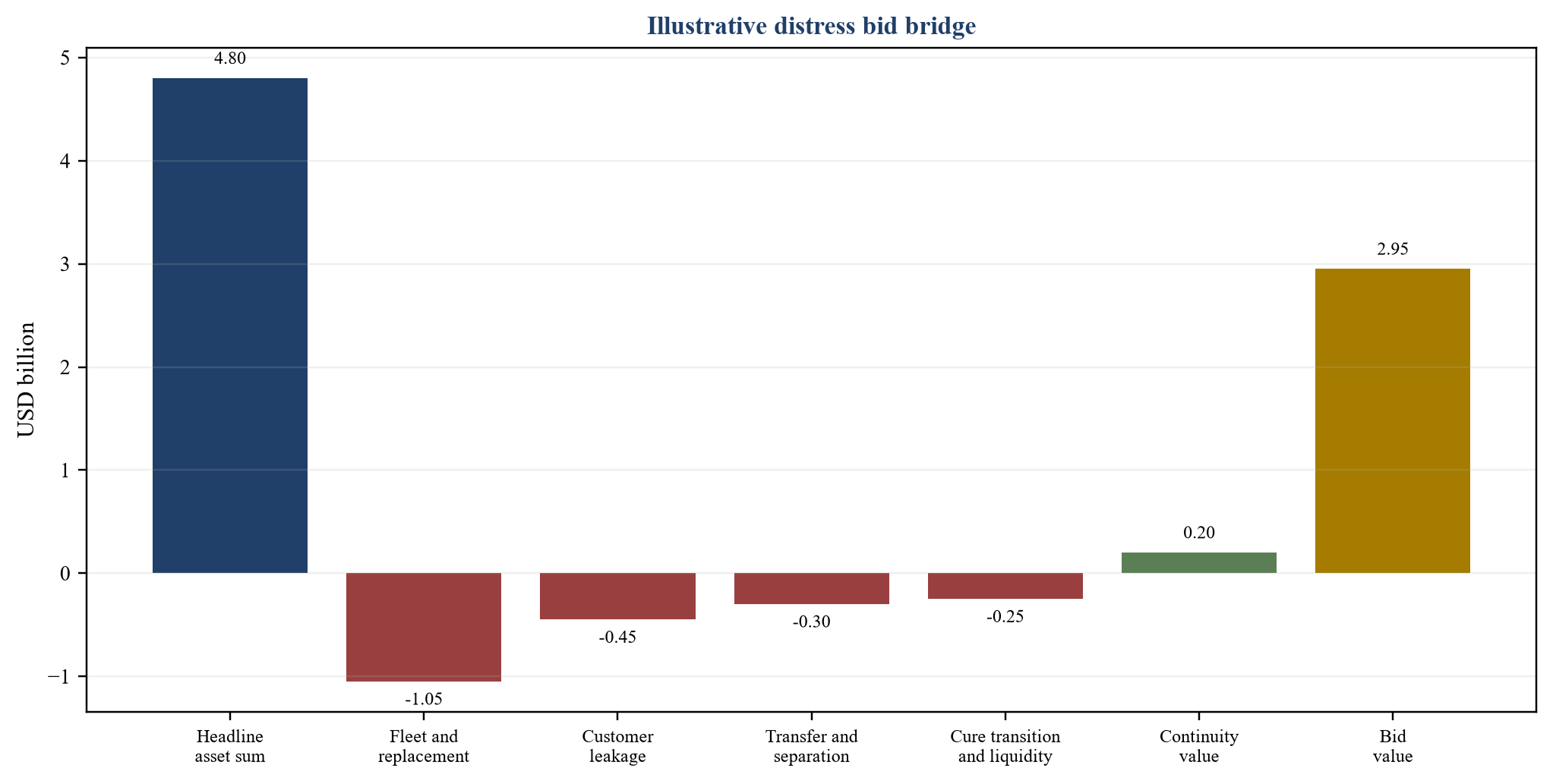
Illustrative bridge from headline asset sum to executable bid value.
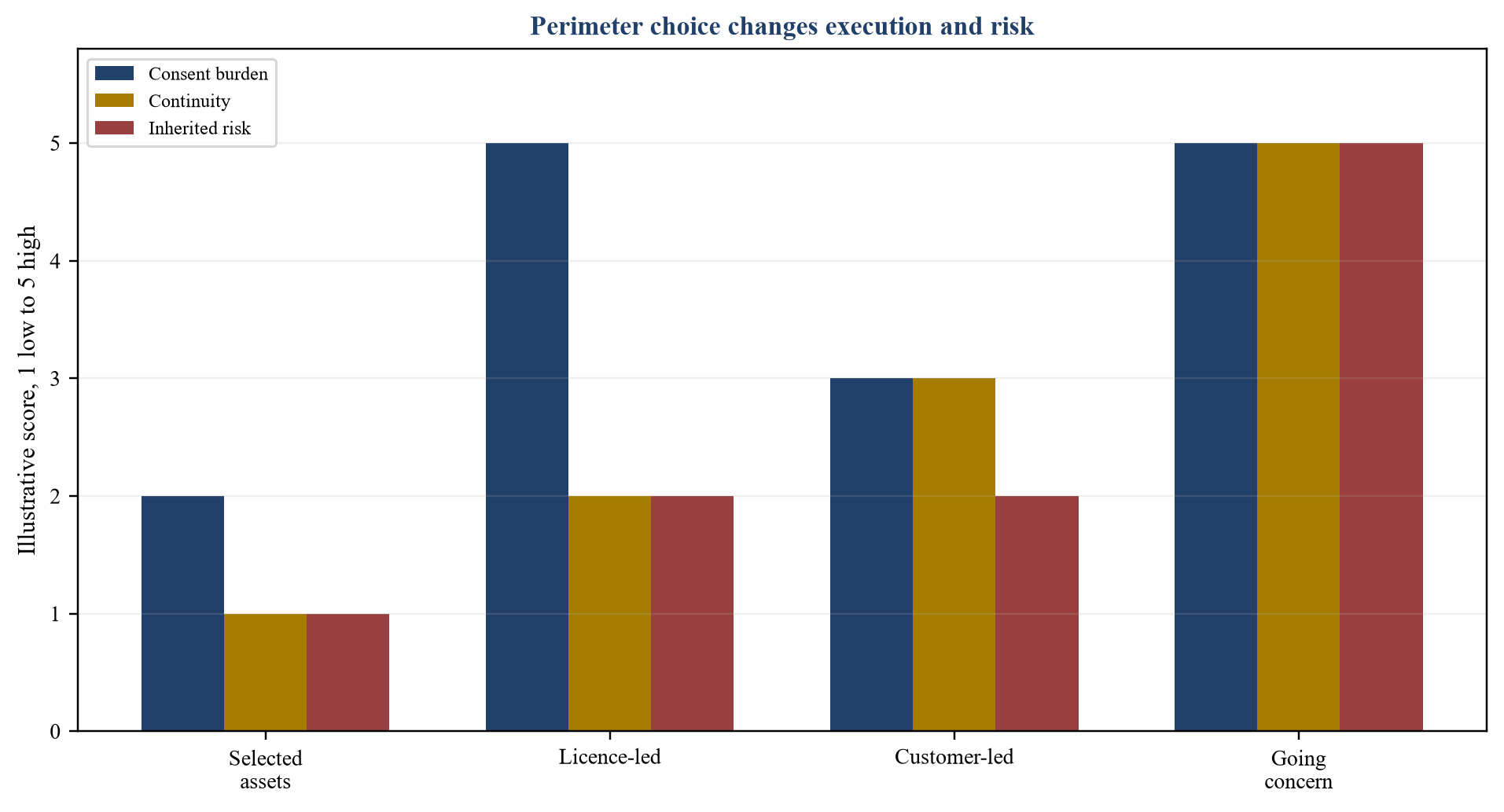
Illustrative comparison of consent burden, continuity and inherited risk.
| Perimeter | Principal value | Principal dependency |
|---|---|---|
| Selected assets | specific hardware or technology | recreated operating capability |
| Licence-led | spectrum and orbital rights | consent milestones and funded use |
| Customer-led | retained subscriber contribution | assignment capacity and migration |
| Going concern | continuity across complete system | inherited liabilities and cash burn |
Proposed decision framework.
| Component | Claimed value | Primary evidence |
|---|---|---|
| Spectrum and orbital rights | 1.80 | licences coordination and transfer path |
| Satellite fleet | 1.25 | capacity condition and remaining life |
| Ground infrastructure | 0.55 | title capacity and essential sites |
| Software and data | 0.30 | transferable rights and tested access |
| Customer relationships | 0.90 | cohort cash retention and assignment |
| Headline total | 4.80 | unreconciled starting point |
All amounts are illustrative USD billions and describe no identified company.
| Right | Required evidence | Bid treatment |
|---|---|---|
| Space station authorisation | transfer application conditions and milestones | closing condition |
| Earth station and gateways | licences sites and landlord rights | perimeter and cure |
| Market access | national permissions and change rules | country-specific condition |
| ITU filings and coordination | administration support and status | continuity evidence |
| Security and export control | approval and operating restrictions | condition and covenant |
Proposed consent register.
| Step | Amount | Evidence required |
|---|---|---|
| Headline asset sum | 4.80 | claimed component values |
| Fleet degradation and replacement | minus 1.05 | engineering and funded fleet plan |
| Customer attrition and leakage | minus 0.45 | cohort and assignment evidence |
| Transfer and separation risk | minus 0.30 | consent and dependency map |
| Cure transition and working capital | minus 0.25 | executable sources and uses |
| Verified continuity value | plus 0.20 | day-one plan and avoided cost |
| Final illustrative bid value | 2.95 | integrated evidence set |
All amounts are illustrative USD billions.
| Gate | Approval evidence | Stop condition |
|---|---|---|
| Perimeter | complete ownership and dependency map | essential orphan asset or service |
| Consent | credible applications and conditions | non-transferable critical right |
| Fleet | verified capacity and replacement plan | service life below contract need |
| Customers | assignable cash and retention plan | unsupported cohort value |
| Day one | tested command billing and security | uncontrolled service transfer |
| Funding | purchase cure transition and replacement cash | liquidity gap before stability |
Proposed board control.
| Risk | Potential protection | Release evidence |
|---|---|---|
| Licence consent | condition and long-stop | regulator approval |
| Fleet condition | price adjustment or escrow | independent inspection |
| Customer retention | earn-out or holdback | collected retained revenue |
| Cure amount | purchase-price adjustment | agreed cure statement |
| Transition dependency | funded TSA and step-in | tested standalone exit |
| Replacement capital | committed facility | production and launch milestones |
Proposed risk allocation.
| Dimension | Core measure | Trigger |
|---|---|---|
| Licences | approvals conditions and milestones | consent delay or breach |
| Fleet | capacity availability and remaining life | service shortfall |
| Customers | churn collections and contribution | retention below case |
| Operations | incidents command and network availability | continuity failure |
| Separation | TSA service and exit milestones | missed standalone date |
| Capital | cash burn replacement and liquidity | funding shortfall |
| Integration | owners dependencies and benefits | unresolved critical path |
Proposed weekly and monthly decision record.
Sources
- U.S. Federal Communications Commission, 47 CFR Section 25.119, Assignment or transfer of control of station authorization. Read the primary source
- U.S. Federal Communications Commission, R2 Space transfer-of-control enforcement order, DA 24-145. Read the primary source
- U.S. Federal Communications Commission, Space Modernization rules, FCC 25-69. Read the primary source
- UK Government, UK government to acquire OneWeb. Read the primary source
- UK Government, Ministerial direction for the purchase of OneWeb. Read the primary source
- Hughes Satellite Systems, 2025 Annual Report. Read the primary source
- Iridium Communications, 2025 Annual Report. Read the primary source
- Spire Global, 2025 Annual Report. Read the primary source
- Eutelsat Communications, 2025 Universal Registration Document. Read the primary source
- Globalstar, 2024 Annual Report. Read the primary source
- Satellogic, 2025 Annual Report. Read the primary source
- BlackSky Technology, 2025 Annual Report. Read the primary source
- U.S. Code, Title 11, Section 363, Use sale or lease of property. Read the primary source
- U.S. Code, Title 11, Section 365, Executory contracts and unexpired leases. Read the primary source
- U.S. Courts, Bankruptcy basics and liquidation under the Bankruptcy Code. Read the primary source
- International Telecommunication Union, Radio Regulations. Read the primary source
- International Telecommunication Union, Space services filing and coordination resources. Read the primary source
- UK Government, National Security and Investment Act guidance. Read the primary source
- U.S. Department of the Treasury, Committee on Foreign Investment in the United States. Read the primary source
- IFRS Foundation, IFRS 3 Business Combinations. Read the primary source
- IFRS Foundation, IFRS 5 Non-current Assets Held for Sale and Discontinued Operations. Read the primary source
- IFRS Foundation, IAS 36 Impairment of Assets. Read the primary source
- IFRS Foundation, IFRS 13 Fair Value Measurement. Read the primary source
- International Private Equity and Venture Capital Valuation Guidelines. Read the primary source
- International Valuation Standards Council, International Valuation Standards. Read the primary source
