

Introduction
Direct-to-device connectivity joins two regulated infrastructures that evolved separately: satellite networks and national mobile systems. The satellite operator controls orbital assets and may hold mobile-satellite assignments. The mobile network operator controls terrestrial spectrum, subscribers, billing, emergency-service routing and the domestic core network. Device manufacturers and standards bodies determine whether ordinary handsets can participate. National regulators decide which combination may operate and under what interference, coverage, consumer and security conditions.
The valuation problem is therefore a rights problem before it is a traffic problem. A global coverage map is not a revenue map. The analyst must identify which legal and contractual rights convert a technically reachable handset into a billable service, how long those rights last, what obligations attach to them and whether they survive financing or change of control.
This paper values the constellation through authorised territory-level cash flows. Spacecraft capacity, replacement and ground infrastructure remain essential. Their value is conditioned by the spectrum and partnership stack that permits service.
1. Define the rights and asset perimeter
The analyst should identify every asset, licence, agreement and obligation needed to deliver an accepted customer service. The perimeter includes spacecraft, launch and integration, gateways, network operations, spectrum assignments, domestic authorisations, mobile-network agreements, device permissions, emergency routing, software, cybersecurity, billing, customer support and decommissioning. Shared services and related-party arrangements require arm's-length treatment.
Legal ownership can differ from economic control. An ITU filing may sit with a notifying administration. A national authorisation may be held by a satellite affiliate. Terrestrial spectrum remains licensed to an MNO. Commercial access can depend on a lease, reseller agreement or revenue share. Device permission and emergency obligations may rest with the MNO. The perimeter should reconcile entities, rights, contracts, assets and cash flows.
The output is a dependency map showing which rights and assets sit inside the transaction, which require continuing agreements and which can interrupt revenue if withdrawn.
2. Distinguish the principal spectrum routes
Direct-to-device services can use frequencies allocated to mobile-satellite service, terrestrial mobile frequencies authorised for supplemental satellite coverage, or a portfolio combining both. These routes are not interchangeable. MSS spectrum can provide a dedicated satellite allocation and established international framework, while compatible device support and national licensing remain necessary. Terrestrial spectrum can reach ordinary handsets through an MNO partnership, while the satellite operator depends on the licensee's continuing consent and interference controls.
The rights register should identify band, direction, bandwidth, geography, primary or secondary status, protection level, device ecosystem, partner, authorising instrument and expiry. It should also show whether access is exclusive, shared, revocable or conditional on service milestones. Combining both routes can diversify regulatory dependence while increasing technical, contractual and device complexity.
The transaction model should value only the route that can legally and commercially serve each territory. A band plan or orbital filing without a complete domestic path remains development inventory rather than operating revenue.
3. Build the international-to-national rights chain
International frequency arrangements establish the environment in which administrations coordinate satellite networks. They do not by themselves authorise retail service in every country. National permissions can include a space-station licence, market access, landing rights, earth-station authority, device exemption, lawful-intercept capability, emergency-service routing and security review.
The analyst should create a chain for every market: international filing and coordination; satellite-system authority; frequency permission; terrestrial-licensee agreement where required; handset authority; gateway and core-network approval; consumer and emergency compliance; and commercial launch acceptance. A missing link prevents or narrows the service.
WRC-27 agenda item 1.13 addresses possible mobile-satellite allocations for direct connectivity between space stations and IMT user equipment. Until national regimes and the international framework converge, valuation scenarios should preserve jurisdictional variation and the possibility of later rule changes. [5][9]
4. Classify right maturity
Rights should be classified as concept, application, conditional approval, final authorisation, operational acceptance or proven renewal. Commercial documents should be classified separately as memorandum, framework, definitive agreement, activated service or recurring paid service. Combining an early regulatory application with a non-binding commercial announcement can create a misleading impression of readiness.
Each class receives a different probability, timing range and cost-to-complete. The probability should reflect evidence rather than a generic regulatory haircut. A final authorisation may still require device approval, interference testing or emergency integration. A definitive MNO agreement may contain conditions precedent tied to coverage, capacity or launch date.
Management should maintain dated evidence for every maturity assessment and identify the next decision that advances the right. Rights without an identifiable authority, process and accountable owner should remain outside the base case.
5. Translate spectrum into usable service capacity
Nominal bandwidth does not equal saleable capacity. Usable service depends on frequency, paired or unpaired configuration, power limits, antenna gain, beam reuse, device capability, terrestrial coordination, geography, gateway visibility, network routing and quality commitments. Low-band spectrum can support reach and device compatibility while offering less capacity than wider mid-band access.
The model should allocate authorised bandwidth by beam, geography, time and service class. It should reflect guard bands, out-of-band emission limits, coordination zones, terrestrial reuse and emergency priority. Coverage obligations may require service in low-demand areas and reserve capacity that cannot be sold twice.
Valuation uses authorised, delivered and billable capacity after regulatory and engineering constraints. Satellite count and theoretical coverage are supporting measures.
6. Underwrite the mobile-network partnership
For terrestrial-spectrum services, the MNO agreement can be the central commercial right. Diligence should establish the bands and territories covered, exclusivity, subscriber access, integration responsibility, service priority, billing, marketing, customer ownership, data control, revenue share, minimum payments, capital contributions and termination rights.
The analyst should distinguish a memorandum from a binding agreement and a binding agreement from an activated service. Conditions precedent may include regulatory approval, minimum constellation coverage, core-network testing, compatible devices and agreed service quality. Prepayments can fund deployment while creating delivery obligations or refund exposure.
Partner concentration deserves explicit treatment. A single national MNO can accelerate access while increasing renewal and repricing risk. Multi-operator arrangements can expand distribution while complicating exclusivity, spectrum coordination and customer experience.
7. Map device and standards dependency
Direct-to-device adoption depends on the installed handset base, supported radio bands, chipsets, operating systems, SIM profiles, power limits and network standards. 3GPP non-terrestrial-network work provides a common technical path, while implementation remains device- and network-specific. The model should identify the exact devices and software versions that can use each service mode. [10][11]
MSS-band services may require compatible chipsets or dedicated radio support. Supplemental coverage in terrestrial bands can reach standard handsets where the satellite and MNO reproduce the required air interface. Both approaches can face device authorisation and performance constraints. The addressable subscriber base should therefore be measured as eligible active devices, rather than the MNO's full reported subscriber count.
Device transitions create timing and marketing costs. Support, battery consumption, line-of-sight requirements and service discovery affect actual usage. Valuation should admit device expansion only after standards, silicon, software and operator implementation are evidenced.
8. Price regulatory access and coverage obligations
Regulatory access can carry application fees, annual spectrum charges, licence payments, security obligations, lawful-intercept cost, emergency-routing requirements, reporting and service commitments. Some obligations are fixed by market; others scale with subscribers, bandwidth or revenue. The model should attribute them to the territory that creates them.
Coverage commitments may create strategic value and economic burden simultaneously. A service can strengthen national resilience and extend rural coverage, while requiring capacity in cells with low commercial traffic. Public support, universal-service funding or minimum MNO payments should be evidenced separately from the obligation.
The licence model should include renewal, modification and revocation. An apparently inexpensive authorisation can be costly if it requires rapid deployment, interference remediation or coverage before subscriber revenue matures.
9. Model wholesale and retail pricing
Pricing can take the form of a monthly add-on, premium tariff, usage fee, emergency service, wholesale capacity charge, minimum commitment or revenue share. The satellite operator may have no direct retail relationship. The economic unit should match the contract: eligible subscriber, activated subscriber, message, minute, megabyte, reserved beam or covered territory.
Global averages conceal local economics. A national MNO can bundle coverage to reduce churn or strengthen a premium plan even when satellite usage is low. The constellation's value to the partner can therefore exceed direct usage revenue. A transaction model should separate observed cash payments from estimated retention or brand benefits.
The model should link price to eligible devices, outdoor availability, service quality, capacity and coverage. A headline partnership covering millions of subscribers should not be converted into revenue without an adoption, usage, billing and revenue-share mechanism.
10. Identify interference and coexistence constraints
Terrestrial and satellite transmissions can share or adjoin bands under carefully defined conditions. The rights register should identify in-band and adjacent-band users, power-flux-density limits, out-of-band emissions, geographic restrictions, border coordination, radio-astronomy concerns and the responsible interference-remediation process.
The commercial model should reserve capacity and cost for compliance. Beam shaping, power control, scheduling, exclusion zones and network coordination can reduce usable throughput. A service authorised on a non-interference or no-protection basis bears a different risk from a protected primary allocation.
Interference disputes can delay launch, narrow geography or require redesign. The valuation should include an accountable technical owner, regulatory escalation path and funded remediation range rather than a single generic risk premium.
11. Integrate emergency and public-safety obligations
Emergency communications create public value and operating obligations. The FCC framework includes interim 911 routing and information requirements for SCS arrangements. National regimes can require emergency calling, location, lawful intercept, outage reporting or priority handling. These capabilities involve the MNO core, device information, routing and trained support. [1][12]
The analyst should map who accepts the emergency message or call, how location is derived, which public-safety point receives it, what happens when data is incomplete and who bears liability. Service marketing must remain consistent with actual availability and regulatory approval.
Emergency capability can improve renewal prospects and support public funding. Its value should be linked to an executed payment or evidenced strategic benefit, while its cost and liability enter the base operating case.
12. Assess exclusivity and competition
Exclusivity can apply by territory, MNO group, frequency band, service class, device ecosystem or period. It may improve launch certainty and partner commitment while limiting alternative distribution. The model should identify carve-outs, performance conditions, matching rights and termination consequences.
Competition occurs across satellite architectures, terrestrial expansion, roaming, emergency-only features and public coverage programmes. An MNO may partner with more than one satellite operator for resilience or service differentiation. A satellite operator may require multiple MNOs to achieve national reach or sufficient bandwidth.
Valuation should test the economics after exclusivity expires and after partner repricing. Strategic scarcity belongs in value only when protected by enforceable rights, switching costs or demonstrated performance.
13. Test transferability and change of control
Spectrum and market-access rights may require regulatory consent for assignment, control changes or substantial ownership changes. MNO agreements can contain consent, termination, competitor or financial-capacity clauses. ITU filings may depend on a notifying administration and continuing deployment milestones.
The transaction timetable should identify every consent and long-stop date. A share acquisition can avoid some asset-assignment steps while still triggering control review. A licence held outside the target perimeter can require a new lease or transitional arrangement.
The buyer should avoid paying full value for rights that can be withdrawn at closing or that do not travel with the acquired business. Conditions precedent, price holdbacks and termination rights should follow the consent map.
14. Measure coverage and service acceptance
Regulatory authorisation permits a service within conditions; commercial acceptance confirms that the service works for the partner and customer. Acceptance testing should cover geography, handset classes, message or call success, throughput, latency, handover, interference, emergency routing, security and billing.
Coverage claims should distinguish landmass reach, population reach, outdoor availability, service probability and continuous capacity. A satellite footprint can cover a country while constellation density provides only intermittent service. The rights value increases as accepted service converts conditional commercial agreements into billable operations.
Milestone payments and revenue recognition should reconcile to acceptance evidence. Test results from one market or band should not be transferred automatically to another device or regulatory configuration.
15. Include gateways core networks and security
Gateways, feeder links, points of presence, cloud services, MNO cores, signalling, identity, billing and cybersecurity convert the radio link into a customer service. Each component can require local authority, security review, data localisation or resilience controls.
The rights map should identify gateway licences and whether traffic may be routed across borders. Inter-satellite links can reduce some gateway dependencies while preserving national interception, emergency and data obligations. The MNO integration plan should specify interfaces, testing, fault ownership and continuity.
Sustainable cash flow should include recurring software, certification, security and operations investment. A spectrum right has little operating value where the ground and core-network path remains incomplete.
16. Value spectrum as a conditional operating right
Spectrum and orbital filings enable operation within defined parameters. They are governed through international coordination, national authorisations, deployment milestones, partner agreements and continuing compliance. Value resides in the complete operating chain rather than a frequency label alone.
The analyst should map frequency, bandwidth, territory, notifying administration, priority, coordination, protection status, device support, MNO access, deployment milestone, expiry and change-of-control implications. The map should distinguish a proprietary licence, a contractual usage right and a partner-dependent permission.
Spectrum should not be counted both as a separate intangible and through the operating cash flows it enables. A relief-from-royalty method, comparable spectrum transaction or option method can provide a cross-check where evidence supports the inputs. The primary enterprise valuation should retain authorised operating cash flows and explicit rights risks.
17. Preserve orbital and spectrum sustainability
The operating right also depends on responsible orbital performance. The operator must manage collision avoidance, end-of-life disposal, reporting, interference and coordination. Failures can affect licensing, partner confidence and public acceptance.
National satellite authorisations and international coordination can impose continuing obligations. The rights register should connect each obligation to telemetry, reporting, engineering controls and board accountability.
The model should include disposal, reporting, remediation, insurance and decommissioning costs. Sustainability performance can affect renewal, additional spectrum access, MNO procurement and financing, so it enters cash flow and risk.
18. Measure continuity across terrestrial and satellite layers
Direct-to-device service is supplemental. The customer moves between terrestrial and satellite layers as coverage changes. The model should test network selection, authentication, service discovery, fallback, handover, messaging queues, emergency routing and customer communication.
Constellation gaps, gateway outages or partner-core failures can interrupt the satellite layer. Include spares, routing alternatives, priority rules and minimum redundancy. A resilience promise may require diversity across gateways, bands or satellite providers.
Continuity has a cash consequence through credits, churn, emergency exposure and renewal risk. Service-level evidence should be measured by territory, device and use case.
19. Build the authorised subscriber contribution bridge
Revenue should bridge to cash contribution through eligible devices, activation, usage, MNO share, support, bad debt, gateway use, cloud, spectrum fees, emergency operations and allocated satellite-network cost. The model should identify which costs scale with subscribers, traffic, geography, bandwidth or constellation size.
Consumer contribution may arise through an add-on or tariff-retention benefit. Enterprise and public-safety offers can include minimum payments or reserved capacity. Wholesale economics may reduce acquisition cost while transferring pricing power to the MNO.
The bridge should be tested by territory and partner. Management reporting that combines authorised and planned markets can hide development spend and cross-subsidy. Terminal value should use contribution after partner share and rights-related cost.
20. Connect demand to spectrum and coverage decisions
Every additional band or market should have a defined commercial purpose. It may expand eligible devices, improve capacity, add resilience, satisfy coverage obligations or support a new partner. The business case should state the right acquired, incremental service, cash cost, integration dependency and downside use.
The investment committee should require a rights business case before material application, acquisition or partnership spend. It should show the authority path, partner economics, device base, expected price, capacity, coverage duty, interference plan and cancellation point.
This discipline prevents a global coverage narrative from driving capital. The rights portfolio becomes a sequence of dated market-entry decisions.
21. Construct authorised free cash flow
Sustainable free cash flow begins with revenue from authorised, activated territories. Deduct the MNO share, network operations, customer support, emergency capability, spectrum and licence cost, ground renewal, constellation replenishment, tax and working capital. Development markets remain outside base cash flow until their rights milestones are achieved.
The forecast should extend through licence renewal and at least one satellite replacement cycle. A shorter period can place regulatory renewal or capital cliffs inside terminal value. The terminal year should contain normalised rights cost, partner economics, device support and replacement capital.
Debt service should be tested against cash from final authorisations and enforceable contracts. Lenders may require partner minimums, regulatory milestones, reserves, launch contracts, insurance, minimum liquidity and covenant headroom.
22. Set terminal value around renewable rights
A perpetual-growth terminal value assumes that the business can maintain its assets and renew the rights supporting terminal cash flow. The analyst should examine licence duration, renewal criteria, MNO term, device evolution, competition and spectrum policy. Cash flow must include steady-state replenishment and continuing compliance.
The analyst should cross-check terminal value against authorised subscriber contribution, rights duration, invested capital and capacity value. A high terminal multiple is difficult to support where access depends on one revocable partner or a temporary authorisation.
Terminal sensitivity should vary renewal, partner share, authorised markets, device eligibility, utilisation, replacement cost and discount rate together. Regulatory delay and commercial repricing can be correlated.
23. Avoid accounting and valuation mismatches
Accounting recognition can differ from transaction value. IAS 38 addresses identifiable intangible assets and useful life; IAS 36 addresses impairment; IFRS 13 provides the fair-value framework. A spectrum usage right recorded at cost may have higher or lower economic value depending on authorisation, transferability and cash generation. [13][14][15]
An indefinite-life classification does not make a right perpetual. The analyst should reconcile legal term, renewal expectations, partner duration, accounting life, tax basis and the period used in cash flow.
Capitalised filing, legal, regulatory and development cost should be reviewed for consistency. Impairment or write-offs can reveal changed expectations without automatically setting transaction value.
24. Value technology and standards options separately
New payloads, antennas, chipsets and 3GPP releases may improve throughput, spectrum reuse, device compatibility or service classes. The analyst should define the capability, standard maturity, device adoption, regulatory path, remaining development and customer benefit.
Option value equals incremental cash flow after rights, integration, device and transition cost. It should not be capitalised merely because a demonstration succeeded or a standard was published. Capacity without permission and distribution has limited operating value.
Technology options can be probability weighted and staged. A standard, prototype, in-orbit demonstration, authorised trial and paid commercial service are distinct evidence gates. Value increases when technical evidence, rights and funded demand converge.
25. Build the hypothetical rights portfolio
The illustrative business targets 12 countries through eight signed MNO arrangements. Four countries have final operating authority and activated technical acceptance. Three have conditional authority subject to device or emergency integration. Three have applications in process. Two remain commercial options without an identified authorisation timetable.
The authorised four-country base covers 62 million eligible devices. The model assumes 6.0 per cent paid activation, USD 4.50 monthly retail revenue per activated user and a 45 per cent satellite-operator share. Enterprise and public-safety minimums add USD 110 million a year. Annual spectrum, partner integration, emergency, ground and compliance cost totals USD 220 million before constellation operations and replacement.
The central case adds two conditional markets after evidence gates and excludes the five application or option markets from base value. All assumptions are hypothetical. The discipline prevents projected global device reach from entering cash flow before rights and distribution are complete.
26. Advance rights through evidence gates
The hypothetical board considers five levers: complete emergency and device integration in two conditional markets; convert two applications into final authority; add a second MNO in a concentrated territory; secure minimum revenue for required rural coverage; and expand the compatible-device base through an evidenced standards roadmap.
The combined case increases eligible devices in authorised or near-authorised markets from 62 million to 104 million. Paid activation reaches 6.5 per cent after rollout, while the satellite-operator revenue share remains 45 per cent. Annual enterprise and public-sector minimums rise to USD 170 million. Added compliance and integration cost is included before value is recognised.
The improvement is conditional on final written authority, activated MNO acceptance, compatible devices and enforceable economics. Each lever receives a milestone, cost-to-complete and abandonment decision rather than immediate full credit.
27. Bridge headline value to rights-adjusted value
The hypothetical headline enterprise value is USD 6.8 billion. The bridge deducts USD 1.15 billion for projected cash from unauthorised markets, USD 0.55 billion for MNO renewal and repricing risk, USD 0.40 billion for interference and device limitations, USD 0.35 billion for coverage and emergency obligations and USD 0.25 billion for regulatory delay and change-of-control exposure. The resulting rights-adjusted value is USD 4.10 billion.
Additional territories can add value after evidence gates. In the illustration, a probability-weighted USD 1.15 billion market-access option is offset by USD 0.45 billion of regulatory, integration, device and coverage investment, adding net USD 0.70 billion. The final illustrative value becomes USD 4.80 billion.
The bridge prevents planned rights from being treated as operating assets. It keeps regulatory and partnership upside visible without treating it as completed.
28. Stress correlated regulatory and commercial downside
The severe case combines a twelve-month regulatory delay in three markets, loss of one major MNO partner, a five-percentage-point reduction in operator revenue share, device eligibility limited to half the expected base, higher interference-remediation cost and slower activation. These variables can interact because delayed rights reduce scale while partner concentration weakens pricing.
The model should calculate liquidity, covenant headroom and funding need through the delay. Management actions may include staging market entry, prioritising MSS-band services, renegotiating coverage commitments, adding partner diversity or raising equity. Each action has timing and commercial consequences.
The board should identify the earliest decision date. Regulatory submissions, satellite configuration and partner exclusivity can make later changes expensive.
29. Structure financing around rights maturity
Financing should match rights maturity and cash profile. Equity can fund technology, applications and early market access. Partner prepayments can fund integration subject to delivery obligations. Project-style debt may become possible where final rights, contracted minimum revenue, defined capacity, reserves and replacement funding are credible.
Debt sizing should use cash from authorised territories and downside liquidity. Covenants may test final licences, activated partners, contracted revenue, eligible devices, coverage performance, liquidity and regulatory status alongside leverage.
A lender needs visibility over satellite title, insurance, spectrum dependencies, MNO contracts, regulatory consents, ground assets and step-in limitations. Security over a licence or usage right may be restricted.
30. Design transaction diligence
An acquisition or financing data room should include the spectrum-rights register, ITU filings, coordination record, national licences, MNO agreements, device approvals, emergency design, interference studies, gateway rights, coverage tests, subscriber eligibility, pricing, capacity, satellite register, launch contracts and territory cash flow.
Technical, commercial, regulatory and financial teams should share one territory-band-partner identifier. This allows a claimed market to be traced from legal authority and spectrum through device support, capacity, customers, revenue and cost. Inconsistent identifiers create false reconciliation.
Confirmations should focus on high-value dependencies: notifying administration, national regulator, material spectrum licensee, key MNO, gateway host, device partner and insurer. Diligence should protect controlled or security-sensitive information.
31. Establish governance after closing
The board should approve a rolling rights plan, territory launch sequence, spectrum and interference report, partner concentration limits, coverage commitments, customer-economics thresholds and technology gates. Capital approval should show the right pursued, demand served, evidence confidence, cost-to-complete and downside liquidity.
Monthly reporting can include applications, conditional and final rights, partner status, eligible devices, acceptance testing, authorised capacity, activation, subscriber contribution, regulatory milestones, interference events and renewal dates.
Independent review is appropriate when management changes rights probability, renewal, partner economics or terminal assumptions materially. Those changes affect capital and valuation together.
32. Define the investment decision
The final decision should state the rights-adjusted enterprise-value range, funding required through commercial activation, final and conditional regulatory rights, partner economics, customer contribution, capacity dependencies, downside liquidity and conditions for additional-market upside.
Approval can be staged through closing conditions, regulatory milestones, escrow, earnouts, committed capital tranches or covenants. Price should remain connected to enforceable operating rights and sustainable cash.
The board should record the evidence that would change the decision. A valuation framework becomes useful when it supports action under uncertainty and can be refreshed as cohorts mature.
33. Reconcile valuation with market evidence
Market evidence can test the model, although no quoted multiple resolves differences in rights. Public operators differ in constellation maturity, spectrum route, national authority, partner concentration, device access, launch capacity and accounting. Private transactions may include usage rights, preferred securities, commercial agreements, prepayments or funding commitments that are absent from headline value.
The analyst should build a comparison matrix before using revenue, subscriber, spectrum or EBITDA multiples. The matrix should show authorised territories, bandwidth, protection status, partner term, eligible devices, service maturity, replacement treatment, net debt and remaining deployment capital. Adjusted observations can inform a range.
Recent funding prices may reflect scarcity, strategic access or investor-specific benefits. They should be reconciled to the rights acquired and capital still required. Globalstar's disclosed customer-funded extended network and AST SpaceMobile's disclosed spectrum-usage arrangements illustrate structures that combine capital, commercial access and rights; they are not direct valuation comparables without contract-specific adjustment. [7][8]
34. Incorporate tax and jurisdictional cash movement
Constellation revenue, assets and licences span jurisdictions. The valuation should map service entities, spectrum-right holders, satellite ownership, intellectual property, gateways, MNO billing, withholding taxes, indirect taxes, transfer pricing and cash repatriation. Regulatory entities may need local capital or face distribution restrictions.
Tax depreciation can differ from accounting and economic life. Launch and satellite expenditure may receive different treatment by jurisdiction. Losses generated during deployment may expire or remain trapped outside profitable entities. The model should therefore calculate cash tax by legal entity and scenario rather than apply a group rate mechanically.
Change of control can affect tax attributes, licences, MNO agreements and intercompany arrangements. Transaction structure may alter the perimeter of debt, intellectual property and spectrum rights. Tax benefits should enter value after legal availability, timing and execution cost are established. Transaction-specific advice is required.
35. Test insurance and contingent liabilities
Insurance can cover launch, in-orbit failure, third-party liability, cyber events or specific assets, subject to exclusions, deductibles and limits. Contractual indemnities can allocate interference, emergency-service, data, security and service-interruption exposure between the satellite operator and MNO. The analyst should reconcile policies, partner caps, claims history and self-insured exposure.
Liability can extend beyond satellite replacement cost. Harmful interference can require service restriction. Emergency-routing failure can create regulatory exposure. Service interruption can trigger credits or claims. Government customers may require indemnities, security controls or priority restoration.
Expected loss should be modelled through frequency, severity and correlation. Rare events can affect multiple satellites, a shared component, a launch batch or ground infrastructure. Insurance recoveries should reflect policy terms and collection timing. Uninsured exposure belongs in liquidity and value, while remote legal outcomes should remain scenario-specific rather than presented as certain obligations.
36. Establish evidence confidence and refresh rules
Every material assumption should carry a source, date, owner and confidence level. Final authorisations, executed partner agreements, accepted service tests and paid invoices provide stronger evidence than applications, memoranda, demonstrations or roadmaps. Confidence affects scenario weighting and price protection.
The model should refresh when rights are granted or modified, a partner agreement changes, WRC or national policy moves, device support expands, interference occurs, pricing changes or a new market activates. A quarterly refresh may be appropriate during deployment, supported by a monthly rights dashboard.
Evidence confidence should also determine diligence expenditure. A high-value assumption supported only by management forecast warrants independent technical, commercial or contractual verification. A low-value assumption may be monitored through sensitivity. This proportional approach focuses time and cost on the variables capable of changing price, financing capacity or approval.
Version control is essential because small changes in partner share, rights timing, eligible devices and activation can alter value materially. The board pack should retain the prior model, explain changes and identify which evidence changed. A model that cannot reproduce its earlier decision is unsuitable for transaction governance.
Conclusion
Direct-to-device value begins with a complete chain of operating rights. International assignments, national authorisations, terrestrial spectrum access, MNO agreements, device support, emergency integration, interference control and coverage obligations must be valued as one operating system.
Authorised-market cash flow and recurring replenishment belong inside sustainable value. Additional markets and standards can create upside after rights, distribution and service evidence are established. A rights-based model exposes the dates, obligations and dependencies that global coverage claims conceal.
For boards and transaction teams, the practical test is direct: can the network retain spectrum access, satisfy partner and public obligations, protect service quality and generate cash through licence and asset cycles? The answer determines financeability and value.
Appendix A. Spectrum and market-access register
The minimum register contains country, band, bandwidth, direction, international filing, national authority, licence holder, protection status, MNO partner, device route, emergency obligation, coverage commitment, issue and expiry dates, renewal, transferability, change of control and evidence owner.
Appendix B. Partner subscriber and capacity register
For every material territory and service, record eligible devices, activated users, traffic, price, MNO share, minimum revenue, usable capacity, reserved capacity, support cost, churn, service commitment and regulatory permission. This register connects rights with cash.
Appendix C. Rights investment checklist
Each proposed right should identify the authority path, partner, eligible devices, capacity, demand, coverage duty, interference controls, emergency route, cost-to-complete, liquidity, downside use and cancellation point. Approval evidence should be dated and owned.
Appendix D. Worked-case figures and tables
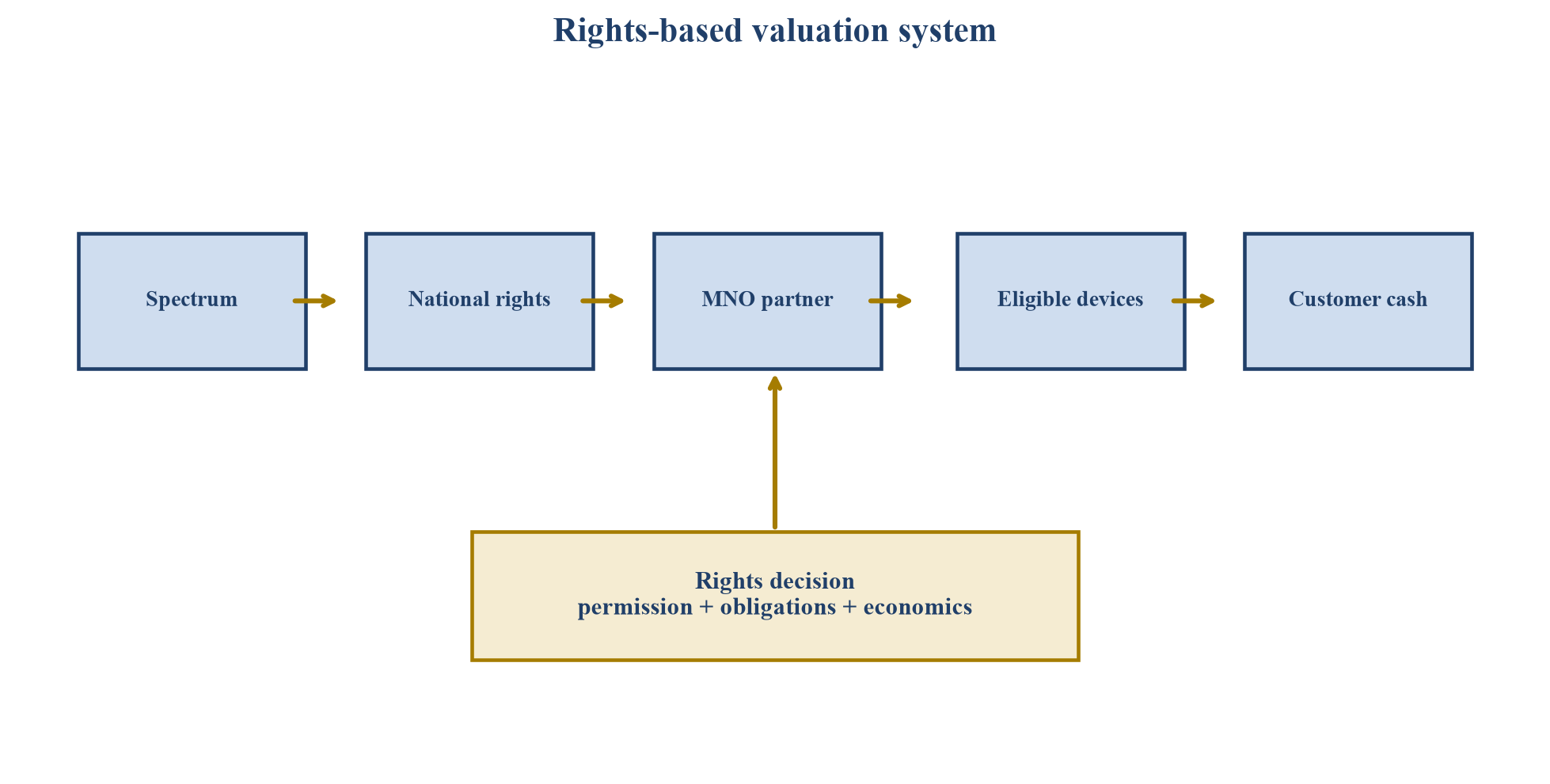
Proposed architecture connecting spectrum, national authority, MNO partnership, device access and customer cash.
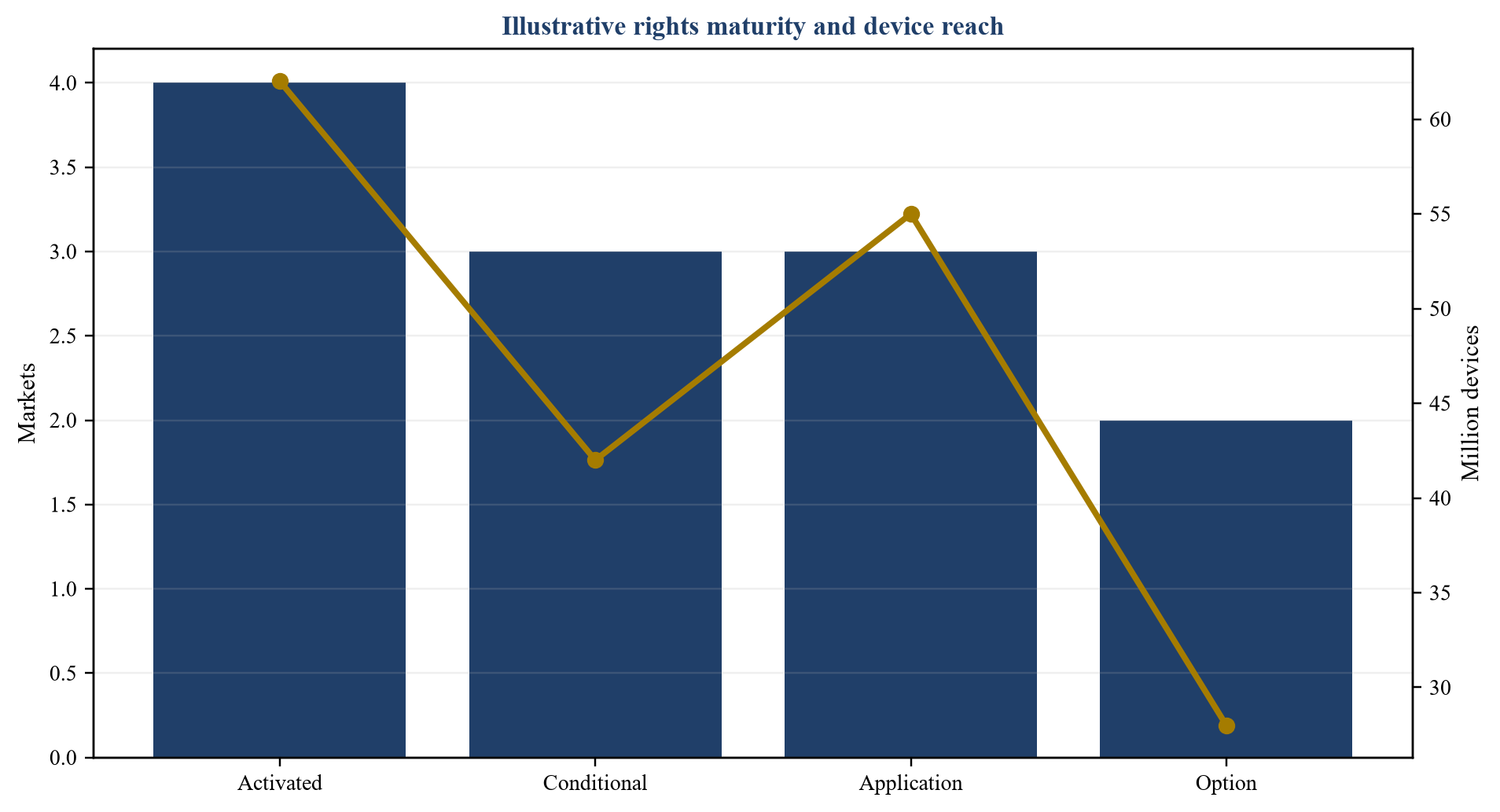
Hypothetical twelve-country portfolio by rights stage and eligible devices.
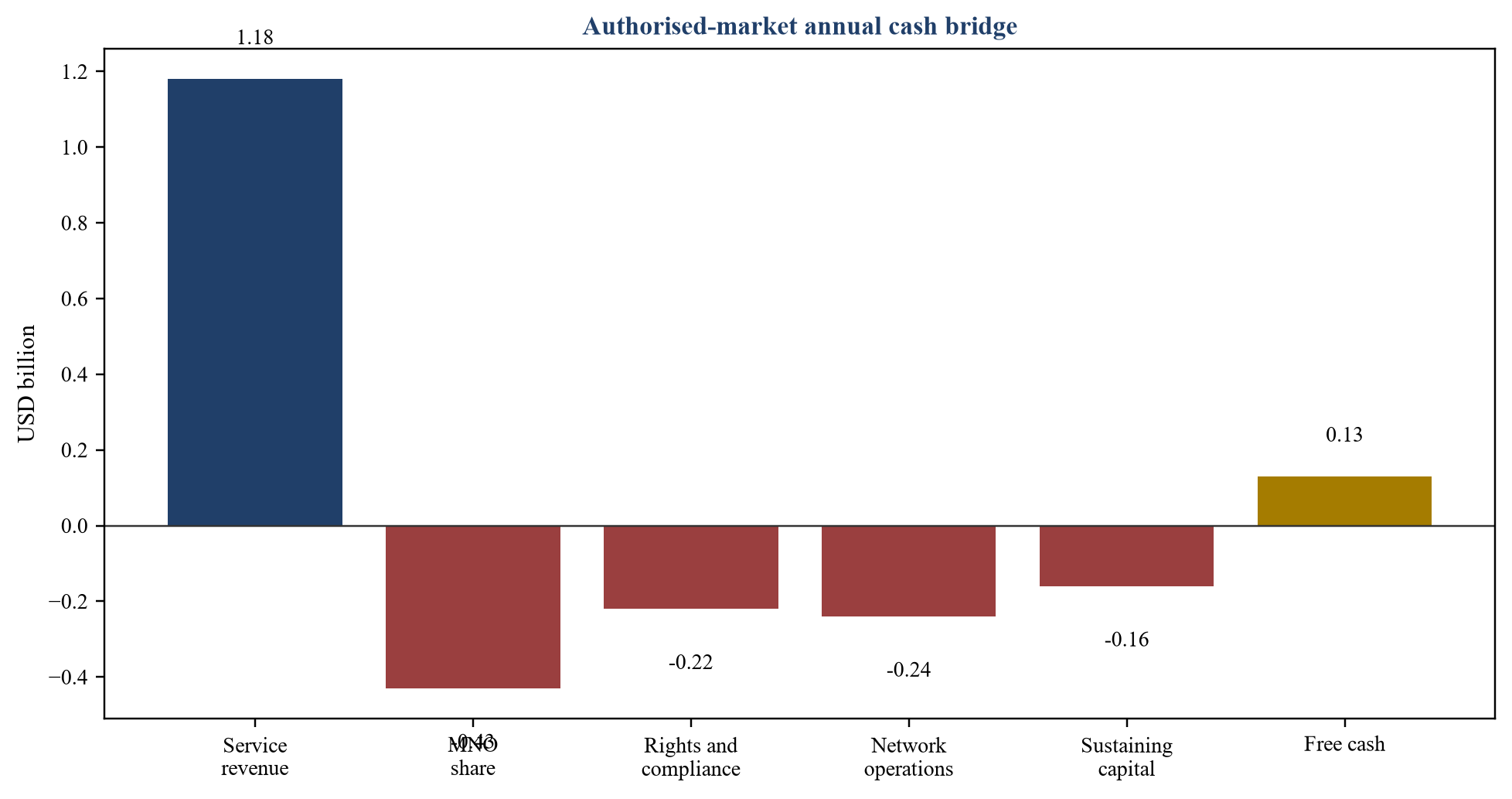
Hypothetical annual revenue less partner share, rights and compliance, network operations and sustaining capital.
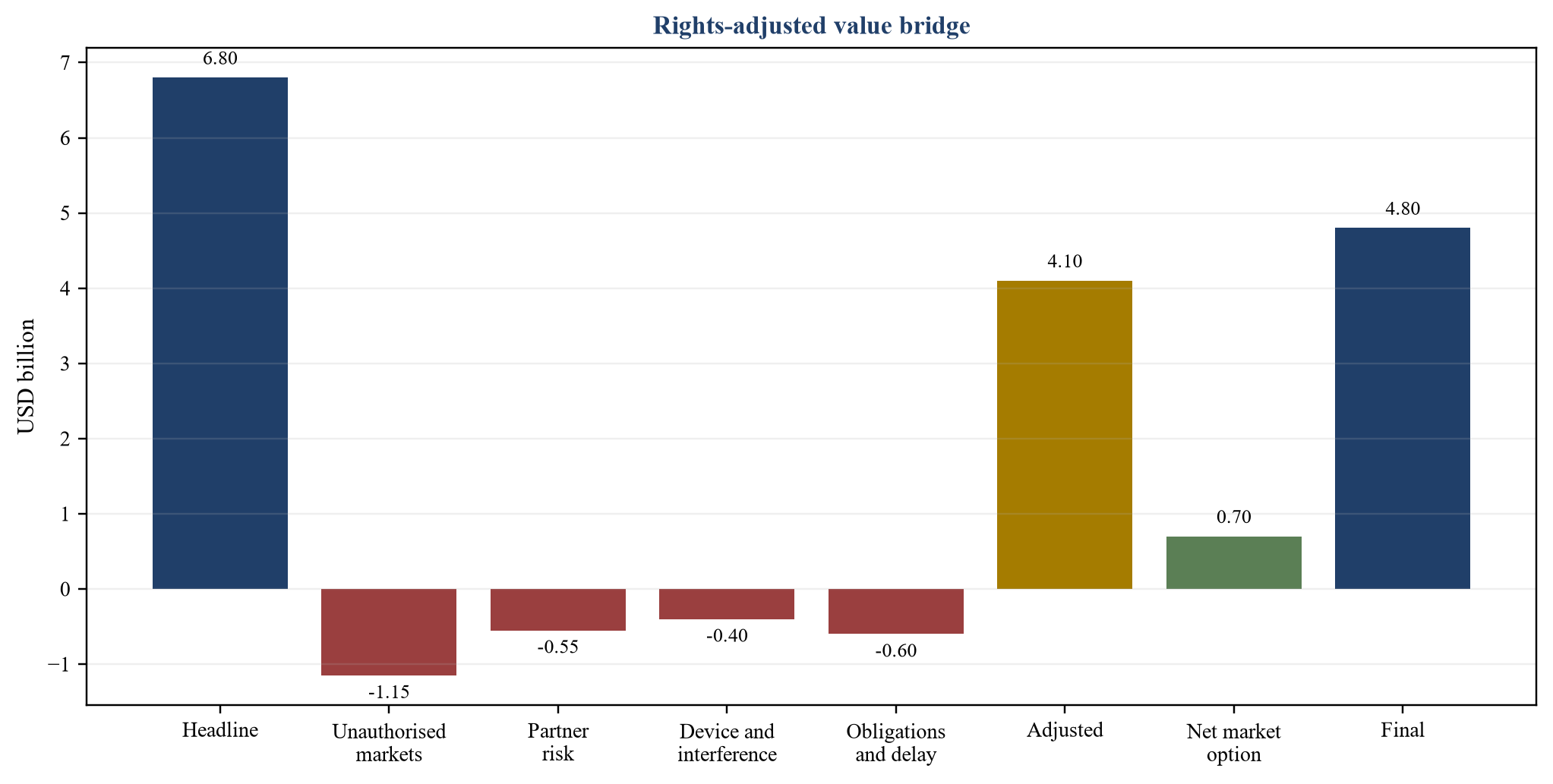
Hypothetical bridge from headline enterprise value to rights-adjusted value and additional-market option.
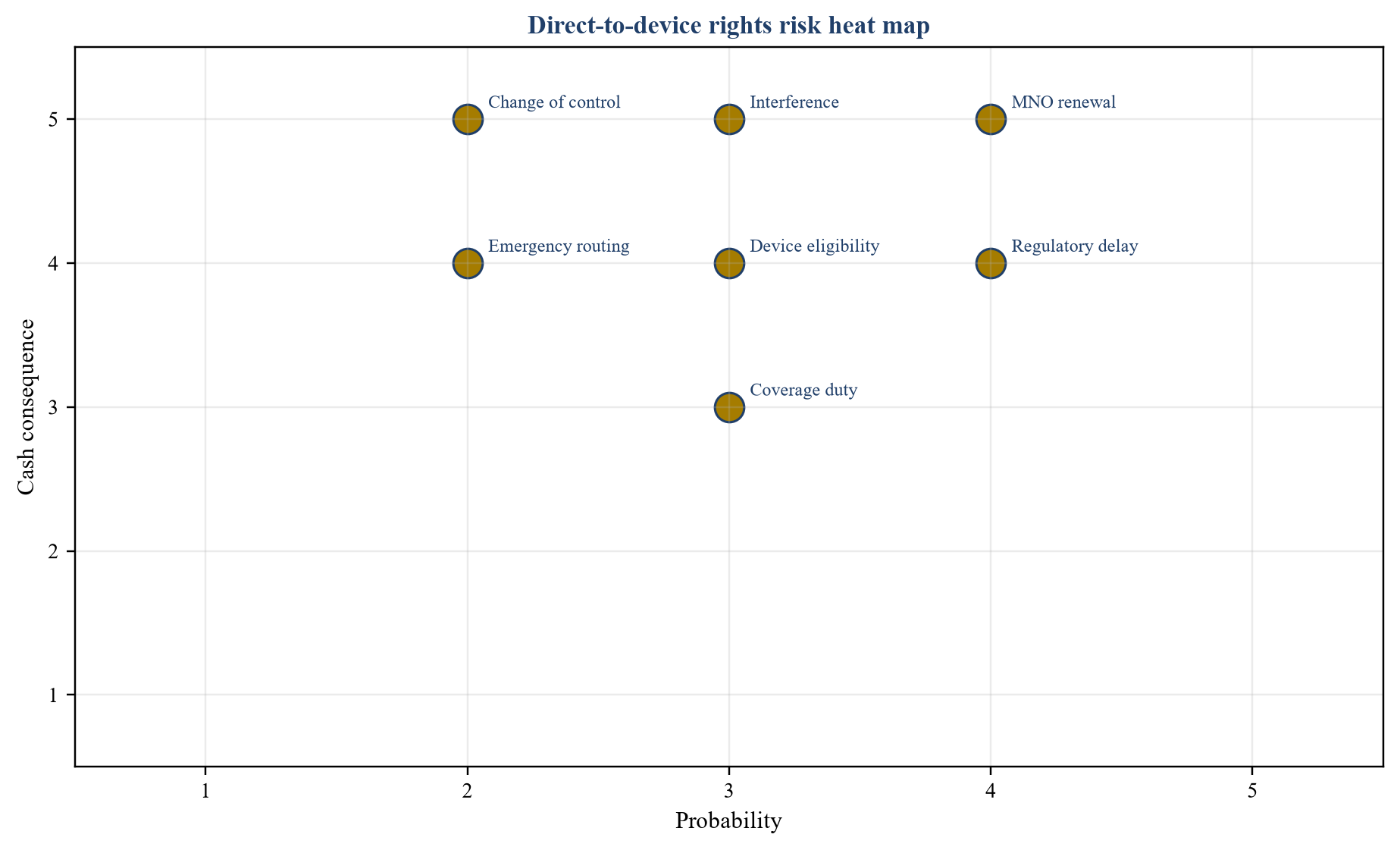
Illustrative probability and cash consequence assessment for key rights and partnership risks.
| Evidence | Required measure | Valuation use |
|---|---|---|
| International spectrum | filing priority coordination and milestones | underlying frequency route |
| National authority | band territory conditions and duration | authorised cash flow |
| MNO agreement | scope term economics and termination | distribution and pricing |
| Device access | eligible models standards and software | addressable subscribers |
| Obligations | coverage emergency interference and security | cost and renewal risk |
Proposed diligence fields.
| Stage | Markets | Eligible devices |
|---|---|---|
| Activated final authority | 4 | 62 million |
| Conditional authority | 3 | 42 million |
| Application in process | 3 | 55 million |
| Commercial option | 2 | 28 million |
| Base valuation perimeter | 4 | 62 million |
All figures are illustrative and describe no identified operator.
| Service | Revenue evidence | Required cash deductions |
|---|---|---|
| Consumer add-on | activated eligible device | MNO share support and churn |
| Premium bundle | tariff and retention evidence | attributed benefit and service cost |
| Enterprise | executed minimum commitment | integration dedicated capacity and support |
| Public safety | funded service order | emergency security and reserved capacity |
| Wholesale | contracted usage or territory fee | partner share credit and repricing risk |
Proposed reconciliation.
| Step | Amount | Evidence required |
|---|---|---|
| Headline enterprise value | 6.80 | forecast method and market assumptions |
| Unauthorised-market cash | minus 1.15 | final national rights and activation |
| MNO renewal and repricing | minus 0.55 | enforceable partner economics |
| Device and interference risk | minus 0.40 | testing eligibility and coexistence |
| Coverage obligations and delay | minus 0.60 | funded compliance and timing |
| Rights-adjusted value | 4.10 | integrated model |
| Net additional-market option | plus 0.70 | milestone value less completion cost |
| Final illustrative value | 4.80 | board-approved evidence set |
All amounts are illustrative USD billions.
| Gate | Approval evidence | Stop condition |
|---|---|---|
| Authority | final licence and conditions | undefined or revocable route |
| Partner | binding MNO scope and economics | memorandum without minimums |
| Device | accepted models and software | unsupported addressable base |
| Service | coverage capacity and emergency tests | material acceptance failure |
| Finance | authorised cash and completion funding | liquidity gap before activation |
| Transfer | change-of-control consent map | right cannot move with transaction |
Proposed board control.
| Requirement | Potential instrument | Evidence gate |
|---|---|---|
| Application and policy uncertainty | equity | defined authority path |
| Network integration | partner prepayment | binding delivery milestones |
| Authorised rollout | corporate facility | licence and accepted service |
| Contracted minimum revenue | project-style debt | enforceable payment and replacement reserve |
| Additional-market option | milestone capital | final authority and activated partner |
Proposed risk allocation.
| Dimension | Core measure | Trigger |
|---|---|---|
| Rights | final conditional and pending markets | authority delay or expiry |
| Partners | term economics concentration and acceptance | renewal or termination risk |
| Devices | eligible active base and software support | addressable-base reduction |
| Customers | activation contribution and churn | negative territory economics |
| Capacity | utilisation coverage and resilience | service deterioration |
| Compliance | interference emergency security and reporting | operating-right risk |
| Liquidity | authorised cash and completion reserve | funding shortfall |
Proposed monthly decision record.
Sources
- Federal Communications Commission, Single Network Future: Supplemental Coverage from Space, Report and Order and Further Notice, FCC 24-28. Read the primary source
- Ofcom, Enabling satellite direct-to-device services in mobile spectrum bands. Read the primary source
- Innovation, Science and Economic Development Canada, Decision on a Policy, Licensing and Technical Framework for Supplemental Mobile Coverage by Satellite. Read the primary source
- Australian Communications and Media Authority, Satellite direct-to-mobile services regulatory issues and outcome. Read the primary source
- International Telecommunication Union, Direct satellite connectivity to mobile. Read the primary source
- International Telecommunication Union, Non-geostationary satellite orbit licensing framework toolkit. Read the primary source
- Globalstar, 2025 Annual Report and updated service agreements. Read the primary source
- AST SpaceMobile, 2025 Annual Report. Read the primary source
- International Telecommunication Union, ITU-R spectrum management and WRC-27 agenda. Read the primary source
- 3GPP, Release 17 non-terrestrial network standards overview. Read the primary source
- Innovation, Science and Economic Development Canada, SMCS consultation and 3GPP context. Read the primary source
- Federal Communications Commission, 911 information requirements for Supplemental Coverage from Space. Read the primary source
- IFRS Foundation, IAS 38 Intangible Assets. Read the primary source
- IFRS Foundation, IAS 36 Impairment of Assets. Read the primary source
- IFRS Foundation, IFRS 13 Fair Value Measurement. Read the primary source
- International Private Equity and Venture Capital Valuation Guidelines. Read the primary source
- International Telecommunication Union, Direct-to-device satellites: four ways to connect the world. Read the primary source
- International Telecommunication Union, Direct-to-device services poised for 6G. Read the primary source
- ACMA, Regulatory guide for an IMT satellite direct-to-mobile service. Read the primary source
- ISED Canada, Space station licence conditions for supplemental mobile coverage by satellite. Read the primary source
- Ofcom, Improving mobile connectivity from the sky and space. Read the primary source
- Vodafone, European direct-to-device satellite service-provider agreement with AST SpaceMobile. Read the primary source
- United Nations Office for Outer Space Affairs, Guidelines for the Long-term Sustainability of Outer Space Activities. Read the primary source
- United Nations Office for Outer Space Affairs, Registration Convention. Read the primary source
- International Telecommunication Union, Regulation of Satellite Systems. Read the primary source
