

Introduction
Constellation valuation usually begins with satellites, capacity, customers and spectrum. Orbit congestion adds a shared environmental constraint that can influence each of them. A close approach consumes analyst attention, computing, coordination and sometimes propellant. A manoeuvre can interrupt payload operations or alter coverage. An impact or fragmentation can remove capacity, create service credits, trigger replacement capital and make a shell more difficult to use.
The relevant question is economic: how much cash flow can the constellation deliver after the recurring cost, capacity loss and capital consequences of operating safely in its orbital environment? That question requires evidence from the operator's conjunction history, flight dynamics, propulsion, insurance, service records and regulatory obligations.
This paper treats congestion as a measurable operating and valuation variable. The method preserves separate ledgers for recurring operations, expected loss, tail liquidity and strategic improvements so that one risk is not counted repeatedly.
1. Define the valuation perimeter
The analysis begins with the legal entities, spacecraft, spectrum, ground systems, launch arrangements, service commitments and disposal obligations that create or absorb congestion exposure. The point is to expose the mechanism through which orbital conditions reach customer service and cash. A fleet-wide percentage cannot show whether one shell, cohort or counterparty creates the exposure. The model should retain object, event, time and decision identifiers so the transaction team can reproduce the result.
The evidence set comprises an entity-to-asset map, active fleet register, mission licences, customer service levels and third-party operating agreements. Records should be reconciled to the financial ledger and retained with source, date, owner and confidence. Missing data should remain a visible gap. Public catalogues can corroborate the operating environment; operator telemetry and executed contracts remain the transaction authority.
The financial model converts this evidence into which cash flows and liabilities travel with the transaction. Central, downside and severe cases should change linked assumptions together, including event volume, decision time, propellant, availability, replacement and liquidity. The board should approve a perimeter that reconciles legal ownership, operational control and economic exposure.
2. Reconstruct the orbital environment by shell
Congestion becomes decision-useful when the analyst can trace the altitude, inclination and phasing of the fleet relative to active spacecraft, rocket bodies and debris populations. The trace should distinguish observed events, engineering estimates, contractual consequences and management scenarios. It should also show which exposure the operator can control and which depends on the behaviour, tracking quality or manoeuvrability of other objects.
Diligence should obtain operator ephemerides, public catalogues, regulator filings and independent tracking, reconciled by date and object identifier. Each record needs a stable identifier and a reconciliation to the relevant spacecraft, shell, customer or cost centre. Exceptions, overrides and late changes deserve separate review because they can reveal capacity, governance or data-quality weaknesses hidden by annual averages.
Valuation then measures traffic density and crossing exposure by shell rather than one fleet-wide average. The result belongs in explicit cash flow where it is recurring and in a separate tail-liquidity case where it is discontinuous. Decision makers should identify shells whose congestion can change deployment, replacement or terminal assumptions; the assumption register should show every resulting change in cash, capital and value.
3. Build a conjunction-event ledger
The practical control question concerns the full progression from screened approach through alert, escalation, coordination, manoeuvre decision and post-event review. It should be answered by a dated operating record rather than a narrative assertion. The assessment should show normal performance, peak workload, correlated stress and the point at which safe operation, service continuity or funding becomes constrained.
Required support includes time-stamped conjunction messages, probability updates, covariance quality, counterpart communications and final disposition. The transaction team should test completeness, consistency and reproducibility, then document gaps and compensating controls. A small sample of high-consequence events should be reconstructed from first alert to final financial outcome.
The model uses the verified record to calculate event volumes, analyst hours, computing load and decision latency. Benefits and costs should share the same timing, tax and funding conventions. The investment committee should separate routine screening from events capable of changing cost, capacity or risk, with conditions tied to specific evidence and owners rather than a broad post-close undertaking.
4. Test tracking and covariance quality
The analysis begins with uncertainty in the estimated positions and velocities that drives false alarms, late alerts and decision quality. The point is to expose the mechanism through which orbital conditions reach customer service and cash. A fleet-wide percentage cannot show whether one shell, cohort or counterparty creates the exposure. The model should retain object, event, time and decision identifiers so the transaction team can reproduce the result.
The evidence set comprises sensor provenance, covariance realism tests, ephemeris age, residual analysis and operator calibration records. Records should be reconciled to the financial ledger and retained with source, date, owner and confidence. Missing data should remain a visible gap. Public catalogues can corroborate the operating environment; operator telemetry and executed contracts remain the transaction authority.
The financial model converts this evidence into the effect of data quality on alert volume and unnecessary manoeuvres. Central, downside and severe cases should change linked assumptions together, including event volume, decision time, propellant, availability, replacement and liquidity. The board should fund independent validation where weak tracking evidence can change value.
5. Define manoeuvre decision rules
Congestion becomes decision-useful when the analyst can trace the probability, miss distance, consequence and coordination thresholds that determine when the fleet moves. The trace should distinguish observed events, engineering estimates, contractual consequences and management scenarios. It should also show which exposure the operator can control and which depends on the behaviour, tracking quality or manoeuvrability of other objects.
Diligence should obtain approved flight rules, authority matrices, automated recommendations, human approvals and exception logs. Each record needs a stable identifier and a reconciliation to the relevant spacecraft, shell, customer or cost centre. Exceptions, overrides and late changes deserve separate review because they can reveal capacity, governance or data-quality weaknesses hidden by annual averages.
Valuation then measures manoeuvre frequency and accepted residual risk under consistent rules. The result belongs in explicit cash flow where it is recurring and in a separate tail-liquidity case where it is discontinuous. Decision makers should confirm that thresholds are documented, governed and compatible with licences and service commitments; the assumption register should show every resulting change in cash, capital and value.
6. Cost the conjunction-operations function
The practical control question concerns the people, software, sensors, cloud, communications and assurance required to screen and resolve close approaches. It should be answered by a dated operating record rather than a narrative assertion. The assessment should show normal performance, peak workload, correlated stress and the point at which safe operation, service continuity or funding becomes constrained.
Required support includes headcount, vendor contracts, software licences, system availability, on-call records and event workload. The transaction team should test completeness, consistency and reproducibility, then document gaps and compensating controls. A small sample of high-consequence events should be reconstructed from first alert to final financial outcome.
The model uses the verified record to calculate a recurring cash cost that scales with fleet, environment and automation quality. Benefits and costs should share the same timing, tax and funding conventions. The investment committee should include a sustainable staffing and systems budget in base free cash flow, with conditions tied to specific evidence and owners rather than a broad post-close undertaking.
7. Measure propellant consumption
The analysis begins with the fuel or stored momentum consumed by avoidance, return-to-slot and coordination manoeuvres. The point is to expose the mechanism through which orbital conditions reach customer service and cash. A fleet-wide percentage cannot show whether one shell, cohort or counterparty creates the exposure. The model should retain object, event, time and decision identifiers so the transaction team can reproduce the result.
The evidence set comprises command histories, achieved delta-v, propulsion efficiency, tank estimates and design reserves. Records should be reconciled to the financial ledger and retained with source, date, owner and confidence. Missing data should remain a visible gap. Public catalogues can corroborate the operating environment; operator telemetry and executed contracts remain the transaction authority.
The financial model converts this evidence into life reduction and replacement acceleration by cohort. Central, downside and severe cases should change linked assumptions together, including event volume, decision time, propellant, availability, replacement and liquidity. The board should translate manoeuvre policy into remaining life and capital rather than a generic risk premium.
8. Measure service interruption and capacity loss
Congestion becomes decision-useful when the analyst can trace payload outages, beam reallocation, coverage gaps and degraded redundancy before, during and after manoeuvres. The trace should distinguish observed events, engineering estimates, contractual consequences and management scenarios. It should also show which exposure the operator can control and which depends on the behaviour, tracking quality or manoeuvrability of other objects.
Diligence should obtain network telemetry, customer tickets, service credits, traffic rerouting and acceptance records. Each record needs a stable identifier and a reconciliation to the relevant spacecraft, shell, customer or cost centre. Exceptions, overrides and late changes deserve separate review because they can reveal capacity, governance or data-quality weaknesses hidden by annual averages.
Valuation then measures lost contribution and customer consequences by geography and service class. The result belongs in explicit cash flow where it is recurring and in a separate tail-liquidity case where it is discontinuous. Decision makers should price interruption using contract economics and observed restoration performance; the assumption register should show every resulting change in cash, capital and value.
9. Distinguish avoidable and unavoidable exposure
The practical control question concerns risk created by manoeuvrable neighbours, non-responsive operators, derelict objects and untracked debris. It should be answered by a dated operating record rather than a narrative assertion. The assessment should show normal performance, peak workload, correlated stress and the point at which safe operation, service continuity or funding becomes constrained.
Required support includes coordination records, object manoeuvrability, ownership, catalogue quality and encounter geometry. The transaction team should test completeness, consistency and reproducibility, then document gaps and compensating controls. A small sample of high-consequence events should be reconstructed from first alert to final financial outcome.
The model uses the verified record to calculate the portion addressable through operating control versus external environment. Benefits and costs should share the same timing, tax and funding conventions. The investment committee should assign mitigation capital only where the operator can influence the outcome, with conditions tied to specific evidence and owners rather than a broad post-close undertaking.
10. Model collision probability and severity
The analysis begins with the distribution of events from harmless conjunctions to satellite loss, multi-object loss and fragmentation. The point is to expose the mechanism through which orbital conditions reach customer service and cash. A fleet-wide percentage cannot show whether one shell, cohort or counterparty creates the exposure. The model should retain object, event, time and decision identifiers so the transaction team can reproduce the result.
The evidence set comprises event history, engineering vulnerability, fleet architecture, object size and relative velocity. Records should be reconciled to the financial ledger and retained with source, date, owner and confidence. Missing data should remain a visible gap. Public catalogues can corroborate the operating environment; operator telemetry and executed contracts remain the transaction authority.
The financial model converts this evidence into expected loss plus a separately tested tail scenario. Central, downside and severe cases should change linked assumptions together, including event volume, decision time, propellant, availability, replacement and liquidity. The board should prevent a low average expected loss from obscuring liquidity and continuity needs.
11. Underwrite insurance coverage
Congestion becomes decision-useful when the analyst can trace launch, in-orbit, third-party liability and business-interruption protection together with exclusions and deductibles. The trace should distinguish observed events, engineering estimates, contractual consequences and management scenarios. It should also show which exposure the operator can control and which depends on the behaviour, tracking quality or manoeuvrability of other objects.
Diligence should obtain policies, endorsements, limits, premiums, claims history, renewal quotes and broker market evidence. Each record needs a stable identifier and a reconciliation to the relevant spacecraft, shell, customer or cost centre. Exceptions, overrides and late changes deserve separate review because they can reveal capacity, governance or data-quality weaknesses hidden by annual averages.
Valuation then measures recoverable cash by event and collection timing. The result belongs in explicit cash flow where it is recurring and in a separate tail-liquidity case where it is discontinuous. Decision makers should recognise only enforceable cover and retain uninsured exposure in liquidity; the assumption register should show every resulting change in cash, capital and value.
12. Price self-insurance and reserves
The practical control question concerns the capital retained when commercial cover is unavailable, uneconomic or narrower than the operating risk. It should be answered by a dated operating record rather than a narrative assertion. The assessment should show normal performance, peak workload, correlated stress and the point at which safe operation, service continuity or funding becomes constrained.
Required support includes board risk appetite, fleet-loss scenarios, replacement lead times, minimum liquidity and covenant terms. The transaction team should test completeness, consistency and reproducibility, then document gaps and compensating controls. A small sample of high-consequence events should be reconstructed from first alert to final financial outcome.
The model uses the verified record to calculate a funded reserve or committed facility sized to restoration needs. Benefits and costs should share the same timing, tax and funding conventions. The investment committee should approve reserve release only when exposure, insurance or replacement capacity improves, with conditions tied to specific evidence and owners rather than a broad post-close undertaking.
13. Integrate satellite reliability
The analysis begins with common-mode design faults, propulsion failures and degraded manoeuvrability that amplify congestion exposure. The point is to expose the mechanism through which orbital conditions reach customer service and cash. A fleet-wide percentage cannot show whether one shell, cohort or counterparty creates the exposure. The model should retain object, event, time and decision identifiers so the transaction team can reproduce the result.
The evidence set comprises cohort telemetry, anomaly records, component lineage, production changes and failure investigations. Records should be reconciled to the financial ledger and retained with source, date, owner and confidence. Missing data should remain a visible gap. Public catalogues can corroborate the operating environment; operator telemetry and executed contracts remain the transaction authority.
The financial model converts this evidence into joint probabilities linking reliability with collision avoidance and disposal. Central, downside and severe cases should change linked assumptions together, including event volume, decision time, propellant, availability, replacement and liquidity. The board should stress correlated events across one launch or hardware cohort.
14. Integrate launch and replacement lead time
Congestion becomes decision-useful when the analyst can trace the period between capacity loss, replacement manufacture, launch, orbit raising and accepted service. The trace should distinguish observed events, engineering estimates, contractual consequences and management scenarios. It should also show which exposure the operator can control and which depends on the behaviour, tracking quality or manoeuvrability of other objects.
Diligence should obtain production slots, supplier lead times, launch contracts, manifests, orbital insertion and acceptance data. Each record needs a stable identifier and a reconciliation to the relevant spacecraft, shell, customer or cost centre. Exceptions, overrides and late changes deserve separate review because they can reveal capacity, governance or data-quality weaknesses hidden by annual averages.
Valuation then measures revenue interruption and bridge liquidity after a loss. The result belongs in explicit cash flow where it is recurring and in a separate tail-liquidity case where it is discontinuous. Decision makers should test whether contracted replacement capacity exists when the downside occurs; the assumption register should show every resulting change in cash, capital and value.
15. Integrate end-of-life disposal
The practical control question concerns controlled deorbit, passivation, casualty risk and the probability that a failed satellite remains as a hazard. It should be answered by a dated operating record rather than a narrative assertion. The assessment should show normal performance, peak workload, correlated stress and the point at which safe operation, service continuity or funding becomes constrained.
Required support includes disposal design, residual propellant, command authority, licence conditions and actual fleet outcomes. The transaction team should test completeness, consistency and reproducibility, then document gaps and compensating controls. A small sample of high-consequence events should be reconstructed from first alert to final financial outcome.
The model uses the verified record to calculate cost, residual liability and renewal implications. Benefits and costs should share the same timing, tax and funding conventions. The investment committee should fund disposal and include failures in regulatory and terminal assumptions, with conditions tied to specific evidence and owners rather than a broad post-close undertaking.
16. Price regulatory obligations
The analysis begins with licence conditions covering manoeuvrability, collision avoidance, disposal, reporting and operational coordination. The point is to expose the mechanism through which orbital conditions reach customer service and cash. A fleet-wide percentage cannot show whether one shell, cohort or counterparty creates the exposure. The model should retain object, event, time and decision identifiers so the transaction team can reproduce the result.
The evidence set comprises authorisations, rulemakings, compliance reports, correspondence and waiver history. Records should be reconciled to the financial ledger and retained with source, date, owner and confidence. Missing data should remain a visible gap. Public catalogues can corroborate the operating environment; operator telemetry and executed contracts remain the transaction authority.
The financial model converts this evidence into cash compliance cost and the value consequence of constrained operations. Central, downside and severe cases should change linked assumptions together, including event volume, decision time, propellant, availability, replacement and liquidity. The board should map every material obligation to an owner, date and evidence source.
17. Evaluate space-traffic coordination
Congestion becomes decision-useful when the analyst can trace the exchange of ephemerides, intent and contact data between operators and public services. The trace should distinguish observed events, engineering estimates, contractual consequences and management scenarios. It should also show which exposure the operator can control and which depends on the behaviour, tracking quality or manoeuvrability of other objects.
Diligence should obtain service agreements, data-sharing protocols, response statistics and coordination test records. Each record needs a stable identifier and a reconciliation to the relevant spacecraft, shell, customer or cost centre. Exceptions, overrides and late changes deserve separate review because they can reveal capacity, governance or data-quality weaknesses hidden by annual averages.
Valuation then measures lower uncertainty, fewer unnecessary manoeuvres and faster decisions. The result belongs in explicit cash flow where it is recurring and in a separate tail-liquidity case where it is discontinuous. Decision makers should value coordination benefits only after repeatable operational evidence; the assumption register should show every resulting change in cash, capital and value.
18. Evaluate autonomous collision avoidance
The practical control question concerns software that screens, prioritises, coordinates or executes avoidance while preserving accountable control. It should be answered by a dated operating record rather than a narrative assertion. The assessment should show normal performance, peak workload, correlated stress and the point at which safe operation, service continuity or funding becomes constrained.
Required support includes validation datasets, simulation, in-orbit demonstrations, override logs, cyber controls and safety cases. The transaction team should test completeness, consistency and reproducibility, then document gaps and compensating controls. A small sample of high-consequence events should be reconstructed from first alert to final financial outcome.
The model uses the verified record to calculate reduced workload and response time with new model and control risks. Benefits and costs should share the same timing, tax and funding conventions. The investment committee should stage value through verification, authority and demonstrated performance gates, with conditions tied to specific evidence and owners rather than a broad post-close undertaking.
19. Test cybersecurity and command integrity
The analysis begins with the confidentiality, integrity and availability of tracking data, manoeuvre recommendations and spacecraft commands. The point is to expose the mechanism through which orbital conditions reach customer service and cash. A fleet-wide percentage cannot show whether one shell, cohort or counterparty creates the exposure. The model should retain object, event, time and decision identifiers so the transaction team can reproduce the result.
The evidence set comprises identity controls, cryptographic design, logging, incident tests, supplier access and recovery exercises. Records should be reconciled to the financial ledger and retained with source, date, owner and confidence. Missing data should remain a visible gap. Public catalogues can corroborate the operating environment; operator telemetry and executed contracts remain the transaction authority.
The financial model converts this evidence into loss scenarios caused by corrupted data, delayed decisions or unauthorised commands. Central, downside and severe cases should change linked assumptions together, including event volume, decision time, propellant, availability, replacement and liquidity. The board should require independent assurance before relying on automation in value.
20. Translate congestion into usable capacity
Congestion becomes decision-useful when the analyst can trace the capacity available after manoeuvre windows, resilience reserves, disrupted beams and constrained shells. The trace should distinguish observed events, engineering estimates, contractual consequences and management scenarios. It should also show which exposure the operator can control and which depends on the behaviour, tracking quality or manoeuvrability of other objects.
Diligence should obtain payload schedules, coverage maps, rerouting records, priority allocations and customer acceptance. Each record needs a stable identifier and a reconciliation to the relevant spacecraft, shell, customer or cost centre. Exceptions, overrides and late changes deserve separate review because they can reveal capacity, governance or data-quality weaknesses hidden by annual averages.
Valuation then measures billable capacity by geography, time and service class. The result belongs in explicit cash flow where it is recurring and in a separate tail-liquidity case where it is discontinuous. Decision makers should value delivered capacity rather than theoretical fleet throughput; the assumption register should show every resulting change in cash, capital and value.
21. Translate congestion into customer economics
The practical control question concerns how degraded availability affects price, churn, credits, renewals and priority-service commitments. It should be answered by a dated operating record rather than a narrative assertion. The assessment should show normal performance, peak workload, correlated stress and the point at which safe operation, service continuity or funding becomes constrained.
Required support includes contracts, billing, service-level reports, customer complaints and renewal outcomes. The transaction team should test completeness, consistency and reproducibility, then document gaps and compensating controls. A small sample of high-consequence events should be reconstructed from first alert to final financial outcome.
The model uses the verified record to calculate contribution after congestion-related deductions. Benefits and costs should share the same timing, tax and funding conventions. The investment committee should distinguish observed customer cash from estimated reputation or retention benefits, with conditions tied to specific evidence and owners rather than a broad post-close undertaking.
22. Construct sustainable free cash flow
The analysis begins with all recurring congestion costs, service effects, replacement capital, insurance, tax and working capital. The point is to expose the mechanism through which orbital conditions reach customer service and cash. A fleet-wide percentage cannot show whether one shell, cohort or counterparty creates the exposure. The model should retain object, event, time and decision identifiers so the transaction team can reproduce the result.
The evidence set comprises reconciled financial accounts, fleet records, operating metrics and contract-level cash evidence. Records should be reconciled to the financial ledger and retained with source, date, owner and confidence. Missing data should remain a visible gap. Public catalogues can corroborate the operating environment; operator telemetry and executed contracts remain the transaction authority.
The financial model converts this evidence into cash after maintaining safe and compliant productive capacity. Central, downside and severe cases should change linked assumptions together, including event volume, decision time, propellant, availability, replacement and liquidity. The board should use the same operating state in the forecast and terminal period.
23. Set a congestion-adjusted terminal value
Congestion becomes decision-useful when the analyst can trace the long-run operating burden and shell condition embedded in the period beyond the explicit forecast. The trace should distinguish observed events, engineering estimates, contractual consequences and management scenarios. It should also show which exposure the operator can control and which depends on the behaviour, tracking quality or manoeuvrability of other objects.
Diligence should obtain steady-state event rates, replacement capital, regulatory outlook, capacity utilisation and return requirements. Each record needs a stable identifier and a reconciliation to the relevant spacecraft, shell, customer or cost centre. Exceptions, overrides and late changes deserve separate review because they can reveal capacity, governance or data-quality weaknesses hidden by annual averages.
Valuation then measures a terminal cash flow and multiple consistent with continuing congestion. The result belongs in explicit cash flow where it is recurring and in a separate tail-liquidity case where it is discontinuous. Decision makers should reduce terminal assumptions when operating evidence cannot support stable access; the assumption register should show every resulting change in cash, capital and value.
24. Avoid double counting
The practical control question concerns overlap between operating cost, expected loss, insurance premium, replacement capital, discount rate and valuation bridge deductions. It should be answered by a dated operating record rather than a narrative assertion. The assessment should show normal performance, peak workload, correlated stress and the point at which safe operation, service continuity or funding becomes constrained.
Required support includes an assumption register showing where each risk enters the model. The transaction team should test completeness, consistency and reproducibility, then document gaps and compensating controls. A small sample of high-consequence events should be reconstructed from first alert to final financial outcome.
The model uses the verified record to calculate one treatment for each economic effect plus a separate tail-liquidity test. Benefits and costs should share the same timing, tax and funding conventions. The investment committee should reconcile every adjustment before board approval, with conditions tied to specific evidence and owners rather than a broad post-close undertaking.
25. Build the hypothetical operating case
The analysis begins with a 4,200-satellite fleet with stated screening, escalation, manoeuvre and service assumptions. The point is to expose the mechanism through which orbital conditions reach customer service and cash. A fleet-wide percentage cannot show whether one shell, cohort or counterparty creates the exposure. The model should retain object, event, time and decision identifiers so the transaction team can reproduce the result.
The evidence set comprises wholly hypothetical inputs identified separately from public evidence. Records should be reconciled to the financial ledger and retained with source, date, owner and confidence. Missing data should remain a visible gap. Public catalogues can corroborate the operating environment; operator telemetry and executed contracts remain the transaction authority.
The financial model converts this evidence into annual congestion cash and life effects under a central case. Central, downside and severe cases should change linked assumptions together, including event volume, decision time, propellant, availability, replacement and liquidity. The board should use the case to demonstrate mechanics rather than represent an identified operator.
26. Build the hypothetical downside case
Congestion becomes decision-useful when the analyst can trace higher alert volumes, poor ephemeris quality, one significant loss, launch delay and customer credits. The trace should distinguish observed events, engineering estimates, contractual consequences and management scenarios. It should also show which exposure the operator can control and which depends on the behaviour, tracking quality or manoeuvrability of other objects.
Diligence should obtain explicit management-estimated scenario variables and timing. Each record needs a stable identifier and a reconciliation to the relevant spacecraft, shell, customer or cost centre. Exceptions, overrides and late changes deserve separate review because they can reveal capacity, governance or data-quality weaknesses hidden by annual averages.
Valuation then measures cash minimum, replacement need, covenant headroom and service recovery. The result belongs in explicit cash flow where it is recurring and in a separate tail-liquidity case where it is discontinuous. Decision makers should identify the earliest action date and funded response; the assumption register should show every resulting change in cash, capital and value.
27. Bridge headline to congestion-adjusted value
The practical control question concerns the deductions required when a headline case omits congestion operations, interrupted capacity and risk capital. It should be answered by a dated operating record rather than a narrative assertion. The assessment should show normal performance, peak workload, correlated stress and the point at which safe operation, service continuity or funding becomes constrained.
Required support includes transparent cash-flow and valuation adjustments with no unidentified plug. The transaction team should test completeness, consistency and reproducibility, then document gaps and compensating controls. A small sample of high-consequence events should be reconstructed from first alert to final financial outcome.
The model uses the verified record to calculate a board-auditable bridge from USD 8.20 billion to USD 5.05 billion. Benefits and costs should share the same timing, tax and funding conventions. The investment committee should keep strategic technology options outside base value until milestones are achieved, with conditions tied to specific evidence and owners rather than a broad post-close undertaking.
28. Value improved tracking separately
The analysis begins with better sensors, data fusion and covariance that can reduce uncertainty and unnecessary manoeuvres. The point is to expose the mechanism through which orbital conditions reach customer service and cash. A fleet-wide percentage cannot show whether one shell, cohort or counterparty creates the exposure. The model should retain object, event, time and decision identifiers so the transaction team can reproduce the result.
The evidence set comprises service-level evidence, benchmark testing and realised event outcomes. Records should be reconciled to the financial ledger and retained with source, date, owner and confidence. Missing data should remain a visible gap. Public catalogues can corroborate the operating environment; operator telemetry and executed contracts remain the transaction authority.
The financial model converts this evidence into incremental life, workload and availability benefits after cost. Central, downside and severe cases should change linked assumptions together, including event volume, decision time, propellant, availability, replacement and liquidity. The board should treat the capability as an option until it is integrated and proven.
29. Value automation separately
Congestion becomes decision-useful when the analyst can trace decision support and autonomous coordination that may increase scale and response speed. The trace should distinguish observed events, engineering estimates, contractual consequences and management scenarios. It should also show which exposure the operator can control and which depends on the behaviour, tracking quality or manoeuvrability of other objects.
Diligence should obtain software verification, safety assurance, cyber controls and in-orbit records. Each record needs a stable identifier and a reconciliation to the relevant spacecraft, shell, customer or cost centre. Exceptions, overrides and late changes deserve separate review because they can reveal capacity, governance or data-quality weaknesses hidden by annual averages.
Valuation then measures incremental operating savings and avoided loss after implementation and oversight. The result belongs in explicit cash flow where it is recurring and in a separate tail-liquidity case where it is discontinuous. Decision makers should retain human accountability for consequential decisions; the assumption register should show every resulting change in cash, capital and value.
30. Structure financing around congestion
The practical control question concerns the match between risk maturity, replacement needs, reserves, insurance and debt service. It should be answered by a dated operating record rather than a narrative assertion. The assessment should show normal performance, peak workload, correlated stress and the point at which safe operation, service continuity or funding becomes constrained.
Required support includes lender models, covenants, collateral, committed liquidity and operating triggers. The transaction team should test completeness, consistency and reproducibility, then document gaps and compensating controls. A small sample of high-consequence events should be reconstructed from first alert to final financial outcome.
The model uses the verified record to calculate debt capacity based on congestion-adjusted cash flow. Benefits and costs should share the same timing, tax and funding conventions. The investment committee should avoid financing structures that depend on unmodelled replacement or refinancing, with conditions tied to specific evidence and owners rather than a broad post-close undertaking.
31. Design transaction diligence
The analysis begins with the evidence needed to test fleet exposure, coordination capability, insurance, service consequences and liabilities. The point is to expose the mechanism through which orbital conditions reach customer service and cash. A fleet-wide percentage cannot show whether one shell, cohort or counterparty creates the exposure. The model should retain object, event, time and decision identifiers so the transaction team can reproduce the result.
The evidence set comprises a data room linked by spacecraft cohort, event identifier and customer service. Records should be reconciled to the financial ledger and retained with source, date, owner and confidence. Missing data should remain a visible gap. Public catalogues can corroborate the operating environment; operator telemetry and executed contracts remain the transaction authority.
The financial model converts this evidence into rapid reconciliation across technical, regulatory, commercial and financial workstreams. Central, downside and severe cases should change linked assumptions together, including event volume, decision time, propellant, availability, replacement and liquidity. The board should make high-value gaps closing conditions, price mechanisms or funded actions.
32. Establish post-close governance
Congestion becomes decision-useful when the analyst can trace the board system for orbital-risk appetite, thresholds, reserves, reporting, investment and incident review. The trace should distinguish observed events, engineering estimates, contractual consequences and management scenarios. It should also show which exposure the operator can control and which depends on the behaviour, tracking quality or manoeuvrability of other objects.
Diligence should obtain approved policies, monthly dashboards, independent assurance and decision logs. Each record needs a stable identifier and a reconciliation to the relevant spacecraft, shell, customer or cost centre. Exceptions, overrides and late changes deserve separate review because they can reveal capacity, governance or data-quality weaknesses hidden by annual averages.
Valuation then measures accountable management action before operational or liquidity thresholds are breached. The result belongs in explicit cash flow where it is recurring and in a separate tail-liquidity case where it is discontinuous. Decision makers should refresh the valuation when the environment or fleet evidence changes materially; the assumption register should show every resulting change in cash, capital and value.
33. Reconcile market evidence
The practical control question concerns differences in fleet maturity, shell, autonomy, launch access, insurance and customer commitments across observed companies and transactions. It should be answered by a dated operating record rather than a narrative assertion. The assessment should show normal performance, peak workload, correlated stress and the point at which safe operation, service continuity or funding becomes constrained.
Required support includes public filings, financing terms and comparable operating measures. The transaction team should test completeness, consistency and reproducibility, then document gaps and compensating controls. A small sample of high-consequence events should be reconstructed from first alert to final financial outcome.
The model uses the verified record to calculate a range informed by evidence rather than an unadjusted revenue multiple. Benefits and costs should share the same timing, tax and funding conventions. The investment committee should explain adjustments before using any market observation, with conditions tied to specific evidence and owners rather than a broad post-close undertaking.
34. Incorporate tax and jurisdiction
The analysis begins with the legal entities that own spacecraft, hold licences, insure risk, bill customers and fund replacements. The point is to expose the mechanism through which orbital conditions reach customer service and cash. A fleet-wide percentage cannot show whether one shell, cohort or counterparty creates the exposure. The model should retain object, event, time and decision identifiers so the transaction team can reproduce the result.
The evidence set comprises entity-level tax bases, loss availability, transfer pricing, withholding and cash-movement rules. Records should be reconciled to the financial ledger and retained with source, date, owner and confidence. Missing data should remain a visible gap. Public catalogues can corroborate the operating environment; operator telemetry and executed contracts remain the transaction authority.
The financial model converts this evidence into cash tax and accessible liquidity by scenario. Central, downside and severe cases should change linked assumptions together, including event volume, decision time, propellant, availability, replacement and liquidity. The board should obtain transaction-specific advice before recognising tax benefits.
35. Establish evidence confidence
Congestion becomes decision-useful when the analyst can trace the quality, age, ownership and reproducibility of every material congestion assumption. The trace should distinguish observed events, engineering estimates, contractual consequences and management scenarios. It should also show which exposure the operator can control and which depends on the behaviour, tracking quality or manoeuvrability of other objects.
Diligence should obtain direct telemetry, executed contracts and regulatory records ranked above forecasts or non-binding plans. Each record needs a stable identifier and a reconciliation to the relevant spacecraft, shell, customer or cost centre. Exceptions, overrides and late changes deserve separate review because they can reveal capacity, governance or data-quality weaknesses hidden by annual averages.
Valuation then measures scenario weighting and diligence effort proportional to value exposure. The result belongs in explicit cash flow where it is recurring and in a separate tail-liquidity case where it is discontinuous. Decision makers should record what evidence would change price, financing or approval; the assumption register should show every resulting change in cash, capital and value.
36. Define the investment decision
The practical control question concerns the price, financing, conditions and operating actions supported by the congestion-adjusted evidence. It should be answered by a dated operating record rather than a narrative assertion. The assessment should show normal performance, peak workload, correlated stress and the point at which safe operation, service continuity or funding becomes constrained.
Required support includes the final value bridge, downside liquidity, consent map, reserve plan and technology milestones. The transaction team should test completeness, consistency and reproducibility, then document gaps and compensating controls. A small sample of high-consequence events should be reconstructed from first alert to final financial outcome.
The model uses the verified record to calculate a decision range with clear conditions and refresh triggers. Benefits and costs should share the same timing, tax and funding conventions. The investment committee should approve, reprice, stage or decline the transaction through an auditable record, with conditions tied to specific evidence and owners rather than a broad post-close undertaking.
Conclusion
Earth-orbit congestion is a recurring operating condition with measurable cash consequences. Conjunction screening, coordination, manoeuvres, propellant, service interruption, insurance, replacement and disposal should be connected to the same constellation cash-flow model.
The framework separates normal operations, expected loss, tail liquidity and technology options. That separation makes the value bridge auditable and prevents the same risk from appearing in operating cost, capital, insurance and the discount rate at once.
For a board or transaction team, the decisive test is whether the constellation can preserve safe access, customer service and replacement capacity through a changing orbital environment. The answer shapes price, financing, conditions and terminal value.
Appendix A. Conjunction-event register
The minimum register contains event identifier, spacecraft, shell, counterpart object, source catalogue, time of closest approach, miss distance, probability, covariance quality, alert chronology, coordination record, manoeuvre decision, delta-v, service effect, post-event assessment and accountable owner.
Appendix B. Congestion cash register
For each material event class, record analyst and system cost, propellant, payload interruption, service credit, churn exposure, replacement consequence, insurance response, regulatory action and tax treatment. This register connects orbital evidence with cash.
Appendix C. Investment checklist
The approval file should contain fleet and shell exposure, tracking and coordination quality, manoeuvre authority, propellant margins, service impact, insurance, replacement lead time, disposal, liquidity, downside actions and technology milestones. Evidence should be dated and owned.
Appendix D. Worked-case figures and tables
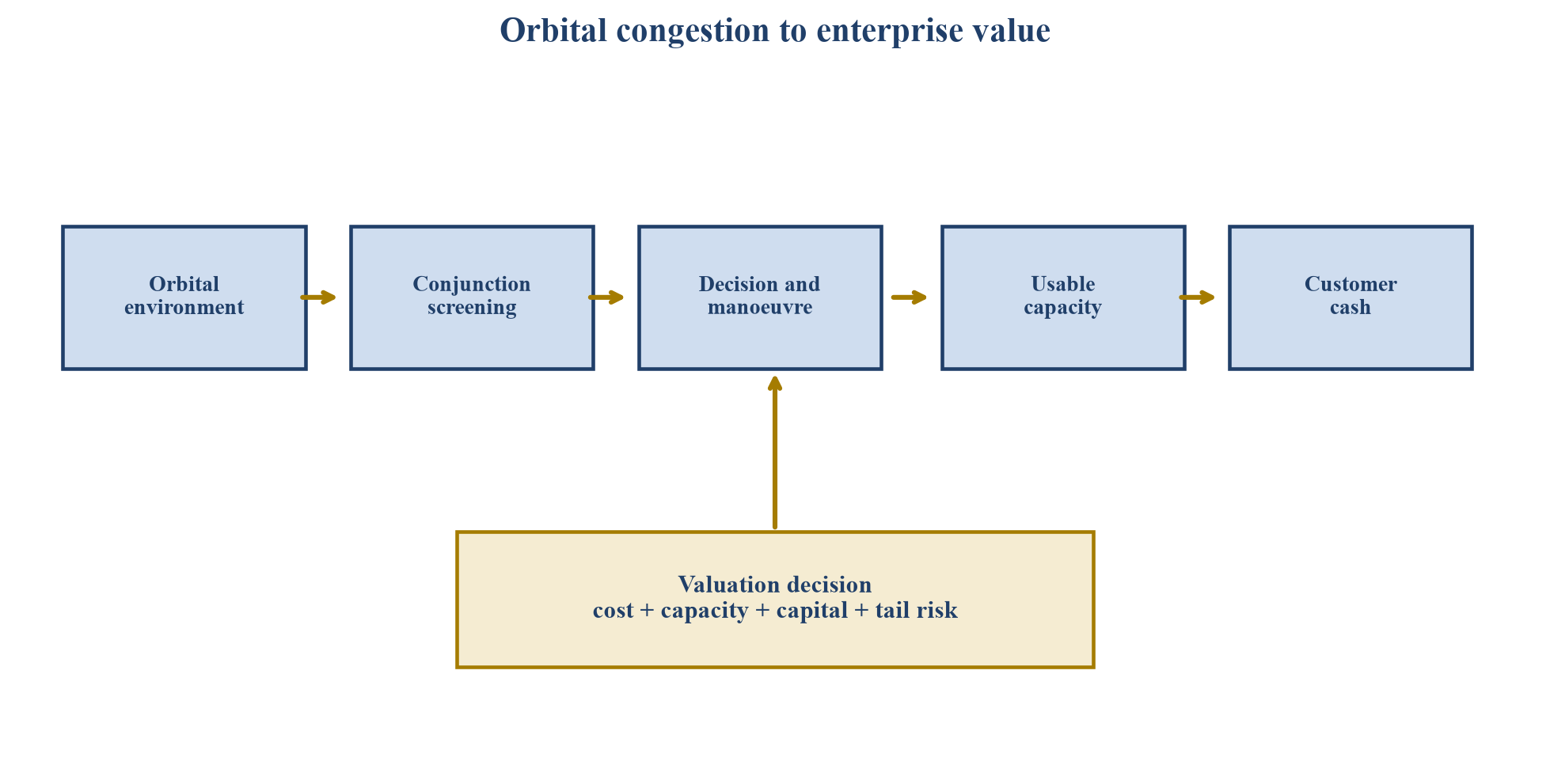
Proposed architecture connecting orbital environment, conjunction operations, customer capacity, cash and value.
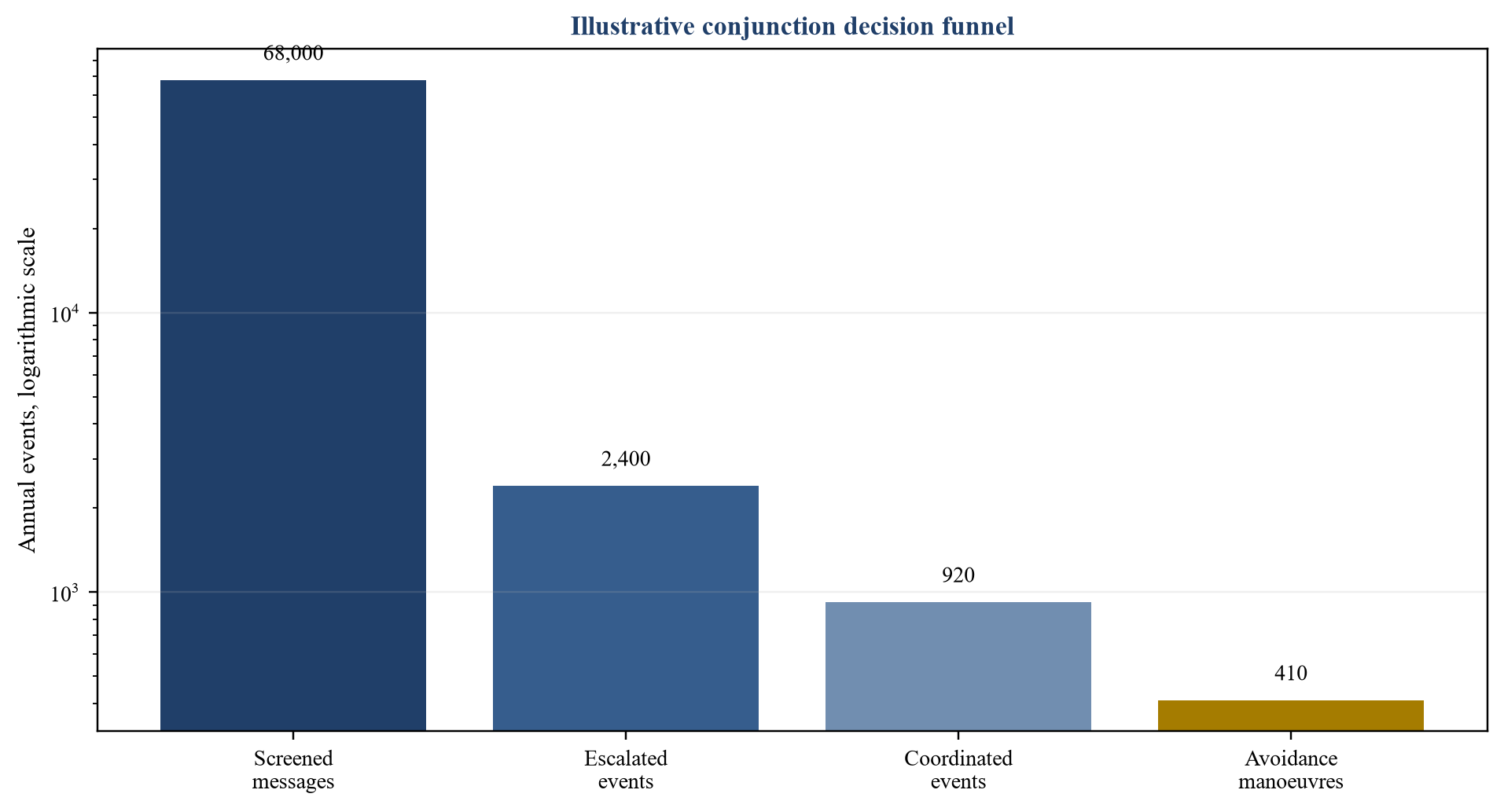
Hypothetical screened messages, escalated events, coordinated events and avoidance manoeuvres.
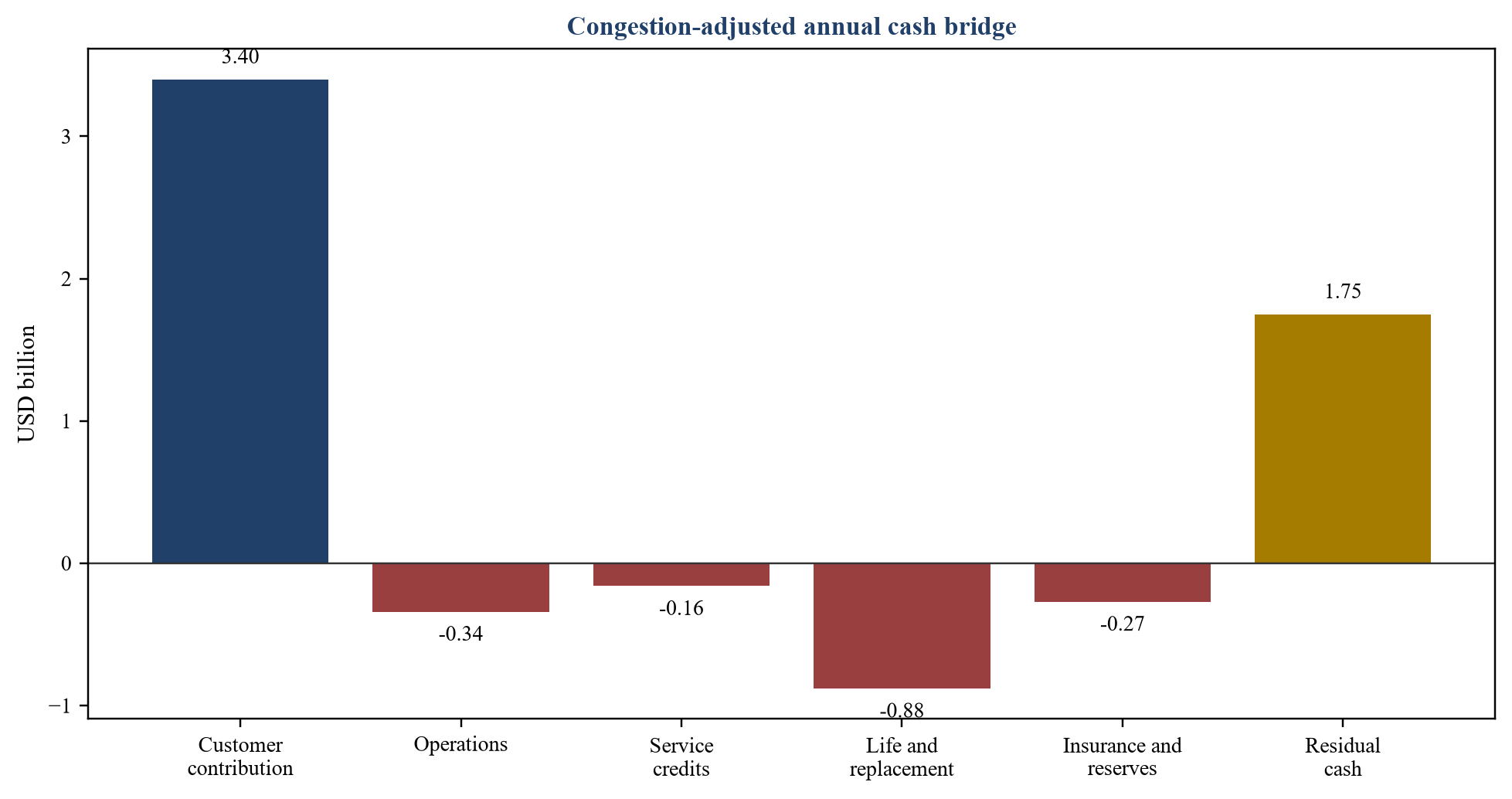
Hypothetical customer contribution less recurring orbital-risk costs and sustaining capital.
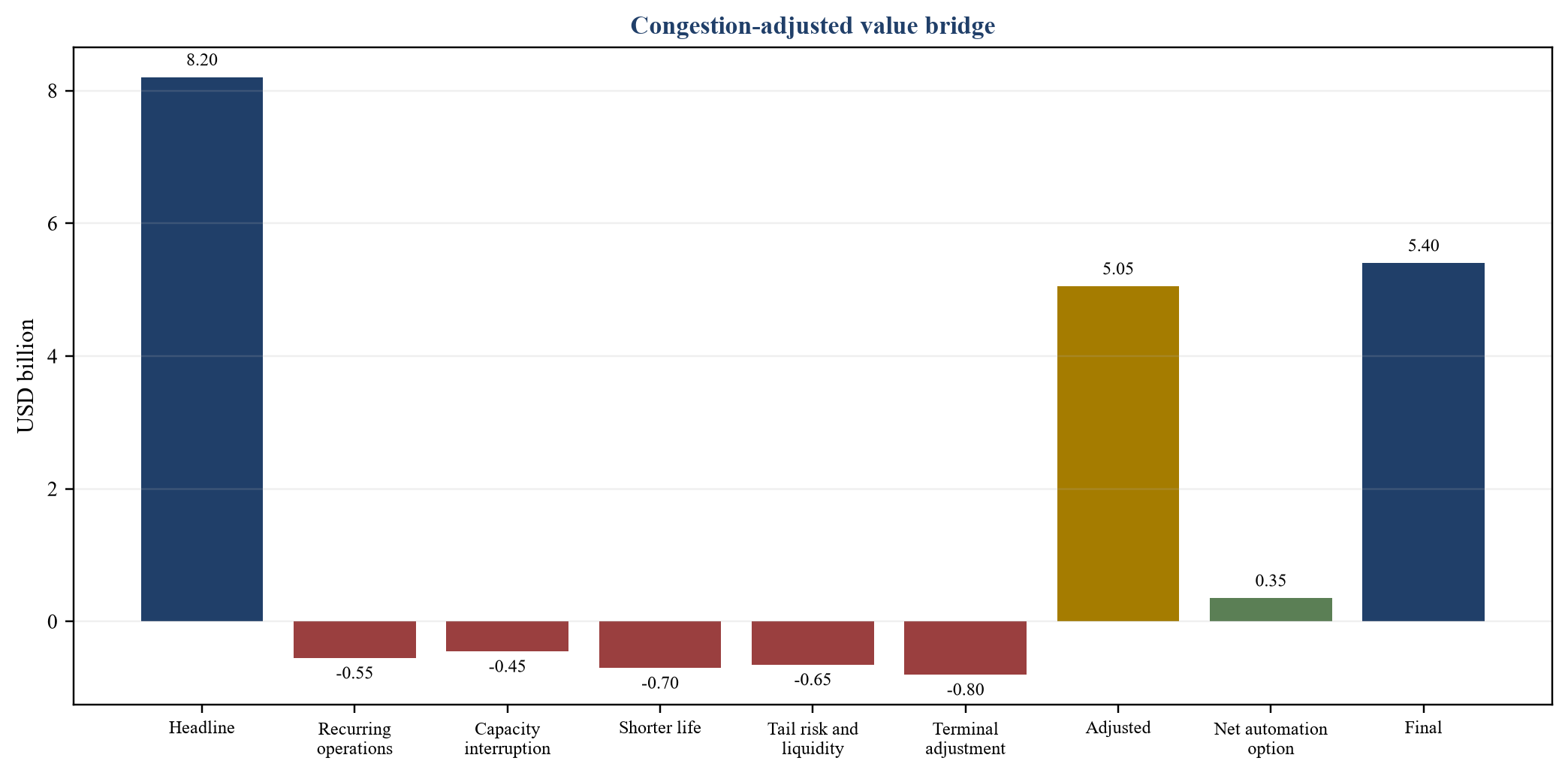
Hypothetical bridge from headline enterprise value to congestion-adjusted value and a net technology option.
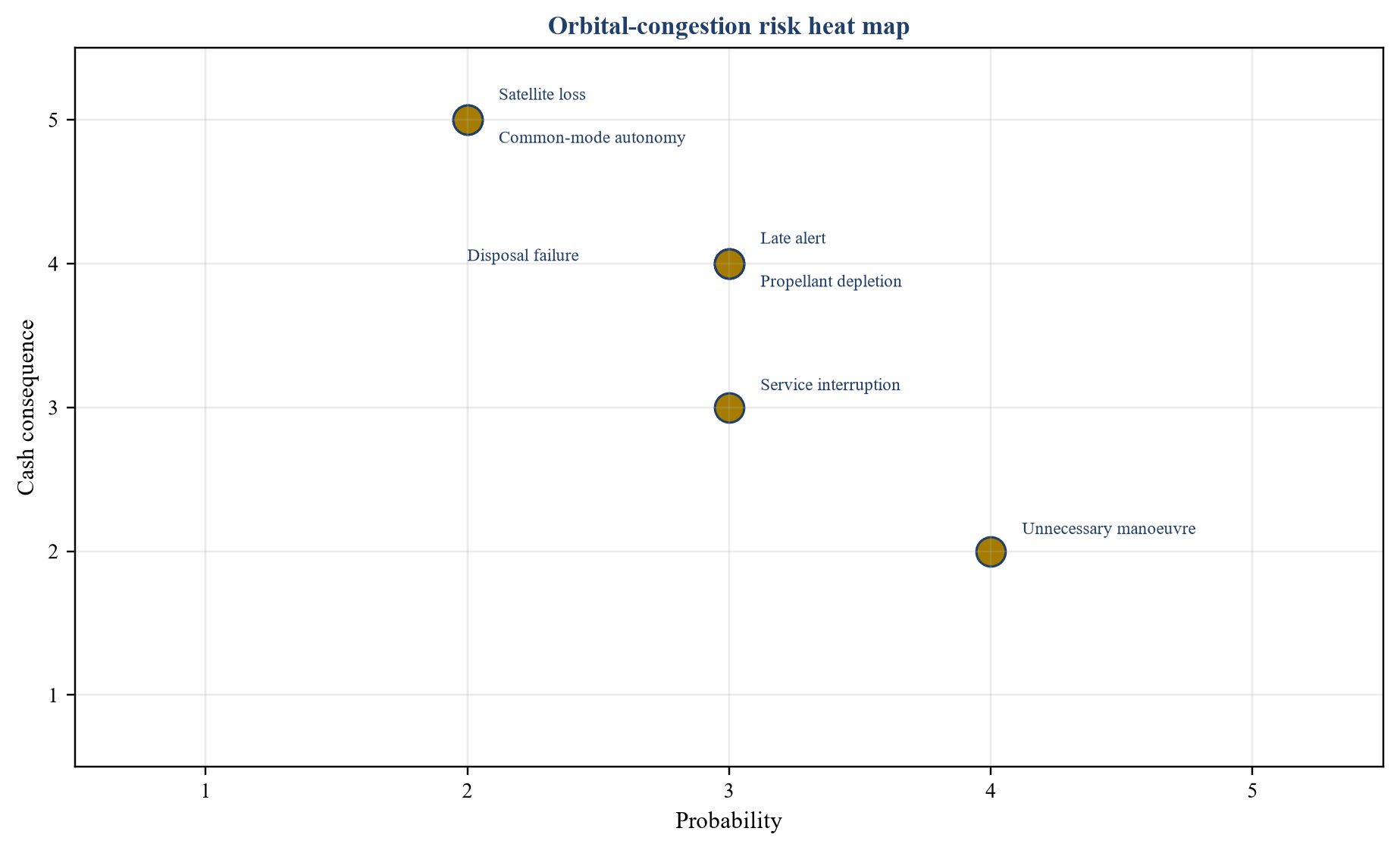
Illustrative probability and cash-consequence assessment for key operating risks.
| Evidence | Required measure | Valuation use |
|---|---|---|
| Fleet and shell | active degraded and non-manoeuvrable objects | exposure perimeter |
| Conjunction ledger | alerts probability covariance and decisions | workload and event risk |
| Manoeuvre record | delta-v time and service effect | life and capacity |
| Insurance | cover exclusions limits and collection | recoverable cash |
| Replacement | production launch and acceptance lead time | interruption and liquidity |
Proposed diligence fields.
| Stage | Annual volume | Primary economic effect |
|---|---|---|
| Screened messages | 68,000 | systems and analyst workload |
| Escalated events | 2,400 | engineering review |
| Coordinated events | 920 | operator communication and scheduling |
| Avoidance manoeuvres | 410 | propellant capacity and life |
| Material service events | 24 | credits contribution and churn |
All figures are illustrative and describe no identified operator.
| Effect | Evidence | Cash treatment |
|---|---|---|
| Screening and operations | payroll vendor and computing records | recurring operating cost |
| Manoeuvre and recovery | command telemetry and service records | operating and life effect |
| Satellite loss | incident and replacement evidence | expected loss and capital |
| Insurance recovery | policy and accepted claim | timed recoverable cash |
| Tail event | correlated scenario and restoration plan | liquidity test |
Proposed reconciliation.
| Step | Amount | Evidence required |
|---|---|---|
| Headline enterprise value | 8.20 | forecast and market assumptions |
| Recurring congestion operations | minus 0.55 | sustainable operating cost |
| Capacity interruption | minus 0.45 | contract and service evidence |
| Shortened life and replacement | minus 0.70 | propulsion and cohort model |
| Tail risk and liquidity | minus 0.65 | severe case and funded response |
| Terminal adjustment | minus 0.80 | steady-state shell assumptions |
| Congestion-adjusted value | 5.05 | integrated model |
| Automation and tracking option | plus 0.55 | performance milestones |
| Implementation cost | minus 0.20 | executable programme budget |
| Final illustrative value | 5.40 | board-approved evidence set |
All amounts are illustrative USD billions.
| Gate | Approval evidence | Stop condition |
|---|---|---|
| Environment | reconciled shell and object exposure | material untracked exposure |
| Operations | tested screening and response | unsafe workload or latency |
| Service | measured interruption and recovery | unpriced material credits |
| Capital | funded replacement and reserve | liquidity gap before restoration |
| Regulation | licences reports and disposal plan | unresolved operating restriction |
| Governance | authority cyber and assurance | unclear consequential accountability |
Proposed board control.
| Requirement | Potential instrument | Evidence gate |
|---|---|---|
| Automation development | equity | validated safety case |
| Tracking integration | vendor or partner finance | accepted service levels |
| Routine fleet operations | corporate facility | stable congestion-adjusted cash |
| Contracted capacity | asset or project-style debt | service and replacement reserve |
| Tail restoration | committed liquidity | severe-case restoration plan |
Proposed risk allocation.
| Dimension | Core measure | Trigger |
|---|---|---|
| Environment | conjunctions by shell and object class | event-rate or data-quality deterioration |
| Decisions | alerts escalation and response time | authority or workload breach |
| Fleet | delta-v life degradation and disposal | replacement acceleration |
| Customers | availability credits churn and contribution | negative service economics |
| Insurance | limits exclusions claims and renewal | unfunded exposure |
| Liquidity | reserve replacement and covenant headroom | restoration shortfall |
| Governance | overrides incidents and assurance | control failure |
Proposed monthly decision record.
Sources
- European Space Agency, ESA Space Environment Report 2025. Read the primary source
- European Space Agency, ESA Space Environment Report 2026. Read the primary source
- NASA, Conjunction Assessment Risk Analysis. Read the primary source
- NASA, NPR 8079.1, NASA Spacecraft Conjunction Analysis and Collision Avoidance for Space Environment Protection. Read the primary source
- Federal Communications Commission, Mitigation of Orbital Debris in the New Space Age, Second Report and Order, FCC 22-74. Read the primary source
- Federal Communications Commission, SpaceX Gen2 authorisation and orbital-debris conditions, FCC 22-91. Read the primary source
- European Space Agency, CREAM: avoiding collisions in space through automation. Read the primary source
- European Space Agency, Space Debris Mitigation Requirements, ESSB-ST-U-007. Read the primary source
- United Nations Office for Outer Space Affairs, Guidelines for the Long-term Sustainability of Outer Space Activities. Read the primary source
- Inter-Agency Space Debris Coordination Committee, Space Debris Mitigation Guidelines. Read the primary source
- International Organization for Standardization, ISO 24113 Space systems: Space debris mitigation requirements. Read the primary source
- U.S. Space Command, Space-Track conjunction data and operator services. Read the primary source
- NASA, Orbital Debris Program Office. Read the primary source
- NASA, Orbital Debris Mitigation Standard Practices. Read the primary source
- Astroscale Holdings, Annual Report 2025. Read the primary source
- Satellogic, 2024 Annual Report. Read the primary source
- Spire Global, 2025 Annual Report. Read the primary source
- Globalstar, 2024 Annual Report. Read the primary source
- IFRS Foundation, IAS 16 Property Plant and Equipment. Read the primary source
- IFRS Foundation, IAS 36 Impairment of Assets. Read the primary source
- IFRS Foundation, IFRS 13 Fair Value Measurement. Read the primary source
- International Private Equity and Venture Capital Valuation Guidelines. Read the primary source
- International Valuation Standards Council, International Valuation Standards. Read the primary source
- European Space Agency, Space environment health index 2025. Read the primary source
- International Telecommunication Union, Non-geostationary satellite orbit licensing framework toolkit. Read the primary source
