

1. Define the roll-up decision
The decision is whether a buyer can acquire a sequence of consumer brands and create a platform whose value exceeds the sum of the businesses purchased. Approval should depend on repeatable acquisition criteria, evidence that shared capabilities improve economics, and an integration model that protects each brand's customer promise. Revenue aggregation alone does not establish a platform.
The mandate should identify target categories, customer segments, geographies, channels, price points, product architectures, supply models and acquisition sizes. It should state which capabilities the platform intends to share, such as finance, data, procurement, fulfilment, product quality, performance marketing or international distribution. It should also state which elements remain brand-specific, including product proposition, voice, creative direction, community, merchandising and selected commercial relationships.
The investment committee should approve maximum aggregate capital, leverage limits, acquisition cadence, minimum cash conversion, portfolio concentration limits and integration capacity. A new deal should require evidence that existing businesses are controlled and that the platform can absorb the target without weakening product safety, service, working capital or decision quality.
2. Use the Brand-to-Platform Roll-Up Framework
The proposed framework has eight gates: strategic adjacency; brand and demand quality; channel and unit economics; product and supply integrity; data and operating compatibility; transaction and financing discipline; integration capacity; and portfolio-level value creation. Each gate produces a finding that changes price, scope, structure, sequencing or the decision to proceed.
The framework starts with the consumer proposition. A brand can report growth while losing repeat customers, buying revenue through discounts or accumulating inventory outside its own balance sheet. A platform can show procurement savings while damaging differentiated formulations or delivery times. Evidence must therefore connect consumer behaviour, product performance, channel economics, inventory movement and cash conversion.
The acquirer should maintain one evidence register covering category demand, customer cohorts, retailer sell-through, marketplace data, product claims, returns, complaints, recalls, supplier capacity, intellectual property, technology, people, financial statements and the integration roadmap. This creates a common decision record for investment, commercial, product, operations, legal and finance teams.
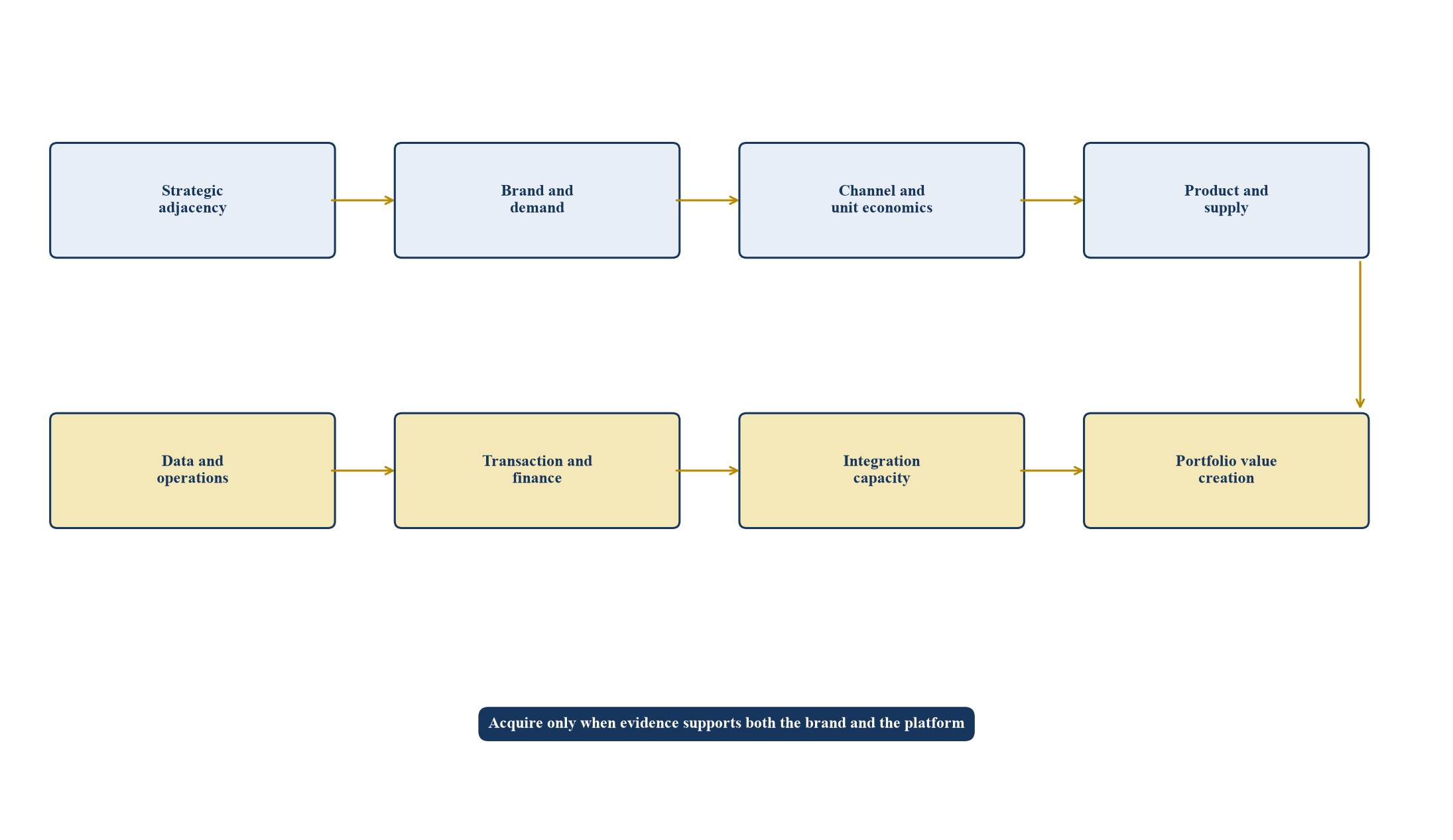
Capital advances only when brand quality and platform readiness pass the next gate.
3. Define a coherent category thesis
A roll-up needs a category thesis precise enough to exclude attractive businesses that do not belong. Adjacency can arise from the same consumer need, retail buyer, product technology, supply base, regulatory capability or route to market. Similar gross margins or social-media aesthetics are weak forms of adjacency when the underlying operating systems differ.
The acquirer should map category size, growth, penetration, price tiers, competitive intensity, retailer structure, online share, innovation cadence and regulatory exposure. US Census data shows that e-commerce represented 17.1 per cent of adjusted US retail sales in the second quarter of 2026, with e-commerce growth outpacing total retail growth in that period [8]. This establishes the continuing importance of digital channels, while category-specific channel economics still require independent diligence.
The thesis should identify the scarce capability the platform will compound. It may be retailer access, product development, formulation, sourcing, subscription retention, performance marketing, regulatory expertise or international distribution. Each target should strengthen that capability or benefit demonstrably from it. Category drift should require explicit board approval.
4. Build an acquisition scorecard that can reject deals
The acquisition scorecard should combine commercial quality, operating resilience, strategic fit and transaction feasibility. Measures can include organic growth, repeat purchase, gross margin after returns, contribution margin by channel, customer and retailer concentration, inventory turns, product-claim support, supplier dependency, cash conversion, founder reliance and systems readiness.
Scores should be supported by source evidence and linked to thresholds. A business with strong reported EBITDA may fail when aged inventory, unpaid marketplace fees, influencer commitments, trade-spend accruals and customer-acquisition costs are normalised. A smaller brand with reliable repeat purchase, clean claims and transferable supplier relationships may create more portfolio value.
The scorecard should retain reasons for rejection. This prevents acquisition volume from becoming an implicit performance target and allows the board to test whether standards weaken as capital commitments or fundraising narratives increase. The same criteria should be used after closing to compare underwriting with actual performance.
5. Separate consumer demand from paid visibility
Consumer demand should be reconstructed from transactions and behaviour rather than followers, impressions or gross merchandise value alone. The buyer should examine cohort retention, repeat intervals, units per order, return rates, discount dependence, review authenticity, search demand, retailer sell-through and customer-service contacts. Channel statements should reconcile to cash and inventory.
Paid media can accelerate a strong proposition or temporarily conceal weak retention. The model should separate new-customer contribution from repeat-customer contribution and allocate discounts, fulfilment, returns, payment fees, agency costs and content production consistently. Customer-acquisition payback should be measured after variable product and channel costs rather than against gross margin before fulfilment.
Consumer data can itself influence competition and market entry. The OECD notes that control of consumer data may raise barriers and requires coordination across competition, privacy and consumer policy [7]. A roll-up should document the lawful origin, permitted uses, portability and practical quality of each customer dataset before attributing value to cross-brand marketing.
6. Reconstruct channel economics
Each channel should have its own profit and cash-flow bridge. Wholesale, marketplace, direct-to-consumer, distributor, subscription and concession channels differ in price, returns, fees, inventory ownership, payment timing, promotions, service obligations and data access. Blended gross margin can hide value-destructive growth.
The acquirer should calculate net revenue after discounts, rebates, returns, marketplace deductions and trade spend. It should deduct product cost, freight, duties, fulfilment, commissions, payment fees, customer service and directly attributable marketing. The resulting contribution margin should be connected to working capital and fixed capability requirements.
Channel evidence should include retailer orders and sell-through, marketplace settlement reports, cohort data, promotional calendars, customer contracts, return reasons and inventory by location. The platform case should show which economics improve through scale and which remain structurally channel-specific.
| Channel evidence | What it establishes | Remaining risk | Transaction treatment |
|---|---|---|---|
| Retailer sell-through by SKU | Consumer movement through the channel | Returns, markdowns and future shelf space | Supports base demand after reconciliation |
| Purchase orders and forecasts | Near-term retailer intention | Cancellation, allocation and timing | Stage working capital and earn-out credit |
| Marketplace settlement data | Net realised revenue after platform deductions | Algorithm, fee and account dependence | Normalise contribution and concentration |
| Direct customer cohorts | Repeat behaviour and order economics | Attribution, privacy and promotion effects | Value recurring contribution, not list size |
| Distributor sell-in | Shipment to intermediary | Channel inventory and sell-through | Require stock and ageing evidence |
| Social and search metrics | Attention and category interest | Paid visibility and weak conversion | Corroborative evidence only |
Evidence should be reconciled to cash, inventory and customer behaviour before it enters valuation.
7. Map channel conflict before combining brands
A portfolio can create conflict when several brands pursue the same retailer, keyword, consumer or distributor without clear positioning. Conflict can appear as internal bidding for paid media, inconsistent wholesale terms, duplicated product claims, overlapping promotions or retailer pressure to rationalise shelf space.
The buyer should map customer, category, price tier, occasion and channel for each brand. It should identify whether two products are substitutes, complements or unrelated purchases. Where overlap is deliberate, the platform needs rules for assortment, pricing, promotion, sales ownership and innovation allocation.
Integration should avoid forcing all brands into one channel merely because the platform has a preferred commercial capability. A prestige brand can lose value through indiscriminate marketplace distribution; a mass brand can be constrained by a selective-retail model. Channel strategy should follow consumer positioning and unit economics.
8. Test brand strength as an economic asset
Brand strength should be evidenced through pricing power, repeat purchase, distribution access, unaided awareness, recommendation, product performance and resilience when promotion declines. A trademark registration protects a sign in defined classes and territories; it does not establish consumer demand or profitability.
Diligence should review ownership, registrations, assignments, licences, oppositions, coexistence agreements, domains, social handles, packaging assets, creative rights and influencer permissions. It should also determine whether the founder's identity is inseparable from the brand and whether name, image or content rights transfer at closing.
Valuation should separate existing brand cash flow from growth that requires new capital or platform capability. Royalty-relief and excess-earnings methods can support intangible-asset analysis, while the transaction case still requires evidence that customers, channels and product quality will persist under new ownership.
9. Diligence product claims and consumer trust
Product claims can create demand and regulatory exposure. The FTC states that advertising claims must be truthful, evidence-based and neither deceptive nor unfair, with heightened substantiation expectations for health-related products [14][15]. Endorsements must reflect honest experience and disclose material connections where relevant [16].
The buyer should inventory every claim across packaging, websites, retailer pages, social posts, creator content, search advertising and customer-service scripts. Each claim should be linked to substantiation, approved wording, territory, product version and responsible owner. Unsupported superiority, health, environmental or origin claims should be priced as remediation and revenue risk.
Trust should be treated as an operating control. A platform that centralises marketing without preserving claim evidence can scale exposure across the portfolio. Approval workflows, evidence libraries and monitoring should be implemented before cross-brand campaigns expand.
10. Diligence product safety and recall readiness
Product safety diligence should cover design, materials, testing, supplier controls, complaints, incidents, corrective actions, recalls, insurance and reporting duties. In the United States, businesses that manufacture, import, distribute, brand or sell consumer products may have immediate reporting obligations to the CPSC when specified hazard information arises [18].
The acquirer should reconcile product identifiers, model numbers, batch or date codes and supplier records to complaint and return data. It should test whether the company can isolate affected inventory, stop sale, notify channels, identify consumers and provide a remedy. Existing recall obligations must remain visible after an acquisition; CPSC guidance specifically addresses recall information following mergers and acquisitions [19].
The purchase agreement should allocate known liabilities, records access, cooperation, insurance and control of notifications. Integration should preserve traceability and escalation before supply chains, systems or customer-service teams are consolidated.
11. Reduce the portfolio to economically useful SKUs
Consumer businesses often accumulate stock-keeping units through seasonal launches, retailer exclusives, packaging changes and founder preference. SKU count can increase revenue choice while consuming forecasting, procurement, quality, warehouse, content and working-capital capacity. The platform should treat SKU complexity as a measurable cost.
The buyer should build a product-level contribution and cash model covering net revenue, gross margin, returns, markdowns, minimum orders, lead times, shelf life, quality incidents, inventory days and operational touches. Products should be classified as core, strategic, experimental, harvest or exit. A product can remain strategically important despite modest current margin when it protects a retailer relationship or enables a high-value regimen, but that role should be explicit.
Portfolio pruning should follow customer and channel evidence. Removing a low-volume product can damage loyalty if it anchors repeat purchase, while retaining every acquired SKU can immobilise cash. Decisions should include run-out plans, supplier obligations, customer communication, write-downs and replacement logic.
12. Rebuild inventory from units and locations
Inventory should be reconstructed by SKU, batch, age, owner, location, channel, quality status and expected selling price. Reported totals can include goods at manufacturers, freight forwarders, third-party logistics providers, distributors, marketplaces, retailers and return centres. The buyer should identify inventory that is obsolete, damaged, recalled, restricted or economically stranded.
IAS 2 measures inventory at the lower of cost and net realisable value and requires write-downs and losses to be recognised as expense when they arise [9]. Transaction diligence should test whether expected selling prices include realistic discounts, returns, completion costs and selling costs. Inventory financing should exclude assets that cannot be sold or controlled.
The platform should establish one ageing policy, reserve methodology and inventory-to-cash reconciliation while retaining category-specific shelf-life and seasonality rules. Purchase-price mechanisms should distinguish normal working capital from excess, obsolete or seller-retained inventory.
13. Design the supply network before seeking purchasing savings
Supplier consolidation can reduce unit cost and increase dependency. The platform should map each product to materials, manufacturer, tooling, formula, certification, capacity, lead time, minimum order, currency, shipping route and alternative source. A common supplier should be evaluated across all brands because portfolio concentration may be invisible at target level.
Savings should be divided into price, specification, volume, logistics, payment terms, yield and complexity reduction. Each saving requires qualification costs, timing and risk. Changing a component or manufacturer can require new testing, retailer approval, claim review or packaging changes. Procurement targets should therefore be evidence-based and sequenced.
The central operating model should maintain supplier performance, continuity plans and contract rights. NIST's supply-chain guidance recommends defining supplier requirements, understanding third-party risks and integrating supply-chain security into enterprise risk management [20][21]. These principles apply to technology providers as well as physical suppliers.
14. Preserve quality while sharing operations
Quality systems should define product specifications, approved suppliers, testing, release, complaints, deviations, corrective actions, changes and recalls. The platform can share standards, data and specialist expertise while maintaining product-specific requirements and accountable owners.
The buyer should test whether quality records are complete and whether actual practices match documented procedures. High return rates may reflect fit, packaging, damage, product performance or customer expectation. Each cause has a different commercial and safety implication. Complaint trends should be connected to batches, suppliers and claims.
Centralisation should begin with visibility and governance. Moving quality decisions to a distant shared-services team before product knowledge transfers can slow containment and weaken accountability. The operating model should state which decisions remain at brand or product level and which require platform approval.
15. Value data only when it can be used lawfully and operationally
Customer files, loyalty records, transaction histories, product reviews and marketing audiences can support retention and cross-selling. Their value depends on consent, notice, purpose, accuracy, identity resolution, access rights and platform compatibility. A large database with weak permissions or duplicated identities may create cost rather than value.
The UK Information Commissioner's Office states that a merger, acquisition or organisational change involving transfer to another controller requires data sharing to be addressed during due diligence and documented in accordance with data-protection principles [17]. The buyer should map controllers, processors, purposes, legal bases, retention, transfers, rights requests and security incidents.
The integration plan should define which datasets can be combined, which remain segregated and which should be deleted. Cross-brand analytics should begin after lawful-use and quality checks. Valuation should credit data-driven benefits only when there is an executable use case, measured uplift and sufficient consumer trust.
16. Build a technology architecture that supports separation and scale
The technology estate may include commerce, marketplace, retail integration, customer relationship management, product information, warehouse, finance, planning, marketing, content and analytics tools. A roll-up can accumulate overlapping applications and fragile interfaces if every acquisition retains its stack indefinitely.
The buyer should classify systems as platform standard, temporary, brand-specific or retire. Architecture decisions should consider data ownership, integrations, transaction volume, service levels, security, localisation, contract assignability and exit cost. A lower software bill does not justify a migration that interrupts orders, product content or retailer feeds.
The target state should provide common identifiers for customers, products, suppliers, locations and financial dimensions. It should allow the platform to add or divest a brand without rebuilding the estate. Migration gates should be based on reconciled data, tested interfaces, cutover readiness and rollback capability.
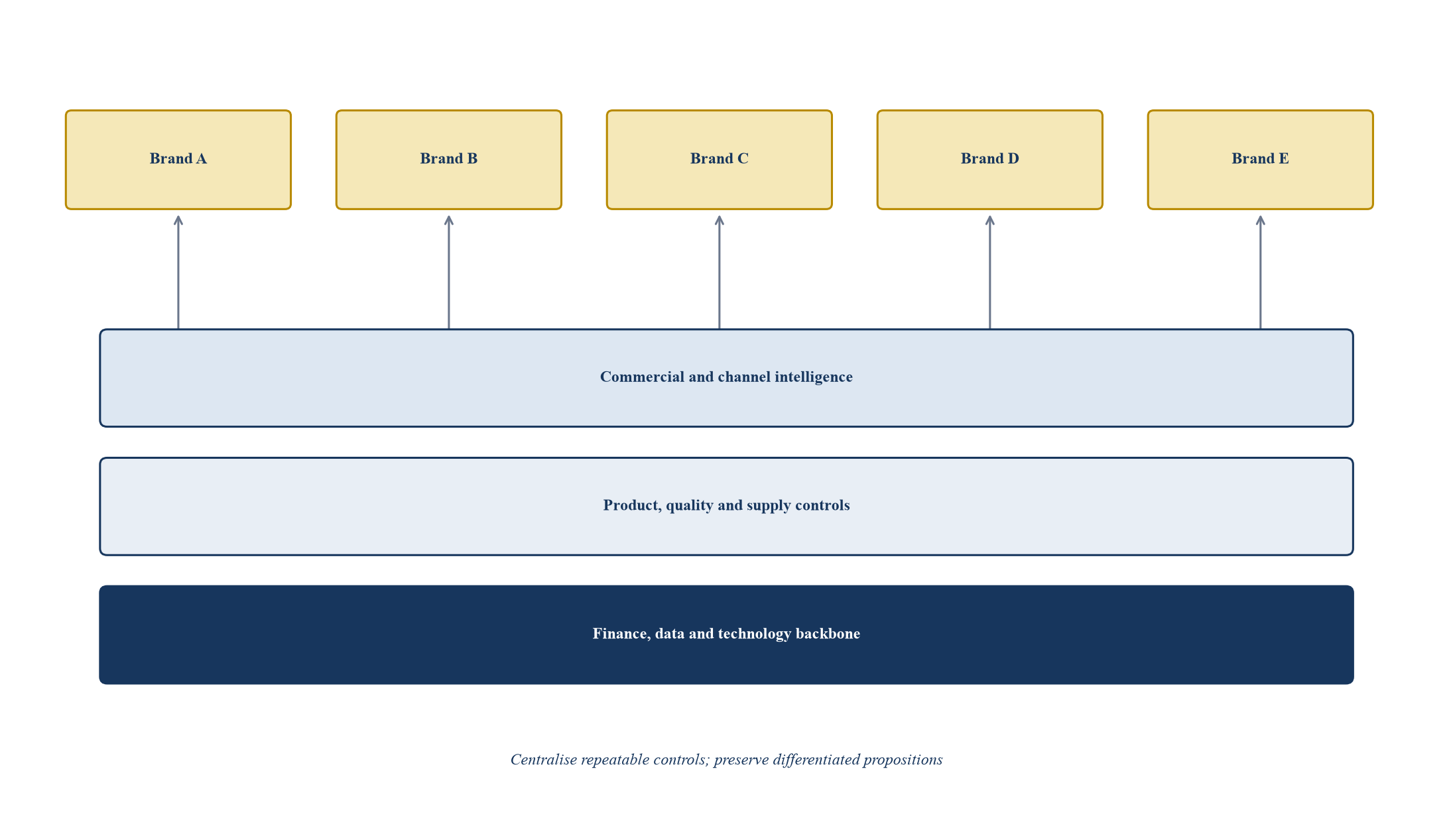
Shared capabilities support each brand while customer promise and product accountability remain identifiable.
17. Treat cybersecurity as a transaction and operating dependency
Consumer platforms process payments, personal data, supplier credentials, advertising accounts and marketplace access. A breach or account takeover can interrupt revenue, expose customers and create disclosure obligations. Cyber diligence should therefore cover governance, identity, access, vulnerabilities, incidents, third parties, backups and recovery.
NIST CSF 2.0 emphasises governance and supply-chain risk alongside identification, protection, detection, response and recovery [20]. The SEC's cybersecurity rules require specified public-company disclosures concerning material incidents and risk management, strategy and governance [22]. The transaction team should determine whether historical incidents, control gaps or integration plans could be material.
Day-one controls should secure privileged accounts, payment settings, domains, social channels, cloud environments and software administrators. Data and system consolidation should follow risk assessment and testing. Cyber insurance, incident responsibility and access to historical logs should be addressed in transaction documents.
18. Design the organisation around capabilities and accountability
A roll-up can retain duplicated functions for too long or centralise before the platform understands the brands. Organisation design should begin with decisions, capabilities and service levels. Roles should be allocated among the board, platform leadership, brand general managers, category teams and shared services.
Brand leaders should remain accountable for consumer proposition, assortment, channel plan and profit-and-loss outcomes. Platform leaders should own capital allocation, standards, data, common controls and capabilities that generate portfolio benefits. Shared services should have measurable service levels, transparent charges and escalation routes.
Founder transitions require special attention. Product intuition, retailer relationships, community credibility and supplier knowledge may reside with a few individuals. Retention, consulting, earn-out and handover terms should be tied to explicit deliverables and decision rights. The platform should convert tacit knowledge into durable routines without turning every founder preference into a permanent exception.
19. Quantify integration capacity before setting acquisition cadence
Acquisition cadence should follow the platform's ability to close books, control cash, stabilise operations, execute change and verify benefits. A pipeline of available targets does not create integration capacity. The board should maintain a capacity model covering leaders, workstreams, systems, vendors, capital and critical milestones.
Each target should be scored for integration load: financial controls, legal entities, product count, supplier complexity, channel mix, systems, data, people, geography, regulatory exposure and separation needs. The load should be compared with active programmes and business-as-usual constraints. Capacity can be increased through dedicated teams, standard playbooks and temporary support, but critical knowledge and accountability cannot be outsourced entirely.
The next transaction should be delayed when unresolved issues threaten control or customer service. An explicit pause rule protects the platform from compounding errors and gives lenders and investors a clearer view of execution risk.
20. Build the integration thesis before signing
The integration thesis should state how the transaction creates value, what will change, what will remain distinct and when evidence will be available. It should translate valuation assumptions into workstreams, owners, costs, dependencies, milestones and measures. Generic synergy percentages should be replaced by operating actions.
Day-one priorities include control of cash, banking, approvals, reporting, product safety, customer and supplier continuity, data access, insurance and communications. The first hundred days should validate the commercial baseline, secure critical people and suppliers, resolve urgent compliance gaps and establish portfolio governance. Longer changes such as systems migration, supply requalification and channel expansion require evidence gates.
The integration plan should include a reverse diligence process. When post-close evidence contradicts underwriting, the platform should reprice internal expectations, stop discretionary spend, revise earn-out measures and protect liquidity. Learning from each acquisition should update the scorecard and playbook.
| Capability | Default location | Evidence before centralisation | Principal failure mode |
|---|---|---|---|
| Brand proposition and creative | Brand | Consumer research and performance baseline | Homogenisation and lost relevance |
| Finance and cash control | Platform | Reconciled opening balance sheet and bank authority | Weak control and delayed reporting |
| Product quality and safety | Shared standards with product owners | Complete specifications, complaints and traceability | Lost product knowledge and slow containment |
| Procurement | Category or platform | Comparable specifications and qualified alternatives | Savings offset by quality or continuity loss |
| Customer data | Controlled platform environment | Lawful-use map, identity quality and security testing | Privacy breach and unusable records |
| Technology | Platform target architecture | Tested interfaces, data reconciliation and rollback | Order interruption and data loss |
Centralisation should follow evidence and service design rather than an arbitrary closing timetable.
21. Sequence transactions to strengthen the platform
The first acquisition should establish a credible operating base rather than maximise headline scale. It should provide clean controls, transferable management, useful channel relationships and a product architecture that the platform can understand. Later transactions can add categories, geographies or capabilities after the core has demonstrated control.
Sequencing should consider competition review, financing availability, management bandwidth, supplier capacity, systems readiness and seasonal trading. Closing immediately before a peak period can restrict integration options and magnify service risk. Multiple simultaneous closings require separate control plans and a portfolio-level view of liquidity.
The US merger guidelines state that agencies may examine a whole series of acquisitions and consider industry consolidation trends [1]. The FTC also sought information on serial acquisitions and roll-up strategies, including combinations of reportable and non-reportable transactions [2]. Competition assessment should therefore consider the cumulative strategy, market position and future pipeline rather than each target in isolation.
22. Choose deal structures that reveal quality
Consideration can combine cash, rollover equity, deferred payments, earn-outs, vendor notes and contingent value. Structure should allocate uncertainty that the seller can influence or evidence. It should not disguise an unaffordable purchase price or transfer ordinary market risk through measures that invite dispute.
Earn-outs should use definitions connected to controllable performance and auditable data. Revenue measures can encourage discounting and inventory loading; EBITDA measures can be distorted by shared costs and integration decisions. Contribution, repeat purchase, retailer retention, claim remediation or working-capital milestones may provide more decision-useful measures when carefully defined.
Rollover equity can align sellers with portfolio value, although governance, liquidity, dilution and information rights must be clear. Escrows and indemnities should address specific exposures such as tax, product liability, data protection, intellectual property and inventory. The structure should remain understandable under a downside case.
23. Match financing to acquisition and integration risk
The platform should separate acquisition consideration, transaction costs, integration expenditure, inventory funding and growth capital. Each use has a different recovery profile. Debt sized against pro forma EBITDA before verifying cash conversion can create a liquidity trap when integration costs, seasonality and inventory absorb cash.
The financing case should model leverage, interest, amortisation, covenant definitions, permitted acquisitions, baskets, earn-out treatment, working-capital facilities and equity cures. It should also show liquidity during peak inventory builds, channel deductions, returns and supplier prepayments. Borrowing-base availability should be calculated from eligible receivables and inventory rather than accounting balances alone.
Acquisition cadence should be a financing decision as well as a strategic one. The board should preserve capacity for remediation and avoid using every available facility for purchase price. A liquidity reserve and covenant headroom should survive the combined downside scenario.
The financing model should distinguish contractual debt capacity from prudent debt capacity. Contractual capacity is determined by facility terms, covenant definitions and permitted-acquisition baskets. Prudent capacity also reflects product concentration, retailer deductions, inventory ageing, return rates, recall exposure and the time required to convert integration actions into cash. The lower of the two should determine the acquisition envelope. This approach reduces the risk that a platform remains technically compliant while losing the liquidity needed to protect brands and customers.
Funding instruments should match the uncertainty they finance. Revolving facilities can support seasonal receivables and eligible inventory; term debt can finance stable acquired cash flows; vendor paper and deferred consideration can bridge valuation uncertainty; preferred or common equity can absorb longer-duration integration and capability investment. The platform should model intercreditor rights, security, cash sweeps, distribution restrictions and cure mechanics before signing. A capital structure that appears inexpensive in the central case may become expensive when downside protections transfer control or restrict the next acquisition.
24. Build valuation from brand cash flows and platform evidence
Valuation should begin with stand-alone cash flows for each brand, adjusted for normalised channel economics, working capital, maintenance investment and compliance costs. Platform value should be added only for benefits supported by capability, timing and capital. A multiple applied to aggregated revenue or EBITDA can conceal differences in quality.
The hypothetical programme acquires six brands for aggregate consideration of USD 350 million and commits USD 70 million to integration, working capital and capability build. The central case assumes selective SKU reduction, improved procurement, disciplined digital spending and international distribution. It produces year-five EBITDA of USD 68 million, enterprise value of USD 680 million, net debt of USD 170 million and equity value of USD 510 million.
The downside case assumes retailer losses, claim remediation, inventory write-downs, delayed systems migration and weaker repeat purchase. Year-five EBITDA falls to USD 33 million, enterprise value to USD 330 million and net debt rises to USD 250 million, leaving equity value of USD 80 million. These figures are illustrative management scenarios.
The valuation bridge should retain target-level visibility after consolidation. Revenue growth, gross margin, fulfilment cost, customer acquisition, repeat purchase, returns, channel deductions, inventory and cash conversion should remain traceable to each brand and cohort. This enables the board to distinguish genuine platform improvement from mix changes, accounting allocation or the temporary benefit of acquisition timing. It also supports clearer discussions with lenders, auditors and future investors.
Terminal value requires particular discipline. A higher platform multiple should follow evidence of durable cash conversion, reduced concentration, repeatable integration, management depth and a credible acquisition pipeline. Size alone does not establish quality. The model should test exit multiples by brand quality, channel mix, leverage and integration maturity, and should calculate returns without any multiple expansion. A transaction that depends on a richer exit multiple should carry a lower price, slower cadence or more equity at entry.
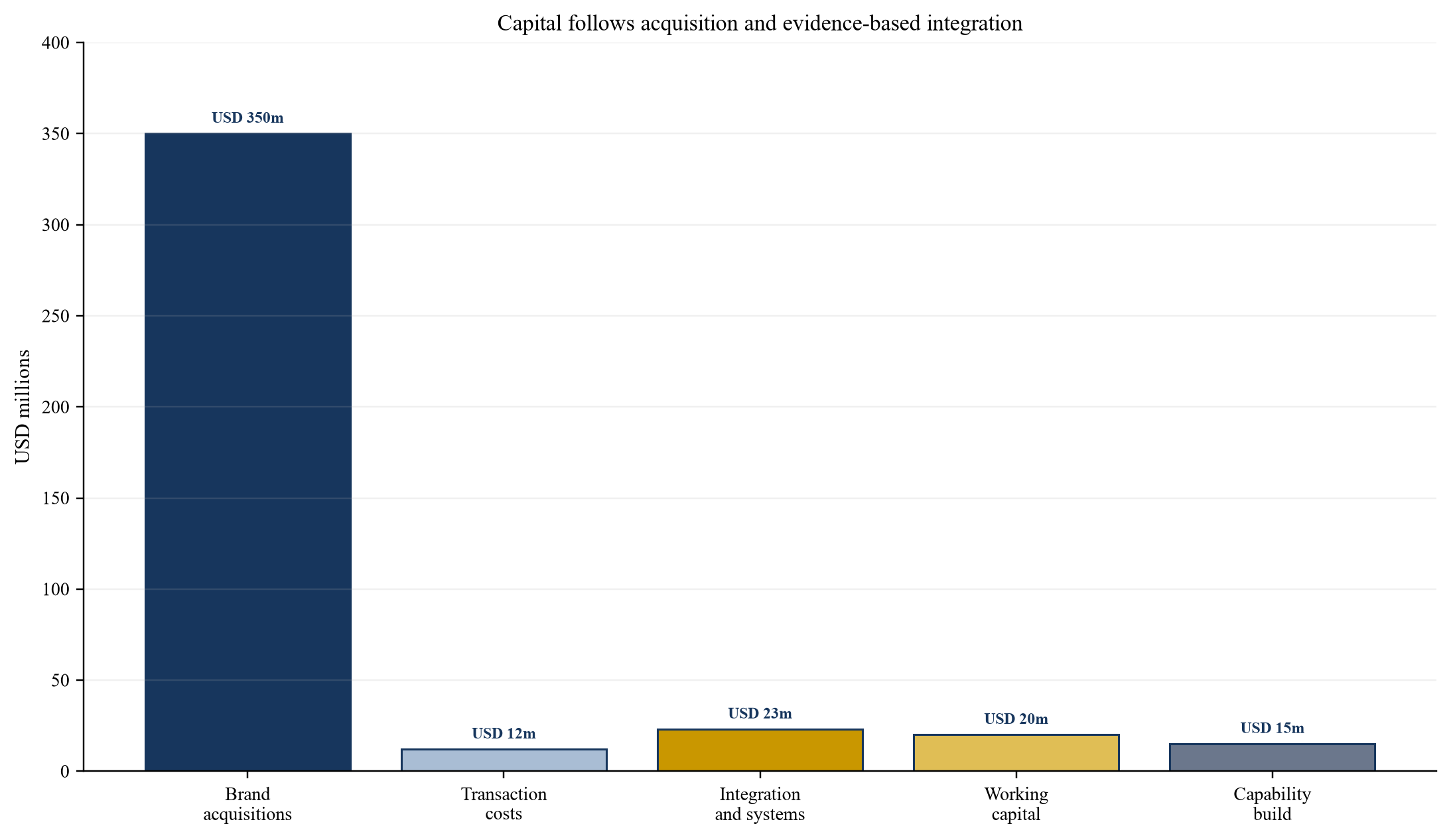
Amounts are hypothetical USD millions and do not represent an observed transaction.
25. Distinguish synergies from transferred costs
Synergy should be defined as a change in cash flow caused by a specific action. Procurement benefits require comparable specifications, supplier capacity, contract rights and implementation timing. Media benefits require credible audience overlap, attribution and incremental contribution. Shared services require cost, service levels and migration expenditure.
The model should include dis-synergies: duplicated teams during transition, retention, severance, contract termination, re-platforming, inventory write-downs, claim remediation, retailer disruption and management distraction. It should also recognise costs that move from the target to the platform without disappearing.
Benefits should have owners, baselines, milestones and finance validation. The board should distinguish committed, executable, at-risk and unproven benefits. Valuation credit should reflect probability and timing, while incentive plans should reward cash and control as well as headline savings.
26. Test goodwill and intangible value under the downside
Acquisitions can create significant goodwill and brand-related intangible assets. IAS 36 requires annual impairment testing of goodwill and indefinite-life intangibles and testing when indicators arise; an asset is impaired when carrying amount exceeds recoverable amount [10]. Inventory, brands, customer relationships and goodwill should therefore be linked to the same operating evidence used by management.
The platform should allocate cash-generating units consistently with how performance is monitored. It should model sensitivity to retailer loss, lower repeat purchase, margin pressure, delayed integration and increased capital requirements. A headroom schedule should show which assumptions create impairment risk.
The IASB is redeliberating proposals concerning disclosures about business-combination performance and impairment [11]. Even before any final amendments, boards benefit from retaining acquisition objectives, key measures and subsequent performance. The investment case should be capable of explaining where value was created or lost after closing.
27. Evaluate competition risk across the acquisition programme
Competition analysis should consider product categories, channels, consumer segments, retailers, suppliers, data and innovation. The CMA's guidelines examine price and non-price dimensions, including quality, choice, service, innovation, brand, reputation, data and ecosystems [3]. The European Commission is updating its merger guidance to reflect digitalisation, globalisation, decarbonisation and changing competitive dynamics [4].
The buyer should map overlaps and vertical relationships for each transaction and the portfolio as a whole. Evidence can include diversion, switching, retailer views, consumer spending patterns, bidding, entry, capacity and innovation plans. Internal documents should describe the commercial rationale accurately and consistently.
Potential remedies, information barriers, hold-separate obligations and timing should be evaluated before signing. The acquisition model should include costs and loss of benefits if approval requires divestiture, behavioural commitments or delayed integration.
28. Govern the platform through one decision system
Governance should link acquisition approval, integration, portfolio performance, risk and capital allocation. The board should receive a consistent pack showing brand and channel contribution, cash conversion, inventory, customer concentration, product quality, claims, technology, people, synergies, leverage and integration milestones.
Reserved matters should cover acquisitions, disposals, debt, major supplier changes, product recalls, material claims, data combinations, brand repositioning and systems cutovers. Brand-level autonomy should operate within platform standards. Decisions should identify accountable owners, evidence, due dates and consequences.
The platform should maintain a transaction ledger comparing underwriting with actual outcomes. Variances should update acquisition criteria, valuation assumptions and integration methods. Governance creates value when it changes decisions early enough to protect cash and customer trust.
Management information should operate at three levels. Brand dashboards protect customer promise and expose local economics. Functional dashboards track shared capabilities such as procurement, fulfilment, technology, finance, people and quality. The portfolio dashboard connects both levels to liquidity, leverage, acquisition capacity and risk. Measures should reconcile to controlled source systems, preserve definitions over time and identify the owner of every corrective action.
Board challenge should focus on decision consequences. When a benefit is late, the pack should show cash impact, covenant effect, management capacity and the next acquisition gate. When a product or data issue emerges, the board should see containment, customer communication, regulatory obligations and funding needs. Escalation thresholds should be agreed before incidents occur, with authority to stop a launch, pause integration, ring-fence data or defer an acquisition.
29. Use a milestone-based roll-up roadmap
The roadmap should begin with thesis, scorecard, governance and financial control. The first acquisition should establish the platform backbone and provide a controlled environment for testing shared capabilities. Later acquisitions should proceed only after defined evidence gates.
Milestones should include diligence completion, closing accounts, cash control, product-safety confirmation, data-lawfulness mapping, supplier continuity, baseline reporting, integration design, benefit verification and readiness for the next deal. Each milestone requires acceptance criteria rather than a percentage-complete label.
The roadmap should preserve contingency around peak trading, retailer range reviews, supplier seasons and technology cutovers. A pause should be treated as disciplined capital allocation when evidence is incomplete.
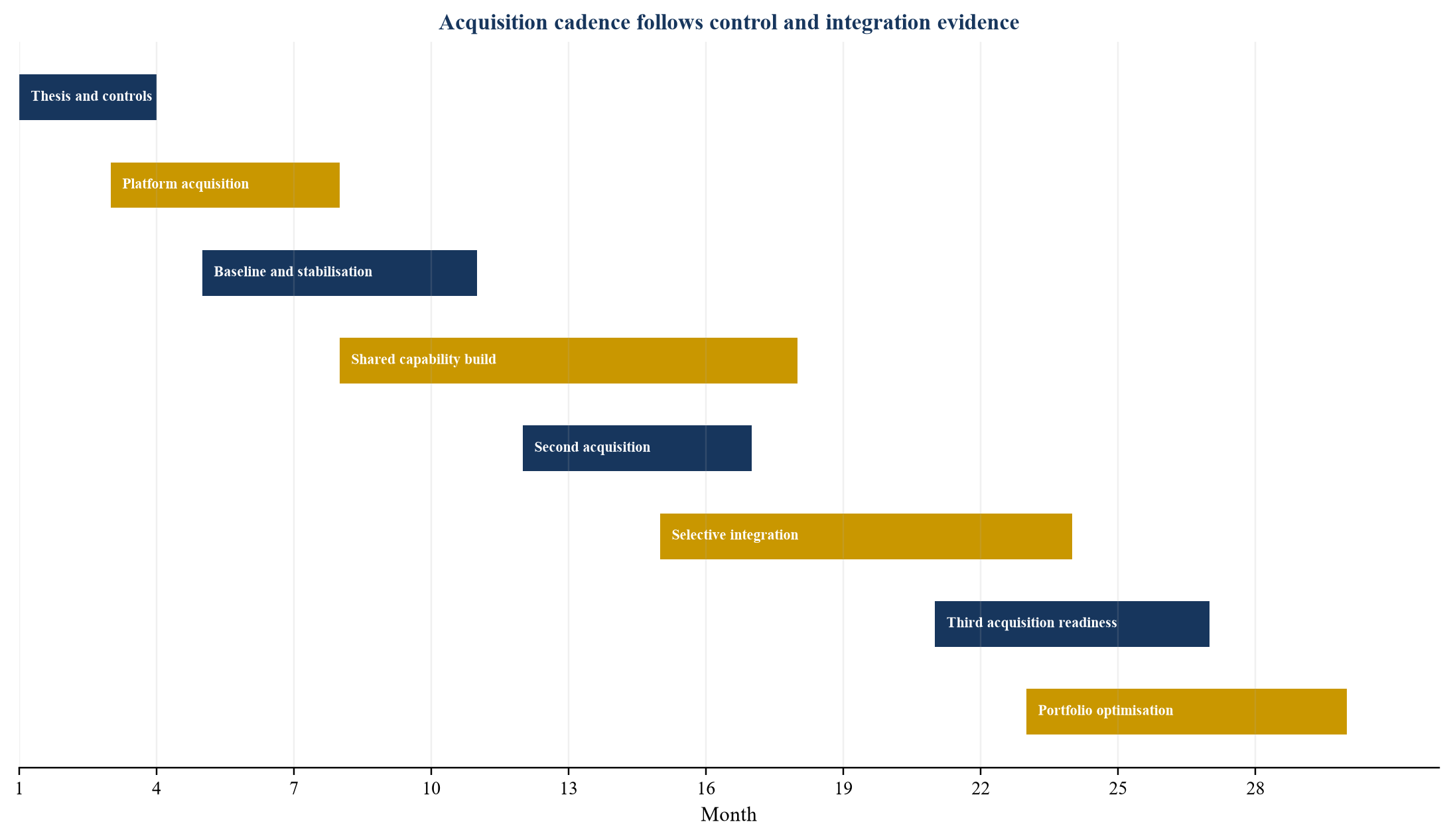
Timing is illustrative and depends on target readiness, transaction approvals and operating evidence.
30. Make the investment committee decision
The committee should approve a consumer roll-up only when the category thesis is coherent, acquisition criteria can reject deals, brand demand and channel economics are evidenced, product and data risks are controlled, and the platform has financing and integration capacity. Approval should specify capital limits, acquisition cadence, leverage, concentration thresholds, integration gates and pause conditions.
The strongest case combines differentiated brands with a small number of capabilities that improve repeatedly across the portfolio. It preserves customer promise while centralising controls and scalable infrastructure. It values benefits only when actions, owners, timing and costs are documented.
The programme should be resized, sequenced differently or rejected when the platform relies on paid visibility, weak inventory evidence, unsupported claims, fragile suppliers, inaccessible data, founder dependency or leverage that assumes rapid integration. These findings should change price and capital at risk.
The final decision should identify evidence that can reverse approval before signing and before each subsequent acquisition. A continuing bring-down process should monitor consumer demand, retailer support, product safety, cash conversion, systems stability and portfolio capacity. Specialist competition, legal, tax, product, data, technology, finance and integration advisers should review the applicable evidence and agreements.
| Measure | Central case | Downside case | Main reason for difference |
|---|---|---|---|
| Total capital deployed | 420 | 455 | Remediation, delayed integration and additional working capital |
| Year-five revenue | 520 | 390 | Retailer loss and lower repeat purchase |
| Year-five EBITDA | 68 | 33 | Margin pressure and duplicated operating cost |
| Net debt at valuation date | 170 | 250 | Slower cash conversion and weaker earnings |
| Enterprise value | 680 | 330 | Lower earnings and valuation multiple |
| Equity value | 510 | 80 | Enterprise value less net debt |
| Inventory days | 92 | 148 | Assortment complexity and slower sell-through |
All figures are illustrative management scenarios in USD millions except inventory days.
| Decision gate | Evidence required | Approval test | Response when the test fails |
|---|---|---|---|
| Strategic adjacency | Category, consumer, channel and capability map | Target strengthens the defined platform thesis | Reject or require a separate investment case |
| Demand quality | Cohorts, sell-through, returns and promotion analysis | Revenue persists after normalisation | Reduce price or defer |
| Product integrity | Claims, safety, quality and traceability records | Liabilities are controlled and continuity is credible | Ring-fence, remediate or reject |
| Cash conversion | SKU margin, inventory and working-capital evidence | Growth converts to cash under stress | Reprice and resize financing |
| Integration capacity | Workload, people, systems and milestone plan | Platform can absorb the target without loss of control | Pause acquisition cadence |
| Competition | Portfolio overlap and cumulative acquisition analysis | Transaction is executable with acceptable remedies | Restructure or terminate |
Thresholds should be tailored to the categories, channels, jurisdictions and financing package.
Sources
- US Department of Justice and Federal Trade Commission, Merger Guidelines, 2023. Read the primary source
- Federal Trade Commission, Department of Justice and Department of Health and Human Services, Request for Information on Corporate Consolidation through Serial Acquisitions and Roll-Up Strategies, 2024. Read the primary source
- UK Competition and Markets Authority, Merger Assessment Guidelines, updated September 2026. Read the primary source
- European Commission, Review of the Merger Guidelines, 2026. Read the primary source
- European Commission, Mergers Overview. Read the primary source
- OECD, Competition and Consumer Policy in Digital Markets, 2026. Read the primary source
- OECD, Consumer Data and Competition, 2021. Read the primary source
- US Census Bureau, Quarterly Retail E-Commerce Sales, second quarter 2026. Read the primary source
- IFRS Foundation, IAS 2 Inventories. Read the primary source
- IFRS Foundation, IAS 36 Impairment of Assets. Read the primary source
- IFRS Foundation, Business Combinations - Disclosures, Goodwill and Impairment, IASB Update July 2026. Read the primary source
- IFRS Foundation, IFRS 3 Business Combinations. Read the primary source
- Federal Trade Commission, Advertising and Marketing Guidance. Read the primary source
- Federal Trade Commission, Advertising FAQs: A Guide for Small Business. Read the primary source
- Federal Trade Commission, Health Claims. Read the primary source
- Federal Trade Commission, Guides Concerning the Use of Endorsements and Testimonials in Advertising, revised 2023. Read the primary source
- UK Information Commissioner's Office, Data Sharing: A Code of Practice. Read the primary source
- US Consumer Product Safety Commission, Duty to Report: Rights and Responsibilities of Businesses. Read the primary source
- US Consumer Product Safety Commission, Website Notification Guide for Recalling Companies. Read the primary source
- National Institute of Standards and Technology, Cybersecurity Framework 2.0, 2024. Read the primary source
- National Institute of Standards and Technology, Cybersecurity Framework 2.0 Quick-Start Guide for Cybersecurity Supply Chain Risk Management, 2024. Read the primary source
- US Securities and Exchange Commission, Cybersecurity Risk Management, Strategy, Governance, and Incident Disclosure, 2023. Read the primary source
