

1. Begin with the value problem
A continuation vehicle transfers one or more assets from an existing fund into a new vehicle managed by the same sponsor or an affiliated manager. Existing limited partners can commonly elect to sell, roll or combine the two. New secondary capital funds the purchase and may also support follow-on investment.
The structure can solve a real mismatch. A fund may be approaching its contractual term while a strong asset needs more time, capital or operating work. Some investors may need liquidity. Others may prefer continued exposure. A strategic sale or initial public offering may be unavailable on acceptable terms. A continuation process can create a governed bridge between those positions.
The commercial question is whether the structure improves the choices and expected outcomes available to the existing fund. The manager should state the asset thesis, remaining work, required capital, expected holding period, credible exits, risks and reasons other routes are less suitable. A desire to prolong fee income, crystallise carried interest or avoid testing value cannot establish the case.
ILPA's 2023 guidance says the primary rationale should be to maximise value for existing investors. It calls for explanation of the alternatives, asset quality and outlook, new capital required, projected time to realisation and exit plan. ILPA issued a continuation-fund disclosure template in January 2026. In June 2026 it published draft updated guidance addressing process integrity, election options, conflict management, price validation and transparency. The June material remains draft guidance at the date of this paper; users should check whether final guidance has since been issued.
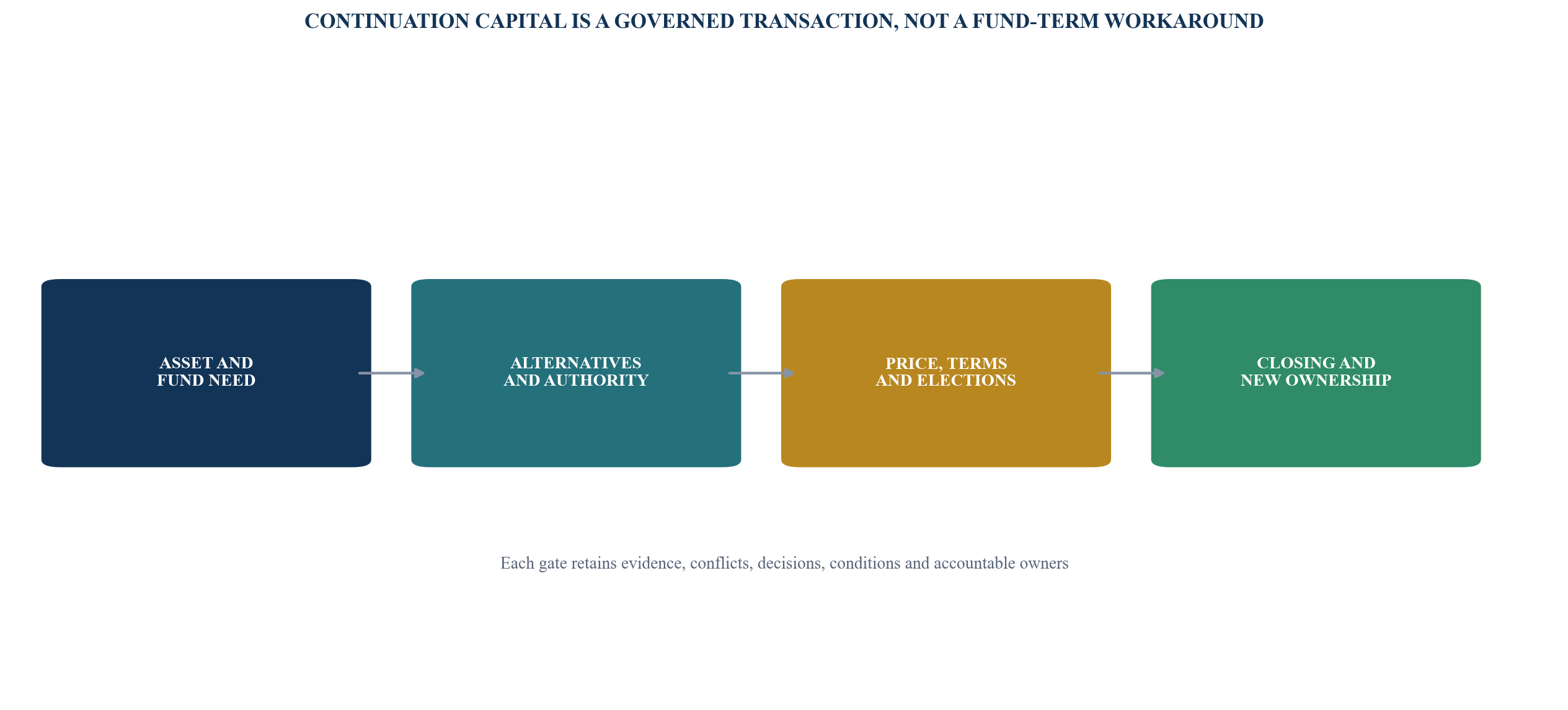
The transaction proceeds only when rationale, alternatives, process integrity and executable outcomes remain coherent.
2. Define the parties and decisions
The existing fund is the seller. The continuation vehicle is the buyer. The manager, general partner or affiliates can influence both. Existing investors decide whether to sell, roll or split their interests. New investors underwrite the asset and the new vehicle. The portfolio company, management team, lenders, advisers, regulators and service providers can each affect execution.
The manager should map legal entities, economic interests and authority before appointing advisers or seeking bids. The map covers the existing fund, parallel and feeder vehicles, co-investors, general partner, management company, carried-interest vehicles, continuation vehicle, acquisition entities and any new commitment vehicle. It identifies boards, committees, limited-partner advisory committees, reserved matters, consents, conflicts procedures and amendment thresholds.
The exact role of an advisory committee depends on the governing documents and applicable law. ILPA's 2023 guidance discusses early engagement, conflict review and access to independent advice. It also states that individual advisory-committee members act in their own interests and do not hold a fiduciary duty to the fund or other investors. A manager should avoid presenting committee review as a substitute for its own duties, required consents or a fair process.
Decision rights should be expressed as actions: approve the rationale, appoint advisers, select assets, approve a process, waive a conflict, approve amendments, accept a bid, set elections, allocate expenses and authorise closing. Each action needs a legal basis, required information, decision-maker, quorum, conflicts treatment and record.
Table 1. Continuation-transaction authority map
| Decision | Evidence required | Proposed owner | Required confirmation |
|---|---|---|---|
| establish strategic rationale | asset plan, fund position and alternatives | governing body | purpose and authority |
| select transaction advisers | scope, independence, conflicts and fees | authorised committee | procurement and expense allocation |
| approve sale process | perimeter, bidders, information and timetable | governing body | confidentiality and market process |
| review conflicts | complete conflict register and mitigations | designated independent forum | consent or waiver mechanics |
| select price and terms | bids, valuation evidence and conditions | authorised seller decision-maker | applicable duty and approvals |
| approve election package | definitive terms, disclosures and options | governing body | securities and investor requirements |
| close transfer | conditions, funds flow and legal deliverables | named signatories | all consents and releases |
Counsel should confirm the actual authority under current documents and law.
3. Test the alternatives before choosing the structure
A continuation vehicle should be compared with executable alternatives. A fund extension can preserve ownership without a related-party sale, although investor consent, liquidity needs and additional capital remain issues. A third-party asset sale can create a clean exit and a market price. A partial sale can provide liquidity while preserving exposure. A refinancing or dividend recapitalisation can create proceeds and retain the asset, subject to leverage capacity and downside risk.
Follow-on capital from the existing fund, co-investors or a new sponsor vehicle can fund the business. A structured minority investment can introduce capital and price evidence. A public-market route may be relevant for a suitable asset. An orderly hold with a later exit can remain viable when the fund has time and investors support it.
Each alternative should be assessed on price, certainty, time, required consent, liquidity delivered, capital available, asset disruption, leverage, tax, regulatory consequences, management bandwidth, execution cost and future exit. A higher headline price can deliver less cash after debt, expenses, escrows, taxes, rollover and timing.
The alternatives memorandum should show why the chosen route fits the current facts. It should record any route that could not be tested and why. Unsupported statements that another buyer would pay less or that an extension is impossible weaken the process.
4. Build an asset-readiness screen
Continuation capital is commonly associated with assets that have more value-creation potential. That phrase needs evidence. The manager should identify the remaining operational initiatives, capital required, accountable executives, dependencies, milestones, downside cases and exit routes. It should explain what has changed since the original underwriting and why the next ownership period fits the manager's capability.
Readiness also includes information quality. Audited financial statements, current management accounts, quality-of-earnings work, commercial and operational data, tax positions, regulatory status, cybersecurity, legal claims, key contracts, debt, equity rights and management incentives need an evidence owner. The asset should withstand a new institutional underwriting process.
Concentration matters. A single-asset vehicle can expose investors to one company, management team, sector and exit route. A multi-asset vehicle can diversify company risk while adding perimeter, allocation and valuation complexity. The proposal should make the concentration and dependency effects visible.
For an emerging manager, team capacity is part of asset readiness. The manager may be raising a successor fund, managing the existing portfolio and executing the continuation transaction simultaneously. The board should test senior attention, investment-team roles, portfolio support, compliance, finance, investor operations and succession. Planned resources should remain separate from current resources.
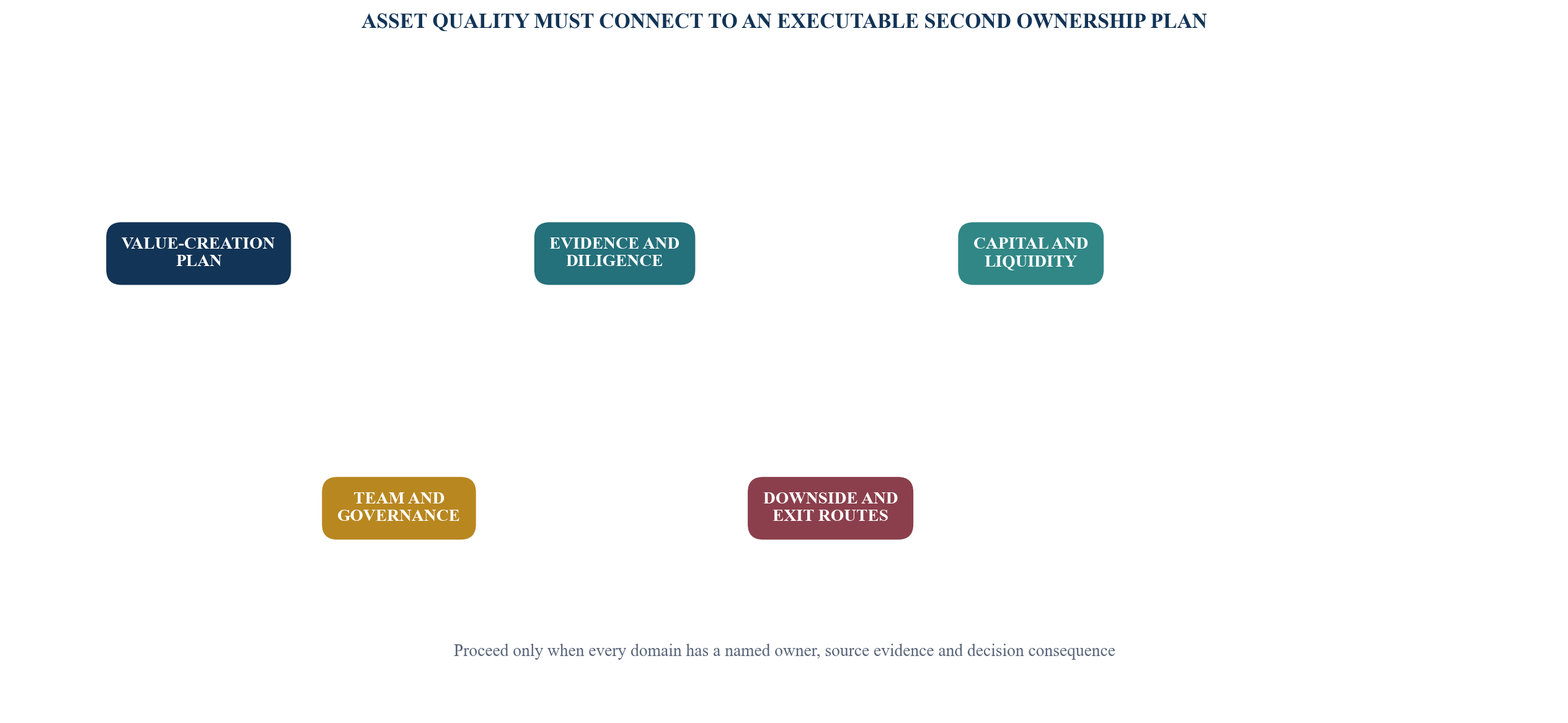
An attractive company still needs evidence, capital, ownership capability and executable exit routes.
5. Create a complete conflict register
The related-party sale creates a structural conflict because the manager influences seller and buyer. Additional conflicts can arise from carried-interest crystallisation, new carried interest, management fees, transaction fees, stapled commitments, adviser incentives, asset selection, allocation of follow-on capital, allocation of expenses, management incentives, future fundraising and the treatment of investors who do not respond.
Each conflict should be specific. The register identifies the affected parties, source of the interest, financial or governance effect, decision influenced, governing provisions, mitigation, required consent, disclosure, owner and closure evidence. A generic statement that conflicts may exist gives investors limited decision support.
Mitigation can include an independent adviser, competitive process, independent valuation evidence, segregated decision-makers, advisory-committee engagement, expense allocation, equal information, status-quo economics for rolling investors, clear elections and adequate time. Disclosure supports informed decisions. Some conflicts require stronger action, consent or avoidance under the applicable framework.
The FCA Handbook requires applicable alternative investment fund managers to identify conflicts and take reasonable steps to avoid them. Where they cannot be avoided, they must be managed, monitored and disclosed as applicable so that funds and investors are fairly treated. The scope depends on the manager, fund and activity. The United States framework also requires current advice. The SEC confirmed that the federal court's June 2024 vacatur removed the 2023 adviser-led-secondary rule along with other private-fund adviser rules. The vacated rule should not be described as current federal law. Existing fiduciary, antifraud, disclosure, contractual and other obligations can still apply.
Table 2. Conflict register for a continuation transaction
| Conflict source | Potential effect | Evidence and mitigation | Decision consequence |
|---|---|---|---|
| manager on both sides | influence over price and process | authority map, independent challenge and documented process | hold, redesign or proceed |
| crystallised and reset carry | manager receives current and future economics | full waterfall, rollover mechanics and approvals | change terms or disclose and approve |
| management-fee reset | longer fee stream | old-versus-new fee bridge and operating budget | negotiate basis and duration |
| stapled commitment | bid may benefit successor fundraising | separate economics, bidder comparison and conflict review | exclude, separate or approve |
| adviser compensation | incentive linked to closing or value | engagement terms, scope and independence review | appoint, mitigate or replace |
| expense allocation | selling or rolling investors bear unequal cost | cost schedule and governing-document analysis | reallocate before launch |
| non-response default | investor may be forced into an outcome | explicit election rules, reminders and current advice | redesign election |
The examples are control categories; the live register should state transaction-specific facts.
6. Design a credible market process
Price validation begins with process design. The manager should define which assets are offered, which bidders receive access, what information is shared, how questions are answered, how bids are compared and what conditions can alter value. Potential purchasers need enough time and information for credible underwriting.
A competitive auction can test price and terms across buyers. A targeted process may suit confidentiality, complexity or a specialised asset. A single-buyer negotiation can be executable when supported by a documented rationale and independent challenge. The chosen process should reflect the asset and fund facts rather than a desired appearance of competition.
Bid comparability requires a common template. It should capture enterprise value, equity value, debt assumptions, cash, working capital, leakage, escrows, warranties, rollover, unfunded commitments, follow-on capital, fees, conditions, approvals, financing certainty, exclusivity and timing. A bidder offering a high value with significant conditions can be less attractive than a lower, funded and executable offer.
Information equality matters. Material answers and updated data should reach the relevant bidders consistently, subject to lawful confidentiality and clean-team controls. The process log should record access, questions, responses, meetings, versions, bids, deviations, conflicts and decisions.
7. Validate value through several lenses
No single method establishes fairness. The manager can combine competitive bids, discounted cash flow, public-company and transaction references, asset-specific operating measures, independent valuation work, third-party financing terms and the existing fund's valuation history. Each method needs a measurement date, scope, assumptions, limitations and reconciliation.
IFRS 13 defines fair value as the price received to sell an asset or paid to transfer a liability in an orderly transaction between market participants at the measurement date. It provides a measurement framework when another standard requires or permits fair value. Its accounting scope and application require specialist advice. A continuation process can still use its focus on market-participant assumptions, current conditions, observable inputs and documented valuation techniques.
The bridge should distinguish the latest reported fund valuation, current transaction value, adjustments to enterprise value, debt, cash, transaction costs and net proceeds. It should show how carried interest, fees, escrows, rollover and taxes affect cash delivered. Valuation sensitivity should change the decision rather than decorate the memorandum.
For an emerging manager, an independent opinion can support challenge and disclosure. It does not replace the sale process or the manager's responsibility. The adviser should have access to current information, a clear scope and disclosed limitations and conflicts.
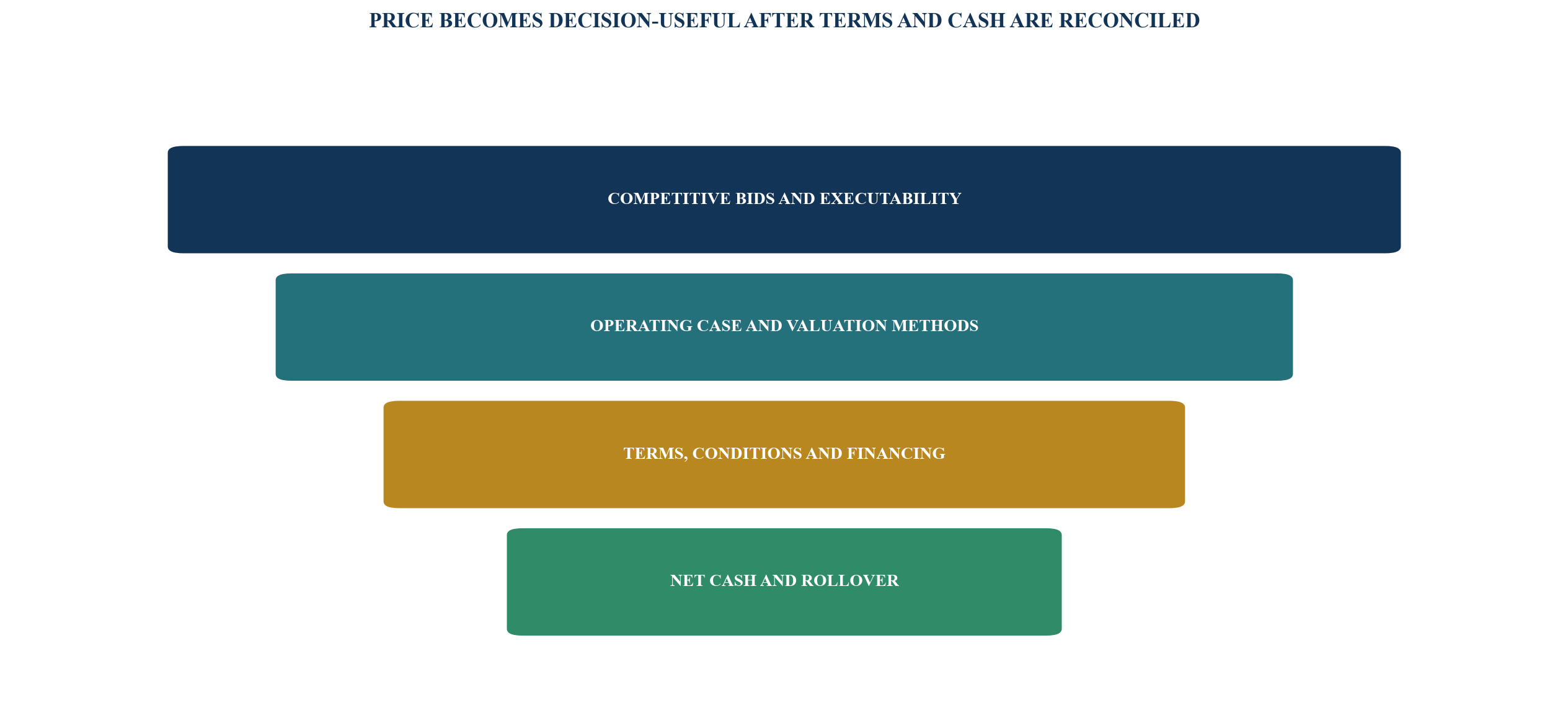
The decision reconciles market evidence, valuation analysis, terms and net cash at one measurement date.
8. Build a transparent economics bridge
The transaction creates economics at several levels. The existing fund receives consideration and pays or allocates costs. Selling investors receive net proceeds. Rolling investors exchange an interest in the existing fund for an interest in the new vehicle. The manager may crystallise carry and receive new fees and carry. New investors fund the purchase and future capital.
The bridge should show each flow separately. It starts with enterprise value, adds cash and subtracts debt and debt-like items to reach equity value. It then includes transaction costs, taxes, escrows, leakage, management rollover, fund-level liabilities and any holdback. Investor-level proceeds depend on the waterfall, ownership, carry and election.
Rolling economics should compare the old and new terms. The comparison covers acquisition value, management fee base, fee rate, offsets, carried-interest rate, preferred return, catch-up, term, extensions, recycling, follow-on obligations, governance, reporting, key-person provisions and transfer rights. Any status-quo option should be stated precisely.
Worked examples can expose mechanics. Assume an asset equity value of USD 120 million, transaction costs of USD 4 million and an escrow of USD 3 million. These values are management assumptions. They do not describe a transaction or market. The bridge shows USD 113 million before fund waterfall, tax and investor elections. A sensitivity should show how lower value, delayed closing or higher costs affect each group.
Table 3. Illustrative price-to-investor bridge
| Bridge item | Illustrative USD million | Evidence required | Decision owner |
|---|---|---|---|
| enterprise value | 150 | bids and valuation work | authorised seller body |
| less net debt and debt-like items | 30 | completion balance sheet and definitions | finance and advisers |
| equity value | 120 | reconciled calculation | governing body |
| less transaction costs | 4 | adviser and execution budget | finance and legal |
| less escrow or holdback | 3 | definitive terms | governing body |
| amount before waterfall and tax | 113 | funds-flow memorandum | finance and administrator |
| selling-investor cash | depends on elections | ownership and waterfall | administrator and signatories |
Every amount is a management assumption solely for method demonstration; no client or market transaction is represented.
9. Preserve genuine investor choice
An election is meaningful when the investor understands the asset, process, price, terms, conflicts, tax considerations, funding obligations and alternatives and has enough time to complete its governance. Sell, roll and split options should be described with identical precision.
The manager should specify eligibility, minimums, maximums, allocation if elections exceed capacity, treatment of fractions, default for non-response, funding, documentation, tax forms, representations, withdrawal rights, finality and closing conditions. The process should avoid using operational complexity to push one choice.
ILPA's guidance highlights the need for adequate decision time and investor engagement. It addresses a status-quo option under which rolling investors can participate without changed economics. The governing documents, legal structure and live terms determine feasibility. The manager should explain any difference between selling, rolling and new investors.
The election calendar should work backward from the investor decision. It includes data-room access, management presentation, adviser reports, questions, final documents, tax analysis, committee meetings, reminders and cure periods. A technically open portal does not create adequate time when essential information arrives late.
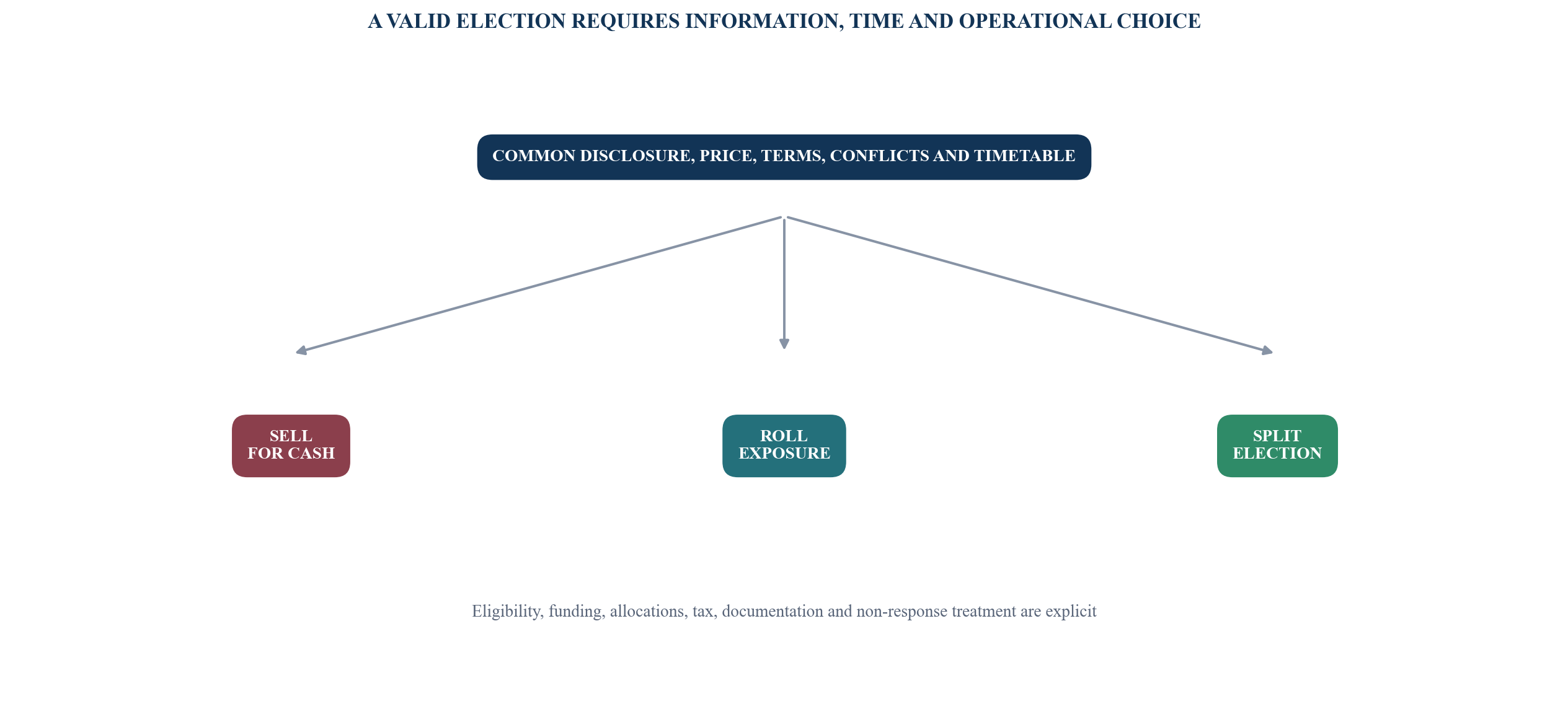
Equal decision support requires complete information, usable time and operationally executable choices.
10. Give rolling investors a complete new-fund case
Rolling is a new investment decision even when no cash changes hands. The investor needs the continuation vehicle's constitutional documents, strategy, asset case, economics, governance, service providers, leverage, valuation, reporting, key-person terms, conflicts, liquidity and exit plan.
The asset underwriting should begin at the continuation-vehicle entry value. Historical cost and performance provide context. The investor's forward return depends on the new purchase price, future cash flows, leverage, fees, carry, dilution and exit. The manager should not use the existing fund's gross multiple as the forward case.
Follow-on capital requires clarity. The investor should know whether it has an obligation or option, how non-participation affects ownership, how allocations work, what instruments can be issued and who can approve further borrowing. The continuation vehicle's capital budget should distinguish committed funds, expected needs, contingencies and optional growth.
The second ownership period also needs a defined end. The paper should show credible exit routes, preparatory work, target conditions and decision gates. An indefinite hold transfers the original maturity problem into a new structure.
11. Underwrite new secondary capital
New investors assess the asset and manager as a current opportunity. Their work can cover company performance, market, customers, operations, management, governance, legal, tax, regulation, cybersecurity, debt, valuation, downside, exit and alignment. They also assess the transaction process and the rights of selling and rolling investors.
The manager should maintain one controlled fact base. Information supplied to new investors, existing investors, advisers, lenders and decision bodies should reconcile. Confidential information can be protected through permissions, clean teams, redaction and staged access while material facts remain consistent.
The fundraising perimeter needs current securities and marketing advice. A private fund cannot assume that a relationship, domicile or investor sophistication permits every communication. The manager should map entity, jurisdiction, recipient, permission or exemption, document, sender, date and record.
Any stapled commitment to a successor fund should be separately identified. It can affect bid comparison and manager incentives. The existing fund should understand whether the transaction price or buyer selection depends on capital committed elsewhere.
12. Finance the vehicle without hiding risk
The continuation vehicle can use buyer equity, rollover interests, acquisition debt, portfolio-company debt, deferred consideration, preferred equity or NAV-linked facilities. Each source changes cash, risk, priority, covenants, governance and exit flexibility.
Leverage should be tested at the asset, acquisition and fund levels. The model identifies borrower, guarantor, collateral, recourse, maturity, amortisation, interest, hedging, covenants, cash sweeps, distributions, default rights and refinancing. Aggregate exposure prevents double counting available cash or understating correlated stress.
The financing case should include lower earnings, slower growth, higher rates, delayed exit, reduced valuation and additional capital needs. The result is connected to covenant headroom, liquidity, investor calls and control rights. A financing package that increases the headline price can still reduce the resilience of rolling and new investors.
ILPA's separate NAV-facility guidance supports transparent discussion of rationale, terms and conflicts. Applicability depends on the actual structure. The continuation process should disclose financing at a level that permits investors to understand cost, recourse and risk.
Table 4. Continuation-vehicle financing map
| Capital source | Key terms | Principal risk | Required evidence |
|---|---|---|---|
| new secondary equity | price, governance and funding | dilution or conditional capital | subscription and funds evidence |
| rolling interests | exchange ratio and new terms | unequal economics | rollover agreement and reconciliation |
| acquisition debt | leverage, covenants and maturity | default or refinancing | commitment papers and downside model |
| portfolio-company debt | security and distribution capacity | operating cash pressure | lender terms and cash-flow model |
| preferred equity | priority, return and controls | value transfer in downside | full waterfall and scenarios |
| follow-on commitment | amount, timing and allocation | future funding shortfall | capital budget and call mechanics |
The structure should be tested on a consolidated basis and under downside cases.
13. Assemble a decision-grade disclosure pack
The disclosure pack should let an existing investor understand what is being sold, why, at what value, through which process, on which terms and with which choices. ILPA's January 2026 template consolidates high-level information and directs users to supporting documents. ILPA says the template complements rather than replaces definitive materials and adviser documents.
The pack can include the rationale, alternatives analysis, asset description, historical and current performance, operating plan, capital needs, transaction structure, valuation, bids, conflicts, adviser roles, manager economics, expenses, financing, rollover terms, new-fund documents, tax materials, election form, timetable and contacts. Every item has a version, date, owner, reviewer and access rule.
Performance should include a defined population, cash flows, valuation date, currency, gross-to-net bridge and reconciliation. Forecasts should state assumptions, sensitivities and limitations. Selected metrics should not obscure adverse or conflicting evidence.
Material updates need a controlled process. The manager identifies what changed, who is affected, whether the election clock should move and which documents require correction. The definitive documents govern where summaries differ.
14. Control the timeline around investor readiness
The transaction calendar has two dimensions: deal execution and investor governance. Asset diligence, bids, financing, documentation and approvals must connect to limited-partner review, tax work and committee calendars. A closing date should not be achieved by withholding decision time.
The manager can publish a milestone plan early, then issue a controlled update when facts change. Critical dates include initial advisory-committee engagement, adviser appointment, bidder access, bids, price selection, disclosure release, management session, question deadline, final documents, election deadline, financing conditions and closing.
An emerging manager should retain contingency. A bidder may retrade, financing may change, a consent may be delayed or a material fact may emerge. The plan defines hold points, extension authority, fallback bidders and a stop route.
Every decision should be reproducible. Minutes and memoranda record information available, conflicts, advice, dissent, conditions and rationale. The record supports governance and future investor reporting.
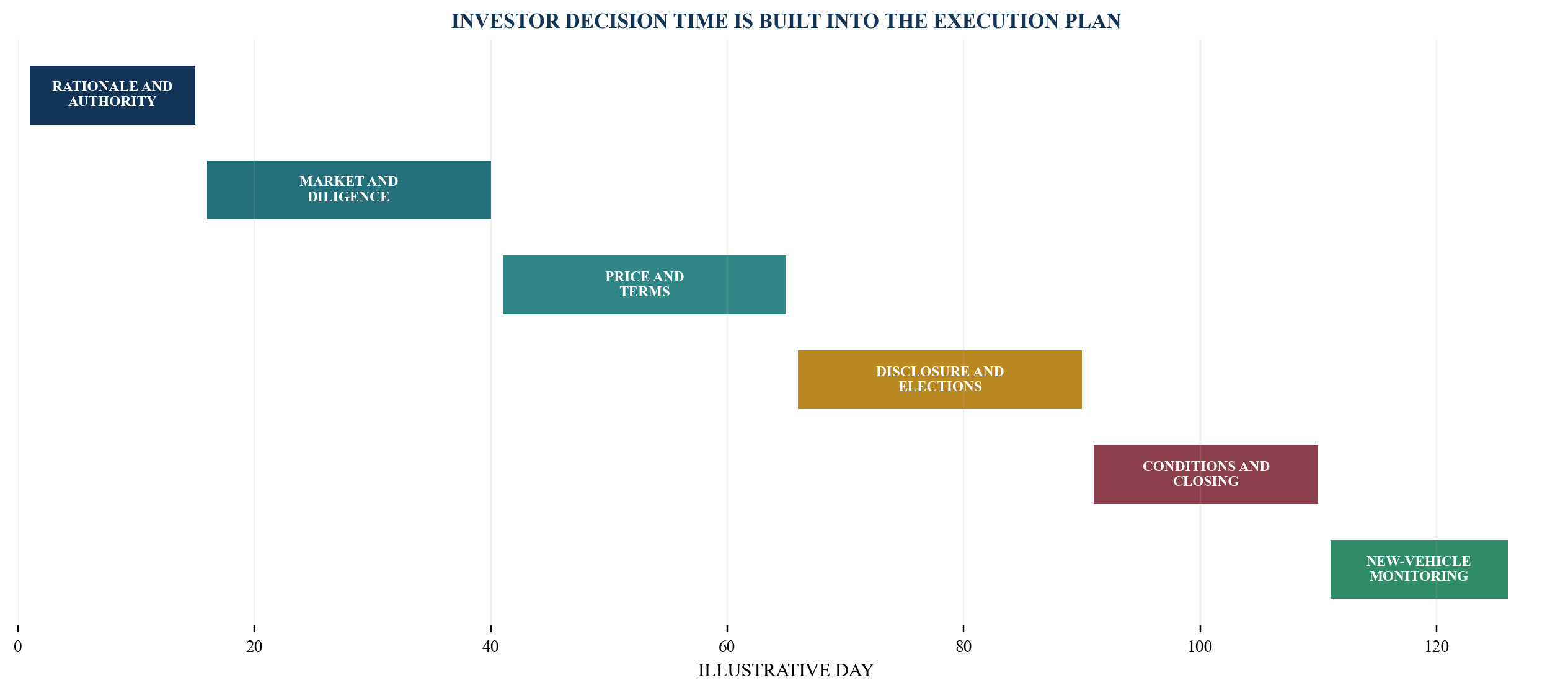
The periods are a management model; actual timing depends on complexity, documents, investors and approvals.
15. Govern expenses, carry and management incentives
Transaction costs can include legal, financial, tax, valuation, diligence, financing, administration, insurance and data-room expenses. The allocation between the existing fund, continuation vehicle, manager, selling investors, rolling investors and new investors should follow the governing documents, applicable duties and approved terms.
The cost schedule should show success fees, broken-deal costs, expenses subject to caps, adviser conflicts, offsets and value-added tax or similar charges where relevant. It should identify costs created by the manager's broader fundraising or platform objectives.
Carried interest requires a full bridge. The model shows carry crystallised in the sale, any rollover of carry, new carry, preferred return, catch-up, escrow, clawback and treatment under downside. The manager should explain whether it is reinvesting proceeds and on what terms.
Portfolio-company management incentives should align with the new operating plan. The process should disclose dilution, vesting, performance conditions, leaver terms, change-of-control treatment and conflicts. Retention should be grounded in role and delivery rather than used as an opaque transfer of value.
16. Prepare for closing as a funds-and-rights transfer
Closing transfers assets, cash, interests, liabilities, rights and obligations. A closing checklist should cover sale documents, fund documents, subscriptions, rollovers, consents, regulatory filings, lender approvals, management arrangements, insurance, tax steps, funds flow, administrator records and conditions.
The funds-flow memorandum should reconcile every payment to an agreement and bank instruction. It identifies sender, recipient, amount, currency, timing, account verification, approval and evidence. Changes follow controlled call-back and dual-authority procedures.
The administrator reconciles selling and rolling elections, ownership, waterfall, capital accounts and new interests. Exceptions remain unresolved until approved. Closing confirmation should tell investors what completed, their final election, cash or interests received, outstanding conditions and first reporting date.
Post-close records include final bids, valuations, conflicts, consents, disclosures, communications, signed documents, funds flow, allocations and decision logs. Retention depends on the entity, jurisdiction and current obligations.
Table 5. Closing-control register
| Control domain | Acceptance evidence | Accountable owner | Hold condition |
|---|---|---|---|
| authority and consent | signed resolutions and approvals | legal and governance | missing valid authority |
| elections | reconciled sell, roll and split file | administrator | unresolved investor exception |
| funds flow | approved memorandum and bank verification | finance | unmatched payment or account |
| asset transfer | executed sale and transfer documents | transaction counsel | unmet condition precedent |
| new interests | signed subscriptions and capital accounts | administrator | allocation mismatch |
| financing | executed facilities and funding evidence | finance and counsel | unfulfilled draw condition |
| reporting handover | obligations, calendar and owners | investor operations | missing first-cycle readiness |
The register joins legal completion, cash movement and investor records.
17. Operate the continuation vehicle as a new fund
The new vehicle needs an operating model from its first day. It covers governance, investment decisions, cash, valuation, administration, investor reporting, service providers, compliance, risk, conflicts, cybersecurity, business continuity and records.
The FCA Handbook, where applicable, requires prior investor information on strategy, service providers, delegation conflicts, valuation procedure, liquidity, fees, fair treatment and preferential treatment. It also contains valuation-independence and annual-report requirements for applicable full-scope UK alternative investment fund managers. The precise scope depends on the fund and manager.
Current DIFC and ADGM fund frameworks may be relevant to a regional structure. The DFSA identifies Public Fund, Exempt Fund and Qualified Investor Fund regimes. Its July 2026 Consultation Paper 173 proposes changes to the collective-investment framework and remains a proposal unless adopted. ADGM's current fund rules, permissions, forms and reporting requirements should be checked for the proposed manager and vehicle. Domicile selection should follow legal, investor, tax, operational and distribution analysis.
The reporting contract defines portfolio performance, valuation, leverage, fees, expenses, capital, risks, incidents, conflicts, asset-plan milestones and exit readiness. Side-letter obligations are mapped to recipients, dates, formats and approvals.
18. Use an emerging-manager proportionality test
An emerging manager may have fewer people, shorter institutional history and smaller systems than an established platform. Proportionality can change how controls are delivered. It does not remove the conflict or the need for credible evidence.
The manager should identify which capabilities are retained, independently challenged or outsourced. A lean platform can appoint specialist legal, financial, tax, valuation, administration and compliance support. Delegation should preserve accountable ownership, oversight, data access, escalation and continuity.
The board should test whether transaction size supports the cost and operating burden. A small vehicle with complex cross-border investors, leverage and bespoke reporting can consume disproportionate resources. The fully loaded budget includes formation, diligence, advisers, administration, audit, valuation, compliance, reporting, technology, directors, insurance and wind-down.
The manager should also test franchise effects. A fair process can support credibility. A rushed process, incomplete disclosure or misaligned economics can damage existing investor relationships and successor fundraising. Commercial pressure should appear in the risk register and decision record.
19. Run a twelve-week readiness office
Weeks one and two define the fund problem, asset thesis, alternatives, entities, authority and conflicts. Weeks three and four build the evidence room, asset plan, capital budget and preliminary valuation bridge. Weeks five and six appoint advisers under controlled scopes and test market-process options.
Weeks seven and eight prepare bidder materials, investor disclosure, elections, new-vehicle terms, finance work and reporting architecture. Weeks nine and ten run independent challenge across price, process, conflicts, economics, tax, legal, regulatory and operational readiness. Weeks eleven and twelve present the go, redesign, defer or stop decision.
The readiness office can deliver an authority map, alternatives memorandum, asset-readiness score, conflict register, information index, bid template, valuation bridge, economics waterfall, election architecture, financing model, disclosure index, implementation calendar and board paper.
The twelve weeks are a management assumption, not a completion promise. A transaction can require a longer period. The first output is a credible decision whether to proceed, together with the work required for a fair and executable process.
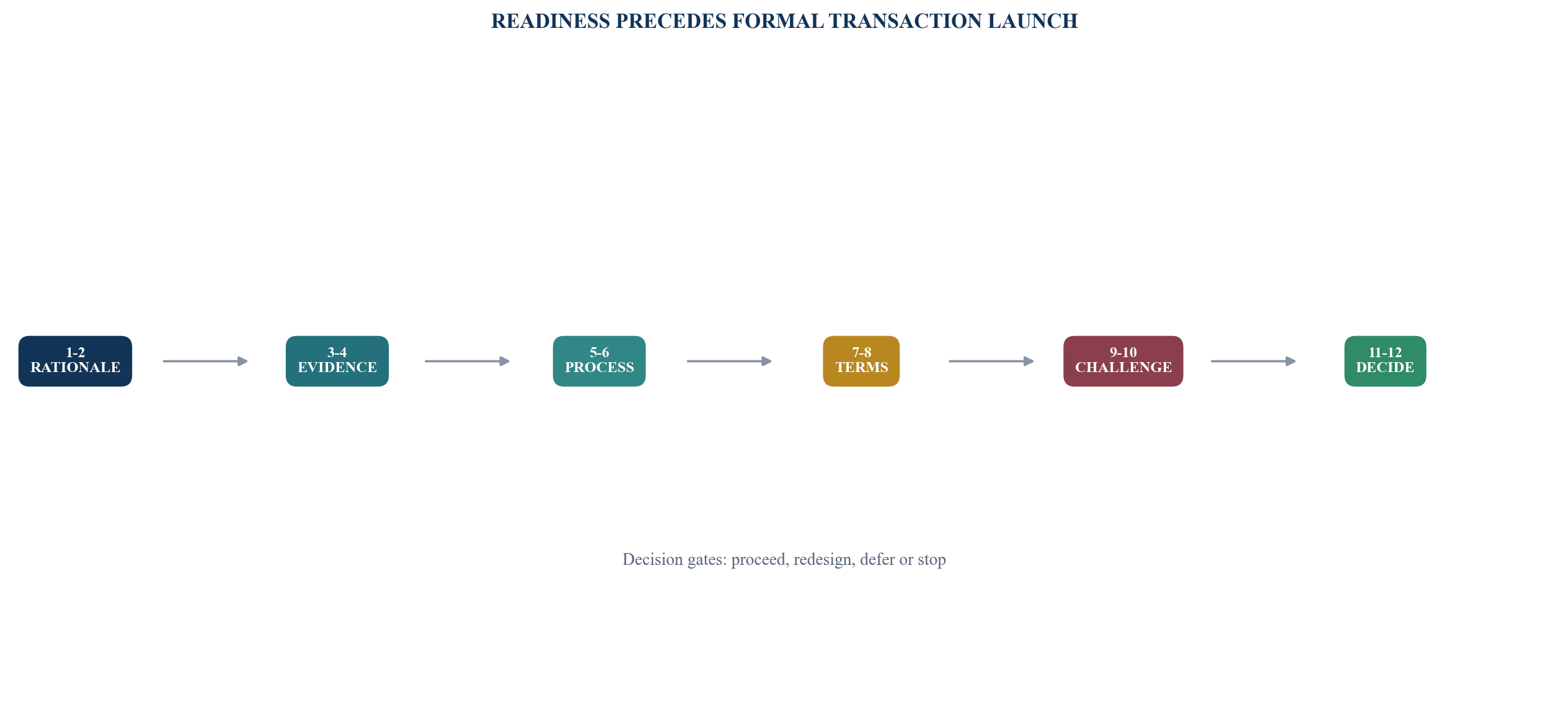
The sequence is an illustrative management model and should expand when evidence or approvals require more time.
20. Measure process integrity and value
The board should monitor evidence completeness, unresolved conflicts, adviser independence, bidder participation, material information updates, bid comparability, valuation sensitivity, investor access, question response time, document timing, election exceptions, financing certainty, costs, closing conditions and post-close reporting readiness.
These measures indicate execution quality. They do not prove that the structure maximises value. The final decision should combine the asset case, alternatives, price, net cash, investor choice, conflicts, terms, downside, execution risk and the manager's ability to operate the new vehicle.
Table 6. Board process-integrity dashboard
| Measure | Definition | Evidence source | Escalation question |
|---|---|---|---|
| unresolved material conflicts | conflicts without approved treatment | conflict register and minutes | can the affected decision proceed? |
| comparable funded bids | bids reconciled across value, terms and certainty | bid matrix and financing evidence | has price received a credible test? |
| disclosure completeness | required decision fields supported and current | disclosure index and data room | which investor decision remains unsupported? |
| information-to-election time | days between complete material release and deadline | version and election logs | does governance have usable time? |
| election exceptions | unresolved eligibility, documentation or allocation items | administrator reconciliation | can every outcome be executed correctly? |
| closing conditions | open conditions by consequence and owner | closing checklist | what can delay or invalidate completion? |
| first-report readiness | approved data, calculation and release owners | reporting contract and dry run | can the new vehicle meet its first obligations? |
Thresholds should be approved for the live transaction; no metric independently establishes fairness or value.
Commercial benefits for the manager can include retained ownership of a strong asset, a new institutional relationship and a longer value-creation period. Benefits for investors can include liquidity or continued exposure. Each benefit remains conditional on price, process, terms and performance.
No approved observed Matchpoint or client evidence was supplied for continuation-fund closes, incremental assets under management, commitments, fee revenue, returns or conversion attributable to this framework. Attributed monetary value remains USD 0 until supported by signed and paid mandate evidence or approved client records.
The central conclusion is that continuation capital can hold a winner without trapping investors only when the process preserves genuine choice. The manager needs an evidenced rationale, tested alternatives, valid authority, complete conflicts treatment, defensible price, transparent economics, usable time, executable elections and a fully governed new vehicle. These disciplines turn a conflicted related-party transaction into a decision that every participant can evaluate on current facts.
References
- Institutional Limited Partners Association. Continuation Funds: Considerations for Limited Partners and General Partners, May 2023. https://ilpa.org/wp-content/uploads/2023/05/Continuation-Funds-Considerations-for-Limited-Partners-and-General-Partners.pdf
- Institutional Limited Partners Association. Continuation Fund Disclosure Template, January 2026. https://ilpa.org/resources-tools/resource-library/continuation-fund-disclosure-template/
- Institutional Limited Partners Association. Draft New Continuation Vehicle Guidance, June 2026. https://ilpa.org/resources-tools/resource-library/draft-new-continuation-vehicle-cv-guidance/
- Institutional Limited Partners Association. Continuation Vehicles: Principles and Best Practices. https://ilpa.org/industry-guidance/principles-best-practices/continuation-funds/
- Institutional Limited Partners Association. GP-Led Secondary Fund Restructurings, April 2019. https://ilpa.org/wp-content/uploads/2019/04/ILPA-Guidance-on-GP-Led-Secondary-Fund-Restructurings-Apr-2019-FINAL.pdf
- Institutional Limited Partners Association. NAV-Based Facilities Guidance. https://ilpa.org/industry-guidance/principles-best-practices/nav-based-facilities-guidance-roadmap/
- IFRS Foundation. IFRS 13 Fair Value Measurement. https://www.ifrs.org/issued-standards/list-of-standards/ifrs-13-fair-value-measurement/
- Financial Conduct Authority. FUND 3: Requirements for Alternative Investment Fund Managers. https://handbook.fca.org.uk/handbook/fund3
- Financial Conduct Authority. SYSC 10: Conflicts of Interest. https://handbook.fca.org.uk/handbook/sysc10
- United States Securities and Exchange Commission. Announcement Regarding the Private Fund Advisers Rules, October 2024. https://www.sec.gov/announcement-regarding-private-fund-advisers-rules
- United States Securities and Exchange Commission. Commission Interpretation Regarding Standard of Conduct for Investment Advisers, June 2019. https://www.sec.gov/rules-regulations/2019/06/ia-5248
- United States Securities and Exchange Commission. Private Funds, June 2024. https://www.sec.gov/resources-small-businesses/capital-raising-building-blocks/private-funds
- Dubai Financial Services Authority. Collective Investment Funds. https://www.dfsa.ae/what-we-do/collective-investment-funds
- Dubai Financial Services Authority. Consultation Paper 173: Proposals to Enhance the Collective Investment Funds Framework, July 2026. https://www.dfsa.ae/news/notice-consultation-paper-release-cp-173
- Abu Dhabi Global Market Financial Services Regulatory Authority. Regulatory Reporting Requirements for Funds, October 2025. https://www.adgm.com/media/announcements/adgm-fsra-implements-regulatory-reporting-requirements-for-funds
About the Author
Chennakeshav Adya, Independent Researcher
