
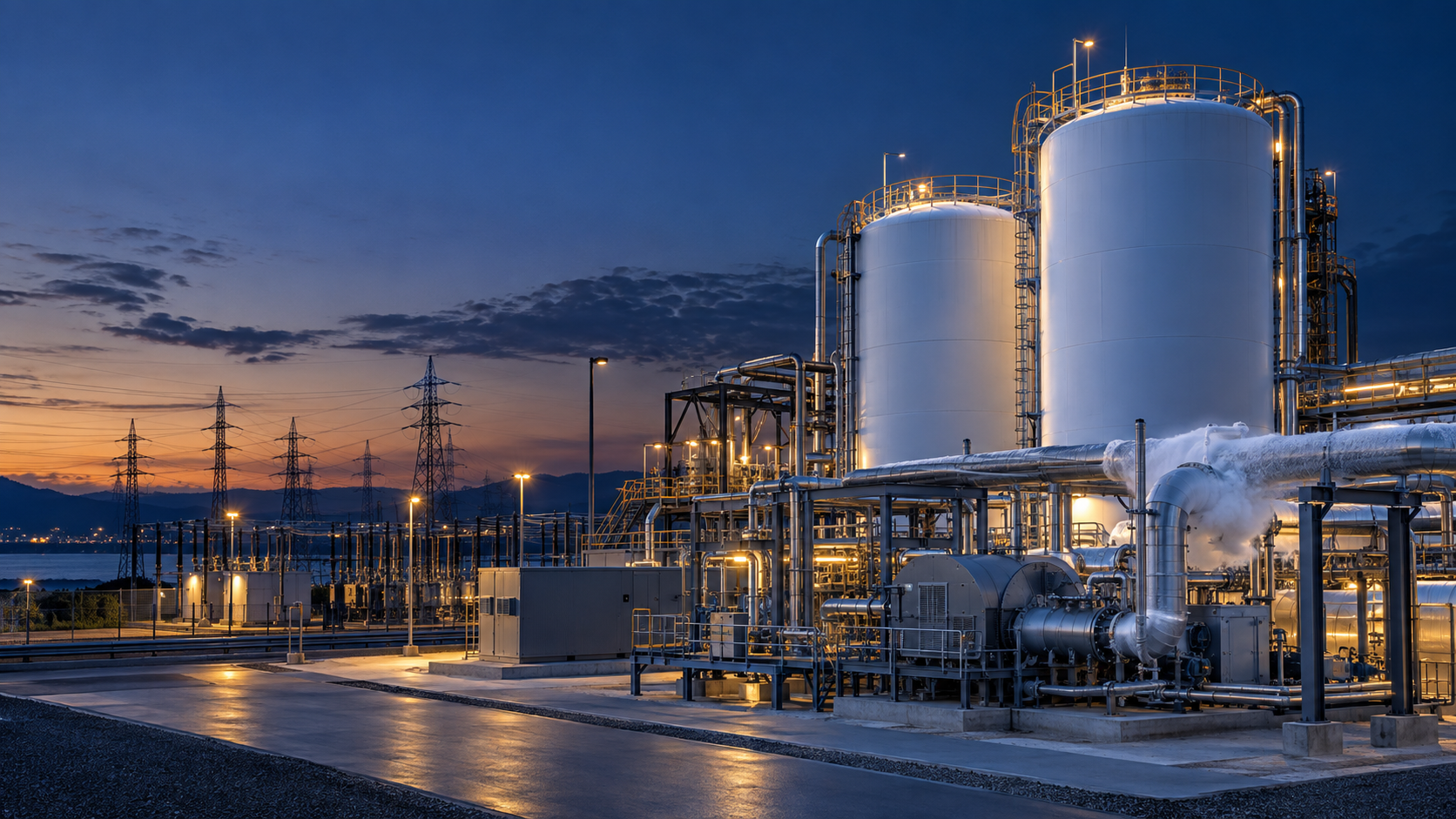
1. Liquid air is an integrated industrial asset
Liquid-air energy storage uses electricity to cool purified air until it becomes liquid, stores the cryogenic liquid at low pressure and later pumps it to a higher pressure before heating and expanding it through turbines. The cycle joins equipment familiar from air separation, cryogenic storage, thermal systems and power generation. Commercial performance emerges from their integration.
The project has several stores. The liquid-air tank holds the energy vector. A cold store can recover refrigeration released during discharge and reuse it during charging. A warm store can capture compression heat and return it during expansion. The grid connection, control system and market interface complete the asset.
Investment analysis should therefore treat liquid-air storage as one operating system. A reliable tank cannot compensate for a weak liquefier. An efficient expander cannot recover value when cold recycling fails. A strong revenue contract can still expose equity if the plant cannot meet its tested duration, availability or response obligations.
2. The investment question is integration risk
The central question is whether the plant can repeatedly convert purchased electricity into dispatchable energy and contracted grid services within guaranteed efficiency, availability and cost. Every material interface can alter that result: air purification, refrigeration, compression heat, cold storage, cryogenic pumping, expansion, cooling water, auxiliary power, grid controls and operating software.
Liquid-air projects can use established components while retaining first-of-a-kind system risk at commercial scale. Scale changes heat-exchanger approach, thermal inventory, pressure loss, start sequence, control stability and maintenance access. A successful subsystem test gives useful evidence; the integrated duty cycle remains the financing unit.
The contract strategy should identify who controls each interface, who measures it, which test proves compliance and which remedy restores the investment case. Unallocated integration risk usually returns to the project company.
3. The physical cycle determines the commercial perimeter
Charging begins with air intake, filtration and removal of water and carbon dioxide that could freeze. Compression and refrigeration reduce temperature until part of the stream liquefies. The plant rejects or stores heat and transfers liquid air to insulated tanks. Charging cost includes compressor power, refrigeration losses, pumps, fans, cooling and other auxiliaries.
Discharge pumps the liquid to pressure, recovers cold during regasification, adds stored or external heat and expands the air through power turbines. Net output equals gross generation after pumps, fans, heaters, controls and balance-of-plant demand. Round-trip efficiency must be measured at the agreed grid boundary.
This perimeter is contractual. A vendor may quote compressor efficiency at a flange while the project finances net export at the meter. The owner's model should reconcile every boundary between those points.
4. Cold recovery is a core production system
Air regasification releases high-grade cold that can support the next liquefaction cycle. Peer-reviewed reviews identify cold recovery as a principal determinant of liquid-air efficiency. Packed beds, phase-change materials, circulating fluids and other designs can store cold across cycles, each with pressure drop, thermal gradient, durability and control implications.
Cold-store performance affects charging power, liquid yield and recovery after long idle periods. A contract based only on discharge output can omit a deterioration that appears later as higher charging consumption. Testing should include steady-state cycles, partial loads, prolonged standby, restart and seasonal ambient conditions.
The financing model should track cold inventory as an operating state. A plant starting with a fully conditioned cold store can outperform a plant after an outage. Guaranteed performance should specify initial condition, conditioning energy and the number of cycles required to reach stable operation.
5. Heat recovery creates value and dependency
Compression creates heat. Capturing that heat can reduce later heating requirements during discharge. External heat from an industrial process, power plant or other source can further improve output in some configurations. The commercial benefit depends on temperature, volume, timing, quality, distance and continuity.
An external heat source creates a new dependency. The project needs access rights, connection works, operating protocols, outage coordination, measurement, specification, liability and a price formula. A non-binding expectation of free waste heat has no debt value. A long-term heat agreement can support value when the supplier's credit and process life are acceptable.
The model should distinguish internal recovered heat from external heat. It should show plant efficiency and revenue with each source unavailable. Debt service should remain supported under the contracted availability regime.
6. Air preparation protects the cryogenic train
Moisture and carbon dioxide can freeze at cryogenic temperatures and obstruct equipment. Air-preparation systems must deliver the specified purity across ambient humidity, pollution and load conditions. Adsorbent beds, regeneration cycles and switching valves introduce operating sequences and maintenance requirements.
The owner should require guarantees for outlet composition, pressure drop, regeneration energy, media life and capacity during bed changeover. Contaminant breakthrough can cause an outage that appears outside the main liquefier warranty. Sensors, trip logic and inspection access should be part of the acceptance basis.
Local air quality and climate influence performance. Site data should cover temperature, humidity, dust, salt, industrial emissions and extreme events. Generic equipment ratings should be converted into site-specific guarantees.
7. Liquefaction performance must be tested at plant scale
Liquefaction determines the energy needed to create stored liquid air. Efficiency depends on compressor maps, heat exchangers, refrigeration cycle, cold return, ambient conditions and operating load. Laboratory or small-plant data may not capture full-scale pressure drop, exchanger distribution and control dynamics.
The guarantee should state net specific energy consumption, liquid production rate, product quality, turndown, ramp, start time and availability. Correction curves should convert test conditions to the reference case. Measurement uncertainty and tolerance should be stated before testing.
Liquid yield alone is insufficient. The test should measure all imported electricity and auxiliary consumption within the project boundary. A guaranteed tonne-per-hour rate can coexist with an uneconomic kilowatt-hour-per-tonne result.
8. Storage tanks separate energy capacity from power capacity
Liquid-air tanks principally support stored-energy duration. Compressors, pumps, expanders and generators determine charge and discharge power. This separation can create an attractive cost curve when additional duration requires more tank capacity rather than a complete second power block.
Tank value depends on usable inventory, boil-off, pressure, insulation, operating range, transfer losses and minimum heel. Gross geometric volume should not be treated as deliverable energy. The design must allow inspection, isolation, pressure relief and maintenance while meeting availability commitments.
Duration expansion can require piping, pumps, foundations, safety systems and control changes. The cost model should derive incremental hours from quantities and operating constraints, not a constant currency-per-kilowatt-hour assumption.
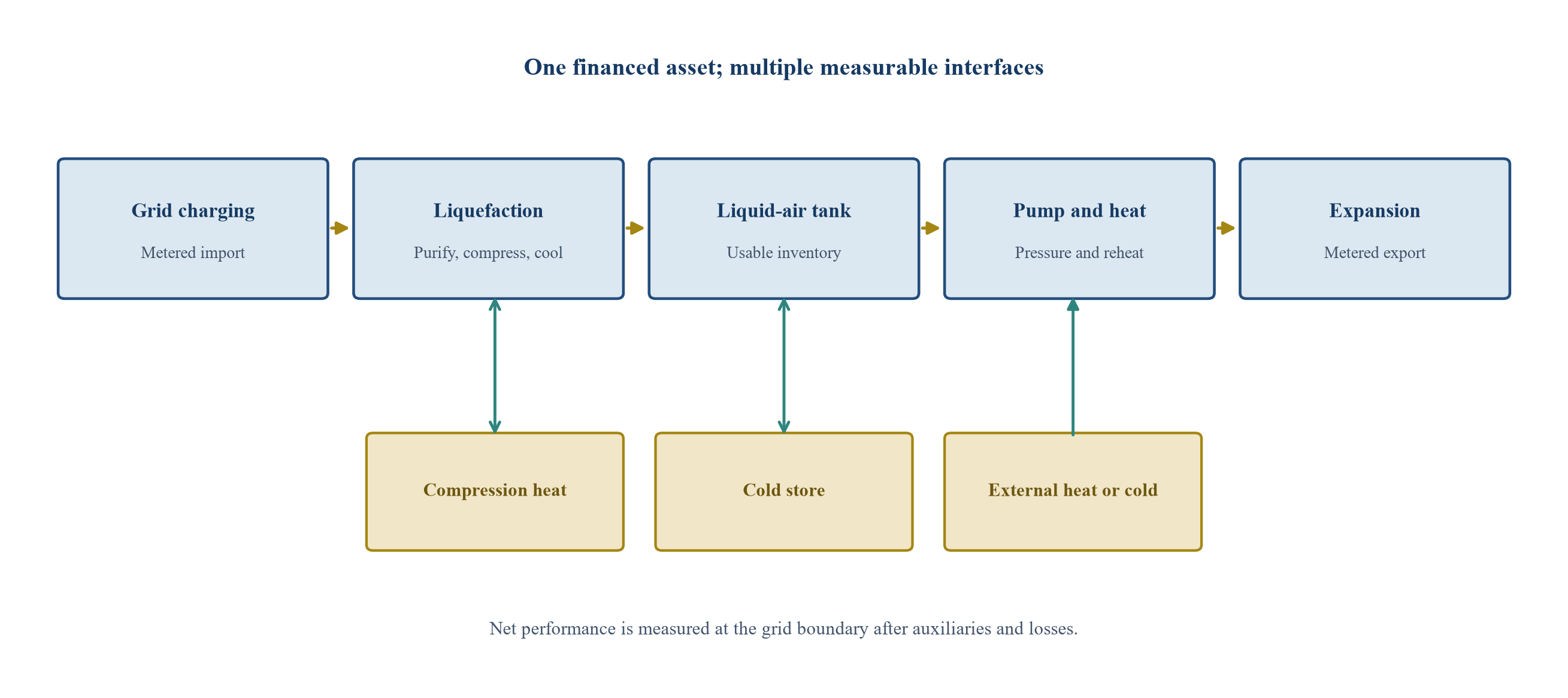
The diagram is conceptual. Project design and guarantees require plant-specific engineering, operating data and tested boundaries.
9. Pressure and temperature link every package
Pressure loss across filters, exchangers, pipework and valves changes compressor work and turbine output. Temperature changes material selection, sealing, insulation, thermal stress and efficiency. The integrated model should use common mass, energy and pressure balances across all packages.
Package vendors often optimise their own equipment. The owner needs a system integrator with authority over interface data, design freezes and change control. Late changes in one package can alter another vendor's guarantee or invalidate the plant heat balance.
The interface register should record design values, tolerances, transient conditions, responsibility, due dates and evidence. Contract schedules should incorporate the final register so that obligations survive personnel changes and disputes.
10. Auxiliary load can erase headline efficiency
Pumps, fans, cooling systems, air preparation, heaters, controls, trace heating and standby systems consume power. Their share can rise at partial load or during conditioning. Gross expander output therefore overstates cash-generating export.
The United States Department of Energy and Pacific Northwest National Laboratory assessed liquid-air round-trip efficiency in a 0.50 to 0.55 range for 2021 configurations and a 35-year calendar life assumption. Those values are assessment inputs rather than project guarantees. Current projects require site-specific evidence.
The financial model should use net metered import and export. It should include start energy, cold-store conditioning, standby demand, cooling variation, parasitic degradation and outage recovery. A single design-point efficiency should not drive debt sizing.
11. Operating modes need separate guarantees
A plant may charge, hold, discharge, provide reactive power, support voltage, remain ready for a capacity call or operate auxiliary stability equipment. Each mode has different constraints. Switching between modes can consume time and stored energy.
The contract should define dispatch notice, minimum run, ramp, start reliability, state-of-charge calculation and recovery after an aborted start. Availability should reflect whether the plant can provide the contracted service, not whether individual machines are technically available.
Mode interaction should be tested. Frequent short calls can disturb thermal inventories needed for a long discharge. Stability services may require equipment energisation that increases auxiliary consumption. Revenue stacking must follow physical chronology.
12. Site selection is industrial rather than geological
Liquid-air storage avoids the need for a particular cavern, yet siting remains consequential. The project needs land, heavy equipment access, grid capacity, cryogenic safety separation, water or cooling strategy, noise control and planning permission. Proximity to heat or cold sources can influence value.
Brownfield energy or industrial sites may offer grid infrastructure, process integration and experienced labour. They may also carry contamination, congestion, legacy services and demolition obligations. The model should value reused infrastructure only after condition, capacity, ownership and availability are verified.
Site screening should combine grid value, construction access, environmental constraints, industrial integration and market eligibility. A technically convenient site can still be commercially weak if connection or revenue timing is uncertain.
13. Water and cooling design affect performance
Heat rejection and equipment cooling can use water, air or hybrid systems. Water availability, temperature, quality, treatment and discharge affect cost and permitting. Air cooling can reduce water dependency while increasing footprint and sensitivity to hot weather.
The performance guarantee should include ambient correction curves and the selected cooling boundary. Extreme-temperature operation may coincide with system stress and high market value. Derating during those hours can reduce capacity accreditation and revenue.
Water balance, plume, noise and chemical treatment should enter environmental diligence early. A permit condition that restricts operation during critical periods has direct valuation consequences.
14. Cryogenic safety needs an integrated case
Liquid air is non-flammable, but cryogenic temperatures, oxygen enrichment, confined spaces, pressure, brittle fracture and rapid vaporisation create hazards. Material compatibility, ventilation, detection, relief, separation and emergency response require integrated design.
Air components can separate during handling. The safety case should assess oxygen concentration and ignition sensitivity where enrichment is possible. It should also define safe drainage and exclusion zones for releases.
Responsibility should extend across package boundaries. A tank vendor, piping contractor and process licensor can each meet a narrow specification while leaving a system hazard. A single hazard register, HAZOP programme and closure process should control the whole plant.
15. Demonstration evidence must match the financed duty
Small plants and pilot projects establish useful principles, operating sequences and maintenance knowledge. They do not automatically establish commercial-scale cost, availability or degradation. Investors should compare scale, configuration, thermal integration, grid duty and operating hours.
The United Kingdom's clean flexibility roadmap records a 5 MW near-commercial liquid-air plant launched in 2018 near Bury and operated for two years. The National Wealth Fund reports a £165 million commitment within a £325 million financing package for a 300 MWh Carrington facility. These disclosures show development and financing progress; they do not substitute for project-specific operating evidence.
Reference-plant diligence should obtain witnessed tests, event logs, maintenance records, auxiliary consumption and lessons incorporated into the new design. Public announcements should be checked against current authoritative status.
16. First-of-a-kind evidence can be financed in stages
An early commercial project may carry technology, scale-up and supply-chain risk that conventional project debt cannot absorb at full leverage. Development equity, strategic capital, public investment, convertible instruments and senior debt can be combined around different risk layers.
The National Wealth Fund states that its Highview investment included direct equity, a convertible loan note and senior debt. The disclosed structure illustrates the bespoke capital that may be required for first-of-a-kind infrastructure. Project terms, priorities and protections remain transaction-specific.
Capital should follow evidence. Equity can fund design completion and early works. Debt draws can require fixed scope, permits, grid rights, completion support and a credible revenue path. Contingent capital can cover residual integration risk.
17. The project company must own the system model
Vendors will maintain proprietary models for their equipment. The project company still needs an integrated, auditable model that reconciles mass balance, energy balance, pressure, temperature, auxiliary load, degradation and dispatch. It should retain inputs, assumptions, version history and calibration evidence.
Contractors should provide interface data in usable formats and grant durable rights for operation, refinancing and sale. A black-box summary limits independent engineering and creates change-of-control risk.
The model should be updated after design freezes, factory tests, commissioning and operating periods. Differences between predicted and measured performance should drive remedies, reserves and maintenance planning.
18. Data rights support refinancing and transactions
Cryogenic process data, control logic, test results, failure records and performance curves are core assets. Investors and lenders need access during diligence. Operators need them to optimise dispatch and diagnose degradation. Buyers need them to value remaining life.
Contracts should preserve data ownership, access, cybersecurity, retention, export and transfer rights. Vendor-hosted platforms should allow continued access after termination and change of control. Confidentiality can protect know-how without blocking project assurance.
The data room should connect requirements, designs, tests, deviations, waivers and remedies. A static commissioning report is weaker than a traceable evidence chain.
19. Cyber and control risk enter the completion test
Plant control coordinates compressors, refrigeration, storage, pumps, heat systems, turbines, grid interface and safety systems. Control instability can reduce ramp, efficiency or availability even when hardware is sound. Remote access and vendor support add cyber dependencies.
The owner should define control architecture, code ownership, configuration management, access control, patching, backup and incident recovery. Factory testing should use realistic dynamic models. Site testing should cover abnormal events, communication loss and safe shutdown.
Completion should require stable operation across agreed modes. A mechanical-completion certificate alone does not prove dispatchable performance.
20. Evidence gates prevent premature capital commitment
Gate one confirms system need, market route and candidate site. Gate two establishes technology configuration, land, grid application and integration opportunities. Gate three completes concept design and independent performance review. Gate four secures front-end engineering, permits, supply-chain bids and contract strategy. Gate five fixes construction, completion, revenue and financing terms. Gate six authorises full construction after residual risk is funded.
Every gate should state evidence, owner, budget, decision rights and stop conditions. Negative evidence can preserve capital by closing an uneconomic path. Positive evidence can increase development value and support new capital.
Acquisition terms can follow the same logic. Upfront value can reflect completed evidence, with milestone consideration tied to defined permits, tests, contracts or support awards.
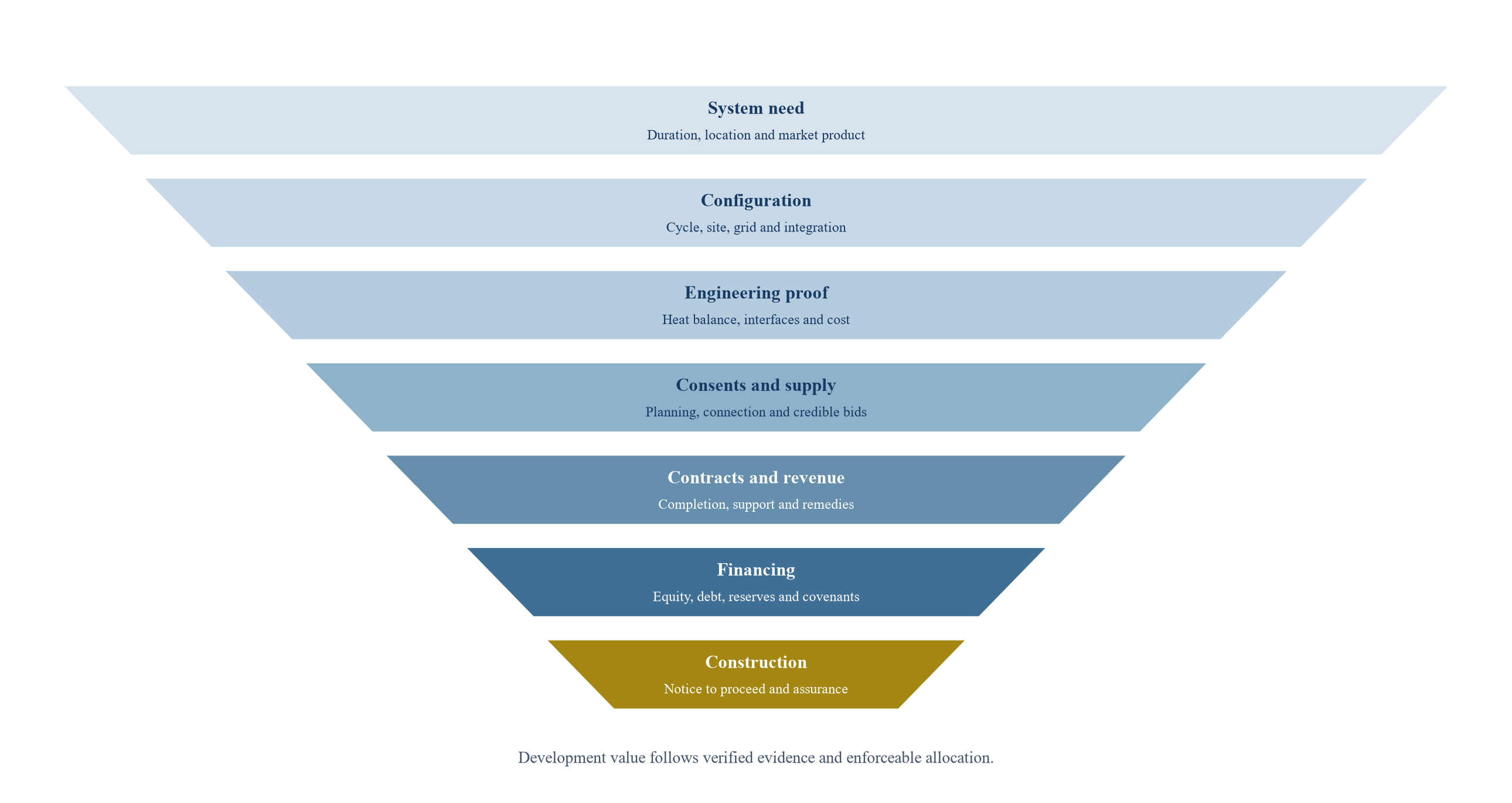
Capital advances only after integrated performance, site, grid, contracts and revenue evidence become specific and enforceable.
21. Interface schedules should be contractual
An interface matrix should identify every exchange of pressure, temperature, flow, purity, electricity, data, controls, utilities, structure and access. It should state the supplying party, receiving party, design value, tolerance, test and remedy.
The matrix becomes effective when it is incorporated into contracts and kept under common change control. An engineering register outside the contract can lose force during a dispute. Conflicting specifications should have a clear order of precedence.
The system integrator needs authority to reject changes that undermine total performance. The owner needs visibility into cumulative margin so that vendors do not consume the same contingency several times.
Table 1. Liquid-air storage interface and contract matrix
| Interface | Required evidence | Primary control party | Contract mechanism | Completion consequence |
|---|---|---|---|---|
| Air preparation to liquefier | Purity, flow, pressure, regeneration energy and changeover capacity | Air-preparation supplier and integrator | Inlet and outlet specifications; integrated test; contamination remedy | Liquefaction test invalid until purity is stable |
| Liquefier to storage | Liquid production rate, quality, transfer loss and tank pressure | Liquefaction contractor | Guaranteed specific energy and delivered liquid; metering protocol | Delay or performance damages for shortfall |
| Cold store to charging cycle | Thermal capacity, pressure drop, recovery efficiency and standby decay | Thermal-store supplier and integrator | Cycle test across defined initial conditions | Net efficiency and repeat-cycle test must pass |
| Heat store or external heat to discharge | Temperature, flow, availability, price and outage rights | Heat supplier, thermal contractor and operator | Heat-supply agreement; specification; backup mode | Debt case uses contracted availability and downside mode |
| Storage to pump and expander | Usable inventory, pump suction, pressure and vapor quality | Tank, pump and power-block contractors | Common operating envelope and witnessed transfer test | Duration and sustained-output guarantees depend on passage |
| Power block to grid | Net MW, ramp, reactive power, inertia and metering boundary | EPC integrator and grid contractor | Grid-code tests; net-output guarantee; control interface | Commercial operation follows system compliance |
| Plant control across packages | Signals, sequencing, cybersecurity, trips and data rights | System integrator | Control responsibility matrix; code escrow; integrated dynamic test | Completion requires stable operation in all contracted modes |
The matrix is a structuring framework. Final allocation depends on project design, procurement strategy and applicable law.
22. EPC structure should follow controllability
A single EPC or wrap can simplify accountability if the contractor can price and control the integrated scope. First-of-a-kind risk may make a full fixed-price wrap expensive or unavailable. Multiple packages can access specialist capability while increasing owner-held interface risk.
The procurement decision should compare total risk-adjusted cost. A lower package price can be offset by duplicated contingency, gaps, claims and delayed testing. A higher wrap price can still leave exclusions for process performance, external heat, grid conditions or proprietary technology.
Contract review should trace each investment assumption to an obligation, test, security and remedy. Residual risk should be visible in contingency, schedule, reserves and leverage.
23. Technology licensing creates long-tail dependency
Proprietary process designs, control logic and thermal systems may require licences, know-how and continuing technical support. The project needs rights for construction, operation, maintenance, modification, refinancing and transfer.
Licences should survive insolvency and change of control to the extent legally possible. Source-code escrow, documentation, spare-parts rights and step-in support can protect continuity. Territorial or field restrictions should match the project and future expansion.
Royalty terms should align with metered output or another auditable basis. A licence termination triggered by a contractor dispute can create disproportionate lender risk.
24. Supply-chain concentration affects schedule and remedies
Large compressors, cryogenic heat exchangers, tanks, turbomachinery, high-pressure pumps and control systems can have long lead times. Supplier qualification, manufacturing slots, materials and specialist labour can constrain schedule.
The project should map sole-source items, alternates, sub-suppliers and quality plans. Factory acceptance tests need hold points, data access and rights to correct defects before shipment. Performance security should remain available through commissioning.
Spare strategy should reflect failure consequence and replacement time. A low-cost proprietary component can control annual availability when its lead time is long.
25. Completion testing must reproduce the commercial cycle
Completion should demonstrate charging, storage, sustained discharge and recovery under a defined sequence. The test should measure net import, net export, duration, efficiency, ramp, start reliability, auxiliary load, thermal inventories, emissions if relevant and grid compliance.
One successful cycle can leave durability and repeatability unproven. A multi-cycle test can show whether cold and heat stores reach stable operation. Long-hold tests can measure standby losses. Partial-load and ambient tests can establish correction curves.
The contract should define instrumentation, calibration, uncertainty, exclusions, retest rights and liquidated damages. The owner and independent engineer should approve the test procedure before construction completion.
26. Remedies should protect the economic threshold
A small efficiency shortfall can have a large lifetime cost when charging energy dominates operating expense. A duration shortfall can reduce capacity value. An availability shortfall can trigger penalties and lost revenue. Remedies should reflect the resulting economic harm within enforceable limits.
Performance damages can compensate quantified shortfalls. Rejection rights may apply below a minimum threshold. Repair obligations, extended warranties, retention and parent support can reinforce recovery.
Caps and exclusions should be assessed across the whole contract suite. Separate caps can leave the project underprotected when one failure crosses several packages.
27. Warranty duration should match failure discovery
Cryogenic cycling, thermal-media degradation, exchanger fouling, valve wear, insulation performance and control defects may emerge after initial acceptance. Warranty periods should consider the number of operating cycles and seasonal exposure required to reveal them.
Availability and efficiency tests after an operating period can preserve accountability. Long-term service agreements can support maintenance and parts while creating dependency on supplier credit and pricing.
The model should include scheduled overhauls, major replacement, degradation and warranty expiry. Reserves should cover risks that remain after contractual protection ends.
28. Revenue must follow physical chronology
Energy arbitrage uses low-price charging periods and high-price discharge periods. Capacity payments value availability during scarcity. Ancillary services can reward response, reserves, reactive power or stability. Regulated or contracted structures can establish a revenue floor.
The same stored energy cannot support incompatible commitments at the same time. A plant reserving duration for a capacity event may forgo arbitrage. Frequent short dispatch can alter thermal state and reduce later duration. Stability equipment can operate independently only where design and contracts permit.
The dispatch model should simulate hourly or finer operation across several weather and market years. It should enforce equipment, thermal, inventory, grid and contract constraints.
29. Capacity accreditation is an operating obligation
Capacity value depends on the market's rules for duration, notice, forced outage, seasonal capability, testing and penalties. Nameplate power multiplied by tank duration does not establish accredited capacity.
The plant should be designed and tested for the relevant stress event. Charging opportunity before the event, minimum state of charge, ambient derating and outage recovery can influence deliverability.
The financing model should use the capacity value recognised under current rules and stress changes in accreditation. Contracted capacity revenue should remain subject to performance deductions and termination provisions.
30. Cap and floor changes the allocation of market risk
The United Kingdom has established a cap-and-floor framework for long-duration electricity storage. Ofgem's technical decision sets eligibility and assessment requirements, including deliverability evidence, grid status and planning. The structure can provide a floor while sharing revenue above a cap, subject to final project-specific terms.
Ofgem reported 171 first-window applications totaling 52.6 GW of discharge capacity across several technologies, including liquid-air and battery hybrids. Eligibility or application volume does not establish award, allowed cost or financing.
Investors should model allowed costs, floor availability, cap sharing, tax, incentives, availability and licence conditions. Debt should rely on cash flow remaining after compliance and downside performance assumptions.
31. Long-term procurement can support long-lived assets
Ontario's Independent Electricity System Operator has included liquid-air storage within a class of late-stage emerging long-duration technologies for its long lead-time procurement design. Its current programme states that successful long lead-time projects will receive 40-year contracts aligned with expected resource lives.
Eligibility still requires project, technology, schedule, connection and bid evidence. Class treatment can require an independent engineer and additional proof of commercial readiness. Procurement documents, rather than general policy statements, determine financeability.
Developers should align design with the contracted service, milestones, security, indexation, curtailment, force majeure and termination regime. A long contract can support debt when its obligations remain technically achievable.
32. Tolling can separate dispatch from asset ownership
A tolling structure can give a creditworthy counterparty rights to charge and dispatch the plant in return for fixed and variable payments. It can reduce merchant exposure while transferring operating choices that affect efficiency, wear and thermal state.
The agreement should define energy supply, scheduling, state-of-charge responsibility, efficiency losses, availability, cycling limits, start costs, imbalance, market settlement and degradation. The operator needs protection against instructions outside the guaranteed envelope.
Lenders should review counterparty credit, termination payments and replacement rights. A toll with weak termination economics can leave debt exposed after a default.
33. Industrial integration needs a bankable host agreement
Co-location with LNG regasification, industrial refrigeration, data centres, manufacturing or power generation may provide heat, cold, land or grid synergies. Academic studies show thermodynamic potential from external integration; project value depends on enforceable, durable and measurable arrangements.
The host agreement should address specification, quantity, timing, outages, maintenance, capital contribution, metering, price, change in operations, environmental liability and termination. The project should retain a technically credible standalone or reduced-output mode.
Host remaining life matters. A storage asset with a multi-decade life should not capitalise benefits from a host expected to close or change process earlier without replacement rights.
34. Three hypothetical cases expose contract value
The following cases compare a standalone merchant plant, an industrially integrated plant and a contracted tolling plant. Every numerical value is an illustrative modelling assumption. The cases do not represent bids, observed projects, forecasts or investment recommendations.
Each case has 100 MW of discharge power and eight hours of nominal duration. The model isolates how efficiency, host dependency, completion support and revenue allocation can change financeability. Real projects require plant-specific engineering, market forecasts, permits, contracts and financing terms.
The integrated case gains efficiency and loses value when host availability weakens. The tolling case can support more debt when termination and performance terms remain robust. The merchant case preserves upside and carries greater revenue volatility.
Table 2. Hypothetical 100 MW liquid-air storage cases
| Input or outcome | Standalone merchant | Industrial heat and cold integration | Contracted tolling |
|---|---|---|---|
| Rated discharge | 100 MW | 100 MW | 100 MW |
| Nominal duration | 8 hours | 8 hours | 8 hours |
| Illustrative net round-trip efficiency | 54% | 64% | 57% |
| Illustrative total capital cost | USD 980 million | USD 1,070 million | USD 1,020 million |
| Illustrative construction period | 4.5 years | 5.0 years | 4.5 years |
| Illustrative construction contingency | 22% | 25% | 20% |
| Principal dependency | Merchant spreads and integrated cycle performance | Host heat and cold availability plus interface works | Tolling counterparty, dispatch rules and termination payment |
| Illustrative revenue basis | Energy, capacity and ancillary services | Energy, capacity, host-services payment and ancillary services | Fixed availability payment plus variable operating reimbursement |
| Financing implication | Conservative leverage and larger liquidity reserve | Debt recognises only contracted host availability and fallback output | Higher leverage possible after completion and credit protections are fixed |
Every numerical value is an illustrative modelling assumption and is not a quotation, forecast or investment recommendation.
35. Valuation should follow evidence and control
Development value equals the probability-weighted present value of the operating project less remaining development cost and required risk capital. Probability should move when evidence changes. A concept heat balance does not deserve the same weight as a witnessed multi-cycle test.
Control also affects value. Rights to land, grid, technology, data, heat, cold and permits determine whether the project can realise its modelled benefit. A synergy outside the project company's control should be probability weighted or excluded.
The valuation should show value before and after each gate. This supports staged investment, joint ventures, option agreements, acquisitions and earn-outs.
36. A value bridge should isolate integration benefits
The hypothetical bridge begins with a standalone reference project. Cold recovery, contracted external heat, grid services and revenue support add value. Interface works, performance uncertainty, schedule and host dependency reduce it.
The percentages are explanatory assumptions and do not estimate a named project. Their purpose is to force each benefit and risk into a distinct line that can be evidenced and contracted.
A real bridge should use measured energy balances, cost quantities, contracts and chronological cash flow. Benefits should enter the base case only when the project controls them.
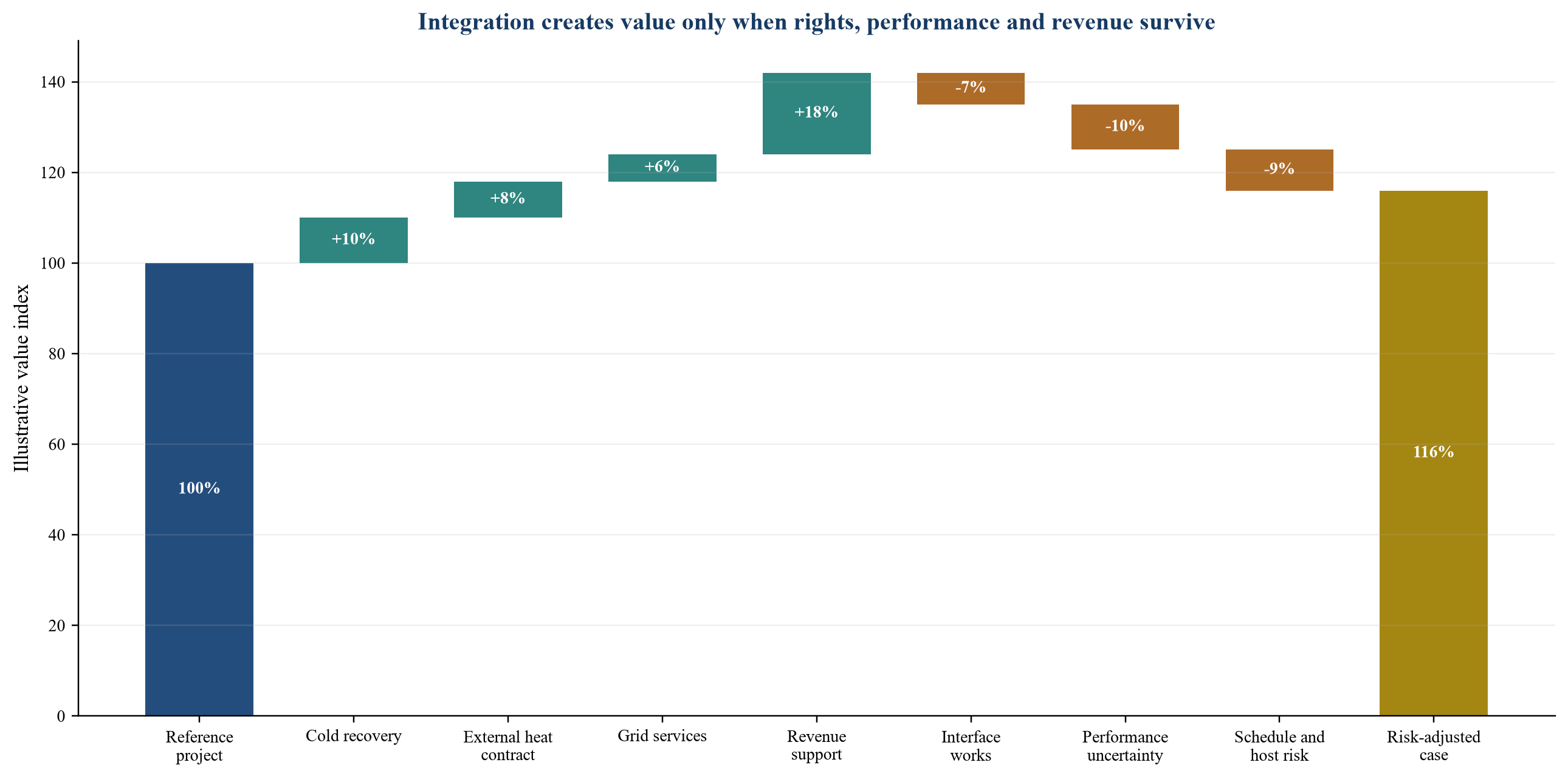
Values are hypothetical percentage adjustments to a common reference index. They are not observed project economics or forecasts.
37. Construction contracts need a common baseline
An owner baseline should define site data, ambient conditions, utilities, grid assumptions, host interfaces and reference design. Bidders can then price known conditions and qualify true uncertainty. An incomplete baseline invites exclusions and later claims.
Relief events should distinguish owner-controlled changes, contractor-controlled methods and genuine external events. Change procedures need prompt notice, records, mitigation and schedule analysis.
The baseline should remain consistent across EPC, technology licence, heat or cold agreement, grid connection and revenue contracts. A mismatch can create an unfunded gap.
38. Delay damages should follow lost commercial value
Delay can miss a support window, grid milestone, procurement date or seasonal revenue period. It also increases financing cost and may extend development guarantees. Contract damages should reflect a reasonable estimate of these exposures within applicable law.
Multiple contractors can each cause critical delay. The integrated schedule should identify logic, float ownership, access and information dependencies. Concurrent delay rules should be understood before construction.
Long-stop dates and termination rights should align across contracts. The project should avoid a position where one agreement terminates while another continues to accrue obligations.
39. Insurance follows disclosed technical risk
Construction all-risks, delay-in-start-up, property damage, machinery breakdown and business interruption policies can cover defined events. They do not replace sound design or guarantee gradual efficiency loss.
Insurers will examine first-of-a-kind equipment, cryogenic hazards, testing, fire separation, supply chain and business-interruption values. Exclusions, deductibles, sublimits and waiting periods should be modelled.
Lenders may require reserves for uninsured or uninsurable integration risk. Insurance evidence should be obtained before leverage and contingency are finalised.
40. Debt should follow completed evidence
Early development and technology work require risk-bearing capital. Construction debt becomes more credible after permits, grid rights, fixed scope, completion security, integrated performance tests and durable revenue are established.
Debt sizing should use net cash flow after charging energy, auxiliary load, maintenance, host payments, availability deductions and reserves. Merchant spreads should receive conservative treatment. A cap-and-floor, toll or capacity contract should be modelled with all compliance conditions.
The capital structure should include cost-overrun support, debt-service reserve, major-maintenance reserve, liquidity and decommissioning provision. Draw conditions should map to evidence gates.
41. Risk allocation should follow control
The process licensor controls core design assumptions. Equipment vendors control component performance. The integrator controls interfaces and system completion. The operator controls procedures and maintenance. Host and grid counterparties control specified external services. The project company retains risks that cannot be transferred.
Risk allocation should be supported by credit. An obligation from a thin special-purpose contractor has limited value without parent support, bonds, guarantees, retention or insurance.
Residual risk should remain visible. Contingency, reserves, lower leverage and staged investment are valid responses when transfer is uneconomic or unavailable.
Table 3. Risk allocation and financing response for liquid-air storage
| Risk | Evidence before commitment | Natural risk bearer | Contractual response | Financing implication |
|---|---|---|---|---|
| Integrated efficiency | Auditable heat balance, auxiliary schedule, correction curves and witnessed cycles | EPC integrator within defined boundary | Net-meter efficiency guarantee, retest and damages | Debt case uses guaranteed downside efficiency |
| Cold and heat storage | Thermal capacity, pressure drop, standby decay and media-life tests | Thermal-system supplier and integrator | Multi-cycle test, degradation warranty and replacement obligation | Reserve for post-warranty media and performance loss |
| External heat or cold | Binding supply specification, availability history and fallback mode | Host within contract; project for retained dependency | Long-term supply agreement, outages, termination and replacement rights | Base case recognises only contracted availability |
| Liquefaction scale-up | Relevant operating data, manufacturing QA and performance model | Technology supplier and EPC integrator | Specific energy, production rate, availability and parent support | Staged draws and contingent equity until test passage |
| Grid compliance | Connection agreement, studies, controls and test plan | Project and grid contractor within roles | Milestones, delay allocation, grid-code completion test | Revenue start and debt draw depend on connection certainty |
| Construction integration | FEED, interface matrix, baseline and qualified bids | EPC integrator or project under multi-package strategy | Single-point completion or explicit interface schedule and security | Contingency reflects exclusions and contractor credit |
| Revenue and dispatch | Chronological model, market rules and binding contract | Equity for merchant risk; offtaker for contracted risk | Toll, cap and floor, capacity contract, hedging and termination payment | Merchant leverage remains conservative |
| Technology and data rights | Licence, source-code, documentation and transfer rights | Licensor and project company within agreed perimeter | Perpetual project rights, escrow, step-in and change-of-control protection | Lenders require continuity after supplier distress |
| Closure and long-tail obligations | Decommissioning plan, environmental requirements and cost estimate | Project company and landowner as allocated | Funded reserve, restoration standard and surviving obligations | Tail reserve and lender security remain after operations |
Final allocation depends on project contracts, technical evidence, counterparties and applicable law.
42. Acquisition diligence should test replicability
An investor acquiring a liquid-air platform should distinguish project-specific value from repeatable capability. Proprietary designs, supplier relationships, data, control software, permitting knowledge and pipeline rights can support platform value when they transfer.
The buyer should review reference-plant performance, claims, warranty recoveries, licence rights, key-person dependency and the maturity of each pipeline site. A development pipeline should be valued by evidence stage and control, not headline megawatts.
Earn-outs can link consideration to objective milestones such as planning, grid, support award, fixed contracts, financial close or performance tests. Governance should prevent either party from controlling the other's milestone without defined standards.
43. The first hundred days should close the evidence gaps
The first programme should establish the metering boundary, integrated performance model, interface register, data-room structure and evidence-gate plan. Independent technical review should test the heat balance, auxiliary load, scale-up assumptions and completion test.
Commercial work should map market products, chronology and revenue eligibility. Legal work should secure land, grid, technology, data and host rights. Procurement work should validate long-lead equipment and contractor credit.
At day one hundred, the sponsor should decide which gaps require tests, revised design, contract protection, more contingency or termination. Continued spend should follow the evidence plan.
44. Limits and further research
Public sources provide technology ranges, programme rules, selected financing disclosures and academic models. They do not establish the cost, efficiency, schedule, contract terms or bankability of an unidentified project. Confidential designs, bids, tests, agreements and permits are required for an investment decision.
The hypothetical cases show method only. Further research should compare realised net efficiency, availability, thermal-media life, auxiliary load, start reliability, maintenance and revenue across commercial plants. It should also test the interaction between cap-and-floor incentives, dispatch and degradation.
Engineering, safety, environmental, legal, tax, accounting and regulatory conclusions require qualified advisers in the relevant jurisdiction.
45. Conclusion
Liquid-air storage can provide long-duration electricity storage without a geological cavern. Its investment case rests on integrated cryogenic and thermal performance, site and grid delivery, enforceable interfaces and a revenue regime aligned with the physical duty.
The project should be financed as a complete operating cycle. Net-meter performance, cold and heat recovery, auxiliary load, start reliability and sustained duration require common models, common tests and remedies that cross package boundaries. External heat or cold creates value when rights, availability and fallback operation are credible.
A disciplined sponsor releases capital through evidence gates, retains a system integrator, contracts material interfaces, models chronological dispatch and sizes debt against cash flow that remains after technical and contractual downside. Air becomes an investable asset when the whole cycle is proven and controlled.
References
- United States Department of Energy and Pacific Northwest National Laboratory, Energy Storage Grand Challenge Cost and Performance Assessment 2022, August 2022. https://www.energy.gov/sites/default/files/2022-09/2022%20Grid%20Energy%20Storage%20Technology%20Cost%20and%20Performance%20Assessment.pdf
- United States Department of Energy, Pathways to Commercial Liftoff: Long Duration Energy Storage, July 2025. https://www.energy.gov/sites/default/files/2025-07/LIFTOFF_DOE_Long-Duration-Energy-Storage.pdf
- United States Department of Energy, Achieving the Promise of Low-Cost Long Duration Energy Storage, August 2024. https://www.energy.gov/sites/default/files/2024-08/Achieving%20the%20Promise%20of%20Low-Cost%20Long%20Duration%20Energy%20Storage_FINAL_08052024.pdf
- Department for Energy Security and Net Zero, Clean Flexibility Roadmap, accessed September 2026. https://www.gov.uk/government/publications/clean-flexibility-roadmap/clean-flexibility-roadmap
- Department for Energy Security and Net Zero and Ofgem, Long Duration Electricity Storage: Technical Decision, March 2025. https://www.ofgem.gov.uk/sites/default/files/2025-03/Long%20Duration%20Electricity%20Storage%20Technical%20Decision%20Document.pdf
- Ofgem, Long Duration Electricity Storage Window 1 Eligibility Assessment Outcome, September 2025. https://www.ofgem.gov.uk/sites/default/files/2025-09/LDES%20Eligibility%20Assessment%20Outcome.pdf
- Ofgem, Long Duration Electricity Storage Multi-Criteria Assessment Framework, September 2025. https://www.ofgem.gov.uk/guidance/ldes-project-assessment-multi-criteria-assessment-mca-framework
- Ofgem, Long Duration Electricity Storage Cap and Floor Financial Model and Handbook, October 2025. https://www.ofgem.gov.uk/guidance/long-duration-electricity-storage-ldes-cap-and-floor-financial-model-and-handbook
- National Wealth Fund, Annual Report and Accounts 2024-2025, 2025. https://www.nationalwealthfund.org.uk/media/wpxnswqx/e03371942_nwf-ara-24-25_accessible_2.pdf
- National Wealth Fund, Highview Power Deal Factsheet, accessed September 2026. https://www.nationalwealthfund.org.uk/factsheets/highview-power-deal-factsheet
- Highview Power, Carrington Groundbreaking Announcement, November 2025. https://highviewpower.com/news-announcements/mayor-of-greater-manchester-andy-burnham-officially-breaks-ground-on-highviews-pioneering-liquid-air-energy-storage-facility-in-carrington-manchester/
- Independent Electricity System Operator, Long Lead-Time Request for Proposals, accessed September 2026. https://ieso.ca/Sector-Participants/Resource-Acquisition-and-Contracts/Long-Lead-Time-RFP
- Independent Electricity System Operator, Long Lead-Time Request for Proposals Presentation, December 2025. https://www.ieso.ca/-/media/Files/IESO/Document-Library/engage/llt/llt-rfp-20251218-presentation.pdf
- Xiaohui She et al., Liquid Air Energy Storage - A Critical Review, Renewable and Sustainable Energy Reviews, February 2025. https://doi.org/10.1016/j.rser.2024.114986
- Liquid Air Energy Storage - Systematic Review of Two Decades of Research and Future Perspectives, Journal of Energy Storage, November 2024. https://doi.org/10.1016/j.est.2024.114022
- Liquid Air Energy Storage: A Review on Technology State-of-the-Art, Integration Pathways and Future Perspectives, Advances in Applied Energy, 2021. https://doi.org/10.1016/j.adapen.2021.100047
- Comprehensive Review of Liquid Air Energy Storage Technologies, Energies, 2023. https://www.mdpi.com/1996-1073/16/17/6216
- United Kingdom Department of Energy and Climate Change, Energy Storage Innovation Showcase, March 2014. https://www.gov.uk/government/speeches/energy-storage-innovation-showcase
About the Author
Chennakeshav (CK) is a corporate finance and investment banking executive with 25+ years of global experience in deal origination, structuring and execution across M&A, growth capital and corporate strategy. He has led value-creation mandates for founders, corporates and funds — bridging the boardroom view to hands-on execution and close.
His career spans Morgan Stanley, HSBC, Lloyds Banking Group, EWEC, ADQ portfolio companies and Emirates Growth Fund, across TMT, real estate, fintech, deeptech, cleantech, infrastructure and energy. He has partnered with C-suite leaders, private equity and venture funds, sovereign wealth funds and family offices to finance complex fund raises and scale-up ventures, and has led M&A due diligence, post-merger integration and business-transformation initiatives to create value.
At Matchpoint Partners he is Managing Partner, leading the firm's corporate finance, M&A and capital-raising practice. He holds an MBA from London Business School, an engineering degree from VTU and a Master of Laws (LLM, in progress) from UCL London.
An active start-up mentor, CK mentors at Techstars, DIFC FinTech Hive, Startup Grind, Founder Institute and IN5, serves as Entrepreneur Mentor in Residence (EMiR) at London Business School, and judges the Entrepreneurship World Cup.
LinkedIn: https://www.linkedin.com/in/ckadya/
Profile: https://www.matchpoint-partners.com/team/ck-adya.html
