

1. Define the investment decision
Dynamic line rating uses measured or forecast weather and conductor conditions to calculate safe transfer capability. The investment decision asks which corridors can deliver dependable economic capacity, under which conditions and at what lifecycle cost.
The evidence file should identify the line, limiting span, conductor data, weather source, model version, network study, operational rule and responsible owner. Every rating used for a financial conclusion needs a reproducible calculation and timestamped input record.
A practical investment review asks how often additional transfer is available, whether operators can use it, how quickly it can be deployed and which conventional investment it defers. The answer should be corridor-specific and linked to measurable acceptance criteria.
2. Separate ratings from network limits
A higher thermal line rating creates value only when voltage, stability, substations, protection, breakers and downstream circuits permit additional transfer. The study should identify the binding constraint for every operating state.
The assessment should distinguish measured conditions, forecast conditions and modelled system outcomes. Capacity, congestion and reliability conclusions should retain confidence ranges and should be updated when the network, market or asset configuration changes.
The implementation plan should translate the issue into hardware, software, integration, cyber, operating and commercial workstreams. Capital release should follow evidence gates rather than a technology-wide assumption of benefit.
3. Compare static, ambient-adjusted and dynamic ratings
Static ratings use conservative long-term assumptions. Ambient-adjusted ratings update for temperature and day or night conditions. Dynamic ratings incorporate wider weather and line-specific measurements to estimate current-carrying capability more precisely.
The working model should reconcile sensor availability, forecast accuracy, thermal headroom, transfer capability and economic dispatch under a common chronology. Maximum observed uplift should remain separate from dependable capacity and realised value.
The board and regulator should see the distribution of capacity and value across seasons, hours and downside cases. The preferred deployment should remain safe and economically defensible when weather, congestion, sensors or communications differ from the base case.
4. Establish the engineering basis
Conductor type, diameter, emissivity, absorptivity, sag, tension, clearances, joints and equipment limits define the model. Asset records should be validated before software converts environmental data into operational ratings.
The evidence file should identify the line, limiting span, conductor data, weather source, model version, network study, operational rule and responsible owner. Every rating used for a financial conclusion needs a reproducible calculation and timestamped input record.
A practical investment review asks how often additional transfer is available, whether operators can use it, how quickly it can be deployed and which conventional investment it defers. The answer should be corridor-specific and linked to measurable acceptance criteria.
5. Map the complete corridor
The corridor model should include every span, tower, crossing, terminal and limiting item. A high-capacity span cannot overcome a weaker span or constrained substation within the same transfer path.
The assessment should distinguish measured conditions, forecast conditions and modelled system outcomes. Capacity, congestion and reliability conclusions should retain confidence ranges and should be updated when the network, market or asset configuration changes.
The implementation plan should translate the issue into hardware, software, integration, cyber, operating and commercial workstreams. Capital release should follow evidence gates rather than a technology-wide assumption of benefit.
Table 1. Dynamic-line-rating market and regulatory benchmark
| Market | Policy or planning anchor | DLR role | Investment implication | Principal execution issue |
|---|---|---|---|---|
| United States | FERC Orders 881 and 1920; DOE GET programmes | Operational ratings and consideration in regional planning | Regulated investment, grants and avoided-cost value | Market-system integration and corridor evidence |
| Great Britain | RIIO price controls and constraint-cost incentives | Scaled deployment linked to verified savings | Incentive and regulated-expenditure economics | Baseline, measurement and whole-system integration |
| European system planning | ENTSO-E TYNDP and national implementation | Candidate non-infrastructure solution | Corridor-specific comparison with grid investment | Cross-border operations and heterogeneous adoption |
| Hot-climate systems | National grid codes and utility planning | Better visibility with selective headroom | Reliability and targeted capacity value | Peak heat, solar load and low-wind coincidence |
| Renewable corridors | Utility and system-operator planning | Reduce curtailment and improve evacuation | Bridge or complement to reinforcement | Output-cooling correlation and downstream constraints |
The summary is conceptual and subject to governing law, standards, tariffs and project-specific approvals.
6. Identify candidate lines
Candidates should combine material congestion, weather-sensitive headroom, suitable assets, accessible communications and a credible operational use case. Screening should exclude lines where non-thermal constraints dominate.
The working model should reconcile sensor availability, forecast accuracy, thermal headroom, transfer capability and economic dispatch under a common chronology. Maximum observed uplift should remain separate from dependable capacity and realised value.
The board and regulator should see the distribution of capacity and value across seasons, hours and downside cases. The preferred deployment should remain safe and economically defensible when weather, congestion, sensors or communications differ from the base case.
7. Build the weather baseline
Historical temperature, wind speed, wind direction, solar irradiance and precipitation should be aligned with line geometry. Data quality, spatial resolution, extremes and missing periods affect calculated headroom.
The evidence file should identify the line, limiting span, conductor data, weather source, model version, network study, operational rule and responsible owner. Every rating used for a financial conclusion needs a reproducible calculation and timestamped input record.
A practical investment review asks how often additional transfer is available, whether operators can use it, how quickly it can be deployed and which conventional investment it defers. The answer should be corridor-specific and linked to measurable acceptance criteria.
8. Measure conductor temperature
Direct and indirect sensing approaches can estimate conductor temperature, sag, tension, vibration and clearance. The design should justify sensor density and the relationship between point measurements and the limiting span.
The assessment should distinguish measured conditions, forecast conditions and modelled system outcomes. Capacity, congestion and reliability conclusions should retain confidence ranges and should be updated when the network, market or asset configuration changes.
The implementation plan should translate the issue into hardware, software, integration, cyber, operating and commercial workstreams. Capital release should follow evidence gates rather than a technology-wide assumption of benefit.
9. Model wind cooling
Wind speed and angle can materially change convective cooling. Complex terrain, wake effects and low-wind pockets require conservative modelling and targeted measurement.
The working model should reconcile sensor availability, forecast accuracy, thermal headroom, transfer capability and economic dispatch under a common chronology. Maximum observed uplift should remain separate from dependable capacity and realised value.
The board and regulator should see the distribution of capacity and value across seasons, hours and downside cases. The preferred deployment should remain safe and economically defensible when weather, congestion, sensors or communications differ from the base case.
10. Model solar heating and ambient temperature
Solar irradiance and air temperature affect conductor heat balance. Forecast error, cloud cover and diurnal patterns should flow into the rating and confidence margin.
The evidence file should identify the line, limiting span, conductor data, weather source, model version, network study, operational rule and responsible owner. Every rating used for a financial conclusion needs a reproducible calculation and timestamped input record.
A practical investment review asks how often additional transfer is available, whether operators can use it, how quickly it can be deployed and which conventional investment it defers. The answer should be corridor-specific and linked to measurable acceptance criteria.
11. Define the forecast horizon
Real-time, intraday and day-ahead ratings support different decisions. Forecast horizons should match market, dispatch, outage and security processes while preserving time for operator action.
The assessment should distinguish measured conditions, forecast conditions and modelled system outcomes. Capacity, congestion and reliability conclusions should retain confidence ranges and should be updated when the network, market or asset configuration changes.
The implementation plan should translate the issue into hardware, software, integration, cyber, operating and commercial workstreams. Capital release should follow evidence gates rather than a technology-wide assumption of benefit.
12. Create the confidence framework
Ratings should include uncertainty, measurement error, model error and forecast dispersion. Conservative percentiles or explicit confidence margins can prevent apparent precision from becoming operational risk.
The working model should reconcile sensor availability, forecast accuracy, thermal headroom, transfer capability and economic dispatch under a common chronology. Maximum observed uplift should remain separate from dependable capacity and realised value.
The board and regulator should see the distribution of capacity and value across seasons, hours and downside cases. The preferred deployment should remain safe and economically defensible when weather, congestion, sensors or communications differ from the base case.
13. Design the fail-safe rating
Loss of sensor, communications, weather feed or analytics should trigger a defined fallback. The fallback may be ambient-adjusted or static and must preserve protection and market consistency.
The evidence file should identify the line, limiting span, conductor data, weather source, model version, network study, operational rule and responsible owner. Every rating used for a financial conclusion needs a reproducible calculation and timestamped input record.
A practical investment review asks how often additional transfer is available, whether operators can use it, how quickly it can be deployed and which conventional investment it defers. The answer should be corridor-specific and linked to measurable acceptance criteria.
14. Integrate protection and control
Protection settings, remedial action, state estimation and contingency analysis should remain aligned with changing ratings. Automated interfaces need validation, cybersecurity and human override.
The assessment should distinguish measured conditions, forecast conditions and modelled system outcomes. Capacity, congestion and reliability conclusions should retain confidence ranges and should be updated when the network, market or asset configuration changes.
The implementation plan should translate the issue into hardware, software, integration, cyber, operating and commercial workstreams. Capital release should follow evidence gates rather than a technology-wide assumption of benefit.
15. Integrate the energy-management system
The energy-management system should ingest, validate, display and archive ratings. Operators need clear confidence indicators, alarms, override controls and explanation of the limiting condition.
The working model should reconcile sensor availability, forecast accuracy, thermal headroom, transfer capability and economic dispatch under a common chronology. Maximum observed uplift should remain separate from dependable capacity and realised value.
The board and regulator should see the distribution of capacity and value across seasons, hours and downside cases. The preferred deployment should remain safe and economically defensible when weather, congestion, sensors or communications differ from the base case.
16. Integrate market systems
Market and congestion-management systems require consistent ratings across planning, day-ahead and real-time horizons. Publication timing and settlement treatment should follow governing rules.
The evidence file should identify the line, limiting span, conductor data, weather source, model version, network study, operational rule and responsible owner. Every rating used for a financial conclusion needs a reproducible calculation and timestamped input record.
A practical investment review asks how often additional transfer is available, whether operators can use it, how quickly it can be deployed and which conventional investment it defers. The answer should be corridor-specific and linked to measurable acceptance criteria.
17. Integrate outage planning
Dynamic capability can support maintenance scheduling and outage coordination, but forecast uncertainty increases over longer horizons. Critical outages should retain conservative contingency margins.
The assessment should distinguish measured conditions, forecast conditions and modelled system outcomes. Capacity, congestion and reliability conclusions should retain confidence ranges and should be updated when the network, market or asset configuration changes.
The implementation plan should translate the issue into hardware, software, integration, cyber, operating and commercial workstreams. Capital release should follow evidence gates rather than a technology-wide assumption of benefit.
18. Build the data architecture
Sensors, weather stations, forecast services, communications, edge devices, analytics and control-room systems form one chain. Availability and timestamp integrity should be measured end to end.
The working model should reconcile sensor availability, forecast accuracy, thermal headroom, transfer capability and economic dispatch under a common chronology. Maximum observed uplift should remain separate from dependable capacity and realised value.
The board and regulator should see the distribution of capacity and value across seasons, hours and downside cases. The preferred deployment should remain safe and economically defensible when weather, congestion, sensors or communications differ from the base case.
19. Secure the cyber perimeter
Field sensors and remote communications increase attack surface. Identity, encryption, patching, segmentation, monitoring, incident response and vendor access controls belong in the investment case.
The evidence file should identify the line, limiting span, conductor data, weather source, model version, network study, operational rule and responsible owner. Every rating used for a financial conclusion needs a reproducible calculation and timestamped input record.
A practical investment review asks how often additional transfer is available, whether operators can use it, how quickly it can be deployed and which conventional investment it defers. The answer should be corridor-specific and linked to measurable acceptance criteria.
20. Define data ownership and rights
The utility should retain access to raw measurements, derived ratings, model configuration and performance history. Vendor contracts should address portability, audit and service termination.
The assessment should distinguish measured conditions, forecast conditions and modelled system outcomes. Capacity, congestion and reliability conclusions should retain confidence ranges and should be updated when the network, market or asset configuration changes.
The implementation plan should translate the issue into hardware, software, integration, cyber, operating and commercial workstreams. Capital release should follow evidence gates rather than a technology-wide assumption of benefit.
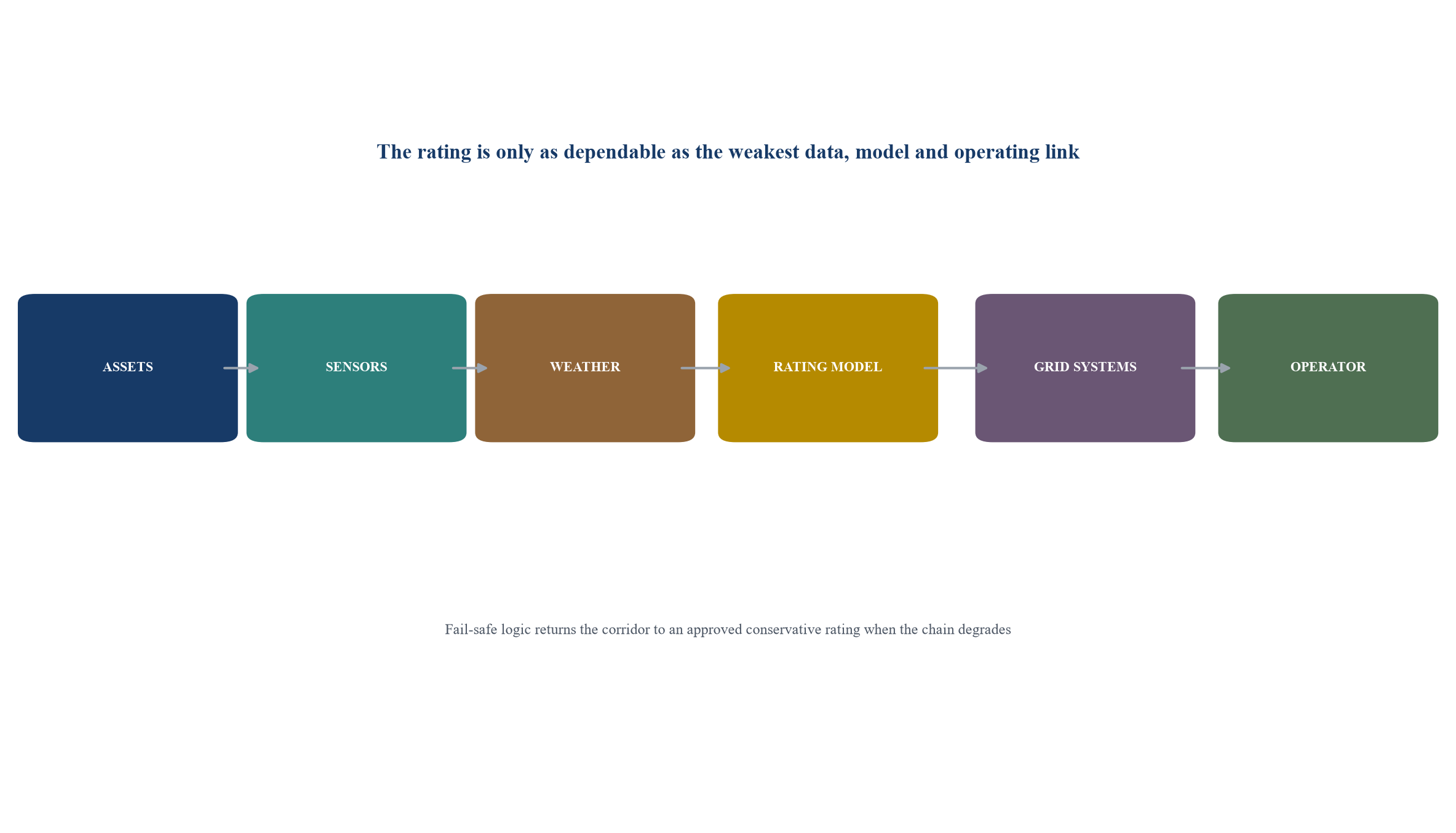
Capacity value depends on an end-to-end chain from field conditions to secure operator action.
21. Validate the model
Commissioning should compare calculated ratings with observed conductor behaviour across weather and loading conditions. Validation should cover normal, extreme and failure modes.
The working model should reconcile sensor availability, forecast accuracy, thermal headroom, transfer capability and economic dispatch under a common chronology. Maximum observed uplift should remain separate from dependable capacity and realised value.
The board and regulator should see the distribution of capacity and value across seasons, hours and downside cases. The preferred deployment should remain safe and economically defensible when weather, congestion, sensors or communications differ from the base case.
22. Run a shadow-operation period
Shadow operation calculates ratings without controlling dispatch. The period tests data quality, operator workflow, forecast performance and fallback behaviour before operational reliance.
The evidence file should identify the line, limiting span, conductor data, weather source, model version, network study, operational rule and responsible owner. Every rating used for a financial conclusion needs a reproducible calculation and timestamped input record.
A practical investment review asks how often additional transfer is available, whether operators can use it, how quickly it can be deployed and which conventional investment it defers. The answer should be corridor-specific and linked to measurable acceptance criteria.
23. Set acceptance criteria
Acceptance should cover measurement availability, rating accuracy, communications latency, fail-safe response, system integration and operator readiness. Criteria should be measurable and linked to payment.
The assessment should distinguish measured conditions, forecast conditions and modelled system outcomes. Capacity, congestion and reliability conclusions should retain confidence ranges and should be updated when the network, market or asset configuration changes.
The implementation plan should translate the issue into hardware, software, integration, cyber, operating and commercial workstreams. Capital release should follow evidence gates rather than a technology-wide assumption of benefit.
24. Measure capacity uplift
Headline maximum uplift can mislead. The business case should show hourly, seasonal and percentile uplift, including the frequency and duration of ratings below static limits.
The working model should reconcile sensor availability, forecast accuracy, thermal headroom, transfer capability and economic dispatch under a common chronology. Maximum observed uplift should remain separate from dependable capacity and realised value.
The board and regulator should see the distribution of capacity and value across seasons, hours and downside cases. The preferred deployment should remain safe and economically defensible when weather, congestion, sensors or communications differ from the base case.
25. Measure usable transfer uplift
Power-flow and contingency studies should translate ampacity into corridor transfer capability. Usable uplift may be lower when other network elements bind.
The evidence file should identify the line, limiting span, conductor data, weather source, model version, network study, operational rule and responsible owner. Every rating used for a financial conclusion needs a reproducible calculation and timestamped input record.
A practical investment review asks how often additional transfer is available, whether operators can use it, how quickly it can be deployed and which conventional investment it defers. The answer should be corridor-specific and linked to measurable acceptance criteria.
26. Measure congestion savings
Dispatch simulation can estimate avoided redispatch and curtailment. The model should use realistic market chronology and distinguish gross system benefit from owner revenue.
The assessment should distinguish measured conditions, forecast conditions and modelled system outcomes. Capacity, congestion and reliability conclusions should retain confidence ranges and should be updated when the network, market or asset configuration changes.
The implementation plan should translate the issue into hardware, software, integration, cyber, operating and commercial workstreams. Capital release should follow evidence gates rather than a technology-wide assumption of benefit.
27. Measure connection value
Additional capacity can accelerate generation or load connections where the corridor is binding. Connection value should use credible project timing and avoid assuming that temporary headroom replaces permanent reinforcement.
The working model should reconcile sensor availability, forecast accuracy, thermal headroom, transfer capability and economic dispatch under a common chronology. Maximum observed uplift should remain separate from dependable capacity and realised value.
The board and regulator should see the distribution of capacity and value across seasons, hours and downside cases. The preferred deployment should remain safe and economically defensible when weather, congestion, sensors or communications differ from the base case.
28. Measure reliability value
DLR can reveal when capacity is safely higher and when it should be lower. Reliability value includes visibility, overload prevention and operational options under changing weather.
The evidence file should identify the line, limiting span, conductor data, weather source, model version, network study, operational rule and responsible owner. Every rating used for a financial conclusion needs a reproducible calculation and timestamped input record.
A practical investment review asks how often additional transfer is available, whether operators can use it, how quickly it can be deployed and which conventional investment it defers. The answer should be corridor-specific and linked to measurable acceptance criteria.
29. Measure asset-health value
Temperature, sag and vibration data can support maintenance and inspection. Asset-health benefits should be tied to defined decisions and avoided interventions.
The assessment should distinguish measured conditions, forecast conditions and modelled system outcomes. Capacity, congestion and reliability conclusions should retain confidence ranges and should be updated when the network, market or asset configuration changes.
The implementation plan should translate the issue into hardware, software, integration, cyber, operating and commercial workstreams. Capital release should follow evidence gates rather than a technology-wide assumption of benefit.
30. Compare DLR with reconductoring
DLR may deliver faster and cheaper capacity where weather provides headroom. Reconductoring can provide firmer structural capacity where conductors remain the binding limit.
The working model should reconcile sensor availability, forecast accuracy, thermal headroom, transfer capability and economic dispatch under a common chronology. Maximum observed uplift should remain separate from dependable capacity and realised value.
The board and regulator should see the distribution of capacity and value across seasons, hours and downside cases. The preferred deployment should remain safe and economically defensible when weather, congestion, sensors or communications differ from the base case.
Table 2. Dynamic-line-rating risk and control matrix
| Risk | Operational effect | Principal owner | Core control | Evidence |
|---|---|---|---|---|
| Sensor or communications failure | Missing or stale rating | Technology operator | Redundancy, health monitoring and fail-safe rating | Availability and fallback logs |
| Forecast error | Rating differs from realised conditions | Forecast and engineering team | Confidence margin and frequent update | Error distribution by horizon |
| Limiting span misidentified | Unsafe overstatement of corridor capability | Asset owner | Survey, model validation and targeted sensing | Span model and field test |
| Downstream equipment constraint | Thermal uplift cannot become transfer uplift | System planner | End-to-end corridor study | Contingency and equipment assessment |
| Cyber compromise | Manipulated measurement or rating | Utility cyber owner | Identity, encryption, segmentation and incident response | Security testing and monitoring |
| Vendor dependency | Service interruption or weak negotiating position | Commercial owner | Data rights, portability, escrow and exit plan | Transition test and documentation |
Control design should reflect the governing grid code, cyber framework and operational procedures.
31. Compare DLR with new transmission
New routes provide durable capacity and topology change but require longer development. DLR can serve as a bridge, complement or targeted alternative rather than a universal substitute.
The evidence file should identify the line, limiting span, conductor data, weather source, model version, network study, operational rule and responsible owner. Every rating used for a financial conclusion needs a reproducible calculation and timestamped input record.
A practical investment review asks how often additional transfer is available, whether operators can use it, how quickly it can be deployed and which conventional investment it defers. The answer should be corridor-specific and linked to measurable acceptance criteria.
32. Compare DLR with power-flow control
Power-flow control redirects power to spare paths; DLR changes the capacity of monitored paths. Combined deployment can unlock more value where both rating and flow distribution constrain the system.
The assessment should distinguish measured conditions, forecast conditions and modelled system outcomes. Capacity, congestion and reliability conclusions should retain confidence ranges and should be updated when the network, market or asset configuration changes.
The implementation plan should translate the issue into hardware, software, integration, cyber, operating and commercial workstreams. Capital release should follow evidence gates rather than a technology-wide assumption of benefit.
33. Compare DLR with topology optimisation
Topology optimisation changes network configuration to manage constraints. Its value depends on switching feasibility, security and coordination with dynamic capacity.
The working model should reconcile sensor availability, forecast accuracy, thermal headroom, transfer capability and economic dispatch under a common chronology. Maximum observed uplift should remain separate from dependable capacity and realised value.
The board and regulator should see the distribution of capacity and value across seasons, hours and downside cases. The preferred deployment should remain safe and economically defensible when weather, congestion, sensors or communications differ from the base case.
34. Compare DLR with storage and flexibility
Storage and flexible demand shift injections and withdrawals. The comparison should use equivalent duration, reliability and operational control.
The evidence file should identify the line, limiting span, conductor data, weather source, model version, network study, operational rule and responsible owner. Every rating used for a financial conclusion needs a reproducible calculation and timestamped input record.
A practical investment review asks how often additional transfer is available, whether operators can use it, how quickly it can be deployed and which conventional investment it defers. The answer should be corridor-specific and linked to measurable acceptance criteria.
35. Build the option portfolio
The preferred solution may combine DLR, reconductoring, flow control, storage and new build across time. Portfolio design should separate bridge capacity from enduring capacity.
The assessment should distinguish measured conditions, forecast conditions and modelled system outcomes. Capacity, congestion and reliability conclusions should retain confidence ranges and should be updated when the network, market or asset configuration changes.
The implementation plan should translate the issue into hardware, software, integration, cyber, operating and commercial workstreams. Capital release should follow evidence gates rather than a technology-wide assumption of benefit.
36. Apply FERC Order 881
Order 881 requires ambient-adjusted ratings for near-term transmission service and operational uses. DLR includes additional weather and line-specific factors and remains subject to separate implementation decisions.
The working model should reconcile sensor availability, forecast accuracy, thermal headroom, transfer capability and economic dispatch under a common chronology. Maximum observed uplift should remain separate from dependable capacity and realised value.
The board and regulator should see the distribution of capacity and value across seasons, hours and downside cases. The preferred deployment should remain safe and economically defensible when weather, congestion, sensors or communications differ from the base case.
37. Apply FERC Order 1920
Order 1920 requires consideration of dynamic line ratings and other alternative transmission technologies in long-term regional planning and project evaluation.
The evidence file should identify the line, limiting span, conductor data, weather source, model version, network study, operational rule and responsible owner. Every rating used for a financial conclusion needs a reproducible calculation and timestamped input record.
A practical investment review asks how often additional transfer is available, whether operators can use it, how quickly it can be deployed and which conventional investment it defers. The answer should be corridor-specific and linked to measurable acceptance criteria.
38. Apply the Great Britain incentive framework
Ofgem's RIIO-3 final determinations include an incentive tied to constraint-cost savings from scaled DLR deployment. The business case should align measured savings with incentive rules.
The assessment should distinguish measured conditions, forecast conditions and modelled system outcomes. Capacity, congestion and reliability conclusions should retain confidence ranges and should be updated when the network, market or asset configuration changes.
The implementation plan should translate the issue into hardware, software, integration, cyber, operating and commercial workstreams. Capital release should follow evidence gates rather than a technology-wide assumption of benefit.
39. Apply the European planning context
ENTSO-E recognises dynamic line rating among infrastructure and non-infrastructure solutions that can address identified system needs. Project selection still requires corridor-specific evidence.
The working model should reconcile sensor availability, forecast accuracy, thermal headroom, transfer capability and economic dispatch under a common chronology. Maximum observed uplift should remain separate from dependable capacity and realised value.
The board and regulator should see the distribution of capacity and value across seasons, hours and downside cases. The preferred deployment should remain safe and economically defensible when weather, congestion, sensors or communications differ from the base case.
40. Consider hot-climate systems
High ambient temperatures, solar heating and low-wind periods can reduce ratings during peak demand. Value may come from improved visibility and selective headroom rather than persistent uplift.
The evidence file should identify the line, limiting span, conductor data, weather source, model version, network study, operational rule and responsible owner. Every rating used for a financial conclusion needs a reproducible calculation and timestamped input record.
A practical investment review asks how often additional transfer is available, whether operators can use it, how quickly it can be deployed and which conventional investment it defers. The answer should be corridor-specific and linked to measurable acceptance criteria.
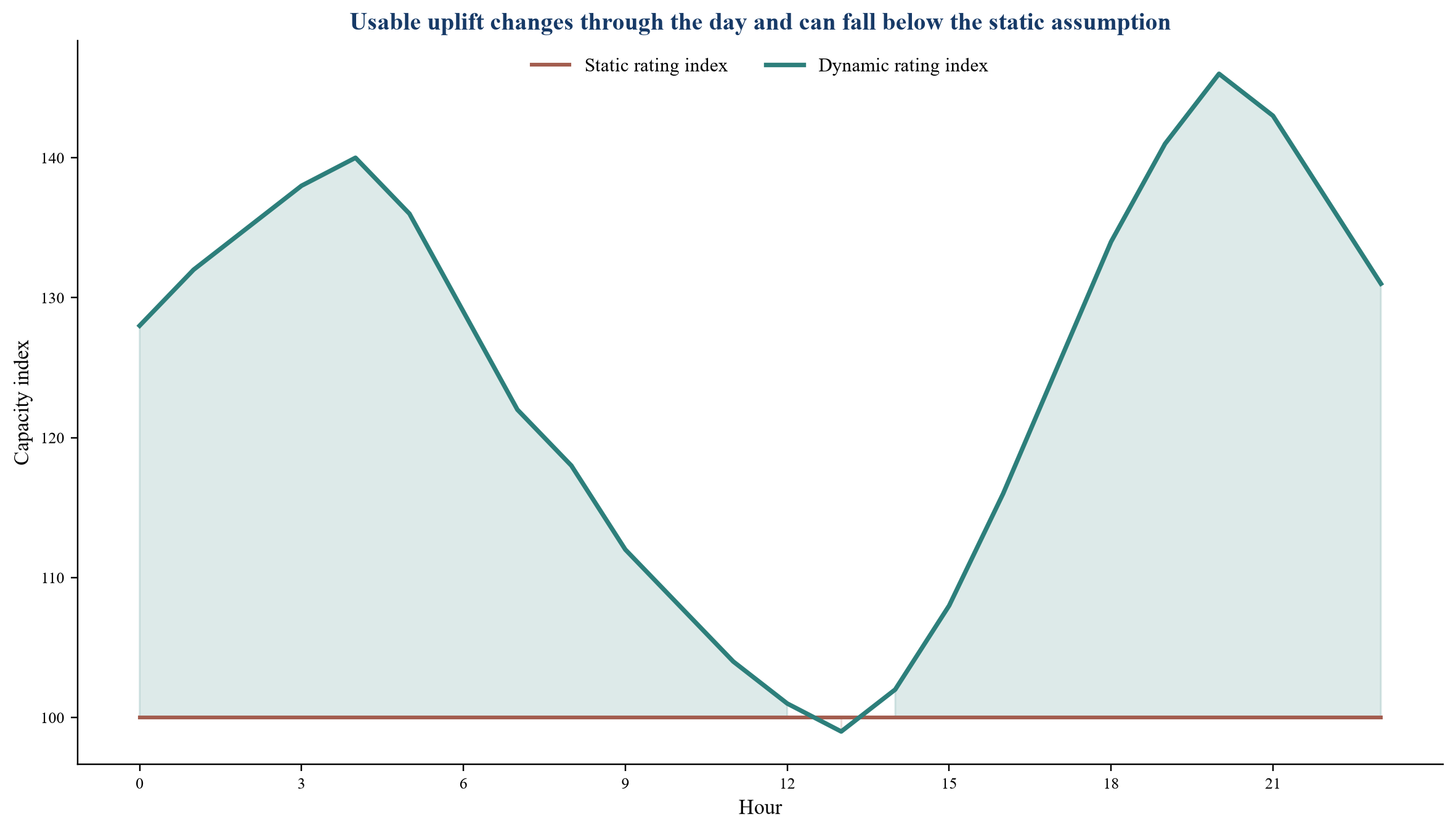
Values are hypothetical management assumptions used solely to demonstrate the framework.
41. Consider cold and windy systems
Wind-rich regions can have positive correlation between renewable output and conductor cooling. The correlation should be tested at line level and under extreme events.
The assessment should distinguish measured conditions, forecast conditions and modelled system outcomes. Capacity, congestion and reliability conclusions should retain confidence ranges and should be updated when the network, market or asset configuration changes.
The implementation plan should translate the issue into hardware, software, integration, cyber, operating and commercial workstreams. Capital release should follow evidence gates rather than a technology-wide assumption of benefit.
42. Consider coastal and complex terrain
Coastal winds, valleys, ridges and exposure can create large span-to-span differences. Sensor and weather-station placement should focus on the limiting microclimate.
The working model should reconcile sensor availability, forecast accuracy, thermal headroom, transfer capability and economic dispatch under a common chronology. Maximum observed uplift should remain separate from dependable capacity and realised value.
The board and regulator should see the distribution of capacity and value across seasons, hours and downside cases. The preferred deployment should remain safe and economically defensible when weather, congestion, sensors or communications differ from the base case.
43. Consider data-centre load growth
Fast, concentrated load growth increases pressure for timely capacity. DLR can support interim transfers where network studies confirm dependable headroom and fallback arrangements.
The evidence file should identify the line, limiting span, conductor data, weather source, model version, network study, operational rule and responsible owner. Every rating used for a financial conclusion needs a reproducible calculation and timestamped input record.
A practical investment review asks how often additional transfer is available, whether operators can use it, how quickly it can be deployed and which conventional investment it defers. The answer should be corridor-specific and linked to measurable acceptance criteria.
44. Consider renewable-energy zones
DLR may reduce curtailment and accelerate evacuation from renewable zones. Output and cooling correlation should be tested with chronological data.
The assessment should distinguish measured conditions, forecast conditions and modelled system outcomes. Capacity, congestion and reliability conclusions should retain confidence ranges and should be updated when the network, market or asset configuration changes.
The implementation plan should translate the issue into hardware, software, integration, cyber, operating and commercial workstreams. Capital release should follow evidence gates rather than a technology-wide assumption of benefit.
45. Define the commercial model
The model may use regulated expenditure, innovation funding, shared savings, managed service or performance-based procurement. Revenue should be tied to governing rules and verified outputs.
The working model should reconcile sensor availability, forecast accuracy, thermal headroom, transfer capability and economic dispatch under a common chronology. Maximum observed uplift should remain separate from dependable capacity and realised value.
The board and regulator should see the distribution of capacity and value across seasons, hours and downside cases. The preferred deployment should remain safe and economically defensible when weather, congestion, sensors or communications differ from the base case.
46. Build sources and uses
Sources should fund surveys, sensors, communications, software, integration, cybersecurity, spares, training and contingency. Uses should separate pilot cost from scalable platform investment.
The evidence file should identify the line, limiting span, conductor data, weather source, model version, network study, operational rule and responsible owner. Every rating used for a financial conclusion needs a reproducible calculation and timestamped input record.
A practical investment review asks how often additional transfer is available, whether operators can use it, how quickly it can be deployed and which conventional investment it defers. The answer should be corridor-specific and linked to measurable acceptance criteria.
47. Model operating expenditure
Recurring costs include data services, connectivity, licences, cloud or edge infrastructure, calibration, maintenance, cyber operations and vendor support. Lifecycle economics should include replacement cycles.
The assessment should distinguish measured conditions, forecast conditions and modelled system outcomes. Capacity, congestion and reliability conclusions should retain confidence ranges and should be updated when the network, market or asset configuration changes.
The implementation plan should translate the issue into hardware, software, integration, cyber, operating and commercial workstreams. Capital release should follow evidence gates rather than a technology-wide assumption of benefit.
48. Value avoided or deferred capital
DLR can defer reconductoring or new construction where headroom is dependable. The value should use the actual deferral period, residual investment and probability of later build.
The working model should reconcile sensor availability, forecast accuracy, thermal headroom, transfer capability and economic dispatch under a common chronology. Maximum observed uplift should remain separate from dependable capacity and realised value.
The board and regulator should see the distribution of capacity and value across seasons, hours and downside cases. The preferred deployment should remain safe and economically defensible when weather, congestion, sensors or communications differ from the base case.
49. Test benefit volatility
Congestion and weather vary by year. Sensitivities should include low-congestion years, adverse weather correlation, forecast error and changed generation patterns.
The evidence file should identify the line, limiting span, conductor data, weather source, model version, network study, operational rule and responsible owner. Every rating used for a financial conclusion needs a reproducible calculation and timestamped input record.
A practical investment review asks how often additional transfer is available, whether operators can use it, how quickly it can be deployed and which conventional investment it defers. The answer should be corridor-specific and linked to measurable acceptance criteria.
50. Test downside capacity
DLR can fall below static assumptions in adverse conditions. Operations, markets and connected users need a plan for lower ratings, including curtailment and reserve requirements.
The assessment should distinguish measured conditions, forecast conditions and modelled system outcomes. Capacity, congestion and reliability conclusions should retain confidence ranges and should be updated when the network, market or asset configuration changes.
The implementation plan should translate the issue into hardware, software, integration, cyber, operating and commercial workstreams. Capital release should follow evidence gates rather than a technology-wide assumption of benefit.
Table 3. Hypothetical DLR investment sensitivity
| Scenario | Dependable transfer uplift | Annual congestion saving, USD m | Lifecycle cost, USD m | Benefit-cost ratio | Decision implication |
|---|---|---|---|---|---|
| Base corridor | 18% | 7.5 | 8.0 | 4.2x | Proceed through shadow operation and acceptance |
| Strong wind-output correlation | 28% | 12.0 | 9.0 | 6.0x | High-priority renewable corridor candidate |
| Downstream constraint binds | 7% | 2.5 | 8.0 | 1.4x | Combine with substation or flow-control work |
| Low congestion case | 18% | 1.5 | 8.0 | 0.8x | Defer or use narrower monitoring scope |
| High failure and fallback frequency | 9% | 2.0 | 10.0 | 0.9x | Redesign architecture before scale deployment |
All values are hypothetical management assumptions and do not represent an actual project or forecast.
51. Set the incentive baseline
Shared-savings or performance incentives require a credible baseline for constraint cost, capacity and availability. Baseline changes should follow pre-agreed governance.
The working model should reconcile sensor availability, forecast accuracy, thermal headroom, transfer capability and economic dispatch under a common chronology. Maximum observed uplift should remain separate from dependable capacity and realised value.
The board and regulator should see the distribution of capacity and value across seasons, hours and downside cases. The preferred deployment should remain safe and economically defensible when weather, congestion, sensors or communications differ from the base case.
52. Allocate performance risk
Vendors can control hardware, software and service availability; utilities control integration and operations; system outcomes depend on weather and market conditions. Contracts should reflect controllability.
The evidence file should identify the line, limiting span, conductor data, weather source, model version, network study, operational rule and responsible owner. Every rating used for a financial conclusion needs a reproducible calculation and timestamped input record.
A practical investment review asks how often additional transfer is available, whether operators can use it, how quickly it can be deployed and which conventional investment it defers. The answer should be corridor-specific and linked to measurable acceptance criteria.
53. Design procurement
Procurement should specify outcomes, interfaces, standards, data rights, validation and lifecycle support. Pilot success should not create an uncompetitive permanent dependency.
The assessment should distinguish measured conditions, forecast conditions and modelled system outcomes. Capacity, congestion and reliability conclusions should retain confidence ranges and should be updated when the network, market or asset configuration changes.
The implementation plan should translate the issue into hardware, software, integration, cyber, operating and commercial workstreams. Capital release should follow evidence gates rather than a technology-wide assumption of benefit.
54. Plan vendor exit
A transition plan should preserve measurements, models, configuration, historical data and safe operations if the supplier changes. Documentation and escrow may be required for critical components.
The working model should reconcile sensor availability, forecast accuracy, thermal headroom, transfer capability and economic dispatch under a common chronology. Maximum observed uplift should remain separate from dependable capacity and realised value.
The board and regulator should see the distribution of capacity and value across seasons, hours and downside cases. The preferred deployment should remain safe and economically defensible when weather, congestion, sensors or communications differ from the base case.
55. Create operating governance
Engineering, operations, markets, IT, cyber, maintenance and finance need defined ownership. Rating overrides and incidents should be reviewed through one governance forum.
The evidence file should identify the line, limiting span, conductor data, weather source, model version, network study, operational rule and responsible owner. Every rating used for a financial conclusion needs a reproducible calculation and timestamped input record.
A practical investment review asks how often additional transfer is available, whether operators can use it, how quickly it can be deployed and which conventional investment it defers. The answer should be corridor-specific and linked to measurable acceptance criteria.
56. Publish performance evidence
Regular reporting should show rating availability, capacity uplift, limiting elements, fallbacks, congestion effects, incidents and realised savings. Definitions should remain stable over time.
The assessment should distinguish measured conditions, forecast conditions and modelled system outcomes. Capacity, congestion and reliability conclusions should retain confidence ranges and should be updated when the network, market or asset configuration changes.
The implementation plan should translate the issue into hardware, software, integration, cyber, operating and commercial workstreams. Capital release should follow evidence gates rather than a technology-wide assumption of benefit.
57. Run the technical gate
This gate confirms asset data, thermal model, limiting spans, sensors, forecast performance, fail-safe logic and network constraints. It establishes whether DLR is technically usable.
The working model should reconcile sensor availability, forecast accuracy, thermal headroom, transfer capability and economic dispatch under a common chronology. Maximum observed uplift should remain separate from dependable capacity and realised value.
The board and regulator should see the distribution of capacity and value across seasons, hours and downside cases. The preferred deployment should remain safe and economically defensible when weather, congestion, sensors or communications differ from the base case.
58. Run the economic gate
This gate tests usable uplift, congestion savings, connection value, avoided capital, lifecycle cost and volatility. It establishes whether deployment creates value.
The evidence file should identify the line, limiting span, conductor data, weather source, model version, network study, operational rule and responsible owner. Every rating used for a financial conclusion needs a reproducible calculation and timestamped input record.
A practical investment review asks how often additional transfer is available, whether operators can use it, how quickly it can be deployed and which conventional investment it defers. The answer should be corridor-specific and linked to measurable acceptance criteria.
59. Run the operational and cyber gate
This gate confirms system integration, operator workflow, protection, communications, cybersecurity, fallback and incident response. It establishes whether DLR can be relied upon safely.
The assessment should distinguish measured conditions, forecast conditions and modelled system outcomes. Capacity, congestion and reliability conclusions should retain confidence ranges and should be updated when the network, market or asset configuration changes.
The implementation plan should translate the issue into hardware, software, integration, cyber, operating and commercial workstreams. Capital release should follow evidence gates rather than a technology-wide assumption of benefit.
60. Adopt the decision record and 90-day plan
The final record states candidate corridors, capacity evidence, economics, contracts, risk owners, gates and scaling criteria. The first 90 days should validate the highest-value corridor under shadow operation.
The working model should reconcile sensor availability, forecast accuracy, thermal headroom, transfer capability and economic dispatch under a common chronology. Maximum observed uplift should remain separate from dependable capacity and realised value.
The board and regulator should see the distribution of capacity and value across seasons, hours and downside cases. The preferred deployment should remain safe and economically defensible when weather, congestion, sensors or communications differ from the base case.
Table 4. Illustrative 90-day DLR investment programme
| Period | Workstream | Core actions | Decision output | Accountable owner |
|---|---|---|---|---|
| Days 1-15 | Corridor screening | Reconcile congestion, ratings, assets, weather and network constraints | Ranked candidate corridors | System planner |
| Days 16-30 | Engineering basis | Validate conductor, spans, clearances, equipment and sensing plan | Approved technical model | Transmission engineer |
| Days 31-45 | Data and integration | Design weather, communications, cyber, EMS and market interfaces | End-to-end architecture | Operations and technology leads |
| Days 46-60 | Economics | Model usable uplift, congestion, connections, lifecycle cost and alternatives | Investment case and sensitivities | Financial adviser |
| Days 61-75 | Shadow operation | Test ratings, forecasts, fallbacks, workflow and operator response | Acceptance evidence | System operator |
| Days 76-90 | Decision record | Approve scope, contracts, risk owners, scaling criteria and reporting | Authorised pilot or rollout | Utility board and regulator |
Timing is indicative and should be adapted to utility governance and the governing regulatory process.
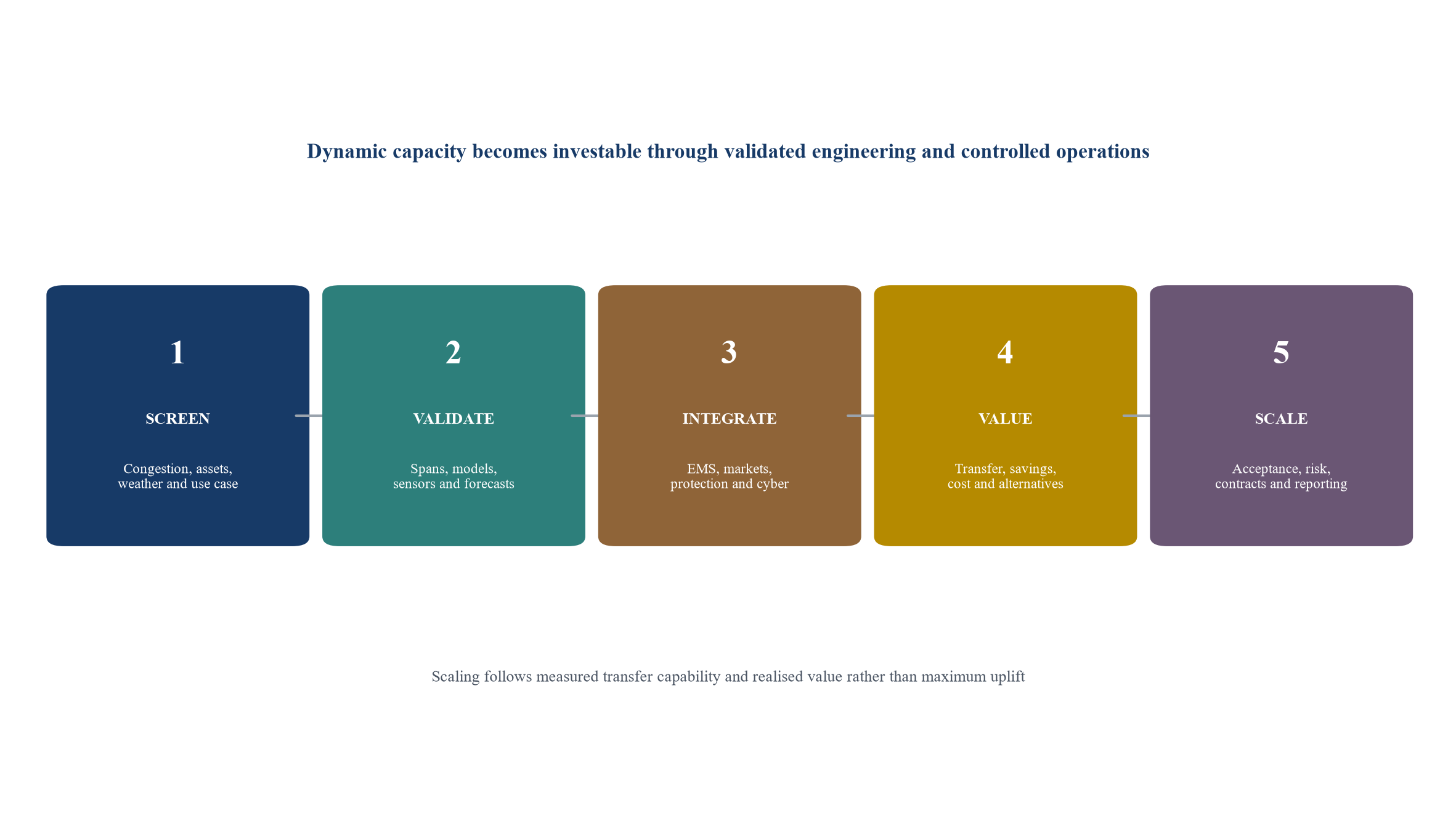
Each gate requires documented evidence before the next capital commitment.
The framework converts dynamic line rating from a technology claim into an auditable corridor investment. It links asset and weather evidence to safe ratings, usable transfer, operating controls and measurable economic value.
Execution quality depends on continuing validation. Asset configuration, weather, congestion and system topology change over time, so rating performance and realised value should be reviewed against the same controlled baseline.
References
- Federal Energy Regulatory Commission, "Managing Transmission Line Ratings, Order No. 881," 2021, https://www.ferc.gov/media/e-1-rm20-16-000
- Federal Energy Regulatory Commission, "FERC Opens Inquiry on Use of Dynamic Line Ratings to Promote Grid Efficiency," 2022, https://www.ferc.gov/news-events/news/ferc-opens-inquiry-use-dynamic-line-ratings-promote-grid-efficiency
- Federal Energy Regulatory Commission, "Demonstration of Potential Data and Calculation Workflows under Order No. 881," 2023, https://www.ferc.gov/media/demonstration-potential-datacalculation-workflows-under-ferc-order-no-881s-ambient-adjusted
- Federal Energy Regulatory Commission, "Explainer on the Transmission Planning and Cost Allocation Final Rule," https://www.ferc.gov/explainer-transmission-planning-and-cost-allocation-final-rule
- Federal Energy Regulatory Commission, "Order No. 1920-A," 2024, https://www.ferc.gov/sites/default/files/2024-11/20241121-3139.PDF
- US Department of Energy, "Grid-Enhancing Technologies Improve Existing Power Lines," https://www.energy.gov/oe/grid-enhancing-technologies-improve-existing-power-lines
- US Department of Energy, "Advanced Transmission Technologies Report," 2020, https://www.energy.gov/sites/prod/files/2021/02/f82/Advanced%20Transmission%20Technologies%20Report%20-%20final%20as%20of%2012.3%20-%20FOR%20PUBLIC.pdf
- US Department of Energy, "Smart Transmission Tools Modernize America's Power Grid," 2025, https://www.energy.gov/cmei/systems/articles/smart-transmission-tools-modernize-americas-power-grid
- Ofgem, "RIIO-3 Final Determinations: Electricity Transmission," 2025, https://www.ofgem.gov.uk/sites/default/files/2025-12/RIIO-3-Final-Determinations-ET.pdf
- ENTSO-E, "TYNDP 2024," https://www.entsoe.eu/outlooks/tyndp/2024/
About the Author
Chennakeshav (CK) is a corporate finance and investment banking executive with 25+ years of global experience in deal origination, structuring and execution across M&A, growth capital and corporate strategy. He has led value-creation mandates for founders, corporates and funds — bridging the boardroom view to hands-on execution and close.
His career spans Morgan Stanley, HSBC, Lloyds Banking Group, EWEC, ADQ portfolio companies and Emirates Growth Fund, across TMT, real estate, fintech, deeptech, cleantech, infrastructure and energy. He has partnered with C-suite leaders, private equity and venture funds, sovereign wealth funds and family offices to finance complex fund raises and scale-up ventures, and has led M&A due diligence, post-merger integration and business-transformation initiatives to create value.
At Matchpoint Partners he is Managing Partner, leading the firm's corporate finance, M&A and capital-raising practice. He holds an MBA from London Business School, an engineering degree from VTU and a Master of Laws (LLM, in progress) from UCL London.
An active start-up mentor, CK mentors at Techstars, DIFC FinTech Hive, Startup Grind, Founder Institute and IN5, serves as Entrepreneur Mentor in Residence (EMiR) at London Business School, and judges the Entrepreneurship World Cup.
