
1. The contracting decision
A reclaimed-water project connecting a utility to a semiconductor fab, hydrogen plant or data centre is a production-infrastructure decision. The parties must decide which source is used, what treatment occurs centrally and on site, what quality and pressure reach the customer, how interruptions are handled, who pays for capacity and how changes in customer technology affect the service.
The contract should convert water chemistry, flow and reliability into enforceable operating obligations. A volumetric tariff by itself can leave the utility exposed to oversized infrastructure and the customer exposed to production loss.
2. Three customers, three water duties
Semiconductor manufacturing can require ultrapure process water, cooling water and other utility grades. Hydrogen electrolysis requires purified feedwater and may use water for cooling and auxiliaries. Data centres can consume water through evaporative cooling, while closed-loop and air-cooled designs can materially reduce operational withdrawal.
The commercial model should therefore price service by duty. A single recycled-water specification can be too expensive for cooling and insufficient for a critical process. Treatment should match the point of use.
3. Reuse as industrial infrastructure
The United States Environmental Protection Agency defines industrial reuse as reclaimed water used for cooling, manufacturing and other industrial applications [1]. Singapore’s PUB supplies NEWater through a dedicated network to industrial users; wafer fabrication plants are among its largest users because of their stringent quality requirements [2].
These examples show that reuse can become a planned utility rather than an occasional environmental initiative. The investment case still depends on local source reliability, treatment, network, customer demand and regulation.
4. The source-to-customer boundary
The project can include municipal effluent, advanced treatment, transmission, storage, customer-side polishing, internal recycling and residual management. The contract needs a defined custody-transfer point and a separate quality boundary for each duty.
Shared infrastructure can serve several customers, while customer-specific polishing can remain behind each meter. This separation supports transparent capital allocation and reduces the risk that one customer’s specification sets the cost for the entire network.
5. Industrial reuse architecture
The architecture should preserve source flexibility, firm capacity, water quality and customer production during planned and unplanned events.
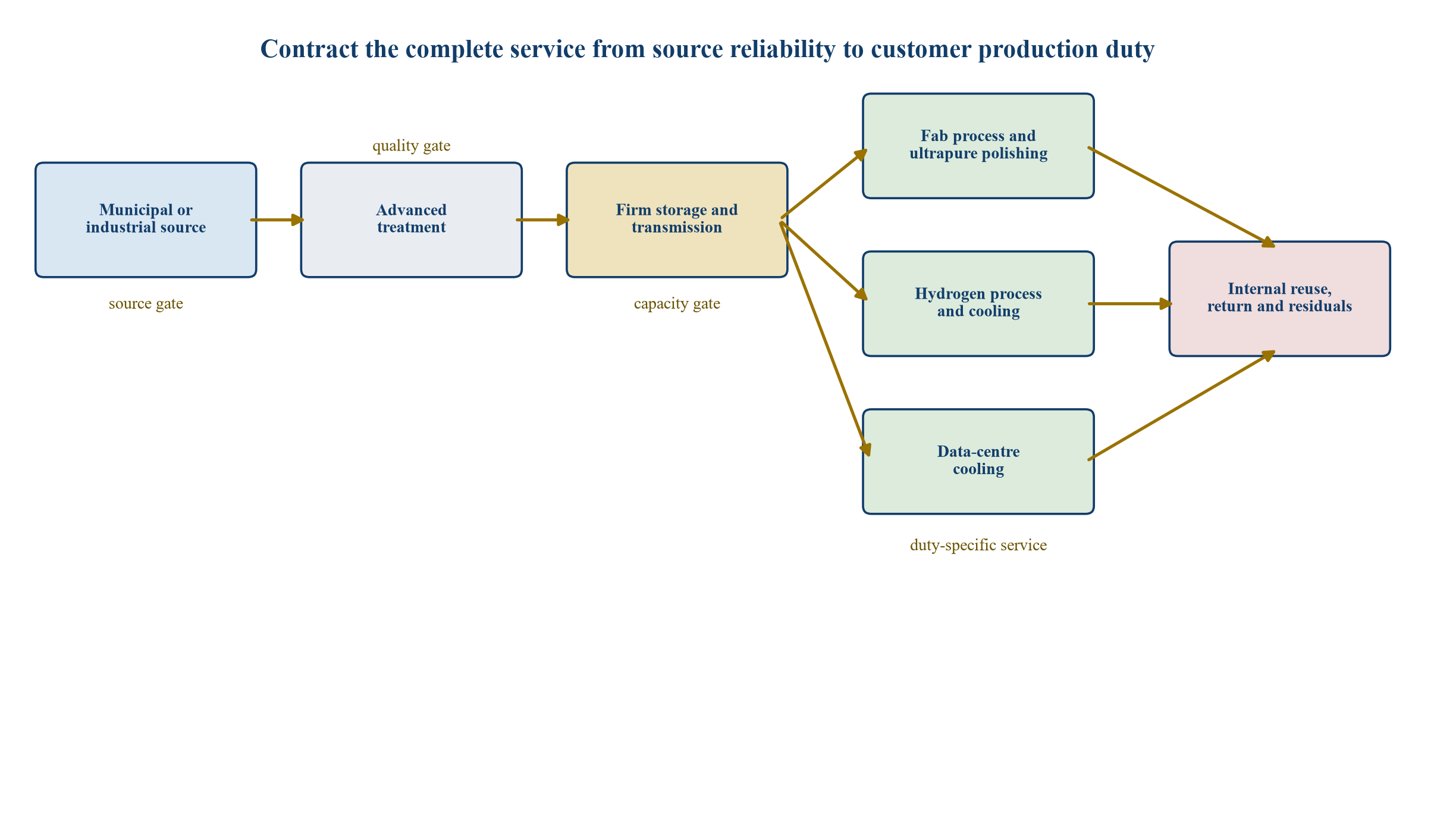
Generic architecture; treatment barriers, storage, backup and customer duties depend on source, regulation and process design.
6. Source reliability
Municipal wastewater flows can be comparatively stable, while composition changes with rainfall, industrial discharges, infiltration and treatment-plant operation. Industrial source streams can track factory schedules and product campaigns. The supply study should use measured daily and seasonal data.
The utility should define firm source yield after its existing obligations, treatment downtime, environmental discharge requirements and growth. Contracted industrial capacity should not rely on every nominal unit of influent.
7. Source control
Upstream contaminants can damage membranes, pass into product water or create hazardous residuals. Source-control programmes, trade-effluent limits and rapid notification are therefore part of the industrial-water service. Singapore’s trade-effluent requirements protect used-water treatment and NEWater production [15].
The agreement should define prohibited discharges, monitoring, investigation and response. A customer cannot rely solely on end-of-pipe testing when a short contamination event could affect critical production.
8. Treatment barriers
Advanced reuse can use combinations of biological treatment, microfiltration or ultrafiltration, reverse osmosis, ultraviolet disinfection, advanced oxidation, ion exchange and disinfection. PUB describes NEWater production using membrane filtration, reverse osmosis and ultraviolet disinfection [2].
The valid barrier train depends on source and end use. Each barrier should have monitored performance, redundancy, maintenance and a defined response to deviation. Product quality is a system result.
9. Storage as reliability capital
Storage separates short treatment interruptions from customer production. It can hold finished reclaimed water, customer utility water or ultrapure water at different points. The required duration depends on repair time, alternative supply and process shutdown risk.
The EPA’s Quincy case describes an eight-hour permeate storage buffer within a data-centre cooling-water reuse system [3]. That case is site-specific, while it illustrates how storage becomes a contract term rather than a civil-design afterthought.
10. Backup supply
Backup can come from potable water, groundwater, desalination, another reclaimed-water plant, mobile treatment or customer storage. The contract should state capacity, quality, switching time, priority and price. A backup that requires manual approval or an unavailable network connection is not firm protection.
The parties should test automatic and manual changeover. Backup use may be restricted during drought, which is when the industrial customer most values it.
11. Semiconductor process water
Wafer fabrication uses water in rinsing, cleaning, cooling and utilities. High-purity stages require extensive polishing and contamination control. PUB states that wafer fabrication plants require water quality more stringent than drinking water and are major NEWater users [2].
Reclaimed water can enter the fab’s treatment train, while the utility’s delivery specification is distinct from point-of-use ultrapure water. The fab retains responsibility for final polishing unless the contract explicitly extends further.
12. Semiconductor quality envelope
The envelope should cover conductivity, total organic carbon, silica, boron, particles, microbial indicators, metals and other constituents relevant to the fab’s polishing system. It should define sampling locations, analytical methods, frequency and action limits.
A specification should distinguish warning, diversion and rejection thresholds. A single instantaneous exceedance may require isolation before laboratory confirmation. Data latency matters when the customer’s exposure is immediate.
13. Fab demand profile
Fab demand reflects tool utilisation, product mix, maintenance, yield and expansion. New phases can add step changes in water and wastewater. A take-or-pay commitment should align network investment with a credible ramp schedule.
The customer should provide forecasts and notice of material process changes. The utility should state expansion lead time. Reserved capacity without payment can crowd out other users.
14. Fab internal recycling
Fabs can segregate relatively clean rinse streams, recover reverse-osmosis reject and reuse cooling water. TSMC’s public sustainability reporting describes water recycling and wastewater treatment as part of fab design and planning [8]. Micron also reports site-level conservation and recycled-water measures [9].
The external contract should account for internal recycling because it changes demand, return flow and concentration. Efficiency can reduce volume while increasing pollutant load in the remaining discharge.
15. Fab production-loss exposure
An interruption can affect tools, work in process, yield and restart. The resulting loss may exceed the water invoice by orders of magnitude. Utilities typically cannot accept unlimited consequential liability.
The commercial solution combines redundancy, storage, backup, operational protocols, liability caps, insurance and customer contingency. The contract should avoid pretending that a volumetric service credit fully compensates production loss.
16. Hydrogen process water
Electrolysis consumes purified water in the reaction and can require additional withdrawals for purification, cooling and auxiliaries. DOE’s 2025 programme record separates reaction consumption, purification losses, cooling and other withdrawals across cases [10].
The water contract should therefore use the complete plant boundary. Stoichiometric reaction water alone understates site demand. The quality specification should match electrolyser and polishing requirements.
17. Hydrogen water quality
Electrolysers require low-conductivity feed and control of ions that affect membranes, catalysts and balance-of-plant equipment. Reclaimed water can be suitable after treatment, while the polishing burden depends on source quality.
The supplier can deliver an agreed intermediate quality, with the hydrogen project completing polishing. This keeps technology-specific risk with the party controlling the electrolyser.
18. Hydrogen capacity profile
Hydrogen demand can follow renewable-power availability, power prices, grid constraints or offtake nominations. Water demand may therefore be variable. Storage can decouple treatment from electrolyser dispatch.
The contract should define peak hourly, daily and annual capacity, minimum take and ramp. A utility designed for average annual volume can fail during a sustained high-load period.
19. Water cost within hydrogen economics
DOE notes that water use is an important consideration, especially in drought-affected regions, and that desalination or purification cost may represent a limited component of total hydrogen cost in some configurations [11]. This does not remove the importance of availability, permits or community allocation.
The project should value water as a reliability constraint and social licence input, not only a small operating-cost line.
20. Data-centre cooling water
Data-centre water demand depends on heat load, cooling architecture, climate and operating strategy. DOE explains that cooling-tower consumption relates to IT and facility heat and that cycles of concentration affect make-up and blowdown [5].
Reclaimed water can serve cooling towers when chemistry is controlled. Closed-loop direct-to-chip or air-cooled designs can reduce operational withdrawal, creating a technology alternative to a large reuse connection.
21. Water usage effectiveness
Water Usage Effectiveness measures annual water used for humidification and cooling relative to IT energy. Microsoft publishes WUE and notes that location and climate affect the metric [6]. A contract should use site metering rather than a corporate average.
WUE can support demand forecasts, while it is not a supply guarantee. Peak-day flow, maintenance and cooling-mode switching remain important.
22. Cooling-technology choice
Evaporative cooling can reduce electrical energy in some climates but consumes water. Air-cooled and closed-loop systems reduce water consumption while potentially changing electricity, capital and heat-rejection requirements. Microsoft reports new closed-loop designs intended to avoid operational water evaporation [7].
The investment decision should compare total electricity, water, carbon, capacity and reliability. A reclaimed-water project should not assume that the customer’s cooling architecture remains fixed for the contract term.
23. Cooling-water chemistry
Cooling towers concentrate dissolved minerals as water evaporates. Hardness, silica, chloride, sulphate, alkalinity and biological growth affect scaling, corrosion and treatment. DOE describes cycles of concentration as a key water-efficiency measure [5].
The supply contract can specify make-up water quality and leave internal treatment with the customer. It should also address blowdown quantity and discharge quality.
24. The Quincy evidence
EPA’s case study describes a partnership between the City of Quincy and Microsoft to recycle data-centre cooling water through softening, ultrafiltration, reverse osmosis, blending, storage and brine management [3]. EPA reports that the system reduces potable-groundwater demand and manages high-total-dissolved-solids blowdown.
The case shows that reuse can require a complete industrial utility, including residual disposal and dedicated pipelines. Geography also matters because connection distance affected other potential customers.
25. Customer-duty matrix
The matrix translates end use into the service that must be contracted.
Table 1. Industrial reclaimed-water duty and contracting requirements
| Customer duty | Delivery requirement | Customer-side treatment | Critical contract term |
|---|---|---|---|
| Fab ultrapure-water feed | Stable advanced-treated water within a narrow contaminant envelope | Reverse osmosis polishing, deionisation and point-of-use control | Rapid quality diversion and traceable sampling |
| Fab cooling and utilities | Controlled hardness, silica, corrosion and microbial risk | Cooling treatment and cycles management | Seasonal capacity and blowdown allocation |
| Electrolyser process feed | Purifiable water with bounded ions and organics | High-purity polishing matched to electrolyser | Peak flow, purity interface and change notification |
| Hydrogen cooling and auxiliaries | Duty-specific utility water | Cooling or boiler treatment | Dispatch-linked capacity and storage |
| Data-centre evaporative cooling | Reliable make-up water with controlled scaling and biological risk | Cooling-tower treatment | Peak-weather capacity and WUE measurement |
| Data-centre closed loop | Initial fill and limited make-up | Facility coolant management | Technology-change and reduced-volume mechanism |
Generic framework; actual specifications require customer engineering and regulatory approval.
26. Service levels
The contract should define firm and interruptible service, planned outage windows, maximum interruption, pressure, flow, quality and response. Different customers can purchase different service classes.
Firm service requires infrastructure and operating reserves. An interruptible discount should correspond to an enforceable curtailment right and customer contingency.
27. Quality at the custody point
The custody point determines measurement and responsibility. The utility should guarantee quality at a defined meter after its treatment and network. The customer controls downstream storage, polishing and internal distribution.
Sampling methods, online instruments and laboratory confirmation should be aligned. Disputes often arise when samples are taken at different points or times.
28. Flow and pressure
The agreement should specify minimum and maximum flow, pressure, ramp and daily nomination. Network hydraulics can limit simultaneous demand across customers. The utility should model peak coincidence and fire-water or emergency obligations.
Customer equipment should tolerate the contracted pressure range. Booster stations and energy cost need clear ownership.
29. Capacity reservation
Capacity payment supports fixed treatment, transmission, storage and redundancy. Volumetric payment covers variable cost. A two-part tariff can align infrastructure funding with use.
Reservation should include a ramp schedule, expiry for unused capacity and rules for expansion. The customer can receive transfer or release rights where appropriate.
30. Hypothetical capacity-value bridge
The illustrative bridge shows how a contracted industrial-water service can create value beyond commodity water volume. The indices are arbitrary and demonstrate method only.
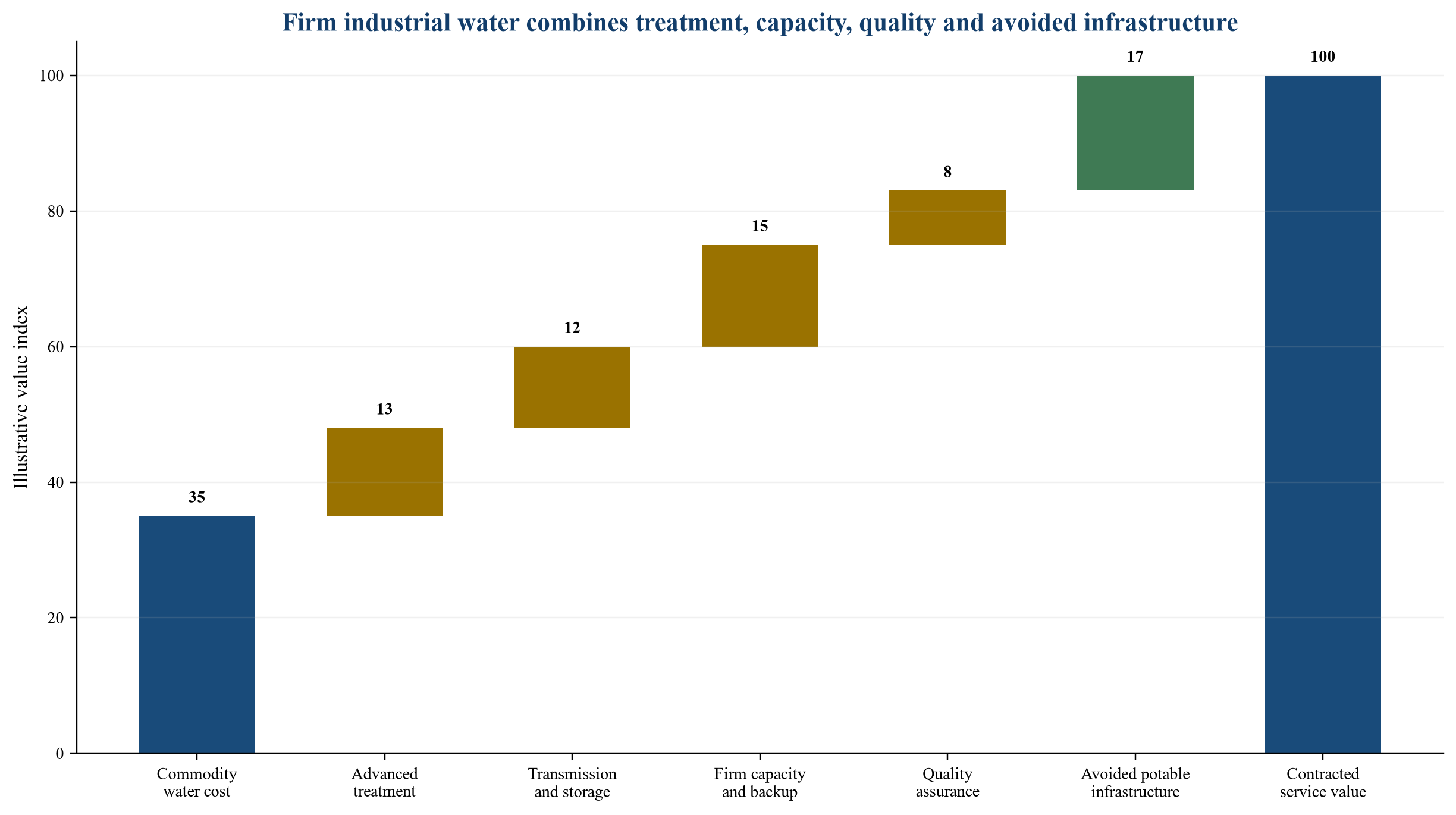
Illustrative value indices only; not a tariff, project estimate or valuation.
31. Connection charges
Customer-specific pipelines, meters, pumping and tie-ins can be funded through an upfront connection charge, amortised capacity payment or customer contribution. The contract should state ownership, maintenance and treatment on termination.
A refundable deposit does not necessarily support long-lived network debt. The financing structure should match asset life and customer credit.
32. Volumetric tariff
The volumetric component can recover variable energy, chemicals, residuals and operating cost. It should use a defined meter and treatment of leakage, flushing and off-specification water.
Tariff indexation should reflect actual cost drivers. A general consumer-price index can misalign with electricity or chemical exposure.
33. Power pass-through
Advanced treatment and pumping consume electricity. Pass-through can use metered consumption, benchmark intensity or a tariff index. The utility should retain incentives for efficiency.
Renewable-power requirements and carbon attributes should be contracted separately. A customer should not assume that reclaimed water is automatically low carbon.
34. Chemical and residual pass-through
Chemicals, membranes and residual disposal can vary with source quality. The agreement can include a base allowance and adjustment outside the feed envelope. This prevents the utility from pricing unlimited contamination risk.
Pass-through requires audit rights and procurement discipline. The customer should not pay for avoidable operating inefficiency.
35. Take-or-pay
Take-or-pay supports fixed-cost recovery when the customer uses less than reserved capacity. It should account for commissioning delay, ramp, force majeure and utility non-performance.
The utility can resell released capacity and credit proceeds under an agreed mechanism. Double recovery should be avoided.
36. Availability payment
An availability payment can reward the utility for maintaining treatment, network, storage and backup. Deductions should reflect service severity and duration.
Availability should exclude customer-side outages and agreed curtailment. Measurement needs a clear clock and event log.
37. Quality deductions
Quality deductions can apply when delivered water falls outside specification but remains usable, with rejection at defined limits. The mechanism should reflect incremental customer treatment or lost service.
The customer should mitigate loss where safe and reasonable. Unlimited production-loss liability can make the project unfinanceable.
38. Change in customer technology
A fab process node, electrolyser design or data-centre cooling system can change demand and quality. The contract should require notice, technical review and cost allocation. A closed-loop cooling conversion can reduce volume materially.
Capacity payments can remain while contracted assets are stranded, or the parties can agree a termination value. This risk should be addressed before construction.
39. Expansion
Expansion rights should state additional volume, quality, notice, engineering, capital and priority. A utility cannot promise future capacity without source and permit evidence.
The customer can fund option capacity, while unused options should expire. Network expansion may require coordination among several users.
40. Community allocation
Industrial reuse can reduce potable demand, while infrastructure and source rights remain public concerns. The project should disclose how costs, drought priority and benefits are allocated. EPA’s Water Reuse Action Plan identifies reuse as a way to support technology-sector water needs and local freshwater resilience [4].
Transparent governance reduces the risk of industrial customers being seen as displacing households or agriculture.
41. Drought and emergency rules
The contract should define drought stages, curtailment order, emergency potable backup and regulatory override. Reclaimed water can be drought-resilient, while treatment or network capacity can still fail.
Priority should align with public policy and paid service levels. The customer should maintain contingency for events beyond the utility’s control.
42. Regulatory change
Reuse regulation can change treatment, monitoring, reporting and permitted end uses. The contract should allocate compliance capital, operating cost and termination rights.
Change-in-law relief should distinguish industry-wide rules from customer-specific process changes. The parties should cooperate on permits and data.
43. Permitting
The project may require water-reuse approval, construction permits, discharge or residual permits, environmental review and customer product-safety approvals. The schedule should identify critical-path authorities.
An existing wastewater permit may not cover a new industrial product or return flow. The Quincy case required defined residual management [3].
44. Return water
Customers can return cooling blowdown, fab wastewater or other streams. The utility should specify flow, temperature, pH, salinity, organics, metals and prohibited constituents. Return quality affects treatment and residuals.
Segregation can preserve valuable clean streams and isolate difficult waste. Mixing everything can destroy reuse value.
45. Residual management
Advanced treatment produces concentrate, sludge, spent media and cleaning waste. The contract should define ownership, classification, transport and disposal. Zero discharge claims require complete evidence.
Residual cost should enter the tariff and downside model. A reuse project can shift rather than remove environmental burden.
46. Metering and data
Revenue-grade flow meters, online quality instruments and energy meters should be calibrated and time-aligned. Data rules should cover missing values, drift, retention and access.
Both parties need raw and processed data. A dashboard without downloadable evidence is insufficient for billing or performance disputes.
47. Cybersecurity and operational control
Automated treatment and industrial connections create digital interfaces. Cybersecurity, remote access, alarm ownership and manual fallback should be defined. A utility should not permit customer systems to control treatment safety.
Incident response should coordinate cyber and water-quality events. Data confidentiality may also matter for customer production profiles.
48. Credit support
Long-lived pipelines and treatment assets can depend on one industrial customer. The utility should assess parent credit, project structure and termination exposure. Security can include parent guarantees, letters of credit, deposits or termination payments.
Customer concentration should influence debt tenor and reserve requirements. A highly rated parent guarantee can be more valuable than a high nominal tariff.
49. Utility performance security
The customer also depends on utility performance. Completion support, performance bonds, liquidated damages, reserve capacity and step-in rights can protect the customer.
Public utilities may have statutory limits on security or liability. The contract should recognise those limits and use engineering redundancy where legal remedies are constrained.
50. Financing structure
Shared treatment and networks can be financed by a utility, concessionaire, infrastructure investor or customer consortium. Customer-specific polishing is often financed with the industrial facility.
Senior debt should rely on contracted capacity, creditworthy payment and proven treatment. Merchant expansion and uncommitted customers should remain equity risk.
51. Contract allocation matrix
The allocation should match control and credit.
Table 2. Industrial reclaimed-water contract allocation
| Element | Utility obligation | Customer obligation | Financing protection |
|---|---|---|---|
| Source and treatment | Maintain firm yield and quality barriers | Provide forecasts and comply with connection rules | Source study, redundancy and reserve |
| Network capacity | Deliver pressure and contracted flow | Pay reserved capacity and connection contribution | Take-or-pay and credit support |
| Customer polishing | Meet custody-point quality | Produce final process-grade water | Clear quality boundary and customer contingency |
| Power and chemicals | Operate efficiently and document usage | Pay agreed indexed or metered adjustment | Caps, audit rights and efficiency benchmark |
| Outage and backup | Notify, restore and provide contracted backup | Maintain internal storage and safe shutdown | Availability deductions and tested contingency |
| Return water | Receive compliant return flow | Segregate and meet discharge envelope | Surcharge, rejection and indemnity |
| Technology change | Review and offer modification | Give notice and fund customer-driven change | Capacity payment or termination value |
Generic allocation; governing law, regulation and project structure determine enforceability.
52. Connection timeline
The programme should begin with source and customer duty definition, then concept design, permitting, commercial terms, detailed design, procurement, construction, commissioning and ramp. Customer factories can have fixed energisation and production dates.
Water infrastructure should be integrated into the customer’s critical path. Temporary supply may bridge commissioning, while it requires its own quality and logistics plan.
53. Stage gates
The first gate confirms source yield and customer specification. The second confirms route, storage and backup. The third secures term sheets and permits. Final investment follows executed contracts, detailed design and funded contingencies.
Each gate should close defined uncertainties. Early works should not create pressure to approve an unsupported full project.
54. Commissioning
Commissioning should test continuous flow, pressure, quality, barrier alarms, storage, backup, changeover, return water and residuals. Customer polishing should be commissioned against the actual delivered water.
The acceptance period should cover representative operation. A short test at low demand does not prove peak service.
55. Ramp-up
Industrial customers may ramp slowly. The utility still incurs fixed cost. Capacity charges and staged modules can manage the gap.
The customer should provide updated forecasts. The utility should retain a downside plan if production start is delayed.
56. Hypothetical downside sensitivity
The chart shows how an illustrative project’s equity-value index responds to six downside drivers. The values are arbitrary and demonstrate method only.
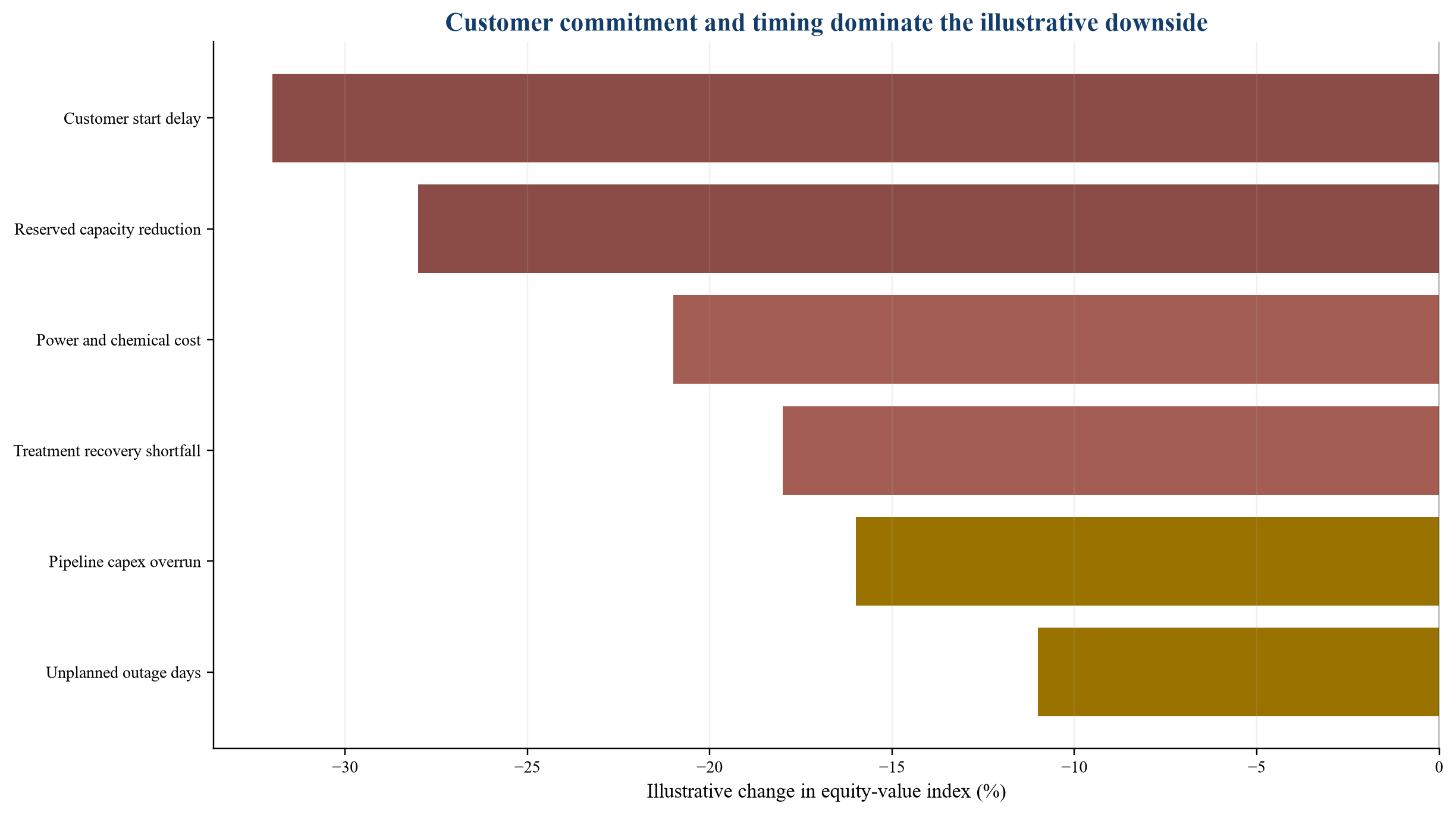
Illustrative changes to an arbitrary equity-value index; not a forecast, tariff or valuation.
57. Risk register
The risk register should connect operating evidence to contract and capital.
Table 3. Industrial reclaimed-water risk and investment response
| Risk | Evidence required | Commercial response | Investment response |
|---|---|---|---|
| Source yield shortfall | Historical flow, growth and drought analysis | Firm-yield covenant and priority rules | Conservative capacity and backup |
| Quality excursion | Barrier validation and source-control data | Diversion limits, notice and deductions | Storage, redundant treatment and reserve |
| Customer start delay | Construction programme and sponsor support | Capacity-payment commencement and long-stop | Phase modules and require security |
| Technology reduces demand | Customer roadmap and cooling or process design | Change notice and termination value | Shorter tenor or transferable capacity |
| Energy and chemical escalation | Metered intensity and supply quotes | Indexed pass-through with audit | Stress debt service and hedge |
| Return water outside envelope | Customer wastewater characterisation | Surcharge, rejection and indemnity | Separate high-risk streams |
| Public opposition or allocation change | Stakeholder and policy review | Transparent priority and reporting | Delay contingency and diversified customers |
| Permit delay | Authority engagement and application plan | Long-stop and cost allocation | Stage notice to proceed |
Generic framework; probability, impact and remedy require project-specific diligence.
58. Independent technical review
The independent engineer should validate source yield, customer demand, treatment barriers, hydraulics, storage, backup, residuals, capital, schedule and performance tests. The review should cover each customer duty.
Supplier models should be reconciled with operating data. The reviewer should identify where claims depend on future customer information.
59. Customer diligence
The utility should diligence sponsor credit, plant schedule, water-demand basis, internal recycling, technology roadmap and contingency. Demand should reconcile to production and cooling assumptions.
The customer should diligence utility governance, operations, source rights, permits, treatment references, network condition and emergency capability.
60. Red flags
Red flags include one water specification for all duties, average volume without peak analysis, no storage or backup, unlimited customer expansion, unpriced customer delay, assumed potable backup during drought, residuals omitted, and quality testing without rapid diversion.
Other warnings are debt sized on uncommitted demand, a long pipeline serving one weak-credit customer, and a contract that ignores a foreseeable change to closed-loop cooling or fab recycling.
61. Practical first hundred days
The first month should establish source data, customer duties, custody points and governance. The second should test treatment routes, storage, hydraulics, residuals and customer-quality requirements. The third should issue commercial principles, capacity cases, permitting plans and a phased development budget.
The output is a common basis for design and negotiation. Equipment procurement should follow agreement on service boundaries.
62. Portfolio development
A utility can serve a cluster of fabs, hydrogen plants and data centres with shared advanced treatment and transmission. Diversity can improve utilisation, while coincident peak demand and customer-specific quality can offset the benefit.
The network model should test customer combinations and expansion. Common capacity should remain usable if one customer exits.
63. Semiconductor-led cluster
A semiconductor-led system can justify high-quality central treatment and stable base demand. Other industrial customers may use lower-grade side streams. The fab’s stringent requirements should not automatically be imposed on all users.
The utility should isolate customer-specific polishing and liability. A qualified fab supply can create a strong reference for later connections.
64. Hydrogen-led cluster
A hydrogen-led system can combine reclaimed water, renewable power and industrial offtake. Variable electrolyser dispatch can create storage and tariff challenges. Co-located oxygen or heat users can change project economics.
Water contracting should be integrated with power and hydrogen schedules. Each commodity contract should use consistent capacity assumptions.
65. Compute-led cluster
A compute-led system can create rapid demand growth and substantial peak-weather cooling needs. Cooling technology can also change quickly. Reclaimed water should be compared with zero-evaporation designs and the power consequences of each.
A long-term contract can preserve flexibility through capacity bands, technology-change procedures and shared network reuse. Community reporting should use site-level withdrawals and consumption.
66. Performance monitoring
Monthly reporting should cover source yield, treatment recovery, quality excursions, flow, pressure, energy, chemicals, storage, outages, customer nominations, return flow, residuals and cash. Variances should be separated into source, utility and customer causes.
Annual reviews should update demand, technology and drought planning. Performance data should inform expansion rather than remain a compliance archive.
67. Tariff benchmarking
Benchmarking should compare services with the same quality, reliability, pressure, distance and residual boundary. A municipal reclaimed-water tariff, an ultrapure-water service and a customer-owned treatment system are different products. Published volumetric prices can mislead when connection and capacity charges sit elsewhere.
The board should see a total delivered-cost comparison over the contract term. This includes customer polishing, storage, backup, return-water treatment and termination exposure. Benchmark ranges should identify date, geography and service scope.
68. Water and power integration
Industrial water and power are linked through treatment, pumping, cooling and production schedules. A water project can reduce potable demand while increasing electricity. A dry-cooled data centre can reduce water while increasing power under some conditions. Electrolyser water and electricity demand can move together.
The integrated model should use hourly or representative operating profiles where peaks matter. Separate utility contracts should reconcile the same production and commissioning assumptions.
69. Heat recovery and temperature
Return-water temperature can affect treatment, discharge and heat-recovery options. Data centres and hydrogen facilities may provide low-grade heat that can serve district or industrial uses when location and temperature are suitable. Heat recovery can change cooling-water demand.
The water agreement should define delivery and return temperature where material. Any heat revenue should be supported by a separate customer and infrastructure case. A theoretical heat quantity is not a contracted benefit.
70. Insurance and business interruption
Utilities and customers should review property damage, machinery breakdown, pollution, cyber and business-interruption insurance. Policy exclusions, deductibles and waiting periods determine practical protection. Insurance rarely replaces engineering redundancy for a critical water input.
The contract should coordinate claims, mitigation and access to evidence. Each party should understand whether the other’s insurance covers third-party loss. Required limits should reflect available market capacity and liability caps.
71. Procurement strategy
The project can use a design-build package, multiple treatment and network contracts, or a concession. A single package can simplify completion responsibility, while customer polishing and live-plant interfaces may remain separate. Multi-package delivery requires a strong integrator.
Bid comparison should use the same source envelope, quality duty, utilisation, energy price, test protocol and lifecycle horizon. Lowest capital cost can create higher operating or residual cost. Evaluation should include credit, references, spares and long-term service.
72. Social licence and disclosure
Technology-sector water demand can attract public scrutiny, especially in stressed basins. Reuse projects should disclose potable-water displacement, actual withdrawals and consumption, drought priority, public cost and residual management. Corporate replenishment claims are separate from site supply performance.
Transparent reporting should use consistent boundaries and avoid treating non-potable supply as zero water use. Community engagement should begin before permits and major construction.
73. Water accounting
The project should distinguish withdrawal, consumption, discharge, internal recirculation and replenishment. Evaporation is consumption; return water can remain available to the basin subject to location and quality. Recycled volume can be counted repeatedly unless the method is clear.
Contract billing and sustainability reporting can use different definitions. Both should reconcile to metered physical flows. Independent assurance can support public and lender reporting.
74. Termination and asset reuse
Termination can leave a dedicated pipeline, treatment module and storage without demand. The contract should state termination payment, asset transfer, decommissioning, residual liability and access rights. The utility should assess whether capacity can serve another user.
Customer-driven termination should cover unamortised customer-specific capital within agreed limits. Utility default should protect customer continuity and step-in where legally feasible.
75. Exit and refinancing
Long-term industrial-water projects may be refinanced or sold after completion. Transfer provisions should preserve operator competence, credit and public obligations. Customer consent should be bounded and objective.
Refinancing value should arise from demonstrated service and contracted cash flow. The base investment case should not depend on an assumed sale multiple. Any gain-sharing mechanism should be stated in the concession or customer agreement.
76. Replication
A proven network can be extended to new industrial clusters, while each location requires source, regulation, customer duty and hydraulic analysis. Standard contract modules and treatment designs can shorten development. Site-specific interfaces remain decisive.
Platform value should separate operating assets from uncontracted pipeline. Data, customer qualification and supplier frameworks can support later projects without turning them into committed revenue.
77. Conclusion
Industrial reclaimed water can support semiconductor fabrication, hydrogen production and compute infrastructure while reducing demand on potable supplies. The investable service is duty-specific water with contracted quality, capacity, reliability, backup and residual management.
Utilities and customers should define the custody point, separate shared treatment from customer polishing, reserve capacity through creditworthy commitments, price variable inputs transparently and plan for technology change. Semiconductor projects require contamination discipline and staged ultrapure-water production. Hydrogen projects require a full plant water balance. Data-centre projects require cooling-architecture and climate analysis. Storage, source control, return-water rules and tested backup convert a reuse connection into production infrastructure. Capital should follow executed service obligations and evidence that the complete system can protect industrial output and community water priorities.
References
- United States Environmental Protection Agency. Water Reuse for Industrial Applications Resources. https://www.epa.gov/waterreuse/water-reuse-industrial-applications-resources
- PUB, Singapore's National Water Agency. NEWater. https://www.pub.gov.sg/Public/WaterLoop/OurWaterStory/NEWater
- United States Environmental Protection Agency. Water Reuse Case Study: Quincy, Washington. https://www.epa.gov/waterreuse/water-reuse-case-study-quincy-washington
- United States Environmental Protection Agency. Water Reuse Action Plan 2.0: Multiplying Water Benefits, Maximizing American Prosperity. https://www.epa.gov/system/files/documents/2026-04/wrap-2.0-booklet.pdf
- United States Department of Energy. Cooling Water Efficiency Opportunities for Federal Data Centers. https://www.energy.gov/cmei/femp/cooling-water-efficiency-opportunities-federal-data-centers
- Microsoft. Measuring Energy and Water Efficiency for Microsoft Datacenters. https://datacenters.microsoft.com/sustainability/efficiency/
- Microsoft. Sustainable by Design: Next-Generation Datacenters Consume Zero Water for Cooling. https://www.microsoft.com/en-us/microsoft-cloud/blog/2024/12/09/sustainable-by-design-next-generation-datacenters-consume-zero-water-for-cooling/
- TSMC. 2024 Sustainability Report. https://esg.tsmc.com/en-US/file/public/2024-TSMC-Sustainability-Report-e.pdf
- Micron Technology. 2026 Sustainability Report. https://www.micron.com/content/dam/micron/global/public/programs/sustainability/documents/micron-technology-2026-sustainability-report.pdf
- United States Department of Energy. Alternative Fuels and Feedstocks Office Program Record 25003: Water Use in Hydrogen Production. https://www.energy.gov/documents/record-25003-water-use-hydrogen-production
- United States Department of Energy. Can Water Usage for Electrolysis Pose Problems for Parts of the United States Currently Facing Water Shortages? https://www.energy.gov/cmei/fuels/can-water-usage-electrolysis-pose-problems-parts-united-states-currently-facing-water
- United States Environmental Protection Agency. Basic Information about Water Reuse. https://www.epa.gov/waterreuse/basic-information-about-water-reuse
- United States Environmental Protection Agency. Summary of Singapore's Water Reuse Guideline or Regulation for Industry. https://www.epa.gov/waterreuse/summary-singapores-water-reuse-guideline-or-regulation-industry
- Microsoft. 2025 Environmental Sustainability Report. https://www.microsoft.com/dmc/en-us/corporate-responsibility/sustainability/report/
- PUB, Singapore's National Water Agency. Trade Effluent Requirements. https://www.pub.gov.sg/Professionals/Requirements/Used-Water/TradeEffluent
About the Author
Chennakeshav (CK) is a corporate finance and investment banking executive with 25+ years of global experience in deal origination, structuring and execution across M&A, growth capital and corporate strategy. He has led value-creation mandates for founders, corporates and funds — bridging the boardroom view to hands-on execution and close.
His career spans Morgan Stanley, HSBC, Lloyds Banking Group, EWEC, ADQ portfolio companies and Emirates Growth Fund, across TMT, real estate, fintech, deeptech, cleantech, infrastructure and energy. He has partnered with C-suite leaders, private equity and venture funds, sovereign wealth funds and family offices to finance complex fund raises and scale-up ventures, and has led M&A due diligence, post-merger integration and business-transformation initiatives to create value.
At Matchpoint Partners he is Managing Partner, leading the firm's corporate finance, M&A and capital-raising practice. He holds an MBA from London Business School, an engineering degree from VTU and a Master of Laws (LLM, in progress) from UCL London.
An active start-up mentor, CK mentors at Techstars, DIFC FinTech Hive, Startup Grind, Founder Institute and IN5, serves as Entrepreneur Mentor in Residence (EMiR) at London Business School, and judges the Entrepreneurship World Cup.
LinkedIn: https://www.linkedin.com/in/ckadya/
Profile: https://www.matchpoint-partners.com/team/ck-adya.html
