

1. Detect contractor distress while the project can still be protected
Contractor distress is a loss of financial or operational capacity that threatens contractual performance. Project distress is the later condition in which completion, safety, quality, cost, funding or customer obligations are already materially impaired. The sponsor's control objective is to identify the first condition before it becomes the second.
A busy site is weak evidence of financial health. Current activity can be funded by overdue subcontractor balances, accelerated employer receipts, diverted working capital, reduced supervision or deferred procurement. Reported progress can also lag commercial reality when valuation, certification and cost-to-complete processes use different definitions.
The early-warning system should join six evidence channels: corporate financial standing; project cash conversion; subcontractor and supplier behaviour; physical progress and programme credibility; contractual claims and notices; and the sponsor's continuity rights. Each signal requires a source, date, owner, trend and decision consequence.
One adverse indicator rarely proves distress. A disputed certificate may be genuine. Labour turnover can be seasonal. A parent may deliberately change working-capital policy. The decision process therefore uses corroboration and trajectory. Several linked signals moving in the same direction justify deeper review even before a covenant or contract is breached.
The sponsor should also protect confidentiality. Financial-health concerns can damage the contractor, disrupt procurement and change stakeholder behaviour. Access, escalation and communications should follow the contract, applicable law and an approved need-to-know protocol.
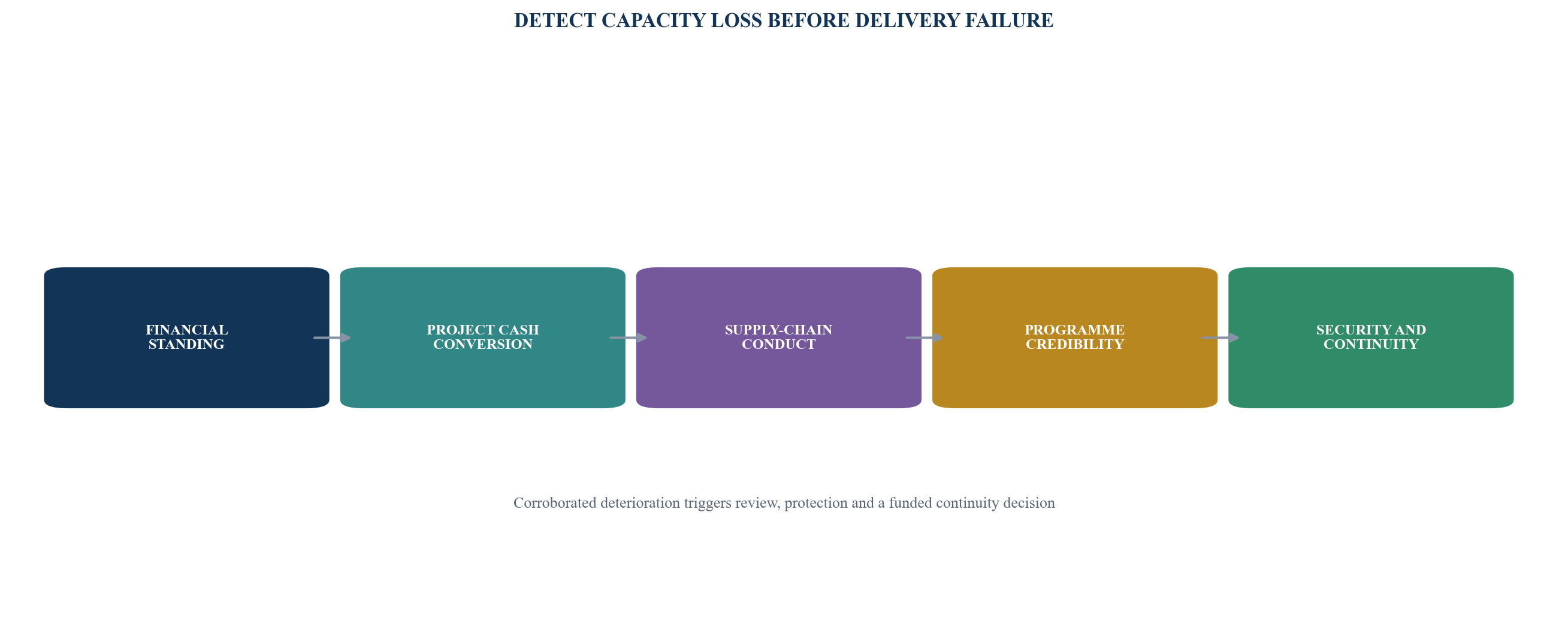
Escalation depends on corroborated evidence, trend, project criticality and contractual rights.
2. Set the monitoring perimeter around project criticality
The same monitoring burden is unsuitable for every contract. A small, substitutable trade package with abundant alternative capacity creates a different sponsor exposure from a design-and-build contractor holding the critical path, design responsibility, major procurement and project records.
Current UK Cabinet Office guidance categorises contracts by criticality and connects more critical contracts to deeper economic and financial-standing assessment. Its stated purpose is to understand the supplier's capacity to perform and identify proportionate mitigation. The framework is designed for specified public bodies, yet its criticality principle is useful for private sponsors when adapted to the project and contract.
Criticality can be assessed through replacement time, interface density, design ownership, access to records, safety responsibility, long-lead procurement, completion dependency, customer exposure and the time available before funding or regulatory milestones. The sponsor then defines the monitoring frequency and evidence rights required for each tier.
The perimeter should extend beyond the contracting entity. A thin project company may rely on a parent guarantee, group treasury, shared plant, central procurement and sister-company personnel. The project can also depend on critical subcontractors whose failure would affect the main contractor's performance. Monitoring should respect legal separateness while mapping these dependencies.
The control register records the monitored entity, group support, contract, work package, critical-path exposure, replacement lead time, permitted information, review cadence and escalation owner. This prevents intensive review from becoming arbitrary and helps the sponsor explain why intervention is proportionate.
Table 1. Project-criticality and monitoring design
| Exposure factor | Lower criticality | Higher criticality | Sponsor control response |
|---|---|---|---|
| replacement | proven alternatives and short mobilisation | scarce capacity or long remobilisation | prequalify alternatives and protect data |
| programme | float available and limited interfaces | critical path and dense interfaces | weekly schedule and constraint review |
| procurement | standard local inputs | bespoke or long-lead equipment | vesting, title and expediting controls |
| information | outputs independently reproducible | contractor controls design and records | mirrored records and licence rights |
| financial support | strong standalone capacity | thin entity or conditional group support | verify support and monitor triggers |
| stakeholder exposure | limited third-party consequence | buyers, lenders or authorities depend on delivery | integrated contingency governance |
Tiers and evidence rights are illustrative and require contract-specific review.
3. Establish the baseline economic and financial standing
Early warning requires a baseline. A sponsor that begins analysis after an adverse event can confuse a long-standing business model with a new deterioration or overlook a change hidden by annual accounts.
The baseline should cover audited financial statements, current management accounts, cash flow, liquidity, debt, facilities, bonding capacity, contingent liabilities, auditor observations, order book, concentration, major disputes and post-balance-sheet events. Group accounts and the contracting entity's own position should both be understood. A parent with scale does not automatically make support available to the project.
Cabinet Office guidance identifies transparent, objective and proportionate assessment and lists financial ratios as part of the evidence. It also warns against relying on an off-the-shelf score alone. A project sponsor can combine reported metrics with contractor explanation, current trading, cash conversion and contract-specific exposure.
Useful measures include revenue trend, operating margin, interest cover, operating cash flow, cash and undrawn committed facilities, current ratio, leverage, net debt, tangible net worth and the maturity profile. The analysis should document accounting period, currency, group perimeter, exceptional items and any adjusted measure.
The baseline concludes with a capacity narrative rather than a single score. It states how the contractor funds work in progress, where liquidity comes from, what consumes bonding headroom, which contracts can create losses, how quickly stress can transmit and which evidence will be refreshed. Any rating remains an internal decision tool and should not be represented as an external credit opinion.
4. Reconcile project cash before relying on group ratios
A solvent group can operate a distressed project, and a loss-making project can drain a contractor that looked sound at award. The sponsor therefore needs a project cash-conversion bridge within the information permitted by the contract.
The bridge begins with cumulative work performed, submitted applications, certified value, deductions, retention, advance recovery, tax, cash received and time from valuation to payment. It then compares these employer-side flows with evidenced labour, subcontractor, supplier and project overhead obligations.
Warning patterns include applications growing faster than verified progress, front-loaded valuation, repeated disagreement over measurement, certification delays, large unapproved variation values, retention pressure, unexplained requests for direct payment and a widening gap between the contractor's reported cost to complete and the independent estimate.
Payment to the main contractor should not be treated as proof that the supply chain has been paid. Current Singapore and New South Wales regimes demonstrate that construction payment claims, responses, due dates and adjudication have their own statutory structure. The exact rights vary by jurisdiction and contract. The sponsor should obtain legal advice before withholding, paying directly, setting off or changing certification practice.
The bridge should be updated on a consistent cut-off. Unreconciled items remain exceptions with an owner and due date. It should never imply access to confidential contractor data beyond the agreed information rights.
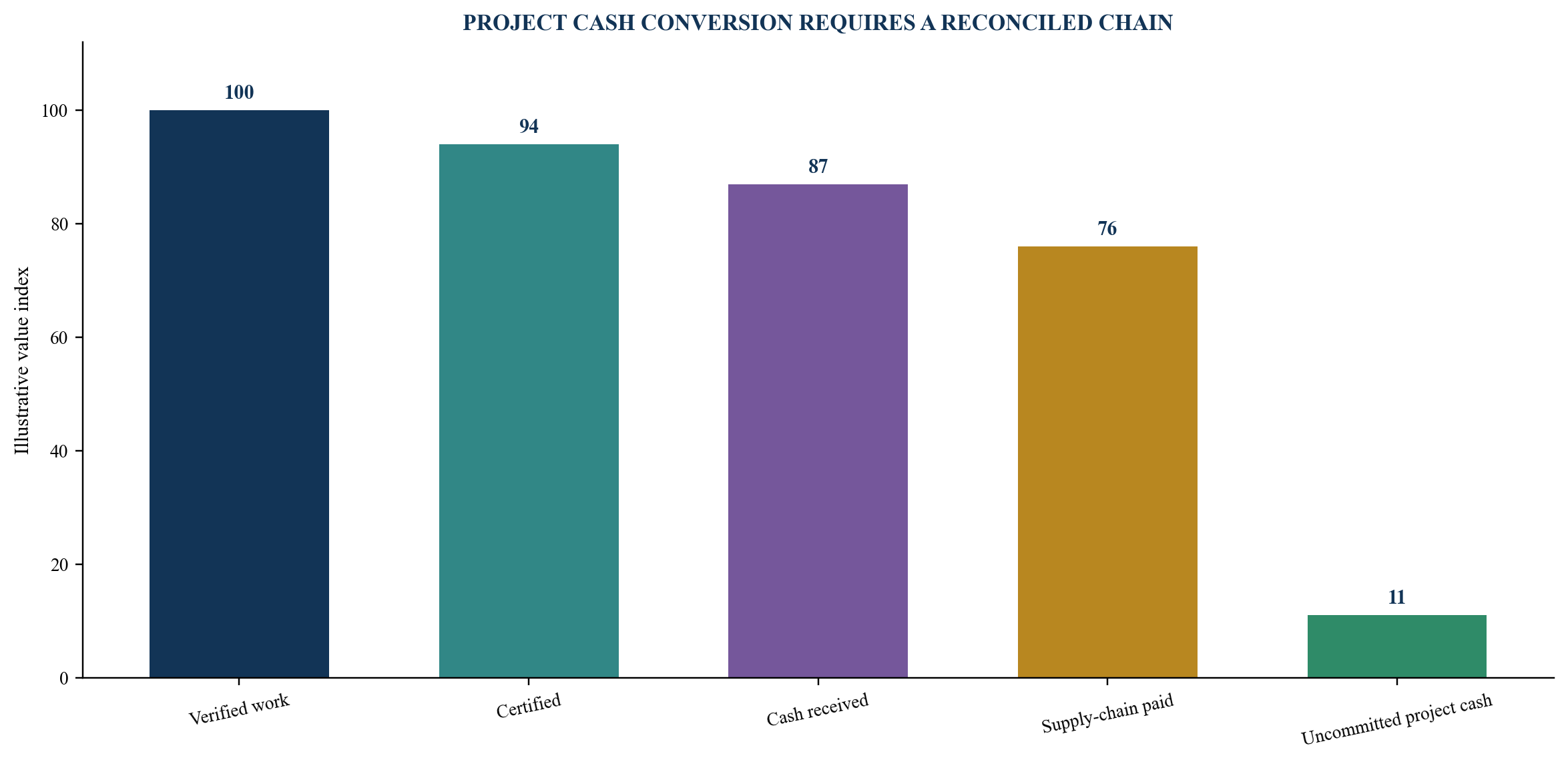
Amounts are management assumptions for method demonstration; they do not describe a named project.
5. Read subcontractor and supplier conduct as a leading indicator
The supply chain often experiences contractor stress before the sponsor sees it in formal reporting. Late payment, reduced credit limits, requests for advance cash, suspended deliveries, missing warranties, labour demobilisation and refusal to release design or testing records can precede programme failure.
The sponsor should establish lawful, structured listening channels. Site management can record changes in attendance, material flow, plant, supervision and subcontractor interfaces. Procurement records can track promised and confirmed manufacturing slots. Contract administrators can log notices, payment disputes and attempts to substitute approved parties.
Unstructured rumour creates risk. Every signal should identify the source class, date, affected package, independent corroboration, confidentiality status and potential project consequence. A supplier's complaint may reflect a genuine dispute rather than inability to pay. The system records both the allegation and the contractor's response.
Critical packages deserve a dependency map. It should show design responsibility, manufacturing location, deposit, title, storage, delivery date, testing, warranty, alternatives and the cost and time to replace. This turns a general concern about contractor health into specific continuity decisions.
The sponsor should avoid inducing breach or interfering with contractual relationships. Direct contact, assurance requests and payment arrangements require contract and legal review. The objective is to protect delivery through authorised information and timely decisions.
Table 2. Supply-chain signal register
| Signal | Evidence to seek | Project consequence | Immediate control question |
|---|---|---|---|
| overdue subcontractor account | statement, dispute basis and payment plan | demobilisation or adjudication | is the package on the critical path? |
| supplier credit reduced | supplier confirmation and order status | manufacturing slot or delivery loss | is title or deposit protected? |
| labour or supervision falls | attendance and resource plan | productivity, safety and quality decline | does the recovery plan remain credible? |
| plant removed | asset ownership and replacement plan | output constraint | does the contractor retain required capacity? |
| warranty or record withheld | contractual deliverables and cause | commissioning or operation impaired | can records be mirrored now? |
| repeated package substitution | approval, price and capability evidence | interface and quality risk | is substitution solving capacity or funding stress? |
A signal initiates verification; it does not establish insolvency or breach by itself.
6. Test programme credibility through resources and constraints
A revised completion date can conceal distress when activities move without the resources, procurement, access, approvals or cash required to perform them. Programme assurance should test the logic beneath the date.
The sponsor should compare the accepted baseline, current update, critical path, near-critical paths, actual productivity, remaining quantities, resource histograms, procurement schedule, design release, testing sequence and authority interfaces. Changes should reconcile with commercial and cash assumptions.
Schedule quality questions include whether actual starts and finishes are evidenced, out-of-sequence work is handled consistently, constraints are visible, calendars are realistic, logic links remain, float is interpreted under the contract and progress measurement matches physical evidence. A recovery programme needs approved actions, owners, resources and funding.
The project's independent estimate at completion should separate contractor delay, employer change, authority dependency and concurrent events without prejudging legal entitlement. The control purpose is to understand what must happen to finish, how much it may cost and which dependencies can fail.
A declining planned-to-actual resource ratio, recurrent missed look-ahead commitments, long-lead dates moving beyond installation need and an unexplained gap between physical and reported progress can corroborate financial signals. The sponsor should escalate the combined pattern rather than debate each metric in isolation.
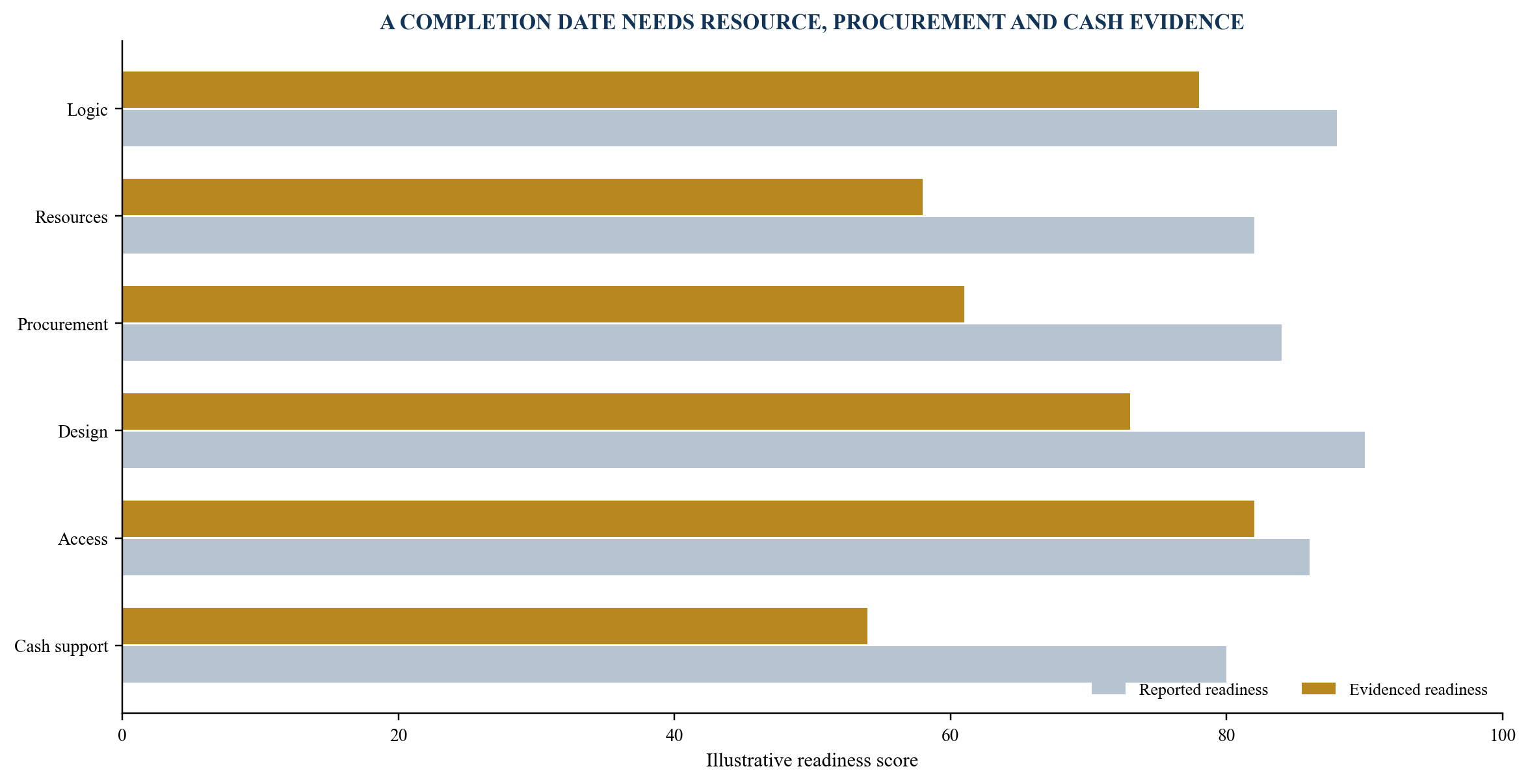
Scores are management assumptions used to demonstrate an evidence-based review.
7. Track claims, notices and commercial behaviour as a connected system
Claims can be legitimate contractual rights and should not be treated as proof of distress. A change in claim behaviour can still be informative when it appears with cash, supply-chain and programme deterioration.
The sponsor should reconcile notices, instructions, variations, contemporaneous records, submissions, determinations, payments and forecast final account. The register distinguishes submitted, assessed, agreed, paid, disputed and reserved amounts. It also records time entitlement and the programme event to which each claim relates.
Potential warning patterns include rapid growth in unsupported value, claims submitted mainly to accelerate cash, repeated reopening of settled matters, reluctance to quantify the final account, aggressive linkage between unrelated disputes and site performance, or settlement proposals that exchange short-term cash for unpriced future exposure.
The employer's own conduct also matters. Late instructions, slow approvals, poor access, delayed certification or failure to decide can create contractor pressure and weaken the sponsor's position. The early-warning office should show both contractor and employer causes and assign corrective actions fairly.
Commercial governance should preserve the contract administrator's independence where required, privilege where applicable and clear authority for negotiation. Operational meetings should not unintentionally waive rights or create undocumented payment commitments.
8. Separate corporate distress from project underperformance
Intervention depends on diagnosis. Four conditions can produce similar symptoms: a financially healthy contractor on a troubled project; a financially stressed contractor on a viable project; a weak contractor and a weak project; or a short-lived operational disruption with adequate capacity.
Corporate distress evidence includes deteriorating liquidity, facility withdrawal, covenant pressure, adverse auditor commentary, creditor action, loss of bonding capacity, material litigation, tax or payroll arrears where lawfully known, and restructuring activity. Project underperformance evidence includes low productivity, design failure, poor planning, rework, safety issues and weak subcontractor management.
The sponsor maps signals into corporate capacity, project economics, project execution and external dependency. The map identifies which party can act and whether the response should focus on cash, management, scope, schedule, security, replacement or a combination.
The diagnosis should remain time-stamped. A contractor can move between states quickly when a facility matures, another large project fails, a major claim settles or new equity arrives. Management representations should be tested against documents and observable conduct.
Formal insolvency and restructuring have jurisdiction-specific effects. The UAE Financial and Bankruptcy Law and Saudi Bankruptcy Law establish legal procedures within their respective scopes. Contract continuation, termination, set-off, security enforcement and creditor action require specialist advice; a project team should not treat an internal risk classification as a legal status.
Table 3. Distress diagnosis matrix
| Corporate capacity | Project condition | Primary question | Possible sponsor workstream |
|---|---|---|---|
| adequate | operationally weak | can management and controls restore performance? | recovery office and independent assurance |
| constrained | technically viable | can liquidity and security be stabilised without leakage? | protected funding and continuity plan |
| constrained | economically weak | is completion, restructure or replacement value-maximising? | options appraisal and stakeholder plan |
| unclear | apparently active | which records can confirm capacity and trajectory? | rapid evidence diagnostic |
| adequate | external shock | what relief, resequencing or contingency is justified? | event-specific commercial plan |
| formal process | any | what can legally continue and who controls decisions? | insolvency counsel and continuity command |
The matrix supports sponsor triage; it does not determine breach, insolvency or legal remedy.
9. Build a contractor distress score from explainable components
A score can organise evidence and escalation if its construction remains transparent. It should not replace judgement or be presented as a probability of insolvency without a validated model.
The score can combine financial standing, project cash conversion, supply-chain conduct, programme credibility, claims behaviour, security headroom and information quality. Each component has defined evidence, direction, weight and staleness rule. Missing information is recorded as unavailable and can increase uncertainty without automatically proving higher risk.
Trend matters more than a static number. The committee should see current state, prior state, drivers, confidence and actions. A modest score that is worsening quickly can justify attention before a high but stable score.
Thresholds should connect to specific governance responses. An amber state may require enhanced information, management meetings and weekly monitoring. A red state may require a continuity command, legal review, funding controls and tested replacement options. Automatic termination is inappropriate; contractual rights and project value need separate analysis.
Back-testing can compare past signals with project outcomes, false alarms and missed events. The sponsor should refine weights cautiously and retain an audit trail. The score is most useful when it forces disciplined questions and ownership.
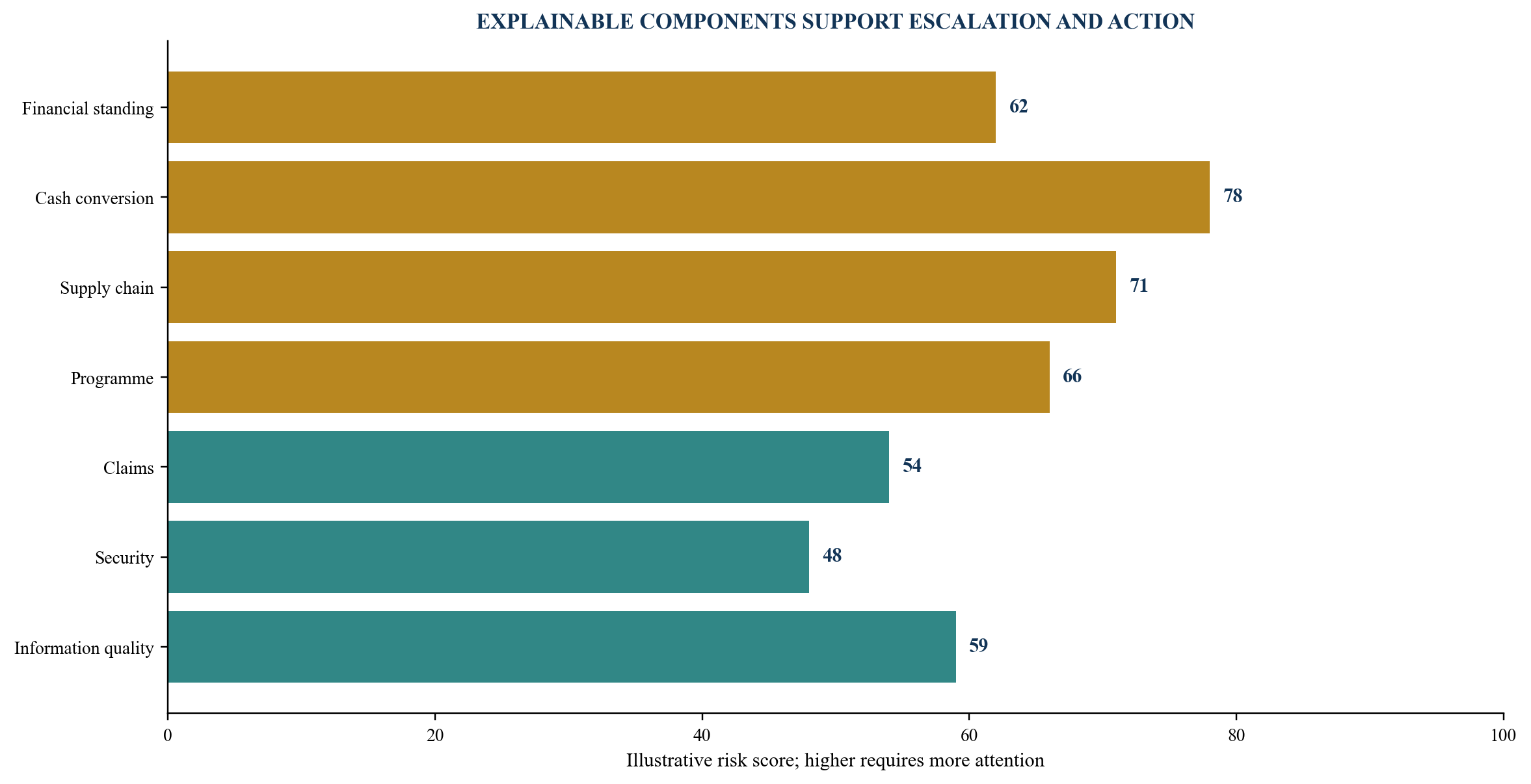
Weights and scores are management assumptions for method demonstration, not a credit rating.
10. Quantify sponsor exposure before choosing an intervention
The sponsor's exposure is broader than the unpaid contract balance. It includes remaining construction, preliminaries, design completion, procurement loss, remobilisation, rework, claims, delay, financing carry, buyer or tenant remedies, professional fees, tax, insurance, authority requirements and operational revenue foregone.
The exposure waterfall begins with an independent cost to complete under the existing contractor. It then models controlled support, partial substitution, consensual novation, termination and replacement, and formal insolvency scenarios. Each scenario has a timeline, cash requirement, legal prerequisites and confidence range.
Recoveries are kept separate from costs. Performance security, retention, advance-payment security, parent support, insurance, set-off and claims may reduce net exposure only if valid, available, callable, solvent and timed. A nominal security amount should not be assumed as immediate cash.
The analysis also includes funding. A lender may control further draws, require consent to material contract changes or have security over project accounts and rights. Buyer funds or escrow may be restricted. Sponsor equity may need approval. Continuity decisions should therefore be integrated with the financing and regulatory perimeter.
All numerical cases should state their status. Management estimates, contractor forecasts, independent estimates and legally recoverable amounts are different evidence classes. The committee paper should preserve those labels in plain reader-friendly language.
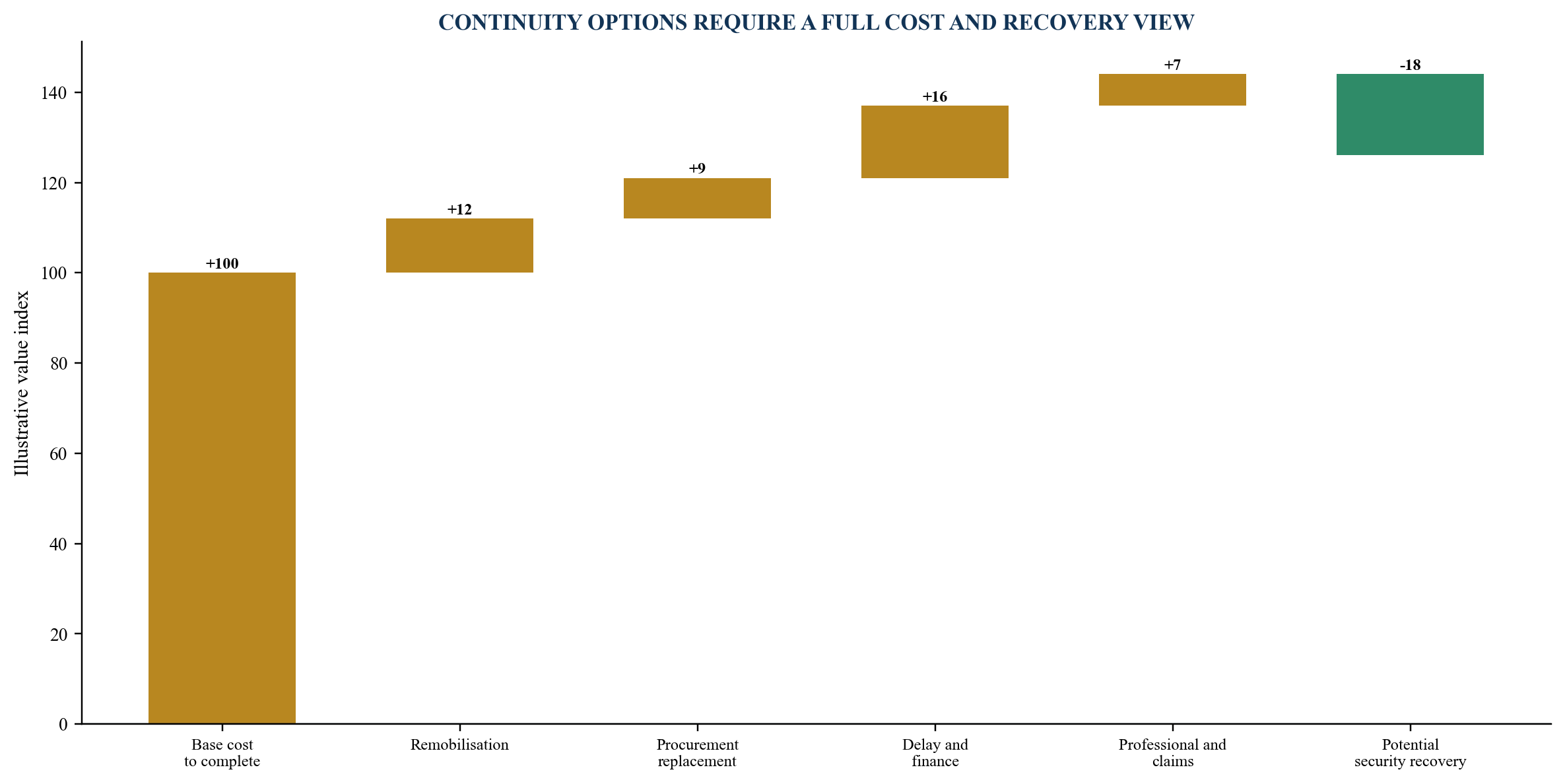
Amounts are management assumptions; actual exposure and recovery require project-specific evidence and advice.
11. Audit security, title and information before they are needed
Security has value when the instrument, issuer, beneficiary, amount, expiry, governing law, calling conditions and original document are verified. The sponsor should maintain a security calendar and test whether expiry tracks the actual project timeline.
The audit covers performance security, advance-payment security, retention, parent guarantee, warranties, insurance, collateral warranties, step-in rights, vesting, title to materials, design licences, source files, records and access. It records gaps, cure dates and authority to act.
Long-lead goods deserve special attention. The register should show order status, manufacturer, deposit, balance, title, identification, storage, insurance, inspection, delivery and alternative route. Payment does not necessarily transfer usable title, and off-site location can complicate recovery.
Information continuity is equally important. The replacement contractor may need design models, calculations, approvals, method statements, testing records, procurement data, subcontract terms, warranties and as-built information. The sponsor should mirror critical records throughout delivery under the contract rather than request them after access is contested.
Calling security, taking possession, direct payment and step-in can have material legal and commercial effects. The audit prepares evidence and options; authorised decision-makers act only after the required advice and approvals.
12. Design protected support without funding leakage
A distressed contractor may request accelerated certification, advance payment, release of retention, direct payment, purchase of materials or revised milestones. Some support can protect completion. Uncontrolled support can move sponsor cash ahead of value and leave the same continuity problem later.
The sponsor should define the purpose, amount, evidence, recipient, conditions, security, controls, reporting, expiry and stop triggers for any support. Funds can be tied to verified work, named critical suppliers, vested goods, payroll evidence or a controlled project account where lawful and agreed.
Support should be evaluated against alternatives. The decision case compares no action, conditional support, partial substitution and replacement. It includes the contractor's credible contribution, shareholder or lender support, claims resolution and operational reforms. Sponsor cash should not become the sole remedy for a structurally loss-making contract without an approved value case.
Direct payment can create legal, tax, contractual, insolvency and relationship consequences. It may affect set-off, priority, warranties or responsibility. The project team should use approved documents and advice rather than informal side arrangements.
The support agreement should preserve transparency. It should identify that continued funding depends on defined evidence and performance, without representing that completion or contractor survival is guaranteed.
Table 4. Protected-support decision register
| Support request | Value-protection condition | Leakage risk | Stop trigger |
|---|---|---|---|
| accelerated payment | independently verified value and updated security | cash ahead of value | evidence failure or missed milestone |
| named supplier payment | confirmed debt, delivery and title route | duplicate liability or disrupted priority | supplier cannot perform or title fails |
| material purchase | specification, inspection, vesting, storage and insurance | unusable or inaccessible goods | manufacture or delivery condition fails |
| retention adjustment | replacement security and quantified completion need | loss of defect leverage | security unavailable or defects increase |
| project liquidity facility | controlled budget, account and reporting | group leakage or structural loss | unauthorised transfer or budget breach |
| claim settlement | evidenced entitlement and finality | paying disputed value without recovery | condition or release not satisfied |
Possible mechanisms require legal, finance, tax, contract and lender review.
13. Build the intervention ladder before a crisis meeting
The intervention ladder converts evidence into proportionate action. It starts with clarification and enhanced monitoring, then progresses through recovery governance, protected support, package substitution, consensual transfer, termination or insolvency-continuity measures where justified.
Each rung has entry evidence, authority, legal review, communications, funding and an exit condition. The sponsor can move up, hold or step down as evidence changes. This avoids treating a monitoring concern as an irreversible decision.
At the first level, the sponsor reconciles data and meets contractor management. The next level adds an approved recovery plan, weekly cash and schedule evidence, critical supplier controls and independent assurance. Higher levels secure records, test replacements, protect goods and prepare stakeholder approvals.
Termination should remain a legal and value decision. Wrongful or poorly executed termination can increase cost and delay. Continuing a contractor without adequate capacity can have the same effect. The decision paper should state evidence, contractual basis, alternatives, funding and implementation readiness.
Communications are part of the ladder. Lenders, buyers, authorities, insurers, consultants, subcontractors and staff may require different information at different times. The communications plan should be accurate, authorised and consistent with confidentiality and market obligations.
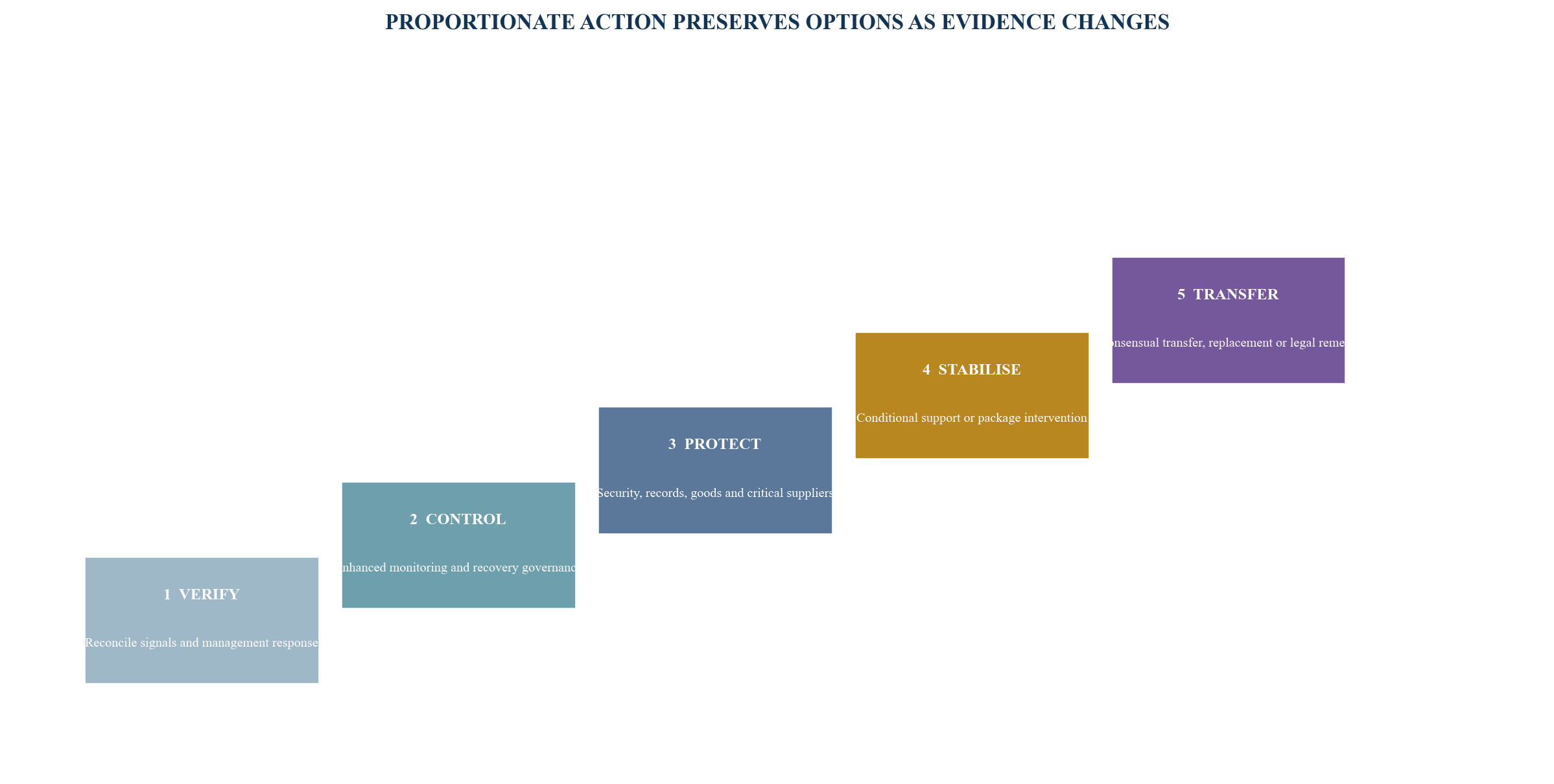
Movement between stages requires current evidence, authority and project-specific legal review.
14. Prepare the replacement and continuity plan while performance continues
Continuity planning is valuable before failure because documents, access, supplier relationships and options are easier to preserve while the contract is operating. The UK Construction Playbook links critical contracts with resolution planning and identifies orderly transfer as a way to limit time, cost and quality impacts.
The project plan should identify the minimum safe state, work that must continue, protection of the site, design responsibility, temporary works, utilities, security, insurance, records, materials, plant, key personnel and statutory interfaces. It then maps potential delivery routes.
Replacement capacity should be tested rather than assumed. The sponsor can confidentially assess market availability, mobilisation time, appetite for inherited design and workmanship, required warranties, price basis, bonding and information needs. A replacement contractor may price uncertainty heavily or decline responsibility for prior work.
The plan should also address subcontract continuity. Some packages may be novated, re-tendered or contracted directly if permitted. Their payment, warranty, intellectual-property and interface positions require review. A list of names alone is not a continuity plan.
The funding model estimates the cash required during transition and the approvals needed from lenders, investors, escrow controllers or authorities. The sponsor should know who can authorise emergency spend and which evidence is required.
15. Integrate local contract, payment and insolvency rules
The early-warning architecture is global; remedies are local. UAE Civil Transactions Law defines muqawala and sets obligations relating to the work, materials, performance and consideration. The current UAE Financial and Bankruptcy Law establishes restructuring and bankruptcy procedures. The specific contract, governing law, forum and entity perimeter determine the practical consequences.
Saudi Arabia's off-plan law and implementing regulations require defined project documentation, escrow and monitoring. Published procedural material includes progress, financial-flow, personnel and sequencing information and processes for delayed or stalled projects. Saudi Bankruptcy Law can affect contracts and creditor decisions within a formal procedure.
Singapore's Building and Construction Industry Security of Payment Act establishes progress-payment and adjudication processes. New South Wales provides statutory progress-payment rights, deadlines and retention trust requirements for specified projects. These systems demonstrate why sponsor action must respect payment law and strict time periods.
The jurisdiction register should cover governing law, dispute forum, statutory payment, insolvency termination restrictions, security calls, direct payment, retention, title, employment transfer, permits, health and safety, insurance, data and customer obligations. Counsel should identify decisions that can be prepared operationally and those that require an event, notice or court or authority action.
This paper does not compare the legal effectiveness of remedies across jurisdictions. It provides a control framework for obtaining current advice before the project loses time and evidence.
Table 5. Jurisdiction and remedy readiness register
| Question | Evidence file | Decision dependency | Accountable adviser |
|---|---|---|---|
| can payment be withheld or redirected? | contract, certificate, claim and statute | notice, adjudication and lender consent | construction counsel |
| can security be called? | original instrument, expiry and conditions | beneficiary authority and demand form | banking and legal |
| can goods be taken or used? | title, vesting, identification and location | payment, possession and insolvency status | property and insolvency counsel |
| can design and records be used? | licences, collateral warranties and source files | termination or step-in rights | intellectual-property counsel |
| can the contract continue in a formal process? | governing law and procedure status | trustee, court or counterparty decision | insolvency counsel |
| can an alternative contractor mobilise? | permits, insurance, safety and appointments | authority and financier approvals | project counsel and technical team |
Legal positions require current qualified advice for the contract, entity and forum.
16. Align lenders, buyers and authorities around verified facts
A contractor issue can affect financing covenants, draw conditions, completion tests, presales disclosures, escrow, authority reporting and insurance. Separate narratives create delay and credibility risk.
The sponsor should establish one verified fact base and different approved reporting views. The lender pack can cover cost to complete, programme, security, contractor capacity, cash need and consent items. Authority reporting follows the applicable form and cadence. Buyer communications address confirmed delivery information and rights under approved advice.
Saudi off-plan regulations illustrate formal monitoring through consultant, accountant and bank reports for defined projects. The public framework also includes information on contractors, implementation, progress and completion. Other jurisdictions have different requirements.
The fact base distinguishes actual events, management estimates, contractor assertions, independent assessments and legal advice. It records cut-off dates and later changes. This helps the sponsor avoid presenting a recovery target as a confirmed outcome.
Stakeholder governance should specify who speaks, who approves, what must be notified and when. Privileged advice and commercially sensitive contractor information remain controlled. Transparency should be accurate and lawful.
17. Run the board dashboard from the exception register
The board needs decision information rather than a volume of site data. The dashboard should connect contractor capacity to completion, sponsor cash and options.
Core measures can include verified progress, forecast completion range, independent cost to complete, certified-to-paid ageing, critical supplier exceptions, resource trend, long-lead readiness, claims exposure, security headroom, information completeness and continuity readiness. Each measure has a definition and source.
The dashboard should show change since the last review, confidence and required decision. A green status without current evidence is less useful than an amber item with a clear owner and closure date. Critical exceptions should link to the underlying record.
The board paper can organise decisions into continue, correct, protect, fund, substitute and prepare. It should state the consequence of delay and the next irreversible date. This helps avoid repeated monitoring without action.
Commercial outcomes are measured through time protected, cash leakage avoided, evidence closed, supplier commitments secured, programme variance reduced and continuity readiness improved. Any savings claim requires a documented counterfactual and should remain separate from observed results.
18. Run a ten-day contractor distress diagnostic
A rapid diagnostic can establish whether concern is isolated, corroborated and decision-relevant. It should be commissioned with clear access, confidentiality, independence and authority.
Days one and two confirm the contract, project criticality, current concerns, financing, information rights, security and governance. Days three and four reconcile financial standing, applications, certificates, cash receipt, cost to complete and claims.
Days five and six review programme logic, resources, procurement, subcontractor dependencies and information continuity. Days seven and eight test contractor explanations, support requests, security, replacement options and jurisdictional constraints.
Days nine and ten produce an evidence-ranked signal map, sponsor exposure range, immediate protections, intervention options, decisions, owners and a ninety-day plan. The diagnostic states data limitations and unresolved legal questions.
The paid deliverable can include the source register, cash-conversion bridge, distress scorecard, supply-chain heat map, programme credibility test, security audit and committee paper. It does not certify solvency or guarantee completion.
19. Operate a ninety-day contractor continuity office
The first thirty days establish the command structure, evidence room, contract and security calendar, cash bridge, programme baseline, critical supplier map and daily exception process. Immediate protections focus on safety, access, records, long-lead goods and funding controls.
Days thirty-one to sixty implement the approved recovery or stabilisation route. The office tracks contractor actions, supplier commitments, design and procurement releases, physical output, cost to complete, claims, stakeholder approvals and contingency procurement.
Days sixty-one to ninety embed a stable control cadence or execute the transition plan. It tests draw deliverables, security dates, alternative capacity, records transfer, communications and the board's next decision gates.
A recurring mandate can provide weekly exception reviews and monthly committee packs. It can coordinate the developer, contractor, consultants, lender, cost manager, counsel and critical suppliers within their respective roles. The office supports decisions without assuming the contract administrator's, engineer's, lender's, insolvency practitioner's or legal adviser's authority.
Table 6. Ninety-day contractor continuity office
| Phase | Core output | Decision supported | Measurable completion test |
|---|---|---|---|
| days 1 to 30 | evidence baseline, cash bridge, security and critical-supplier controls | immediate protection and governance | priority records reconcile and exceptions have owners |
| days 31 to 60 | funded recovery, support or substitution workstream | stabilise performance and preserve value | actions have evidence, dates and accountable parties |
| days 61 to 90 | stable cadence or transition execution | continue, restructure or replace | decision route is funded, documented and executable |
| recurring mandate | weekly exceptions and monthly committee pack | continued delivery and stakeholder confidence | critical actions close to the approved cadence |
The sequence should be adapted to the distress state, contract and stakeholder approvals.
20. Package advisory work around funded sponsor decisions
A contractor distress diagnostic can support a sponsor facing slowing delivery, unexplained cash requests, supplier complaints, claims growth, covenant pressure or a looming completion milestone. The paid outcome is a decision-grade view of contractor capacity, project cash conversion, completion exposure and available protections.
A recurring contractor continuity office can coordinate finance, commercial, programme, procurement, legal and stakeholder workstreams. Deliverables can include a controlled evidence room, weekly exception register, sponsor exposure model, security calendar, supplier heat map, recovery assurance and committee materials.
A transaction or restructuring mandate can support protected funding, claims settlement, package transfer, replacement procurement, lender consent, stakeholder coordination and closing. Scope, fees, conflicts, permitted activity and success events should be documented under the applicable framework.
Commercial qualification should establish a live project, senior decision owner, verified distress signals, funding or completion decision, controlled evidence access, professional advisers, budget and timetable. Expressions of concern without authority, information and paid scope remain leads rather than mandate evidence.
The durable proposition is earlier optionality. A sponsor that connects financial, commercial and delivery evidence can protect records, security, procurement and funding while several routes remain feasible. The system cannot remove construction or insolvency risk. It can give accountable decision-makers clearer evidence, earlier choices and an executable path.
References
- United Kingdom Cabinet Office. The Construction Playbook. https://assets.publishing.service.gov.uk/media/6312222de90e075880923330/14.116_CO_Construction_Playbook_Web.pdf
- United Kingdom Cabinet Office. Assessing and Monitoring the Economic and Financial Standing of Suppliers Guidance Note. https://www.gov.uk/government/publications/the-sourcing-and-consultancy-playbooks/assessing-and-monitoring-the-economic-and-financial-standing-of-suppliers-guidance-note-html--2
- United Kingdom Government Commercial Function. Corporate Financial Distress Guidance Note. https://www.gov.uk/government/publications/the-sourcing-and-consultancy-playbooks/corporate-financial-distress-guidance-note-html
- United Kingdom Insolvency Service. Company Insolvencies, December 2025. https://www.gov.uk/government/statistics/company-insolvencies-december-2025
- United Arab Emirates. Federal Law No. 5 of 1985 Concerning the Issuance of the Civil Transactions Law. https://uaelegislation.gov.ae/en/legislations/1025/download
- United Arab Emirates. Federal Decree-Law No. 51 of 2023 Promulgating the Financial and Bankruptcy Law. https://uaelegislation.gov.ae/en/legislations/2190
- Saudi Real Estate General Authority. Law of Selling and Leasing Off-Plan Real Estate Projects. https://rega.gov.sa/en/laws-and-decisions/regulations-and-by-laws/rules/law-of-selling-and-leasing-off-plan-real-estate-projects/
- Saudi Real Estate General Authority. Implementing Regulations of the Off-Plan Sale and Lease of Real Estate Projects Law. https://rega.gov.sa/media/xswbjgnx/implementing-regulations-of-the-off-plan-sale-and-lease-of-real-estate-projects-law.pdf
- Saudi Real Estate General Authority. Procedural Manual for Sale and Lease of Off-Plan Real Estate Projects. https://rega.gov.sa/en/laws-and-decisions/regulations-and-by-laws/guidelines/procedural-manual-for-sale-and-lease-of-off-plan-real-estate-projects/
- Saudi Ministry of Justice. Bankruptcy Law. https://www.moj.gov.sa/Documents/Regulations/pdf/En/BankruptcyLaw.pdf
- Singapore Statutes Online. Building and Construction Industry Security of Payment Act 2004. https://sso.agc.gov.sg/Act/BCISPA2004
- New South Wales Government. Security of Payment for Construction Contractors. https://www.nsw.gov.au/housing-and-construction/compliance-and-regulation/security-of-payment/about
- New South Wales Government. Retention Money Held by Head Contractors. https://www.nsw.gov.au/housing-and-construction/compliance-and-regulation/security-of-payment/retention-money
About the Author
Chennakeshav Adya, Independent Researcher
