

1. Corporate development is a management system
Corporate development links strategy to inorganic action. Its remit can include acquisitions, disposals, joint ventures, minority investments, strategic partnerships and portfolio reviews. This paper focuses on acquisitions, while recognising that the same evidence may show that a partnership, commercial agreement, build programme or decision to wait is preferable.
An acquisition process starts long before a target enters a data room. The buyer needs to decide what problem the acquisition should solve, what capabilities or market positions it values, what financial capacity it can deploy, which risks it will accept, who can speak for the group and how an acquired business would be governed. These choices form a mandate. A target is attractive only in relation to that mandate.
Family groups often possess advantages in origination: long-standing relationships, local credibility, patient capital, sector knowledge and the ability to resolve decisions through a concentrated ownership structure. The same organisations may also face constraints. Strategic priorities can remain implicit, relationship information can sit with individuals, business units can compete for capital, and shareholders may have different views of control, leverage and integration. A corporate-development system makes these choices visible and creates a record that can survive personnel changes.
A retained office provides continuity. It maintains the acquisition thesis and target universe, prepares outreach, records interactions, qualifies opportunities, coordinates internal input and brings decision-ready material to the authorised forum. It does not replace the board, management, transaction counsel, tax advisers, auditors, valuation specialists, competition counsel, financing providers or regulated financial advisers. The office integrates their inputs into one controlled process.
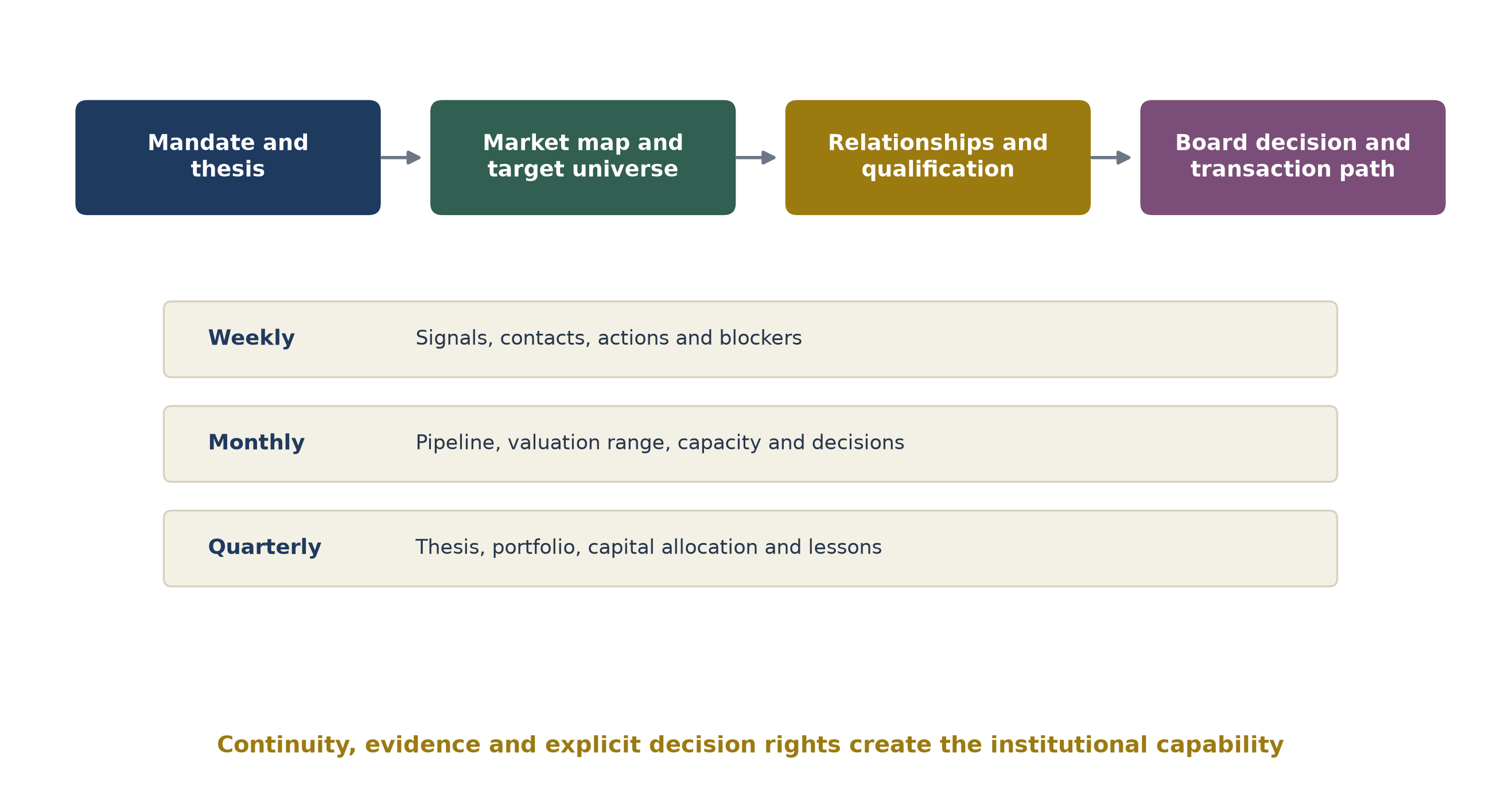
Matchpoint management framework. Each layer produces evidence for the next decision.
2. Write the mandate before building the target list
The mandate states why the group is considering acquisitions and the authority under which the work proceeds. It defines the sponsoring shareholder or executive, participating business units, available management capacity, capital parameters, preferred ownership position, geographic scope, sector boundaries, prohibited exposures, confidentiality rules and reserved matters. It should also state the conditions under which the group will stop work.
The acquisition thesis translates strategy into testable characteristics. A capability thesis might seek proprietary technology, licences, talent or operating know-how. A market-access thesis might seek customers, channels, local content, distribution or regulated permissions. A consolidation thesis might seek density, scale or procurement benefits. A resilience thesis might seek supply security or diversification. Each thesis needs a value mechanism and a credible owner after completion.
The thesis should be expressed as evidence requirements. If the buyer seeks customer access, it should define the customer segment, revenue quality, concentration tolerance, renewal behaviour and cross-sell route. If it seeks a capability, it should identify the people, intellectual property, processes, data, assets and authorisations that make the capability transferable. If it seeks cost synergy, it should identify the operating action, owner, timing, implementation cost and dependency. Strategic language becomes decision-useful when it connects to observable facts.
Financial guardrails establish a search range. They may include enterprise value, equity cheque, leverage, minimum revenue, profitability, cash conversion, recurring-revenue proportion, capital intensity and downside tolerance. These are initial filters rather than a valuation conclusion. The office should record whether a metric is reported, management-adjusted, estimated or unverified. A group can then expand or narrow the range deliberately.
Table 1. Acquisition mandate design
| Mandate element | Decision to record | Evidence required | Owner |
|---|---|---|---|
| Strategic purpose | Capability, market access, consolidation, resilience or portfolio renewal | Board strategy, business-unit plan and value mechanism | Board and sponsor |
| Scope | Sector, geography, ownership and size | Approved search parameters and exclusions | Sponsor |
| Capital | Equity, debt and liquidity constraints | Funding capacity, covenant review and downside case | CFO and treasury |
| Risk appetite | Regulatory, country, customer, technology and integration limits | Risk statement and escalation thresholds | Board and risk owner |
| Decision rights | Who may approach, offer, diligence, sign and complete | Delegated authority and reserved matters | Company secretary and counsel |
| Post-deal ownership | Who will run the asset and deliver the thesis | Named executive, operating model and capacity assessment | CEO |
| Stop rules | Conditions that end or pause work | Red flags, price ceiling, evidence failure and capacity limits | Investment committee |
Matchpoint management framework. Actual authority follows the group's constitutional documents and approved governance.
3. Build a target universe that can be maintained
A target universe is a structured view of organisations that could satisfy the thesis. It is broader than an active pipeline. Its purpose is to preserve market memory, compare alternatives and create relationships before a sale process begins. The universe should include known targets, emerging challengers, adjacent capabilities, assets owned by larger groups and businesses that may become relevant after a strategic change.
Each target record needs a source, date and confidence level for every material field. Public filings, official registries, regulator records, company publications, audited accounts and direct authorised conversations are stronger than unattributed databases or market hearsay. Revenue, ownership, profitability, licences and willingness to transact require separate verification. Silence from an owner is not evidence of interest.
Segmentation improves focus. Targets can be grouped by strategic fit, accessibility, transaction readiness and likely complexity. A high-fit company with no ownership route may belong in long-term relationship development. A medium-fit company entering a formal sale process may deserve rapid screening. A small capability acquisition may need less capital while demanding more attention to founder retention and integration.
The universe needs a refresh protocol. Changes in ownership, leadership, results, funding, regulation, litigation, customer concentration, technology or succession can alter relevance. The office should capture the date of the last verified fact, next intelligence action and person responsible. Unverified information should stay marked as such until evidence is obtained.
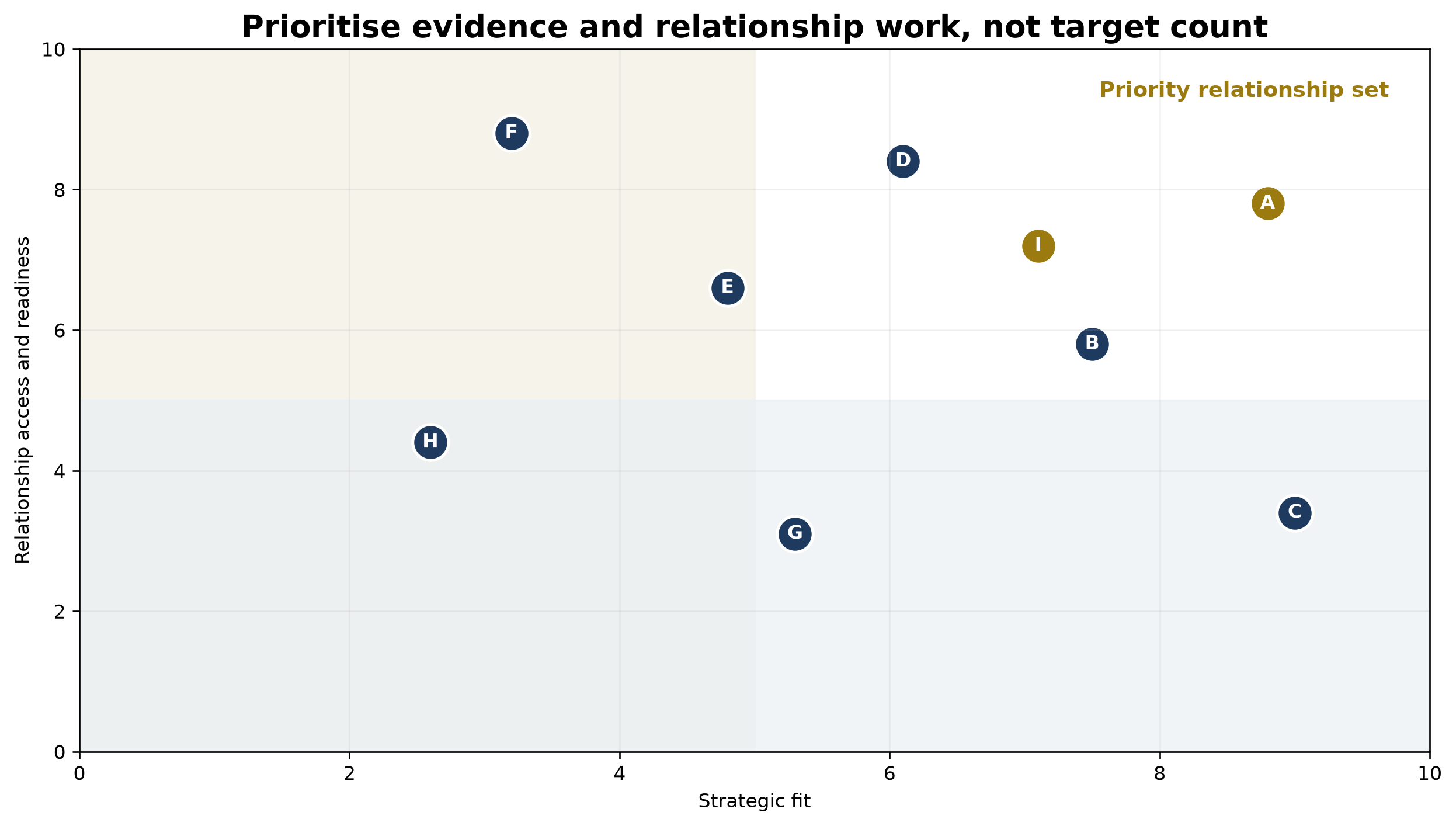
Hypothetical illustration. Positioning does not describe any actual company or willingness to transact.
4. Origination is a relationship process
Proprietary origination means that the buyer develops a direct or authorised relationship outside a broad auction. It does not mean that the target has agreed to sell. A relationship-led approach should respect the owner's objectives, confidentiality, governance and advisers. A credible first conversation explains the buyer's identity, strategic interest, decision authority and proposed next step without creating an impression of certainty that does not exist.
The office should maintain a stakeholder map. A family-owned target may involve operating shareholders, non-operating shareholders, next-generation family members, trusted advisers and executives. A sponsor-owned target may involve the deal team, portfolio leadership and lenders. A corporate divestment may involve strategy, finance, business-unit, legal and separation teams. Contact should follow lawful and ethical routes and avoid restricted or confidential information.
Outreach is sequenced. The first objective is usually permission for a strategic discussion. The second is mutual understanding of objectives. The third is agreement on information and process. A confidentiality agreement creates a legal framework for information exchange; it does not validate the information or create a commitment to transact. The office records who said what, under which authority, with what restrictions and what follow-up was agreed.
Intermediaries can widen access and help interpret process. Their appointment should define role, territory, conflicts, confidentiality, compensation, permitted communications and compliance. The buyer should know whether an intermediary represents it, the seller or both, and whether the person is authorised to make the statements being relied upon.
Table 2. Relationship-led origination record
| Record | Minimum content | Control question | Next action |
|---|---|---|---|
| Contact basis | Source, relationship owner and authorised route | Is the approach lawful, appropriate and conflict-checked? | Approve contact plan |
| Strategic message | Buyer identity, thesis and relevant capability | Does the message reflect approved strategy and authority? | Prepare concise introduction |
| Conversation note | Participants, date, statements, restrictions and questions | Which statements are direct, reported or unverified? | Confirm agreed points |
| Process status | No contact, relationship, exploratory, NDA, information, offer | Has the target authorised the next stage? | Set stage-specific action |
| Stakeholder map | Owners, executives, advisers and decision dynamics | Whose consent or support matters? | Build engagement plan |
| Next milestone | Owner, date, evidence and desired outcome | Is the action proportionate to pipeline priority? | Escalate or archive |
Willingness to transact remains unverified until evidenced through the authorised process.
5. Qualify targets through stage gates
A pipeline should represent evidence, not optimism. Each stage needs an entry test, work programme, decision owner and exit condition. A target moves forward when evidence improves and the authorised decision maker accepts the remaining uncertainty. It moves backward or leaves the pipeline when the thesis weakens, access closes, facts change or the opportunity no longer justifies management attention.
An initial screen can assess strategic fit, ownership, scale, geography, economics, regulatory context, management requirements, integration difficulty and likely transaction route. The output is a short record of known facts, missing evidence and recommended action. A positive screen permits more work. It does not approve valuation, an approach or a transaction.
The next gate develops a preliminary value range and value-creation bridge. The team considers standalone performance, normalisation, capital requirements, working capital, debt, tax, minority interests, contingent obligations, synergies, implementation cost and downside. Inputs should retain their source and status. A valuation range based on public or management-estimated information should remain identified as preliminary.
The authorised offer gate requires a defined process, financing path, diligence scope, integration owner, regulatory analysis, negotiation position and walk-away rules. Exclusivity reduces the seller's process risk and may increase the buyer's access. It can also consume time and create pressure to complete. The board should understand which evidence is expected during exclusivity and which conditions remain unresolved.
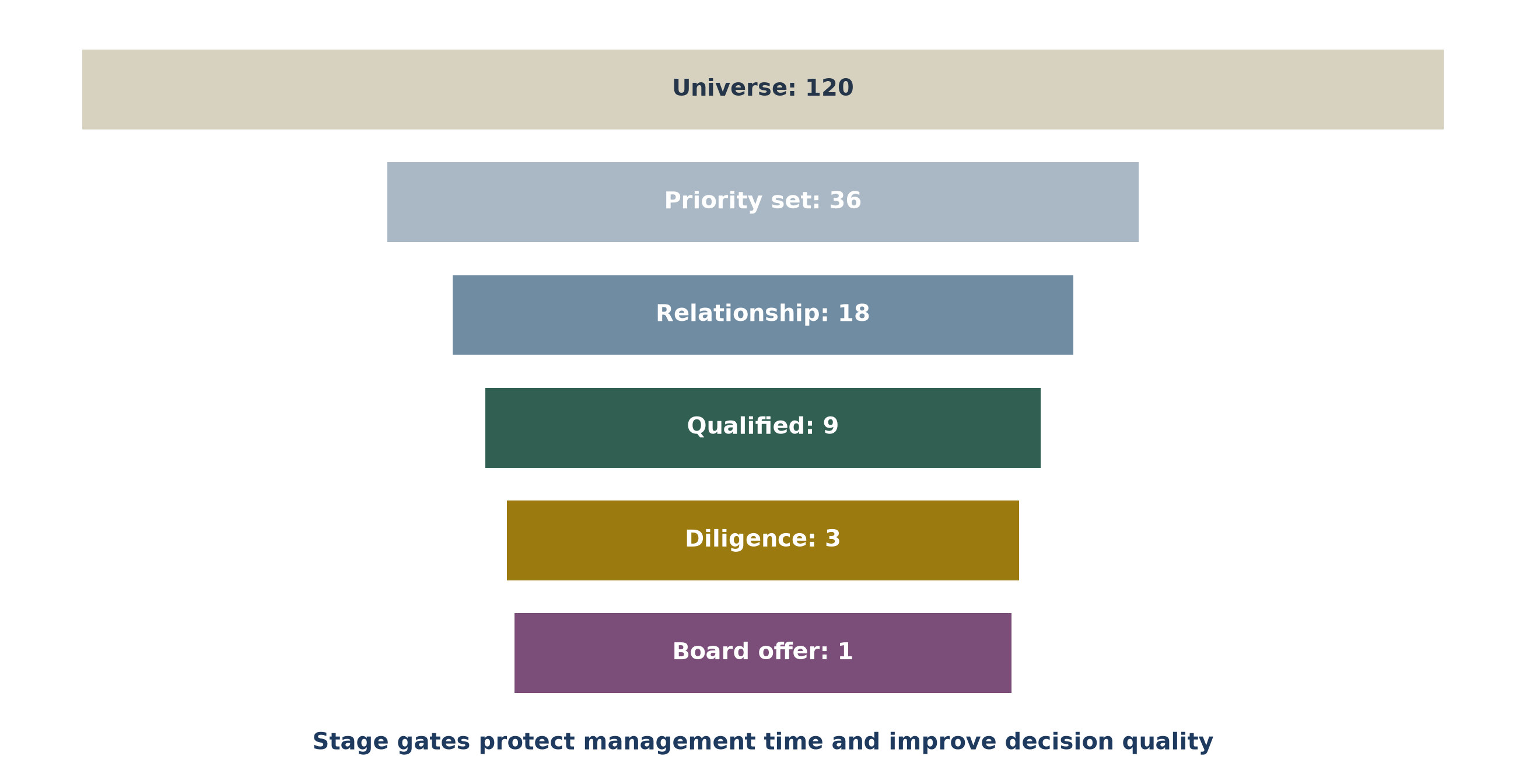
Hypothetical monthly pipeline. Stage movement indicates evidence and authority, not probability of completion.
Table 3. Acquisition stage gates
| Stage | Entry evidence | Principal work | Decision output |
|---|---|---|---|
| Universe | Relevance to one approved thesis | Verify identity, ownership, activity and source | Retain, monitor or remove |
| Priority | Strategic fit and plausible route | Deep profile, stakeholder map and relationship plan | Authorise relationship work |
| Relationship | Authorised contact or route | Explore objectives, timing and process | Advance, nurture or archive |
| Qualified | Sufficient commercial and financial information | Preliminary value, risks, integration and regulatory scan | Authorise NDA or information request |
| Diligence | Process access and approved resources | Commercial, financial, tax, legal, operational and compliance work | Renegotiate, offer, pause or stop |
| Offer | Decision-ready evidence and financing path | Terms, protections, conditions and integration plan | Submit, revise or decline |
| Signing and completion | Approved documents and conditions | Confirm approvals, financing, readiness and closing mechanics | Complete or exercise contractual rights |
Matchpoint management framework. Specialist advice and the buyer's governance determine actual requirements.
6. Put regulation, accounting, tax and compliance on the critical path
An acquisition pipeline crosses multiple legal and professional domains. Early screening should identify the jurisdictions, sectors, licences, ownership restrictions, competition thresholds, foreign-investment requirements, related-party issues, financing constraints, tax consequences and financial-reporting treatment that may affect structure or timing. Screening identifies questions; qualified advisers provide conclusions.
The UAE's competition framework defines economic concentration broadly around transactions that enable direct or indirect control. Cabinet Decision No. 3 of 2025 provides notification thresholds based on annual sales in the relevant UAE market exceeding AED 300 million or a combined market share exceeding 40 per cent in that market.[1][2] The Ministry of Economy and Tourism states that the new thresholds entered enforcement in April 2025 and describes a review period of 90 working days, which may be extended by 45 days.[3] The facts, market definition, exemptions, sector rules and transaction structure require specialist analysis.
Saudi Arabia's General Authority for Competition publishes Economic Concentration Review Guidelines. The guidance explains the authority's review of mergers, acquisitions and similar transactions, including its power to approve, condition or block a concentration based on likely competitive effects.[4] A group pursuing GCC targets should identify filing questions during qualification because approval processes can affect confidentiality, timetable, conditions, financing and long-stop dates.
IFRS 3 establishes the acquisition method for business combinations, including identification of the acquirer, recognition and measurement of identifiable assets and liabilities, goodwill or bargain purchase, and disclosures about the nature and financial effects of a combination.[5] The accounting work can affect valuation, data requests, completion accounts, intangible-asset analysis, contingent consideration and post-deal reporting. The IFRS Foundation continues to consider business-combination disclosures, goodwill and impairment, with decisions and proposals developing through its due process.[6]
The UAE Federal Tax Authority publishes guidance on Business Restructuring Relief under the corporate-tax regime.[7] Relief eligibility, elections, clawback conditions and transaction steps are fact-specific. The corporate-development office should include tax structure and documentation in the work plan without presenting a preliminary screen as tax advice.
Compliance diligence needs a path into implementation. The US Department of Justice's September 2024 Evaluation of Corporate Compliance Programs asks how acquisition targets are scrutinised, who conducts the risk review, how compliance is integrated into the M&A process, how findings are tracked and remediated, and how the acquired business enters the buyer's compliance programme and risk assessment.[8] These questions offer a useful control checklist for groups with relevant exposure, while local laws and facts govern the transaction.
Table 4. Early transaction workstreams
| Workstream | Early question | Evidence | Effect on pipeline |
|---|---|---|---|
| Competition | Could control, turnover or market-share tests require notification? | Activities, markets, revenues, shares and transaction structure | Timetable, conditions and feasibility |
| Sector regulation | Are licences, ownership, fit-and-proper or change-of-control approvals relevant? | Licence register, regulator rules and ownership map | Structure and completion conditions |
| Accounting | Is the acquired set a business and what reporting follows? | Processes, assets, liabilities, control and reporting data | Valuation, disclosures and opening balance sheet |
| Tax | What taxes, reliefs, elections or clawbacks may apply? | Entity chart, residence, asset basis, history and structure | Net value, covenants and documentation |
| Compliance | What misconduct, sanctions, bribery, fraud or control risks require diligence? | Risk assessment, investigations, third parties and controls | Price, protection, remediation or stop decision |
| Financing | What capital, covenants and consents are required? | Funding sources, leverage model and lender terms | Offer capacity and certainty |
| Data and cyber | Can data be shared, transferred and integrated lawfully and securely? | Data map, systems, incidents and access controls | Diligence method and integration plan |
The list is a management prompt and does not replace professional advice.
7. Make board decisions comparable
A board or investment committee needs a concise, consistent record of the thesis, evidence, value range, risk, funding, integration requirement and proposed decision. Consistency allows decision makers to compare a current target with other targets, organic investment, capital return, debt reduction and the option to wait.
The decision paper should distinguish facts, assumptions and unresolved questions. It should show the source date of material information, changes since the prior gate and the sensitivity of value to key variables. A headline multiple without a bridge to cash flow, working capital, capital expenditure, tax, debt, synergies and implementation cost can obscure the economics.
The value-creation case needs named owners. Revenue synergy requires customer, product, channel, price, timing, probability and delivery cost assumptions. Cost synergy requires actions, affected resources, timing, one-time cost and service-risk analysis. Capability value needs a retention and deployment plan. The board should be able to see which value exists in the target today and which value depends on future execution.
The paper should include a credible downside case. It can model slower growth, customer loss, margin pressure, integration delay, higher separation cost, financing cost, regulatory conditions or failure to deliver synergy. The assumptions remain hypothetical until supported by verified target data and approved forecasts. The purpose is to understand the decision's resilience, not to manufacture precision.
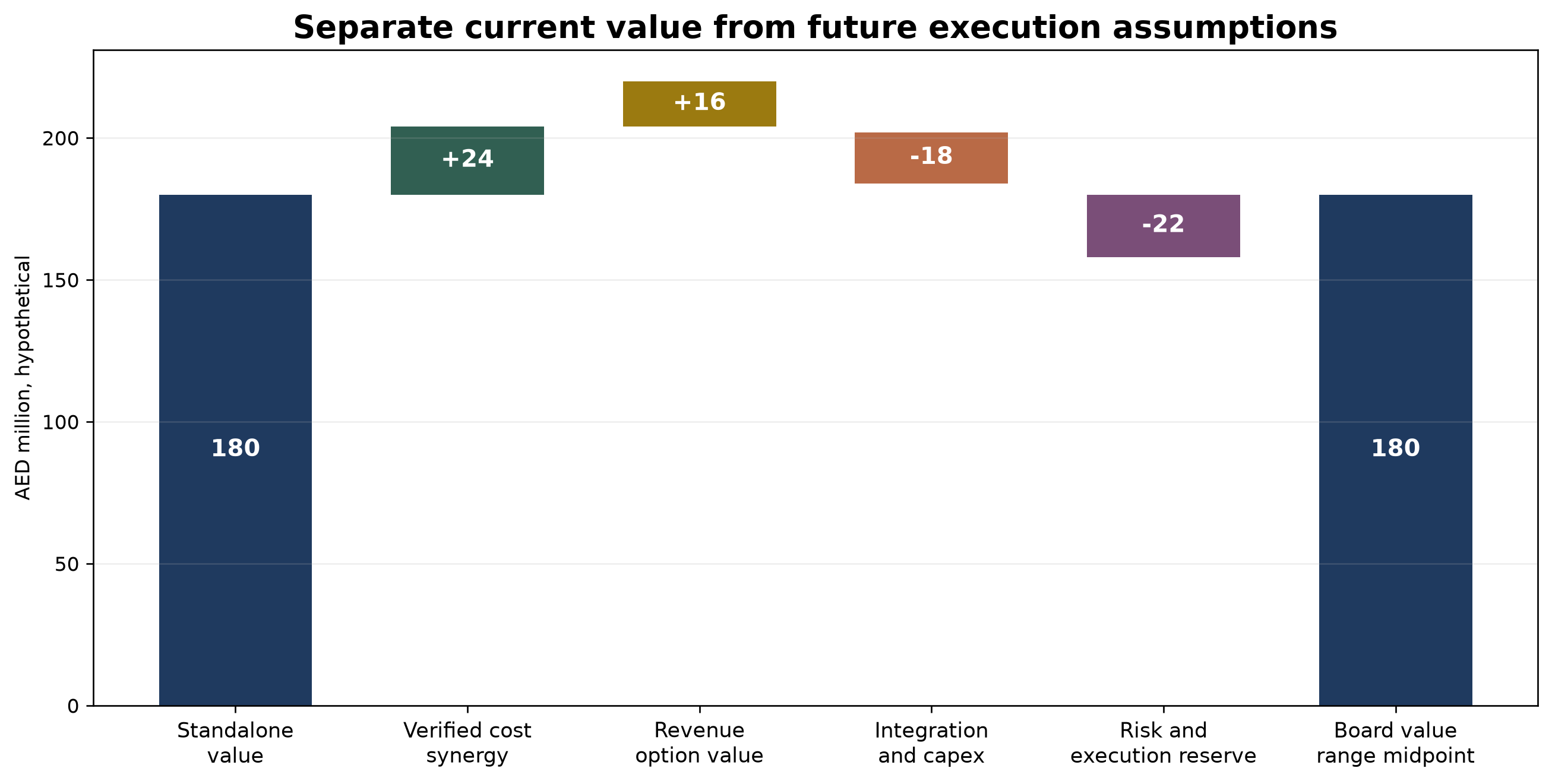
Illustrative amounts in AED millions. The example is not a valuation, forecast or client transaction.
Table 5. Board decision pack
| Section | Required content | Decision test |
|---|---|---|
| Thesis | Strategic problem, fit and alternatives | Does the opportunity advance approved strategy? |
| Target evidence | Ownership, performance, customers, capability and management | Which material facts are verified? |
| Value | Standalone range, synergies, costs, debt, tax and sensitivities | Is price supported under the base and downside cases? |
| Risk | Regulatory, compliance, commercial, operational and execution issues | Which risks can be avoided, reduced, transferred or accepted? |
| Funding | Sources, uses, covenants, liquidity and currency | Can the group fund the transaction and integration safely? |
| Integration | Owner, model, Day-One priorities and 100-day outcomes | Is management capacity real and funded? |
| Terms | Structure, protections, conditions and walk-away rules | Do terms allocate unresolved risks appropriately? |
| Recommendation | Decision requested, authority and next gate | Is the requested authority specific and recorded? |
The decision owner should see changes from the previous gate and the treatment of unresolved matters.
8. Connect diligence to integration
Diligence should answer the questions that determine value, terms and the ability to operate the business after completion. A generic data-room checklist can collect documents without resolving the buyer's thesis. The corporate-development office converts the thesis and preliminary risks into diligence questions, owners, evidence standards and decision consequences.
Commercial diligence tests the market, customer economics, competitive position, revenue quality and growth plan. Financial diligence tests earnings, cash conversion, working capital, debt-like items, capital expenditure and forecast assumptions. Operational diligence tests capacity, processes, supply, service, quality and resilience. Legal, tax, regulatory, technology, cyber, people, environmental and compliance workstreams address their respective risks. Qualified specialists should lead work requiring professional judgement.
Findings need a common issues register. Each issue records the fact, source, materiality, value effect, contractual treatment, remediation, integration action, owner and decision deadline. A red issue may change price, require a condition, create an indemnity request, trigger remediation or end the transaction. An unresolved issue should not disappear when the deal team changes phase.
Integration planning begins during diligence, subject to competition, confidentiality and contractual limits. The buyer identifies the future operating model, Day-One control requirements, leadership, people decisions, customer protections, cash and authority, systems, reporting and synergy actions. The integration leader should participate before signing and confirm the resources required to deliver the value case.
Table 6. From finding to action
| Diligence finding | Transaction response | Integration response | Board visibility |
|---|---|---|---|
| Customer concentration | Adjust value, earn-out, covenant or protection | Executive retention plan and account actions | Revenue sensitivity and owner |
| Control weakness | Condition, remediation covenant or specific protection | Control implementation and post-close audit | Residual risk and deadline |
| Founder dependency | Retention, transition, incentive or price mechanism | Authority transfer, succession and relationship handover | Departure downside |
| Technology debt | Price adjustment, warranty or planned investment | Architecture roadmap, cyber remediation and funding | Cost, timing and service risk |
| Working-capital volatility | Peg, completion mechanism or seasonal provision | Cash forecast and collection discipline | Liquidity requirement |
| Licence or approval | Condition precedent and long-stop treatment | Compliance calendar and accountable executive | Completion feasibility |
Pre-completion planning must follow applicable competition, confidentiality, privacy and transaction restrictions.
9. Design the retained-office operating model
The retained office needs a charter, service catalogue, governance, information model and review cycle. The charter defines the approved mandate, workstreams, authority, confidentiality, conflicts, use of external advisers, data handling, records, reporting and escalation. The service catalogue distinguishes recurring corporate-development work from transaction-specific execution.
Recurring work can include thesis maintenance, market mapping, target intelligence, stakeholder maps, relationship plans, pipeline reviews, preliminary screens, meeting preparation, decision logs and quarterly portfolio reviews. Transaction work can include project coordination, information-request management, valuation support, diligence integration, board materials, negotiation support and the integration handover, subject to the agreed role and regulatory perimeter.
The monthly cadence should fit the buyer's decision rhythm. A weekly working session can review contacts, evidence, actions and blockers. A monthly investment forum can review stage movement, preliminary value, management capacity and decisions. A quarterly session can test the thesis against strategy, capital availability and lessons from declined or completed opportunities.
The information architecture can be simple if it is disciplined. A controlled target register, relationship history, evidence library, stage-gate record, issues log, valuation archive, decision log and integration handover create institutional memory. Access should reflect confidentiality, competition constraints and data sensitivity. The system should preserve source, date, author and status for material claims.
Performance should measure quality and decision usefulness. Relevant indicators include coverage of the approved target universe, freshness of verified facts, priority relationships advanced, time to screen, stage-gate discipline, decisions made, management hours protected, due-diligence issues closed and integration actions handed over. Deal count and transaction value are outcomes influenced by market conditions and seller decisions; they are not sufficient measures of office quality.
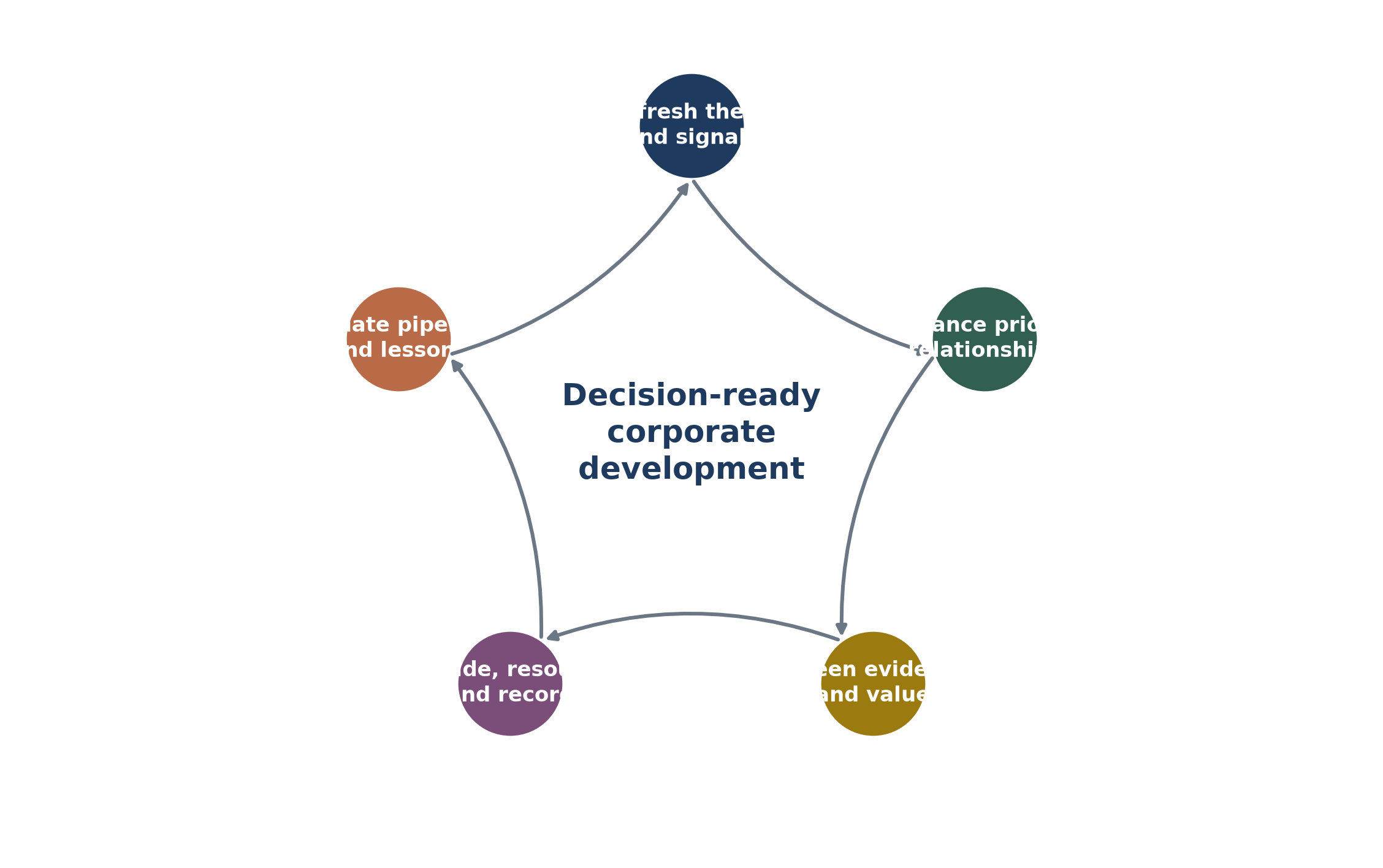
Matchpoint management framework. The cadence should follow the buyer's governance and transaction activity.
Table 7. Retained-office deliverables and boundaries
| Cadence | Core deliverable | Decision enabled | Boundary |
|---|---|---|---|
| Weekly | Action list, relationship movement and evidence gaps | Direct management attention | No unauthorised target contact or commitment |
| Monthly | Pipeline funnel, screens, preliminary ranges and capacity | Advance, nurture, pause or stop | Preliminary analysis is not a fairness opinion or audit |
| Quarterly | Thesis refresh, capital allocation and portfolio lessons | Renew or change mandate | Strategy remains a board and management responsibility |
| Transaction gate | Integrated decision paper and issues register | Approve diligence, offer, signing or completion | Specialists retain accountability for their advice |
| Post-signing | Integration handover and value-creation baseline | Fund owners, Day One and 100-day actions | Management owns implementation and results |
Commercial terms, professional responsibilities and regulated activities require a written engagement scope.
10. A hypothetical family-group case
The following case is hypothetical and does not describe a Matchpoint client, a real target or a forecast. A diversified GCC family group has operating businesses in business services, distribution and light industry. The board wants to acquire a technology-enabled service capability that can improve existing customer retention and create an external revenue line. The group has capital capacity, while its executives have limited time for continuous origination.
The retained office first turns the objective into two acquisition theses. Thesis A seeks a majority acquisition of a profitable regional platform with recurring contracts and an experienced management team. Thesis B seeks a smaller capability acquisition whose people and intellectual property could be embedded into an existing business. The board approves different capital ranges, control positions, integration models and risk tolerances for each thesis.
A market map identifies 120 organisations from public and authorised sources. Thirty-six meet the first strategic filters. Eighteen have credible ownership and activity evidence. Nine receive detailed profiles. Six are assigned relationship plans, and three owners agree to exploratory conversations. Agreement to speak is recorded separately from willingness to transact.
One platform proceeds under a confidentiality agreement. Preliminary information supports the customer and capability thesis but identifies customer concentration, founder dependency and a need for technology investment. The office builds a preliminary value range with a downside case, records all unverified assumptions, appoints specialist advisers and maps the issues into terms and integration actions. Competition counsel also screens the transaction under the relevant jurisdictions.
The board declines to make an early binding offer. It authorises a non-binding range subject to evidence on customer renewals, founder transition, cyber controls, technology cost and regulatory treatment. The decision preserves negotiating credibility and protects the group from committing value before the core thesis is tested. The opportunity can still fail, proceed at revised terms or produce a partnership instead of an acquisition.
The case shows the economic role of the retained office. The office does not create a seller or guarantee completion. It creates continuous coverage, quicker qualification, better use of management time, an auditable decision record and a bridge from strategic intent to executable work.
11. Economics of the retained model
A group should compare the retained model with the alternatives of an in-house team, ad hoc executive effort and transaction-only adviser appointments. The relevant costs include salaries, incentives, data, travel, systems, adviser fees, executive time, delayed decisions and opportunities pursued without adequate fit. Capability, confidentiality, volume and regulatory requirements affect the choice.
A retainer can cover a defined recurring capacity, cadence and deliverable set. Transaction-specific work can be separately scoped where effort, risk or specialist inputs change materially. Any success-linked compensation requires careful consideration of applicable regulation, conflicts, independence and the engagement's legal character. The written agreement should define compensation, expenses, termination, conflicts, confidentiality, records and ownership of work product.
The buyer should assess the office through controllable outputs and decision quality. A high-quality outcome can be a completed acquisition, a disciplined decline, an improved relationship, a partnership, a clarified build strategy or the removal of an unsuitable target. The office earns continuation through relevance, evidence, responsiveness and the quality of decisions it supports.
The retained model is most useful when the group has a genuine strategic mandate, decision-maker access, capacity to act and willingness to maintain a relationship programme. It is less suitable when the group lacks decision authority, funding visibility, management capacity or a defined strategic question. Those conditions should be resolved during mobilisation.
12. Mobilisation and first 100 days
Mobilisation begins with sponsor interviews, governance review, strategy and portfolio materials, capital parameters, prior target lists, relationship history and current opportunities. The office confirms its role, information access, conflicts process, target-contact protocol, reporting calendar and decision forums. Material gaps are documented.
During the first 30 days, the office prepares the mandate, thesis, screening scorecard, initial universe, priority criteria and information architecture. During days 31 to 60, it verifies priority profiles, prepares stakeholder maps, agrees relationship routes and runs the first monthly pipeline review. During days 61 to 100, it advances authorised relationships, produces full screens for qualified opportunities and presents a thesis refresh with evidence gaps and recommended decisions.
The timetable is a management template. Actual progress depends on the starting data, number of theses, target availability, internal approvals, market access and seller responses. A board should expect disciplined coverage and decision-ready evidence; it should not treat a 100-day programme as a promise of a signed transaction.
The first 100 days should leave the group with an operating capability: approved mandate, maintained target universe, prioritised relationships, stage-gate definitions, board calendar, adviser map, secure evidence library, decision log and integration bridge. These assets support subsequent transactions and make the group's strategy more executable.
13. Conclusion
Corporate development becomes repeatable when strategy, relationships, evidence and authority operate as one system. A retained office can provide that continuity for a family group or mid-market company that has acquisition ambition and decision capacity but does not need a full permanent team at the outset.
The system begins with an explicit mandate and acquisition thesis. It maintains a sourced target universe, develops relationships through authorised routes, qualifies opportunities through evidence-led gates and introduces regulatory, accounting, tax, compliance, financing and integration questions early. It gives the board comparable choices and preserves the record of why the group advanced, paused or declined an opportunity.
The commercial value of the model lies in persistent coverage, protected management time and stronger decisions. Completion, price and returns remain dependent on target facts, seller decisions, market conditions, professional advice, financing, approvals, negotiation and implementation. The retained office provides the management infrastructure through which those uncertainties can be handled with discipline.
References
- [1] United Arab Emirates Ministry of Economy and Tourism, Federal Decree-Law No. 36 of 2023 on the Regulation of Competition, https://www.moet.gov.ae/en/regulation-of-competition
- [2] United Arab Emirates Cabinet, Cabinet Decision No. 3 of 2025 on thresholds related to the implementation of Federal Decree-Law No. 36 of 2023, https://www.moet.gov.ae/documents/20121/0/Cabinet%2BDecision%2BNo.%2B%283%29%2Bof%2B2025%2BOn%2Bthe%2BThresholds%2BRelated%2Bto%2Bthe%2BImplementation%2Bof%2BFederal%2BDecree-Law%2BNo.%2B%2836%29%2Bof%2B2023%2BRegulati.pdf/0f228724-8dd5-9b9c-0ed8-0b94d5ae0873
- [3] United Arab Emirates Ministry of Economy and Tourism, Ministry reviews Cabinet Resolution on competition thresholds, 20 February 2025, https://www.moet.gov.ae/en/-/ministry-of-economy-reviews-cabinet-resolution-on%C2%A0thresholds-and-controls-associated-with-competition-law-and-its-role-in-enhancing-oversight-of-economic-concentration-transactions-in-the-country
- [4] General Authority for Competition, Kingdom of Saudi Arabia, Economic Concentration Review Guidelines, 2025, https://gacbep.gac.gov.sa/cms/b9376edc-79a1-4573-a36d-4f3effaba838.pdf
- [5] IFRS Foundation, IFRS 3 Business Combinations, https://www.ifrs.org/issued-standards/list-of-standards/ifrs-3-business-combinations/
- [6] IFRS Foundation, IASB Update May 2025: Business Combinations, Disclosures, Goodwill and Impairment, https://www.ifrs.org/news-and-events/updates/iasb/2025/iasb-update-may-2025/
- [7] United Arab Emirates Federal Tax Authority, Business Restructuring Relief, CTGBRR1, https://tax.gov.ae/en/content/business.restructuring.relief.aspx
- [8] United States Department of Justice, Criminal Division, Evaluation of Corporate Compliance Programs, updated September 2024, https://www.justice.gov/criminal/criminal-fraud/page/file/937501/dl
- [9] United States Securities and Exchange Commission, Financial Disclosures about Acquired and Disposed Businesses, https://www.sec.gov/resources-small-businesses/small-business-compliance-guides/financial-disclosures-about-acquired-disposed-businesses
About the Author
Chennakeshav Adya, Independent Researcher
Appendix A: Monthly corporate-development review agenda
- Confirm approved thesis, changes in strategic priorities and available management capacity.
- Review the target universe, source freshness and material new signals.
- Review priority relationships, authorised contacts, statements and next actions.
- Test stage movements against entry evidence and decision authority.
- Review preliminary value ranges, sensitivities and unverified assumptions.
- Review competition, regulatory, tax, accounting, compliance and financing questions.
- Review diligence issues and their transaction, integration and board consequences.
- Confirm decisions, owners, deadlines, records and external adviser requirements.
- Archive or nurture targets that do not justify current management attention.
Appendix B: Target-screen minimum evidence checklist
- Legal name, ownership, jurisdiction, principal activities and source dates.
- Strategic thesis served and the specific capability or market position sought.
- Product, customer, channel, geography and competitive-position evidence.
- Reported or estimated revenue, earnings, cash conversion, capital needs and debt.
- Management, founder, key-person and succession dependencies.
- Licences, sector rules, competition questions and change-of-control considerations.
- Tax, accounting, compliance, litigation, sanctions, cyber and data questions.
- Preliminary value range with source status and sensitivity.
- Integration model, accountable executive, Day-One needs and 100-day priorities.
- Relationship route, authorised contacts, confidentiality and willingness status.
- Recommendation, next gate, required evidence, owner and decision date.
