

1. Treat tax status as a governed consequence
A foundation is established to carry a purpose across time. That purpose may include family stewardship, succession, asset protection, philanthropy, disciplined investment and continuity of decision-making. Corporate-tax treatment is one consequence of the chosen legal and operating design. A board that starts with the desired tax result can overlook the rights, activities and evidence that determine whether the result is available and sustainable.
Article 17 of the UAE Corporate Tax Law allows an eligible Family Foundation that is a juridical person to apply to the Federal Tax Authority, or FTA, to be treated as an Unincorporated Partnership for Corporate Tax purposes [1, 3]. Approval makes the arrangement fiscally transparent in the UAE; the foundation is not taxed in its own right and the beneficiaries are treated as directly owning or benefiting from its assets and activities. An unincorporated trust or similar contractual arrangement may already be transparent by default, subject to its facts and the law [1]. Legal personality and fiscal treatment must therefore be classified separately.
The decision has a lifecycle. The board should first confirm why the arrangement exists, who can benefit, what it may do, which entities it owns, what assets it will receive and where relevant persons reside. Advisers can then test eligibility, model beneficiary-level consequences, prepare the evidence file and decide the requested effective period. After approval, the same facts require continuing surveillance and annual confirmation. A material change can alter treatment from the beginning of the tax period in which a condition fails [1].
This approach creates a clear decision standard. The board approves an application when the legal documents, actual conduct, entity chain, beneficiary register, activity perimeter and cross-border review agree. Open items appear in a signed exception register with owners and due dates. The application becomes the recorded output of a controlled process, supported by evidence that can be reproduced if the FTA, a bank, an auditor or a foreign authority asks how the conclusion was reached.
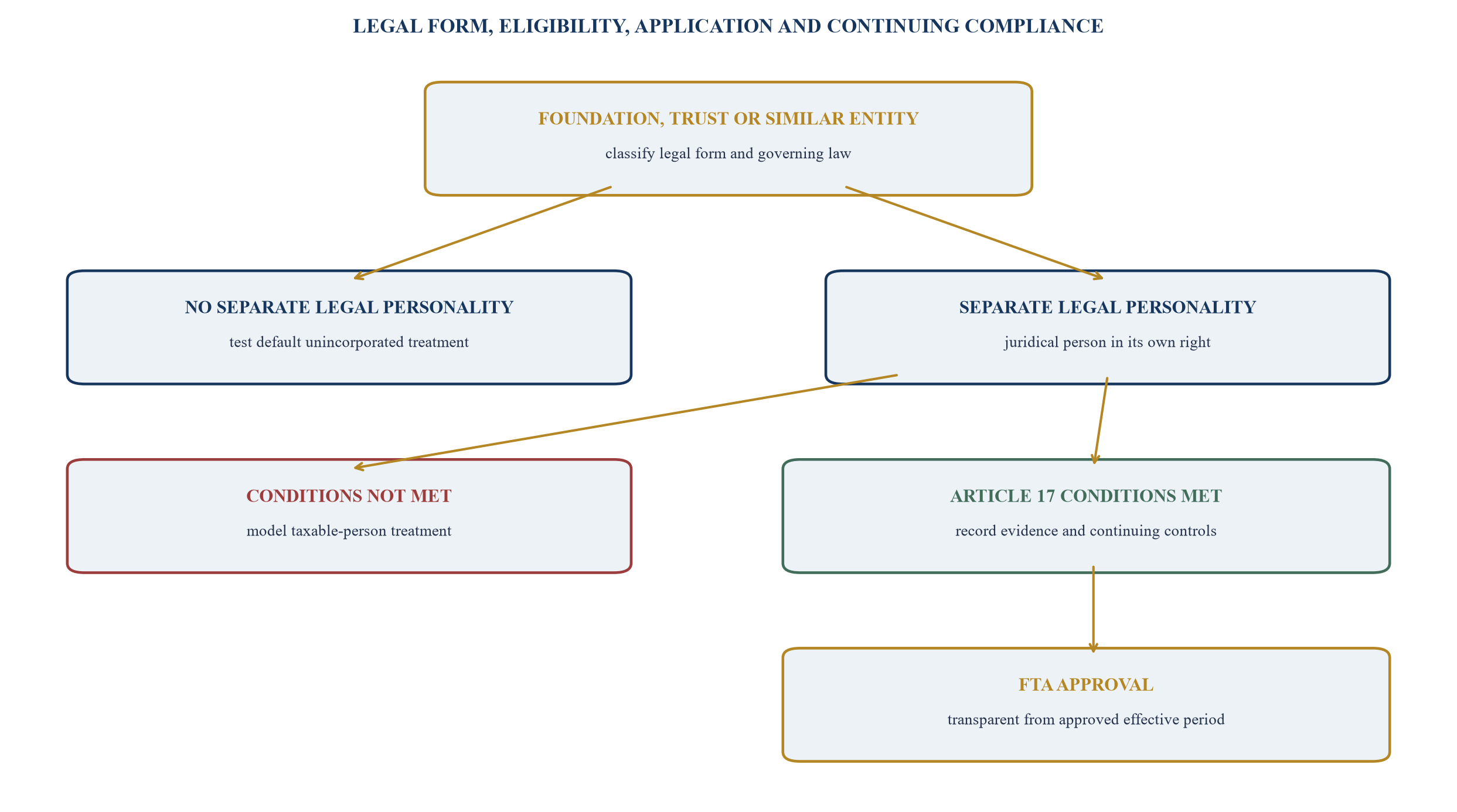
The tree is a decision aid. Classification and eligibility require professional advice on the arrangement's facts and governing law.
2. Separate legal architecture from tax classification
The legal architecture answers who owns property, who manages it, who can amend the charter and who may receive benefits. The tax classification answers who is treated as earning income and incurring expenditure. These maps can overlap without being identical. A foundation established under a regime with separate legal personality may be a juridical person and a Taxable Person unless an Article 17 application is approved. A contractual trust without separate legal personality may be treated as an Unincorporated Partnership by default [1, 2].
The classification file should begin with primary documents: charter, by-laws, regulations, trust deed, registry extract, council appointments, guardian or protector terms, founder-reserved powers and any side letters. It should identify the governing law and the actual rights created. ADGM, DIFC and RAK ICC each provide foundation regimes with their own formation and governance requirements [13, 15, 17]. Registration in a recognised jurisdiction does not determine the UAE Corporate Tax outcome by itself.
The foundation should also be distinguished from every company, partnership, special-purpose vehicle and family-office entity around it. A limited liability company is not a similar entity for the Article 17 Family Foundation concept described by the FTA [1]. A holding company beneath a foundation remains a separate juridical person unless it independently satisfies the multi-tier conditions and receives any required approval. A service company earns fees for activities; it should not be collapsed into the foundation merely because the same family controls both.
The board can use a classification memorandum with four signed conclusions: legal personality, UAE tax residence or nexus, default Corporate Tax status, and eligibility path. Each conclusion should cite the document and legal provision on which it relies. Unknowns should remain open. A document-based perimeter prevents a diagram prepared for banking, succession or marketing from becoming an unsupported tax record.
Table 1. Legal-form and tax-classification matrix
| Arrangement | Separate legal personality | Initial UAE Corporate Tax question | Transparency route | Board evidence |
|---|---|---|---|---|
| incorporated foundation | generally yes under its formation law | resident or non-resident juridical person; scope and registration | Article 17 application if all conditions are met | charter, registry extract, council powers and beneficiary rules |
| unincorporated trust | generally no; confirm governing law | whether it is an Unincorporated Partnership by default | default treatment, with Family Foundation status tested for multi-tier use | trust deed, trustee powers and legal opinion |
| similar contractual entity | fact-specific | whether legal character resembles a foundation or trust | default or application route based on personality | governing instrument and classification opinion |
| limited liability company | yes | Taxable Person in its own right | unavailable as a similar entity solely under Article 17 | licence, constitutional records and tax analysis |
| wholly owned special-purpose vehicle | yes | separate Taxable Person unless an approved route applies | entity-by-entity multi-tier application | ownership, control, purpose and activity evidence |
| family-office service company | yes | income and expenses of operating service business | ordinary taxable or qualifying free-zone analysis | service agreements, staff, licence and transfer-pricing file |
The matrix summarises possible analytical paths. Treatment depends on the governing documents, activities, residence, applicable law and FTA approval.
3. Define purpose before beneficiary and asset design
Purpose governs the rest of the structure. The charter should explain the family outcomes the arrangement is expected to serve and the principles that constrain decision-making. Examples include preserving a long-term pool, financing education, supporting vulnerable beneficiaries, maintaining strategic holdings, providing emergency liquidity and making defined public-benefit distributions. The wording should be specific enough to guide conduct and broad enough to remain workable as family circumstances evolve.
The FTA's principal-activity condition focuses on receiving, holding, investing, disbursing or otherwise managing assets or funds associated with savings and investments [1]. That perimeter supports investing in securities, real estate and other assets and paying costs consistent with the foundation's objectives. The actual pattern of activity matters. A purpose statement cannot convert an operating trade into passive family-wealth administration.
Governance should translate purpose into an asset-admissibility policy. The policy can distinguish directly held investment assets, operating companies held through subsidiaries, licensed businesses, property investments, personal-use assets, venture investments, loans, guarantees and philanthropic pools. For each category it should name the approved holding entity, decision authority, reporting standard and tax review trigger. The board can then test a proposed acquisition before the foundation signs, rather than after the activity has created uncertainty.
Purpose also supports the no-tax-avoidance condition. The FTA guide states that applying for transparent treatment does not by itself establish a tax-avoidance purpose; the arrangement should be used for the purposes contemplated by the law [1]. The decision file should record the non-tax objectives, alternatives considered, reasons for the chosen jurisdiction and expected governance benefits. Tax consequences remain part of the analysis, presented beside succession, control, cost, privacy, reporting and operational factors.
4. Build a beneficiary register that can operate
The beneficiary condition can be met where the arrangement benefits identified or identifiable natural persons, public benefit entities, or both [1, 3]. An identified beneficiary is named in official documentation. An identifiable beneficiary may belong to a defined class, such as a settlor's children or grandchildren, including persons not yet born. The Corporate Tax Law does not prescribe a minimum or maximum number of beneficiaries or require them to belong to one family [1].
A workable register needs more than names. It should record the beneficiary category, legal basis for inclusion, date of entry or exit, residence, tax-identification information where appropriate, relationship to the founder, distribution rights, discretionary status, restrictions, contact channel and documentary evidence. Sensitive information requires access controls and retention rules. The council should receive a governance view; tax and compliance teams may need a more detailed controlled record.
Direct and indirect beneficiaries should be mapped through any transparent intermediate entities. Public benefit entities require additional analysis because the distribution condition can apply. The decision file should identify whether income attributed to such a beneficiary would be Taxable Income if earned directly or whether relevant income must be distributed within six months after the end of the tax period [1, 4]. A calendar, liquidity reserve and approval path should support that deadline.
Changes to beneficiary classes require a formal pre-clearance process. A marriage, birth, death, migration, charitable nomination or exercise of founder-reserved power can affect tax, sanctions, reporting and governance. The foundation should assign one record owner, require supporting documentation, run jurisdictional review and update the beneficial-ownership and reporting files. The same controlled event should reach banks, administrators and advisers, reducing inconsistent records across institutions.
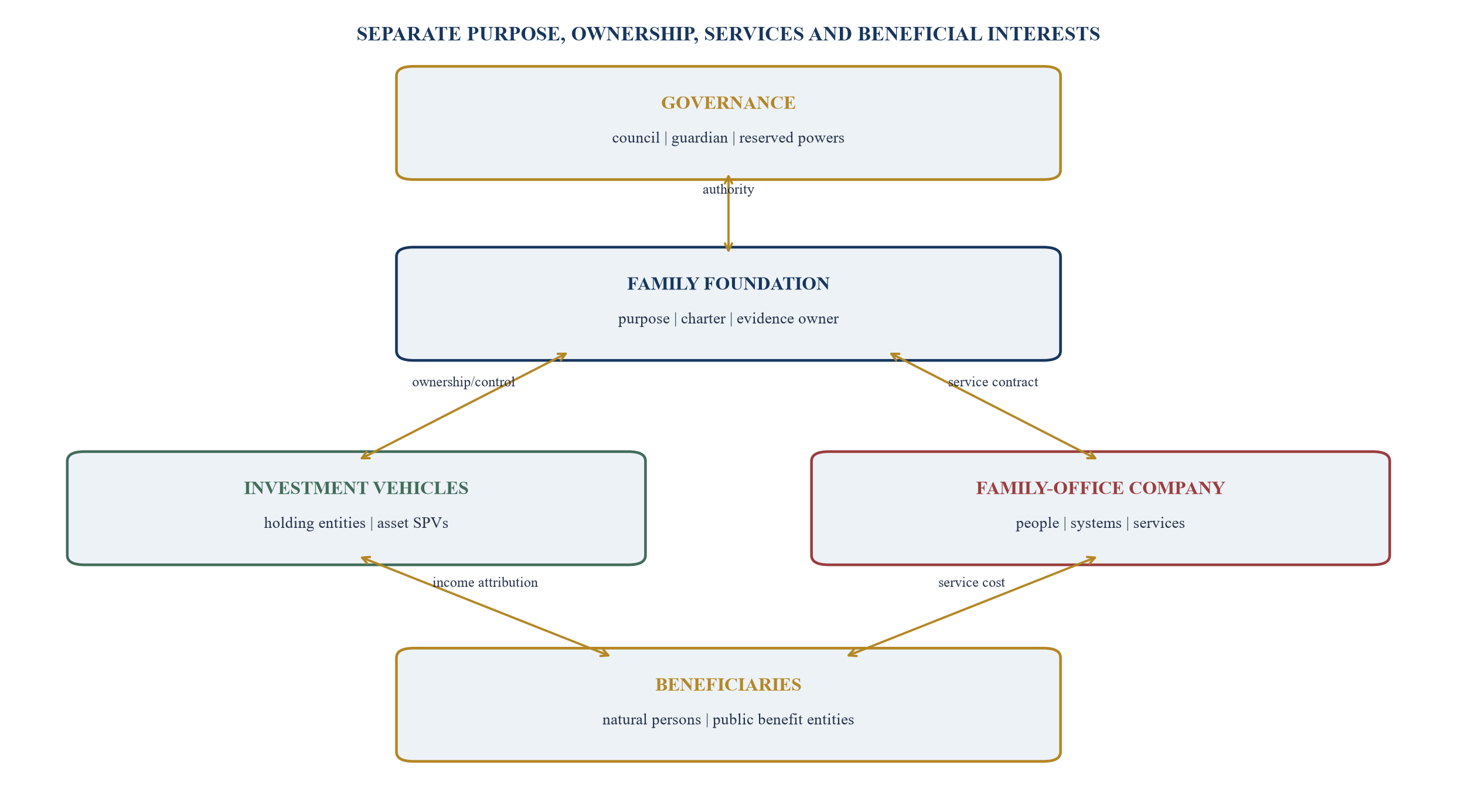
Ownership, control and beneficiary links must be supported by governing documents. The diagram does not prescribe a legal structure.
5. Convert the Article 17 conditions into controls
Eligibility requires all applicable conditions to be met. The foundation must serve the permitted beneficiary population; its principal activity must concern savings and investment assets; it must not conduct an activity that would constitute a Business or Business Activity if undertaken by the relevant natural person; its main purpose must not be Corporate Tax avoidance; and it must meet an additional distribution condition when public benefit entities are beneficiaries [1, 3, 4].
The board should assign each condition an evidence owner and a recurring test. Legal or secretarial staff can own the beneficiary register and constitutional record. The investment or finance lead can reconcile actual assets, income and transactions to the permitted activity perimeter. The tax adviser can review business-activity indicators, purpose and beneficiary-level consequences. Treasury can monitor public-benefit distributions. The council retains responsibility for accepting exceptions and approving remedial action.
The no-Business-Activity test deserves transaction-level discipline. The FTA guide contrasts passive residential leasing that does not require a licence with operating a motel that would require one [1]. Similar boundaries can arise where the foundation provides services, develops property, employs operating staff, trades systematically or assumes customer obligations. The governing documents, licences, contracts, invoices, people and conduct should tell the same story.
The controls should operate before acquisitions, restructurings and new activities. A pre-transaction form can ask which entity will contract, whether a licence is required, whether employees or premises are needed, who bears commercial risk, how income will be characterised and whether the activity remains consistent with principal purpose. A red flag pauses execution for specialist review. This protects the intended perimeter through action rather than annual retrospective explanation.
Table 2. Article 17 condition, evidence and operating control
| Condition | Evidence at application | Continuing control | Event trigger | Accountable owner |
|---|---|---|---|---|
| permitted beneficiaries | charter, by-laws and dated beneficiary register | quarterly register certification | person or class added, removed or migrated | foundation secretary |
| principal activity | asset register, investment policy and transaction history | monthly activity-perimeter review | new asset class, contract or revenue stream | investment director |
| no Business Activity | licence review, contracts, staffing and operating facts | pre-transaction business-activity screen | employees, customers, licence or active operation | tax lead and general counsel |
| no tax avoidance purpose | board rationale, alternatives and non-tax objectives | annual purpose and conduct confirmation | restructuring driven by new tax result | council chair |
| public-benefit distribution | beneficiary tax analysis and distribution policy | income allocation and deadline calendar | taxable income attributed to public-benefit beneficiary | finance director |
| evidence integrity | indexed source pack and signed conclusions | monthly exceptions and document-expiry review | missing, conflicting or expired evidence | compliance lead |
Control frequency and escalation thresholds are hypothetical management assumptions and should be approved for the actual structure.
6. Keep operating businesses outside the foundation's activity perimeter
A family may want the foundation to own operating businesses while keeping the foundation itself focused on holding and stewardship. That distinction requires legal and operational separation. The subsidiary contracts with customers, employs people, holds operating licences, owns business assets, bears commercial risks and keeps its own records. The foundation exercises shareholder and governance rights without directly carrying on the subsidiary's trade.
The entity map should identify where each function occurs. Investment oversight, director appointment, dividend decisions and reserved shareholder matters may sit with the foundation or council. Product delivery, procurement, sales, payroll, financing and regulatory obligations remain with operating entities. Shared resources require written agreements, appropriate approvals and arm's-length pricing where the Corporate Tax rules apply [5]. Informal movement of costs and staff can blur the activity boundary.
Direct property deserves a tailored test. Holding and leasing property may fall within Real Estate Investment activity for a natural person where the activity is not conducted, or required to be conducted, through a licence [1, 6]. Development, hospitality, serviced accommodation or property management can carry different facts. The foundation should not rely on the label “real estate investment.” It should document contracts, services, licensing, risk, staff and actual conduct for each asset.
The operating-company boundary also improves financing and valuation. Lenders can underwrite cash flows and security in the entity that produces them. Directors can manage solvency and distributions under the correct law. A sale process can separate a portfolio company from family governance. The foundation retains evidence of share ownership, acquisition cost, distributions and shareholder actions while the company maintains its operating tax, accounting and regulatory files.
7. Design multi-tier transparency entity by entity
Multi-tier structures can place holding companies or special-purpose vehicles beneath a Family Foundation. The FTA guide permits a juridical person to apply for transparent treatment when it is wholly owned and controlled, directly or indirectly, by a Family Foundation that is treated as an Unincorporated Partnership and when the relevant conditions are met [1, 4]. Each entity's eligibility is determined separately.
Indirect ownership and control must pass through an uninterrupted chain of entities that are themselves fiscally transparent under the Corporate Tax Law [1]. One opaque or ineligible entity can interrupt the route for entities below it. The board should therefore avoid treating the group chart as one election. It needs an entity register with legal personality, ownership, control, activities, beneficiaries served, registration status, application status, effective period and continuing-control result for every tier.
The application sequence matters. A lower entity may depend on approval of the tier above it. Every juridical person requires a Tax Registration Number before an application for transparent treatment [1]. The project plan should identify dependencies and avoid assuming that all entities share one effective date. The financial model needs a base case for approval timing and a contingency case in which one or more entities remain taxable.
The board should also test whether transparency is desirable for each vehicle. A holding company may have exemptions, losses, financing or jurisdictional attributes that deserve separate modelling. Foreign jurisdictions may classify the same vehicle differently. Administrative simplicity in the UAE can create reporting complexity elsewhere. Entity-by-entity analysis makes those trade-offs visible before documents and asset transfers are executed.
Table 3. Multi-tier entity architecture and control record
| Tier | Legal role | UAE treatment question | Required dependency | Core control record |
|---|---|---|---|---|
| family foundation | purpose and top-level ownership | default taxable status or approved transparency | Article 17 conditions and FTA process | charter, beneficiaries, assets, activities and approval |
| holding vehicle | shares, financing or central ownership | separate taxable person or eligible transparent tier | wholly owned and controlled by approved transparent parent | ownership chain, board rights and activity screen |
| asset special-purpose vehicle | ring-fenced property or investment | entity-specific tax status and income treatment | uninterrupted transparent chain if applying | title, contracts, licence test and cost base |
| operating company | trade, staff and customer contracts | ordinary Corporate Tax and possible reliefs | operational separation from foundation | licences, payroll, books and intercompany agreements |
| family-office company | governance support and investment services | taxable service income; free-zone analysis where relevant | regulatory status and arm's-length remuneration | service catalogue, pricing, people and substance |
| foreign vehicle | non-UAE ownership or investment layer | UAE nexus plus foreign classification | evidence from formation jurisdiction | foreign legal opinion, residence and filing map |
The entries are illustrative and do not express the treatment of any actual arrangement.
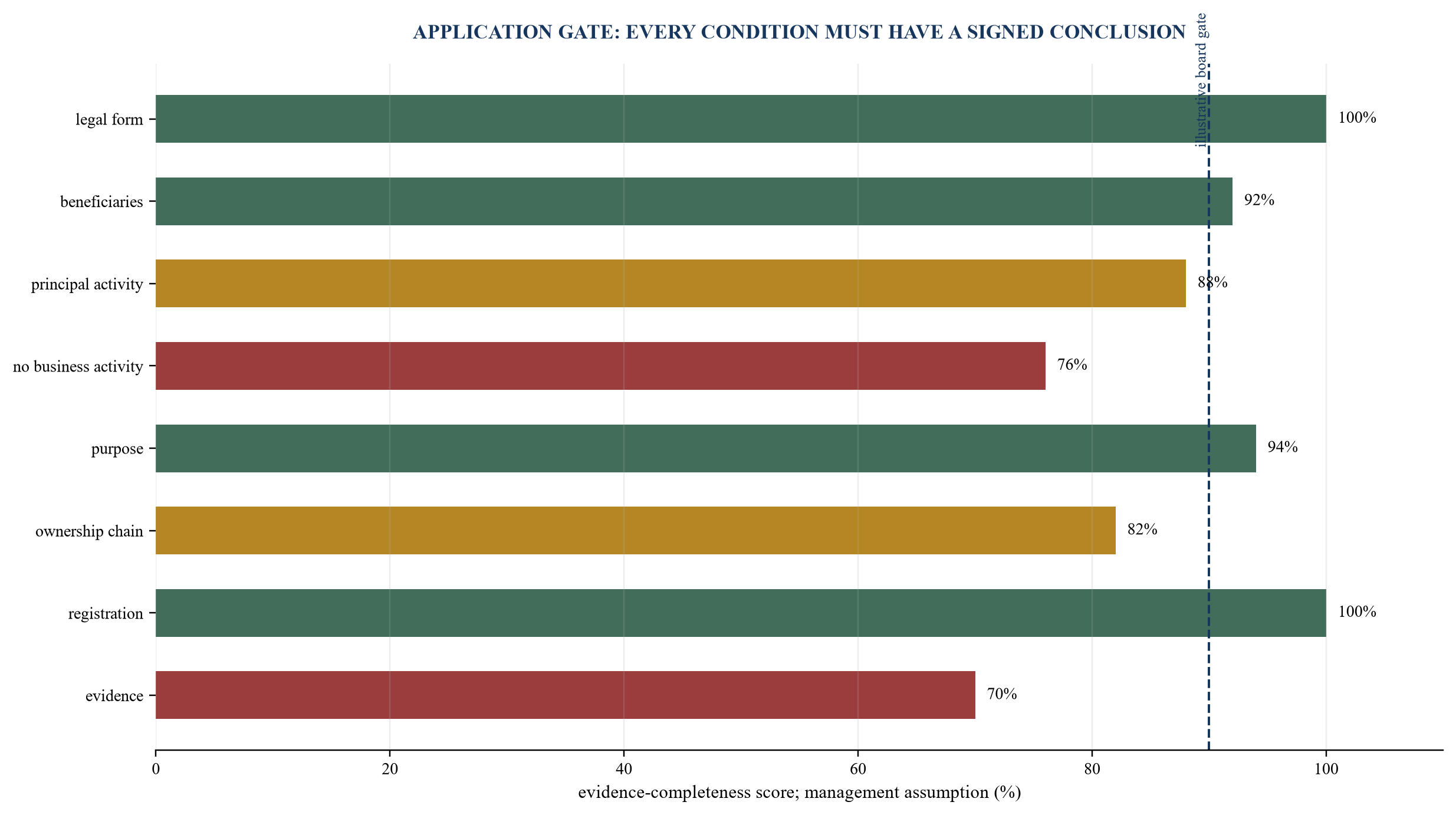
Scores are hypothetical management assumptions for governance. They do not determine legal eligibility or FTA approval.
8. Assemble an evidence file before applying
An application should be reproducible from one indexed evidence file. The file begins with a signed decision memorandum and includes the legal-form analysis, constitutional documents, beneficiary register, purpose statement, entity chart, ownership and control proof, asset and activity register, licences, material contracts, tax registrations, financial information and adviser conclusions. Each item should have a source, date, owner, version and review status.
Evidence quality matters more than volume. A registry extract supports formation and current officers; it may not establish beneficial interests or actual conduct. A charter supports powers and classes; it may not show how assets were used. Financial records show income and expenditure; they may not explain whether an activity required a licence. The conclusion matrix should connect each legal condition to more than one relevant source and explain any inconsistency.
The board should maintain a list of statements made in the application and the evidence behind each statement. This creates a practical representation register. If the application identifies a beneficiary class, an activity or an ownership chain, the register names the supporting document and control that keeps the statement current. A change to the underlying fact then becomes a compliance event rather than a silent divergence.
Document governance should include access permissions, confidentiality, retention, legal privilege where applicable, data residency and secure adviser exchange. Personal and tax information should be limited to those who need it. The UAE Personal Data Protection Law and applicable financial-centre data-protection regimes require professional analysis for the actual processing model [20, 21, 22]. The tax file and the broad family portal need separate permission designs.
9. Control registration, application and effective period
A juridical person wishing to apply for transparent treatment must first register for Corporate Tax and obtain a Tax Registration Number [1, 7]. Each eligible juridical person in a multi-tier structure should be registered separately before its application. The board's project plan should make registration a formal gate, reconcile registered details to legal records and retain submission and approval evidence.
The FTA guide states that a Family Foundation application is made before the end of the relevant tax period. The application identifies the current tax period or the next tax period as the requested period, and approved treatment begins from the commencement of the specified period or another date determined by the FTA [1]. Historic transition provisions require advice on the period concerned. The operating team should use current EmaraTax instructions and confirm deadlines for the actual facts [8].
The application should be preceded by a close-quality trial. The finance team can produce the beneficiary attribution, expense allocation, asset roll-forward, related-party schedule and confirmation checklist for a sample period. A trial exposes missing acquisition costs, inconsistent beneficiary records, opaque entities and service charges before they affect a filing. It also estimates the recurring effort required after approval.
Approval evidence should be recorded in the tax calendar, entity master and accounting instructions. Banks, administrators and advisers receive only the information required for their role. The board should avoid describing the structure as transparent before the approval and effective period are confirmed. The contingency model remains active until the outcome is documented.
10. Model taxable and transparent outcomes side by side
The board needs a decision model that explains cash tax, compliance, control and cross-border consequences under more than one classification. The transparent case attributes assets, income and expenditure to beneficiaries for UAE Corporate Tax purposes. The taxable-person case calculates the foundation's own taxable income, exemptions, deductions and filing obligations. A third case may retain some subsidiaries as taxable entities while the foundation and selected holding tiers are transparent.
The model should be built by income stream and beneficiary. Dividends, interest, gains, rental income, operating income and foreign income may have different treatment. Exempt-income provisions and participation-exemption conditions are assessed at the relevant person and on the facts [1, 3, 9]. Foreign tax credits are limited by applicable rules. The model should show gross income, directly attributable expenses, shared expenses, exemptions, foreign tax and estimated UAE liability without assuming every beneficiary has the same status.
Compliance costs belong in the decision. Registration, application, annual confirmation, attribution schedules, accounting, transfer-pricing support, foreign filings and adviser review can be material even when the UAE cash-tax result is low. Governance benefits also belong in the analysis: a clear entity map, beneficiary record and activity perimeter can reduce operational ambiguity. These items should be shown separately from tax savings.
All case numbers should be labelled as management assumptions until supported by verified records. Sensitivities can vary approval date, beneficiary residence, income mix, asset sale, public-benefit allocation, operating activity and foreign classification. The board then understands which facts drive the outcome and which controls deserve the most attention.
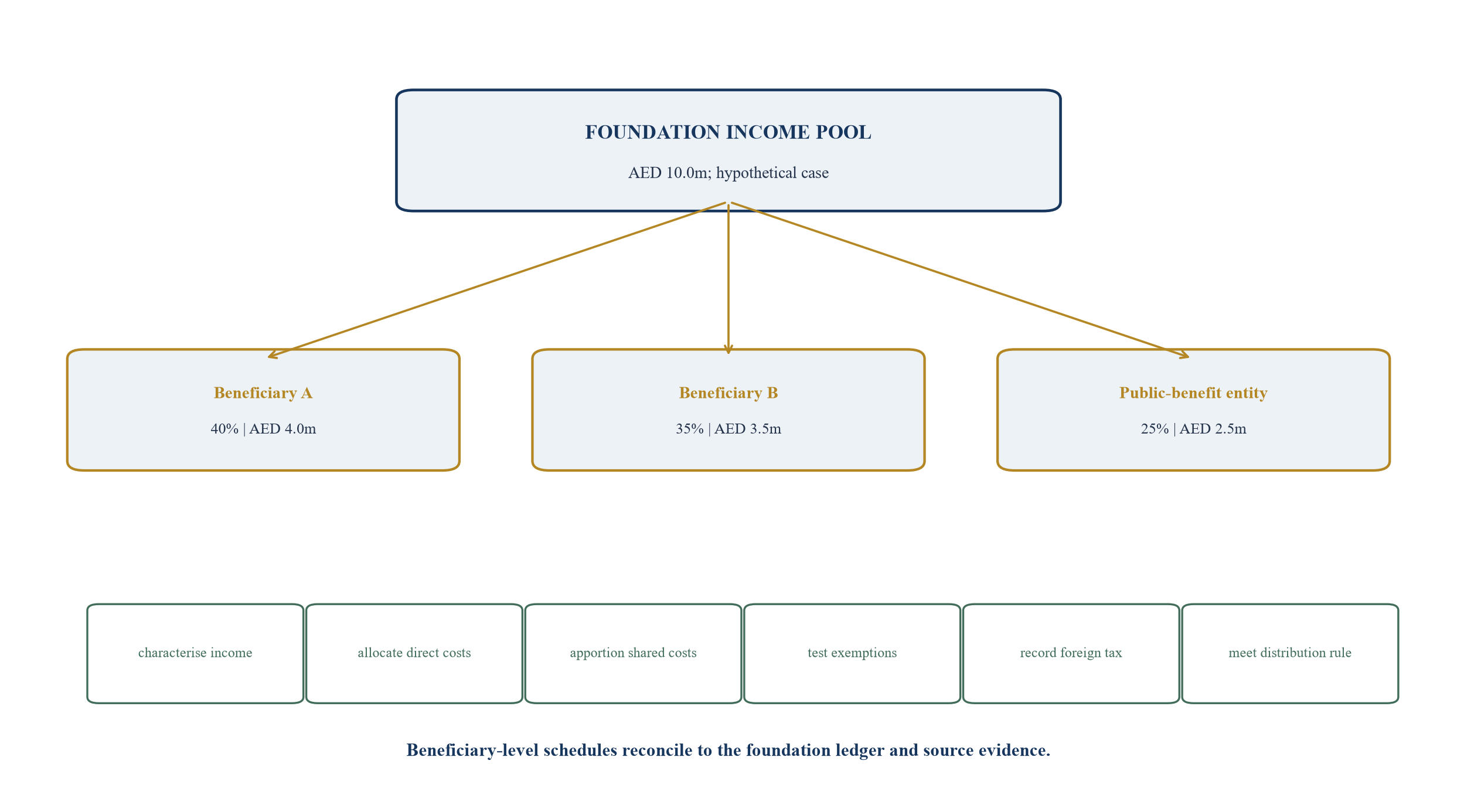
Percentages and amounts are hypothetical management assumptions. Actual attribution and tax treatment require verified beneficiary interests, income character and professional advice.
11. Attribute income and expenditure at beneficiary level
Fiscal transparency moves the analytical burden to the beneficiaries. The foundation needs a ledger and tax-support schedule that identify each item of income, expense, asset, liability, gain and loss and the beneficiary to whom it is attributed. The method should follow legal entitlements and applicable tax rules. A discretionary arrangement may require more analysis than a fixed-interest structure.
The schedule should retain source currency, transaction date, payer, income character, asset identifier, acquisition cost, foreign tax and supporting document. Expenses should be linked to the income or activity they support. Shared governance and administration costs need a documented allocation basis. The FTA guide states that deductible expenditure is considered in determining any beneficiary's Taxable Income, subject to the Corporate Tax Law [1].
Natural-person beneficiaries require an activity analysis. Wages, Personal Investment income and qualifying Real Estate Investment income are outside the scope of Corporate Tax as Business or Business Activity for a natural person under the cited rules [1, 6]. A beneficiary conducting a separate UAE business can have different registration and tax consequences. Public-benefit and juridical-person beneficiaries also require their own status analysis.
The foundation should issue a controlled annual tax pack to each beneficiary or authorised adviser. It can include attributed income by category, expenses, transactions, foreign tax, distributions, opening and closing interests, and relevant foundation approvals. The pack should state its purpose, period, assumptions and limitations. Recipient confirmation and correction workflows reduce the risk that different advisers use inconsistent numbers.
12. Govern contributions, transfers and distributions
Asset transfers create legal, tax, valuation and operational events. Before a founder or related party contributes cash, shares, property, loans or other assets, the foundation should verify title, restrictions, acquisition cost, market value where relevant, liabilities, tax residence, sanctions and reporting obligations. The receiving entity, transfer instrument and effective date should agree across legal and accounting records.
The FTA guide states that transfers by a Related Party should meet the arm's-length standard and that the tax result depends on the transferor's facts, including whether the transferor is a Taxable Person [1, 5]. A natural person's transfer of Personal Investments or qualifying Real Estate Investments may have different UAE Corporate Tax treatment. Other taxes, duties and foreign consequences require separate analysis.
Distribution governance should start with the charter and beneficiary rights. The council should record the purpose, recipient, amount, asset, valuation, approval and source of funds. Finance should distinguish distributions from loans, reimbursements, service payments and related-party transactions. Public-benefit distributions subject to the six-month condition require a dedicated calendar and liquidity reserve [1, 4].
In-kind distributions require extra control. The board should obtain title and valuation support, assess restrictions and financing, confirm beneficiary acceptance and consider whether the asset's tax attributes transfer or remain relevant. Every distribution updates the beneficiary ledger, beneficial-ownership record, liquidity forecast and cross-border reporting map. A closing checklist prevents a signed resolution from being treated as completed before title and cash movement are verified.
Table 4. Contribution and distribution decision file
| Decision | Minimum evidence | Tax-support question | Execution control | Close evidence |
|---|---|---|---|---|
| contribute cash | bank source, ownership and purpose | transferor status and source of funds | approved receiving account and dual authorisation | bank confirmation and ledger entry |
| contribute shares | title, restrictions, cost and valuation | arm's-length standard, gain and exemption analysis | executed instrument and register update | ownership confirmation and tax basis record |
| contribute property | title, debt, use, licence and valuation | transferor status, duties and activity classification | legal completion and lender consent | registry record and opening balance |
| distribute cash | beneficiary entitlement and resolution | attribution, public-benefit deadline and foreign reporting | liquidity and sanctions checks | payment confirmation and beneficiary statement |
| distribute an asset | entitlement, title and current valuation | disposal, basis and foreign consequences | transfer documents and acceptance | updated registers and reconciled ledger |
| make a beneficiary loan | charter power, terms and purpose | related-party and market-term analysis | signed agreement and repayment schedule | balance confirmation and ongoing monitoring |
The checklist is an operating framework. Legal documents, valuations and tax conclusions must be prepared for the actual transaction.
13. Separate the family office and price its services
A family office can employ staff, select advisers, consolidate information, manage investments and administer governance. Those are service activities. The FTA guide observes that a single- or multi-family office is unlikely to satisfy the no-Business-Activity condition where it conducts such a business; a resident family-office company is subject to Corporate Tax on its income and should be remunerated at arm's length for services to Related Parties and Connected Persons [1, 2, 5].
The structure should therefore separate asset ownership from service delivery. A written service catalogue identifies strategy, investment administration, accounting, tax coordination, legal operations, philanthropy, property support and personal services. Each service has a recipient, people, systems, cost pool, pricing method and decision rights. The foundation pays only for services it receives and can evidence.
Free-zone treatment requires its own analysis. The FTA guide notes that qualifying wealth, investment-management or fund-management services may benefit from the zero per cent rate on Qualifying Income when the relevant conditions, including regulatory oversight by a competent UAE authority, are met [1, 10]. A licence without the required regulatory oversight does not establish that result. The family office should avoid presenting a free-zone address as a tax conclusion.
Transfer-pricing governance should include intercompany agreements, functional analysis, cost allocation, comparables where needed, invoicing and periodic true-ups. The allocation should exclude shareholder or personal costs that do not benefit the foundation. A board dashboard can show service cost by category, pricing method, unpaid balances and evidence status. This makes the service boundary visible and supports both tax and operating discipline.
14. Protect residence, nexus and permanent-establishment positions
Foundation design crosses several residence concepts. The foundation, subsidiaries, council members, founder, beneficiaries, family-office company and investment managers can each have a different tax residence. Legal registration in one jurisdiction does not resolve management, control, nexus or permanent-establishment questions in another. The board should maintain a residence map rather than use a single label for the group.
The UAE Corporate Tax Law and FTA guidance should be applied to determine whether an entity is a Resident Person, a Non-Resident Person with a Permanent Establishment, or otherwise within scope [3, 11]. A foreign foundation, trust or similar juridical person with a UAE presence or nexus may apply under Article 17 if the conditions are met and should be ready to provide formation-jurisdiction evidence [1]. Foreign classification remains a separate question.
Governance facts should match the intended position. The foundation should record meeting location, attendance, agenda, information considered, conflicts, deliberation and decision. Delegations should identify scope and supervision. Investment managers can exercise contractual mandates without becoming a substitute for the council's reserved decisions. Rubber-stamped minutes and undocumented electronic approvals weaken the factual record.
Movement by decision-makers should trigger review. A council member's relocation, prolonged presence, new home office, local authority or execution of material contracts can affect residence or permanent-establishment analysis. The annual calendar should include travel and authority certifications for relevant roles. Specialist advisers assess material events before the foundation changes where and how it is directed.
15. Integrate UK exposure before a family moves
A move from the United Kingdom to the UAE can leave UK tax connections through settlors, beneficiaries, trustees, assets, income and prior residence. HMRC states that non-resident trust treatment depends on trust type and the residence and interests of settlors and beneficiaries [24]. UK-resident settlors or beneficiaries can face attribution and reporting rules; UK property can remain within Capital Gains Tax; registration on the Trust Registration Service can be required [24, 26].
From 6 April 2025, HMRC's Inheritance Tax framework uses long-term UK residence for relevant exposure, including potential treatment of non-UK assets in trusts where the settlor is a long-term UK resident [23, 24, 25]. The application of these rules depends on dates and detailed facts. A UAE foundation or transparent UAE treatment does not displace UK analysis.
The pre-move file should therefore capture the statutory-residence history of principals and beneficiaries, domicile and prior deemed-domicile analysis where relevant, asset location, trust and foundation creation dates, additions, reserved benefits, UK-source income, property, companies, trustees and planned distributions. It should also record the advice date because law and guidance can change.
The board should model a sequence rather than a single departure date. Formation, asset contribution, change of trustees or council, sale, dividend, distribution and investment realisation can produce different results before and after residence changes. A timeline with legal closing conditions and verified travel records helps advisers test each step. The foundation should delay irreversible transfers until all relevant jurisdictional advice is documented.
16. Connect transparency with CRS and beneficial ownership
Fiscal transparency for Corporate Tax does not mean anonymity or a single reporting classification. Financial institutions apply the Common Reporting Standard, or CRS, based on entity type, controlling persons, account relationships and tax residence. The OECD's consolidated CRS text and commentary provide the international framework; domestic implementation and financial-institution procedures determine actual reporting [27].
The foundation should maintain one controlled tax-residency and self-certification file for the entity, founder, council, guardian or protector, beneficiaries and controlling persons as applicable. Changes in residence, control or beneficiary status should be communicated to affected financial institutions. The account-opening representation register should identify what each institution was told and when.
Beneficial-ownership obligations have a different purpose and scope. UAE legislation requires adequate, accurate and current information about persons who ultimately own or control legal persons and legal arrangements, with current implementing requirements applying to trustees and equivalent roles [18, 19]. FATF guidance for legal arrangements emphasises access to accurate and up-to-date information on settlors, trustees, protectors, beneficiaries or classes and other persons exercising ultimate effective control [28].
The foundation can meet these needs through a governed master record that exposes only the fields required for each use. Tax, AML, registry, bank and internal governance views remain linked to the same verified identity and relationship evidence. Reconciliation should flag differences in names, addresses, roles, ownership and residence. Privacy controls restrict access; they do not hide legally required information.
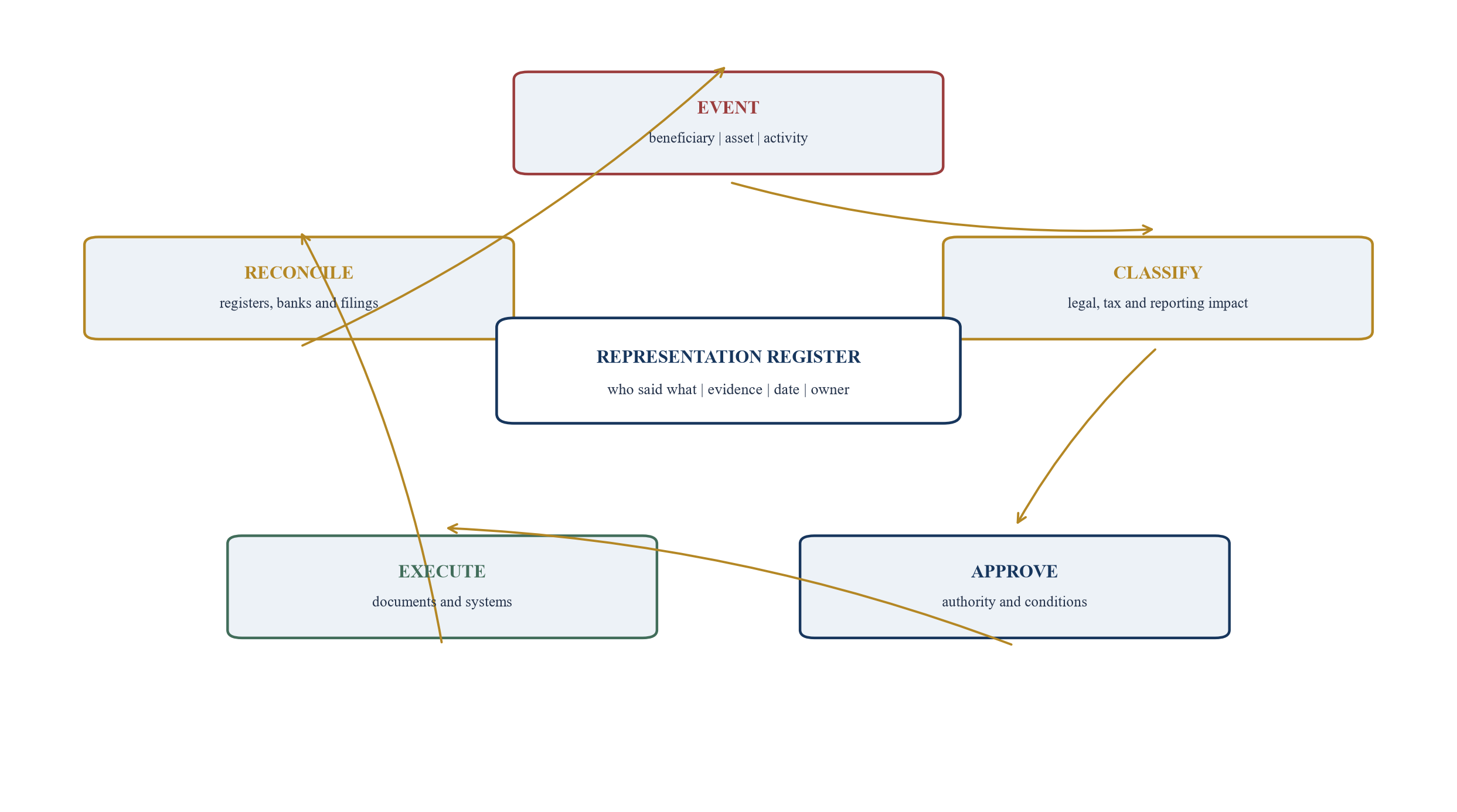
Timings are hypothetical management assumptions. Statutory and contractual deadlines must be confirmed for each event.
17. Build a governance charter that can survive transition
The governance charter should turn constitutional powers into a practical operating system. It defines council composition, appointment and removal, quorum, conflicts, reserved matters, delegations, investment authority, distribution process, emergency authority, information rights and review. Guardian or protector powers should be clear. Founder-reserved powers need legal and tax analysis because control can affect asset-protection, succession, reporting and residence conclusions.
Decision rights can be arranged by consequence. Routine portfolio rebalancing may be delegated within an approved investment policy. New asset classes, borrowing, guarantees, operating activities, related-party transactions, distributions, beneficiary changes and amendments require higher approval. Tax-status representations and annual confirmation should sit on the reserved-matter list. The charter should also define who can halt a transaction when evidence is incomplete.
Succession planning must cover the governance machinery itself. The file should identify alternates, incapacity evidence, appointment process, onboarding requirements, access credentials and urgent banking authority. A family foundation can hold assets continuously while still becoming operationally paralysed if council or signatory succession is weak. Periodic simulations can test whether a successor can obtain the records, understand the open obligations and make a valid decision.
Board effectiveness should be evidenced through focused minutes and a decision pack. The pack includes the requested decision, verified facts, assumptions, alternatives, tax and legal advice, cash effects, conflicts, risks, implementation owner and monitoring plan. Minutes record deliberation and reasons. This supports governance quality and provides a factual record for residence, purpose and no-tax-avoidance analysis.
18. Treat every material change as a tax-status event
Approval is conditional on continuing facts. The FTA guide states that a Family Foundation that ceases to meet an Article 17 condition loses fiscally transparent status and reverts to being a Taxable Person from the beginning of the tax period in which the failure occurred [1]. In a multi-tier structure, failure at one tier can affect entities beneath it. This consequence makes change control a central tax process.
The event register should include beneficiary changes, public-benefit allocations, new activities, operating licences, employees, property use, acquisition or disposal of subsidiaries, ownership changes, new debt, related-party services, amendment of purpose, council migration, foreign nexus and data-reporting changes. Each event receives a legal, tax, accounting, reporting and operational assessment before approval where possible.
The foundation should define escalation by consequence. A potential business activity, broken ownership chain or missed public-benefit condition is critical. A late document refresh may be high or medium depending on what it supports. The owner records immediate containment, adviser review, board decision, FTA interaction if required, accounting impact and downstream entity effect. Closure requires evidence, not a status label.
Scenario planning can improve readiness. The board can model transparent treatment continuing, treatment lost at the foundation, one lower tier becoming opaque, or a foreign authority classifying the arrangement differently. Each scenario identifies tax return, registration, accounting, distribution and liquidity actions. The purpose is operational preparedness; it does not assume the event will occur.
19. Implement through a controlled 120-day programme
A complex foundation can be prepared through four linked workstreams: legal and governance, tax classification, finance and data, and implementation. The first thirty days establish the perimeter, collect governing documents, confirm decision rights and create the beneficiary, entity, asset and activity registers. Open facts are assigned to owners. Irreversible transfers remain gated.
Days thirty-one to sixty complete the condition analysis, classify income and expenses, map operating activities, test multi-tier eligibility, review residence and foreign exposure, and prepare the first tax model. The board approves the target architecture and contingency case. Service-company boundaries and related-party agreements are drafted. Registrations and application dependencies are mapped.
Days sixty-one to ninety run a trial close, complete registrations, assemble the representation and evidence registers, obtain specialist sign-offs and prepare the application pack. Privacy, access and retention controls are tested. Banks and administrators receive consistent verified information. The council reviews the application statements line by line.
Days ninety-one to one hundred and twenty complete approved submissions, record effective periods, implement accounting and beneficiary schedules, activate the event calendar and rehearse the annual confirmation. Actual duration depends on document availability, registrations, adviser capacity, jurisdictional complexity and FTA processing. The plan is a management sequence, not a statutory timetable or outcome commitment.
Table 5. Illustrative 120-day implementation sequence
| Phase | Primary output | Critical gate | Evidence of completion | Board decision |
|---|---|---|---|---|
| days 1 to 30 | legal, beneficiary, entity, asset and activity perimeter | governing records complete enough to classify | signed perimeter and exception register | approve purpose and workplan |
| days 31 to 60 | Article 17 analysis and target architecture | every condition has an owner and preliminary conclusion | condition matrix and alternative tax model | approve target and contingency structures |
| days 61 to 90 | trial close, registrations and application evidence | representations reconcile to underlying records | trial schedules, registrations and adviser sign-offs | authorise final application preparation |
| days 91 to 120 | submission, system activation and monitoring calendar | approval authority and current evidence confirmed | submission receipt, accounting instructions and control calendar | accept residual risks and begin steady-state governance |
| monthly thereafter | activity, beneficiary and entity change review | no critical unexplained exception | dashboard and signed exception actions | approve remediation where required |
| annually | confirmation and full status reassessment | conditions met for complete tax period | signed conclusion and submission evidence | authorise annual confirmation |
Timing is a hypothetical management assumption. The actual plan should reflect legal, regulatory, FTA, banking and adviser dependencies.
20. Operate an annual confirmation as a continuous close
The FTA requires a Family Foundation or eligible wholly owned juridical person that applied for transparent treatment to submit an annual confirmation within nine months after the end of the relevant tax period [1, 12]. In a multi-tier structure, the foundation or Unincorporated Partnership can make confirmation for itself and qualifying wholly owned and controlled entities, or entities can confirm separately, subject to the applicable process [1].
The confirmation should be the output of monthly and event-driven controls. Each month, finance closes income, expenses, contributions, distributions and related-party balances. The secretary certifies beneficiary and governance changes. The investment lead confirms activities and asset use. Tax reconciles the ownership chain, exemptions, public-benefit condition, foreign tax and representations. Open exceptions roll to the board dashboard.
At year end, the responsible team performs a full condition reassessment for the entire period. It should not rely solely on the closing-date position. A disqualifying activity during the year may matter even if it ceased before year end. The review should cover every entity in a transparent chain and reconcile the conclusion to financial, legal and operational records.
Submission controls include preparer, reviewer, authorised signatory, portal evidence, deadline monitoring and document retention. The board minutes the conclusion, material judgements, specialist advice and remedial items. The foundation should retain the exact evidence set used, preserving version and date. This makes the next year's opening position clear and supports an efficient response to an FTA information request.
21. Govern through a board-ready election decision file
The final decision file should let a council member understand the structure, eligibility, economic outcome and unresolved risks without reading every source document. The opening page states the decision requested, requested effective period, entities covered, advisers, and whether any prerequisite remains open. It distinguishes verified facts from management assumptions and professional conclusions.
The core pack includes the legal and tax classification, Article 17 condition matrix, entity architecture, beneficiary register summary, activity and asset perimeter, transparent-versus-taxable model, cross-border map, evidence register, implementation plan and post-approval calendar. Appendices hold primary documents and detailed schedules. Every material figure has a source and owner.
The dashboard should focus on decision quality. It can show evidence completeness, critical exceptions, days to deadlines, percentage of assets with confirmed tax basis, beneficiary records current, entity-chain status, related-party agreements executed, public-benefit distributions due and foreign reviews complete. Thresholds are approved by the board. A green dashboard means the agreed controls passed; it does not replace legal eligibility or FTA approval.
The board authorises an application only when it is satisfied with purpose, powers, conduct, beneficiary treatment, ownership chain, cross-border analysis and the capacity to operate continuing controls. It records conditions to approval and delegates submission within a defined authority. That sequence makes governance the source of the election and turns annual compliance into a repeatable operating discipline.
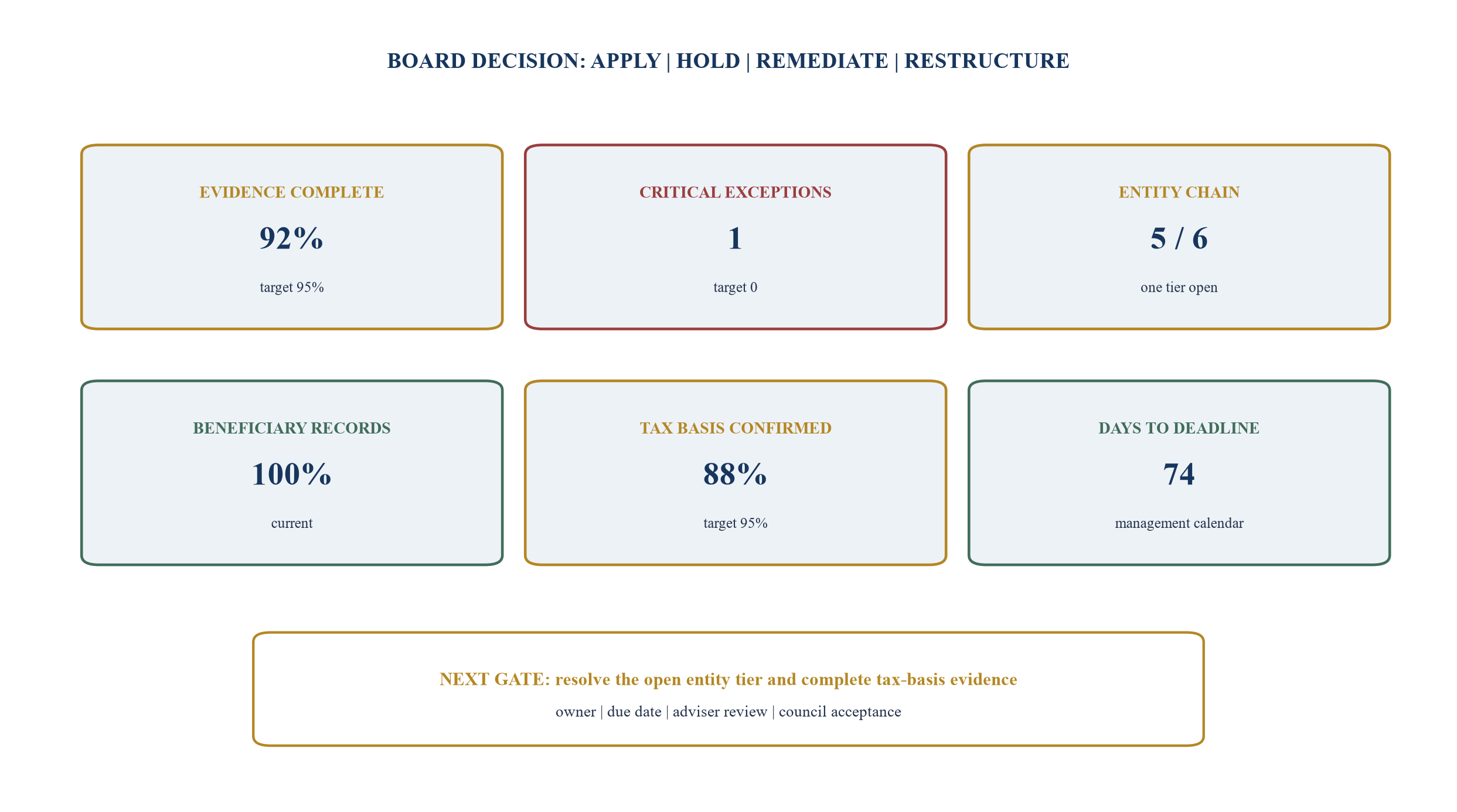
Values and thresholds are hypothetical management assumptions. They do not represent any client or predict an FTA outcome.
Table 6. Board decision and monitoring agenda
| Agenda item | Decision evidence | Illustrative board gate | Escalation question | Monitoring owner |
|---|---|---|---|---|
| purpose and legal form | charter, legal opinion and registry record | no unresolved classification conflict | do powers or conduct undermine the stated purpose? | council secretary |
| Article 17 conditions | signed condition matrix | every condition concluded and evidenced | which fact could cause loss of status? | tax lead |
| entity chain | ownership, control and approval map | every dependent tier classified | does one opaque entity interrupt the intended chain? | group controller |
| beneficiary outcome | attribution model and residence map | material beneficiaries reviewed | does any beneficiary create a foreign or distribution issue? | tax and wealth-planning leads |
| application authority | registration, evidence and requested period | submission statements reconciled | is any representation conditional or outdated? | authorised signatory |
| continuing compliance | annual calendar and event register | owners and deadlines accepted | can the organisation detect and contain a change promptly? | chief operating officer |
Thresholds and committee assignments are hypothetical management assumptions for adapting to an actual governance system.
Sources and further reading
- Federal Tax Authority, “Taxation of Family Foundations | CTGFF1,” 10 June 2026. Official source
- Federal Tax Authority, “Corporate Tax treatment of family wealth management structures | CTP008,” 2025. Official source
- United Arab Emirates Legislation, Federal Decree-Law No. 47 of 2022 on the Taxation of Corporations and Businesses, as amended. Official source
- Ministry of Finance, Ministerial Decision No. 261 of 2024 on Unincorporated Partnership, Foreign Partnership and Family Foundation. Official source
- Federal Tax Authority, “Transfer Pricing Guide | CTGTP1.” Official source
- United Arab Emirates Legislation, Cabinet Decision No. 49 of 2023 on the Categories of Businesses or Business Activities Conducted by a Resident or Non-Resident Natural Person. Official source
- Federal Tax Authority, “Corporate Tax Registration.” Official source
- Federal Tax Authority, “FTA launches Family Foundations as an Unincorporated Partnership application via EmaraTax,” 10 March 2025. Official source
- Federal Tax Authority, “Exempt Income: Dividends and Participation Exemption | CTGEXI1.” Official source
- Ministry of Finance, Ministerial Decision No. 229 of 2025 Regarding Qualifying Activities and Excluded Activities. Official source
- Federal Tax Authority, “Determination of Taxable Income | CTGDTI1.” Official source
- Federal Tax Authority, Decision No. 5 of 2025 on Tax Registration and Annual Confirmation requirements relevant to Family Foundations. Official source
- Abu Dhabi Global Market, “Setting Up: Foundations.” Official source
- Abu Dhabi Global Market, Foundations Regulations, consolidated text. Official source
- Dubai International Financial Centre, “Private and Family Wealth.” Official source
- Dubai International Financial Centre, Foundations Law, DIFC Law No. 3 of 2018, as amended. Official source
- RAK International Corporate Centre, Foundations Regulations 2019, consolidated with 2025 amendments. Official source
- United Arab Emirates Legislation, Cabinet Decision No. 109 of 2023 Regulating the Real Beneficiary Procedures. Official source
- United Arab Emirates Legislation, Cabinet Resolution No. 134 of 2025 regarding the Executive Regulations on Anti-Money Laundering and related matters. Official source
- United Arab Emirates Legislation, Federal Decree-Law No. 45 of 2021 Regarding the Protection of Personal Data. Official source
- Abu Dhabi Global Market, Data Protection Regulations 2021. Official source
- Dubai International Financial Centre, Data Protection Law, DIFC Law No. 5 of 2020. Official source
- HM Revenue & Customs, “Inheritance Tax if you’re a long-term UK resident.” Official source
- HM Revenue & Customs, “Non-resident trusts,” updated 6 April 2026. Official source
- HM Revenue & Customs, “Trusts and Inheritance Tax.” Official source
- HM Revenue & Customs, “Check if you need to register a trust,” updated July 2026. Official source
- OECD, “Consolidated Text of the Common Reporting Standard 2025,” 2025. Official source
- Financial Action Task Force, “Guidance on Beneficial Ownership and Transparency of Legal Arrangements,” 2024. Official source
- OECD, “Model Tax Convention on Income and on Capital,” 2017. Official source
- OECD, “Transfer Pricing Guidelines for Multinational Enterprises and Tax Administrations,” 2022. Official source
