

1. Govern covenant headroom as a decision system
A covenant result is often presented as a single ratio: net leverage of 4.2 times against a maximum of 5.0 times, or interest cover of 2.4 times against a minimum of 2.0 times. The apparent headroom can create false comfort. The numerator may depend on cash that is legally trapped, debt that management excluded incorrectly or lease liabilities treated differently across facilities. The denominator may contain add-backs that expire, synergies that require evidence, acquisitions that need pro forma treatment or accounting items that do not follow the lender definition.
The board needs a system that answers five questions. What exactly does the executed agreement require? Which source data enters each calculation? What does the next measurement date look like under the base case and credible downside cases? Which decisions can protect headroom and liquidity? When should management engage lenders, advisers and shareholders?
This system is a control room because it combines contract, finance, operations and governance. Legal teams interpret documents. Finance owns the controlled calculation and reconciliation. Treasury owns debt, cash, interest and liquidity. Business leaders own operational assumptions. The board approves risk appetite, financing actions and material lender engagement. Independent challenge tests the calculation, forecast and management response.
The European Banking Authority treats covenant adherence and timely certificates as early-warning information for lenders, alongside broader quantitative and qualitative indicators [11][12]. The Central Bank of the UAE requires licensed financial institutions to monitor financing covenants, contractual requirements, cash-flow projections and forward-looking borrower affordability [16][17]. Borrowers can use the same logic internally: detect pressure before the contractual test and act while options remain.
The operating cadence should match the decision horizon. Stable headroom can support a monthly cycle with quarterly certificate controls. Deteriorating trading, tight liquidity, a pending acquisition or lender negotiation can require weekly review. A forecast contractual breach can require daily cash and workstream governance. The board should approve the escalation between cadences so that management neither normalises a crisis process nor delays it until options narrow.
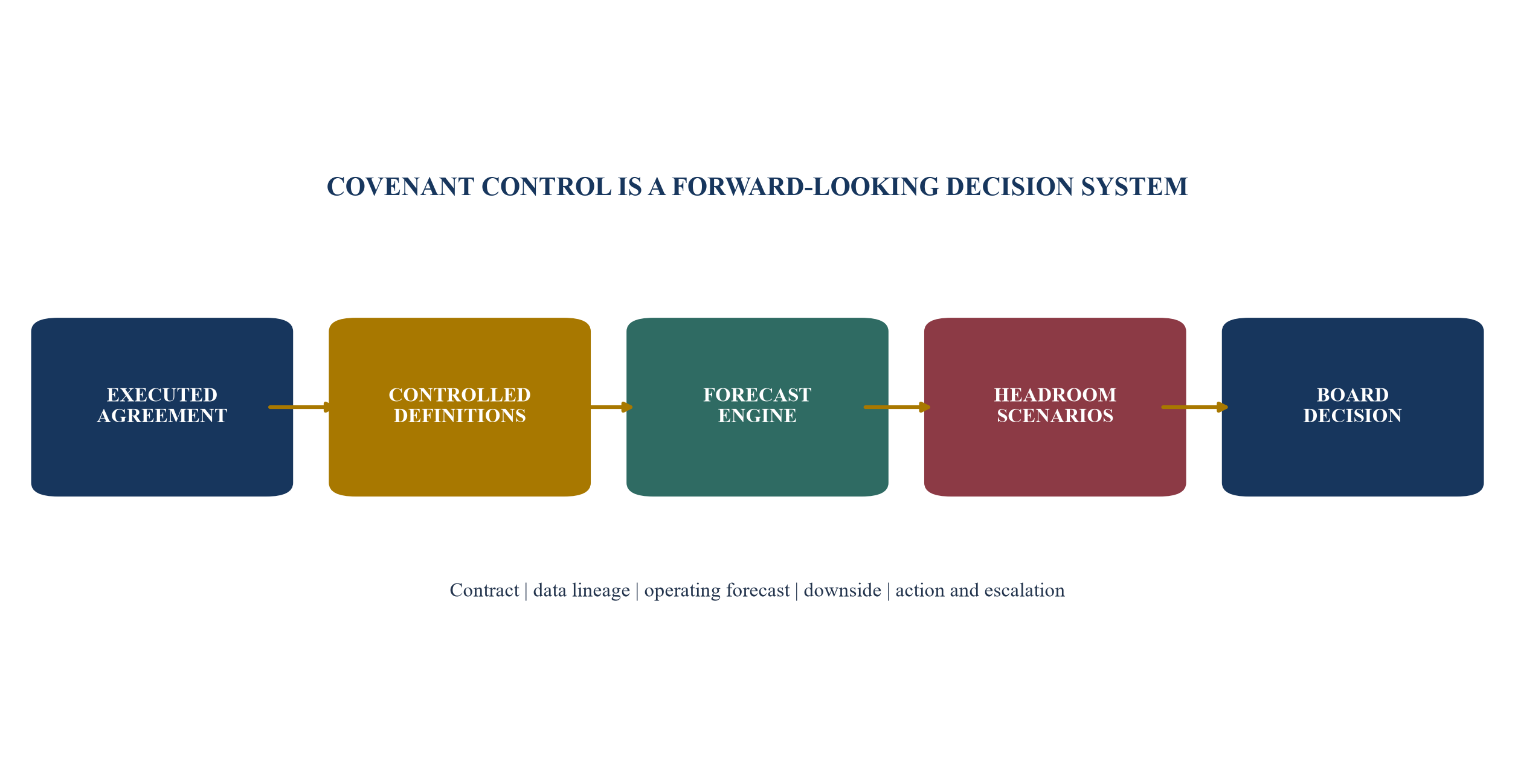
Headroom becomes useful when the agreement, controlled data, forward forecast and decision pathway remain connected.
2. Start with the executed financing perimeter
The control room begins with the complete financing perimeter. Management should identify every facility, note, guarantee, intercreditor arrangement, security document, hedging agreement, shareholder instrument and amendment that can affect a calculation or remedy. The authoritative record is the executed document set, including side letters and waivers. A lender model, prior certificate or transaction summary can assist navigation but should not replace the signed terms.
The perimeter should distinguish maintenance tests, incurrence tests, minimum liquidity requirements, reporting undertakings and event-driven conditions. A maintenance covenant is tested periodically whether or not the company takes an action. An incurrence test applies when the company proposes an action such as new debt, a distribution or acquisition. A minimum liquidity condition may apply continuously, weekly or on specified dates. Reporting obligations can themselves create default risk when certificates, accounts, budgets or notices are late.
Each requirement needs the borrower, obligors, guarantors, restricted group, test frequency, calculation period, threshold, cure mechanics, information deadline, grace period, remedy and responsible owner. Management should also record cross-default, cross-acceleration, material-adverse-effect and representation provisions for legal review. These terms can change the consequence of an operational or reporting issue even when a financial ratio remains within threshold.
The inventory must remain version-controlled. Every amendment should update the definition book, model, calendar and board pack. A file name marked “final” is insufficient. The control owner should retain execution evidence, effective date, legal confirmation, approval history and a change log showing which calculations and forecasts were updated.
Table 1. Covenant and undertaking inventory
| requirement | contractual basis | frequency or trigger | controlled input | early-warning view | owner and escalation |
|---|---|---|---|---|---|
| maximum net leverage | facility definition and schedule | quarter end and acquisition | net debt, covenant EBITDA | monthly forecast plus downside | CFO; board below approved buffer |
| minimum interest cover | facility definition | quarter end | covenant EBITDA, finance charges | rolling twelve-month forecast | controller and treasury |
| minimum liquidity | agreement or waiver | daily, weekly or month end | unrestricted cash, available commitments | thirteen-week cash forecast | treasurer; immediate breach path |
| debt-service coverage | project or asset facility | distribution or test date | cash available for debt service, scheduled debt service | monthly operating and cash forecast | finance director and asset lead |
| restricted payment test | permitted payment basket and incurrence test | before proposed payment | retained basket, leverage, defaults | transaction pre-clearance | CFO, counsel and board |
| information covenant | reporting clause | specified delivery date | accounts, budget, certificate | calendar and completion evidence | company secretary and finance |
The inventory separates contractual tests, reporting duties and management monitoring triggers.
3. Build a measurement calendar before building a model
A model without a calendar can calculate the wrong period correctly. The calendar should show historical test dates, next measurement dates, look-back periods, certificate deadlines, audit delivery dates, amortisation, interest resets, hedge maturities, bullet maturities, availability tests and planned corporate actions. It should also identify weekends, public holidays and approval lead times where timing affects cash or documentation.
Rolling calculations require particular care. A quarter-end leverage test may use the last twelve months of covenant EBITDA, including pro forma adjustments for acquisitions and disposals. An interest-cover test can use cash interest, accrued interest or finance charges defined through several cross-references. A liquidity test may measure at close of business on every Friday. The forecast must replicate each contractual timing rule.
The calendar should include management checkpoints before the legal deadline. A board meeting held five business days before quarter end may be too late if the response requires shareholder funding, asset disposal proceeds, a waiver or operational actions that cannot be completed in time. A practical sequence works backwards from each test date through data close, forecast refresh, independent review, management decision, board approval and lender communication.
Calendar ownership should sit with a named executive and a second-line checker. Automated reminders support execution, while completion evidence proves that the requirement was met. The board pack should state the next test, certificate and reporting dates rather than rely on a generic “quarterly” label.
4. Convert legal drafting into a controlled definition book
The definition book is the bridge between the agreement and the model. It should reproduce or precisely cite each relevant term, identify its source clause, describe management's operational interpretation and map the term to controlled data. Where interpretation depends on counsel, the record should state the advice date and scope. It should avoid rewriting legal language into a broader management policy without approval.
Definitions interact. “Consolidated EBITDA” can refer to accounting profit adjusted by permitted additions and deductions. “Net Debt” may exclude specified cash, cash equivalents or letters of credit, while including guarantees, leases, factoring, deferred consideration or shareholder instruments in defined circumstances. “Finance Charges” may include hedging payments, commitment fees, capitalised interest or lease interest. The control room must follow the negotiated language rather than a textbook ratio.
Every adjustment should have eligibility criteria, evidence, cap, time limit and approval. A cost-saving initiative can be commercially credible yet fail the covenant definition because it was not implemented, not measurable, outside the permitted period or above an adjustment cap. A permitted add-back can be legally available yet unsuitable for the board's internal downside view because the cash cost remains real.
The book should distinguish three views: reported accounting, contractual covenant and management prudence. Reported accounting follows the applicable reporting framework. The covenant view follows the agreement. The prudent view removes uncertain adjustments or adds management overlays for decision-making. Presenting the three side by side prevents an aggressive contractual case from becoming the sole operating forecast.
Definition control also requires negative logic. The book should state which items are excluded and why. Examples can include cash in non-obligor entities, projected synergies beyond the permitted window, subordinated instruments that meet the debt definition, overdue interest, extraordinary income, or a cost action already reflected in reported results. Explicit exclusions reduce the risk that a future preparer interprets silence as permission.
Table 2. Controlled covenant definition book
| term | clause and scope | calculation rule | evidence required | common failure mode | prudent overlay |
|---|---|---|---|---|---|
| covenant EBITDA | defined term and restricted group | accounting base plus permitted adjustments | ledger tie-out, invoices, plan, approval | expired or unsupported add-back | show EBITDA before uncertain items |
| total debt | indebtedness definition | include specified funded and contingent items | lender statements, debt register, contracts | omitted lease, guarantee or factoring | include disputed items in downside |
| permitted cash | cash and cash-equivalent definition | deduct only eligible accessible balances | bank evidence, entity and jurisdiction | trapped or restricted cash netted | exclude transfer-restricted balances |
| finance charges | finance-charge definition | include defined interest, fees and hedge items | debt schedule and treasury records | cash and accrued bases mixed | reconcile to cash forecast |
| pro forma acquisition effect | acquisition and adjustment clauses | apply approved period and methodology | completion accounts and model | double counting or wrong start date | separate realised and forecast effect |
| cure amount | equity-cure clause | apply only within timing and frequency limits | funding evidence and legal confirmation | cure assumed before committed | base case excludes uncommitted cure |
Each term needs a contractual citation, data rule, evidence test and prudent management overlay.
5. Reconcile accounting performance to covenant EBITDA
The EBITDA bridge should start from a controlled accounting measure and identify every movement to the contractual result. The starting point may be operating profit, profit before tax or another defined amount. Each adjustment should carry a unique identifier, accounting period, amount, clause, category, business owner, evidence location, approval and expiry date.
Recurring and non-recurring language needs discipline. A restructuring programme may generate cash costs over several periods while the agreement permits a defined adjustment subject to a cap. Cost savings may be permitted when actions are implemented or formally committed, yet management must avoid counting the same saving in both reported performance and an add-back. Acquisition synergies may require a specified realisation window and a reasonable basis.
The bridge should reconcile actuals, latest estimate and forecast. Historical adjustments require evidence at the certificate date. Forecast adjustments require evidence of eligibility and timing at each future test. The model should prevent an adjustment from continuing after the contractual window or after the underlying benefit enters reported EBITDA.
Independent review should challenge amount, eligibility, period, duplication, cap and cash effect. A ratio can improve through a permitted add-back while liquidity worsens because the related cash cost is paid. The board therefore needs both the covenant bridge and the cash bridge.
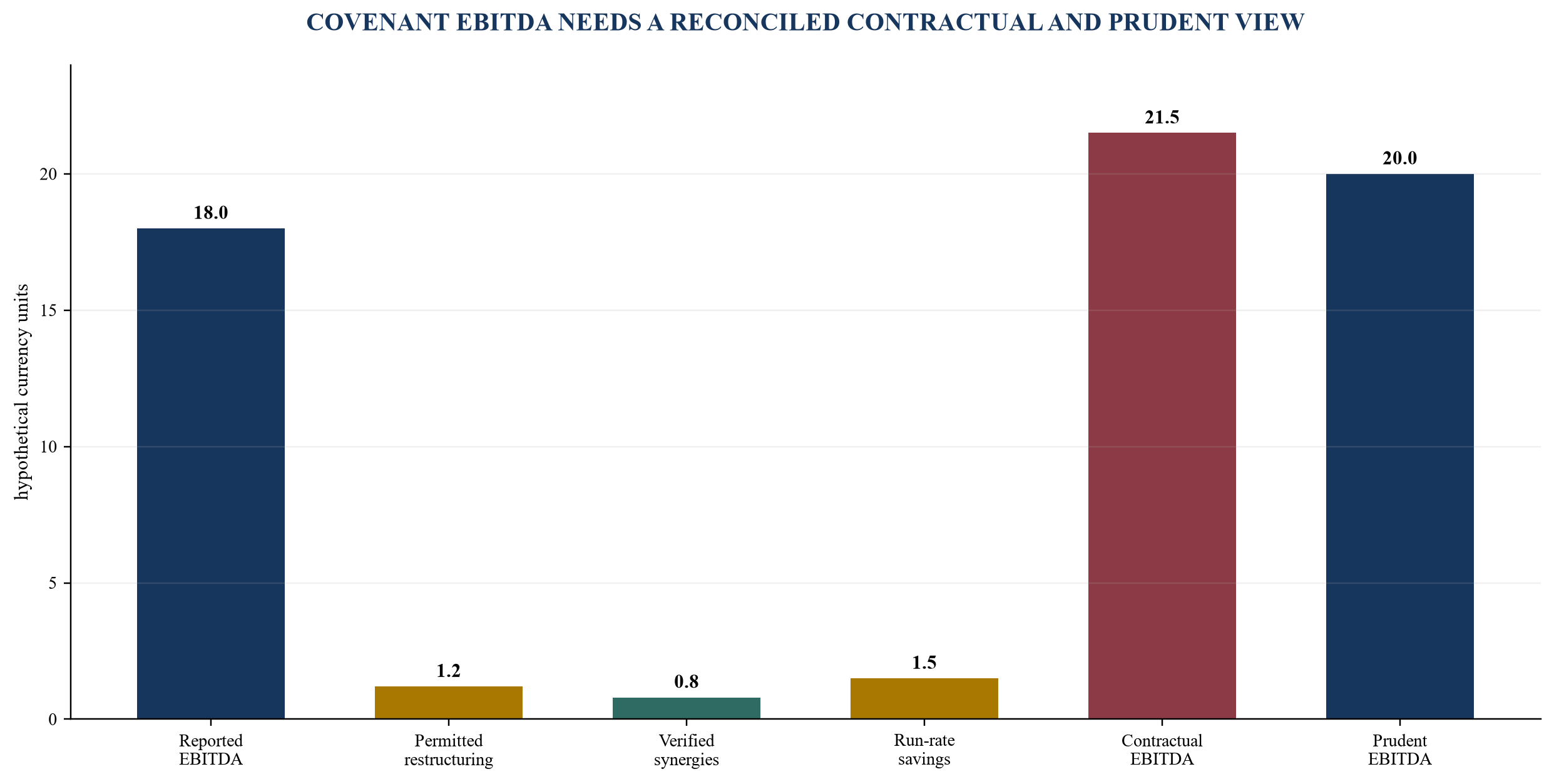
Values are hypothetical management assumptions. The prudent view excludes an uncertain adjustment from the contractual case.
6. Define net debt, liquidity and availability separately
Net debt, liquidity and facility availability are related but distinct. Net debt applies the agreement's debt and cash definitions. Liquidity measures cash and committed undrawn resources that are accessible when needed. Availability measures whether borrowing conditions, borrowing-base limits, representations and drawstop events permit use of a facility. Treating an undrawn commitment as cash can overstate resilience when the company may fail a draw condition.
The debt register should include lender, borrower, currency, principal, accrued interest, fees, amortisation, maturity, security, guarantee, hedge, ranking and covenant treatment. It should reconcile to the general ledger, lender statements and treasury forecast. Foreign-currency debt needs the agreement's exchange-rate rule and a scenario for rate movement.
Cash requires entity and jurisdiction mapping. Restricted, pledged, trapped or operationally required balances may be unavailable for netting or liquidity. The control room should record bank, entity, account, currency, restriction, transferability, cut-off and evidence date. Intercompany cash transfers may need board, tax, exchange-control, solvency or regulatory analysis.
Committed facilities should show total commitment, drawings, letters of credit, ancillary use, borrowing-base deductions, conditions precedent and remaining availability. The board should see gross cash, covenant cash, immediately accessible liquidity and stressed liquidity as separate values.
Liquidity timing should be modelled at the point of control, not only at month end. Payroll, tax, interest, rent, supplier settlements, acquisition consideration and mandatory prepayments can create intra-period low points. A company that closes each month with positive cash can still fail a weekly liquidity requirement or require an unavailable draw mid-month. The thirteen-week forecast should therefore identify daily or weekly low points where material.
7. Establish one data lineage and one controlled calculation
The model should identify the source, transformation and owner of every material input. Revenue, payroll, inventory, receivables and payables may originate in operating systems. Accounting results come from consolidation and close processes. Debt, cash, rates and hedges come from treasury. Contract terms come from the controlled document set. Forecast assumptions come from named operating owners.
Data lineage matters because a calculation can be mathematically correct and operationally wrong. A newly acquired subsidiary may be absent from the consolidation perimeter. A debt schedule may use the contractual balance while the lender statement includes capitalised fees or accrued interest. A working-capital forecast may use invoice dates while the cash model uses contractual due dates.
The control room should maintain one production calculation, protected from uncontrolled edits. Inputs, formulas, overrides and outputs need version, timestamp, preparer and reviewer. Material manual inputs require evidence and commentary. Changes to definitions or formulas require approval, regression testing and re-performance of affected periods.
Access control should separate preparation, review and approval. The board receives the approved output and material exceptions. A spreadsheet can be appropriate for a smaller company when its architecture is controlled. Greater scale, complexity or frequency can justify a governed data model and workflow. Technology should follow the control design.
Table 3. Covenant data-lineage and control matrix
| calculation family | authoritative source | transformation | primary control | reviewer evidence | exception trigger |
|---|---|---|---|---|---|
| reported earnings | consolidation ledger and approved accounts | map defined accounting base | ledger tie-out and period lock | controller sign-off | post-close journal or perimeter change |
| adjustments | evidence register and clause map | eligibility, cap and expiry logic | unique adjustment ID | finance and legal review | missing evidence or duplicated benefit |
| debt and interest | lender statements and treasury register | currency, accrual and covenant classification | balance and rate reconciliation | treasury sign-off | unmatched balance or rate reset |
| cash and availability | bank evidence and facility records | restriction and draw-condition filters | bank-to-ledger reconciliation | treasurer review | inaccessible cash or drawstop risk |
| forecast | operating plans and cash model | driver-based monthly and weekly projections | assumption owner approval | FP&A challenge | variance outside tolerance |
| certificate | approved covenant model | contractual presentation and rounding | independent re-performance | CFO and authorised signatory | model or evidence change after approval |
The matrix makes source, transformation, review and evidence visible for each material calculation family.
8. Run an integrated forecast at the right frequencies
The covenant forecast should share operating drivers with the board forecast and cash model. Revenue, gross margin, payroll, capital expenditure, working capital, taxes, interest and acquisitions cannot move independently. A covenant-only model invites reconciliation gaps and delayed decisions.
Different frequencies serve different needs. A monthly model can project covenant tests, earnings, debt and liquidity over twelve to twenty-four months. A weekly thirteen-week cash forecast can identify near-term liquidity, payment and draw requirements. A daily view may be necessary when a minimum-liquidity covenant or waiver condition applies continuously or on specified days.
The model should include actuals, approved budget, latest estimate and scenario cases. Actual-to-forecast variance updates the next test rather than waiting for the next planning cycle. Management should distinguish forecast changes caused by trading, timing, definitions, financing and corporate actions.
Forecast ownership belongs with operating management. Finance controls consolidation, calculation and challenge. Each major assumption should identify owner, evidence date, confidence range and dependency. A sales forecast without conversion, delivery and collection assumptions cannot support a headroom decision.
Forecast horizons should cover the period in which management must make financing decisions. The legal test horizon may be twelve months while a maturity, refinancing process or exit sits further away. A longer monthly view can expose a structural issue hidden by near-term compliance. The board should see which later periods have lower forecast reliability and which actions require commitment before confidence improves.
9. Design scenarios that expose action points
A base case alone measures the plan. A control room needs scenarios that reveal where the financing structure becomes restrictive and which action still has time to work. Scenarios should be severe enough to support decisions and plausible enough to connect to identifiable drivers.
Useful shocks include revenue delay, margin compression, customer loss, slower collections, inventory build, supplier tightening, interest-rate increase, foreign-exchange movement, capex overrun, acquisition underperformance, disposal delay and loss of a permitted adjustment. Combined scenarios matter because covenant pressure often reflects several moderate movements rather than one extreme event.
Reverse stress testing begins from an outcome such as minimum board buffer, zero contractual headroom, minimum liquidity or inability to draw. The model solves for the driver movement that produces the outcome. This shows whether a small miss can trigger a disproportionate financing consequence and how early the decision path must begin.
Scenario outputs should include leverage, cover, liquidity, availability, cash low point and earliest breach date. They should also state actions, lead times, dependencies and residual risk. Stress-testing principles emphasise governance, methodology, resources, documentation and use in decision-making [13][14][15]. The borrower-side model should retain those disciplines without presenting bank supervisory standards as borrower obligations.
Scenario governance should prevent selective optimism. Management should approve the scenario library before results are known, retain the prior case, explain changes and compare scenarios with actual outcomes. The review should challenge correlations: lower revenue can coincide with slower collections, weaker inventory turns, supplier tightening and reduced facility availability. Independent shocks added one by one can understate the combined pressure.
Table 4. Scenario library for covenant and liquidity decisions
| scenario | driver shock | covenant mechanism | earliest warning | potential response | evidence needed |
|---|---|---|---|---|---|
| trading softness | revenue and margin below plan | lower rolling EBITDA and cash | order, volume and price variance | pricing, cost, capex and working-capital actions | driver bridge and owner plan |
| collection delay | higher receivable days | lower liquidity and higher debt | overdue profile and dispute ageing | collections sprint, dispute resolution, facility use | customer-level cash plan |
| interest reset | higher reference rate or hedge expiry | lower interest cover and cash | forward curve and hedge calendar | hedge, repricing, debt amendment | treasury quote and covenant treatment |
| acquisition delay | later completion or slower synergy | pro forma EBITDA and debt change | diligence and integration milestones | resize, reprice, defer or add equity | transaction model and counsel review |
| adjustment expiry | add-back window closes | covenant EBITDA falls | adjustment register expiry | accelerate benefit, reduce debt or reset covenant | benefit evidence and calculation |
| combined downside | moderate shocks across drivers | leverage, cover and liquidity interact | board buffer breached | coordinated operating and financing plan | integrated scenario and decision timetable |
Each scenario connects a business driver to the covenant mechanism, decision window and management response.
10. Show headroom as distance, time and confidence
Headroom should not be reduced to the arithmetic distance from threshold. The board needs three dimensions. Distance is the gap between forecast result and contractual threshold. Time is the period until the relevant test or cash low point. Confidence is the quality of evidence supporting the forecast and calculation.
A company can have ample numeric headroom and low confidence when the result depends on a disputed add-back, uncommitted disposal or weak cash-conversion forecast. Another company can have narrow headroom with high confidence and a funded response. The decision differs.
The dashboard should show threshold, approved management buffer, base case, downside cases and previous forecast for every measurement date. It should identify the earliest buffer breach, contractual breach and liquidity low point. A trend line is more useful than a single quarter-end number because it exposes direction and acceleration.
Management buffers should be approved deliberately. They may vary by covenant, forecast horizon, business volatility, data quality, lender relationship and response lead time. The buffer is a decision trigger, not a second contractual covenant.
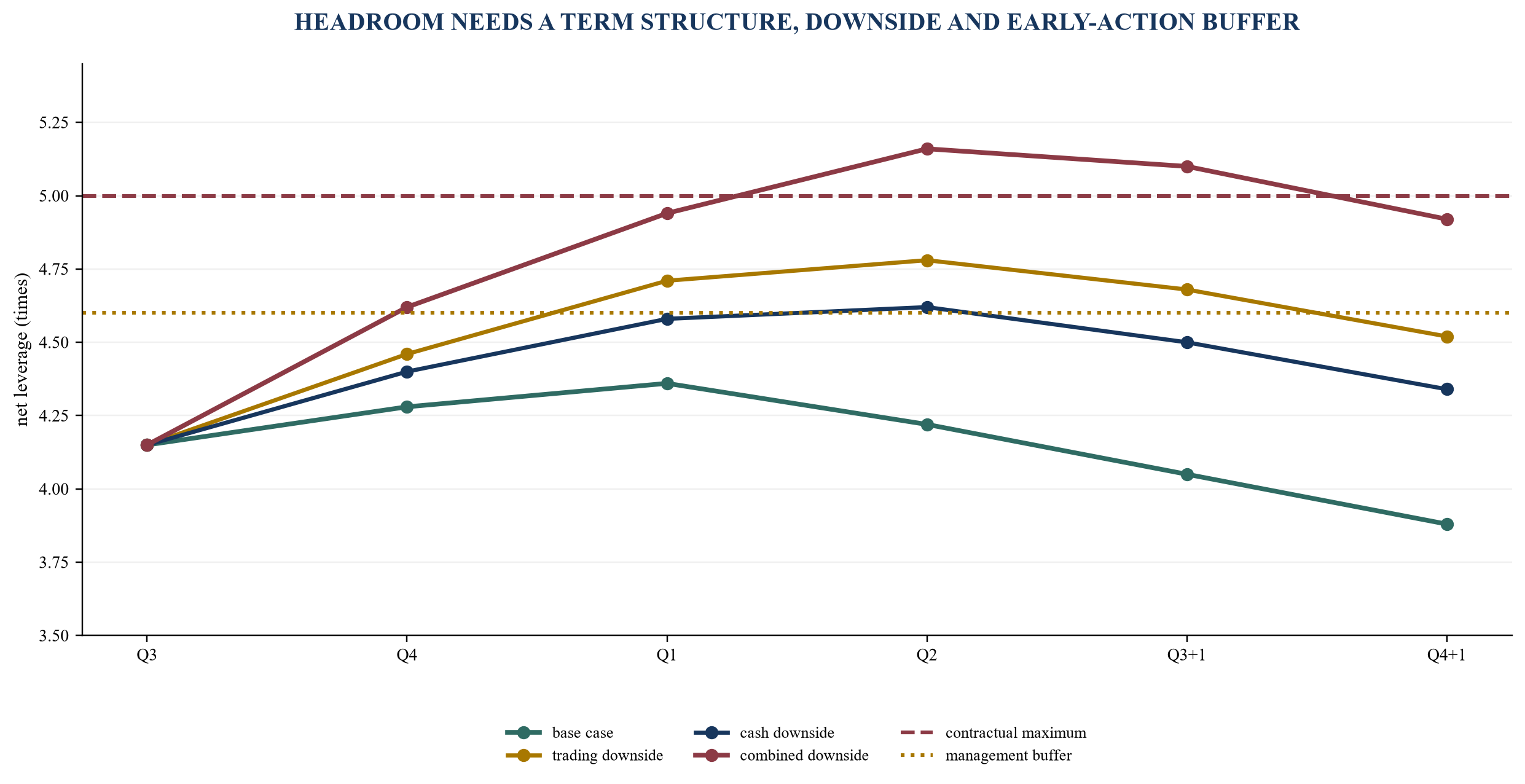
Values are hypothetical management assumptions. Lower leverage is stronger. The management buffer creates an earlier action point than the contractual threshold.
11. Use early-warning indicators before forecast headroom disappears
Financial covenants are often lagging indicators because they use historical or rolling results. The control room should combine them with operating, cash, financing and qualitative signals. Examples include order intake, customer churn, gross-margin variance, utilisation, backlog quality, overdue receivables, inventory ageing, supplier holds, capex commitments, employee turnover, audit delays and lender information requests.
Each indicator needs definition, source, threshold, owner and escalation. A red indicator should trigger a specified action, not merely change a colour. The action can include forecast refresh, cash restriction, hiring gate, capex review, lender communication or board decision.
The EBA guidance expects lenders to use quantitative and qualitative early-warning indicators supported by data infrastructure and assigned escalation procedures [11][12]. RBI materials emphasise robust management information and early detection of borrower distress before or at default [21]. These lender-side expectations support a practical borrower conclusion: management should surface deterioration before a compliance certificate becomes the first formal warning.
Indicators should be tested for predictive value. A high-volume dashboard creates noise when measures do not lead to decisions. Management can review whether each trigger preceded forecast deterioration, produced action and improved outcomes. Obsolete indicators should be retired with approval.
12. Define board, management and control-function decisions
The board should approve covenant risk appetite, management buffers, financing strategy, material assumptions and escalation thresholds. It should review forecast headroom, liquidity, availability, downside, adjustment confidence, certificates due, lender engagement and required decisions. It should understand which actions are within management authority and which require board or shareholder approval.
The CFO owns the integrated view and certifies the governance process. The controller owns the accounting bridge and calculation control. Treasury owns debt, cash, interest and facility availability. FP&A owns forecast integration and scenario consolidation. Business leaders own operating drivers and actions. Legal counsel interprets the agreement and supports notices, waivers and amendments. The company secretary controls board decisions and evidence.
Independent challenge can come from a finance reviewer, internal audit, sponsor team or external adviser, depending on size and risk. The reviewer should re-perform material calculations, trace adjustments, test scenarios and challenge actions. Independence does not transfer management responsibility.
Corporate-governance sources emphasise board assessment of prospects, liabilities, risks and assumptions [6][7][27]. The control room turns those principles into a recurring financing decision cycle. Applicability remains entity- and jurisdiction-specific.
Table 5. Covenant-control decision rights and escalation
| event | preparer | independent challenge | decision authority | required record | escalation timing |
|---|---|---|---|---|---|
| routine forecast refresh | FP&A and treasury | controller | CFO | version, variance and assumptions | before monthly close meeting |
| management buffer breach | CFO team | sponsor or risk reviewer | executive committee or board delegate | downside, options and lead times | within approved trigger window |
| uncertain covenant interpretation | finance and counsel | external counsel where material | CFO and board as required | clause map and advice scope | before model or certificate approval |
| forecast contractual breach | CFO | advisers and counsel | board | financing and operating response | early enough for executable remedy |
| lender waiver or amendment | CFO and counsel | sponsor and advisers | board and required shareholders | term comparison and approvals | before lender process launch |
| compliance certificate | controller and treasury | independent re-performance | authorised signatory | calculation, evidence and sign-off | before contractual deadline |
Decision rights keep preparation, challenge, approval and external communication distinct.
13. Control certificates, reporting and the covenant calendar
The compliance certificate should be the output of the control room rather than a separate quarter-end exercise. It should use the same controlled definitions, debt register, adjustment evidence and calculation reviewed through the period. Late changes require re-performance and documented approval.
The certificate process should begin with a checklist of required financial statements, schedules, representations, notices and signatures. Management should confirm the reporting perimeter, measurement period, thresholds, calculations, default status and any reserved interpretations. Counsel should review where the agreement or facts require it.
Information covenants need the same discipline. Budgets, monthly accounts, audit reports, borrowing-base certificates, insurance evidence and other deliverables can have different deadlines and recipients. Delivery evidence should record what was sent, when, by whom and under which clause.
The calendar should also record cure periods and remedy limits. An equity cure may be subject to timing, amount, frequency, deemed EBITDA treatment or debt-reduction rules. Management should model the executed clause and avoid assuming shareholder support before commitment.
14. Manage lender communication as a controlled workstream
Lender communication should begin before a forecast issue becomes a surprise. Early engagement can increase the time available to validate facts, compare options and secure approvals. The timing and content require judgement because premature or inaccurate statements can also create risk.
The company should maintain a lender map covering facility agent, relationship banks, private-credit decision makers, advisers, consent thresholds and information rights. The engagement plan should state objective, message, evidence, requested action, negotiation range, confidentiality and authority.
Every forecast shared externally should reconcile to the board-approved control-room version. Differences in assumptions or presentation need explanation. The company should separate factual performance, management forecast, scenario analysis and requested amendment. It should avoid presenting hypothetical actions as committed outcomes.
Lender discussions can address waiver, covenant reset, amendment, new money, maturity extension, security, pricing, reporting and operational milestones. The board should see the complete economic and governance package, including fees, interest, equity protections, restrictions, conditions and execution risk.
The external workstream needs a controlled data room. It should contain executed finance documents, historical certificates, approved accounts, debt and cash reconciliations, forecast versions, scenario explanations, action evidence and board authority. Access, privilege and confidentiality should be managed with counsel. Consistent evidence reduces avoidable follow-up and helps management identify differences between the company's case and lender analysis.
15. Evaluate waivers, resets and amendments before urgency dictates terms
A waiver addresses a specified breach or anticipated breach for a defined period or circumstance. A covenant reset changes future thresholds or definitions. An amendment can change wider terms. The control room should model each path across the full forecast and document set.
The decision should compare base case, downside, liquidity, operational plan, timing, certainty and total cost. A short waiver can preserve time while leaving a near-term refinancing cliff. A reset can create headroom while imposing tighter reporting, cash sweeps, restricted payments or pricing. New equity can reduce leverage while diluting ownership and affecting returns.
Management should identify the minimum viable request and the resilient request. The minimum request addresses the immediate test. The resilient request creates a reasonable buffer through the forecast horizon and credible downside. The board should understand the probability and consequence of returning to lenders.
Term comparison should extend beyond headline margin. Management should model amendment fees, interest floors, payment-in-kind components, cash sweeps, mandatory prepayment, additional reporting, capex restrictions, acquisition conditions, board-observer rights, equity warrants and future consent costs. The control room should show how each package performs under the same operating cases and which restrictions constrain the ownership plan.
Accounting and disclosure consequences require qualified assessment. IFRS amendments effective from 2024 address classification and disclosure for non-current liabilities with covenants [1][2][3]. FASB going-concern guidance requires management to evaluate reasonably knowable conditions and obligations over its specified horizon [8][9]. These reporting rules do not replace the contractual calculation.
16. Connect operating interventions to cash and covenant mechanics
Operating actions protect headroom only when their timing and mechanics enter the model correctly. Price increases affect revenue, margin, volume and collections. Cost actions can create near-term cash costs before EBITDA benefit. Working-capital actions affect debt and liquidity, while their EBITDA effect may be limited. Capex deferral can protect cash but impair capacity, safety or customer commitments.
Each action should show gross benefit, implementation cost, cash timing, accounting treatment, covenant treatment, owner, dependency and confidence. The model should avoid counting an EBITDA benefit as both realised performance and a forecast adjustment. It should also preserve operating guardrails for customer service, quality, safety, compliance and supply continuity.
A weekly action register can join the value-creation plan to the covenant forecast. The board sees which actions have been approved, implemented, validated in results and reflected in cash. Forecast headroom should improve only when the relevant evidence threshold is met.
The control room is therefore an execution mechanism. It makes financing constraints visible to commercial and operational owners without asking them to interpret loan documents. Their task is to deliver the agreed driver and evidence.
17. Pre-clear acquisitions, disposals and restricted actions
Acquisitions can affect leverage through purchase debt, acquired EBITDA, pro forma adjustments, transaction costs, integration costs and working capital. The agreement may impose acquisition conditions, leverage tests, permitted-acquisition criteria, debt baskets and notice requirements. The transaction model should use the same covenant definitions as the control room.
Disposals can reduce debt and EBITDA while triggering mandatory prepayment, reinvestment periods or disposal baskets. The net covenant effect depends on timing, proceeds, transaction costs, debt application and lost earnings. A disposal announced as deleveraging can weaken a ratio when EBITDA leaves before sufficient debt is repaid.
Restricted payments, shareholder distributions, management fees, investments and additional debt should be pre-cleared through incurrence tests and basket capacity. The control room should record basket origin, use, remaining capacity and interaction with defaults.
The board paper for a material transaction should include pro forma covenant results, liquidity, availability, downside, certificate timing and required consents. Legal and financing conditions remain decision gates rather than appendices.
18. Respect jurisdiction, reporting and facility-specific overlays
Contract law, insolvency duties, accounting standards, disclosure rules and banking practice vary. The executed documents and applicable law govern the company. A global framework should organise evidence and decisions without treating one jurisdiction's rule as universal.
UK governance guidance asks boards to assess prospects, liabilities and material uncertainties and to explain assumptions [6][7]. US GAAP places a going-concern evaluation on management over its defined horizon [8][9]. IFRS addresses classification and disclosure of liabilities subject to covenants [1][2][3]. Public-company and subsidiary-distribution disclosures can add further requirements in the United States [10][31].
Bank-supervisory sources from the EU, UAE, Saudi Arabia, India, Singapore and Australia emphasise forward-looking borrower assessment, covenant monitoring, management information, early-warning indicators and stress testing [11][12][16][17][19][20][21][22][23][24][25][26]. Those expectations apply to regulated institutions within their scope. They remain useful reference architecture for understanding the evidence lenders may request.
Directors should obtain jurisdiction-specific advice when solvency, distributions, creditor interests, disclosure, audit, restructuring or enforcement becomes relevant [28][32][33]. The control room should record advice and decisions without converting the model into a legal conclusion.
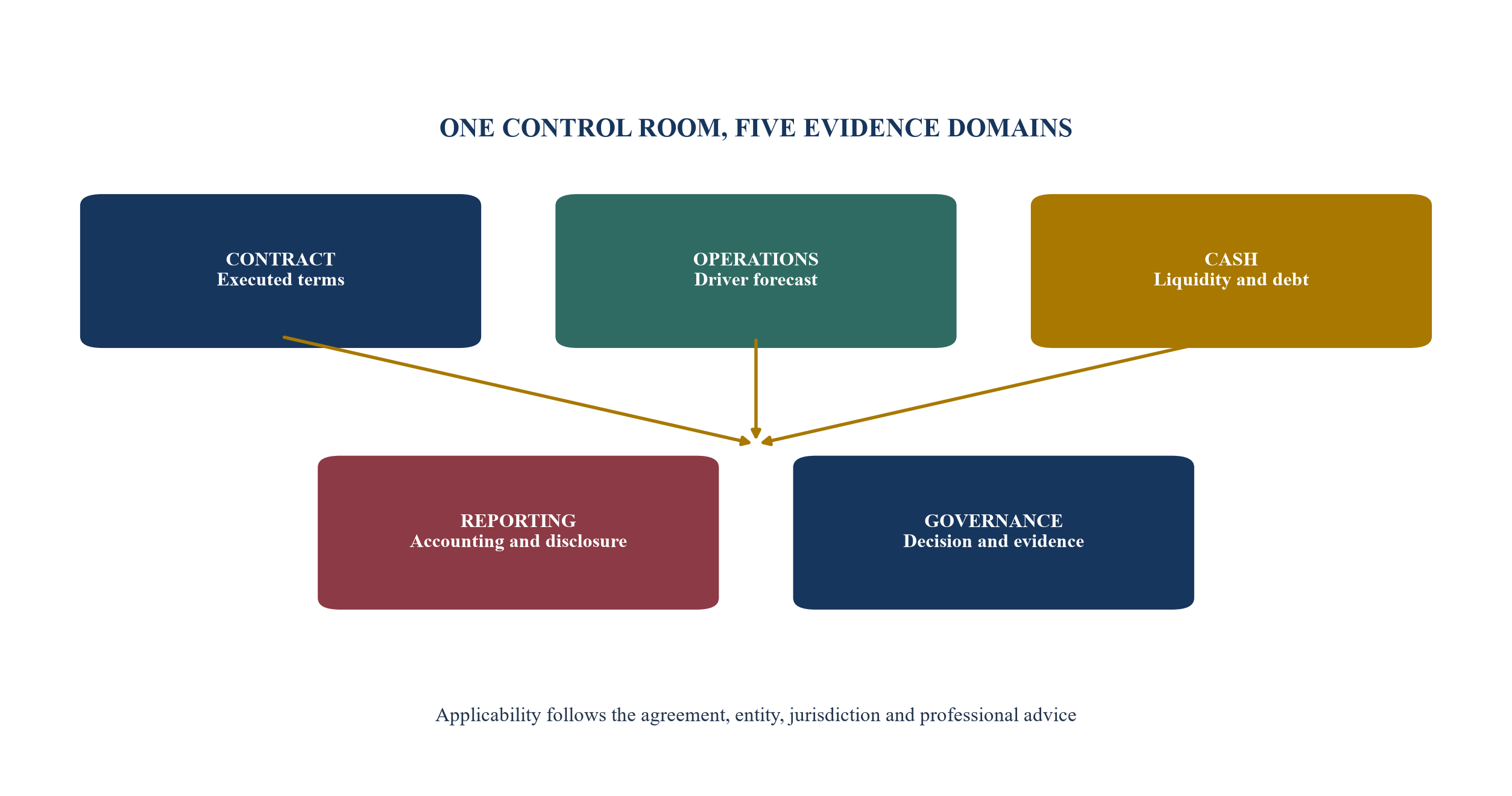
The company needs a contractual calculation, operating forecast, cash view, reporting assessment and governance decision.
19. Test the framework on a hypothetical portfolio company
Consider a hypothetical multi-site services company with a maximum net-leverage covenant of 5.0 times, an internal management buffer of 4.6 times and a minimum interest-cover covenant of 2.0 times. The latest certificate shows leverage of 4.15 times and interest cover of 2.55 times. These values are illustrative.
The first forecast refresh shows slower order conversion, margin pressure and a receivables delay. Base-case leverage rises to 4.36 times before declining. The combined downside reaches 5.16 times at the fourth forecast date. A permitted cost-saving adjustment of 1.5 hypothetical currency units supports the contractual case, while the prudent case excludes it until implementation evidence is complete.
The control room identifies three decision dates. The management buffer is crossed two quarters before the projected contractual breach. Liquidity reaches its low point one quarter earlier because restructuring costs and receivable delays precede the EBITDA benefit. An acquisition planned during the period would use availability and increase leverage before synergies are realised.
Management responds by validating price and cost actions, restricting discretionary capex, launching a customer-level collection plan and deferring the acquisition decision. Treasury tests hedge and refinancing options. The board authorises early lender engagement around a resilient covenant reset rather than waiting for the projected test date. The outcome remains unknown; the framework demonstrates sequence and evidence.
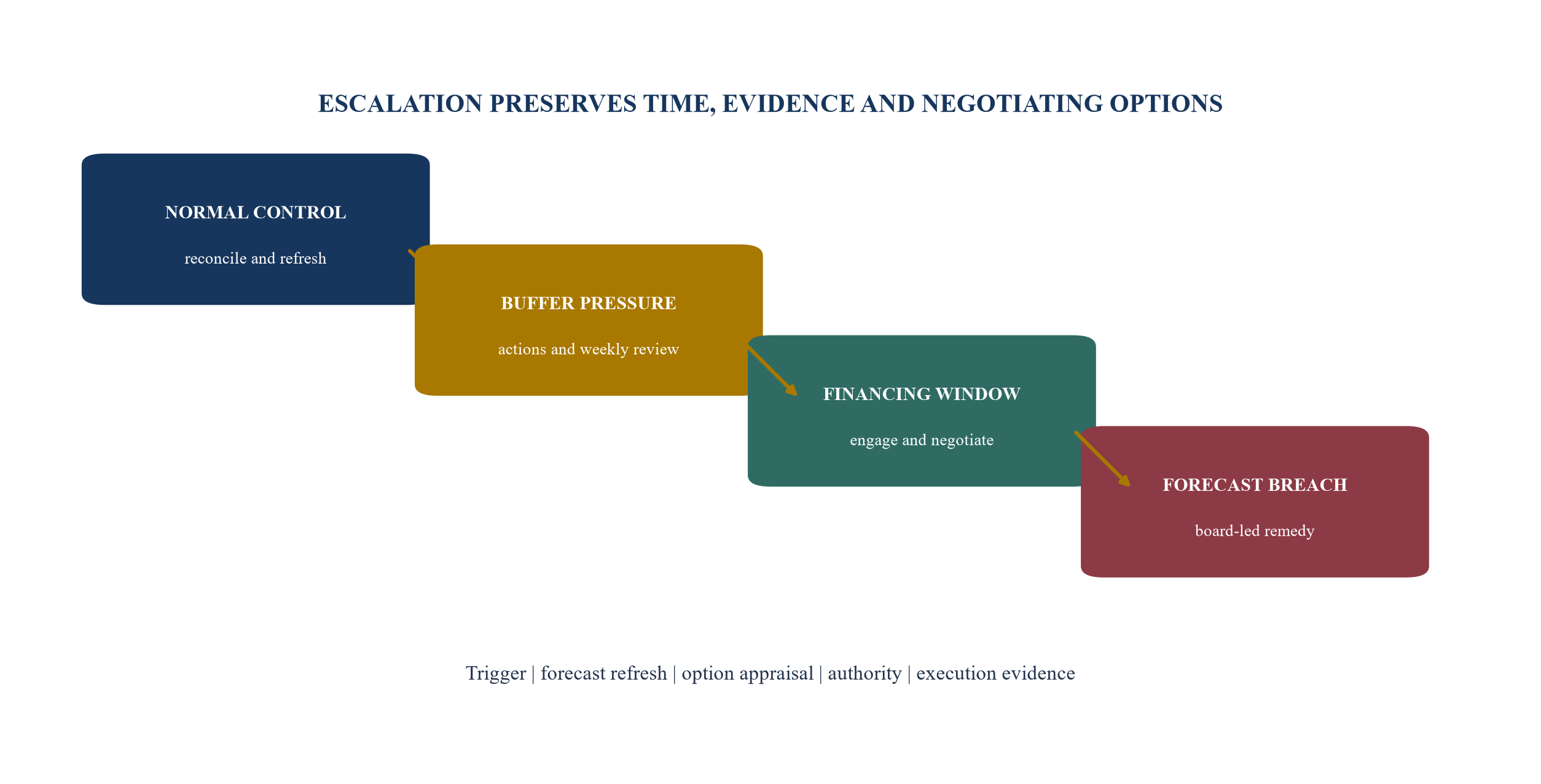
Values and trigger distances are hypothetical. Governance escalates before contractual headroom reaches zero.
20. Translate covenant control into financing and equity optionality
Covenant headroom has economic value through options rather than through a fixed valuation multiple. Adequate headroom can support continued facility availability, acquisition capacity, distributions, capex, customer confidence and an orderly transaction process. Weak headroom can increase pricing, fees, reporting, restrictions, refinancing risk and management distraction.
The value bridge should begin with observable financing and operating consequences. It can show interest, fees, advisory cost, cure equity, capex constraints, lost commercial actions, working-capital effects and transaction delay. Scenario values should remain ranges with explicit probability and timing assumptions.
Management should avoid double counting. A cost action can improve EBITDA and cash, reduce net debt and improve leverage. The equity effect should not count the same operational benefit once through cash, again through an assumed multiple and again as “covenant value”. The bridge should separate enterprise value, net debt, financing cost and ownership dilution.
The strongest economic claim is preserved optionality. A company that forecasts early and acts with evidence can compare operating, financing and transaction choices before urgency eliminates them. Actual value depends on execution, lender decisions, markets, legal terms and future performance.
Option value can be expressed without assigning a speculative valuation uplift. The board can compare the number of executable paths, time available, funding certainty, cash cost, dilution, restrictions and downside resilience under each case. This decision matrix makes the benefit of early control visible while retaining uncertainty about market value and lender behaviour.
21. Build a board pack that drives named decisions
The board pack should begin with decisions due, not a dense model output. It should state current compliance, next measurement date, base and downside headroom, liquidity low point, facility availability, adjustment confidence, early-warning triggers, certificates due and lender engagement.
Supporting pages should include the covenant inventory, definition changes, EBITDA bridge, debt and cash reconciliation, forecast term structure, scenario results, action register and certificate calendar. The pack should identify data or interpretation limitations and the owner of each resolution.
Trend and variance matter. The board should see movement from prior forecast, source of change and management response. A headroom improvement driven by lower capex or delayed payables has a different quality from sustained trading performance.
Minutes should record assumptions challenged, alternatives considered, conflicts, advice, decisions, delegated authority and follow-up. Corporate-governance standards emphasise board oversight, risk management and reliable information [6][7][27]. The control room provides the financing evidence for that responsibility.
Table 6. Covenant control-room board scorecard
| board field | current fact | forward view | confidence test | decision or action | accountable owner |
|---|---|---|---|---|---|
| compliance | latest approved ratios and threshold | next test dates | independent re-performance complete | approve certificate or correction | CFO |
| headroom | distance to threshold and buffer | base and downside term structure | key adjustments and drivers evidenced | operating or financing escalation | CFO and business owners |
| liquidity | cash, accessible liquidity and availability | low point and draw conditions | bank, debt and cash reconciled | funding and cash controls | treasurer |
| early warnings | triggered indicators | direction and lead time | source and predictive relevance | weekly review or action plan | FP&A and operations |
| lender process | latest formal engagement | requested outcome and timetable | shared forecast reconciles to board case | authority and negotiation range | CFO and counsel |
| reporting calendar | next certificate and information duties | completion plan | preparer, reviewer and evidence assigned | approve signatory and delivery | controller and company secretary |
The scorecard combines contractual status, forecast trajectory, evidence confidence and decisions.
22. Implement the first control cycle in one hundred days
Days 1 to 15 establish governance and perimeter. The CFO confirms executive sponsorship, owners, decision rights and escalation. Legal and finance assemble the executed document set, debt register and facility map. The team creates the covenant and undertaking inventory and locks the next measurement and reporting calendar.
Days 16 to 35 build the definition book and controlled calculation. Finance maps clauses to accounting, debt, cash and forecast data. Treasury reconciles balances, rates, hedges and availability. The reviewer re-performs the latest certificate and records interpretation or evidence gaps.
Days 36 to 60 integrate forecast and scenarios. FP&A connects operating drivers, monthly forecast and thirteen-week cash. Management defines base, downside and reverse-stress cases. The team sets board buffers, early-warning triggers and action lead times.
Days 61 to 80 operate the control room. Management runs weekly or monthly review according to risk, validates actions and prepares lender materials where required. The board reviews decisions, not only ratios. Certificate and information-covenant workflows are tested before the deadline.
Days 81 to 100 close the first cycle. Internal review tests model governance, evidence, access, versioning and completion. The board approves the recurring pack, lender strategy and next twelve-month calendar. Completion means the system is operating and exceptions are owned. It does not mean forecast uncertainty or financing risk has disappeared.
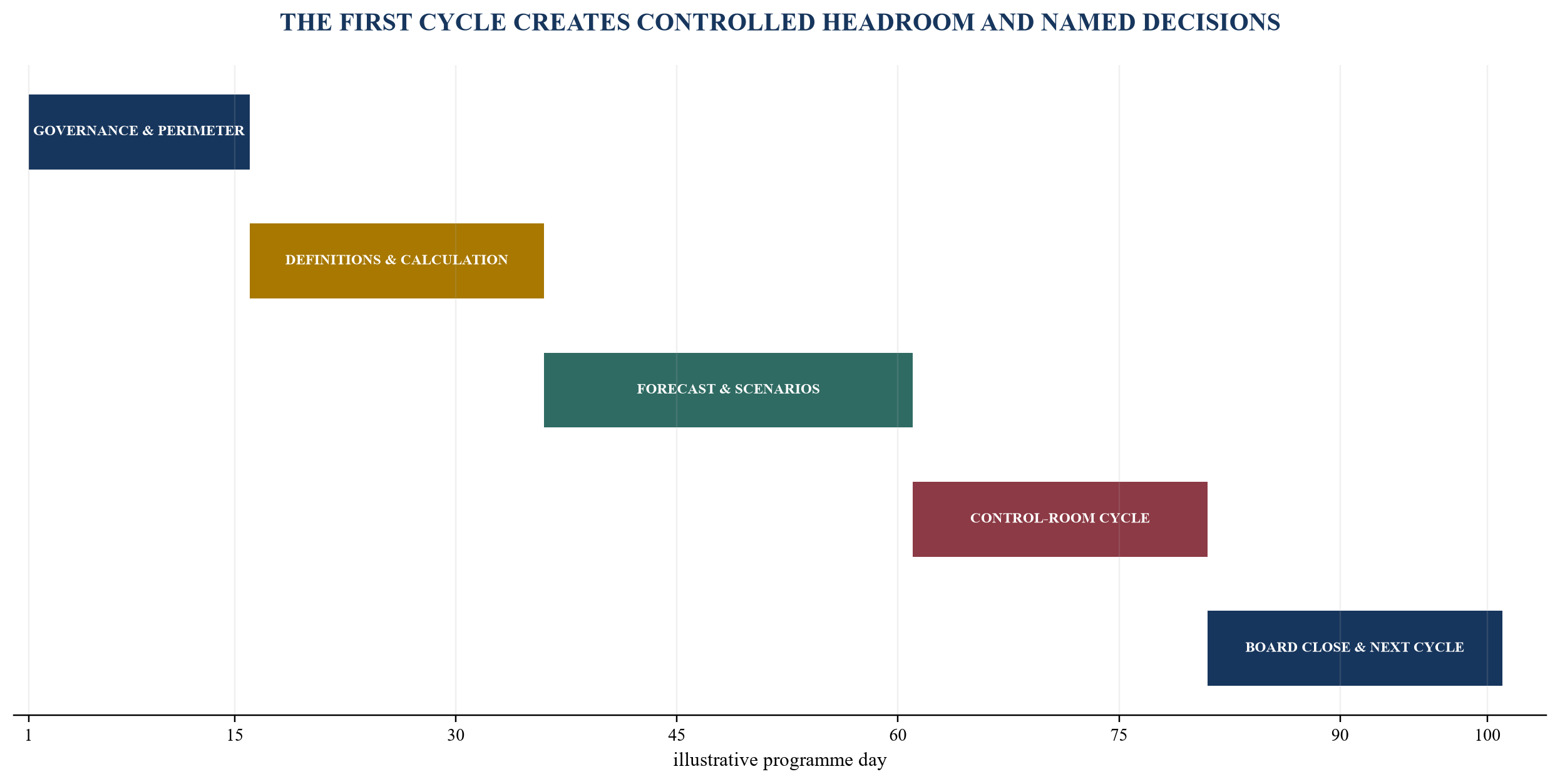
The first cycle moves from document authority and calculation control to scenario-led board decisions.
23. Recognise limits and govern the recurring process
The framework does not determine the legal meaning of a covenant, whether a breach has occurred, which accounting treatment applies, whether directors have met their duties or how a lender will respond. Those conclusions depend on executed documents, law, reporting standards, evidence, professional advice and lender action.
Forecasts remain uncertain. Revenue, margin, working capital, interest, foreign exchange, acquisitions, disposals and management actions can differ from plan. A scenario tests specified assumptions and does not predict every path. A management buffer supports escalation and does not change the contract.
Data and models also have limits. A controlled spreadsheet can still contain an incorrect interpretation. A system can reconcile to the ledger while excluding a contractual item. An approved adjustment can later lose evidence. The recurring cycle needs version control, independent review, actual-to-forecast learning and prompt change management.
The covenant control room gives the board a disciplined way to see financing pressure early. It joins the executed agreement, reconciled data, operating forecast, cash position, downside scenarios, early-warning triggers and decision rights. Its practical output is time: time to improve performance, preserve liquidity, engage lenders, compare terms and protect transaction options before the next board meeting becomes a breach meeting.
References
- IFRS Foundation, IASB Amends Accounting Standard to Improve Information about Long-term Debt with Covenants, https://www.ifrs.org/news-and-events/news/2022/10/iasb-amends-accounting-standard-to-improve-information-about-long-term-debt-with-covenants/
- IFRS Foundation, IAS 1 Presentation of Financial Statements, 2024 Issued Standard, https://www.ifrs.org/content/dam/ifrs/publications/pdf-standards/english/2024/issued/part-a/ias-1-presentation-of-financial-statements.pdf?bypass=on
- IFRS Foundation, IAS 1 Presentation of Financial Statements, https://www.ifrs.org/issued-standards/list-of-standards/ias-1-presentation-of-financial-statements.html/
- IFRS Foundation, IASB Increases Transparency of Companies' Supplier Finance, https://www.ifrs.org/news-and-events/news/2023/05/iasb-increases-transparency-of-companies-supplier-finance/
- IFRS Foundation, IFRS 7 Financial Instruments: Disclosures, https://www.ifrs.org/issued-standards/list-of-standards/ifrs-7-financial-instruments-disclosures/
- Financial Reporting Council, UK Corporate Governance Code 2024, https://media.frc.org.uk/documents/UK_Corporate_Governance_Code_2024_a2hmQmY.pdf
- Financial Reporting Council, Corporate Governance Code Guidance, https://www.frc.org.uk/library/standards-codes-policy/corporate-governance/corporate-governance-code-guidance/
- Financial Accounting Standards Board, ASU 2014-15 Going Concern, https://storage.fasb.org/ASU%202014-15.pdf
- Financial Accounting Standards Board, Guidance to Improve Reporting of Going Concern Uncertainties, https://fasb.org/page/getarticle?uid=fasb_NewsRelease08-27-14Body_0228221200
- Electronic Code of Federal Regulations, 17 CFR 210.12-04 Condensed Financial Information of Registrant, https://www.ecfr.gov/current/title-17/chapter-II/part-210/subject-group-ECFRba732fd3cf5b2c6/section-210.12-04
- European Banking Authority, Guidelines on Loan Origination and Monitoring, https://www.eba.europa.eu/activities/single-rulebook/regulatory-activities/credit-risk/guidelines-loan-origination-and-monitoring
- European Banking Authority, Final Report on Guidelines on Loan Origination and Monitoring, https://www.eba.europa.eu/sites/default/files/document_library/Publications/Guidelines/2020/Guidelines%20on%20loan%20origination%20and%20monitoring/884283/EBA%20GL%202020%2006%20Final%20Report%20on%20GL%20on%20loan%20origination%20and%20monitoring.pdf
- Bank for International Settlements, Principles for the Management of Credit Risk, 2025, https://www.bis.org/bcbs/publ/d595.pdf
- Bank for International Settlements, Stress Testing Principles, https://www.bis.org/bcbs/publ/d450.htm
- Bank for International Settlements, Basel Core Principles and Assessment Criteria, https://www.bis.org/basel_framework/chapter/BCP/40.htm
- Central Bank of the United Arab Emirates, Credit Risk Management Regulation, https://rulebook.centralbank.ae/en/rulebook/credit-risk-management-regulation
- Central Bank of the United Arab Emirates, Credit Risk Management Standards, https://rulebook.centralbank.ae/en/rulebook/credit-risk-management-standards
- Central Bank of the United Arab Emirates, Stress Testing of Material Risks, https://rulebook.centralbank.ae/en/rulebook/article-5-stress-testing-material-risks
- Saudi Central Bank, Rules on Credit Risk Management, https://rulebook.sama.gov.sa/en/circular-re-rules-credit-risk-management
- Saudi Central Bank, Stress Testing of Credit Risk, https://rulebook.sama.gov.sa/en/6-stress-testing-credit-risk
- Reserve Bank of India, Master Circular on Prudential Norms and Resolution of Stressed Assets, https://www.rbi.org.in/scripts/BS_ViewMasterCirculars.aspx?Id=12472
- Reserve Bank of India, Liquidity Risk Management Guidelines, https://www.rbi.org.in/scripts/NotificationUser.aspx?Id=7680
- Australian Prudential Regulation Authority, APS 220 Credit Risk Management, https://www.apra.gov.au/sites/default/files/2022-06/Final%20Prudential%20Standard%20APS%20220%20Credit%20Risk%20Management%20.pdf
- Australian Prudential Regulation Authority, CPS 220 Risk Management, https://www.apra.gov.au/standards/cps-220
- Australian Prudential Regulation Authority, CPG 220 Risk Management, https://www.apra.gov.au/practice-guides/cpg-220
- Monetary Authority of Singapore, Governance and Risk Management of Commodity Financing, https://www.mas.gov.sg/-/media/mas-media-library/publications/monographs-or-information-paper/imd/2025/information-paper-on-commodity-financing.pdf
- OECD, G20/OECD Principles of Corporate Governance 2023, https://www.oecd.org/en/publications/g20-oecd-principles-of-corporate-governance-2023_ed750b30-en.html
- United Kingdom Insolvency Service, Director Duties upon Insolvency, https://www.gov.uk/guidance/director-information-hub-director-duties-upon-insolvency
- Office of the Comptroller of the Currency, Leveraged Lending, https://www.occ.treas.gov/publications-and-resources/publications/comptrollers-handbook/files/leveraged-lending/index-leveraged-lending.html
- Board of Governors of the Federal Reserve System, Interagency Guidance on Leveraged Lending, https://www.federalreserve.gov/supervisionreg/srletters/sr1303.htm
- United States Securities and Exchange Commission, Management's Discussion and Analysis and Related Financial Information, https://www.sec.gov/rules-regulations/2020/11/managements-discussion-analysis-selected-financial-data-supplementary-financial-information
- Public Company Accounting Oversight Board, AS 2415 Consideration of an Entity's Ability to Continue as a Going Concern, https://pcaobus.org/oversight/standards/auditing-standards/details/AS2415
- International Auditing and Assurance Standards Board, ISA 570 Revised 2024 Going Concern, https://www.iaasb.org/publications/isa-570-revised-2024-going-concern
Sources and further reading
- IFRS Foundation, IASB Amends Accounting Standard to Improve Information about Long-term Debt with Covenants, Official source
- IFRS Foundation, IAS 1 Presentation of Financial Statements, 2024 Issued Standard, Official source
- IFRS Foundation, IAS 1 Presentation of Financial Statements, Official source
- IFRS Foundation, IASB Increases Transparency of Companies' Supplier Finance, Official source
- IFRS Foundation, IFRS 7 Financial Instruments: Disclosures, Official source
- Financial Reporting Council, UK Corporate Governance Code 2024, Official source
- Financial Reporting Council, Corporate Governance Code Guidance, Official source
- Financial Accounting Standards Board, ASU 2014-15 Going Concern, Official source
- Financial Accounting Standards Board, Guidance to Improve Reporting of Going Concern Uncertainties, Official source
- Electronic Code of Federal Regulations, 17 CFR 210.12-04 Condensed Financial Information of Registrant, Official source
- European Banking Authority, Guidelines on Loan Origination and Monitoring, Official source
- European Banking Authority, Final Report on Guidelines on Loan Origination and Monitoring, Official source
- Bank for International Settlements, Principles for the Management of Credit Risk, 2025, Official source
- Bank for International Settlements, Stress Testing Principles, Official source
- Bank for International Settlements, Basel Core Principles and Assessment Criteria, Official source
- Central Bank of the United Arab Emirates, Credit Risk Management Regulation, Official source
- Central Bank of the United Arab Emirates, Credit Risk Management Standards, Official source
- Central Bank of the United Arab Emirates, Stress Testing of Material Risks, Official source
- Saudi Central Bank, Rules on Credit Risk Management, Official source
- Saudi Central Bank, Stress Testing of Credit Risk, Official source
- Reserve Bank of India, Master Circular on Prudential Norms and Resolution of Stressed Assets, Official source
- Reserve Bank of India, Liquidity Risk Management Guidelines, Official source
- Australian Prudential Regulation Authority, APS 220 Credit Risk Management, Official source
- Australian Prudential Regulation Authority, CPS 220 Risk Management, Official source
- Australian Prudential Regulation Authority, CPG 220 Risk Management, Official source
- Monetary Authority of Singapore, Governance and Risk Management of Commodity Financing, Official source
- OECD, G20/OECD Principles of Corporate Governance 2023, Official source
- United Kingdom Insolvency Service, Director Duties upon Insolvency, Official source
- Office of the Comptroller of the Currency, Leveraged Lending, Official source
- Board of Governors of the Federal Reserve System, Interagency Guidance on Leveraged Lending, Official source
- United States Securities and Exchange Commission, Management's Discussion and Analysis and Related Financial Information, Official source
- Public Company Accounting Oversight Board, AS 2415 Consideration of an Entity's Ability to Continue as a Going Concern, Official source
- International Auditing and Assurance Standards Board, ISA 570 Revised 2024 Going Concern, Official source
