

1. The waiver request usually has a prehistory
A borrower rarely moves from stable performance to a waiver request in one step. Revenue can soften. Gross margin can narrow. Receivables can age. Supplier terms can shorten. Inventory can rise. Cash forecasts can become less reliable. Management accounts can arrive later. A sponsor can seek additional debt, distributions or acquisitions. Each event can reduce the lender's protection before the tested ratio formally fails.
The Central Bank of the UAE Credit Risk Management Standards require licensed financial institutions within their scope to monitor total indebtedness, financial performance and risk factors continuously and on a forward-looking basis. The standards call for suitable metrics and early-warning indicators at facility, obligor, group, segment and portfolio levels. They identify deterioration in revenues, margins, working capital, liquidity, leverage, asset quality, competitive position and management, as well as deterioration in covenants, among relevant indicators.[1]
Those requirements support a monitoring discipline extending beyond the pass or fail result. The same discipline is commercially useful for non-bank direct lenders, subject to their mandates, documents and applicable rules. A negotiated covenant has value only when the lender knows what it measures, receives reliable information, calculates it consistently, understands its trajectory and acts under valid authority.
This paper uses covenant drift as a defined author framework. It means the progressive loss of financial, informational or behavioural protection before a formal breach or waiver request. Drift can be quantitative, such as lower interest-cover headroom. It can be informational, such as repeated reporting delay. It can be structural, such as permitted debt accumulating across baskets. It can be behavioural, such as unexplained changes in forecasts, advisers or payment priorities.
The objective is earlier, better-governed credit judgement. A signal is not a default conclusion. It is an evidence-based reason to verify, engage, re-underwrite, escalate or protect the lender's position.
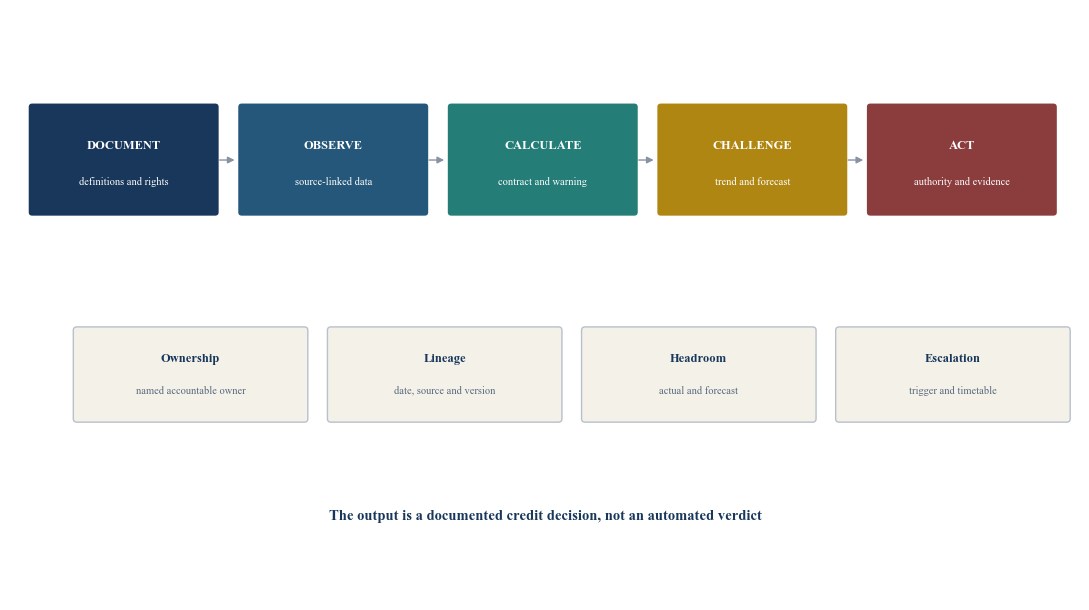
Author framework. Every action remains subject to executed documents, valid authority and professional advice.
2. Begin with the executed covenant package
Monitoring begins with executed documents rather than a spreadsheet inherited from origination. The authoritative package can include the facility agreement, amendments, side letters, intercreditor agreement, security documents, hedging, guarantees, fee letters, accession documents, utilisation notices and formal waivers. The team should confirm completeness, governing law, counterparties, signatures, effective dates and amendment history.
The covenant dictionary translates that package into an operational record without rewriting the legal terms. It identifies each test, undertaking, information requirement, permitted action, basket, threshold, testing date, evidence source, cure, consequence and owner. The original clause and defined terms remain linked to every operational field.
A ratio label can conceal material differences. Net leverage can use gross debt or funded debt, allow or cap cash netting, include or exclude leases, treat shareholder instruments differently and permit specified add-backs. EBITDA can be historical, run-rate, pro forma or adjusted, with caps and timing restrictions. A covenant calculated accurately under the wrong definition is still wrong.
The lender should record hierarchy. A facility-specific definition can override a template. An amendment can change one threshold while leaving the formula intact. A side letter can alter reporting. An equity cure can affect the test period, cash, debt repayment and future cures. Covenant holidays and springing tests can switch according to utilisation or liquidity.
Table 1. Controlled covenant dictionary
| Field | Controlled content | Evidence | Owner and review |
|---|---|---|---|
| Covenant identity | unique name, clause and affected facilities | executed agreement and amendment register | legal and credit administration at onboarding and change |
| Calculation | numerator, denominator, inclusions, exclusions and signs | defined terms and approved calculation workbook | credit analyst each reporting cycle |
| Threshold | maximum, minimum or absolute requirement | covenant schedule and amendment history | credit administration validates version |
| Test date | monthly, quarterly, annual, incurrence or springing event | reporting clause and utilisation data | portfolio operations owns calendar |
| Evidence source | audited accounts, management accounts, certificate, bank data or valuation | document index and source record | analyst verifies date and provenance |
| Adjustments | permitted add-backs, pro forma effects, caps and look-forward periods | definition and supporting schedules | analyst calculates; independent reviewer challenges |
| Cure | type, amount, frequency, timing and downstream effect | cure clause and notices | legal, credit and operations confirm use |
| Consequence | information request, drawstop, default, pricing or other right | facility and enforcement analysis | authorised decision maker determines action |
| Waiver history | event, scope, consideration, conditions and expiry | signed waiver and committee record | credit administration maintains complete chronology |
| Change control | requested, approved and effective changes | redline, legal opinion and signed document | maker-checker control before production use |
The executed document remains authoritative. Legal interpretation requires transaction-specific advice.
3. Separate contractual compliance from early-warning analysis
The contractual calculation answers whether the borrower complied under the executed terms at the relevant test date. It should preserve every permitted adjustment, notice, cure, testing convention and certificate requirement. The lender should avoid changing this calculation informally because management believes a definition is aggressive.
The management early-warning view answers a different question: is repayment risk deteriorating? It can remove unsupported adjustments, use a current run rate, stress working capital, test cash without restricted balances, include known commitments and compare actual performance with the approved base case. Its purpose should be explicit. It must not be represented as the contractual result.
Displaying both views helps the lender avoid two errors. The first is a false breach created by ignoring valid contractual rights. The second is false comfort created by treating a compliant but highly adjusted ratio as proof of stable credit quality.
The bridge between the views should be reproducible. Each difference has a label, amount, evidence, permitted status and reviewer. Changes from the previous period remain visible. A recurring adjustment may signal a permanently weaker earnings base, even when it remains permitted.
Data quality also belongs in the analysis. A pass based on stale, incomplete or unaudited data has a different evidence quality from a pass supported by current audited information and a reconciled compliance certificate. The committee should see the result, headroom and evidence grade together.
4. Measure headroom and trajectory
Headroom is the distance between the calculated result and the contractual threshold, expressed in the unit that supports a decision. A maximum leverage covenant can show turns of headroom. A minimum debt-service coverage ratio can show ratio points. A minimum liquidity test can show currency. The direction and sign should be unambiguous.
Current headroom alone is insufficient. The lender should compare prior periods, borrower forecast, lender-adjusted forecast and stress case. It should identify which operational variables consume protection. A small revenue decline can have a larger covenant effect when margins and fixed costs amplify the movement. A working-capital outflow can cause a liquidity breach before it appears fully in leverage.
The forecast horizon should cover the next relevant test dates, debt service, major contracts, tax, capex, distributions, refinancing and seasonal cash needs. Management should state the source and date of each assumption. Scenarios should remain internally consistent. Lower revenue can affect margin, receivables, inventory, tax and liquidity together.
Trend flags should have a documented basis. Three consecutive quarters of lower headroom can deserve review even when the latest result remains comfortable. A sharp single-period movement can matter more than a gradual trend. Thresholds guide attention; credit judgement evaluates cause, persistence, reversibility and borrower response.
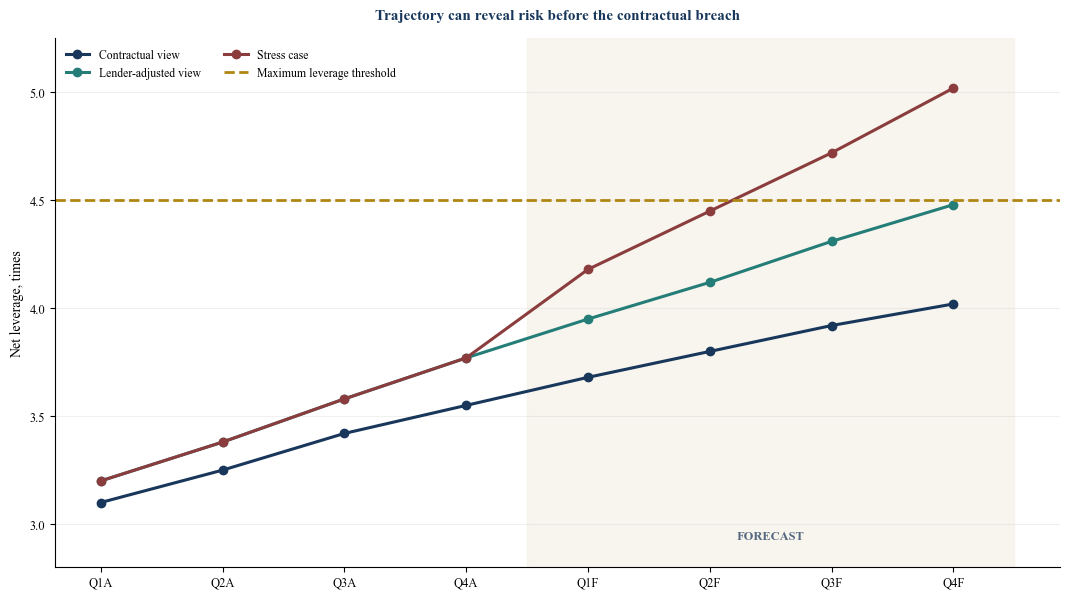
All ratio values and thresholds are illustrative management assumptions.
5. Create a signal hierarchy
The monitoring system should collect financial, liquidity, operational, informational, structural, collateral, market and behavioural signals. Each signal needs a definition, source, frequency, owner and response time. A long uncontrolled list produces alerts without decisions.
Financial signals can include revenue, gross margin, EBITDA, cash conversion, leverage, coverage, capex, tax and forecast variance. Liquidity signals can include cash, available facilities, overdraft use, payment delays, ageing, inventory and supplier terms. Operational signals can include customer loss, project delay, utilisation, churn, claims, production interruption or key-person departure.
Information signals can include late accounts, missing certificates, repeated corrections, reconciliation breaks or auditor changes. Structural signals can include new debt, security, acquisitions, disposals, distributions, related-party flows and use of baskets. Collateral signals can include insurance lapse, valuation decline, registration weakness, prior claims or deteriorating condition.
Behavioural signals require careful handling. A borrower challenging a calculation can have a legitimate interpretation. Concern increases when explanations conflict, requested evidence is withheld, projections change without support or agreed actions repeatedly slip. The lender should record evidence and avoid character conclusions unsupported by facts.
Signals become useful when they enter a funnel. The system verifies source and materiality, connects related events, re-underwrites repayment, identifies available rights and routes a decision. Low-quality or duplicate alerts are closed with a reason. Material signals remain open until the authorised action is completed or the evidence changes.
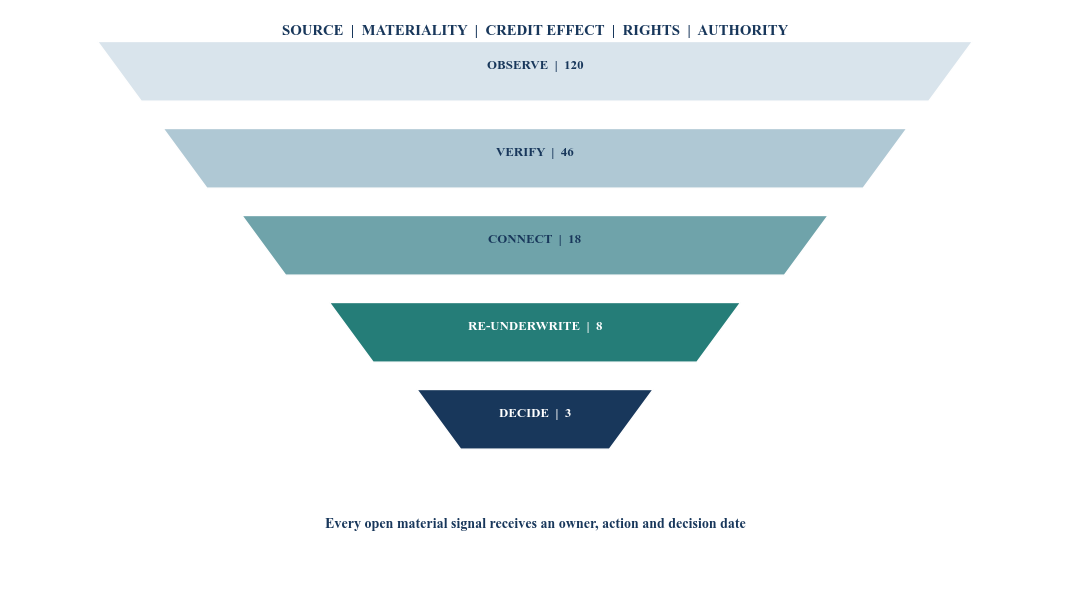
Author framework. Signal counts are illustrative management assumptions.
6. Align the signal with the action
A warning system should specify the next controlled action rather than apply a universal score. The action can include verification, a borrower meeting, additional information, reforecasting, independent review, collateral inspection, draw restriction, amendment, waiver, pricing, additional security, restructuring or enforcement preparation.
The executed documents determine available rights. A management alert does not create a contractual drawstop. A technical breach does not decide the lender's commercial response. The decision maker should see the evidence, contract, alternatives, value, timing, borrower viability, other creditors and portfolio implications.
Action timing matters. An information request can be immediate. A site visit can occur within days. A liquidity forecast can be required before the next utilisation. A formal reservation of rights or default notice requires counsel and authorised approval. The system should prevent an operational alert from triggering an unauthorised legal communication.
Table 2. Signal-to-action matrix
| Signal | Verification | Credit question | Controlled next action |
|---|---|---|---|
| Contractual headroom below internal watch level | recalculate from source and check definitions | what is driving the movement and when can the threshold fail? | borrower engagement, forecast and committee watchlist |
| Reporting late or repeatedly corrected | confirm obligation, receipt history and reason | is the lender losing reliable visibility? | cure timetable, enhanced reporting and information-right review |
| Cash below approved forecast | reconcile bank, working capital and payments | is liquidity temporary, structural or controlled by another creditor? | short-horizon cash flow, payment priorities and funding plan |
| Material add-backs increasing | inspect support, caps, timing and recurrence | does contractual compliance mask weaker underlying earnings? | dual calculation, re-underwriting and amendment discussion |
| New debt or security | review documents, registries and group records | is the action permitted and how does priority change? | legal review, consent decision or rights protection |
| Customer or contract loss | verify notice, economics and replacement plan | how does the event affect revenue, margin, cash and covenant dates? | integrated downside case and revised monitoring |
| Collateral value or insurance concern | obtain current evidence and independent review | has loss severity increased? | valuation, perfection, insurance or additional-support workstream |
| Covenant breach expected in forecast | validate timing, assumptions and mitigants | can the borrower restore compliance without harming repayment? | early amendment or restructuring pathway with authority |
| Actual material covenant breach | confirm calculation, notice, cure and legal status | which rights and value-preserving options are available? | reservation, waiver, amendment, drawstop or workout decision |
| Repeated waiver request | review full chronology and delivered conditions | is the original capital structure still sustainable? | comprehensive re-underwriting and restructuring review |
Actions depend on the executed documents, applicable law, authority and facts.
7. Use a transparent covenant-drift assessment
A lender can combine several dimensions into a transparent assessment. The purpose is prioritisation and consistency. It should not replace the underlying calculation or the competent credit decision.
One framework assesses six dimensions: contractual headroom, direction of travel, forecast stress, data quality and timeliness, qualitative events, and value protection. Each dimension can be green, amber, red or critical under documented criteria. The portfolio team records the evidence and explains overrides.
Aggregation should preserve severity. A critical data-integrity or unauthorised-security event should not be averaged away by several green financial indicators. Correlated ambers can deserve red treatment when they point to one liquidity or governance problem. The system should show the components and rationale rather than a single unexplained score.
The criteria require validation. The lender reviews whether alerts identified deterioration with enough lead time, which alerts were false, whether actions were completed and whether overrides improved decisions. Thresholds can be refined with evidence from the lender's own portfolio. Public generic thresholds should not be represented as predictive facts.
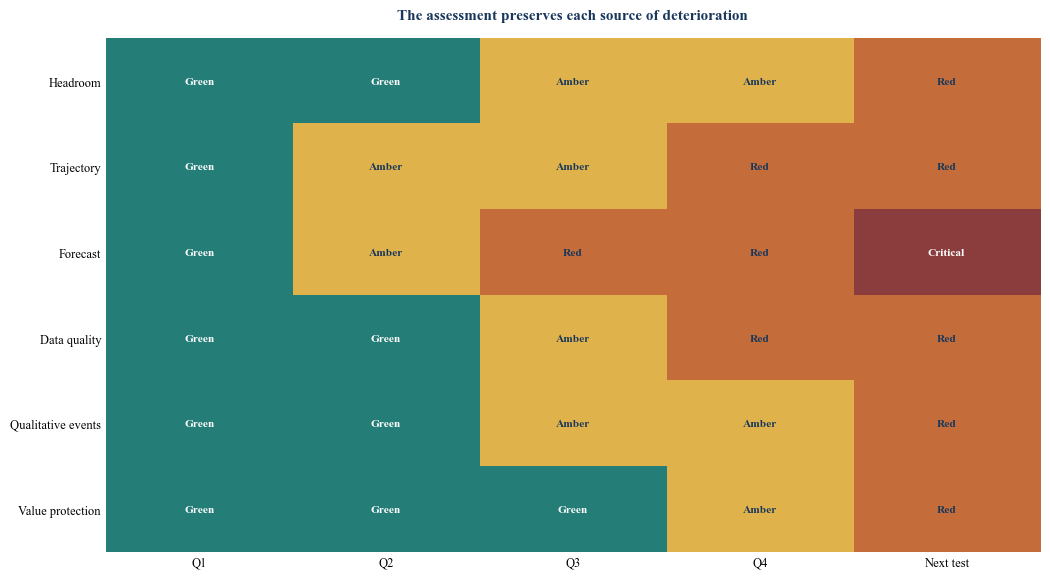
Colours and scores are illustrative management assumptions for workflow demonstration.
8. Treat reporting quality as a credit signal
Information covenants create the monitoring supply chain. The borrower can be required to deliver audited accounts, management accounts, compliance certificates, budgets, forecasts, bank statements, borrowing-base reports, insurance, valuations, capex reports and notices. The exact obligation comes from the documents.
The lender should maintain a calendar with due date, received date, completeness, source, version, owner, reviewer and open query. Repeated lateness or correction can reduce confidence. It does not automatically prove financial deterioration. The analyst should establish cause and effect.
Borrower-supplied calculations require independent checking proportionate to risk. The lender reconciles financial statements to covenant inputs, verifies debt and cash, tests adjustments, checks prior-period consistency and links material assumptions. A certificate signed on time can still contain a formula or source error.
Automation can improve version control, reminders, calculation and exception routing. Governance remains essential. Access should be controlled. Source files should be retained. Formula changes should use maker-checker approval. The system should display uncertainty and missing data. Automated extraction should not silently convert an unreadable document or ambiguous label into a credit fact.
Table 3. Borrower monitoring data pack
| Data item | Minimum control | Analytical use | Escalation example |
|---|---|---|---|
| Management accounts | period, entity, approval status and reconciliation | revenue, margin, cash conversion and covenant inputs | late, incomplete or unexplained variance |
| Compliance certificate | authorised signatory, formula and supporting schedule | contractual compliance and headroom | calculation difference or missing support |
| Rolling cash forecast | opening cash, receipts, payments, facilities and assumptions | near-term liquidity and debt service | minimum cash below plan or unsupported inflows |
| Debt schedule | lender, balance, maturity, rate, security and covenant | total indebtedness, priority and refinancing | unknown facility, new security or maturity gap |
| Working-capital detail | receivables, payables, inventory and ageing | cash conversion and concentration | ageing deterioration or disputed balances |
| Budget and reforecast | version, approval, bridge and assumptions | forward covenant and repayment analysis | repeated downward reset without action plan |
| Customer and supplier concentration | names, shares, contracts and renewal dates | operating dependency and event monitoring | material loss, dispute or shortening terms |
| Collateral and insurance | ownership, location, valuation, perfection and cover | recovery and loss severity | lapse, prior claim, value decline or access issue |
| Capex and distributions | approved plan, spend, funding and permissions | cash leakage and permitted-action review | unapproved spend or restricted payment |
| Waiver and condition log | signed terms, conditions, owners and expiry | chronology, consideration and compliance | condition overdue or repeated temporary relief |
Frequency and content depend on the loan documents and risk profile.
9. Re-underwrite before discussing a waiver
A waiver request should trigger a current credit analysis. The original underwriting can be outdated. The lender rebuilds repayment capacity, liquidity, leverage, coverage, enterprise value, collateral, priority, ownership, management, sector outlook, refinancing, documentation and downside.
The current Basel Committee Principles for the Management of Credit Risk organise sound banking practice around the credit-risk environment, credit granting, administration and monitoring, and controls. They require systems for administering portfolios, monitoring individual credits and the overall composition and quality of the credit portfolio.[2] The EBA Guidelines on Loan Origination and Monitoring likewise address governance and monitoring throughout the lifecycle for institutions within their EU scope.[5]
The waiver analysis should state why compliance failed or is forecast to fail. It should distinguish timing, temporary volatility, structural underperformance, acquisition integration, reporting error, definition dispute and capital-structure stress. The borrower plan should be tested against cash, operational capacity and stakeholder incentives.
The lender compares alternatives. These can include no action where no consent is needed, information enhancement, temporary waiver, permanent amendment, equity injection, cash sweep, pricing change, collateral, guarantee, reduced commitment, debt repayment, disposal, restructuring or enforcement. Each option has value, time, execution and relationship effects.
Other lenders and creditors matter. A bilateral lender can have rights constrained by intercreditor arrangements. A new-money provider can require priority. Trade creditors, tax, employees and secured parties can affect liquidity and recovery. Legal advisers should confirm the actual position.
10. Design the waiver decision record
A waiver is a governed transaction. The record should identify the precise event, calculation, date, affected obligation, requested relief, period, conditions, consideration and authority. It should distinguish a waiver of one event from a permanent amendment of future terms.
The lender should state what it receives. Consideration can include a fee, margin increase, additional information, equity, debt repayment, cash sweep, collateral, guarantee, restricted payments, capex controls, adviser appointment or milestones. The economics should reflect the risk and facts. A fee alone does not repair an unsustainable capital structure.
The document should reserve unaffected rights, define expiry and avoid ambiguity about repeated events. The committee pack should identify accounting, classification, impairment, valuation, tax, regulatory and conduct implications for relevant specialists. A covenant waiver can be relevant to credit deterioration without automatically determining every consequence.
Table 4. Waiver and amendment decision record
| Decision field | Required evidence | Committee question | Recorded output |
|---|---|---|---|
| Event | calculation, clause, date, notice and cure status | what occurred or is forecast to occur? | verified event description |
| Cause | operating, financial, structural, informational or technical analysis | is the issue temporary, reversible and within management control? | source-linked cause assessment |
| Credit case | actuals, forecast, liquidity, leverage, recovery and stress | can the borrower repay under the proposed structure? | updated base and downside case |
| Request | duration, scope and proposed terms | is a waiver sufficient or is amendment required? | exact relief and expiry |
| Consideration | fee, pricing, repayment, equity, collateral, controls or milestones | does the package improve risk-adjusted value and protection? | quantified and documented consideration |
| Alternatives | hold, reject, amend, restructure, sell or enforce | which feasible option preserves the best governed value? | option comparison and rationale |
| Stakeholders | borrower, sponsor, lenders, agent, creditors and advisers | whose consent or action is required? | responsibility and consent map |
| Consequences | accounting, classification, impairment, valuation, tax and regulation | which specialist determinations are triggered? | assigned analyses and conclusions |
| Authority | mandate, delegation, conflicts and escalation | who can approve every element? | resolution, recusals and conditions |
| Monitoring | reporting, milestones, tests and review dates | how will the lender know whether the plan works? | owner, calendar and action ladder |
Legal drafting, rights and consequences require transaction-specific professional advice.
11. Avoid serial temporary relief
Repeated short waivers can postpone a necessary capital-structure decision. Each event should be assessed on current evidence. The chronology can reveal whether management delivered the previous forecast, equity, disposal, reporting, collateral or cost action.
An extension can be reasonable when a defined transaction or temporary event needs more time and the lender's position remains protected. It becomes weaker when milestones repeatedly move, forecasts reset downward, consideration fails to compensate for risk or liquidity depends on uncertain funding.
The lender should compare the new request with the last committee thesis. Which assumptions held? Which failed? What cash was generated? What actions were completed? What additional value or control is available now? A documented variance review reduces the risk that each waiver is considered in isolation.
Evergreen exceptions also deserve attention. A policy deviation, calculation override or reporting concession can become normal through repetition. The CBUAE standards require active monitoring and consolidated reporting of credit facilities with deviations from credit policy, underwriting standards or risk appetite for institutions within scope.[1] A direct lender can apply the same governance principle to mandate, covenant and process exceptions.
12. Connect covenants to classification and impairment
Covenant information contributes to credit classification and impairment analysis. It should not be used as a mechanical substitute for the applicable accounting or regulatory assessment.
IFRS 9 requires entities to assess whether credit risk has increased significantly since initial recognition using reasonable and supportable information, including forward-looking information. Relevant indicators can include changes in financial performance, liquidity, leverage, operating results, business conditions, collateral and other credit-risk factors.[3]
The CBUAE standards state that a breach of a material covenant can be relevant to significant increase in credit risk and classification for licensed financial institutions within their scope.[1] The institution should assess materiality, circumstances, cure, borrower condition and all other available information according to the applicable requirements.
A waiver can change expected cash flows, probability, timing, rights and recovery. Accounting specialists determine modification, derecognition, staging, expected credit loss, interest recognition and disclosure under the actual terms. Credit committees should receive that analysis before approving a structure with a material financial-reporting effect.
The lender should reconcile the covenant watchlist, risk rating, classification, impairment, valuation and workout lists. Differences can be valid because the measures serve distinct purposes. Every difference should have an owner and documented rationale.
13. Model recovery before protection erodes
Recovery work should begin while information and options remain available. The analysis identifies claim, priority, security, guarantees, intercreditor rights, enterprise value, collateral, cash, working capital, jurisdiction, insolvency ranking, cost, delay and operating continuity.
Gross collateral value is not recovery. Prior claims, tax, employees, preservation, sale cost, legal cost and time reduce value. A forced sale can damage the operating business. A going-concern restructuring can preserve enterprise value while requiring new money and stakeholder agreement.
Covenant drift can affect recovery before default. New permitted debt can dilute value. Asset disposal can reduce collateral. Deferred maintenance can lower condition. Cash leakage can move value outside the obligor. Delayed action can reduce optionality. The lender should monitor the rights and value bridge alongside the financial ratio.
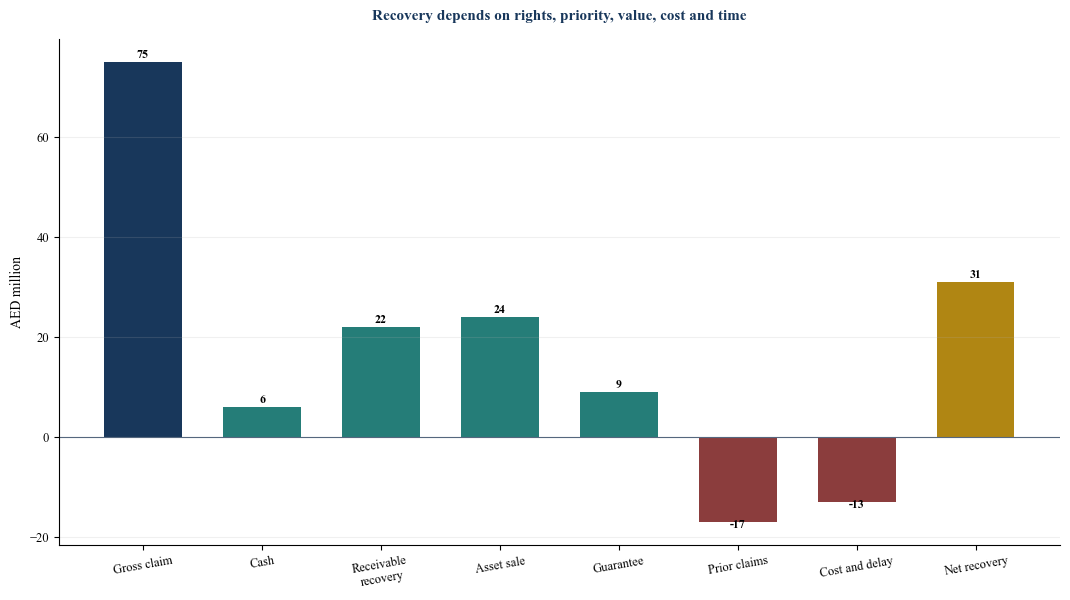
All amounts are illustrative management assumptions in AED millions.
14. Demonstrate the method with a hypothetical borrower
Consider a hypothetical UAE-based private-credit fund with a senior secured AED 75 million facility to a GCC business-services group. Every amount, ratio, date, forecast, probability, recovery and outcome in this example is a management assumption created solely to demonstrate the framework. It does not describe a fund, borrower, transaction, market price or recommendation.
The assumed facility has a maximum net-leverage covenant of 4.5 times, a minimum fixed-charge coverage ratio of 1.25 times, a minimum-liquidity requirement of AED 8 million and quarterly reporting. The hypothetical documents permit specified acquisition and restructuring add-backs within limits and require consent for additional secured debt.
At the first quarter test, net leverage is 3.10 times. By the fourth quarter it is 3.55 times under the contractual calculation and 3.77 times after the lender removes unsupported future savings from its early-warning view. Contractual compliance remains. Cash conversion weakens because receivables age and two customers extend payment.
Management's next-year forecast assumes revenue growth, margin recovery and collection of overdue balances. The lender's adjusted forecast applies current run-rate revenue, a slower collection profile and only evidenced cost savings. It produces net leverage of 4.48 times by the fourth forecast quarter. The stress case reaches 5.02 times and minimum liquidity falls below the assumed threshold two quarters earlier.
The borrower also delivers one compliance certificate 18 days late and seeks consent for a small secured equipment facility. Each event is assessed on evidence. The reporting delay alone does not prove distress. The proposed security could affect priority. The combined trajectory justifies re-underwriting and early engagement before any formal waiver request.
The fund places the exposure on an amber watchlist, requires a 13-week cash forecast, commissions a receivables review, declines the secured-debt request in its proposed form and opens an amendment discussion. The hypothetical amendment includes an equity contribution, debt repayment, revised information, a cash sweep and covenant reset. Completion remains conditional on due diligence, documentation and competent approval. No transaction outcome is claimed.
Table 5. Hypothetical covenant-drift case
| Measure | Current evidence | Forecast or issue | Governed response |
|---|---|---|---|
| Facility | AED 75m senior secured | 28 months assumed remaining | confirm balance, rights and security |
| Net leverage | 3.55x contractual; 3.77x adjusted | 4.48x adjusted forecast; 5.02x stress | dual calculation and early re-underwriting |
| Covenant threshold | maximum 4.50x | forecast protection nearly exhausted | amendment considered before breach |
| Fixed-charge coverage | 1.44x | 1.28x adjusted forecast | test debt service and downside |
| Minimum liquidity | AED 12m | AED 6m in stress | 13-week cash forecast and controls |
| Receivables | ageing deteriorated | two customers pay later | independent ageing and collectability review |
| Reporting | one certificate 18 days late | cause under review | enhanced calendar and evidence requirements |
| Additional secured debt | borrower requests AED 6m | priority effect requires analysis | consent declined in proposed form |
| Hypothetical support | none completed | equity and repayment proposed | verify funds, conditions and documents |
| Recovery | AED 31m central estimate | AED 22m severe case | update rights, collateral, cost and timing |
| Status | contractual compliance assumed | forecast covenant pressure | amber watchlist with decision timetable |
| Outcome | no breach or waiver claimed | amendment remains conditional | competent committee retains approval |
Every value, event and decision is an illustrative management assumption.
15. Monitor concentrations and common drivers
Covenant monitoring should aggregate beyond the borrower. Portfolio deterioration can arise from common revenue exposure, commodity prices, real-estate cycles, interest rates, currencies, sponsors, maturities, covenant definitions or add-back practices.
The CBUAE standards require monitoring at several levels of granularity, including facility, obligor, consolidated group, segment and portfolio, for institutions within their scope.[1] A private-credit fund can similarly map watchlist exposure by sector, jurisdiction, sponsor, vintage, seniority, maturity, rating and covenant type according to its mandate.
The portfolio dashboard should distinguish contractual breaches, forecast breaches, amber drift, late information, waivers, amendments, conditions and completed remediation. It should show funded and committed exposure. A low count can conceal high concentration. A high count can reflect one shared data issue.
The IMF's April 2024 analysis of private credit identified opacity, valuation, leverage, liquidity and monitoring considerations and encouraged stronger risk management and supervision as the market grows.[4] The analysis is global and does not establish the condition of a specific GCC portfolio. It supports the need for evidence-led portfolio visibility.
Committee reporting should include movement. New cases, escalations, cures, exits, repeated waivers and overdue actions reveal whether the process is working. A static red-amber-green snapshot can hide a worsening trend.
16. Build a decision dashboard
The dashboard should answer six questions. What changed? Is the contractual calculation correct? How much actual and forecast headroom remains? What drives repayment risk? Which rights and protections are available? What decision is required by when?
Each card should link to source evidence. The responsible owner confirms data date, confidence and open limitations. The dashboard should avoid decorative precision. A probability unsupported by portfolio evidence can create false confidence. Ranges and qualitative judgements should show their basis.
The action panel records owner, deadline, authority and completion evidence. A committee decision is not complete when minutes are signed. Conditions, documentation, monitoring changes, borrower notices and system updates must be closed.
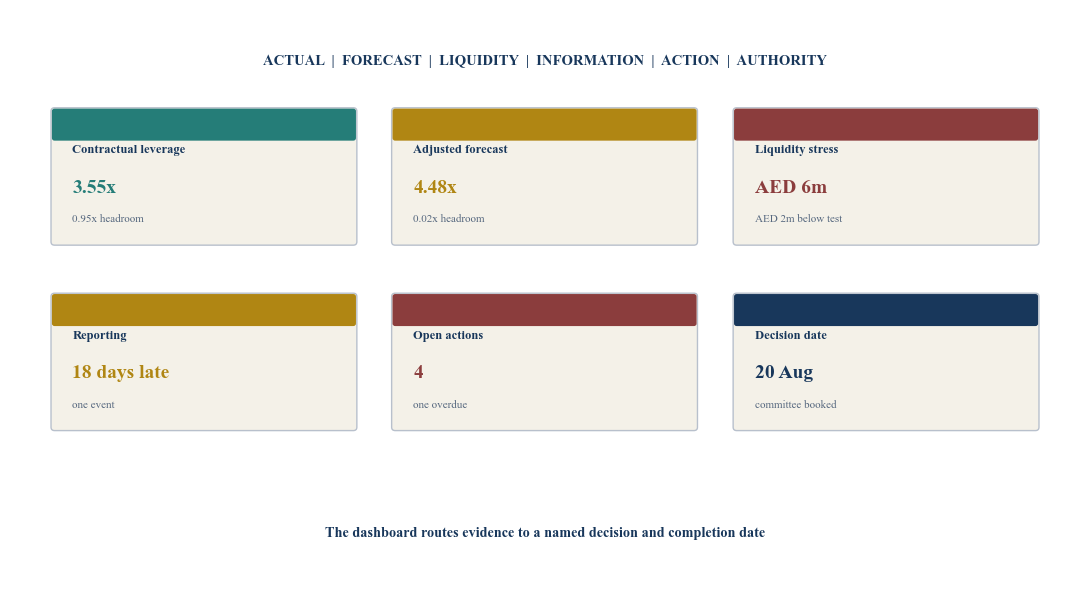
Every displayed value is an illustrative management assumption.
17. Implement the operating model in 100 days
The first 15 days establish sponsor, scope, portfolio, authority, legal and regulatory perimeter, accounting ownership and current pain points. The team inventories documents, systems, calculations, calendars, waivers, watchlists and open conditions.
Days 16 to 35 build the covenant dictionary and document hierarchy. Material facilities are reconciled to executed terms. The team defines data sources, evidence grades, contractual and early-warning calculations, change control and borrower delivery calendars.
Days 36 to 55 create signal definitions, headroom trends, forecasts, watchlist criteria and action ladders. Credit, legal, finance, operations and portfolio management agree responsibilities and escalation. Technology automates only controlled logic.
Days 56 to 75 pilot the model on selected exposures across risk grades. Independent reviewers recalculate covenants, test data lineage, review false alerts, assess borrower communications and validate committee outputs.
Days 76 to 90 expand portfolio reporting, concentration analysis, waiver chronology and condition tracking. Days 91 to 100 approve procedures, train owners, close critical control gaps and establish periodic validation.
Table 6. One-hundred-day covenant-drift programme
| Days | Workstream | Controlled deliverable | Gate |
|---|---|---|---|
| 1 to 10 | mandate | scope, sponsor, authority, risk appetite and success measures | governing body confirms accountable owners |
| 11 to 20 | inventory | facility, document, covenant, waiver, system and action map | completeness gaps assigned |
| 21 to 30 | dictionary | clauses, formulas, tests, cures, rights and evidence | legal and credit administration validate material terms |
| 31 to 40 | data lineage | sources, dates, versions, access and maker-checker controls | calculations reproduce from retained evidence |
| 41 to 50 | early warning | headroom, trend, forecast, qualitative and value signals | criteria and action times approved |
| 51 to 60 | workflow | calendar, ownership, escalation, authority and completion evidence | no alert or decision lacks an owner |
| 61 to 70 | pilot | selected borrowers recalculated and re-underwritten | material differences resolved or escalated |
| 71 to 80 | waiver governance | decision template, chronology, conditions and expiry | current waivers reconcile to signed terms |
| 81 to 90 | portfolio view | exposure, concentration, movement and common-driver dashboard | committee accepts data and limitations |
| 91 to 100 | embed and validate | procedures, training, access, testing and review calendar | sponsor signs controlled production release |
Timing depends on portfolio size, documentation, systems, data and governance.
18. Limitations and conclusion
Covenant drift is an author framework, not a defined legal or accounting term. It organises evidence concerning the progressive loss of financial, informational or behavioural protection before a formal breach or waiver request. The contractual result remains governed by the executed documents and applicable law.
The CBUAE credit-risk standards provide current, in-force requirements for licensed financial institutions within their scope, including continuous forward-looking monitoring, early-warning indicators, covenant deterioration, material covenant breach and active monitoring of deviations.[1] The Basel Committee principles provide a current global banking credit-risk architecture.[2] IFRS 9 provides accounting requirements concerning significant increases in credit risk and expected credit losses.[3]
The IMF analysis, EBA guidelines and ECB leveraged-transaction guidance provide relevant international context.[4][5][6] Their institutional, geographic and legal scopes differ. ECB guidance states that systems should flag weak covenant structures and track covenant breaches for credit institutions within its supervisory context.[6] None of these sources creates one contractual standard for all GCC private-credit lenders.
The hypothetical borrower, facility, ratios, thresholds, forecasts, signals, recovery values, amendment package and outcome in this paper are management assumptions for framework demonstration. They are not client information, market observations, probabilities or recommendations.
A robust operating model begins with the executed loan package. It translates terms into a controlled dictionary, keeps contractual and early-warning views separate, links calculations to source data, measures actual and forecast headroom, connects signals to authorised actions and re-underwrites the borrower before relief is granted.
The waiver record then preserves the event, cause, alternatives, consideration, rights, conditions, consequences and monitoring. Portfolio reporting reveals concentrations, common drivers, repeated exceptions and overdue actions. Recovery analysis begins while options remain.
This sequence gives lenders time to make better decisions. The benefit comes from reliable evidence, disciplined challenge, timely borrower engagement and completed governance actions before protection erodes further.
References
- [1] Central Bank of the UAE, Credit Risk Management Regulation and Credit Risk Management Standards, C 3/2024, effective 30 November 2024, status in force when accessed 13 August 2026. https://rulebook.centralbank.ae/en/rulebook/credit-risk-management-standards
- [2] Basel Committee on Banking Supervision, Principles for the Management of Credit Risk, 30 April 2025, current status when accessed 13 August 2026. https://www.bis.org/bcbs/publ/d595.htm
- [3] IFRS Foundation, IFRS 9 Financial Instruments, official standard overview and issued material, accessed 13 August 2026. https://www.ifrs.org/issued-standards/list-of-standards/ifrs-9-financial-instruments/
- [4] International Monetary Fund, Global Financial Stability Report, April 2024, Chapter 2: The Rise and Risks of Private Credit. https://www.imf.org/-/media/files/publications/gfsr/2024/april/english/ch2.pdf
- [5] European Banking Authority, Guidelines on Loan Origination and Monitoring, EBA/GL/2020/06, in force; consolidated page accessed 13 August 2026. https://www.eba.europa.eu/activities/single-rulebook/regulatory-activities/credit-risk/guidelines-loan-origination-and-monitoring?version=2020
- [6] European Central Bank, Guidance on Leveraged Transactions, May 2017, section on monitoring longer-term leveraged transaction holdings. https://www.bankingsupervision.europa.eu/ecb/pub/pdf/ssm.leveraged_transactions_guidance_201705.en.pdf
- [7] Central Bank of the UAE, Article 15: Internal Policies and Procedures for Finance Companies, including early detection and quantitative and qualitative indicators, official rulebook accessed 13 August 2026. https://rulebook.centralbank.ae/en/rulebook/article-15-internal-policies-and-procedures-0
- [8] Basel Committee on Banking Supervision, Core Principles for Effective Banking Supervision, 25 April 2024. https://www.bis.org/bcbs/publ/d573.htm
- [9] IFRS Foundation, IFRS 7 Financial Instruments: Disclosures, official standard overview, accessed 13 August 2026. https://www.ifrs.org/issued-standards/list-of-standards/ifrs-7-financial-instruments-disclosures/
- [10] Central Bank of the UAE, Standards for Loan Classification and Provisioning, official rulebook, accessed 13 August 2026. https://rulebook.centralbank.ae/en/rulebook/standards-loan-classification-and-provisioning
About the Author
Chennakeshav Adya is an independent researcher and Managing Partner of Matchpoint Partners. His research focuses on investment strategy, capital formation, transaction execution, governance and operating-model design across the Gulf and international markets.
