

1. Portfolio rotation is a credit decision
A direct lender can hold a performing loan to maturity and still have a reason to rotate it. The position can consume a concentration limit, create a maturity cluster, use regulatory or fund capital, reduce sector capacity or produce a return below the portfolio's current hurdle. A lender can also retain a stressed position because its information, control rights and recovery plan create more value than an external bid.
The CBUAE Credit Risk Management Standards require licensed financial institutions within their scope to review credit instruments and portfolios, escalate concerns and implement documented risk-mitigation actions. The stated actions include additional collateral, downgrade, restructuring, liquidation, sell-off, hedging and portfolio rebalancing.[1] A sale therefore belongs inside the credit-risk framework rather than outside it as a pure markets activity.
The first decision compares hold, amend, hedge, participate, sell and work out. Each option changes economics, liquidity, control, borrower relationship, accounting and operational exposure. A lender should state the objective before asking for a price: reduce single-name concentration; free capacity; manage maturity; crystallise a view; remove an out-of-strategy asset; transfer servicing; or acquire a loan with an attractive risk-adjusted return.
The decision should remain loan-specific and portfolio-aware. A discount can be acceptable when the capital or liquidity released has a higher governed use. A premium can be unattractive when legal, information or servicing risks are underestimated.
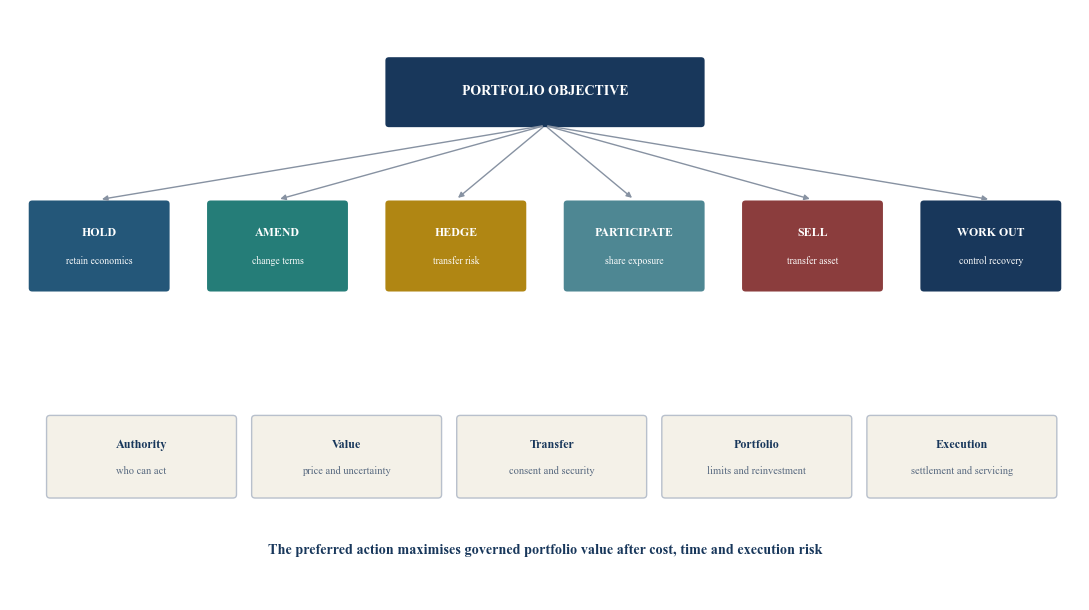
Author framework. Every option remains subject to valid authority, documentation and professional advice.
2. Define the secondary-market claim precisely
A secondary market can describe several mechanisms. A lender can assign its legal rights and obligations. It can transfer only the economic interest through a funded participation. A bank can transfer credit risk synthetically while retaining the asset. A portfolio can be sold through a special-purpose vehicle. A fund investor can sell an interest in the lending fund while the underlying loans remain in place.
These mechanisms have different legal, regulatory, accounting, capital, tax, control and borrower effects. A market-volume statistic that combines them can mislead. A GCC direct-loan secondary claim should state the instrument, jurisdiction, seller, buyer, transfer form, reference period and whether the number represents enquiry, face value, signed trade, settled trade or outstanding exposure.
The IMF's 2024 private-credit analysis described private credit as illiquid and its secondary market as incipient in the markets it examined.[8] A 2025 BIS Bulletin considered whether secondary markets could improve transparency and liquidity while noting tension with bespoke documentation, relationship lending and the illiquidity premium.[9] Those global observations do not establish GCC turnover or pricing.
Market development can be measured through verified indicators: eligible face value; assets marketed; bids received; trades signed; trades settled; time to diligence; bid dispersion; borrower-consent rate; settlement failures; and repeat buyers. A sponsor should publish only what its underlying evidence supports.
3. Establish the asset-eligibility gate
A saleable loan is more than a performing loan. The seller needs authority to transfer, a valid right or economic interest, a defined security position, a complete credit file, reliable servicing data and a lawful information-sharing path. The buyer needs capacity, mandate, licensing and operational readiness.
Eligibility begins with the facility agreement, intercreditor agreement, security documents, guarantees, agency terms, hedging, insurance and side letters. The review identifies assignment restrictions, eligible assignees, minimum transfer amounts, borrower or agent consent, notice, confidentiality, voting, pro rata sharing, tax gross-up, increased-cost protections and transfer fees.
Current UAE civil-transactions legislation contains provisions governing assignment of rights and debt.[5] The detailed effect, effectiveness against the debtor or third parties, available defences and treatment of security requires fact-specific legal advice. Other GCC jurisdictions and financial free zones can apply different regimes.
Table 1. Loan-secondary eligibility gate
| Gate | Evidence | Eligible condition | Escalation when unresolved |
|---|---|---|---|
| Seller authority | mandate, board or committee delegation and policy | sale fits valid authority and risk appetite | governing-body approval or stop |
| Asset ownership | facility records, participation and accounting ledger | seller's legal or economic interest reconciles | legal and accounting review |
| Transfer right | facility, intercreditor, agency and side letters | permitted route, conditions and eligible buyer identified | borrower, agent or lender consent plan |
| Credit file | agreements, financials, compliance, monitoring and notices | material file complete and current | data-room remediation |
| Security and guarantees | registrations, perfection, priority and valuation | transfer mechanics and continuing benefit confirmed | local counsel and security-agent review |
| Confidentiality and data | contractual permission, privacy and clean-team plan | lawful buyer access with controlled use | redaction, staged access or stop |
| Borrower and agent mechanics | consent, notice, fee, form and timing | executable sequence and responsibilities agreed | conditional bid and long-stop date |
| Buyer eligibility | mandate, licence, sanctions, KYC and funding | buyer can legally acquire and settle | compliance and legal escalation |
| Accounting and tax | classification, derecognition, tax and withholding analysis | treatment understood before binding decision | specialist opinion and price adjustment |
| Servicing and settlement | payment, reporting, records and transition plan | post-trade operating model tested | transitional servicing or delayed close |
The gate requires transaction-specific legal, regulatory, accounting and tax review.
4. Build one controlled information pack
The buyer should receive a source-linked credit file proportionate to the asset and stage of the process. The first pack can include an anonymised term sheet, sector, jurisdiction, maturity, pricing, amortisation, collateral, covenant state, risk rating, payment status and information timetable. Deeper access follows confidentiality, eligibility and conflicts clearance.
The full file can include executed documents, amendments, financial statements, management accounts, compliance evidence, ownership, facility history, collateral, guarantees, covenant calculations, waivers, correspondence, servicing records, insurance, valuations and recovery analysis. The seller should distinguish borrower-supplied facts, agent records, external evidence, internal analysis and management assumptions.
Data quality affects price. Missing security evidence, inconsistent balances, stale financials or unexplained waivers should not disappear inside a discount. They should remain visible as diligence conditions, valuation uncertainty or reasons to stop.
The seller should preserve equal and controlled access among comparable bidders, subject to conflicts and lawful restrictions. Every document should have a version, source, date, owner and access classification. A question log prevents private clarifications from creating unequal information.
5. Re-underwrite the loan from the buyer's perspective
A buyer acquires today's credit, documentation and portfolio effect. It should not rely on the seller's original approval. The buyer rebuilds the repayment thesis, obligor risk, facility structure, legal enforceability, security, covenants, downside, expected loss, recovery and monitoring plan.
The current Basel Committee Principles for the Management of Credit Risk organise sound bank practice around the credit-risk environment, credit granting, administration and monitoring, and controls.[2] The CBUAE standards require licensed financial institutions to maintain a comprehensive view of credit exposures and concentration, understand obligors, perform legal due diligence and independently challenge material credit decisions within their scope.[1]
The re-underwriting memorandum should show what changed since origination: leverage, earnings, cash conversion, ownership, management, contracts, regulation, security value, covenant headroom, lender group and refinancing conditions. A performing status can coexist with weakening evidence.
The buyer also evaluates rights. A loan with strong economics can be unattractive if information, voting, transfer, enforcement or security arrangements are weak. A discounted stressed loan can be attractive when the buyer has valid authority, specialist workout capability and a supported recovery case.
6. Construct a price bridge
Price should be explained through a bridge rather than a single percentage of par. The starting point is the remaining contractual cash-flow schedule, including principal, coupon, fees, amortisation and maturity. The buyer applies a market-participant required return consistent with the asset's current risk, currency, tenor, seniority, liquidity and structure.
The bridge then incorporates expected credit loss, downside timing, recovery, documentation weakness, transfer cost, servicing cost, information uncertainty and buyer-specific portfolio effects. Accounting fair value has its own purpose. IFRS 13 defines fair value as the exit price in an orderly transaction between market participants at the measurement date when another standard requires or permits fair value.[3] A lender's internal hold value, regulatory value, accounting carrying amount and negotiated transaction price can differ for valid reasons.
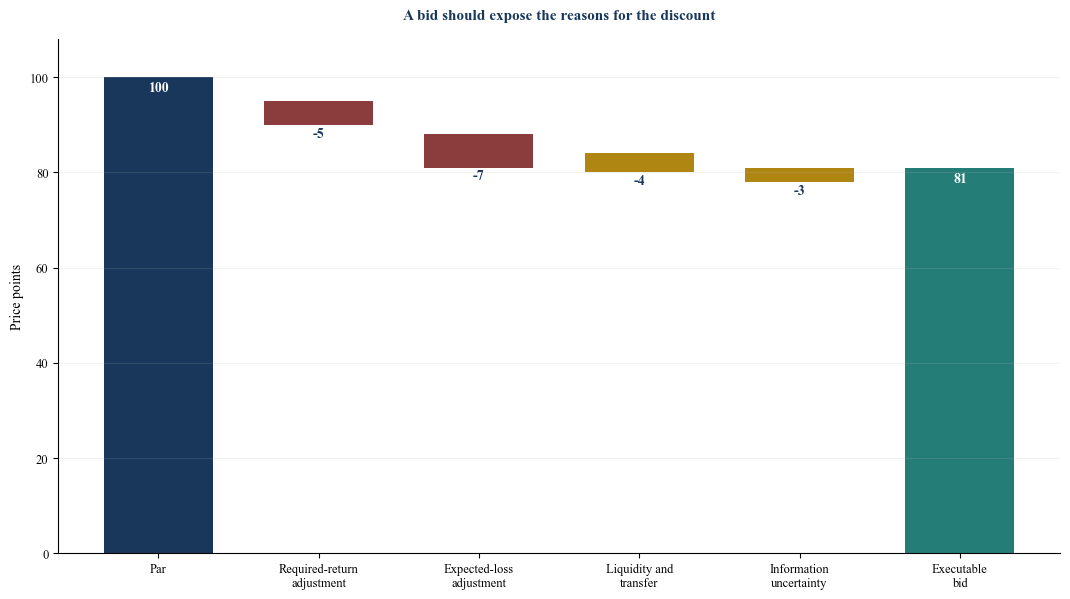
All values are illustrative management assumptions stated as points of par.
Table 2. Bid and valuation evidence matrix
| Evidence | What it informs | Control question | Possible price effect |
|---|---|---|---|
| Contractual cash flows | principal, coupon, fees, tenor and amortisation | are terms complete, valid and current? | base cash-flow schedule |
| Current borrower evidence | repayment capacity and trend | do financial and operating facts support the thesis? | required return and loss expectation |
| Comparable credit | market return and structure | is the comparison genuinely similar and observable? | discount rate and relative value |
| Indicative bids | buyer appetite at a point in time | are bids current, informed, firm and executable? | market calibration with evidence-quality label |
| Completed transactions | realised price and terms | are unit, date, rights and conditions comparable? | stronger market evidence when verified |
| Recovery analysis | downside amount, timing and cost | are rights, priority and collateral independently supported? | loss severity and floor |
| Transfer mechanics | consent, fee, delay and failure risk | can the selected buyer settle on the assumed date? | execution-cost and timing adjustment |
| Servicing model | collection, information and administration | who performs obligations after transfer? | recurring cost and operational-risk adjustment |
| Uncertainty range | method, inputs and evidence gaps | could reasonable alternatives change the decision? | range, reserve or conditional price |
Weight and treatment depend on the asset, measurement purpose and available evidence.
7. Present value uncertainty as a decision input
Illiquid credit valuation can involve several reasonable methods and assumptions. IVSC distinguishes value uncertainty from valuation risk: uncertainty can arise because reasonable methods or inputs produce a range, while valuation risk concerns process error or inadequate work.[6] The decision pack should show both.
A central estimate can be accompanied by an evidence-supported range. The range can vary required return, cash-flow timing, default probability, recovery amount, recovery delay and transfer completion. Correlated stresses should be considered. A lower enterprise value can reduce recovery and lengthen enforcement at the same time.
Third-party quotes need classification. An executable bid from an eligible funded buyer after diligence carries different evidence from an informal broker indication or a model-generated consensus. IFRS guidance emphasises that fair-value hierarchy classification depends on the inputs used rather than the name of a pricing service.[3]
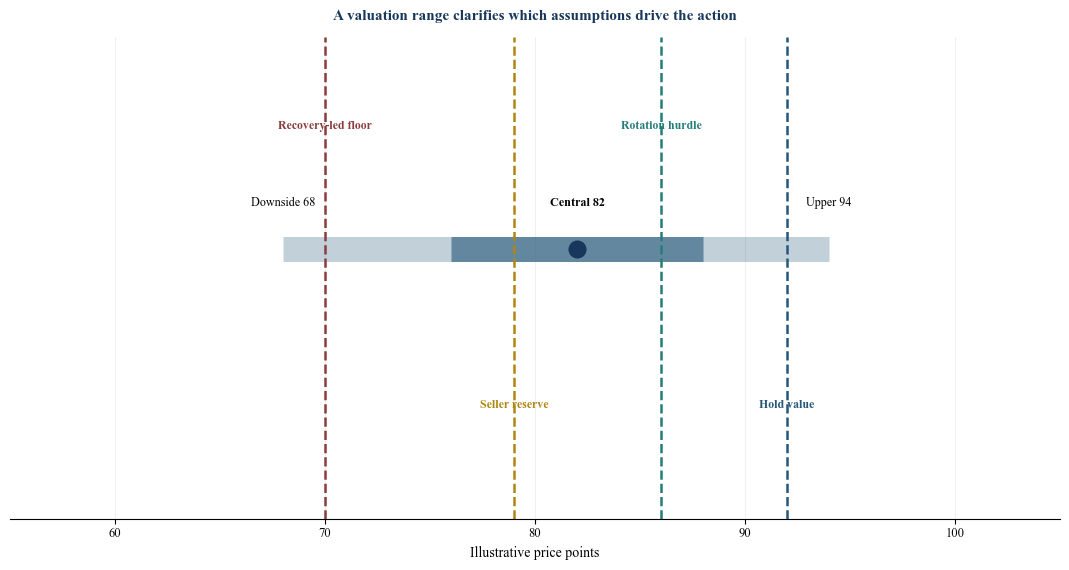
Values are illustrative management assumptions and do not represent market prices.
8. Design the transfer route before launching the sale
The transfer route determines who remains lender of record, who receives payments, who exercises votes, who controls enforcement and what the borrower sees. Assignment can transfer legal rights and obligations according to the documents and law. Participation can leave the seller as lender of record while transferring defined economics and risk to the participant. A synthetic arrangement can transfer credit risk without transferring the loan.
The CBUAE's published securitisation guidance discusses legal opinions, true sale, legal isolation and the treatment of sub-participation for recognition of risk transference within its scope.[7] A bilateral or portfolio loan sale requires its own analysis. The parties should avoid assuming that an economic transfer creates accounting derecognition, capital relief, legal isolation or security transfer.
IFRS 9 contains derecognition requirements for financial assets. When a transfer does not qualify because substantially all risks and rewards are retained, the transferor continues to recognise the asset and recognises a financial liability for consideration received.[4] Accounting advisers should assess the actual terms, continuing involvement and control.
Table 3. Transfer workplan from term sheet to settlement
| Stage | Seller deliverable | Buyer deliverable | Joint gate |
|---|---|---|---|
| Strategy | objective, authority, asset perimeter and conflicts | mandate, eligibility and funding | approved transaction route |
| Initial information | anonymised asset profile and process letter | confidentiality and eligibility confirmation | controlled diligence access |
| Re-underwriting | complete credit, legal, security and servicing file | independent credit memorandum and value range | material issues assigned to price, condition or stop |
| Transfer analysis | contractual restrictions, consents and notices | legal capacity, licensing and tax position | counsel-approved structure |
| Bid | price, accrued interest, fees and seller conditions | funded offer, assumptions, validity and approvals | comparable bid basis |
| Documentation | transfer form, representations and file schedule | buyer representations and settlement instructions | agreed rights, liability and deliverables |
| Consent | borrower, agent, lender and security steps | requested onboarding and KYC | required approvals obtained or valid waiver documented |
| Settlement | reconciled balance, cash and records | cleared funds and account readiness | simultaneous value and controlled title transfer |
| Handover | servicing history, notices, calculations and contacts | operational acceptance and monitoring plan | post-trade ownership and responsibility confirmed |
Requirements depend on the transaction, documents, parties and jurisdictions.
9. Protect borrower relationships and information
A lender can damage value by launching a poorly controlled sale. A borrower can interpret the process as a withdrawal of support, a signal of distress or a prelude to enforcement. The seller should determine when the borrower is engaged, who communicates, what can be disclosed and how the proposed buyer is assessed.
The borrower relationship does not override transfer rights. It remains an economic and conduct consideration. A credible buyer can bring new capacity, sector expertise or refinancing options. An unsuitable buyer can create operational friction, reputational concern or strategic conflict.
Information should be staged. Initial materials can be anonymised. Named borrower access follows confidentiality, conflict and eligibility clearance. Highly sensitive customer, employee, pricing, technology or personal data can require redaction, clean-team access or explicit permission. Data-protection obligations continue through diligence, settlement, retention and deletion.
The seller should record borrower feedback separately from its own credit and sale decision. A consent right can affect execution. A preference without contractual force can still affect relationship value and future origination.
10. Govern conflicts before price discovery
Conflicts can arise when the seller manages several funds, holds another part of the capital structure, has inside information, provides advisory services, finances the buyer or trades with an affiliate. A manager can seek liquidity for one vehicle while another vehicle benefits from acquiring the asset.
The conflict process should identify affected duties, information barriers, allocation, valuation, fees, approvals and disclosure. An affiliate transaction can require independent evidence, advisory-committee or board approval, fairness work or a competitive process according to the applicable mandate and law.
The person responsible for originating or managing the exposure should not unilaterally set the sale price, select the buyer and approve the accounting result. Independent credit, valuation, compliance and legal review should be proportionate to materiality.
Table 4. Conflict and conduct controls in a credit-secondary process
| Conflict | Risk | Control | Evidence |
|---|---|---|---|
| Affiliate buyer | value shifted between related vehicles | independent price evidence, recusal and competent approval | bids, valuation, conflict memo and resolution |
| Multiple managed funds | unfair allocation of opportunity or loss | documented eligibility and allocation rule | mandate comparison and allocation log |
| Seller financing | price inflated or risk retained | separate credit decision and full economic bridge | financing terms, risk transfer and approvals |
| Different capital positions | one position benefits at another's expense | position map, information barrier and independent review | exposure register and decision rationale |
| Inside information | unlawful or unfair trading and disclosure | restricted list, counsel review and controlled recipients | access log and clearance |
| Fee incentive | completion prioritised over value | fee disclosure and risk-adjusted performance measure | mandate, remuneration and committee pack |
| Borrower advisory role | confidential information or duty conflict | engagement review, consent and separate team where valid | conflict assessment and information controls |
| Valuation ownership | carrying value influences sale recommendation | independent validation and range | method, inputs, challenge and approval history |
Actual duties and approvals depend on the parties, mandates, regulation and facts.
11. Model recovery before setting a floor price
Recovery provides a downside reference rather than a guaranteed floor. The analysis identifies legal claim, priority, collateral, guarantees, cash sweep, intercreditor position, enforcement forum, insolvency ranking, cost, delay and operating continuity. It should reconcile exposure at the expected decision date.
Gross collateral value is not recovery. The lender deducts prior claims, tax, employees, preservation, professional cost, sale friction and time. It also considers whether value depends on the business continuing as a going concern.
A buyer with specialist workout capabilities may price a stressed loan above a passive investor. A seller with control rights, borrower knowledge and a credible restructuring path can have a higher hold value. Those differences should appear in the price bridge.
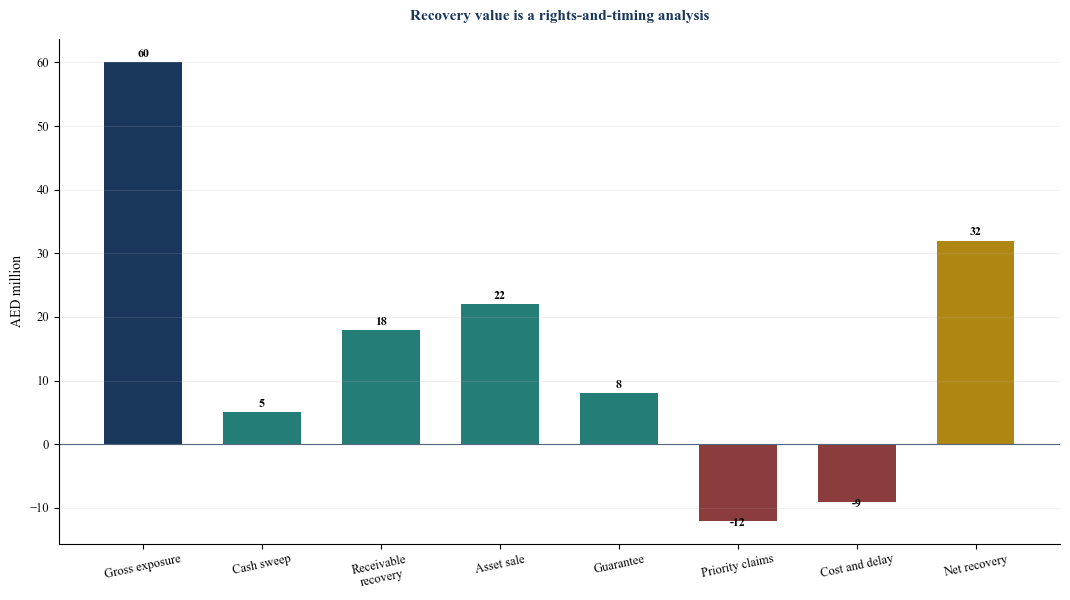
All values are illustrative management assumptions in AED millions.
12. Measure concentration before and after the trade
A sale changes several portfolio measures. Single-name, sector, sponsor, country, currency, maturity, seniority, risk grade and origination-vintage concentrations can move in different directions. Reinvestment can introduce a new risk before settlement benefits the portfolio.
The committee should compare the portfolio before sale, after sale and after proposed reinvestment. It should include committed but undrawn amounts, guarantees, hedges and related obligors. A face-value reduction can have a smaller effect on economic concentration when the asset is already marked down.
Liquidity should be measured through available cash and realistic settlement, not gross sale proceeds. Taxes, fees, accrued interest, withholding, hedge termination and delayed consent can affect usable proceeds.
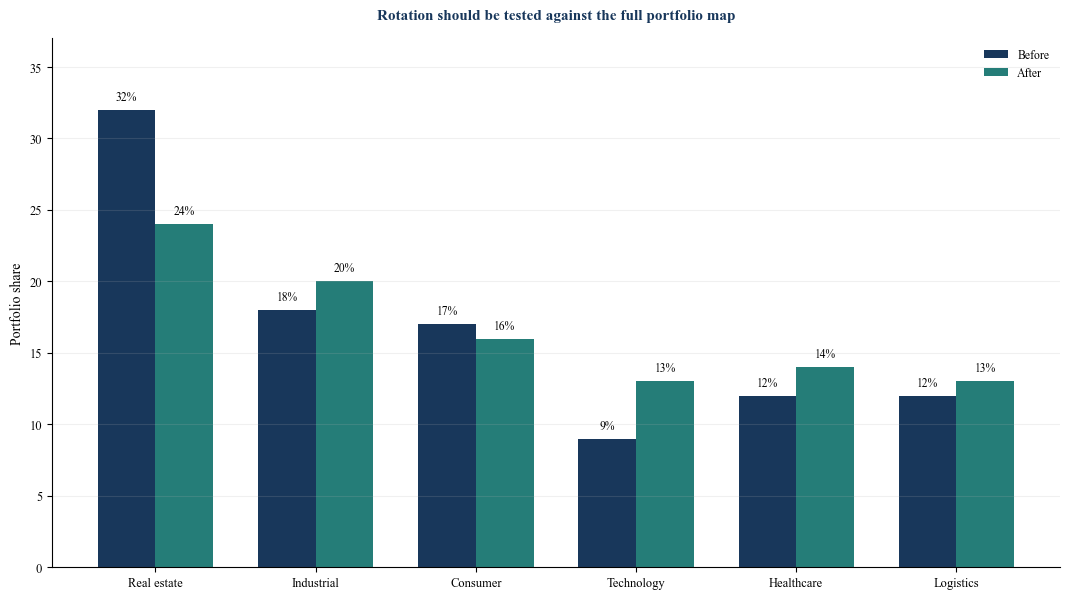
Weights are illustrative management assumptions and do not represent a portfolio.
13. Demonstrate the method with a hypothetical portfolio
Consider a hypothetical GCC direct lender with AED 1.5 billion of committed capital and AED 1.12 billion of funded exposure across 27 borrowers. Every number and circumstance in this example is a management assumption created solely to demonstrate the framework. It does not describe a lender, borrower, market price, forecast or recommendation.
The portfolio's real-estate exposure represents 32 percent of funded assets, above a 30 percent internal watch level. Four loans mature within 15 months. A performing AED 60 million senior loan to a UAE property-services company yields a contractual floating coupon and has 26 months remaining. It was originated when the lender had more sector capacity.
The borrower is current. Cash flow has improved, although customer concentration remains material. The loan documents permit assignment to an eligible financial institution with borrower consent that cannot be unreasonably withheld under the hypothetical terms. Security-agent and guarantee-transfer steps require counsel confirmation. The internal accounting carrying amount, hold value and transaction value have distinct purposes.
The lender models a central secondary value of 82 points, a downside of 68 and an upper case of 94. An indicative buyer offers 80 after initial review, subject to borrower consent, updated financials and verified security. A second eligible buyer indicates 83 with a shorter validity period and a servicing condition. Neither indication is treated as a completed market transaction.
The committee compares sale proceeds, remaining expected cash flow, capital release, sector concentration, reinvestment options, relationship effect and execution probability. It authorises a controlled process with an 86-point reserve for a performing sale and a lower delegated threshold only if specified new adverse evidence is independently verified. The hypothetical bids therefore do not meet the approved reserve. Management retains the asset, opens an amendment discussion and records the bid evidence for future valuation review.
Table 5. Hypothetical portfolio-rotation decision case
| Measure | Current or central case | Downside or alternative | Decision implication |
|---|---|---|---|
| Funded portfolio | AED 1.12bn across 27 borrowers | AED 1.18bn after pipeline closes | capacity and concentration should include committed transactions |
| Real-estate share | 32 percent | 35 percent after pipeline | rotation objective is supported by internal watch level |
| Loan face value | AED 60m | no partial transfer below AED 20m assumed | transaction perimeter affects buyer universe |
| Remaining tenor | 26 months | consent delay of four months | settlement timing affects value and maturity benefit |
| Central transaction value | 82 points | range 68 to 94 | valuation uncertainty remains explicit |
| Seller reserve | 86 points | 80 if defined adverse event occurs | authority prevents an ungoverned discount |
| Buyer indication A | 80 points | subject to three conditions | does not meet approved reserve |
| Buyer indication B | 83 points | short validity and servicing condition | higher price with execution dependency |
| Net recovery estimate | AED 32m | AED 24m severe case | informs downside rather than performing-sale reserve alone |
| Sector share after full sale | 27.9 percent | 31 percent after pipeline | reinvestment and pipeline can reverse benefit |
| Time to settlement | 45 days | 120 days with consent delay | liquidity date should reflect realistic completion |
| Committee outcome | retain and amend | relaunch after verified trigger | bids become evidence; no sale is claimed |
All values, prices, assumptions and outcomes are illustrative management assumptions.
14. Set a reserve price and authority ladder
The reserve price should reflect the transaction objective, valuation range, cost, authority and alternatives. It should not be a private target held outside the decision record. The committee can approve a base reserve, a conditional lower level for named events and an expiry date.
The authority ladder separates marketing, indicative discussions, access, final bids, negotiation, binding agreement and settlement. Management can be authorised to run a process within stated limits. A credit or investment committee approves material price, representations, retained liabilities and conflicts. A board can retain decisions above materiality thresholds or outside risk appetite.
Price is one term. The committee should compare accrued interest, transfer fee, settlement date, conditions, representations, indemnities, servicing, confidentiality, financing and certainty. A lower clean price can create more value than a higher conditional bid.
Every exception should be documented with the evidence changing the original decision. A late request to accept a discount because the buyer's offer is expiring is a process weakness unless the committee already approved that decision path.
15. Build settlement and post-trade controls
Settlement requires reconciled principal, accrued interest, fees, payments, defaults, notices and obligations. The transfer documents should identify the effective time and treatment of receipts around cut-off. Funds, title, records and notices should move through controlled instructions.
The seller should verify authorised signatories, buyer onboarding, sanctions and anti-money-laundering requirements, settlement accounts and payment controls. Shared credentials and informal bank-instruction changes should be prohibited. A two-person check confirms account details through an independent channel.
Post-trade, the parties reconcile borrower and agent records, security and guarantee benefit, payment routing, information rights, voting and servicing responsibilities. The buyer loads the asset into monitoring before settlement where permitted, then confirms the first reporting and payment cycle.
The seller retains records required by law, regulation, accounting, tax, policy and contract. Data that the seller may no longer hold should be deleted or restricted under the approved retention schedule.
16. Monitor market evidence and execution quality
A portfolio dashboard should distinguish inventory, process and completed evidence. Inventory includes eligible face value and assets under review. Process includes buyers cleared, bids, conditions, bid dispersion, consent and days in diligence. Completed evidence includes signed and settled trades, final price, cost and timing.
Valuation teams can use transaction evidence only after checking comparability, date, information access, buyer eligibility, conditions and whether the trade was orderly. A forced or related-party transaction requires separate interpretation.
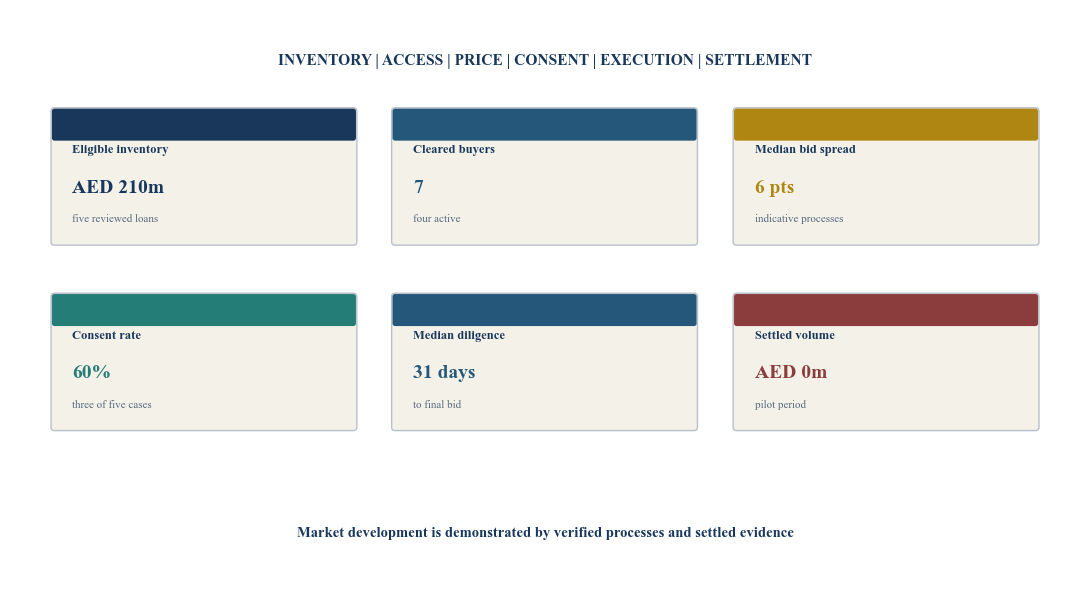
Every displayed value is an illustrative management assumption.
17. Implement a controlled pilot in 100 days
The programme begins with portfolio governance rather than a public marketplace. Days one to 15 define sponsor, objectives, authority, regulatory perimeter, conflicts and eligible asset types. Days 16 to 30 review the portfolio against transfer, file, information, security, accounting and tax gates.
Days 31 to 45 prepare standard asset profiles, data-room taxonomy, confidentiality, buyer eligibility, bid instructions and valuation templates. Days 46 to 60 establish a controlled buyer universe and conduct non-deal education using anonymised information.
Days 61 to 80 select one or two pilot assets, complete re-underwriting and launch staged diligence. Days 81 to 90 receive comparable bids, validate transfer routes and obtain competent approvals. Days 91 to 100 settle only if every gate is satisfied, then review evidence and remediate the operating model.
Table 6. One-hundred-day GCC credit-secondary pilot
| Days | Workstream | Controlled deliverable | Gate |
|---|---|---|---|
| 1 to 10 | mandate | objectives, authority, risk appetite and success measures | board or committee confirms scope |
| 11 to 20 | perimeter | licensing, legal, accounting, tax, conflicts and data map | specialist owners accept required analysis |
| 21 to 30 | portfolio screen | transferability and file-quality matrix | eligible pilot inventory approved |
| 31 to 40 | information | asset profile, data room, versioning and question log | seller can support source-linked diligence |
| 41 to 50 | valuation | hold, accounting, transaction and recovery views | independent challenge accepts methods and range |
| 51 to 60 | buyer universe | mandate, capacity, conflicts, KYC and funding screen | eligible counterparties cleared |
| 61 to 70 | pilot launch | anonymised teaser, confidentiality and staged access | comparable process begins |
| 71 to 80 | re-underwriting | buyer questions, updated evidence and conditions | material issues assigned to price, term or stop |
| 81 to 90 | decision | bid comparison, transfer route, consent and approval | competent authority accepts complete economics |
| 91 to 100 | settlement and review | controlled close, handover and lessons report | remote and internal records reconcile to signed terms |
Timing depends on documents, parties, consents, advisers, diligence and regulation.
18. Limitations and conclusion
A GCC credit-secondary capability should be described through verified transactions and controlled processes. Public primary evidence reviewed for this paper does not establish a distinct market's current size, turnover, depth or realised price distribution. Indicative enquiries, bids, signed trades and settled trades should remain separate measures.
The CBUAE credit-risk standards directly support portfolio review and documented actions including sell-off and rebalancing within their scope.[1] The Basel Committee principles provide a current bank credit-risk architecture.[2] IFRS 13 addresses fair value when required or permitted by another standard, and IFRS 9 contains derecognition requirements for transfers of financial assets.[3][4] Neither standard determines the legal transfer route.
Current UAE civil-transactions legislation addresses assignment, although each facility, security and party requires legal analysis.[5] IVSC materials support transparent treatment of value uncertainty.[6] CBUAE securitisation guidance provides relevant true-sale and risk-transfer concepts within its stated context.[7] IMF and BIS materials document global private-credit liquidity and market-development questions without establishing GCC transaction evidence.[8][9]
The hypothetical lender, loan, bids, values, portfolio weights, recovery and outcome in this paper are management assumptions for framework demonstration. They are not client information, market observations, expected prices or recommendations.
A functioning secondary capability requires a chain of evidence. The portfolio objective identifies why rotation matters. The eligibility gate proves that an asset can enter the process. Re-underwriting establishes today's credit. The price bridge shows what drives value. Legal and accounting work identifies what transfers. Conflict controls protect the decision. Settlement and servicing complete the transaction. Verified outcomes then improve valuation, origination and portfolio construction.
That operating system can create liquidity and price discovery gradually. Each completed, comparable and well-documented process strengthens the next decision.
References
- [1] Central Bank of the UAE, Credit Risk Management Regulation and Credit Risk Management Standards, C 3/2024, effective 30 November 2024, status in force when accessed 13 August 2026. https://rulebook.centralbank.ae/en/rulebook/credit-risk-management-standards
- [2] Basel Committee on Banking Supervision, Principles for the Management of Credit Risk, 30 April 2025, current status when accessed 13 August 2026. https://www.bis.org/bcbs/publ/d595.htm
- [3] IFRS Foundation, IFRS 13 Fair Value Measurement, official standard overview and supporting material, accessed 13 August 2026. https://www.ifrs.org/issued-standards/list-of-standards/ifrs-13-fair-value-measurement/
- [4] IFRS Foundation, IFRS 9 Financial Instruments, derecognition requirements and official overview, accessed 13 August 2026. https://www.ifrs.org/issued-standards/list-of-standards/ifrs-9-financial-instruments/
- [5] United Arab Emirates, Federal Decree by Law No. 25 of 2025 Promulgating the Civil Transactions Law, official legislation portal, accessed 13 August 2026. https://uaelegislation.gov.ae/en/legislations/4011
- [6] International Valuation Standards Council, Managing and Communicating Value Uncertainty, 19 May 2026. https://ivsc.org/managing-and-communicating-value-uncertainty/
- [7] Central Bank of the UAE, Operational Requirements for the Recognition of Risk Transference, official rulebook guidance, effective 1 April 2021, accessed 13 August 2026. https://rulebook.centralbank.ae/en/rulebook/3-operational-requirements-recognition-risk-transference
- [8] International Monetary Fund, Global Financial Stability Report, April 2024, Chapter 2: The Rise and Risks of Private Credit. https://www.imf.org/-/media/files/publications/gfsr/2024/april/english/ch2.pdf
- [9] Bank for International Settlements, BIS Bulletin No. 106, private credit structure, liquidity and secondary-market discussion, 2025. https://www.bis.org/publ/bisbull106.pdf
- [10] Committee on the Global Financial System, Credit Risk Transfer, January 2003, taxonomy of funded and unfunded credit-risk transfer. https://www.bis.org/publ/cgfs20.pdf
About the Author
Chennakeshav Adya is an independent researcher and Managing Partner of Matchpoint Partners. His research focuses on investment strategy, capital formation, transaction execution, governance and operating-model design across the Gulf and international markets.
