

1. Open finance changes the evidence available to a credit committee
Mid-market credit analysis often begins with information that is reliable and delayed. Audited accounts describe a completed period. Management accounts can be current and uneven. Bank statements are detailed and laborious to reconcile. Bureau information shows reported obligations and payment behaviour. A borrowing request can arrive while the company is growing, absorbing working capital or experiencing a temporary shock that none of those sources captures alone.
Open finance can make consented account and transaction information available through standardised infrastructure. The CBUAE Open Finance Regulation establishes an API Hub, Trust Framework and common infrastructural services for cross-sector data sharing and transaction initiation on behalf of users. Participation is mandatory for CBUAE licensees in respect of products and services within the framework's scope, with implementation proceeding in phases.[1] The CBUAE reported that the Al Tareq initiative went live in 2025, with two banks and two third-party providers meeting operational requirements and central infrastructure enabling services including data-sharing APIs and standardised consent journeys.[2]
The underwriting opportunity is greater frequency, traceability and behavioural evidence. The lender can observe whether invoice receipts arrive as described, whether revenue depends on a few counterparties, whether payroll and tax payments are stable, whether cash deficits recur before month end and whether existing debt receives priority. These observations remain evidence inputs. They do not replace the credit committee, legal structure, ownership diligence, financial analysis, purpose test, repayment source, security review or independent risk judgment.
The operating model should answer five questions before the first decision: which data may be accessed; whether the account population is complete; how raw transactions become reviewed features; how features influence the credit decision; and how every material conclusion can be reproduced from source records.
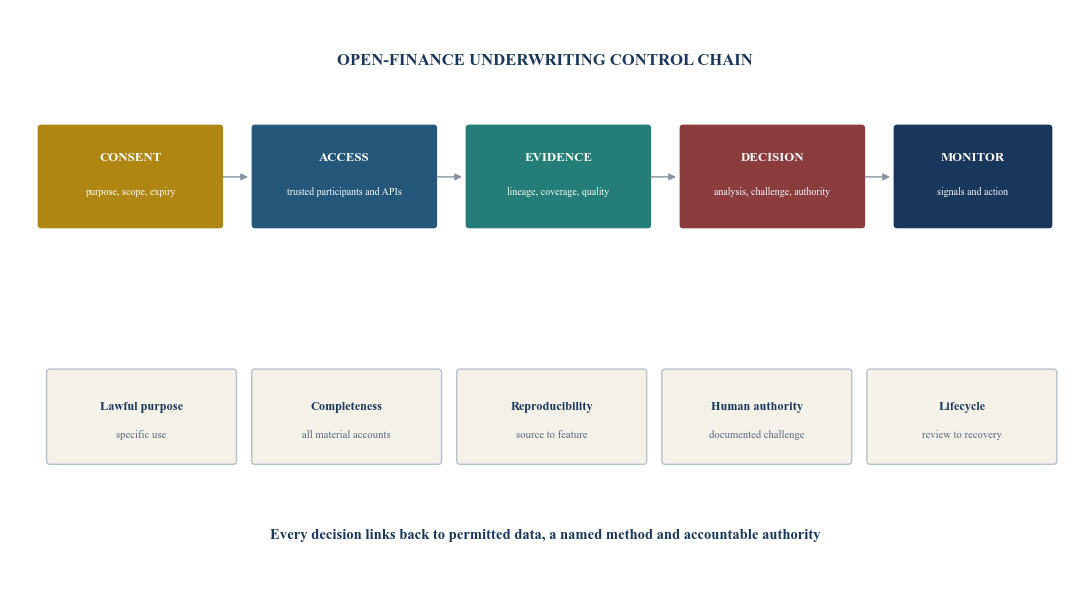
Author framework based on the cited UAE open-finance, data-protection and credit-risk requirements.
2. Start with the legal and regulatory perimeter
The CBUAE Open Finance Regulation controls the provision of open-finance services in the UAE. It sets licensing routes, identifies persons deemed licensed, defines limitations and requires secure interfaces, records and supervisory access.[1] An organisation should determine whether it acts as a data holder, service owner, open-finance provider, lender, processor, technology vendor or several of these roles. Each role can carry a different responsibility.
The framework is consent-led. The data purpose, participating entities, accounts, fields, duration, use and withdrawal process should be expressed clearly. The regulation restricts access to purposes connected with the open-finance service and prohibits an open-finance provider from processing sensitive data for that service even with explicit user consent.[1] Additional authority may be required for lending, advice, negotiation or another regulated activity.
UAE Federal Decree-Law No. 45 of 2021 requires personal data to be processed fairly, transparently and lawfully, collected for a specific purpose, limited to what is necessary, accurate and protected by technical and organisational measures.[3] Data subjects have information rights concerning processing purposes, automated decisions and data sharing. They can object to certain automated decisions, and the law provides for human review at the data subject's request in the circumstances described by Article 18.[3] A data-protection impact assessment is required for high-risk processing described by Article 21, including certain systematic automated evaluations with legal or significant effects.[3]
Corporate transaction data can contain personal data: employee names, sole-trader counterparties, cardholders, beneficial owners or narrative references. The lender should minimise fields, restrict access, separate underwriting from unrelated commercial use and apply retention and deletion rules. Consent evidence, processor instructions, cross-border arrangements, security controls and incident response should be reviewed by qualified advisers for the actual structure.
3. Define a complete data population before calculating a score
A transaction model can be arithmetically correct and economically misleading when material accounts are missing. A borrower may route collections through one bank, payroll through another, shareholder transfers through a third and trade-finance settlements through an off-balance-sheet facility. The lender needs a declared account map across legal entities, currencies and banking relationships.
Completeness begins with ownership and group structure. The borrower identifies operating entities, holding entities, material related parties, collection channels, merchant accounts, payment gateways, cards, loans, overdrafts, guarantees and trade instruments. The lender reconciles the declaration to audited accounts, bureau records, management accounts, debt schedules and legal diligence. Unexplained gaps become conditions or reasons to stop the automated path.
Data quality should be assessed across coverage, continuity, timeliness, currency, duplication, reversal, counterparty identity, transaction narrative and category confidence. A twelve-month period can miss a long operating cycle. A two-year period can contain a discontinued business. The observation window should cover the borrower's cash-conversion cycle, seasonal peaks and at least one meaningful stress period where available.
Table 1. Minimum data-sufficiency gate before transaction analysis
| Test | Evidence | Pass condition | Escalation when incomplete |
|---|---|---|---|
| Legal entity population | group chart, licences, audited accounts and beneficial ownership records | every borrowing, operating and material cash-owning entity identified | ownership and legal diligence before scoring |
| Account population | borrower declaration, bank confirmations, bureau and debt schedule | all material collection, payment, debt and merchant accounts mapped | manual underwriting and funding condition |
| Consent and purpose | consent record, privacy information and permitted-use register | specific active permission covers required fields and use | pause access and obtain compliant authority |
| Observation period | account-level start and end dates | complete period covers relevant operating and seasonal cycles | extend history or use conservative manual treatment |
| Transaction integrity | unique identifiers, reversals, duplicates and balances | ledger reconciles within approved tolerance | data-quality remediation and exception approval |
| Counterparty resolution | names, identifiers and mapping rules | material inflows and outflows assigned with stated confidence | manual review of unresolved material flows |
| Currency treatment | account currency and conversion source | original and reporting currency preserved with date-specific method | independent reconciliation |
| Related-party treatment | ownership map and transaction classification | material related-party flows separately visible | enhanced diligence and decision condition |
| Existing obligations | bureau, statements, facilities and guarantees | observed service agrees to declared obligations or differences explained | independent verification and credit escalation |
| Audit trail | source ID, transformation version and reviewer | decision can be reproduced from retained authorised evidence | no automated decision until traceable |
The precise gate should reflect product, borrower, licensing perimeter and current professional advice.
4. Turn transactions into economically meaningful features
The feature library should begin with the repayment thesis. A working-capital facility depends on recurring operating inflows, cash conversion and borrowing-base quality. An acquisition facility depends on consolidated cash generation, integration risk and debt capacity. An asset-backed facility depends on collateral cash flows, perfection and recovery. The same transaction can carry different meaning across products.
Operating inflows should be separated from shareholder funding, loan proceeds, refunds, intercompany transfers, asset sales and one-off receipts. Operating outflows should distinguish suppliers, payroll, rent, utilities, tax, debt service, capital expenditure, distributions and exceptional items. Netting should preserve the gross pattern where concentration and timing matter.
Useful features include recurring monthly inflow, volatility, trend, customer concentration, late-payment proxy, refund ratio, cash-conversion timing, lowest daily balance, days below a liquidity floor, payroll stability, supplier continuity, debt-service coverage and the frequency of returned or rejected payments. Each feature needs a definition, business rationale, calculation period, outlier policy, missing-data rule and owner.
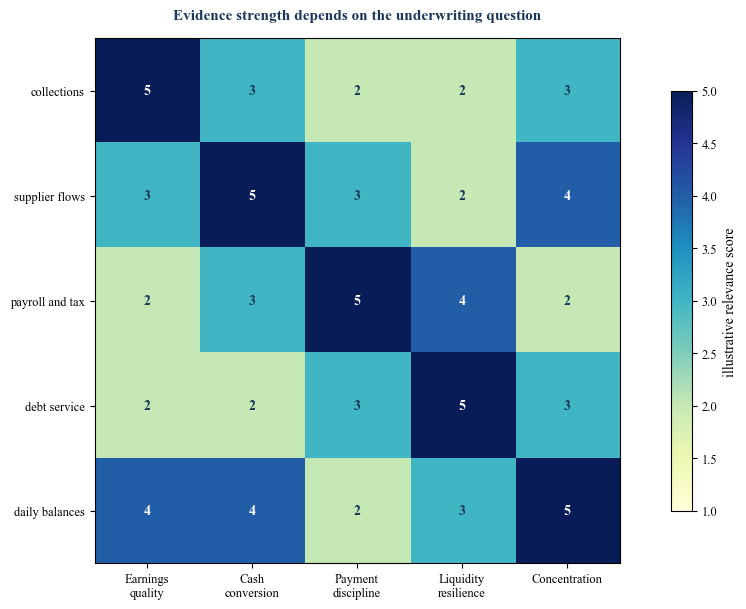
Author framework. Features require borrower-specific interpretation and validated data.
5. Preserve financial-statement and bureau discipline
Transaction data provides a view of cash movement. It does not establish revenue recognition, profitability, asset ownership, contingent liabilities, tax compliance, inventory quality or legal enforceability. The lender should reconcile transaction-derived measures to audited and management accounts, tax records where lawfully available, customer ledgers, supplier ledgers and facility statements.
Differences can be informative. Cash collections below recognised revenue can signal slower conversion, channel changes, routing outside observed accounts or accounting timing. Collections above revenue can reflect advances, taxes, pass-through receipts or related-party funding. The credit memorandum should identify the bridge and show unresolved differences.
Official credit information remains important. CBUAE requirements for specialised banks require credit information to be obtained from Al Etihad Credit Bureau before extending credit to an individual or company and reported at least monthly.[6] Other lender-specific obligations should be confirmed for the applicable regime. Open-finance evidence should be reconciled to bureau obligations, payment records and declared facilities.
The CBUAE Credit Risk Management Regulation states that licensed financial institutions should limit reliance on external credit assessment and develop an independent view of credit risk.[4] Transaction analytics can strengthen that independent view when the lender documents the connection between source evidence, feature, conclusion and decision.
6. Design a funnel with explicit stop, review and approval gates
An efficient funnel removes cases for valid reasons. It should not conceal decline logic inside a score. The first gate confirms borrower and product eligibility. The second confirms consent and data sufficiency. The third tests fraud, sanctions, ownership and legal issues. The fourth assesses repayment capacity and structure. The fifth applies independent challenge and approval authority.
A case can leave the automated path without being declined. A complex group, volatile event, incomplete data history or material model override can move to enhanced manual underwriting. The funnel should record the reason and outcome so management can see whether automation excludes a particular segment or creates repeated exceptions.
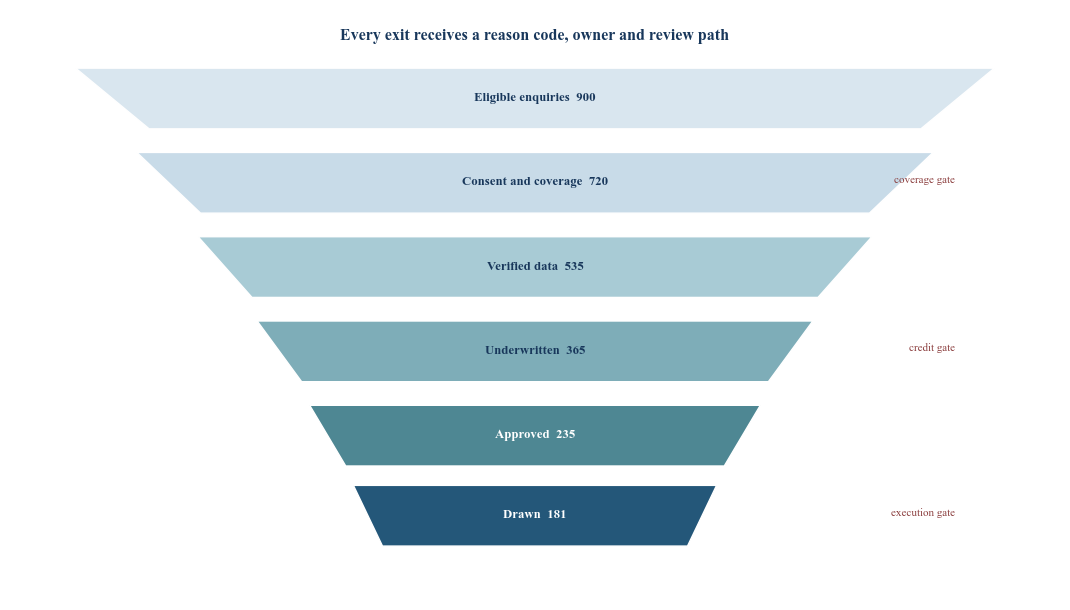
Counts are hypothetical management assumptions created for process design.
Table 2. Underwriting decision matrix
| Dimension | Evidence | Acceptable path | Enhanced review | Stop or decline consideration |
|---|---|---|---|---|
| Repayment source | recurring operating inflow and financial statements | stable, explained and adequate under downside | volatility or recent change with credible evidence | no identifiable lawful repayment source |
| Data coverage | complete material account map | continuous, reconciled history | short gap or complex routing that can be verified | material undisclosed or inaccessible accounts |
| Leverage | existing and proposed debt schedule | within approved product and borrower limits | refinance, contingent debt or rapid increase | debt burden outside risk appetite without valid mitigation |
| Concentration | customers, suppliers, products and geography | diversified or contractually resilient | concentrated with strong evidence and structure | dependency lacks visibility or credible mitigation |
| Governance | ownership, management and controls | clear authority and reliable reporting | succession, key-person or related-party complexity | ownership or authority cannot be verified |
| Conduct and integrity | KYC, AML, sanctions, disputes and tax status | required checks completed | adverse item requiring specialist review | legal or policy prohibition |
| Facility structure | purpose, tenor, amortisation and covenants | matches cash cycle and repayment source | bespoke controls or staged availability | structure relies on unsupported exit or refinancing |
| Model result | validated score with reason codes | within approved use and confidence | low confidence, override or out-of-scope case | result cannot be reproduced or responsibly used |
| Credit authority | complete memorandum and independent challenge | within delegated approval | committee or board escalation | valid authority unavailable |
Thresholds, authorities and outcomes are illustrative; each lender should approve its own policy.
7. Keep the model subordinate to credit judgment
The CBUAE Model Management Standards apply to UAE banks using models for decision-making and require governance, development, approval, independent validation, monitoring and controls designed to reduce model risk.[5] A lender should confirm its exact regulatory perimeter. The disciplines remain useful for any organisation using transaction models in consequential credit decisions.
Model documentation should define purpose, population, target outcome, data sources, transformations, exclusions, performance measures, limitations, decision role and override process. Development and validation should be organisationally separated to a degree proportionate to risk. Changes to transaction categorisation can alter model behaviour even when the statistical code remains unchanged, so data and taxonomy versions belong in change control.
Performance should be tested across industries, company sizes, operating cycles, currencies, time periods and relevant borrower characteristics. A model trained on merchants with high-frequency card receipts can perform poorly for project contractors with milestone payments. Approval should state where the model may be used and what sends a case to manual review.
Reason codes should describe the evidence influencing the result. A credit officer needs to see that cash deficits recur, collections are concentrated or debt service has increased. A proprietary score without traceable drivers weakens challenge, borrower communication, exception handling and remediation.
8. Structure the facility around observed cash behaviour
The transaction record can inform limit, tenor, amortisation, availability, pricing and covenants. A business with predictable monthly collections can support scheduled amortisation. A seasonal importer may need a borrowing base and clean-down period. A contractor can require milestone-linked drawdowns and assignment controls. The structure should reflect the cash-conversion mechanism rather than the highest modelled limit.
Debt-service capacity should be tested under declines in collections, margin compression, slower customer payment and higher funding cost. A downside model should state which stresses can occur together. It should also identify actions available to the borrower before default, including cost reduction, working-capital release, shareholder support or asset disposal, with evidence for each.
Pricing should reflect expected loss, capital, liquidity, operational cost, concentration, optionality and target return. Open-finance efficiency can reduce information and monitoring cost. It does not remove credit, fraud, legal, recovery or model risk.
Table 3. Facility structure mapped to observed cash behaviour
| Observed pattern | Credit interpretation | Possible structure | Monitoring focus |
|---|---|---|---|
| Recurring diversified receipts | potentially resilient operating cash flow | amortising term or revolving line within tested capacity | inflow level, concentration and debt-service coverage |
| Seasonal inventory build | temporary working-capital absorption | seasonal revolving facility with clean-down | inventory evidence, supplier payment and peak utilisation |
| Milestone project receipts | lumpy contractual conversion | staged draw, assignment or controlled account where valid | certified milestones, disputes and receivable ageing |
| Marketplace or merchant receipts | high-frequency channel evidence | receivables-linked limit with channel controls | refunds, chargebacks, platform dependency and settlement changes |
| Concentrated anchor customer | dependency and contract risk | lower advance, reserve, covenant or assignment where enforceable | customer status, payment delay and contract renewal |
| Related-party cash support | uncertain independence of repayment | exclude unsupported flows or condition verified subordination | source, recurrence, legal terms and withdrawal risk |
| Persistent overdraft use | structural liquidity deficit | smaller restructured limit, amortisation or remediation | lowest balance, excesses and cash-generation plan |
| Rapid growth with negative cash conversion | execution and working-capital risk | staged availability linked to verified milestones | margin, debtor days, inventory and funding gap |
Examples are general and require borrower-specific legal, credit and regulatory review.
9. Convert covenants into observable early-warning signals
Traditional covenants often rely on quarterly accounts and certificates. Transaction data can support more frequent indicators, including minimum operating inflow, maximum concentration, debt-service coverage, cash-balance duration, payment-return events and account-routing compliance. Legal enforceability and borrower control over the data source require review.
An indicator should have a defined calculation, observation window, cure treatment, threshold, materiality, owner and escalation action. A single unusual payment should not automatically trigger default. A repeated pattern can activate enquiry, enhanced monitoring, draw suspension or committee review according to approved terms.
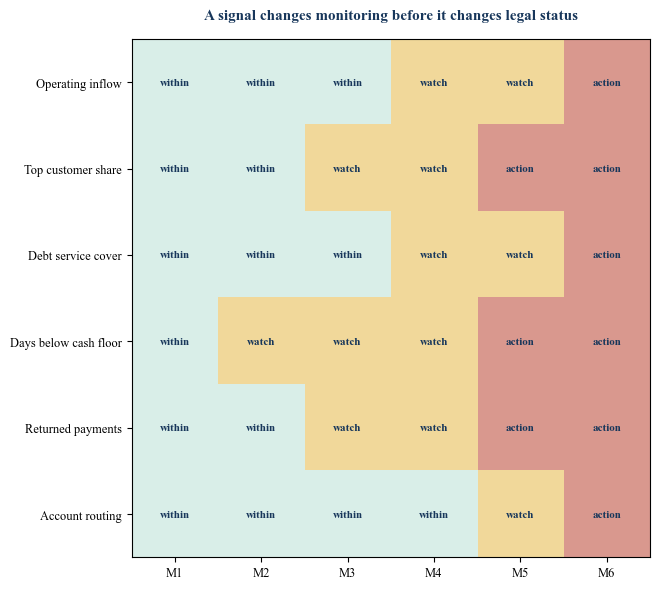
Values and thresholds are hypothetical management assumptions.
10. Monitor the borrower and the portfolio as one system
The CBUAE Credit Risk Management Standards require licensed financial institutions to monitor individual obligors, facilities, relevant segments and portfolios, with information flowing between portfolio management and underwriting.[4] Open-finance monitoring can shorten the observation interval, provided that the lender controls false alerts, incomplete feeds and operational failures.
Borrower monitoring should compare actual behaviour with the approved thesis. Has the expected collection channel remained active? Has customer concentration increased? Are suppliers being paid later? Has payroll changed abruptly? Has a new lender begun receiving service? Each alert should link to a review protocol rather than produce an automatic adverse action without authority and context.
Portfolio monitoring should aggregate risk by sector, sponsor, geography, product, currency, maturity, model version, data provider and dominant cash-flow channel. A common API or categorisation error can create correlated operational exposure. A concentrated portfolio can look diversified at the company-name level while depending on the same government payer, platform or supply chain.
Table 4. Signal-to-action monitoring playbook
| Signal | Validation | First action | Escalation | Record |
|---|---|---|---|---|
| Material inflow decline | check data continuity, seasonality, known event and other accounts | borrower enquiry and refreshed cash forecast | credit review when persistent or unexplained | source values, explanation, reviewer and deadline |
| Customer concentration increase | resolve counterparties and intercompany flows | assess contract, ageing and alternatives | limit, reserve or covenant review | concentration history and decision |
| Debt-service anomaly | reconcile bureau, statements and facility schedule | identify new, late or redirected obligation | independent risk and legal review | obligation, date, cause and remedy |
| Repeated returned payments | exclude technical duplicates and bank errors | liquidity discussion and daily monitoring | draw control or remediation committee | events, verified cause and action |
| Consent or feed interruption | determine withdrawal, expiry or technical failure | suspend model refresh and use last valid date visibly | manual review under approved policy | last complete period and data incident |
| Model drift | compare outcome, population and feature distributions | restrict affected use and investigate | validation committee and change approval | version, tests, decision and remediation |
| Policy exception growth | analyse originator, segment and reason | targeted file review | CRO, committee or board according to materiality | exception population and outcome |
| Recovery deterioration | validate arrears, collateral and borrower engagement | revised recovery estimate and plan | specialised assets or workout authority | cash recovery, cost, timing and forecast variance |
Illustrative operating controls; contractual and regulatory consequences require current review.
11. Treat decline, override and exception data as governance evidence
Overrides are information about the operating model. A credit officer can identify a valid contract, unusual seasonality or verified ownership event that a model cannot interpret. Overrides can also conceal commercial pressure, inconsistent risk appetite or model weakness. Every override needs direction, reason, evidence, authority and subsequent outcome.
Decline reasons should be intelligible and specific enough for control. Categories can include eligibility, incomplete data, legal prohibition, conduct, weak repayment capacity, excessive leverage, concentration, structure, affordability, policy or authority. A lender should review whether particular channels, sectors or borrower types experience different outcomes and determine whether the cause is risk, data quality, model design or process access.
The CBUAE Credit Risk Management Standards require clear exception processes, CRO review, documentation and appropriate approval, with exceptions remaining a small part of the portfolio and receiving active monitoring.[4] The exact requirement applies within the standards' scope. A private-credit manager can adopt an equivalent internal discipline through its investment mandate and committee terms.
12. Plan recovery while the facility is still performing
Recovery analysis should begin at origination. The lender identifies the primary repayment source, secondary source, contractual rights, security, guarantees, set-off position, account control, priority, jurisdiction, enforcement path, cost and time. Transaction history can show where value moves before stress and whether collections remain available.
A recovery estimate should distinguish consensual cure, cash sweep, refinancing, asset sale, guarantee, security enforcement and insolvency distribution. Each path has timing, leakage and professional-cost assumptions. Legal advice should validate rights, perfection, priority and enforceability.
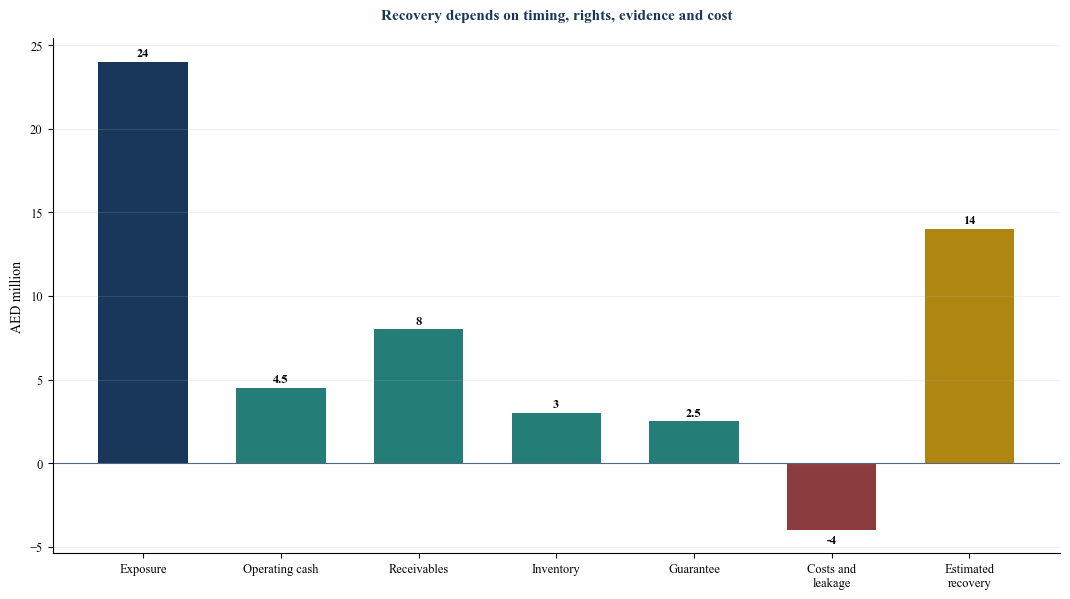
All values are illustrative management assumptions in AED millions.
13. Demonstrate the framework with a hypothetical UAE distributor
Consider a hypothetical UAE distributor seeking an AED 24 million revolving working-capital facility. The company imports industrial consumables and sells to contractors, manufacturers and facilities-management businesses. Every number and circumstance in this example is a management assumption created solely to demonstrate the framework. It does not describe a client, market forecast, approval expectation or recommendation.
The borrower reports AED 168 million of annual revenue and EBITDA of AED 16.8 million. It declares four operating accounts across two banks, one trade-finance line and two company cards. The consented data provides 24 months of transactions. Reconciliation identifies that 93 percent of reported cash collections flows through the observed accounts. The remaining seven percent relates to a foreign collection account and cash deposits that require manual evidence.
Transaction analysis identifies monthly operating inflows between AED 10.2 million and AED 17.6 million, with a seasonal peak before year end. The top customer represents 19 percent of observed operating inflow and the top five represent 48 percent. Median customer receipt timing has lengthened by nine days over six months. Payroll remains stable. Tax and existing debt payments appear regular. The lowest daily cash balance becomes negative in four of the last six months because the overdraft supports inventory purchases before customer receipts.
The credit memorandum reconciles observed collections to management accounts, analyses customer and supplier ledgers, obtains bureau information, verifies facilities and completes ownership, legal, AML, sanctions and tax diligence appropriate to the lender. The repayment thesis is revolving cash conversion, supported by diversified collections and an inventory cycle. Risks include slower receipt timing, supplier concentration, foreign-currency purchases and persistent overdraft dependence.
The proposed structure remains hypothetical: an AED 18 million committed revolving line, an additional AED 6 million seasonal accordion subject to verified orders and borrowing-base evidence, a 24-month tenor, quarterly clean-down test, customer-concentration watch level, minimum trailing operating inflow and restrictions on additional secured borrowing. The credit committee can approve, amend or reject the proposal according to its authority and independent judgment.
Table 5. Hypothetical borrower and portfolio decision analysis
| Measure | Base observation | Downside assumption | Decision use |
|---|---|---|---|
| Annual operating inflow | AED 156m observed | 15 percent decline | test debt service and working-capital need |
| EBITDA | AED 16.8m reported | margin falls from 10.0 to 7.5 percent | reconcile cash conversion and covenant capacity |
| Top customer share | 19 percent | rises to 27 percent | set watch threshold and concentration response |
| Top-five customer share | 48 percent | rises to 58 percent | test dependency and portfolio correlation |
| Median receipt delay | nine-day deterioration | further 15-day delay | size liquidity buffer and seasonal availability |
| Existing funded debt | AED 31m | no reduction | aggregate leverage and service across lenders |
| Proposed committed line | AED 18m | fully drawn | test peak utilisation and clean-down |
| Proposed accordion | AED 6m | unavailable in downside | avoid reliance on discretionary capacity |
| Downside debt-service cover | 1.42x modelled | 1.08x severe case | committee condition, pricing and monitoring |
| Estimated recovery | AED 14m on AED 24m exposure | AED 10m severe case | inform structure, security and loss estimate |
| Portfolio sector share after approval | 8.4 percent | 10.6 percent if pipeline closes | concentration limit and allocation decision |
| Model confidence | medium-high | medium if foreign account remains incomplete | manual review and evidence condition |
All amounts, ratios, scores and outcomes are illustrative management assumptions.
14. Use a dashboard that separates data health from credit health
A monitoring dashboard should show whether the evidence system works and whether the borrower is changing. Data-health indicators include consent status, account coverage, last successful refresh, unmatched transaction value, categorisation confidence and model version. Credit-health indicators include inflow, concentration, liquidity, debt service, covenant state, arrears, collateral and recovery estimate.
A green credit indicator derived from an incomplete feed is unreliable. A red data indicator should suspend automated interpretation and display the last complete observation date. The responsible team then follows the approved manual process.
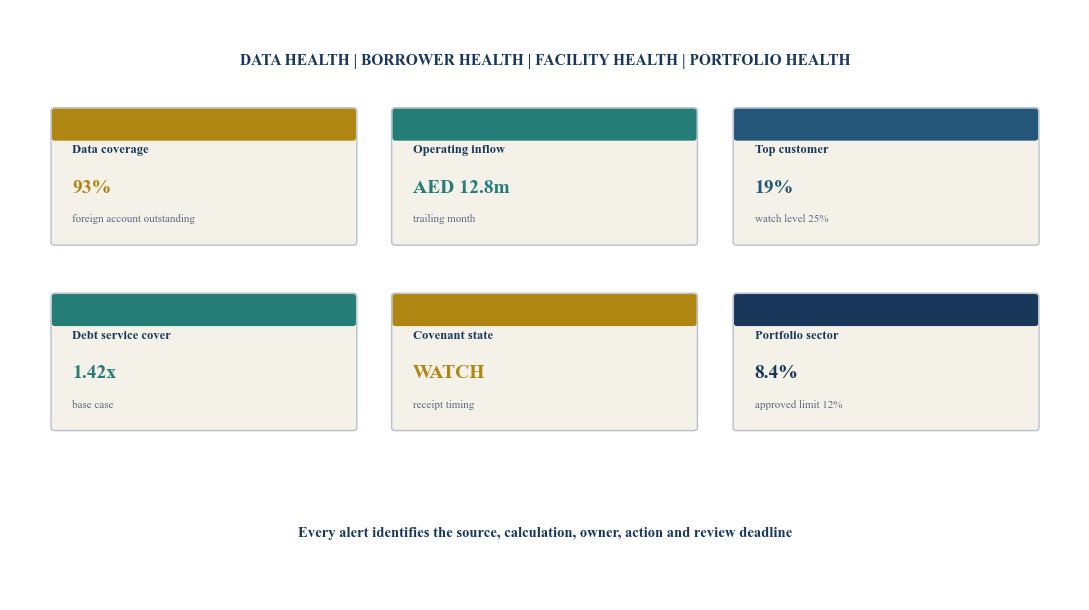
Every displayed value is an illustrative management assumption.
15. Govern vendors, APIs and operational resilience
Open-finance underwriting can depend on the API Hub, data holders, third-party providers, cloud services, categorisation vendors, identity tools and internal credit systems. The lender should map the service chain and identify which failure can stop access, corrupt features, delay decisions or expose data.
Vendor diligence should cover licensing and regulatory status, information security, access control, encryption, data location, incident response, subcontractors, change management, performance, audit rights, portability, deletion and exit. A contract should align responsibility with the lender's continuing obligations. Outsourcing does not transfer accountability.
Operational resilience requires monitoring, retry controls, data-integrity checks, versioned schemas, alternative evidence paths and a manual process. A system should fail visibly. Credit staff should see that data is stale, incomplete or transformed under a new version before they act.
Cybersecurity and fraud controls should protect consent, credentials, API calls, account identifiers, transaction data and credit decisions. Access should follow least privilege, sensitive actions should require appropriate approvals and logs should support investigation. The exact controls depend on the participant role and applicable CBUAE, data-protection and sector requirements.
16. Align private-credit governance to the regulated evidence standard
A private-credit fund can use open-finance data through appropriately authorised arrangements. The fund's investment committee should approve the underwriting policy, eligible sectors, facility types, data standards, score role, overrides, concentration limits, valuation, monitoring and workouts. The fund also needs to reconcile its mandate, limited-partner disclosures, valuation policy, administrator processes and data-protection responsibilities.
The same evidence should support origination and portfolio management. A transaction model used only at approval can become stale as borrower behaviour and the portfolio change. Monitoring outcomes should feed back into feature review, pricing and risk appetite.
The manager should distinguish regulated requirements applying to banks or CBUAE licensees from internal controls adopted by a fund. Documents should describe the actual perimeter accurately. Legal and regulatory advice should confirm whether the manager, fund, lender, originator, servicer or technology provider needs a licence or approval for the planned activity.
17. Implement one controlled segment in 100 days
The programme should begin with one defined borrower segment and product. A narrow pilot provides enough consistency to test data, model and process while limiting operational and credit exposure. Candidates can include established UAE distributors, service businesses or merchants with recurring account flows and clear financial records.
Days one to 15 establish sponsorship, licensing and data-protection review, eligible product, borrower definition, risk appetite, authority and success measures. Days 16 to 35 design consent, data inventory, completeness tests, transaction taxonomy and source reconciliation. Days 36 to 55 develop features, decision logic, downside scenarios and reason codes using controlled historical data.
Days 56 to 70 complete independent validation, information-security testing, operating procedures, credit templates and staff training. Days 71 to 85 run decisions in parallel with the established process, with no unapproved automation. Days 86 to 100 review outcomes, exceptions, bias, data incidents, borrower experience and portfolio impact before a documented scale decision.
Table 6. One-hundred-day controlled implementation programme
| Days | Workstream | Controlled deliverable | Gate |
|---|---|---|---|
| 1 to 10 | mandate and perimeter | sponsor, product, borrower segment, roles and legal questions | accountable authority confirms scope |
| 11 to 20 | risk and privacy | risk appetite, consent, permitted use, impact assessment and retention | legal, compliance, risk and data owners approve design |
| 21 to 35 | data | account map, taxonomy, lineage, quality and completeness controls | test cases reproduce source-to-feature results |
| 36 to 45 | underwriting | feature library, financial reconciliation and downside cases | credit owners approve economic meaning |
| 46 to 55 | decision | score role, reason codes, manual path, conditions and overrides | delegated authorities and escalation agreed |
| 56 to 65 | validation | conceptual, data, performance, stability and limitation review | independent validation resolves material findings |
| 66 to 75 | operations | API monitoring, security, vendor, incident and business-continuity controls | end-to-end test completes with auditable evidence |
| 76 to 85 | parallel pilot | established and proposed methods run on the same controlled cases | differences reviewed before any production reliance |
| 86 to 95 | monitored decisions | limited production population with enhanced oversight | every approval, decline and override receives review |
| 96 to 100 | scale decision | outcome, exception, conduct, data and portfolio report | authorised committee approves remediate, expand or stop |
Timing depends on licensing, data access, technology, portfolio, advisers and governance readiness.
18. Limitations and conclusion
Open-finance data is a new evidence channel inside an established credit responsibility. It can improve timeliness and cash-flow visibility. It can also amplify missing accounts, classification errors, population bias, model drift and inappropriate automation. A controlled design begins with lawful purpose, complete data, economic interpretation and accountable approval.
The CBUAE Open Finance Regulation defines the UAE framework and participant obligations.[1] The CBUAE 2025 annual report documents the initial operation of Al Tareq.[2] The UAE Personal Data Protection Law establishes data-processing controls and rights, including provisions relevant to automated processing and high-risk impact assessment.[3] The CBUAE Credit Risk Management Regulation and Standards govern licensed financial institutions within their scope and provide direct requirements for underwriting, monitoring, models and exceptions.[4] The CBUAE Model Management Standards apply to UAE banks within their stated scope.[5]
The Basel Committee's current credit-risk principles address banks and supervisors, organising sound practice around the credit-risk environment, granting, administration, monitoring and controls.[7] World Bank materials describe the potential and operational issues associated with alternative and transaction data for small-business finance.[8] These sources inform the framework while retaining their actual jurisdiction and institutional scope.
The hypothetical distributor case contains management assumptions solely for demonstration. Its transaction history, financial performance, facility structure, recovery estimate and portfolio impact should not be treated as observations, forecasts, market terms or recommendations.
A lender should be able to explain a decision in plain language: what data the borrower authorised; which accounts and periods were complete; what the cash flows demonstrated; how those observations reconciled to financial and bureau evidence; why the proposed structure matched the repayment source; which risks remained; who challenged and approved the decision; and what monitoring will cause action. That chain turns open-finance data into a controlled credit capability.
References
- [1] Central Bank of the UAE, Open Finance Regulation, C 03/2025, issued 10 July 2025, status in force when accessed 13 August 2026. https://rulebook.centralbank.ae/en/rulebook/open-finance-regulation
- [2] Central Bank of the UAE, Annual Report 2025, section describing the Al Tareq open-finance initiative, published 2026. https://www.centralbank.ae/media/4qbn11cl/annual-report-2025-en.pdf
- [3] United Arab Emirates, Federal Decree-Law No. 45 of 2021 Concerning the Protection of Personal Data, official legislation portal, accessed 13 August 2026. https://uaelegislation.gov.ae/en/legislations/1972
- [4] Central Bank of the UAE, Credit Risk Management Regulation and Credit Risk Management Standards, C 3/2024, effective 30 November 2024, status in force when accessed 13 August 2026. https://rulebook.centralbank.ae/en/rulebook/credit-risk-management-standards
- [5] Central Bank of the UAE, Model Management Standards, official rulebook, accessed 13 August 2026. https://rulebook.centralbank.ae/en/rulebook/model-management-standards
- [6] Central Bank of the UAE, Article 8 Credit Reports for specialised banks, C 21/2022, effective 14 April 2022, status in force when accessed 13 August 2026. https://rulebook.centralbank.ae/en/rulebook/article-8-credit-reports
- [7] Basel Committee on Banking Supervision, Principles for the Management of Credit Risk, 30 April 2025, current status when accessed 13 August 2026. https://www.bis.org/bcbs/publ/d595.htm
- [8] World Bank Group, Alternative Data Transforming SME Finance, official publication, accessed 13 August 2026. https://documents.worldbank.org/curated/en/701331497329509915/pdf/116186-WP-AlternativeFinanceReportlowres-PUBLIC.pdf
- [9] Central Bank of the UAE, CBUAE issues the Open Finance Regulation, 27 June 2024. https://www.centralbank.ae/en/news-and-publications/news-and-insights/press-release/cbuae-issues-the-open-finance-regulation-to-ensure-the-soundness-and-efficiency-of-services-and-to-promote-innovation-and-competitiveness/
- [10] World Bank Group, Data Protection and Privacy, Digital Finance Inclusion knowledge resource, accessed 13 August 2026. https://digitalfinance.worldbank.org/topics/data-protection-privacy
About the Author
Chennakeshav Adya is an independent researcher and Managing Partner of Matchpoint Partners. His research focuses on investment strategy, capital formation, transaction execution, governance and operating-model design across the Gulf and international markets.
