

1. A structured invoice becomes useful through a chain of evidence
An invoice-finance decision begins with a commercial claim. A supplier says it delivered goods or services, issued an invoice to a buyer and expects payment on a stated date. The lender advances cash against that expected payment and assumes risks relating to authenticity, performance, dispute, dilution, priority, fraud, concentration, timing and recovery.
Unstructured files create operational friction. A PDF can be altered. Fields can be inconsistent. Names can vary. Dates can be ambiguous. A portfolio team can spend time extracting information before it evaluates the credit. Structured eInvoice data improves the starting point by standardising material transaction fields and carrying them through accredited exchange channels.
The UAE Ministry of Finance defines an eInvoice as structured invoice data issued and exchanged electronically between supplier and buyer and reported electronically to the Federal Tax Authority. It expressly distinguishes eInvoices from PDFs, word-processing documents, images, scans and emails.[1] The official guidance describes a decentralised five-corner architecture using Accredited Service Providers and the Peppol International Invoice standard adapted for the UAE.[2]
Credit infrastructure requires more than the invoice record. The lender should establish lawful access, data authenticity, supplier and buyer identity, commercial performance, acceptance, credit notes, dispute, assignment, prior finance, payment and bank reconciliation. Each step has a source, owner and decision consequence.
The resulting chain supports underwriting and monitoring. It does not replace the lender's independent assessment of repayment capacity, legal rights and recovery.
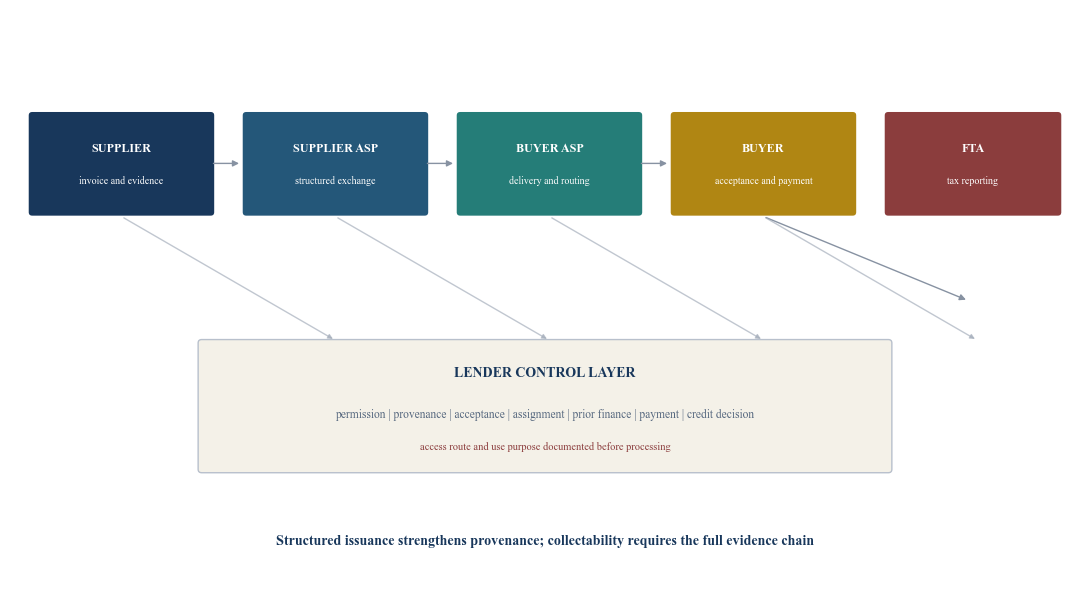
Author framework. Lender access and use require a valid legal, contractual and technical basis.
2. Start from the current UAE programme
The current official position matters because the programme is evolving. The Ministry of Finance portal states that it is the official source for UAE eInvoicing information and publishes the guidelines, mandatory fields, service-provider information and legislative documents.[1]
The pilot programme commenced on 1 July 2026 for selected consenting participants. Voluntary implementation became available from the same date under the published guidance. Mandatory implementation follows a phased timetable. Under the May 2026 amendment announced by the Ministry, persons with annual revenue above AED 50 million have until 30 October 2026 to appoint an Accredited Service Provider and remain required to implement by 1 January 2027. Persons below AED 50 million are scheduled to appoint an Accredited Service Provider by 31 March 2027 and implement by 1 July 2027. In-scope government entities are scheduled to implement by 1 October 2027.[3][4]
The official guidelines state that electronic invoicing applies broadly to persons conducting business in the UAE for business transactions unless specifically excluded, with detailed scope and exclusions in the decisions and guidance.[2] A company should confirm its current status, revenue threshold, transaction types, exclusions and dates with tax and legal advisers.
The system uses a five-corner model. The supplier transmits structured invoice data through its Accredited Service Provider. The buyer receives through its provider. Relevant invoice data is reported to the tax authority as the fifth corner. The published architecture supports interoperability and structured exchange. It does not describe a general lender-data feed.
A credit programme should therefore avoid assuming access. The lender needs a permitted source such as borrower-provided data, a contractual reporting route, a consented data service, an assignment or servicing arrangement, or another lawful mechanism confirmed for the use case.
3. Establish a data-access and purpose gate
Data availability and data entitlement are separate. A supplier can possess its issued invoices. A buyer can possess received invoices. An Accredited Service Provider processes information under the eInvoicing framework and its agreements. The tax authority receives reporting data for its statutory purposes. A lender's right to obtain or use any of that information must be established independently.
The access gate identifies the data controller or responsible party, the provider, subject entities, fields, purpose, frequency, retention, onward sharing, security, withdrawal or termination, cross-border treatment and deletion. Commercial confidentiality can apply even when the data does not identify a natural person. Personal data can appear in sole-trader, contact, bank, signatory or delivery information.
The UAE Personal Data Protection Law defines personal data broadly and sets rules for processing within its scope.[8] The lender and its providers should determine roles, lawful basis, notices, rights, security and transfer requirements using current professional advice. Tax confidentiality, banking secrecy, contractual restrictions and free-zone regimes can create additional requirements.
Purpose limitation should shape the dataset. Underwriting may need supplier, buyer, amount, currency, dates, terms, line items, credit notes and status. It may not need every operational detail. Portfolio monitoring can use derived indicators where raw-data retention is unnecessary. The design should minimise access while preserving decision evidence and auditability.
Table 1. Lender data-access and purpose gate
| Gate | Evidence | Credit use | Stop or escalation condition |
|---|---|---|---|
| Data owner and provider | entity map, agreements and system roles | identify who can provide each field | ownership or authority unresolved |
| Lawful access | consent, contract, assignment, servicing or other confirmed basis | receive data for stated purpose | access assumed from technical availability |
| Purpose | underwriting, monitoring, servicing, fraud or recovery purpose | limit processing and feature creation | broad secondary use unsupported |
| Data scope | defined fields, entities, periods and transactions | complete relevant population | unknown omissions or mixed entities |
| Confidentiality | customer, pricing, product and contract restrictions | controlled credit review | disclosure conflicts with contract or duty |
| Personal data | role, lawful basis, notice, rights and minimisation analysis | process permitted natural-person information | basis, notice or rights process incomplete |
| Security | encryption, access, authentication, monitoring and incident response | protect source data and decisions | material control gap or unapproved provider |
| Retention and deletion | schedule, legal holds, model evidence and termination plan | preserve required audit trail | indefinite or inconsistent retention |
| Onward sharing | bureau, insurer, adviser, funder and subprocessor map | enable approved credit workflow | recipient or purpose outside authority |
| Change control | version, field, provider and regulatory update process | keep features and decisions reproducible | silent schema or permission change |
Requirements depend on the parties, data route, documents and applicable law.
4. Build an invoice state machine
An invoice should have a controlled state rather than a single existence flag. The state machine can begin with created and issued, then move through delivered, received, accepted, disputed, credited, assigned, financed, due, paid or overdue. Some states can coexist. A partially credited invoice can remain due for the balance. A financed invoice can later be disputed.
Each state requires an event, timestamp, source and responsible party. Supplier issuance is evidence of a claim made by the supplier. Provider delivery can support routing. Buyer acceptance can arise from a portal action, matched purchase order, goods-received note, service confirmation, contractual deemed acceptance or another source. The legal effect depends on the contract and facts.
Credit notes and cancellations update exposure. They should not merely reduce historic sales in aggregate. The system links them to the original invoice and records reason, timing and amount. Repeated post-finance credit notes can signal dilution, quality problems or fraud.
Payment closes the state only after reconciliation to the correct debtor, invoice, currency and amount. A supplier-funded transfer, circular payment or unrelated deposit should not be treated as buyer collection. Partial payments, deductions and set-off remain visible.
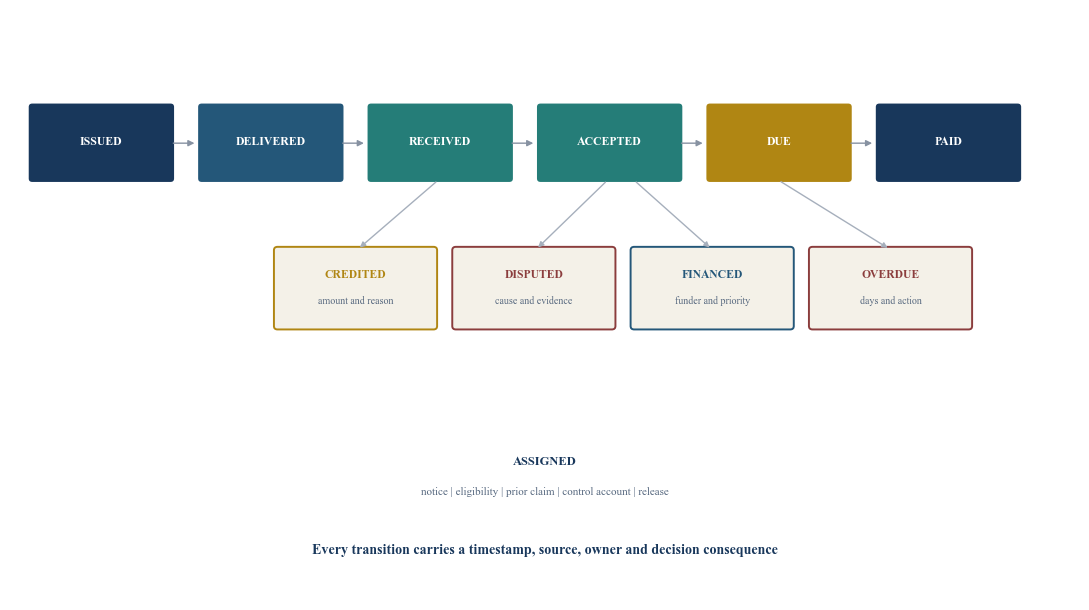
Legal effect and available actions depend on the commercial contract, finance documents and applicable law.
5. Preserve provenance from source to decision
Credit teams should be able to reproduce every material invoice metric. The provenance record links the raw message, provider receipt, schema version, supplier and buyer identifiers, invoice identifier, original fields, transformations, enrichment, exception, reviewer and decision.
Structured syntax reduces extraction ambiguity. It does not guarantee commercial truth. A valid field can contain an incorrect amount or buyer. An authorised user can create a fictitious invoice. A genuine invoice can reflect undelivered goods. The provenance stack therefore combines technical validation and commercial verification.
Technical controls can include schema validation, message identity, provider status, timestamp, integrity check, duplicate check and version. Entity controls reconcile tax registration, licence, legal name, account ownership, group relationships and beneficial ownership. Commercial controls connect purchase order, contract, delivery, acceptance, dispute and credit note. Cash controls reconcile collection to buyer-originated bank evidence.
Every transformation should have a business definition. Days to pay needs a chosen start date and treatment of partial payments, non-business days and credits. Buyer concentration needs a resolved buyer group. Dilution needs a defined numerator and observation window. Changes require maker-checker approval and back-testing where appropriate.
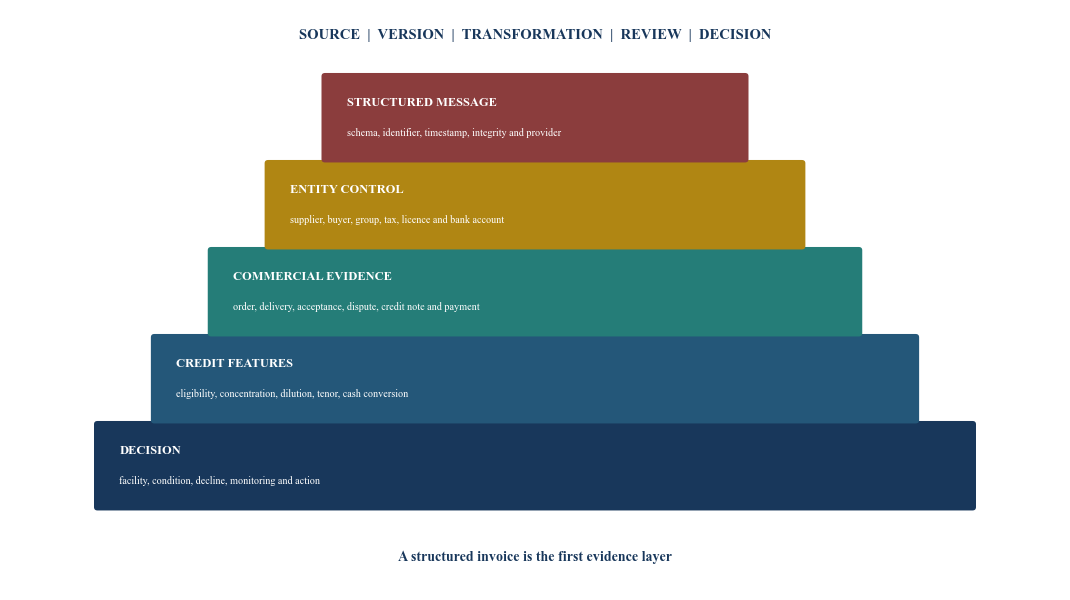
Author framework. Each layer preserves source, date, version and accountable ownership.
6. Use the mandatory fields as a starting dataset
The Ministry of Finance publishes mandatory-field requirements for electronic tax invoices and commercial electronic invoices.[5] The current detailed field set and schema should be obtained from the official portal and provider implementation materials.
Credit design begins by mapping available fields to a purpose. Supplier and buyer identifiers support entity resolution. Invoice number and issue date support uniqueness and ageing. Supply date and line items support commercial analysis. Currency, amount, tax category and total support exposure. Payment terms support due date. References can connect purchase orders, contracts and prior documents where populated.
Missing, optional or low-quality fields remain visible. A mandatory technical field can still be commercially generic. A line description such as services rendered provides less verification value than a specific milestone tied to a contract and acceptance record.
The lender should avoid collecting fields without a decision use. It should also avoid deriving a high-confidence feature from a field with uncertain population practice. Pilot data should be profiled for completeness, consistency, uniqueness, timeliness and reconciliation before it enters automated policy.
Table 2. Invoice evidence matrix for SME credit
| Evidence | Credit question | Reconciliation | Limitation to preserve |
|---|---|---|---|
| Supplier identity | who created the claim and owns the receivable? | licence, tax registration, ownership and bank account | identity does not prove performance |
| Buyer identity | who is expected to pay? | legal entity, group, contract and credit file | trading name can differ from obligor |
| Invoice identifier | is the record unique? | supplier series, provider message and ledger | identifier alone does not prevent duplicate finance |
| Issue and supply dates | when did the commercial event occur? | contract, delivery and accounting period | backdating or delayed issue requires review |
| Amount, currency and tax | what is the gross and financeable exposure? | ledger, tax treatment, credit notes and contract | tax or non-eligible amounts may need exclusion |
| Line items | what was supplied? | order, milestone, quantity and price | description quality can be weak |
| Payment terms and due date | when should cash arrive? | contract, buyer practice and amendments | invoice terms can conflict with master agreement |
| Purchase-order reference | was spend authorised? | buyer procurement and order record | a valid order does not prove delivery |
| Delivery or acceptance evidence | has performance occurred? | goods receipt, service acceptance or milestone | legal effect depends on contract and facts |
| Credit note and dispute | how much exposure remains and why? | linked original invoice and correspondence | late adjustments create dilution risk |
| Bank collection | did the debtor pay the receivable? | control account, remitter and allocation | unrelated or circular cash can mislead |
| Finance history | is another funder claiming the same cash flow? | assignment notice, registry, ledger and confirmations | invoice data does not establish priority alone |
Field availability and meaning should be confirmed against the current official schema and transaction evidence.
7. Verify buyer acceptance and dispute status
Buyer risk and performance risk are distinct. A strong buyer can refuse payment when the supplier did not perform, the invoice is incorrect or the contract allows set-off. A lender should determine how acceptance occurs and which evidence supports it.
Evidence can include purchase-order match, goods-received note, warehouse receipt, service completion, milestone certificate, portal approval, buyer confirmation or a contractual deemed-acceptance period. The hierarchy depends on the sector and agreement. Buyer confirmation should use an independently verified channel, with controls against supplier impersonation.
Dispute status should be specific. Price, quantity, quality, delivery, tax, contract, set-off and administrative disputes have different effects. The lender records disputed amount, date, owner, evidence and expected resolution. A partial dispute can reduce eligibility while leaving the uncontested balance financeable under policy.
Repeated disputes can reveal supplier quality, buyer behaviour or weak documentation. The portfolio view should compare dispute rate by supplier, buyer, product, branch and salesperson. A sudden drop in reported disputes can also require validation if the data route changed.
Acceptance should remain current. A buyer can accept delivery and later claim warranty, return or set-off rights. Facility documents, reserves and recourse should address risks that survive initial verification.
8. Prevent duplicate and circular financing
The same invoice can be presented to more than one funder. A supplier can also create duplicate invoice numbers across systems, split one delivery into overlapping claims, replace an invoice without releasing the original finance or redirect collections. Structured issuance helps identify records. It does not create a universal lien or finance registry.
Duplicate-finance controls combine internal and external evidence. Internally, the lender checks supplier, buyer, invoice identifier, amount, date, purchase order, contract, line items, bank details and document hash. It compares active, repaid, rejected and cancelled invoices across products and legal entities.
Externally, the lender can use assignment notices, acknowledgements, account control, registries where applicable, bureau or provider data available under lawful arrangements, other-lender confirmations and contractual representations. Counsel should confirm assignment, priority, perfection, notice and enforcement for the transaction.
Circular financing can appear when loan proceeds or related-party transfers are presented as customer collections. Payment reconciliation identifies remitter account, payer entity, amount, timing, references and return flows. Unexplained third-party payment deserves review rather than automatic cure.
Fraud controls should protect genuine customers. Alerts need evidence, proportionality, investigation and authorised outcomes. A system that rejects legitimate invoice patterns without review can reduce access to finance and create conduct risk.
9. Convert invoice history into credit features
Invoice data can reveal trading activity at higher frequency than annual financial statements. Useful measures can include invoiced sales, unique buyers, buyer concentration, invoice size distribution, seasonality, days to acceptance, contractual tenor, realised days to pay, overdue migration, partial payment, dispute, credit note, dilution and collection volatility.
Features require consistent populations. Growth calculated from one connected buyer subset can misrepresent total sales. Days to pay should distinguish current and closed invoices. Concentration should resolve buyer groups. Dilution should connect credit notes, deductions, returns and disputes to original gross invoices.
The lender reconciles invoice activity to revenue, receivables, tax, bank collections and management accounts. Timing differences are expected. Unexplained gaps remain exceptions. The purpose is a complete repayment picture rather than forced equality at every date.
Forward-looking analysis matters. A strong historic collection record can weaken when the supplier loses a contract, buyer terms extend, input costs rise or a sector slows. The CBUAE Credit Risk Management Standards require comprehensive, forward-looking analysis, robust data gathering and monitoring for licensed financial institutions within their scope.[6]
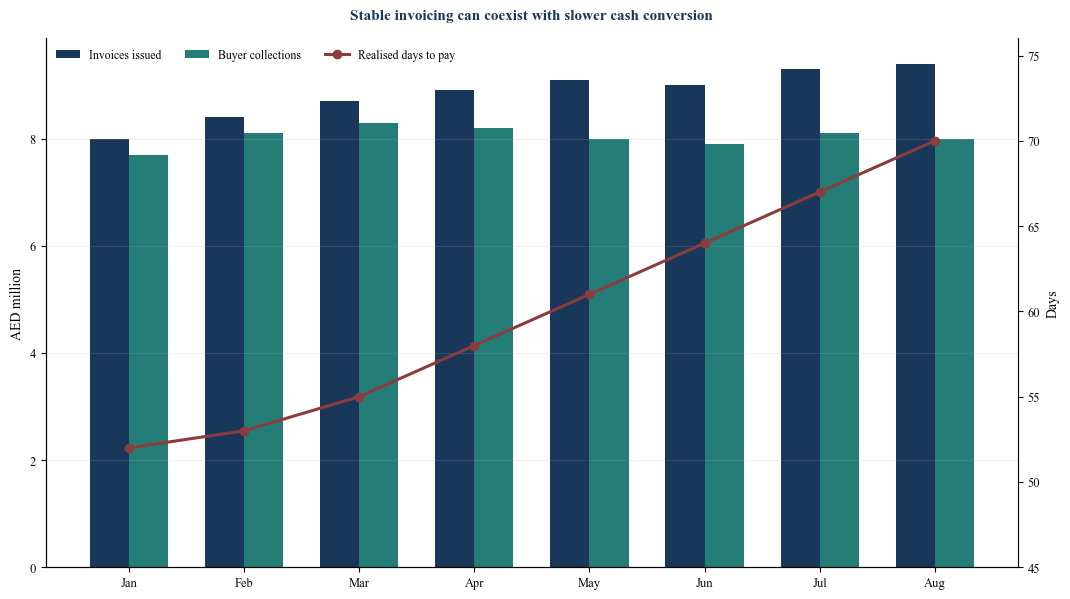
Every value is an illustrative management assumption.
10. Design the receivables eligibility engine
Eligibility defines which receivables can support an advance. The rule set can cover supplier, buyer, jurisdiction, currency, invoice state, acceptance, remaining tenor, ageing, amount, dispute, credit note, concentration, related party, assignment, prior finance, insurance, sector and documentation.
Every exclusion should have a risk rationale. Related-party invoices can lack arm's-length payment behaviour. Milestone invoices can depend on certification. Retention amounts can remain unavailable for long periods. Consumer invoices can have different rights and data requirements. Government and large-corporate receivables can have procurement and assignment restrictions.
Eligibility should be calculated at the decision date and refreshed through servicing. An invoice can become ineligible after a dispute, credit note, overdue threshold, buyer downgrade or concentration breach. The system preserves original eligibility, current eligibility and reason for change.
Overrides require named authority, evidence, expiry and monitoring. A salesperson should not be able to alter an invoice state or buyer group to obtain funding. Material exceptions should appear in portfolio reporting.
Table 3. Receivables eligibility and facility rules
| Rule | Evidence | Possible treatment | Control purpose |
|---|---|---|---|
| Supplier | approved legal entity, ownership, operations and account | include only approved originators | prevent mixed or unauthorised sellers |
| Buyer | approved obligor and group mapping | limit, exclude or require enhancement | manage payment and concentration risk |
| Invoice state | issued, delivered, accepted and undisputed evidence | fund only permitted state | connect advance to commercial performance |
| Tenor and ageing | due date, issue date and realised behaviour | maximum original and remaining days | contain duration and overdue risk |
| Amount | gross, tax, retention, credits and deductions | finance eligible net amount | avoid advancing against unavailable value |
| Concentration | buyer, group, sector and geography | cap or apply lower advance | contain correlated exposure |
| Dilution | credit notes, disputes, returns and offsets | reserve, haircut or stop | protect against shrinking receivable value |
| Assignment and priority | contract, notice, acknowledgement and legal analysis | condition precedent or exclusion | establish enforceable lender interest |
| Prior finance | lender ledger, representations and external checks | reject duplicate or unresolved claim | prevent multiple advances against one cash flow |
| Collection control | approved account, payer and reconciliation | controlled account or blocked funding | preserve cash and servicing visibility |
| Recourse and support | supplier obligation, reserve, guarantee or insurance | price and structure according to support | allocate residual performance and collection risk |
| Stop-funding event | fraud, data loss, breach, dispute spike or buyer stress | suspend new advances pending decision | stop risk accumulation during uncertainty |
Terms are illustrative categories; actual rules require transaction-specific approval and documentation.
11. Link advance rate to loss and dilution
The advance rate determines how much cash the lender provides against eligible receivables. It should reflect expected collection, dilution, concentration, tenor, timing, recourse, priority, fraud, operating cost and uncertainty. A high-quality buyer does not eliminate supplier performance or assignment risk.
The borrowing base begins with eligible receivables and deducts ineligible amounts, concentration excess, dilution reserve, tax or retention where relevant, unapplied cash and other reserves. Outstanding advances, fees and accrued amounts are reconciled to availability.
The lender should stress several risks together. Longer payment can increase funding duration and supplier liquidity pressure. Higher disputes can reduce collections and increase dilution. Buyer concentration can turn an operational problem into a material portfolio loss.
Pricing should connect to expected and unexpected loss, capital or fund return, liquidity, servicing and operational effort. A low headline advance rate can still create risk if eligibility is weak or collections bypass control.
The credit committee should see base, downside and severe borrowing-base cases. It should identify the first variable that causes over-advance and the available cure, reserve, repayment or stop-funding response.
12. Build continuous servicing and exception control
Receivables finance is administered every day. New invoices enter. Credits reduce balances. Payments arrive. Disputes emerge. Buyers reach limits. The lender should reconcile the entire movement from opening to closing exposure.
The daily or periodic roll-forward includes opening eligible receivables, new eligible invoices, exclusions, credit notes, collections, reallocations, overdue migration, concentration excess and closing availability. Every manual journal or allocation has an owner and evidence.
Collections should route through the agreed structure. The servicing team identifies payer, remittance, invoice allocation, short payment, set-off, refund and unapplied cash. Changes to bank instructions use independent verification and two-person approval.
Exception queues need priority and ageing. A missing purchase order can be resolved operationally. A new undisclosed secured lender can change priority. A buyer denying the transaction can trigger immediate funding suspension and investigation.
Table 4. Invoice-finance signal-to-action controls
| Signal | Verification | Credit question | Controlled action |
|---|---|---|---|
| Invoice volume rises sharply | compare orders, capacity, buyers, tax and bank data | is growth genuine and financeable? | enhanced sample, cap or temporary reserve |
| Days to acceptance lengthen | inspect buyer workflow and supplier performance | is commercial quality weakening? | reduce eligibility pending acceptance |
| Credit notes increase | link reason, buyer, product and original invoice | is dilution temporary, concentrated or structural? | dilution reserve, haircut or stop funding |
| Buyer concentration breaches | resolve buyer group and active exposure | can one delay create over-advance? | concentration exclusion or repayment |
| Buyer denies invoice | verify channel, order, delivery and identity | is the claim invalid, disputed or fraudulent? | suspend affected funding and investigate |
| Collection arrives from third party | identify remitter, relationship and return flow | does cash evidence genuine buyer payment? | hold allocation and obtain support |
| Duplicate match appears | compare identifiers, amount, order and funding ledger | has the same cash flow been financed twice? | block advance and escalate priority review |
| Payment bypasses control account | trace buyer instruction and supplier receipt | has lender cash control weakened? | cure, sweep, notice or stop funding |
| Provider or schema changes | validate fields, permissions and transformations | are features and decisions still reproducible? | controlled release and parallel testing |
| Data feed stops | confirm cause, duration and alternative evidence | can risk be monitored reliably? | fallback reporting, limit or funding pause |
Actions depend on the facility documents, authority, law and verified facts.
13. Integrate fraud controls with credit judgement
Invoice fraud can involve fictitious trade, duplicate claims, altered buyers, inflated amounts, related parties, collusion, false delivery, account diversion or fabricated collections. Controls should combine data, people, documents and independent communication.
Entity resolution can reveal shared addresses, directors, domains, devices, bank accounts and contact details. Transaction analytics can identify repeated amounts, unusual round numbers, weekend issuance, sequence gaps, unexpected buyer changes, implausible growth and circular payments. These patterns create questions. They do not establish fraud alone.
Verification should use channels independently sourced from official or contractual records. Supplier-provided contact details should not be the sole route for buyer confirmation. Staff access, overrides and bank changes require segregation and logging.
Fraud and credit teams should share evidence under approved permissions. A false-positive review records why an alert was closed. A confirmed or suspected material issue follows legal, regulatory, contractual and reporting requirements. Communications should preserve confidentiality and due process.
Portfolio learning improves policy. The lender records event type, exposure, detection source, loss, recovery and control failure. Model or rule changes follow validation and approval rather than emergency silent adjustment.
14. Confirm assignment, priority and recovery
Invoice data describes a receivable. It does not determine whether the supplier can assign it, whether consent or notice is required, whether set-off applies, whether another creditor has priority or how enforcement proceeds.
The legal review covers the underlying contract, governing law, assignment restriction, prohibition, consent, notice, acknowledgement, future receivables, proceeds, commingling, set-off, counterclaim, tax, security, perfection, registration, insolvency and enforcement. Cross-border buyers and contracts can add jurisdictions.
The 2023 UNIDROIT Model Law on Factoring provides international reform context for transfers of receivables and factoring.[9] It is a model law. It does not establish the governing rule for a UAE transaction. Current UAE law, relevant financial free-zone law and the actual documents require local counsel.
Recovery analysis separates gross invoice from expected cash. It considers invalid or disputed amounts, credit notes, set-off, priority claims, collection cost, delay and supplier recourse. A buyer's strong credit rating has limited value when the buyer has a valid defence to the invoice.
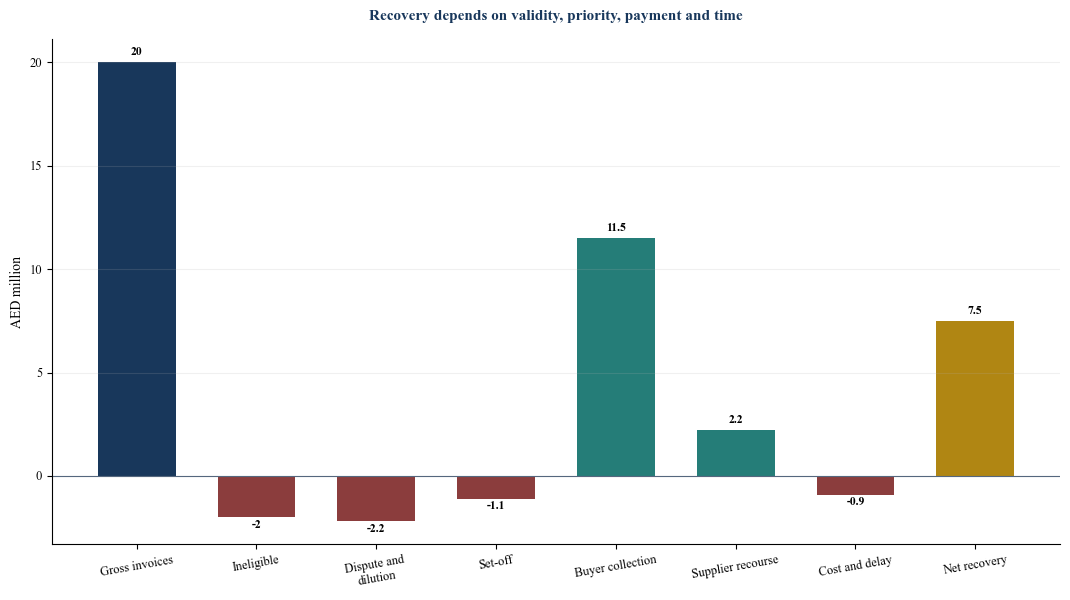
All amounts are illustrative management assumptions in AED millions.
15. Demonstrate the method with a hypothetical UAE SME
Consider a hypothetical UAE distribution company seeking an AED 12 million revolving receivables facility. Every company, buyer, invoice, amount, ratio, probability, recovery and outcome in this example is a management assumption created solely to demonstrate the framework. It does not describe a borrower, lender, transaction, market price or recommendation.
The assumed company reports AED 96 million of annual revenue, a diverse product catalogue and 62 active business customers. Its monthly invoicing is approximately AED 8 million to AED 9.4 million. Collections have grown more slowly, and realised days to pay have increased from 52 to 70 over eight months.
The hypothetical connected dataset contains AED 20 million of gross open invoices. The lender excludes AED 2 million for related parties, excessive tenor and missing acceptance. It applies a concentration cap that removes AED 1.5 million, a dilution reserve of AED 1 million and an unapplied-cash reserve of AED 0.5 million. The resulting assumed borrowing base is AED 15 million.
At an illustrative 75 percent advance rate, availability is AED 11.25 million before outstanding advances and fees. The proposed commitment remains AED 12 million, with actual drawings limited by the borrowing base. The lender requires a controlled collection account, periodic buyer verification, invoice-state refresh, concentration limits, dilution triggers, data-availability conditions and a stop-funding event for material integrity concerns.
During the pilot, the system detects two invoices with matching buyer, amount and purchase order but different invoice identifiers. Review finds that one is a corrected replacement with a linked credit note. The original invoice is removed from eligibility. The event is a process issue under the hypothetical facts, and no fraud conclusion is made.
A separate buyer extends payment terms. Concentration and tenor reduce availability by AED 1.2 million. The supplier provides additional eligible invoices and repays AED 0.4 million to restore headroom. The committee approves a six-month pilot subject to legal, tax, data, operational and security conditions. No executed facility or outcome is claimed.
Table 5. Hypothetical eInvoice-based SME facility
| Measure | Assumed current evidence | Downside or exception | Governed response |
|---|---|---|---|
| Annual revenue | AED 96m | lower cash conversion despite sales growth | reconcile invoices, revenue and bank collections |
| Gross open invoices | AED 20m | includes ineligible and concentrated items | apply source-linked eligibility rules |
| Eligible before reserves | AED 16.5m | buyer term extension reduces amount | refresh at each borrowing-base date |
| Dilution and cash reserves | AED 1.5m | credit notes can rise under stress | dynamic reserve and trigger |
| Borrowing base | AED 15m | AED 13.4m after exception | cap drawings and require cure |
| Advance rate | 75 percent | lower rate for weaker evidence or buyers | committee-approved matrix |
| Initial availability | AED 11.25m | AED 10.05m after exception | reconcile outstanding advance and fees |
| Largest buyer | 24 percent of eligible pool | term extension increases duration | concentration excess and tenor control |
| Realised days to pay | 70 days | 82 days stress | monitor vintage migration and liquidity |
| Replacement invoice | two identifiers share one order | original remained in feed | remove original and correct workflow |
| Collection control | dedicated account assumed | bypass risk remains | notice, reconciliation and stop-funding right |
| Outcome | six-month pilot approved in principle | conditions remain open | no funding until every gate is completed |
Every amount, rule, event and outcome is an illustrative management assumption.
16. Monitor the portfolio at invoice, buyer and supplier level
Portfolio monitoring should aggregate invoice risk across several dimensions. At invoice level, the lender tracks state, age, amount, dispute, credit, finance and payment. At buyer level, it tracks exposure, group, payment behaviour, set-off, sector and limit. At supplier level, it tracks dilution, concentration, fraud alerts, recourse, liquidity and facility headroom.
Common drivers can create correlated risk. Several suppliers can sell to one buyer. One buyer can extend terms across the market. A sector shock can increase returns and disputes. A provider outage can reduce visibility across many facilities.
The CBUAE standards require licensed financial institutions within scope to monitor credit at facility, obligor, group, segment and portfolio levels and to maintain reliable and timely data processes.[6] An invoice-finance platform should link operational data to those credit views rather than treat invoices as isolated transactions.
The dashboard distinguishes data health from credit health. A missing feed can create uncertainty without proving borrower deterioration. A current feed can show deteriorating collections. Each condition has a response.
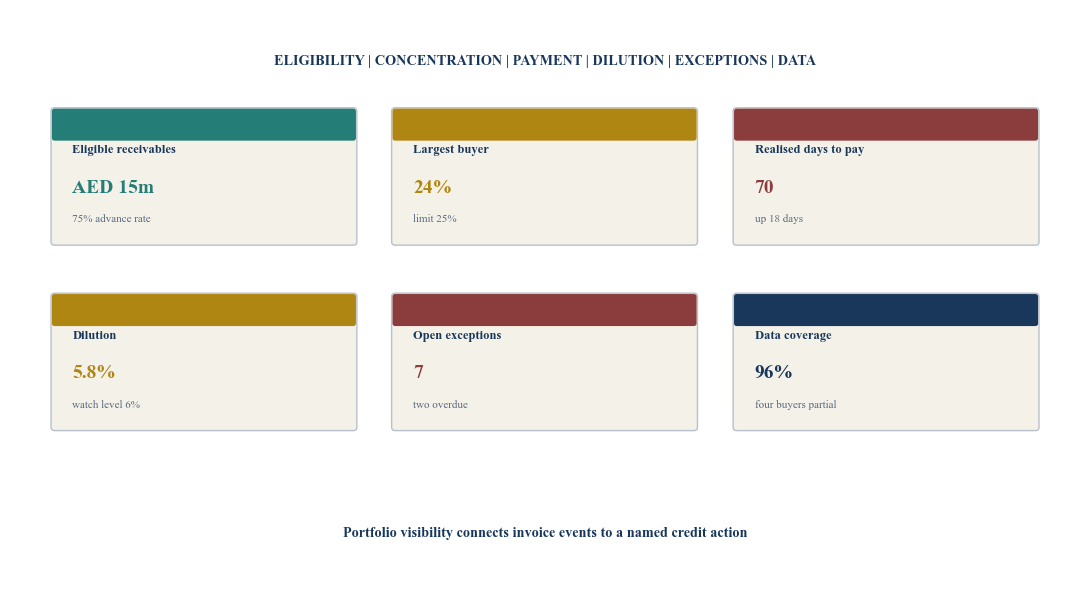
Every displayed value is an illustrative management assumption.
17. Implement a controlled pilot in 100 days
The programme begins with authority and evidence. Days one to 15 define sponsor, regulated perimeter, product, target SME segment, data route, legal and tax owners, credit appetite and success measures. The team confirms the current eInvoicing timetable and participant obligations from official sources.
Days 16 to 30 map entities, providers, permissions, fields, systems and documents. The team builds the invoice state machine, provenance record and data-quality rules. It identifies where buyer acceptance, assignment, prior finance and payment evidence enter.
Days 31 to 50 define eligibility, advance rates, concentration, dilution, tenor, reserves, recourse, collection and stop-funding rules. Credit, legal, finance, operations, fraud, data protection and technology approve responsibilities.
Days 51 to 70 test historic and current data from selected consenting companies. Analysts reconcile invoices to orders, delivery, ledgers, tax, credit notes and bank collections. They measure missing data, false duplicates, buyer mapping, dispute and payment behaviour.
Days 71 to 85 run shadow borrowing bases and credit decisions without funding. Independent reviewers reproduce features and challenge exceptions. Days 86 to 100 approve a small live pilot only after documents, access, security, servicing, reconciliation, recovery and reporting gates pass.
Table 6. One-hundred-day eInvoice credit pilot
| Days | Workstream | Controlled deliverable | Gate |
|---|---|---|---|
| 1 to 10 | mandate | product, segment, authority, risk appetite and success measures | governing body confirms accountable owners |
| 11 to 20 | perimeter | regulatory, legal, tax, data, confidentiality and provider map | specialist owners accept scope and open issues |
| 21 to 30 | data architecture | fields, entities, state machine, provenance and retention | source-to-decision lineage is reproducible |
| 31 to 40 | commercial evidence | order, delivery, acceptance, dispute, credit and payment hierarchy | financeable state is approved by sector |
| 41 to 50 | credit policy | eligibility, advance, concentration, dilution, tenor and reserves | committee approves rules and overrides |
| 51 to 60 | fraud and priority | duplicate, entity, bank, assignment and prior-finance controls | unresolved claims cannot be funded |
| 61 to 70 | servicing | borrowing base, collection, allocation, exception and reconciliation | opening-to-closing exposure balances |
| 71 to 80 | shadow pilot | selected SME data tested without advances | material data and decision gaps resolved |
| 81 to 90 | independent challenge | feature reproduction, downside, security and recovery review | second line accepts limitations and controls |
| 91 to 100 | controlled release | small limits, monitoring, incident plan and review calendar | sponsor signs production release with conditions closed |
Timing depends on permissions, providers, borrowers, buyers, data, documents and regulation.
18. Limitations and conclusion
The UAE eInvoicing programme creates a structured business-transaction layer with important operational and potential credit value. The official Ministry of Finance materials define the system, architecture, scope, fields, providers and implementation phases.[1][2][3][4][5] The programme's purposes include digitalisation, efficiency, transparency and tax compliance.
This paper does not claim that the official eInvoicing system grants lenders access to tax or invoice data. A lender needs a lawful, contractual and technically controlled access route for its stated purpose. The eInvoice record also does not by itself establish delivery, acceptance, non-dispute, assignability, priority, prior finance, collectability or payment.
The CBUAE credit-risk framework provides current requirements for licensed financial institutions within its scope, including robust data gathering, forward-looking analysis, credit administration, monitoring, documentation, portfolio aggregation and risk mitigation.[6] The CBUAE open-finance programme provides relevant consent-driven data context.[7] It remains a separate framework from eInvoicing.
The UAE Personal Data Protection Law provides the federal personal-data framework within its scope.[8] Commercial confidentiality, tax rules, banking requirements, contracts and financial free-zone regimes can also apply. The UNIDROIT Model Law on Factoring provides international context and does not determine UAE transaction law.[9]
The hypothetical SME, invoices, buyers, amounts, advance rates, days, reserves, recovery and outcome in this paper are management assumptions for framework demonstration. They are not client information, market observations, default probabilities or recommendations.
The operating model begins with permission and provenance. It tracks the invoice through commercial and financial states. It verifies buyer acceptance, credits, disputes, assignment, prior finance and payment. It converts reconciled history into transparent credit features. It connects eligibility and facility structure to risk. It services every movement and aggregates common drivers across the portfolio.
That sequence can turn structured invoicing into credit infrastructure. The value comes from a controlled evidence chain and timely human decisions.
References
- [1] United Arab Emirates Ministry of Finance, eInvoicing official programme portal, current materials and legislative links, accessed 13 August 2026. https://mof.gov.ae/en/about-us/initiatives/einvoicing/
- [2] United Arab Emirates Ministry of Finance, UAE Electronic Invoicing Guidelines, version 1.1 dated 1 June 2026. https://mof.gov.ae/wp-content/uploads/2026/06/UAE-Electronic-Invoicing-Guidelines_V-1.1-01June2026.pdf
- [3] United Arab Emirates Ministry of Finance, announcement on scope and phased implementation of the Electronic Invoicing System, 29 September 2025. https://mof.gov.ae/en/news/ministry-of-finance-announces-the-issuance-of-two-ministerial-decisions-on-the-scope-of-obligations-and-the-timelines-for-implementing-the-electronic-invoicing-system-2/
- [4] United Arab Emirates Ministry of Finance, targeted amendments to eInvoicing decisions, including the amended ASP appointment deadline for persons above AED 50 million, 10 May 2026. https://mof.gov.ae/en/news/ministry-of-finance-announces-targeted-amendments-to-einvoicing-system-decisions/
- [5] United Arab Emirates Ministry of Finance, UAE Electronic Invoice Mandatory Fields, version 1.0 dated 23 February 2026. https://mof.gov.ae/wp-content/uploads/2026/02/UAE-Electronic-Invoice-mandatory-fields_V-1.0-23Feb2026.pdf
- [6] Central Bank of the UAE, Credit Risk Management Regulation and Credit Risk Management Standards, C 3/2024, effective 30 November 2024, status in force when accessed 13 August 2026. https://rulebook.centralbank.ae/en/rulebook/credit-risk-management-standards
- [7] Central Bank of the UAE, Open Finance programme and roadmap, updated 22 October 2025. https://www.centralbank.ae/en/our-operations/fintech-digital-transformation/open-finance/
- [8] United Arab Emirates, Federal Decree by Law No. 45 of 2021 Concerning the Protection of Personal Data, official legislation portal, accessed 13 August 2026. https://uaelegislation.gov.ae/en/legislations/1972
- [9] UNIDROIT, Model Law on Factoring, adopted May 2023. https://www.unidroit.org/instruments/factoring/model-law-on-factoring/
- [10] United Arab Emirates Ministry of Finance, launch of the eInvoicing four-corner model and progress toward the five-corner model, 21 April 2026. https://mof.gov.ae/en/news/uae-marks-milestone-with-introduction-of-einvoicing-4-corner-model-for-businesses/
About the Author
Chennakeshav Adya is an independent researcher and Managing Partner of Matchpoint Partners. His research focuses on investment strategy, capital formation, transaction execution, governance and operating-model design across the Gulf and international markets.
