

1. Treat consolidation as a continuity decision
A fund manager is a network of promises. Investors expect the stated people to exercise judgement within agreed strategy and governance. Portfolio companies and borrowers expect decisions, capital and stewardship. Regulators expect an authorised firm to maintain fitness, financial resources, systems, controls and accountable senior management. Employees expect roles, incentives and a credible future. Service providers operate against legal entities, permissions, instructions and data flows.
An ownership or platform transaction touches this complete network. A higher headline valuation can lose value if consent failures reduce revenue, key people leave, a regulatory condition delays closing, systems cannot migrate or investors pause commitments. A lower-complexity structure can create more durable value where it protects continuity and preserves strategic flexibility.
The board should begin with the decision the firm is trying to solve. Common questions include how to fund succession, deepen distribution, lower fixed cost, enter a jurisdiction, add strategies, institutionalise controls, finance GP commitments, give founders liquidity or repair an undersized platform. Each question has more than one solution.
The strategic baseline is credible independence. It describes the cost, investment and governance required to continue alone. Every transaction option should be compared with that baseline over the same period and under the same fundraising, retention and regulatory assumptions.
The decision file should state the protected outcomes: fiduciary performance, investor treatment, regulatory continuity, team stability, data integrity, service continuity and sustainable economics. These outcomes become deal conditions, diligence tests and integration measures.
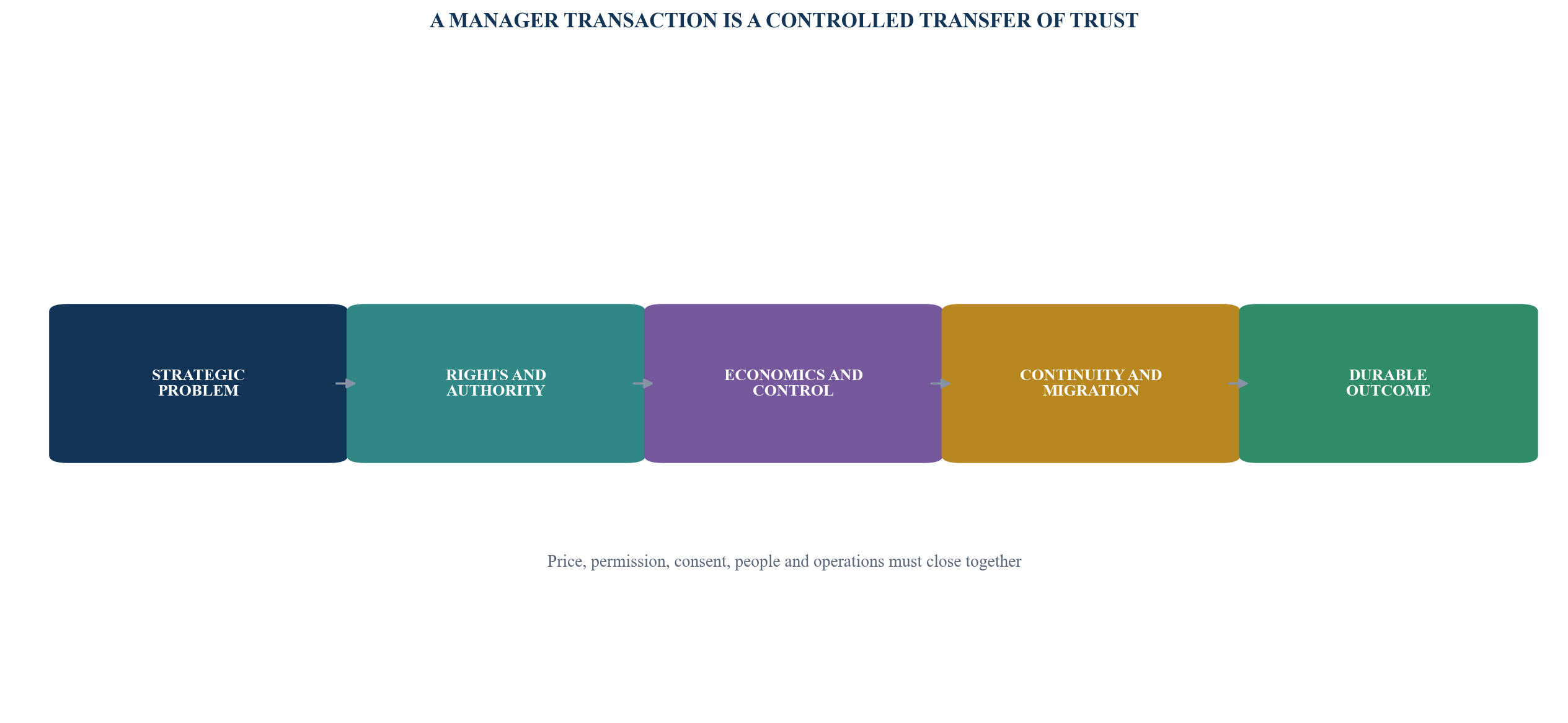
Transaction value survives only when every link remains supportable through completion and integration.
2. Separate the available transaction architectures
Remaining independent can include a funded transformation programme, outsourced operations, selective hires, technology replacement, distribution partnerships or balance-sheet financing. Independence retains control while leaving the firm responsible for capability, capital and succession.
A shared platform can provide regulated hosting where permitted, operations, compliance, finance, technology, administration oversight or distribution. The manager may retain investment identity and ownership. The arrangement requires a precise allocation of regulated responsibility, client ownership, data control, economics, service levels, exit rights and transition assistance.
A minority investment can provide founder liquidity, GP commitment capital, acquisition capacity or institutional support. The investor may receive board, information, consent, transfer, distribution, pre-emption and exit rights. Economic participation can extend across management fees, carried interest, balance-sheet assets and future products.
A majority sale or merger transfers or combines control. It can create distribution reach, product breadth, capital and shared infrastructure. It also creates approval, consent, culture, retention, integration, branding and strategic-governance work.
An asset or team transfer can move selected contracts, people, mandates or funds without acquiring the complete corporate entity. It can isolate liabilities, although every transferred item needs a valid path and operational landing point.
A fund-level continuation vehicle addresses portfolio ownership and investor liquidity. It differs from a sale of the management company or general-partner interest. A manager transaction and a continuation transaction can interact, producing distinct conflicts, approvals, economics and disclosures.
Table 1. Strategic architecture comparison
| Architecture | Primary objective | Control effect | Central execution risk |
|---|---|---|---|
| funded independence | build capability while retaining ownership | existing control retained | programme funding and delivery capacity |
| shared platform | access selected infrastructure or permission | contract-based allocation | responsibility, service and exit ambiguity |
| minority investment | capital, liquidity or institutional support | reserved rights without planned control transfer | economic leakage and governance deadlock |
| merger or majority sale | combine scale, capability and ownership | control changes or combines | approvals, consents and integration |
| asset or team transfer | move selected business perimeter | item-specific | contracts, people and operational separation |
| fund continuation transaction | extend ownership of selected assets | fund-level change | conflicts, price, process and investor election |
Actual rights, approvals and consequences depend on the firms, funds, documents and jurisdictions.
3. Define the problem before selecting the solution
A consolidation thesis should identify a binding constraint. Scale alone is too broad. The useful question is which capability, capital or continuity gap limits the next strategy and whether ownership needs to change to close it.
Distribution constraints can arise from insufficient relationships, jurisdictional reach, product fit, diligence evidence or capacity to service investors. A buyer's brand does not automatically solve these issues. The firm should test channel access, product acceptance, sales ownership, economics and conversion evidence.
Operating constraints include compliance, finance, risk, valuation, reporting, cybersecurity, data, legal, human resources and provider oversight. Shared infrastructure can lower duplicative cost, while migration and governance can add cost.
Balance-sheet constraints can limit GP commitments, hiring, technology or acquisitions. Capital can come from retained earnings, financing, strategic investment or a sale. Each source creates different cash-flow and control obligations.
Succession constraints arise when value and investor trust depend on founders whose ownership, carry and decision rights have no funded transition. A transaction can finance succession if successor roles, economics, governance and investor communication are designed before signing.
Strategy constraints arise when the firm lacks adjacent expertise or a current product cannot achieve institutional scale. Combining firms can add capability. It can also create investment overlap, allocation conflicts and an incoherent product shelf.
The problem statement should include evidence, consequence, deadline, owner and alternatives. A board should reject a transaction thesis built primarily around market enthusiasm or an unsolicited valuation indication.
4. Establish the credible independence case
The independence case prevents a sale process from becoming the default solution. It models the firm with the investments required to remain credible rather than assuming current cost and capability can continue unchanged.
The plan should cover people, GP commitments, regulatory capital, technology, risk, data, finance, distribution, product development and succession. It identifies which capabilities can be bought as services and which require internal accountability.
Revenue is tested fund by fund and client by client. Management fees can step down after investment periods, depend on net invested capital, cease at termination or face renegotiation. Performance fees and carry remain contingent. New-fund revenue depends on fundraising and acceptance rather than announced targets.
Costs should include senior-team time, control functions, insurance, audits, providers, data, technology, cybersecurity and jurisdictional maintenance. Deferred investment can create false near-term margin.
The plan also values optionality. Independence can preserve product choice, culture and future economics. It can leave succession or distribution unresolved. The comparison should use an explicit board-approved horizon and scenarios.
A credible plan specifies funding sources and gates. If the firm cannot finance the required operating model, independence may remain legally available while becoming strategically weak.
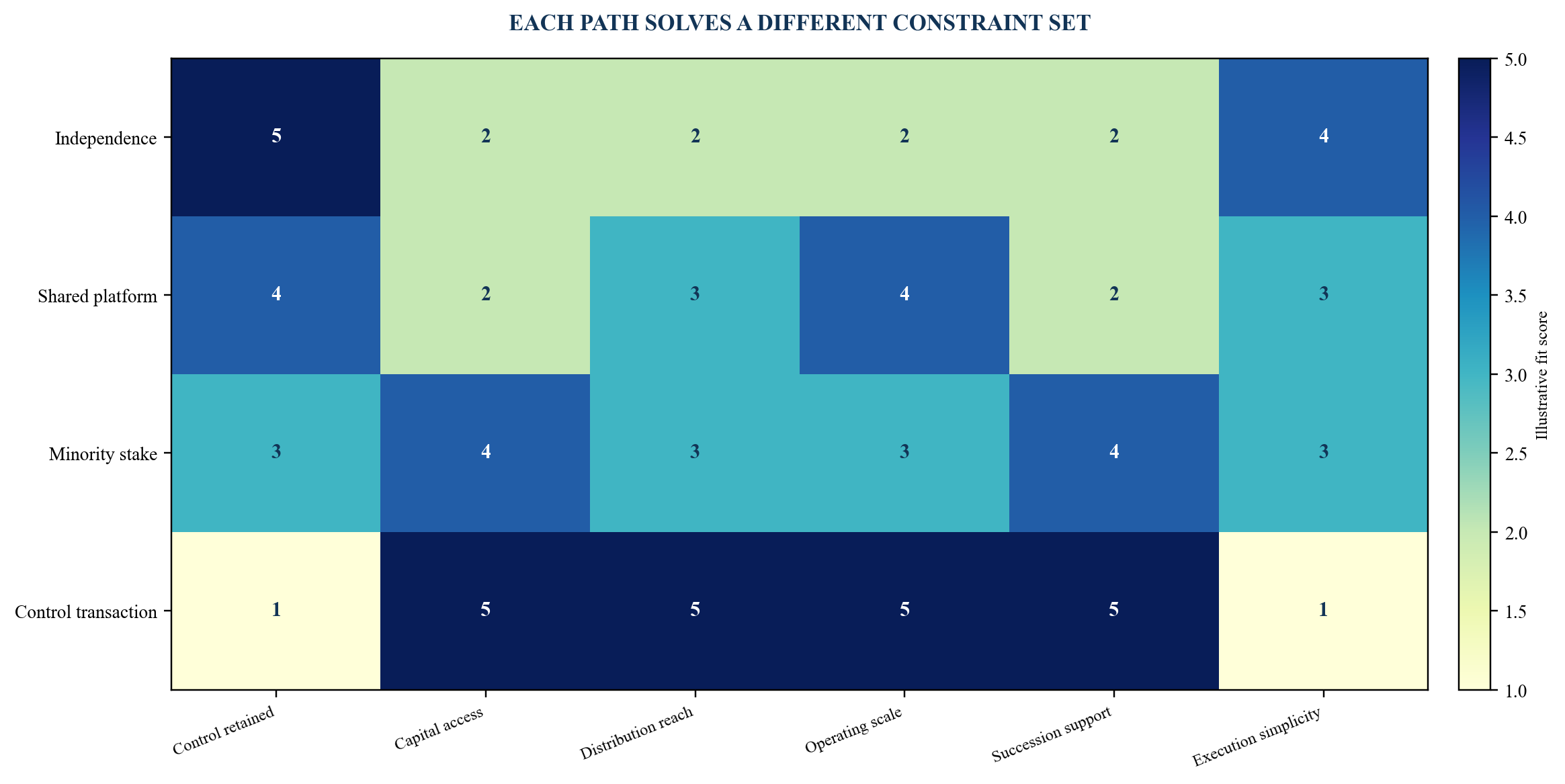
Scores are management assumptions for demonstrating comparison; they are not assessments of any firm or transaction.
5. Test strategy and product compatibility
Manager combinations can look complementary at corporate level while producing conflict at fund level. The strategy map should compare mandate, geography, sector, stage, instrument, return objective, risk, holding period, sourcing and portfolio-construction rules.
Overlapping funds can compete for an opportunity. The combined firm needs an allocation policy that is lawful, disclosed, operational and acceptable to investors. A statement that the strategies are complementary provides insufficient protection where investment committees pursue the same asset.
Adjacent strategies can extend the product shelf and relationships. They can also dilute investment identity and stretch a small senior team. The combination should specify which investment engines remain autonomous, which capabilities combine and how shared information is controlled.
Legacy fund restrictions matter. Partnership agreements, advisory agreements, side letters, seed arrangements, strategic partnerships, confidentiality commitments and employment terms can restrict competing products, transfers or control changes.
Track records require disciplined treatment. The combined entity should define which people made decisions, which portfolios are attributable, how departures affect presentation and which regulatory marketing requirements apply.
The product roadmap should distinguish committed launches from possibilities. Revenue from a new combined product remains conditional on documents, permissions, capital, distribution and investor decisions.
The strategy test produces an overlap register, allocation protocol, track-record matrix, product retirement plan and investment-governance design.
6. Underwrite revenue quality and portability
Assets under management provide an incomplete valuation base. Revenue depends on fee basis, rate, fund life, deployment, redemptions, realisations, fee offsets, waivers, breakpoints and client continuity. A transaction model should bridge reported assets to portable recurring revenue and distributable cash.
The first layer maps every fund, account and vehicle to its legal manager, adviser, general partner, fee recipient and governing document. The second layer calculates current contractual economics. The third identifies events that can change those economics before or after closing.
Investor concentration matters at both fund and franchise level. A small number of LPs can influence successor fundraising even when existing fund revenue is contractually durable. Separate-account clients may hold termination or consent rights.
Performance economics require a fund-by-fund waterfall. Accrued carry can reverse. Future carry depends on performance, realisation and team participation. Buyer and seller must distinguish legacy carry, unvested carry, future-fund carry and corporate profit share.
The portability model assigns each revenue stream a condition: unaffected, notice required, consent required, approval dependent, key-person exposed, terminable or non-portable. Legal advisers confirm the operative classification.
Table 2. Revenue portability register
| Revenue stream | Economic driver | Portability question | Evidence required |
|---|---|---|---|
| management fee | fee basis, rate and fund stage | does ownership or manager change affect the fee right? | governing agreement and fee calculation |
| advisory fee | client contract and assets | is assignment or client consent engaged? | advisory agreement and applicable law |
| performance fee | measurement period and hurdle | does the transaction crystallise, reset or terminate rights? | contract and performance ledger |
| carried interest | fund waterfall and realisations | who retains legacy and future economics? | LPA, carry plan and allocation schedule |
| platform recharge | service scope and allocation | can the service and price continue? | service agreement and cost evidence |
| prospective product | fundraising and launch | which conditions remain before revenue begins? | permissions, documents and accepted capital |
The register is illustrative; legal classification and financial amounts require current contract-level review.
7. Model owner, team and firm economics separately
A transaction can create different outcomes for selling founders, continuing partners, employees, investors and the corporate firm. The board should view those outcomes separately.
Consideration can include cash at closing, rollover equity, deferred payments, earn-outs, retention awards and future profit share. Each component has conditions, financing, tax, accounting and control consequences.
Founder liquidity can support succession while reducing ongoing exposure. Rollover preserves participation and can align the seller with integration. It also creates concentration in the buyer and exposes value to the buyer's governance and capital structure.
Earn-outs can bridge valuation differences. Metrics require precision: revenue, fee-related earnings, assets, fundraising, performance or EBITDA can respond differently to market movements and buyer decisions. The contract should allocate authority over budgets, hiring, acquisitions, pricing, product launches, distributions and cost allocations during the measurement period.
Team economics include salary, bonus, carried interest, equity, vesting, leaver terms and decision rights. A pool described as generous can still fail if allocation becomes discretionary or legacy and future carry are unclear.
Firm economics should fund regulated capital, technology, controls, integration and growth. A structure that directs most value to selling owners can leave the operating firm undercapitalised.
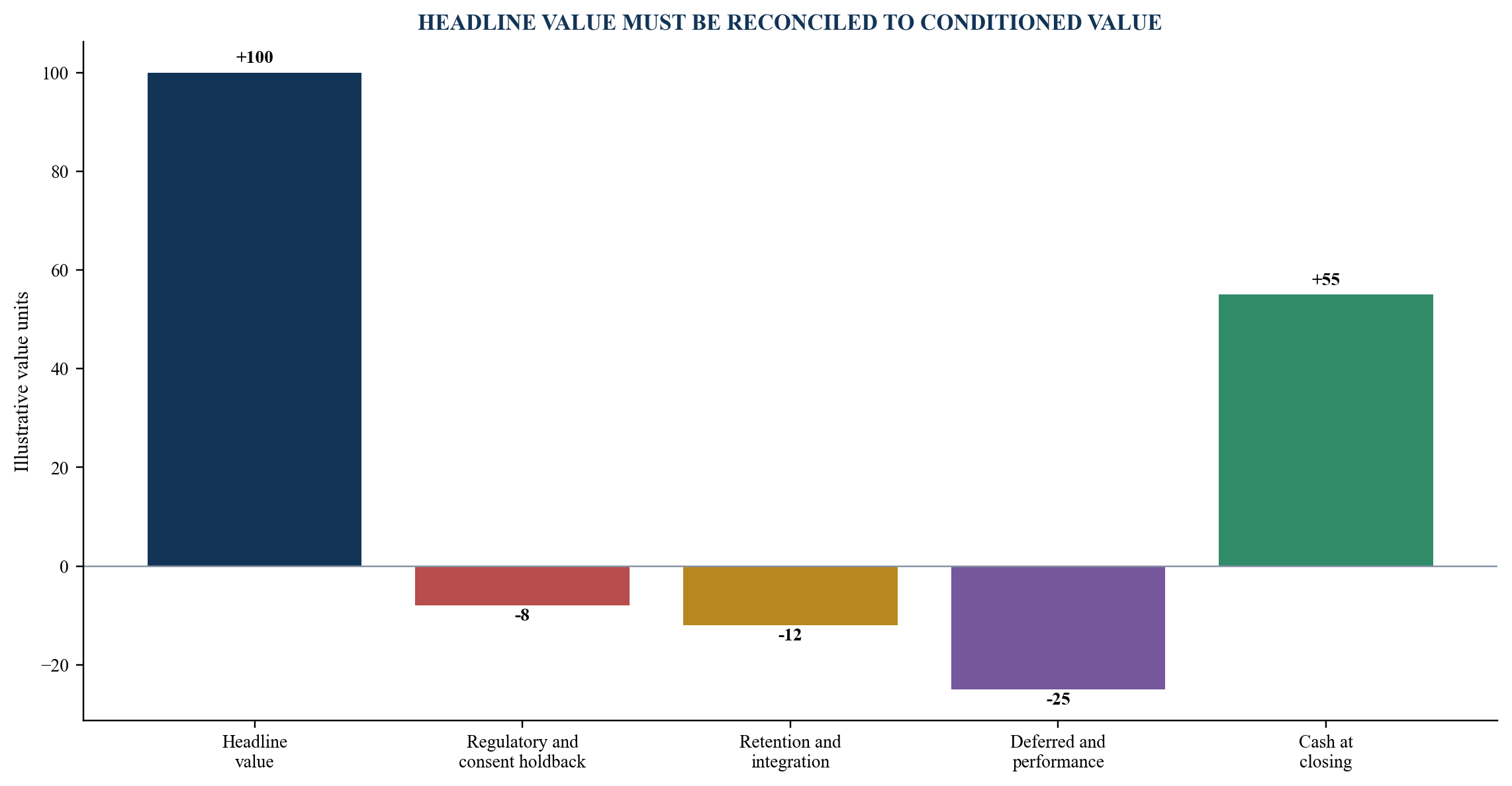
All amounts are management assumptions used to demonstrate the method and do not value a business.
8. Build the regulatory control map before signing
A manager transaction can require approval, notification, variation, registration, fit-and-proper assessment, capital analysis and changes to responsible individuals. The path depends on the legal entities, regulated activities, controller definitions, ownership chain and jurisdiction.
Current DFSA rules require prior written approval before a person becomes a controller of a Domestic Firm or crosses specified control thresholds. Current DFSA materials provide a specific change-in-control application and notification form and describe timing and information requirements. The precise path should be confirmed with the DFSA and current counsel before transaction documents assume a closing date.
The FCA requires proposed acquirers or persons increasing control in an authorised firm to notify it and obtain approval where the regime applies. Its current materials describe the assessment process, controller analysis, required information and possible conditions. Closing mechanics should reflect the actual statutory process and any parallel regulator.
In the United States, the corporate transaction can engage adviser registration, Form ADV succession and advisory-contract assignment issues. Current SEC staff materials explain that adviser contracts must contain the relevant assignment provision and that sufficient information and an opportunity to withhold consent matter in the cited context. Fund, client and state requirements require separate review.
Other jurisdictions can apply additional ownership, licensing, competition, foreign-investment, economic-substance, tax or employment rules. A group's global chart should identify every regulated entity and indirect controller.
The regulatory workstream should start at option design. It informs transaction structure, buyer eligibility, diligence, conditions precedent, long-stop date, interim covenants, communications and integration.
Table 3. Regulatory and authority workstream
| Workstream | Core question | Transaction output | Owner evidence |
|---|---|---|---|
| controller analysis | who becomes, increases, reduces or ceases control? | ownership and threshold map | verified corporate chart |
| permissions | which regulated activities continue, change or move? | target operating perimeter | licences and rule analysis |
| people | which approved or responsible roles change? | role and succession plan | fitness, capacity and applications |
| financial resources | can the regulated entities meet obligations after closing? | capital and liquidity plan | audited data and forecast assumptions |
| systems and controls | will governance remain effective through migration? | control-continuity plan | policies, testing and accountability |
| timetable | which approvals or notices govern closing? | conditions and long-stop plan | regulator-confirmed process |
This is a planning framework and does not replace jurisdiction-specific legal or regulatory advice.
9. Map fund rights, investor governance and conflicts
The corporate owner of a manager does not automatically possess unrestricted freedom to transfer fund-related roles or economics. Fund documents can contain change-of-control, assignment, key-person, removal, termination, amendment, transfer, conflict and consent provisions.
The rights matrix should cover every fund, parallel vehicle, feeder, co-investment vehicle, general partner, manager and adviser. It records the decision body, threshold, notice, timing, consequence and cure for each relevant provision.
ILPA's published principles emphasise transparency around ownership changes, rationale, cash-flow effects and changes to fund-level and GP-level economics. They also emphasise key-person continuity and LP governance. These are industry principles rather than universal contractual rules; the executed documents govern the actual fund.
Conflicts can arise where founders receive liquidity, continuing professionals receive different economics, the buyer manages competing products, a strategic investor is also an LP, or fund assets support transaction value. The firm should identify, disclose and govern each conflict through the applicable process.
The LPAC's role depends on the agreement. Information, consultation, conflict waiver and approval are distinct. Full investor consent may be required for certain changes. Silence should not be treated as consent unless the governing framework clearly permits the process and advisers confirm it.
A fund-level continuation transaction requires its own rationale, price, alternatives, conflict process and investor election. It should not be embedded invisibly inside a manager transaction.
10. Design client and investor consent as a value workstream
Consent is frequently modelled as a legal closing item after price is agreed. It is also a revenue-retention and trust process.
The team should classify every relationship by contract, law, fund terms, channel and commercial importance. The matrix identifies affirmative consent, negative-consent process where valid, notice, board or shareholder approval, LP vote, platform approval and no-action status.
Current SEC staff materials state the cited advisory-contract assignment requirement and explain that clients need sufficient information to make an informed decision and an opportunity to withhold consent. The exact consent process depends on the contract, client and applicable framework.
Communications should explain ownership, control, investment personnel, fees, services, conflicts, privacy, operational changes and choices accurately. Different audiences can require different documents while relying on one controlled fact base.
The consent forecast should use evidence stages: record verified, requirement confirmed, materials approved, delivered, response received, conditions satisfied and revenue retained. A meeting or a positive conversation is not consent.
Transaction economics can link consideration to retained consenting revenue. The definition should handle terminations, partial mandates, fee changes, affiliated clients and timing.
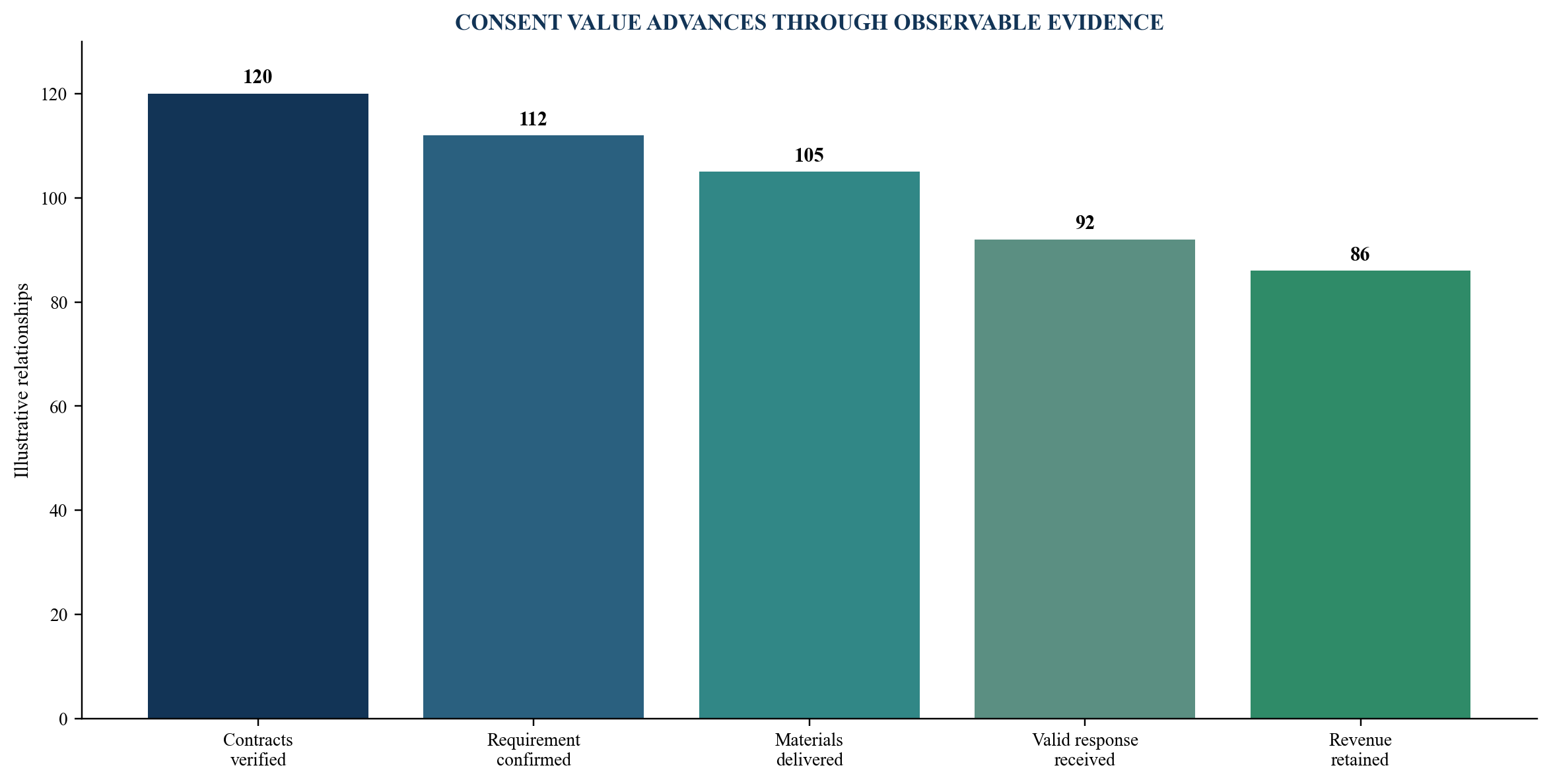
Counts are management assumptions used to demonstrate evidence stages; they do not describe any transaction.
11. Prepare an evidence-backed transaction perimeter
Manager groups often evolved through multiple entities, funds, carry vehicles, service companies and informal arrangements. The transaction perimeter should be reconstructed from evidence.
The corporate file includes incorporation, ownership, options, shareholder instruments, board records, intercompany agreements, debt, guarantees, intellectual property, insurance, tax and litigation. The regulated file adds licences, controllers, responsible individuals, capital, regulatory correspondence, breaches and remediation.
The commercial file maps clients, investors, funds, mandates, pipeline and distribution arrangements. The operating file covers people, providers, technology, data, cybersecurity, valuation, finance and business continuity.
The economic perimeter distinguishes management-company profit, GP commitment, carried interest, seed capital, balance-sheet investments, co-investment, founder receivables and future-fund rights. Parties should agree which items transfer and which remain.
Quality matters more than volume. A data room with inconsistent fund names, unauthorised models or missing agreements slows diligence and undermines confidence. Every critical schedule should reconcile to a controlled source.
The readiness certificate identifies verified items, exceptions, ownership, remediation and remaining adviser opinions. It should never imply that missing evidence has been completed.
Table 4. Manager transaction evidence room
| Module | Critical evidence | Reconciliation test | Typical blocker |
|---|---|---|---|
| corporate and ownership | registers, agreements and instruments | legal ownership to fully diluted schedule | undocumented rights or legacy entity |
| regulated perimeter | licences, controllers and correspondence | activity to permission and responsible person | unassessed indirect control |
| funds and clients | executed agreements, side letters and registers | role, fee and consent to each relationship | missing amendment or conflicting term |
| economics | ledgers, budgets and carry schedules | revenue and cash to audited evidence | non-recurring or conditional income |
| people | contracts, incentives and role maps | dependency to retention and succession | disputed carry or informal promise |
| operations and data | systems, providers, incidents and flows | important service to owner, control and recovery | undocumented dependency or access |
The actual index should be tailored to the transaction perimeter and applicable duties.
12. Value the firm through conditioned cash flows
Manager valuation should reflect the cash flows and risks the transaction actually transfers. A single multiple of assets or EBITDA can obscure fund maturity, consent, concentration, key-person exposure, future investment and contingent performance.
Fee-related earnings can provide a recurring base when revenue and costs are carefully normalised. The model should preserve the investment and control functions required to generate that revenue. Removing essential cost overstates transferable earnings.
Carry and performance fees are scenario-based. The model can use fund-level value, waterfall, vesting, timing, probability and tax assumptions. Uncertainty should remain visible rather than being buried inside a blended multiple.
Future-fund value depends on team, track record, strategy, investor support, permissions, market conditions and execution. It should be presented separately from contracted current-fund economics.
The valuation bridge deducts integration, retention, capital, technology, remediation and transaction cost. It also tests consent attrition, fundraising delay and market movement.
Consideration design allocates risk. Cash transfers more risk to the buyer at closing. Rollover, deferral and earn-outs keep the seller exposed. The allocation should match controllability: a seller should not carry performance risk driven primarily by buyer-controlled decisions without suitable protections.
IFRS 3 establishes accounting principles for qualifying business combinations, including recognition and measurement of acquired assets, liabilities, goodwill and disclosures. Accounting classification and treatment require transaction-specific analysis.
13. Make shared-platform arrangements operable and reversible
A shared platform can solve a defined capacity gap without a full ownership transaction. Its value depends on precise responsibility and a viable exit path.
The service map should identify legal employer, regulated principal, investment decision maker, client contracting party, data controller, fund operator, compliance owner, finance owner and provider manager. Marketing language should match those roles.
Service levels cover onboarding, trade support, valuation, reporting, compliance review, filings, incident response, data, cybersecurity, accounts and investor communications. Each level needs measurement, evidence, escalation and remediation.
Economics can include fixed fees, basis points, revenue share, minimums and transition charges. The model should test small, target and stressed scale. A low entry fee can become expensive when revenue grows or when ancillary services are mandatory.
Intellectual property, track record, client relationships and data require explicit ownership and use rights. The agreement should address confidentiality, conflicts, non-solicitation, sub-outsourcing and regulatory access.
Exit planning begins at entry. The manager needs data export, records, transition assistance, open-item transfer, investor communications and a permitted successor. The time and cost to exit belong in the initial business case.
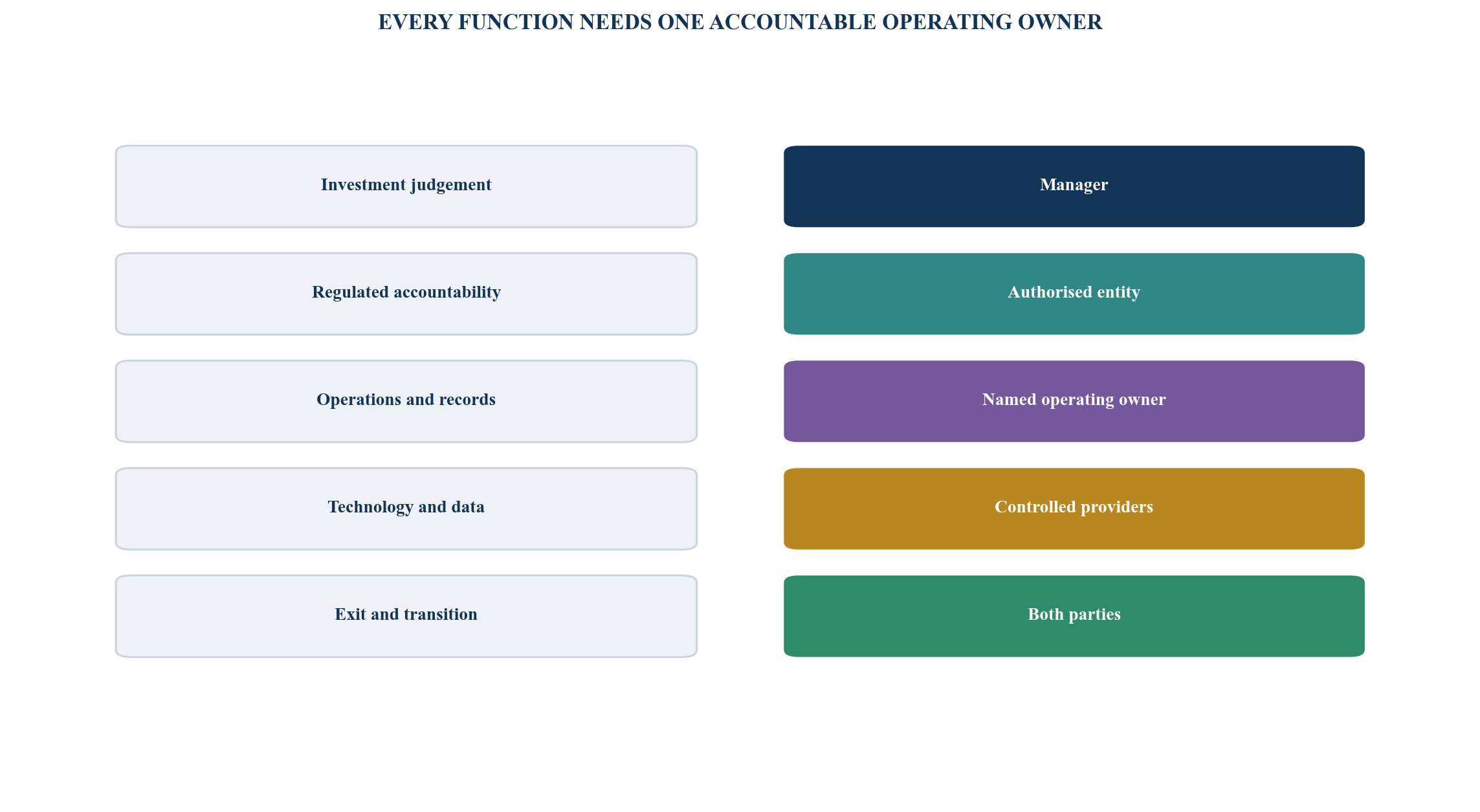
The allocation is illustrative; actual regulated and contractual responsibility cannot be delegated by diagram.
14. Design people continuity before announcing the deal
People are both value drivers and duty holders. A manager transaction needs a role, authority, incentive and communication plan before rumours or selective offers destabilise the firm.
The dependency map identifies investment decision makers, client owners, regulated officers, control specialists, operations leaders and institutional knowledge holders. Key-person analysis follows the executed fund documents and current investor expectations.
Retention should support required service and succession. Cash awards can retain through a date. Equity and carry can align longer outcomes. Role clarity and decision authority can matter as much as amount.
Legacy carry requires a reconciled ledger and governing documents. The transaction should address vesting, leaver treatment, clawback, tax, funding and administration. Future carry should align the combined strategy and team contribution.
Employment consultation, transfer and termination requirements vary by jurisdiction and transaction form. Communications should follow current advice and avoid promises that signed documents cannot support.
Culture diligence should examine how investment decisions, challenge, risk, remuneration and accountability operate. Survey language alone provides limited evidence. Minutes, exceptions, promotion decisions and incident responses reveal working norms.
The succession plan identifies interim authority, permanent roles, handover evidence and investor engagement. A founder title without a defined post-closing function can create governance ambiguity.
15. Protect data, cybersecurity and operating resilience
Manager transactions require sensitive client, investor, employee, portfolio and commercial data. Diligence access should follow law, purpose, minimisation, confidentiality and security.
Current UK ICO guidance states that a merger or acquisition involving a change or addition of controller should include data sharing in due diligence, including purpose, lawful basis, documentation, transparency, governance and security. Other jurisdictions have their own requirements.
The clean-team design limits competitive and personal data to authorised reviewers. The team records access, purpose, retention, export and deletion. Aggregated or redacted information can support early diligence.
Cyber diligence covers identity, privileged access, endpoints, cloud, code, providers, incident history, vulnerabilities, backups, recovery and insurance. Known weaknesses belong in remediation, consideration and closing conditions.
Migration should preserve record completeness, access control, valuation, trading, cash, reporting, client service and regulatory evidence. Parallel running and reconciliations can reveal differences before cutover.
The FCA's current operational-resilience observations place change management and strategic transformation inside the resilience framework. The combined firm should map important services, impact tolerances, dependencies, scenarios and response through the transaction.
Table 5. Day-one continuity control plan
| Domain | Day-one requirement | Evidence gate | Contingency |
|---|---|---|---|
| investment authority | valid committees, mandates and access | approved role and permission matrix | documented interim authority |
| cash and trading | authorised instructions and counterparties | successful test and reconciled signatories | controlled legacy process |
| valuation and reporting | complete data and approved methods | parallel result and exception sign-off | delayed cutover under approved plan |
| client and investor service | current contacts, rights and messages | channel test and communication approval | dual coverage and escalation |
| cybersecurity | identity, monitoring and incident response | access review and recovery test | isolation and manual continuity |
| regulatory records | accessible complete records | inventory and retrieval test | preserved source repository |
Controls and tolerances should reflect the actual regulated services, systems and transaction.
16. Negotiate control rights as an operating constitution
Ownership percentage provides an incomplete picture of control. Governance rights determine which decisions can be made, delayed or blocked.
The rights schedule should cover board composition, quorum, budget, hiring, compensation, product launch, acquisitions, debt, capital, distributions, related-party dealings, valuation, compliance, litigation, changes to fund economics and sale of the firm.
Minority protections can protect invested capital and alignment. A broad veto package can impede ordinary operation or create regulatory-control questions. The parties should map rights against controller definitions and obtain current advice.
Information rights should respect fund confidentiality, personal data, market sensitivity, inside information and competitive boundaries. A strategic owner does not automatically receive every portfolio or investor record.
Transfer provisions cover lock-up, permitted transfers, pre-emption, tag, drag, change of control, competitor restrictions and regulatory eligibility. Exit mechanics should address valuation, timing, financing and unresolved approvals.
Deadlock provisions can include escalation, mediation, buy-sell or sale processes. Their practical effect should be modelled under capital stress and strategic disagreement.
The governance design also allocates fiduciary and regulated responsibilities. Corporate shareholder instructions cannot displace duties owed by directors, authorised individuals, managers or general partners.
17. Convert diligence findings into deal mechanics
Diligence creates value when findings change structure, price, protection or plan. A long exception list without decision routing produces limited control.
Each material issue should have an evidence record, consequence, owner and proposed treatment. Treatment can include remediation before signing, condition precedent, covenant, indemnity, warranty, holdback, price change, excluded asset, insurance or integration action.
Conditions precedent should be objectively testable. Regulatory approval, fund or client consents, key-person retention, financing, third-party approval and reorganisation may sit on the critical path.
Interim operating covenants protect the business between signing and closing. They should allow required fiduciary, regulatory and business action. Buyer consent processes need response deadlines and exceptions.
Warranties and disclosures allocate information risk. Indemnities can address identified exposures. Financial caps, baskets, survival, security and claims procedures determine practical protection.
The closing accounts or locked-box approach should fit the business. Cash, debt, working capital, regulatory capital, accrued carry, fund receivables and intercompany items require defined treatment.
The transaction document set should reconcile with regulatory submissions, investor communications, retention letters, service agreements and integration plans.
18. Govern integration through value and risk gates
Integration should preserve investment and client continuity while delivering the approved thesis. It begins during diligence with clean-team boundaries.
Day one establishes legal ownership, boards, delegated authority, signatories, regulatory obligations, communications, access, incident response and financial control. A celebratory announcement cannot substitute for operational readiness.
The first thirty days validate staff, client and investor continuity; stabilise governance; reconcile cash and records; and resolve exceptions. The firm should limit unnecessary simultaneous change.
Days thirty-one to one hundred can implement approved provider, technology, reporting, finance, brand and organisation changes. Each migration advances after data, control, performance and fallback evidence.
Synergies should have a baseline, owner, action, cost, timing, risk and realised evidence. Removing a position is an action. Sustained cost reduction after control and service requirements are met is a realised result.
Revenue synergies advance through a funnel: eligible product, approved channel, qualified opportunity, diligence, accepted commitment and funded capital. Pipeline and introductions remain leading indicators.
The integration committee should monitor investment performance, client loss, consent, people, incidents, regulatory actions, service levels, costs and synergy evidence.
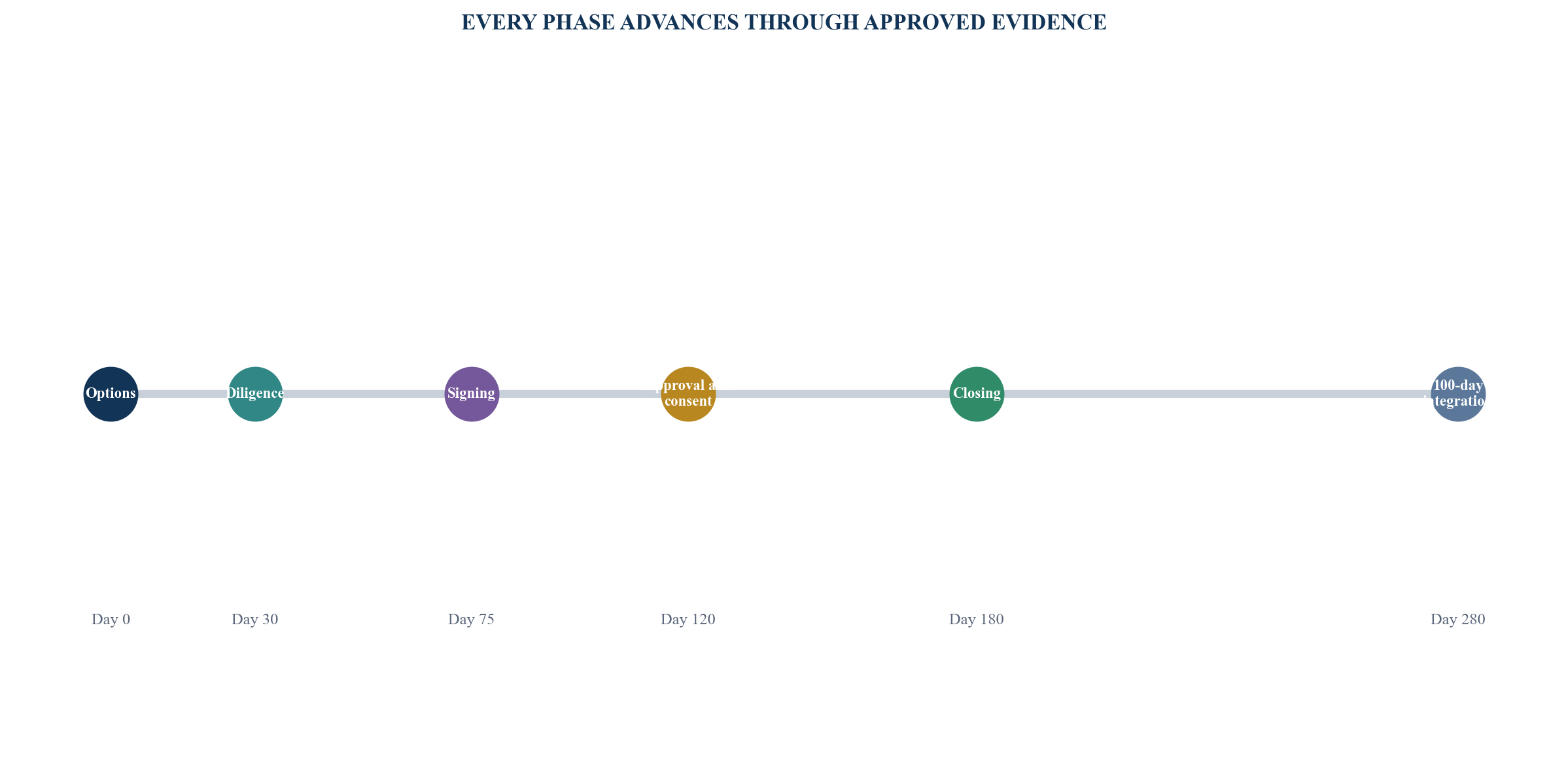
Timings are management assumptions for demonstrating sequencing; authorities and transaction facts determine the actual calendar.
19. Run a ten-day strategic-options diagnostic
Days one and two define the decision, owners, deadline, protected outcomes and credible independence case. The team collects the corporate, regulatory, fund, economic, people and operating perimeter.
Days three and four map strategy overlap, product roadmap, track-record attribution, distribution, revenue quality, fund life, client concentration and conditional economics.
Days five and six build the controller, permission, consent, key-person, conflict, data and competition maps with current specialist advisers.
Days seven and eight compare independence, shared platform, minority investment, merger, control sale and selective transfer. The model tests value, control, capital, cost, timing, continuity and downside.
Days nine and ten deliver the board options paper, red-flag report, readiness backlog, transaction perimeter, counterparty criteria, evidence room index and ninety-day action plan.
The diagnostic should identify issues requiring legal or regulatory advice rather than presenting internal analysis as an approval. It should also identify data that cannot be verified.
Commercial qualification requires a live board decision, an accountable sponsor, accessible evidence, adviser access, a defined transaction or transformation budget and a decision calendar. General interest in consolidation does not establish demand for a paid mandate.
The recommended path can be staged. A firm may first repair evidence and succession, then approach platforms or investors. Readiness improves both transaction options and the independence case.
20. Operate a recurring GP consolidation office
A recurring office coordinates owners, board, investment leadership, finance, operations, risk, compliance, people, technology, data, tax, legal, regulatory, valuation and transaction advisers.
It maintains the option model, issue register, data-room index, consent matrix, regulatory path, people plan, consideration bridge, closing plan, integration gates and decision log.
The weekly forum reviews evidence, critical path, counterparty questions, exceptions and decisions. Board reporting separates verified facts, management assumptions, adviser conclusions and open items.
During a process, controlled communications protect confidentiality and consistency. The office maintains one approved fact base for buyers, regulators, investors, clients, employees and providers.
After signing, the office tracks conditions, consent, approvals, interim covenants, retention, Day-one readiness and contingency. After closing, it tracks value and risk through observable results.
Retainer scope should identify the paid decision, transaction perimeter, deliverables, cadence, client dependencies, adviser responsibilities, exclusions, acceptance and fee. Buyer, seller, investor and collected-fee outcomes remain unverified until supported by executed and paid engagements.
The correct consolidation path is the one that solves the binding strategic constraint while preserving investor, regulatory and operating continuity. Independence requires a funded operating plan. A shared platform requires precise accountability and reversibility. A minority investment requires governable rights and durable team economics. A control transaction requires approvals, consents and integration to close alongside the share purchase.
Table 6. Recurring GP consolidation office
| Cadence | Review | Evidence | Decision output |
|---|---|---|---|
| daily during critical path | approvals, consents, incidents and blockers | current tracker and source record | escalation and owner action |
| weekly | value, diligence, people and execution | reconciled workstream packs | steering decision |
| fortnightly | counterparty and adviser positions | controlled Q&A and advice | negotiation mandate |
| monthly | economics, continuity and risk | model, operating and retention evidence | board options update |
| pre-signing or closing | complete gate certificate | signed documents and verified conditions | proceed, defer or stop |
| post-closing | value, clients, people and controls | realised results and exception log | integration change or remediation |
Cadence and authority should reflect the live decision, transaction and applicable responsibilities.
References
- Dubai Financial Services Authority. GEN 11.8.4: Requirement for Prior Approval of Controllers of Domestic Firms. https://dfsaen.thomsonreuters.com/entiresection/18696
- Dubai Financial Services Authority. PFN AUT 12: Applications and Notifications Concerning a Change in Control. https://dfsaen.thomsonreuters.com/entiresection/8149
- Dubai Financial Services Authority. Collective Investment Funds. https://www.dfsa.ae/what-we-do/collective-investment-funds
- Dubai Financial Services Authority. Consultation Paper No. 173: Proposals to Enhance the Collective Investment Funds Framework. https://www.dfsa.ae/news/dfsa-proposes-significant-updates-its-collective-investment-fund-framework
- United Kingdom Financial Conduct Authority. Change in Control. https://www.fca.org.uk/firms/change-control
- United Kingdom Financial Conduct Authority. FG24/5: Prudential Assessment of Acquisitions and Increases in Control. https://www.fca.org.uk/publications/finalised-guidance/fg24-5-prudential-assessment-acquisitions-and-increases-control
- United Kingdom Financial Conduct Authority. SUP 11: Controllers and Close Links. https://handbook.fca.org.uk/handbook/SUP/11/
- United Kingdom Financial Conduct Authority. Operational Resilience: Insights and Observations for Firms. https://www.fca.org.uk/firms/operational-resilience/insights-observations
- United States Securities and Exchange Commission. Investment Management Staff Issues of Interest: Advisory Contracts and Consent. https://www.sec.gov/rules-regulations/no-action-interpretive-exemptive-letters/division-investment-management-staff-no-action-interpretive-letters/investment-management-staff-issues-interest
- United States Securities and Exchange Commission. Frequently Asked Questions on Form ADV and IARD: Adviser Successions. https://www.sec.gov/about/divisions-offices/division-investment-management/electronic-filing-investment-advisers-iard/frequently-asked-questions-form-adv-iard
- United States Securities and Exchange Commission. Investment Adviser Reliance on Predecessor Registrations. https://www.sec.gov/investment/im-guidance-2016-05.pdf
- Institutional Limited Partners Association. ILPA Principles 3.0. https://ilpa.org/wp-content/uploads/2019/06/ILPA-Principles-3.0_2019.pdf
- Institutional Limited Partners Association. Due Diligence Questionnaire 2.0. https://ilpa.org/wp-content/uploads/2021/11/ILPA-DDQ-2.0.pdf
- Institutional Limited Partners Association. Continuation Funds: Considerations for Limited Partners and General Partners. https://ilpa.org/wp-content/uploads/2023/05/Continuation-Funds-Considerations-for-Limited-Partners-and-General-Partners.pdf
- United Kingdom Information Commissioner's Office. Due Diligence When Sharing Data Following Mergers and Acquisitions. https://ico.org.uk/for-organisations/uk-gdpr-guidance-and-resources/data-sharing/data-sharing-a-code-of-practice/due-diligence/
- IFRS Foundation. IFRS 3 Business Combinations. https://www.ifrs.org/issued-standards/list-of-standards/ifrs-3-business-combinations/
- United States Federal Trade Commission and Department of Justice. 2023 Merger Guidelines. https://www.ftc.gov/reports/merger-guidelines-2023
About the Author
Chennakeshav Adya, Independent Researcher
