

1. Define the partnership decision
The investment committee should begin with a specific decision. It may seek secure mineral supply for a Gulf industrial base, financial returns from a diversified mining platform, access to processing technology, a trading franchise, or a combination of these outcomes. Each objective implies a different transaction perimeter, risk tolerance and control model. A passive minority stake can provide financial exposure. It cannot guarantee product, influence development sequencing or establish downstream capability unless those rights are documented and enforceable.
The mandate should name the minerals, acceptable jurisdictions, development stages, annual capital capacity, minimum product rights, maximum construction exposure, currency tolerance and holding period. It should state whether the investor can fund exploration, build processing facilities, support infrastructure, accept commodity-price volatility or hold capital through a long permitting cycle. It should also define whether supply security is measured by volume, quality, delivery reliability, price formula or substitution value.
The first question is therefore whether the proposed partnership supplies an approved strategic or financial outcome through executable rights. Resource size, government support and projected demand provide context. Approval should depend on technical evidence, legal tenure, permitted operations, product qualification, funded infrastructure, accountable governance and a downside case that can be financed.
2. Separate regional potential from transaction evidence
Latin America and the Caribbean hold material shares of global resources and production in lithium, copper, silver, graphite, molybdenum, tin, niobium and other specialty minerals. The IEA's 2026 outlook also identifies an opportunity to expand regional processing and downstream activity [1]. Those regional findings support origination. They do not establish the value or financeability of an individual licence, resource, mine, refinery or processing proposal.
Country and asset evidence should be organised in layers. The first layer establishes lawful mineral tenure, surface access and regulatory route. The second tests geology, resource classification, mine plan, metallurgy and recovery. The third confirms water, power, transport, waste and tailings solutions. The fourth verifies customers, product specifications and price formulae. The fifth reconciles capital, schedule, funding and cash mobility. A project enters valuation only when the relevant layers have sufficient evidence for its stage.
Regional diversification can reduce dependence on one mineral, country or processing route. It can also hide common risks. Several assets may rely on the same commodity price, equipment supplier, port, technology provider or buyer. The partnership should therefore diversify by failure mode and cash-flow driver rather than rely on country labels.
3. Use demand outlooks as scenarios
The IEA projects continued growth in demand for minerals used in energy technologies and identifies copper and lithium as markets where expected mined supply from announced projects falls short of projected 2035 requirements under its stated-policies scenario [2]. The IEA also estimates substantial capital needs for new mines and refineries through 2040 [2]. These projections are scenarios built from stated assumptions. They are not a price forecast or a guarantee of demand for a specific product.
The commercial model should test at least three demand cases. The central case can use a referenced industry scenario. The low case should reflect slower technology deployment, substitution, recycling, product redesign and competing supply. The high case can reflect faster electrification, data-centre expansion, grid investment and defence or aerospace demand. Product quality, location and delivery reliability should be tested separately from aggregate tonnes.
Investment approval should survive a market that is strategically important and temporarily oversupplied. Lithium prices demonstrated that rapid supply growth can weaken near-term economics even when long-term demand remains strong. A partnership that depends on a single high price has limited resilience. Staged development, flexible capacity, cost discipline and committed customers can preserve options while evidence improves.
4. Convert the mandate into mineral and product specifications
Mineral labels are too broad for transaction design. Copper concentrate, cathode and rod have different processing, logistics and customer requirements. Lithium carbonate and lithium hydroxide serve different cathode chemistries and qualification processes. Natural graphite concentrate, purified spherical graphite and synthetic graphite occupy different cost, technology and customer positions. Rare-earth concentrate has limited value without separation and magnet-grade product pathways.
The mandate should specify the required product, impurity limits, moisture, particle size, recovery assumptions, annual volume, delivery location and qualification process. It should identify acceptable substitutes and technology changes. A downstream plant should be designed around verified feed characteristics and customer specifications rather than a generic mineral name.
Product definition also governs the capital stack. A mine may support project debt once reserve, permits and offtake are established. A first-of-kind processing route may need more equity, vendor support and performance guarantees. A trading or prepayment facility depends on deliverable product, title and inventory controls. The product specification becomes a commercial, technical and financing control.
5. Compare markets through a common screen
Brazil, Chile, Argentina and Peru offer different combinations of resources, policy, infrastructure, operating capability and state participation. Brazil has a broad mineral base that includes graphite, nickel, niobium, rare earths, lithium and copper, supported by current geological and investment initiatives [5,6]. Chile has established copper capability, major lithium assets and a 2026 critical-minerals strategy that identifies copper, lithium, molybdenum and rhenium among its leading strategic categories [9]. Argentina has large lithium and copper development pipelines and a federal investment-incentive regime for qualifying large projects [12,13]. Peru remains a major copper jurisdiction with a substantial official project portfolio [14].
The common screen should test tenure, fiscal terms, permitting, state participation, foreign-investment rules, foreign-exchange access, infrastructure, community process, operating depth and capital-market access. The analysis should distinguish current law from proposed policy. It should also identify national, provincial, state and municipal authority where responsibilities differ.
A common screen creates comparability. Local legal, geological, engineering, environmental, tax and community advice remains necessary. The committee should approve country exposure only after the proposed asset and structure are mapped to the actual decision process.
| Gate | Brazil | Chile | Argentina | Peru |
|---|---|---|---|---|
| Priority opportunity | Graphite, rare earths, nickel, niobium, lithium and copper | Copper, lithium, molybdenum, rhenium and downstream capability | Lithium and copper development platforms | Copper projects, expansions and associated infrastructure |
| State and policy interface | Federal and state approvals, geological policy and development-bank instruments | National strategy, state-company participation and project-specific rights | Federal incentives with provincial mineral ownership and approvals | National mining approvals, regional interface and project infrastructure |
| Critical technical question | Resource quality, processing route and logistics | Resource, water, state-partner structure and downstream economics | Resource confidence, water, power, logistics and implementation under incentives | Resource conversion, social licence, water, permits and construction delivery |
| Capital question | Blend strategic equity with local development instruments | Align state and private rights with project and processing finance | Stage capital against legal, fiscal, technical and infrastructure milestones | Match project debt and equity to approvals, construction and community commitments |
| Approval requirement | Asset-specific legal, technical, environmental, tax and commercial opinion | Asset-specific legal, technical, environmental, tax and commercial opinion | Asset-specific legal, technical, environmental, tax and commercial opinion | Asset-specific legal, technical, environmental, tax and commercial opinion |
The table is an investment-screening framework. Current law, regulation, geology and fiscal terms require independent verification.
6. Map the partnership from resource to customer
A critical-minerals transaction is a chain of rights and performance. The chain begins with mineral tenure and resource evidence. It continues through mine planning, extraction, beneficiation, refining or conversion, product qualification, storage, transport, sale and collected cash. Infrastructure, water, energy, technology, data and community obligations support every link.
The transaction map should identify the entity that owns each right and performs each function. It should show licences, land access, processing agreements, shared infrastructure, intellectual property, customer contracts, security, insurance and cash accounts. It should also identify where title passes and which entity bears loss, delay, contamination, price and foreign-exchange risk.
An equity investment at holding-company level can create exposure to assets without control over the chain. Offtake can create product rights without a return on project value. Project debt can finance construction without solving technology or market risk. The partnership design should combine instruments only after the map shows how each instrument supports an approved outcome.
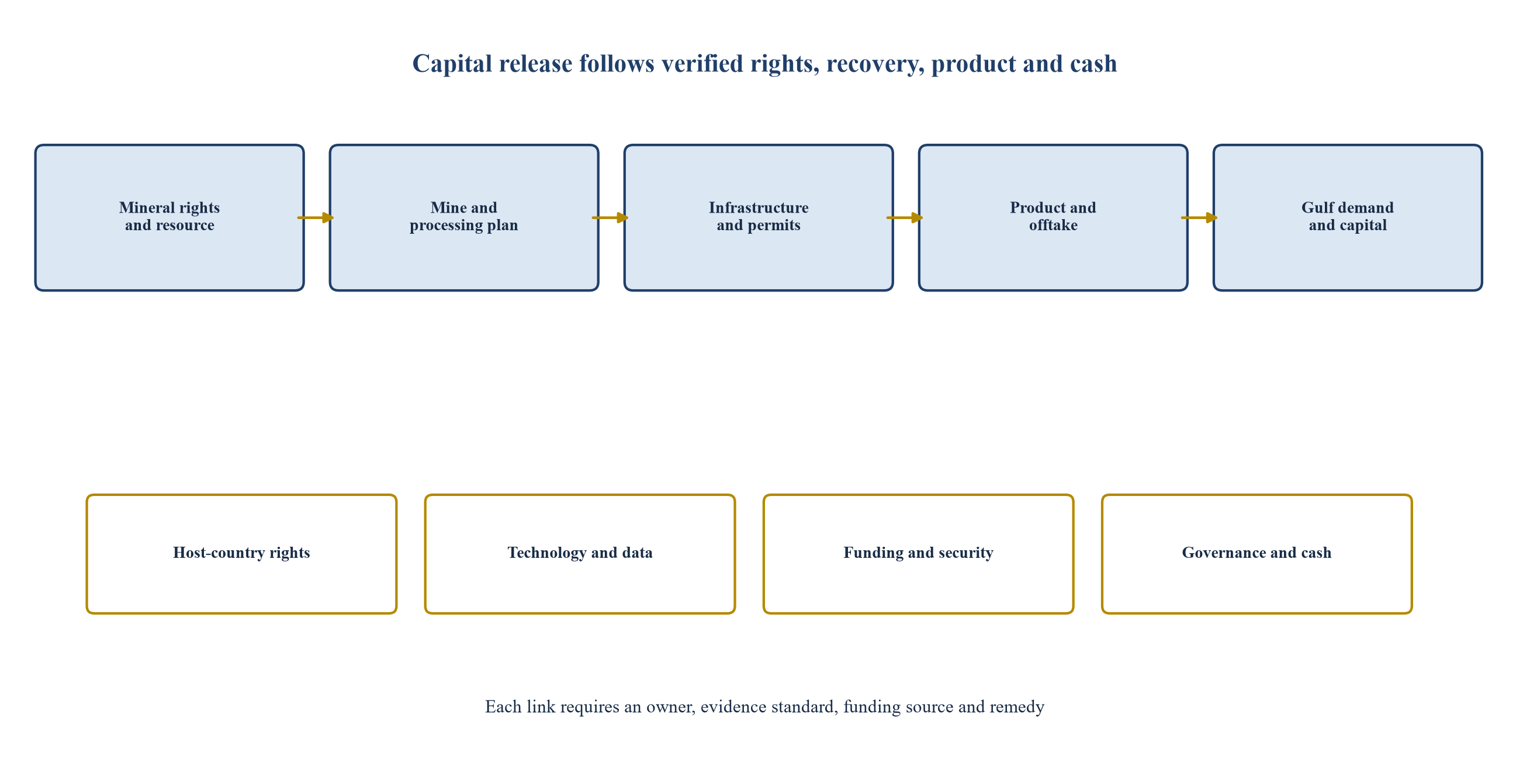
The architecture is a proposed decision framework and does not represent an observed transaction.
7. Distinguish resources from financeable reserves
A geological resource estimates mineral occurrence using defined confidence categories. A reserve incorporates technical and economic factors that support extraction under stated assumptions. The partnership should not value an inferred resource as if it were production. It should reconcile the reporting standard, competent-person responsibility, cut-off grade, recovery, dilution, geotechnical assumptions, commodity prices and effective date.
The technical review should reproduce key calculations and identify the drilling, sampling, laboratory and quality-control evidence. It should reconcile resource models with mine design, plant feed and production schedules. Changes in price, recovery, strip ratio, water or power can alter the economically recoverable portion. The model should preserve those dependencies rather than apply a flat multiple to contained metal.
Exploration upside should be treated as an option. Capital can be staged against drill results, model updates and permitting. The acquisition agreement can use contingent consideration or earn-ins when uncertainty is material. A strategic investor can retain exposure without paying full value before geological evidence exists.
8. Make metallurgy a primary investment gate
Metallurgical recovery connects rock or brine to saleable product. Laboratory recovery can differ from pilot and operating performance. Ore variability, mineralogy, impurities, reagent use, temperature, water quality and scale can change output and cost. The investment committee should see the test-work programme, sample representativeness, flowsheet, mass balance, recovery range and remaining scale-up work.
Lithium extraction routes need feed-specific evidence. Direct lithium extraction can reduce ponds or improve recovery in some settings, while performance depends on brine chemistry, sorbent life, water, reagents and reinjection design. Rare-earth separation can require complex chemical circuits and specialist intellectual property. Graphite upgrading must reach customer purity, morphology and consistency. Copper projects face ore-grade, recovery, concentrate-quality and smelter-term risk.
Technology-provider warranties should be tested against the operating guarantee, exclusions, credit support and remedy. The base case should use demonstrated recovery. Upside from an unproven process should remain outside debt capacity until independently supported.
9. Verify water and energy before expansion value
Water and energy are operating inputs, community issues and value drivers. The project should identify lawful water rights, source reliability, competing users, pumping and treatment needs, recycling, discharge, brine management and closure obligations. Climate and catchment conditions should be reflected in a site-specific water balance. A national resource estimate does not answer a local water constraint.
Power analysis should cover capacity, connection, quality, price, indexation, carbon intensity, backup and curtailment. Processing facilities can require stable electricity and heat. Remote mines may need dedicated generation, storage or network upgrades. Renewable power can reduce emissions and price exposure when the contract and grid solution are executable.
Capital and schedule should include shared infrastructure and permitting. The partnership agreement should allocate cost overruns, delayed availability and performance shortfall. Water and energy milestones belong in conditions precedent and draw controls when they determine the project's ability to operate.
10. Build logistics from physical specifications
Logistics design begins with product form, volume, hazard classification, moisture, contamination sensitivity and destination. The route may include mine roads, rail, pipeline, storage, port, customs and ocean freight. Concentrate, carbonate, hydroxide, graphite product and separated rare-earth products require different handling and inventory controls.
The model should identify capacity rights, take-or-pay obligations, seasonal disruption, competing cargoes, maintenance, demurrage, insurance and alternative routes. It should reconcile nominal capacity with observed throughput and planned expansions. A port agreement without inland transport does not create an integrated route.
Title and security also matter. Lenders and prepayment providers may rely on inventory, receivables or controlled accounts. The partnership should specify custody, assay, weighing, loss allocation and fraud controls. Logistics evidence should support both operating cost and financing collateral.
11. Structure product qualification as a funded programme
Customers buy a product that meets process requirements. Qualification can require multiple samples, production campaigns, audits and months of testing. The programme should identify target customers, specifications, sample volumes, test protocol, decision owner and timing. It should also show how changes in feed or flowsheet affect qualification.
An indicative memorandum or expression of interest is not committed demand. A binding offtake should state volume, quality, delivery, price formula, provisional payment, final assay, rejection, penalties, force majeure, credit support and termination. The project should model uncommitted volume and off-specification product separately.
Strategic value can arise from customer access and co-development. The Gulf partner may offer industrial demand, trading capability or financing relationships. These contributions should be documented as obligations, rights and measurable milestones. A general promise of market access should receive no value in the base case.
12. Compare transaction structures against the decision
Strategic minority equity can provide exposure and governance rights with limited operational control. A joint venture can combine host-country rights and Gulf capital, though it requires detailed decision rights and deadlock mechanisms. A platform acquisition can create scale and capability while importing legacy liabilities and uneven assets. Project finance can isolate cash flows after technical and commercial risk is sufficiently mature.
Offtake-linked prepayment can provide funding and product rights. Its economics depend on price formula, delivery priority, security, repayment through product, quantity flexibility and termination. Development capital can use earn-ins or milestone subscriptions to preserve optionality. Export-credit, DFI and local development instruments can support equipment, infrastructure or policy objectives when eligibility and conditions are verified.
The committee should compare structures on control, capital at risk, product rights, downside, cash mobility, tax, accounting, approvals and exit. Structure should follow evidence. A complex stack cannot compensate for a weak project.
| Structure | Primary purpose | Required evidence | Principal risk | Useful control |
|---|---|---|---|---|
| Strategic minority equity | Financial exposure, access and future options | Verified asset value, governance and information rights | Limited control and funding dilution | Reserved matters, funding limits and exit rights |
| Joint venture | Combine rights, capability, capital and product access | Contribution values, decision rights and operating model | Deadlock, related parties and uneven obligations | Board architecture, budgets, transfer and deadlock process |
| Platform acquisition | Acquire operating capability and a project pipeline | Asset-by-asset technical, legal and liability evidence | Paying a platform premium for unsupported pipeline | Perimeter, value bridge, indemnities and staged consideration |
| Project finance | Fund construction and operation from project cash | Reserve, permits, contracts, completion and cash-flow evidence | Cost, delay, ramp-up and commodity exposure | Conditions precedent, completion support and cash waterfall |
| Offtake prepayment | Fund development and secure product | Qualified product, deliverable volume and enforceable contract | Under-delivery, price and security mismatch | Delivery schedule, security, cure and replacement product |
| Milestone development capital | Preserve upside while evidence matures | Defined technical and approval milestones | Capital spent before decisive evidence | Tranches, stop rights, earn-in and independent certification |
The comparison is a general decision aid and does not state current terms available to any project.
13. Value the assets by stage and evidence
Producing assets can be valued from expected distributable cash under verified operating, cost, tax and sustaining-capital assumptions. Construction assets require remaining capital, contingency, schedule and completion support. Feasibility-stage assets require a range around cost, timing, recovery and price. Exploration value should remain an option until evidence advances.
The valuation bridge should show resource, reserve, production, product, price, operating cost, royalties, tax, capital, working capital, closure, debt and restricted cash. It should reconcile the technical model to the financial model. Each assumption needs an owner, source date and sensitivity. A single enterprise-value multiple should not conceal different stages and obligations.
Strategic value should be stated separately. Product security, downstream access, technology learning and future regional options may support additional value. The committee should identify who receives that value, how it is measured and what rights secure it. Strategic premium without enforceable rights is an unsupported payment.
14. Build a product-linked revenue model
Revenue should start with payable product rather than contained mineral. The model should convert mined volume through dilution, recovery, yield, product grade, moisture and payability. It should apply the contract's reference price, quotation period, treatment and refining charges, penalties, freight, provisional settlement and final assay.
Commodity-price exposure should be shown by product and contract. Price floors, caps, quotational periods and hedges can change cash timing and basis risk. Long-term contracts can improve financeability and transfer upside. Spot exposure can improve participation and weaken debt resilience. The model should avoid using one annual average where shipment timing matters.
Collected revenue differs from invoiced revenue. Provisional payments, working capital, inventory, customer credit and disputes should enter the cash model. Project debt and prepayment service should align with the cash cycle.
15. Match currency across revenue, cost and debt
Mineral sales are often linked to US dollars while labour, services, taxes, power and local obligations may be denominated in local currency. The resulting exposure can support or weaken margins. The model should identify transaction currency, functional currency, tax currency and the investor's AED, SAR or USD reporting currency.
Debt should match durable cash inflows where practical. Local debt can align costs and approvals while exposing lenders to commodity and project risk. Hard-currency debt can match export revenue and create pressure when volumes or payability fall. Hedges should specify notional, maturity, settlement, collateral and accounting treatment.
Cash convertibility and upstreaming require legal and tax analysis. The investor should distinguish project debt service, local distributions and consolidated translation. A platform can meet local obligations and still fail to deliver the expected Gulf-currency return.
16. Use a capital stack tied to risk maturity
Early exploration and test work normally require risk capital. Feasibility, pilot and permitting can support strategic equity, grants or development finance when the programme and governance are defined. Construction debt becomes more credible after reserve, permits, contracts, completion plan and sponsor support are established. Working-capital and prepayment facilities require product and collateral controls.
The hypothetical case assumes USD 1.45 billion of uses. USD 420 million of sponsor equity funds acquisition, early construction and reserves. USD 540 million of project debt supports sufficiently mature assets. USD 220 million of offtake-linked prepayment is tied to qualified production and delivery. USD 170 million of development or export-credit finance supports eligible infrastructure or equipment. USD 100 million of host-country or strategic co-investment aligns local participation. These inputs are management assumptions, not available terms.
Every source should have a defined use, draw condition, tenor, currency, cost, security and remedy. The stack should maintain enough equity and liquidity to complete the project under an approved downside. Funding sources that depend on the same unverified milestone should not be counted independently.
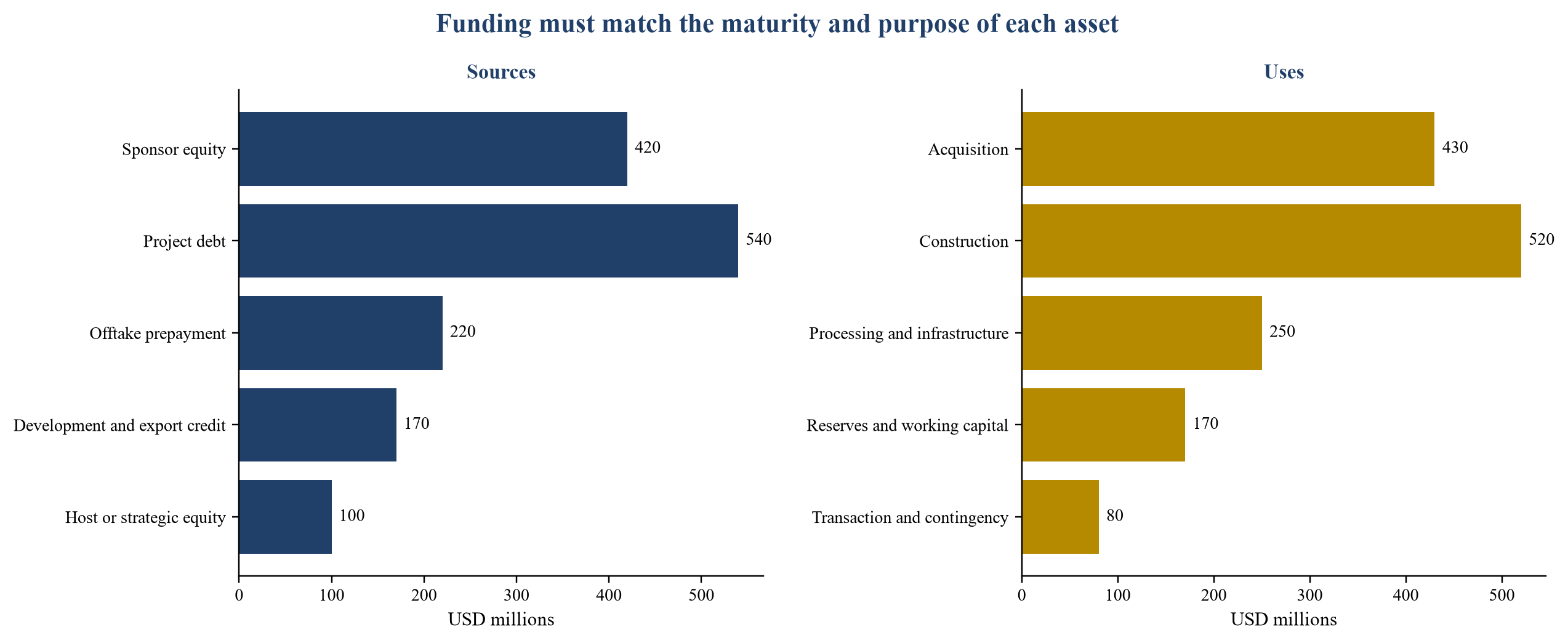
Every amount is a hypothetical management assumption in USD millions and does not represent an actual transaction or financing offer.
17. Test completion rather than budget only
Construction review should connect scope, quantities, contracts, interfaces, schedule, critical path, contingency, commissioning and ramp-up. A budget can be fully funded and still omit a water line, grid upgrade, tailings facility, owner cost or working-capital requirement. The review should reconcile physical progress, incurred cost, committed cost, forecast cost and remaining contingency.
Completion should have technical, operating and financial definitions. Mechanical completion does not establish nameplate performance or qualified product. Debt completion may require output, recovery, cost, environmental and reliability tests over a defined period. The sponsor-support package should state funding, expiry and release conditions.
The acquisition or investment agreement should allocate pre-closing delay and cost. Conditions precedent, longstop dates, escrow, guarantees, price adjustment and termination rights should align with the completion plan. Capital release should stop when the updated forecast exceeds approved capacity without a funded remedy.
18. Model ramp-up as a distribution
Ramp-up risk arises from commissioning, feed variability, recovery, maintenance, workforce, supply chain and customer qualification. A single smooth curve can overstate early cash. The model should include a central profile, a slower profile, a lower-recovery profile and a combined case. It should show monthly production, quality, operating cost, working capital and covenant headroom.
Operating readiness should cover organisation, training, maintenance, spares, laboratories, safety, environmental monitoring, systems and procedures. The project should demonstrate who controls the process and how vendor knowledge transfers to the operator. Critical technical personnel and technology licences require continuity protection.
Debt amortisation and prepayment deliveries should follow achievable output. Grace periods can protect liquidity and increase accumulated obligations. Reserve accounts can absorb short disruption and should not replace a credible ramp-up plan.
19. Underwrite price and cost together
Commodity prices, treatment charges, freight, reagents, power and labour can move together or in opposite directions. The model should test margin rather than price alone. A lower mineral price may coincide with weaker currencies and lower local costs. It may also coincide with rigid contracts, inflation and higher financing cost.
The cost curve should be built from physical inputs and contract terms. It should distinguish fixed and variable cost, sustaining capital, royalties, taxes, community obligations and closure funding. Benchmark cost positions should be adjusted for product quality, geography and infrastructure.
Hedging can reduce short-term price risk when instruments and liquidity exist. It can introduce collateral, basis and opportunity cost. The partnership should define hedge objectives, authority, counterparty limits and reporting. Debt capacity should not assume a hedge beyond its documented tenor.
20. Use a correlated downside
Mining risks can occur together. A construction delay can increase cost, postpone revenue, consume contingency and trigger customer or debt obligations. Lower recovery can reduce volume while raising unit cost. Water restrictions can lower throughput and require new capital. Currency weakness can support local cost and increase imported equipment or hard-currency debt.
The hypothetical central case assumes cash available for debt service of USD 184 million and annual debt service of USD 118 million, producing 1.56 times coverage. The correlated downside assumes lower realised prices, delayed ramp-up, weaker recovery, higher water and power cost, and adverse translation. Cash available for debt service falls to USD 122 million, or 1.03 times coverage. These amounts and relationships are management assumptions.
The proposed response stages remaining development capital, draws completion support, extends or reshapes prepayment delivery, preserves distributions and revises selected offtake terms. Hypothetical cash available for debt service after those actions is USD 146 million, or 1.24 times coverage. The committee should accept only remedies with authority, funding, timing and counterparty support.
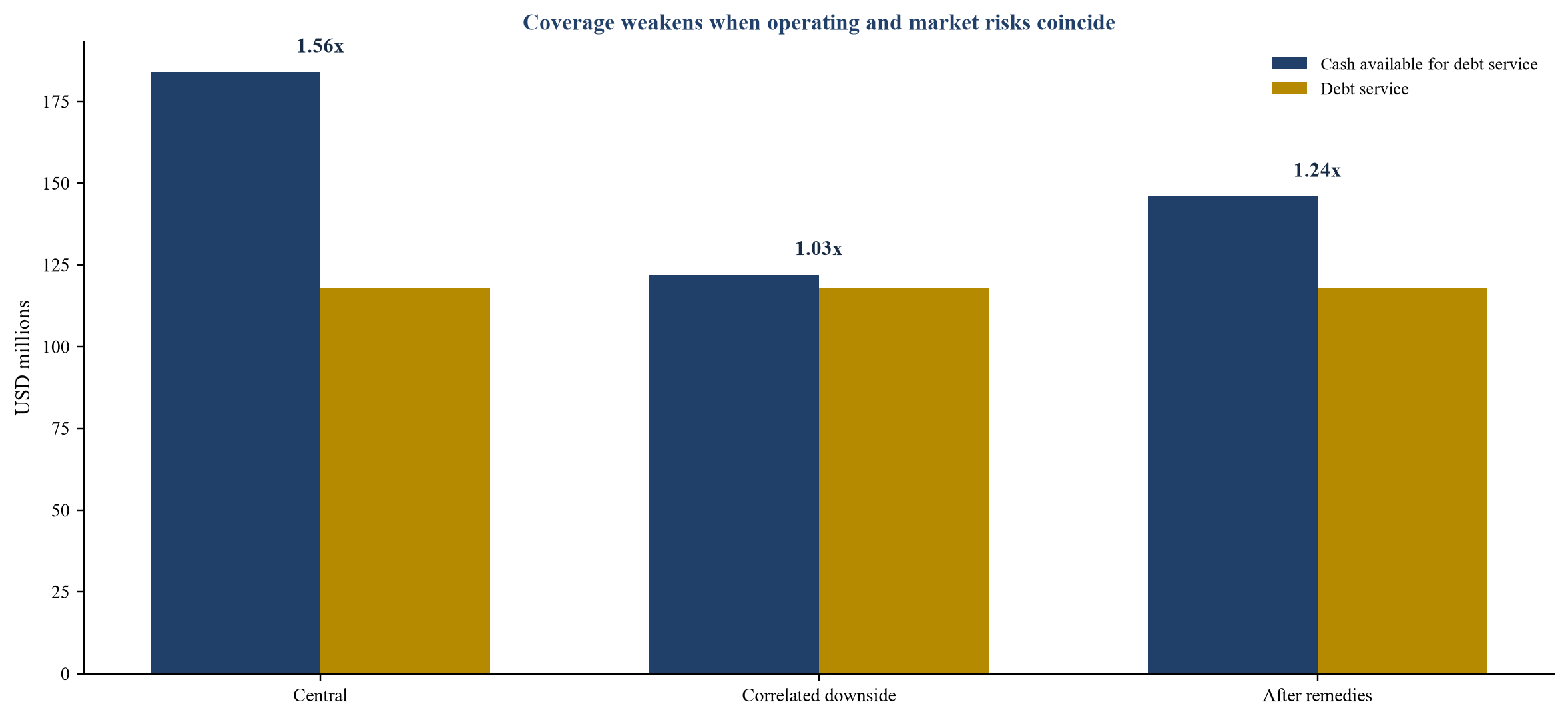
All amounts and outcomes are hypothetical management assumptions in USD millions; they are not forecasts.
21. Treat permits as an integrated critical path
Mining, processing, water, power, tailings, transport, hazardous material and closure approvals can follow different authorities and timelines. The project should maintain a permit register with legal basis, holder, scope, issue date, conditions, renewal, change-of-control effect and dependencies. It should distinguish applications, approvals and approvals that are effective after further conditions.
The construction schedule should link each activity to the relevant permit. Early works should not assume the final project can proceed. Changes in design, throughput or footprint may require amendment. A permit obtained for one entity or mine plan may not transfer automatically to the transaction perimeter.
Legal diligence should identify appeal, consultation and judicial-review risk. The model should include time and cost for conditions, monitoring and community commitments. The transaction documents should allocate pre-closing breach and incomplete transfer. Closing should not occur on a permit narrative when the project depends on enforceable approvals.
22. Integrate community evidence into valuation
Mining affects land, water, employment, cultural heritage, local business and public services. Community engagement should identify rights holders, affected groups, prior processes, commitments, grievances and benefit arrangements. It should also reconcile company records with government, community and independent evidence.
The partnership should value obligations as operating and capital commitments. Employment, procurement, infrastructure, monitoring and closure commitments can be material. Unrecorded promises create legal, social and reputational exposure. A strong engagement record can support continuity and still require improvement after expansion or change of control.
International frameworks such as the IFC Performance Standards, Equator Principles and OECD due-diligence guidance provide useful reference points [17,18,19]. They do not replace local law or site-specific work. The approval memorandum should state the applicable standard, evidence gap, action plan, budget, owner and consequence for capital release.
23. Assess tailings and waste as life-cycle liabilities
Tailings, waste rock, process residue and hazardous material require design, operation, monitoring, emergency preparedness and closure funding. The review should test facility ownership, design basis, independent assurance, downstream consequence, water balance, operating records and change management. It should identify legacy facilities and liabilities outside the current mine plan.
The Global Industry Standard on Tailings Management provides a recognised framework for consequence, governance and public disclosure [20]. Transaction diligence should verify site implementation rather than rely on a policy statement. Insurance exclusions and security requirements should be mapped to residual exposure.
Closure and rehabilitation estimates should reflect current disturbance, planned expansion, inflation, discounting and legal security. A low accounting provision can differ from the cash required under an accelerated or severe event. Valuation should deduct funded and unfunded obligations and identify the entity that bears them.
24. Make responsible sourcing traceable
Customers, lenders and regulators increasingly require evidence about origin, labour, environmental performance, sanctions and chain of custody. The partnership should define traceability from mine and batch through processing, storage, transport and customer delivery. Assay, mass balance, title and custody data should reconcile.
The OECD minerals guidance supports a risk-based approach to responsible supply chains [17]. EITI reporting can improve transparency around rights, payments and sector governance in participating countries [21]. These frameworks support diligence. They do not establish that a particular shipment or project meets a customer's standard.
Commercial contracts should specify required data, audit rights, certification, correction and rejection. Systems should protect integrity and access. Traceability investment should be tied to customer requirements and financing conditions rather than treated as a branding exercise.
25. Design technology-transfer obligations
Technology transfer can include process licences, pilot facilities, engineering, digital systems, operating procedures, training, research partnerships and local supplier development. The agreement should state the technology, owner, territory, duration, exclusivity, improvements, data rights, performance obligations and termination consequences.
A Gulf investor may seek to develop processing or manufacturing capability at home. The analysis should compare shipping ore, intermediate product or refined product against energy, water, logistics, waste, customer location and technology economics. Local value-add policy in the host country may constrain or shape exports. The optimal split should be supported by product and cash evidence.
Knowledge transfer should have milestones and measurable outputs. A licence without trained operators, data and support can be unusable. A broad cooperation memorandum without deliverables should not support strategic value.
26. Govern intellectual property and operating data
Mining and processing projects generate geological models, test work, plant data, maintenance history, environmental data, customer specifications and proprietary process information. Diligence should identify ownership, access, licences, cybersecurity, retention and change-of-control provisions. Data needed to operate, finance or sell the project should remain available after closing.
Joint ventures require rules for background and newly developed intellectual property. They should address improvements, publication, employee inventions, contractor rights and use after exit. Technology-provider restrictions can affect financing and replacement options.
The board should receive data-quality reporting. Resource, production, recovery, inventory, sales and cash should reconcile through controlled systems. Decision rights are weak when the investor cannot verify the information on which they depend.
27. Build governance around capital and product rights
The board structure should reflect ownership, expertise and host-country requirements. Reserved matters should cover budgets, mine plans, capital, financing, offtake, related parties, technology, permits, closure, material contracts, litigation, distributions and asset sales. Thresholds should recognise project size and irreversibility.
Offtake creates potential conflicts when a shareholder buys product. The contract should use transparent price formulae, quality adjustments and market review. Related-party decisions may require independent approval and information barriers. A strategic shareholder should not be able to extract product value at the expense of project solvency or minority investors.
Funding obligations should state timing, limits, dilution, default and rescue rights. Deadlock mechanisms should preserve safe operation and legal compliance. Exit rights should address transfer, competitor restrictions, product arrangements and separation of technology and data.
28. Protect cash through the project waterfall
The cash waterfall should begin with operating and statutory obligations. It should fund tax, royalties, labour, essential suppliers, environmental obligations, sustaining capital, debt service and reserves before distributions. Prepayment delivery obligations and hedge settlements should be integrated rather than modelled outside project cash.
Controlled accounts can improve discipline when collection, inventory and payment data reconcile. Cash traps should respond to coverage, reserve, construction, permit and environmental triggers. Cure rights should identify the source and form of support. Distribution tests should operate prospectively and retrospectively.
The platform model should avoid double counting cash available at project and holding-company levels. Restricted cash, minority leakage, local taxes and transfer conditions should be shown. The investor's return depends on cash that can lawfully and practically reach it.
29. Use covenants that detect technical deterioration
Financial covenants respond after technical and operating changes affect cash. The monitoring system should therefore include resource reconciliation, mine movement, grade, recovery, throughput, product quality, water, energy, tailings, safety, permits, community commitments and customer claims. Each metric should have definition, source, frequency, threshold and owner.
Early-warning triggers can require a revised mine plan, independent review, reserve increase, capital stop or distribution restriction. The response should be proportionate and executable. Too many unprioritised metrics can obscure the few indicators that drive solvency.
Lenders, strategic investors and host partners should use a common evidence pack where confidentiality allows. Reconciled data reduces argument about facts and speeds intervention. Governance should preserve independent review for material technical and environmental matters.
| Risk area | Early warning | Illustrative trigger | Proposed response |
|---|---|---|---|
| Resource and mine plan | Reconciliation variance and declining grade | Reserve or production forecast moves outside approval range | Update model, commission independent review and stage capital |
| Processing | Recovery, impurity or throughput deterioration | Qualified product or cash output falls below plan | Apply performance regime, modify flowsheet or delay expansion |
| Water and power | Higher consumption, restriction or outage | Available capacity threatens safe production | Activate reserve solution, reprioritise output and fund remediation |
| Construction | Milestone slippage and contingency use | Completion forecast exceeds approved longstop or budget | Draw support, enforce security and revise scope or sequence |
| Market and offtake | Price, buyer, assay or delivery dispute | Uncovered volume or receivable exceeds limit | Recontract, increase security and retain liquidity |
| Community and environment | Grievance escalation or missed commitment | Material permit or operating continuity is at risk | Escalate governance, fund action plan and pause affected work |
| Liquidity | Reserve draw and delayed collections | Coverage or headroom falls below threshold | Stop distributions, use funded cure and revise debt schedule |
Thresholds are proposed controls and must be calibrated to the actual project and financing documents.
30. Plan integration around safe operations
The first integration objective is safe and lawful continuity. Mine control, processing, maintenance, laboratories, environmental monitoring, community interface, payroll, banking, procurement, logistics and customer delivery should operate through closing. Day-one changes should focus on authority, cash, compliance, incidents and information.
Value initiatives can follow a verified baseline. Opportunities may include procurement, maintenance, recovery improvement, energy optimisation, refinancing, product mix, logistics, customer diversification and downstream development. Each initiative needs baseline, owner, capital, timetable, technical dependency and cash measure. Benefits should enter the investment case only when evidence supports them.
The Gulf partner may contribute capital-markets access, trading, infrastructure, industrial demand and long-term governance. Local partners contribute rights, technical teams, regulatory knowledge and community relationships. The operating model should define how these capabilities work together without weakening site accountability.
31. Prepare an executable exit and continuation plan
Exit can occur through strategic sale, sale to an infrastructure or mining fund, public markets, partner buyout or continuation ownership. Each route values a different mix of production, reserve life, growth, product contracts, operating capability and downstream options. The transaction should preserve more than one credible route.
Offtake, shareholder and technology agreements can constrain exit. Change-of-control consent, product rights, pre-emption, debt repayment and licence termination should be understood before entry. A partnership that cannot separate its assets, product and technology may have a narrower buyer universe.
Exit readiness requires audited financials, reconciled technical reporting, clean title, compliant permits, current closure provision, transferable contracts and an organised data room. The hold case should be credible so the investor does not depend on a favourable market window.
32. Sequence implementation through evidence gates
Days 1 to 30 should confirm the strategic objective, mineral and product mandate, country limits and origination pipeline. Days 31 to 60 should screen tenure, resource, metallurgy, water, energy, logistics, permits and community evidence. Days 61 to 90 should build product, market, capital and structure options for the surviving assets.
Days 91 to 120 should complete priority technical, legal, environmental, tax and commercial diligence and obtain lender, customer and insurer feedback. Days 121 to 150 should negotiate contribution values, governance, offtake, funding, conditions, remedies and integration. Days 151 to 180 should complete approval, signing or controlled closing readiness.
The timetable does not override consultation, permitting or technical work. It sequences responsibilities and evidence. The committee should receive a stop, stage or proceed recommendation at each gate.
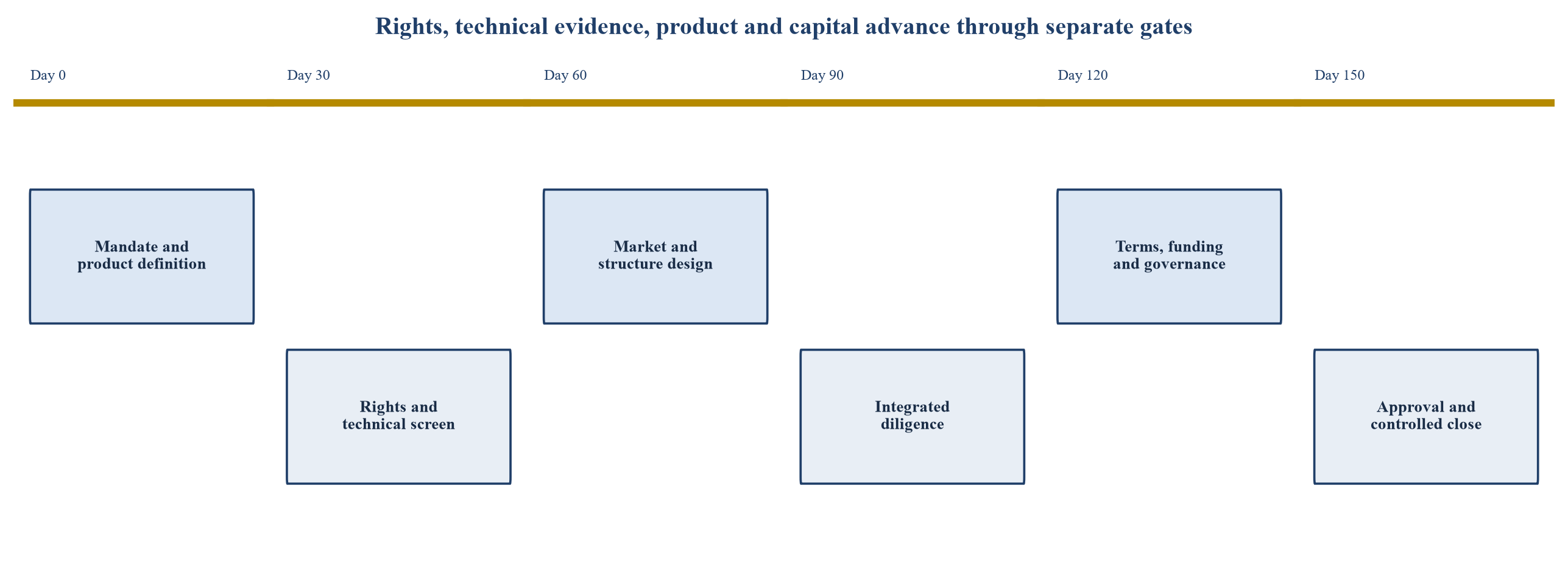
The roadmap is illustrative and must be adapted to the assets, jurisdictions and regulatory timetables.
33. Use an approval memorandum that can reject the deal
The approval memorandum should state the strategic objective, product rights, transaction perimeter, contributions, price, funding, governance and exit. It should reconcile every asset to tenure, resource, reserve, metallurgy, infrastructure, permit, community, customer and cash evidence. Observed facts, specialist opinions and management assumptions should be distinguished in normal reader-friendly prose.
The committee should receive the asset register, technical report, permit matrix, water and power plans, product and offtake matrix, resource and reserve bridge, capital schedule, valuation, sources and uses, tax and legal structure, environmental and social plan, downside, completion support, governance and implementation roadmap. Every unresolved matter needs an owner, deadline, budget and decision consequence.
Capital should stop when the partnership lacks lawful rights, representative technical evidence, a viable processing route, water or power, a permitted path, product qualification, funded completion, accountable governance or a downside remedy. A critical-minerals partnership creates value when it converts verified mineral rights into qualified product, collected cash and durable strategic options.
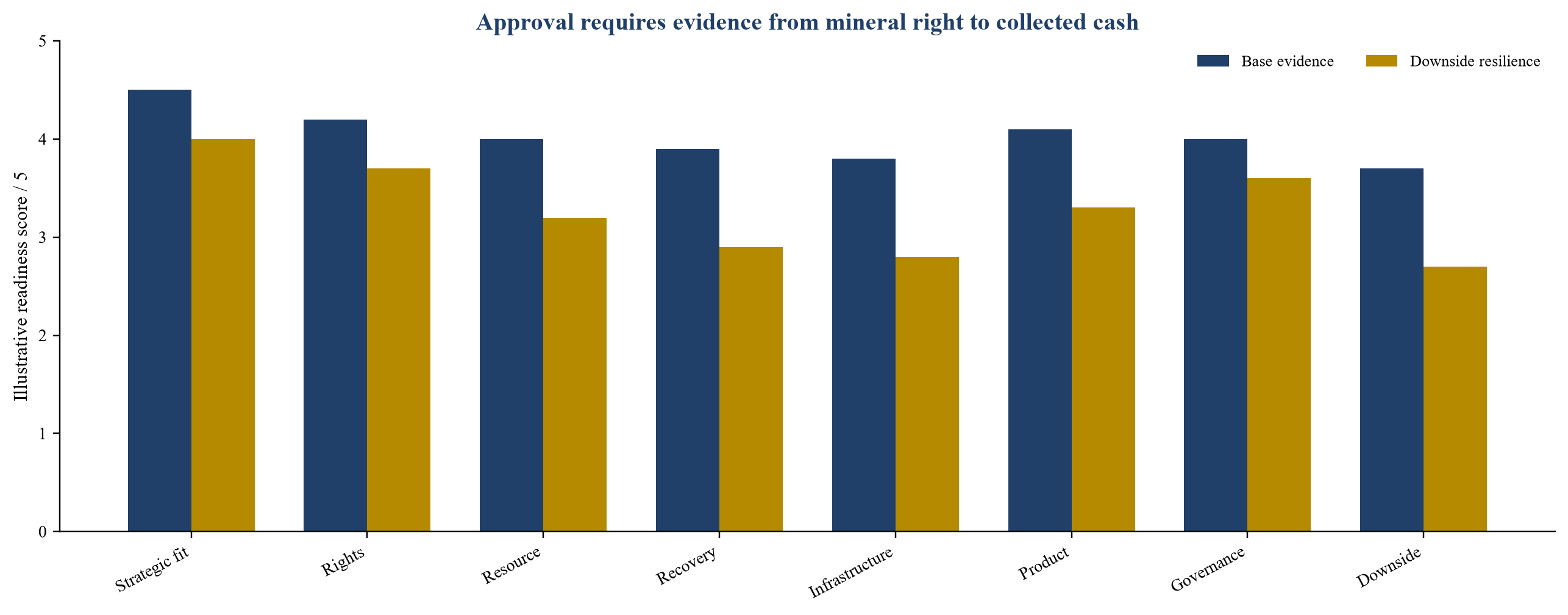
Scores are illustrative management assumptions and require transaction-specific evidence.
| Approval area | Evidence required | Decision |
|---|---|---|
| Mandate and structure | Product, countries, stages, capital, contribution values and instrument rights | Confirm strategic fit and transaction route |
| Mineral and process | Tenure, resource, reserve, mine plan, metallurgy, recovery and product | Include, condition, stage or exclude each asset |
| Infrastructure and permits | Water, power, logistics, land, approvals, tailings and closure | Confirm executable operating path and funded obligations |
| Market and cash | Qualification, offtake, price, cost, tax, currency and cash mobility | Approve revenue, funding and distribution case |
| Responsible investment | Community, labour, environment, traceability and grievance evidence | Accept, mitigate, stage or decline material impacts |
| Governance and resilience | Board rights, related parties, reporting, completion, liquidity, downside and exit | Approve controlled signing or close |
The checklist supports governance and does not replace specialist advice.
Sources
- International Energy Agency, Global Critical Minerals Outlook 2026: Latin America. Read the primary source
- International Energy Agency, Global Critical Minerals Outlook 2025: Overview of Outlook for Key Minerals. Read the primary source
- International Energy Agency, Global Critical Minerals Outlook 2026: Market Overview. Read the primary source
- Inter-American Development Bank, 2026 Latin American and Caribbean Macroeconomic Report. Read the primary source
- Brazil Ministry of Mines and Energy, Foreign Investor Guide for Critical Minerals 2026. Read the primary source
- Geological Survey of Brazil, Critical and Strategic Mineral Potential of Brazil 2025. Read the primary source
- BNDES, Strategic Minerals Investment Fund Manager Selection, updated 22 July 2025. Read the primary source
- BNDES and Finep, Strategic Minerals Business Plans Selected for Support, 12 June 2025. Read the primary source
- Chile Ministry of Mining, National Critical Minerals Strategy 2026. Read the primary source
- Codelco, Codelco and SQM Form NovaAndino Litio, 27 December 2025. Read the primary source
- Codelco, Rio Tinto Selected as Partner for Maricunga Lithium Project, 19 May 2025. Read the primary source
- Argentina Ministry of Economy, Resolution 735/2025 Approving Rincon Mining under RIGI. Read the primary source
- Argentina Ministry of Economy, Official RIGI Project Information Portal, 2026. Read the primary source
- Peru Ministry of Energy and Mines, Mining Investment Portfolio, April 2025. Read the primary source
- Public Investment Fund, Manara Minerals Partners with Vale Base Metals, 2023. Read the primary source
- Public Investment Fund, International Bond Programme Offering Circular 2025. Read the primary source
- OECD, Due Diligence Guidance for Responsible Supply Chains of Minerals from Conflict-Affected and High-Risk Areas. Read the primary source
- International Finance Corporation, Performance Standards on Environmental and Social Sustainability. Read the primary source
- Equator Principles Association, The Equator Principles EP4. Read the primary source
- Global Industry Standard on Tailings Management. Read the primary source
- Extractive Industries Transparency Initiative, EITI Standard 2023. Read the primary source
- UN Trade and Development, World Investment Report 2025. Read the primary source
- World Bank, Climate-Smart Mining Initiative. Read the primary source
- United States Geological Survey, Mineral Commodity Summaries 2026. Read the primary source
